

Most Dubai companies do not choose an auditor first. They discover, usually at licence renewal or when a bank asks for accounts, that someone upstream wants a signed audit report. This guide explains who actually requires one, what each authority expects, and how to pick from the audit firms Dubai regulators and lenders will accept.
Nobody sets up a Dubai company dreaming about audits. Then a free zone renewal, a bank officer or an investor’s lawyer asks for signed accounts, and a deadline you never planned for appears on the calendar. It is a very ordinary surprise.
The search for audit firms dubai usually starts at that moment, and it is a stressful time to compare strangers. The trouble is that the firm you pick may not be accepted by the authority receiving the report, and nobody mentions that until the report is rejected. Skip that check and the cheapest quote can turn into the most expensive mistake. This guide starts from the other end: who is asking, which rules apply, and how to choose a firm that will actually be accepted.
Audit firms Dubai companies hire are driven by one question: who is demanding the audited accounts? For a mainland LLC it is the Commercial Companies Law, which requires an auditor elected each year. For a DMCC, JAFZA or DIFC company it is the free-zone authority, and each one accepts only auditors on its own terms. For corporate tax it is a Ministry of Finance decision that applies to all Qualifying Free Zone Persons and to taxable persons with revenue above AED 50 million.
Outside those triggers, hiring audit firms Dubai wide is a commercial choice. Lenders, investors and buyers may ask for one, and some will not, so check what they actually want before paying.
Our reading of the evidence: shortlist audit firms Dubai authorities will accept only after you know which authority receives the report, because approval lists and licence rules differ. Confirm the firm’s licence and any authority approval in writing. Then compare scope, partner involvement, independence and timetable, with fees last. Below you get the decision map, a year-end clock, a verification path, a scorecard, a worked fee logic, a readiness plan and ten FAQs.
This is a desk-research guide. We read the primary texts and authority pages named in the source list: Federal Decree-Law 41 of 2023 on the audit and accounting professions, the 2021 Commercial Companies Law text, Ministry of Finance Ministerial Decision 84 of 2025, and the published audit pages of DMCC, JAFZA, DIFC, the DFSA and Dubai Land Department. All were checked on 29 October 2026.
We did not interview audit firms, collect quotes or review any firm’s work, so we do not rank or recommend any of the audit firms Dubai regulators list, and no firm paid for inclusion. Several authority documents are dated 2019 or 2021, and we say so where it matters. Audit fees are not published officially, so we show arithmetic, not market prices. This is general information, not legal, tax or audit advice.
This page covers audits only: who needs one, who may sign it, and how to choose between audit firms Dubai authorities accept. If you are still deciding what to buy in the way of bookkeeping, VAT and tax filing, start with our overview of accounting services in Dubai. The day-to-day ledger work that makes an audit cheaper sits in the bookkeeping guide.
What audit firms Dubai businesses hire actually do
An audit is an independent professional’s opinion on whether your financial statements are free of material misstatement and follow the reporting framework you used, usually IFRS. It is not a tax filing, a bookkeeping service or a business health check. The auditor does not prepare your accounts, although many audit firms Dubai businesses use sell that as a separate engagement, and that overlap deserves attention later in this guide.
In practice, audit firms Dubai companies engage do four things. They plan the work around risks in your business. They test balances and transactions, for example by confirming bank balances directly with banks and checking invoices and contracts. They discuss errors and judgements with management. And they issue a signed report, normally with a summary sheet or a similar submission form when a free zone requires one.
The opinion can come in different shapes. An unmodified (clean) opinion says the statements give a true and fair view. A qualified opinion flags a specific problem. An adverse opinion says the statements are materially wrong, and a disclaimer says the auditor could not gather enough evidence. Authorities and banks treat these differently, and a modified report is likely to draw follow-up questions from a free zone or a lender.
Audit, review, compilation and tax audit are different products
People type audit firms dubai into a search bar and then buy the wrong product, or the right product with the wrong label. Four terms cause most of the confusion.
- An audit gives reasonable assurance, the highest level, and ends in a formal opinion.
- A review gives limited assurance: inquiries and analytical checks, no deep testing. It is cheaper, and many authorities do not accept it where an audit is required.
- A compilation is the accountant assembling statements from your records with no assurance at all.
- A tax audit is something the tax authority does to you, an examination of your returns. It is not the same as hiring audit firms Dubai regulators recognise for your statutory accounts.
Internal audit is a fifth term. It is a function inside or outsourced to a company that tests controls for management, and it produces no opinion for outsiders. Some large groups need it, most small businesses do not, and it is not what any Dubai authority wants from the audit firms Dubai companies appoint for statutory reports. If your question is about FTA reviews of returns, the VAT side is covered in our guide to VAT for Dubai businesses.
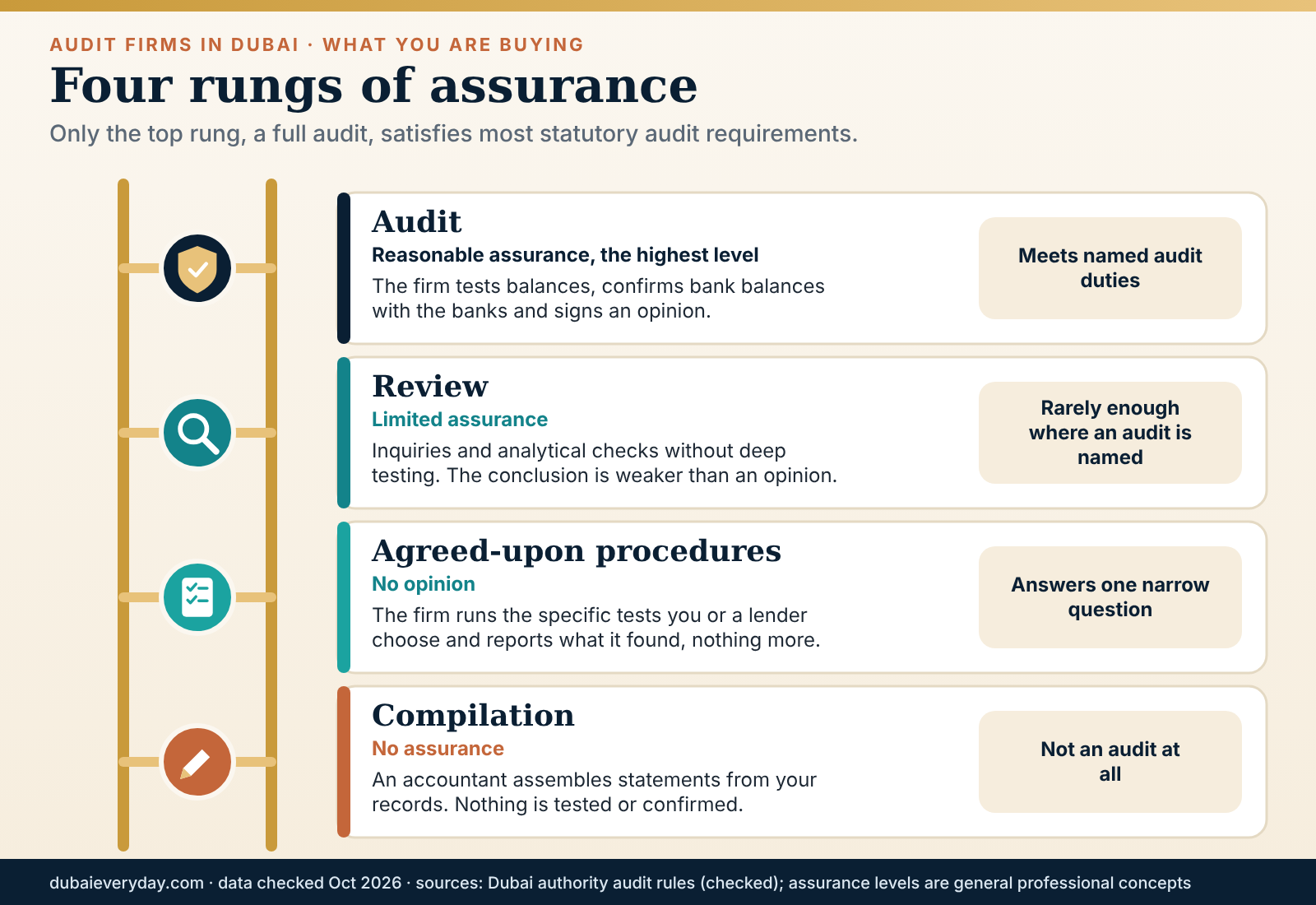
Our rule of thumb when comparing audit firms Dubai wide: if a document asks for audited financial statements, nothing below the top rung of that ladder will do. If a lender or investor only says “financial statements”, ask which level they accept before commissioning anything.
Who needs an audit: the decision map
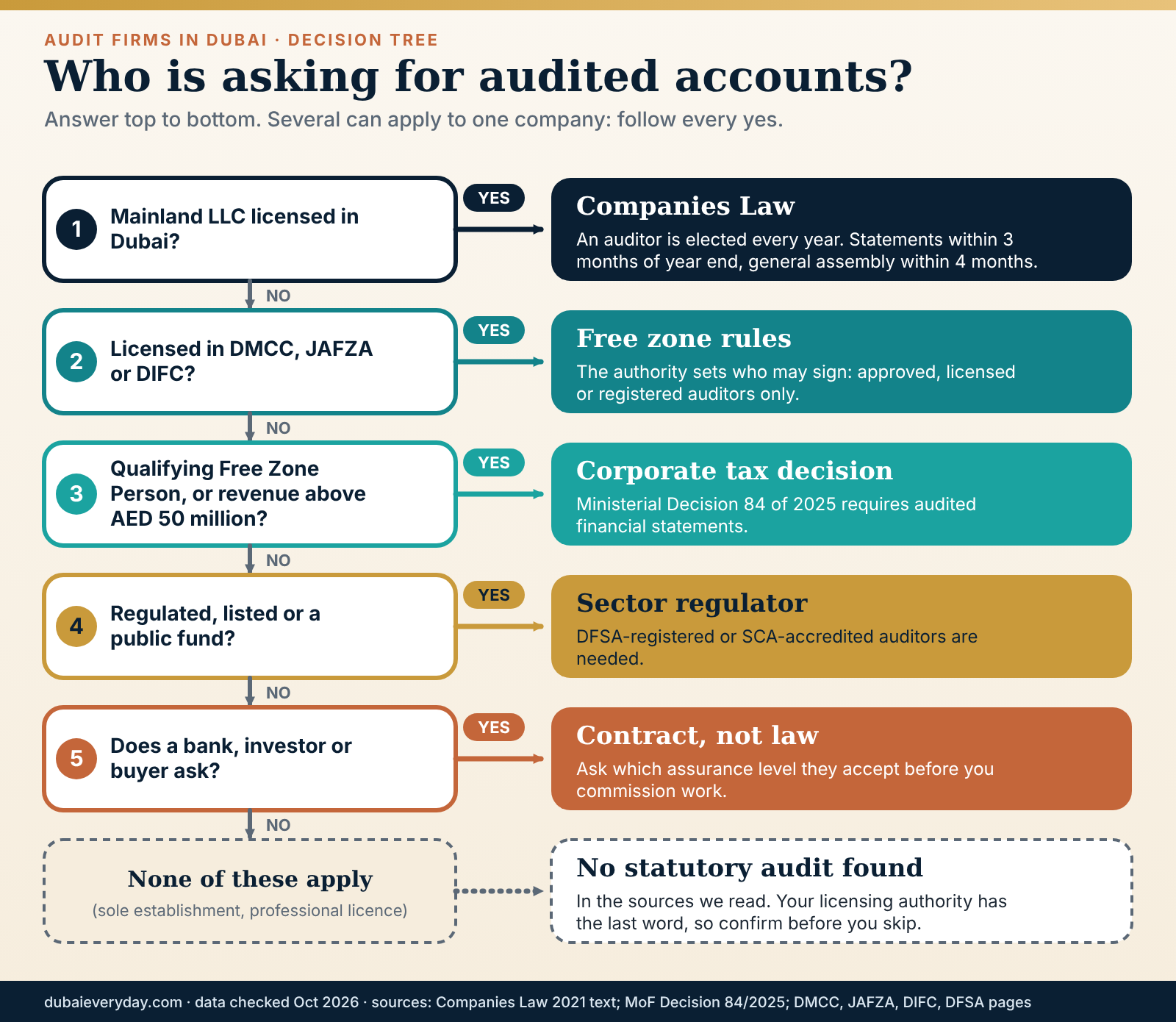
There is no single Dubai audit law. Requirements stack from several sources: the federal company law for mainland LLCs, the rules of each free zone, a federal tax decision, sector regulators, and private contracts. A business can be caught by more than one. A DMCC company that qualifies for the 0% free zone corporate tax rate, for example, has a free zone audit duty and a tax-side audit duty at the same time, and one report can often serve both if the auditor is acceptable to each.
Work through the questions in the order below before you contact any audit firms Dubai has to offer. The first yes usually tells you which authority’s rules matter most, and the infographic after the table puts the same logic into a tree.
| Your situation | Audit required? | Where the rule comes from | Who to ask |
|---|---|---|---|
| Mainland LLC licensed in Dubai | Yes, an auditor is elected every year | Commercial Companies Law (Arts. 27, 102 in the 2021 text) | Your licensing authority and a licensed auditor |
| Sole establishment or individual professional licence | No general rule found in the sources we read | Company law applies to companies; confirm for your licence type | DET, your licensing authority |
| DMCC company | Yes, audited accounts each year | DMCC Company Regulations; Approved Auditor Rules | DMCC Approved Auditor list |
| JAFZA FZE or FZCO | Yes, an updated audit report each year | JAFZA audit report submission guide | JAFZA, via Dubai Trade |
| DIFC entity needing audited accounts | Yes, with a Registrar-registered auditor | DIFC Registrar of Companies | DIFC list of registered auditors |
| DFSA-regulated firm, listed company or domestic fund | Yes, with a DFSA-registered auditor | DFSA auditor registration regime | DFSA Public Register |
| Other Dubai free zones (Airport Freezone, Silicon Oasis, Meydan, IFZA and so on) | Not checked for this guide | Each authority sets its own rule | Your free zone authority |
| Qualifying Free Zone Person (corporate tax) | Yes | Ministerial Decision 84 of 2025, Art. 2(1)(b) | Your tax adviser, FTA guidance |
| Any taxable person with revenue above AED 50 million | Yes | Ministerial Decision 84 of 2025, Art. 2(1)(a) | Your tax adviser, FTA guidance |
| Public joint-stock company or public investment fund | Yes, with an SCA-accredited firm | Federal Decree-Law 41 of 2023, Art. 15(1) | Securities and Commodities Authority |
| Jointly owned property service-charge budgets | Audit review by accredited offices | Law No. 6 of 2019; RERA arrangements | RERA, Dubai Land Department |
| Bank loan, investor round, sale of the business | Only if the counterparty asks | Contract or credit policy | The bank, investor or buyer |
Two cautions on that table. First, it is a map, not advice on your case: licence type, ownership and group structure change answers. Second, the free zone rows reflect the authority pages we read on 29 October 2026, some of which carry 2019 dates. Check the current version with the authority before you sign an engagement letter with one of the audit firms Dubai free zones approve.
When nobody requires an audit
Plenty of small Dubai businesses fall into the bottom rows of the table: a consultant on a professional licence, a one-person trading establishment, a startup with no outside lender. For them, the sources we read show no general statutory audit, so hiring audit firms Dubai provides is a choice rather than a duty. That does not mean nobody will ask. Banks onboarding a corporate account, landlords of commercial space, visa-sponsoring partners and later-stage investors sometimes want assurance. Spending on an audit before anyone asks is rarely the best use of money. Better books are.
That is why our guide to accounting services treats audit as a layer that sits on top of bookkeeping, VAT and tax work, not a replacement for them. If the base layer is weak, an audit will be slow, more expensive, and more likely to end in a modified opinion.
Mainland companies and the statutory audit
The Commercial Companies Law governs companies licensed on the mainland. In the 2021 text of Federal Decree-Law 32 of 2021, every limited liability company must have one or more auditors who audit the accounts yearly (Article 27), and the partners’ general assembly elects them each year (Article 102). The same assembly sets the auditor’s pay and considers the report (Article 94). So the appointment is annual by design, not a one-off.
Two other statutory duties shape your calendar. The manager prepares the annual financial statements and an activity report within three months of the financial year end (Article 87), and the general assembly must meet at least once a year within four months of year end (Article 92). A partner can request a free copy of the last audited accounts and the auditor’s report, and the company is expected to answer within ten days (Article 27).
We read the original 2021 version of the law, as published in an international legal database. The law has since been amended, and we did not read the later versions. Treat the article numbers above as a pointer to where the duty lives, and ask your auditor or lawyer to confirm the current wording and any carve-outs for your company type.
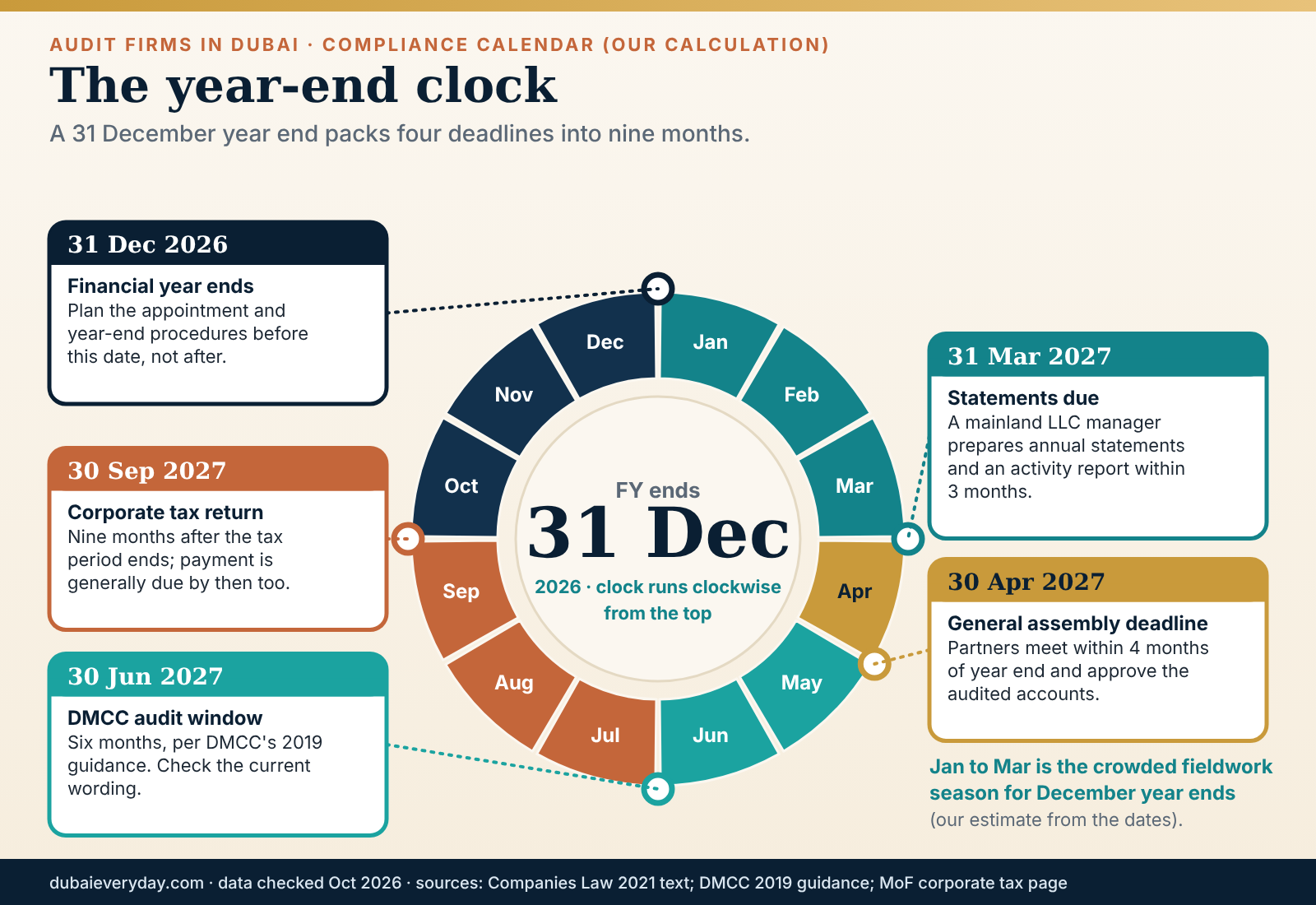
A year-end clock, worked through
Here is our calculation for a mainland LLC with a 31 December year end, using the statutory intervals above. Financial statements are due from management by 31 March, three months later. The general assembly deadline falls on 30 April. The corporate tax return, due nine months after the tax period ends, lands on 30 September. Those three dates are consistent only if the auditor can finish between roughly February and April.
That is why audit firms Dubai businesses rely on run short of slots in the first quarter. Every December-year-end company competes for the same partners at once. Companies with a different year end have a smoother calendar, which is worth considering when you set up. Our mainland company setup guide covers the licence side of that decision.
One practical point that the law does not spell out in the text we read: what the Dubai licensing authority checks, and when. We could not verify whether, or for which licence types, the Department of Economy and Tourism asks to see the audit report at renewal. Do not assume either way. Ask your licensing authority which documents it actually requires, and keep the signed report on file in any case, because banks and partners may ask for it later.
If you are weighing mainland against a free zone partly because of audit burden, remember that free zones are not audit-free. The three authorities we checked (DMCC, JAFZA and DIFC) all expect audited accounts, and the difference is who must approve your auditor. Our comparison of mainland versus free zone sets the audit point beside licensing, visas and market access.
Free zone audits: DMCC, JAFZA, DIFC and the rest
Free zone companies are not governed by the mainland company law in the same way, so their audit duties come from the zone’s own regulations. That is why one question, “do I need an audit?”, has a different answer in each place, and why the audit firms Dubai free zones accept differ from zone to zone. Below is what the authorities’ own pages say, with their dates, followed by what to do about the zones we did not check. If you are still choosing a zone, our free zone company setup guide covers licensing, visas and renewals.
DMCC: the Approved Auditor model
DMCC member companies submit audited financial statements under the Company Regulations, and the audit must come from a firm on DMCC’s Approved Auditor list. The Approved Auditor Rules we read (version 2.0, effective 1 February 2019) say a report from a non-approved auditor can be rejected and can lead to sanctions. A branch whose figures are included in group accounts audited by the parent’s group auditor is excluded, but a branch that appoints its own standalone auditor must use an approved one.
The companion guidance note (version 1.0, dated 31 January 2019) sets the rhythm. Directors prepare, approve and arrange the audit of the accounts within six months of the financial year end, and the accounts and auditor’s report are filed with the Registrar within five business days of the shareholders’ meeting that approves them. For a 31 December year end that works out, in our calculation, to a six-month window ending 30 June.
The approval criteria are the useful part for buyers, because they show what DMCC expects from audit firms Dubai members hire. The guidance note requires a UAE trade licence that permits auditing, a physical UAE location, an audit partner holding a Ministry of Economy accreditation certificate, a lead auditor with a public accounting qualification and ten years’ experience, and enough capacity to serve members. Approval lasts 12 months and must be renewed, with the application due at least 20 business days before expiry. The Rules also say DMCC monitors approved auditors by sampling submitted accounts, sending questionnaires and running investigations.
What the audit report must address is spelled out too: IFRS compliance, a true and fair view, whether the company’s activities fall within its commercial licence, and any qualification. The auditor also confirms share capital against the Articles and confirms bank balances with the banks. That “within licence” test deserves a pause. A trading company that books consultancy income may find the auditor disclosing it as non-licensed revenue. It is an awkward conversation that is much easier to have before year end than after.
Both documents are from 2019, and neither states penalties for late filing. DMCC may have updated its process since, so ask the Approved Auditor team for the current list and rules (the guidance note names an email address for applications and notifications) before relying on the dates above.
JAFZA: a licensed auditor and the Dubai Trade portal
JAFZA’s published guide for FZE and FZCO establishments says each one must give the Authority an updated audit report every year, and must pass a resolution appointing the auditor who prepares it. The report has to be issued by an auditor licensed by the Dubai economic licensing authority, which the page calls the Dubai Economic Department. The financial year covered can be no shorter than six months and no longer than eighteen.
You submit through the Dubai Trade portal under Registration, with company administrator access. Two documents are needed: a summary sheet, stamped and signed by the auditor, and the audit report, signed by the manager and carrying the company stamp. A courier then collects the originals from your registered address. The page lists a fee of AED 10 for companies inside the free zone and AED 20 for those outside, with processing of about three working days (one more for companies outside JAFZA). The page gives no calendar deadline and no penalty figure, so we have not stated either.
DIFC and the DFSA: registers instead of lists
DIFC works through registration. The Registrar’s page says a DIFC-registered entity that must have its accounts examined and reported on by an auditor has to appoint one registered with the Registrar of Companies, and it points to a public list of registered auditors, with a portal service for firms to register or update their details. The DIFC sits close to Downtown, which helps if you plan in-person meetings; our Downtown Dubai area guide covers getting around that district.
The Dubai Financial Services Authority runs a stricter regime for regulated activity. Listed companies, domestic authorised firms, authorised market institutions and domestic funds must appoint an auditor registered with the DFSA. To register, a firm must be fit and proper, carry professional indemnity insurance, have systems to comply with auditing and ethics standards, be controlled by a majority of professionally qualified people, and appoint named audit principals with at least five years of relevant audit experience in the previous seven. The DFSA keeps a public register of registered auditors and audit principals.
Free zones we did not check
Dubai has many more free zones: the airport zone, Silicon Oasis, Meydan, Dubai South, IFZA and others. We did not review their audit pages for this guide, and we are not going to guess. The sensible assumption is that each has its own rule on whether audited accounts are required, which auditors are accepted, and whether the report is filed at renewal. Ask the zone in writing, and get the answer on the same day you ask your auditor for a quote.
One line for planning: in a free zone the authority approves the auditor, not you, and the cheaper audit firms Dubai free zones have not approved cost you twice.
Corporate tax and the AED 50 million line
Corporate tax added a second audit trigger that is independent of where you are licensed. Ministerial Decision 84 of 2025, issued by the Ministry of Finance, says audited financial statements must be prepared and maintained by taxable persons whose revenue in the tax period exceeds AED 50 million, and by all Qualifying Free Zone Persons, with no revenue threshold. Tax groups must prepare audited special-purpose statements in the form the FTA specifies.
The decision applies to tax periods starting on or after 1 January 2025. It repealed Ministerial Decision 82 of 2023, which still governs tax periods that began earlier. For non-resident persons, only revenue earned through a permanent establishment or other nexus in the UAE counts toward the AED 50 million line. The decision text we read does not say who may carry out the audit, and it contains no auditor registration rules, so the practical test is whether the firm is among the audit firms Dubai authorities accept for your licence type.
Why does this matter to a founder in a free zone? A zone company that wants the 0% rate on qualifying income has to meet the Qualifying Free Zone Person conditions, and the decision then adds a yearly audited statement to the compliance load. Whether you meet those conditions is a tax question, not an audit question, and the full treatment belongs in our guide to UAE corporate tax for Dubai businesses.
Why audited accounts also help even below AED 50 million
Taxable income starts from accounting profit prepared under accepted accounting standards. If your accounts are loose, the starting number is loose, and so is the tax return. Small Business Relief, available for tax periods ending on or before 31 December 2029 for businesses with revenue up to AED 3 million, reduces the filing burden but does not remove the need for sound records. Corporate tax records are kept for seven years according to FTA guidance, which is a long time to hold a messy ledger.
The AED 50 million figure comes from a decision issued in March 2025. Tax rules in the UAE have been amended several times in the past year, so confirm the current threshold and who is caught with the FTA or a registered tax agent before you decide you are “below the line”.
Lenders, investors and buyers
Here the law is silent and the commercial reality takes over. A bank, investor or buyer asks for audited accounts when the risk justifies the cost of reading them. That depends on size, product and the counterparty’s internal policy, not on a Dubai rule. So the most useful step you can take is to ask for the exact documents list before you request quotes from any audit firms Dubai offers.
The evidence is mixed in a helpful way. One UAE bank’s published small business loan page lists a passport or national ID, a trade licence, twelve months of bank statements, constitutional documents and proof of address. It does not mention audited financial statements or management accounts. For small unsecured facilities, then, a bank may rely on account turnover and licence documents. Larger facilities, secured lending and corporate banking often add audited accounts, but we could not verify a published policy, so treat that as a general expectation to confirm, not a rule.
What investors tend to want, and why an audit is only part of it
Investors do their own diligence. An audited set of accounts reduces the time they spend on historic numbers, and a clean opinion tells them an independent professional looked at the work. It does not predict future performance, test your pricing, or replace a management accounts pack with monthly trends. For early-stage rounds, many investors care more about recent cash flow and customer data than a year-old audit.
If you expect a transaction in the next year, a sensible move is to align audit timing to it and to mention the deal date when you brief the audit firms Dubai investors may later review. An audit signed three months before due diligence is far more useful than one signed nine months after.
Buyers, landlords and partners
Selling a business, tendering for large contracts and applying for certain commercial leases can all trigger an audited accounts request. The audit does not guarantee you win, but a missing report can disqualify you from the start. If you are in tender-heavy work such as facilities management or contracting, assume a client will eventually ask and plan accordingly.
If no regulator requires the audit, buy it for a reason you can name, and first ask whether management accounts and bank statements would answer the same question for less.
Who may sign: licences, registers and the verification path
A report is only worth the licence behind the signature. Under Federal Decree-Law 41 of 2023, which replaced the 2014 auditors law, practising as an auditor requires a professional licence from the Ministry of Economy for the individual, and an economic licence from the local emirate authority for the firm, issued with the Ministry’s approval. Only licensed individuals may use the title Chartered Accountant. Unlicensed practice is a criminal offence with a minimum of three months in prison and/or a fine from AED 100,000 to AED 2 million.
That is the baseline for all audit firms Dubai wide. On top of it, each audience adds its own approval layer.
Mainland company
A Ministry of Economy licensed individual signing for a firm that holds an emirate economic licence. Ask for both and confirm them with the issuing authority.
DMCC member
The firm must be on DMCC’s Approved Auditor list, which is renewed every 12 months. A firm that was approved last year is not automatically approved today.
JAFZA FZE or FZCO
The report must come from an auditor licensed by the Dubai economic authority, with the auditor’s stamped summary sheet attached.
DIFC or DFSA
An auditor registered with the DIFC Registrar, or with the DFSA for regulated and listed entities. Both keep public lists.
Listed companies
Firms auditing public joint-stock companies or public investment funds need accreditation from the Securities and Commodities Authority.
Jointly owned property
RERA works with accredited audit offices for service-charge budgets. Dubai Land Department publishes the accredited list in its app and on its website.
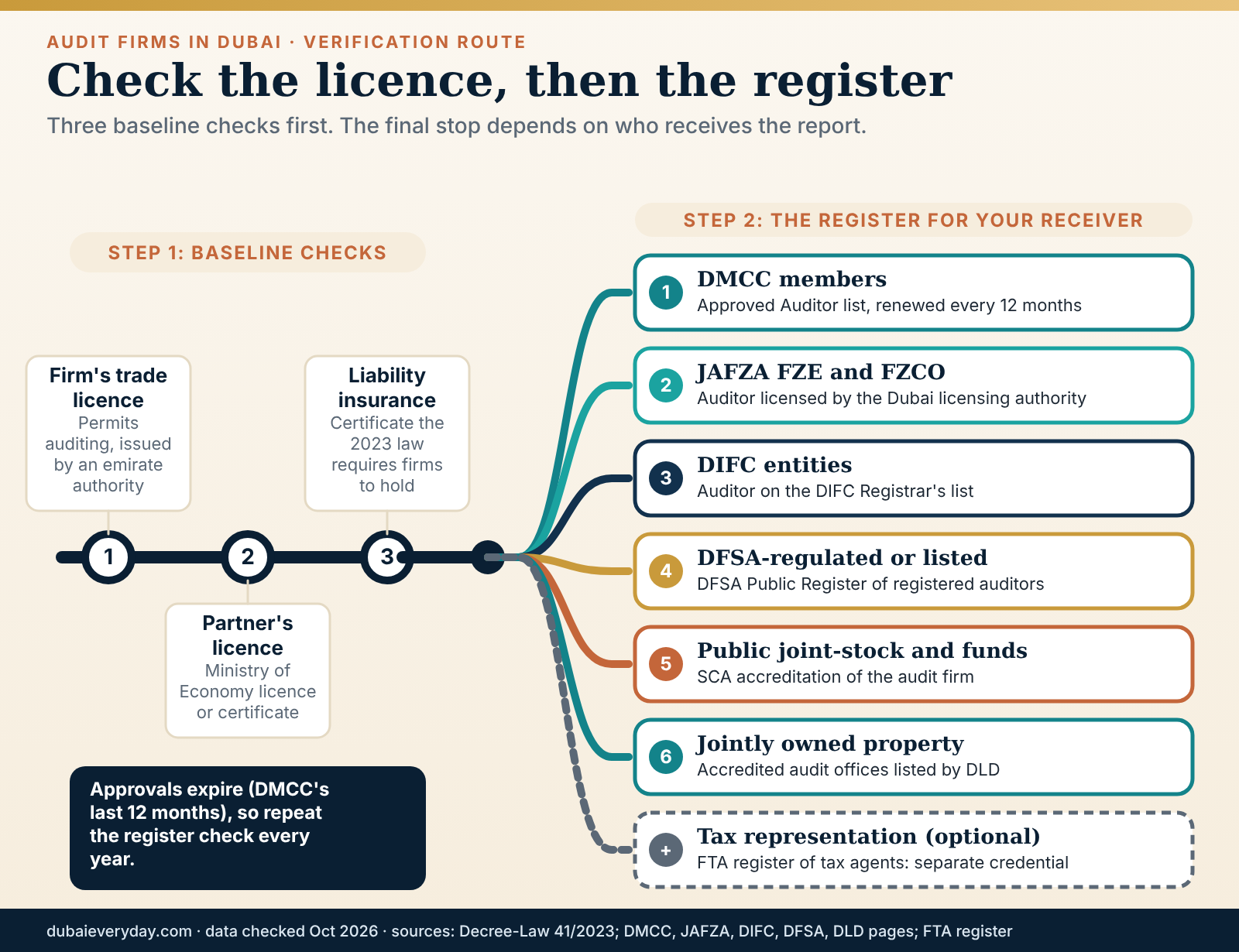
A five-step routine for checking audit firms Dubai buyers shortlist
- Ask for the licence pack. Request the firm’s trade licence, the signing partner’s Ministry of Economy licence or accreditation certificate, and the professional liability insurance certificate, which the 2023 law requires firms to carry.
- Confirm the authority list. Check the register that belongs to your receiver: the DMCC Approved Auditor list, the DIFC list, the DFSA Public Register, the RERA accredited list, or the SCA arrangement.
- Match the name on the signature. The partner who signs must be the person whose credentials you checked, not another partner at the same firm.
- Get approval in the engagement letter. Put a line in the contract saying the firm is currently approved by the receiving authority, and that the report will be issued in the format that authority requires.
- Re-check at renewal. Approvals such as DMCC’s last 12 months, so repeat the check every year, not once.
We did not find a single public register of all Ministry-licensed auditors during this research, so we are not going to point you at one. Practically, the licensing authority and the receiving authority are your two sources of truth; where one publishes a list, use it, and where it does not, ask the firm for a document and confirm it with the issuer.
Auditor, tax agent and accountant are three different credentials
An audit-firm licence does not make a firm an FTA registered tax agent. The FTA maintains its own public register of registered tax agents, which on 29 October 2026 listed 802 entries and can be filtered by emirate. Registration as a juridical person requires an audit, tax or law firm licence plus at least one linked registered tax agent who meets the FTA’s conditions. If you need a firm to represent you before the FTA as well as sign your audit, ask for both credentials separately.
Likewise, a bookkeeping or “accounting services” licence does not authorise audit signing. The mix-up is common because many firms sell all three services under one brand. That is fine, provided the right person with the right credential signs the right document. Our guide to accounting services in Dubai explains how those layers fit together.
Independence: the rule that shapes who can do what
Article 17 of the 2023 law limits what a licensed auditor can do for a client. In the text we read, the professional may not enter contracts that conflict with required independence, trade in or advise on a client’s securities, or take financial interests in or transactions with a client and its related parties (with a 30% capital threshold for affiliates). There is also a two-year restriction after working for or with an entity the professional has served. The text we read does not state a mandatory rotation period for audit firms, and neither do the DMCC rules.
The law does not spell out that a firm must not both keep your books and audit them. General professional ethics treat that as a self-review risk: the firm would be checking its own work. Some firms handle it by assigning separate teams or by declining the audit. For small companies this is a genuine trade-off, because one provider doing both can be cheaper. If you go that way, ask in writing how the firm manages the overlap, and expect a lender or investor to ask the same question.
Choosing between audit firms Dubai offers
By now the filter for audit firms Dubai buyers is mechanical. The authority that receives the report tells you which firms are eligible, and the licence check removes anyone who is not. What remains among the eligible audit firms Dubai offers is a judgement about fit. We are not ranking named firms, because we did not field-test any. A scorecard you can apply yourself is more useful.
Our scorecard, with suggested weights
The weights below are our editorial starting point, not a standard. Change them to match your situation. A company facing a bank deadline will weigh timetable more heavily, while one preparing for investment will weigh reputation and sector experience.
Eligibility and approvals (30)
Licence pack complete, receiving authority approval confirmed, insurance in place. A fail here ends the comparison.
Independence and scope (20)
No conflicting services, clear written scope, who signs, and how any bookkeeping overlap is handled.
Partner involvement (15)
How much time the signing partner spends on your file and who does the fieldwork. Ask for names and roles.
Relevant experience (15)
Prior audits of companies like yours in your activity, free zone or size band, not just brand familiarity.
Timetable and communication (10)
A dated plan, a single contact, and a stated turnaround for queries.
Fee clarity (10)
A fixed fee with defined assumptions, and a stated rate for extra work.
Notice where price sits: ten points out of a hundred. Price matters, but only among firms that have already passed eligibility and independence. A quote from one of the audit firms Dubai buyers contact that is far below the others usually means a thinner scope or a rushed file, and a report that your free zone rejects is the most expensive outcome of all.
Size tiers: what audit firms Dubai businesses actually offer
Audit firms Dubai businesses can choose from range from large international networks to mid-sized regional practices to small local partnerships. Each has a logic, and none is automatically better. Large networks bring methodology, review layers and name recognition that some banks and investors like. Their minimum engagement sizes and staffing patterns may not suit a ten-person company. Mid-sized firms often combine partner access with a broad client base across sectors. Small practices can be responsive and cheaper, but have less spare capacity in peak season and may be less familiar with complex group structures.
Match the tier to the audience for the report. A free zone filing needs an approved auditor, any size. A bank facility may name an acceptable list. A foreign parent company may require a network firm for consolidation. Ask the receiving party first, then pick.
Questions that separate audit firms Dubai buyers compare
- Which authority approvals do you hold today, and can I see the current confirmation?
- Who is the signing partner, how many hours will they spend on my file, and who will be on site or online daily?
- What do you need from me, and by when, to meet the filing deadline?
- What is in the fixed fee, and what triggers extra charges?
- Do you also keep my books or prepare my tax return, and if so how do you manage independence?
- What happens if there is a modified opinion or a dispute about a finding?
Among audit firms Dubai buyers compare, the one that answers these precisely, in writing, is usually easier to work with than one with a better pitch deck. If the answers are vague, treat that as information.
Engagement letters and switching audit firms Dubai companies already use
The engagement letter is the contract that turns a scorecard into a service. Read it as carefully as you would a lease. For audit firms Dubai regulators recognise, it should name the reporting framework (normally IFRS), the receiving authority and report format, the signing partner, the dates by which you must deliver records, the fixed fee with its assumptions, and the rate for extra work. If a free zone requires a summary sheet or a stamped form, the letter should say who prepares it.
Two protections are worth asking for. The first is a written statement that the firm holds, on the date of signing, whatever approval your receiving authority requires. The second is clarity on records: Federal Decree-Law 41 of 2023 obliges licensed firms to keep data, documents and records for at least ten years from the report date, so ask how the firm stores working papers and how you can obtain copies of reports you have paid for.
How the appointment itself works
For a mainland LLC, the appointment is a decision of the general assembly, taken each year, which also fixes the auditor’s pay. JAFZA’s guide expects a company resolution appointing the auditor for FZE and FZCO establishments. DMCC asks the member to confirm that its auditor is on the Approved Auditor list at the time of engagement or renewal. In all three cases the paperwork belongs to you, not to the firm, so keep the signed resolution in your corporate records alongside the report.
Switching: when it helps and when it hurts
Companies change auditors for sensible reasons: poor service, a fee jump, a move to a different free zone, a new parent company that wants its own network, or an independence conflict. Switching is lawful, because mainland LLC auditors are elected annually, but timing matters. A change after year end means the new firm starts without a year-end stock count or bank confirmations it could have witnessed, and a first-year audit by any new firm carries extra opening-balance work.
Professional practice normally has the incoming firm contact the outgoing one before accepting an appointment. We have not verified a UAE-specific rule on this, so ask any new candidate among audit firms Dubai wide to explain its process and what it will request from your previous auditor. Settle outstanding fees and make sure the outgoing firm is told in writing. If you plan to switch, decide before the year-end procedures, not during the busy season.
Fees and timing: what moves an audit quote
There is no official audit fee schedule in Dubai, and we found no credible public data on typical fees, so we do not publish market prices. What we can do is explain the logic. Most quotes from audit firms Dubai businesses approach are an estimate of hours multiplied by blended rates for staff grades, plus a risk and review margin. Anything that increases the hours increases the price.
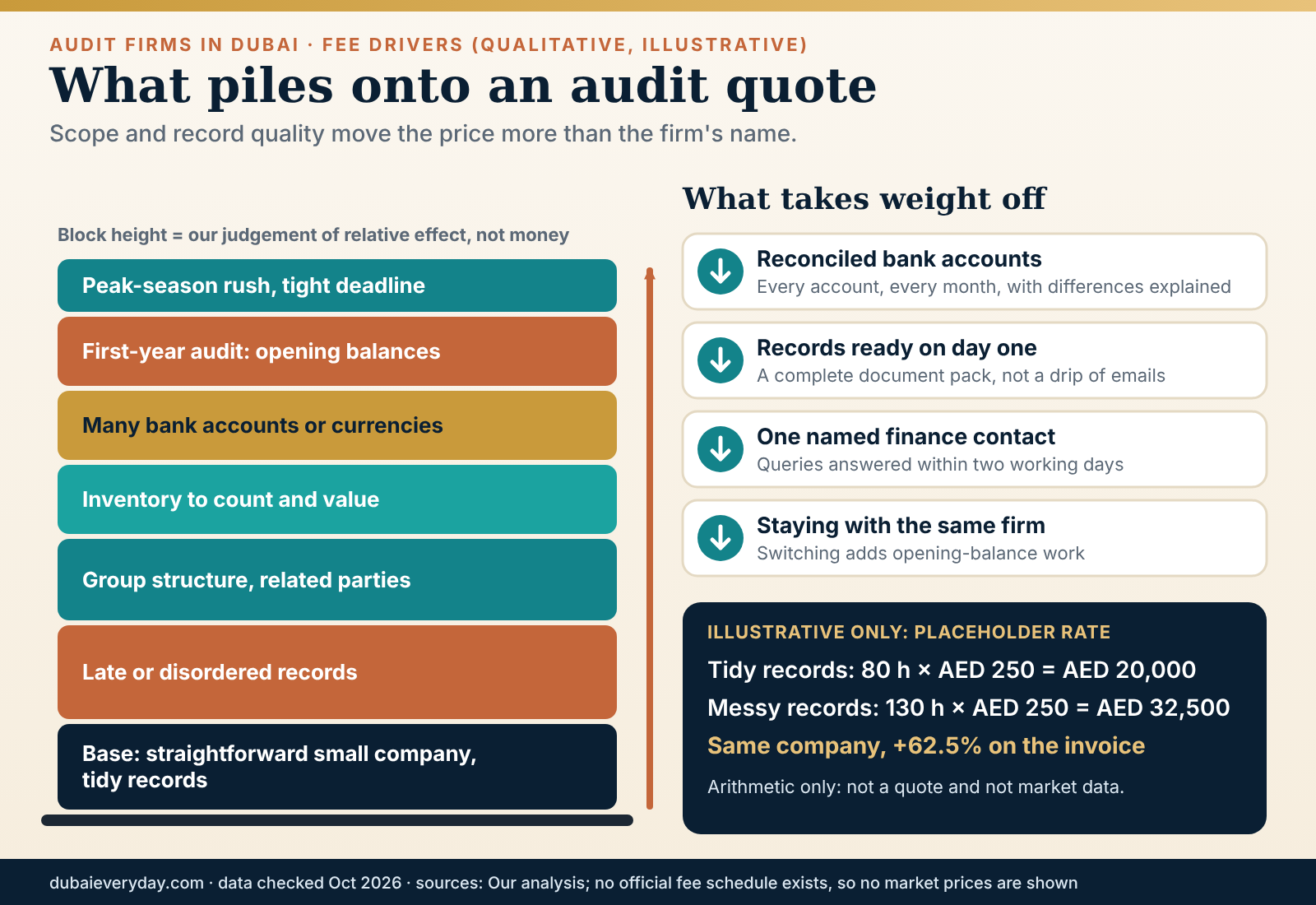
Factors that push the price up
- Late or incomplete records, unreconciled bank accounts, or a ledger that must be rebuilt first.
- High transaction volume, many bank accounts, multiple currencies or sales channels.
- Inventory, which requires a stock count and valuation testing.
- Group structures, related-party deals, or branches in several countries.
- First-year audits, which need opening balance work, and years with prior qualified opinions.
- Tight timetables during the January to April peak.
Factors that bring it down
Clean, reconciled, on-time records are the strongest lever, followed by a named finance contact who answers queries within a day, a prepared list of documents, and a repeat engagement with the same firm. Switching between audit firms Dubai offers for a small saving can erase the saving, because the incoming firm needs time to understand your business and obtain the predecessor’s information.
Illustrative example (not a quote or market fact)
To show how scope drives price, suppose a firm estimates 80 hours for a straightforward small company at a blended AED 250 an hour, which gives AED 20,000. These numbers are placeholders chosen only to show the arithmetic, not a price list. Now suppose the records arrive in disorder, bank reconciliations are missing and the team needs 130 hours. At the same placeholder rate the total is AED 32,500, an increase of 62.5% without a single change in the company’s size. Tidy books can change the invoice more than a firm’s brand can.
Ask every one of the audit firms Dubai buyers contact to state its assumptions, for example “records delivered by 15 February, bank statements reconciled, one round of queries”, and the hourly rate that applies when assumptions fail. A fixed fee without assumptions is a negotiating position, not a commitment.
Getting audit-ready
Working with audit firms Dubai wide is a collaboration with a deadline. The firm cannot start fieldwork until it has records, and it cannot finish until you answer queries. Most delays come from the client side, and most of them are predictable. This section is a plan, built from the statutory intervals above, so you can work backwards from the dates that matter.
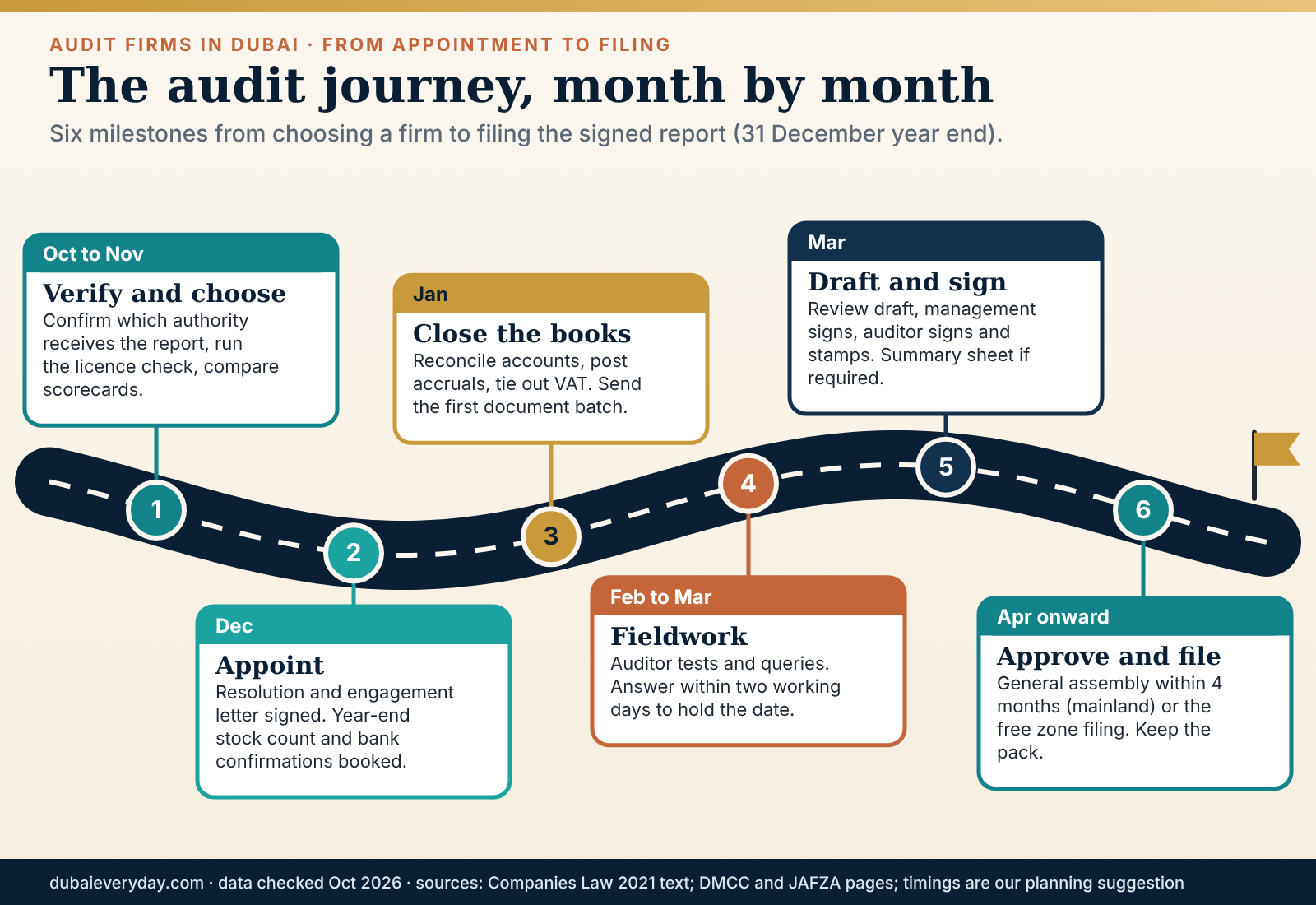
The documents every auditor asks for first
The list below is common across audit firms Dubai companies deal with. Auditors call it the “prepared by client” list, and giving them all of it on day one is the single best way to avoid a rush fee.
- Trial balance and general ledger for the full year, plus last year’s signed accounts.
- Bank statements and reconciliations for every account open at any point in the year, including closed accounts.
- Receivables and payables ageing, with notes on anything overdue by more than 90 days.
- Fixed asset register, with purchase invoices for additions.
- Inventory listing and count sheets, if you hold stock.
- Payroll records, visa and gratuity calculations, and staff loan balances.
- Loan, lease and major customer or supplier contracts.
- VAT returns and a reconciliation of VAT in the ledger to the returns filed.
- Constitutional documents, shareholder register, board minutes and a list of related parties.
If your books are weak, fix them before the audit, not during it. Our guide to bookkeeping in Dubai sets out the monthly close and bank reconciliation routine that makes this list quick to assemble.
A 90-day plan for a 31 December year end
- October to November: choose and verify.Confirm which authority receives the report, shortlist two or three eligible audit firms Dubai authorities accept, run the licence check and compare scorecards. Ask for the engagement letter draft.
- December: appoint and prepare year-end procedures.Pass the shareholder resolution appointing the auditor where your regime requires it, agree the timetable, and book any stock count and bank confirmation requests for the year-end date.
- January: close the books.Finish reconciliations, accruals, depreciation and the VAT tie-out. Send the first batch of documents.
- February to March: fieldwork and queries.Answer queries within two working days. Late replies are a common reason a March finish slips.
- March: draft, review and sign.Review the draft report and notes. Management signs, the auditor signs and stamps, and any summary sheet your authority needs is prepared.
- April onward: approve and file.Take the accounts to the general assembly within the four-month limit if you are a mainland LLC, or file within the free zone’s window, and keep the signed pack for the bank and the tax return.
For a company with a different year end, shift every month by the same number. A 30 June year end, for example, moves the statutory dates to 30 September, 31 October and, for the corporate tax return, 31 March of the following year, in our calculation from the nine-month rule.
The tax return and the audit should draw on the same final accounts. If the auditor adjusts profit after you have prepared the tax computation, you will need to redo it. That is why founders who also use a separate adviser for tax should share the draft audit adjustments early, a point the corporate tax guide returns to when it covers the accounting starting point.
Red flags with audit firms Dubai buyers meet, and costly mistakes
Many audit problems come from mismatched expectations about authority, scope or timing rather than from bad faith. Some patterns, though, deserve caution, and we list them so you can spot them before you pay a deposit.
“Approved everywhere”
None of the audit firms Dubai wide is automatically accepted by every authority. Approvals are specific and expire. Ask for the current confirmation for your receiver.
No records needed
A firm that offers to sign without seeing a ledger, bank statements or contracts is not offering an audit. Signing a report one did not prepare is itself an offence under the 2023 law.
Unnamed signer
If you cannot find out who will sign and what licence that person holds, stop. The credential belongs to a person, not a brand.
Price far below peers
It usually signals a thin scope, a junior team or extras billed later. Ask what assumptions the fee depends on.
Impossible timelines
An audit in a few days in March is unlikely to be a thorough audit. Peak season capacity is real.
Pre-agreed opinion
Anyone promising a clean opinion before seeing the records is selling a document. Opinions follow evidence.
Mistakes that cost the most
Choosing among audit firms Dubai offers before checking the receiver is the most expensive error. A company that engages a firm unknown to its free zone may need a second audit, or at least a re-issued report. The second is leaving the audit until the filing month. The third is changing the financial year end or accounting policies mid-year without telling the auditor, which can force restatement. The fourth is treating the engagement letter as boilerplate: the scope, deliverables, deadlines and fee assumptions all live there.
A fifth mistake is subtler: confusing the audit with advice. An auditor reports on your statements and may point out control weaknesses, but audit firms Dubai regulators license for assurance are not obliged to design your systems, and independence rules limit what they can do for you. If you want redesign work, scope it separately, and if it comes from the same firm, ask how they will manage the overlap.
For anything that turns on how company or tax law applies to you, a licensed professional should confirm. Our overview of Dubai legal basics for residents shows where to verify rules.
Five scenarios, five answers
These scenarios are illustrative and built from the rules above. They are not real cases, so treat them as templates for your own questions.
1. A mainland trading LLC with six staff
The company falls under the Commercial Companies Law, so the partners must elect an auditor yearly and approve audited accounts within four months of year end. The owner should ask the licensing authority which documents it wants at renewal, because we could not verify that. The practical plan is the 90-day schedule above, with an engagement letter in December and fieldwork in February.
2. A DMCC consultancy that wants the cheapest quote
The rules we read allow only DMCC Approved Auditors, so price comparison among audit firms Dubai wide starts after the approved list is applied. Anyone off the list is not a cheaper option; their report may be rejected. The owner should also ask each approved firm how it treats income outside the licensed activity, since the report must address that point.
3. A free zone company aiming for the 0% corporate tax rate
If the company qualifies as a Qualifying Free Zone Person, Ministerial Decision 84 of 2025 requires audited financial statements. The owner should coordinate with a tax adviser so the audit and the qualification analysis rest on the same numbers. Whether the company qualifies is a tax question, and our corporate tax guide explains the framework.
4. A professional-licence startup with a term sheet in six months
No statutory audit trigger appears for this licence type in the sources we read, but the investor may want audited accounts. The founder should ask what the investor’s diligence list says and whether reviewed management accounts would do. If an audit is wanted, time it before due diligence starts.
5. A resident on a building’s owners committee
Dubai Land Department announced in 2021 that RERA had agreements with 27 accredited audit offices to audit jointly owned property accounts and service-charge budgets. Counts may have changed since. A committee member should ask the management company which accredited office audited the latest budget, and check the office against the DLD list.
Audit firms Dubai FAQ: ten common questions
Is an audit mandatory for every company in Dubai?
No. In the sources we read, a mainland LLC must have an auditor elected each year under the Commercial Companies Law, DMCC, JAFZA and DIFC entities have free zone audit duties, and corporate tax adds one for Qualifying Free Zone Persons and for taxable persons above AED 50 million of revenue. Sole establishments and individual professional licences showed no general rule, though your licensing authority has the last word. Confirm your own position before you contact audit firms Dubai wide, or decide to skip an audit.
Do free zone companies need audited accounts?
Which audit firms Dubai free zones accept is set by each authority, and the three we checked do expect audited accounts: DMCC for member companies, JAFZA for FZE and FZCO establishments, and the DIFC where accounts must be audited. Each applies its own filing rules. We did not check other Dubai free zones, so ask yours in writing. The safest sequence is to get the zone’s requirements first and the auditor’s quote second.
Can any audit firm sign for my DMCC company?
Not under the Approved Auditor Rules we read, so only DMCC-listed audit firms Dubai wide can sign. Reports from a non-approved auditor can be rejected and can lead to sanctions, and approval itself lasts 12 months before renewal. Ask the firm for current confirmation that it is on DMCC’s list, and put that statement in the engagement letter. The documents we read are dated 2019, so confirm the present process with DMCC’s Approved Auditor team.
How do I check that audit firms Dubai buyers shortlist are properly licensed?
Start with the firm’s trade licence and the signing partner’s Ministry of Economy licence, then check the register that belongs to your receiving authority: DMCC’s Approved Auditor list, the DIFC list, the DFSA Public Register, or the RERA accredited list. The 2023 law also requires firms to carry professional liability insurance, so ask for the certificate. We did not find one public register that covers every licensed auditor, so confirm documents with the issuer.
How often must I change my auditor?
The texts we read set no mandatory rotation. Decree-Law 41 of 2023 has no rotation or maximum-tenure rule, and the DMCC rules do not require it. Under the Commercial Companies Law, mainland LLC auditors are elected every year, which means you can reappoint the same firm. Rules for listed companies or regulated sectors may differ, and we did not check them. For audit firms Dubai companies reappoint year after year, independence is the safeguard, not a set term.
Will a bank accept reviewed or management accounts instead of an audit?
It depends on the bank and the product. One UAE bank’s small business loan page lists twelve months of bank statements and licence documents without mentioning audited accounts, so some small facilities do not need one. Larger or secured lending often asks for audited statements, but we could not verify a published policy. Ask the bank for its checklist in writing before you commission anything, and ask which assurance level it accepts.
How long does an audit take?
Time varies with size, record quality and firm capacity, and we found no official benchmark. What is fixed is the calendar: a mainland LLC should have statements within three months of year end and a general assembly within four, while DMCC’s guidance gives six months for the audit. Work backwards from those dates and expect audit firms Dubai companies rely on to be busiest from January to April. A complete document pack on day one is the main thing you control.
Does a Qualifying Free Zone Person always need an audit?
Yes. Ministerial Decision 84 of 2025, Article 2(1)(b), requires audited financial statements for all Qualifying Free Zone Persons, with no revenue threshold, for tax periods starting on or after 1 January 2025. Whether your company is a Qualifying Free Zone Person is a separate tax question that depends on its activities and income, so take advice from a tax professional. Our corporate tax guide explains the framework in plain terms.
Can my accountant also be my auditor?
The 2023 law bars contracts that conflict with required independence, and professional ethics treat auditing your own bookkeeping as a self-review risk. Some firms use separate teams, and some decline the audit. For a small company it may be cheaper to use one provider, but you should ask in writing how the firm manages the overlap, and expect banks or investors to ask as well. Where independence is a hard requirement of the receiving authority, use separate firms.
What is the difference between audit firms Dubai wide and FTA tax agents?
An audit firm holds licences to examine and report on financial statements. An FTA registered tax agent is someone the Federal Tax Authority has registered to represent taxpayers on tax matters, and the register on 29 October 2026 listed 802 entries. A firm can be both, but the credentials are separate and need separate checks. A juridical person applying as a tax agent needs an audit, tax or law licence plus at least one linked registered agent.
How much does an audit cost in Dubai?
There is no official fee schedule and we found no credible public data, so we do not quote a market price. Quotes are built from the hours the firm expects and the grade of staff doing the work, which is why records quality, transaction volume, inventory, group structure and the January to April peak all move the price. Ask each of the audit firms Dubai offers for a fixed fee with written assumptions and a stated rate for extra work, then compare like with like.
Related reading
Sources and further reading (19 links)
- UAE Legislation portal: Federal Decree-Law 41 of 2023 on regulating the auditing and accounting professions — licensing, independence, record-keeping and penalties
- FAOLEX: Federal Decree-Law 32 of 2021 on Commercial Companies (2021 text) — LLC auditor, financial statements and general assembly articles
- Ministry of Finance: Ministerial Decision 84 of 2025 on audited financial statements — AED 50 million threshold and Qualifying Free Zone Persons
- DMCC: Approved Auditor Rules — approval, renewal and report content
- DMCC: Approved Auditors Guidance Note — approval criteria and six-month audit window
- Jafza: Audit report submission for FZE and FZCO — annual audit report, documents and portal
- DIFC: Registered and recognised auditors — Registrar auditor registration
- DFSA: Auditor registration — who must use a DFSA-registered auditor and registration criteria
- Dubai Land Department: auditing standards for jointly owned properties — accredited audit offices and independence limits
- Mashreq: Small business loan — example of a lender’s required documents list
- UAE Government portal: Corporate tax — rates and application
- Ministry of Finance: Corporate tax in the UAE — nine-month filing window and accounting profit as the starting point
- Ministry of Finance: Federal Decree-Law 47 of 2022, consolidated (unofficial English translation) — financial statements as the basis of taxable income
- Ministry of Finance: Small Business Relief extended to 2029 — relief window and AED 3 million revenue limit
- Federal Tax Authority: corporate tax record-keeping release — seven-year record retention
- Federal Tax Authority: registered tax agents — public register
- Federal Tax Authority: registration of tax agents — conditions for firms
- Ministry of Economy and Tourism: auditing and accounting legislation — list of governing laws and resolutions (Arabic)
- Dubai Department of Economy and Tourism: licences and permits — starting point for mainland licensing questions
Update log: 29 October 2026, first publication; facts checked against the sources above. Next review due by 29 April 2027, or sooner if the Companies Law, Ministerial Decision 84 of 2025, or a free zone audit rule changes. Corrections welcome. This page is general information and not legal, tax or audit advice; a licensed professional should confirm your own position.
About DubaiEveryday and this guide
DubaiEveryday.com is an independent editorial project that publishes practical, research-based guides to everyday life in Dubai: where to live, what things cost, how the rules work and how to get around. This page was written and edited by the DubaiEveryday editorial team. It is not signed by a named expert, doctor, lawyer or adviser, and we do not claim first-hand testing of a venue, clinic or service unless the page says so.
Each guide is built from official sources such as government and regulator pages, operator websites and established news outlets, cross-checked where we can. When we could not confirm something, we say so in the text, and examples that use made-up numbers are labelled as illustrations. Mentions are editorial choices, not paid placements, and a link is not an endorsement.
Dubai changes quickly. If you spot something that is out of date or wrong, please tell us through the contact options on DubaiEveryday.com and we will check it and correct the page.