

A rental dispute Dubai tenants and landlords cannot settle privately goes to the Rental Disputes Center, and the outcome usually depends on evidence, notices and fees you handle before any hearing. This guide walks through each step, with the official numbers checked on 29 October 2026.
The landlord wants a rent you cannot justify, or the deposit has quietly shrunk by AED 2,000, or an eviction notice has landed in your inbox. Your first instinct is to fire off an angry message, and that instinct is almost always the expensive one. A rental dispute Dubai residents win is rarely the loudest one. It is the one with the right paper, sent the right way, in the right order.
This guide takes you through that order. You will see which notices carry legal weight, what to keep as evidence, how the Rental Disputes Center handles a case, what the fees come to in dirhams, and the point at which paying for a lawyer is cheaper than not. It is a research-based map of the official process, not legal advice, and it tells you plainly where we could not verify something.
A rental dispute Dubai landlords and tenants cannot resolve between themselves normally ends at the Rental Disputes Center (RDC), the Dubai Land Department’s judicial arm. It has exclusive jurisdiction over landlord and tenant disputes in the emirate, free zones included, except zones that run their own courts. The usual path is simple: keep paying undisputed rent, put your objection in writing, serve any formal notice the law requires, then ask for amicable settlement or file a first-instance case online or through a Real Estate Services Trustee centre.
For eviction, renewal and similar claims the filing fee is 3.5% of annual rent, minimum AED 500, maximum AED 20,000. Money claims use 3.5% of the amount, capped at AED 15,000, plus small service fees. The lease must be registered in Ejari, every document must be in Arabic or legally translated, and judgments on claims under AED 100,000 are final apart from six narrow exceptions. That last point is why you assemble the evidence once, and completely. Get legal advice when eviction, a 12-month notice or a large sum is involved.
This is a research-based guide, not legal advice. On 29 October 2026 we read the Dubai Land Department and Rental Disputes Center service pages for amicable settlement, first-instance lawsuits, writ of payment, offer and deposit, appeal and execution; Decree No. 26 of 2013 and Law No. 26 of 2007 as amended by Law No. 33 of 2008 on the Dubai Legislation Portal; the DLD tenancy guide; and the Unified Tenancy Contract. Press explainers and law-firm blogs were used only for context and are labelled as such.
We did not file a case, attend a hearing or speak to the RDC, and a Dubai-licensed lawyer has not yet reviewed this page. Fees and procedures change, so confirm them on the live service page before paying. No law firm, broker or service is recommended here and nothing in this guide was paid for.
Rental dispute Dubai basics: what counts and what does not
People use “rental dispute” for everything from a slow repair to a notice to leave. The Rental Disputes Center treats those differently, and so should you, because the notice you need, the fee you pay and the evidence that helps all change with the type of claim. This page covers the route a rental dispute Dubai authorities will actually hear: evidence, formal notices, the RDC itself, fees, and the moment paid legal help earns its cost.
It does not re-explain your underlying rights in detail. For what the law says about rent increases, repairs, deposits and renewal, read our guide to tenant rights in Dubai. For the owner’s side, see landlord rights in Dubai. Here we assume your rental dispute Dubai case has already started and you need to know what to do next, in what order, and what it costs.
Six kinds of rental dispute, and why the label matters
Money
Unpaid rent, a deposit not returned, bounced cheques or a damage claim. Filed as a financial claim.
Possession
Eviction during or after the lease, or a tenant seeking handover or registration. A non-monetary claim.
Rent and renewal
A proposed increase, a refused renewal, or a landlord who will not take rent at the old figure.
Condition and services
Repairs, air conditioning, leaks, cut utilities or blocked access. Photos and dated messages decide it.
Paperwork
An unregistered lease or an amendment never re-registered. Many cases stall here before they begin.
Sharing and subletting
Roommates, partitions and unapproved subletting, a grey zone because subleases cannot be registered through Ejari.
Who the RDC covers, and who it does not
Decree No. 26 of 2013 gives the RDC exclusive jurisdiction over rental dispute Dubai cases between landlords and tenants of real property, including free zones, plus counterclaims and urgent applications. Since 2019 it has also handled disputes over jointly owned property, according to its website.
The decree excludes three things: free zones that run their own tribunals or courts (DIFC is the usual example), disputes arising from lease-finance contracts, and long-term leases covered by a separate Dubai law, which the decree cites as Law No. 7 of 2006. Law No. 26 of 2007 also carves out property provided rent-free to house employees. We did not verify how hotel rooms, holiday homes or serviced apartments fit, so if the let was short-term or run by a licensed operator, check that first.
The first 48 hours: keep paying, write it down
Most damage in a rental dispute Dubai residents later regret happens in the first two days, and it is usually self-inflicted. A heated message, a withheld cheque or a changed lock can turn a winnable position into a counter-claim. The better opening is dull on purpose.
Start with rent, which in almost every rental dispute Dubai landlords and tenants have is the first thing to protect. Filing a claim does not, by itself, suspend your obligation to pay. Law No. 26 of 2007 says that rent keeps accruing while an eviction claim is pending, and a recent Gulf News explainer, updated on 28 September 2026, makes the same practical point: pay what is not in dispute, on time, and object to the rest in writing. Withholding rent invites a separate arrears claim.
A calm opening checklist
- Confirm the lease is registered in Ejari and that you hold the certificate. Without registration, the RDC route is blocked under Article 4 of the tenancy law.
- Write one dated message that says what the disagreement is, what outcome you want and by when. Keep it factual and short.
- Keep paying undisputed rent through a traceable method, and keep the proof.
- Do not agree to a higher rent, new fees or changed terms in a casual reply. Law-firm commentary warns that careless renewal messages can later be read as acceptance.
- Photograph the property and save every message before anyone changes anything.
- Write the deadlines in a calendar: the 90-day, 30-day and 12-month clocks are covered in the notices section below.
What neither side should do
Self-help is the fastest way to lose a tidy rental dispute Dubai case. Under Article 34 of the tenancy law a landlord may not cut services or otherwise disturb a tenant, and the tenant may complain to the police or sue before the tribunal. Landlords with a real grievance should use the notice and claim route, which is also what makes a later eviction enforceable. Our landlord rights guide covers the legitimate options.
Tenants make the mirror-image mistake: leaving keys with a security desk, vacating without a handover record, or stopping payment because a repair is late. If a landlord simply refuses your rent, there is a lawful alternative called offer and deposit, covered in the playbooks.
Evidence that holds up at the Rental Disputes Center
Every rental dispute Dubai case is decided on documents. Everything is uploaded to its portal and archived by division, and the service pages state plainly that hard copies are not accepted. A Gulf News explainer, updated in September 2026, adds the practical warning: material you forget at filing is hard to add later. Treat your first upload as your only upload.
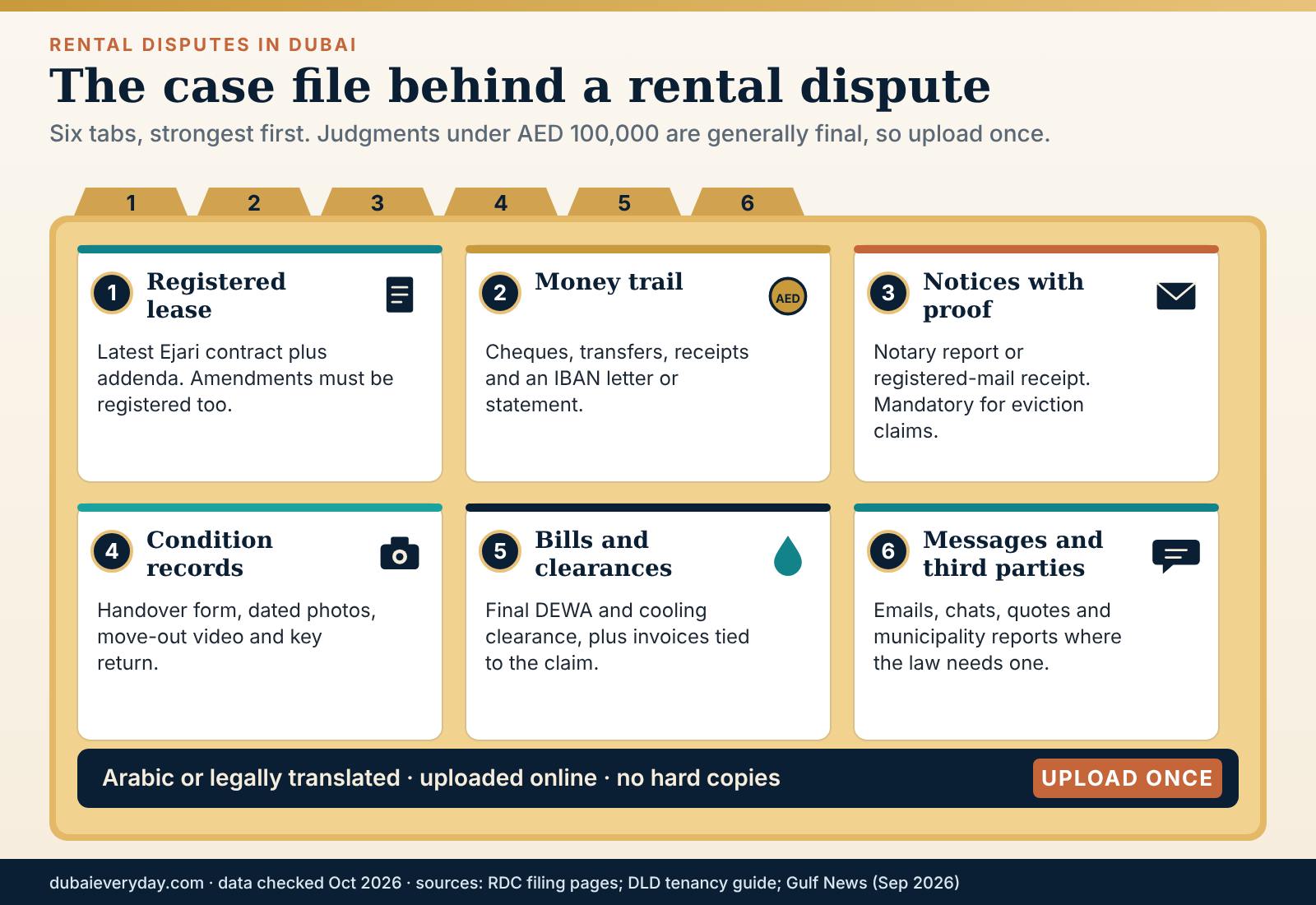
The evidence stack, strongest first
In a rental dispute Dubai evidence does not all carry the same weight. This order is our reading of the RDC’s own checklists, not a rule: documents a decision-maker can verify rank above claims either side can simply assert.
- The registered lease and every addendum. The latest Ejari tenancy contract is the first document on every RDC filing list. If terms changed mid-lease, the amendment should be registered too, because the tenancy law requires amendments to be registered, not only the original contract.
- The money trail. Cheques, bank transfers, receipts and a bank letter or statement showing the claimant’s IBAN. The IBAN document is a filing requirement for money claims, so get it early.
- Formal notices with proof they arrived. A notarised notice with the notification officer’s report, or registered post with an acknowledgment receipt. For eviction claims this is a mandatory attachment.
- Condition records. Signed handover forms, inspection reports, dated photos and video at move-in and move-out, snag lists and key-return confirmation.
- Utility and service paperwork. Final DEWA and cooling clearance, and any bills tied to the dispute. Explainers commonly cite these for deposit claims.
- Messages and third-party material. Emails and chats show what was promised and when, and support the documents above rather than replacing them. Add contractor quotes and invoices, and a Dubai Municipality technical report where the law ties a ground to one, such as a collapse risk or major restoration.
Evidence by type of dispute
The same stack is weighted differently in each kind of rental dispute Dubai parties bring. A deposit claim lives or dies on condition records and utility clearances. An arrears claim lives on the money trail and the payment demand. A rent-increase claim needs the old and proposed rent, the notice date and a dated capture of the rent calculator. A repair claim needs dated photos and your first written report. An eviction defence needs the notice, its delivery record and proof the stated ground is wrong.
Arabic, translation and format
The RDC works in Arabic. Its pages say every document must be in Arabic or legally translated, and the Gulf News explainer says English documents, including chat messages and emails, need a translation by a Ministry of Justice certified legal translator. Language also matters inside the lease. Under the Unified Tenancy Contract, if the Arabic and non-Arabic texts conflict in meaning or scope, the Arabic text prevails.
We found no verified price list for translating rental dispute Dubai paperwork, so we do not quote one. The sensible approach is to prepare a short list of the documents you actually rely on, ask for quotes, and start before you need to file.
Photos, recordings and one-page timelines
Keep original files with their metadata intact, store a second copy elsewhere, and add labels in a separate working file. Recordings are a caution: UAE privacy and cybercrime rules can be strict about recording people and sharing private content, and we did not verify the details. Ask a lawyer before secretly recording a call or posting screenshots of a dispute.
Before filing, write one page listing each event by date, with the document name beside it: lease start, payments, first complaint, each notice, each reply. It helps a conciliator or judge, and it shows gaps while there is still time to fill them.
Notices: the clocks that decide a rental dispute Dubai case
In a rental dispute Dubai law gives the word “notice” a defined meaning. As amended in 2008, the law describes it as a written notification from one party to the other, sent through a notary public, delivered by registered mail or by hand, or sent by another technological means approved by law. Several provisions go further and require a notary or registered mail specifically. The method you choose can decide whether the notice counts.
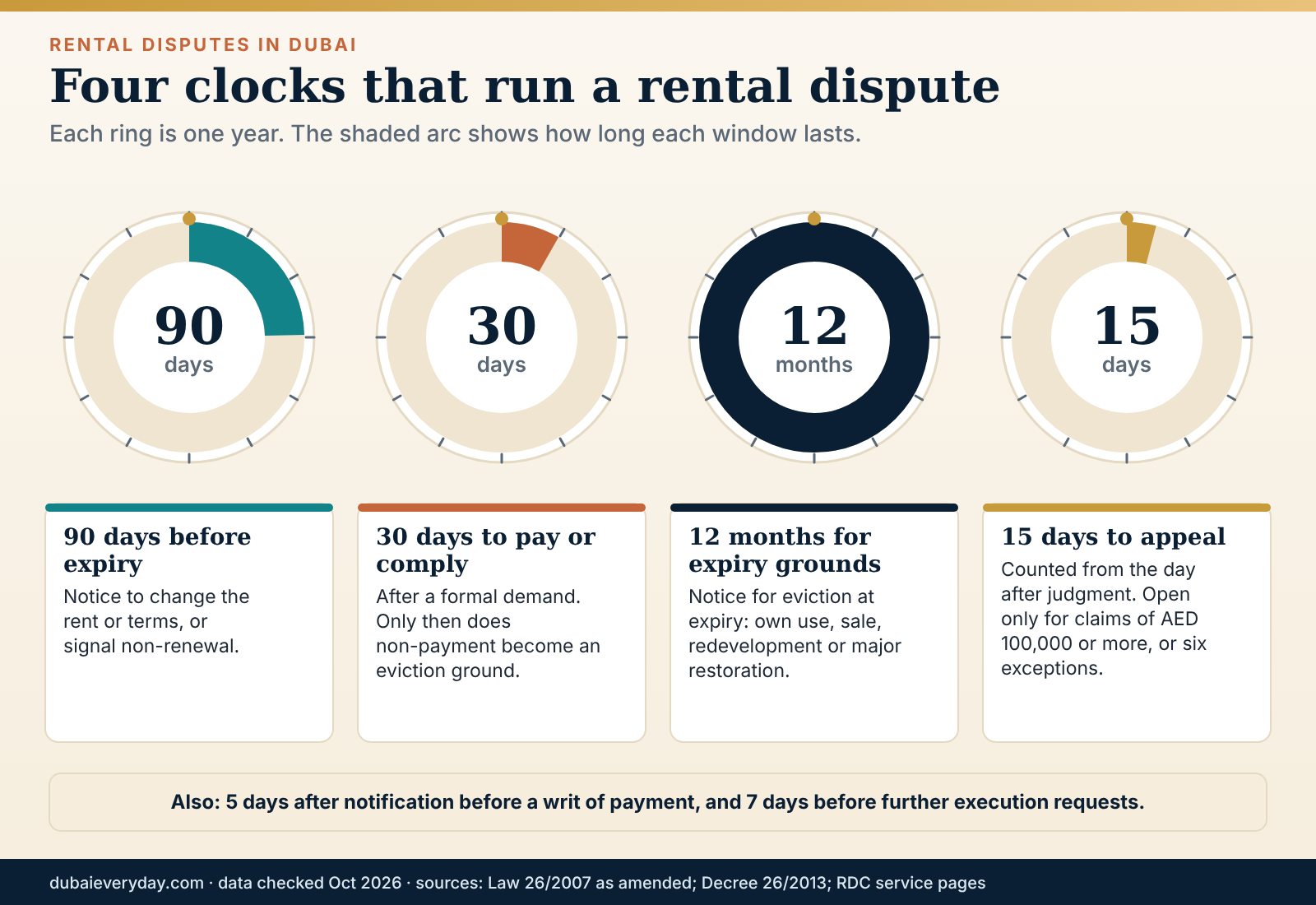
Contact details matter too. In the Unified Tenancy Contract, both parties confirm that the email addresses and phone numbers they listed are correct, and formal and legal notices for any dispute are to be sent to those details. If your contact details changed, update them in writing before a dispute starts, not after.
The notice cheat sheet
| Notice or step | Clock | How it must be sent | Where it comes from |
|---|---|---|---|
| Change terms, propose a different rent, or signal non-renewal | At least 90 days before the lease expires, unless the parties agree otherwise | The article does not name a method, so use a provable one | Law 26/2007, Art. 14 as amended |
| Payment demand before early eviction | Tenant has 30 days from the landlord’s demand to pay | Notary public or registered mail | Art. 25(1)(a) |
| Notice to comply with a lease or legal obligation | 30 days to comply | Notary public or registered mail | Art. 25(1)(h) |
| Eviction at expiry (own use, sale, redevelopment, major restoration) | At least 12 months before the eviction date | Notary public or registered mail | Art. 25(2) |
| Writ of payment for an immediately due debt | File if still unpaid 5 days after notification | Notary public or registered mail | RDC writ of payment page |
| Appeal of a first-instance judgment | 15 days from the day after judgment, or from service if you missed every hearing | Through the RDC portal | Decree 26/2013, Art. 18 |
| Further enforcement requests | After 7 days from notification of the execution file | Electronic requests | RDC execution page |
Where people get caught
The 90-day rule produces the most arguments, because the amended article gives a time limit but no method. Press explainers read it as meaning a landlord who misses the window cannot lift the rent for the renewal. That is an interpretation in secondary sources, not wording in the statute we read, so raise it as an argument rather than counting on it.
The 12-month clock is stricter and tied to specific grounds: demolition or reconstruction with permits, major restoration confirmed by a Dubai Municipality report, the owner or a first-degree relative needing the home, or a sale. A notice that names none of those, or arrives with less than a year to run, deserves a closer look. The detail sits in our landlord rights guide, and the tenant’s side is covered in our tenant rights guide. The texts speak of days and months without explaining weekends or holidays, so do not plan to the last hour.
How the Rental Disputes Center works
The Rental Disputes Center was created by Decree No. 26 of 2013 and sits inside the Dubai Land Department. It is a judicial body, not a customer-service desk, and its decisions are enforceable. That distinction is worth holding onto, because a complaint to a regulator or a call to a hotline is not the same thing as a case. A rental dispute Dubai residents want resolved, rather than just recorded, has to be registered with the RDC as a conciliation request or a lawsuit.
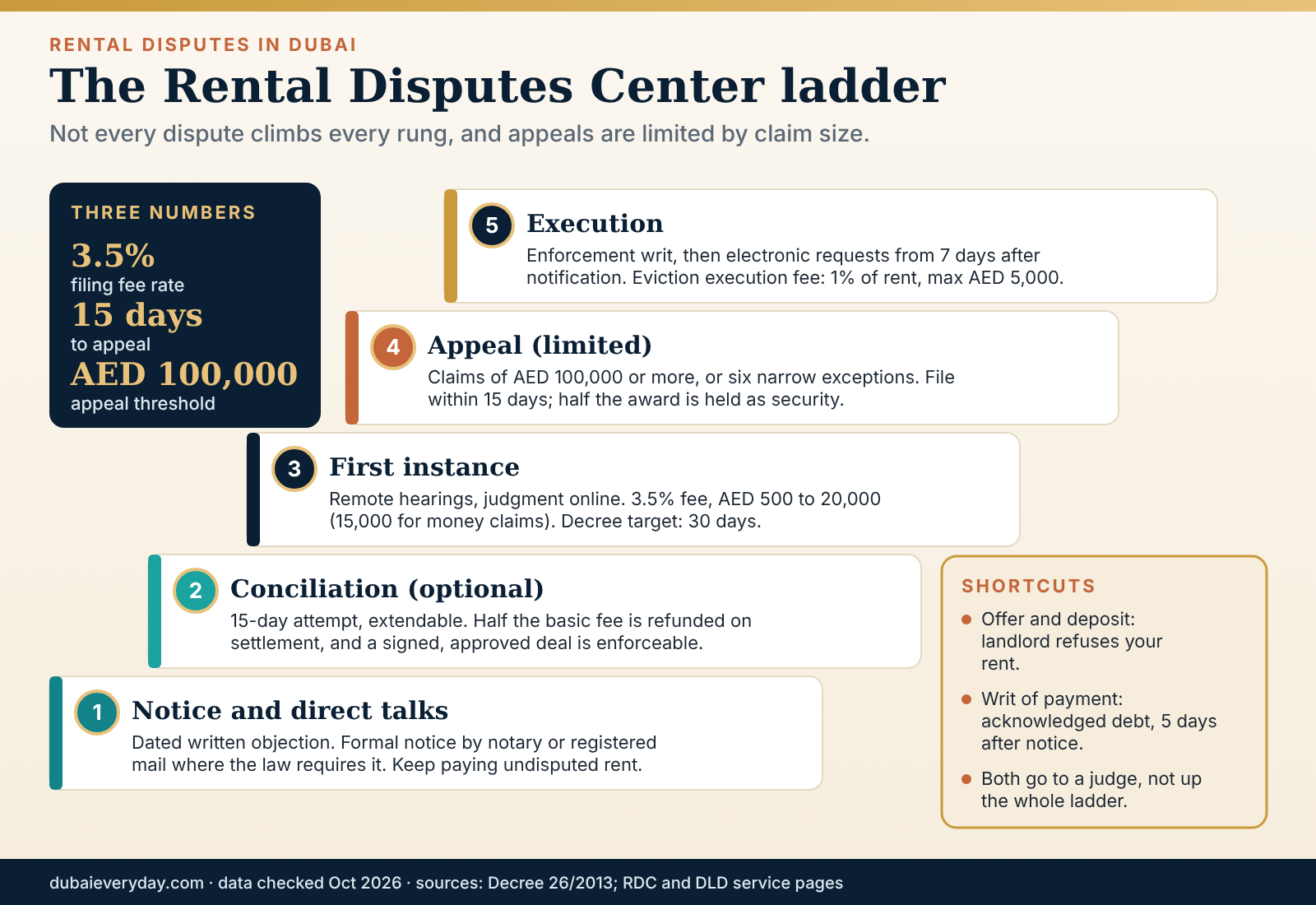
Who sits on the panel, and what you can do online
In a rental dispute Dubai first-instance hearing, the tribunal has a chair, who must be a judge, and two members who specialise in law and real property. An appellate tribunal has two judges and one member with real-estate experience. You are not arguing before a single clerk, which explains why the process leans on written evidence. The RDC’s website describes conciliation, central support and judgment execution departments; the decree uses slightly different names for the same sequence.
The portal groups its e-services into amicable settlement, lawsuits, contestations, execution, provisional and summary orders, and miscellaneous services, including “Track Your Case”, a session schedule and a request for exemption or postponement of lawsuit fees. The exemption page gave no criteria, so we cannot say who qualifies. The site is in Arabic with a translation option the RDC says covers more than 65 languages, but filings still need Arabic or legally translated documents. The Dubai Land Department’s toll-free support line is 800 4488.
How long it takes, honestly
Two clocks get confused in every rental dispute Dubai timeline. The decree says a first-instance tribunal should determine a claim within 30 days of referral, extendable. The e-service pages give about 10 minutes for registration and 8 business days for service completion on a first-instance filing, 7 for amicable settlement. The second set describes the service, not how long a contested case takes to end.
The Gulf News explainer says the RDC often rules within one or two hearings, frequently in under a month, but notices, expert evidence, referrals, appeals and enforcement can stretch that. We found no current official duration statistics; the Land Department figures we saw date from 2016 and 2017, too old to quote.
Amicable settlement: the cheaper first stop
The RDC offers conciliation as an alternative to litigation. In January 2026 Gulf News reported that Dubai had launched an enhanced version of it, in which parties settle under the supervision of a conciliator and a judge. If both sides sign, the agreement is approved by a supervising judge and is enforceable at the centre. If you can reach a deal, this is the least expensive and fastest way to turn a promise into something you can enforce, which suits many a rental dispute Dubai parties see as a gap over a number.
What it costs and how long it runs
The settlement service charges rental dispute Dubai fees on the same basis as a lawsuit, with a different refund rule. For eviction, renewal, rent claims, termination and return of the premises, the fee is 3.5% of annual rent, minimum AED 500 and maximum AED 20,000. Monetary claims are 3.5% of the amount, minimum AED 500 and maximum AED 15,000. Extras listed include knowledge and innovation fees of AED 10 each, AED 25 for power of attorney registration where used, and a fast-track notification fee of AED 105. If a settlement is reached, half of the basic court fee is refunded.
The decree sets 15 days for the settlement attempt from the parties’ first appearance, extendable by the supervising judge. It also suspends limitation periods from the date the dispute is registered with the mediation directorate. The service page states a duration of 7 business days. Payment for this service is by debit or credit card.
What conciliation cannot do, and when to skip it
The decree says the mediation directorate does not hear urgent or interim applications, so a refused rent deposit needs a different service. If no settlement is reached, the service page does not say what happens next; the decree sends unsettled claims on to the First Instance Division. Conciliation suits a rental dispute Dubai parties can reduce to a number, such as a deposit deduction or a staged move-out. It is a poor fit when the other side will not attend or a deadline is about to expire.
If you settle, draft the agreement as if a stranger must enforce it: the amount, the date, the account, what happens on a missed payment, whether Ejari is cancelled or renewed, and who returns which keys and cheques. Vague terms can reopen the dispute you just paid to close.
Filing step by step: the rental dispute Dubai process
A rental dispute Dubai claimant has two doors into the system: the RDC portal, and the Real Estate Services Trustee centres, where staff check documents, enter the case and collect payment. Either way, hearings are held through the remote litigation system and the judgment is issued online. Here is the sequence for a first-instance case, built from the RDC’s service page.
- Check registration. Confirm the lease is registered in Ejari and that the details match the claim. Registration is the legal gateway to a hearing.
- Choose the claim type. Eviction, renewal, lease registration, annulment or demolition-related claims are filed as non-monetary claims. Rent, deposit and damage claims are financial claims. The fee differs, so pick carefully.
- Serve what the law requires. For eviction, attach the legal notice and proof of delivery. For renewal claims, attach the offer and deposit receipt where there is one.
- Gather and translate documents. The list is below. Everything must be in Arabic or legally translated.
- Register. Create or log into your account on the RDC portal and select the service, or visit a trustee centre. Registration is about 10 minutes of data entry once your documents are ready.
- Upload and pay. Pay by Noqodi wallet, card or, at a trustee centre, cash. Keep the receipt.
- Attend the sessions. Hearings are remote. Use the session schedule and Track Your Case tools so you do not miss one.
- Collect the judgment online. It is issued on the website. Note the appeal clock immediately.
The first-instance document list
- The latest Ejari tenancy contract, translated.
- The applicant’s Emirates ID. For a company, the ID of the manager named on the trade licence plus the latest trade licence.
- A valid management contract, where one applies.
- A bank letter or statement showing the plaintiff’s IBAN.
- For evacuation cases, a copy of the legal notice and proof of delivery.
- If relevant: a notarised power of attorney, an heirs’ distribution decree if the lessor has died, and the offer and deposit receipt for renewals.
- Your supporting evidence: correspondence, notices, violations, utility bills, cheques or letters.
Representing yourself or using a representative
The first-instance page says applicants can be individuals or companies and can act through a legal representative, so self-filing is not barred by the page we read. A power of attorney must be notarised and the attorney’s ID supplied. Whether you can handle Arabic filings and procedure alone is covered in the legal advice section; narrower problems have faster services, covered in the playbooks.
What a rental dispute Dubai case costs: fees and worked sums
The fee structure for a rental dispute Dubai case is simple at the core and fiddly at the edges. One percentage does most of the work, a floor and a cap bound it, and a handful of small fixed fees ride on top. The arithmetic below is ours, built from the service pages we read on 29 October 2026.
The rental dispute Dubai fee stack
- Main fee, non-monetary claims (eviction, lease renewal, lease registration, annulment, demolition or rebuild): 3.5% of annual rent, or of the rental value if the term is not a year. Minimum AED 500, maximum AED 20,000.
- Main fee, financial claims: 3.5% of the claim. Minimum AED 500, maximum AED 15,000.
- Small fixed fees: a knowledge fee of AED 10 and an innovation fee of AED 10 on the services we read, plus AED 100 for advertisement or process service depending on the service page.
- Trustee centre: an extra service partner fee of AED 130, plus VAT.
- Power of attorney: AED 25 on most pages. The first-instance page words its power-of-attorney line differently, so confirm at filing.
- Offer and deposit: AED 50, plus the knowledge and innovation fees.
- Execution of an eviction: 1% of the annual lease amount, capped at AED 5,000, plus AED 100 process service, the small fees, and AED 20 for each electronic request during execution.
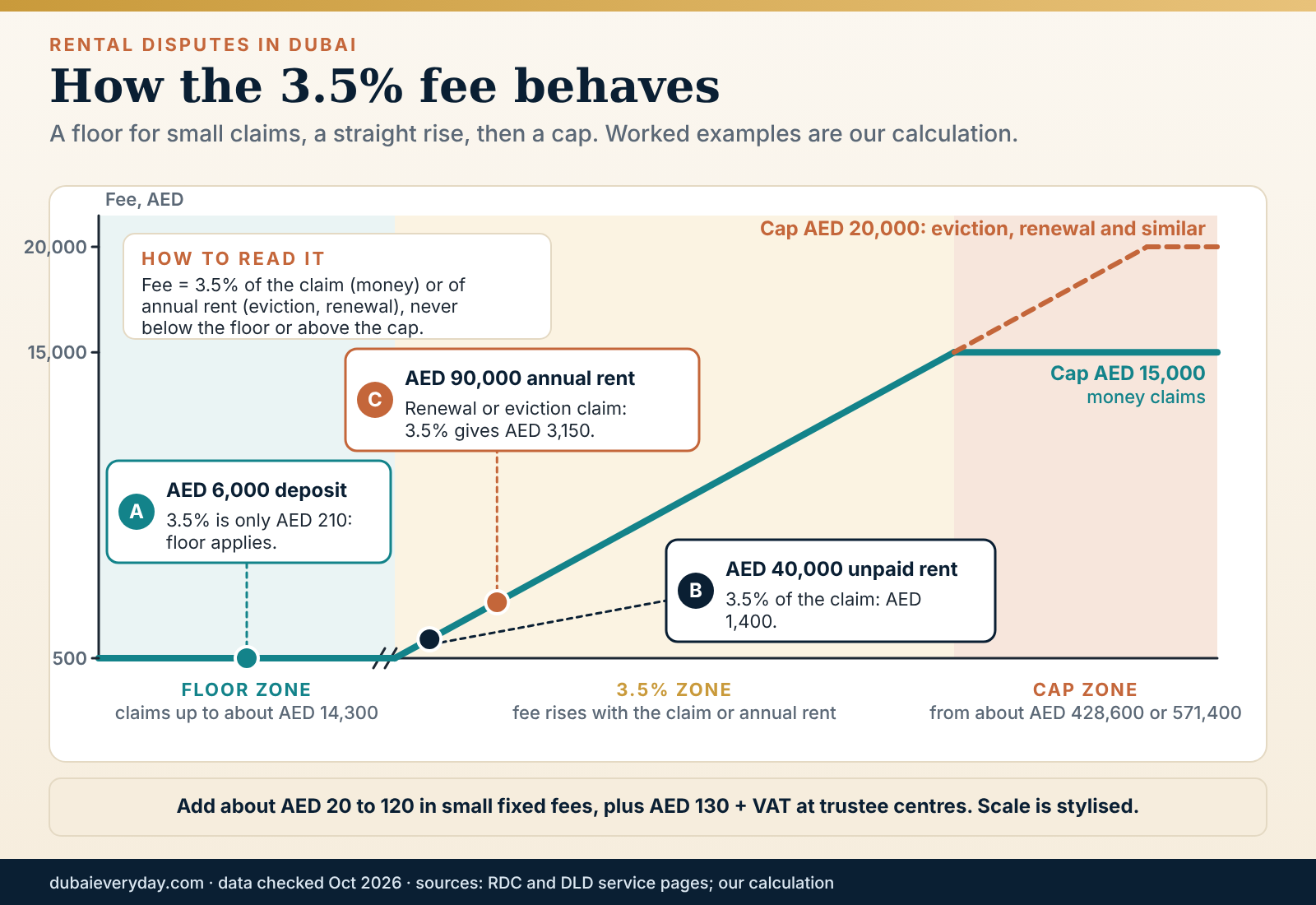
Worked rental dispute Dubai fee sums (our calculation)
These rental dispute Dubai examples use the percentages and caps above and assume the small fees apply. They are arithmetic, not quotes, and they exclude translation, notary, lawyer and time costs.
- Deposit claim of AED 6,000. 3.5% is AED 210, below the AED 500 floor, so the main fee is AED 500. Add 10, 10 and 100 and the total is AED 620, which is about 10% of what you are claiming.
- Unpaid rent of AED 40,000. 3.5% is AED 1,400. Add 20 and 100 for AED 1,520, about 3.8% of the claim.
- Renewal or eviction claim on AED 90,000 annual rent. 3.5% is AED 3,150. With the small fees the total is AED 3,270. Through a trustee centre, add AED 130 plus 5% VAT on that partner fee, and you reach about AED 3,406.50.
Where the floor and the cap bite
Divide the minimum by the rate and the floor ends where a claim reaches about AED 14,286. Below that, the fee does not fall with the claim, which is why a small rental dispute Dubai deposit claim feels expensive. The AED 15,000 financial-claim cap arrives at a claim of about AED 428,571, and the AED 20,000 non-monetary cap when annual rent reaches about AED 571,429. Few ordinary residential claims get near either.
Reading the fee against the stake
Our rule of thumb on rental dispute Dubai fees, not advice: under about AED 10,000, the floor plus extras can absorb 5% to 10% or more of the claim, so negotiation or conciliation, with half the basic fee back on settlement, usually beats a contested case. From AED 10,000 to AED 100,000 a lawsuit is proportionate, but the judgment is generally final. Above AED 100,000, appeal rights, security deposits and a longer timeline enter the sum. Whether fees are awarded back to the winner, or how lawyer fees are treated, we did not verify, so ask before committing.
Translation, notary fees, registered mail, lawyer fees and lost working time sit outside the RDC tariff, and we found no verified prices, so gather written quotes. For where a one-off cost lands in a household, see our cost of living guide and the single-person budget.
Dispute-by-dispute playbooks
Each kind of rental dispute Dubai residents face has its own door. Some have a cheap, quick service built for them; others have to go through a full claim. The table sets out the first formal step for common situations, and the decision tree maps the same choices visually.
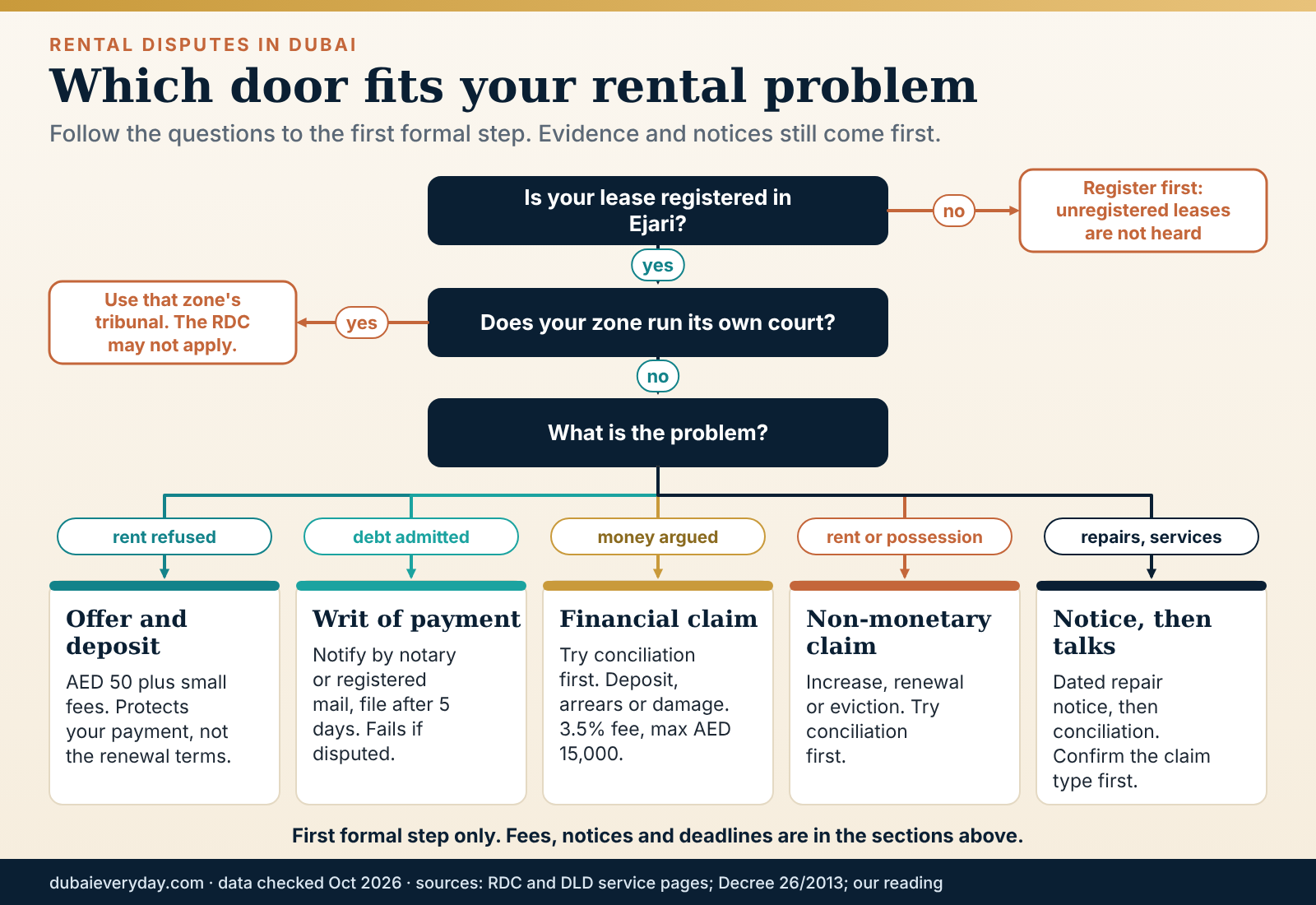
| If this is your problem | First formal step | Where it goes | Main watch-out |
|---|---|---|---|
| Landlord will not accept your rent or renewal cheques | Offer and deposit | RDC judge of provisional matters | It protects payment, not the renewal terms |
| Disputed rent increase | Written objection, then renewal claim if no agreement | Conciliation, then first instance | Check the 90-day notice and the rent calculator |
| Deposit deductions you reject | Itemised written demand | Conciliation or a financial claim | Judgments under AED 100,000 are generally final |
| Rent debt the tenant has acknowledged in writing | Notice, then writ of payment after 5 days | RDC summary actions judge | Fails if the debt is disputed |
| Rent debt the tenant disputes | 30-day payment demand, then financial claim | Conciliation, then first instance | Landlord must not cut services |
| Eviction notice at expiry | Check ground, method and 12-month period | Respond in writing, then defend or settle | Notice by notary or registered mail only |
| Repairs ignored | Dated written notice with deadline | Conciliation; confirm the claim type | Do not deduct from rent on your own |
| Free zone with its own court | Check the zone’s rules first | That zone’s tribunal or court | The RDC may not have jurisdiction |
Rental dispute Dubai over a rent increase you think is unlawful
Dubai ties permitted increases to how far your rent sits below the average for similar units. Under the rent-increase decree summarised in the DLD tenancy guide, a rent up to 10% below the average allows no increase. At 11% to 20% below, the cap is 5%; at 21% to 30% below, 10%; at 31% to 40% below, 15%; beyond that, 20%. The guide’s own example: average AED 80,000, current rent AED 60,000, which is 25% below, so the cap is 10% and the new rent can be AED 66,000.
The average comes from the DLD rental index, and in January 2025 the Land Department announced a Smart Rental Index that classifies buildings by structure, finishes, maintenance, location and services. One wrinkle: the tenancy guide cites the decree as No. 43 of 2013, while the 2025 announcement cites No. 34. We use 43 and flag the inconsistency. What matters in a rental dispute Dubai landlords start with a rent demand is the live calculator result on the day you receive the notice, so capture it with the date.
So the order is: check that notice came at least 90 days before expiry unless your lease says otherwise; run the calculator and save the result; reply in writing with the figure you accept and why; keep paying, using offer and deposit if the old rent is refused; and if you cannot agree, ask for conciliation or file a renewal claim, since the law lets the tribunal set a fair rent. Do not sign at the higher number to “sort it out later”.
Our tenant rights guide explains the bands further, including why some sources still describe an older two-year restriction that the 2008 amendment replaced.
Rental dispute Dubai over a deposit that is not returned
The tenancy law lets a landlord take a deposit to secure upkeep at the end of the lease, and requires the deposit, or the balance, to be returned when the lease ends. The tenant must return the property as received, apart from ordinary wear or events beyond the tenant’s control. The DLD guide notes there is no percentage cap, and the Unified Tenancy Contract carries only a field for the amount, with no clause on deductions. We found no statutory refund deadline, so any timetable comes from your contract.
That leaves evidence to decide it. A landlord who deducts for “deep cleaning” with no receipt is making a claim they must support. Send an itemised written demand with a deadline. Fourteen days is our drafting suggestion, not a legal rule. If it passes, conciliation or a financial claim follows.
The decisive fact is usually the amount. Most deposit claims are well under AED 100,000, so a first-instance judgment is generally final. File only with a complete evidence set, and weigh the AED 500 minimum fee against what you stand to recover. The legal basics guide for residents places deposits in the wider picture of tenancy law.
A landlord who refuses your rent or the renewal
Offer and deposit is the RDC’s tool for this kind of rental dispute Dubai tenants face. A tenant lodges rent as cheques or cash, a new tenancy contract, or the keys, and asks a judge of provisional matters for an order that does not prejudice either side’s rights. Fees are AED 50 plus the knowledge and innovation fees, and the service page lists completion in one business day.
The documents include the last signed contract, two copies of the new contract on the same terms, copies of the new cheques, any correspondence, and, depending on the case, proof that you notified the landlord by notary, registered mail with acknowledgment, or email. Cheques previously deposited must be converted to cash. For keys, the page ties the deposit to cleared rent and utilities and says keys may be deposited only immediately before the lease expires.
Offer and deposit does not decide the lawful rent, force a renewal or resolve eviction, repair or deposit disputes. Law-firm and press commentary agree on this. If the landlord still disputes the figure, you may need a separate claim, and any extra rent later awarded must still be paid.
Unpaid rent and bounced cheques
A landlord’s route in a rental dispute Dubai arrears case starts with a payment demand. Under Article 25 of the amended tenancy law, non-payment can justify eviction during the lease if the tenant fails to pay within 30 days of the demand, and the notice should go through a notary or by registered mail. A landlord who files before the 30 days have run weakens their own claim.
For a debt that is immediately due and acknowledged, the RDC offers a writ of payment. The creditor first notifies the debtor through a notary or registered mail, and can file if the debtor has still not paid five days after notification. Gulf News warns that this fast route suits only an exact, acknowledged debt; where repairs or damage are argued, a standard claim is safer. The portal also lists a cheque-execution service, which we did not read in detail.
Landlords should keep clean records of what was charged and paid; the bookkeeping guide covers receivables records for anyone running rentals like a small business. Tenants who cannot pay on time are usually better placed asking for a payment plan in conciliation than ignoring the demand, because silence turns a payment problem into an eviction ground.
Repairs, cut services and access
The tenancy law puts maintenance and repair of defects that affect use on the landlord unless the parties agree otherwise, and expects the tenant to care for the property as an ordinary person would. The Unified Tenancy Contract repeats the split and has the tenant pay electricity, water, cooling and gas unless agreed otherwise.
When a repair is ignored, write once, clearly, with photos and a deadline, then keep the follow-ups. We found no statutory right to repair and deduct from rent, so do not do it. We also could not confirm which RDC claim type best fits a repair demand, so ask the RDC or a lawyer first. If the landlord cuts water or electricity, Article 34 is the provision to cite. For damage to your belongings, start with your own cover, which the insurance guide introduces. We found no statutory notice period for landlord entry, so agree access times in writing.
An eviction notice arrives
An eviction notice is the most serious rental dispute Dubai tenants meet. Do not ignore it, and do not panic. Check four things. Does it name a ground the law allows? Was it sent by notary or registered mail? Does it give the period the ground requires, 12 months for expiry-based grounds? Does the lease still run? During the term the grounds are narrow: unpaid rent after notice, unapproved subletting, illegal use, unsafe alterations, collapse risk, breach after notice, or a government demolition decision.
If the landlord reclaims the home for personal use and the tribunal allows it, the owner may not re-let to a third party for at least two years (residential) or three (non-residential), or the tenant may seek compensation. After redevelopment, a tenant has a right of first refusal, exercised within 30 days of notice. Rent keeps accruing while an eviction claim runs. Our landlord rights guide covers the grounds in more depth.
Leaving early, subletting and shared rooms
The law bars unilateral termination during the term, and the Unified Tenancy Contract text we read has no early-exit clause. Leaving early is therefore a negotiation, and a conciliation agreement is a clean way to record the exit date, Ejari cancellation and the return of cheques. Subletting needs the landlord’s written consent, and the DLD guide says subleases and single rooms cannot be registered through Ejari, which weakens any claim built on an unregistered arrangement.
Disputes between roommates fall into a gap we could not resolve from official pages. The RDC’s remit is landlord and tenant disputes, and we did not verify how it treats a quarrel between two occupants. Record who paid what and agreed what, and ask a lawyer before assuming the route is open.
Company tenants, offices and free-zone leases
Companies file through the manager named on the trade licence, with the latest licence attached. Free zones are inside the RDC’s jurisdiction unless the zone runs its own tribunal or court. If the lease is for an office that supports a licence, a rental dispute Dubai businesses face can threaten the licence as well as the premises, so read the free zone company guide and the mainland company guide.
Appeals, final judgments and enforcement
In a rental dispute Dubai courts decide, winning a judgment and getting what it says are two separate stages, and the first surprise for many people is how little room there is to appeal. Article 17 of the RDC decree makes first-instance judgments on claims of AED 100,000 or more appealable to the Appellate Division. Below that figure they are final, apart from six listed situations.
Almost every residential deposit and small arrears rental dispute Dubai claimants file sits below AED 100,000. For those, a first-instance judgment is generally the last word, so there is no second chance to add the receipt you forgot. Build the complete file before you register, not after the first hearing.
The six exceptions for claims under AED 100,000
These situations are narrow and procedural, not a general right to argue the facts again.
- Eviction judgments.
- Judgments that breach jurisdiction rules.
- Judgments that grant relief nobody asked for, exceed what was asked, or ignore relief that was requested.
- Judgments against a person who was not duly represented or served.
- Judgments based on documents or testimony later judicially declared false.
- Judgments where a party concealed evidence or documents that would have changed the outcome.
Deadlines and security
A rental dispute Dubai appeal must be filed within 15 days of the day after the hearing at which the judgment was issued. If the defendant missed every hearing and filed no defence, time runs from service of the judgment. The RDC appeal page applies the same 15 days to appeals against writs of payment and certain execution decisions.
For financial claims, the judgment debtor must deposit half the judgment amount while the appeal is pending, although the chairman may waive it or accept a partial deposit. The appeal page describes this as refundable security, plus AED 100 process service and the small fees. Appellate decisions are final. If you are on the receiving end of a claim, do not skip hearings hoping it goes away: a judgment can be issued against you and the appeal clock may run from service.
Enforcement: after the judgment
Final rental dispute Dubai judgments of both divisions are enforced by the Judgment Enforcement Directorate, and the chairman can ask the Dubai Courts Execution Department for help. A conciliation agreement approved by the supervising judge has the force of a writ of execution. Per Gulf News, if the other party does not comply, the winner opens an execution file, the other party is notified, and further requests can generally follow after seven days.
The RDC execution page lists the enforcement writ with its stamp, any appeal security receipt, the offer and deposit receipt when enforcing a renewal verdict, and a bank letter if the payment account needs updating. Execution fees are in the fee stack above, and registration is listed at one business day. Methods vary by award: attaching assets, carrying out an eviction or implementing a renewal, under judicial supervision. We did not verify typical enforcement timelines for money judgments.
When to get legal advice, and how to choose a lawyer
Many small rental dispute Dubai cases can be run without a lawyer. Many cannot. The test is not how angry you are but what a mistake would cost and whether you can spot the mistake in time.
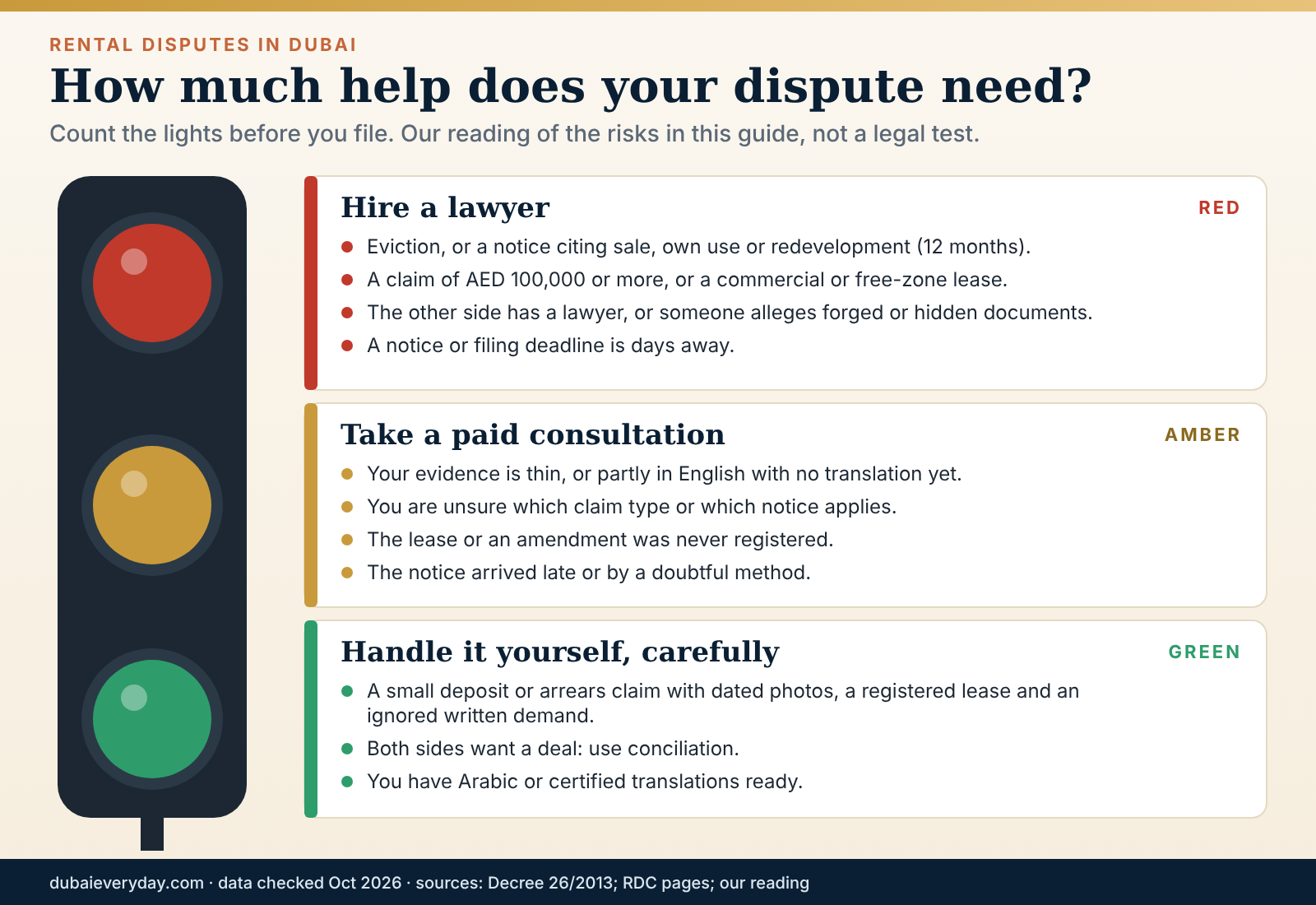
Signals that a rental dispute Dubai case needs paid advice
- Eviction, or a notice that cites a 12-month ground such as sale or personal use.
- An amount at or above AED 100,000, a high-rent lease or a commercial or free-zone tenancy.
- The other side has a lawyer, or a property management company is handling its side.
- Your evidence is thin, contested or partly in English only, and you cannot easily fix that.
- A notice or filing deadline falls within days.
- You are an heir, a company, or acting for someone absent, so a power of attorney is needed.
When you can reasonably go it alone
A clear rental dispute Dubai deposit case with dated move-in and move-out photos, a registered lease, an itemised demand that was ignored, and a claim of a few thousand dirhams is a fair candidate for self-filing, or for conciliation without a lawyer. In that case, paying for a lawyer may cost as much as the sum you are chasing. A single paid consultation to review your file is the middle path.
What a lawyer adds, and what one cannot do
A good litigator in a rental dispute Dubai case picks the right claim type, writes the Arabic pleadings, watches deadlines, handles powers of attorney and negotiates from procedural strength. Nobody can guarantee a result or make weak evidence strong, and a lawyer who promises an outcome is the clearest red flag in this market.
How to choose without being sold to
Dubai’s Legal Affairs Department lists a “find a lawyer or legal consultant” feature on its official site, the logical first place to confirm someone is licensed. We could not open the search itself, so we cannot describe how it works. A law-firm blog we read says advocates can appear before the courts while legal consultants generally cannot; that is a firm’s own view, so confirm it with the department.
- Ask for the licence number and check it before paying anything.
- Get a written engagement that sets out scope, fee basis and exclusions such as translation, RDC fees and execution.
- Ask who handles the file day to day and who appears at hearings.
- Be wary of guarantees, large retainers demanded before a written fee breakdown, or “best lawyer” claims.
- Compare the legal fee with the fee at stake from the fees section and the value of what you might lose.
We do not recommend or rank any firm here, and nothing on this page was paid for. The department’s site also lists a volunteer legal services platform that connects lawyers with free help for people who cannot afford it; we could not verify eligibility, so check directly.
Three worked scenarios and the mistakes they expose
These are illustrative examples, not quotes or market facts. The people are invented and the numbers are chosen to show the logic, using the fee rules above. They show how a rental dispute Dubai residents commonly face is weighed, and where it can go wrong.
Scenario A: a deposit deduction
A tenant on a AED 60,000 lease paid a AED 5,000 deposit. The landlord keeps AED 2,200 for repainting and cleaning and offers no receipts. The tenant has dated move-in photos showing scuffed walls from the start, a move-out video and the final utility clearances.
The first move is an itemised written demand with a deadline, perhaps conceding a modest cleaning charge. If that fails, a financial claim for AED 2,200 carries the AED 500 floor plus small fees, about AED 620. A full win nets roughly AED 1,580; a loss costs the AED 620. Conciliation is the more natural choice, since half the basic fee is refunded on settlement. Either way the judgment will probably be final, so the photos and clearances go in at the start.
Scenario B: a renewal at an inflated rent
A tenant pays AED 72,000. The rent calculator shows an average of AED 90,000 for similar units, so the rent is 20% below the average, which falls in the 11% to 20% band and allows up to 5%, or AED 75,600. The landlord asks for AED 85,000 and sends notice 60 days before expiry.
The gap between demand and cap is AED 9,400 a year. Two arguments exist: the figure exceeds the band, and the notice came late against a 90-day rule. The second is a contested reading, so the first carries the weight. The tenant replies in writing, offers AED 75,600 and, if the landlord refuses the cheques, uses offer and deposit for about AED 70 in fees. A renewal claim would cost about AED 2,640 on this rent: proportionate to a AED 9,400 yearly difference, but not trivial. An hour with a lawyer pays for itself here.
Scenario C: a landlord facing a bounced cheque
A landlord rents a flat at AED 100,000 a year in four cheques of AED 25,000. The second bounces. The tenant says the air conditioning has been broken for a month and that is why payment stopped.
The debt is disputed, so a writ of payment is the wrong tool. The landlord serves a payment demand through a notary, waits the 30 days, and files a financial claim for AED 25,000, about AED 995 in fees. An eviction claim on the whole lease would cost about AED 3,620. A cautious landlord files the debt first and keeps non-payment in reserve as a ground. The tenant’s repair complaint is a real argument, but stopping payment without a lawful basis exposes the tenant to both claims. Neither side should cut services or lock the other out.
Eight mistakes that sink a rental dispute Dubai case
- Withholding rent over a repair, a deposit row or an increase, instead of paying and objecting.
- Filing before the notice period has run, or serving it by a method the law does not accept.
- Relying on an unregistered lease or amendment.
- Uploading English-only documents and expecting them to be read.
- Assuming an appeal exists when the claim is under AED 100,000.
- Using the writ of payment for an argued debt, or picking the wrong claim type.
- Sending a casual message that reads as accepting a higher rent or new terms.
- Self-help: cutting services, changing locks or handing over keys without a signed record.
Prevention: check before you sign
The RDC runs a Rental Good Conduct certificate service that tells you whether a rental case has been filed against a person or company. Tenants can check landlords, landlords can check prospective tenants, and property managers can use it. It runs through the RDC app; the press release we read, dated 2018 but internally inconsistent, did not state a fee, so confirm details in the app.
The other protection against a rental dispute Dubai parties dread is paperwork: register the lease and any amendment, keep the handover record, put promises in a signed addendum and read the notice clause. If you are still choosing a home, the Downtown Dubai area guide is a place to start on neighbourhoods, and the couple’s budget and family budget show what rent leaves room for.
FAQ: rental dispute Dubai questions
What is the Rental Disputes Center in Dubai?
It is the Dubai Land Department’s judicial body for landlord and tenant disputes, created by Decree No. 26 of 2013. It has exclusive jurisdiction in the emirate, free zones included, except zones with their own tribunals or courts. It offers conciliation, first-instance lawsuits, appeals and execution, mostly online. Any rental dispute Dubai parties cannot settle privately is normally registered there.
Can I start a rental dispute Dubai case without Ejari?
Generally not. The tenancy law requires leases, and amendments, to be registered, and says courts and government bodies cannot hear lease-related disputes unless the lease is registered. Every RDC filing list also begins with the latest Ejari tenancy contract. If yours was never registered, fix that first or ask a lawyer how to proceed before paying any fee.
How much does a rental dispute Dubai filing cost?
For eviction, renewal and similar claims the main fee is 3.5% of annual rent, minimum AED 500, maximum AED 20,000. For money claims it is 3.5% of the amount, minimum AED 500, maximum AED 15,000. Small fixed fees and a trustee-centre fee are added. Check the live service page before paying.
How long does a rental dispute Dubai case take?
The decree aims for a first-instance decision within 30 days of referral, extendable. The settlement and filing services list 7 and 8 business days, but those describe service completion, not the whole case. Press commentary reports many cases decided in one or two hearings, though notices, appeals and enforcement can lengthen things. We found no current official duration statistics.
Do I need a lawyer for a rental dispute Dubai case?
For a rental dispute Dubai filing, the first-instance page says applicants can be individuals or companies and can act through a legal representative, so a lawyer is optional on the page we read. Counsel is more valuable for eviction, high-value or commercial disputes, or when the other side has one. For a small, well-documented deposit claim, many people file themselves. A single paid consultation can sit in between.
Can I appeal a rental dispute Dubai judgment?
Sometimes. In a rental dispute Dubai case, first-instance judgments on claims of AED 100,000 or more can be appealed within 15 days. Below that figure the judgment is final except in six listed cases, including eviction judgments and judgments based on false documents. For financial claims, half the judgment amount is deposited as security while the appeal runs, unless the chairman waives or reduces it.
What if my landlord refuses to accept the rent?
In a rental dispute Dubai over refused rent, use offer and deposit rather than stopping payment. You lodge rent cheques or cash, a new contract or the keys with a judge of provisional matters, for AED 50 plus small fees, with completion listed at one business day. It protects your payment record but does not decide the lawful rent or force a renewal, so a separate claim may still be needed.
Does the Rental Disputes Center cover free zones such as DIFC?
Partly. The decree gives the RDC jurisdiction over rental dispute Dubai cases across the emirate, including free zones, but excludes free zones with their own tribunals or special courts. DIFC runs its own courts, so check your zone before filing.
Can a landlord cut off my electricity or lock me out?
No. Article 34 of the tenancy law says the landlord cannot cut services or otherwise disturb the tenant’s use of the property. A tenant may complain to the local police or sue for damages before the tribunal, supported by official reports. Landlords with a genuine grievance must use the notice and claim route.
Related reading
Sources and further reading (21 links)
- Dubai Land Department: First Instance Lawsuit (Rental Disputes Center) — fees, documents, steps and timings for filing a lawsuit
- Dubai Land Department: Dispute Lawsuit (for Amicable Settlement) — conciliation fees, refund rule, documents and outcomes
- Dubai Land Department: Offer and Deposit — fees, documents and conditions for lodging rent, contracts or keys
- Rental Disputes Center: Register a Writ of Payment — notification, five-day wait, fees and documents
- Rental Disputes Center: Register an Execution Proceeding (Rental) — enforcement fees, documents and steps
- Rental Disputes Center: Register an Appeal (Rental) — appeal deadline, security and fees
- Rental Disputes Center: E-services — list of services and categories
- Rental Disputes Center: Request an exemption from lawsuit fees — existence of the fee exemption service
- Rental Disputes Center: About the Rental Disputes Center — mandate, departments and digital services
- Dubai Legislation Portal: Decree No. 26 of 2013 — jurisdiction, stages, time limits and appeal threshold
- Dubai Legislation Portal: Law No. 26 of 2007 — registration, maintenance, deposit, subletting and interference rules
- Dubai Legislation Portal: Law No. 33 of 2008 amending Law No. 26 of 2007 — notices, 90-day and 12-month rules, eviction grounds
- Dubai Land Department: Tenancy guide — rent-increase bands, registration and deposit notes
- Dubai Land Department: Ejari Unified Tenancy Contract — notices, jurisdiction and language clauses
- Dubai Land Department: Smart Rental Index announcement — rental index context and support line
- Dubai Land Department: Rental Good Conduct certificate press release — what the certificate shows
- Legal Affairs Department of the Government of Dubai — lawyer finder and volunteer legal services listing
- Gulf News: Dubai rental dispute process — press explainer used for practice, translation and enforcement context only
- Gulf News: Dubai launches streamlined rental dispute settlement service — press context on enhanced conciliation
- UAE Ahead: Offer and Deposit when a landlord refuses rent — law-firm commentary on limits of the service
- LY Lawyers: How to find a lawyer in Dubai — law-firm view on checking advocate status and engagement terms
Update log: 29 October 2026 — first publication; fees, forms and procedures re-checked against the sources above. Next review due: within three months, or sooner after any change to RDC fees or the tenancy laws. Corrections welcome. This page is general information, not individual legal advice; a Dubai-licensed lawyer should review any high-stakes claim.
About DubaiEveryday and this guide
DubaiEveryday.com is an independent editorial project that publishes practical, research-based guides to everyday life in Dubai: where to live, what things cost, how the rules work and how to get around. This page was written and edited by the DubaiEveryday editorial team. It is not signed by a named expert, doctor, lawyer or adviser, and we do not claim first-hand testing of a venue, clinic or service unless the page says so.
Each guide is built from official sources such as government and regulator pages, operator websites and established news outlets, cross-checked where we can. When we could not confirm something, we say so in the text, and examples that use made-up numbers are labelled as illustrations. Mentions are editorial choices, not paid placements, and a link is not an endorsement.
Dubai changes quickly. If you spot something that is out of date or wrong, please tell us through the contact options on DubaiEveryday.com and we will check it and correct the page.