

Mosque etiquette Dubai visitors need is a short list: cover up properly, take your shoes off, keep your voice and camera under control, and plan around prayer times and Fridays. This guide sorts dress, shoes, photography, guided visits and respect into what is a rule, what is a request and what is simply good manners, using sources checked on 29 October 2026.
Most people planning a Dubai trip never think about mosques until they are standing outside one, wondering whether the door is open to them and whether their shorts are about to become a problem. The honest answer is that one Dubai mosque runs a regular public visit, a handful of others are listed but vague, and the rest are places of worship that you admire from the street. Mosque etiquette Dubai visitors actually need is smaller than the internet makes it sound, but a few mistakes are expensive.
Turning up on a Friday, photographing a stranger at prayer or relying on a blog post with last year’s price are the ones that catch people out. This guide sorts what the operators say, what the law says and what plain good manners add, with the times, the dress rules and the Friday change that older sites still get wrong. Read it once, and you will walk in knowing what to wear, when to go and where to keep your camera.
Mosque etiquette Dubai visitors should follow is built on five habits: dress modestly with arms, legs and (for women) hair covered; leave your shoes at the entrance; speak quietly and never walk in front of someone who is praying; photograph the building, not the worshippers; and schedule around prayer times, especially on Fridays. Most mosques in Dubai are for worshippers only. The one the official tourism site presents as welcoming non-Muslims six days a week is Jumeirah Mosque.
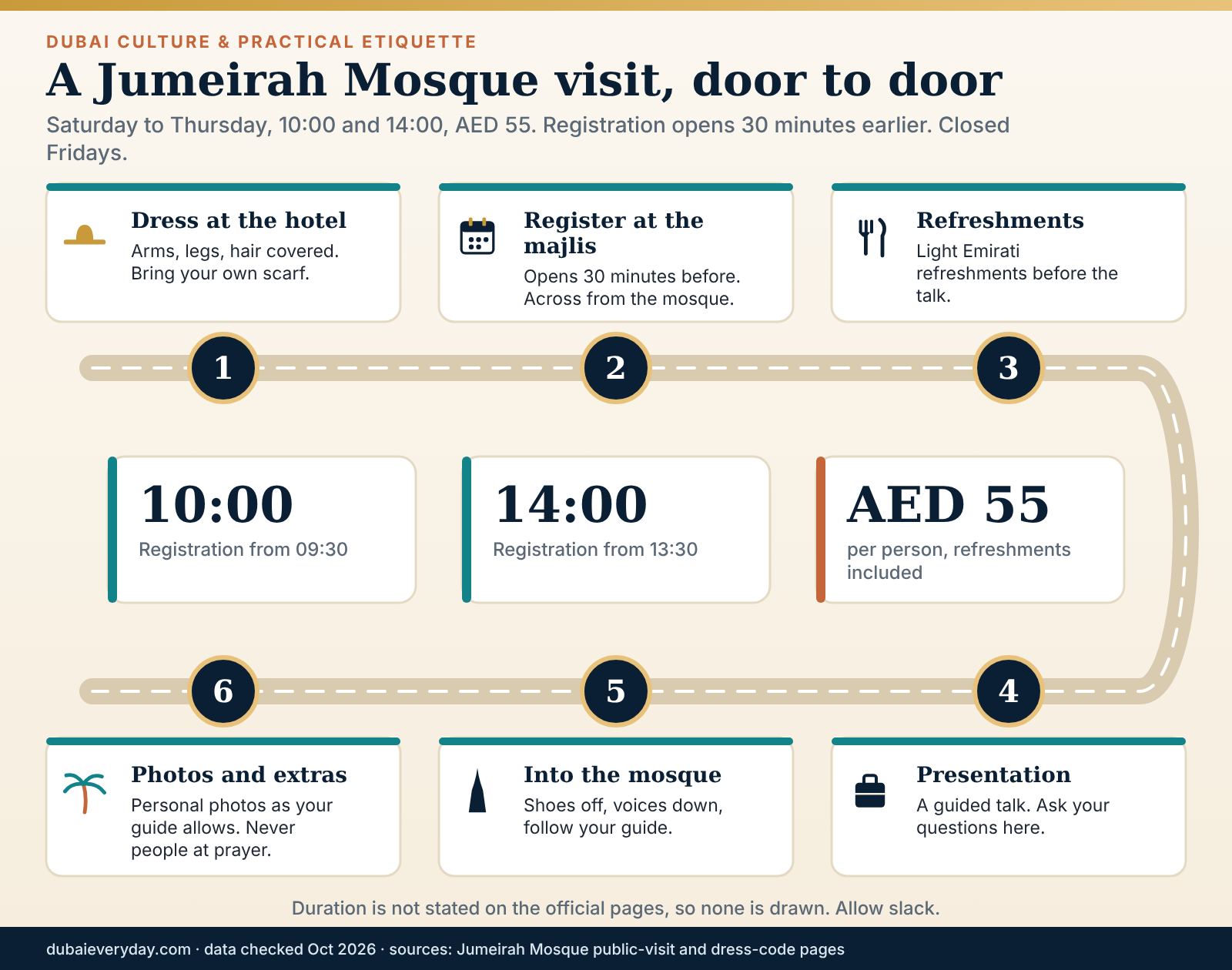
According to the mosque’s own website, guided public visits run Saturday to Thursday at 10:00 and 14:00, registration opens 30 minutes earlier, no advance booking is needed for the public visit, and it costs AED 55 per person (about USD 15) including light Emirati refreshments. It is closed on Fridays. Men should avoid shorts and sleeveless tops; women need arms, legs and hair covered, and robes and scarves are lent on site, though bringing your own scarf is sensible. Since 2 January 2026 the Friday sermon and prayer in the UAE are set at 12:45.
The rest of this page explains each point of mosque etiquette Dubai operators actually state, where the evidence is thin, and what to do when something goes wrong on the day.
This is a desk-research guide to mosque etiquette Dubai visitors ask about. DubaiEveryday.com has not joined the tours, sat in the majlis or photographed the interiors described here. On 29 October 2026 we read the Jumeirah Mosque website, the Sheikh Zayed Grand Mosque Centre pages, Visit Dubai’s mosque pages and recent UAE press reports, and we re-used the cybercrime-law and Ramadan-date research from our Dubai etiquette guide. We did not read the full UAE statutes on places of worship, and we are not religious scholars, so this page does not explain Islamic practice beyond what a visitor needs.
Where mosque operators and press reports disagree (they do, on Abu Dhabi hours and fees), we say so. Prayer times shown here are our own indicative calculations from solar geometry, not an official timetable. No mosque, centre or tour operator paid for inclusion, and there are no affiliate or booking links. This is general information, not religious or legal advice. Confirm days, prices and dress rules with the operator before you travel.
Mosque etiquette Dubai visitors can rely on: law, venue rules and custom
Most advice on mosque etiquette Dubai travellers find online treats every rule as equally serious. That is not how it works in a mosque. Three different things are going on at once, and separating them tells you how much to worry.
The first layer is law. A handful of general rules apply everywhere in the UAE, including at mosques. The one most relevant to visitors is privacy. As summarised in our research for the Dubai etiquette guide, Federal Decree-Law 34 of 2021 on cybercrime treats photographing people without consent, and publishing such images, as an offence with potential prison time and fines running into six figures in dirhams. A mosque is where you are most likely to point a phone at strangers who did not agree to be in your holiday album.
The second layer is the venue rule. When Jumeirah Mosque says men should avoid shorts and sleeveless tops, or when the Sheikh Zayed Grand Mosque says food and drink are not allowed on the premises, that is a condition of entry. You will not be fined by a police officer, but you will be turned away, handed a robe, or asked to leave. These rules are set by the operator, can change, and differ between mosques. They are the part you should check before you go.
The third layer is custom, and it is the one that is hardest to find in writing. Lowering your voice, sitting rather than lounging, not stepping across a prayer carpet where someone is kneeling, not treating the call to prayer as background music: nobody will hand you a leaflet, but they will notice. Custom is also where visitors are most forgiven, provided it is clear you are trying.
Why a mosque is not a museum
The mental shift that fixes most mosque etiquette Dubai mistakes is simple. A mosque is a working place of worship first and a sightseeing stop a distant second. Prayer happens five times a day, the building is planned around it, and visiting hours are carved out of the gaps. The open-to-visitors tours in Dubai exist as cultural programmes, not because the building is a public attraction. If you treat the day like entry to a gallery, you will plan wrongly: you will turn up on a Friday, at midday, in beach clothes, and wonder why nobody is smiling.
It also explains why the rules look stricter than in a mall. Our Dubai dress code guide covers how expectations shift from mall to beach to office. A mosque sits at the top of that scale, not out of prudishness towards tourists, but because worshippers need to pray in a space that has not been turned into a photo set.
What this page covers, and what it leaves to others
This page has one job: to set out the mosque etiquette Dubai visitors need when they enter, or want to enter, a mosque in Dubai, with practical logistics for the visits that exist. For manners across the whole city (greetings, tipping, alcohol, public behaviour), use the main Dubai etiquette guide. For fasting hours, iftar and the changes Ramadan brings to the whole city, the Ramadan etiquette guide goes further than the short section here.
One note on scope: we cover mosques in Dubai, plus a short section on the Sheikh Zayed Grand Mosque because it is the visit most people from Dubai add. We do not explain how or why Muslims pray. A guide who invites questions is the better route to that.
Which mosques in Dubai can you actually enter?
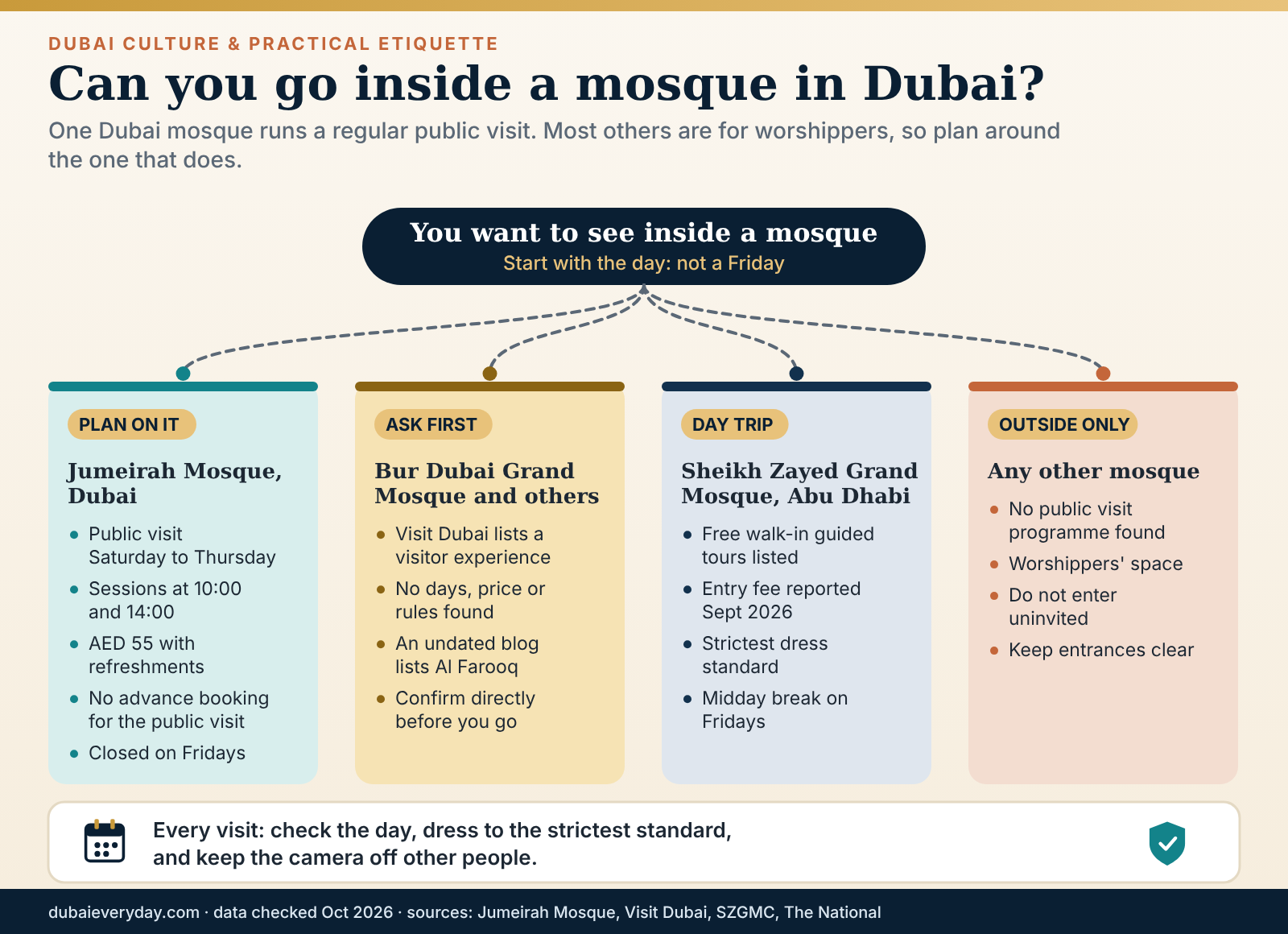
This is the question behind most mosque etiquette Dubai searches, and the honest answer is: fewer than the guidebooks imply. Visit Dubai’s own mosque article says that some mosques welcome the public and offer guided tours, and then leaves the list to its individual place pages. Those pages are the best official evidence we found. One says Jumeirah Mosque is the only mosque in Dubai that welcomes non-Muslim guests six days a week. Another lists a “mosque experience for non-Muslims” at Bur Dubai Grand Mosque but gives no days, prices or rules.
So treat the picture like this. One Dubai mosque has a published, regular public visit with a price and a schedule. A second has an official listing but no usable details. Everything else, including the mosque at the end of your street, is a place of worship you may admire from the outside and should not walk into uninvited. That includes mosques that look grand, photogenic and entirely open.
| Mosque | What the sources say | How to treat it |
|---|---|---|
| Jumeirah Mosque, Jumeirah 1, Dubai | Mosque website: public guided visits Saturday to Thursday at 10:00 and 14:00, AED 55, no advance booking, closed Fridays. Visit Dubai: welcomes non-Muslims six days a week. | The one to plan around. Confirm before travelling. |
| Bur Dubai Grand Mosque | Visit Dubai lists a mosque experience for non-Muslims. No days, price or rules on the page we read. | Ask the organiser first. Do not turn up and expect entry. |
| Al Farooq Omar Bin Al Khattab Mosque, Al Safa | An undated blog lists guided visits by reservation. We found no official page confirming it. | Unconfirmed lead. Verify directly. |
| Any other mosque in Dubai | No public visitor programme found. | Outside views only. Keep clear of entrances at prayer times. |
| Sheikh Zayed Grand Mosque, Abu Dhabi | Official centre pages describe daily walk-in tours; press reported an entry fee in September 2026. | A day trip, not a Dubai visit. See the day-trips section. |
Why older mosque etiquette Dubai guides disagree with the mosque’s own website
Search results for mosque visits are full of blog posts, and many are out of date. One undated property-blog roundup we read lists Jumeirah Mosque tours on Saturday, Sunday, Tuesday and Thursday at 10:00 for AED 10, with a minimum age of five. The mosque’s own site now says Saturday to Thursday, two sessions, AED 55. We have not tried to work out when that changed, and we cannot say whether the minimum age still applies.
The practical rule for any mosque etiquette Dubai article, ours included: a number that is not dated and not on the operator’s own site is a lead, not a fact. This is also why our table gives the source next to each claim. It is the reason we call the Al Farooq listing unconfirmed rather than leaving it out; if you choose to chase it, call the mosque rather than relying on us or on the blog.
Third-party “mosque tours”: ask what you are buying
Tour operators sell mosque visits bundled into city tours and Abu Dhabi day trips. Some are perfectly good, and we are not rating any here. The questions worth asking are simple. Which mosque exactly? Does the price include entry, or only the transport? Is the stop inside the mosque or a photo stop at the gate? If the answer to “which mosque and for how long” is vague, the stop is probably an exterior photo.
Appreciating a mosque from the outside
Standing across the road to look at a minaret is fine. Standing in the doorway, on the shoe racks or in the middle of the path at 12:40 on a Friday is not. If a stream of men is walking in, you are in the way. If the forecourt is empty and a visible sign or staff member does not object, a respectful photograph of the building is normal. Keep clear of people, for reasons the photography section explains. Outside, the mosque etiquette Dubai neighbourhoods expect is mostly about not being in the way.
Visiting Jumeirah Mosque step by step
The mosque opened in 1979 as a gift from Sheikh Rashid bin Saeed Al Maktoum, then Ruler of Dubai, according to its own website. The public visit is run alongside the Sheikh Mohammed Centre for Cultural Understanding, which describes the mosque as one of the few in Dubai open to non-Muslims and says guests register at the majlis across from the mosque. The mosque site gives the address as Jumeirah Beach Road, Jumeirah 1.
These figures come from the mosque’s public-visit page, checked on 29 October 2026. Prices and slots can change, and the page does not state how long a visit lasts.
- Choose your sessionThe 10:00 slot is the easier choice if you dislike heat or want the rest of the day free. The 14:00 slot works if you start late, but check where it sits against the afternoon prayer in your travel month; the prayer-times section shows how that moves.
- Dress before you leave the hotelFollow the dress guidance below. Robes and scarves are lent on site, but a scarf of your own is quicker and more comfortable, and the mosque’s site itself asks women to bring one.
- Register at the majlisRegistration opens 30 minutes before the session. You register at the majlis across from the mosque, where light Emirati refreshments are served before the presentation begins. No advance booking is needed for the public visit, according to the mosque site.
- Listen firstThe visit is a guided tour with a presentation. Questions are the point of the programme, so ask them, and keep them curious rather than argumentative.
- Go in as a guestHere the mosque etiquette Dubai operators expect applies in full: shoes come off, voices drop, and you follow your guide’s lead on where to stand and what to photograph. Personal photography is permitted on the visit, according to the mosque site; your guide will tell you where and when.
- AfterwardsThe site lists a museum, a “Mosques of the World” gallery and a gift shop, plus henna for women and a photo with a falcon among the tour extras. The majlis itself is listed as open 09:00 to 17:00 daily except Friday.
Booking, groups and private visits
There is a small mismatch to be aware of. The mosque’s website says no advance booking is required for public visits. The Sheikh Mohammed Centre’s own programme page invites bookings through a form, WhatsApp or email for the visit it describes, which includes a light breakfast. We read that as two products: the walk-up public session and a booked programme. For a couple or a family, walking up is what the mosque says works; for a group of ten, contacting the centre first is cheap insurance. The mosque site also lists a private visit option; it does not give a price on the pages we read.
Time budget and getting there
Official pages give no duration, and an older blog we read said about 90 minutes including questions. Our planning estimate, not an official figure, is to keep roughly two to two and a half hours free: 30 minutes for registration and refreshments, the visit itself, and a little slack. The Metro runs inland along Sheikh Zayed Road, not along Jumeirah Beach Road, so expect a taxi or ride-hail for the last stretch.
Our guide to Dubai beaches is useful if you plan to pair the visit with a swim, with one rule: change clothes between the two. Swimwear belongs on the sand, not in a mosque courtyard.
If the date does not work
Fridays are out, and so are any days the centre announces closures. Shift a Friday visit to the day before or after rather than hoping the gates are open. If Jumeirah is impossible, the Abu Dhabi option in the day-trips section is the realistic alternative.
Mosque dress code in Dubai: men, women and children
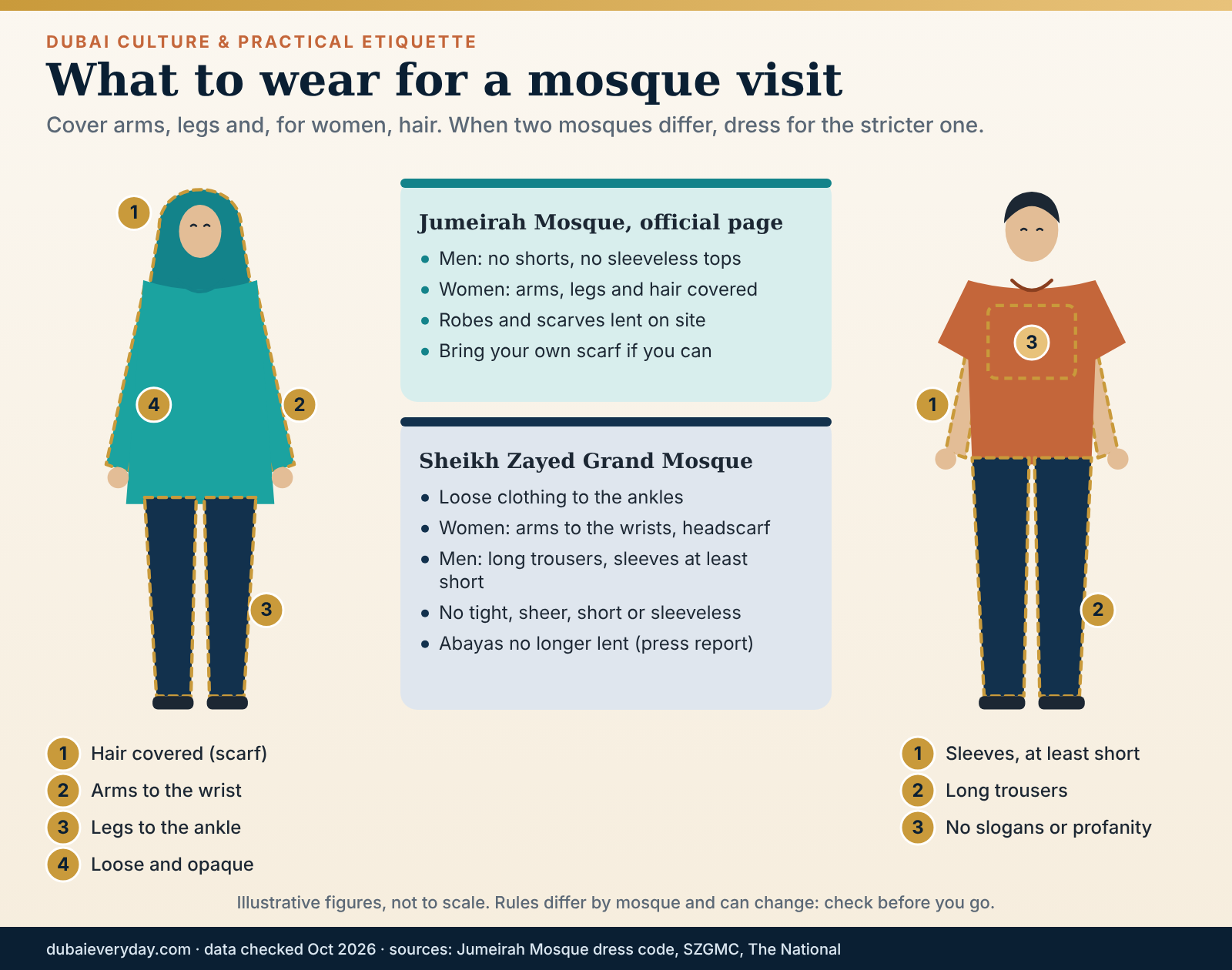
Here is the mosque etiquette Dubai operators actually state about clothing, before we add any advice of our own. Jumeirah Mosque’s dress-code page asks men to avoid shorts and sleeveless tops. For women it requires that arms, legs and hair be covered. It says abayas and head scarves are provided for visitors who need them, and kanduras for men, all cleaned by the centre. It does not specify sleeve lengths, rules on transparent or tight clothing, footwear, or whether men need to cover their heads. Its home page adds that women should bring their own head covering where possible.
The Sheikh Zayed Grand Mosque is stricter, and clearer. Its official pages ask both men and women for long, loose clothing down to the ankles, with a headscarf for women. A September 2026 report in The National added detail: women’s clothing should cover arms to the wrists and legs to the ankles, men need long trousers and a shirt with at least short sleeves, and transparent, tight, short or sleeveless clothing is refused. It also reported that the centre no longer lends abayas and that one can be bought for AED 45 at Souq Al Jami next to the mosque.
The simple rule for mosque etiquette Dubai dress: wear the strictest standard on your list
Because the standards differ, the safest mosque etiquette Dubai travellers can adopt is to pick the strictest mosque you might visit and dress for that. If your plans include Abu Dhabi, pack for the Sheikh Zayed standard and you will pass at Jumeirah without a second thought. If you dress for Jumeirah’s minimum and then add Abu Dhabi on a whim, you will be buying a robe at a souq. For the wider scale of expectations across malls, restaurants and offices, our Dubai dress code guide sets mosques at the top, for the reasons given earlier.
What to wear in practice: mosque etiquette Dubai outfits that work
For women, the easiest combination is a loose long-sleeved top or tunic over lightweight trousers, plus a large scarf in a breathable fabric. A long, loose dress also works if it covers the ankles and you add a layer on the arms. Avoid leggings worn as trousers on their own, anything sheer, and anything with slogans.
For men, lightweight long trousers in cotton, linen or a technical fabric, and a shirt with sleeves. Sport shorts and vests are the commonest reason for being handed a robe. One older roundup suggests covering visible tattoos; none of the official pages we read mention them, but long sleeves and trousers settle the question anyway.
Heat: the hard part of mosque etiquette Dubai summers
Covering up in a Dubai summer sounds miserable, and a poor fabric choice makes it so. Loose cotton, linen and viscose let air move; tight synthetics do not. A morning session helps, and a scarf you can slide from head to shoulders between the car and the tour cuts the time spent wrapped up. We cannot say how hot any courtyard feels, but outdoor stone in summer sun is a fair thing to expect, another reason to bring socks.
Children and the mosque etiquette Dubai families should plan for
We found no age or dress rule for children on the Jumeirah pages. The Sheikh Zayed Grand Mosque says children are welcome but must stay under constant parental supervision. Dress them to the same standard as adults: light trousers rather than shorts, a long-sleeved top, and a scarf for girls where the mosque requires one. A younger child will find a long silent tour hard, so choose the earlier slot and plan to leave quietly if needed. Our Dubai travel guide covers heat and timing logistics with young children.
A scarf is a condition of entry, not a statement
Some visitors hesitate over this part of mosque etiquette Dubai operators set, because they read covering their hair as taking on a belief. The way the mosque operators frame it, it is a condition of entry, in the same way a jacket is for a formal restaurant. You are not asked to say or sign anything. If wearing one still bothers you, that is a good reason to skip the interior and enjoy the exterior; it is not a reason to argue at the door.
- The mosque etiquette Dubai standard at its strictest: shoulders, arms and legs covered to the wrist and ankle
- Nothing sheer, tight or printed with slogans
- A large scarf of your own, if you are a woman
- Slip-on shoes and clean socks
- Water consumed before you go in, not carried in (no food or drink at Sheikh Zayed)
- A small bag, since bags may be checked at security
Shoes, floors and behaviour inside a mosque
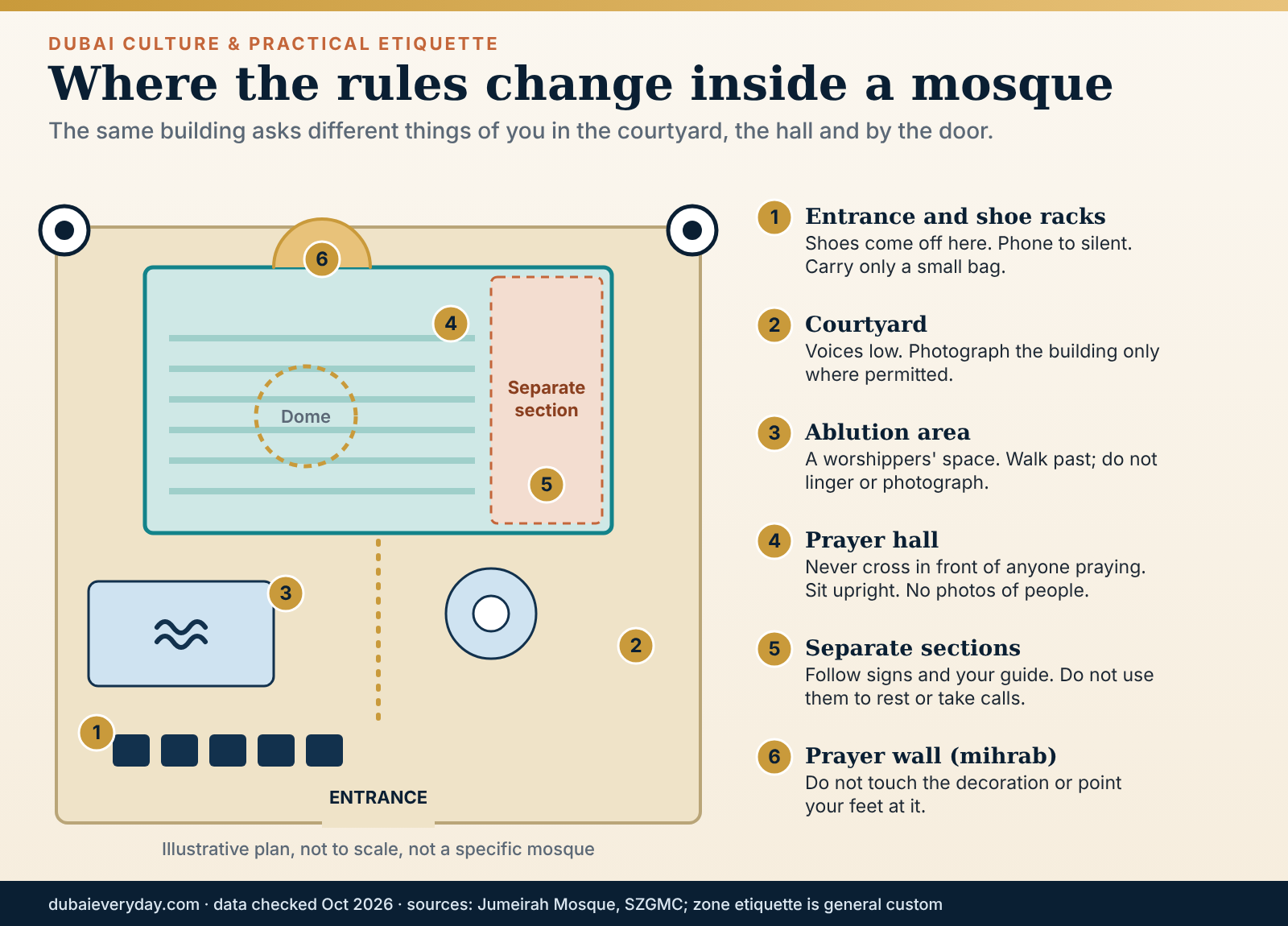
None of the official pages we read spell out the shoe rule, and that tells you something: it is assumed. The universal custom is that shoes come off before you enter the prayer area, and the floor space there is covered in carpet that people kneel on with their foreheads. Racks or cubbies are normally provided at the entrance. If you are unsure where the line is, ask your guide, or look for the shoe racks and follow what other people do.
Practical tweaks help more than they sound. Shoes you can slip off without sitting down save you from holding a queue. Clean socks are better than bare feet on shared carpets. Carry only what you must; a bag you cannot leave on the rack is another thing to manage during a silent presentation.
Moving through the building without breaking mosque etiquette Dubai rules
Walk, do not stride, and keep to the route the guide or signs indicate. Do not cross the front of anyone who is praying; wait, or go around behind. If a prayer begins while you are in the hall, the courteous reaction is to stop where you are, step back from the praying line, and stay silent until it ends. A guide will normally have arranged the visit so that this does not come up.
The call to prayer may sound while you are inside. It is not a signal to leave, and it is not background noise. Stop talking, let it finish, and carry on when your guide does.
Voices, phones and food
Switch your phone to silent before you enter, not after it rings. Speak at the volume of a library. The Sheikh Zayed Grand Mosque bans smoking on its grounds and bars food and drink, including water, to protect the marble and carpets. That is a sound default for any mosque, even where the rule is not posted. If you need a drink on a hot day, have it before you start and finish it before you reach the door.
Sitting, posture and hands
Sit upright or cross-legged if you sit at all. Lying back, stretching your legs out or putting your feet on cushions looks careless in any room that is used for prayer. Widely published guidance also suggests not pointing the soles of your feet toward the direction of prayer or toward religious books; we could not trace that to a Dubai operator, so treat it as general custom, not as mosque etiquette Dubai officials have published. Do not touch Qurans, decorative panels or lamps unless invited. The Sheikh Zayed Grand Mosque notes that delicate architectural features must be handled with care.
Greetings and the guide
Your guide is a host. Let them set the tone, and do not offer a hand to someone of the opposite sex unless they extend theirs first; our Dubai etiquette guide explains the handshake custom in more depth. A simple “thank you” at the end lands better than a long speech. If a guide asks where you come from or whether you are Muslim, that is conversation, not a test. Answer plainly.
Separate lanes and spaces
Expect men and women to be directed differently in places. The Sheikh Zayed Grand Mosque’s FAQ notes separate security lanes for women and men. Prayer halls are commonly divided or arranged so that men and women pray separately. Follow the signs, and do not use a worshippers’ section as a place to rest or take a call. In a mixed group, agree a meeting point outside before you split up at the door.
Photography at a mosque: what is allowed and what is not
Photography is where mosque etiquette Dubai guides usually go vague, so here is the split. The operators permit personal photos in defined settings. The law, separately, protects people from being photographed or filmed without consent. Custom adds one more rule that neither of them has to write down: you do not photograph people at prayer.
On the operator side, the Jumeirah Mosque public-visit page says visitors can take photographs during the visit, and gives no further rules; your guide fills in the gaps. The Sheikh Zayed Grand Mosque Centre allows personal photos and videos but limits them to designated photo stops, and requires professional filmmakers and media to get prior approval through a filming permit form. Its FAQ does not address drones or tripods, so ask before you unpack either.
As summarised in our research for the Dubai etiquette guide, Article 44 of Federal Decree-Law 34 of 2021 treats taking photos of others without consent, and publishing them, as an offence carrying at least six months in prison and/or a fine of AED 150,000 to 500,000. The UK FCDO also warns against photographing people without permission. We did not re-read the statute, and this is not legal advice, but the practical rule for photography in any mosque etiquette Dubai checklist is easy: if a recognisable person is in the frame and has not agreed, do not take the photo, and certainly do not post it.
A three-question test before you press the shutter
- Is a person recognisable in the shot?Faces, but also a distinctive outfit or a child. Worshippers, staff, other visitors and passing families all count. If yes, ask, or choose another angle.
- Is this a spot where photography is permitted?On a guided visit, your guide sets this. At the Sheikh Zayed Grand Mosque it means a designated stop. If you cannot tell, treat it as not permitted until someone says otherwise.
- Would I be comfortable if the shot were shown to the people in the room?Posing as if the prayer hall were a studio, or treating the space as a backdrop for a dance or yoga clip, tends to fail this test even where no one is in the frame.
Mosque etiquette Dubai treats praying people as off-limits, even from behind
The hardest case is the one visitors think is harmless: a single worshipper in profile, or a row of backs in perfect symmetry. It is still a photograph of a person at prayer, taken without their knowledge, and in a place where privacy matters. Leave it. If you want a shot of the prayer hall, take it when it is empty, with your guide’s agreement, or buy a postcard.
Selfies, influencers and professional shoots
A selfie at a permitted stop is fine. A tripod, a ring light, a gimbal or a second person filming you is no longer a casual personal photo, and the Sheikh Zayed Grand Mosque’s permit rule for professionals shows how seriously a large operator treats it. If you create content for a living, contact the centre first. Otherwise keep it simple: one phone, no flash, no props, nobody else’s face.
Posting afterwards: the part of mosque etiquette Dubai that follows you home
Before you upload, look at the corners of each image. A stranger half-visible in the background is still a stranger. Crop, blur or choose a different frame. It is easier to do this at the airport than to explain it later. Do not geotag a worshipper’s face, and never caption a photo of people at prayer with anything other than respect.
Exteriors, drones and the sky
Photographing a minaret from across the street is ordinary tourist behaviour. Drones are different. We did not verify current aviation rules for this page, so the only safe advice is to check the General Civil Aviation Authority rules and do not fly near religious buildings or crowds, which is both a legal and a courtesy matter.
Mosque etiquette Dubai and prayer times: how to plan around them
Muslims pray five times a day: Fajr before sunrise, Dhuhr around midday, Asr in the afternoon, Maghrib just after sunset and Isha in the evening. The times are tied to the sun, so they slide through the year. For mosque etiquette Dubai planning, the useful question is not when each prayer falls but whether your plan collides with one.
The one fixed point is Friday. The General Authority of Islamic Affairs, Endowments and Zakat announced in December 2025 that the Friday sermon and prayer would be held at exactly 12:45 from 2 January 2026, moving from 13:15, according to The National. Older websites still show 13:15, including one prayer-times page we read that no longer publishes times at all. If you rely on an old guide, you could arrive just as the sermon starts. The report was less clear about Sharjah, and we only discuss Dubai here.
Our calculation: how the five prayers move across the year
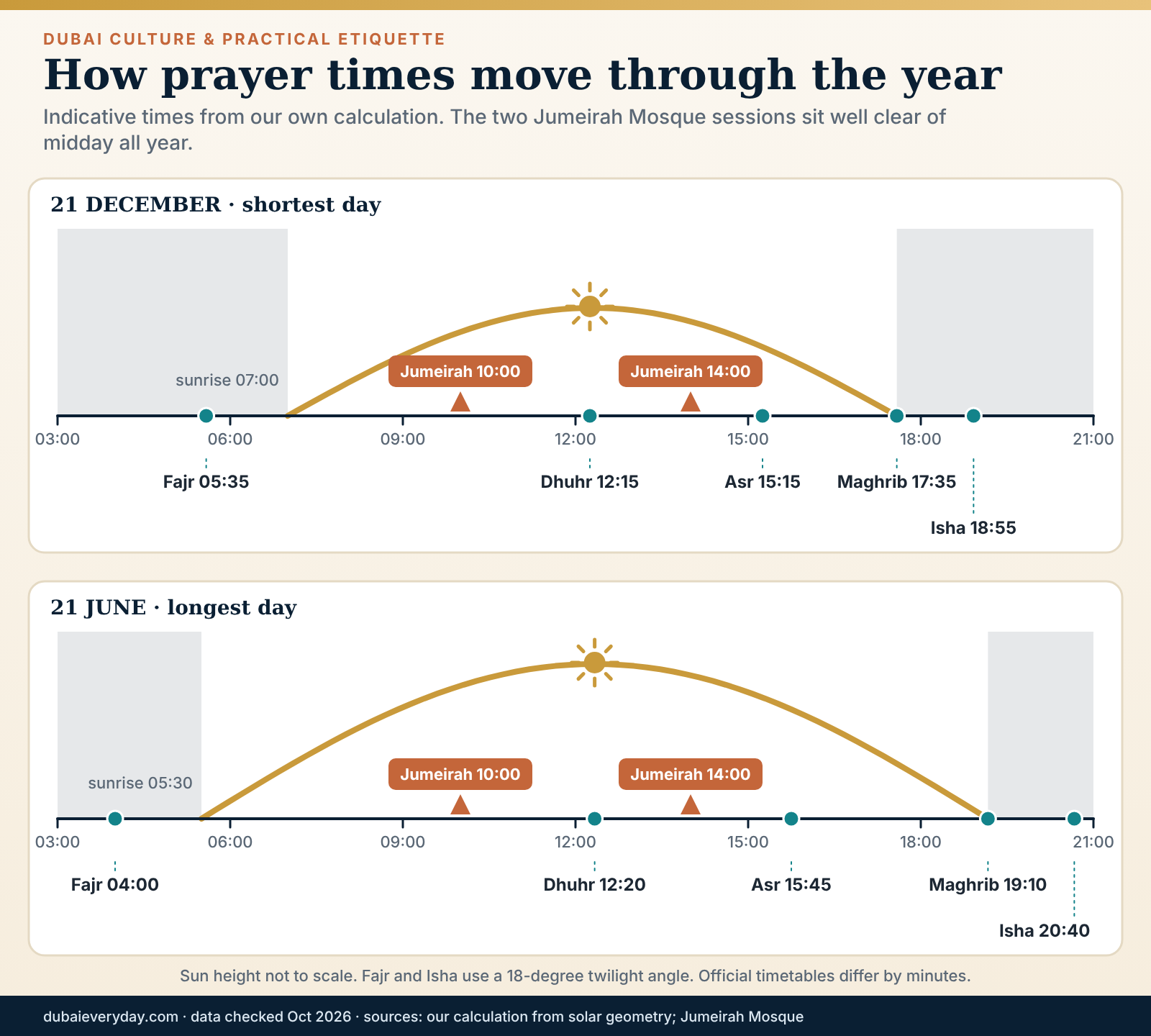
Official timetables are the thing to follow, and we have not reproduced one. To show the pattern, we calculated indicative times from solar geometry for Dubai’s coordinates (about 25.2°N, 55.3°E), using a standard twilight angle of about 18 degrees for Fajr and Isha and the standard midday-to-afternoon method for Asr. Official timetables use their own conventions and rounding and may differ by several minutes. Treat the numbers as shape, not schedule.
On 29 October the sun sets at about 17:40, Fajr falls near 05:05 and Dhuhr near 12:05. On the shortest day, 21 December, Dhuhr is near 12:15 and Maghrib near 17:35. On the longest, 21 June, Fajr moves back to about 04:00 and Maghrib out to about 19:10, with Isha near 20:40. Across the whole year Dhuhr stays within roughly 12:00 to 12:35, and Asr within roughly 15:10 to 15:55.
What this means for a Jumeirah Mosque visit
The 10:00 session sits comfortably before Dhuhr all year; midday prayer in our calculation never falls before about 12:00. The 14:00 session sits between Dhuhr and Asr. If a visit lasts about 90 minutes, as an undated blog claimed, it would finish just before the afternoon prayer window opens at around 15:10 to 15:55. Official pages give no duration, so allow slack rather than assuming.
If a call to prayer sounds during your visit, that is normal. Your guide will either pause or move on, and you should follow their lead.
Where to check the real times
Use the official timetable published by the UAE’s Islamic affairs authorities, which prayer apps and news sites usually reproduce. The calculation method differs between apps, so two apps can disagree by a few minutes. For mosque etiquette Dubai purposes you do not need the minute, you need to know that the window around midday and Friday is busy. If a mosque or centre gives you a time, that time wins.
A worked day: Saturday in January
An illustrative plan, with our indicative times. Sunrise is around 07:05, the 10:00 Jumeirah session starts with registration at 09:30, and Dhuhr falls near 12:30. If you allow two and a half hours, you are done around 12:00, which leaves you time to leave before the midday prayer crowd gathers at neighbourhood mosques on the way. Our guide to choosing restaurants in Dubai helps with lunch afterwards. In July the same plan holds, but the sun is already high by 09:30, so the morning session matters more.
Mosque etiquette Dubai on Fridays, the call to prayer and prayer rooms
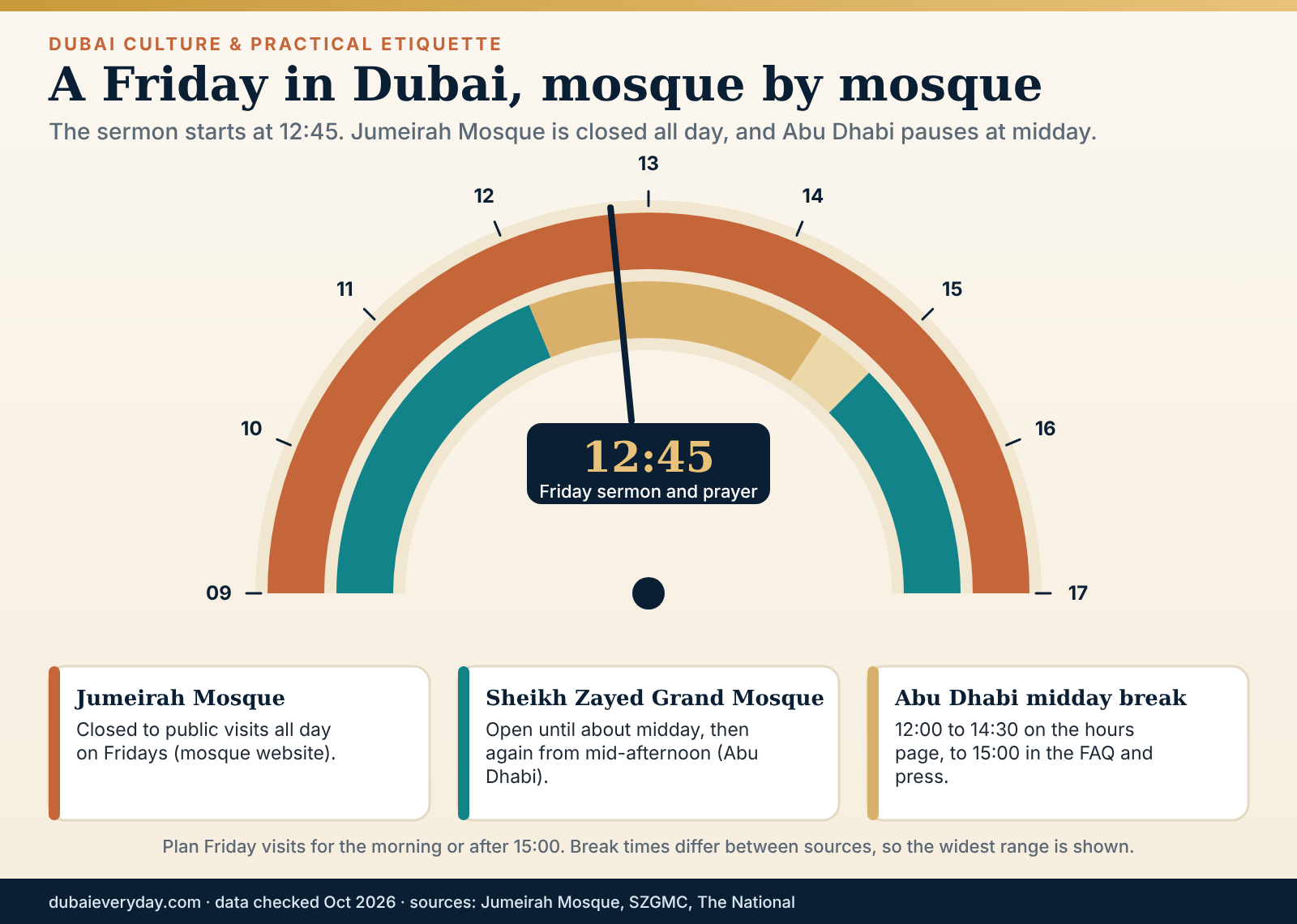
Friday is the one day of the week when the rhythm of the city bends around the mosque. The congregational midday prayer is the high point of the Muslim week, and since 2 January 2026 the sermon and prayer in the UAE start at 12:45. For mosque etiquette Dubai purposes, read Friday as a split day: mornings are workable, the middle of the day belongs to worshippers, and the afternoon returns to normal.
The operators we read all build their schedules around it. Jumeirah Mosque does not run public visits on Fridays at all. The Sheikh Zayed Grand Mosque stays open but pauses in the middle of the day. Its official hours page lists a Friday break from 12:00 to 14:30, its FAQ page says 12:00 to 15:00, and The National’s September 2026 report said the prayer hall is closed to tourists from midday to 15:00. With three versions in circulation, plan to arrive after 15:00 on a Friday, or in the morning.
What to expect around neighbourhood mosques on Fridays
We found no official description of traffic around Dubai mosques on Fridays, so this is inference. A prayer that starts at one time for everyone draws people in a narrow window, and they arrive early to find a place. Expect parked cars, people walking to the mosque, and some of the surrounding pavement in use. If you are driving through a residential neighbourhood between about 12:00 and 13:30, give yourself extra time and extra patience, and do not block a mosque entrance or the verge beside it.
If you are a pedestrian, step aside for groups walking in, and do not stop to photograph the crowd. A busy Friday is not the moment for a candid street shot.
The call to prayer is not background music
Respecting the call is one of the smaller points of mosque etiquette Dubai asks of visitors, and one of the easiest. The call to prayer, the adhan, is recited five times a day, traditionally from the minaret. Many mosques now use loudspeakers, a microphone or a recording, according to a Dubai visitor site. Treat it with the respect you would give a church bell in a quiet street: do not mimic it, and do not film yourself reacting. If it sounds while you are in a taxi or a cafe, nothing is expected of you beyond not talking over it with a joke.
If you are sensitive to early sounds, note that the first call comes before dawn. The call is audible differently depending on which side of a building you are on, so when you compare areas in our guide to choosing hotels in Dubai, a nearby mosque is one more thing to ask the hotel about rather than a defect.
Prayer rooms in malls, airports and offices
Large malls, airports and many offices have prayer rooms, usually signed, and often divided by gender. We did not check each one for this page, so this is general. The mosque etiquette Dubai expects in a prayer room is straightforward. Shoes are left outside or on the racks. The room is for prayer, not for a quiet sit, a phone charge or a call. If you walk in by mistake, step back out quietly without comment, and do not photograph the entrance or the shoes lined up outside.
Prayer breaks are part of how the city works, so a short wait for a member of staff is not a service failure. If you are planning a mall day, our Dubai Mall guide and the wider shopping guide cover the practical side of timing.
Guided visits and day trips: choosing the right one
There are three realistic ways to see the inside of a mosque from Dubai, and they suit different travellers. Choose by what you want from the visit rather than by which has the best photographs.
Jumeirah Mosque public visit
Best when you have a free morning in Dubai and want conversation, a guide and a small group. Sessions at 10:00 and 14:00, Saturday to Thursday, AED 55. Closed Fridays. Dress code is lighter than Abu Dhabi’s, and robes and scarves are lent.
Cultural programme at the Sheikh Mohammed Centre
Best when you want to ask questions in a more relaxed setting. The centre is in the Al Fahidi Historical Neighbourhood and describes cultural meals as well as the mosque visit. Book through the centre. We did not find prices on the pages we read.
Sheikh Zayed Grand Mosque, Abu Dhabi
Best when architecture and scale are the point and you can spare most of a day. Free walk-in guided tours were listed on the official pages; entry fees were reported in September 2026. Stricter dress code and no lending of abayas, according to the same report.
Sheikh Zayed Grand Mosque: the details that moved
This is the visit most people from Dubai add, and it is also the one with the most conflicting information. The official hours page says the mosque is open daily from 09:00 to 21:00, last entry 20:30, with a Friday break. The FAQ page says Saturday to Thursday from 09:00 to 22:00. The National reported 09:00 to 20:30. The simple response is to plan on arriving before 17:00 and to check the centre’s site on the day.
The National also reported a new entry fee: AED 5 for Emirates ID holders, AED 10 for tourists and AED 8 for those arriving through tour operators, with worshippers and visitors aged 60 and over free, and guided cultural tours free. A main prayer hall tour was listed at AED 30. The article gave no effective date, and the official FAQ page we read still said admission is free, so the price may be in transition. Visitors may not pray inside the main prayer hall.
The centre’s FAQ lists free walk-in guided tours led by a specialist, in English and Arabic only, lasting 30 to 60 minutes depending on which page you read, with an advice to arrive about 15 minutes early and start on the east side. The National reported tours at 11:00, 13:00 and 17:00 daily, with only the 11:00 and 17:00 on Fridays. Confirm both before you set out.
Getting there and how much time to give it
Abu Dhabi is a road trip from Dubai. Our planning estimate, not an official figure, is to budget about 90 minutes each way from central Dubai by car, longer in rush hour or with a tour pick-up route, and to treat the whole thing as a day. A live map on the morning will beat our number. If you are staying in the middle of the city, our Downtown Dubai guide shows how the area connects to the main roads.
How to choose, using a few honest questions
The mosque etiquette Dubai visitors need is the same at all three; what changes is the dress standard, the booking and the clock. If you have one free morning and want a human conversation, go to Jumeirah. If you want scale and architecture and have a whole day, go to Abu Dhabi. If you have mobility concerns, we did not find accessibility information on the pages we read, so ask the centre before you travel.
With very young children, the Jumeirah session may be less demanding than a day on the road, though neither page sets an age rule. If your trip falls on a Friday, choose the afternoon in Abu Dhabi or a different day entirely.
It is also reasonable to skip the interior altogether. A visit takes a couple of hours, requires you to dress for it, and works best when you want to listen. If that does not describe your day, admire the architecture from outside and put the time elsewhere; our things-to-do list has options.
Ramadan and Eid: mosque etiquette Dubai visitors need when it gets busy
Ramadan 2027 is projected to begin around 8 February 2027 and to last 29 or 30 days, ending around 8 or 9 March, according to The National’s report on projections by the UAE’s Astronomy Centre, updated 6 October 2026. Eid Al Fitr is expected on 9 or 10 March, subject to moon sighting. These are projections, not announcements, so treat them as planning dates and watch for official confirmation.
For a mosque visitor the month changes three things. Evenings become the busy time, because the extra night prayers and the breaking of the fast draw crowds that the rest of the year does not see. Visiting arrangements for tourists may be different. The Jumeirah Mosque page we read does not describe Ramadan visits, so we cannot tell you whether the sessions change; ask the centre before you plan. And the mosque etiquette Dubai expects in Ramadan sets a higher baseline: no eating, drinking or smoking in public in daylight, voices lowered, dress more careful than usual.
Iftar at a mosque
Some mosques in the UAE host iftar for the public, and press coverage has described Dubai mosques doing this in past years. If you are invited, arrive a little before sunset, wait until your hosts begin, and expect a pause for prayer. Ask your host if you are unsure about anything, from where to sit to when to start eating. We have not verified which Dubai mosques will host iftars in 2027, so do not plan on turning up. Our Ramadan etiquette guide covers iftar invitations, restaurant hours and the fasting-day rules in full.
Eid mornings
Eid prayers are usually held shortly after sunrise at mosques and designated prayer grounds, and they draw large numbers of families in their best clothes. Mosque etiquette Dubai on Eid morning comes down to staying clear of the crowd, not photographing it. If your trip includes the holiday, ask the centre whether public visits run on those days; we found no published Eid arrangements.
Ramadan visits, in short
- Ask the operator for Ramadan visit times; we found no published Ramadan hours for Jumeirah
- Avoid drinking water in view of the mosque entrance in daylight, even on a hot day
- Skip evenings if you want a quiet look; the area fills for night prayers
- Dress to the strictest standard and carry a scarf
- Keep photography to the building and to permitted stops
Ten mosque etiquette Dubai situations and the mistakes behind them
Every mosque etiquette Dubai guide gives a list of dos and don’ts. These ten scenarios cover what to do when the list fails you, drawing on the sources above and saying so where we are reasoning.
1. You arrive in shorts
Jumeirah Mosque asks men to avoid shorts and says robes are provided, so the fix is a kandura at the door. At the Sheikh Zayed Grand Mosque, men in shorts were reported as being refused entry. Do not argue; the robe is the courtesy. The better answer is to pack a pair of long, light trousers in the day bag.
2. Your scarf keeps slipping
Use a larger, grippier scarf than a fashion one, and pin it if you must. If it falls, put it back on calmly, away from the prayer area if possible. No one is watching to catch you out; they would simply prefer that you did not turn the tour into a styling session.
3. The call to prayer begins during the tour
Stop talking, stay where you are, and let the guide decide whether to pause or move on. If a worshipper is praying nearby, do not walk in front of them.
4. You want a picture of the prayer hall, and someone is in it
Do not take it. Ask your guide whether there is a moment when the hall is empty, or whether another angle works. A photo with a stranger at prayer in it is a legal and a manners problem together.
5. A child gets loud
Step out, calmly, and return when they have settled. The Sheikh Zayed Grand Mosque asks that children stay under constant supervision. Children are welcome there, and the expectation is that a parent keeps the visit calm for everyone else.
6. The guide asks if you are Muslim
It is a question about how to pitch the explanation, not a test. Answer honestly and briefly. A Muslim visitor who wants to pray should ask where that is possible rather than assuming; The National reported that visitors may not pray inside the Sheikh Zayed Grand Mosque’s main prayer hall.
7. You feel faint in the heat
Tell the guide, sit down, and get into shade. Covering up in summer makes heat illness a real risk, so drink before you arrive and choose the cooler session. No scarf is worth a trip to hospital.
8. You arrive on a Friday at noon
Jumeirah Mosque is closed, and the Sheikh Zayed Grand Mosque is mid-break. The mosque etiquette Dubai mistake here was in the planning, and the fix is a different day. Do not wait at the door.
9. Your partner wants a photo with a kiss or a hug
Not here. Affection in a religious setting is out of place, and the UK FCDO’s summary of local law says kissing in public can lead to arrest. Take the photo somewhere else and keep your hands to yourself in the mosque.
10. You are a resident and your guests arrive on a Friday
Plan the mosque for Saturday morning, and use Friday for something that does not depend on opening hours. If you have a weekday free, use it for the visit and give your guests the weekend for the beach. Our things-to-do guide can help you structure the days around it.
The mistakes behind the situations, ranked
Our reading of the ten scenarios is that mosque etiquette Dubai mistakes fall into three tiers. The costly ones involve people: photographing or posting images of worshippers or strangers. The embarrassing ones involve dress and shoes: turning up in shorts, swimwear or sheer fabrics. The avoidable ones involve timing: Fridays, midday, and the unsupported assumption that a mosque is open because it is beautiful.
Everything else on this page is a version of one of those three. Fix the people, the clothes and the clock, and the rest is good manners you probably already have.
FAQ
Can non-Muslims visit mosques in Dubai?
Yes, at a small number. Visit Dubai describes Jumeirah Mosque as the only mosque in Dubai that welcomes non-Muslim guests six days a week, and lists a visitor experience at Bur Dubai Grand Mosque without giving details. Other mosques are for worshippers and do not run visitor programmes that we found. Do not walk into a neighbourhood mosque uninvited, even if the doors are open.
What is the most important mosque etiquette Dubai visitors forget?
Timing and people. Visitors remember to cover up but forget that Fridays and midday are for worshippers, and that photographing recognisable people, especially anyone at prayer, can be a legal problem as well as a discourtesy. If you only fix two things, check the day and hour of your visit, and keep your camera off other people.
What should I wear to Jumeirah Mosque?
Men should avoid shorts and sleeveless tops. Women need arms, legs and hair covered. The mosque lends kanduras, abayas and scarves, but asks women to bring their own head covering if they can. The pages we read do not specify sleeve length or fabric rules, so wear loose, opaque, lightweight long clothing. Treat the stricter Abu Dhabi standard as your mosque etiquette Dubai baseline if you might visit there too.
Do I have to take my shoes off?
Yes, before entering the prayer area. It is the one piece of mosque etiquette Dubai operators assume everyone knows, so none of the official pages we read spell it out. Racks or cubbies are normally provided at the entrance. Slip-on shoes and clean socks make it simple. Never walk on prayer carpets in shoes, and carry only the bag you need, since you cannot leave it on the rack while you tour.
Can I take photos inside a mosque?
Jumeirah Mosque says visitors can take photographs during the public visit; your guide will set the limits. The Sheikh Zayed Grand Mosque allows personal photos and videos at designated stops only, and requires a permit for professionals. In every mosque etiquette Dubai checklist the rule is the same: do not photograph worshippers or strangers without consent. Cybercrime-law privacy provisions, as summarised above, carry heavy penalties.
What time is Friday prayer in Dubai?
The Friday sermon and prayer in the UAE have been set at 12:45 since 2 January 2026, according to The National’s report of a circular from the General Authority of Islamic Affairs, Endowments and Zakat. The previous time was 13:15, and older websites still show it. Check an official timetable close to your date, since announcements can change.
How much does a Jumeirah Mosque visit cost, and do I need to book?
The mosque’s public-visit page lists AED 55 per person (about USD 15) including light Emirati refreshments, with sessions at 10:00 and 14:00, Saturday to Thursday. It says no advance booking is required for public visits. The Sheikh Mohammed Centre takes bookings for its own programmes by form, WhatsApp or email, so for larger groups it is sensible to contact them first.
Can children visit a mosque in Dubai?
We found no age rule on the Jumeirah pages; an undated blog mentioned a minimum age of five, which we could not confirm, so ask the centre. The Sheikh Zayed Grand Mosque says children are welcome under constant parental supervision. Apply the same mosque etiquette Dubai standard to children as to adults, choose the earlier session and be ready to step out quietly if they get restless.
Can I visit a mosque during Ramadan?
Possibly, but we found no published Ramadan arrangements for Jumeirah Mosque, so ask the centre. Ramadan 2027 is projected to start around 8 February, with Eid Al Fitr on 9 or 10 March. During the month, the mosque etiquette Dubai expects includes avoiding eating, drinking or smoking in public in daylight, and you should expect evenings to be crowded for night prayers.
Is the Sheikh Zayed Grand Mosque worth the trip from Dubai?
It depends on what you want. It is a full day for scale and architecture, with a stricter dress code, free walk-in tours on the official pages and a reported entry fee from September 2026. Jumeirah is the simpler choice for a morning with a guide. If you are short of time or travel on a Friday, Jumeirah or the exterior views are lower-risk.
Related reading
Sources and further reading (18 links)
- Jumeirah Mosque: public mosque visit — session days and times, price, registration, no advance booking, photography
- Jumeirah Mosque: dress code — rules for men and women, garments provided on site
- Jumeirah Mosque: official website — opening year, majlis hours, address, extras listed, private visit option
- Sheikh Mohammed Centre for Cultural Understanding — majlis registration, booking by form or WhatsApp, cultural programmes
- Visit Dubai: Jumeirah Mosque — welcomes non-Muslim guests six days a week
- Visit Dubai: Bur Dubai Grand Mosque — listing of a mosque experience for non-Muslims
- Visit Dubai: mosques in Dubai — introduction stating that some mosques offer guided tours
- Visit Dubai: how to experience Ramadan in Dubai — official Ramadan visitor context
- Sheikh Zayed Grand Mosque Centre: opening hours — daily and Friday hours
- Sheikh Zayed Grand Mosque Centre: FAQs — dress, photography, tours, children, hours, security
- Sheikh Zayed Grand Mosque Centre: mosque manners — dress, food and drink, smoking, supervision
- The National: Sheikh Zayed Grand Mosque introduces entry fee — reported fees, tour times, dress detail
- The National: UAE Friday prayers timing change — Friday prayer moved to 12:45
- The National: Ramadan 2027 UAE dates — projected Ramadan and Eid dates
- UAE Legislation: Federal Decree-Law 34 of 2021 on cybercrime — privacy and photography provisions, as summarised in our etiquette research
- UK FCDO: UAE safety and security — photography, public affection and dress guidance for travellers
- MyBayut: mosque tours in the UAE — secondary blog, used only as an example of outdated details and an unconfirmed lead
- Dubai Online: prayer times — secondary site, used for the names of the five prayers and as an example of an outdated Friday time
Update log: 29 October 2026 — first publication; facts re-checked against the sources above, except the cybercrime-law and FCDO points, which were re-used from our Dubai etiquette research. Next review due: 8 January 2027, ahead of Ramadan 2027, then annually, and sooner if mosque etiquette Dubai details change, such as Jumeirah Mosque visit times or prices, the Friday prayer time or Sheikh Zayed Grand Mosque fees change. Corrections welcome. This page is general information about visiting mosques, not religious or legal advice.
About DubaiEveryday and this guide
DubaiEveryday.com is an independent editorial project that publishes practical, research-based guides to everyday life in Dubai: where to live, what things cost, how the rules work and how to get around. This page was written and edited by the DubaiEveryday editorial team. It is not signed by a named expert, doctor, lawyer or adviser, and we do not claim first-hand testing of a venue, clinic or service unless the page says so.
Each guide is built from official sources such as government and regulator pages, operator websites and established news outlets, cross-checked where we can. When we could not confirm something, we say so in the text, and examples that use made-up numbers are labelled as illustrations. Mentions are editorial choices, not paid placements, and a link is not an endorsement.
Dubai changes quickly. If you spot something that is out of date or wrong, please tell us through the contact options on DubaiEveryday.com and we will check it and correct the page.