

Shopping in Dubai is easy to do badly: the wrong mall for the job, a gold price you cannot decode, a sale that was never a sale, a refund you forgot to validate. This guide sorts malls, souks, luxury, outlets, tax refunds and sales into a plan you can actually follow, and says plainly what is worth buying.
Everyone tells you Dubai is a shopping city, so you arrive with an empty suitcase and a vague plan to “see the malls”. Three hours and one very large food court later, you are not sure what you actually bought or whether it was a good price. Big places reward a plan.
Shopping in Dubai is easier once you match each place to a job: malls for breadth, souks for gold and spices, outlets for last season, sales windows for real discounts. This guide covers all of them, plus how a gold price is built and how the tourist VAT refund works. You will skip the common slip-ups and know what is truly worth carrying home.
Shopping in Dubai works best when you match the place to the job. Malls give you air-conditioned breadth and brands, souks give you gold, spices and textiles you can negotiate over, outlets give you last-season stock, and the big sale windows give you the only discounts worth planning a trip around. For most visitors the strongest plan is one anchor mall, one morning in an old-town souk, and a calendar-aware approach to timing, rather than a long list of stops.
Three facts decide most of the money. Displayed prices already include 5% VAT, and eligible tourists can reclaim most of it: 87% of the VAT, minus AED 3.60 per invoice, on invoices of at least AED 250 before VAT. The main sale windows follow fixed calendars: the Dubai Shopping Festival runs 4 December 2026 to 17 January 2027, and Dubai Summer Surprises ran 2 July to 30 August in 2026. And gold is priced by weight, karat and a making charge, so a single sticker price tells you very little.
The sections below cover how to choose a mall, how the souks work, how to read a gold bill, how to claim the refund, when prices genuinely fall, and how to judge authenticity, warranty and returns. Everything was checked against official or operator sources on 29 October 2026; nothing was field-tested.
This is a desk-research guide to shopping in Dubai. DubaiEveryday.com has not walked these malls, haggled in these souks or queued at these refund kiosks, and nothing here describes a personal visit. The rules on tourist refunds come from the UAE Federal Tax Authority and the refund operator’s published FAQ. Mall hours, expansions and outlet details come from the operators’ own sites where they could be read, and from press reports where they could not. Festival dates come from Visit Dubai and trade press.
Where an official page could not be loaded or did not state a number, we say so and give a labelled range or no figure at all. Calculations marked “our calculation” use only the inputs shown. Mall and souk selection is research-based and was not paid for; there are no affiliate links and no booking links. This is general information, not individual legal, tax or financial advice. Confirm prices, hours and refund terms with the shop or operator before you buy.
What is new for shopping in Dubai in 2026-27
Most shopping in Dubai advice online was written before the autumn of 2026, so start with what has moved. The numbers below are the ones that change what you do at the till, not trivia about square metres.
The refund fee dropped in July
The Federal Tax Authority’s tourist-refund page currently shows two deductions: 13% of the VAT you ask back, and AED 3.60 per tax-free transaction. A tax-news report dated 4 August 2026 says the fixed fee was cut with effect from 12 July 2026 under an FTA decision, with the 13% share, the AED 35,000 cash cap and the AED 250 minimum unchanged.
That report is secondary, and we could not read the decision itself, so treat the effective date as “reported” and trust the figure on the FTA page. The practical effect is small per invoice, but for anyone shopping in Dubai on a tourist visa it rewards fewer, larger invoices.
The sale calendar is already published
The 32nd Dubai Shopping Festival is scheduled from 4 December 2026 to 17 January 2027, 45 days in all, organised by Dubai Festivals and Retail Establishment. Trade press reports citywide promotions, raffles and mall activations, with the full programme still to be announced when we checked.
The summer equivalent, Dubai Summer Surprises, ran 2 July to 30 August in 2026 with up to 90% off at more than 100 participating brands; its 2027 dates had not been published. The sales section later shows how to use both for shopping in Dubai without being herded.
Big malls are mid-expansion
Two of the largest destinations for shopping in Dubai are being rebuilt around shoppers. Emaar announced The District, a precinct inside Dubai Mall on the former Souk area, with 279 new outlets (198 retail, 81 food and beverage) in a AED 1.5 billion expansion; the announcement described an initial selection open and more phases to come, with no completion date. Mall of the Emirates is in the middle of a reported AED 5 billion programme that adds a precinct called The Hangout, described by the mall as an indoor-outdoor destination with 15 dining venues and four entertainment concepts.
Building work can change routes and parking, so check each mall’s site before a long trip.
Global Village is back for its 31st season
Global Village opened Season 31 on 14 October 2026 and runs to May 2027 with no closing day published on its site. It opens at 16:00 daily, closing at midnight Sunday to Wednesday and 01:00 Thursday to Saturday, with Tuesdays reserved for ladies and families.
Entry is listed at 25 for a weekday ticket and 30 for any day, VAT included; the page does not state the currency, and press reports give AED. It is a seasonal market-and-entertainment site, not a discount destination, so for shopping in Dubai on a budget, treat it as a place to browse gifts, not to chase bargains.
Ramadan 2027 will shift opening hours
Ramadan is expected to begin around 8 February 2027, with the exact start depending on moon sighting (our calendar estimate; confirm closer to the date). Mall hours, sales and the pace of shopping in Dubai change for the month. The Dubai etiquette guide covers daytime eating, dress and behaviour, and the events calendar is the place to track the rest of the year’s dates.
The map: which part of Dubai for which shopping job
Dubai is a long, thin city stretched along the coast, and shopping in Dubai follows that line. Old trading districts sit on either side of the Creek in the north-east. The big modern anchors cluster around Sheikh Zayed Road and Downtown in the middle. Newer neighbourhood malls and the waterfront strips sit to the south-west, and the outlet and wholesale-style destinations sit well inland. The schematic below places the destinations discussed in this guide by area. It is not to scale, and distances between pins are deliberately compressed.
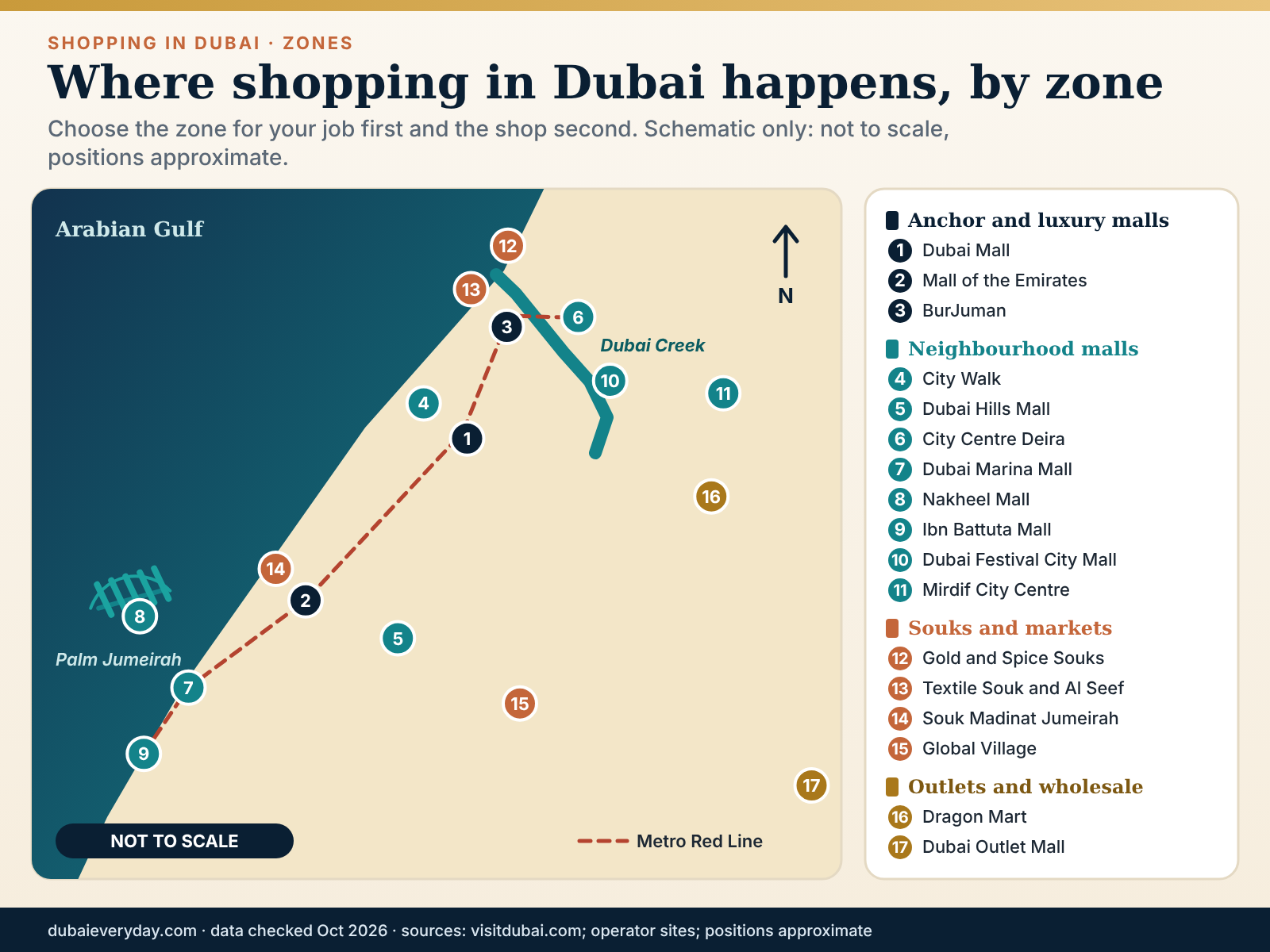
Think in zones when shopping in Dubai, not in shop names
Travel time is the hidden cost of shopping in Dubai. A mall that looks ten minutes away on a map can take three times that at the Friday evening or Saturday peak, and the heat from May to September makes any outdoor leg feel longer than it is.
So the first decision is the zone, not the store. If you are staying in Downtown, the Marina or the Palm, your default anchor is the nearest big mall, and you add one old-town morning rather than trying to cross the city twice.
A rough way to choose: pick the zone that matches your main job, then add a second zone only if the job needs it. A luxury job points to Downtown or Al Barsha. A gold or textile job points to the Creek districts. A bargain job points inland to the outlets. An everyday-household job points to the nearest neighbourhood mall and, for groceries, to the supermarket chains covered in the supermarket guide.
Where each zone fits
Downtown and Business Bay
Home of the largest mall and the densest luxury strip. Good when you want everything in one air-conditioned building and a Metro connection. The Downtown Dubai guide covers the district itself.
Al Barsha and Sheikh Zayed Road
The second great anchor mall sits here, along with a Metro station named after it. Suits families who want shops plus an indoor attraction under one roof.
Creek districts: Deira and Bur Dubai
The old trading core. Gold, spices, textiles and fragrance markets, older malls with long-established brands, and the AED 1 abra crossing between the two banks.
Marina, JBR, Palm and Ibn Battuta
Waterfront and neighbourhood malls for people who live or stay in the south-west. See the Marina guide and the Palm Jumeirah guide for the districts.
Dubai Hills, City Walk, Mirdif, Festival City
Newer and residential-led malls and open-air streets, useful if you are staying or living nearby and want a quieter visit than the headline malls.
Inland outlets and wholesale halls
Dubai Outlet Mall and the Chinese-goods halls of Dragon Mart sit far from the coast. They need a plan for getting there and back, and a clear idea of what you are hunting.
Heat rule. Mean daily highs at Dubai airport run from about 24 degrees in January to about 42 degrees in July and August (NOAA 1991-2020 normals, via a reference compilation). Our reading: from June to September, shopping in Dubai is an indoor sport, and souk visits belong before 10:00 or after sunset. In winter the same souk walk is pleasant at midday. The best time to visit Dubai guide has the full seasonal picture.
Choosing a mall for shopping in Dubai
Dubai has more malls than anyone shopping in Dubai can use in one trip, and they are not interchangeable. The decision tree below turns the choice into six questions about the job you actually have. Treat it as a first filter, then read the notes on each cluster that follow. For the largest mall in detail, including parking, floor logic and time planning, the companion Dubai Mall guide goes much deeper than this page does.
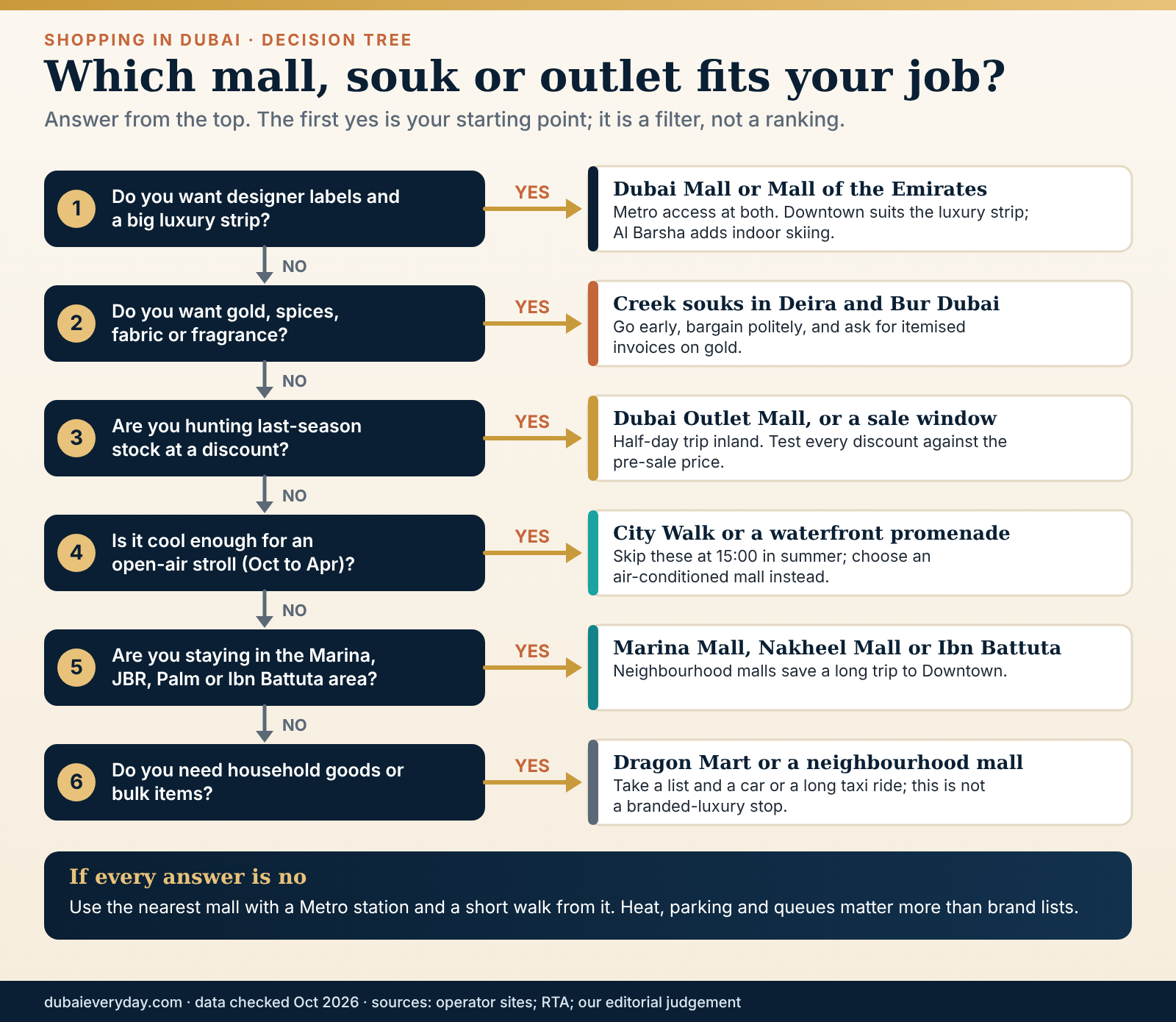
Dubai Mall: the one-building answer
The Dubai Mall’s own site describes Fashion Avenue as home to more than 200 luxury brands, and Emaar’s materials, as relayed by the press, put the mall at over 1,200 retail stores and 200 restaurants across more than 3.8 million square feet of retail area. Retail hours listed on the mall’s page are 10:00 to 23:00 Monday to Thursday and 10:00 to midnight Friday to Sunday, with restaurants and food courts open an hour later. The page also lists Souk Al Bahar, Chinatown and the Exhibition Center as sections.
It is the right choice for shopping in Dubai if you want the widest range of mainstream and luxury brands in a single trip, or if the job includes an attraction such as the aquarium or the fountain evening.
It is the wrong choice if you want a quick errand: the building is large enough that a single-item run can eat an hour in walking and parking. Parking is tiered, with the first four hours free on weekdays and the first six at weekends according to the mall’s paid-parking page, then rising steeply, so a long visit by car has a real cost.
By Metro, the Burj Khalifa/Dubai Mall station connects to the mall by an air-conditioned walkway that press coverage of its 2012 opening put at 820 metres. At an ordinary pace, our estimate is ten to twelve minutes, helped by travelators. That is a feature in July and a minor chore in January.
Mall of the Emirates: shopping plus a snow slope
Mall of the Emirates, in Al Barsha, is the other anchor. Its own site lists indoor skiing under entertainment and shows hours of 10:00 to 23:00 on the day we read it. The Red Line has a station named after the mall, so the Metro is a realistic way in.
The mall is in the middle of a reported AED 5 billion upgrade (adding around 100 stores and an outdoor dining courtyard, according to a Gulf News report from April 2025, with the outdoor food courtyard timed for early 2027), so some areas may be under works.
Choose it if you are staying around Al Barsha, the Marina or Sheikh Zayed Road and want a full-scale mall without crossing to Downtown. Choose Downtown instead if the luxury strip is the point. If you are comparing the two for a family day, the Dubai with kids guide and the indoor things to do page help weigh the attractions.
Deira, Bur Dubai and the older malls
Around the Creek sit the established malls that long predate the Downtown boom: City Centre Deira, BurJuman, Al Ghurair Centre and others. BurJuman has a Red Line station of the same name. Their appeal is practical rather than glamorous: mainstream brands, department stores and food courts, often paired in a day with the souks a short ride away. A sensible pattern is souks in the morning, a mall lunch in the cool, then a taxi or Metro back.
These malls also make sense for residents of the older districts, where they function as the neighbourhood’s everyday retail. We could not confirm current store counts from the operators’ pages, and reference listings differ, so we do not quote any.
Mirdif, Festival City, Dubai Hills and City Walk
The newer or residential-led destinations serve the communities around them. Mirdif City Centre and City Centre Deira appear, alongside Mall of the Emirates, among the Majid Al Futtaim venues named in the 2026 summer-sale coverage, which is useful when timing a visit to a sale. Dubai Festival City Mall and Dubai Hills Mall are anchors for their own districts. City Walk is an open-air street-style destination, which is pleasant from late October to April and a poor choice at 15:00 in August.
For visitors, these are second-day options for shopping in Dubai: less crowded than the headline malls on weekdays, but without the same breadth of luxury. For residents, they are often the real answer, because a mall ten minutes from your door beats a famous one forty minutes away.
Marina, JBR, Palm and Ibn Battuta
Along the south-west waterfront, Dubai Marina Mall serves the Marina towers, Nakheel Mall serves the Palm (a reference listing gives its opening as 1 January 2020), and Ibn Battuta, on the Red Line with a station of the same name, serves the Jebel Ali side of Sheikh Zayed Road.
For everyday shopping in Dubai’s south-west, these are convenience-and-lifestyle malls: fashion, food, services and cinemas, with fewer flagship luxury stores. If you are staying in the area, they save a long trip to Downtown, and the district guides for the Marina and Palm Jumeirah show what else is nearby.
Dragon Mart and the wholesale-style halls
Dragon Mart is a different category of shopping in Dubai: a very large hall complex that, per its own site, sells furniture, home goods, office equipment, sports gear, electronics, building materials and more.
The site gives hours of 10:00 to 22:00 Sunday to Thursday and until 23:00 on Friday and Saturday, and quotes both more than 5,000 shops and kiosks and more than 3,500 outlets in different places, so treat the count as “thousands”. It suits furniture, home goods, hardware, small appliances and bulk buying, and it is not a mall in the fashion-and-brands sense.
It sits well away from the coast, so it needs a car or a long taxi ride and an actual shopping list. It is not a place to buy branded luxury, and you should treat any “designer” claim there with the scepticism discussed in the authenticity section.
A simple tiebreaker. When two malls look equally good, choose the one with a Metro station and a short walk from it. A taxi is the easy fallback, but a taxi queue at 21:30 on a Saturday is not easy, and your bags get heavier with every hour. The Dubai Metro guide covers fares, hours and the Nol card.
Souks and old-town markets: shopping in Dubai the traditional way
Souks are the part of shopping in Dubai that a mall cannot copy: narrow lanes, shopkeepers who will name a price and expect a reply, and goods sold by weight, by the metre or by the bundle. They are also where most disappointment happens, because visitors arrive without knowing what a fair opening price looks like. The notes below say what each market is good for and what to watch.
Deira: gold, spice and fragrance
Across the Creek on the Deira side, the best-known lanes specialise. The Gold Souk is a dense run of jewellery shops. The Spice Souk sells spices, dried fruit, incense and herbs, and the Perfume Souk deals in oud, attars and bottled fragrance. The Green Line has a station in the Gold Souk area; station names change with naming-rights deals, so check the current name on the RTA map rather than relying on an older guide.
Our reading of how these markets work, as a framework rather than a survey: the Gold Souk is organised around a simple logic (the metal at the day’s per-gram rate, plus a making charge, plus VAT), the Spice Souk rewards buying small and fresh rather than in bulk, and the fragrance lanes reward a patient nose and a willingness to say no. None of them has a single official price list that we could find, which is why the checks in the next sections matter.
A reference source puts the Gold Souk in Deira’s Al Ras area near Baniyas Square and counts more than 380 retailers, mostly jewellery traders, with loose stones and bullion also sold. The same source notes Dubai Municipality plans to renovate the souk and expand the Dubai Gold District, with work described as expected soon as of September 2024. We could not confirm the current state of any works, so check for diversions before you go.
Bur Dubai: textiles and the heritage waterfront
On the Bur Dubai bank, the Textile Souk is the place for fabric by the metre, scarves and shawls, and for tailors who can turn cloth into a garment. Quality varies enormously, and a shawl described as pure wool or pashmina on a stall is not proof of fibre content. A simple test, widely used, is to ask for a fabric label and for the price per piece in writing; if the seller cannot show a label, price accordingly.
Nearby, Al Seef is a waterfront promenade built in a heritage style, with shops, cafés and an easy walk beside the water. It is more curated than the old lanes, and prices tend to follow tourist-district logic rather than the logic of the souks proper. A Creek morning that links the textile lanes, the heritage district and an abra ride across to Deira is one of the cheaper and more varied half-days available; the things to do in Dubai guide shows how it fits into a wider itinerary.
The abra crossing
The cheapest way between the two banks is the abra. The Roads and Transport Authority lists the standard motorised abra at AED 1 per crossing, cash. The route runs between the Bur Dubai and Deira Old Souq abra stations in both directions.
Petrol heritage abras on Creek routes such as Al Seef to Baniyas are listed at AED 2, and charters and tourist cruises cost more, so look at the posted fare before you board. The crossing is short enough that it works as a mid-morning break rather than a separate activity.
Karama and other local markets
Karama is a residential district known for local-priced clothes, souvenirs and household goods. It is where residents do everyday shopping in Dubai for bargains, and also where the sale of counterfeit goods has historically been reported. Counterfeits are illegal to sell in the UAE, and buying them carries its own risks (including seizure by customs on the way home). If you want a genuine logo, buy it from an authorised retailer; if a branded watch is a tenth of the shop price, the label is the product, not the watch.
Souk Madinat Jumeirah and Souk Al Bahar
Two modern, souk-styled complexes sit inside larger developments. Souk Madinat Jumeirah belongs to a hotel resort complex and Souk Al Bahar is listed on The Dubai Mall’s own site as one of the mall’s sections. They are air-conditioned or shaded, easy to reach and good for gifts and a meal. They are also priced for visitors, so use them for convenience and atmosphere, and use the older markets for price discovery.
Global Village, the seasonal market
Global Village is a seasonal market-and-entertainment park organised by country pavilions. Season 31 opened on 14 October 2026 and runs to May 2027, according to its official site. Its published hours are 16:00 to midnight Sunday to Wednesday and 16:00 to 01:00 Thursday to Saturday, with Tuesdays for ladies and families, and entry is listed at 25 on weekdays and 30 on any day, VAT included.
It is a good place to browse regional crafts and sweets in one evening, and a poor place to test a price comparison, because stall prices reflect a captive crowd.
How to bargain without drama. Our rule of thumb, drawn from how bargaining is usually described: ask the price, pause, and counter at roughly two-thirds of the first quote on goods that do not carry a visible price tag. Smile, stay civil and be ready to leave; the price often drops as you reach the door. Do not bargain in a fixed-price shop, and never negotiate the day’s metal rate on gold, only the making charge. The etiquette guide covers the broader manners.
Timing a souk visit
Many traditional shops keep long hours with a break in the afternoon, and individual hours vary shop by shop; we could not verify a single official timetable for the souks, so check on the day. Our recommendation for souk shopping in Dubai is to arrive around 09:30 to 10:00 in winter and before 10:00 in summer, when the lanes are cooler and quieter, and to schedule the mall for the hot afternoon. In winter, an early evening visit works because the lanes light up and the temperature drops.
What to wear for the souks
Dress modestly, in breathable fabrics, with comfortable shoes for uneven surfaces. Shoulders and knees covered is a safe standard in the old districts, and it keeps you cooler in the sun as well as being respectful. The Dubai dress code guide lists what malls, beaches and mosques expect.
Gold and jewellery: how the price is built
Gold is the category where shopping in Dubai most rewards a little arithmetic and most punishes a lot of enthusiasm. The reputation for gold here rests on a transparent structure: a per-gram rate for the metal, a making charge for the craftsmanship, and VAT on top. If a shop will show you all three on an itemised invoice, you can compare it with any other shop in the street. If it will not, you cannot compare anything.
Karat: what the number means
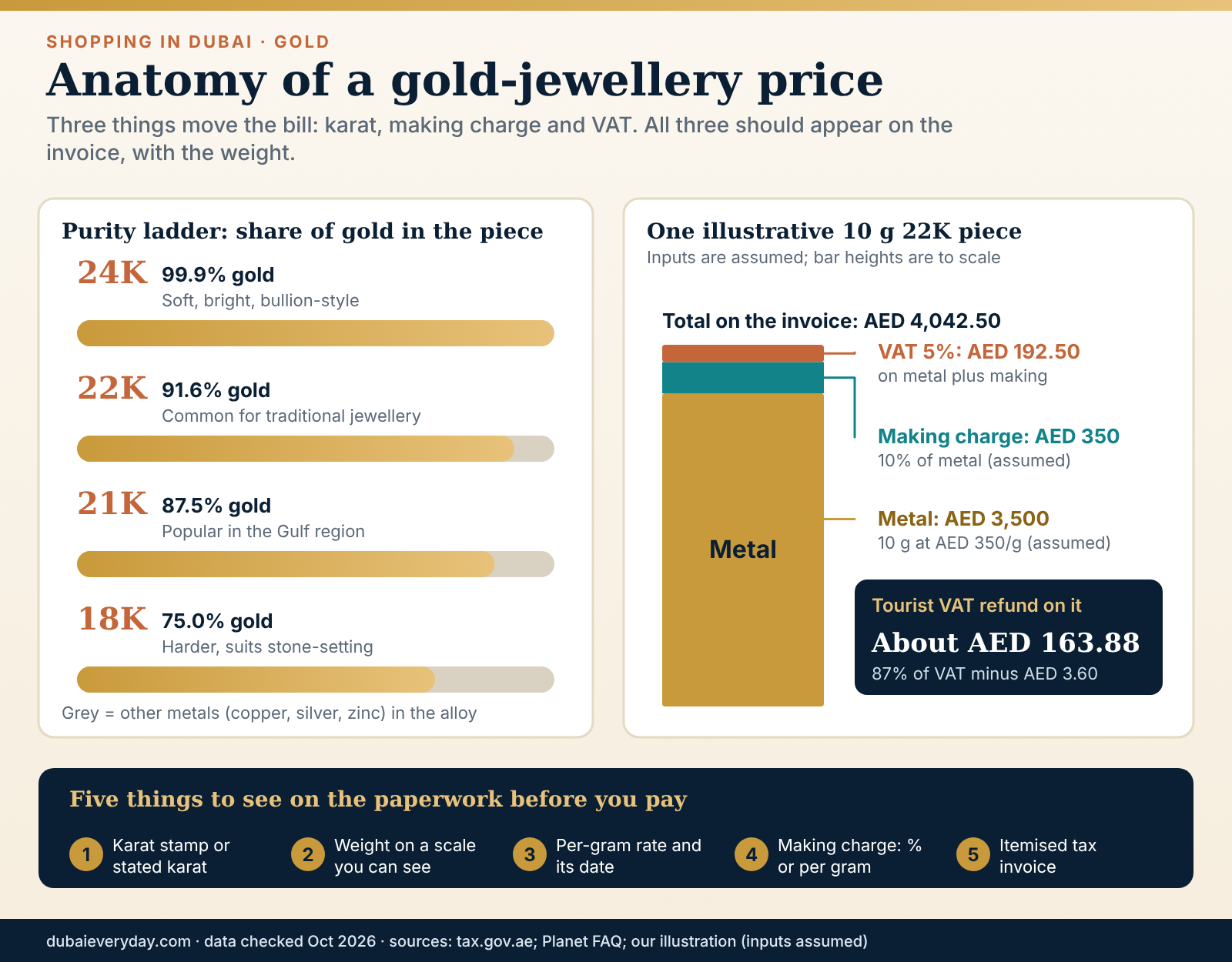
Karat measures purity in twenty-fourths. Pure gold is 24 karat. A 22 karat piece is 22 parts gold in 24, which is about 91.7% (usually written 91.6% or marked 916). A 21 karat piece is 87.5%, and 18 karat is 75%. The rest is other metals, which add hardness and change the colour. Higher karat means more gold per gram, a softer metal and a higher metal cost per gram; lower karat means a harder piece that holds stones more securely. Neither is “better”; they suit different pieces.
The first rule: never compare a 22 karat price with an 18 karat price. Compare like for like, or convert. Because the arithmetic is linear, a gram of 18 karat contains about 82% as much gold as a gram of 22 karat (75 divided by 91.7), so it should cost roughly that proportion in metal terms before making charges and design.
The three-line bill
A clean gold invoice has three lines that matter. The metal line is the weight of the piece times the day’s per-gram rate for that karat. The making line is the craftsmanship charge, quoted either as a percentage of the metal or as an amount per gram. The tax line is 5% VAT on the sale.
In the illustration above, a 10 gram, 22 karat piece with assumed inputs of AED 350 per gram and a 10% making charge comes to AED 3,500 in metal, AED 350 in making and AED 192.50 in VAT, for AED 4,042.50. Those inputs are ours, chosen to show the structure. The real rate changes through the day with the world gold price, so ask for the current figure and its time.
VAT treatment is worth a sentence. As we understand the Federal Tax Authority’s VAT rules, jewellery is standard-rated at 5%, while investment-grade metal bars and coins that meet purity and documentation conditions are treated differently. We did not re-read that guidance today, so confirm with the FTA or your accountant if the purchase is large.
For a tourist, the useful point is that jewellery VAT can be claimed back under the tourist scheme described later, and that the scheme’s published exclusions (perishables, vehicles, services, cargo and used goods without packaging) do not list jewellery.
Where the room to negotiate actually is
In most gold shops you will meet while shopping in Dubai, as commonly described, the metal rate is the day’s rate and is not negotiable; the making charge is where the shop has margin, and the margin is what you are bargaining over. On our illustrative piece, each percentage point of making charge is worth AED 35 in making plus AED 1.75 in VAT on it, so AED 36.75.
Haggling a quoted 15% down to 8% would save 7 points, or about AED 257 in total on that piece. That is real money, and it is also why a shop quoting an unusually low making charge needs a second look at the metal line.
Two other levers matter more than they seem. First, weight: ask for the piece to be weighed on the scale in front of you and have the weight written on the invoice. Second, price per gram of the whole piece: divide the final price by the weight to see the all-in cost per gram, and compare that across shops after converting to the same karat. If one shop’s all-in figure is far below the others, find out why before you celebrate.
Paperwork that protects you when shopping in Dubai
- An itemised tax invoice showing karat, weight, per-gram rate, making charge and VAT, in the name on your passport if you will claim a refund.
- A stated return or exchange policy in writing, including what happens if you later sell the piece back (shops commonly deduct the making charge on buy-back, which is why jewellery is a poor store of value).
- For diamonds or gemstones, a certificate from an independent grading laboratory, and a check that the certificate number matches the stone.
- Payment by card or another traceable method rather than bundles of cash, so that you have a record if a dispute arises.
We could not load a primary source describing the official hallmarking or testing regime for gold sold in Dubai, or the rate benchmark that shops follow. Do not assume a piece has been independently tested because the shop is in a famous street. Ask for the karat marking and a tax invoice, and use the Dubai Department of Economy and Tourism’s consumer-complaint channel if a piece is sold as a purity it does not have.
Gold as a purchase, not an investment
Of everything on offer when shopping in Dubai, gold jewellery is worth buying for what it is: something to wear, give or keep. The making charge, VAT and the retail margin mean you will rarely get back what you paid, even if the metal price rises.
If your aim is to hold gold as a store of value, a different product and a different dealer are involved, and that is a financial decision for a licensed adviser, not a shopping tip. For a gift, a heavier 22 or 21 karat piece in a plain design carries a smaller share of making charge per gram than an elaborate one, which is simply arithmetic: the more labour in a piece, the more of the price is labour.
Comparing shops in an afternoon
A practical method for shopping in Dubai’s gold lanes, which takes about an hour: choose two or three pieces in the same karat and weight range, visit three shops, and ask each for the same three numbers (rate, making charge, total). Write them down. The shop with the lowest all-in price per gram is not automatically the best, because design quality and after-sales policy matter, but the list you build in an hour will make it hard for anyone to sell you a single “special price” without scrutiny.
Finally, schedule gold for the beginning of a trip, not the end. If you buy early you have time to test your own comparisons, return to the best shop and, if something is wrong with a piece, get it sorted before you fly. The tourist refund also asks you to validate within 90 days and to leave within six hours of validating, and staff may inspect goods at validation, so keep high-value items unpacked and to hand until that desk has stamped them.
Luxury shopping in Dubai: Fashion Avenue and beyond
Luxury is where the headline promise of shopping in Dubai is strongest and the evidence for a bargain is weakest. The city has a very deep supply of designer boutiques, and the tourist VAT refund shaves the effective tax rate to under 1% on large invoices.
But whether a particular bag, watch or pair of shoes is cheaper here than at home depends on the brand’s own pricing in each market, which no guide can promise, and on what happens at your home border. What a guide can do is give you a way to check.
Where the luxury is concentrated
Downtown’s Fashion Avenue is the obvious starting point: the mall’s own site describes more than 200 luxury brands there, and the District expansion adds further luxury outlets inside the same building. Mall of the Emirates is the other big address, and BurJuman in Bur Dubai has long been a luxury-oriented mall on the old side of the Creek.
Gate Avenue in the Dubai International Financial Centre is a smaller luxury-and-lifestyle strip, which a reference source lists at around 185 outlets. For hotels, spas, yachts and concierge-level shopping, the Luxury Dubai guide takes the premium end further.
A three-step price check for luxury shopping in Dubai
- Get the exact model and reference number.Brands often use different product codes in different regions, so a “same” bag can be a slightly different item. Photograph the label, note the reference, and compare like with like.
- Convert the Dubai price to your currency after the refund.Take the shelf price, subtract the refundable VAT (87% of the 5/105 share of the price, minus AED 3.60) and convert at your card’s actual rate, including any foreign-transaction fee.
- Compare with the home price including tax, then add the border.Your home price should be the full tax-inclusive shelf price. If your country charges import tax above a duty-free allowance, add it to the Dubai figure before deciding.
Our calculation: how much can the refund move a luxury price?
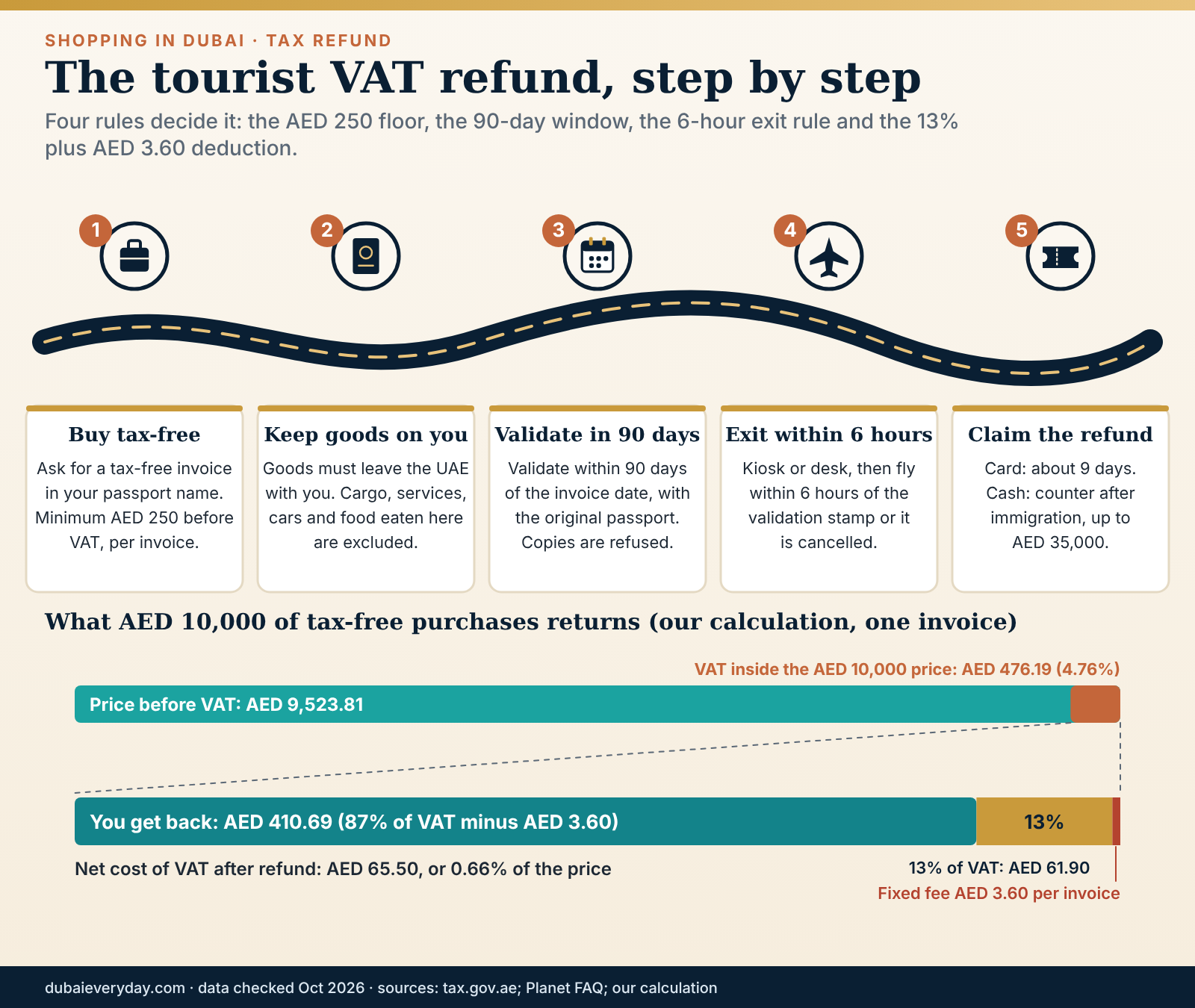
Take an item priced at AED 10,000 on the shelf (about USD 2,723 at the peg of 3.6725). Of that, AED 476.19 is VAT. The refund is 87% of that, AED 414.29, minus AED 3.60: AED 410.69. Your net cost is AED 9,589.31, about USD 2,611. That is a saving of about 4.1% against the shelf price, and the effective VAT you bear is AED 65.50, or 0.66% of the price.
So for a home market with a 20% sales tax, the home price must be above roughly USD 2,611 before duty for the Dubai purchase to win on tax alone, and it needs to be considerably above that if the home country taxes goods carried back above your allowance.
For a home market with a low or zero sales tax, as in several US states, the refund does not change the picture much and the brand’s regional pricing decides. We cannot verify any individual brand’s regional prices, and we do not name one.
Warranty, authenticity and the boutique rule
The first rule of luxury shopping in Dubai: buy only from the brand’s own boutique or a recognised authorised retailer. That single rule removes most counterfeit risk. Watches are the category where warranty matters most: keep the warranty card, check that the retailer has completed it with the date and serial number, and ask whether the warranty is honoured internationally or only in the UAE. If a boutique cannot answer in writing, assume the cover is limited.
Second-hand and “pre-loved” luxury is a different risk class. Reputable resale houses authenticate items, but marketplace listings and social-media sellers may not, and the tourist refund does not apply to used goods without original packaging. Treat any luxury price that is dramatically below the boutique price as a question, not a discovery.
Appointments, personal shoppers and shipping
Many boutiques offer appointments or personal shopping for larger purchases. These are service features, not discounts, and there is no reason to book one for a small item. If a store offers to ship your purchase home, remember that goods shipped as cargo are excluded from the tourist refund, so shipping and refund do not combine. Ask which matters more to you before you choose.
Dress codes in luxury boutiques
There is no special luxury-boutique dress code in Dubai’s malls, but the general mall expectations of modest, tidy clothing apply. Beachwear in a mall is the mistake visitors most often make. The Dubai dress code guide sets out what is expected where.
Outlets and discount hunting
The outlets are the second pillar of bargain-led shopping in Dubai, after the sales calendar. They are not a single thing: the destination called Dubai Outlet Mall is a specific property on the Dubai-Al Ain Road, and it should not be confused with other places that use “outlet” in their name.
Dubai Outlet Mall: what its own site says
The mall’s website gives its address as Dubai-Al Ain Road (Route 66), says there are more than 200 shops, and states that more than 300 brands offer at least 40% off, with 100-plus offers advertised at up to 65% off on selected brands. It lists a shuttle-services page and a phone number, +971 4 423 4666.
It does not list opening hours on the page we read. A Property Finder article gives hours of 10:00 to 22:00 Sunday to Thursday and until midnight on Fridays and Saturdays, mentions bus lines 66 and 67, and describes free outdoor parking and hotel shuttles by arrangement. That article is secondary, so confirm hours and shuttle terms with the mall before you go.
How to read an outlet discount
Advertised outlet discounts are almost always stated as maximums (“up to”) against a reference price that you cannot see being tested. Three habits keep you honest. First, check the price against the brand’s own current price for the same item, not against the crossed-out number on the tag. Second, remember that some brands make lines specifically for outlets, so a lower price may reflect a different product, not just a lower margin. Third, check the return and warranty terms, because some outlet items are final sale or carry reduced cover.
Our calculation of how a reference price can mislead: a jacket tagged AED 1,000 with “40% off” costs AED 600. If the brand’s regular price for the same jacket is AED 700, the real saving is AED 100, or 14%, not 40%. The headline number is a measure of the tag, not of your saving. That is why the like-for-like check matters more than the discount percentage.
Is the outlet trip worth it for shopping in Dubai?
The outlet is far from the coast, so a visit takes a half-day once travel is counted. It is worth it when you have a specific list (sports and casual brands, shoes, children’s clothes, homeware) and the time to browse for pieces that happen to fit.
It is not worth it as a casual add-on, and it is a poor choice at the hottest hour if your plan involves outdoor walking between stores. If you are travelling by public bus, you need a Nol card and a return plan; if by taxi, ask the driver to wait or book the return ride before you leave the counter. Allow more time than you think.
Other places where discounts are real
Beyond the outlet, three kinds of discount are reliable enough to plan shopping in Dubai around: the festival and summer sale windows covered in the sales section, end-of-season clearances in individual stores, and the wholesale-style halls such as Dragon Mart for goods where brand is not the point. For residents, the supermarket chains’ own promotions matter more day to day, as the Carrefour guide and the supermarket comparison explain.
Tourist VAT refund for shopping in Dubai, step by step
Every shelf price when shopping in Dubai includes 5% VAT, and if you are an eligible visitor you can reclaim most of it. The scheme is run by the Federal Tax Authority through an appointed operator, Planet, whose desks and kiosks sit at exit points and some malls.
The rules below come from the FTA’s tourist-refund page and the operator’s published FAQ, read on 29 October 2026. The founding legal text is a 2018 Cabinet resolution, which sets the principle but leaves the amounts to later decisions, so the current numbers live on the FTA page.
Who qualifies
You must be 18 or over, a non-resident, and have entered the UAE on a tourist visa. Only the passport holder (or holder of a GCC national ID) can start or complete validation, and the original document is required; photocopies and photos are refused.
Under the 2018 resolution an eligible tourist is a non-resident of the UAE or of another GCC state that applies VAT, who is not aircrew and who is leaving for a destination outside those states. If you live in Dubai, this scheme is not for you; the section on shopping in Dubai as a resident covers what is.
Step one: buy from a participating shop and ask early
The retailer must be registered with the operator and must issue a tax-free transaction tied to your passport details, so tell the cashier before you pay, not after. The name on the invoice must match your passport, and the operator’s local-rules page says the receipt should carry the tax-free tag.
Participation is per retailer, not per mall: press coverage has reported thousands of registered retailers, but you should look for tax-free signage and ask at the till. If a shop does not recognise the scheme, you cannot claim on that purchase, so ask about it before you commit to a big one.
The minimum is AED 250 before VAT per tax-free transaction, which on a tax-inclusive receipt is AED 262.50. At the peg of 3.6725 that is about USD 71.50. We did not find a rule allowing separate shops’ invoices to be combined to reach the minimum, so assume each invoice must clear the threshold on its own.
Step two: what is not eligible
The operator’s FAQ excludes perishable goods consumed fully or partly in the UAE, motor vehicles, boats and aircraft, goods not accompanied by the tourist when leaving, services, used goods without original packaging, and goods shipped as cargo. In practice that means restaurant meals, hotel stays, spa treatments and taxi rides are out, and so is anything you post or have couriered home. If you plan to ship a large purchase, price the shipping against the refund before you decide.
Step three: validate within 90 days, and on the day you leave
You have 90 days from the invoice date to validate. At the airport, validation happens at the operator’s manned desks or its self-service kiosks at exit points. Bring the receipt with its tag, the goods, your original passport and a valid ticket showing your departure.
The operator’s local-rules page says the goods are shown to validation staff before check-in, so keep them to hand and your invoices together. You must then leave the UAE within six hours of completing validation, or the validation is cancelled and must be repeated with all goods and invoices. That six-hour rule is the reason not to validate early in the day for a late flight.
The operator also runs city validation kiosks at some malls and hotels. Those need an online boarding pass for a flight leaving within 24 hours. The FAQ page we read does not list kiosk addresses, so ask the operator’s customer line (published as +971 4 586 4700, 09:00 to midnight) or check its website for the nearest one. If you miss your six-hour window because of a delay, tell staff at your rescheduled departure so they can revalidate.
Step four: choose how to be paid
Refunds go to a card (Visa, Mastercard, American Express, JCB or UnionPay), to a WeChat or AliPay wallet, or as cash. Cash is paid at participating currency-exchange counters after immigration, and is capped at AED 35,000; larger refunds need a card.
Card refunds are processed when you depart and are expected within nine calendar days, after which your issuer is the first call if nothing has arrived. You have a year from validation to claim. The card issuer sets the exchange rate, so your refund in your own currency can differ slightly from the dirham figure.
What you actually get back: our calculation
The refund is 87% of the VAT you paid, minus AED 3.60 per tax-free transaction. VAT inside a tax-inclusive price is the price multiplied by 5 and divided by 105, so it is 4.76% of the shelf price, not 5%. The table shows the result for five invoice sizes.
| Invoice total (AED, VAT included) | VAT inside it | Refund after fees | VAT you still bear | That as % of price |
|---|---|---|---|---|
| 262.50 (the minimum) | 12.50 | 7.28 | 5.22 | 1.99% |
| 1,000 | 47.62 | 37.83 | 9.79 | 0.98% |
| 5,000 | 238.10 | 203.54 | 34.55 | 0.69% |
| 10,000 | 476.19 | 410.69 | 65.50 | 0.66% |
| 50,000 | 2,380.95 | 2,067.83 | 313.12 | 0.63% |
Two lessons follow for anyone shopping in Dubai on a tourist visa. First, a small invoice at the minimum yields a refund of about AED 7, which will not repay the effort of queueing for it, so the scheme is worth it only when invoices are meaningful or when you are going to the desk anyway.
Second, the fixed AED 3.60 is charged per invoice. Five AED 2,000 invoices return about AED 396, while one AED 10,000 invoice returns AED 410.69, a gap of about AED 14. It is small, but if a shop can put several items on one tax invoice, that is free money.
Practical timing at the airport
We have not found an official figure for queue times at the validation desks, so we give none. Our suggestion is to treat refund validation as an extra airport task with its own buffer: reach the airport earlier than you otherwise would, validate before you drop bags, and check that the validation stamp or kiosk confirmation is recorded before you head to check-in. The Dubai International Airport guide covers the terminals and the order of departure tasks, and the first-time visitor plan places the refund inside a typical trip.
The fixed fee in this scheme was reported cut in July 2026, which shows how quickly numbers move. Before a large purchase, check the FTA’s tourist-refund page and the operator’s FAQ for the current minimum, fees and deadlines. This is general information, not individual tax advice.
Customs and cash at the border
Refund validation is a separate matter from customs. The Dubai Airports FAQ says you must declare cash above AED 60,000 on entry and above AED 100,000 on exit. Your home country’s duty-free allowance for goods you bring back is also separate, and is set by your own customs authority; check it before a high-value purchase.
Sales calendar: when prices really fall
The honest answer to “when is shopping in Dubai cheapest?” is: during a handful of dated windows, and only on items whose normal price you already know. The city’s marketing runs a big sale season in winter and another in summer, retailers pile smaller promotions around Ramadan and the online shopping days, and in between the discounts are store-by-store. The wheel below separates what is dated and verified from what is only typical.
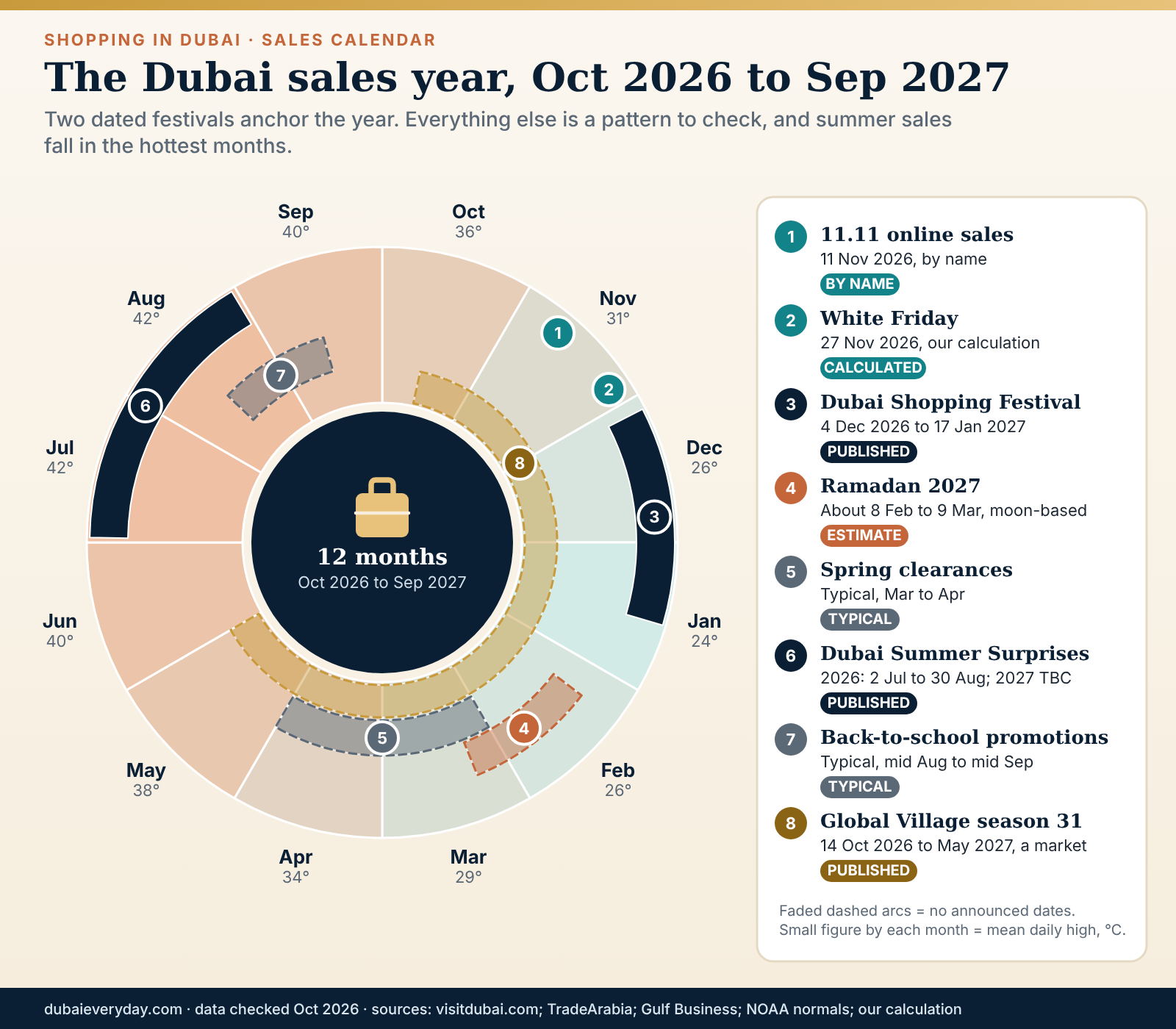
The two festivals that anchor shopping in Dubai’s year
The Dubai Shopping Festival is the winter anchor. The 32nd edition is scheduled for 4 December 2026 to 17 January 2027, organised by Dubai Festivals and Retail Establishment, with citywide promotions, raffles and mall events, and the full programme to be released closer to the date. It overlaps the Christmas and New Year holidays, so it is also when hotel demand and mall crowds are at their peak. The Dubai events in January guide looks at what else is on and how booking pressure behaves.
Dubai Summer Surprises is the summer equivalent. In 2026 it ran from 2 July to 30 August, with a 12-hour “Great Dubai Summer Sale” on 2 July from 10:00 to 22:00 and discounts of up to 90% at more than 100 participating brands, according to a trade report quoting the organisers. Its 2027 dates had not been published when we checked. Because it falls in the hottest months, the mall-based format makes sense: you are shopping in air conditioning anyway.
Smaller windows worth knowing
Our reading of the retail calendar, with the caveat that these windows do not have announced 2026-27 dates unless stated:
- Online shopping days. 11 November (11.11) and the Friday after US Thanksgiving, which falls on 27 November 2026 by our calendar calculation, are the dates regional e-commerce platforms and many shops use for promotions. Campaign lengths and terms are set by each retailer.
- Ramadan and Eid. Ramadan is expected to begin around 8 February 2027 (subject to moon sighting), and shops commonly run promotions around it. Mall hours shift for the month, so check the specific mall.
- End-of-season clearances. Fashion retailers commonly clear winter stock in early spring and summer stock before autumn, with discounts that vary by store.
- Back-to-school. Stationery, uniforms and electronics promotions usually appear in the weeks before schools reopen in late summer.
None of these is guaranteed in a given week. The reliable rule is to treat the two festival windows as dated and everything else as “probably, check”.
How to tell a real sale from a staged one
The most useful habit in sale shopping in Dubai is the reference-price test. Before the sale, note what the item costs at two or three retailers. When the sale arrives, compare the sale price with that remembered price, not with the “was” price on the tag. If the item has not moved much from your remembered price, the discount is a label, not a saving. A simple expression: real saving equals the pre-sale price you observed minus the sale price, divided by the pre-sale price.
Our calculation of how the label can mislead: an item that sold at AED 1,200 for months is retagged at AED 1,667 and then advertised at “40% off”, which is AED 1,000. Against the tag, the discount is 40%. Against what you could have paid last month, the saving is AED 200, or 17%. Not every advertised discount works like this; the point is that the percentage on the tag alone cannot tell you which case you are in.
What the rules say about sale claims
Dubai’s Department of Economy and Tourism handles consumer protection, including complaints about misleading prices. We could not load the page that sets out promotional-sale permit rules, so we do not state them. If you think a shop is advertising a discount it does not honour, keep the advert (a screenshot is fine), the receipt and the tag, and use DET’s complaints channel, described in the authenticity section.
Is it worth travelling for a sale?
For most visitors, a trip made only for shopping in Dubai’s sales is not worth it. Flights and hotels are priced for peak demand in the festival weeks, and the saving on a handful of items rarely covers the premium. It does make sense if you were coming anyway, because you can wait to buy the expensive items until the window and use the refund on top.
If you live in Dubai, the festival and summer windows are the best times to replace big-ticket items: furniture, electronics, mattresses, children’s clothes and school kit. A wishlist with reference prices, built over the preceding month, turns a crowd into a plan. The best time to visit Dubai guide shows how the sale seasons line up with weather and hotel demand.
Online sales and the delivery factor
Online shopping in Dubai leans on regional platforms such as Noon and Amazon.ae, which run their own sale days, and many Dubai retailers mirror prices online. For residents, delivery is often the deciding factor: a price that looks equal in store and online is not equal if one includes a delivery fee or a wait.
For visitors, online orders are rarely useful unless the item can be delivered to your hotel before you leave, and goods shipped as cargo do not qualify for the tourist refund. Treat the online sale as a price check for a shop purchase rather than as a separate channel.
A two-week routine. Two weeks before a sale window: list five items and their current prices at two shops. During the window: re-check, and buy only those items where the price has fallen by an amount you would call real. After the window: keep the receipts and the tags, check the return terms, and if you are a visitor, put everything on as few invoices as the shops allow so that the refund is simpler.
What is actually worth buying when shopping in Dubai
This is the section on shopping in Dubai that most guides dodge, because “worth it” depends on where you live, what you already own and how you value time. We cannot verify price gaps for individual products, so we do not claim any. What we can offer is a way to sort categories by the reasons they might be worth buying here, and a verdict we are willing to defend with reasoning rather than with a price list. It is our reading, not a finding.
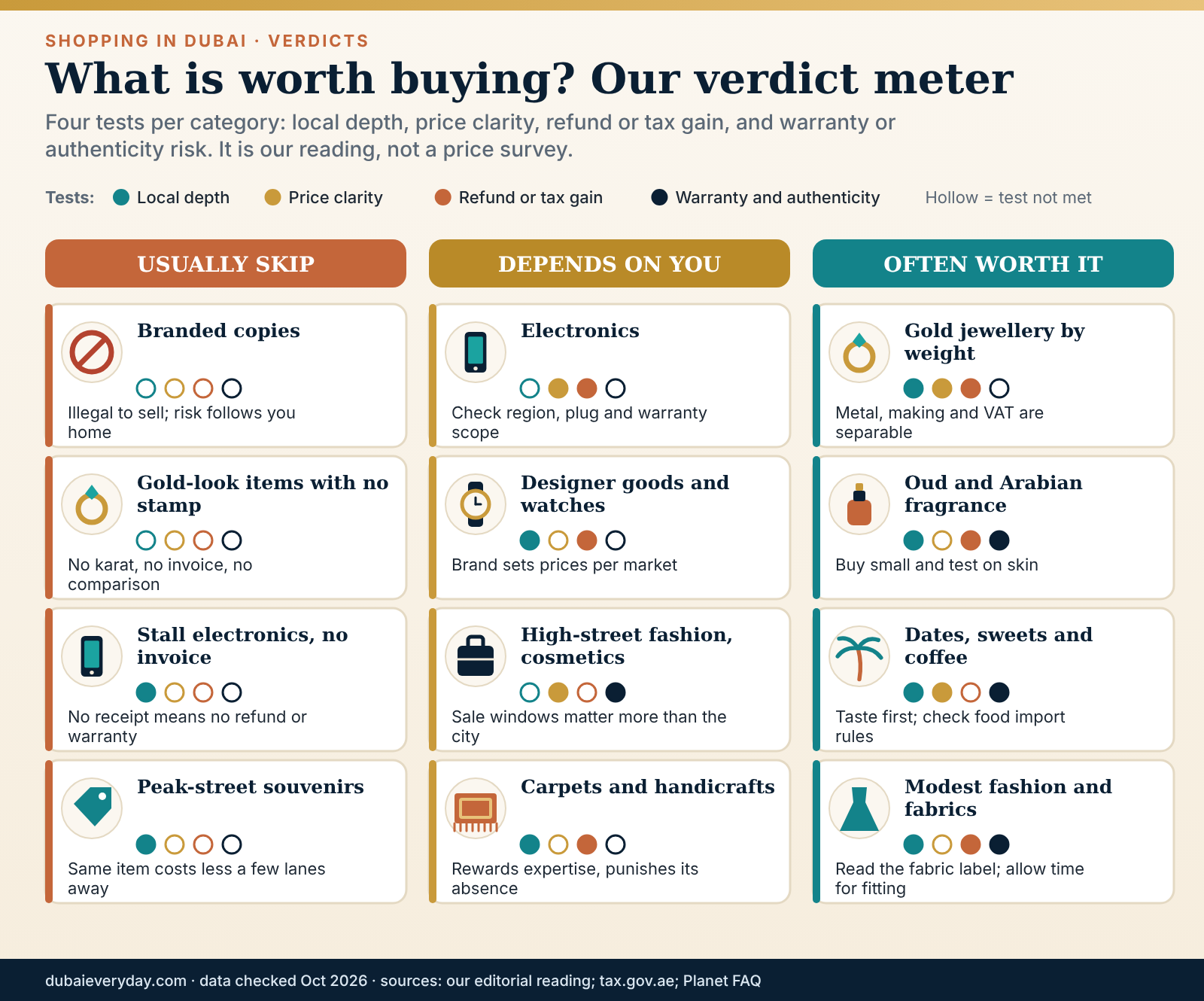
The test we used: four questions
For each category of shopping in Dubai we asked four questions.
Does Dubai have unusual depth in it, meaning many sellers competing in one place? Is the price structure transparent enough to compare? Does the tourist refund or the low local tax make a meaningful difference? And is the warranty or authenticity risk manageable for a visitor? A category that passes at least three is “often worth it”, one that passes two is “depends”, and one that fails on price clarity and on warranty or authenticity, whatever else it offers, is “usually skip”.
Often worth it
Gold jewellery scores well on depth and transparency. The metal, the making charge and the VAT are separable, and a street full of competing shops lets you compare in an hour. It is worth buying as jewellery, not as an investment, for the reasons set out in the gold section.
Oud, attars and Arabian fragrance are a local specialism, so depth is high. Price transparency is lower, since the quality of oil and the dilution are hard to judge, so buy small, test on skin and give the scent time to settle before committing. Skip claims of “pure” oud that no label supports.
Dates, sweets, coffee and similar regional food gifts are easy wins: the range is wide, the prices are modest and the quality is easy to judge by tasting what is offered. Check your home country’s rules on bringing food in, and ask the retailer whether a packaged item qualifies for the tourist refund, since the scheme excludes perishables consumed in the UAE.
Modest fashion, abayas, kaftans and shawls are a category with real local depth, from everyday pieces to couture. The market runs from mass-produced to bespoke, so fabric labels and fit matter more than the shop’s location. Tailors in the older districts can alter or make to order, but allow time for fittings.
Depends on you
Electronics sit in the middle. Global prices tend to converge, so the question is whether your home tax and warranty terms make the Dubai price better. Check the model’s regional version, the power plug (the UAE uses three-pin sockets of the British type, so bring or buy an adapter if your devices use another), the keyboard and language layout, and the warranty’s geographic scope.
For a AED 3,000 item, the refund returns about AED 120.69 (our calculation), so the net cost is AED 2,879.31, about USD 784; your home price including tax must be above that, plus any border tax, to make Dubai the cheaper choice.
Designer goods and watches depend on the brand’s regional pricing, which varies and which we cannot verify. The luxury section’s price check is the tool. Global high-street fashion and cosmetics are usually priced per market by the chain, so the sale windows matter more than the city. Carpets and handicrafts reward expertise and punish its absence; if you know what you are buying, a specialist can be good, and if you do not, a fixed-price shop is safer.
Usually skip
- Anything described as a branded “copy”, “first copy” or “master copy”. Counterfeit sales are illegal in the UAE, and the quality and the legal risk on your return journey are not worth a lower price.
- Gold-plated or “gold-look” items sold under pressure at a premium to the base metal, when you cannot see a karat stamp or an invoice that shows it.
- Electronics from stalls that cannot provide a tax invoice and a warranty, however low the price.
- Large, fragile or heavy items you would have to ship, if the shipping cost plus the lost tourist refund erases the saving.
- Tourist-priced souvenirs in the most visited streets, when the same item is available for less a few lanes away or in an ordinary shop.
The luggage test
One more factor decides many purchases when shopping in Dubai: what it costs to carry. Airlines publish different baggage allowances and excess-baggage charges, and we have not checked any, so check yours.
Our suggestion is to estimate the per-kilogram cost of extra luggage on your airline, multiply by the weight of the purchase, and add it to the price. A heavy item that looked cheap can stop being cheap. For visitors, the sensible things to buy are those with high value per kilogram: jewellery, fragrance, small electronics, textiles and food gifts.
What residents should buy when shopping in Dubai
Residents have a different test. The refund does not apply to them, but the sale windows and the supermarkets’ promotions do, and warranties are easier to use because the shop and the service centre are local.
For household goods, furniture and electronics, a resident’s best moves are to wait for the festival or summer windows for big items, and to keep invoices in a folder because a warranty claim is only as good as the receipt behind it. The cost of living guide shows where shopping sits in a monthly budget, and the home setup checklist covers what to buy in the first week after a move.
Authenticity, warranty, returns and complaints
Rights and protections are the least glamorous part of shopping in Dubai and the part you will be most grateful for when something goes wrong. We could not load the official text of the federal consumer-protection law or the Dubai Department of Economy and Tourism’s rights pages in full on 29 October 2026, because the relevant pages rendered without their content.
So the outline below is practical guidance, flagged where it rests on general retail practice rather than a verified rule, and it points you to the official channel for anything that matters.
What to do before you pay
- Ask for the return and exchange policy before you pay, and ask for it in writing or on the receipt. A shop’s change-of-mind policy is usually its own commercial policy, which can be generous, restricted or “exchange only”. A defective item is a different matter.
- Check the item at the till. Power on electronics, try on clothes, open sealed boxes with the seller present and compare the serial number on the box with the unit.
- Keep the tax invoice. It is your proof of purchase, your warranty record and, for visitors, the document the refund operator needs.
- Photograph price tags and advertised offers, particularly during a sale, so that you can show what was promised.
Authenticity: the three-layer check
Our checklist has three layers. First, the seller: an authorised retailer or the brand’s own boutique removes most of the risk, and a seller who cannot name the authorisation is a warning. Second, the item: look at serial numbers, packaging, labels, warranty cards and country-of-origin marks, and compare them with the brand’s own website. Third, the paperwork: an itemised tax invoice with the retailer’s name and tax registration details. Missing any one layer is a reason to ask more questions.
Counterfeit goods are illegal to sell in the UAE, so when shopping in Dubai they are a legal risk as well as a quality one, and the Dubai economy department lists the resolution of intellectual-property disputes among its consumer-protection work. For a buyer the practical points are simple.
A “bargain” copy is not a bargain if it is confiscated, if it falls apart, or if it has to be explained at a border. If a brand’s own price is far above what a seller is asking for the same model, assume the difference is not a favour to you.
Warranty: how to make it work
A warranty is only as good as your ability to use it. Before buying electronics, watches or appliances, check four things: who gives the warranty (the brand or only the shop), whether it covers you outside the UAE, what the claim process is, and whether the product is the regional version that the warranty is written for.
Keep the invoice and the warranty card together, and photograph both. If you are a visitor and the item is a gift, find out whether the recipient can claim the warranty at home, because a UAE-only warranty is little help once you are back.
If something goes wrong
Start with the shop, calmly, with the invoice and a clear statement of the problem and what you want (repair, replacement or refund). Ask for the manager if the first conversation stalls, and ask for the answer in writing.
If that fails, the Dubai Department of Economy and Tourism has a “Business and Consumer Protection” area and a suggestions-and-complaints form on its website, and the Ministry of Economy publishes a unified contact number (800 1222). We could not confirm which of these accepts retail consumer complaints, or the documents they require, so check the current process on the official sites before you rely on it. Keep every receipt, message and photograph.
For disputes that involve a card payment, your card issuer’s chargeback process is a separate route, with its own time limits. For legal questions beyond a simple complaint, the Dubai legal basics guide explains where rules are verified and when to take advice. This page is general information, not legal advice.
Online and social-media sellers
Instagram and WhatsApp shops sell everything from handbags to dates. Some are legitimate businesses; some are not. Our rules of thumb: ask for the trade licence number, pay by card or cash on delivery rather than a bank transfer to an individual, be wary of prices far below the brand’s own, and check the return terms before you pay. A seller who will not put the terms in writing is giving you information.
Paying, bargaining, hours and manners when shopping in Dubai
Prices, VAT and currency
When shopping in Dubai, shelf prices in shops and malls are normally quoted inclusive of 5% VAT, and the receipt shows the VAT amount separately. Prices are in dirhams (AED), which are pegged to the US dollar at 3.6725, so for dollar-based visitors the AED price does not move against the dollar.
For visitors paying in other currencies, the card network sets the exchange rate on the day. If a card terminal offers to charge you in your home currency, you will often get a worse rate than if you pay in dirhams and let your bank convert; declining the offer is a habit that costs nothing.
Cash, cards and the souks
For shopping in Dubai, malls and most shops accept cards and contactless payments. Souk stalls and small shops may prefer cash or add a card surcharge, so carry some small notes for the abra (AED 1), a taxi and the smaller stalls. Check your bank’s foreign-transaction fees and daily limits before a large purchase, and tell it you are travelling so that a legitimate purchase is not blocked.
When to bargain and when not to
Bargaining is expected in souks, in some jewellery and electronics shops, and with some tailors. It is not expected in malls’ fixed-price shops, supermarkets, chain stores or anywhere prices are displayed on a tag with a barcode. Do not bargain on the metal rate in a gold shop, as discussed earlier.
If you ask for a discount in a fixed-price shop, ask politely about bundles or an offer, not for a haggle. The tone matters more than the number: being friendly, unhurried and prepared to walk away usually works better than being aggressive.
Opening hours
Hours vary by place, so use these as a pattern, not a promise. The Dubai Mall lists retail from 10:00 to 23:00 Monday to Thursday and 10:00 to midnight Friday to Sunday. Mall of the Emirates showed 10:00 to 23:00 on the day we read it.
Global Village opens at 16:00. Dubai Outlet Mall hours are reported as 10:00 to 22:00 Sunday to Thursday, later on Friday and Saturday (secondary source). Souk shops follow their own schedules. Hours change during Ramadan, on public holidays and during sales events, so check the mall’s own site on the day.
Manners in malls
For shopping in Dubai, dress modestly in malls, covering shoulders and knees as a safe standard, and avoid beachwear, as the dress code guide explains. Public displays of affection are discouraged, photographing people without permission is a problem (some shops also prohibit photography inside), and queue-jumping is not appreciated. In Ramadan, eating or drinking in public during the day is discouraged, though malls usually provide designated areas. The Dubai etiquette guide goes through the reasons and the exceptions.
Shopping with children and prams
Large malls are used to families, and baby-changing rooms and food courts are standard in the big ones, though facilities vary by mall. For the logistics of strollers, feeding and heat with a baby, the Dubai with a baby guide is the better reference, and the Dubai with kids guide covers older children.
Getting around with bags: Metro, taxis and parking for shopping in Dubai
Transport is a real line in the budget for shopping in Dubai, and it decides how tired you are by the third bag. Dubai is built around the car, but the Metro serves the main mall corridor, and the figures below show what a mall day costs by each mode. Fares come from the Roads and Transport Authority where we could read it, and from press reports where we could not, with the disagreements noted.
By Metro and tram
The Nol card is the fare medium, and the RTA’s fare page lists the current Silver and Red Ticket fares. Standard Silver fares run AED 3, AED 5 or AED 7.50 depending on the number of zones crossed, with a minimum balance of AED 7.50 to tap in. The card itself is reported at AED 25, including AED 19 of credit, but that figure comes from secondary sources, not the fares page, so check it at the machine.
A paper Red Ticket costs slightly more per trip. The Red Line has stations named after Mall of the Emirates, Ibn Battuta, BurJuman and Burj Khalifa/Dubai Mall, which makes it the natural spine for a mall day, and the Dubai Metro, Red Line and Green Line guides cover the details: the Metro guide, the Red Line guide and the Green Line guide for the Creek side.
Metro hours reported for 2026 are 05:00 to midnight Monday to Thursday, until 01:00 on Fridays, and from 08:00 on Sundays, with the tram running from 06:00. Those figures come from a property-portal summary, not the RTA timetable, so confirm on the RTA site. Our calculation for a full mall day: four Metro journeys at the top fare of AED 7.50 is AED 30, plus the card’s AED 6 of non-credit cost, so AED 36 at most. A taxi day would cost several times that.
By taxi and ride-hailing
Press reports of the November 2025 tariff changes give the street-hail flag-fall as about AED 5 by day and 5.50 at night with a minimum fare of AED 12, app bookings with a minimum of about AED 13 plus a booking fee that varies between roughly AED 4 and AED 7.50, and AED 25 flag-fall at the airport.
Sources disagree on some details, so the meter and the app quote are what count. Taxis work well for shopping in Dubai when you are carrying purchases, when the Metro station is a long walk, or when it is 42 degrees outside, and badly at shift change and at Friday and Saturday evening peaks around the big malls.
By car and parking
If you have a car, shopping in Dubai’s big malls is easy to reach but parking has a cost at the biggest. The Dubai Mall’s paid-parking page lists the first four hours free on weekdays and the first six at weekends.
On a weekday, parking beyond the free hours costs AED 20 up to five hours, AED 60 up to six, AED 80 up to seven and AED 100 up to eight; over eight hours is AED 200, over twelve AED 500 and a full day AED 1,000. At weekends the tiers start at AED 80 for the seventh hour. Fees are charged automatically to a Salik account, which matters if you are in a rental car and want to know how the rental company passes the charge on.
Other malls have their own tariffs, which we have not verified here. The car rental guides, the best car rental in Dubai comparison and the cheap car rental page, explain deposits, tolls and insurance if you plan to rent for an outlet or Dragon Mart run.
The timing logic
Our reading of mall demand, which follows the pattern in the published late hours: Friday evening through Sunday is the busiest period, because malls stay open later then. Weekday mornings are quietest. For a visitor with a choice, a Monday to Thursday morning visit to a big mall is the easiest day to shop, and the late weekend evening is the best time for atmosphere and the worst for parking.
In summer the hot afternoon from 12:00 to 16:00 is when the malls feel like the right place to be; in winter, the lanes of the souks and the open-air streets are best in the afternoon.
Getting purchases home
Carry-on and checked baggage rules are set by your airline, and they shape what is sensible to buy when shopping in Dubai, so check your allowance before you buy anything large. Jewellery and valuables belong in your hand luggage. If you will claim the tourist refund, keep every purchase accessible until the validation desk has seen it, then pack. Items bought for shipping do not qualify for the refund, as discussed earlier. The Dubai airport guide explains the terminal layout and departure order.
Shopping in Dubai as a resident (and as a returning visitor)
Residents and returning visitors want something different from a first-time tourist, and most generic advice for shopping in Dubai ignores them. The refund scheme is for tourists, so a resident’s savings come from timing, promotion tracking and good paperwork, not from a refund at the airport.
Everyday shopping in Dubai and the neighbourhood mall
For daily life, the nearest supermarket and neighbourhood mall matter more than any landmark. Groceries are covered in the supermarket guide, which compares the main chains and delivery, and in the Carrefour guide. If you are choosing where to live, remember that a mall within a short walk or a Metro stop changes weekly life more than a view does; the moving to Dubai guide covers the larger setup.
Big-ticket purchases
Furniture, appliances and electronics are the purchases where timing pays. Plan them around the two festival windows, as set out in the sales section, and use the reference-price test. Keep invoices and warranty cards in a single folder or a photo album on your phone, because a warranty claim without a receipt is an argument. The home setup guide lists what a new household needs in the first week, and the cost of living guide places shopping in context against rent and utilities.
Loyalty programmes and card offers
Malls, supermarkets and banks all run loyalty schemes and card offers. We have not verified current terms, so we do not describe any. The principle is simple: pick one or two programmes that match where you actually shop, compare the real value of points against a plain discount, and avoid spreading spending thinly across many schemes. Card cashback can beat a loyalty scheme, or the reverse, depending on your habits.
Second-hand and marketplace buying
Dubai has an active second-hand market, from furniture to electronics to cars, because residents move often. The same rules apply as in new retail, with more risk: inspect the item, ask for the original invoice and warranty, meet in a public place, and do not pay in advance for goods you have not seen. For vehicles, a separate set of checks applies that this guide does not cover.
If you are a returning visitor
On a second or third trip you already know the headline malls. Spend the time instead on a neighbourhood mall, an outlet visit or a souk you skipped, and consider timing the trip around a sale window. You also know your own refund routine: put purchases on fewer invoices, validate early on departure day and keep your boarding pass ready if you use a city kiosk. Our reading is that returning visitors gain more from timing and from skipping crowds than from any single shop.
Three sample days for shopping in Dubai
These plans are built from the opening hours, fares and rules above. They are templates, not itineraries we have walked. Costs use the Silver-card fares and the AED 1 abra, and exclude what you buy and eat. Everything is our calculation, and the Metro station for each mall should be checked against the current RTA map.
Plan one: a first-time visitor in winter, one day
- 09:30 Creek souks.Start in the Gold and Spice lanes on the Deira side before the day warms up. Buy small, ask for itemised invoices and, if you will claim the refund, tell the shop at the till.
- 11:30 Abra across the Creek.The standard crossing costs AED 1 in cash. Browse the textile lanes and the heritage waterfront on the Bur Dubai side.
- 13:30 Lunch in an older mall.A food court in a Creek-side mall is cheaper and quicker than a souk-side restaurant, and the air conditioning is welcome.
- 15:30 Metro to Downtown.Allow for up to AED 7.50 per Silver-card journey. Walk the Dubai Mall by precinct, not by shop list.
- 19:00 Fountain evening.Evening shows run on the half-hour; see the Downtown guide for the timings and the district.
Transport cost for this plan is about AED 1 for the abra and up to AED 15 for two Metro rides, plus the AED 6 card cost: roughly AED 22 in all, on our assumptions.
Plan two: a summer day, indoors only, with a refund in mind
From June to September, begin at 10:00 at Mall of the Emirates, which offers shops, food and an indoor ski slope, and finish at the Dubai Mall in the evening. If the day falls within a summer-sale window, check the mall’s own offers page.
Ask for tax-free invoices at each large purchase and put them in one folder. The day costs at most four Metro journeys, so AED 30 plus the AED 6 card cost, and it involves almost no outdoor walking beyond the station approaches. The indoor things to do page has ideas for the gaps between shops.
Plan three: a resident’s bargain-and-big-ticket day
For a resident, the best use of a day in the festival window is a list. Choose the three highest-value items (for example, an appliance, a mattress and a laptop), build the wishlist with reference prices in the weeks before, and visit two or three shops for each item.
Add the outlet for clothes and shoes if the budget allows a half-day trip. The only transport cost that matters here is the taxi or the car, since carrying a large item by Metro is a poor plan. This is where shopping in Dubai rewards preparation most.
Twelve mistakes to avoid when shopping in Dubai
- Choosing a mall by fame instead of by job when shopping in Dubai. The headline malls are superb for some jobs and slow for others.
- Doing your shopping in Dubai’s souks at 14:00 in July. Heat decides how much you buy and how well you judge it.
- Comparing gold by sticker price. Compare karat, weight, per-gram rate and making charge, and ask for them on paper.
- Telling the cashier about the tax-free scheme after paying. Ask before the card goes in.
- Splitting one purchase across many small invoices. Each invoice carries its own AED 3.60 fee and its own AED 250 floor.
- Validating the refund too early. The six-hour exit rule means the validation belongs on departure day, close to the flight.
- Packing purchases before validation. Staff may inspect goods, so keep them to hand until the desk has stamped them.
- Believing “up to 90% off”. Test the price against what you saw before the sale.
- Skipping the warranty check on electronics and watches. Confirm who gives the cover and where it applies.
- Buying a “copy” and calling it a bargain. Counterfeit sales are illegal, and the risk follows you home.
- Paying in your home currency at the terminal when it is offered, which often gives a worse conversion than paying in dirhams.
- Planning the whole trip around a sale without checking hotel prices. The saving can vanish into peak-season rates.
The plan to take with you
If you remember five things about shopping in Dubai, make them these. Pick the mall by the job. Do the souks early and the malls in the heat. Read gold as three lines: metal, making, VAT. Ask for a tax-free invoice before you pay, validate on departure day and expect AED 3.60 plus 13% of the VAT to disappear. And treat every discount as a claim to be tested against the price you saw before it.
The rest is detail, and the details are in the sections above. For the largest mall, see the Dubai Mall guide. For a wider trip plan, the Dubai travel guide and the things to do in Dubai page place shopping among everything else a visit can include, and the best hotels in Dubai guide helps you choose a base near the malls or the souks.
FAQ: shopping in Dubai
Is shopping in Dubai cheaper than in Europe or the US?
It depends on the item, the brand and your home tax. Dubai’s VAT is 5%, and eligible tourists can reclaim most of it, so the tax element is low. But brands set prices market by market, and we cannot verify price gaps for individual products. Use the three-step check in the luxury section: get the exact model, convert the Dubai price after the refund, and compare it with the home price including tax and any border charge. For gold, compare per-gram all-in prices.
Can tourists get a VAT refund when shopping in Dubai?
Yes, if you are 18 or over, a non-resident who entered on a tourist visa, and you buy from a retailer registered with the scheme. You get 87% of the VAT paid, minus AED 3.60 per tax-free transaction, on goods you take out of the UAE. The invoice must be at least AED 250 before VAT and carry the name on your passport. Validate at the airport on departure day, within 90 days of the invoice date and within six hours of leaving.
What is the minimum purchase for a refund?
For shopping in Dubai, the floor is AED 250 before VAT for each tax-free transaction, which is AED 262.50 on a VAT-inclusive receipt, about USD 71.50. The threshold applies per invoice, not per day or per trip, and we found no rule allowing invoices from different shops to be combined. A refund at the minimum is only about AED 7.28 after fees (our calculation), so the scheme is worth the queue mainly for larger or consolidated invoices.
How long does the refund take, and how is it paid?
For purchases made while shopping in Dubai, card refunds start processing when you depart and are expected within nine calendar days, according to the Federal Tax Authority. You can also take cash at participating currency-exchange counters after immigration, up to AED 35,000, or use a WeChat or AliPay wallet. Cards accepted include Visa, Mastercard, American Express, JCB and UnionPay. You have a year from validation to claim. If a card refund has not arrived after nine days, contact your card issuer first.
When is the Dubai Shopping Festival?
The 32nd edition is scheduled for 4 December 2026 to 17 January 2027, 45 days, organised by Dubai Festivals and Retail Establishment. The full programme had not been released when we checked. It overlaps the Christmas and New Year peak, so expect crowds and high hotel demand. Summer’s equivalent, Dubai Summer Surprises, ran 2 July to 30 August in 2026, and its 2027 dates were not published at the time of writing.
What is the best time of year for shopping in Dubai?
For discounts, the festival window from early December to mid-January and the summer window in July and August. For comfort, October to April is better for souks and open-air areas, and the summer heat, with mean highs around 42 degrees in July and August, favours indoor malls. If the weather matters more than the discounts, winter is the better choice. The best time to visit Dubai guide has the full trade-offs.
Can you bargain when shopping in Dubai malls?
Not in fixed-price shops, chain stores or supermarkets. Bargaining is expected in souks and is common in some jewellery, electronics and tailoring shops. In gold shops, the metal rate is the day’s rate; the making charge is where the shop has room. In malls, ask about bundles or current offers rather than asking for a haggle. Politeness and a willingness to walk away work better than pressure, in both souks and shops.
Is gold cheaper in Dubai?
We cannot verify that it is, and we do not claim it. What Dubai offers is a transparent structure (a per-gram metal price, a making charge and 5% VAT) and many competing shops in one place, so comparison is easy. Whether the all-in price beats your home market depends on the day’s rate, the making charge and your home taxes. Ask for karat, weight, rate and making charge in writing, and compare per-gram all-in prices across three shops.
What are the opening hours for shopping in Dubai’s malls?
The Dubai Mall lists retail from 10:00 to 23:00 Monday to Thursday and 10:00 to midnight Friday to Sunday, with restaurants an hour later. Mall of the Emirates showed 10:00 to 23:00 on the day we checked. Many other large malls follow similar patterns, but hours change in Ramadan, on public holidays and during sales, so check the mall’s own site. Souk shops keep their own hours, often with an afternoon break.
What should I wear for shopping in Dubai?
For shopping in Dubai, wear modest, comfortable clothing: shoulders and knees covered is a safe standard in malls and especially in the older districts. Avoid beachwear in malls. Light fabrics and comfortable shoes matter more than formality, and a light layer helps because malls are strongly air-conditioned. The Dubai dress code guide lists what malls, mosques, restaurants and government buildings expect.
Can I return things I bought when shopping in Dubai?
It depends on the shop’s policy and on whether the item is defective. Change-of-mind returns are usually governed by the shop’s own policy, so ask for it before you pay and get it in writing or on the receipt. A defective product is a different matter, and the consumer-protection rules apply; we could not read the official text in full, so confirm the current rules with the Dubai Department of Economy and Tourism. Keep the receipt and the packaging, and note the return window.
How do I avoid fakes when shopping in Dubai souks?
Buy branded goods only from the brand’s boutique or an authorised retailer, and treat any “copy” as illegal and risky. In souks, stick to categories where the value is in the material or the craft (gold by weight and karat, spices, fabrics with labels, fragrance you can test). For anything with a serial number, check it against the box and the brand’s site, and keep the tax invoice.
Do I need cash for shopping in Dubai?
Malls and most shops take cards and contactless payments. Carry a little cash for the AED 1 abra, taxis that are not booked by app, and smaller souk stalls that prefer it. If a terminal offers to charge you in your home currency, paying in dirhams usually gives a better rate. Check your bank’s foreign-transaction fees and tell it you are travelling, so that a large purchase is not blocked.
Which mall is best for a first day of shopping in Dubai?
For breadth and luxury in one building, the Dubai Mall in Downtown; for shops plus an indoor ski slope, Mall of the Emirates in Al Barsha. Both have Metro access. If you would rather have a quieter, more local experience, choose a neighbourhood mall near where you are staying. The decision tree in this guide routes you by job, and the Dubai Mall guide covers the biggest one in depth.
Related reading
Sources and further reading (28 links)
- UAE Federal Tax Authority: VAT Refund for Tourists — eligibility, AED 250 minimum, 13% and AED 3.60 deductions, deadlines, cash cap
- Planet Payment: tourist FAQ — operator rules, exclusions, validation points, refund methods
- UAE Legislation portal: Cabinet Resolution on refunding VAT to tourists — legal basis and definition of an eligible tourist
- VATupdate: UAE FTA lowers tourist VAT refund scheme claim fee — secondary report of the July 2026 fee change
- Visit Dubai: Dubai Shopping Festival — 2026-27 festival dates
- TradeArabia: Dubai Shopping Festival returns for 32nd edition — dates, organiser, announced features
- Gulf Business: Dubai Summer Surprises 2026 — 2026 dates, sale format, participating malls
- The Dubai Mall: opening hours — retail and restaurant hours
- The Dubai Mall: about us — Fashion Avenue brand count and mall sections
- The Dubai Mall: paid parking — free-hours and tier structure
- Emaar: Dubai Mall expansion, The District unveiled — scale and status of the expansion
- What’s On: Dubai Mall AED 1.5 billion expansion — store count and floor area as reported
- Mall of the Emirates: official site — hours, indoor skiing, The Hangout precinct
- Gulf News: Mall of the Emirates AED 5 billion expansion — scope and timeline as reported in April 2025
- Dubai Outlet Mall: official site — location, shop count, advertised discount ranges
- Property Finder: Dubai Outlet Mall guide — secondary source for hours, buses and parking
- Global Village: official site — Season 31 dates, hours and ticket prices
- Dubai Department of Economy and Tourism: Business and Consumer Protection — consumer-rights and complaints entry point
- Roads and Transport Authority: Nol fares — Silver card and zone fares
- Roads and Transport Authority: marine transport — abra fares
- Dubai Airports: FAQs — cash declaration thresholds
- UAE Federal Tax Authority: VAT overview — 5% standard rate
- Planet Payment: local rules for the Tourist Refund Scheme — receipt tag, goods shown before check-in, exclusions
- Dragon Mart: official site — opening hours, product range and shop counts
- Wikipedia: Dubai Gold Souk — secondary context on location, retailer count and renovation plans
- Wikipedia: List of shopping malls in Dubai — secondary context only for locations and opening dates
- Wikipedia: Dubai Metro — secondary context for station names near malls
- Wikipedia: Climate of Dubai — NOAA 1991-2020 monthly highs, secondary compilation
Update log: 29 October 2026 — first publication; facts checked against the sources listed above wherever the pages could be read, and flagged in the text where they could not. Next review due: after the Dubai Shopping Festival programme is announced (expected November 2026), and again at the annual review. Corrections welcome. This page gives general information, not individual legal, tax or financial advice; confirm refund terms, prices and hours with the shop or operator.
About DubaiEveryday and this guide
DubaiEveryday.com is an independent editorial project that publishes practical, research-based guides to everyday life in Dubai: where to live, what things cost, how the rules work and how to get around. This page was written and edited by the DubaiEveryday editorial team. It is not signed by a named expert, doctor, lawyer or adviser, and we do not claim first-hand testing of a venue, clinic or service unless the page says so.
Each guide is built from official sources such as government and regulator pages, operator websites and established news outlets, cross-checked where we can. When we could not confirm something, we say so in the text, and examples that use made-up numbers are labelled as illustrations. Mentions are editorial choices, not paid placements, and a link is not an endorsement.
Dubai changes quickly. If you spot something that is out of date or wrong, please tell us through the contact options on DubaiEveryday.com and we will check it and correct the page.