

Ramadan etiquette Dubai residents and visitors follow is mostly about discretion between sunrise and sunset, patience on the roads at dusk and warmth after dark. This guide covers eating, work, dress, iftar, noise, attractions and everyday behaviour for the expected February 2027 Ramadan, using sources checked on 29 October 2026.
Ramadan changes Dubai more than any other month, and it does so quietly. The lunch queue vanishes, the roads fill up an hour before sunset, and then the whole city exhales at the same moment and goes out for dinner. Most visitors who get it wrong are not rude, just surprised: a croissant eaten on a pavement bench, a speaker left on at the pool, a meeting booked for 4 pm.
This guide to Ramadan etiquette Dubai residents and visitors can use covers what to do with food, work, dress, iftar invitations, noise and attractions, and it separates the few things that are law from the many that are courtesy. Dates, hours and rules are checked against official sources, with the gaps admitted. It is written around the expected 2027 Ramadan, but nearly everything holds in any year.
Ramadan etiquette Dubai visitors need comes down to one idea: between dawn and sunset, be discreet about eating, drinking, smoking and chewing gum in public, keep music and voices low, dress a notch more modestly than usual, and expect the whole city to run on a shifted clock. You are not expected to fast. Restaurants and cafes still operate, hotels still feed guests, and nobody will mind a quiet sip of water in a corner when you need it.
The pattern behind Ramadan etiquette Dubai-wide is predictable. Mornings are calm, the late afternoon is tired and the roads are tense, and the hour after sunset is warm, social and loud with plates. Private-sector working hours are cut by two hours a day, so schedule meetings in the morning. If you are invited to iftar, say yes, arrive a little before sunset and bring dates or sweets. Learn two phrases, “Ramadan Kareem” and “Ramadan Mubarak”.
Expected dates for 2027: about 8 February to 8 or 9 March, with Eid Al Fitr on 9 or 10 March. The moon-sighting committee confirms them, so treat them as provisional until announced. The rest of this guide to Ramadan etiquette Dubai travellers and residents ask about turns those lines into decisions you can act on, and separates what is law from what is courtesy.
This guide to Ramadan etiquette Dubai-wide is desk research. Nobody on the DubaiEveryday team fasted, dined or attended an iftar to write it, and nothing here is presented as personal experience. Rules and dates were read on 29 October 2026 from the UAE government portal’s Ramadan page, the UK Foreign Office (FCDO) travel advice for the UAE, the Dubai Economy and Tourism circular on restaurants, Dubai Police campaign notices, and press reports on 2026 timetables and the 2027 date projection. Where only press or a single law-firm summary was available, the text says so.
Not checked: 2027 opening hours, 2027 transport timetables and any venue’s Ramadan policy for next year, because none are published yet. Inclusion of any place or product was not paid for. This is general cultural and practical information, not legal or religious advice.
When Ramadan 2027 falls, and what it changes for a trip
Ramadan is the ninth month of the Islamic calendar. It starts with the sighting of the new crescent and lasts 29 or 30 days, and in the UAE the moon-sighting committee under the Council for Fatwa makes the call, as the UAE government’s Ramadan page explains. Astronomers project the start in advance. According to The National’s report of 6 October 2026, the UAE Astronomy Centre expects Ramadan 2027 to begin on Monday 8 February.
If it does, the month ends on 8 or 9 March depending on its length, with Eid Al Fitr expected on Tuesday 9 or Wednesday 10 March. Federal law gives three paid holidays for the first days of Shawwal, and a 30-day Ramadan adds a fourth day, so the break would run 9 to 11 March or 9 to 12 March. Treat all of it as a forecast. The announcement usually comes the evening before, and a day either way is normal.
The calendar arithmetic that matters
By our calculation, 21 of February 2027’s 28 days fall inside Ramadan, and so do the first eight days of March. The first of March would be day 22. If you are planning a February trip, a conference or a house move, assume the entire second half of the month runs on Ramadan hours, which is the core of Ramadan etiquette Dubai planning. Ramadan also moves about eleven days earlier each Gregorian year, so the 2028 edition lands around the end of January.

Why a February Ramadan is the easy version
When Ramadan falls in summer, fasting days are longer and daytime highs in Dubai sit around 40°C or higher, which changes what visitors can reasonably do outdoors. In 2027 it falls in the mildest part of the year. By our calculation from astronomical sunrise and sunset, the fasting window between first light and sunset is roughly 12.5 hours at the start of the month and about 13 hours at the end, with sunset a little after 6 pm. February daytime highs average in the mid-20s Celsius, according to climate normals.
That makes the practical side gentler for everyone. It does not change the manners. A quiet pavement lunch is as noticeable in 24°C as in 44°C, which is why this guide treats Ramadan etiquette Dubai-wide as the main subject and weather as a footnote.
What changes across the month
Ramadan etiquette Dubai-wide shifts with the calendar. The first few days feel like an adjustment: offices shorten their hours, lunch spots go quiet, and everyone is working out their sleep. By the second week the rhythm is settled and the evenings are in full swing. The final ten days are the most devotional for many Muslims, with long nights in mosques, and also the busiest for shopping and travel ahead of Eid. We return to those later in the Eid section.
Ramadan etiquette Dubai in three layers: law, rule, custom
The most useful habit in Dubai, in any month, is to ask which layer a behaviour sits in. Some things are law, with penalties that apply all year. Some are venue or official rules. The rest is custom, which carries no fine but decides whether people warm to you. Ramadan does not add many laws. What it does is raise the weight of custom, and raise the social cost of ignoring Ramadan etiquette Dubai-wide. The broader version of this idea is in the Dubai etiquette guide, which covers greetings, tipping and photography outside Ramadan.
This page covers the Ramadan etiquette Dubai job: what is different from sunrise to sunset, and what to do about it. For the clothing detail beyond Ramadan, the Dubai dress code guide goes room by room.
| Behaviour | Layer | What the sources say |
|---|---|---|
| Swearing and rude gestures, including online | Law, all year | FCDO: illegal, treated as obscene acts |
| Kissing and similar affection in public | Law, all year | FCDO: you can be arrested for kissing in public |
| Public drinking or being intoxicated in public | Law, all year | FCDO: illegal anywhere in the UAE |
| Begging, including online; unlicensed fundraising | Law, all year | UAE government portal; Dubai Police campaign notice |
| Cutting private-sector hours by two a day | Law, employer duty | UAE government working-hours page |
| Screens or curtains over daytime dining | Venue choice | Dubai Economy circular, 13 April 2021: optional |
| Dress codes in malls, offices, hotels | Venue and official rules | FCDO: dress codes matter more in Ramadan |
| Eating, drinking, smoking, chewing gum in public in daylight | Strong custom (legal status debated, see below) | FCDO: may cause offence, including in your car |
| Loud music, dancing in public | Custom, plus venue rules | FCDO: may cause offence |
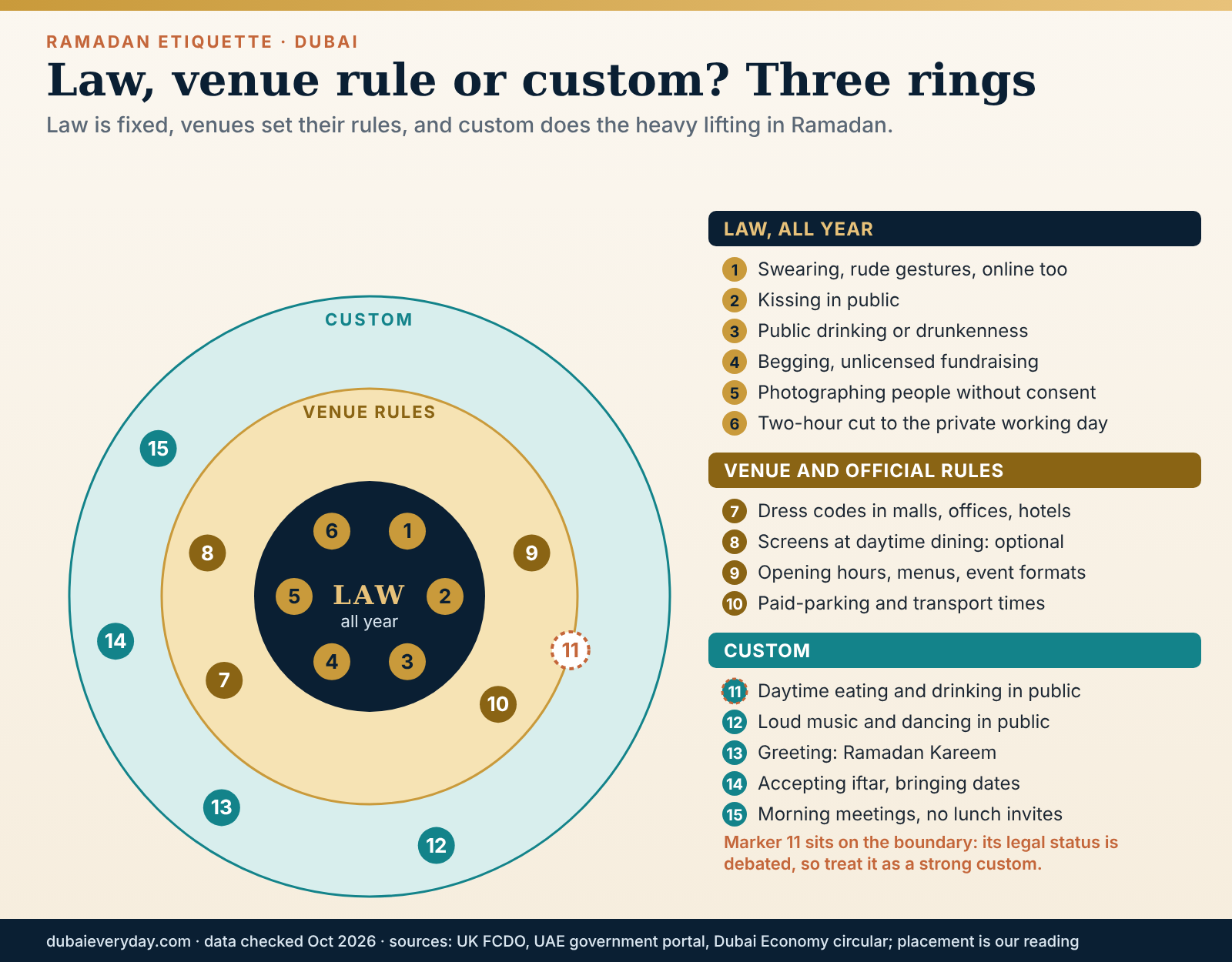
The table is our reading of the sources on Ramadan etiquette Dubai-wide, not an official classification. Its last two rows are where visitors most often ask “but is it illegal?”, and the honest answer for the eating question is in the next section.
Daytime food is the question visitors fixate on, yet the behaviours that carry clearly stated penalties are the ones that apply all year and that Ramadan makes more conspicuous: public drunkenness, rude gestures, kissing in public, photographing people without permission and unlicensed fundraising. If you are weighing one risk against another, weigh those, not the croissant.
Eating, drinking and smoking in public: the core of Ramadan etiquette Dubai asks of you
If you remember one rule of Ramadan etiquette Dubai-wide, make it this one. During fasting hours, which run from first light until sunset, many people around you are neither eating nor drinking, and the polite thing is not to make a show of it. The UK Foreign Office advises visitors to avoid eating, drinking, smoking or chewing gum in public in the daytime, and it specifically includes your car. That is the whole rule, and it is shorter than the anxiety around it.
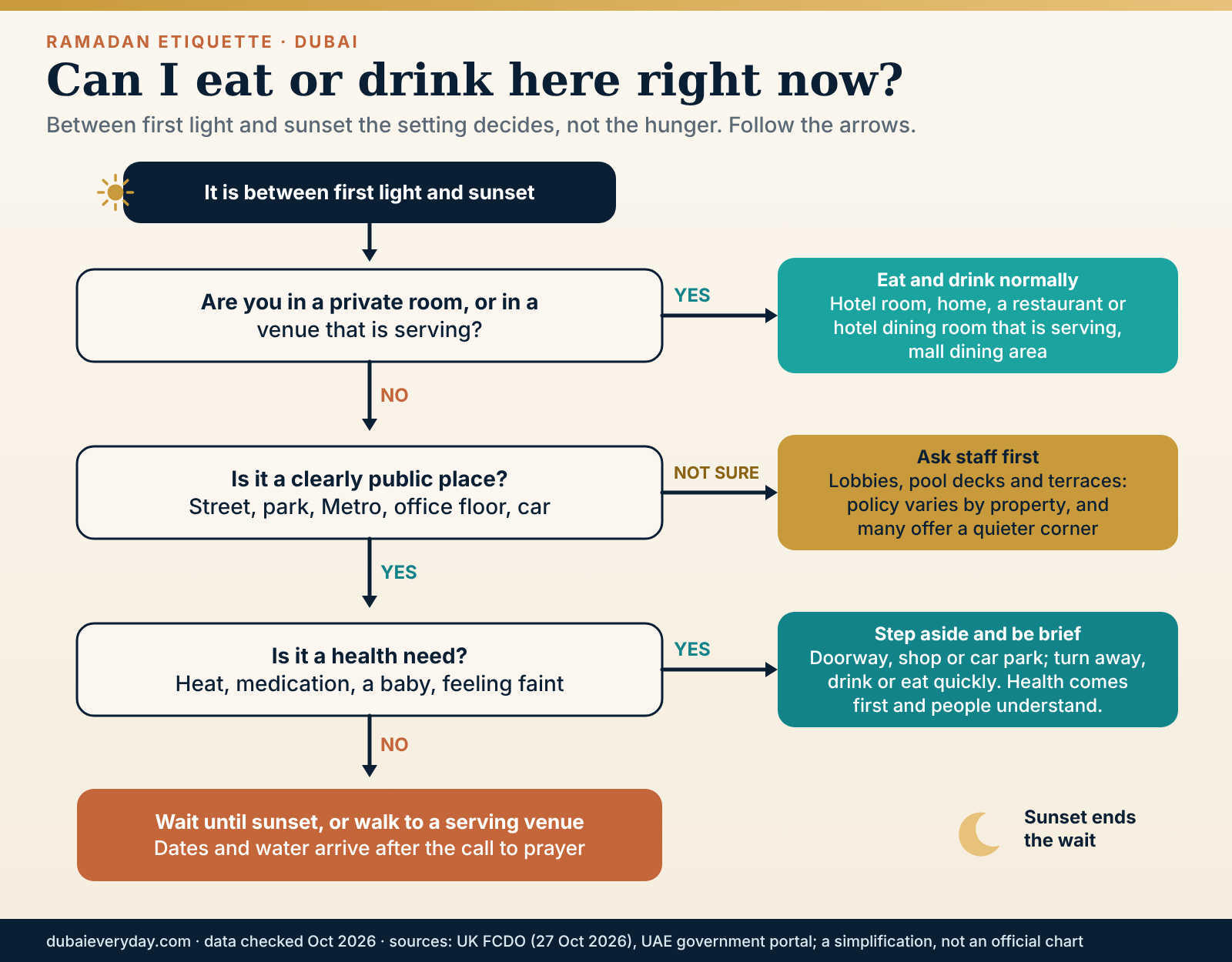
The word “public” is doing a lot of work in Ramadan etiquette Dubai advice, so here is how it plays out in practice. A table inside a restaurant that is serving is not “public” in the sense meant. A bench on the Creek, a Metro platform, an open-plan office floor, a park, a beach path, a taxi queue and a car at a traffic light are. Rooms with doors, such as your hotel room or your own flat, are private, and you can eat there as you like.
Is it a crime? What we can and cannot say
This is the question behind much of the search traffic on Ramadan etiquette Dubai-wide, so it deserves a careful answer. For many years the UAE Penal Code (Federal Law 3 of 1987, Article 313) was reported to punish eating or drinking in public in daylight during Ramadan, and press accounts from that era quoted a fine or up to a month in detention, with figures varying between reports. The UAE then replaced the Penal Code with Federal Decree-Law 31 of 2021. One law-firm summary we read says the new code contains no equivalent offence.
We could not find an official statement that settles the point either way, and a 2023 Khaleej Times visitor FAQ still cited an Attorney General decision (No. 119 of 2019) and a fine of up to AED 2,000, which we were unable to verify against the decision’s text.
What we can document is the direction of travel. Dubai Economy and Tourism told restaurants in a circular dated 13 April 2021 that they no longer needed a special permit to serve food during fasting hours, and that curtains or screens were optional.
The UK Foreign Office, whose page was updated on 27 October 2026, still tells visitors to avoid public eating and drinking in daylight. Our reading: even if the criminal offence has gone, the expectation of discretion has not. Treat it as a strong custom, do not test it, and take legal advice if you are in a dispute.
Where Ramadan etiquette Dubai allows food, and where it does not
Think in three bands for basic Ramadan etiquette Dubai decisions. Fine without a second thought: hotel rooms, private homes, hotel and restaurant dining rooms that are serving, and dining areas set aside in malls. The UAE government’s Ramadan page notes that malls have designated dining areas away from people who are fasting, and that restaurants and tourist sites stay open in the daytime.
Needs a quieter spot: lobbies, car parks, hotel pool decks and terraces, which vary by property. Best avoided: the street, public transport, parks and beaches, office floors and cars. A 2026 press round-up of the changes in Dubai went further and said eating and drinking in public spaces such as malls and public transport is not permitted. It is a secondary source, but it points the same direction as the official ones.
Water, heat and health
Good Ramadan etiquette Dubai-wide never asks you to be dehydrated. If you are walking in the sun, travelling with a baby, diabetic, pregnant, taking medication with food, or simply feeling faint, drink or eat. Step into a doorway, a shop or a car park, turn slightly away and be quick about it. In Islam itself, people who are ill, pregnant or travelling are exempt from fasting, as the UAE government’s page notes, so most people understand the logic. What reads badly is the performance, not the sip.
Two habits remove most of the friction. Carry a small bottle and drink it where nobody is looking, which in a city of malls and lobbies is easy. And finish a takeaway coffee before you leave the cafe, because a cup in your hand on the pavement is the most visible daytime drink there is.
Children, babies and medication
Young children are not expected to fast, and the UAE government’s page says children are encouraged to practise rather than required to. A hungry toddler cannot wait until 6 pm. Feed them in a restaurant, a hotel room, a hotel lobby cafe or a mall dining area, and keep snacks low-key. If a mall day with children is on the cards, the Dubai Mall guide covers parking, Metro access and time planning.
Prescription medicine taken with food is a legitimate reason to eat. Take it somewhere private if you can. You do not owe anyone an explanation, but if a colleague notices, a simple “I need to take this with food” is enough.
Cars, taxis and gum
The Foreign Office wording includes eating and drinking in your car, and that surprises people who think a windscreen is a wall. Cars are semi-public: other drivers, pedestrians and police can see in. Water at a long red light is unlikely to cause offence, but a burger is a different matter. In a taxi or ride-hail, ask yourself whether the driver is fasting, which is a fair assumption, and keep your own snacks for later.
Chewing gum is on the Foreign Office list for the same reason as food: it looks like eating. Vaping and shisha belong in the same category as smoking. If you smoke, the sensible plan is to cut down for the day or smoke in a hotel designated area.
Eating and drinking around people who fast
Ramadan etiquette Dubai-wide is about the person in front of you as much as the street. Do not eat at your desk in an open office if a colleague at the next one is fasting. Do not offer a fasting friend a coffee, then press them. Do not apologise at length for eating either: a short “I will step out” does the job, and long apologies make the moment about you.
If you are a host, it is courteous to schedule gatherings after sunset, or to pick a venue where nobody sits through a meal. Offering food in the daytime to a Muslim colleague is not an insult, but a refusal is simply a refusal. Accept it with a smile and move on.
Restaurants and cafes during the day: what is open and how to check
The old picture of shuttered cafes and curtained dining rooms is out of date. Dubai Economy and Tourism’s circular of 13 April 2021 made screens optional and removed the permit requirement, and the UAE government’s Ramadan page today says restaurants may adjust hours or close during the day and that most open fully at iftar. In other words, for Ramadan etiquette Dubai dining, the variable is the venue, not the rule. A hotel coffee shop may serve lunch as usual, while a small neighbourhood place may open only at sunset.
The Foreign Office adds one practical detail: hotels and restaurants serving food or drink in fasting hours may separate you from Muslim guests, for example with screens. If you are seated behind one, that is a courtesy for them and a convenience for you. There is no need to comment on it.
A venue-type guide to daytime dining
No official list of who serves what in 2027 exists yet, and policies differ between operators, so the table below is a pattern guide drawn from the sources above, not a promise about any venue. Always confirm by phone or the venue’s own channels.
| Venue type | What to expect in fasting hours | How to check |
|---|---|---|
| Hotel restaurants and coffee shops | Often serving, sometimes with screens or a separate area | Ask the front desk or the restaurant when booking |
| Mall dining areas and food courts | Designated seating away from fasting people; some counters open later | Look for signage; staff will point you to the area |
| Independent cafes and small restaurants | Mixed: some serve, some open only at sunset | Check current hours on the venue’s own page or call |
| Cafeterias and street-level eateries | Varies widely; many gear up for sunset takeaway | Ask on arrival, and expect a short wait near iftar |
| Delivery and takeaway | Generally available; eat privately, not on the pavement | Use the app’s listed hours for that day |
| Supermarkets and groceries | Usual hours, according to the UAE government | Normal opening hours apply |
Ramadan etiquette Dubai-wide for planning a daytime meal
For Ramadan etiquette Dubai dining, start from the setting you are in, not the cuisine you want. If you are at a hotel, eat at the hotel. If you are in a mall, walk to the dining area. If you are in a neighbourhood, call first, or plan the meal for after sunset. For lunch-heavy itineraries, such as a day in Old Dubai, carry something to eat in your hotel room at breakfast and move your main meal to the evening, when everything is open anyway.
If you are choosing where to eat after dark, the best restaurants in Dubai guide explains how to match a place to a purpose, and the cheap eats guide covers cafeterias and bakeries whose hours shift most. Breakfast is also worth planning ahead, so the breakfast guide is worth a look before you commit to an early table.
Cafes, coffee and work spots
Coffee habits shift in Ramadan: the daytime slows and the evening, including the hours around suhoor, is when many places come alive. Opening hours differ by venue, so check before you go. If you are a coffee person, the best cafes in Dubai and specialty coffee guides explain what to look for. During the day, take your cup to a corner of the lobby of the hotel where you are staying, or save it for sunset.
Fine dining, Michelin and special occasions
Restaurants at the top end often run set iftar menus during Ramadan and may change their usual format, so a reservation made for the normal tasting menu can turn into something else. The reason is simple: sunset is when guests arrive, so the kitchen is organised around it. If you have a special booking in the month, confirm what is on offer. The fine dining and Michelin restaurants guides explain how bookings and dress work in a normal month, and the same principles apply with extra emphasis on timing.
One more piece of Ramadan etiquette Dubai servers appreciate: do not ask for food to be brought to the table before sunset in a venue that is mid-service for fasting guests. Order, then wait. Staff will usually bring dates and water at the call, and the best servers will tell you the best moment to start.
Iftar and suhoor: invitations, tents and table manners
Iftar, the meal that breaks the fast at sunset, is the most social part of the month, and for visitors it is the easiest way to see Ramadan etiquette Dubai-wide at its warmest. The UAE government’s Ramadan page describes the fast being broken traditionally with dates and laban, followed by a meal, and says families often gather for a first iftar at the grandfather’s home. Dishes it names include alqurs, harees and threed. Suhoor is the lighter meal before dawn, and it is why parts of the city are awake at 3 am.
The Dubai government’s own Ramadan guidance for visitors is short and consistent with that: accept an iftar invitation, consider bringing a small gift such as dates, and greet people with “Ramadan Kareem” or “Ramadan Mubarak”. Everything below expands on those three lines.
If a person invites you to iftar
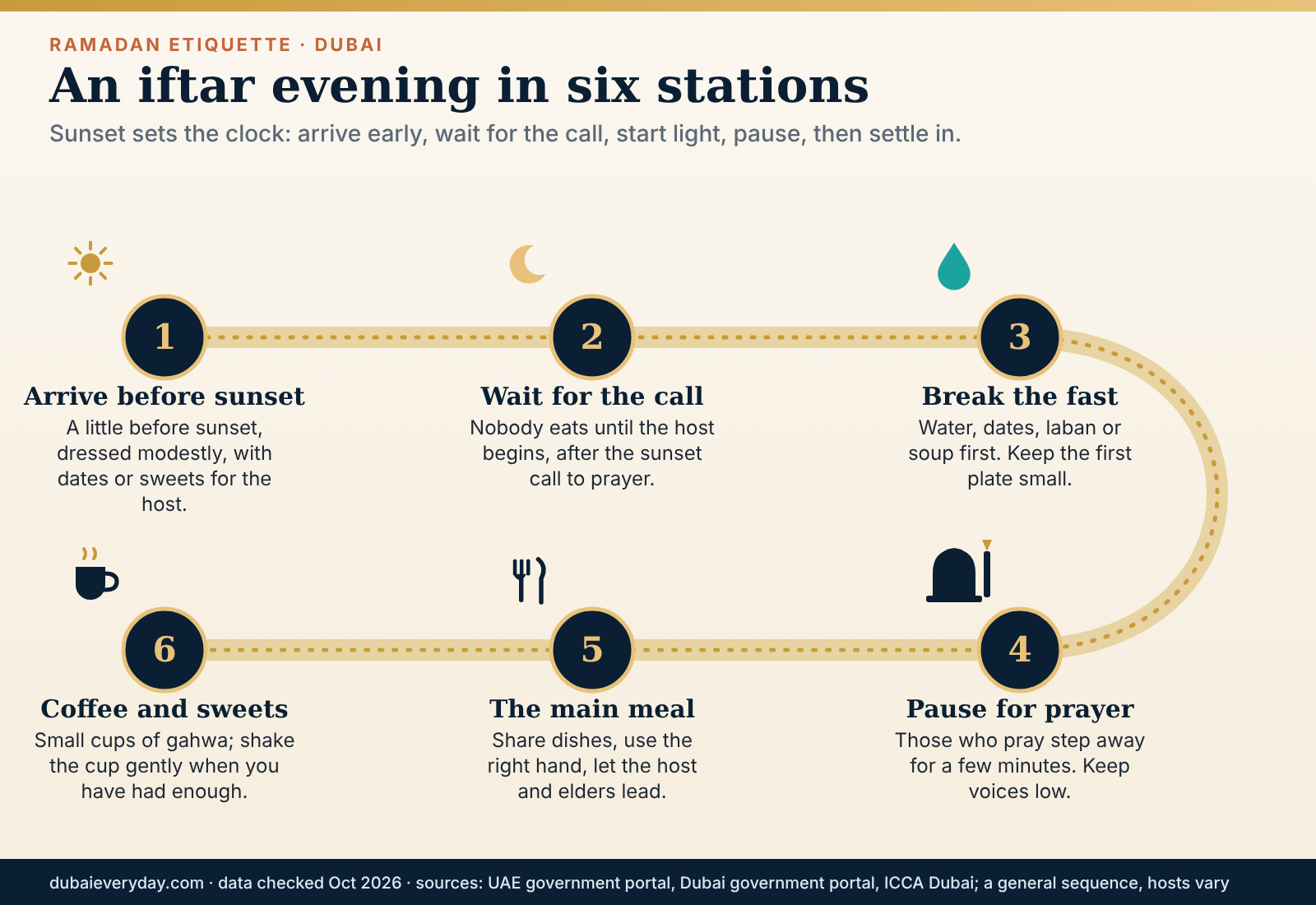
Say yes if you can, which is the first rule of Ramadan etiquette Dubai hosts hope guests know. In a culture where hospitality is a mark of character, a polite acceptance carries weight, and most hosts are glad to share the experience. Arrive a little before sunset, not at it. Wait to eat until the host begins, which will be after the sunset call to prayer. Expect a light start, often water, dates and laban or soup, then a pause while those who pray step away, and then the main meal.
A few practical customs of Ramadan etiquette Dubai homes expect will help. Dress modestly, with shoulders and knees covered, and wear shoes that slip off easily, since many homes ask guests to remove them. Use your right hand to eat and pass dishes. Do not bring alcohol. Bring dates, sweets or good chocolate, and do not be offended if the gift is set aside rather than opened in front of you.
Coffee comes at the end. In Emirati homes, the host or a server pours small cups of gahwa, and a guest who has had enough gives the cup a gentle shake. If the shaking part feels like a trap, watch what others do and follow. Staying a few minutes after the meal, rather than rushing off, is the polite choice, though many hosts will excuse you if you have a late-night prayer to attend with the family.
Hotel iftars and Ramadan tents
For most visitors, the realistic iftar is a hotel buffet, a restaurant set menu or a Ramadan tent, the large seasonal spaces that hotels and venues set up for iftar and suhoor. The Dubai government’s page describes these tents as places where people gather for iftar and suhoor. None of the sources we checked publishes 2027 prices or dates for them, so we give none.
What matters for Ramadan etiquette Dubai-wide at a hotel iftar is timing. Sittings tend to be organised around the sunset call, so arrive before it and be seated. Do not start eating from the buffet before the call. Dates and water usually appear on the table first, and the first plate should be small. After that, queues and conversation settle into a long, relaxed evening. Plan on the meal taking two hours or more, and book early, because the popular evenings fill first.
Dress for the setting, which is usually smart casual with modest coverage. If you are sitting near families, keep the volume of conversation and any phone calls low.
Free iftars and charity tables
Free iftar meals are common in Ramadan across the UAE, at mosques, malls and public places, according to the government’s page. It adds that the Emirates Red Crescent, the Khalifa bin Zayed Al Nahyan Foundation and other charities set up iftar tents open to people of all backgrounds. The courteous approach for a visitor with a hotel budget is not to treat a charity table as a free-dinner attraction. If you want to see one, go with a resident who knows the organisers, or ask.
Giving, as distinct from taking, is also regulated. We cover how to donate properly in the behaviour section.
Suhoor: the late-night side
Suhoor is eaten before first light. Hotels and restaurants host it in the late evening and into the small hours, and some friends make a ritual of a long night out ending in an early breakfast. For visitors it is optional and pleasant, but the etiquette is about volume. A group laughing loudly at 2 am under apartment windows is a different thing from a group in a hotel tent.
If you are staying in a residential building, be a considerate neighbour: low voices in corridors, no music from balconies, and quiet in lifts. We expand on this in the noise section.
Photographing iftar
Photographing food is fine. Photographing people, especially women and families, without permission is not, and the Foreign Office is explicit about it. At a private or community iftar, ask the host before taking a group photo. At a cannon firing or a public tent, do not shoot close-ups of strangers. The wider rules on photography are in the Dubai etiquette guide.
Work and business: Ramadan etiquette Dubai offices follow
For anyone working in Dubai, or working with Dubai, Ramadan etiquette Dubai-wide starts as a schedule change before it is anything else. UAE labour rules cut daily working hours in the private sector by two hours during the month, and the UAE government’s pages say this applies to all employees, whether or not they are fasting, without loss of regular pay. The Dubai government’s own Ramadan guidance for visitors repeats that working hours are shortened by two hours in both the public and private sectors.
That has one consequence above all others. If a team normally works an eight-hour day, a Ramadan day is six, which by our calculation is a quarter fewer contractual hours. Add the energy dip in the late afternoon that the Foreign Office also notes, and the sensible plan is to treat the month as roughly three-quarters of normal capacity, concentrated in the morning.
What the 2026 government timetable tells us
Government hours give a useful pattern for anyone booking appointments. For Ramadan 2026, the Dubai Government Human Resources Department announced office hours of 9 am to 2.30 pm Monday to Thursday and 9 am to noon on Friday, with entities free to let staff start between 7 and 10 am, and staff in suitable roles allowed to work remotely up to two days a week. That was reported by Gulf News on 17 February 2026. The 2027 hours have not been announced, so treat this as precedent, not a promise.
The practical lesson is to book anything that needs a government desk, a bank counter or an approvals clerk in the morning, and early in the week. After 2 pm, expect counters to be empty or closed.
Meetings and the Ramadan etiquette Dubai offices expect
The core of Ramadan etiquette Dubai offices follow is simple: morning is the best time for meetings, ideally between 9 and 12. Avoid scheduling anything from about 3 to 6 pm, when many colleagues are tired and the roads fill up for iftar. Do not book lunch meetings, and be careful with in-person coffee meetings. If you need a longer discussion, move it to after sunset only if the other side proposes it, since some businesses do hold evening meetings and some do not.
Where offices are set up for hospitality, offering coffee or water is normal courtesy in most months. In Ramadan, skip it unless the visitor asks. Keep snacks and drinks out of shared rooms. Arrive on time, since the shorter day leaves little slack, and keep meetings tight.
Email, calls and deadlines
Ramadan etiquette Dubai colleagues appreciate starts with a greeting: open emails with “Ramadan Kareem” or “Ramadan Mubarak” for counterparts in the region, and keep the tone patient. Expect slower replies in the late afternoon and a burst of activity after sunset in some sectors. If you work across time zones, state your availability windows explicitly, because a colleague in London may not realise that the Dubai office closes at 3 pm.
Deadlines deserve the same honesty. If you are managing a project with a Dubai team, plan the milestone calendar around the month, and ask your colleagues what works instead of assuming. Some will want to keep their usual pace and finish earlier in the day, others will want more slack.
If you manage people
Managers who follow Ramadan etiquette Dubai offices respect have two useful gestures: flexibility and clarity. Flexibility means allowing staggered starts, short breaks for prayer and the option to work from home on days when that makes sense, where the role allows it. Clarity means setting reduced-hours rules in writing so that nobody is left guessing whether the day ends at 3 or 5. Do not ask people whether they are fasting. Follow their lead, and do not comment on their energy or appearance.
For free-zone employers, check the zone’s own rules, since one law-firm summary we read says the reduced-hours rule is applied differently in some financial free zones than on the mainland. We could not confirm that with an official source, so ask your HR or your zone authority.
An illustrative day on Ramadan hours
The following is an illustrative example, not a legal schedule. A mainland office normally runs 9 am to 6 pm, with a one-hour break, which is eight working hours. On Ramadan hours, the same office might run 9 am to 3 pm with no lunch hour, six working hours. Meetings sit between 9 and 12. Admin tasks, deep work and approvals fall in the quiet stretch between noon and 3. Anything needing a decision from a client in a government body is sent before 10 am.
The team leaves at 3, gets home before the roads clog, and sits down at sunset.
The example makes a simple point for Ramadan etiquette Dubai planning: shortening the day is easier if you also shorten the to-do list, and hours that disappear into a late meeting cannot be recovered.
Dress: what to wear in Ramadan
Dubai is relaxed about clothes compared with much of the region, and Ramadan does not change the baseline. It raises the stakes of ignoring it, which is most of what Ramadan etiquette Dubai says about dress. The Foreign Office says dress codes matter more in the month and that clothing which breaches local norms may cause more offence than usual. The Dubai government’s visitor guidance says the same in fewer words: dress modestly in public. If your normal Dubai wardrobe already covers shoulders and knees in public places, you are done.
If it does not, a few adjustments are enough to meet the Ramadan etiquette Dubai expects. This section covers the Ramadan emphasis only. For room-by-room detail across malls, offices, beaches and nightlife, the Dubai dress code guide is the longer reference.

The Ramadan etiquette Dubai dress baseline, in plain terms
The Foreign Office wording for public areas such as shopping malls is that women should cover shoulders and knees and that underwear should not be visible. It also advises avoiding transparent clothing and clothing with imagery or phrases that could offend others, says swimwear belongs only on beaches and at pools, and notes that some venues, events and buildings have their own codes.
For men, the sources on Ramadan etiquette Dubai-wide are less specific. As general practice, knee-length shorts and a sleeved top are accepted in most public places, and sleeveless tops and very short shorts are best kept for the gym, beach or pool. That is our reading of common practice rather than a published rule, and stricter venues exist.
What to wear by setting
Malls and shopping streets: shoulders and knees covered, light fabrics, comfortable shoes. Malls are air-conditioned to the point of chill, so a light layer is useful anyway. Hotel lobbies and restaurants: smart casual, same coverage, with beachwear kept for the beach. Offices and meetings: business wear as normal, which is already conservative.
Iftar tents and invitations: a step up, with modest coverage and neat footwear, particularly in a family home. Evening wear for nights out in licensed venues is governed by the venue’s rules. Gyms: if you walk through a mall or lobby to get there, bring a layer to cover it.
Beaches and pools: swimwear is for the beach and the pool only, so cover up on the way through lobbies and walkways, and avoid walking a public street in a swimsuit. The best beaches in Dubai guide explains which beaches have facilities and which are simply sand.
Visiting a mosque
Dress rules are stricter at a mosque, and visiting schedules may differ in Ramadan. The Jumeirah Mosque, run by the Sheikh Mohammed Centre for Cultural Understanding, runs guided visits for non-Muslims. Its own page says men should avoid shorts and sleeveless tops, women should cover arms, legs and hair, and that loan garments are available. Its normal schedule is guided visits at 10 am and 2 pm, Saturday to Thursday, closed Fridays. Ramadan timings for 2027 have not been published, so confirm before you go.
Eid clothing and the end of the month
For Eid, many families dress up in new clothes and traditional wear, and the same modest baseline applies to visitors invited to celebrate. A small thing helps: a neat, plain outfit in a muted colour, as a guest, rarely goes wrong.
A Ramadan wardrobe checklist
- Two or three light tops with sleeves, or a shawl or kimono-style layer for lobbies and malls
- Trousers, midi skirts or knee-length shorts for daytime outings
- A scarf or shawl in the day bag, useful for mosques and for cold air-conditioning
- Shoes that slip on and off, for homes, prayer areas and mosques
- One smarter outfit for an iftar invitation or a hotel buffet
- A cover-up for the walk to the pool or beach
Noise, music, nightlife and neighbours
Ramadan etiquette Dubai residents mention most after eating is volume. The Foreign Office advises visitors to avoid playing loud music, dancing and swearing in public during the month, and the Dubai government’s guidance adds that you should avoid aggressive behaviour and inappropriate language. Press guides translate that into daily habits: headphones, not speakers, in public, quiet car stereos and low voices in shared spaces.
Phones, speakers and cars
The easiest Ramadan etiquette Dubai wins are digital. Put your phone on silent on the Metro and in lobbies, watch videos with headphones, and avoid video calls on speaker in cafes. In a car, keep windows up if the music is loud, and be gentle with the horn near sunset when drivers are tired and hungry. The Foreign Office warns of erratic driving around dusk, and a stray horn does not help.
Nightlife during Ramadan
Licensed venues continue to operate in Dubai during the month, according to Gulf News guidance, but the picture varies by operator. Some pause daytime service, and policies are not uniform. A 2026 press round-up reported that live music and concerts are generally paused, with low-level background music still common and some venues offering traditional or acoustic sets, such as oud, around iftar and suhoor. Both are secondary sources, and we found no official 2027 rule.
So the sensible Ramadan etiquette Dubai approach to nightlife is to ask. Call the bar or lounge, check its social page for the Ramadan format, and expect a calmer atmosphere than you would find in other months. The usual law still applies: public drinking or being under the influence in public is illegal everywhere in the UAE, the legal drinking age in Dubai is 21, and licensed hotel venues do not require a personal licence, according to the Foreign Office. For the normal-month picture, see the Dubai nightlife guide, the best bars guide and the rooftop bars guide.
Dancing, shows and events
The Foreign Office lists dancing in public among the behaviours that may cause offence in Ramadan. Stage shows, concerts and festivals typically adjust their programmes, and operators usually publish changes closer to the date. Desert safari operators are a good example: one operator’s Ramadan note says belly dancing cannot be added during the month and live music needs approval, and another says it runs no cultural entertainment at all in Ramadan. Both are operator terms, so read the one on your booking.
Residents: neighbours and noise in buildings
If you live in a building, Ramadan can mean more movement after dark: families visiting for iftar, late suhoor gatherings, children up later. A polite neighbour keeps corridor voices down, closes balcony doors for loud calls, and keeps the lift lobby quiet at 3 am. If you are hosting, a note on the door or a message to adjacent flats about a family iftar is a small courtesy that earns goodwill.
Building management may also set quiet hours of their own. Check your community rules instead of guessing, particularly for villa communities with shared pools and parks.
The cannon
One loud noise is welcome. The iftar cannon, called Midfa Al Iftar, is fired at sunset to mark the end of the day’s fast, and the UAE government says it is carried out by military personnel with safety precautions. In 2026, Dubai Police ran a mobile cannon around the emirate and six fixed ones, including at JBR, Burj Khalifa, Damac Hills, Expo City, Dubai Festival City and Vida Creek Harbour, according to Khaleej Times. Places and times for 2027 are not announced.
If you go to watch, treat it like a community moment, not a photo stop: arrive early, stay back from the crew, keep to the safety lines and ask before photographing families. If you are staying in JBR, the JBR guide covers walkability, parking and noise in the area.
Attractions, malls and getting around: Ramadan etiquette Dubai sightseers should plan for
For a sightseeing trip, Ramadan etiquette Dubai style is mostly logistics. The UAE government’s Ramadan page says amusement parks, restaurants and cultural and tourist sites remain open in the daytime, grocery stores and supermarkets keep their usual hours, and malls stay open late. That matches a Khaleej Times visitor FAQ from 2023, which said sightseeing spots keep regular hours. What changes is the rhythm around them, and the manners expected while you are there.
No attraction in Dubai has published 2027 Ramadan hours yet, and we have not guessed them. The Ramadan etiquette Dubai advice below is built from the official rules, the 2026 precedents and one calculation about the shape of the day.
The shape of a Ramadan day, and how to plan around it
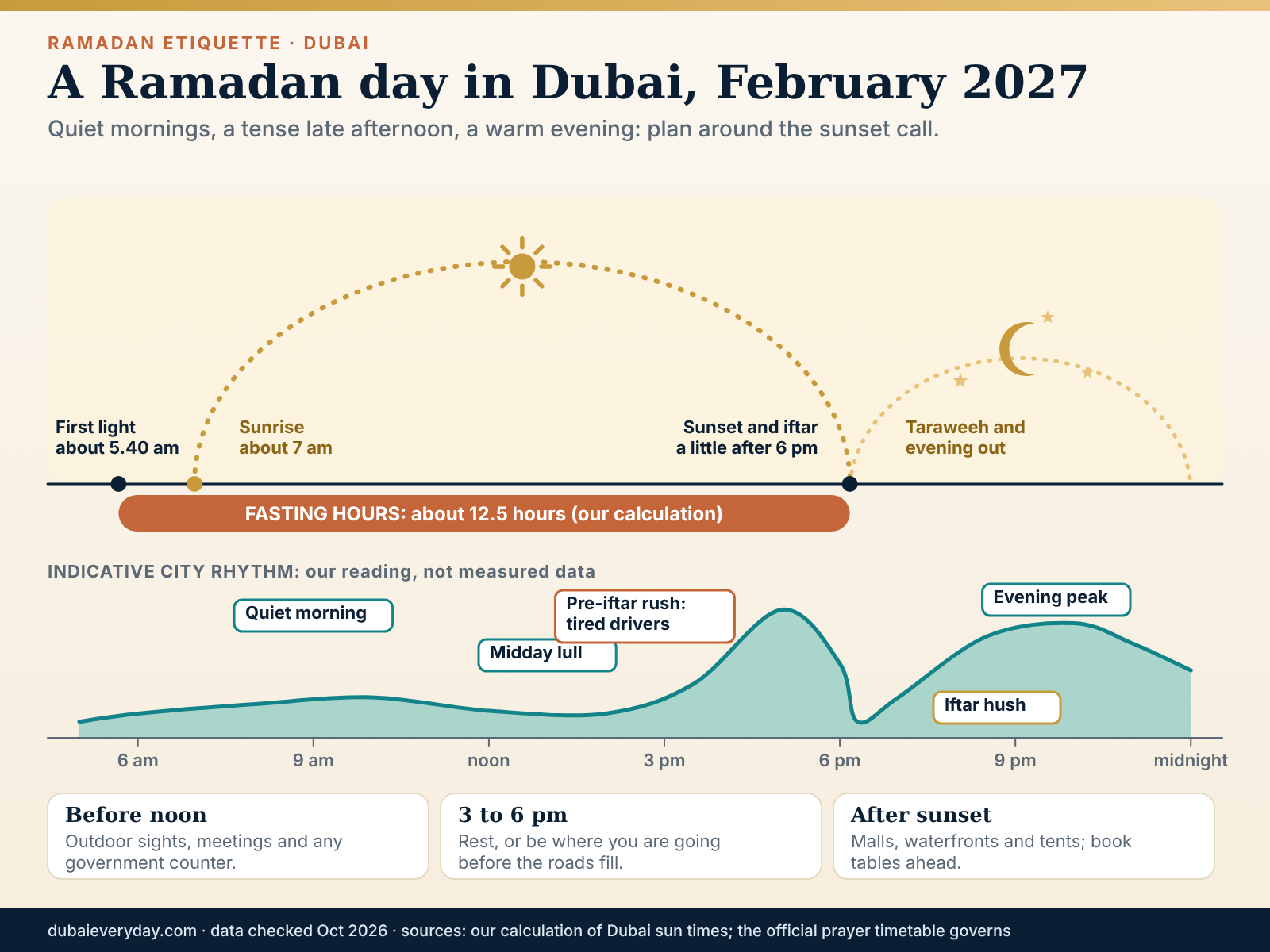
By our calculation for early February 2027, first light comes at about 5.40 am, the sun rises close to 7 am and it sets a little after 6 pm. Fasting runs from the first to the last of those, so the day has a clear structure for sightseers. Mornings are quiet. The middle of the day is the lull. The late afternoon is the hard part, with tired drivers, shorter tempers and everybody heading somewhere. After sunset, the city fills up.
A workable plan, labelled as our reading rather than any official guidance: do outdoor and heritage sights in the morning, move to indoor sights or a museum around midday, rest in your hotel in the late afternoon, be seated for iftar well before sunset, and use the evening for malls, waterfronts and night views. It is also, not by coincidence, the way to avoid the worst of the roads. The things to do in Dubai guide has the longer list of what to put in each slot.
Malls and shopping
Malls are the easiest part of Ramadan etiquette Dubai-wide for visitors. They open as usual or later, and the UAE government’s page says they stay open late. A 2023 Khaleej Times FAQ put extended hours at up to around 1 am, varying by mall, and a 2026 round-up reported Mall of the Emirates opening at 10 am with closing at 11 pm Monday to Thursday and midnight at weekends. Treat both as secondary guides and check the mall’s own page for the month.
Ramadan etiquette Dubai malls expect is simple: eat only in designated dining areas, as the government’s page notes they are set up away from fasting people, keep your voice low, dress modestly and give prayer rooms a wide berth. The Dubai Mall guide, the Mall of the Emirates guide and the wider Dubai shopping guide cover the rest.
On prices, the UAE government’s page says many stores run seasonal discounts, sometimes up to 70 per cent, and that the Ministry of Economy and Tourism caps prices on essential goods and inspects retailers. Price complaints go to 800 1222. Read discount claims the way you would in any sale month: check the actual price, not the percentage.
Downtown, waterfronts and Old Dubai
Evenings are when outdoor Dubai shines in Ramadan. The Downtown area and its waterfront promenade are lively after sunset, and Burj Khalifa is one of the places where Dubai Police placed an iftar cannon in 2026. The Downtown Dubai guide covers getting there, parking and where to eat. Old Dubai, with its souks and creek crossings, is a sensible morning option, though many places there change their hours in the month.
At heritage sites and museums, expect hours to shift and dress to matter. Before you go, check the site’s own page for Ramadan hours. Do not assume that a Friday opening time is the same as in a normal month. If you want an insider’s view of the month’s traditions, guided cultural visits and the Jumeirah Mosque tour are the most direct routes. We could not confirm 2027 timings for either.
Beaches, pools and the Palm
Beaches and hotel pools operate as normal, and swimwear is accepted there, as the Foreign Office says swimwear belongs on beaches and at pools. What changes is the tone. Keep music low, avoid drinking games and keep your cover-up on when walking away from the sand. For beach choices, the best beaches in Dubai guide is the starting point. If you are based on the Palm or in the Marina, the Palm Jumeirah guide and the Dubai Marina guide explain transport and everyday life in each area.
Hotels vary in their approach to daytime food and drink service on pool decks and terraces, as they do in their evening entertainment. Ask at reception when you check in. It saves a surprise at the pool bar.
Desert, cruises and tours
Desert safaris and tours continue in Ramadan, with changes. One operator’s Ramadan note says guests should drink only inside the vehicle in daylight hours and that belly dancing cannot be added, while another says it runs no cultural entertainment during the month. Another says live music needs approval. Take those as operator-specific. If you have a tour booked, read its Ramadan terms and ask what happens with food and drink on the way.
For a day trip, take water and a snack for the vehicle, and keep both out of sight at stops where the public gather.
Getting around: Metro, parking and taxis
For Ramadan 2026, press reports said the Metro ran its normal hours: Monday to Thursday and Saturday 5 am to midnight, Friday 5 am to 1 am the next day and Sunday 8 am to midnight, with the tram running 6 am to 1 am Monday to Saturday and from 9 am on Sundays.
Paid public parking in 2026 was reported at 8 am to 6 pm and 8 pm to midnight, Monday to Saturday, with Sunday free and multi-storey car parks open round the clock. Those were 2026 timetables, and the RTA announces each year’s near the start of the month.
The UAE government’s page warns that taxis can be scarce in the evenings and advises booking ahead. The Foreign Office adds that driving can be erratic around dusk. The practical rule is to be where you are going before 5 pm, or accept that you will be moving in the thick of it. For the bigger picture of getting here and around, the Dubai travel guide is the place to start.
Respectful visitor behaviour: greetings, photos, charity and social media
Everything above is about food, time and noise. This section is about the person in front of you and the phone in your hand, and small gestures are what residents notice most in Ramadan etiquette Dubai-wide.
Greetings in Ramadan etiquette Dubai-wide
The UAE government’s page gives “Ramadan Kareem” and “Ramadan Mubarak” as the standard greetings, and the Dubai government’s guidance encourages visitors to use them. Both are welcome from non-Muslims, and you can use either at any point in the month. The common reply is to repeat the greeting or to say “Allah Akram”, meaning that God is more generous. In the last days, “Eid Mubarak” takes over.
Ramadan etiquette Dubai-wide does not need anything more elaborate. A smile and the two words are enough, and trying to explain Ramadan to a person who observes it is rarely what they want.
Prayer, mosques and Taraweeh
The UAE government’s page notes that Muslims perform Tarawih prayers nightly after Isha, and that in the last ten nights many spend long periods in mosques praying and reading the Quran. For a visitor, the effect is practical: expect crowds and parked cars around mosques in the evening, and quiet in the nearby streets during prayer. Do not walk in front of someone praying, do not film worshippers, and keep voices down near prayer rooms in malls and offices.
Photography and posting online: Ramadan etiquette Dubai visitors forget
The Foreign Office is clear that you should not photograph people without permission, that men have been arrested for photographing women on beaches, and that photographing some government buildings and military sites is illegal. Irish government travel advice adds that sharing an image or video of a person without consent can be a criminal offence carrying heavy fines. We have not read the underlying statute, so treat it as a strong reason to ask first.
Ramadan gives this extra weight. Iftar scenes, family tables, prayer scenes and crowds at the cannon are exactly the pictures people want, and exactly where permission matters most. If your feed is public, remember that content judged offensive can have consequences. Media activity, including digital content, needs the right permits from the National Media Council, according to the Foreign Office. Posting a mocking clip about fasting or prayer is the one social-media mistake with no upside.
Give donations and zakat only through officially licensed charities. The UAE government’s Ramadan page says individuals may not organise fundraising themselves, and that begging is illegal. Dubai Police’s 2026 “Combat Begging” campaign warned about fraudulent online appeals and said online begging is an offence under Federal Decree-Law 34 of 2021, with up to three months’ imprisonment, a fine of at least AED 10,000, or both. To report: call 901, use the Police Eye service in the Dubai Police app or use the eCrime platform.
Giving well
Generosity is the heart of the month, and it is the one thing you can do with money to be a good guest. The Dubai government’s page says people and companies give food boxes, clothing and money through licensed charities. If you want to give, use the official channels, many of which collect at malls and mosques with clear branding. If a stranger approaches you in the street or at a hotel with a story and a request for cash, do not hand money over, and report if it feels organised.
Showing interest without intruding
In Ramadan etiquette Dubai conversations, questions are welcome when they are curious and not challenging. “What is your favourite part of iftar?” opens a door. “Isn’t it hard not to drink water?” can feel like an inspection. Let people lead. At work, do not ask a colleague whether they are fasting. At a table, wait to be told about dishes before you comment. If a host explains a custom, thank them for it.
Affection and everyday conduct
The law on public affection does not change in Ramadan, and the Foreign Office says you can be arrested for kissing in public. Canadian government advice adds that even holding hands may attract attention. Keep affection small and private. The same goes for arguments, which are better handled indoors.
Ramadan etiquette Dubai residents and fasting visitors should know
Most of this guide is written for a non-fasting visitor, because that is who asks the questions. Two other groups need their own Ramadan etiquette Dubai advice: the people who live here and run their lives through the month, and Muslim visitors who are fasting on holiday. A few points for each.
Residents: errands, services and the shape of the week
If you live in Dubai, the Ramadan etiquette Dubai residents practise is mostly about timing. Government counters run to shortened hours, and banks, clinics and other services may adjust theirs, so do anything that needs a desk in the morning and early in the week. The Dubai government’s 2026 hours, 9 am to 2.30 pm on weekdays and noon on Fridays, show how little of the afternoon is left. Home-service visits, deliveries and maintenance appointments are easiest before midday, and a tradesperson who is fasting works best in the morning too.
Use delivery apps in the evening with patience. Riders and drivers can be busy around sunset, and the UAE government’s page says taxis can be scarce then, so allow extra time and avoid placing a large order at the very moment of the call to prayer. If you receive a delivery, a courteous greeting and a cold bottle of water offered in the evening are small ways of saying thanks, whenever the person is able to accept.
Tipping habits are not specific to Ramadan, and the Dubai etiquette guide covers how service charges and tipping normally work.
Residents: schools, gyms and daily routines
Schools, gyms, clinics and other services each publish their own Ramadan timetable, and we have not found a 2027 version of any of them yet. The right habit is to wait for the notice from your own provider, then plan around it. If a school or club asks families to follow a Ramadan rule, such as no food in the car park, follow it. At a gym, expect the pattern to shift, with evenings busier. Keep gym gear covered on the walk through public areas.
Residents: hosting and being hosted
Ramadan etiquette Dubai hosts follow starts with the fact that many residents entertain in this month, and invitations to colleagues and neighbours are common. If you host, tell guests the time of sunset rather than a clock time, have dates and water ready for the first moment, offer something that suits fasting guests, and let those who pray step away without comment. If you host non-fasting guests earlier in the day, serve them in a private room.
If you are a Muslim visitor who is fasting
The UAE government’s page says travellers may make up fasts later, so whether to fast on a trip is a personal decision. If you choose to, Dubai is easier than many cities: hotels and restaurants understand fasting guests, iftar is widely available at sunset, and many malls provide prayer rooms. Check the prayer timetable for the city, which differs from your home city’s, and keep your plans light in the late afternoon, which the Foreign Office warns is the tiring time of day.
Ask your hotel at check-in whether it can arrange a suhoor meal or room service at unusual hours, because arrangements differ by property.
Explaining Ramadan to children
If you are travelling with children, a short conversation before you arrive does most of the work. Tell them that many people in Dubai do not eat or drink from dawn to sunset for a month, that everyone is kind about it, and that snacks happen in the hotel room or at a restaurant. Children are not expected to fast, as the government notes, but they are expected to be gentle with voices and with the food they carry around.
Ramadan etiquette Dubai situations worked through
Ramadan etiquette Dubai rules are easier to remember when they are attached to scenes. The eight below are constructed examples, not anecdotes, built from the sources above to show how the reasoning runs. In each, the question to ask is the same: who can see me, who might be fasting, and what is the quietest way to do this?
1. Hungry at 1 pm on a main road
You are between sights and your stomach disagrees with the calendar. The street is the wrong place, so walk to a hotel, a mall or a restaurant that is serving. A hotel lobby cafe is often the fastest answer. If none is in sight, ask a hotel doorman. The cost is ten minutes, not an incident.
2. A client meeting at 4 pm
You are visiting from overseas and your Dubai counterpart has suggested 4 pm. Ask whether 10 am works better. Late afternoon is when energy dips, the roads thicken and offices on shortened hours may already have closed. If 4 pm is the only slot, keep it brief and do not offer refreshments in the room.
3. A beach day on the Palm
Beaches and pools run as normal. Bring your own water, keep speakers off, remember that public drinking is illegal anywhere in the UAE, and put on a cover-up when walking back through lobbies. If your hotel pool bar serves, that is the hotel’s decision. If you want the longer view of where to stay, the best hotels in Dubai guide explains how areas differ.
4. A toddler who needs a snack
The government’s page says malls provide designated dining areas away from fasting people, so use one, or a hotel lobby, or return to the room. Do not feed a toddler on a bench or in a pushchair on the walkway. Nobody expects a small child to fast, and the answer is just a quieter place.
5. A colleague invites you to iftar at home
Accept. Ask the host what time to arrive and whether to bring something, bring dates or sweets regardless, wear modest clothes and shoes that are easy to remove, wait for the host to start eating and stay for coffee. Do not bring alcohol. When you leave, thank the household, not just the cook.
6. A fasting driver and a thirsty passenger
In a taxi or a ride, a driver may be fasting. Keep your own drink in your bag until you are out of the car, or take a quick sip when you are not in view. If you are travelling with a child, say so with a smile and ask if the child may drink water. Most drivers will say yes at once. The important thing is that you ask, not that you win an argument.
7. Neighbours hosting a late iftar
As a resident, you may hear voices at 11 pm that you would not hear in March. That is the month. A polite message to your neighbours about a family event on your own side is a courtesy, and a note to building management is only for noise that is genuinely out of bounds. If a neighbour invites you for a bite, say yes.
8. A cannon firing and a camera
You have heard that the cannon at sunset is worth watching. Arrive early, stay behind barriers, point your phone at the cannon and the sky, and ask before filming people. Applaud when others do. If you are with children, make sure they know the bang is coming.
The last ten days and Eid Al Fitr
The final ten days are the most devotional of the month. The UAE government’s page says many Muslims spend long periods in mosques then, seeking Laylat Al Qadar, the Night of Power. By our calculation, if Ramadan starts on 8 February 2027, this stretch falls around the end of February and the first days of March. Expect later evenings, more traffic around mosques at night and a rush of shopping ahead of Eid.
Eid Al Fitr itself, expected on 9 or 10 March 2027, is a holiday of three paid days for the start of Shawwal under federal rules, with a fourth if Ramadan runs for 30 days, as The National reported. The greeting is “Eid Mubarak”. Charities distribute zakat al fitr and Eid clothing for families in need, according to the government’s page. Children often receive money gifts from relatives, known as eidiya, and a small gift for a host is always welcome.
What to expect at Eid
Eid is a time of family visits, prayers at the mosque or the open prayer grounds, and shared meals. Offices and many businesses close for the holiday, while shops, malls, hotels and attractions are generally busy. Treat that last part as an expectation rather than a record. Plan arrivals and departures with extra time, and book ahead for anything that matters.
The key rule for planning: do not commit to non-refundable plans that depend on exact Eid dates before the announcement, since the crescent sighting decides whether the holiday begins on the 9th or the 10th. A flexible booking costs a little more, and a missed holiday day costs more.
If you work in Dubai across Eid
Check your employer’s holiday notice, which usually follows the government announcement. Leave planning matters: a long weekend around the holiday is likely to put pressure on flights and hotels. The most useful single habit is to ask your team what they are planning before you propose a project date in the same week.
Should you visit Dubai during Ramadan?
Visiting in Ramadan, with Ramadan etiquette Dubai-wide in mind, is a good idea for some travellers and a poor one for others. The ones who benefit most are those who want the cultural side, enjoy evenings out and do not rely on a packed daytime schedule. The ones who may be disappointed are those who plan a beach and bar holiday, rely on daytime restaurant crowds or travel for events that pause.
The official sources are consistent that the city stays open. The UAE government’s page says non-Muslims are not required to fast and can enjoy the atmosphere, particularly after sunset. The question is fit, not permission.
A good fit if
You like long evenings, want to see how the city lives in its most social month, are happy to plan your main meal for after sunset and can keep sightseeing to mornings and evenings. A February Ramadan also brings mild weather.
A poor fit if
You are travelling for a pool-and-cocktail week, depend on live music and big events, need late-afternoon meetings or want a restaurant crawl through the day. Hours and formats will be different.
Ask before you book
Whether your hotel serves food and drink in daytime and where, what the pool-bar and entertainment arrangements are, and whether your tours change their programme in Ramadan.
What about prices?
We found no verified data on how hotel rates behave during Ramadan, so we do not make a claim. Check live rates for your own dates. The UAE government’s page does say that retail discounts are common during the month, but that is about shopping, not stays. For help choosing where to stay, the best hotels in Dubai guide explains how to compare areas.
Weighing it up
By our reading, the strongest case for a Ramadan trip is a short one, three or four days, with the daytime kept light and the evenings filled in advance. The weakest is a long itinerary built around meals out. If this is your first visit, the Dubai travel guide sets out what to plan, and you can layer Ramadan etiquette Dubai travellers need on top of it.
The most common mistakes, and how to recover
- Eating on the street.Stop, finish what is in your mouth, and move to a hotel, mall dining area or restaurant. A short apology is enough, and no one expects a speech.
- Booking a 4 pm meeting.Move it to the morning. Offer a choice of two times and let the other side pick.
- Offering coffee at a meeting.Withdraw the offer without comment. Do not ask whether the person is fasting.
- Playing music or video aloud in public.Switch to headphones at once. It costs one second.
- Wearing a swimsuit past the lobby.Add a cover-up. Carry one in the bag so you never need to ask.
- Assuming everything is shut.Check opening hours online or by phone. Most hotels, malls and many restaurants serve through the day.
- Assuming everything is normal.Check the day’s hours and book iftar-time tables ahead.
- Taking a photograph of a stranger.Delete it if asked, and apologise. Ask first next time.
- Giving cash to a stranger who approaches you.Give through licensed charities instead, and report anything that looks organised to Dubai Police on 901.
- Booking non-refundable Eid travel before the dates are confirmed.Switch to a flexible fare or wait for the moon-sighting announcement.
The pattern behind all ten Ramadan etiquette Dubai mistakes is the same. None of them is a disaster, and most are cured by a few seconds of quiet adjustment. The costly errors are rarer: the all-year offences covered earlier, and the unlicensed fundraising that the authorities treat seriously.
Ramadan etiquette Dubai on one page: the ten-line version
Everything above compresses into a short list you can screenshot. If a situation is not covered by it, go back to the three questions: who can see me, who may be fasting, and what is the quietest way to do this? Ramadan etiquette Dubai residents value most is rarely dramatic, and almost all of it is about small adjustments made without fuss.
- Between first light and sunset, eat, drink, smoke and chew gum only in private or in venues that are serving
- Keep a bottle in your bag, and drink discreetly when health requires it
- Check opening hours, because Ramadan etiquette Dubai-wide includes accepting that some places open late or only at sunset
- Book meetings and government appointments in the morning; avoid 3 to 6 pm
- Cover shoulders and knees in public places, and keep swimwear for beaches and pools
- Use headphones, keep voices and car stereos low, and avoid dancing and loud music in public
- Say yes to iftar invitations, arrive before sunset and bring dates or sweets
- Greet people with “Ramadan Kareem” or “Ramadan Mubarak”
- Ask before photographing people, and never post mocking or offensive content
- Give only through licensed charities, and report organised begging on 901
Treat the dates as provisional until the moon-sighting announcement, and the opening hours as unknown until each operator publishes them. If your plans depend on either, leave room to change them. That is the habit that makes Ramadan etiquette Dubai visitors follow feel natural rather than anxious.
Ramadan etiquette Dubai FAQ
Can tourists eat or drink in public during Ramadan in Dubai?
Ramadan etiquette Dubai-wide does not expect you to fast, but it does expect discretion. The UK Foreign Office advises visitors to avoid eating, drinking, smoking or chewing gum in public in the daytime, including in the car, and the Dubai government’s visitor guidance says the same. Restaurants, hotel dining rooms and mall dining areas that serve in the daytime are fine. Streets, parks, public transport and offices are not. A quiet sip of water from a bottle when you need one is understood, as health comes first.
Is it illegal to eat in public during Ramadan in Dubai?
The honest answer is that the position is not clear to us. An older Penal Code provision was widely reported to punish it, one law-firm summary says the 2021 replacement code has no equivalent, and a 2023 press FAQ still quoted a fine. We found no official statement settling it. Dubai Economy and Tourism has removed the screen and permit requirements for restaurants. Treat public eating as a strong custom within Ramadan etiquette Dubai-wide, and ask a licensed lawyer if you need certainty.
Are restaurants open during the day in Ramadan in Dubai?
Many are. The UAE government’s page says restaurants may adjust hours or close during the day and that most open fully at iftar, while tourist sites and restaurants generally remain open. Hotels are the most dependable option for daytime meals, and some venues use screens to separate diners. The sensible approach is to check each venue’s current hours online or by phone, and to plan your main meal for after sunset. A venue-type guide appears in the restaurants section above.
Can I drink alcohol in Dubai during Ramadan?
Licensed venues continue to serve alcohol, according to press guidance, though some pause daytime service and policies vary by operator, so check ahead. The all-year rules still apply: the legal drinking age in Dubai is 21, public drinking or being drunk in public is illegal anywhere in the UAE, and licensed hotel venues do not require you to hold a personal licence, according to the Foreign Office. Expect a calmer atmosphere than usual, with live music often paused.
What should I wear in Dubai during Ramadan?
Ramadan etiquette Dubai-wide on dress is simple: cover your shoulders and knees in public places such as malls, avoid transparent clothing and offensive slogans, and keep swimwear for beaches and pools. The Foreign Office says dress codes matter more in Ramadan and that breaching them may cause more offence than usual. At a mosque, cover arms and legs, and women also cover their hair; the Jumeirah Mosque lends garments. Carry a light layer for malls and lobbies. For more detail, see the dress code guide linked above.
Do non-Muslims have to fast in Dubai?
No. The UAE government’s Ramadan page says non-Muslims are not required to fast and can enjoy the atmosphere, especially after sunset. What Ramadan etiquette Dubai-wide asks is consideration in public during fasting hours. Many non-Muslim residents choose to join iftar meals, avoid eating in front of fasting colleagues and adapt their schedule to the shorter working day. Nobody will check what you eat in the privacy of your own room or home.
What time is iftar in Dubai in 2027?
Iftar is at sunset. By our calculation, sunset in Dubai is a little after 6 pm in early February 2027 and moves later through the month, so expect it between about 6.10 and 6.25 pm. That is an approximation. Use the official daily prayer timetable or a reliable prayer app for exact times, because the call to prayer, not the clock, signals the end of the fast. Arrive for a reservation before the sunset time, not at it.
Are malls and attractions open during Ramadan?
Yes. The UAE government’s page says amusement parks and cultural and tourist sites remain open in the daytime, that supermarkets keep usual hours and that malls stay open late. Individual hours can differ, and 2027 hours are not published yet, so check the operator’s page for your dates. Evenings are the busiest period, and dining areas in malls are set aside for people who are not fasting, as the government notes.
What are working hours during Ramadan in Dubai?
Private-sector working hours are reduced by two hours a day for all employees, according to the UAE government, whether or not they are fasting. For Ramadan 2026 the Dubai government set office hours of 9 am to 2.30 pm Monday to Thursday and 9 am to noon on Friday, with flexible starts and remote work in suitable roles. The 2027 hours have not been announced. Book morning meetings and government appointments early in the week.
What do you say to someone during Ramadan?
“Ramadan Kareem” or “Ramadan Mubarak” are the standard greetings, and both are welcome from non-Muslims. A simple reply is to repeat the greeting, or to say “Allah Akram”. At the end of the month the greeting changes to “Eid Mubarak”. Avoid asking people whether they are fasting, and avoid commenting on how tired or hungry they look. A smile and the two words are enough.
Is it rude to eat in front of someone who is fasting?
Ramadan etiquette Dubai-wide says it is better to avoid it where you can, but it is not an insult if it happens naturally, for example in a restaurant with friends who invited you. The courteous approach is to eat elsewhere or after sunset when you have a choice, not to apologise at length, and not to offer food to someone who has declined. In a shared office, eat in a break room away from the main floor, and keep snacks out of sight.
Can I play music or dance in public during Ramadan?
For Ramadan etiquette Dubai-wide, the Foreign Office advises visitors to avoid playing loud music, dancing and swearing in public, and press guides recommend headphones in shared spaces. Licensed hotel venues often continue with a quieter format, and live music is generally paused according to a 2026 round-up, although that varies by venue. In your own room, use ordinary courtesy, and keep volume down late at night so neighbours are not disturbed.
How should I give to charity in Ramadan in Dubai?
Only through licensed, authorised charities. The UAE government’s page says individuals may not organise fundraising themselves, and Dubai Police warned in 2026 about fraudulent online appeals. Giving cash to people who approach you in the street is discouraged, and begging is illegal. If you want to report a suspected scam or an organised begging case, call 901, use the Police Eye service in the Dubai Police app or the eCrime platform.
Related reading
Sources and further reading (19 links)
- UAE Government Portal: Ramadan — what Ramadan is, iftar and suhoor customs, the iftar cannon, charity and zakat rules, begging, reduced working hours and consumer protection
- Dubai Government Portal: The Holy Month of Ramadan — visitor dos and don’ts, iftar tents, donation rules and working hours
- UK Foreign, Commonwealth and Development Office: UAE safety and security — Ramadan conduct, dress, photography, alcohol and public behaviour
- The National: Ramadan 2027 dates and Eid Al Fitr holiday — projected start, length and Eid dates
- Khaleej Times: Ramadan, Eid Al Fitr and Eid Al Adha 2027 likely dates — second forecast of the 2027 dates
- Gulf News: Ramadan, Eid Al Fitr and Eid Al Adha 2027 and UAE public holidays — expected Eid holiday length
- UAE Government Portal: working hours in the private sector — two-hour Ramadan reduction
- Gulf News: Dubai sets shorter Ramadan working hours for government staff — 2026 government hours, flexible starts and remote work
- Gulf News: Dubai Economy clarifies rule on covering dining areas — the 2021 circular ending the permit and screen requirements
- The National: UAE legal Q&A on eating in public — the older Penal Code provision (background only)
- LY Lawyers: UAE Ramadan 2026 working hours and public conduct laws — a law-firm view that the 2021 Penal Code has no daytime-eating offence (single secondary source)
- Khaleej Times: Ramadan FAQs for tourists in Dubai — 2023 tourist FAQ on malls, dress, nightlife and the legal position
- Khaleej Times: Dubai Police Ramadan 2026 cannon locations — mobile and stationary iftar cannons
- Gulf News: Dubai Police warning on online charity scams — licensed donation channels, reporting routes and the online begging penalty
- Gulf News: Ramadan dos and don’ts in Dubai — press guidance on noise, alcohol, traffic and mall hours
- What’s On: Ramadan in Dubai 2026, key changes — 2026 Metro, tram and parking hours and live-music practice (secondary source)
- Jumeirah Mosque: dress code — visitor dress guidance and loan garments
- Irish Department of Foreign Affairs: UAE travel advice — consent for sharing images of people
- ICCA Dubai: Emirati cuisine and food guide — coffee and majlis table customs (context only)
Update log: 29 October 2026 — first publication; facts re-checked against the sources above, except where we say a page could not be read. Next review due: January 2027, ahead of Ramadan 2027, then annually, and sooner if Ramadan dates, working-hours announcements or the official guidance change. Corrections welcome. This page is general information about local customs and law, not individual legal, religious or financial advice.
About DubaiEveryday and this guide
DubaiEveryday.com is an independent editorial project that publishes practical, research-based guides to everyday life in Dubai: where to live, what things cost, how the rules work and how to get around. This page was written and edited by the DubaiEveryday editorial team. It is not signed by a named expert, doctor, lawyer or adviser, and we do not claim first-hand testing of a venue, clinic or service unless the page says so.
Each guide is built from official sources such as government and regulator pages, operator websites and established news outlets, cross-checked where we can. When we could not confirm something, we say so in the text, and examples that use made-up numbers are labelled as illustrations. Mentions are editorial choices, not paid placements, and a link is not an endorsement.
Dubai changes quickly. If you spot something that is out of date or wrong, please tell us through the contact options on DubaiEveryday.com and we will check it and correct the page.