

Finding the best Dubai desert safari is a matter of timing, group size and how much of the trip you want to spend in a car. This page compares the five formats (morning, evening, overnight, private and luxury) using operator pages, official rules and our own price arithmetic, checked on 29 October 2026.
Picture yourself scrolling through dozens of desert safari listings at midnight, all showing golden dunes and a sunset, all priced differently. Nothing on the screen tells you which one will leave you comfortable and which will leave you sandy, sunburnt and stuck in a car. Price alone tells you less than you would hope. The real differences sit in timing, group size and how much of your trip you want to spend driving.
So how do you pick the best dubai desert safari for your own trip? The answer turns on what you want: a quiet morning, a classic evening, a night under canvas or a car to yourself. This guide compares all five formats, so you can match one to your group and skip the mistakes that lead to a regretted booking.
The best Dubai desert safari for most first-time visitors is a shared evening trip in the cooler months, because it gives you the sunset, a camel ride, dinner and a show in one block of roughly six to seven hours. If you dislike crowds or heat, a morning safari is shorter, quieter and usually cheaper per hour. If you want to sleep out, the real choice is between a tented camp with a shower and a stone room without one.
Price tells you less than you would hope about which is the best Dubai desert safari. The listings we read on 29 October 2026 range from about AED 110 for a mass-market shared evening ticket to AED 1,950 per adult for a six-course private dinner in a conservation reserve, and AED 7,950 for a private vintage Land Rover with nine guests. A private car on the marketplace listings we checked costs exactly six adult tickets, so privacy is cheap for a group of six and expensive for a couple.
Below you get the five formats side by side, a month-by-month heat guide, a worked cost model, a decision tree, a six-gate operator check built on Dubai’s own tourist-camp rules, and a frank list of mistakes. Nothing here was field-tested. The method box explains what was checked.
This is a desk-research comparison of the best Dubai desert safari options. DubaiEveryday.com has not taken any of these trips, and nothing below describes a personal outing. Every operator detail comes from the operator’s own booking page or from a ticket marketplace, read on 29 October 2026. Rules come from Dubai’s Administrative Resolution No. 39 of 2023 on tourist camps from the Department of Economy and Tourism (DET), the Dubai Municipality protected-areas page and the UK Foreign Office safety guidance.
Prices are “from” figures on the day. Marketplace prices are labelled as such and are not operator tariffs. USD prices are converted at the fixed peg of 3.6725 AED per USD. Several operator pages showed “sold out” when we captured them, so availability is unverified. We could not read Bab Al Shams’ own site and have not described it beyond what Visit Dubai says. Inclusion was not paid for, nothing is ranked by commission, and there are no booking links. This is general information, not individual travel, medical or insurance advice.
What is running now and what to check first
Start with the unglamorous part: conditions. The desert season has opened. Mean daily highs fall from 36.5°C in October to 31.0°C in November, according to the Dubai Meteorological Office series compiled on Wikipedia’s climate table (a secondary compilation, which is why we use it for orientation only). Operators we read were selling morning, evening and overnight programmes, so every format of the best Dubai desert safari was on the shelf, and one balloon operator says it flies from September to May.
The regional picture is less settled. On 27 October 2026 the UK Foreign Office updated its UAE page and described the situation as “deeply unpredictable”, with a high risk of sudden escalation and possible flight cancellations and airspace closures. It also tells travellers to hold travel insurance that covers their planned activities. Read your own government’s advice before you pay a non-refundable deposit, and read the cancellation terms of any safari the same day.
Desert camps are far from buildings. We found no public statement from any operator on what happens during a phone-alert or shelter instruction while you are in the dunes. Ask the operator in writing what the procedure is, who decides to cancel a trip, and whether you get a refund or a rebooking. A vague answer is itself an answer.
A quick status board
Operating, per operator pages
Shared morning and evening programmes, private and “exclusive” evenings, overnight camps, hot-air balloon flights and a reserve-based luxury dinner format were all listed for sale on 29 October 2026.
Season openBalloon Sep to May
Unverified or hedged
Live availability (several pages said “sold out” on capture), Bab Al Shams’ current programme, and any operator’s alert procedure. Treat each as a question to put to the operator.
Not confirmed
Coming up
A self-drive “Desert Drive” event is listed for 14 November 2026 at Bab Al Shams Arena on Al Qudra Road. Ramadan 2027 is projected to start about 8 February, which changes entertainment and alcohol service at camps.
Projection, not official
If you are still deciding whether a desert day belongs in your trip at all, the wider planning view is in our guide to things to do in Dubai, which places a safari alongside the city attractions. This page assumes you have decided to go and want to pick the best Dubai desert safari for your dates.
The three decisions that matter most
Almost every other choice about the best Dubai desert safari follows from three. The first is the time of day: sunrise to lunchtime, afternoon to late evening, or the full night. The second is the place: a red-dune convoy area close to the city, or one of the protected reserves where driving is more controlled. The third is the group: shared vehicle with strangers, or a private car for your party. Price, comfort and crowds are mostly consequences of those three.
Prices are a poor shortcut because operators bundle different things. An AED 150 ticket and an AED 650 ticket can both be called an “evening desert safari” and both include a camel ride and dinner. They differ in group size, vehicle, location, the food, the entertainment and whether anyone talks to you about the animals. The rest of this page is about reading those differences before you pay.
One more framing point before the detail. We do not publish a numbered league table of operators, because we cannot verify the things a ranking of the best Dubai desert safari operators would depend on: what the drive feels like, how the food tastes, how a driver behaves on a crest. What we can do is compare what each format promises in writing, what the rules require, and what it costs. That is the basis for every pick below, and the next section lays out the criteria.
How we compared the best Dubai desert safari options
A comparison page is only as honest as its criteria, so here are the ones behind every pick for the best Dubai desert safari. For each format we asked six questions of the operator pages and official documents we could actually read. We scored nothing out of ten, because the numbers would have been made up. Instead we noted whether each question had a written, checkable answer, and treated a missing answer as a reason for caution rather than a neutral blank.
1. On sale now
Was the product listed, with a current price, on 29 October 2026? Pages that were undated, sold out without explanation or clearly out of date were flagged or left out.
2. A timed itinerary
Pickup window, drive time, dune time, camp time and return time, in writing. If an operator only says “approximately”, we say so.
3. Honest price
What is in the headline price, what is paid on the spot (quad bikes, photos, drinks) and what the child price actually covers.
4. Restrictions disclosed
Age, height, pregnancy, back and neck, wheelchair access. A page that lists them is easier to trust than one that does not.
5. Refund terms
Cut-off hours, no-show rules and what happens if weather or the operator cancels.
6. Rules and reserve context
Whether the format sits inside Dubai’s tourist-camp regime and, where relevant, a protected reserve with its own limits.
What we ignored on purpose
We did not use star ratings or review snippets to decide the best Dubai desert safari. A rating tells you that previous customers were satisfied with a package on a particular day, not that the vehicle is maintained, and we cannot audit either. We also did not rank by commission or by who has the biggest advertising budget. The marketplaces that appear in the price tables are used as price evidence only, and each is named when we use it.
The “best for” labels throughout, such as the best Dubai desert safari for families, are editorial judgements built from the criteria above. They are meant to help you shortlist, not to rate a company. Where we name an operator, it is because its page was readable and complete enough to describe, not because we recommend it over one we could not read. The checks in the operator section matter more than any name here.
Sources, by type. Operator pages: Arabian Adventures, Platinum Heritage (including its Visit Dubai listings), Balloon Adventures Dubai and Nara. Marketplace pages: Platinumlist and Headout. Official or quasi-official: the DET resolution, Dubai Municipality, the Visit Dubai experiences site and the Dubai Pass listing, Emirates’ conservation page, and the UK Foreign Office. Context only: Property Finder (for Nara’s published tariff), Michelin Guide and Marriott (for Al Maha), and Gulf News (for older operator rules).
What a Dubai desert safari actually is, and where it happens
Strip the branding away and nearly every shared safari, including whichever you decide is the best Dubai desert safari, follows the same chain. A 4×4 collects you from your hotel. You drive roughly 45 minutes to the desert, which is the figure Arabian Adventures gives in its itineraries and the one Headout quotes as about 45 minutes from the city. There is a stretch of driving over dunes, a photo stop at sunset or sunrise, a camp with camel rides and snacks, and then a meal and entertainment if it is the evening version. Then the long drive back.
The time split is the thing most pages hide. On the evening listings we read, the dune drive is 30 to 40 minutes (Platinumlist’s standard listing), 30 minutes (its premium listing and Arabian Adventures’ itinerary) or 30 to 45 minutes (an overnight listing). Against a trip of six to seven hours, our reading is that the headline activity occupies roughly 7% to 11% of the clock. The rest is transport, camp time, food and waiting for the next group.
Three kinds of desert, three kinds of trip
Where you go shapes the experience more than the name on the brochure. There are three broad types. Which one you are buying is usually stated in the listing if you look for it, and often in the first or second line of the itinerary rather than in the title.
Red-dune convoy areas
Open desert tracts where many tour vehicles operate. The Dubai Police’s “Tour Dubai Safely” campaign for tour drivers, reported by Gulf News in 2023, named Al Aweer, Lahbab and Margham as areas of tour activity. Listings use phrases such as “Lahbab red dunes” and “red dunes of Dubai”. Typically the cheapest tier, with camps built around dinner and shows.
Camp sites with an entrance fee
A fixed fort or camp that sells entry, dinner and optional extras. Arabian Adventures’ Fort at Lisaili lists a camp-only price from USD 27 (about AED 99) without transfer, allows self-drive, and charges extra for quad bikes and buggies. Open daily, 4:00 pm to 8:30 pm, according to its page.
Protected reserves
The Dubai Desert Conservation Reserve (DDCR) and the Al Marmoom area. Emirates’ conservation page puts the DDCR at 225 square kilometres, about 5% of Dubai’s land area. Access is controlled, group sizes are smaller and the drive is described as a nature or wildlife drive.
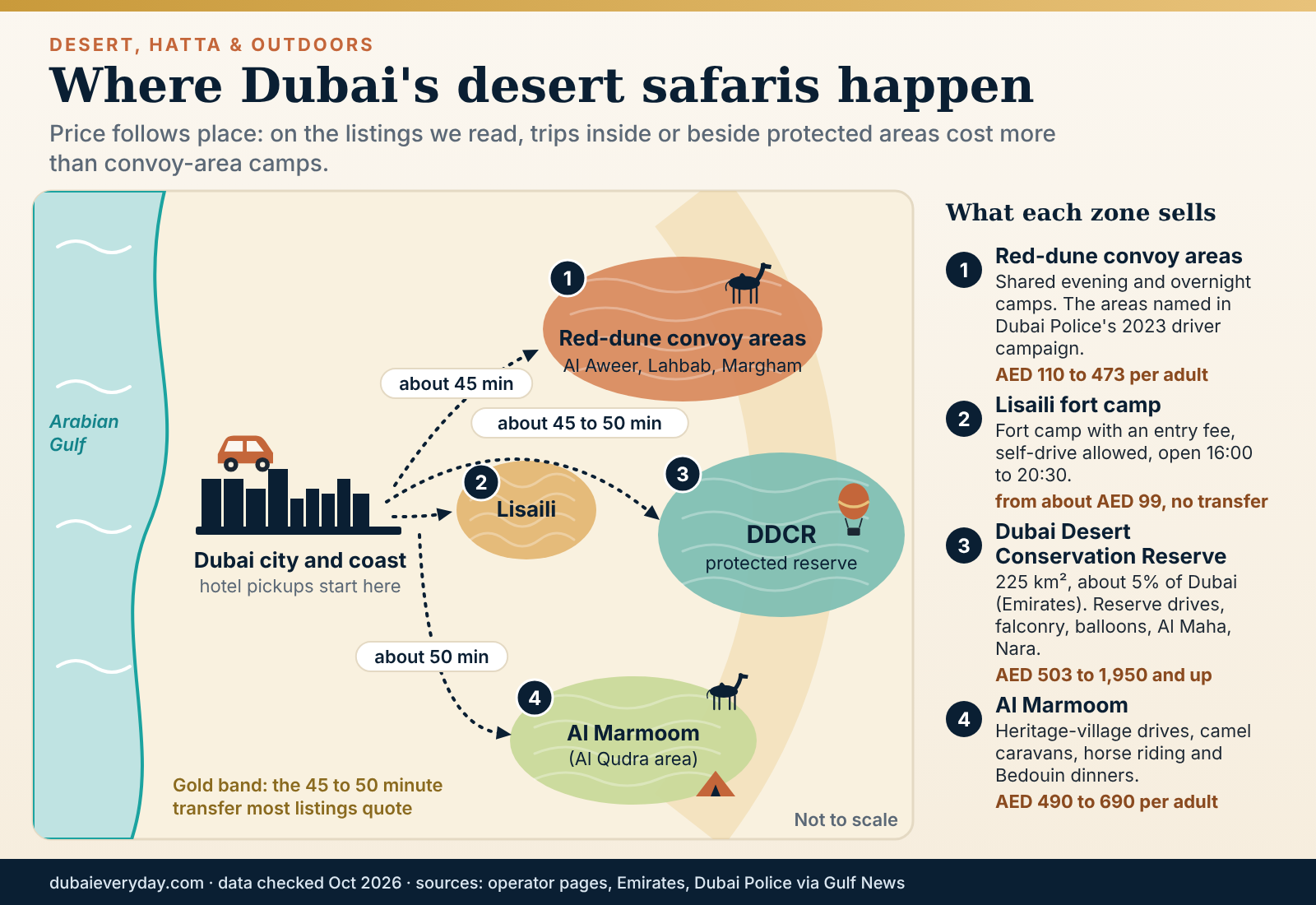
The map is deliberately loose, because the best Dubai desert safari is rarely decided by distance. Operator pages give drive times, not kilometres, and the zones blur into one another. What matters for planning is the ring: almost every listing we read puts the desert about 45 to 50 minutes from a central hotel. The Michelin Guide’s page for Al Maha, inside the DDCR, says about 50 minutes’ drive, and Marriott’s page puts the resort 65 km from Dubai International.
What the reserves change
Dubai Municipality says eight protected areas, covering about 31% of the emirate, were established under a 2014 decree, and it cites a 2003 local order that bans hunting or disturbing wildlife and removing plants, and restricts motorised vehicle use without a permit. That is the legal reason a reserve-based trip reads differently from a convoy trip. Fewer vehicles, set routes and a guide who talks about animals are the practical result, and they cost more.
Emirates states on its DDCR page that all visitor revenue from the reserve goes to conservation and wildlife care and that the reserve protects the Arabian oryx. That is Emirates’ own statement, so treat it as the operator-side claim it is. What we can say from operator pages is that DDCR itineraries emphasise a visitor centre, wildlife spotting and falconry, while red-dune convoy itineraries emphasise sandboarding, shows and a barbecue buffet.
Words that mean different things on different pages
“Dune bashing” is the common term for fast 4×4 driving over dune crests. In reserve listings the same stretch is called a “dune and wildlife drive” or a “nature drive”. “Heritage” usually signals a vintage vehicle and a Bedouin-themed camp rather than a museum visit. “Exclusive” and “private” are not the same: Arabian Adventures’ exclusive evening is private to your party and has no live entertainment, only background music.
“Luxury” has no defined meaning on a booking page, which is a problem when you are shortlisting the best Dubai desert safari at the top of the market. Dubai’s tourist-camp rules do, however, give camps one of three classes: Economy, Premium or Luxe. That is the only classification we found with regulatory backing, and we come back to it in the operator-check section. For now, keep it in mind as the one label that is supposed to be audited rather than invented.
The best Dubai desert safari by format: morning, evening, overnight, private, luxury
The five formats in the title are not five separate products. They are overlapping answers to two questions: when do you go, and who is in the vehicle with you? Settle those and the best Dubai desert safari for your trip largely picks itself. Morning and evening are about the clock. Overnight stretches the clock to 18 hours. Private is about the vehicle. Luxury is mostly about what happens at the camp. A single trip can be two of these at once, such as a private overnight with a balloon flight at dawn.
This page compares them head to head so you can pick the best Dubai desert safari for your own constraints. For a deeper hour-by-hour look at one format, we have separate pages on the morning desert safari (sunrise, cooler temperatures and pickup windows) and the evening desert safari (sunset, dinner camps, shows and crowds). Here we stay at the level of the decision.
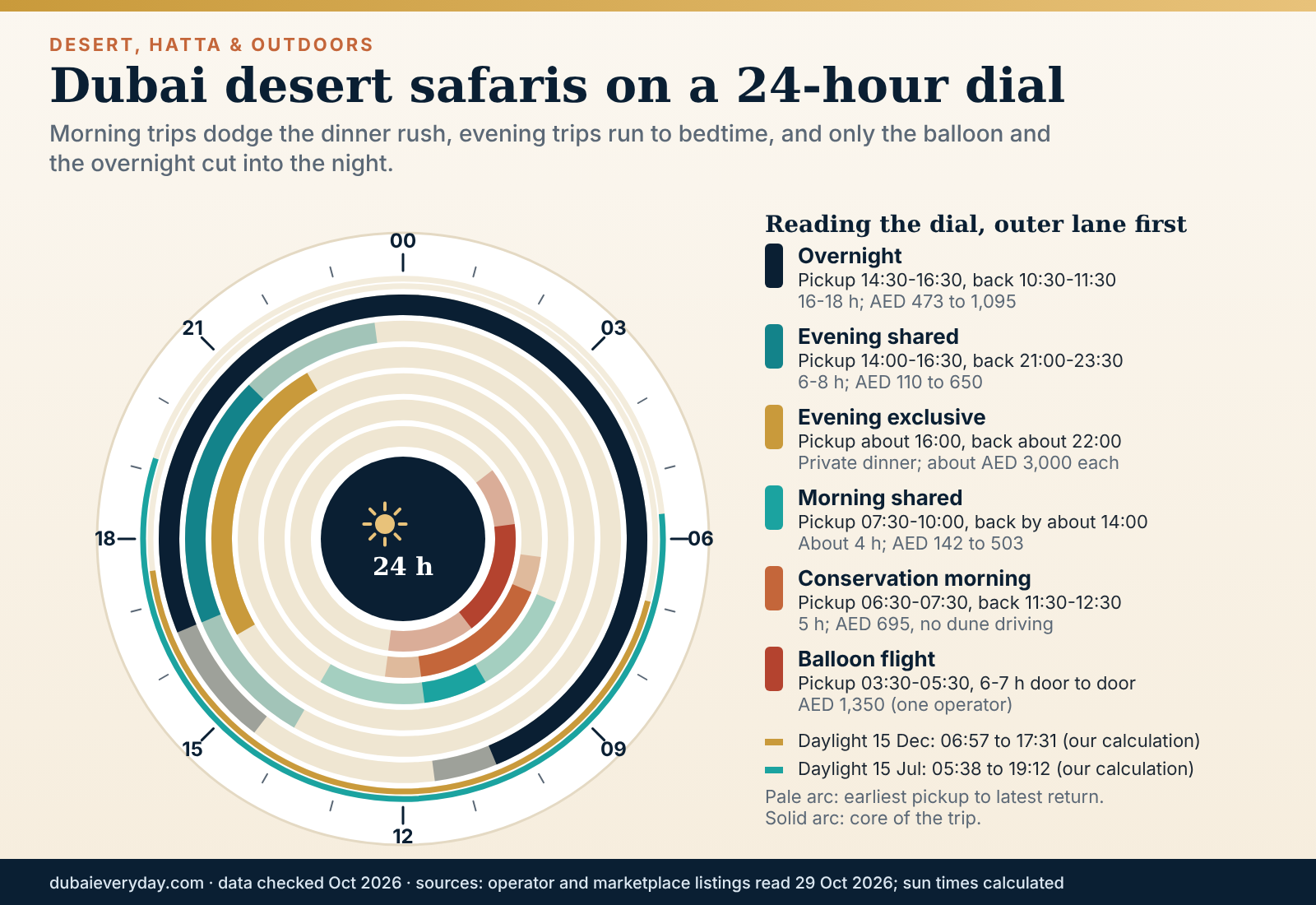
The dial shows something the listings never put side by side. A balloon flight starts in the dead of night, between 03:30 and 05:30 pickup according to Balloon Adventures Dubai. A morning safari starts after breakfast time. An evening safari starts in the middle of the afternoon and finishes after most Dubai restaurants have seated their last tables. Overnight spans the whole dark half of the clock. When you choose the best Dubai desert safari, you are choosing a sleep pattern as much as an activity.
| Format | Typical window (from listings) | Length | Price band, per adult (AED, from) | Suits | Main catch |
|---|---|---|---|---|---|
| Morning | Pickup 07:30 to 10:00 (Dubai Pass listing); about 08:30 (Arabian Adventures) | About 4 h | 142 (Platinumlist) to about 503 (USD 136.95, reserve) | Families with young children, short stays, heat-averse | No sunset, no show; in summer it is not cool |
| Evening, shared | Pickup 14:00 to 16:30; return about 21:00 to 22:30 | 6 to 8 h | About 110 (Headout) to 650 (Arabian Adventures) | First-timers wanting the full programme | Large camps, scripted shows, 45-minute transfers each way |
| Overnight | Pickup about 14:30 to 16:30; return next morning | 16 to 18 h | 473 (tented camp) to 1,095 (stone rooms) | Stargazing, sunrise, a slow pace | Facilities vary hugely; some rooms have no showers or air-conditioning |
| Private | Same windows as shared | Same as shared | 900 per car (6 guests) to 3,247 per vehicle (USD 884, 2 to 6 guests); 7,950 per vintage car (9 guests) | Groups of five or six, mixed ages, special occasions | For a couple, it costs two to three times the shared price per head |
| Luxury | Often pickup about 16:00; or pre-dawn for balloon | 5 to 7 h; resort stay is overnight | About 890 (Nara sunset and dinner, approximate) to 1,950 (Platinum Heritage) | Couples, celebrations, people who dislike crowds | Price buys privacy and food, not a different desert |
Every row has a caveat of the kind that never fits in a table cell, so the next five sections give each format a fuller hearing. After them come the two choices that cut across all formats: how much dune driving you want, and which month you travel in.
Morning desert safari: shorter, quieter, cooler in winter
A morning safari is the version of the best Dubai desert safari that fits into a short itinerary, and the cheapest way to try the dunes. The Dubai Pass listing for a shared morning trip into the reserve gives about four hours, a 6-seater vehicle with a guide, dune bashing, a camel ride, optional sandboarding in winter and a stop in an air-conditioned tent. Hotel pickup windows are 07:30, 08:00, 09:00 or 10:00, with a flexible window of up to 40 minutes. The listing price is USD 136.95 for adults, about AED 503, and USD 122.65 for children, about AED 450.
Arabian Adventures’ Morning Desert Adventure follows a similar shape: 4 hours, pickup estimated at 08:30, drive to the desert (45 minutes), a visitor-centre briefing (15 minutes), a dune and wildlife drive (30 minutes), a short camel ride (20 minutes), optional sandboarding (30 minutes), breakfast at a camp (60 minutes) and return (45 minutes). Its page shows a shared price of USD 130, about AED 477. The numbers are not magic. They show that the actual desert part of a four-hour trip is under two hours.
Three morning products with the same name
The word “morning” hides three different products, and they price very differently. Compare them before you compare operators.
- The dune-and-camel morning: shared vehicle, dune drive, camel, sandboarding. Platinumlist lists one from AED 142.
- The heritage morning: a vintage vehicle, a Bedouin village, falcon photos and a traditional breakfast. Platinumlist’s Al Marmoom version lists adults from AED 490 and a private car for six from AED 2,940, over four hours.
- The conservation morning: Platinum Heritage’s drive and breakfast at Al Maha is AED 695 for ages 8 and over, about five hours, with a 75-minute nature drive. Its Visit Dubai listing says the tour has no dune driving and that pickups run between roughly 06:30 and 07:30.
Those three sit within the same search term and a price range of roughly 5 to 1, so “the best Dubai desert safari in the morning” can mean three different things. Our reading is that the cheap version is built around volume (a convoy to a camp), while the other two are built around place and pace (a protected area, a guide, a seated breakfast). Neither is better in the abstract. They answer different wishes, and the listing text usually tells you which one you are buying if you read the first two lines of the itinerary.
Is the morning really cooler?
In winter, yes, and that is when a morning safari makes most sense. The Dubai Meteorological Office series shows a January mean daily minimum of 14.3°C and a mean maximum of 24.0°C. In July the mean minimum is 30.0°C and the maximum 41.7°C, so even the coolest hour of an average July day is hot. The Dubai Pass page acknowledges this by saying summer pickups may be brought forward by an hour.
Our calculation of sunrise for central Dubai gives about 06:57 on 15 December and 05:38 on 15 July. In December an 08:30 pickup puts you in the dunes by about 09:15, with the sun already well up but air temperatures still mild.
In July the same pickup puts you there at about 09:15 as well, when it is already well above 30°C. That is why the morning format is a winter and shoulder-season proposition, and why the best Dubai desert safari for a July visitor is rarely a morning one, and why a summer visitor should ask about a pre-sunrise start or choose an air-conditioned alternative.
Heat check. If your trip falls between May and September, a morning safari does not escape the heat; it only moves it. Prefer a format with air-conditioned vehicles and an air-conditioned camp stop, drink water before you leave the hotel, and consider skipping the sandboarding. The month-by-month guide further down shows how the numbers move.
Who a morning safari suits, and who should skip it
As the best Dubai desert safari for a short stay, it suits visitors with little time, those arriving on a late flight who want an easy first or last day, families with younger children who would struggle with a late return, and anyone who would rather not eat a barbecue buffet at 7 pm. It also leaves the rest of the day free, which matters if you have a beach plan from our guide to the best beaches in Dubai.
It does not suit people who want a sunset, a camp full of music or a long, lazy dinner. It also carries a few practical flags. The Dubai Pass page says infants under three are not allowed in the vehicle during the dune bashing, that seats are not pre-assigned and rotate, and that quad biking costs extra, is paid directly to the supplier on site and is at your own risk and not covered by the company’s insurance. Read that last point twice before you hand over cash at a camp.
On crowds, we found no data. Our reading is that a four-hour programme with fewer listings than the evening format probably involves fewer simultaneous groups, but that is an inference, not a measurement. If quiet matters, ask the operator how many vehicles will be at the stop at the same time.
Evening desert safari: the classic, in two very different price tiers
The evening trip is what most people mean by the best Dubai desert safari, and it is the format with the widest price spread. Three timed itineraries from the listings we read show how the afternoon is spent.
- Mass-market red-dune trip (Platinumlist standard listing)Pickup 15:30 to 16:00 from most Dubai hotels, a 4WD ride with 30 to 40 minutes of dune bashing, sandboarding with an instructor, a camel ride, then a barbecue dinner at a Bedouin-style camp with Tanoura, belly dance and fire shows. Listed hours 15:30 to 22:00, about seven hours.
- Premium red-dune trip (Platinumlist, Al Khayma camp)Pickup 14:00, dune bashing about 15:30 for 30 minutes, camp arrival 16:15, sandboarding and camel riding 16:45, dances from 18:00, dinner 19:00, drop-off 21:00. An international buffet with live barbecue and unlimited soft drinks.
- Reserve trip (Arabian Adventures)Pickup about 16:00, 45-minute drive, a 15-minute DDCR visitor-centre stop, a 30-minute dune and wildlife drive, a 60-minute sunset stop with a falcon show and nature walk, optional sandboarding and camel rides, a 90-minute barbecue dinner with live entertainment, and a 45-minute return. Drop-off about 21:30.
What the money buys at each tier
The cheapest tier of the best Dubai desert safari sits around AED 110 to 150. On Headout, a shared evening safari with dune bashing, sandboarding, a camel ride, henna, a barbecue and three shows is USD 29.95, about AED 110, for an advertised eight hours. A second Headout listing with a sunset photo stop is from USD 40.57, about AED 149, for seven hours. Platinumlist’s standard listing is from AED 150 for adults and AED 144 for children aged 4 to 10.
The premium red-dune tier is around AED 393 for adults and AED 334 for children on Platinumlist. The reserve tier is higher again: Arabian Adventures lists USD 177 per adult for the shared evening, about AED 650, with unlimited soft drinks. That is about 4.3 times the mass-market Platinumlist adult price and about 1.65 times the premium red-dune price, by our calculation from the listings.
What does the extra buy? Reading the itineraries side by side, the reserve tier adds a visitor-centre briefing, a falcon show, a nature walk and a sunset drink stop, and swaps a convoy area for a protected one. It does not obviously buy a smaller camp: group size is not stated on any of the pages. The mass-market tier adds sandboarding and shows by default. Whether the difference makes it the best Dubai desert safari for you depends on whether you want the animals or the entertainment.
Timing against sunset
The best Dubai desert safari in the evening is built around sunset, and sunset moves by almost two hours over the year. Our calculation for central Dubai gives about 17:31 on 15 December and about 19:12 on 15 July. Platinum Heritage’s own Visit Dubai listing shifts pickup with the season: 14:30 to 15:30 from October to February, 15:00 to 16:00 from March to May, and 15:30 to 16:30 from June to September. That is the operator keeping its dune stop aligned with the light, and a good sign when you see it.
For a mass-market trip the same logic applies in reverse. A pickup at 15:30 in December puts you at the camp at about 16:15 with sunset at about 17:30, which works. The same pickup in July puts you in the dunes at 16:15 with sunset three hours away, and most of that time is spent in open air at temperatures that, in the Dubai Meteorological Office series, average a July maximum of 41.7°C. Late pickups and air-conditioned vehicles matter more in summer than any show.
Food, drinks and entertainment
Food at the mass-market tier is a barbecue buffet with vegetarian and non-vegetarian options. Dietary needs are the sort of thing every operator asks you to declare in advance, and Arabian Adventures’ Lisaili page warns that walk-in dietary requests may not be accommodated. Treat that as a general rule: if you eat halal-only, vegan, gluten-free or kosher-style, say so at booking and again by message the day before.
Alcohol varies by operator. Platinumlist’s standard listing excludes alcohol but says it is available to buy at the camp. Its premium Al Khayma listing says alcohol is not served. Arabian Adventures sells an optional House Beverages package with unlimited wine and beer at USD 215 per adult, about AED 790, against USD 177 for soft drinks only. That is a difference of USD 38, about AED 140 per adult, by our calculation.
Remember the legal drinking age is 21 in Dubai, and the Foreign Office notes that drinking in a public place is illegal anywhere in the UAE, so a licensed camp is the only legal setting.
Entertainment on the best Dubai desert safari is scripted. Listings promise Tanoura dance, belly dance and fire shows. Arabian Adventures promises live entertainment at the reserve camp and none at its exclusive private dinner, where background music plays. If you dislike amplified shows, the reserve and private tiers are quieter, but the listings do not publish decibel levels or camp capacity, so ask.
Who the evening safari suits
It suits first-timers who want the full ritual in one night, which is why it so often tops a first-visit shortlist for the best Dubai desert safari, groups with mixed ages, and anyone who values a sunset. It is a poor fit for light sleepers who need an early start the next day, for people prone to motion sickness (the drive to the camp and back is about 90 minutes of road time before any dune driving), and for anyone who cannot sit through a show. During Ramadan the programme changes. We deal with that, and with the pre-Ramadan weeks, in the safety section below.
Overnight desert safari: what you actually sleep in
Overnight listings of the best Dubai desert safari look alike until you read the sleeping arrangements. Two operators illustrate the range, and the difference between them is bigger than the price gap suggests.
Platinumlist’s overnight listing for the Al Khayma Desert Camp in the Lahbab red dunes is from AED 473, for roughly 16 to 18 hours. It includes a 4×4 ride, 30 to 45 minutes of dune bashing, sandboarding, a camel ride, a barbecue dinner, shows, stargazing, a private air-conditioned traditional Bedouin tent, Wi-Fi, showers, toiletries, towels, slippers, a sunrise camel trek and breakfast. Washrooms and showers are shared. The page does not mention bedding.
Platinum Heritage’s Overnight Desert Safari is AED 1,095 for adults and AED 895 for children aged 5 to 11. Its Visit Dubai listing for the balloon version describes a stone dwelling room with bedding, a camp where power is off from 11:00 pm to 6:00 am, no air-conditioning or heating in the rooms and no showers on site. Its Ventrata page says the stone rooms have bathrooms without showers. Each guest may bring one overnight backpack or carry-on up to 50 cm high.
Which overnight is the best Dubai desert safari?
That depends on whether you want comfort or authenticity, and the two products are honest about it in different ways. The AED 473 option gives you a private air-conditioned tent and a shower, which matters in any month but winter. The AED 1,095 option gives you a remote protected-area setting, a nature drive in a 1950s Land Rover, a falcon demonstration and a four-course dinner, but you sleep without cooling and wash without a shower. In winter that may be fine. In April or October it may not.
Our reading is that the cheaper overnight is a longer evening safari with a bed attached, while the dearer one is an experience built around place and silence. They are not substitutes, and the 2.3 times price ratio (1,095 divided by 473) says little about quality. Check three things in the listing: is the room air-conditioned, is there a shower, and is the camp’s power cut at night. Those three answers decide whether you sleep.
Children and overnights. Age rules differ sharply. Platinum Heritage’s overnight with a balloon flight, for example, no longer admits children under 7 and does not admit pregnant guests at any stage. Platinumlist’s red-dune overnight says children must be accompanied by an adult and gives no minimum age. Confirm age and sleeping arrangements in writing before you pay for a family.
The balloon add-on
Platinum Heritage sells an overnight with a sunrise balloon flight for AED 2,940 for adults and AED 2,245 for children. Balloon Adventures Dubai sells a standalone flight at AED 1,350 for adults and AED 1,100 for children, flying from September to May, with a 45 to 60-minute flight and a 6 to 7-hour experience from pickup to drop-off. Its pickup is between 03:30 and 05:30, and it launches over the Dubai Desert Conservation Reserve.
The arithmetic is interesting but incomplete, and the sources disagree. Platinum Heritage’s own booking page lists the overnight with balloon at AED 2,940 for adults, while its Visit Dubai listing says “from AED 2,095” for the shared version. We cannot explain the gap from the pages, so confirm the live price. Against the AED 1,095 overnight alone, the balloon costs between about AED 1,000 and AED 1,845 extra, depending on which figure applies. A standalone flight with another operator is AED 1,350, but needs a pre-dawn start from your hotel.
We cannot compare the flights themselves, and the bundle’s real selling point is that you wake at the camp instead of at 03:00 in a hotel room. Whether that is worth the difference is a personal call. If the AED 1,000 figure is the current one, the bundle is clearly cheaper than doing the two things separately.
Balloon restrictions are strict. Balloon Adventures says children under 5 cannot fly, women more than three months pregnant cannot fly, and anyone with chronic back or neck pain or major surgery or a broken arm or leg in the last six months cannot fly. If the weather cancels a flight it offers rebooking or a full refund. A balloon is the one desert activity where “weather permitting” is not boilerplate.
Private desert safari: when paying for the whole car makes sense
Private is the easiest format to misjudge when you are looking for the best Dubai desert safari, because the price looks like a luxury and is often a simple multiple. On the four Platinumlist listings we checked, the “private car, up to 6 guests” price is exactly six adult tickets. That is AED 900 against AED 150 on the standard evening, AED 2,358 against AED 393 on the premium evening, AED 2,940 against AED 490 on the heritage morning, and AED 4,140 against AED 690 on the luxury heritage evening. This is our calculation from the listing prices on 29 October 2026.
It means the real question is how many people are in your party. For a group of six, the best Dubai desert safari may simply be the private one.
The break-even rule
Take the AED 900 car on the standard evening trip. For a couple, the car works out at AED 450 each, three times the shared adult price. For three people it is AED 300 each (two times), for four it is AED 225 (1.5 times), for five AED 180 (1.2 times), and for six it is AED 150, the same as the shared ticket.
Arabian Adventures follows a similar logic with different numbers: USD 884 per vehicle for 2 to 6 guests, about AED 3,247, against USD 177 per adult shared. Five guests cost USD 885 shared, so the break-even is five, and a party of six pays about 17% less in a private car than shared.
Platinum Heritage’s private Visit Dubai listing is a different animal: a private vintage Land Rover for up to nine guests from AED 7,950, which is about AED 883 each if you fill the car. It includes a 60-minute nature drive, a falcon show and sunset photo stop, a Bedouin camp welcome, bread and coffee making, camel rides, shisha, a four-course dinner and Emirati performances. For comparison, the shared Heritage Safari by air-conditioned vehicle on the operator’s own booking page is AED 695 per adult, so the private nine-seater costs about 27% more per head and removes strangers.
What a private vehicle does and does not change
A private vehicle changes the drive. You choose where to sit, you are not rotated between seats (the Dubai Pass listing says a seat-rotation policy applies on its shared tour), and you control the pace of photo stops. For groups of mixed ages that matters. It does not necessarily change the camp. In most private-car listings we read, the camp, the dinner and the show are still shared with other groups. A private car to a shared camp is a private ride, not a private evening.
The listings are also clear that private is sometimes the only option for young children. Arabian Adventures requires infants under 5 to travel in a private vehicle with special seating, and its pages differ on children under 135 cm: the evening page allows shared vehicles with a child seat, while the morning page asks for a private booking. Platinum Heritage requires a private car booking for children under 5. Its nature drive is not recommended for guests more than six months pregnant.
If you travel with a toddler, the question is not whether a private safari is worth it but whether a shared one is allowed. Our guides to Dubai with kids and Dubai with a baby cover the wider family logistics.
Self-drive: the option we would not casually recommend
A few listings allow self-drive. The Fort at Lisaili has on-site parking and a reduced entrance fee for self-drive guests. A guided self-drive event branded “Desert Drive 2026” is listed on Platinumlist for 14 November 2026, starting at Bab Al Shams Arena on Al Qudra Road, with early-bird tickets from AED 375 for adults and AED 300 for children aged 5 to 12, and it requires you to bring your own suitable 4×4.
The UK Foreign Office is blunt: desert trips are dangerous unless you have a properly equipped four-wheel-drive vehicle, you should travel with other vehicles, carry water and a phone, and use reputable operators with good safety procedures. If you rent a car, our guides to car rental in Dubai explain how deposits and insurance work, but read your own rental contract for off-road exclusions before assuming anything.
Rental contracts and insurance policies can exclude off-road use. We have not read any particular company’s clause, so we state no rule. Put the question to the rental company in writing, and do not drive onto sand in an ordinary saloon or crossover. A recovery call from the middle of a dune field is slow and costly.
Luxury desert safari: reserve drives, private dinners and resort stays
The luxury end of the best Dubai desert safari comes in three shapes, and the prices are not comparable until you separate them. One is a private, conservation-style outing with a high-end dinner. One is a branded camp where you buy a sunset, a dinner or a pod for the night. The third is a desert resort, where the desert is the address rather than the activity.
The private conservation outing
Platinum Heritage’s Platinum Desert Safari is listed at AED 1,950 for adults and AED 1,500 for children aged 5 to 11, for about 7 hours. It uses a Land Rover Defender (shared or private, a maximum of five guests per car), with a 60 to 75-minute nature safari, a 25-minute falcon demonstration, a sunset photo stop with canapés, a 15-minute camel ride, a six-course dinner in a private desert setup, and an aerial acrobatic performance and fire dancer. Gratuity and photos are extra.
Arabian Adventures’ Exclusive Desert Experience is the same idea in a quieter register. It is private to your party, hosts up to six guests, and uses a private 4×4. The itinerary is: transfer, the reserve visitor centre, a dune and wildlife drive, an optional camel ride to a private sunset lounge, a three-course Arabic dinner in a private space, and personal waiter service.
The listed prices are USD 816 per adult for one or two guests, USD 1,161 for three or four and USD 1,568 for five or six. At the peg, that is about AED 2,997, AED 4,264 and AED 5,758 per adult. There is no live entertainment, only background music.
The price ladder is steep. Our calculation of Platinum Heritage’s AED 1,950 over a seven-hour trip is about AED 279 per adult-hour, against roughly AED 21 for the AED 150 mass-market trip over seven hours. That comparison is crude, because food, group size and access are not equivalent, but it makes the point that luxury here is a purchase of exclusivity and food, not of more desert. The best Dubai desert safari at the top end is the one whose extras you will use.
Branded camps and pods
Nara runs Sonara Camp, The Nest and Nara Desert Escape in Dubai’s protected desert, and Property Finder reported its tariff in February 2026. Treat the numbers as approximate and possibly out of date until confirmed: a sunset experience about AED 390 per adult (children 6 to 12 about AED 120), sunset and dinner about AED 890 (children about AED 390), dinner only about AED 790, and an overnight at The Nest about AED 2,340 per pod for two adults.
Experiences were said to run on select days, typically Thursday to Saturday, and Nara’s site gives no prices, so contact it directly.
For a stay rather than a dinner, Property Finder describes The Nest as 14 private pods with ensuite bathrooms, climate control, fire pits and private terraces, inside the DDCR and about 40 minutes from Downtown Dubai. Access is by private transport or chauffeur-driven 4WD, because DDCR entry is controlled. We could not verify Nara’s current operating days, prices or alcohol policy from its own pages, which gave none. Ask for them in writing.
The desert resort
Al Maha, a Luxury Collection Desert Resort and Spa, sits inside the DDCR. The Michelin Guide lists 42 rooms and awards it one Michelin Key, describing a tented, Bedouin-style camp about 50 minutes’ drive from Dubai. Marriott’s page says every suite has a private temperature-controlled infinity plunge pool and puts the resort 65 km from Dubai International, with a luxury 4×4 transfer from the airport at AED 447 one way. Michelin notes that children must be 8 or older and lists an extra child supplement of AED 1,500 per night.
We found no nightly rate on either page, so we publish none. Visit Dubai names Bab Al Shams alongside Al Maha as one of the emirate’s best desert getaways, but we could not read the resort’s own site and say nothing more about it. For hotel-style comparisons, see our guides to the best luxury hotels in Dubai, the ultra-luxury hotel tier and the wider luxury Dubai guide.
How to judge the best Dubai desert safari at the premium end
Ignore adjectives. Ask what the party size is at the camp, whether the dinner is truly private, how many cars share the nature drive, and who the guide is. Ask whether the camp holds a Luxe classification certificate under the DET tourist-camp rules, and if the answer is “we are in the process of classification”, note it. Ask what is excluded. In Platinum Heritage’s case, gratuities and photographs are extra, and those add up on a party of five.
Finally, ask about wildlife. Arabian Adventures states that wildlife sightings are not guaranteed, which is the honest position. A luxury price does not buy an oryx on schedule. It buys a better chance of seeing one with a guide who knows where to look, and a better dinner afterwards.
Dune bashing or a conservation drive: the choice behind every listing
Underneath the five formats sits a simpler choice. Do you want the fast, tilting, crest-and-slide ride that gave the activity its name, or a slower drive that stops for animals and views? Some listings give you both, some give you one, and a few explicitly give you neither. If you answer this question first, the best Dubai desert safari for you usually becomes obvious.
What the restrictions actually say
Operators are fairly consistent about who should not do the dune drive of the best Dubai desert safari, though the wording differs. Platinumlist’s overnight listing says dune bashing is not recommended for pregnant women, infants, or people with serious back, neck or heart conditions. Its standard evening listing says pregnant women and people with back aches are not recommended to join, yet also states that children from one year old may join the dune bashing. The Dubai Pass listing for the morning trip says infants under three are not allowed in the vehicle during dune bashing.
Arabian Adventures takes a more flexible line that is worth knowing about. Expectant mothers and guests with pre-existing medical conditions cannot join the dune drive, but they can join the other activities, and the operator asks you to say so in advance so alternatives can be arranged. That is a more useful policy than a blanket exclusion, because it lets a mixed party stay together. Whether other operators do the same is a question to put to them, and you should do it before booking, not at the pickup point.
General information, not medical advice. Operator pages are not clinical guidance. If you are pregnant, have a spinal, neck, heart or balance condition, or are recovering from surgery, ask your own doctor whether a dune drive is sensible. Then choose an option that does not include one. The operator’s refund terms matter here: 24 to 48 hours is the cut-off on most pages we read, and no-shows are not refunded.
The no-dune options
Several products avoid the dunes altogether. Platinum Heritage’s conservation drive and breakfast at Al Maha states that it has no dune driving. Its Heritage Safari by air-conditioned vehicle has a 60-minute air-conditioned nature drive. Platinumlist carries a “Luxury Sahara Desert Oasis Dinner without Dune Bashing” from AED 295 and a “Caravanserai Desert Dinner with Optional Transfers” from AED 204, which we have not read beyond their listing titles and prices. Arabian Adventures’ Lisaili camp can be booked without a dune drive, for as little as USD 27 without transfer.
These formats are underrated by people who assume a desert trip must be a ride. For anyone with a back problem, a small child, a weak stomach or a strong dislike of being tossed about, a seated dinner in a camp or a slow reserve drive may be the best Dubai desert safari in practice, even if it would not top a thrill-seeker’s list.
What the rules say about the vehicles
Two older official-source pieces give an idea of the regulatory baseline. In 2018 Dubai Tourism announced rules that Gulf News summarised: vehicles must carry child car seats and in-car safety equipment and be inspected, drivers must complete tour-guide certification and hold Roads and Transport Authority licences to give safety briefings, and operators are assessed on health and safety, insurance and other measures. In February 2023 the Dubai Police “Tour Dubai Safely” campaign told tour-company drivers working at Al Aweer, Lahbab and Margham to monitor tyre pressure, carry off-road emergency supplies, use four-wheel-drive mode and drive slowly over obstacles.
Both are older than the current DET tourist-camp resolution and neither speaks to passengers. We cannot tell you whether any particular driver follows them. What you can do is ask the operator three things in writing: are all seats fitted with belts, are child seats supplied for the ages in your party, and does the driver give a safety briefing before the dune drive. A reputable operator will answer those without fuss.
Quad bikes and buggies
These are the highest-risk add-ons and the ones where paperwork matters most.
The Dubai Pass listing says quad biking costs extra, is paid on site, is at your own risk and is not covered by the company’s insurance, and it recommends travel insurance. Arabian Adventures’ buggy experience (USD 218 per adult as a passenger, USD 230 as a driver, about 4 hours with up to two in the buggy) requires drivers to be 16 or older, to hold a valid licence from their country of residence and to pay an AED 5,000 refundable security deposit. Passengers must be 6 or older.
At Lisaili, closed shoes are required for quad bikes and buggies, and flip-flops and sandals are not accepted. The Foreign Office advises using reputable tour operators for desert driving or quad biking and confirming that your insurance covers these activities. Our Dubai insurance guide explains how to compare travel cover, but read the policy’s activities clause for quad bikes yourself.
The best time for a Dubai desert safari, month by month
The best Dubai desert safari in January is a different experience from the best Dubai desert safari in August, and the difference is more than comfort. In winter the day is short, sandboarding is offered and operators warn that desert evenings can cool quickly. In summer the programme survives on air conditioning, early starts and late pickups. The wheel below plots the Dubai Meteorological Office mean daily maximum for each month against the operating season.

The months, in three bands
Our reading of the temperature series puts the months into three bands for the best Dubai desert safari outdoors. November to March, with mean maxima of 31.0°C, 26.0°C, 24.0°C, 25.0°C and 30.0°C, is the comfortable band. October (36.5°C) and April (34.0°C) are shoulder months, workable if you aim for the late-afternoon and sunset window. May to September, with maxima between 37.5°C and 42.1°C and mean minima of 25.1°C to 30.4°C, is the hard band.
August is the extreme. The mean daily maximum is 42.1°C and the mean daily minimum 30.4°C, so even a dawn trip starts above 30°C on an average day. The record highs in the same table run to 49.0°C in July. That is not a number to build a plan around. It is a number that explains why summer operators change pickup times, and why one balloon operator flies only from September to May.
What changes with the season, beyond heat
Rain. The same series records 3.8 to 5.8 rainy days a month from December to March, against fewer than one a month from May to September. Rain in the desert is rare and brief, but the Foreign Office notes that heavy rain can cause flooding, and balloon flights, sandboarding and some drives are weather dependent. Build a spare day into a winter itinerary if the safari is the point of the trip.
Light. Sunrise is at about 06:57 on 15 December and 05:38 on 15 July, and sunset at about 17:31 and 19:12 (our calculation). Civil dusk, when it is dark enough for stargazing to start, is about 17:57 in mid-December and 19:37 in mid-July. A winter evening trip therefore starts earlier, which is why Platinum Heritage moves its pickup window by season.
Sandboarding. The Dubai Pass listing says optional sandboarding is offered in winter, weather permitting. Read that as a hint that summer sand is too hot to be pleasant. If sandboarding is the reason you are going, go between November and March.
Peak demand, Ramadan and events
We have no official figures for safari demand, but the same tourist calendar that fills hotels fills camps. The winter weeks around the end-of-year holidays and the Dubai Shopping Festival period (see our January events guide) are the likeliest to sell out, and our best time to visit Dubai page explains how the calendar interacts with hotel prices. This is our reading of how the calendar works, not a count of bookings.
Ramadan 2027 is projected to begin around 8 February, according to The National citing the UAE Astronomy Centre, with Eid Al Fitr around 9 or 10 March, and the dates depend on moon sighting. Operators change programmes in that period. Platinum Heritage says cultural entertainment is not available during Ramadan on its overnight trip. Arabian Adventures says that in Ramadan daytime water is to be consumed only inside its vehicles, and that adult beverage service may vary during Ramadan and religious holidays. For wider guidance see our February events guide and etiquette guide.
If you can only go in summer
You can still go, and the best Dubai desert safari in summer is the one with air conditioning at every stage. Pick an air-conditioned format: Platinum Heritage’s air-conditioned heritage safari, a conservation breakfast with a seated meal at Al Maha, or an evening with a late pickup. Avoid quad bikes. Take water, a hat and sunscreen and keep outdoor time short. If heat is a serious concern for anyone in your party, our indoor things to do in Dubai page lists summer-proof alternatives, and skipping the desert in July is a perfectly sensible decision.
What the best Dubai desert safari really costs
The advertised price of the best Dubai desert safari is only the start of the bill. The listings we read are explicit about what lies outside it: quad bikes and buggies, photographs, gratuities, alcohol at some camps, travel insurance and, on at least one listing, pickups from certain hotels. Dubai’s own tourist-camp rules say operators must show a detailed price list, keep prices consistent across reservations and marketing, and not charge beyond what is in the reservation agreement. That is a useful standard to hold an operator to.

The ladder, rung by rung
The ladder starts with a camp-only ticket at about AED 99 (USD 27, no transfer, no dune drive) and a mass-market shared evening from about AED 110 to 150. It climbs through a premium red-dune evening at AED 393, a tented overnight at AED 473, the heritage morning at AED 490 and a reserve morning at about AED 503, then a reserve evening at about AED 650.
Above that sit a conservation breakfast and a heritage safari at AED 695, an overnight at stone-room camp at AED 1,095, a standalone balloon flight at AED 1,350 and Platinum Heritage’s flagship evening at AED 1,950.
At the top are the balloon-and-overnight bundle at AED 2,940 and the private exclusive evening at about AED 2,997 per adult for one or two guests. The span from bottom to top is roughly 30 to 1. Nothing in that range is a scam by itself, and nothing in it is automatically a bargain. The point of the ladder is to show how much of the price is the product and how much is the label when you shortlist the best Dubai desert safari.
Worked budgets for a couple and a family of four
The table below, a cost model for the best Dubai desert safari at six price points, is our calculation from listing prices, using adults at the adult price and, for the family, two children at the child price. Child bands differ by operator (4 to 10, 3 to 11 or 5 to 11), so check the age cut-offs. Totals exclude extras and tips.
| Option (listing) | Couple (AED) | Family: 2 adults + 2 children (AED) |
|---|---|---|
| Mass-market shared evening (Platinumlist standard: 150 adult, 144 child) | 300 | 588 |
| Private car for up to 6, same evening trip (900) | 900 | 900 |
| Premium red-dune evening (393 adult, 334 child) | 786 | 1,454 |
| Air-conditioned heritage safari (Platinum Heritage: 695 adult, 595 child) | 1,390 | 2,580 |
| Overnight in stone rooms (Platinum Heritage: 1,095 adult, 895 child) | 2,190 | 3,980 |
| Platinum Desert Safari (1,950 adult, 1,500 child) | 3,900 | 6,900 |
Three things stand out. For a family of four, the private car on the mass-market trip is AED 312 dearer than four shared tickets (AED 900 against AED 588), which is a fair price for a controlled vehicle and a toddler-friendly seat arrangement. The premium red-dune evening costs about 2.5 times the mass-market one for the same family (1,454 against 588). And the top-tier evening costs more than eleven times the mass-market family total (6,900 against 588), which is a measure of how much the label does.
What the add-ons add
- Alcohol: Arabian Adventures’ House Beverages package is USD 215 per adult against USD 177 for soft drinks, a difference of about AED 140 each. Private vehicles add USD 190 per vehicle (about AED 698).
- Buggies: Arabian Adventures lists USD 218 for a passenger and USD 230 for a driver, about AED 801 and AED 845, plus an AED 5,000 refundable deposit for drivers.
- Quad bikes: extra at most camps and paid on site. We found no verified price on the pages we read, so we do not quote one.
- Pickup surcharges: the Dubai Pass listing says pickup from Bab Al Shams, Al Maha or Jebel Ali costs an additional fee, and that airport pickup is only available from one named airport hotel.
- Photos, videos and tips: excluded on Platinum Heritage’s pages. Tips are optional on every page that mentions them.
- Travel insurance: listed as an exclusion on Headout and recommended by Dubai Pass. Our insurance guide covers how to compare policies.
Cash flow and refund windows
Money leaves your account earlier than you might expect when you book the best Dubai desert safari, and comes back later. Arabian Adventures asks for full payment at least two days before the activity, or the booking may be cancelled. Its cancellations need 24 hours’ notice. Platinum Heritage offers a full refund if you cancel more than 18 hours before pickup on its own site and 24 hours on its Visit Dubai listings. Platinumlist’s standard and heritage listings allow free cancellation or rescheduling up to 24 or 48 hours before. Balloon Adventures needs 24 hours, and its flights are cancelled for weather with rebooking or a refund.
One pattern is worth noting: the later you book, the fewer refund options you have. If your plans might change because of flights, weather or the regional situation, book the most flexible product and pay as late as the operator allows. Read the no-show clause too. On every operator page that states one, no-shows are non-refundable.
Cheaper ways to see the desert
There is no verified free desert experience that we can recommend as a substitute for a guided trip. For a low-cost alternative, camp-only entries such as Lisaili’s USD 27 option let you skip the dune drive and the hotel transfer. For wider budget ideas in the city, see our guide to free things to do in Dubai. A shared mass-market safari at AED 110 to 150 is already the cheapest guided option we found, and for a tight budget it can be the best Dubai desert safari.
How to choose the best Dubai desert safari for your trip
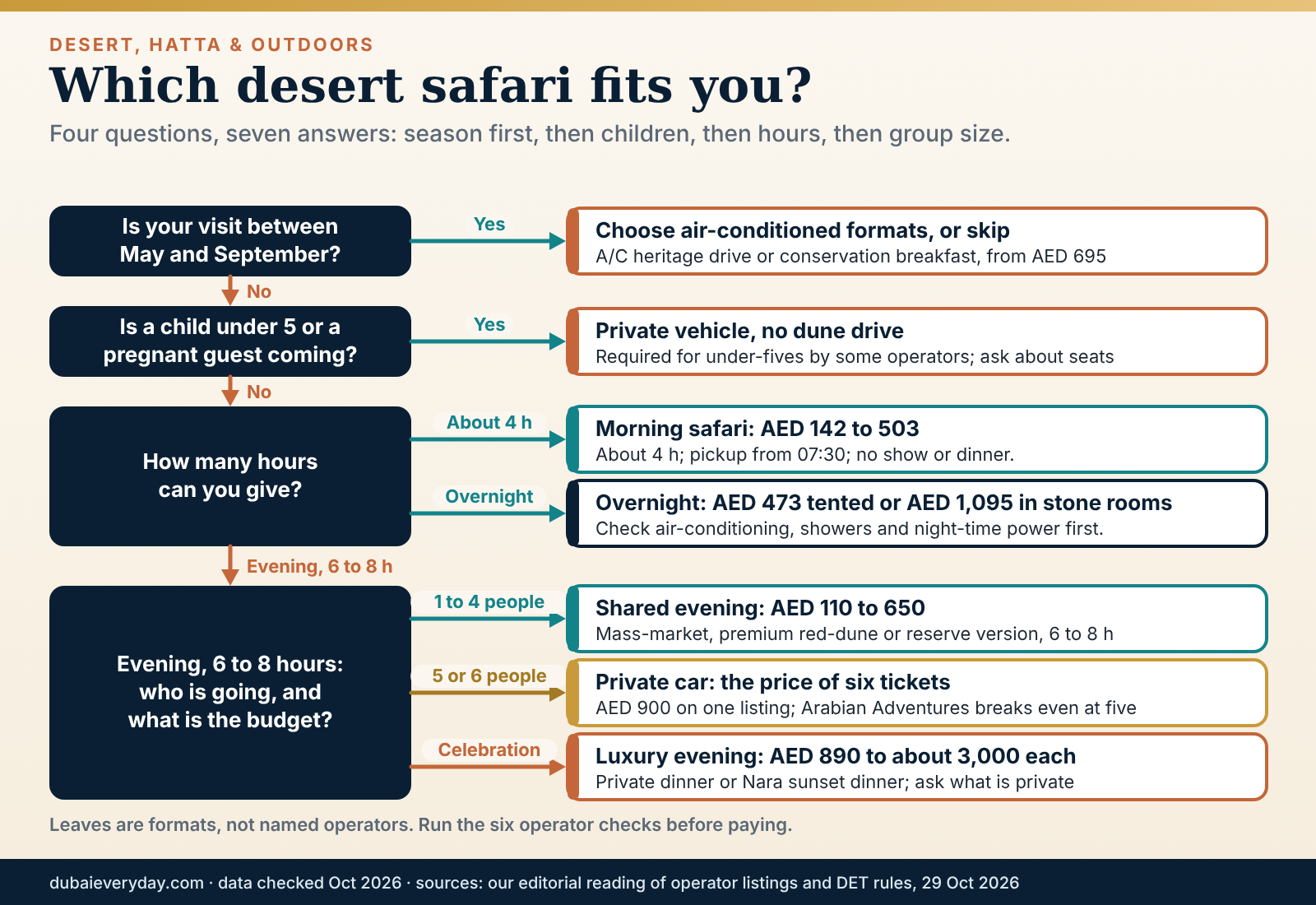
The decision tree below turns the sections above into five questions. Start at the top, answer honestly, and the leaves point to a format. It is a shortlisting aid, not a verdict, and each leaf still needs the operator checks that follow in the next section.
Scenario picks for the best Dubai desert safari
Here are the scenarios people most often bring to this decision. Each pairs a situation with a format and the reason, built from the listings and rules above.
A first-time couple in December
The best Dubai desert safari here is a shared evening trip, either mass-market (about AED 110 to 150 each) or premium red-dune (AED 393). In winter the heat problem is gone and the full programme is at its best. If you want to talk to a guide rather than watch a show, move up to a reserve evening at about AED 650.
Parents with children aged 7 and 10
The best Dubai desert safari for this family is a morning trip or an early-pickup evening. Both children fit every child band we read. Check that child seats are supplied, that the dune drive is optional, and that the programme ends before bedtime. A private car for four is AED 312 dearer than shared on the mass-market trip.
A family with a toddler
The best Dubai desert safari is a private vehicle, because operators require it for under-fives. Pick a seated, no-dune format such as a conservation breakfast or an air-conditioned heritage safari. Ask about child seats in writing.
Six friends
For six, the best Dubai desert safari is often a private car: at AED 900 on the mass-market trip it costs the same as six shared tickets, and gives you one vehicle and one schedule. Book the premium tier if shows and dinner matter more than the price.
An anniversary or proposal
The best Dubai desert safari for a celebration is a private, no-entertainment evening such as Arabian Adventures’ exclusive format, or a Nara sunset-and-dinner at about AED 890. Expect to pay several times the shared price. Ask what is private and what is shared.
A solo traveller on a budget
The best Dubai desert safari on a budget is a shared mass-market evening or morning, with add-ons kept to a minimum. Do not book a private car: it is priced at six adult tickets, so a solo traveller would pay six times the shared fare.
Four more situations
Short stopover. For the best Dubai desert safari on a layover, our rule of thumb, not an operator rule, is to avoid an evening safari if you fly within about six hours of its return window. Evening listings return at roughly 21:00 to 23:30. A morning trip with a 4-hour programme and a 45-minute return drive fits a long layover better. For the airport side of the plan, see our Dubai International Airport guide.
Visiting in July or August. Choose an air-conditioned format or skip the desert, and consider indoor alternatives. This is the one scenario where we would say skipping the desert is a sound decision.
Back, neck, heart or balance concerns, or pregnancy. Ask your doctor, and then pick a product that excludes the dune drive or lets you opt out of it. Arabian Adventures’ approach, where the traveller joins everything except the drive, is the model to look for.
Wildlife and photography enthusiasts. A reserve trip with a conservation guide is the best Dubai desert safari choice, and a morning departure gives the best chance of seeing animals before the heat sends them to shade. That last point is our inference. No operator guarantees sightings, and Arabian Adventures says so explicitly.
If this is your first trip to the city, the complete planning sequence is in our first time in Dubai guide, and the full destination overview is in the Dubai travel guide.
How to check an operator before booking the best Dubai desert safari
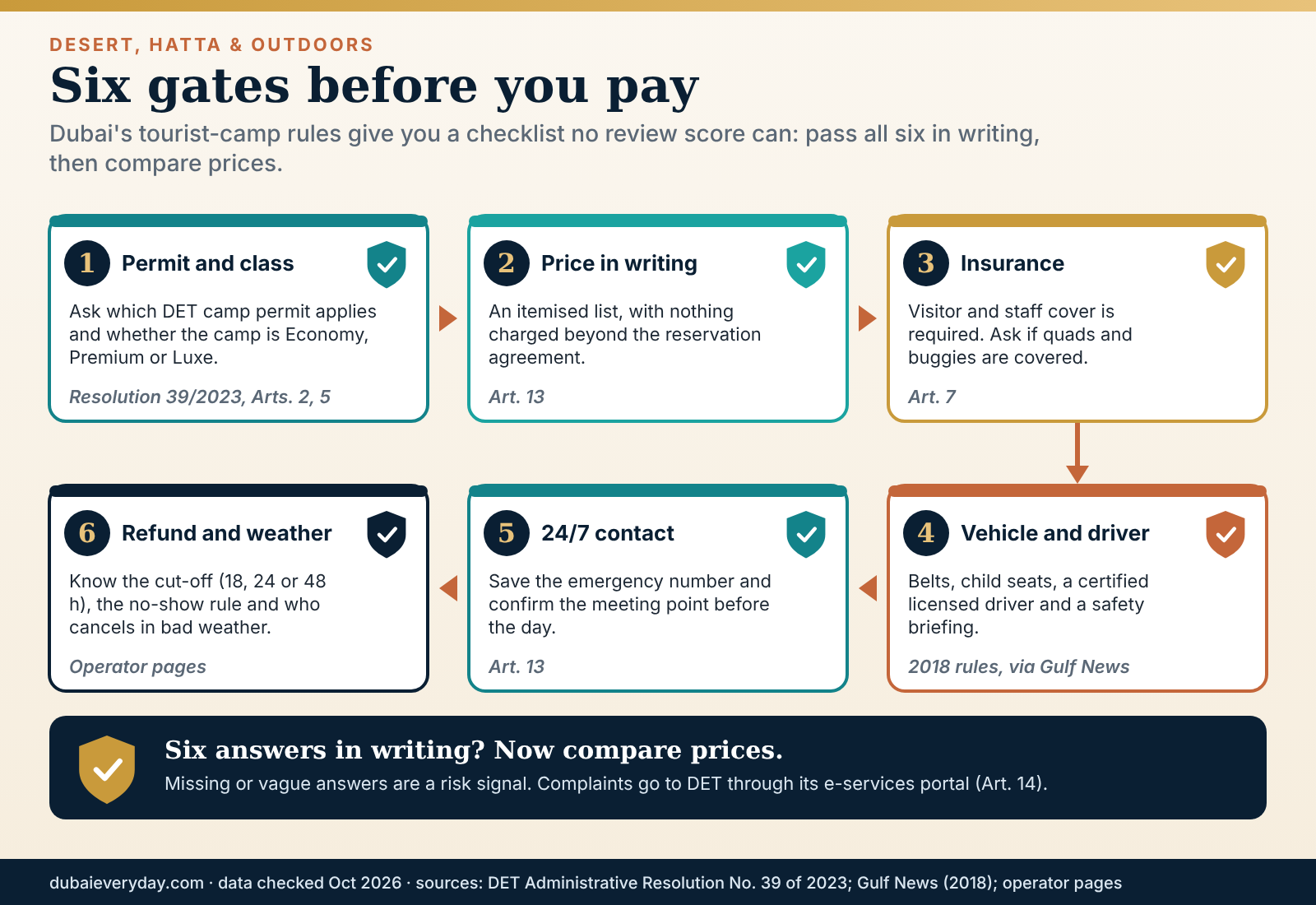
Most comparison pages stop at the product. The more useful question is whether the company selling the best Dubai desert safari meets the rules Dubai has set for desert camps. Those rules exist and are readable, and they give you a six-point test that no review score can.
What Dubai’s tourist-camp rules require
DET Administrative Resolution No. 39 of 2023, which implements an earlier Executive Council resolution on tourist camps, applies to temporary sites set up by a licensed inbound tour operator in a desert, mountain area, valley or nature reserve. It requires a camp permit valid for one year, renewable. It sorts camps into three classes, Economy, Premium and Luxe, and gives successful camps a classification certificate. We read the published PDF through an automated summary, so check any article wording against the original; we are not lawyers, and this is general information.
For a visitor, the operating obligations are the useful part. Operators must respect maximum capacity, hold a valid insurance policy from an insurer licensed in Dubai that covers visitors and staff, meet first-aid and safety standards, take reasonable fire precautions, and keep 24/7 contact numbers for visitor support and emergencies. They must show a detailed price list, keep prices consistent across reservations and marketing, honour the agreed reservation terms and not charge beyond them. They must publish a complaints policy and keep complaint records.
The six gates in practice
- Ask for the permit and the classAsk which DET camp permit covers the site and whether it is Economy, Premium or Luxe. A genuine operator should be able to answer in a sentence. If it cannot, treat the word “luxury” on its page as marketing.
- Get the price in writingAsk for an itemised price in the booking confirmation: what is included, what is paid on site, what children pay and which fees apply to your hotel. The resolution says no costs beyond the reservation agreement.
- Ask what the insurance coversThe resolution requires visitor and staff cover, but quad bikes and buggies are often described as at your own risk. Ask in writing whether those activities are covered, and check your own travel policy.
- Ask about the vehicle and the driverAsk whether seats have belts, whether child seats are supplied, whether the driver is certified and licensed, and whether there is a safety briefing before the dune drive. The 2018 rules reported by Gulf News called for exactly these things.
- Save the 24/7 numberThe rules require operators to keep emergency and support numbers. Save the number before the day and confirm the meeting point if you are not collected from a hotel lobby.
- Read the refund and weather termsKnow the cut-off (18, 24 or 48 hours on the pages we read), the no-show rule and what happens if the operator or the weather cancels. Ask what happens if an official alert or advisory affects the trip.
If something goes wrong
The resolution sets out a complaints route. A complaint is filed through the DET e-services portal with supporting documents, the operator has seven days to respond, and the DET may meet the parties to seek an amicable settlement. If a party rejects the settlement, the complaint closes and the complainant may go to the Dubai courts.
DET can suspend a camp for up to six months or revoke its permit. We found no public licence lookup on the DET pages we could load, so the practical step is to ask for the permit details and, if you doubt them, contact the DET.
What we could not verify. We could not load the DET page that lists the camp classification criteria, and we found no public register of permitted camps. We therefore cannot tell you which named operators hold which class. Ask them, and if you are unsatisfied with the answer, book elsewhere.
Mistakes that cost money or comfort when booking
Avoiding these mistakes is half of finding the best Dubai desert safari. Each comes from a specific listing term or rule above, not from anecdote. They are the places where reading the fine print saves you something.
- Comparing headline prices without comparing group size, vehicle type and location. An AED 150 convoy trip and an AED 650 reserve trip are different products with the same name.
- Booking a cheap ticket and then buying a quad bike on the spot, without checking whether the activity is covered by insurance. The Dubai Pass listing says it is not covered by the company’s policy.
- Assuming a private car means a private camp. Check whether the dinner, show and seating are shared.
- Booking an evening safari for the last night before an early flight. The return window runs to 21:00 to 23:30 on the listings we read.
- Not checking the age and seating rules. Platinum Heritage requires a private car for under-fives, and its balloon overnight no longer admits under-sevens.
- Skipping the pickup confirmation. The Dubai Pass listing asks you to wait in the lobby 15 minutes before pickup, allows a pickup window of up to 40 minutes, and asks you to confirm the time with the supplier by WhatsApp at least a day before.
- Wearing sandals to sandboard or ride a buggy. Lisaili refuses flip-flops and sandals on quad bikes and buggies, and the Dubai Pass listing recommends sports shoes for sandboarding.
- Expecting full entertainment in Ramadan. Platinum Heritage says its cultural entertainment is not available during Ramadan.
Red flags in a listing
Some warning signs are judgement rather than rule, so we label them as ours. A price far below every comparable listing, with no explanation, deserves suspicion, because the cheapest tier we found was already about AED 110. A refusal to name the camp or the pickup process is a problem. So is a listing that gives no age or health restrictions at all, because every operator we read states some. And pressure to pay in cash on arrival for add-ons, without a printed price list, runs against the spirit of the price-list rule.
None of this makes a cheaper trip a bad one, and the best Dubai desert safari is not automatically the dearest. Mass-market safaris are a mature product and the camps are used to large groups. The point is that price alone is not evidence of quality or of safety, in either direction.
Safety on the best Dubai desert safari: health, dress, alcohol and Ramadan
This section collects the practical rules for whichever trip you pick as the best Dubai desert safari. It is general information drawn from operator pages and the UK Foreign Office’s safety guidance, not medical, legal or insurance advice, and your own government’s travel advice and your doctor override anything here.
Heat, sun and water
Operators of the best Dubai desert safari trips repeat the same kit list: lightweight breathable clothing, sturdy shoes, sunscreen, sunglasses and a hat, and a warm layer for winter evenings because desert temperatures can drop quickly after sunset. Platinum Heritage gives each guest a stainless-steel water bottle and a headscarf; the Dubai Pass listing includes mineral water and soft drinks. For anyone prone to heat illness, children, older adults and people on medication that affects heat tolerance, the sensible response is to choose the cooler months, air-conditioned vehicles and shorter formats, and to ask your own doctor.
The Dubai Meteorological Office series on which this guide relies shows why. A mean daily maximum of 36.5°C in October and 37.5°C in May already puts a standing-around camp programme in the hot band. Between November and March the mean maximum stays between 24.0°C and 31.0°C, which is the comfortable window for the best Dubai desert safari experiences that involve a lot of time outdoors.
Children, pregnancy and health conditions
Rules differ by operator, as the earlier sections showed, and a few rules are strict. Children up to 11 must be accompanied by an adult aged 18 or over on Platinum Heritage’s private safari. Children under 7 are not permitted on its balloon overnight. Balloon Adventures does not allow children under 5 or women more than three months pregnant, and excludes people with chronic back or neck pain, major surgery in the last six months or a broken arm or leg in the same period. Al Maha accepts children aged 8 and over.
The common thread is that operators put the burden on you to disclose conditions in advance. Do so at booking, and again by message the day before. Ask for dietary needs and allergies too: Arabian Adventures notes that walk-in dietary requests may not be accommodated, and Platinum Heritage asks for them at booking.
Dress, behaviour and photography
Dress modestly while travelling to and from the desert on any safari, because hotel lobbies and public areas follow normal Dubai norms; our Dubai dress code guide goes into detail. In the camp itself, the practical clothing is covered-up, loose and sun-protective. The Foreign Office advises asking permission before photographing people and notes that publishing photos or video can require National Media Council permits. Falcon photos with the handler are a standard camp activity on several pages we read.
Platinum Heritage’s balloon overnight listing says drones are not permitted. We did not find the general drone rules for the desert in the sources we read, so we say nothing more about them. If you plan to fly one, check the current UAE rules and the operator’s policy before you pack it.
Alcohol
On a desert safari, as elsewhere, the legal drinking age in Dubai is 21, and the Foreign Office states that drinking or being under the influence of alcohol in a public place anywhere in the UAE is illegal. In Dubai you do not need a personal liquor licence to drink in licensed venues. Some desert camps sell alcohol, some do not, and one operator sells a drinks package. If a camp advertises alcohol, ask whether it is licensed. If a camp does not serve it, do not bring your own. Our etiquette guide covers the wider norms.
Respecting the reserve
In the DDCR and other protected areas, the Dubai Municipality-cited 2003 local order prohibits hunting or disturbing wildlife, removing plants and introducing non-native species, and restricts motorised vehicle use without a permit. In practice that means stay with your guide, do not feed or chase animals, take your rubbish back, and do not collect plants or fossils. An operator that lets you wander off or encourages you to chase animals for a photo is not following the spirit of the reserve.
Insurance
The Foreign Office tells travellers to hold insurance that covers their planned activities and emergency costs. Read the policy for words such as “off-road”, “quad”, “buggy”, “adventure sports” and “hot-air balloon”. Some policies exclude such activities. Compare cover before you buy, using our insurance guide as a framework, and keep the booking confirmation, the operator’s permit details and its 24/7 number together on your phone.
Logistics: pickups, flights and what to pack
Even the best Dubai desert safari can be spoilt by logistics. The things that go wrong are usually pickup, timing and what you carry.
Pickups
Most shared trips on the best Dubai desert safari lists pick up from hotels. Platinum Heritage’s Visit Dubai listings say hotels only, not private residences, and Arabian Adventures says hotel or residence in Dubai. Pickup windows depend on area as well as season. Platinumlist’s standard evening listing gives 15:30 to 16:00 for most Dubai hotels and 16:00 to 16:30 for Jebel Ali, Al Maktoum hotels, Production City, Sports City and Al Furjan. Our best hotels in Dubai guide discusses areas, but remember that on this listing location moves your pickup slot by only about 30 minutes.
Pickups are windows, not appointments. The Dubai Pass listing allows pickup up to 40 minutes after your chosen time and asks you to be in the lobby 15 minutes ahead. Confirm the exact time by WhatsApp or message the day before, because Platinum Heritage says its exact times are sent 24 to 48 hours ahead or around noon on the day, depending on the listing. If you are not contacted, call the operator.
Timing around your trip
Our planning rules, built from the listed windows, are simple. For an evening trip, leave at least six hours between the return window and any flight or early commitment. For a morning trip, allow a buffer of about two hours after the return time before a check-in or a lunch booking. For a balloon, plan a nap. Return transfer times are estimates, and traffic on Dubai’s roads late in the day can lengthen them.
If you are connecting a safari to a longer visit, our events calendar guide helps avoid clashes with big events that affect traffic. Hotel guests at the desert resorts should plan separate transfers: Marriott’s page lists a luxury 4×4 transfer from the airport to Al Maha at AED 447 one way.
What to bring
- Passport or Emirates ID for any activity that asks for ID. The balloon overnight listing requires full name, nationality, passport number, date of birth and a contact number; buggy drivers need a valid licence and a photo ID.
- Closed shoes for sandboarding, quads and buggies, and sunglasses, a hat and sunscreen for the daytime.
- A warm layer between November and March, because Arabian Adventures notes that desert temperatures drop quickly in the evening.
- A phone with a charged battery and the operator’s contact number saved. The Platinumlist overnight listing mentions Wi-Fi at camp, but signal in the dunes is not something any page we read promised.
- Cash or a card for on-site add-ons, but only after you have seen the printed price list.
- Any medication you need, with documentation where required, and your dietary information already sent to the operator.
- Cheap, washable clothing for sandboarding, and a bag or case for your phone and camera, since sand gets into everything.
Pairing the safari with the rest of your trip
The best Dubai desert safari for a packed itinerary is one that pairs with the rest of the day. A morning safari pairs well with an afternoon on the sand of a city beach. An evening safari pairs with a slow morning and a late breakfast. For other plans around the city, see our things to do in Dubai guide and the Dubai travel guide. If you have only one free day in the whole trip and it is July, skip the desert and use that day for something indoors.
FAQ: the best Dubai desert safari questions answered
What is the best Dubai desert safari for first-timers?
For most first-timers the best Dubai desert safari is a shared evening trip between November and March, because it packs a drive, a sunset, a camel ride, dinner and a show into one afternoon. Pay about AED 110 to 150 for a mass-market version, around AED 393 for a premium red-dune camp, or about AED 650 for a reserve version with a falcon show and a nature walk. Choose by what you want to see, then run the operator checks in this guide.
Is a morning or an evening desert safari the best Dubai desert safari?
Which is the best Dubai desert safari depends on how much time you have. Evening is the fuller programme and morning is the shorter, simpler one. Morning trips run about four hours, with pickup from about 07:30, and skip the dinner and show. Evening trips run six to eight hours and include sunset and entertainment. In winter either works. In summer neither is truly cool, since the July mean daily minimum is 30.0°C, so the format matters less than air conditioning and a late or early start. See our separate pages on the morning and evening formats for detail.
How much does a desert safari in Dubai cost?
The best Dubai desert safari has no single price. On the listings we read on 29 October 2026, shared trips ranged from about AED 110 (a mass-market evening on Headout) to about AED 650 (a reserve evening at Arabian Adventures). Overnight trips ran from AED 473 to AED 1,095, a standalone balloon flight was AED 1,350, and a six-course private dinner was AED 1,950 per adult. Quad bikes, buggies, photographs, tips and some drinks cost extra. Treat all prices as “from” figures and confirm them.
Is a private desert safari the best Dubai desert safari for the money?
It depends on party size, and a private car can be the best Dubai desert safari for a group of five or six. On four Platinumlist listings the private car for up to six guests costs exactly six adult tickets, so six people pay the same as shared, four pay about 1.5 times and a couple pay about three times per head. Private is worth it for families with infants, because operators require private vehicles for under-fives, and for groups of five or six who want one schedule. For a couple it mostly buys control, not a different camp.
How far is the desert from Dubai, and how long does a safari take?
Operator itineraries give about 45 minutes each way from a central hotel, and Michelin describes Al Maha as about 50 minutes’ drive from Dubai. Morning safaris run about four hours, evening ones six to eight hours and overnight ones 16 to 18 hours. A balloon flight takes 45 to 60 minutes in the air and six to seven hours from pickup to drop-off. Actual pickup and return times vary by season, hotel area and traffic.
Is an overnight desert safari worth it, and are there showers?
Overnights vary enormously. A Platinumlist overnight from AED 473 lists a private air-conditioned tent, with shared washrooms and showers. Platinum Heritage’s AED 1,095 overnight uses stone rooms with no air-conditioning and no showers, and camp power is off from 11:00 pm to 6:00 am on the balloon version. If comfort matters, ask about air-conditioning, showers and night-time power before you book. Overnights suit stargazing and slow mornings, not light sleepers.
Is dune bashing safe, and who should avoid it?
We cannot assess safety for a specific driver or vehicle. Operators generally say dune bashing is not recommended for pregnant women, infants, or people with serious back, neck or heart conditions. Dubai’s rules and past police campaigns focus on driver certification, vehicle checks and slow, careful driving. Ask whether seats have belts and whether a briefing is given, choose reputable operators and ask your doctor if you have a health concern. Several formats avoid dune driving altogether.
Can children, babies or pregnant women go on a desert safari?
Often, but the rules differ, so check them before you settle on the best Dubai desert safari for a family. Arabian Adventures requires infants under five to travel in a private vehicle, and Platinum Heritage requires a private car for under-fives. The Dubai Pass listing bars infants under three from the vehicle during dune bashing. Pregnant guests cannot join the dune drive on some operators but can join the rest, and Platinum Heritage’s overnight with a balloon excludes pregnancy at any stage. Check each operator’s age and health rules before paying.
What should I wear and bring?
Operators suggest lightweight breathable clothing, sturdy closed shoes, sunscreen, sunglasses and a hat, plus a warm layer in winter because desert evenings cool quickly. Sports shoes are advised for sandboarding, and flip-flops are refused for quads and buggies at Lisaili. Bring a charged phone, the operator’s number, any ID the activity requires, and dietary details already sent. A scarf is handy for sun and sand, and Platinum Heritage supplies a headscarf.
Is alcohol served on the best Dubai desert safari trips?
Sometimes. Platinumlist’s standard evening listing excludes alcohol but says it can be bought at the camp, and its premium listing says none is served. Arabian Adventures sells a House Beverages package with unlimited wine and beer for USD 215 per adult against USD 177 for soft drinks. The legal drinking age in Dubai is 21, and drinking in public places anywhere in the UAE is illegal, so alcohol is only legal at a licensed venue. Service can change during Ramadan.
Can I do the best Dubai desert safari in summer?
You can, and the best Dubai desert safari in summer is air-conditioned from pickup to drop-off. The mean daily maximum is 39.9°C in June and 42.1°C in August, and the mean daily minimum in August is 30.4°C. Pick an air-conditioned vehicle and camp, a late pickup for evening trips or a very early start for morning ones, and avoid quad bikes. One balloon operator flies only from September to May. If anyone in your party is heat-sensitive, an indoor day is a sensible alternative.
Do desert safaris run during Ramadan?
Some do, with changes. Ramadan 2027 is projected to begin around 8 February, depending on moon sighting. Platinum Heritage says cultural entertainment is not available during Ramadan on its overnight trip. Arabian Adventures says daytime drinking of water is limited to inside its vehicles, and that adult beverage service may vary. Ask the operator what the Ramadan programme includes and whether prices change, because the entertainment is a large part of what the shared evening trip sells.
Can I drive myself into the desert?
Some camps allow self-drive to a fixed site, such as the Fort at Lisaili, and a guided self-drive event is listed for 14 November 2026. Open-desert driving is another matter. The UK Foreign Office says desert trips are dangerous without a properly equipped four-wheel-drive vehicle, advises travelling with other vehicles and carrying water and a phone, and suggests using reputable operators. Check your rental contract and insurance before taking any hired vehicle off the road.
How can I check that a desert safari company is legitimate?
Use the six gates in this guide before you book the best Dubai desert safari. Ask for the DET camp permit and its Economy, Premium or Luxe class, an itemised written price, details of insurance, the vehicle and driver arrangements, a 24/7 contact number and the refund terms. Dubai’s tourist-camp resolution requires several of these. We found no public permit lookup on the DET pages we could load, so ask the operator directly and contact the DET if you have doubts.
Related reading
Sources and further reading (37 links)
- Dubai Legislation Portal: DET Administrative Resolution No. 39 of 2023 Concerning Tourist Camps — camp permits, Economy/Premium/Luxe classes, insurance, price list, complaints
- Dubai Department of Economy and Tourism: Tourism businesses licences — page covers safari, tour and camp licences; detail did not load
- Dubai Municipality: About Dubai protected areas — eight reserves, about 31% of Dubai, 2003 local order
- Emirates: Dubai Desert Conservation Reserve — reserve size, oryx, revenue statement (operator-side claims)
- Visit Dubai: Al Marmoom Bedouin Experience — description only
- Visit Dubai: Dubai desert hotels and resorts — Bab Al Shams and Al Maha named
- Dubai Pass: Morning Desert Safari with dune bashing (shared) — price, pickups, quad terms
- Visit Dubai Experiences: Heritage Safari by Vintage Land Rover, private car — Platinum Heritage price, seasonal pickups, restrictions
- Visit Dubai Experiences: Conservation Drive with Breakfast — Platinum Heritage AED 695, no dune driving
- Visit Dubai Experiences: Heritage Safari with Overnight Stay and Hot Air Balloon — stone rooms, restrictions, price discrepancy
- Platinum Heritage booking page (Ventrata): all products — operator prices, durations, inclusions
- Platinum Heritage Dubai: official site — Platinum and Heritage collections, 18-hour refund rule
- Arabian Adventures: Evening Desert Safari in Dubai — itinerary, USD prices, alcohol, age policy
- Arabian Adventures: Morning Desert Adventure — itinerary, price, restrictions
- Arabian Adventures: Exclusive Desert Experience — private dinner, USD tiers
- Arabian Adventures: The Fort, Lisaili Desert Experience — camp-only price, hours, self-drive
- Arabian Adventures: Dune Buggy Adventure — buggy price, age, licence, deposit
- Balloon Adventures Dubai: FAQ — price, season, pickup, restrictions, weather policy
- Platinumlist: Desert safaris in Dubai — marketplace listing prices
- Platinumlist: Red Dunes Desert Safari with BBQ Dinner — marketplace: price, per-car, restrictions
- Platinumlist: Premium Red Dunes Safari at Al Khayma Camp — marketplace: timed itinerary and prices
- Platinumlist: Overnight Red Dune Desert Safari — marketplace: tented overnight
- Platinumlist: Morning Heritage Safari, Al Marmoom — marketplace: price and private car
- Platinumlist: Evening Luxury Heritage Safari, Al Marmoom — marketplace: price and private car
- Platinumlist: Desert Drive 2026 — self-drive event on 14 November 2026
- Headout: Evening Desert Safari with shared transfers — marketplace price USD 29.95
- Headout: Evening Desert Safari with dune bashing and BBQ — marketplace price from USD 40.57
- Property Finder: Nara Desert Escape — secondary: Nara tariff and Nest details
- Nara: Desert Collection — operator page, no prices
- Marriott: Al Maha, a Luxury Collection Desert Resort and Spa — suites, pools, transfer fare
- Michelin Guide: Al Maha — rooms, One Key, drive time, age rule
- UK Foreign Office: UAE travel advice — current regional warning, insurance
- UK Foreign Office: UAE safety and security — alcohol, photography, desert driving advice
- Wikipedia: Climate of Dubai — secondary compilation of Dubai Meteorological Office monthly data
- The National: Ramadan 2027 UAE dates — projected dates, moon-sighting caveat
- Gulf News: New rules to make desert safaris safer — 2018 rules summary (older)
- Gulf News: Safety campaign for drivers of desert tours in Dubai — Dubai Police “Tour Dubai Safely”, 2023
Update log: 29 October 2026 — first publication; all facts re-checked against the sources above. Next review due: April 2027 for prices, pickup times and Ramadan 2027 programmes, with a full annual review by October 2027, and sooner if access, policy, price or operator status changes. Corrections welcome. This page is general information, not individual travel, medical, legal or insurance advice; confirm prices, availability and rules with the operator before you pay.
About DubaiEveryday and this guide
DubaiEveryday.com is an independent editorial project that publishes practical, research-based guides to everyday life in Dubai: where to live, what things cost, how the rules work and how to get around. This page was written and edited by the DubaiEveryday editorial team. It is not signed by a named expert, doctor, lawyer or adviser, and we do not claim first-hand testing of a venue, clinic or service unless the page says so.
Each guide is built from official sources such as government and regulator pages, operator websites and established news outlets, cross-checked where we can. When we could not confirm something, we say so in the text, and examples that use made-up numbers are labelled as illustrations. Mentions are editorial choices, not paid placements, and a link is not an endorsement.
Dubai changes quickly. If you spot something that is out of date or wrong, please tell us through the contact options on DubaiEveryday.com and we will check it and correct the page.