

Dubai with baby is perfectly workable once you stop planning around attractions and start planning around feeds, naps, shade and a car seat. This guide covers the logistics for babies under about two: feeding, strollers, taxis, hotels, malls, changing rooms and heat.
Say your baby falls asleep in the taxi, wakes up hungry at the mall entrance and decides the heat is a personal insult. None of that is a disaster, but all of it is easier with a plan. The hard part is rarely the sights. It is the gaps between feeds, naps and shade.
Planning dubai with baby around the baby’s rhythm, not the attraction list, is what makes a trip workable. This guide covers car seats, strollers, taxis, feeding, changing rooms, hotels and heat, and it is upfront about what could not be confirmed, such as the lack of a confirmed taxi with a child seat. You will also see what to check before booking anything non-refundable this season.
Dubai with baby works when every outing is built around the baby’s rhythm rather than the sights. In practice that means three things: a cool or shaded place within a few minutes of wherever you are, a car seat you control, and a feeding plan that does not depend on finding a quiet corner.
Go between mid-November and March if you can, when average daytime highs are roughly 24 to 31°C. From June to September, highs are around 40 to 42°C and the pram becomes a short-distance tool, not a daily one. Children aged five and under travel free on the Metro, infants under two usually fly on a lap, and UAE rules reported by Gulf News require a child seat for children under four. Taxis are the weak link, because we could not confirm that any taxi or ride-hailing car will bring a seat.
Malls are the easy part: the Dubai Mall lists baby changing rooms and strollers among its services. One caution applies this season: the UK Foreign Office called the regional situation “deeply unpredictable” on 27 October 2026, so read the next section before you book anything non-refundable.
This is a desk-research guide to Dubai with baby. DubaiEveryday.com has not stayed at the hotels, pushed a pram through the malls, ridden the Metro with an infant or tested any taxi mentioned here, and nothing below describes a personal trip. There is no parent testimonial on this page and none is implied.
On 29 October 2026 we read what could be read: RTA’s nol fares page, Dubai Airports’ FAQ, the Dubai Taxi homepage, the Dubai Mall visitor page, the UAE government portal, a Gulf News explainer on seat-belt rules, the World Health Organization’s infant-feeding fact sheet, the UK National Health Service’s sun guidance and the Emirates infant page. Facts reused from our sibling research on Dubai with kids are marked “research log” in the sources box.
Many practical details that parents care about most, such as which taxi carries a seat or where each mall puts its baby room, are not published in a form we could verify. Where that is the case we say so and give you the question to ask, marked “Confirm first”. Inclusion was not paid for, and nothing here is an affiliate recommendation. This is general information, not medical, legal or individual advice: for anything about your baby’s health, ask a paediatrician.
Dubai with baby right now: what to check before you book
Start with the season, because 2026 has not been a normal year for Dubai with baby, or for any other kind of trip. The 2026-27 outdoor season began only in October, and the regional situation is the main reason to build flexibility into any plan for Dubai with baby.
The advisory, stated plainly
The UK Foreign Office page for the UAE was updated on 27 October 2026 and describes the Middle East situation as “deeply unpredictable”, with the possibility of flight cancellations and airspace closures at short notice. Other governments publish their own levels, and they differ, so read the advice from your own government before you decide. We read the UK page through our research log, and it is a point-in-time statement, not a forecast.
For Dubai with baby, the practical consequences are about supplies and flexibility, not drama. Choose a fare you can change. Check whether your travel insurance covers disruption linked to regional conflict, because many policies exclude it, and check how the policy treats infants. Carry more formula, nappies and medicine than the trip strictly needs, because a delay of one night is a bigger problem with a six-month-old than with an adult.
If an alert sounds
The official guidance on sheltering is to stay indoors, choose an interior stairwell or a room with few outside walls or windows, and avoid touching fragments.
With a baby, the useful preparation is mechanical: know which interior room you would use, keep a carrier within reach, and keep one bag packed with milk or formula, a bottle, nappies, a change of clothes and the baby’s passport. Phones can sound a loud alert, which can wake a sleeping infant, so a dummy, a feed or a hand on the back may be all the settling you need.
Open, closed and uncertain for Dubai with baby this season
Reported open
Dubai Safari Park opened its eighth season on 12 October and rents strollers at the main entrance. Global Village opened Season 31 on 14 October and is planned to run into May 2027. Dubai Miracle Garden’s Season 15 runs from 8 October 2026 to 31 May 2027. All three list free entry for small children.
Closed or restricted
The Museum of the Future closed on 1 September 2026, with a reopening reported for 2027 but no firm date. The Burj Al Arab was reported closed for restoration. Neither should be in a plan.
Moving, so check
Airline schedules (several foreign carriers were reported to have suspended Dubai routes), fountain show times during upgrade works and the exact season end dates of outdoor attractions. Confirm child age bands on the operator’s page on the day you buy.
What this guide covers, and what it leaves to others
This page answers one job: how to travel in, or settle into, Dubai with baby from birth to about two years old. It is organised around the things parents of babies actually have to solve, namely feeding, strollers, taxis and car seats, hotels, malls, changing rooms and heat. It then adds a section for families who live here, because Dubai with baby as a resident changes your paperwork, insurance and home as much as your trips.
It does not repeat our broader guide to Dubai with kids, which covers attractions, hotels, seasons and budgets for children from toddlers to teenagers. If your children are three and above, start there. If your Dubai with baby trip includes an older child, use both: this guide for the baby’s logistics, that one for the older child’s days.
Other jobs are covered elsewhere. For choosing a beach, see the family beaches guide. For hotels by area, see the best hotels guide. For rainy-day and summer ideas, see the indoor things to do guide. For first-trip planning in general, the Dubai travel guide and the first-time visitor plan do that job.
A note on the word “baby”. In this guide, Dubai with baby means travelling or living with a child from birth to about 24 months, with a note where a rule changes at a particular age. Many Dubai rules are written around ages three, four, five or six, so the guide often looks slightly beyond two. Where we mention a toddler, we mean roughly one to two years.
Dubai with baby by age: what changes from newborn to toddler
Dubai with baby is not one trip. A six-week-old who sleeps through a mall and a fourteen-month-old who wants to walk into the Dubai Fountain have almost nothing in common, and the rules that matter in Dubai shift at different birthdays. Some are health thresholds, some are airline rules, some are Dubai fares and entry policies, and some are the law. The ladder below puts them on one page.

Birth to three months
This is the portability age. Most babies sleep wherever they are, feed often and cannot regulate their temperature well, so Dubai’s problem in this window is not boredom but overheating and crowds. The sensible plan is a short, flexible itinerary: a hotel or flat with a proper fridge, a carrier you can wear in a cold mall, and nothing booked that you would hate to cancel.
Two practical points are specific to the very young. First, airline minimum ages for newborns vary, and some carriers ask for medical clearance for the youngest infants, so ask before you buy the ticket. Second, your paediatrician is the right person to say whether travel and a crowded public place are sensible for your baby. We cannot, and we are not offering clinical advice.
Three to six months
Babies in this window are awake more, grip things and begin to enjoy a view from a stroller. They are also, in the guidance of the UK National Health Service, babies who should be kept out of direct, strong sunlight until six months. In Dubai that rule changes the shape of a day: shade and indoor time are the default, not the treat, and a beach is a very early or very late activity.
The World Health Organization’s feeding advice for this age is exclusive breastfeeding to six months, with no other food or drink, not even water, unless medically necessary. Heat makes parents nervous about that last point. If you are worried about hydration in the weather, ask your paediatrician before you add anything, because the usual instinct to offer water can be the wrong one for a baby this young.
Six to twelve months
Solids start around six months according to the WHO, alongside continued milk. This is the age when restaurants, high chairs and supermarket baby aisles suddenly matter. It is also the age of crawling, which makes hotel carpets, mall floors and pool decks a hygiene and safety issue, and of the first teeth, which can make a long day out less predictable than any itinerary.
The positive side is that a baby of eight or nine months is often happy in a carrier or stroller for an hour, enjoys water and animals, and still travels free on the Metro and gets into several attractions without a ticket.
Twelve to twenty-four months
Walking changes everything. Toddlers run towards fountains, escalators and water, and they resist the stroller at exactly the hours when you most want them in it. In Dubai’s malls, the Dubai Mall lists children’s wrist bands among its services, which is one practical answer. The other is a plan that gives a walking toddler a place to burn energy in the cool, such as a park in the early morning or an indoor play area at midday.
The airline rules also change: an infant under two on Emirates is listed as travelling on an adult’s lap, and a second birthday during your trip can change the fare. If your child turns two before the return flight, ask the airline how it applies the age on the date of each flight.
Our reading. For most families, 4 to 9 months is the easiest age for Dubai with baby: the baby is portable, mostly happy in a carrier, not yet mobile, and the heat is the only major variable. The hardest are the first weeks, when everything is unpredictable, and the walking months, when everything that is safe at home is suddenly a hazard. This is our reasoning from the thresholds above, not a clinical statement.
When to go to Dubai with baby: season, flights and jet lag
For Dubai with baby, the month matters more than it does for any other traveller, because the month decides how many minutes a day the baby can be outside. Long-term averages for Dubai airport (NOAA 1991 to 2020 normals as compiled on Wikipedia, so a secondary source) put the average daily high at 24.4°C in January, 26.1°C in February, 28.9°C in March, 30.7°C in November and 26.5°C in December. Those are pram-walk numbers.
The same normals give 40.0°C in June, 41.5°C in July, 41.9°C in August and 39.5°C in September, with overnight lows in July around 31°C. April (33.7°C) and October (35.9°C) sit in between. The pattern is the same one we use in our guide to the best time to visit Dubai, applied here to a child who cannot ask for shade.
Three bands for Dubai with baby
These bands are our reading of the temperature normals, not an official comfort scale, and a heat-sensitive baby may need the thresholds moved down.
Green: mid-November to March
Highs of about 24 to 31°C. A morning in a park, a stroller walk along a promenade and a short beach session are all sensible. You can plan two outdoor sessions in a day, with shade and breaks. This is the band to pick if dates are flexible.
Amber: April, May, October
Highs of about 34 to 38°C. Outdoor time is for the first two hours after sunrise and the last hour before sunset. Midday belongs to the mall, the hotel room or a long nap.
Red: June to September
Highs of about 40 to 42°C. Treat outdoors as a short transfer between air-conditioned places. Pavements, car seats and stroller handles become hot to touch. Many resident families leave for these months, which is informative.
Crowds, prices and the school calendar
Hotel prices follow the same curve as the weather. Dubai’s 2025 average daily rate was reported at AED 579 with occupancy of 80.7 percent, according to a Dubai Media Office release, and occupancy was reported at about 66 percent in August 2026. A family doing Dubai with baby in the red band can find the lowest room rates of the year, and spend part of the saving on taxis and indoor time.
If you do travel at peak time, note the private-school calendar reported by Gulf News for 2026-27: a winter break from 14 December 2026 to 3 January 2027 and a spring break from 5 to 11 April 2027. Those weeks mean full flights, queues and higher prices. A baby does not need school holidays, so a family without older children can avoid them by a week or two on either side. The Dubai events calendar guide explains how to track other busy dates.
Ramadan and Eid for Dubai with baby
Ramadan 2027 is expected to begin around 8 February, with Eid Al Fitr around 9 or 10 March, according to projections reported by The National via our research log; moon sighting decides. The city shifts later: restaurants fill after sunset, some attractions change hours, and eating and drinking in public in daylight is something adults are asked to avoid. We did not find official text on infants during Ramadan. A mothers’ room, the car or your hotel room is the simple solution, and the etiquette guide covers the norms for adults.
Flight timing and jet lag for Dubai with baby, in clock arithmetic
Dubai is on UTC+4 all year and does not change its clocks. Our calculation for the difference with some common origins: London is 4 hours behind Dubai in winter and 3 in summer; central Europe is 3 hours behind in winter and 2 in summer; India is 1.5 hours behind; the US east coast is 9 hours behind in winter and 8 in summer, with the change on 1 November 2026; Sydney is 7 hours behind from October to April and 6 outside that window.
The small gaps (India, Europe) barely register for Dubai with baby. The large ones (the US, Australia) mean a few days of broken nights. There is no formula, but the general approach recommended in many family-travel guides is to move feeds and bedtime to local time as soon as you land, give the baby morning daylight in shade rather than strong sun, and accept that the first two nights may be bad. Ask your paediatrician about any plan to shift routines before departure.
One Dubai-specific point: many long-haul flights land at awkward hours, and standard hotel check-in is often mid-afternoon. Dubai with baby is hard on a baby who arrives at 07:00 and cannot get into a room until 15:00, because that is a very long day. Ask the hotel about early check-in before you travel, or book the previous night so the room is already yours. The first-time visitor plan covers arrival-day logic for adults, which this section adapts.
Before you fly: documents, insurance, airline rules and packing
Most of the avoidable trouble on a trip to Dubai with baby happens before you leave home, and most of it is paperwork. A baby is a full passenger for every document that matters, even though the baby may occupy no seat.
Documents: one folder, one set of copies
A baby needs their own passport. Whether the baby needs an entry permit or visa depends on your nationality and the baby’s, so check the official entry rules rather than assuming that a baby is covered by a parent’s arrangement. The Dubai travel guide explains how to check entry requirements and which official pages to use. We could not verify nationality-specific infant entry rules today, so we are not going to guess.
- Baby’s passport, with the validity your airline and the destination require (confirm the rule with the airline).
- Entry permit or visa evidence for the baby, if your nationality needs one.
- A copy of the birth certificate, in case an adult’s surname differs from the baby’s or someone asks about parentage.
- The baby’s vaccination record, in case you need a doctor in Dubai.
- Travel insurance documents that name the baby.
- Hotel address and booking reference, in writing, for immigration and for the first taxi.
- Photographs of all of the above on your phone, in a folder that works offline.
What the airline decides
The airline sets the rules for the journey. On Emirates, the page we read lists infants as under two, travelling on an adult’s lap, with each infant accompanied by an adult aged 16 or over, and each adult limited to one infant. Buying a separate seat for an infant means contacting the airline. The page links to other pages on infant fares, baggage, car seats and bassinets, but they did not load for us, so we cannot quote their contents. Other airlines differ.
The questions worth asking any carrier are the same.
- What is the minimum age for a newborn to fly, and is any paperwork needed for the youngest infants?
- Is there an infant fare, and is an infant seat or a bassinet available on this aircraft and in this cabin?
- What is the infant baggage allowance, and does it include a stroller and a car seat?
- Can the stroller go to the aircraft door, and where will it be returned on arrival?
- Is baby food or formula allowed in the cabin in the quantity I will bring, and does it need to be screened separately?
- If I buy a seat for the baby, is my car seat approved for use on board?
Write the answers down with the date and name of the agent or the web page. If a disagreement happens at the desk, the record helps.
Insurance for Dubai with baby
Travel insurance is not optional with a small baby, because a private hospital visit in Dubai can be expensive. Check three things on any policy: whether the baby is named and covered, whether the policy excludes disruption caused by regional conflict, and what the medical limit is. Our insurance guide explains how to compare policies, and the health insurance guide covers residents.
Medicines
Carry any prescription or over-the-counter medicine for the baby in original packaging, with the prescription or a doctor’s letter. The UAE is known for strict controls on certain medicines, and some drugs that are routine elsewhere need paperwork. We could not verify the current list, so check the official Ministry of Health and Prevention guidance for the specific product before you pack. We offer no dosing advice: ask your paediatrician what to carry and how to use it.
Packing for Dubai with baby by arithmetic, not by guess
The most common packing error is guessing how many nappies and how much formula a trip needs. Use a count instead. For three days before you leave, record how many nappies the baby uses per day and how much formula or how many pouches. Take the average, multiply by the number of days plus two spare days, and add a fifth.
Illustrative example (not a market fact): a baby using seven nappies a day on a seven-day trip needs 7 × (7 + 2) = 63, plus 20 percent, which is about 76. That is a lot to carry, so the practical split is a cabin bag with about two days of everything and a plan to buy the rest in Dubai. The supermarket guide and the Carrefour guide cover where to buy baby goods and how delivery works.
The exception is formula. Brands and stages differ between countries, and a baby who is fussy about one brand can be a problem. If your baby is on a specific formula, bring enough for the whole trip, or at least enough to cover the days until you can confirm the same product is sold locally.
Cabin bag
Two days of nappies, wipes, formula or milk plan, a bottle, a change of clothes for the baby and a top for you, a thin blanket, any medicines, documents, a dummy if used, and a small first-aid kit you are already comfortable with.
Dubai-specific extras
A brimmed hat, light long-sleeved cotton clothing, a clip-on or fitted stroller shade, swim nappies if you plan to use a pool, a cardigan for cold air conditioning and a travel-size sunscreen your paediatrician approves for the baby’s age.
Electrical
The UAE uses 230 V sockets of the British three-pin type (G). Check that a breast pump, sterilizer, bottle warmer or monitor is rated for 230 V and carry the right adapter. This is common knowledge, not something we verified on an official page today.
Arriving at DXB: Dubai with baby from gate to kerb
The arrival at Dubai International is short on paper and long for Dubai with baby, because every stage has a baby-specific problem. The full terminal story is in our Dubai airport guide. This section lists only what changes when you are carrying an infant.
Which terminal changes the plan
Dubai Airports’ pages, as read by our research desk, show Metro stations at Terminals 1 and 3 on the Red Line, and none at Terminal 2. A Terminal 2 arrival therefore means a taxi, bus or pre-arranged car, while Terminals 1 and 3 give you the option of the Metro. See the guide to Terminal 2 for access and taxis and the Dubai Metro guide for the train. Taxi ranks run around the clock at each terminal with a start fare of AED 25 at the airport, and ride-hailing apps use marked pick-up points.
Terminal 3 has free showers at Gates A and B, and free buggies for passengers on Concourses B and C; the airport says buggy service depends on availability and must be arranged through the airline or service provider. A family zone near the B gates was reported in our research log. If your Dubai with baby journey includes a long connection, those are useful details, and the buggy is worth asking about when you book.
Passport control with a pram
Dubai Airports’ immigration information lists people under 1.2 m and very large strollers among the groups that cannot use the automated Smart Gates. A baby is under 1.2 m, so expect the staffed desks. That is normal and not a problem; it simply means you should know which queue you are in. Dubai Airports’ 2025 statistics reported that 98.8 percent of arrivals cleared passport control in under 15 minutes. That is an average across all passengers, not a promise for a family at 04:00 with a screaming infant, so plan more time.
Special lanes for people who need extra help are available at all checkpoints, according to the airport’s FAQ, and a Sunflower lanyard for hidden disabilities can be collected at the assistance desk. These are not designed for babies, but a tired parent with a stroller and a bag may ask Guest Experience Ambassadors for directions.
Feeding and changing before you leave the gate
Dubai Airports’ FAQ says baby food may be carried in cabin baggage in the amount the baby needs for the flight. The page does not describe how milk or formula is screened, and the rule at your departure airport matters more on the outbound leg. A sensible routine for the final hour of the flight is to change the baby, feed during descent if the baby is awake (many parents do this for ear comfort, though it is a common practice, not an official rule) and be ready to move when the doors open.
We could not verify where each terminal places its baby-care rooms, so do not rely on one being next to the gate. A clean change on the aircraft before landing is worth more than hoping.

From the kerb to the room
Decide before you land how Dubai with baby will work on the first journey, from kerb to hotel. If you are bringing a car seat, a taxi from the rank is the simplest route: the driver can wait while you fit it. If you are not, pre-book a car and ask for the seat in writing. If you are using the Metro from Terminal 1 or 3, you need a carrier or a stroller that folds. The next section sets out the car seat position in full.
Our planning allowance, which is our estimate and not a published figure, is 60 to 90 minutes from aircraft door to kerb for Dubai with baby and luggage, longer if you check a pram at the aircraft door and wait for it. That number is deliberately generous. A short arrival is a nice surprise, and a long one is not a crisis.
Taxis, car seats and cars for Dubai with baby
If there is one weak link in Dubai with baby, it is the taxi. Dubai’s taxis are plentiful, metered and air-conditioned, and the system is good for adults. For a baby, the question is not the fare. It is whether you have a safe way to carry the baby in a moving car, and what the rules say about it.
What the rule says
Gulf News, summarising UAE federal traffic rules in an explainer first published in December 2024 and updated in November 2025, reports that children under four must be secured in an appropriate child car seat, that children under ten should ride in the back, and that a front-seat passenger must be at least ten years old and at least 145 cm tall. It reports a fine of AED 400 and four black points for breaking the child-seat rule. The same article says rear-facing seats absorb crash forces and protect a baby’s spine and organs.
The wider traffic framework is Federal Decree-Law No. 14 of 2024, which the UAE government portal lists as being in force. The portal page we read gave no child-seat text, so the specifics above rest on a news explainer, not on the legal text. Treat them as the best available summary, and check the Ministry of Interior or Dubai Police if you need certainty.
Notably, the explainer says nothing about taxis. We could not find an official statement on how the child-seat rule applies in a licensed taxi or a ride-hailing car, so we treat that as unresolved. For a baby the legal question is secondary: a baby held on an adult’s lap in a moving car is not protected in a crash, whatever the rule says.
The practical options, ranked by control
The ranking below is our reading, from the most control for you to the least. It is not a ranking of operators, and we have not tested any of them.
- Your own infant seatBring the infant carrier or the travel seat you already use. You know how it fits, you can fit it in any car with a rear seat belt, and you do not depend on anyone’s inventory. The trade-off is weight and the ten seconds of care it takes to install it correctly at the kerb. Practise the belt path at home.
- A seat supplied with a hire carRental firms commonly offer child seats for a daily fee, and fees and availability are company-specific, according to our research log. Reserve the seat in writing, ask which type (rear-facing for babies) and photograph the fitting. Our car rental guide and airport car rental guide cover deposits, insurance and return timing.
- A pre-booked private transfer with a confirmed seatSome transfer providers will fit a seat if you request one. Ask for the seat type, the baby’s age and weight, and a written confirmation. We have not verified any provider, so this is a question to ask, not a recommendation.
- Family-oriented taxisDubai Taxi’s site lists “Families and Ladies Taxi” as female-driven, family-friendly cars. The page did not say whether they carry child seats, so do not assume it. If you intend to use the service, ask about a seat at booking.
- Street-hail taxis and ride-hailingWe could not verify that a taxi or a ride-hailing car will have a baby seat. Plan on bringing your own. Check the vehicle categories in your app before you rely on any “family” or “child seat” option.
Fitting a seat at the kerb
With a baby seat, the awkward part is the minute after the taxi stops. Choose a safe spot, put the stroller in the boot, open the rear door and fit the seat using the seat belt path in the manual. If the belt locks in an unfamiliar way, the driver may not know the model. Practise at home until you can do it in under two minutes, and keep the manual page photographed on your phone.
If your seat clicks onto your stroller frame, you have a travel system, and the infant carrier is the baby’s bed for the journey. That is useful for an airport transfer, because you can fold the frame, carry the seat and be in the car in a short time. It is also heavy with a baby inside, so do not expect to carry it far.
Do not hold the baby on your lap in a taxi because the seat is “in the boot” or “only a short trip”. Most journeys in Dubai are on fast roads where a short trip is not a slow trip. If you cannot fit a seat, use a different way of getting there: the Metro with a carrier, a hotel shuttle with a seat, or a different time.
What a taxi costs for Dubai with baby
Taxis are metered. Press reports of the November 2025 changes put the street-hail start fare around AED 5 with a minimum fare near AED 12, and Dubai Taxi lists AED 2.45 per kilometre, with Salik tolls added. The airport start fare is AED 25 according to Dubai Airports. Our calculation for a 12 km city ride, with booking fee and tolls, is about AED 35 to 45; the meter decides. For Dubai with baby, the Metro is cheaper but needs a stroller or carrier that works on stairs and in crowds.
Using RTA’s published nol fares, two adults on Silver cards pay AED 3, 5 or 7.50 each per trip depending on zones, and the baby travels free because RTA lists children aged 5 and below as free on all card types. A two-zone trip for two adults is therefore AED 10, against AED 35 to 45 in a taxi. The gap is the price of a door-to-door ride with a seat in your own hands. The Dubai Metro guide covers cards and zones.

If you drive
Residents with a car and visitors with a hire car have the most control over Dubai with baby, and the most responsibility.
Fit the seat in the back, never in front of an active airbag, and check the seat is not loose by tugging it at the belt path. In the heat, a closed car warms fast. The UAE government portal notes that Wadeema’s Law, the federal child-rights law, covers leaving children without supervision as an offence, and it prohibits smoking in a vehicle where children are present; the page does not give penalty amounts for either.
Never leave the baby in a parked car, not even for a minute with the engine running. Pre-cool the car, shade the seat with a sun reflector or a towel while parked, and check the buckles with the back of your hand before clipping them. Metal buckles can scorch skin in a parked car in summer. Our driving licence guide is relevant if you are a new resident who intends to drive.
Strollers for Dubai with baby: carriers, Metro and pavements
A stroller for Dubai with baby does three different jobs: it carries the baby in air-conditioned malls, it carries shopping and bags, and it provides shade when you must be outdoors. These jobs pull in different directions, which is why the stroller choice is worth a paragraph.
Choosing the stroller for Dubai with baby
For babies under about six months, a stroller that lies flat is the usual guidance, because young babies do not yet have the neck and trunk control to sit upright for long. After that, a seat with a reclining back works. For Dubai, the extra criteria are heat and portability.
- A light fold that fits a taxi boot and an overhead bin is worth more than a premium suspension system.
- A mesh or breathable seat liner is cooler than a thick padded one. Dark fabric heats quickly in sun.
- A canopy with UV protection, ideally with a ventilated panel, is better than a large cloth thrown over the top.
- Large wheels help with kerbs, but a stroller that is hard to fold becomes a daily irritation.
Paediatric and consumer-safety bodies commonly caution against draping a blanket or muslin over a stroller, because it can trap heat and restrict airflow. That is general advice and we did not verify it on a specific official page today. Use a proper shade accessory and look in at the baby often.
Strollers on the Metro and in malls
The RTA fare page we read lists children aged 5 and below as free on all card types, including the Red Ticket, and gives no stroller-specific rule. RTA’s Metro pages blocked our access, so we could not read the station or carriage rules. In practice, a folded stroller is the safest choice, and a large travel system may be awkward in a crowded carriage, particularly at peak hours. Metro trains include a section reserved for women and children, according to our research log; we did not re-check the carriage rules today.
Lifts matter more than stairs. Before you travel, look up the station on the RTA journey planner and find where the lift is. Do not take a stroller on an escalator with a baby inside; it is unsafe, and many malls display signs forbidding it.
Malls are the easy case. The Dubai Mall lists baby strollers and baby changing rooms among its visitor services, though the page does not say whether strollers are rented or how to obtain one. Guest services is the place to ask, and there are eight desks across the mall. Stroller hire at attractions is more clearly stated: Dubai Safari Park rents strollers and wheelchairs at the main entrance, according to its FAQ.
Carriers and the heat
A soft carrier solves escalators, crowds and short walks. It also puts a warm baby against a warm adult. In a cold mall that is lovely, and in an outdoor walk in April it is a small oven. Use a carrier for indoor stretches and a stroller with shade for outdoor ones, and check the baby’s neck and back for sweat when you take them out.
For a newborn, a carrier is often the only thing that works in crowds, but follow the manufacturer’s guidance on positioning and ask your paediatrician about safe carrying. A baby’s airway and breathing are not an area for improvisation.
Pavements and the 500-metre rule
Dubai is a car city, and for Dubai with baby on foot the pavement network is patchy outside the main districts. Our rule of thumb, which is an editorial judgement and not a measured threshold, is to treat anything over 500 metres of outdoor walking with a stroller between 10:00 and 17:00 as a problem in the amber and red bands. Walking in cool mornings is another matter, and the Dubai Marina and Downtown promenades are well suited to a pram in the green band.
For covered links, press reports at the time of opening described an air-conditioned, travelator-equipped walkway of about 820 m between the Burj Khalifa/Dubai Mall Metro station and the mall. For a baby in summer, that is not a luxury; check the current layout in the Dubai Mall guide before you rely on it.
Feeding a baby in Dubai: breast, bottle, formula and first foods
Feeding is the part of Dubai with baby that parents worry about most, and the part with the least published detail. Dubai does not have a public rulebook for feeding a baby in a mall. What it has is a mix of facilities that exist but are not described in detail online, norms of discretion, and a climate that makes everything about milk, water and food storage harder. This section separates what we could verify from what you should ask.
Breastfeeding in public
We did not find an official rule that bans or regulates breastfeeding in public places in Dubai, and we are not aware of one. What you will meet is a norm of discretion, in line with the city’s general approach to modest behaviour, which our etiquette guide and dress code guide describe for adults. Many mothers use a nursing top, a lightweight cover or a baby carrier to feed discreetly, or move to a quieter spot. That is a practical choice rather than a legal one.
The WHO’s fact sheet recommends breastfeeding within the first hour of birth, exclusive breastfeeding for six months, and continued breastfeeding up to two years of age or beyond, alongside appropriate foods from six months. Nothing about Dubai’s climate changes that recommendation, but the climate changes the logistics: feeding on demand in a cold mall is easier than in a hot car park.
Feeding spots to look for, in order of comfort: your hotel room or flat, a mall’s baby or family room, a quiet seat in a cafe, and a bench in the shade as a last resort. The Dubai Mall’s visitor page lists baby changing rooms among its facilities but did not mention nursing rooms or give locations, so ask at a guest services desk for the nearest one. We could not verify the nursing facilities at any other mall.
Expressing, storing and carrying milk
If you pump, three practical questions come up: power, cold storage and screening. On power, the UAE uses 230 V British-style sockets, so check your pump’s rating and bring an adapter. On cold storage, ask your hotel whether the room has a fridge you control, because a minibar fridge that is set to chill drinks may be too warm or may be locked, and check whether a hotel will store milk in a staff fridge. A small insulated bag with ice packs makes a day out workable.
On screening, the rule is set by the airport you depart from, not by Dubai. Dubai Airports’ FAQ says baby food may be carried in cabin baggage in the quantity needed for the flight, but it does not describe how expressed milk is handled, and your departure airport may apply its own process. Ask the airline and the departure airport before you travel. For storage times and temperatures, follow the guidance of your health visitor or lactation consultant: we give no times, because guidance differs and heat changes the margin for error.
Bottles and formula in a hot climate
Formula safety is about hygiene and temperature. The WHO publishes guidelines on the safe preparation, storage and handling of powdered infant formula, which cover sterilising equipment, the water temperature used to make up the feed, how fast to cool it, how long it can be held and how it should be stored and transported. The summary page we read did not give the values, which sit in the full document. Follow the instructions on your formula tin and ask your paediatrician about anything unclear.
The Dubai-specific points are practical.
- Carry powder and water separately and make up each feed when needed, instead of carrying made-up bottles in a hot bag. Heat helps bacteria grow, and a bottle in a stroller basket at midday is a warm bottle.
- Decide before arrival which water you will use. We could not load the utility’s water-quality page today, so we cannot state a standard for tap water. Many families use bottled water for formula; ask your paediatrician what they advise for your baby and ask your hotel or landlord about the building’s water tanks.
- A flask of hot water and a small cooling jug can work in a hotel room. In a flat with a kettle, the simplest routine is the one you already use at home.
- Ready-to-feed cartons are convenient for outings. We could not verify which products are sold in Dubai, so bring a few if your baby has a specific brand.
- Sterilising away from home is the least-liked job. Cold-water sterilising tablets and steam bags work anywhere there is a kettle or microwave, and a hotel with a kitchenette makes it easier.
First foods and high chairs
The WHO recommends starting complementary foods at around six months, with two to three meals a day at six to eight months and three to four from nine to twenty-three months, plus snacks as needed, while breastfeeding continues. In Dubai, those meals will mostly happen in hotels, home kitchens and restaurants. Most restaurants in malls and hotels have high chairs, but we have not verified any specific venue, so ask when you book or when you arrive.
A short list of questions makes any restaurant easier for Dubai with baby.
- Do you have a high chair, and can it go at a table away from the air-conditioning vent?
- Can the kitchen warm a pouch or jar, or provide a bowl of hot water for a bottle?
- Is there a smoke-free area, indoors or outdoors, and is the terrace shaded?
- Where is the nearest baby changing room?
- How long will a plain, unseasoned dish take, and can it come first?
Dubai’s food scene suits adventurous eating, but a baby in the first weeks of solids is not the time to experiment with heavily seasoned dishes. Ask your paediatrician about foods to avoid and how to introduce common allergens, and carry the list. The supermarket guide covers where to buy purées, cereals and fresh fruit, and for restaurant ideas see the cafes guide.
A feeding plan for Dubai with baby that follows the heat
The rule that works across the year for Dubai with baby is to feed before you leave the cool place and after you arrive at the next one, so the hottest part of the journey takes place with a baby who has just eaten and is likely to sleep. In the red band, that means feeding in the hotel room before leaving for the mall, and finding the mall’s baby room as soon as you arrive. In the green band, a feed on a shaded bench in a park is easy.
The nursing parent needs water too. A refillable bottle in your own bag matters more than most guidebooks suggest, because feeding a baby in a hot climate and carrying a stroller are both thirsty jobs. If you are fasting during Ramadan, speak to your doctor about nursing and fasting; that is a medical decision, not a travel one.
Confirm first. Before you rely on any feeding facility, ask the venue three things: where it is, whether it is open at the time you will be there, and whether it has a chair, a sink and a power point. Mall pages are often vague, and a phone call to guest services takes two minutes.
Malls and changing rooms for Dubai with baby: the 90-minute loop
For parents doing Dubai with baby, the malls are not primarily shopping destinations. They are the one reliably cool, flat, stroller-friendly environment in a city of heat, which is why the answer to “what do we do at 14:00 in July?” is almost always a mall. The skill is using one without wearing everyone out.
What the Dubai Mall confirms
The Dubai Mall’s visitor page lists baby strollers, baby changing rooms and children’s wrist bands among its services, and says there are eight guest-service desks around the mall. It does not give locations for the changing rooms, says nothing about nursing rooms, and does not explain how strollers are obtained. The Mall of the Emirates page we read mentioned parking, lounges and hands-free shopping, but nothing about baby facilities. Both malls give contact details for enquiries.
So the verified position is modest: at least one of Dubai’s largest malls states that it offers baby changing rooms and strollers, and nobody has published a map for you. Our Dubai Mall guide covers the layout, parking and the Metro link in general, and the shopping guide covers other malls.
Changing rooms and toilets: how to find them
Larger malls often put family or baby rooms near food courts and guest services, and many toilet blocks have a changing table or a family cubicle, but this varies and we could not verify any specific location. The reliable method is the one that works in any big building.
- Look for the baby or family symbol on the floor directory at the entrance, and photograph the directory.
- Ask at guest services when you arrive, not when the baby needs changing.
- Use the food court’s toilets as a fallback, since those are often larger.
- Carry a portable changing mat, a few nappy bags and a small wipe pack, because a changing table may be missing, occupied or unclean.
- Keep a spare outfit and a spare top for yourself in the stroller basket.
The 90-minute loop
Babies run on cycles, typically a feed, a period of wakefulness and a sleep. The cycle length changes with age, and your own baby’s pattern is the one that counts. For a baby of roughly three to nine months, a cycle of around ninety minutes is often a useful planning unit, and it fits a mall visit well. The idea is to put the stops in the right order: feed, then walk, then change, then sleep in the stroller while you have a coffee.
The loop below is our planning model, not a medical schedule. In a mall it gives you a recognisable shape: arrive after a feed, walk and look around for about 30 minutes, take a changing and feeding break, then let the baby sleep in the stroller while you sit. Adjust the minutes to your own baby.

Parking, entrances and the hottest 60 metres
In summer, the hottest part of a mall visit is not the mall. It is the walk from the car to the door. The Dubai Mall’s parking page, as read by our research desk, lists the first four hours free on weekdays and six at weekends, with four parking zones. For Dubai with baby, the useful rule is to pick the zone nearest the entrance you need and photograph the zone sign and level. Valet, where available, can be worth the cost in July. Our Dubai Mall guide covers the parking logic in more detail.
Turn the car’s air conditioning on a few minutes before you put the baby in, and shade the seat when you park. Keep the stroller in the boot, folded, so that the first thing you do on arrival is open it in the cool of the car park lobby, not the heat of the pavement.
Wrist bands, crowds and missing children
The Dubai Mall lists children’s wrist bands as a service. They are intended for children who can wander, so they matter more from walking age. If your toddler goes missing in a mall, go to the nearest staff member or guest services immediately, and do not search alone. A baby who cannot walk is at lower risk of wandering, but the risk of a stroller rolling away on a ramp or a baby being left on a changing table is real, so keep a hand on the baby at all times.
Weekends are busier than weekdays. Dubai Mall retail hours on the official page run from 10:00 to 23:00 Monday to Thursday and 10:00 to midnight Friday to Sunday, with the supermarket from 07:00 and the pharmacy from 08:00. A Mediclinic in the mall is listed from 08:00 to 20:00 Monday to Saturday and 10:00 to 20:00 on Sunday. Those hours were the research log’s reading, so check them on the day.
Heat, sun, water and air conditioning
Every other topic in Dubai with baby bends around heat. It decides when you leave the room, where the stroller goes, how you carry milk and whether the park is a pleasure or a mistake. Handle it as a system with three parts: when the baby is outside, how much shade and cooling you control, and how closely you can watch the baby near water. This section is general information and not medical advice. Your paediatrician knows your baby; we do not.
What the health bodies say, and how we apply it
The UK National Health Service says babies under six months should be kept out of direct, strong sunlight, and for older children it advises shade between 11am and 3pm in the sunny months, suitable clothing, and at least SPF 30 on skin that cannot be covered, such as the face, ears, feet and the backs of the hands. That advice was written for British summers. Dubai’s sun is stronger and its season is longer, so our reading is to apply the advice more strictly, not less.
The World Health Organization’s UV index guidance classes a reading of 8 or above as “very high”, which is a common midday reading in a sunny city. Check the daily UV forecast on a weather app, and treat shade as the default when it shows 8 or more. For a baby under six months, a better default is to avoid direct sun altogether and use stroller canopies, shaded promenades and indoor time.
Sunscreen rules for babies differ between health bodies and countries, particularly for the first six months. Ask your paediatrician what to use and when, and test any new product on a small area of skin first.
Plan the day around the sun, not the opening hours
Attractions tell you when the gates are open, not when a baby can cope with being outdoors. In the amber and red bands, build the day in three blocks: a short outdoor session soon after sunrise, an indoor block through the middle, and a second short outdoor session once the sun is low. In midsummer, our calculation for Dubai’s coordinates puts sunrise at about 05:30 and sunset after 19:00, so the early window is short and the evening one is longer.
In the green band you can use more of the day, with shade breaks. The sun-path graphic below is our rule of thumb, built on the monthly temperature normals and calculated daylight, not on measured hourly temperatures. Humidity, wind and the surface you stand on all change what a morning feels like, and none of them are in the diagram.
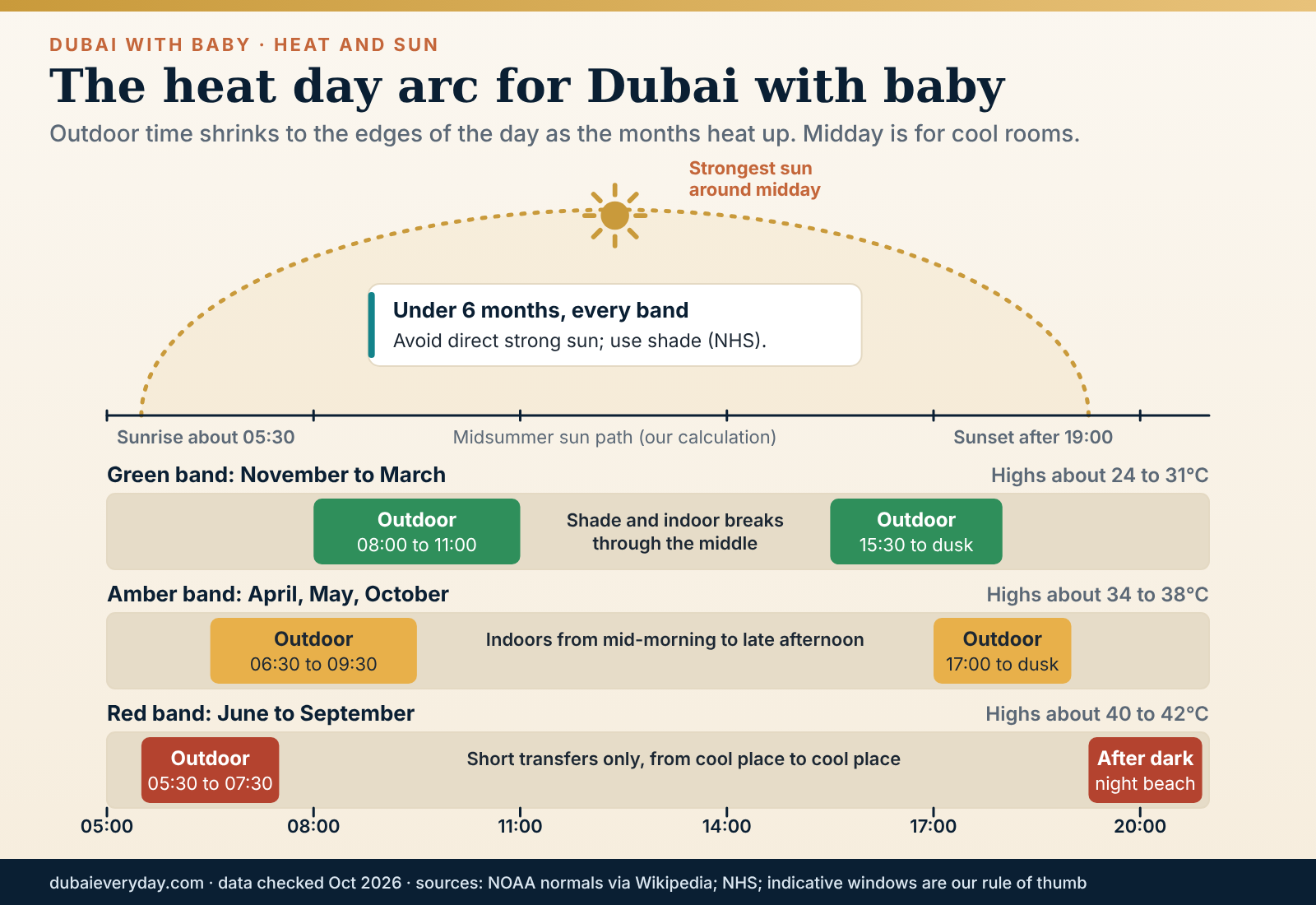
Hot surfaces and the things you forget
Babies are low to the ground and in contact with surfaces more than adults are. In the red band, the following can burn skin or make a baby miserable.
- Car seat buckles and harness clips after a parked car has baked, which is why you check them with the back of your hand before clipping.
- Metal playground equipment, sand and dark paving in direct sun.
- Stroller frames and the seat fabric after sitting in a boot or a patch of sun.
- Water in a hose or an outdoor tap that has warmed in the sun.
- Bath water from a tank that has sat in the sun, which can be warmer than you expect, so test it with your elbow or a thermometer.
The sea follows the same curve with a lag. Indicative averages put the water at around 21°C in January and about 33°C in August, from our research log. A January swim can be a cold shock for a baby, and an August swim is bath water that offers little relief. Mid-spring and mid-autumn are the sea’s sweet spot, though the air is then hot by midday.
Air conditioning is the other extreme
Malls, aquariums, cinemas and hotel lobbies can be cold. Moving a baby from a 41°C pavement into a 20°C mall in a minute is a thermal shock for an adult, and a baby cannot complain. Carry a thin cotton layer or a muslin that you can put on and take off, avoid putting the stroller under a vent and watch for cold hands and feet. The point is a gradual change and a comfortable baby, not a baby who is either flushed or shivering.
At night, set the room to a temperature that is comfortable for a lightly dressed adult, and do not point a vent at the cot. Safe-sleep guidance from paediatric bodies generally advises a firm flat mattress, no loose bedding or soft toys, and the baby placed on their back; follow the advice your own health service gives, and treat hotel cots with the same checks you would apply at home.
Warning signs, and what to do
Babies cannot tell you they are hot. General paediatric advice lists signs such as unusual drowsiness or floppiness, hot or flushed skin, fast breathing, fewer wet nappies, a sunken soft spot, and crying that is unusual for that baby. These are not a diagnosis, and none of them should be dismissed. If you are worried about your baby’s temperature or alertness, move to a cool place, remove extra layers and seek medical help immediately. In Dubai, the UAE government portal lists 998 for an ambulance and 999 for the police.
The five heat rules for Dubai with baby.
- Under six months: no direct sun, ever, and shade is the default.
- Leave the cool place fed, and arrive at the next cool place before the next feed.
- Never leave the baby in a parked car, even for a minute, and check buckles by hand.
- Dress for the room you are going to, with a layer you can add or remove.
- Treat water as the biggest risk: keep the baby within arm’s reach near any pool, bath or sea.
Hotels and rentals for Dubai with baby
Choosing where to stay for Dubai with baby is more consequential than choosing which hotel, because the neighbourhood decides how far you are from the pharmacy, the supermarket, the nearest shaded promenade and the nearest Metro station. After that, the room decides whether the baby sleeps. The full comparison of hotels by area is in our best hotels guide; this section adds the baby-specific questions.
What a baby needs from a room
The checklist is shorter than most parents fear, but it contains items that a hotel can fail without telling you. Ask in writing before you book, because the answers at check-in are usually easier to give than to change.
- A cot or crib, and whether it is free, what size it is and whether it is the kind your baby can sleep in safely at their age.
- A fridge that you can set, large enough for milk and food, not just a minibar.
- A kettle, and ideally a microwave or a kitchenette for sterilising and warming.
- Blackout curtains, so a daytime nap and early-morning jet lag are manageable.
- A room away from lifts, ice machines and pool music.
- A bath rather than only a shower, or room for a folding baby bath.
- A balcony door that locks high or has a child-proof catch, and windows with restrictors.
- Early check-in or a guaranteed late checkout, which often matters more than the room’s view.

The price on the screen is not the price you pay
Dubai hotels commonly add a service charge, a municipality fee, VAT and a Tourism Dirham to the advertised rate. Illustrative example (not a quote): on an advertised AED 1,000 base room, a 10 percent service charge, a 7 percent municipality fee, 5 percent VAT on the subtotal and a Tourism Dirham of AED 20 would come to about AED 1,248.50. The order of charges and the Tourism Dirham amount vary by hotel, so treat this as arithmetic to show the gap, not as a bill.
For a baby, add the items the booking page may not mention: a cot or an extra bed, breakfast for an infant, and a babysitting service if you use one. We could not verify whether infants are exempt from any of these charges, so ask. The question “is there any fee for a cot or for a child under two?” takes ten seconds and avoids an unpleasant surprise.
Which area suits Dubai with baby
The answer depends on whether your priorities are indoor cooling, beach access or calm. Our reasoning, from the area guides and general logic, is below. We have not stayed in any of these areas.
Downtown and Business Bay
Best for summer: the Dubai Mall, a Metro station and indoor cooling in one cluster. The trade-off is that there is no beach, so a beach morning means a taxi. See the Downtown Dubai guide.
Marina and JBR
Best for green-band stays: a promenade for stroller walks, a beach nearby and the tram. In summer, the walk to the beach is the hot part. The trade-off is evening noise. See the Marina guide.
Palm Jumeirah
Best for a resort week with a beach and a pool on site. The trade-off is isolation: almost every outing off the Palm needs a car. See the Palm Jumeirah guide.
Al Barsha, Deira and Bur Dubai
Better value, with a mall and Metro in Al Barsha and heritage and the Creek in the older districts. The trade-off is fewer pools and beaches, and hot narrow pavements in summer.
Apartment or hotel?
For a stay of a week or more, a serviced apartment with a washing machine and a kitchen is usually easier for Dubai with baby than a hotel room, because a washing machine reduces how many clothes you need, and a kitchen lets you control feeding. The trade-offs are fewer services, a longer walk to a pool and the need to check the building’s safety, particularly balconies and windows. The apartment rental guide has a viewing checklist that you can add baby checks to.
A hotel suite with a kitchenette is the best of both worlds, and a connecting room is useful if grandparents are travelling too. Babysitting services offered by hotels are a service to ask about carefully: ask who provides it, how staff are vetted and whether the sitter has paediatric first-aid training. We have not verified any hotel’s service.
Pools, beach clubs and baby clubs
Hotel pools with a shallow area suit a baby, in shade and in the evening. The risks are water, sun and hot decking. Never rely on a lifeguard as a substitute for an adult within arm’s reach, and check whether the pool has a fence and a self-closing gate if the room opens directly on to it. Kids’ clubs commonly have minimum ages above babyhood; ask for the age and the staff ratio before you plan around one.
Days out for Dubai with baby: beach, pool, parks and indoor options
Dubai with baby does not need attractions. A baby needs shade, a safe place to lie or crawl, and a parent who is not exhausted. That is good news for budgets, because many of the best baby-friendly outings in Dubai are free or cheap. It is also a reason not to import the sightseeing logic of an adult trip. Use the sections below as a menu, and pick one outing a day, two at most.
Beach mornings
Dubai Municipality’s public beaches charge no entrance fee, according to our research log, and the main swimming zones have lifeguard towers. For night swimming, the municipality has named Jumeirah 2, Jumeirah 3 and Umm Suqeim 1, and the Khor Al Mamzar beach, which opened in May 2026 with about 3.6 km of swimming shoreline and lifeguard towers, according to the Dubai Media Office. Our guides to family beaches and free public beaches compare facilities, and the wider best beaches guide covers the rest.
For Dubai with baby, the beach is a short, early or late activity in the green and amber bands, and a late-evening one in the red band. The NHS advice for babies under six months is no direct strong sunlight, so a beach session for a young baby means a shaded tent or umbrella, a hat and a plan to leave as soon as shade runs out. Sand heats faster than you expect. Use a blanket, keep the baby off hot sand, and bring more water than you think you need.
Water safety is the critical point. Stay within arm’s reach of a baby near any water, and take any flag or lifeguard instruction seriously. We did not verify beach water quality, so check the municipality’s notices on the day. A nappy that is not designed for water leaks and swells, so use swim nappies if you plan to dip a baby’s toes.
Pools
For many families doing Dubai with baby, the hotel or building pool is the main daily outing. The simplest rules apply: use the pool in shade or in the evening, keep the baby in water that is warm enough but not hot, and keep within arm’s reach, with no phone in your hand. Ask whether the pool needs swim nappies, because many pools require them and we have not verified any rule. A baby floatie is not a safety device. Teaching swimming early is sensible but belongs in a conversation with a qualified instructor.
Parks and promenades
Gulf News reported in early October that Dubai’s public parks charge between AED 0 and AED 5, and earlier reports put Zabeel Park at AED 5 and Safa Park at AED 3.
Burj Park, beneath the Burj Khalifa, was reported free and open from 08:00 to 23:00. Al Mamzar Beach Park was reported at AED 5 per person plus AED 30 per car in a 2024 report, so confirm that fee. All of these figures come from news reports and our research log, not from the municipality’s own pages, and we have not field-tested any park.
What Dubai with baby needs from a park is simple: shade over a bench, a flat path for the stroller, a clean toilet block within a minute’s walk and, for a crawler or toddler, a fenced play area. Those are features to look for, not claims about a particular park. In the green band, the late-afternoon hour before sunset suits an under-two well.
Animals, gardens and markets for under-threes
Three seasonal attractions list free entry for small children. Dubai Safari Park charges AED 50 for the Safari Park Pass from age three, and children under three enter free, according to its FAQ. Dubai Miracle Garden’s Season 15 lists adults from AED 105 and children from AED 84, with children under three free, according to a Gulf News report. Global Village lists free entry for small children on its official site, and Season 31 runs into May 2027. Rides, feeding experiences and food cost extra.
Which is best for Dubai with baby? In our reading, the Safari Park suits the 6 to 24 month age: animals are visible from the park train, the pass includes unlimited train rides, strollers can be rented at the main entrance and outside food is not allowed, except baby food and water, according to its FAQ. The hours conflict between the FAQ and the homepage, and the park is in Al Warqa 4 off the E311, so it needs a car or taxi from most of the city. Confirm the day’s times before you leave.
The Miracle Garden is a stroller-friendly stroll in a cool season and a poor idea in summer, when it is closed anyway. Global Village is large, loud and late, which is wearing for a baby, though weekday early evenings are calmer; the research log notes that Tuesdays are reserved for ladies and families. We have not verified stroller access at either site. For the wider list of family attractions, our Dubai with kids guide goes deeper, and the things to do guide covers the full city.
Indoor days
The red band belongs to indoor options. A mall visit, an aquarium, a soft-play centre with a baby zone and a long hotel lunch can fill a day. The Dubai Mall’s aquarium is the obvious indoor anchor, though we did not verify its under-three ticket policy or any age restriction. Look for dim light, a stroller-friendly route and a seated area, and note that air-conditioning is cold in aquariums. Our indoor things to do guide lists summer-proof options.
Indoor play centres commonly have age-specific zones, but we have not verified any in Dubai. Ask whether there is a separate area for under-twos, whether adults must wear socks, how many children are allowed in at once and whether the space is cleaned between sessions.
Boats, desert and attractions to skip for Dubai with baby
The traditional abra crossing of Dubai Creek costs AED 1 on motorised abras (cash) and AED 2 on heritage abras, according to RTA’s marine page. It is the cheapest ride in the city, but it is a boat, in the sun, with a baby. If you do it, go early, hold the baby in a carrier, and ask about life jackets for infants before you board; we could not verify that any are provided.
Desert safaris and dune driving are another matter. Operators set their own age limits and many exclude young infants because of the motion, the heat and the open vehicles. We did not verify any operator’s policy. If you are tempted, ask for the minimum age in writing, and read our morning desert safari guide to see what the cooler options involve. For a baby under one, we would put the desert on the “next trip” list.
Theme parks and big water parks are poor value for Dubai with baby under two. Most rides have age or height limits, queues are long and the sun is intense. The Dubai Parks and Resorts complex is, in our reading, not a good fit for babies and under-twos.
Three sample days for Dubai with baby
The three days below show Dubai with baby as illustrative models, not itineraries to follow minute by minute. They show the logic: anchor on the baby’s wake windows, stay near cool places and leave a gap in the middle of the day. Adjust the times to your own baby’s pattern.
Day A: a 4-month-old in January (green band)
- 07:30 Feed and change at the hotelBreakfast for the adults, then a feed before leaving. The promenade will be cool and the baby will be content for a while.
- 09:00 Shaded promenade walkA 45-minute stroller walk along a flat promenade, in shade, with the canopy ventilated. Keep the baby out of direct sun, as under-six-month advice suggests.
- 10:30 Coffee and a feedSit in an air-conditioned or shaded cafe. Ask for a seat away from the vent and keep a layer handy.
- 12:00 Nap at the hotelBack to the room for the main sleep. The adults rest too, because a baby’s nap is the only reliable pause in the day.
- 16:30 Second outingA short stroller walk or a mall visit with the 90-minute loop, then early supper. In January the sun sets early enough that the evening feels cool.
Day B: a 9-month-old in July (red band)
- 06:30 Early pool sessionBefore the sun is high, an hour in a shaded pool at the hotel, within arm’s reach, followed by breakfast and a first nap.
- 10:30 Taxi or Metro to a mallA car or Metro with a carrier. The mall is the day’s anchor, with the 90-minute loop repeated once, a first solid meal in a food court and a play area for crawling.
- 13:00 Return and sleepBack to the room before the hottest part of the day. No planned activity at all.
- 18:30 Evening pool or shaded terraceAs the sun drops, a gentle swim or a stroller loop around the hotel, then supper and an early bedtime.
The total cost of the day is dominated by the hotel and the taxi. Using the published fares, two adults on a two-zone Metro journey pay AED 10 in total each way, with the baby free; a taxi for the same ride is more.
Day C: a 16-month-old in April (amber band)
- 07:30 Safari Park by taxiAn early start, since the park opens in the morning and the sun is low. Two adults at AED 50 for the pass each is AED 100; the toddler enters free, per the park’s FAQ. Taxi fares are the larger cost.
- 09:00 Train ride and animalsHire a stroller at the main entrance if you did not bring one, and use the train to rest the walking toddler.
- 11:30 Leave before the sun peaksEat at the hotel or a mall on the way back. A toddler who has been outside for three hours needs a long drink and a long sleep.
- 16:30 Park with a playgroundA cheap, simple end to the day: Zabeel or Safa Park, if the playground has shade, or a hotel play area.
None of these days includes a paid attraction after lunch. That is deliberate. In our reading, the day a baby enjoys most is the day with one anchor, one long nap and an early supper.
Living in Dubai with baby: paperwork, health cover, childcare and home
If you live here, or are about to, a baby changes your paperwork, insurance and home as much as your weekends. This section is the resident layer of Dubai with baby, and it is deliberately at decision level. Processes and fees change, and we could not read several official pages today, so it tells you what to ask and who to ask, not what the form says.
The three pieces of newborn paperwork
A baby born in Dubai needs three things from three directions: a birth record in the UAE, a passport from your country’s embassy or consulate, and a UAE residence visa with an Emirates ID. The UAE government portal’s children’s-safety page lists failing to register a birth among the acts that can bring penalties under Wadeema’s Law, the federal child-rights law, although it does not give amounts. That is a good reason to start early.
The deadlines are the hard part. Figures are widely quoted for how long you have to obtain a newborn’s visa, but we could not confirm any of them on an official page today, so we are not printing one. The family-visa page on the UAE portal does not cover newborns and refers readers to the Federal Authority for Identity, Citizenship, Customs and Port Security (ICP) and GDRFA. Ask your hospital’s PRO desk, your employer’s PRO or ICP for the current deadline in writing, and diarise it from the baby’s birth date.
What the portal does confirm is useful context. Expatriate residents can sponsor a spouse and children, with a minimum salary of AED 4,000, or AED 3,000 plus accommodation.
A dependant’s visa is tied to the sponsor’s; if the sponsor’s visa is cancelled, the dependants’ must be cancelled too, and there is a six-month grace period from expiry or cancellation to obtain a new residence permit. Applying for an Emirates ID is mandatory for all citizens and residents, through the ICP site or an accredited typing centre. Our guides to the residence visa, moving to Dubai and the relocation checklist set out the wider sequence.
Health cover for a baby
Health insurance for Dubai with baby as a resident is a rules-and-network question, and the baby is a dependant under it. The questions to put to the employer or insurer are specific.
- Is the baby covered automatically from birth, or only after the insurer is notified, and by when?
- Which paediatric clinics and hospitals are in the network, and what are the co-pays for visits and vaccines?
- What does the policy say about maternity, newborn care and neonatal intensive care, and are there waiting periods?
- Does the policy cover the baby when travelling home in the summer?
Our health insurance guide and the resident health insurance guide explain employer cover, dependants and networks. The healthcare guide and the hospitals guide explain how to compare facilities by emergency services, specialists and network.
Leave and nursing breaks
The UAE government’s private-sector leave page lists 60 days of maternity leave (45 on full pay and 15 on half pay), five paid working days of parental leave for either parent within six months of birth, and nursing breaks of up to one hour a day for six months. Those figures come from our research log and apply to the private sector; public-sector and free-zone rules can differ, so check your contract and your employer’s policy.
Childcare: nurseries, nannies and helpers
Families in Dubai commonly use nurseries, nannies or domestic helpers. For a nursery, check the licence and the latest inspection report with the regulator, KHDA, whose pages we could not read today, so confirm the process. For a domestic worker, the employment relationship is regulated by a separate federal law, Federal Decree-Law No. 9 of 2022 as amended, and by MOHRE, according to our research log. Our legal basics guide explains where to verify employer duties, and the cleaning services guide covers hourly help if you want a cleaner but not a live-in worker.
We give no fees for any of these, because we could not verify market figures. Treat any number you see on a forum as a starting point for questions, not as a price. When you choose a nursery for later, the schools guide and the KHDA ratings guide explain how inspection results work.
Home safety with a baby
High-rise living and private pools raise specific risks for Dubai with baby. These are general safety points, not legal requirements that we verified.
- Balconies and windows: check that balcony doors latch out of reach, that windows have restrictors, and that furniture is not placed where a crawler can climb it.
- Pools in villas and compounds: look for a fence and a self-closing gate before you sign, and consider a pool alarm.
- Cords and sockets: blind cords are a strangulation risk; tie them up high.
- Chillers: older buildings with central cooling can have separate charges and rules, which the home setup guide explains.
- Cars: never leave a baby in a parked car, and keep keys out of reach so a toddler cannot lock themselves in.
The apartment rental guide and the villa rental guide include viewing checklists that you can add baby checks to. A baby also means a cooler flat for more hours, so expect higher cooling costs in summer; our cost of living guide shows the components of a household budget.
A year of Dubai with baby as a resident
The rhythm of the year follows the heat. From November to March, weekends are for parks, promenades, beaches and markets. In the amber months, outdoor play moves to early mornings and evenings. From June to September, resident families lean on indoor routines, mall mornings and, for many, a stretch of leave abroad. If you are leaving for the summer, check the baby’s passport validity and your residence permit’s rules for time outside the country with ICP before you book, because we could not verify those rules today.
Health, medicines and emergencies
This section is general information, not medical advice. Dubai has a large private and public health system, and the most useful preparation for Dubai with baby is to know three things before you need them: the emergency numbers, your insurance position and your baby’s medicines.
Emergency numbers
The UAE government portal lists these emergency numbers: police 999, ambulance 998, civil defence 997 and the electricity authority 991. The Ministry of Interior’s Child Protection Centre is listed at 116111, and the Hemayati app is the reporting route for concerns about a child’s safety. Save those numbers in your phone, tell everyone who looks after the baby where they are written, and give the hotel or building address in both English and Arabic if you can.
Choosing where to go
For a minor illness, an urgent-care clinic or a paediatric clinic in your insurer’s network is usually quicker and cheaper than an emergency department.
For a high fever in a young baby, laboured breathing, a baby who is hard to wake or any injury to the head, go to emergency care or call 998 and do not wait for an appointment. Our hospitals guide explains how to compare emergency services and insurance networks. Pharmacies in malls often open early: the Dubai Mall’s pharmacy is listed from 08:00 and its Mediclinic from 08:00 on weekdays, according to the official hours page via our research log.
Visitors: insurance, costs and records
If you are a visitor, ask your travel insurer how it handles an infant’s emergency and whether you must call before treatment. Carry the baby’s vaccination record and a list of any allergies or conditions in English. Keep a photo of the baby’s passport on your phone. If you are prescribed a medicine in Dubai, ask the doctor for the name of the active ingredient, because brand names differ between countries.
Medicines you carry
Keep medicines in their original packaging, with a prescription or a doctor’s letter for anything beyond routine items. As noted earlier, the UAE controls certain medicines more strictly than many countries do, and we could not verify the current list. Check the Ministry of Health and Prevention guidance for the specific product, and ask your paediatrician about a travel kit. We do not give doses.
Mistakes parents make when planning Dubai with baby
These are the errors that research and common sense suggest are most likely. They are our reading of the facts above, not survey findings.
- Booking a trip in July or August without an indoor plan, then trying to do outdoor sightseeing with a baby who cannot cope with the heat.
- Assuming a taxi will have a baby seat. We could not confirm one will, so bring your own or arrange a vehicle with a confirmed seat.
- Carrying made-up bottles in a hot bag for hours. Carry powder and water separately and make up each feed when needed.
- Forgetting a layer for the baby in malls and aquariums, where air conditioning can be very cold.
- Trusting a stroller shade made from a blanket. Use a proper canopy or shade accessory and check the baby often.
- Leaving the baby in a parked car for “just a minute” with the engine on.
- Planning two attractions a day when a baby only has the energy for one, and a nap.
- Not checking the airline’s infant baggage and stroller rules until the check-in desk.
- Booking a hotel room without a fridge or a cot, then discovering both cost extra.
- Waiting too long to start a newborn’s visa and Emirates ID, because deadlines exist and are easy to miss.
- Relying on a pool lifeguard instead of staying within arm’s reach of the baby.
Dubai with baby: frequently asked questions
Is Dubai with baby a good idea?
Yes, with planning. Dubai has air-conditioned malls, a well-developed healthcare system and short distances between cool places, which suits a baby. The weak points are heat, the lack of verified baby seats in taxis and, this season, a regional situation that the UK Foreign Office called “deeply unpredictable” on 27 October 2026. If your baby is a newborn or has a medical condition, ask your paediatrician before you book. Dubai with baby is easiest between mid-November and March, and hardest from June to September.
Do I need a car seat for a baby in a Dubai taxi?
Gulf News, summarising UAE federal traffic rules, reports that children under four must be in an appropriate child seat, with a fine of AED 400 and four black points. The article does not mention taxis, and we could not find an official statement on how the rule applies in them. We could not confirm that taxis or ride-hailing cars carry baby seats either, so bring your own, or book a hire car or transfer with a confirmed rear-facing seat. Holding a baby on your lap is not safe in any car.
Is the Dubai Metro free for babies?
RTA’s nol fares page lists children aged 5 and below as free on all card types, including the Red Ticket. Older children pay the standard fare: AED 3, 5 or 7.50 per trip on a Silver card depending on zones. We could not read RTA’s Metro rules, so we cannot say how large strollers are treated; a folded lightweight stroller or a carrier is the safest choice. Find the nearest lift at your station before you travel. That free fare makes the Metro the cheapest way to do Dubai with baby on the corridors it serves.
Can I breastfeed in public in Dubai?
We found no official rule that bans or regulates breastfeeding in public, and we are not aware of one. The norm is discretion, so many mothers use a nursing top, a light cover or a baby carrier, or choose a mall baby room, a cafe corner or a hotel room. Expect to need a quiet space at some points, and ask guest services where the nearest one is. The WHO recommends continued breastfeeding up to two years or beyond. That is the realistic picture for Dubai with baby: no rulebook, plenty of private options.
Where are the baby changing rooms in the Dubai Mall?
The Dubai Mall’s visitor page lists baby changing rooms, baby strollers and children’s wrist bands among its services, but it gives no locations. The mall has eight guest-service desks, and the quickest way to find the nearest changing room is to ask at one when you arrive, or to photograph the floor directory at the entrance. Larger toilet blocks and food courts are the usual fallback. We could not verify baby facilities at any other mall.
What is the best time of year for Dubai with baby?
Mid-November to March, when average daytime highs run from roughly 24 to 31°C, is the easiest period. Peak weeks around the winter school break from 14 December to 3 January are crowded and expensive, so a week either side is calmer. April, May and October are workable with early-morning and evening outings. June to September, with highs around 40 to 42°C, is the period for indoor routines and short transfers, though hotel prices are lower then.
Can I bring formula and baby food on the flight to Dubai?
Dubai Airports’ FAQ says baby food may be carried in cabin baggage in the amount your baby needs for the flight. It does not describe how milk or formula is screened, and the rules at your departure airport apply on the outbound leg, so ask your airline and departure airport about quantities and separate screening. Pack two days of baby supplies in the cabin bag in case of a delay.
Can I use a stroller at Dubai airport?
Yes, though the automated Smart Gates exclude people under 1.2 m and very large strollers, so you will use the staffed passport desks with a baby. Terminal 3 offers a free buggy service on Concourses B and C, subject to availability and arranged through the airline or service provider. Whether you can take the stroller to the aircraft door depends on the airline, so ask before you fly. Plan every Dubai with baby arrival around the staffed desks.
How hot is too hot for a baby in Dubai?
There is no single threshold, and we will not invent one. The UK NHS advises keeping babies under six months out of direct strong sunlight, and for older children it advises shade between 11am and 3pm in the sunny months. The WHO treats a UV index of 8 or above as very high. In practice, anything above about 35°C should mean shade, short outings and indoor breaks. If your baby seems unusually drowsy, flushed or unwell, seek medical help.
Does a baby need a separate passport and visa for Dubai?
A baby needs their own passport. Whether a visa or entry permit is needed depends on the baby’s nationality and the rules that apply to it, so check the official entry requirements and ask your airline before you travel. We could not verify nationality-specific rules for infants today, and we do not guess. For the wider checklist, see the Dubai travel guide.
Can I buy formula, nappies and baby food in Dubai?
Supermarkets, pharmacies and baby stores sell nappies, formula and baby food, and supermarkets such as Carrefour offer online delivery. We could not verify which brands and stages are in stock, so if your baby is on a specific formula, bring enough for the trip or the first weeks. Check expiry dates and the age stage on the tin, and ask your paediatrician before switching a feeding product. Stocking up locally makes a long Dubai with baby stay easier.
What do I need to do if my baby is born in Dubai?
Three streams run in parallel: a UAE birth record, a passport from your embassy or consulate, and a residence visa and Emirates ID for the baby. The UAE portal lists failing to register a birth among acts that can bring penalties under the child-rights law. We could not confirm the current deadlines, so ask your hospital’s PRO desk, your employer’s PRO or ICP for them in writing, and add the baby to your health insurance as soon as the policy allows.
Related reading
Sources and further reading (27 links)
- RTA: nol fares — child fares (5 and below free) and Silver, Gold and Red Ticket fares
- Dubai Airports: FAQs — baby food in cabin baggage, Terminal 3 showers and buggy service, special lanes
- Dubai Taxi: homepage — Families and Ladies Taxi description
- The Dubai Mall: plan your visit — strollers, baby changing rooms, wrist bands, guest services
- Mall of the Emirates: plan your visit — services listed (no baby facilities listed)
- Emirates: travelling with children — infant age, lap travel, adult age, one infant per adult
- Gulf News: UAE seat belt rules and fines — child-seat rule, front-seat rule, fine (news report)
- UAE Government Portal: road safety — Federal Decree-Law No. 14 of 2024
- UAE Government Portal: children’s safety — Wadeema’s Law, supervision, smoking in vehicles, Child Protection Centre 116111
- UAE Government Portal: safety — emergency numbers 999, 998, 997, 991
- UAE Government Portal: residence visa for family members — sponsorship thresholds, dependants, grace period
- UAE Government Portal: Emirates ID — mandatory for residents, application route
- WHO: infant and young child feeding — exclusive breastfeeding to six months, complementary feeding
- WHO: safe preparation, storage and handling of powdered infant formula — scope of guideline
- NHS: sunscreen and sun safety — babies under six months, shade, SPF 30
- WHO: the ultraviolet (UV) index — UV 8 or above is very high (research log)
- UK Foreign Office: UAE travel advice — update of 27 October 2026 (research log)
- Dubai Safari Park: FAQs — pass price, under-3 free, stroller hire, baby food (research log)
- Global Village — Season 31 dates, free entry for small children (research log)
- Gulf News: Dubai Miracle Garden Season 15 — dates and prices (news report; research log)
- Dubai Municipality: night-swimming beaches — Jumeirah 2, Jumeirah 3, Umm Suqeim 1 (research log)
- Dubai Media Office: Khor Al Mamzar beach — opening and shoreline length (research log)
- Dubai Media Office: 2025 tourism results — average daily rate and occupancy (research log)
- RTA: marine transport — abra and water taxi fares (research log)
- UAE Government Portal: types of leave — maternity, parental leave and nursing breaks (research log)
- Gulf News: UAE school holidays 2026-27 — school calendar (news report; research log)
- Wikipedia: Climate of Dubai — NOAA 1991-2020 normals (secondary source; research log)
Update log: 29 October 2026 — first publication; all facts re-checked against the sources above. Next review due: annually, or sooner if taxi, airport, mall or entry rules change, before the 2027 summer season. Corrections welcome. This guide is general information and not medical, legal or insurance advice; confirm every price and rule with the operator or authority before you rely on it.
About DubaiEveryday and this guide
DubaiEveryday.com is an independent editorial project that publishes practical, research-based guides to everyday life in Dubai: where to live, what things cost, how the rules work and how to get around. This page was written and edited by the DubaiEveryday editorial team. It is not signed by a named expert, doctor, lawyer or adviser, and we do not claim first-hand testing of a venue, clinic or service unless the page says so.
Each guide is built from official sources such as government and regulator pages, operator websites and established news outlets, cross-checked where we can. When we could not confirm something, we say so in the text, and examples that use made-up numbers are labelled as illustrations. Mentions are editorial choices, not paid placements, and a link is not an endorsement.
Dubai changes quickly. If you spot something that is out of date or wrong, please tell us through the contact options on DubaiEveryday.com and we will check it and correct the page.