

Dubai with toddlers works when the day is built around one nap and the heat, not around the attraction list. This guide covers nap-friendly routines, indoor play, beaches, food, strollers, car seats and transport for children of roughly one to three.
A two-year-old does not care that the Dubai Fountain is famous. What registers is that the stroller is boring, the sun is in her eyes and nobody has produced a snack for eleven whole minutes. Most plans for Dubai with toddlers fall apart for that reason: they are written around attractions, when the day is really run by one afternoon nap and one very hot sun.
Here is the useful bit. Those two things line up. The hours when a one-nap toddler should be asleep are largely the hours when Dubai is least pleasant outside, so a day built around the nap is also a day built around the heat. What follows is the practical version: car seats, the Metro, strollers, beaches, indoor play, food and a few sample days, with the price cliffs to know about and the gaps in the evidence marked as such.
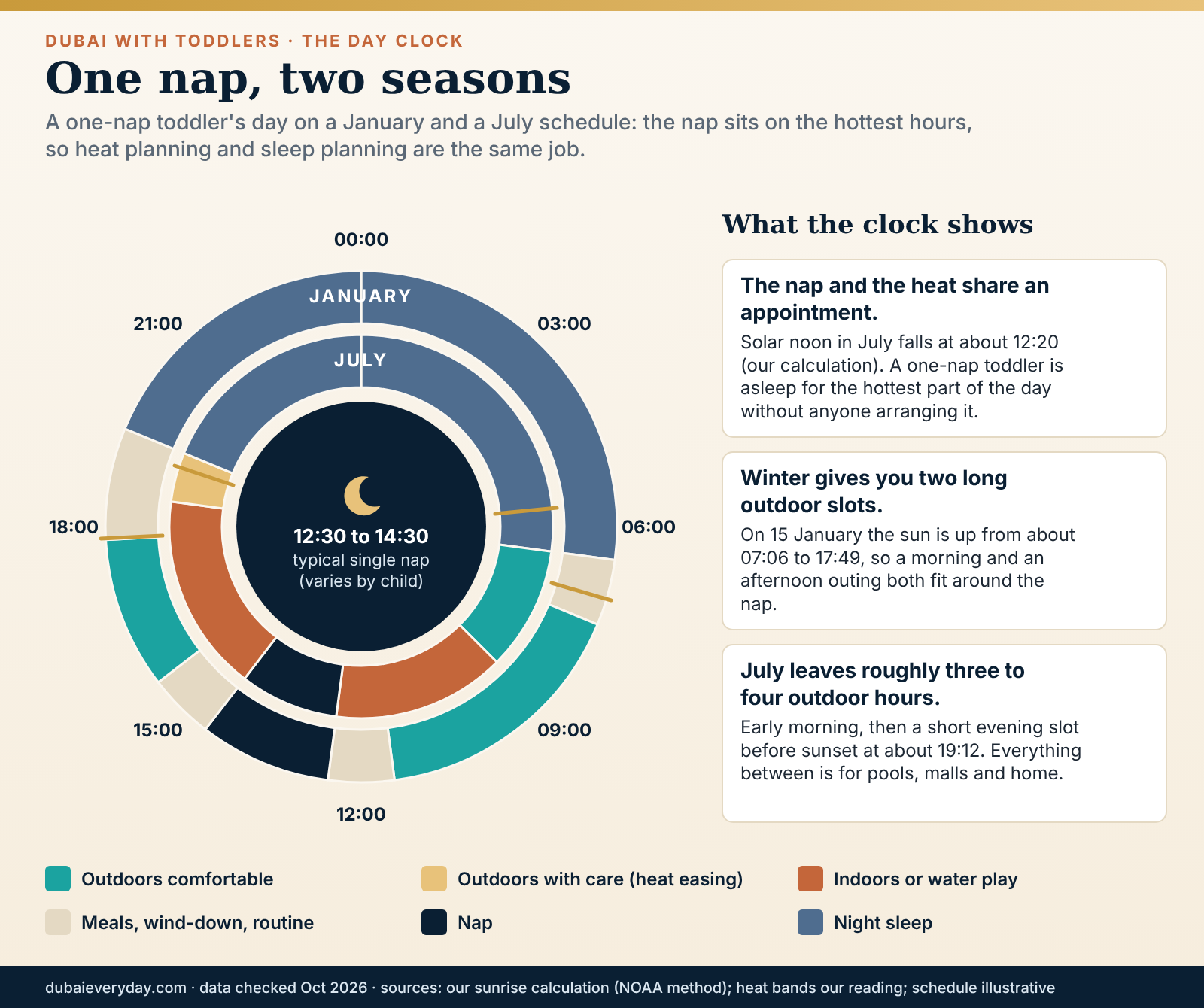
Dubai with toddlers is easiest when you plan the nap first and the sights second. A one-nap toddler usually sleeps somewhere between 12:30 and 14:30, which happens to be the hottest part of a Dubai day, so the pattern that works is a morning outing, an early lunch, a nap somewhere cool, then a second outing as the heat eases.
Go between December and February if you can: average daily highs are about 24 to 27°C and most of the day is usable outdoors. From June to August highs reach 40 to 42°C and outdoor time shrinks to early morning and the last hour of daylight. Children under four need a child seat in a car, according to Dubai Police guidance, and we could not confirm that any taxi will bring one, so plan to carry your own or book a service that confirms it in writing. Children aged five and under travel free on the Metro.
Know the price cliffs for Dubai with toddlers. The Dubai Aquarium and Children’s City charge from age 2; Dubai Safari Park, Dubai Miracle Garden and Global Village charge from age 3. Beaches work well if you pick a lifeguarded one, arrive early or late, and keep an adult within arm’s reach. Almost everything else in this guide to Dubai with toddlers is detail on four habits: protect the nap, respect the heat, know the age cliffs and use a proper seat.
This is a desk-research guide to Dubai with toddlers. DubaiEveryday.com has not stayed at the hotels, pushed a stroller along the beach promenades, ridden the Metro with a two-year-old or tested any taxi mentioned here, and nothing below describes a personal trip. There are no parent testimonials on this page and none is implied.
On 29 October 2026 we read what could be read: the RTA fares page, the Dubai legislation portal’s public-transport fines schedule, the operator pages of Dubai Safari Park, the Dubai Aquarium, LEGOLAND Dubai, Global Village and The Dubai Mall, Dubai Municipality’s Children’s City terms, the UAE government portal, Dubai Airports, Emirates, the UK Foreign Office, the NHS, the American Academy of Sleep Medicine’s published consensus, and recent news reports from The National, Gulf News, Khaleej Times and Gulf Today. Where only a news report was available we say so.
A lot of what parents planning Dubai with toddlers want most is not published in a checkable form: which taxi carries a seat today, where each mall puts its nursing room, which indoor play centre is calm on a Tuesday. Where that is the case we say it and give you the question to ask. Inclusion was not paid for and nothing here is an affiliate link. This is general information, not medical or individual advice; ask your paediatrician about your child.
Before you plan Dubai with toddlers: scope and season check
What this guide covers, and what it leaves to others
This page answers one job: how to spend days, or settle in, with a child of about one to three years. In short, this is Dubai with toddlers, not Dubai with a newborn or a teenager. That is the age of walking, climbing, saying no and dropping to one nap. It is organised around the questions that age creates, namely naps, indoor play, beaches, food, strollers and transport, and it keeps coming back to heat, because heat decides almost every answer.
It deliberately does not repeat two neighbours. If your child is under about two and the questions are feeds, formula, newborn paperwork and nursing rooms, the guide to Dubai with a baby is the better starting point. If your children are older, or you want attractions sorted by height rules, budgets and hotel choice, use our broader guide to Dubai with kids. A family with a baby and a four-year-old will want all three pages.
Other jobs have their own pages. The wider best beaches guide compares beaches for everyone, things to do in Dubai covers the headline attractions, and the Dubai travel guide handles visas, money and first-trip planning. Here we use those topics only through a toddler’s eyes.
Who this is written for
Two kinds of reader land on a page about Dubai with toddlers. Visitors need a plan for a week or two, and they care about flights, car seats at the airport and which attractions are worth a nap disruption. Residents, including people who have just arrived, need a plan for a year: where a nap-length drive ends, which parks are close, what a toddler-proof apartment looks like and how to cope in August.
We write for both, and label which is which. If a section is mostly for residents, the heading says so. If a fact is a news report rather than an official statement, the text says that too.
Dubai with toddlers right now: what to check this season
Start with the season, because for Dubai with toddlers autumn 2026 is the beginning of the outdoor year and several attractions have only just reopened. Dubai Miracle Garden’s Season 15 opened on 8 October 2026 after a delay of about two weeks that Gulf News attributed to weather, and it is scheduled to run to 31 May 2027. Global Village’s Season 31 opened on 14 October 2026 and runs into May 2027. Dubai Safari Park lists winter hours from November. These are the three outings where a toddler’s free-entry age matters most, and we return to them in the section on parks and big days out.
The regional advisory, stated plainly
The UK Foreign Office updated its UAE travel advice on 27 October 2026 and describes the wider Middle East context as deeply unpredictable, with a high risk of sudden escalation. It tells British nationals to expect possible flight cancellations, airspace closures and disruption, and to keep departure plans under review. Other governments publish their own levels and they differ, so read the advice from your own government before you book. This is a point-in-time statement, not a forecast, and we are not in a position to judge it.
For a family planning Dubai with toddlers the practical effects are about buffers. Choose fares you can change. Check that your travel insurance covers your itinerary and says clearly how it treats disruption linked to regional conflict, because exclusions are common. Pack a day or two more of nappies, snacks and any regular medicine than the trip strictly needs: a night’s delay is a far bigger problem with a two-year-old than with an adult.
If you are told to shelter
The Foreign Office’s own wording is that if you are advised to shelter you should stay indoors, preferably in an interior stairwell or a room with few outside walls or windows, and avoid touching any fragments. With a toddler the useful preparation is mechanical. Know which interior room you would use, keep a carrier within reach, and keep one small bag with water, a snack, a dummy or comforter if you use them, nappies, wipes and a change of clothes. Phone alerts are loud and can wake a sleeping child, so a familiar blanket or a song is a better plan than hoping they sleep through it.
What to treat as moving
Treat these as moving targets whenever you plan Dubai with toddlers: attraction hours, last-entry times, season end dates, ticket prices, free-entry age bands and anything that depends on weather. Operator pages sometimes contradict themselves. Dubai Safari Park’s FAQ gives closing times that differ from its own header, which we flag later. When we quote a price in this guide it is the price shown on the operator or official page on 29 October 2026, labelled as such, and the total you pay will include whatever the booking platform adds.
Nap-friendly days: building Dubai with toddlers around sleep
A toddler runs on two clocks. The first is the sleep clock: a nap, a bedtime, a window of cheerful hours in between. The second is the sun clock: a morning that is pleasant, a middle of the day that is not, and an evening that comes back. Most guides to Dubai with toddlers give you a list of places and leave you to reconcile the clocks yourself, usually at 13:40 in a queue, with a child who stopped being reasonable at 13:15.
The reconciliation is easier than it sounds, because the two clocks overlap in a useful way. That overlap is the organising idea behind Dubai with toddlers in this guide. This section sets out why, then gives rules for building a day around it. Everything here about Dubai with toddlers is our reading of published data plus ordinary toddler routines, not medical advice, and children vary enormously.
How much sleep a toddler needs
The American Academy of Sleep Medicine’s 2016 consensus statement, published in the Journal of Clinical Sleep Medicine, recommends 11 to 14 hours of sleep in each 24 hours, naps included, for children aged one to two, and 10 to 13 hours for ages three to five. It is a population recommendation, not a prescription for your child, but it explains why a missed nap is not a small thing. If night sleep is around 10 to 11 hours, the nap carries the remaining one to three hours.
Many children move from two naps to one at some point in their second year, and many drop the nap altogether between about three and five. We cannot tell you where your child is on that curve, and this guide does not try. Our plan for Dubai with toddlers covers the common middle case, one nap of around one to two hours starting around the middle of the day, and notes what changes if your child still has two.
The nap and the heat share an appointment
Here is the overlap. By our calculation, solar noon in Dubai falls at about 12:20 in July and 12:17 in mid-December, give or take a few minutes through the year. A single nap that starts around 12:30 sits across the hottest part of the day in every season. In July the NOAA 1991 to 2020 normals for Dubai International Airport put the average daily high at 41.5°C, and the monthly average sunshine is roughly 340 hours, about 11 hours a day. In January the average high is 24.4°C.
So a family that protects the nap is, almost without trying, avoiding the worst of the sun. That is why a nap-first plan is not a sacrifice in Dubai with toddlers; it is the cooling strategy. The days that go wrong are the ones that treat the nap as negotiable: a 12:30 ticket slot, a stroller nap on a pavement, a long drive that begins at 11:45 and ends in a car park with a child who has just woken up in 38-degree heat.
Five rules for a nap-first day of Dubai with toddlers
These are our rules of thumb for Dubai with toddlers. They are not official guidance, and they bend when a child does not follow the script.
- Fix the nap firstDecide when and where the nap happens before you look at a single attraction. Write it on the plan. Everything else is arranged around that block.
- Spend the big outing in the first windowThe period from breakfast to about 11:00 or 11:30 is the best slot of the day in nearly every month. Put the outing that needs the most energy, queueing or walking there.
- Eat before you moveLunch should finish 30 to 45 minutes before the nap, so the transition is quiet and the child is not hungry at the wrong moment. A hungry toddler is a short nap.
- Finish the morning next to the nap spotPlan the last 45 minutes of the morning so that you are within a short, air-conditioned trip of wherever the nap happens. Dubai distances look small on a map and are not small at lunchtime traffic.
- Protect the hour after wakingToddlers wake slowly and badly. Do not book anything with a queue, a ticket scan or a strict entry time for the first 30 minutes after you expect the nap to end.
Where the nap can happen
There are four realistic places to nap during Dubai with toddlers, and they do not cost the same in effort or in risk. The best by a wide margin is the place the child usually sleeps. The rest are compromises.
At base
Hotel room or apartment, blackout curtains, cool, quiet and familiar. It costs you the transit time both ways, but it protects the afternoon. This is the default in summer and the one to choose if the nap is already fragile.
In a car seat
Works for a trip of roughly 20 minutes or more when the child is already tired. You need a proper seat, an adult in the car at all times and a plan for the moment you stop. Transferring a sleeping toddler often ends the nap, so choose a route that ends where you want to be.
In a stroller
Fine in a cool, shaded or air-conditioned setting such as a mall, an aquarium concourse or a shaded promenade in winter. In summer heat, outdoors, it is a poor idea because the child cannot cool down and you cannot easily tell.
In a carrier
Good for a short nap while you keep moving, and common with younger toddlers. It is warm for both of you. In Dubai this is an indoor-and-evening solution, not a midday one.
When a toddler still has two naps
If your child still takes a morning nap and an afternoon one, the day splits into three blocks of about two to three hours of awake time each. The morning nap usually falls between about 09:00 and 10:30 and the afternoon one around 14:00 to 15:00. This pattern suits Dubai with toddlers in summer, because it moves one nap to the cool part of the morning and leaves a single outing window before 09:00.
It is harder in winter, when you would rather use the morning. In that case accept the shorter outing and use a stroller or carrier nap in a shaded, comfortable place, with the longer afternoon sleep at base. The principle does not change: choose the nap place before you choose the activity.
What to do when the nap does not happen
It will not happen on some days. The new place is too interesting, the adult is anxious, or the child has simply decided. The sensible plan is a quiet block: a cool room, dim light, a picture book and no screens or noise, then an earlier bedtime. Do not rescue a missed nap with another big outing, because the late afternoon in Dubai is precisely when a tired toddler and a long queue are least compatible.
For a visitor, planning Dubai with toddlers means leaving slack in a long trip. A week in which every afternoon is booked is a week in which one bad nap cascades. A family doing three outings in a day with a two-year-old is not being ambitious; it is borrowing from the following morning.
When to go: the toddler’s year in Dubai
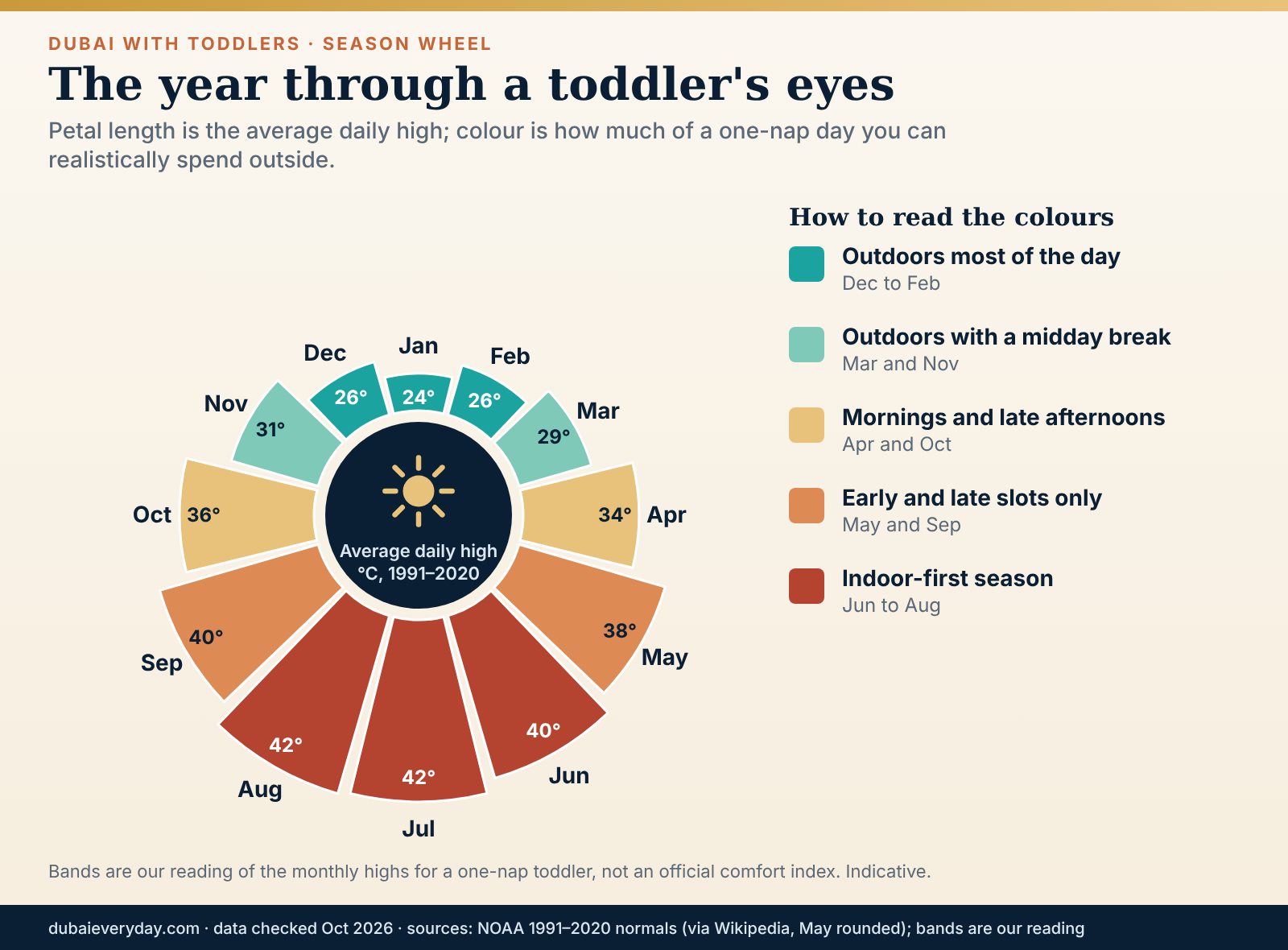
For adults, the question of when to visit is a trade between price, crowds and weather. For Dubai with toddlers it is mostly about weather, because a child cannot be talked into tolerating 40°C and cannot say clearly when they are too hot. The picture below shows the average daily high for each month and our reading of how much of a one-nap day is realistically usable outdoors.
The month-by-month dataset
The table gives the numbers behind the picture and works as a planning map for Dubai with toddlers, not as a forecast. Highs are NOAA 1991 to 2020 normals for Dubai International Airport; sea temperatures are a separate, secondary dataset and are indicative; sunrise and sunset are our calculation for the 15th of each month using the standard NOAA solar method, rounded to the minute. The last column is our reading, not a measurement.
| Month | Average high | Sea (indicative) | Sunrise to sunset (15th) | Our reading for a one-nap toddler |
|---|---|---|---|---|
| January | 24.4°C | 20.8°C | 07:06 to 17:49 | Outdoors most of the day; sea is cool |
| February | 26.1°C | 20.6°C | 06:54 to 18:12 | Outdoors most of the day; sea is cool |
| March | 28.9°C | 22.3°C | 06:29 to 18:28 | Outdoors with a shaded midday break |
| April | 33.7°C | 25.0°C | 05:57 to 18:41 | Mornings and late afternoons |
| May | 38.2°C | 28.5°C | 05:34 to 18:56 | Early and late slots only |
| June | 40.0°C | 30.7°C | 05:28 to 19:10 | Indoor-first |
| July | 41.5°C | 32.2°C | 05:38 to 19:12 | Indoor-first |
| August | 41.9°C | 32.8°C | 05:52 to 18:55 | Indoor-first |
| September | 39.5°C | 31.9°C | 06:04 to 18:24 | Early and late slots only |
| October | 35.9°C | 29.7°C | 06:16 to 17:53 | Mornings and late afternoons |
| November | 30.7°C | 27.1°C | 06:36 to 17:32 | Outdoors with a shaded midday break |
| December | 26.5°C | 23.3°C | 06:57 to 17:31 | Outdoors most of the day |
December to February: the easy months
This is the window when Dubai with toddlers is simplest, and also the most expensive and the most crowded. Average highs are 24 to 27°C, the sun is up from about 07:00 to 17:50 in mid-January, and you can plan a morning outing and an afternoon outing around a nap without needing a cooling plan for either. It is the best time for parks, the Dubai Safari Park, outdoor markets and beaches.
Two cautions. The sea is the coolest it gets, around 21°C in January on the secondary figures we found, and a wet toddler in a breeze loses heat quickly, so beach play is wet-sand-and-paddle rather than a swim, with a warm layer and a towel within reach. And sunshine does not switch off: NOAA’s January normal is about 253 hours of sunshine a month, around eight hours a day, so sun protection still matters on a cool-feeling morning.
March and November: the shoulder that still works
Highs of about 29 and 31°C mean outdoor mornings and evenings are comfortable and the middle of the day is warm but manageable in shade. November has the advantage of starting the season, with attractions reopening and school-holiday crowds not yet in force. March has the advantage of long evenings, with sunset at about 18:30 in mid-month. Both months suit Dubai with toddlers when the child naps at base and goes out twice.
April, May, September and October: a sliding scale
These months are the hard ones to advise on for Dubai with toddlers, because the first half of a month can feel different from the second. October averages 35.9°C and, in practice, behaves like a late summer month early on and an early winter month at the end. April is the reverse. We would treat them as morning-and-late-afternoon months with a firm indoor midday, and as months where a stroller nap outdoors is no longer a good plan.
May and September, with highs of 38.2 and 39.5°C, belong to the early-and-late slot category. The sea is warm, 28 to 32°C on the secondary numbers, which makes it tolerable to spend time in the water, but the air over it is still hot and the sand is worse.
June to August: the indoor-first months
Average highs of 40 to 42°C make these months a different kind of holiday. A family can do Dubai with toddlers in summer, and plenty of residents do it every year, but the plan is built around air conditioning. Outdoors, the usable windows are roughly the first two or three hours after sunrise, which comes between 05:28 and 05:52, and the last hour before sunset, which falls between 18:55 and 19:12 in mid-month. Beaches, pools and splash areas are best in those windows or after dark at the designated night beaches.
Prices tend to be lower in summer, and the hotel pool does a lot of work. If your dates for Dubai with toddlers are fixed and fall in summer, plan for indoor-first days rather than trying to fit a winter itinerary into a hotter calendar. The sections on indoor play and on sample days show what that looks like.
School holidays, Eid and Ramadan
Toddlers are not in school, but their older siblings and everyone else’s are, and the calendar shapes crowds at family venues. The UAE unified calendar for 2026 to 2027, as reported by Gulf News, runs from 31 August 2026 to 2 July 2027, with a winter break from 14 December 2026 to 3 January 2027 and a spring break from 5 to 11 April 2027. Expect indoor play centres, aquariums and the big attractions to be busiest on those weeks and on weekends. Private schools with different curricula can differ, so treat the dates as a guide.
Ramadan in 2027 is projected to begin around 8 February, with Eid Al Fitr around 9 or 10 March, according to The National citing the UAE Astronomy Centre. Hijri dates are confirmed only after the crescent is sighted, so these are estimates. For Dubai with toddlers, the practical effects of Ramadan are a shifted rhythm: shops and malls adjust hours, evenings are lively and late, and restaurants around sunset are busy. We did not verify any venue’s daytime service rules for Ramadan, so check the specific place.
A quick way to choose your season for Dubai with toddlers
- If your toddler is in the middle of a nap transition or sleeps badly away from home, choose December to February and book accommodation you can return to easily.
- If your dates are fixed in summer, choose a hotel with a shaded pool and a short route between lobby and room, and plan indoor-first days.
- If you are a resident, treat June to September as the indoor season and make your outdoor plans between November and April.
- If you are travelling with older children too, check the school-break weeks before you book anything non-refundable.
Flying to Dubai with toddlers: seats, DXB and the first 24 hours
Most of what is written about Dubai with toddlers starts at the hotel door. The first problem, though, is usually the flight, and the first 24 hours after landing set the tone for the week. This section covers what the airline and airport pages actually say, a time-zone calculation for the first nap, and a short arrival plan. For visas and entry paperwork, the Dubai travel guide is the right starting point; the rules for children depend on nationality and we do not try to cover them here.
The age-two cliff on the plane
Emirates states on its travelling-with-children page that an infant under two sits on an adult’s lap, that the adult must be 16 or older, and that each adult can bring one infant. If you want a separate seat for an infant, you contact Emirates, and the page gives no price. The page we read did not state the fare for a child aged two and over, or its rules on child restraints and strollers; those sit on linked pages that did not load for us.
The practical lesson is about the birthday. A child who is 22 months old on the outbound flight and 24 months old on the return may need a seat for one leg and not the other. Airlines differ on whether they count age on the first or the last flight of a booking, so ask before you buy, in writing if you can. The seat itself raises a separate question: whether your car seat is approved for use on board. That depends on the airline and the seat, and we did not find a source we could verify today, so confirm with the carrier.
What Dubai Airports says about toddler supplies
On its FAQ page Dubai Airports says you can bring as much baby food as your baby might need during the flight. The page does not mention formula or milk, and it keeps the general 100 ml limit for liquids, gels and aerosols in a clear resealable bag, without saying whether baby items are exempt. Rules at your departure airport apply on the way in, and those are the ones that bite first, so check them there. A pouch of purée is baby food; a litre of milk in a bag may be treated differently.
The same page notes that a buggy service in the terminals is subject to availability and has to be booked through the airline or the service provider, and that a free TaxiDXB service operates in Terminal 3, Concourses B and C. It says special lanes exist at all checkpoints for people with special needs; it does not mention family lanes. Terminals 1 and 3 are on the Metro and Terminal 2 is not, which we did not re-check on the page today, so confirm which terminal your airline uses before choosing between a taxi and the train.
At immigration, expect to use a staffed desk when arriving in Dubai with toddlers. Dubai Airports’ immigration information, which we read for our sibling research on Dubai with a baby, excludes people under 1.2 metres from the automated Smart Gates, and a two-year-old is well under that. Staffed desks are usually quick for families with documents ready, but build a margin.
Time zones: where the first nap actually falls
Dubai is on UTC+4 all year with no daylight saving. That makes the arithmetic easy for Dubai with toddlers, and the effect on a toddler’s body clock significant. These are our calculations from standard time differences, as of the clock changes around 25 October (UK) and 1 November 2026 (US):
- London: Dubai is 4 hours ahead in winter and 3 hours ahead in summer.
- Central Europe: 3 hours ahead in winter, 2 in summer.
- India: Dubai is 1.5 hours behind.
- US east coast: Dubai is 9 hours ahead in winter and 8 in summer.
A child from London in winter who naps at 13:00 at home is napping at 17:00 Dubai time on day one, in the middle of the second outing window, and their usual 19:00 bedtime is 23:00 in Dubai. A child from the US east coast has it worse: a 13:00 home nap is 22:00 in Dubai. Neither family is doing anything wrong. They are just carrying a clock that is several hours off.
A simple first-day plan
This is a rule of thumb, not medical advice. The aim for the first day of Dubai with toddlers is to shift to local time quickly without fighting the child’s body on day one.
- Get daylight earlyIf you land in the morning, spend an hour or two outdoors in the cooler part of the day, in sun-protective clothing, with water. Morning light helps the body clock move.
- Offer a short nap at local nap timeAim for the local 12:30 to 14:30 window, but cap the first day’s sleep at around 90 minutes, then wake the child gently, so night sleep is not lost.
- Hold bedtime near local 19:30If the child can manage it, an almost-local bedtime on day one is easier than a gradual shift, because the second night usually behaves better.
- Keep day two quietOne main outing, one nap at base, no new venue after 17:00. Many toddlers hit the wall on day two, not day one.
From the airport to the base
The first transfer is where the seat matters most for Dubai with toddlers. A private transfer that confirms a child seat in writing is the most predictable option, and we cover the legal position and the gaps in taxi availability in the transport section below. If you are carrying your own seat, remember that it will be fitted in a hurry in an arrivals queue. Practise installing it before the trip, and check that it can be fitted with a standard seat belt.
- Passports, residence documents if relevant, and printed bookings, in one pouch.
- A comfort item and a spare outfit in hand luggage, not in the hold.
- A light layer for the child: Dubai arrival halls, taxis and malls are often much colder than the air outside.
- Water and a snack that is easy to eat in a car seat.
- The address of your base in Arabic and English, and the booking reference for any seat or transfer you confirmed.
Getting around Dubai with toddlers: car seats, taxis, Metro and walking
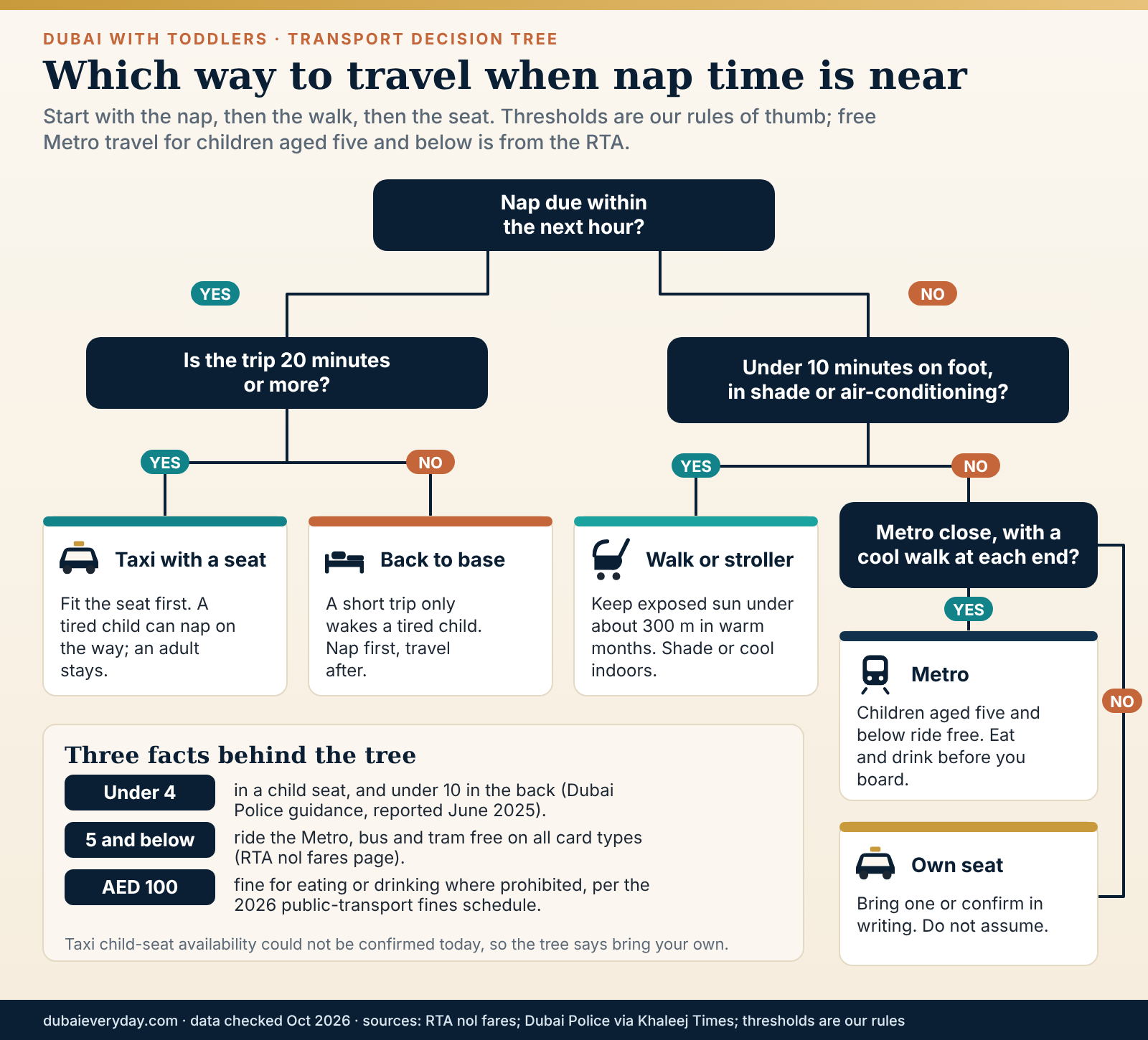
In a city this spread out, every trip in Dubai with toddlers is a small decision about the nap. A 25-minute drive is a chance for a tired toddler to sleep, or a missed nap if they are not yet tired. A Metro ride is a cheap, cold, uninterrupted half hour, followed by a walk that may be the hardest part of the day. This section sets out the rules, the gaps in what we could verify, and a way to choose.
The car seat rule, as police describe it
Dubai Police guidance, reported by Khaleej Times on 17 June 2025, says children under four must be secured in a suitable child safety seat and children under 10 must travel in the back. The same report says non-compliance, or a passenger without a seat belt, carries a fine of AED 400 and four black points on the driver’s licence.
The report also quotes the force urging parents to lock doors before driving and to activate the child locks on the rear doors. A Gulf News explainer we read for our sibling guides also mentions a height threshold of 145 cm for the front seat; we have not re-verified that figure, so treat it as a question to check.
The UAE government’s road-safety page cites Federal Decree-Law No. 14 of 2024 as the traffic framework but, on the page we read, does not reproduce the child-seat text. In other words the clearest statements we found are police guidance and news reports, not the legal text. For Dubai with toddlers the practical reading is simple: a child under four belongs in a proper seat, in the back, with the rear child locks on.
Taxis and ride-hailing: what we could and could not confirm
This is the weakest part of Dubai with toddlers for visitors, and we want to be exact about it. Here is the paper trail we found, in date order, none of which tells you what is available today.
- In 2011 Khaleej Times reported that Dubai Taxi had fitted 50 cabs at the airport with free child seats, requested by calling the RTA’s booking centre.
- A Gulf News report, last updated in September 2018 and describing a federal traffic-law amendment taking effect on 1 July, said the RTA had told all taxi franchise companies and limousine services to keep a child car seat available at all times.
- In March 2022 Careem and the RTA announced Hala Juniors, with 150 Hala taxis fitted with child seats, bookable in the Careem app for about AED 5 more than a standard Hala ride, with seats for rear-facing babies up to 10 kg and forward-facing toddlers up to 18 kg.
We could not confirm whether Hala Juniors still runs, how many seats exist now, or how a street-hailed taxi would respond to a family with a toddler. The honest planning position is this: do not assume a seat will be there. If you need one, arrange it in advance, in writing, and have a fallback.
The fallbacks, in rough order of reliability, are your own lightweight travel seat, a private transfer that confirms a seat in the booking, a hotel transfer where the hotel confirms the seat, or a rental car where you ask for a seat as an extra and check the fit. We could not verify rental seat charges, so ask for the price before you collect the keys. Whichever you choose, install it in front of the driver and check that the belt locks.
Metro, tram and bus
The RTA fare page lists children aged five and below as free on all its card types: Silver, Gold, Personal and Red Ticket. That is generous for a toddler, and it makes the Metro the cheapest way to move a family around the city. For adults the same page lists Silver fares of AED 3 within one zone, AED 5 across two adjacent zones and AED 7.50 for more than two, with Gold fares double plus a surcharge on tram and Metro. By our calculation two adults crossing two adjacent zones pay AED 10 in total on Silver cards, with the toddler free.
The page says nothing about strollers or prams. The public-transport fines schedule in Executive Council Resolution No. 3 of 2026, published on the Dubai legislation portal, also contains no provision specific to children or strollers. It does set AED 100 fines for eating or drinking where it is prohibited and for entering or sitting in areas designated for specific categories of passengers. The text does not say which areas those are or whether a baby’s bottle or a toddler’s snack is exempt, so assume that eating and drinking on trains is not allowed and keep snacks for the platform and the street.
A Metro carriage reserved for women and children is part of the system, as widely described, but we did not re-check the current rule today. If a father is travelling alone with a toddler, ask station staff which carriage to use rather than guess. Station lifts, gate widths and opening hours are details to check on the RTA site or the station itself.
The last-mile problem
The hidden cost of public transport in Dubai with toddlers is the walk at each end. Dubai’s stations and stops are not always where the destination is, and the pavement may be shaded for part of the route and bare for the rest. In winter this is a pleasant ten minutes. From May to September it is the reason a cheap Metro ride becomes a hard day.
Our planning rule for Dubai with toddlers in the warm months is to accept no more than about 300 metres of exposed walking between air-conditioned places, and to treat anything over about 500 metres as a taxi trip. That is a rule of thumb, not a standard. It works because the child’s tolerance, not yours, sets the limit, and because a hot, upset toddler in a stroller cannot cool down.
Where the walking link is air-conditioned, the maths of Dubai with toddlers changes. The link between the Burj Khalifa and Dubai Mall Metro station and the mall is reported to be an indoor, air-conditioned walkway, which is why Downtown suits toddlers better than most districts; we cover the area in the Downtown Dubai guide. Check the exact route on the day, because works and diversions change what is open.
Using your own or a hired car
Residents with a car have a big advantage in Dubai with toddlers: the seat is fitted, the air conditioning is on before you get in, and the nap can happen in motion. If you are a visitor hiring a car, remember that you, not the rental desk, are responsible for fitting the seat correctly and for the child’s safety. Never leave a child alone in a parked car, even briefly; the section on heat and safety says why.
Parking close to the entrance is worth paying for in Dubai with toddlers. A ten-minute walk across a hot car park with a stroller and a bag is a poor use of the first outing window. Where an attraction has a drop-off point, use it: one adult unloads the child while the other parks.
Strollers in Dubai: what to bring, borrow or skip
Do you need a stroller for Dubai with toddlers? For most children aged one to three, yes, even if they walk well at home. Distances inside malls, zoos and gardens are long, pavements outside them are patchy, and the stroller doubles as a nap bed, a shade and a luggage cart. It is also the thing most often chosen badly: a light umbrella stroller that is perfect for an airport and miserable on a mall’s tiled joints and a beach promenade.
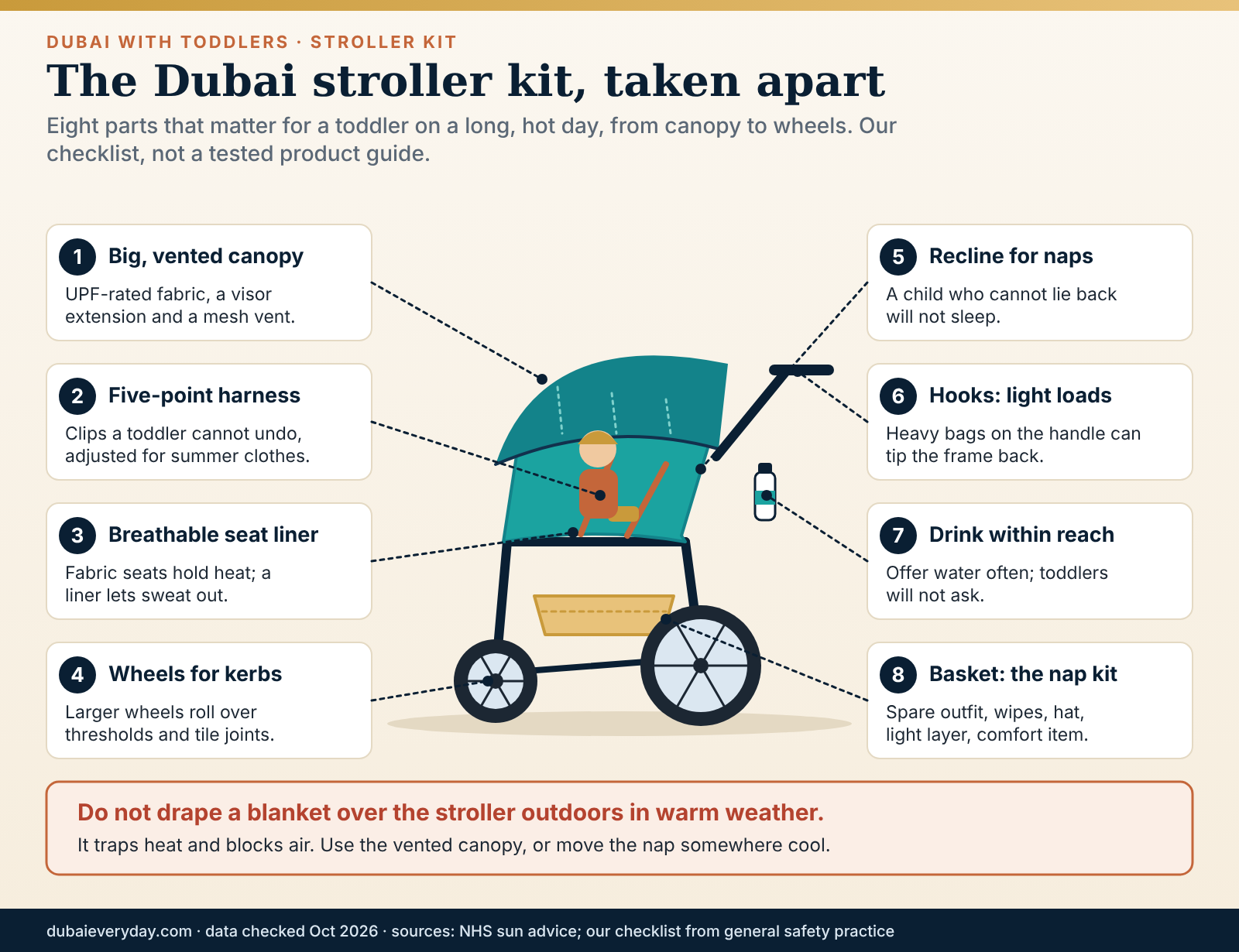
What to look for in a stroller for Dubai with toddlers
These are practical criteria rather than brand advice. We have not tested any model, and we are not recommending one.
- A large canopy with a sun visor extension, ideally a fabric with a stated UPF rating, and a mesh vent so air moves through it.
- A seat that reclines far enough for sleep. A toddler who cannot lie back will not nap in a stroller, however tired.
- Wheels big enough for kerbs, door thresholds and the occasional gravel path. Small hard wheels judder and stall.
- A quick, one-hand fold that fits the boot of a standard taxi, because a taxi driver will not wait for you to wrestle a complex frame.
- A basket large enough for the nap kit described below, and a five-point harness that the child cannot undo.
- A breathable seat liner. A fabric seat in the sun can be uncomfortably hot, and toddlers sweat into the seat back.
For Dubai with toddlers, weight matters less in a car-based city than on a European street, but it matters at the airport and for any trip with steps. A middle path is a mid-weight, mid-price stroller with a decent canopy, rather than the lightest or the most elaborate.
Borrow it: loan and rental options we could verify
You can often avoid carrying a stroller at all, but the published detail is thin. The Dubai Mall’s services page lists a baby stroller among items loaned through its Concierge Desk, for use inside the mall only, and mentions a refundable retainer for loaned items; it gives no rental price and does not say which desks lend strollers, so ask at the nearest Concierge Desk.
Dubai Safari Park’s FAQ says strollers and wheelchairs can be rented at the main entrance, again without a price. LEGOLAND Dubai’s Little Builders page lists strollers among essentials available at the theme park and water park but does not say whether they are free, rented or sold.
Global Village’s page and the Miracle Garden coverage we read did not mention strollers at all. That does not mean you cannot bring one, only that we could not confirm any rule. Baby equipment hire companies also operate in Dubai, but we did not verify any of them, so we name none; if you use one, ask about cleaning, safety standards, delivery to your hotel and what happens if the equipment breaks.
Strollers on the Metro, in taxis and in malls
The RTA fare page and the 2026 fines schedule do not mention strollers, so we have no verified rule to quote for the Metro. Common sense helps: fold the stroller if the carriage is crowded, keep it out of doorways, and choose a quieter time. In taxis, a folded stroller goes in the boot, so choose a fold that works when you are holding a toddler in one arm.
In malls, the stroller’s main enemy in Dubai with toddlers is the weekend crowd. Fridays, Saturdays and school-holiday afternoons are the hardest, and a double-width model is a liability. If your toddler walks, a good plan is to use the stroller as a base station, with the child walking in short bursts and riding when tired, rather than forcing a toddler into the seat for the whole outing.
The nap kit that lives in the basket
The easiest way to make Dubai with toddlers work is to treat the stroller basket as a mobile base. The same contents go with you every day, so you stop thinking about them. Our version is below, and every parent will adjust it.
- A refillable water bottle and a second drink, because toddlers drink little and often, and heat makes the gap matter.
- Two snacks that do not melt: crackers, fruit pouches, plain rice cakes, cut fruit in a small insulated bag.
- A spare outfit, a pack of wipes, a nappy kit and a small bag for rubbish.
- A sun hat with a brim that covers ears and neck, and sunglasses if your child will wear them.
- A thin muslin or light scarf for the nap, and a light long-sleeved layer for aggressive air conditioning.
- A comfort item. Not optional, and worth buying a spare.
- Sunscreen, applied before you leave and reapplied in line with the label and after swimming.
A note on stroller covers and heat
Do not drape a blanket or muslin over a stroller to create a dark nap space outdoors in warm weather. It traps heat and cuts air movement. Use a stroller’s ventilated canopy, a clip-on shade that leaves a gap, or, better, move the nap to somewhere cool. If your child is sweating, flushed, unusually sleepy or hard to rouse, treat it as a heat problem and move them to a cool place immediately; the health section covers what to watch for. This is general practice, not medical advice, and your paediatrician can give guidance specific to your child.
A battery-powered clip-on fan is a common accessory and some parents like it. If you use one, check that it cannot be reached by small fingers and that it is not blowing directly into a sleeping child’s face for long. We have not tested any product and do not recommend any.
Beaches and pools with toddlers in Dubai
A beach is the easiest part of Dubai with toddlers to love and the one that most needs a plan. The sand is entertainment enough for an hour, the water is mostly shallow near the edge, and public beaches cost nothing to enter. They are also where heat, glare and drowning risk meet. This section is about the choices you can make before you leave the car.
Choosing a beach for Dubai with toddlers
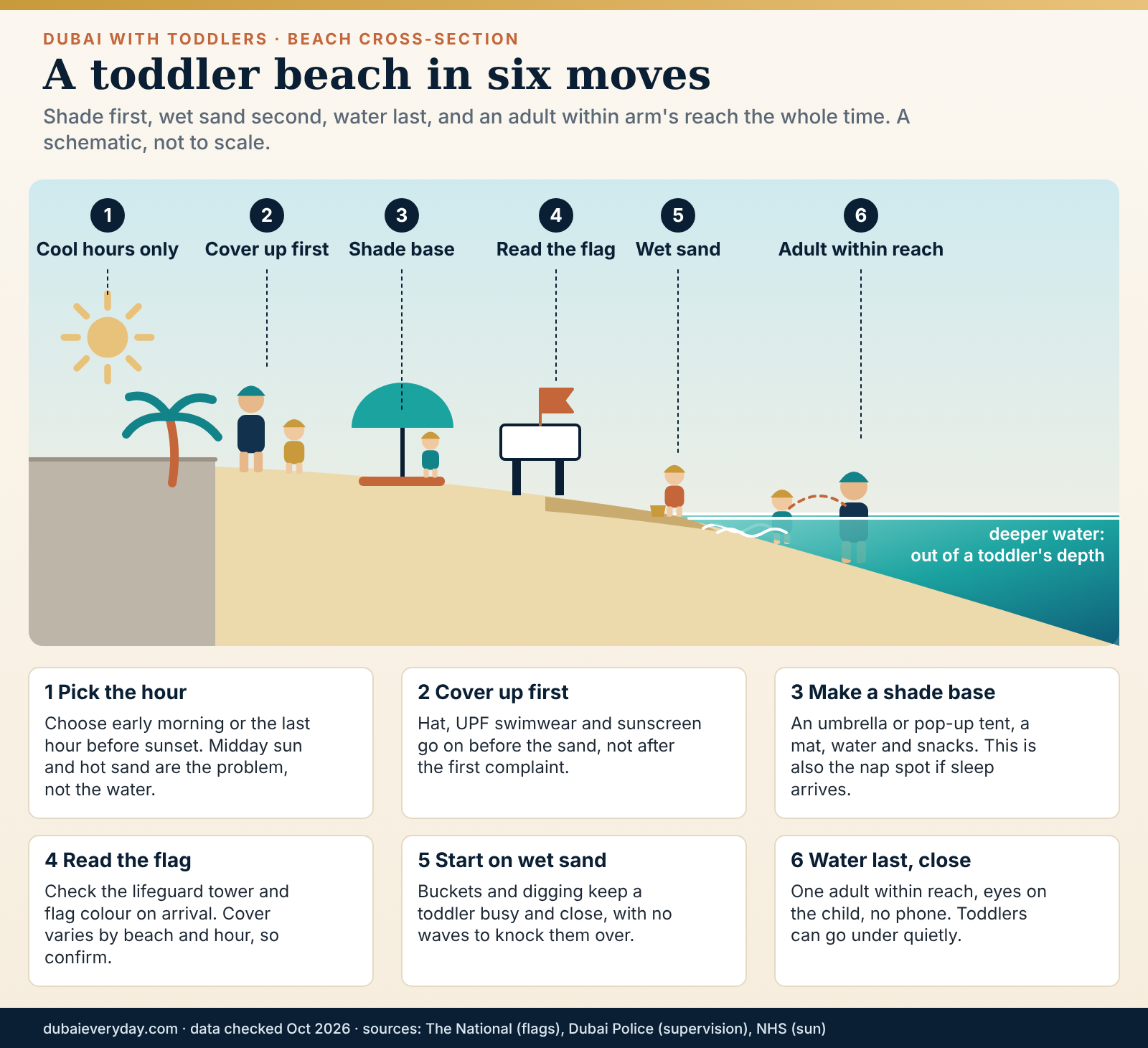
Here is what to look for, in order of importance. A lifeguard tower you can see from where you sit. A gentle entry, so the first metres of water are ankle-to-knee deep for a long stretch. Showers and toilets close enough to reach in a hurry. Somewhere to put your own shade, because public beaches do not promise it. A short, simple route from parking, with a shaded or paved path rather than a long hot walk through soft sand.
The National’s beach-safety piece of 9 October 2026 reports that lifeguarded beaches are usually monitored from sunrise to sunset, that designated night beaches have floodlights, and that not every beach is monitored, so you should check before swimming. For comparisons between named beaches, including facilities, access and crowds, use the wider best beaches guide; here we concentrate on what we could verify that matters for a toddler.
Night-swimming beaches
Dubai Municipality opened Jumeirah 2, Jumeirah 3 and Umm Suqeim 1 for night swimming in May 2023. Each is 800 metres long, has qualified lifeguards and lighting, and screens with safety messages. The municipality describes swimming dusk to dawn. For toddlers they are useful in summer, but bedtime and a late beach are a poor mix for most children.
Khor Al Mamzar Beach
Opened by Dubai Municipality on 5 May 2026 as the first phase of the Al Mamzar beaches development. It has a 3.6 km swimming shoreline, 12 lifeguard towers, 12 emergency call points, 19 food and beverage outlets and a 300-metre night beach. The release does not describe shade, showers or the water’s calmness, so check those before you plan around it.
Al Mamzar Beach Park
Gulf News, in an article last updated on 6 October 2026, lists entry as AED 5 per person plus AED 30 per car, with a pool at AED 10 for adults and AED 5 for children. A paid park often has predictable facilities, but we did not verify its toddler suitability, so treat it as one to check, not a recommendation.
The right hour, and why the water is not the problem
By the numbers, the sea is not what makes a midday beach hard. It is the sand and the sun. In summer the sea is about 31 to 33°C on the secondary figures we found, which is warm enough that the water offers little relief, while the air is 40 to 42°C. In winter the sea is around 21 to 23°C and the air is pleasant, but a wet toddler can chill quickly in a breeze.
Choose the early morning or the last hour of daylight in the hot months. In winter, a late-morning beach before lunch and the nap is the best slot of the day. A pop-up tent, an umbrella or a shaded corner is not an optional extra in any month, because shade is also where the nap happens if sleep arrives.
On sun protection, the NHS advises at least SPF 30 with UVA protection of four stars or more, a wide-brimmed hat that shades face, neck and ears, and long-sleeved close-weave clothing, with sunscreen reapplied after swimming, towel-drying or sweating and, as a general rule, every two hours. In a hot place, UPF-rated swimwear with sleeves reduces the area you have to cover and the number of times a squirming child has to be caught.
Dubai Police said in July 2026 that children near pools and beaches need direct, continuous supervision, that lifeguards and flotation devices do not replace it, and that a child can drown within seconds without anyone noticing. The National’s October piece adds that drowning is often quiet and fast, and tells parents to watch for a child losing footing, tiptoeing as the water deepens, or the waterline rising towards the chin. Keep one adult within arm’s reach, eyes on the child, with no phone in hand. Agree beforehand which adult is on duty and swap on a timer, so nobody assumes the other has it.
Flags and what they mean
The National reports the following flag meanings: green means safe for swimming, yellow means caution, red means do not enter the water, purple means possible harmful marine life such as jellyfish, and red and yellow flags together mark designated lifeguarded swimming areas. Always read the beach’s own signs and ask the lifeguard, because local practice can differ and conditions change during the day. If the flag is red, the beach morning becomes a sand morning.
A bright swimsuit makes a small child easier to find. The same article suggests high-visibility swimwear and rash vests, with orange and pink being the easiest colours to see in water. Pick the colour that stands out against the water and sand, not the one that matches the towel.
Hotel beaches, beach clubs and the question to ask
Hotel beaches and beach clubs can be easier than public beaches for Dubai with toddlers: loungers and shade are set up, there are toilets and food, and there is often a lifeguard. They also vary widely in access, pricing and age policies, and we could not verify any single venue’s terms today. Before you pay a day-use fee, ask four things: whether the beach has a lifeguard and during which hours; how the water entry works; whether there is shade you can sit in without paying extra; and whether the restaurant serves before your toddler’s lunch slot. Our best hotels guide explains how beach access differs by area.
Pools and splash areas
For many families doing Dubai with toddlers, a pool is better than a beach: shallower, calmer and closer to the nap spot. The key checks are the same as for the sea: a shallow area suited to the child’s height, a lifeguard or a fence and a gate with a self-closing latch, and shade. Ask whether the pool is heated or cooled, because unheated pools can feel cold in winter and very warm in August, and ask whether the venue has swim-nappy rules, which we did not verify and which vary.
Splash pads are a reasonable middle: moving water, no depth. Reported options include LEGOLAND Dubai’s Sea Port Splash Pad, which sits in the toddler-friendly list on its Little Builders page, the splash pad at Town Square Park, which Gulf News says has separate fees, and the splash park at Dubai Hills Park, which Gulf News lists inside a day pass of AED 55 for residents and AED 85 for non-residents that also covers a skate park and ice rink. These prices come from a news report last updated on 6 October 2026, so confirm them with the operator.
In short, the beach part of Dubai with toddlers comes down to three decisions: the hour you go, the flag on the day and the adult who is on duty.
Indoor play for toddlers in Dubai: how to judge a place
Indoor play is the pressure valve of Dubai with toddlers. It fills the stretch between breakfast and lunch in summer, the hour after a nap on a windy day, and the weeks of the year when nobody wants to be outside. It is also a category in which nearly every operator describes itself in superlatives and almost none publishes the details a parent wants, such as who is allowed in, for how long and at what price per hour.
We do not rank indoor play centres on this page, and we say why: the published information was too thin to compare them fairly, and we did not visit any. Instead, this section gives you a way to judge any indoor play place for Dubai with toddlers in a few minutes, followed by what we could verify about a handful of places with a clear toddler angle.
The ten-question check for Dubai with toddlers
Whether it is a soft-play centre in a mall or a standalone venue, ask the same questions before you pay. Most can be answered by a phone call or a look at the website.
- Is there a separate area for children under three, away from the big-kid equipment?
- What are the age and height limits for each zone, and are they enforced?
- Does an adult have to stay with the child, and are there seats with a clear line of sight?
- Is entry timed, all-day or by pass, and can you leave and re-enter, for example for a nap?
- Are grip socks required, and are they sold on the spot?
- How many children are admitted at a time, and when are the quiet hours?
- Is there one exit, staffed, so a runner cannot slip out behind you?
- Where are the toilets and the changing area, and how close are they to the play zone?
- Is there food a toddler will eat, and can you bring your own?
- What is the cleaning routine, in plain words, and can you see it happening?
The re-entry question is more important than it looks. A toddler who needs a nap at 12:30 and a venue that does not let you leave and return is a conflict you will lose. The Dubai Aquarium’s ticket page, for example, says tickets are valid on the date selected only, are non-refundable and do not allow re-admission, so a nap break in the middle of the day means paying twice or skipping the nap.
What we could verify at four toddler-relevant places
Dubai Aquarium and Underwater Zoo. The operator’s ticket page lists a standard ticket at AED 199 for adults and children aged two and over, and says children under two enter free. Children under 15 must be accompanied by an adult aged 15 or older. The page says the venue is open 365 days a year, without giving hours.
It describes the Otter Encounter as stroller and wheelchair accessible, and the Penguin and Ray encounters as not accessible by stroller, so for a toddler in a stroller the standard visit and the otters are the practical choices. We did not verify the walking distance inside, or whether it is a sensible stroller route.
Children’s City. Dubai Municipality’s visitor terms say children under two get free admission with valid proof of identity and that children up to 16 must be accompanied by an adult at all times. The terms page did not publish hours or a general ticket price, referred readers to the website or the number 800900, and noted that exhibits and hours may change or close for health, safety or events. It did not describe a toddler or early-years zone, so we cannot tell you whether it suits a one-year-old.
LEGOLAND Dubai, young children’s areas. The operator’s Little Builders page names areas with no minimum height, including DUPLO Valley, Sea Port and its Splash Pad, Build and Test, Imagination Garden and the LEGO Movie 4D show, and lists rides with minimums of 80 cm (DUPLO Express and Submarine Adventure), 90 cm (Lost Kingdom Adventure) and 95 cm (Junior Driving School, City Airport, Rescue Academy and Kid Power Towers).
The Boating School has a minimum age of one year. Baby Care Centres in the IMAGINATION zone and the water park have private nursing areas, a kitchen with a microwave, washrooms and a small play area. The page marks some attractions as containing small bricks, which it flags as a choking hazard for the youngest children.
The Dubai Mall. The mall’s services page lists a baby stroller as a loaned item at its Concierge Desk, with guest services open 10:00 to 23:00 Monday to Thursday and 10:00 to 24:00 Friday to Sunday. It does not mention nursing rooms or toddler play areas, and gives no locations, so we cannot confirm either; ask at a desk on arrival. The Downtown Dubai guide covers the district around the mall; this page sticks to what the operator has published.
Timing indoor play around the nap
In Dubai with toddlers, indoor play is not a nap activity. Use it in the first window of the day, or after the nap, and not in the hour before sleep. Trampolines, slides and shared toys are exciting; a toddler who reaches the nap overexcited will take longer to settle and sleep less. In the hour before the nap, choose a calm space: a book corner, an aquarium tunnel, a quiet walk.
Crowds also follow the calendar. Weekday mornings are quiet and weekends, school-holiday weeks and wet days are not. If your visit is in a holiday week, arrive when the doors open, and plan to leave by late morning.
A simple price test for Dubai with toddlers
Admission models differ, so convert them to a common unit. Our rule of thumb is the cost per useful toddler hour: the ticket price divided by the hours your child will actually use. An illustrative example, not a market fact: the Aquarium’s AED 199 ticket for a two-year-old, enjoyed for about two hours, is roughly AED 100 an hour, while Global Village at AED 30 per adult, with a toddler under three free, is about AED 15 an hour per adult for two hours.
The number on its own proves nothing; it is a way of comparing a full-price outing with a cheap one before you decide how many treats the week can bear.
When indoor play is the wrong answer
Skip it, whatever your plan for Dubai with toddlers says, when your child is coming down with something, because shared toys and enclosed spaces spread colds quickly, and when your toddler is already overtired. Skip it, too, on the busiest day of a school break unless you like queueing. A free alternative may be better: a hotel playroom, a lobby with a tank, a quiet corner in a mall.
Parks, animals and big days out: toddler ages and prices
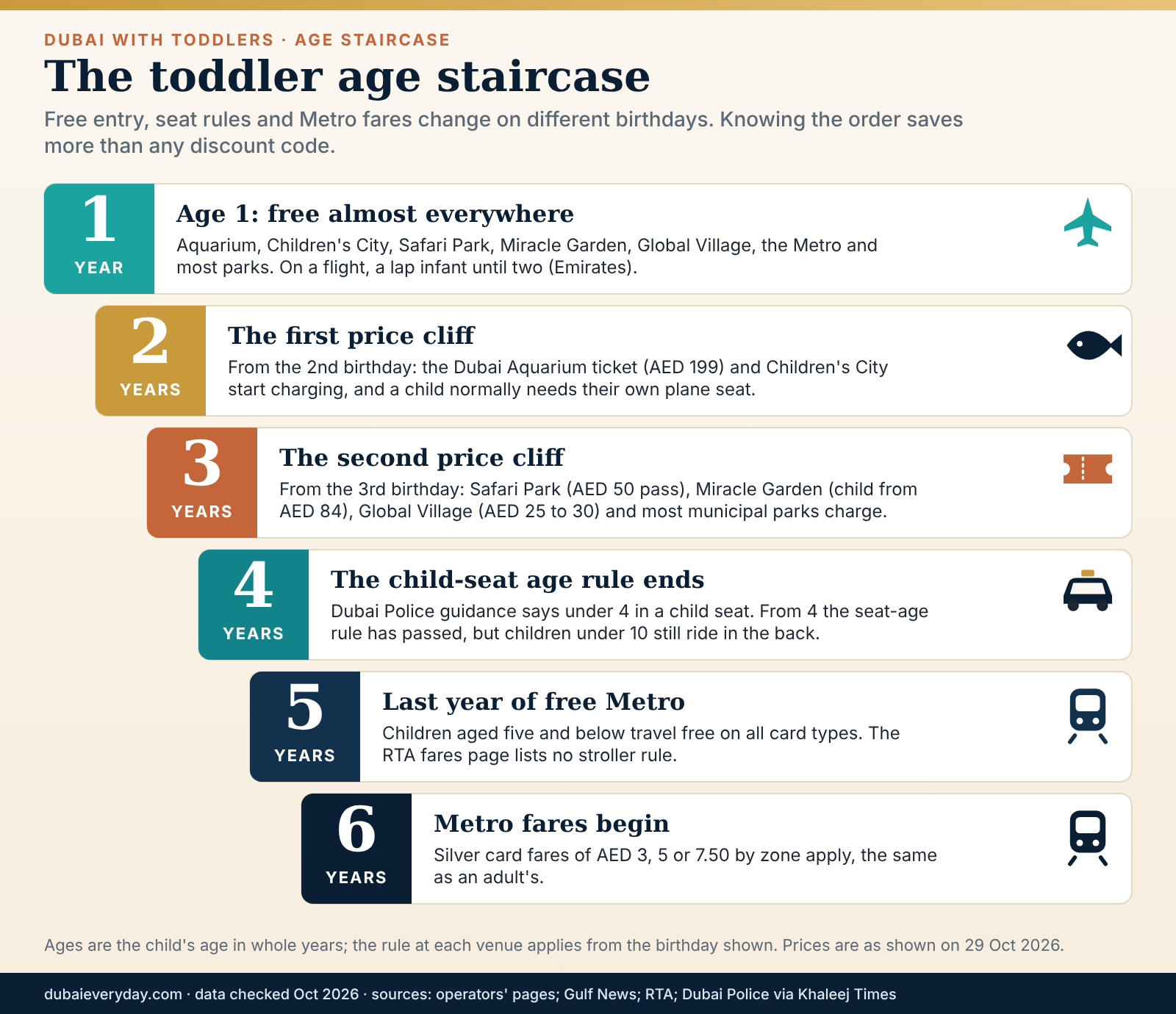
The most useful single fact about paid attractions in Dubai with toddlers is not a price but an age. Almost every venue has a birthday at which your child stops being free, and they are not the same birthday. A child who is two years and one month old costs nothing at one venue and a full ticket at the next. Knowing the order lets you do the paying outings while the child is still free, and plan the later years around parks.
What a toddler costs at the gate
The table below, a decision aid for Dubai with toddlers, collects what each operator’s page said on 29 October 2026, or what Gulf News reported where the operator’s page did not say. Prices move, and a booking platform may charge more than the operator, so use it as a map, not a quote.
| Venue | Toddler is free until | Price shown for an adult | What else matters |
|---|---|---|---|
| Dubai Aquarium and Underwater Zoo | Under 2 | AED 199 standard | Tickets are date-specific, non-refundable, no re-admission |
| Children’s City | Under 2, with ID | Not on the terms page | Check hours with the operator; Creek Park charges separately |
| Dubai Safari Park | Under 3 | AED 50 pass | Strollers rented at the main entrance; hours on the page conflict |
| Dubai Miracle Garden | Under 3 | From AED 105 (child from AED 84) | Season 15 runs to 31 May 2027, 09:00 to 21:00 |
| Global Village | Under 3 | AED 30 any day, AED 25 weekday | Opens 16:00; Tuesdays are ladies and families |
| Municipal parks | Usually 2 and under | Free to AED 5 typically | Reported by Gulf News; check the park |
| Metro, bus and tram | 5 and below | Silver AED 3, 5 or 7.50 by zones | RTA fares page; no stroller rule published there |
Dubai Safari Park
The park’s FAQ lists a single Safari Park Pass at AED 50 covering six zones, unlimited train rides and free parking, with children under three admitted free and children under 12 required to have an adult. The Safari Bundle, at AED 117, adds a 35-minute guided Explorer Safari Tour. Strollers and wheelchairs can be rented at the main entrance, with no price listed. Outside food and drink are not allowed except baby food and water, and the page mentions prayer rooms and lockers but no nursing room.
Hours are where the page contradicts itself. The FAQ gives winter hours of 09:00 to 20:00 from November to March and summer hours of 09:00 to 18:00 from April to October, with last entry one hour before closing, while a header on the same page says last entry is 17:00. Confirm the day’s hours with the operator. The park is mostly outdoors and recommends hats and sunscreen, so for a toddler the sensible window is the morning in winter, with lunch and the nap afterwards at base, not a full day.
Dubai Miracle Garden
Season 15 opened on 8 October 2026 and runs to 31 May 2027, daily from 09:00 to 21:00, according to Gulf News. Adult tickets start at AED 105 and children’s at AED 84, with children under three free. The report does not mention strollers or a Butterfly Garden. It is an open-air outing, so in practice it is a December to February activity for a toddler, best in the late afternoon after the nap when the heat has eased, or in the morning in the shoulder months. Be wary of the last hour on weekends, when the crowd thickens along narrow paths.
Global Village
Season 31 opened on 14 October 2026 and runs into May 2027. The operator’s page lists opening at 16:00, closing at midnight from Sunday to Wednesday and at 01:00 from Thursday to Saturday, with tickets at AED 30 for any day or AED 25 for Monday to Thursday excluding public holidays, and free entry for children under three. It also says Tuesdays are reserved for ladies and families except on public holidays. The page did not mention strollers or baby-care facilities.
The 16:00 opening makes it a post-nap outing, which suits Dubai with toddlers well. The risk is the late finish: a toddler who is asleep by 19:30 does not belong there at 22:00. A sensible plan is to arrive at opening, leave by about 18:30 with a fed, tired child, and treat the family evening as a stroller outing with a firm meeting point if you are two adults. Crowds and noise rise through the evening, and a toddler who is not strapped into a stroller can be hard to keep in sight.
Parks for the days between
Parks are the best free-to-cheap days for Dubai with toddlers, and Gulf News’s October 2026 survey gives the details that matter. JLT Park is free and has a zone for babies and toddlers with swings. Al Barsha Pond Park is free and has three shaded playground zones. Al Sufouh Park is free with two shaded play areas. Safa Park charges AED 3 with free parking, Zabeel Park charges AED 5, and Mushrif National Park charges AED 3 per person plus AED 10 per car, with a train ride at AED 2. Al Ittihad Park on the Palm is free and open round the clock.
The report says municipal parks generally open at 08:00 and close at 22:00, later on weekends, and that children aged two and under usually enter public parks free. It does not mention strollers or shade for most parks, so check the park before you go. In hot months, a playground in direct sun is not a play space: metal slides and rubber surfaces can be hot enough to burn small hands and feet, so test the surface with your own hand before you put a child on it.
LEGOLAND Dubai for the youngest
The operator’s Little Builders page makes a case for toddlers, with no-minimum-height areas, a splash pad and baby care centres, and we describe those details in the indoor play section. What the page does not say is the entry price for a child, or the free-entry age. A theme park day is a long outing, and a toddler uses a small slice of it, so it is a value question: if you also want the rides for an older child, the toddler comes along cheaply; if the day is for a one-year-old, a park and a swim may give more for the money.
The pattern for Dubai with toddlers is to use the free years well: do the aquarium and Children’s City before the second birthday, the safari park, the garden and Global Village before the third, and fill the rest of the calendar with parks, pools and the beach.
Food with toddlers in Dubai: restaurants, snacks and supermarkets
For parents planning Dubai with toddlers, food is the other half of the nap problem. A toddler who is hungry at 12:00 will not nap at 12:30, and a toddler who is fed a large meal at 12:20 may not either. The good news is that Dubai has a huge variety of places to eat and that most of them can feed a child. The bad news is that almost nothing about them is published in a form we could verify, so this section is about timing and questions, not named restaurants.
We do not list or rank restaurants in this guide to Dubai with toddlers, because we have not eaten at any, and a toddler-friendliness claim about a restaurant without a visit would be a guess. For restaurant choice by area, budget and occasion, use the site’s restaurant coverage; here we concentrate on how to make any place work.
The meal clock for a one-nap day in Dubai with toddlers
A common pattern for a single-nap toddler is breakfast soon after waking, a snack mid-morning, lunch before the nap, a snack after it, and an early dinner. In Dubai with toddlers, three practical points follow.
- Early lunch is easier than early dinner. In our reading, a table at 11:30 is the least contested of the day, and the child is fed and ready for the nap.
- Early dinner is harder. Some dinner-focused restaurants open only in the evening, and popular ones fill early. If your toddler is in bed by 19:30, dinner often means an early hotel meal, a mall food court or room service. Check opening hours before you cross town.
- The post-nap snack matters. A toddler waking at 14:30 into a queue with nothing to eat is the second most common cause of a lost afternoon.
What to ask a restaurant before you sit down
The questions are short and the answers tell you quickly whether the place will work.
- Is there a high chair?If the answer is hesitant, assume it is not a place built for toddlers, and that you may spend the meal holding a child on a knee.
- Can the child’s food come first?Ask this when you order. Toddler meals are short, and the first ten minutes decide the next hour.
- Is there something plain and soft?Rice, flatbread, grilled chicken, plain pasta, yogurt, eggs, soup, lentils and fruit are common on menus in the city. Ask about spice, salt and sauces, and whether a dish can be made without them.
- Is it noisy or smoky?Outdoor terraces may allow shisha. The UAE government portal says the child-protection law prohibits smoking in vehicles and indoor facilities where children are present, and a terrace is a different case, so ask for a table away from smokers.
- How long will it take?A place that says 40 minutes for a main course is not a toddler lunch before a 12:30 nap.
Allergies and dietary needs
We did not verify any Dubai-specific requirement on allergen labelling or menu allergen information, so treat every restaurant as one where you must ask directly and repeat the question to whoever will prepare the food. If your child has a diagnosed allergy, carry what your doctor has prescribed for emergencies and know the location of the nearest hospital before you eat out. This is general information, not medical advice. Our sibling guide to Dubai with a baby covers first-foods questions for younger children.
Water and drinks
Offer water regularly, in small amounts, in a cup the child likes. In warm months it matters more than parents expect, because a toddler absorbed in play does not ask. We did not find a current official statement on drinking-water quality that we could verify today, so follow your accommodation’s guidance on whether to use bottled or filtered water for a toddler’s drinks, and carry a refillable bottle.
Supermarkets, staples and delivery
For a stay of more than a few days of Dubai with toddlers, do one grocery run in the first 24 hours. The staples that make a week easy are nappies and wipes, familiar snacks, fruit, yogurt, milk or the milk your child drinks, and any brand your child will accept without protest. Brand availability varies, so bring a few emergency items from home. Our supermarkets guide compares the main chains, and the Carrefour guide covers hypermarkets and delivery, which can save you a taxi and a nap.
If you are staying in a hotel, ask whether it can receive a delivery, whether the room has a fridge and whether a microwave or kettle can be arranged. A fridge that holds yogurt, fruit and milk is worth more than a minibar, and an apartment with a kitchen turns a toddler’s fussy-eating phase from a restaurant problem into a home problem.
Feeding in public and nursing
We found no published Dubai rule on breastfeeding in public and no verified list of nursing rooms. The norm, as we read it, is discretion rather than prohibition, but that is our reading, not a legal statement. LEGOLAND Dubai’s page does list Baby Care Centres with private nursing areas, and our baby guide goes further on the practical side. For a mall, ask a guest-services desk where the baby room is rather than hunt for it.
Hotel breakfasts and buffets
A hotel buffet can be an excellent breakfast for Dubai with toddlers: variety, no waiting, and the freedom to leave when the child is done. The cost varies by hotel and by the child’s age band, so ask for the child’s price when you book. Go at the start of service, when it is calm, and take a plate of safe food to the table before the child’s patience runs out. If your hotel does not include breakfast, check whether a nearby cafe opens early enough for a 07:00 wake-up.
Where to stay, and how to toddler-proof a Dubai base
For a family doing Dubai with toddlers, the accommodation is not a place to sleep; it is the nap station, the snack bar, the changing room and the escape hatch. A hotel that photographs well and has a long, hot walk from lobby to pool will cost you more in daily effort than a plainer one with a shaded pool next to the lift. This section covers how to choose, how to make a temporary base safe, and what changes if you live here.
Choosing a hotel by sleep first
Judge a hotel by what happens after 19:30. A single room with a toddler asleep in a cot and two adults awake in the dark is a recipe for evenings spent in the bathroom. A suite or apartment with a separate bedroom changes the holiday. The same applies to the nap: blackout curtains, a quiet room away from the lift and a corridor that does not echo are worth more than a view.
- Ask about cots: whether one is free, whether it is guaranteed at check-in and what age it takes. We did not verify any hotel’s cot policy or charge.
- Ask about early check-in, because arriving with a tired toddler at 09:00 and being told the room is at 15:00 is a bad start. A later check-out matters too if the nap is the last event of the day.
- Check the route from room to pool: lift, shade, distance, and whether the pool has a shallow area and a lifeguard.
- Check the balcony door: a lock that sits high on the frame, out of reach of a small child.
- Look for a fridge in the room and ask whether a microwave or kettle is available.
- Find out when the hotel kids’ club accepts children and whether parents must stay; many clubs have a minimum age above a toddler’s, which we could not verify for any hotel.
For choosing by area, beach access and price band, our best hotels guide sets out the trade-offs. If a short, air-conditioned route to a mall, an aquarium and a Metro station is your priority, the Downtown Dubai guide covers the district. Whichever you choose, check the total price including taxes and fees, because the advertised rate and the amount charged often differ.
Making a temporary base safe
Whether it is a hotel room or a short-term rental, spend ten minutes on arrival doing a toddler audit; it is the first practical job of Dubai with toddlers on any stay. Walk the room at your child’s height and look for what they can reach: cords, sockets, glass tables, a mini-fridge with drinks, an unsecured balcony door. Move furniture away from windows and balcony doors, because climbing is how toddlers get hurt.
Police forces in the UAE have repeatedly put out warnings about children falling from windows and balconies; we saw several such reports in our research but did not verify any rule specific to Dubai rentals, so we cannot say what a landlord must provide. The practical response does not depend on a rule: keep balcony doors locked, keep windows closed or fitted with stops that limit how far they open, and keep climbable objects away from both. If a window or balcony door in a rental cannot be secured, ask for it to be fixed or choose a different unit.
Pools are the other major risk when staying in Dubai with toddlers. A building pool is not a fenced garden: check whether there is a lifeguard, whether the gate is self-closing and whether the pool is open to children under a certain age without an adult. The supervision advice earlier in this guide applies.
If you live here: the everyday layer of Dubai with toddlers
The rest of this guide to Dubai with toddlers applies equally to residents, but residents also deal with the slow, unglamorous details of a toddler’s home. Setting up the apartment, choosing childcare and organising health care are different jobs from a holiday, and they are better handled with a checklist.
- Home setup. Our home setup guide covers the first-week checklist for a rented home: tenancy registration, electricity and water, internet, cooling and furniture. With a toddler, add childproofing, a cool bedroom for the nap and a plan for how the apartment’s air conditioning behaves in August.
- Cleaning. A licensed cleaning company is a practical help, and the cleaning services guide explains licensing, rates and supplies. With a toddler, ask which products will be used and keep the child out of the room until floors are dry. The sofa cleaning and carpet cleaning pages explain drying times and stain limits, which matter more when the carpet is where the toddler sits.
- Health. Emirates 24/7 reported in September 2026 that the National Immunisation Programme for children is free and can be booked in Dubai. We could not verify the schedule or the booking steps from an official page today, so ask your paediatrician or a primary-care centre for your child’s schedule and bring the child’s vaccination record.
- Paperwork. Wadeema’s Law, Federal Law No. 3 of 2016, makes failure to register a child’s birth an offence, according to the UAE government portal. Deadlines and fees for registration, visas and identity cards depend on your situation and were not on the page, so check the official portals directly.
- Childcare. Nurseries are regulated, and any provider should be able to show a licence. We did not verify the licensing process, fees or inspection arrangements, so ask for the licence and the latest inspection information before you pay a deposit.
Our sibling guide to Dubai with kids picks up school choices and budgets for older children.
Heat, health and safety for Dubai with toddlers
Most of this guide to Dubai with toddlers has been about avoiding trouble, and this section is about what to do if it arrives. It is general information, not medical advice. We are not clinicians, and for anything that worries you about your child, the right person is a doctor, a paediatrician or the emergency services. The UAE government portal lists 999 for police, 998 for an ambulance and 997 for civil defence.
How a toddler handles heat
Young children heat up faster than adults, and the more important point is that they cannot manage it themselves. A toddler absorbed in play will not stop to ask for a drink or a break, and cannot explain a headache. In a city where average daily highs are 38°C or more from May to September, you are the thermostat in any plan for Dubai with toddlers.
The warning signs that health services commonly list for young children include unusual sleepiness or irritability, flushed or very hot skin, heavy sweating or, worse, stopping sweating, fewer wet nappies, vomiting and difficulty rousing the child. If you see them, move to a cool place immediately, give fluids if the child is alert enough to drink, loosen clothing, and seek medical help. If a child is hard to wake, floppy or confused, treat it as an emergency and call 998.
Sun, clothing and sunscreen
The NHS advises at least SPF 30 with UVA protection of four stars or more, a wide-brimmed hat that shades the face, neck and ears, and close-weave long-sleeved clothing. It recommends spending time in the shade, especially between 11:00 and 15:00, and reapplying sunscreen often, after swimming, towel-drying or sweating, and as a general rule every two hours. The NHS page is written for the UK, where its 11:00 to 15:00 advice is tied to March to October, but Dubai’s sunshine is strong all year: NOAA’s January normal is about 253 hours of sun a month. Use the midday shade rule in every season.
For toddlers, clothes beat cream. A UPF-rated rash vest, a sun hat that stays on and a thin cotton shirt cover most of the body without a negotiation. Sunscreen then goes on the face, hands, feet and anywhere else that is exposed. Test a new sunscreen on a small patch at home, because a toddler with a reaction on day two of a short trip is a disaster.
A parked car in Dubai heats up far faster than most people expect, and a child cannot cool down or get out. Even a quick stop to pay or collect a parcel is too long. The UAE government portal says that Wadeema’s Law, Federal Law No. 3 of 2016, makes it an offence to endanger, abandon, neglect or leave a child unsupervised, with penalties that include prison, a fine or both, and that it also bans smoking in vehicles where children are present.
The page does not give a specific rule or figure for children left in cars, so we do not quote one. The rule of thumb is simple: if you leave the car, the child comes with you.
Cold as well as hot
The surprising hazard for visitors doing Dubai with toddlers is air conditioning. Malls, taxis, hotels and aquariums are kept cold, and a sweaty toddler moving from 38°C outdoors into a chilled mall can end up shivering. Layer for the building, not the street: carry a light long-sleeved top in the stroller basket, and take it off when you leave.
On the road
We covered the child-seat rule in the transport section. In June 2025, after a report of a five-year-old falling from a moving car, Dubai Police urged parents to follow the rules on seats and rear seating, to lock doors before driving and to activate rear child locks. For Dubai with toddlers, the child locks are a one-minute job at the start of a trip and are worth doing every time in a hired car, because the hirer will not have done it for you.
Illness, insurance and medicines
Know where the nearest clinic is for each place you will sleep, and check what your insurance covers before you travel: whether it covers a toddler, whether it requires you to use specific providers and whether it expects you to pay up front and claim back. Carry the vaccination record and any regular medicines in their original packaging with a copy of the prescription. Some medicines that are routine in other countries are controlled in the UAE; we did not verify the current rules, so check them with the UAE’s health authorities or your doctor before you pack.
For a visitor, a cold is a normal part of Dubai with toddlers: a good reason to cancel an afternoon and a bad reason to panic. For a resident, the first step is a paediatrician in your insurance network, and our Dubai with kids guide has a section on health and heat for older children.
Losing a toddler in a crowd
Toddlers disappear in seconds, and Dubai’s malls, markets and parks are large. Make a plan before you go. Decide who looks for the child and who stays put. Write your phone number on a card in the child’s pocket or on a wristband, not on their back where a stranger will see it. Teach a toddler that if they are lost they should find an adult in uniform or a person with a child, and tell them to wait. In a mall, guest-services desks are the place to go: The Dubai Mall’s are open from 10:00 to 23:00 Monday to Thursday and 10:00 to 24:00 Friday to Sunday.
A three-question check before any outdoor stop in Dubai with toddlers
- Can we reach air conditioning within five minutes if the child gets hot or upset?
- Is there shade for the whole of this stop, not just the start?
- Is water within reach and is someone watching the child’s colour and mood?
If the answer to any of these is no, change the stop, not the child’s tolerance. That one habit does more for Dubai with toddlers than any gadget.
Three sample days for Dubai with toddlers, with costs
These are illustrative days for Dubai with toddlers, built from the rules above and the prices and hours we verified on 29 October 2026. They are not itineraries to copy; they show how the nap, the heat and the price cliffs interact. Times are our assumptions for a child who wakes at about 06:30, naps from about 12:30 to 14:30 and sleeps at about 19:30. Hours and prices change, and a booking platform may add fees.
Day one: a winter animal day (December to February)
- 07:00 to 08:30Wake, breakfast at base, pack the stroller basket, sunscreen on, hat on. Leave by 08:30 to arrive when the gates open.
- 09:00 to 11:30Dubai Safari Park in its winter hours, which the park lists as 09:00 to 20:00 from November to March. Use the train and a stroller rented at the main entrance if you did not bring one. The park does not allow outside food except baby food and water, so plan to eat there.
- 11:30 to 12:15Early lunch at the park, then return to base. A tired toddler may sleep in the car seat on the way.
- 12:30 to 14:30Nap at base. Adults eat something and sit down.
- 16:00 to 18:30Global Village, which opens at 16:00 and, according to its page, closes at midnight from Sunday to Wednesday and at 01:00 from Thursday to Saturday. Arrive at opening, eat an early dinner on site, and leave by about 18:30. A Tuesday is a ladies and families day.
Our calculation of the gate cost: two adults at the Safari Park Pass of AED 50 each is AED 100, with the toddler free under three and parking included. Global Village is AED 25 per adult on a weekday or AED 30 on any day, so AED 50 to AED 60 for two adults, with the toddler free under three. The whole day costs AED 150 to AED 160 in tickets, before transport and food.
Day two: a summer indoor-first day (June to August)
- 06:30 to 08:30The only outdoor window. A short walk or a hotel pool before the heat builds. Sunrise falls at about 05:38 in mid-July by our calculation.
- 09:00 to 09:45Breakfast, a nappy change and a taxi or Metro trip to the destination, with the child seat arranged in advance.
- 10:00 to 11:45The Dubai Aquarium and Underwater Zoo. Tickets are for the date only, with no re-admission, so do it in one visit and skip the middle-of-the-day break. Opening hours were not on the ticket page, so confirm them.
- 11:45 to 12:30Early lunch in the adjoining mall, then a short, cool ride back to base.
- 12:30 to 14:30Nap at base with the blinds closed.
- 17:30 to 19:00The hotel pool in the last hour of light, a fed child and an early bed.
Our calculation: the Aquarium’s standard ticket is AED 199, so two adults pay AED 398 with a toddler under two free, or AED 597 if the child is two or older. If you use the Metro, two adults crossing two adjacent zones pay AED 5 each way each on Silver cards, or AED 20 for the return, with the child free. The day costs about AED 418 to AED 617 in tickets and fares before food, which is why we suggest one paid outing per day in summer, not two.
Day three: a resident weekday on a budget
- 07:30 to 09:30A neighbourhood park while the air is still bearable: JLT Park has a free toddler zone with swings, and Al Barsha Pond Park and Al Sufouh Park offer shaded play areas, all per Gulf News.
- 09:30 to 10:30Snack and a walk home, or a cafe stop if the child is happy.
- 10:30 to 12:00Quiet play at home, a supermarket run with the toddler in the stroller, or a rotation of toys that have been out of sight for a week.
- 12:00 to 14:30Lunch and the nap at home.
- 16:00 to 18:00A second park visit, a playground, or a pool in the building if there is one with proper supervision.
Our calculation: the parks above are free, and the paid ones in the same survey are AED 3 to AED 5 per person. A week of this pattern costs very little, which is why many residents treat parks as the backbone of Dubai with toddlers and save paid attractions for the cooler months or for when a child turns an age that makes them worth it.
What a toddler adds to the cost of a trip
Counting only what we verified, the toddler’s own gate costs are zero at all of the places in the table above until the child’s second or third birthday.
The cost of Dubai with toddlers is mostly elsewhere: a seat on the plane from age two, a child seat or a private transfer, a hotel room with a separate bedroom, a taxi in place of the Metro when the heat is too high, and the paid meal you eat because you cannot cook. As an indication only: if your plan swaps four Metro journeys a day for four taxi trips, the Metro’s AED 20 for the return of two adults becomes whatever four metered fares cost, which we have not verified.
Mistakes parents make
These come from the logic of the data above, not from anyone’s anecdote. Each is a pattern that tends to turn a manageable day of Dubai with toddlers into a bad one.
- Planning the day around the attraction and the nap around the gap. Fix the nap first, as above.
- Booking a timed or no-re-entry ticket at 12:30. A midday slot is where the heat and the nap meet.
- Assuming a taxi will have a car seat. We could not confirm one, so arrange it or carry your own.
- Letting the toddler nap in a stroller in the sun. A stroller is not a bed in 38-degree heat.
- Choosing the beach for the hour you prefer, not the hour the child can tolerate. Early and late are the safe slots in warm months.
- Treating lifeguards or floats as a substitute for an adult. Dubai Police say they are not.
- Walking to the destination because it looks close on the map. Measure in minutes of shade, not metres.
- Eating at the worst time. A hungry toddler or a lunch that ends at 12:25 both cost you the nap.
- Saving the free-entry venues for later. A place that is free until a child’s third birthday is cheapest to visit before it.
- Over-planning a long trip. Three bookings in a day with a two-year-old is not an itinerary; it is a debt.
Dubai with toddlers: frequently asked questions
Is Dubai a good destination for toddlers?
It can be, with caveats. The strengths are short flights from many places, air-conditioned malls and attractions, free or cheap entry for under-twos and under-threes at several venues, free Metro travel up to age five, and reliable winter weather. The weaknesses are heat for much of the year, long distances between places, patchy information on taxi child seats, and a lot of paid entertainment. A toddler who naps well and a plan that respects the heat make Dubai with toddlers an easy trip; a plan that ignores both makes it a hard one.
When is the best time for Dubai with toddlers?
December to February is the easiest, with average daily highs of about 24 to 27°C by the NOAA 1991 to 2020 normals, and outdoor time possible for most of the day. March and November also work. April, May, September and October need a firm indoor midday, and June to August is an indoor-first season, with highs of 40 to 42°C. The trade-off is crowds and price: the winter months, and the school break from 14 December 2026 to 3 January 2027, are the busiest.
Do toddlers need a car seat in Dubai?
Dubai Police guidance reported by Khaleej Times in June 2025 says children under four must be secured in a suitable child safety seat, and children under 10 must sit in the back. The report gives a fine of AED 400 and four black points for non-compliance. A Gulf News explainer also mentions a 145 cm threshold for the front seat, which we did not re-verify. Ask your own insurer, your car-hire company or your airport transfer provider about the seat before you travel.
Do Dubai taxis have child seats?
We could not confirm that they do today. Reports from 2011, 2018 and 2022 describe seat schemes: 50 Dubai Taxi cabs at the airport, an RTA instruction to taxi and limousine companies to keep a seat available, and the Careem Hala Juniors option with 150 taxis at about AED 5 extra. None tells you what is available now. Treat a taxi seat as unconfirmed, arrange one in writing in advance for transfers, or take a seat you control.
Do toddlers pay on the Dubai Metro?
No. The RTA nol fares page lists children aged five and below as free on all card types, including Silver, Gold, Personal and Red Ticket. Adults pay by zone: on a Silver card the page lists AED 3 within one zone, AED 5 across two adjacent zones and AED 7.50 for more than two, with Gold double plus a surcharge. The page does not say anything about strollers, so confirm with station staff if you are carrying one.
Can I take a stroller on the Dubai Metro?
We found no published rule on the RTA fares page or in the 2026 public-transport fines schedule on the Dubai legislation portal, so we cannot quote one. In practice, families fold or wheel strollers through station gates and use lifts, but check at the station, travel off-peak when you can, and keep the stroller clear of doors. The fines schedule does set AED 100 penalties for eating or drinking where prohibited, so keep snacks for outside the train.
Are Dubai beaches safe for toddlers?
They can be, if you choose well and supervise closely. The National reported on 9 October 2026 that lifeguarded beaches are usually monitored from sunrise to sunset and that not every beach is monitored. Dubai Police said in July 2026 that lifeguards and flotation devices do not replace direct, continuous supervision. Choose a lifeguarded beach, check the flag colour, go early or late, set up shade, and keep an adult within arm’s reach of the child at all times.
What are the best things to do in Dubai with toddlers?
In our reading of the evidence, a good mix for Dubai with toddlers is a municipal park in the morning, a beach or pool at the cooler ends of the day, one paid outing a day at most, and a nap at base. Verified options include Dubai Safari Park and Miracle Garden (free under three), the Dubai Aquarium and Children’s City (free under two), LEGOLAND Dubai’s toddler areas and Global Village (free under three). The things to do guide covers the headline sights for all ages.
Are children under three free at Dubai attractions?
At some, but not all. From the operators’ pages on 29 October 2026: the Dubai Aquarium and Children’s City admit under-twos free, and Dubai Safari Park, Global Village and Miracle Garden (per Gulf News) admit under-threes free. Gulf News reports that public parks usually admit children aged two and under free. LEGOLAND Dubai’s page did not state a free-entry age, so check before you book. Always carry proof of the child’s age, because Children’s City asks for identity.
How do you handle naps in the Dubai heat?
Move the nap to where it is cool and familiar, not to the stroller. The usual toddler nap falls between about 12:30 and 14:30, which is the hottest part of a Dubai day, so a nap at the hotel or apartment protects both sleep and safety. If a nap happens in a car, keep the child in a proper seat with an adult present. Plan outings for the morning and late afternoon, and avoid timed tickets at midday.
How hot is too hot for a toddler outside in Dubai?
There is no single official threshold that we could verify, and children differ, so we use a practical rule instead: in the hot months, outdoor stops should be limited to early morning and the last hour of daylight, with shade, water and an air-conditioned escape within about five minutes. If a child is flushed, unusually sleepy, floppy or not drinking, treat it as heat illness and seek help. This is general information, not medical advice.
Can I bring food into Dubai Safari Park or onto a flight?
Dubai Safari Park’s FAQ says outside food and drink are not allowed except baby food and water. Dubai Airports’ FAQ says you can bring as much baby food as your baby might need during the flight, while keeping the general 100 ml liquids limit for other liquids; it does not say whether baby milk is exempt. Rules at your departure airport apply on the way in, so check them, and carry snacks that are dry and easy to eat.
How many days do you need for Dubai with toddlers?
There is no official answer, so this is our planning view. Three or four days is workable if you accept one outing a day and a nap at base. Five to seven days gives room for a slack afternoon after a bad night, a rainy or windy day and a repeat visit to whichever place the child loved. For Dubai with toddlers, a shorter trip with fewer bookings usually beats a longer one packed with them.
Can you do Dubai with toddlers on a budget?
Yes, though the savings sit in some places and not others. Children aged five and below travel free on the Metro per the RTA, the Aquarium and Children’s City admit under-twos free, and Dubai Safari Park, Global Village and Miracle Garden admit under-threes free. Many municipal parks are free or cost a few dirhams. The costs for Dubai with toddlers are elsewhere: a child seat or private transfer, a room with a separate bedroom, and taxis when the heat rules out walking.
Related reading
Sources and further reading (29 links)
- RTA: nol fares — child free-travel age, zone fares and card types
- Dubai Legislation Portal: Executive Council Resolution No. 3 of 2026 — public-transport fines schedule
- Dubai Safari Park: FAQs — pass price, under-3 entry, stroller rental, hours and food rules
- The Dubai Aquarium and Underwater Zoo: ticket information — ticket price, under-2 entry, no re-admission
- Dubai Municipality: Children’s City visitor terms — under-2 entry, supervision rules
- LEGOLAND Dubai: Little Builders — toddler areas, height rules, baby care centres
- Global Village: Season 31 — hours, tickets, under-3 entry, family days
- The Dubai Mall: services — stroller loan, guest-services hours
- Dubai Airports: FAQs — baby food, buggy service, liquids rule
- Emirates: travelling with children — infant and lap rules
- UK Foreign Office: UAE travel advice — regional advisory and shelter guidance
- UAE Government Portal: children’s safety — Wadeema’s Law and child protection services
- UAE Government Portal: safety — emergency numbers
- Dubai Municipality: night-swimming beaches — Jumeirah 2, Jumeirah 3 and Umm Suqeim 1
- Dubai Media Office: Khor Al Mamzar Beach opens — shoreline, lifeguard towers, facilities
- NHS: sunscreen and sun safety — sunscreen strength, clothing, shade and reapplication
- American Academy of Sleep Medicine: paediatric sleep duration consensus — recommended hours of sleep by age
- Khaleej Times: Dubai Police child-safety guidance — child seat, rear seat and fine
- Gulf Today: Dubai Police on child drownings — supervision advice
- The National: keeping children safe on UAE beaches — flags, lifeguard hours, drowning signs
- Gulf News: Dubai’s outdoor parks for kids — park fees and features
- Gulf News: Dubai Miracle Garden Season 15 — dates, hours, prices, under-3 entry
- Gulf News: Dubai taxis and limousines and child seats — RTA circular on child seats
- What’s On: Careem Hala Juniors — child-seat taxi option announced in 2022
- Khaleej Times: Dubai Taxi fits cabs with child seats — 2011 airport child-seat scheme
- Gulf News: UAE school holidays 2026 to 2027 — school calendar
- The National: Ramadan 2027 expected dates — projected Ramadan and Eid Al Fitr
- Wikipedia: Climate of Dubai — NOAA 1991 to 2020 normals and sea temperatures (secondary source)
- Emirates 24/7: UAE child vaccination schedule — National Immunisation Programme overview (news report)
Update log: 29 October 2026, first publication; every fact marked as verified was re-checked against the sources above on that date. Next review due: annually, or sooner if entry ages, season dates, taxi child-seat arrangements, Metro rules or the regional advisory change, and before the 2027 summer season. Corrections welcome. This guide is general information and not medical, legal or insurance advice; confirm every price and rule with the operator or authority before you rely on it.
About DubaiEveryday and this guide
DubaiEveryday.com is an independent editorial project that publishes practical, research-based guides to everyday life in Dubai: where to live, what things cost, how the rules work and how to get around. This page was written and edited by the DubaiEveryday editorial team. It is not signed by a named expert, doctor, lawyer or adviser, and we do not claim first-hand testing of a venue, clinic or service unless the page says so.
Each guide is built from official sources such as government and regulator pages, operator websites and established news outlets, cross-checked where we can. When we could not confirm something, we say so in the text, and examples that use made-up numbers are labelled as illustrations. Mentions are editorial choices, not paid placements, and a link is not an endorsement.
Dubai changes quickly. If you spot something that is out of date or wrong, please tell us through the contact options on DubaiEveryday.com and we will check it and correct the page.