
Dubai’s outdoors splits into a cool season that works all day and a hot season that works only at dawn, after dark or in the water. This guide sorts the outdoor things to do Dubai offers by what the weather allows, what each one costs and how to reach it.
Most people picture Dubai from the inside: tall glass, cold air and a lot of lifts. Yet for half the year the city is built to be enjoyed outside, with free beaches, a one-dirham boat across the Creek and a cycling track that runs for more than 80 kilometres. The catch is that the other half of the year asks you to be finished by ten in the morning.
The outdoor things to do Dubai offers range from a municipal beach morning and flower gardens to flamingo hides, a desert dawn and a day in the Hatta mountains. This guide sorts them by season, rules and cost, so you can see what fits your dates before a photo talks you into something. It is also blunt about the months when the sun makes the decision for you.
The best outdoor things to do Dubai offers are its municipal beaches, the Creek and Downtown promenades, the parks and seasonal gardens, a desert drive and a day in the Hatta mountains, and nearly all of them are at their best from November to April. The airport’s average daily high is 26.1 C in February but 41.9 C in August (NOAA 1991-2020 normals), so the season decides more than the itinerary does.
Costs run from nothing to a lot. Dubai Municipality says its public beaches charge no entrance fee, a motorised abra across the Creek is AED 1, public parks mostly charge AED 0 to 5, Dubai Miracle Garden starts at AED 105 for adults, and a shared morning desert trip sits around AED 500. A balloon flight is AED 1,350 on one operator’s page. Several seasonal sites reopened this month, including the Miracle Garden on 8 October and Dubai Safari Park on 12 October.
The simple method for planning outdoor things to do Dubai is to pick one coast, one green space and one bigger outing per trip, cluster them by area, and put anything exposed to the sun before 10:00 or after 16:00 from April to October.
This is desk research. DubaiEveryday.com has not walked these beaches, paddled these waters or driven these dunes, and nothing below describes a personal visit. Places are described in the neutral third person from the sources named at the end of the page.
Facts were read on 29 October 2026, mostly from Dubai Municipality, the Dubai Media Office, the Roads and Transport Authority (RTA), the operators’ own pages and Gulf News, The National and Khaleej Times for dated prices and reopenings. Outdoor things to do Dubai qualify for this page if they are outdoors, open to a visitor with no special licence, and currently operating or on a published seasonal schedule. Ordering follows weather and effort, not popularity or commission. Inclusion was not paid for and there are no booking links.
Prices carry a “checked October 2026” meaning and move quickly. Anything we could not confirm is labelled. This is general travel information, not safety, medical or legal advice for your circumstances.
Which outdoor things to do Dubai covers here, and a 30-second chooser
The phrase covers a lot of ground, so this page keeps to five groups: beaches, water activities, desert and mountain outings, walking areas, and parks or wildlife. It does not rank restaurants, hotels or indoor attractions, and it leaves the deep detail of each group to a sibling guide.
For the all-purpose list of attractions across the city, read our guide to the essential things to do in Dubai. For nothing-to-pay options, see free things to do in Dubai. When the thermometer wins the argument, the indoor guide takes over. What stays here is the single question of how to spend time outside, and when.
Why outdoor things to do Dubai are organised by season first
Most lists of outdoor things to do Dubai visitors read start with the attraction and bury the temperature. That is backwards. A beach at 07:00 in July and the same beach at 14:00 in July are different activities, and a desert trip in January bears little resemblance to one in August. So this guide sets the climate frame first, then places each activity inside it.
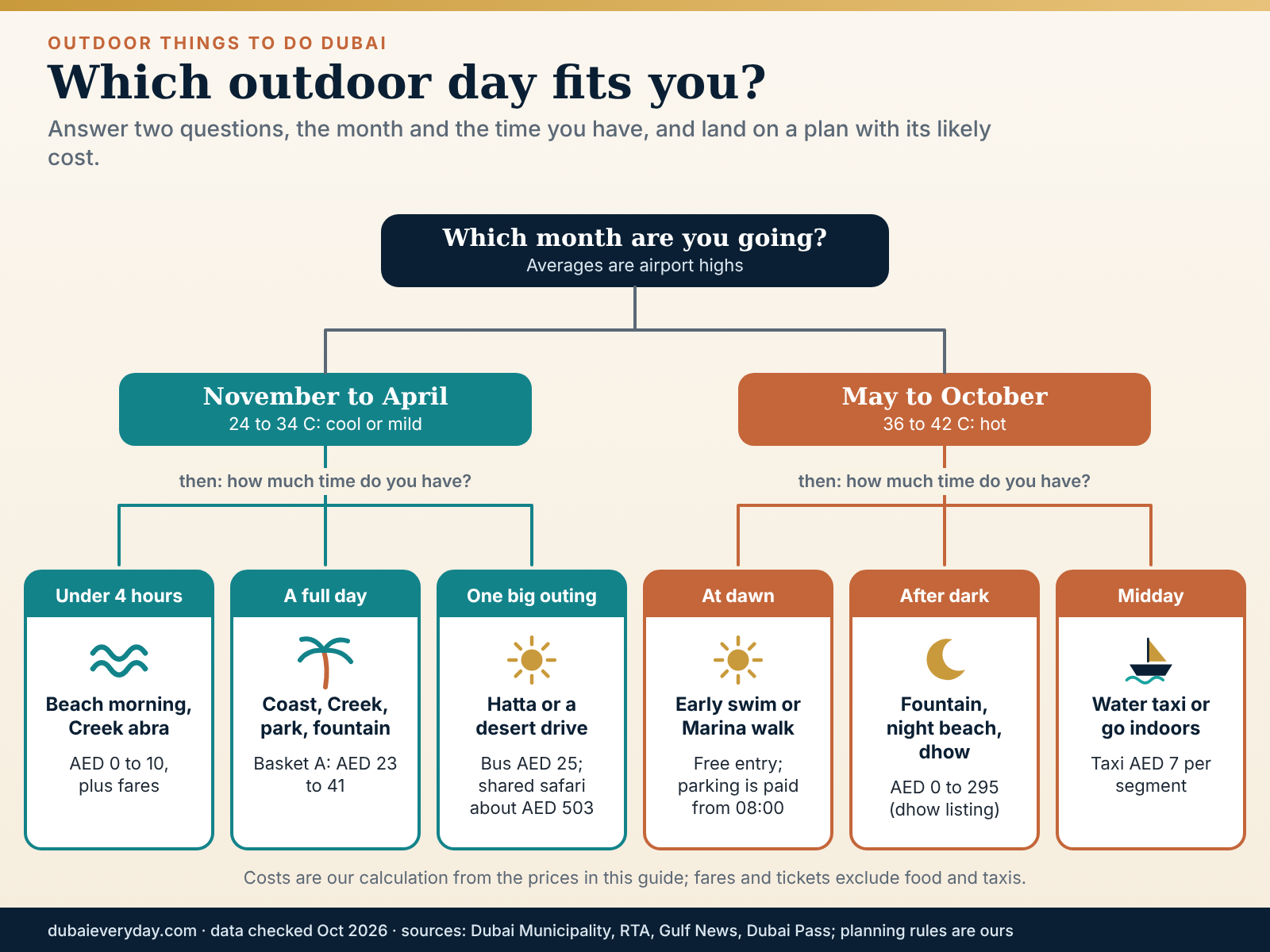
The planning unit is the half-day, not the day. Our reading of the data: from December to March you can run two or three outdoor blocks a day; in November and April you get two with a shaded gap at midday; in October you get one morning block and an evening; and from May to September you get a dawn block and a night block with the water in between.
Who this guide suits, and who it does not
The outdoor things to do Dubai covers here suit stopover visitors with one free day, first-timers building a week, and business travellers with a gap between meetings. It is less useful for residents who already know the beaches, for people who want sport-specific advice such as golf or padel (the sports guides cover those), and for anyone planning an organised group event.
If you are still deciding when to travel, the best time to visit Dubai guide weighs hotel prices and crowds alongside weather. If this is your first trip, the first-time-in-Dubai plan covers arrival, transport and dress before you start choosing activities.
Outdoor things to do Dubai by season: what the heat allows
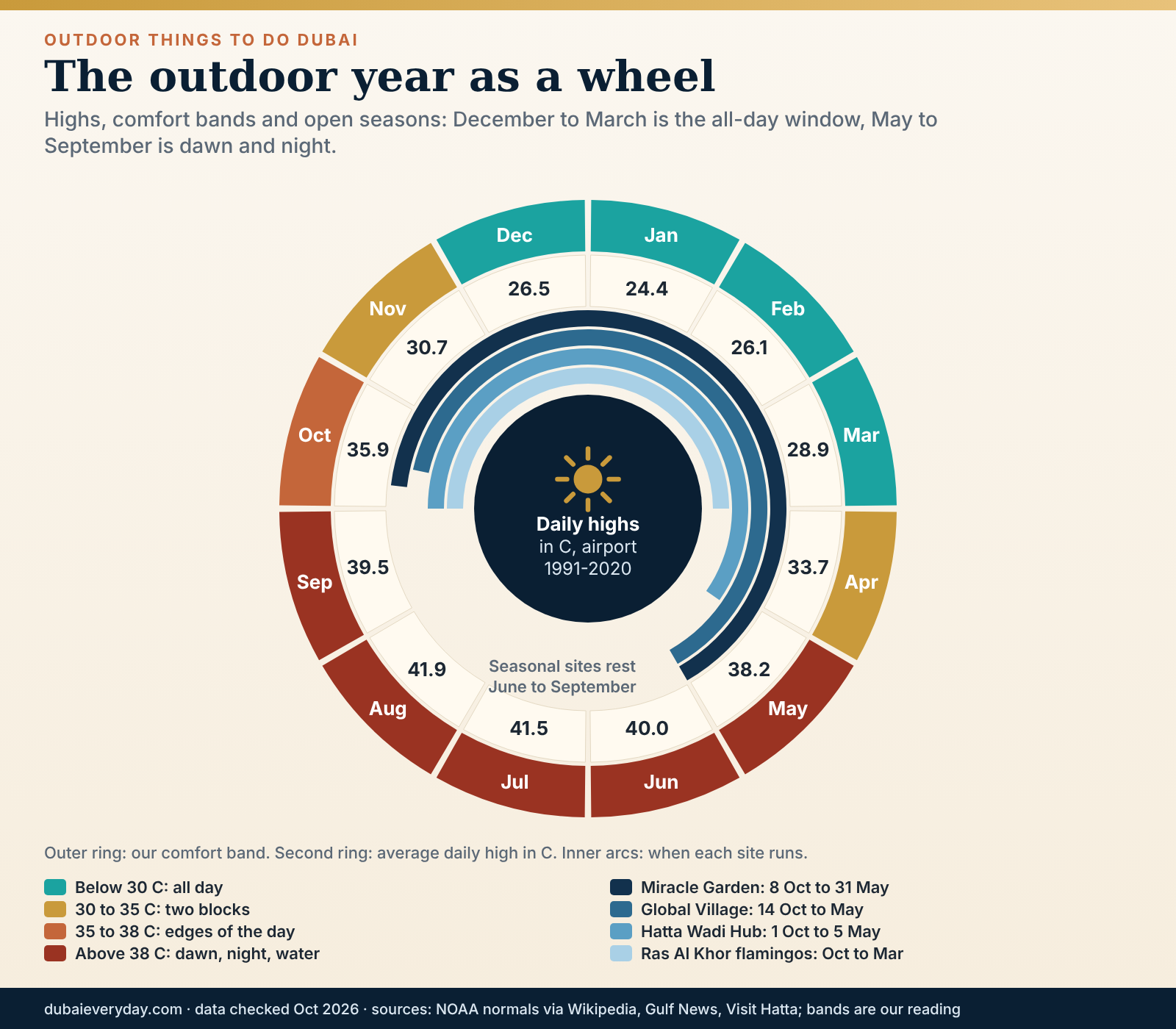
The Dubai airport station’s 1991-2020 climate normals (NOAA, as compiled in the Climate of Dubai reference) give average daily highs of 24.4 C in January, 26.1 C in February, 28.9 C in March, 33.7 C in April, 38.2 C in May, 40.0 C in June, 41.5 C in July, 41.9 C in August, 39.5 C in September, 35.9 C in October, 30.7 C in November and 26.5 C in December. Those are averages, so individual afternoons run hotter, and the coast adds humidity that a dry-bulb figure does not capture.
Our four comfort bands
To turn the averages into decisions, this guide uses four bands. They are editorial rules of thumb, not an official scale, and they ignore wind, humidity and individual tolerance.
Below 30 C: all day
December to March. Two or three outdoor blocks a day work, and midday is fine for walking with a hat and water.
30 to 35 C: two blocks
November and April. Plan a morning block, a shaded or indoor gap from about 12:00 to 15:00, then a late-afternoon block.
35 to 38 C: edges of the day
October, now ending. Early morning and the hour before sunset work, and the beach or a park lawn at noon is a test of will.
Above 38 C: dawn, night, water
May to September. Treat anything on dry land as a dawn or after-dark activity and use the sea, a pool or an air-conditioned venue in between.
Daylight sets the real window for outdoor things to do Dubai
Our calculation (a standard solar-position formula for central Dubai, accurate to a minute or two) puts sunrise and sunset on 15 December at about 06:57 and 17:31, and on 15 June at about 05:28 and 19:10. That is roughly 10.5 hours of light in midwinter and 13.7 in midsummer. Summer gives you more light but less usable light: the extra hours fall in the heat.
Municipal beach lifeguards are generally on duty from sunrise to sunset, so the sun’s schedule also defines your safe swimming window outside the night-swimming zones. In mid-November that is about 06:36 to 17:32 by the same calculation.
Month-by-month verdicts for outdoor things to do Dubai
December to March is when outdoor things to do Dubai are most generous. Highs of 24 to 29 C make the beach, the Creek walk and the desert comfortable at midday, and the big seasonal sites are all running. The price of that comfort is demand: hotels and weekends are usually busiest, and the best time to visit Dubai guide covers the trade-off.
November and April are the shoulder months. The averages (30.7 C and 33.7 C) are fine in the morning and late afternoon but tiring from noon, so outdoor things to do Dubai in these months need a shaded gap. April is also the last full month for Hatta, whose operator describes most activities as ending on 5 May.
October and May are the edge months. October’s average high of 35.9 C keeps the month for mornings and evenings, and May’s 38.2 C is already in the range where dry-land activity belongs to dawn. The Miracle Garden closes on 31 May.
From June to September, outdoor things to do Dubai becomes a dawn-and-night list: early beach, late Marina walk, a dhow after dark. Sea averages in the low 30s mean the water does little to cool you. This is the season in which the indoor guide earns its keep.
Which outdoor things to do Dubai offers are open when
Several of the bigger outdoor things to do Dubai offers are seasonal, and this is the part most guides get wrong because they reuse last year’s dates. As read on 29 October 2026: Dubai Miracle Garden runs its 15th season from 8 October 2026 to 31 May 2027, Dubai Safari Park reopened on 12 October for its eighth season, Global Village opened its 31st season on 14 October and runs to May 2027, and the Hatta Wadi Hub reopened on 28 September for its ninth season.
The Hatta operator describes most activities as running from 1 October to 5 May.
Flamingos and other waders at Ras Al Khor are an October-to-March story, and one balloon operator says it flies from September to May. Dubai Parks and Resorts reopened on 7 October after a closure of more than six months, though it is a theme-park day rather than a typical outdoor outing.
The event layer for the next six weeks
The Dubai Fitness Challenge runs 31 October to 29 November 2026, built around 30 minutes of activity a day, with public rides and runs inside it. Press reports put Dubai Ride on 1 November and Dubai Run on 22 November, both on Sheikh Zayed Road, with registration required. Those road closures change traffic and Metro crowding, so check the Dubai events calendar guide for how to track them, and the January events guide for the winter peak.
Beaches: the outdoor things to do Dubai does most reliably
If you only do one of the outdoor things to do Dubai offers, make it a morning on the sand, because the municipal beaches are free to enter, run along most of the Jumeirah coast and need no booking. Dubai Municipality’s beach page states that its beach centres are service-based and charge no entrance fee, except for requested services. The same page lists Jumeira Beach and Al Mamzar (the Al Mamzar beach park is open 08:00 to 22:00) and gives a service line, 800900.
The municipal beaches in plain terms
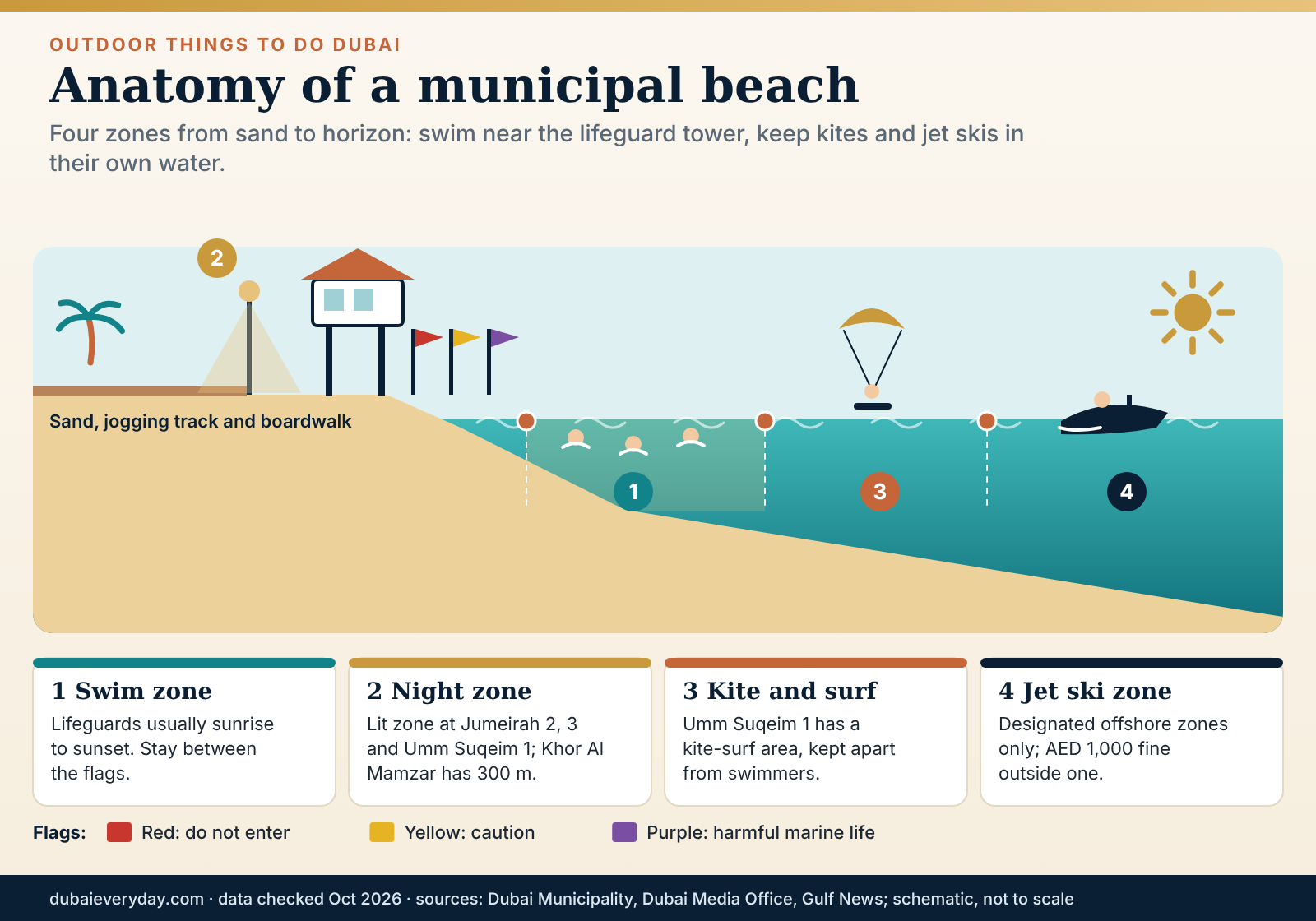
The beaches visitors meet most are Jumeirah 1, 2 and 3, Umm Suqeim 1 and 2, the Al Mamzar lagoon and the newest, Khor Al Mamzar. Dubai Municipality pages describe lifeguards from sunrise to sunset, access corridors for people of determination, jogging tracks and separated water-sport zones. Jumeirah 2 is described as swim-only. Umm Suqeim 1 has a kite-surf area, and that beach is the one commonly called Kite Beach (our reading, as the municipality’s own page does not use the nickname).
Night swimming is limited. A 2023 municipality announcement named Jumeirah 2, Jumeirah 3 and Umm Suqeim 1 as beaches with lit night zones, and the Khor Al Mamzar release describes a 300 metre night beach that operates 24/7. One municipality page for Umm Suqeim 1 says its night zone runs until midnight, while other pages suggest sunrise-to-sunset lifeguards, so confirm the hours on the day.
Khor Al Mamzar, the 2026 addition
Dubai Municipality opened Khor Al Mamzar on 5 May 2026, per the Dubai Media Office. The release describes a 3.6 km swimming shoreline, 182,000 square metres of sand, 12 lifeguard towers, 12 emergency call points, 19 food and beverage outlets, an outdoor gym, volleyball, padel, kayaking and other water sports, the region’s first floating walkway and more than 5.5 km of tracks. It does not state an entrance fee, opening hours or parking, so treat the free label as likely but unconfirmed.
The cost of reaching the sand
Free entry does not mean free access, and that applies to most outdoor things to do Dubai lists. Public roadside parking in Dubai is paid from 08:00 to 22:00 and free on Sundays and public holidays, and a March 2025 Gulf News explainer put peak rates at AED 4 to 6 an hour depending on zone. Tariffs change, so confirm the bay’s sign.
At JBR The Beach, the operator’s FAQ lists parking at AED 20 an hour with the first three hours free against a validated AED 100 spend. Our calculation: three hours there without spending costs AED 60.
The no-car route to JBR is Metro to the DMCC area and then the tram, which runs Monday to Saturday 06:00 to 01:00 and Sunday 09:00 to 01:00 (RTA timetable). The wider beach choices, including family and hotel beaches, are in the best beaches in Dubai guide and the public beaches guide, which this page does not repeat.
When the sea is actually pleasant
Published sea-temperature averages (secondary, rounded) run from the low 20s in January to the low 30s from July to September. Our reading: most people find the water comfortable from about April to November, and cool but fine for short swims in midwinter. In high summer the sea is warm like a bath, so it helps less with heat than people expect, and the practical benefit is shade and movement rather than cooling.
If beach access is a hotel decision, the hotel choice by area and beach access guide explains the trade-off between a private stretch and a public one.
Water activities beyond swimming
Water is where the heat bargain works best, which is why the water side of the outdoor things to do Dubai visitors book rises sharply after April. It is also the area with the most rules, so this section leads with what is regulated and what the operator should be able to tell you.
Jet skis, and the zone rule
A Gulf News explainer (16 July 2026) summarises the rules for riding. Riding is allowed only within designated zones, and an official flyer it describes names Dubai Marina, Umm Suqeim 1 and 2, and Jumeirah 2 and 3 as approved areas. Rental permits come from the RTA. Under RTA rules as quoted there, the rider must be at least 16 unless accompanied by a custodian or qualified coach.
The fines in that report are what make the rule matter: AED 1,000 for riding outside a designated area, for an expired licence or for no life jacket or helmet, and AED 2,000 for disturbing others. A joint Dubai Police and Dubai Maritime Authority campaign in July 2025 produced 431 fines and 41 impounded jet skis. If you hire one, ask the operator in which zone you are riding and who is responsible for the licence. To report a violation or an emergency, Dubai Police point to 999 and the Sail Safely feature of their app.
Kayaks, paddleboards and quiet water
Calmer outdoor things to do Dubai are growing in number. The Khor Al Mamzar release lists kayaking and other water sports among its amenities. In Hatta, the operator’s page describes a Hatta Kayak offer, and The National reported in September 2024 that kayak sessions cost AED 60 with no time limit and that kayaks and bike boats can be booked to explore Hatta Dam. That price is two years old, so treat it as a dated indicator.
Hatta’s own page adds a useful rule: dogs may join a kayak if under full control, wearing a life vest and staying inside the craft. Stand-up paddleboarding appears in the Dubai Fitness Challenge calendar, with the Hatta waterways used for the event according to the Dubai Media Office.
Abras, water taxis and dhows
The cheapest boat in the city is also the oldest. The RTA’s marine page lists the motorised traditional abra between Bur Dubai and Deira Old Souq at AED 1 cash per person per trip, the heritage petrol abra routes on the Creek at AED 2, and the air-conditioned abra from Al Jaddaf to Dubai Festival City at AED 2. The Dubai Water Canal heritage abra does round trips of about 45 minutes from the Sheikh Zayed Road marine station at AED 25 per person per hour, but needs at least six passengers.
Dubai Marina has a water taxi with four stops (Marina Terrace, Marina Walk, Dubai Marina Mall and Marina Promenade): most single-segment trips are AED 7, with the full route AED 7 to 21 depending on stops. Children under 12 cannot travel unaccompanied on marine transport and must wear a life jacket on board, per the RTA.
For a dinner cruise, a Platinumlist listing for a Creek dhow shows adults from AED 295 and children from AED 236 for two hours, boarding at Al Seef at 19:30 for a 20:00 departure. That is a marketplace price, not an operator quote, and the listing says nothing about alcohol service.
From above: a note on skydiving
Skydive Dubai’s Palm drop zone is on the coast and is priced for visitors at about AED 2,200 to 2,500 for a tandem jump according to the Visit Dubai experiences page and a Gulf Business report on its reopening. It is the most expensive outdoor line in this guide, it depends on wind and visibility, and it is a one-off rather than a day out. This guide lists it for completeness only.
Desert, wadis and mountains: the longer outings
The outdoor things to do Dubai offers beyond the city limits cost time rather than money, and this is where planning mistakes cost most. The honest summary from the operators’ own pages is that desert trips are half-day or evening products, mountain trips are full days, and almost nothing in this group can be improvised.
The desert safari in outline
A shared morning desert trip with dune driving is listed on the Dubai Pass pages at USD 136.95 for an adult, which is about AED 503 at the fixed rate of 3.6725. It takes roughly four hours, with hotel pickups between about 07:30 and 10:00 and a recommended lobby wait 15 minutes early. Evening trips on the marketplace listings we read ran from about AED 110 to 150 for a standard shared red-dune package with a barbecue, and AED 393 for a premium camp.
Our reading of the listings: dune driving is a small part of the trip, typically 30 to 45 minutes out of a six- or seven-hour evening product, so roughly 7 to 11 per cent. If the drive is what you want, check that fraction. The full comparison of morning, evening, overnight and private options is in the best Dubai desert safari guide, and the cooler-hours case is in the morning desert safari guide.
On safety, a 2023 Dubai administrative resolution on tourist camps sets permit rules for camps (a one-year permit, three classes called Economy, Premium and Luxe, insurance, price lists and 24/7 contacts). There was no public licence lookup we could find, so ask the operator for its permit details.
Heritage drives and balloons
Quieter alternatives exist inside the Dubai Desert Conservation Reserve, which an airline partner describes as 225 square kilometres, roughly 5 per cent of Dubai’s land (that is the partner’s own claim). A Visit Dubai experiences listing for a conservation drive with breakfast shows AED 695, ages 8 and over, about five hours and a nature drive of about 75 minutes with no dune driving.
Balloon Adventures Dubai lists AED 1,350, with pickups between 03:30 and 05:30 and a 6 to 7 hour door-to-door schedule, a September-to-May season, no children under 5 and exclusions for pregnancy and back or neck problems. Weather cancellations are normal in ballooning, so ask about the refund rule before paying.
Al Qudra: lakes and the long cycling track
The Al Qudra cycling track is run by the RTA and measured 80.6 km when Guinness declared it the longest continuous cycling path in November 2022, per the Dubai Media Office. The release lists emergency call phones at 30 points, shaded rest areas, restaurants, toilets and bike-rental shops. The lakes nearby attract birds and photographers, but rules matter: Dubai Municipality signboards reported in 2018 banned camping, bonfires, dog walking, swimming, fishing, barbecues and driving into the lake area. That report is old, so follow the signage you actually see.
Hatta, the mountain day among outdoor things to do Dubai
Hatta sits about 90 minutes from Dubai by car, according to the Visit Hatta planning page, and the RTA H02 express from Dubai Mall takes about 1.5 hours at AED 25 with a nol card. The Hatta Wadi Hub, 3 km from the Hatta Fort roundabout, has food trucks, washrooms and bike rental, and the operator lists activities from 1 October to 5 May, with temporary closures in rain.
Most activities carry a minimum age of 6, some are 16 plus, and activities are bookable only on-site. The Visit Dubai page names mountain biking, archery, freefall jumps, wall climbing and ziplining. Hiking equipment is not rented there, so bring shoes and water. The operator pages give two opening times (9:00 daily, and 8:00 to 19:00 for the season), so confirm before leaving.
Walking areas: the Creek, the Canal and the promenades
Walking is the cheapest of the outdoor things to do Dubai provides, but it is also the one most affected by planning. Dubai is built for cars, shade is patchy, and a “short walk” on a map can be a sun-exposed kilometre. The areas below are the ones where walking is the point rather than a penalty.
Old Dubai and the Creek
Visit Dubai describes Al Fahidi Historical Neighbourhood as a restored old town in Bur Dubai with wind-tower buildings, galleries and museums, and Al Seef as a Creek-side area with souk-style shopping, cafes and heritage-inspired streets. Neither page gives opening hours or entry terms, so the lane walking is an open-air activity you should time yourself, not a ticketed one. The crossing between Bur Dubai and Deira is the signature move: the AED 1 abra is part of the route, not a detour.
Al Fahidi Fort was reported closed for restoration with a reopening expected but undated, so do not build a morning around it. Old Dubai is best before 11:00 in the warm months. In the cool ones, anything outside the early afternoon works.
Downtown and the fountain
The Dubai Fountain’s schedule, as published by Emaar, is afternoon shows at 13:00 and 13:30 (14:00 and 14:30 on Fridays) and evening shows every 30 minutes from 18:00 to 23:00. Viewing areas include the Waterfront Promenade, the Souk Al Bahar terraces, Burj Park and the Boardwalk, which starts at AED 25 on Visit Dubai’s page. Press reported a new-look fountain on 26 October 2026, so details on the show may differ from older guides.
Our calculation: on 15 November sunset is about 17:32, so the 18:00 show starts roughly half an hour after dark. In mid-June sunset is about 19:10, so the 18:00 show is still in daylight and the effect is weaker. For wider context on the district, see the Downtown Dubai area guide.
The Canal, the Marina and the Palm
Safa Park sits next to the Dubai Water Canal and is a convenient green end to a walk along it. Dubai Marina offers the water taxi and a long promenade; JBR The Beach is described by its operator as publicly accessible with a 600 m track. On the Palm, Al Ittihad Park is open 24 hours and free, with a 3.2 km jogging track and one of the few dog-friendly policies among public parks, per Gulf News.
Cycling as walking’s faster sibling
The RTA describes a network of about 560 km with a target of 1,000 km by 2030, including Al Qudra, Seih Al Salam, Meydan, the Canal, the Marina and Jumeira Street. Urban tracks carry a 20 km/h limit and amateur tracks 30 km/h, helmets and reflective gear are recommended, and folding bikes are allowed on the Metro. Do not cycle on pedestrian or jogging lanes.
After dark: evening outdoor things to do Dubai
From May to September, evening is the main window, and even in winter it is the cheapest time of the day to be outside. The reliable evening list is short and mostly published: the Dubai Fountain from 18:00 to 23:00, the night-swimming zones at Jumeirah 2, Jumeirah 3 and Umm Suqeim 1, the 300 metre night beach at Khor Al Mamzar, a Creek dhow cruise at 20:00 per the marketplace listing, and Al Ittihad Park, which is open around the clock.
Global Village is the other large evening outing, though it is a fairground-and-pavilion site rather than a nature one. We could not confirm its daily opening hours on the pages we read, only the season (14 October to May 2027) and an entry price of AED 25 on weekdays and AED 30 on any day. Evening outdoor things to do Dubai visitors choose still depend on local conditions, so check the municipality or operator notice before you set out.
Parks, gardens and wildlife
Parks are where the outdoor things to do Dubai residents use daily are easiest for a visitor to borrow. Gulf News (updated 6 October 2026) lists large public parks run by Dubai Municipality as mostly open from 08:00 to 22:00, with later closing at weekends, and children aged two and under and People of Determination usually free. Some gates accept nol cards.
| Park | Entry (Gulf News, 6 Oct 2026) | What the source notes |
|---|---|---|
| Zabeel Park | AED 5 per person | Lawns and playgrounds; Dubai Frame is a separate ticket |
| Creek Park | AED 5 per person | Creek views; Children’s City and the Dolphinarium are separate |
| Safa Park | AED 3 per person; parking free | Beside the Dubai Water Canal; fenced ladies’ area |
| Mushrif National Park | AED 3 per person, AED 10 per car | Woodland, sandy picnic areas, barbecue spots |
| Al Mamzar Beach Park | AED 5 per person, AED 30 per car | 106 hectares; pools AED 10 adults, AED 5 children |
| Al Ittihad Park | Free; 24 hours | Palm Jumeirah; 3.2 km jogging track |
| Quranic Park | Free; small fees for two attractions | Gardens and lake; Cave of Miracles and Glass House charge separately |
| Dubai Hills Park | Free entry; day pass AED 55 residents, AED 85 non-residents | Pass covers splash park, skate park and ice rink |
Our reading of the list: nine of the fourteen parks the article covers charge nothing, and the rest charge AED 3 to 5. For a visitor, park choice is about location and shade, not price. The cost trap is the car, as at Mushrif and Al Mamzar.
Dubai Miracle Garden, a seasonal pick among outdoor things to do Dubai
Season 15 runs from 8 October 2026 to 31 May 2027, daily 09:00 to 21:00, with adult tickets from AED 105, children from AED 84 and under-threes free (Gulf News).
The park delayed its opening by a couple of weeks because of the weather, and UAE residents with a valid Emirates ID and a birthday in the season can register for two complimentary tickets. It is a flower-and-photo day, so late afternoon into evening is the sensible slot from November onwards, and it is one of the few outdoor things to do Dubai visitors can book with a published season end date.
Dubai Safari Park and Global Village
Dubai Safari Park opened its eighth season on 12 October, with daily hours of 09:00 to 18:00 and last entry at 17:00 according to Khaleej Times. A Gulf News report we saw gave an AED 50 pass for ages three and over, which should be confirmed with the park. The Arabian Desert Safari Tour is included with admission, other tours cost extra.
Global Village opened on 14 October for season 31 and runs to May 2027, with entry reported at AED 25 on weekdays and AED 30 on any day. It is partly outdoors and mainly an evening activity.
Ras Al Khor and the flamingos
The Ras Al Khor Wildlife Sanctuary opens 07:30 to 17:30 in winter (October to March) and 06:00 to 18:00 in summer, per Dubai Municipality. The municipality does not state an entry fee on that page; an Emaar article published on 23 October 2026 says access to the public hides is free. Rules are strict: no phones, food, drinks, smoking or pets in the hides, a maximum of 15 people at a time, and priority for People of Determination.
Dubai Garden Glow was a Zabeel Park attraction in earlier years, but we could not confirm a 2026-27 season, so it is not recommended here.
What outdoor things to do Dubai visitors actually pay
The word outdoors suggests cheap, but the outdoor things to do Dubai sells range in price from AED 0 to more than AED 2,000. The headline fact is the spread: the cheapest items are public, municipal and on foot, and the dearest are air or desert experiences sold by private operators. What matters for planning is the total, including the getting there.
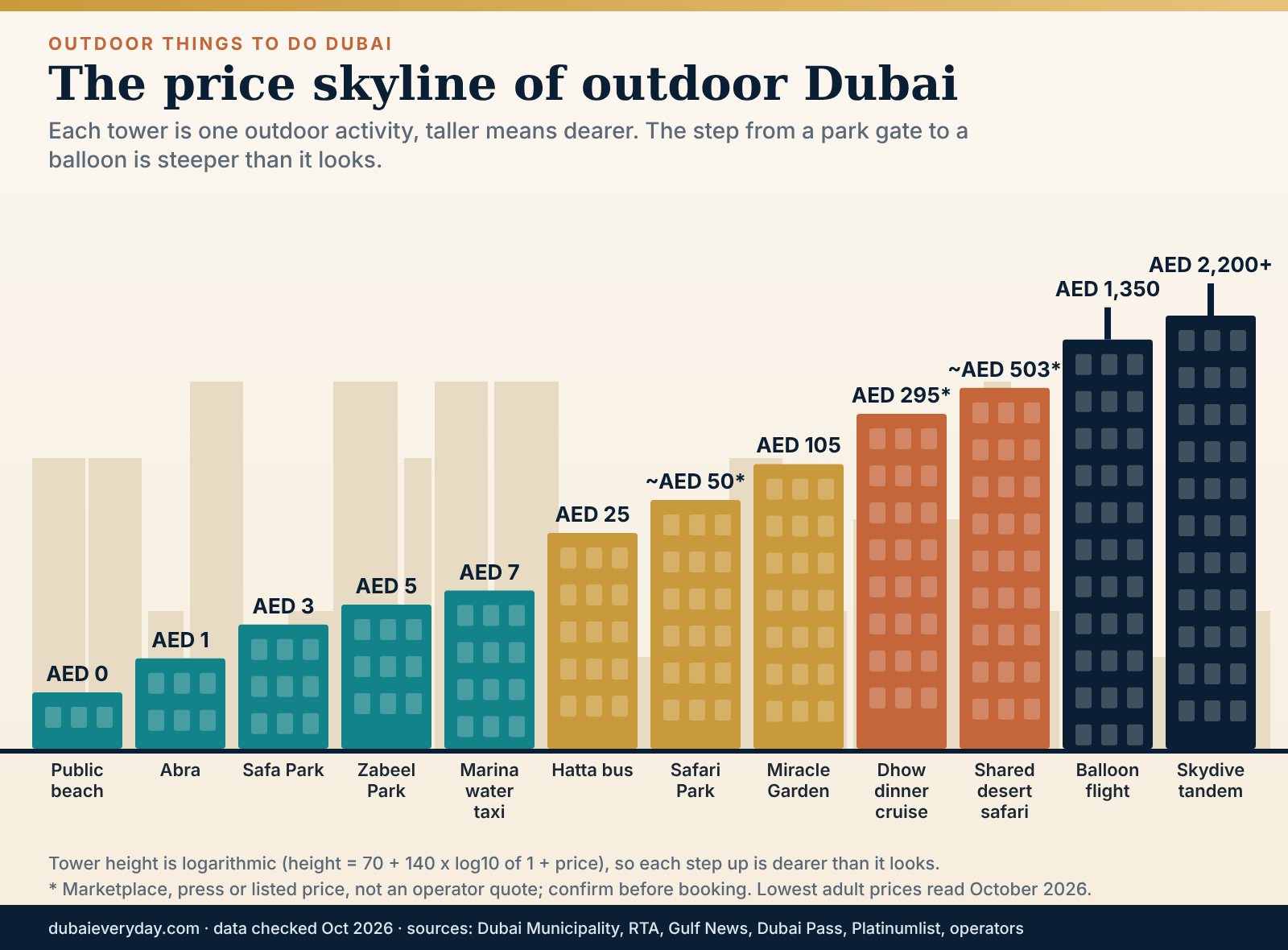
Three worked baskets for outdoor things to do Dubai (our calculation)
These are illustrative baskets, not quotes. They use the published prices in this guide, exclude food, taxis and parking, and price Metro journeys on a Silver nol card at the RTA tiers of AED 3, 5 and 7.50, plus the card’s net cost of AED 6 (AED 25 with AED 19 credit, per the RTA’s nol pages we cross-checked). Marketplace and press prices are labelled as such in the text above.
- Basket A, mostly free: AED 23 to 41 per adult (about USD 6 to 11).One beach morning, two abra crossings (AED 2), Safa Park (AED 3), four Metro journeys (AED 12 to 30) and the card.
- Basket B, mid-range: AED 185 to 203 (about USD 50 to 55).Basket A plus a Dubai Safari Park pass (about AED 50, reported), Dubai Miracle Garden (from AED 105) and one Marina water-taxi segment (AED 7).
- Basket C, big day: AED 983 to 1,001 (about USD 268 to 273).Basket B plus a shared morning desert trip (about AED 503) and a Creek dhow dinner cruise (from AED 295).
The point of the exercise is the ratio. Basket C costs roughly five times Basket B, and the whole gap is two bookable products. You can sit anywhere on the ladder without feeling you did the city badly, and the free end holds up better than most visitors expect. See the free things to do guide for the strictly nothing-to-pay version.
Ways to lower the bill
Most savings come from timing and clustering, not from discounts. Roadside parking is chargeable from 08:00 to 22:00 and free on Sundays and public holidays, so an early beach slot costs nothing to park. Park gates cost AED 3 to 5 and some take nol cards.
Clustering the Creek, Downtown and one park in a single day removes the repeated taxi legs that quietly outspend every ticket.
For outdoor things to do Dubai visitors share with a group, shared desert products are far cheaper per head than private ones: one marketplace listing offered a private car for six at AED 900, which is AED 150 each for six people but AED 450 each for a couple (our arithmetic).
Reaching outdoor things to do Dubai without a car
The outdoor things to do Dubai provides sit in rings, not in a cluster, and the ring decides the transport. Our grouping of the outdoor things to do Dubai offers, based on the RTA and Gulf News station and route information we read, divides them into places you can reach on the Metro with a short walk, places that need a taxi or car, and places that are really excursions.
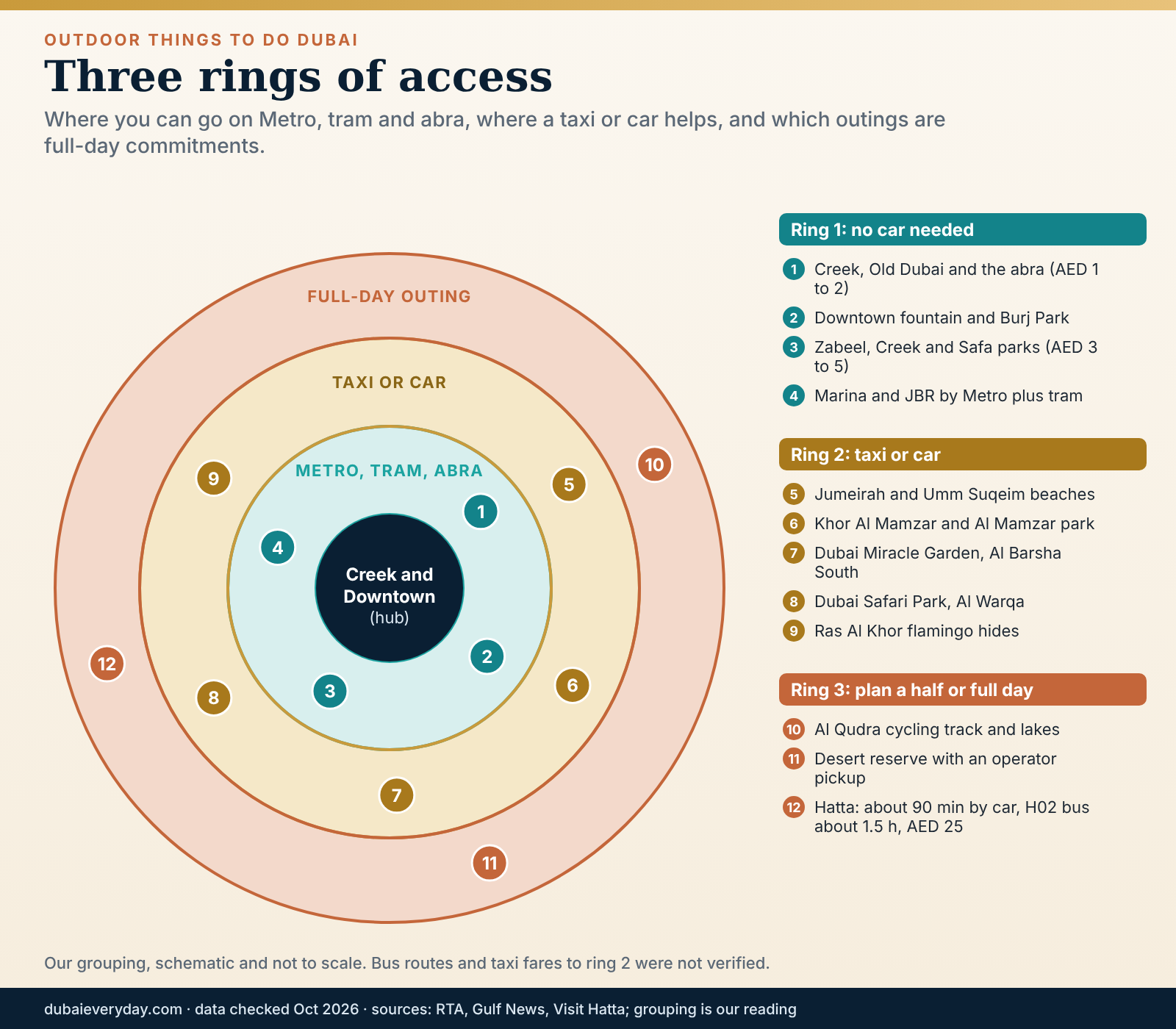
Inner ring: Metro, tram or abra
The Creek and Old Dubai, Downtown, the large city parks (Gulf News lists Metro stations for Zabeel, Creek, Safa and Al Mamzar parks) and the Marina or JBR via Metro and tram all fit here. The RTA timetable gives Metro hours of 05:00 to midnight Monday to Thursday and Saturday, 05:00 to 01:00 on Fridays and 08:00 to midnight on Sundays, with the tram running 06:00 to 01:00 Monday to Saturday and 09:00 to 01:00 on Sundays. Fares are AED 3 within one zone, AED 5 across two and AED 7.50 beyond on a Silver card.
Middle ring: taxi or car
The municipal beaches along Jumeirah and Umm Suqeim, Khor Al Mamzar, Dubai Miracle Garden (Al Barsha South), Dubai Safari Park (Al Warqa) and the Ras Al Khor hides are not conveniently served by Metro stations as far as we could verify. We did not confirm current bus routes to them, and we did not obtain a current taxi tariff, so check the app estimate before you go. Parking at Ras Al Khor is in designated areas only.
Outer ring: tours, buses and the long drive
Al Qudra, the desert reserve and Hatta are day or half-day commitments. Hatta is reachable by car or by the H02 bus from Dubai Mall in about 1.5 hours. The desert is nearly always done with a licensed operator. For a travel plan that stitches these into a trip, the Dubai 3-day itinerary shows how to avoid spending the whole visit in taxis, and the airport guide covers the first and last day logistics.
Safety rules for outdoor things to do Dubai: heat, water and conduct
None of what follows is medical, legal or insurance advice. It is a short list of the official or near-official rules that most often matter for outdoor things to do Dubai visitors choose, drawn from Dubai Municipality, the RTA, UK government travel advice (updated 27 October 2026), the WHO and the NHS.
From May to September the daily average high is 38 C or more, and the sun is dangerous well before noon. The WHO treats a UV index of 8 or above as very high, and published monthly UV peaks for Dubai reach 11 or more across April to September. Move hard activity to dawn or night, carry water, and learn the signs of heat exhaustion from the NHS before you need them.
Swim only at lifeguarded beaches, between the flags, and not after sunset outside the lit night zones. Red flags mean do not enter, yellow means caution and purple means harmful marine life, as described by Dubai Municipality. Rip currents can occur at any beach, and a child needs an adult within reach, not just in view.
Conduct rules that catch visitors
UK government advice for the UAE says swimwear is for beaches and pools only, people should not be photographed without permission (arrests of men photographing women on beaches are reported), and alcohol is illegal in public places, with a drinking age of 21 in Dubai. Municipal beach rules also ban pets, barbecues and shisha, overnight stays and swimwear in passageways. New drone rules were reported in January 2025, with recreational use under review, so leave the drone at home unless you have checked.
Wildlife and desert etiquette
At Ras Al Khor, noise, approaching wildlife and leaving the fenced areas can bring heavy fines. In the desert, go with a licensed operator and take your rubbish with you. Dubai Municipality’s protected-area rules restrict vehicles, hunting and the removal of plants. If the weather turns, Hatta’s operator closes activities in rain, and ballooning cancels in poor visibility, so build a buffer day into any bookable outdoor plan.
Outdoor things to do Dubai plans you can copy
These outdoor things to do Dubai plans use the timings and prices above. They are templates built from published information, not routes anyone walked for this page, so adjust for your hotel, your legs and the day’s forecast.
Cool-season outdoor things to do Dubai in one day
Sunrise is around 07:00 and sunset between about 17:30 and 18:30 in these months, by our calculation. Start with a swim or walk on a municipal beach around 07:00, before roadside parking becomes chargeable at 08:00. Move to the Creek by late morning for Old Dubai, cross by abra, and eat in the shade. Use the mid-afternoon for a park such as Zabeel or Safa, and finish at Downtown for the evening fountain show from 18:00.
The logic is geographic, not touristic: coast first, Creek second, Downtown last, because Downtown is the destination where evening matters and the Creek is the one where the morning is kinder. If you prefer a place to sleep that makes this easy, see how to choose a hotel by area and beach access.
Summer outdoor things to do Dubai in one day
Sunrise is about 05:28 and sunset about 19:10 in mid-June. The window that works is 06:00 to 09:00 and again from about 19:30. Swim early, before roadside parking becomes chargeable at 08:00, then spend 10:00 to 17:00 indoors. The indoor guide covers that gap. Return after dark for the Marina walk or a Creek cruise, when the dhow’s air-conditioned lower deck is also an option.
Do not plan desert, Hatta or long walking outings between mid-May and mid-September unless the activity is explicitly scheduled for dawn. Hatta’s main activity season ends on 5 May.
Three days of outdoor things to do Dubai with a ladder of effort
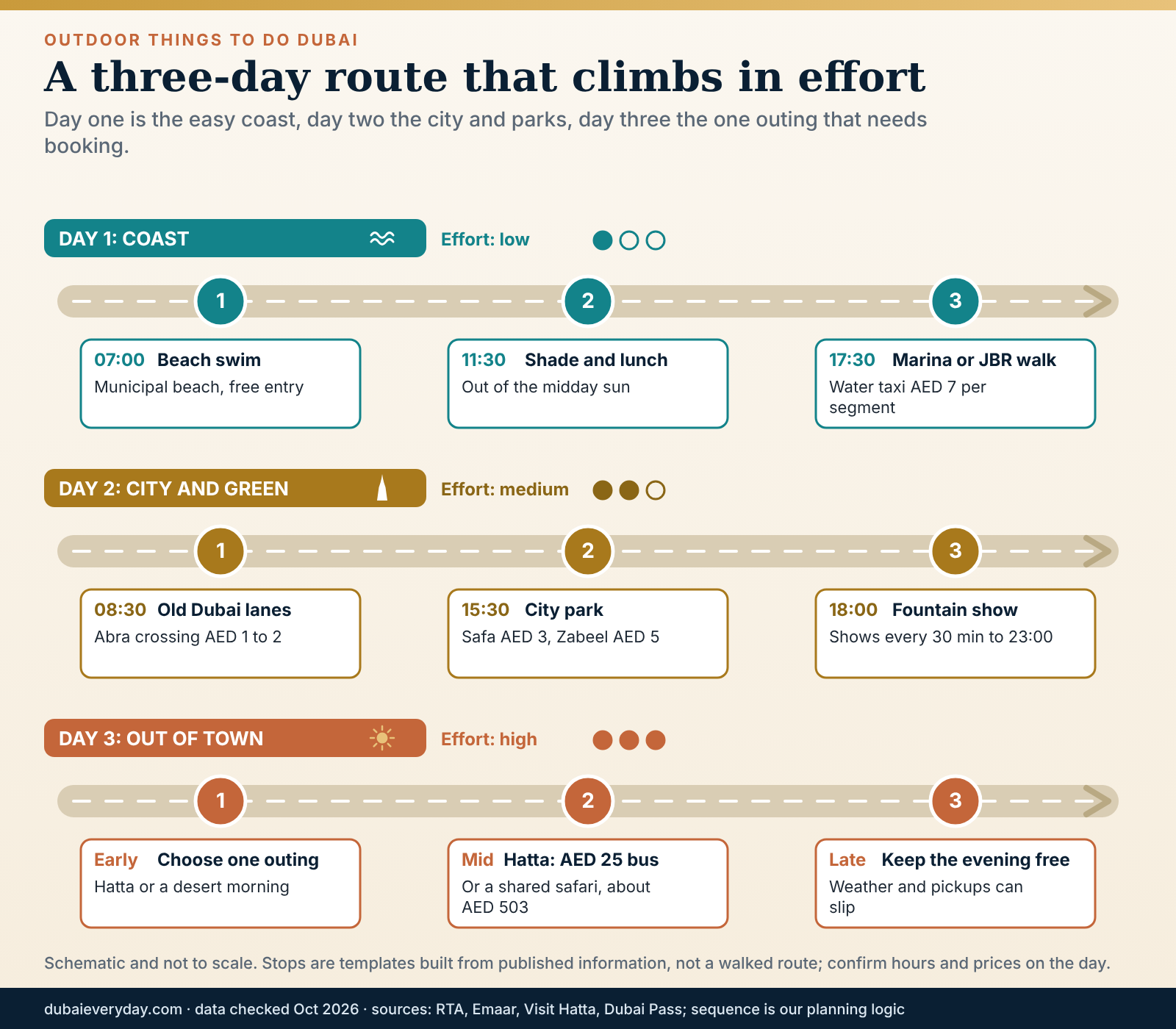
Day one is the easy day: beach morning, a Marina or JBR sunset walk, and an early night. Day two is the city day: Old Dubai, the abra, a park and the evening fountain. Day three is the one bookable outing, either Hatta or a desert experience, and it goes last because the weather and availability are the two things you cannot control.
Our reading: put the dependent outing on the day with the most slack either side. If you leave on day four, book the long outing for day two or three. For a fuller city plan alongside these, see the Dubai 3-day itinerary, and for what to book before landing, the Dubai travel guide.
By traveller type
Families with young children
Lean on parks and shallow, lifeguarded beaches in the morning, with an afternoon rest. Children aged two and under usually enter public parks free. Check age rules before booking: Hatta activities start at 6 for most, the conservation drive at 8, balloons at 5. See family hotels with pools and beach access.
Couples
The Creek dhow at dusk, the Marina walk and one early desert or balloon morning give the clearest contrast with a city break. Allow for cancellations on weather-dependent products and keep one flexible day.
Solo and business travellers
A single early beach or Creek block fits around meetings, and the AED 1 abra and Metro keep it cheap. Parks open from 08:00, so the time before work is the dawn beach or track.
Stopovers
With 8 to 10 hours, choose one zone: the Creek and Downtown fountain is the compact pair. Our airport planning is in the DXB airport guide.
Mistakes that spoil outdoor things to do Dubai plans
These come from the logic of the sources, not from anyone’s bad trip, and they apply to nearly all outdoor things to do Dubai visitors plan. Most of them are timing mistakes, and they are cheap to avoid.
- Booking a seasonal site on last year’s dates. Miracle Garden, Safari Park, Global Village and Hatta Wadi Hub all open and close by season, so check the current dates.
- Treating “free entry” as “free”. Parking, Metro fares and a taxi back can exceed an AED 5 park ticket.
- Swimming after sunset outside a night zone, or ignoring a red or purple flag.
- Planning a walking day between 11:00 and 16:00 from May to September.
- Hiring a jet ski without asking which designated zone the operator uses, and who holds the permit.
- Stacking a desert morning on the day you fly out. Operators advise a lobby wait and late pickups of up to about 40 minutes.
- Assuming dune driving is most of a desert safari. It is a modest fraction of the trip on the listings we read.
- Forgetting that the cooler months are also the busiest, so book weekends of the Dubai Shopping Festival (from 4 December) early. The January events guide shows the demand.
Taken together, the outdoor things to do Dubai offers reward a plain approach: choose the season before the attraction, keep the free coast and Creek at the centre, and treat the desert, Hatta and the water sports as bookable extras with their own rules. If one habit is worth keeping from this page, it is checking dates, hours and zone rules on the day, because that is where most of the information in any outdoor guide goes out of date.
Outdoor things to do Dubai: questions answered
What are the best outdoor things to do Dubai offers in winter?
From December to March the airport averages 24 to 29 C, so the full set opens up: municipal beaches, the Creek and Downtown walks, parks, Dubai Miracle Garden (open until 31 May), a desert drive, Al Qudra cycling and a day in Hatta. Our reading is that the best value among outdoor things to do Dubai in winter is the free end: beach mornings, Old Dubai, park afternoons and an evening fountain show. Add one paid outing per two or three days rather than one per day.
Which outdoor things to do Dubai has are free?
Municipal beaches charge no entrance fee except for requested services, according to Dubai Municipality. Many parks are free (nine of fourteen in a Gulf News list), and Al Ittihad Park on the Palm is free and open 24 hours. Public hides at Ras Al Khor were described as free in an Emaar article from 23 October 2026. Remember that parking, Metro fares and some park extras are not free. See our full guide to free things to do in Dubai.
Can you do outdoor activities in Dubai in summer?
Yes, but on different terms for outdoor things to do Dubai in summer. From May to September the average daily high is 38 to 42 C, so dry-land activity belongs at dawn or after dark, and the sea, a pool or an air-conditioned venue fills the middle. Seasonal sites such as Hatta and the Miracle Garden close, or run on shorter schedules, in the hottest months. Use the indoor guide for the gap and shift outdoor plans to 06:00 to 09:00 and after sunset.
Is it safe to swim at night in Dubai?
Only at designated, lit and lifeguarded night zones. Dubai Municipality named Jumeirah 2, Jumeirah 3 and Umm Suqeim 1 for night swimming in 2023, and Khor Al Mamzar describes a 300 metre night beach operating 24/7. Swimming after sunset elsewhere breaks beach rules. One municipality page lists lifeguards to midnight at Umm Suqeim 1 while others suggest sunrise-to-sunset cover, so confirm the zone and hours on the day.
Do I need a licence to rent a jet ski in Dubai?
We found no official page setting a visitor licence test. A Gulf News explainer from July 2026 describes a current licence and registration for the craft and an RTA rental permit for the operator. Under the RTA rules it quotes, the rider must be at least 16 unless with a custodian or qualified coach, and riding is allowed only in designated zones. Fines of AED 1,000 apply for riding outside a zone, an expired licence or no life jacket. Ask your operator for its zone and permit details.
How far is Hatta, and how do I get there?
Visit Hatta says it is about 90 minutes by car from Dubai, usually via the Sharjah-Kalba route on the E102. The RTA H02 express bus from Dubai Mall takes about 1.5 hours and costs AED 25 with a nol card. The Hatta Wadi Hub, 3 km from the Hatta Fort roundabout, has food trucks, washrooms and bike rental. Most activities run 1 October to 5 May and are booked on-site, so go on a day with slack either side.
How much does a desert safari cost?
The prices we read span more than a factor of ten, from about AED 110 to AED 1,350. A shared morning trip with dune driving is USD 136.95 (about AED 503) on the Dubai Pass listing. Standard shared evening packages on marketplace listings ran from about AED 110 to 150, a premium camp AED 393, a conservation drive with breakfast AED 695 and a balloon flight AED 1,350. Compare what is included, as in our desert safari comparison.
Are outdoor things to do Dubai offers suitable for children?
Many outdoor things to do Dubai offers suit children. Public parks usually admit children aged two and under free, and Dubai Miracle Garden admits under-threes free. Age rules apply to adventure products: most Hatta activities start at 6, the conservation drive at 8 and the balloon at 5, and children under 12 must wear a life jacket on RTA marine transport. Heat is the other limit, so use mornings in the warm months. See family hotels for stays with pools.
Can I cycle in Dubai as a visitor?
Yes. The RTA describes a network of about 560 km with a 1,000 km target by 2030. Al Qudra’s track was measured at 80.6 km in 2022 and has emergency phones at 30 points and bike-rental shops nearby. Urban tracks have a 20 km/h limit and amateur tracks 30 km/h, helmets are advised, and cycling on pedestrian lanes is not allowed. Folding bikes can go on the Metro.
What is the best month for outdoor things to do Dubai visitors enjoy?
Our reading of the climate averages is that, for outdoor things to do Dubai visitors enjoy, December, January and February have the most comfortable all-day conditions, with highs of 24 to 26 C, and March and November are close behind. Those months are generally also the busiest for hotels, so the best time to visit Dubai guide weighs the trade-off. April and October can work with an early start.
Related reading
Sources and further reading (30 links)
- Dubai Municipality: Discover Dubai Beaches — no entrance fee statement, Al Mamzar hours, service line
- Dubai Media Office: Dubai Municipality opens Khor Al Mamzar Beach to the public — shoreline, lifeguards, night beach, amenities
- Dubai Municipality: Dubai Protected Areas, plan your visit — Ras Al Khor hours and hide rules
- Dubai Municipality: three new beaches for night swimming — Jumeirah 2, Jumeirah 3 and Umm Suqeim 1
- RTA: Marine transport, about marine — abra, water taxi and ferry fares and child rules
- RTA: Nol fares — zone fares and child rules
- RTA: Timetables — Metro and tram operating hours
- Dubai Media Office: Al Qudra Cycling Track record — track length and facilities
- Visit Hatta: Plan your visit — travel to Hatta, Wadi Hub season, rules
- Visit Dubai: Hatta Wadi Hub — activity list
- Gulf News: Dubai’s outdoor parks with entry prices — park fees and features
- Gulf News: Dubai Miracle Garden Season 15 — dates, hours, ticket prices
- Khaleej Times: Dubai Safari Park reopens for Season 8 — reopening date and hours
- The National: UAE attractions reopening for the new season — Hatta, Global Village and park reopening dates
- Gulf News: Planning to jet ski in Dubai — jet ski rules and fines
- Gulf News: Ban on camping, bonfire, barbecue at Al Qudra Lake — older signage rules
- The National: Hatta dates, prices and things to do — dated kayak and horse-riding prices
- UK Government: UAE safety and security — beach, swimwear, photography and alcohol rules
- Wikipedia: Climate of Dubai — NOAA 1991-2020 normals (secondary compilation)
- WHO: The ultraviolet (UV) index — UV index categories
- NHS: Heat exhaustion and heatstroke — signs and first steps
- Platinumlist: Dubai Creek dinner dhow cruise — marketplace price and boarding details
- Dubai Pass: Morning desert safari shared tour — price and pickup times
- Emaar: Dubai Fountain show timings — fountain schedule
- Visit Dubai: Dubai Shopping Festival — festival start date
- Dubai Fitness Challenge — 2026 challenge dates
- Balloon Adventures Dubai: FAQ — balloon price, season and exclusions
- Visit Dubai Experiences: conservation drive and breakfast — price, age and duration
- Visit Dubai Experiences: Skydive Dubai tandem — tandem jump price
- The Beach JBR: FAQ — public access and parking terms
Update log: 29 October 2026 — first publication; all facts re-checked against the sources above. Next review due: annually, and sooner when a seasonal site changes dates, a price moves or an access rule changes. Corrections welcome. This page is general information, not individual safety, medical or legal advice.
About DubaiEveryday and this guide
DubaiEveryday.com is an independent editorial project that publishes practical, research-based guides to everyday life in Dubai: where to live, what things cost, how the rules work and how to get around. This page was written and edited by the DubaiEveryday editorial team. It is not signed by a named expert, doctor, lawyer or adviser, and we do not claim first-hand testing of a venue, clinic or service unless the page says so.
Each guide is built from official sources such as government and regulator pages, operator websites and established news outlets, cross-checked where we can. When we could not confirm something, we say so in the text, and examples that use made-up numbers are labelled as illustrations. Mentions are editorial choices, not paid placements, and a link is not an endorsement.
Dubai changes quickly. If you spot something that is out of date or wrong, please tell us through the contact options on DubaiEveryday.com and we will check it and correct the page.