

A DEWA move in Dubai is a short online job with a few expensive ways to get it wrong: the wrong account type, the wrong premises number, an Ejari that does not match, or a Friday payment that nobody processes until Monday. This guide walks the whole path from signed lease to lights on, for tenants and owners.
Keys in hand, boxes in the hallway, and the flat is dark. No air conditioning, no hot water, nothing. It sounds like a small admin job, but a few details can turn it into a lost weekend. A Friday payment, for one, may sit unprocessed until Monday.
A wrong account type or a premises number that does not match your Ejari can cause trouble too. This guide to a DEWA move in Dubai follows the path from signed lease to lights on, for tenants and owners. You will see what to prepare before keys day and which small mismatches cause the delays.
A DEWA move in Dubai means opening an electricity and water account in your name for one specific property, using DEWA’s Move-in service. For most tenants it starts from the Ejari registration of the tenancy contract. Owners apply with a title deed or sales agreement. Existing DEWA customers who are changing homes use Move-To, which carries the old deposit across.
Reported figures, which you should confirm on DEWA before paying: a refundable security deposit of AED 2,000 for an apartment or AED 4,000 for a villa, plus an activation charge of AED 100 to 125 for a small meter (AED 300 for a large one) and three AED 10 fees. Activation is reported as within 15 working hours of payment, with one source saying 24 hours.
Plan on two working days, not two hours. Do the Ejari first, check that the premises number is right, pay the same day, and never schedule a move-in that depends on the power being on by Friday evening.
This is a research-based guide. Nobody on the editorial team has applied for a DEWA account for the purpose of writing it, and nothing here is presented as personal experience. We read the official Dubai Land Department page for Ejari, the Dubai Legal Portal text of the 2011 tariff resolution and of Law No. 26 of 2007, and the Dubai Media Office notice on DEWA’s switch to cubic metres, all on 29 October 2026.
What we could not do: open DEWA’s own Move-in service pages. Our tools were refused by dewa.gov.ae, so every DEWA-specific number below (deposits, activation charges, timing) comes from property portals and a utilities guide that quote DEWA, last updated between June and October 2026. Where they agree we say so; where they differ we show the range. Treat every amount as “confirm on DEWA” until the application screen shows the exact figure.
Inclusion was not paid for, nobody sponsors this page, and there are no affiliate links. This is general information, not legal, financial or individual property advice.
What a DEWA move in Dubai is, and what this guide covers
DEWA is the Dubai Electricity and Water Authority. Its Move-in service switches on electricity and water at a property and attaches the supply to a named customer. Property portals also call it a “new connection”. When it finishes, you hold a contract account number, you receive bills, and the meter is live. That is the whole of a DEWA move in Dubai, and it is narrower than most “moving checklists” make it sound.
In practice a DEWA move in Dubai is a chain of four small things: a tenancy or ownership record that DEWA can read, an account holder’s identity, a refundable deposit with a handful of small fees, and a wait while the supply is activated. The difficulty is not complexity. It is that each link depends on the one before it, and a mistake in the first link (usually the Ejari) shows up three steps later as a rejected or delayed activation.
The one job this page does
Four neighbouring pages on this site cover adjacent jobs, so here is the split. This guide is about the DEWA move in Dubai itself, meaning the activation of electricity and water: the Ejari link, deposits, owner versus tenant routes, and timing. For the full first-week sequence including internet, cooling, gas and furniture, read Setting up a home in Dubai. For the lease itself, cheques and viewings, read Renting in Dubai.
Monthly budgets and how a DEWA bill compares with food, transport and schooling sit in Cost of living in Dubai. Closing an account, the final bill and getting the deposit back are in DEWA move-out. We touch those topics only where they change what you should do on move-in day.
Who this guide is for, and who it is not for
It is written for people who have just signed a lease in Dubai, people who have just received keys to a property they own, and families or new arrivals who want to know what to do before landing. It assumes your DEWA move in Dubai concerns a normal residential property supplied by DEWA. If you are about to rent a serviced apartment or hotel-managed unit where utilities are bundled into the rent, you may never open a DEWA account at all, and you should ask the operator in writing.
It is not for properties outside Dubai. Sharjah, Abu Dhabi and the northern emirates use different utilities with different rules, and nothing here should be applied to them. It is also not a guide to commercial or industrial accounts, where deposits are worked out from expected consumption and a trade licence replaces the personal documents. We mention those only to mark the boundary.
Why the details matter more in Dubai’s climate
Electricity here is not a convenience, it is the air conditioning. A flat with no power from June to September is not just dark; it is unlivable within an hour or two, and any food you bring in goes with it. That is why we treat timing as a core part of a DEWA move in Dubai, not an afterthought. A delay of two days in January is an annoyance. In August it is a hotel bill.
The other reason is money flow. The first payments in a DEWA move in Dubai are small next to rent and agent commission, but they are due at the moment you are also paying a security deposit, the Ejari fee, movers and possibly cooling or internet deposits. Knowing what is refundable and what is not helps you decide where to be flexible. We come back to that in the deposit section, and the full day-one cash picture sits in the moving to Dubai guide.
Two terms to keep apart. “Move-in” is DEWA’s name for activating a property for a new customer. “Move-To” is the combined service for an existing customer who is leaving one Dubai address and starting another. Both appear in the DEWA app and website. Choosing the wrong one is an avoidable error, and the Move-To section below shows when each one applies.
The four numbers behind every DEWA move in Dubai
Almost every failed or delayed DEWA move in Dubai comes down to a number that was copied wrongly, belongs to the wrong thing, or does not exist yet. A DEWA move in Dubai involves four of them, and they identify four different things: the property, the lease, you, and the account. Once you can say which is which, a DEWA move in Dubai stops looking like a trap.
The sources we read use these terms loosely, and none of them lays out the relationship between the four in one place. The summary below is our reading of how they fit together, based on what the portals describe. Where a term is only mentioned in passing, we say so.
Premises number
Identifies the physical property in DEWA’s records. Sources describe it as a 9-digit figure (one says 9 to 10 digits) on a plate or sticker at the main entrance, and printed on bills for a property that already has an account.
Ejari number
Identifies the registered tenancy contract. It is created by the Dubai Land Department system when the lease is registered, and it is what DEWA reads for tenants outside free zones.
Business Partner number
Identifies you as a DEWA customer. Reported to be created when you register as a “New Customer in Dubai”, and used when you set up your login.
Contract account number
Identifies this supply at this address in your name. DEWA sends it by email and SMS once the Move-in is set up, and it is the number on the bills.
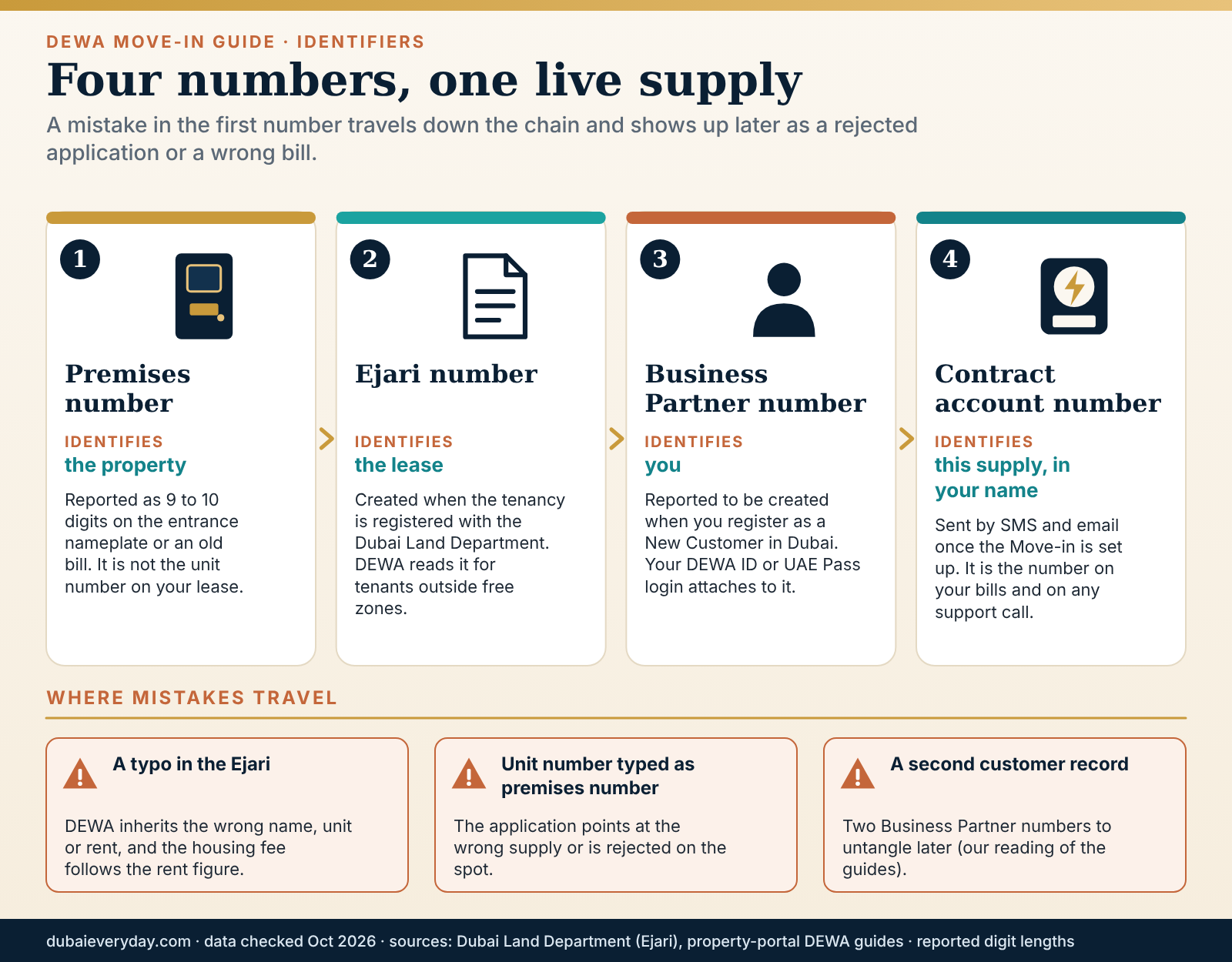
The premises number is the one people get wrong
The lease says “Unit 1204, Marina Tower”. DEWA does not care. It cares about its own premises number, which is a separate identifier for the supply point, and the two do not look alike. Guides describe finding it on the nameplate on the main entrance doorframe, on a sticker near the entrance, or on a previous DEWA bill if the previous tenant left one behind or the landlord has a copy.
Photograph it before you leave the flat on your first visit. Then check the digits against what you type, because a single transposed digit can point the application at a neighbour’s unit. The Ejari form itself reportedly asks for the DEWA premises number as well, which means it should also appear on the registered contract. If the landlord or agent filled it in for you, compare it with the door.
Cheap insurance. On the first viewing, photograph the entrance plate and the electricity meter in one frame if the layout allows it. Two photos, ten seconds, and you have the premises number and a dated starting point if a meter reading is ever questioned.
Business Partner number versus contract account number
This is where portal guides blur together. The Business Partner number belongs to you as a customer. It exists whether you have one property or three, and it is what your DEWA ID (or UAE Pass login) attaches to. The contract account number belongs to a particular supply. If you move house and use Move-To, our reading is that you keep the first and receive a new second.
That matters for two reasons. First, if you already had a DEWA account at a previous Dubai address, you should not create a second customer record; log in with the existing credentials. Second, when you phone customer care, they will ask for the contract account number to find a specific supply, and for the Business Partner number to find you. Keep both in a note on your phone.
Your login: UAE Pass or DEWA ID
Guides we read describe two ways to log in to DEWA: a DEWA ID (username and password) or UAE Pass, the national digital identity. Existing customers sign in with one of them. New applicants choose the “New Customer in Dubai” option, which creates the customer record and then asks them to set up credentials. One guide describes the registration as entering your Business Partner number, receiving a verification code by email or SMS, then choosing a username and password.
The practical advice is boring and sound. Set up UAE Pass before you need it if you have an Emirates ID, because several Dubai services accept it and it reduces the number of passwords to manage. If you are still waiting for the Emirates ID, we could not confirm what DEWA accepts in the meantime (one portal lists a passport copy for GCC nationals and investors only), so ask customer care before you pay anyone to “fix” it.
The wider digital-identity toolkit for newcomers, including UAE Pass, DubaiNow and payment apps, is covered in the Dubai internet and mobile guide.
Ejari integration: how the lease starts your DEWA move in Dubai
Ejari is Dubai’s tenancy registration system, run by the Dubai Land Department. Every residential lease is supposed to be registered, and the registration produces a certificate and a number. For DEWA purposes it is the document that proves you are entitled to the supply at that address. Property portals describe the link between the two systems as “Ejari integration”.
The integration is the reason a DEWA move in Dubai can feel almost automatic for tenants. It is also the reason it can silently stall. Because DEWA reads data from Ejari, anything wrong on the Ejari record (a misspelt name, the wrong unit, a rent figure with a typo) is inherited by DEWA. We will take the two halves in turn: what the integration does, and what you must get right before it can do it.
What the integration does for a tenant
Two portals describe the mechanism of a DEWA move in Dubai the same way. When the Ejari certificate is issued, tenancy and property details are shared with DEWA, and for tenants outside free zones the Move-in can start without a separate application. DEWA then sends an SMS and an email with the contract account number and the security deposit amount. The tenant still has to pay the deposit and the activation charges before the supply is switched on.
A third source describes it from the other end: you log in to DEWA, choose Move-in, enter the premises number and the Ejari number, and DEWA pulls the tenancy data from Ejari. These are not contradictory. One describes the Ejari-triggered route; the other describes what you do if the message never arrives or if you prefer to apply yourself. Both end with payment.
What we cannot confirm. We could not read DEWA’s own description of this integration, so we cannot say whether every Ejari registration triggers an automatic Move-in, how long the message takes to arrive, or whether it behaves the same way for registrations done at a trustee centre versus the app. Treat the automatic message as a convenience that may or may not arrive, and be ready to apply directly.
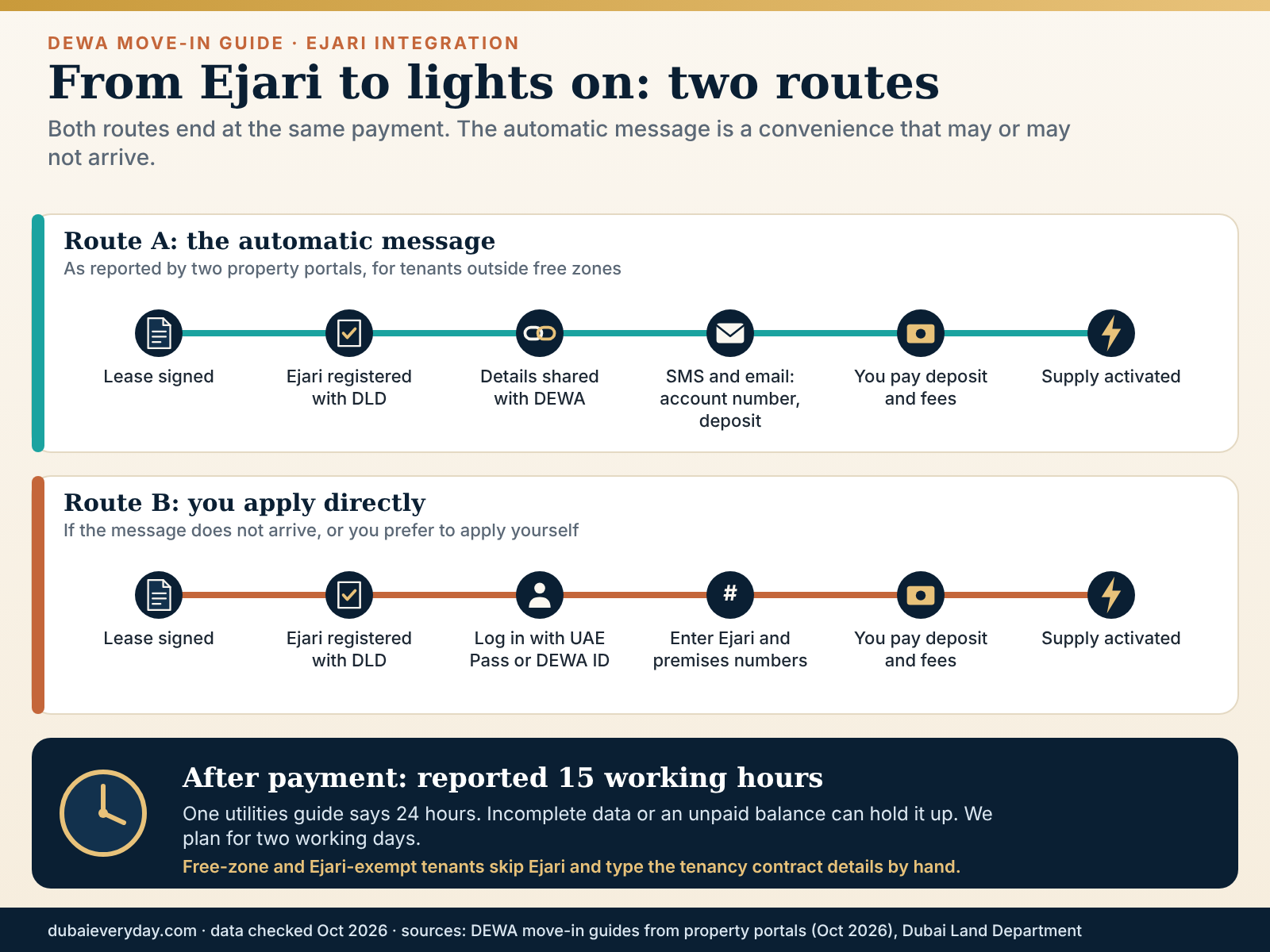
What you must get right before Ejari can help
The Dubai Land Department’s own Ejari page sets out the registration channels: the DLD website, the Dubai REST app, a real estate trustee centre, and the DubaiNow app. Through the app or website you need a copy of the unified tenancy contract, and both landlord and tenant must be individuals (not companies) for the app route. At a trustee centre you bring the original contract, your Emirates ID and, if you are acting for someone, a power of attorney.
The official fees are AED 177.75 through the app or website (AED 100 registration, AED 10 knowledge fee, AED 10 innovation fee, AED 55 service partner fee and AED 2.75 VAT) and AED 220 at a trustee centre. The DLD page gives about 25 minutes at a trustee centre, excluding the queue. It gives no processing time for the app route, and one portal says the certificate arrives by email once the landlord or property representative approves.
That approval step is the hidden dependency in a DEWA move in Dubai. If your landlord is slow to approve in the app, your DEWA clock does not start. A trustee centre visit with the landlord’s cooperation can be faster, but only if the property is not managed by a real estate company or an owner who already has Ejari system access; the DLD page lists that as a condition for the centre route.
Who files the Ejari, and who pays
Property guides say the legal duty to register sits with the landlord. For the law itself, Article 4 of Law No. 26 of 2007 says tenancy contracts for properties it covers are registered with RERA, and that courts and government bodies will not act on an unregistered lease. In day-to-day practice, tenants often file and pay for the Ejari, and the tenancy addendum usually says who does what. Portal and newspaper guides describe the tenant paying as the usual pattern.
The practical consequence for a DEWA move in Dubai is simple. You are the person who needs the Ejari number to turn the lights on, so you have a stronger reason to chase it than the landlord does. Ask for the Ejari number, not just a promise that it is “done”, and keep the PDF certificate. How these fees fit into the larger deal is covered in the renting guide’s day-one cost section.
One property, one active Ejari
A property can carry only one active Ejari registration at a time. That has a direct effect on your DEWA move in Dubai when you are replacing a previous tenant. If the earlier contract has not been cancelled, the system will not let a new one be registered, and without your own Ejari there is nothing for DEWA to read. One portal says landlords typically cancel when a tenant leaves, either after early termination or when neither side renews.
The fix is administrative and belongs to the landlord or the previous tenant’s representative. You cannot cancel someone else’s tenancy. If the Ejari will not go through and the agent says “the system is slow”, ask a precise question: is the previous Ejari for this unit cancelled, and when? A vague answer is a warning about how the rest of the tenancy may run, which the tenant rights guide covers from a legal angle.
Typos that follow you into DEWA
Because DEWA inherits the Ejari data, the most expensive errors are boring ones. A tenant name spelled differently from the Emirates ID, a wrong unit number, a missing premises number, or an incorrect rent figure. The last one has a financial tail: the Dubai Municipality housing fee is calculated from the rent in the Ejari record and appears on the DEWA bill, so an inflated figure becomes an inflated monthly charge until someone corrects it.
Before you accept the certificate, read it like a form you will be bound by. The checklist below takes a few minutes and avoids most of the trouble a DEWA move in Dubai can run into, as the troubleshooting section later shows.
- Your name matches your Emirates ID or passport exactly, including the order of names.
- The building, unit number and community match the lease and the door.
- The DEWA premises number, if the form shows it, matches the entrance plate.
- The annual rent equals the lease figure, not a monthly or per-cheque figure.
- The start and end dates match the lease, and the landlord’s name is correct.
- The certificate is saved as a PDF in the same folder as the lease and cheques.
Ejari timing against the key handover
Do not let the clock on your DEWA move in Dubai start at the key handover. The sequence that works is: sign the lease, register the Ejari the same day if you can, apply for or confirm the DEWA Move-in as soon as the number exists, and pay the deposit while the property is still empty. Then the supply is already live when you collect the keys. The alternative is arriving with boxes, a phone battery and an empty fridge, and discovering that the next step takes a working day.
There is a counter-argument worth stating. If the property is not yet cleaned, painted or repaired, you may not want the meter running in your name from day one. The tenancy start date and the activation date are not the same thing. Our advice is to activate on the day you have the keys, not weeks earlier, and to record the meter reading when you do. If the landlord or agent has asked you to activate early so contractors can work, put that arrangement in writing.
Free-zone tenants and Ejari-exempt cases
Not every DEWA move in Dubai follows the standard Ejari path. Portals describe a different route for some commercial free zones and similar cases that are exempt from Ejari. In the online application these applicants select that they do not have an Ejari and supply the tenancy contract details directly: contract number, start and end dates, contract value, number of rooms and the premises number. One guide lists a valid tenancy contract as the document for free-zone customers.
If you live in a free-zone community, ask your landlord or the community management which route applies to your DEWA move in Dubai before you assume the standard one does. The direct-entry route puts more of the data-entry work on you, which means more chances for a transposed digit, and it is less likely to be triggered by an automatic message. Allow extra time and keep the PDF of the contract at hand.
If an agent says the Ejari “cannot be done” but a “contact” can push it through for a fee, stop. The official channels and their prices are listed on the Dubai Land Department page: AED 177.75 online and AED 220 at a trustee centre. A request for cash on top, or a payment to a personal account, is not part of that schedule.
Renewals, rent changes and what DEWA does with them
When the lease renews, the Ejari must be renewed or updated too, and portals say the fee matches the registration fee. We found nothing saying a renewal requires a new DEWA Move-in, since the supply and the account simply continue (confirm with DEWA if your landlord says otherwise), but the rent in the Ejari changes. That feeds the housing fee. If the rent has gone up, expect the monthly line on the DEWA bill to follow; if it has gone down, you can ask Dubai Municipality to update the figure.
The housing-fee mechanics are in the first bill section below. The renewal rules that decide how much the rent can rise, and when notice is due, are covered in the renting guide and, for rights and disputes, the Dubai legal basics page.
Tenant or owner: who applies, with which documents
The online form for a DEWA move in Dubai asks two questions before anything else, according to the portal guides we read. The first is customer type: expatriate, GCC national, investor or UAE national. The second is account type: owner or tenant. Those two answers decide which record DEWA will look for and which identity document it expects. Picking the wrong box is a quiet way to get an application bounced.
The rest of this section takes each combination in turn, then pulls them into one comparison. Everything about documents is reported by secondary sources and should be checked against the form on the day, since DEWA can change its fields without a headline.
Tenants outside the free zones
This is the standard DEWA move in Dubai, the case the Ejari integration was built for. You need a valid Ejari number for the tenancy. Portals add that Dubai residents use their Emirates ID, and that, because the data is pulled from the Ejari record, a tenant with a valid number usually has no further documents to upload. Everything else, such as the premises number, the contract details and the rent, is filled from the registration.
The tenant is the account holder, which means the bills, the deposit and the responsibility for any unpaid balance sit with you. That is straightforward for a single occupant. It is less so if you share, and we return to that in the scenarios. Keep in mind that the deposit is paid by whoever is the account holder, so agree in writing how a flatmate reimburses you and how the deposit refund will be split.
Tenants in free zones and Ejari-exempt properties
As covered above, applicants who are exempt from Ejari choose the option that says they have none, then enter the tenancy details by hand. The guides list a valid tenancy contract as the supporting document. If you are unsure whether your community falls in this group, ask the landlord for the Ejari number first. If there is none and the landlord confirms an exemption, ask for it in writing and use the direct route.
Owners
For homeowners the supporting document is the title deed, or a sales and purchase agreement in some guides. Owners move in on their own property, so there is no Ejari to read, and DEWA checks ownership instead. Owners also choose the “owner” account type. Everything else in an owner’s DEWA move in Dubai is the same: the premises number, payment of the deposit and activation charges, and a wait for the supply to go live.
New-build and off-plan buyers should add a step. The developer’s handover process, snagging and any master-community service charges are separate from DEWA, and we could not verify whether a developer or master community requires a DEWA account before handover. Ask in writing. The purchase side is covered by the buying guide, and ownership rules for non-residents by the freehold property page.
Owners who let the property
If the owner rents the property out, the tenant is the account holder and the tenant’s Ejari triggers the Move-in. The owner has no application to make for that DEWA move in Dubai, but there is one thing to check: whether the owner’s earlier account for the same premises was closed. An open account in the previous holder’s name is something the sources list among the reasons activation can be held up, since outstanding payments or incomplete information delay the process.
The housing fee tells the same story from a different angle. Dubai Municipality’s fee is 5 per cent of annual rent, and if a property is let it is the tenant who is billed. If the owner lives in the property or leaves it vacant, the owner pays, using an average rental value set by RERA. That is relevant to anyone deciding whether to live in or let an investment unit, and the rental yield guide shows how such recurring charges eat into returns.
GCC nationals, investors and UAE nationals
The form distinguishes these customer types, and the documents differ. A passport copy is listed for GCC nationals and investors. For UAE nationals who hold a Thukher or Sanad card, a 50 per cent reduction on activation charges is reported. The Executive Council resolution of 2011 also exempts UAE nationals’ private residences from the DEWA fuel surcharge, and portal guides say UAE nationals are exempt from the housing fee. None of the sources we read says the deposit changes with nationality.
Tenants whose employer holds the lease
If your employer leased the property in its own name, as with staff accommodation, two things change. The Ejari app route does not allow a company as a party, so the company will usually need another route; the DLD page lists the conditions for each. And the account holder question becomes a policy question: does HR put the account in the company’s name or yours? We found no source that settles this. Ask HR in writing, because the account holder is the person who owes any unpaid balance.

The routes side by side
The table is deliberately short. It lists what each applicant should have in hand before opening the form, not what DEWA might eventually ask for, and every entry is marked as reported.
| You are | DEWA reads or checks | Reported supporting document | Watch for |
|---|---|---|---|
| Tenant, standard lease | Ejari record | Valid Ejari number; Emirates ID for residents | Name, unit and rent typos in Ejari |
| Tenant, free zone or Ejari-exempt | Details you enter | Valid tenancy contract | Manual data entry; premises number |
| Owner living in the property | Ownership record | Title deed or sales and purchase agreement | Handover requirements; housing fee on RERA value |
| GCC national or investor | Identity and property | Passport copy (plus ownership or tenancy proof) | Choose the right customer type |
| UAE national with Thukher or Sanad card | As above | Card for the discount | 50% off activation charges only, per portals |
| Existing DEWA customer changing homes | Old account and new premises | Old account number, new Ejari or title | Use Move-To so the deposit transfers |
When the landlord says they will do it
Some landlords and agents offer to run the whole thing: Ejari, DEWA, even the payment. It can work, and for an overseas tenant it can save a week. The risk is a mismatch between what you think happened and what did. Ask for three things in writing or by message: the Ejari number, the DEWA contract account number and a payment receipt in your name. Without those three, you do not know that a DEWA move in Dubai has actually taken place.
Also ask whose name is on the DEWA account. A landlord’s account that you simply use would leave the deposit and the liability with them, and you would have no standing with DEWA if the supply failed. If you are paying for the supply, the account should be yours, the deposit should be recorded as yours and the refund should come back to you.
Deposits and activation fees: the cost of a DEWA move in Dubai
The money side of a DEWA move in Dubai is small and mostly refundable, which is exactly why it gets less attention than it deserves. There are two kinds of payment: a security deposit that you get back when the account closes, and a handful of activation charges that you do not. Mixing them up leads to bad budgets in both directions.
The DEWA move in Dubai security deposit
Six sources we read agree on the residential deposit: AED 2,000 for an apartment and AED 4,000 for a villa. They also agree that it is refundable when the account is closed, once outstanding amounts are settled. For non-residential premises the deposit is reportedly calculated from expected consumption, so no fixed figure applies. We are using the fixed residential figures with the caveat that DEWA’s own screen is the final word.
Two things are worth knowing about the deposit. The first is that the category is about the property type, not your preference. If your home is a townhouse, a duplex, a ground-floor unit with a garden or a serviced villa-style unit, the sources do not say which bracket applies. The application screen should show the amount DEWA expects, and a surprise there is the cue to phone customer care before paying.
The second is that one portal says the deposit is refundable to owners only on sale of the property, which is a different treatment from the tenant case. Other sources describe refunds on account closure generally. If you are an owner-occupier, assume your deposit is tied up for as long as you hold the account, and ask DEWA to confirm the rule that applies to you.
Activation charges in a DEWA move in Dubai, and why sources disagree
The activation charge for a small meter is reported as AED 100 in one portal, AED 125 in two others, and about AED 130 in total in a third and in a newspaper cost guide. On top of the base charge, three small fees are reported at AED 10 each: registration, knowledge and innovation. A large meter is AED 300 in every source that mentions it, though none of them defines how DEWA decides which meter size a home has.
Putting that together gives a range, not a number. A small-meter home pays AED 130 to AED 155 in fees, before VAT where it applies, and a large-meter home pays about AED 330. This is why the short answer at the top says “AED 100 to 125”. We do not know which portal copied which figure, and the safest assumption is that the figures changed at some point and not every article caught up. DEWA’s checkout screen shows the exact total.
Our calculation: the range for day one. Apartment, small meter: AED 2,000 deposit plus AED 130 to 155 in fees, so AED 2,130 to 2,155. Villa, small meter: AED 4,000 plus the same fees, so AED 4,130 to 4,155. Large meter: AED 300 plus AED 30, so AED 330 in fees, which brings an apartment to AED 2,330 and a villa to AED 4,330. All before any VAT that DEWA applies. The refundable share of the total is 93 to 94 per cent for the apartment and about 96 to 97 per cent for the villa.
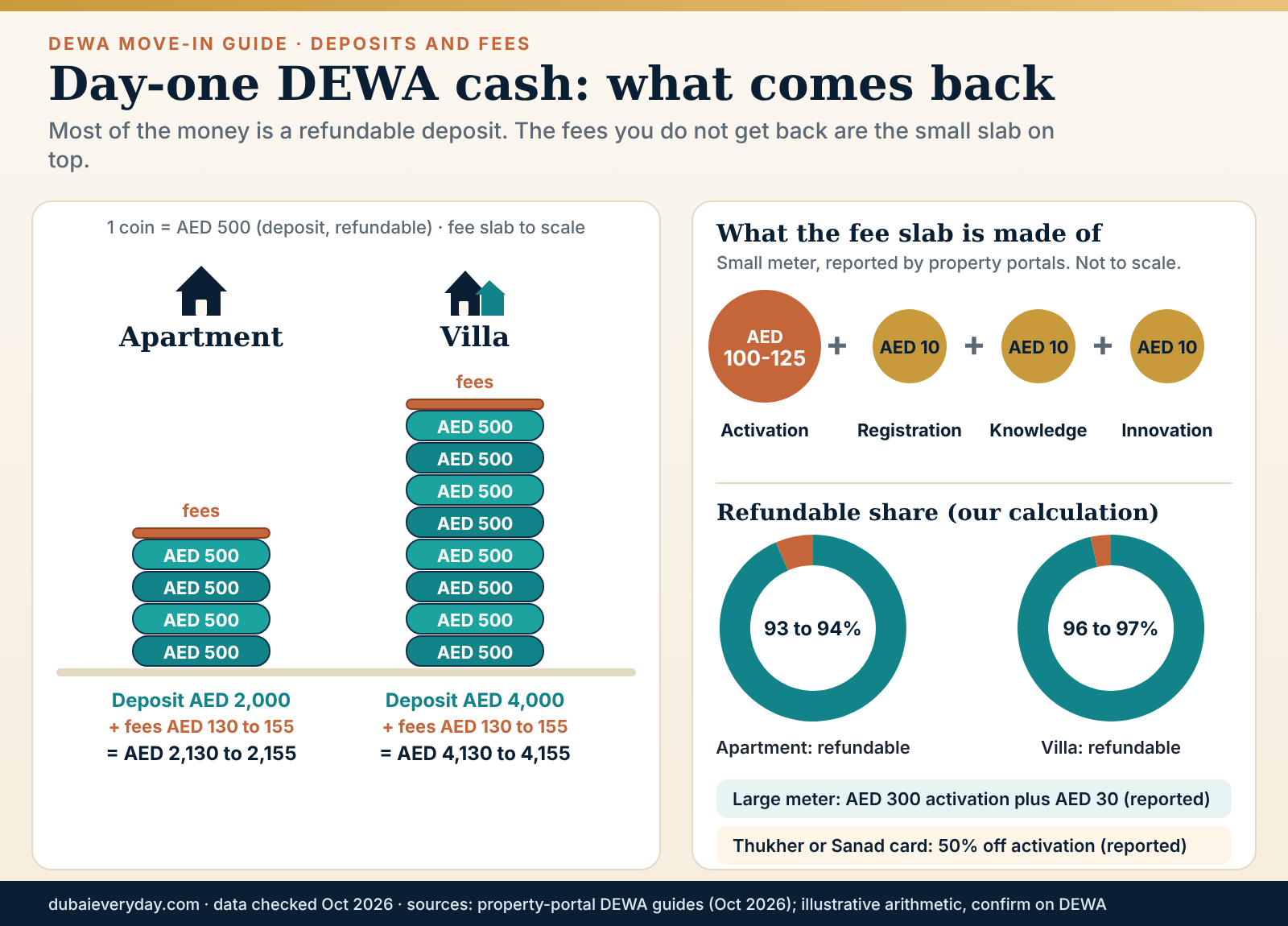
The Thukher and Sanad discount
Two portals report that UAE nationals holding a Thukher or Sanad card receive 50 per cent off activation charges. The wording is vague about whether “activation charges” means only the base charge or also the three small fees. Worked through, the saving is roughly AED 50 to 62 on the base charge alone, or AED 65 to 78 if it covers all four items. It matters more as a rule to remember than as money.
The same people are exempt from the housing fee, per a property-portal guide to the fee, and from the fuel surcharge on a private residence under the 2011 tariff resolution. If you belong to this group, your bill will look different from the examples in this guide, and the exemptions are worth confirming on the first one.
VAT and what “as applicable” means
One portal says VAT is charged on the activation fees “as applicable”. The Dubai Land Department’s Ejari page shows a VAT element only on the service partner fee. We could not find a DEWA statement on exactly how VAT works on the activation lines, so we do not give a precise figure. A 5 per cent charge on AED 130 to 155 would be AED 6.50 to 7.75, which is small enough that it is not worth arguing about, but large enough to explain why your total is not a round number.
How DEWA move in Dubai cash compares with the rest of the move-in
Take the AED 70,000 one-bedroom example, which is an illustration, not a quote. A customary landlord deposit of 5 per cent for an unfurnished unit (the figure Gulf News quotes) is AED 3,500. Add the Ejari at AED 177.75 and the DEWA range of AED 2,130 to 2,155, and the three items total AED 5,807.75 to 5,832.75. Of that, AED 5,500 comes back eventually: the landlord’s deposit and DEWA’s. The non-refundable part is AED 307.75 to 332.75, about 5 per cent.
The lesson is a cash-flow one. DEWA’s deposit is not where the pain is, and chasing a discount on activation is not where the saving is. What hurts is being asked to pay several refundable deposits at once, the landlord’s, DEWA’s, a cooling provider’s and perhaps an internet installation deposit, and wanting all of them back at the same time. The cooling and internet deposits are covered in the home setup guide, and the day-one cash total sits in the moving guide.
Paying for your DEWA move in Dubai now or later
One portal describes a “pay using other channels” option at the payment step, which lets you submit the application and settle the amounts afterwards. That can help if the card you want to use is not ready or if a landlord is paying. The risk is obvious: the supply is not activated until DEWA receives the money, and an application sitting in a queue gives a false sense of progress. If you use deferred payment, put the deadline in your calendar.
The reported 15-working-hour clock for a DEWA move in Dubai starts after payment, not after the application. A submitted but unpaid application is, in effect, a reservation of nothing. We cover how to count that clock in the next section.
Getting the deposit back
The refund is not part of a DEWA move in Dubai, but it shapes how you treat the deposit. It comes back when you close the account and settle the final bill. One utilities guide says that, since April 2026, deposits up to AED 4,000 are paid back in as little as eight minutes to a bank account on the account, replacing a slower process. That is a secondary report of a DEWA announcement, so treat it as a hopeful sign rather than a promise.
How to close, what the final bill includes and what happens if the deposit does not arrive are all in the DEWA move-out guide. One habit that follows from it is worth adopting now: keep the payment receipt and the contract account number with your lease, because you will want them both a year or three from now.
Timing a DEWA move in Dubai: from signature to lights on
Timing is where a DEWA move in Dubai most often disappoints people, because the headline promise is short and the surrounding steps are not. Two property portals and a utilities guide give the activation promise as “within 15 working hours” after payment and complete information, and one gives 24 hours. Neither number includes the days it takes to get a registered Ejari. The sensible plan covers the whole chain, not the last link.
What the promise says, and what it leaves out
The reported rule is that supply is activated within 15 working hours of paying the deposit and the activation charges, provided the information is complete and nothing else is outstanding. One guide adds that morning applications are often live the same day. Another says DEWA commits to activation within 24 hours of payment. We found no DEWA page defining a “working hour”, so we cannot say whether the clock runs through lunch, through Friday afternoon or through the weekend.
That gap is the whole planning problem. Fifteen continuous clock hours is less than a day. Fifteen working hours at roughly eight a day is two working days. If the supply is activated on DEWA’s own working calendar, a payment late on a Thursday could slide into the following week. We cannot resolve it from the outside, so we plan for the pessimistic reading and treat anything faster as a gift.
Three readings of the clock
Best case
Fifteen clock hours, or the 24-hour version, counted straight through. Pay on a weekday morning and expect the supply the same day or the next morning.
Planning case
Fifteen working hours at about eight a day, so two working days. This is the reading we recommend you build your plan on.
Weekend case
Payment on a Thursday evening or a Friday, where the working-hour count may not move until Monday. Plan for the supply on Monday or Tuesday.

Why the weekend matters for a DEWA move in Dubai
A utilities guide that lists DEWA Customer Happiness Centre hours gives 7:30 am to 3 pm, Friday to 11:30 am, closed Saturday and Sunday, with the Ibn Battuta Mall centre on mall hours. That guide is dated June 2026, is not DEWA’s own page, and hours can change, so confirm before travelling. The point is the shape: a centre-based service stops at the weekend.
Whether online activation also pauses we could not confirm. Someone paying on Friday afternoon cannot rely on it continuing. If your keys arrive on a Friday, schedule the payment for the Tuesday or Wednesday before, and treat a Thursday payment as a gamble that may well pay off but is not a plan.
Working backwards from the key date of your DEWA move in Dubai
The most reliable method for a DEWA move in Dubai is to count back from the day you need the power. Take an illustrative case: keys on Monday 9 November 2026. You want the supply live that morning, so the payment should clear by Thursday 5 November under the planning reading. The Ejari should exist by Wednesday 4 November so the application can use it, and the lease should be signed by Tuesday 3 November so the registration can start. That is a six-day lead time for a process that may take two.
Now compare a cramped version: lease signed on Thursday 5 November, keys the next Monday. The Ejari might be done on Friday if the landlord approves quickly, but payment on Friday afternoon pushes activation toward Monday or Tuesday. In that second case, plan to spend the first night somewhere with air conditioning. The hotel guide helps pick an area that suits the first-week logistics.
Heat changes the stakes. In winter, a day without power is inconvenient: lights, hot water, a phone charger. From roughly June to September it means no cooling, a warm fridge and a flat that can be unpleasant even with the windows open. If your key date falls in the hot months, add a day to every buffer in this section and have a fallback bed booked. It costs less than a stressed first week.
What speeds a DEWA move in Dubai up
Complete data and early payment. The sources are consistent that incomplete or incorrect information, or outstanding payments, can delay activation. Our reading is that applications with a clean Ejari match and an on-time payment should be the easy ones. A clean application is mostly a matter of preparation: the right premises number, the right account type, an Ejari that matches your ID.
- Register the Ejari the day you sign the lease, or the next working day.
- Apply and pay on a weekday morning, not at the end of the day.
- Pay the deposit and fees in one go; do not leave the deferred payment to the last minute.
- Keep the confirmation reference and the SMS or email with the contract account number.
- Check the app the next morning for account status instead of waiting for a call.
What slows a DEWA move in Dubai down
The list is short and the same names recur: an Ejari that has not been issued or is wrong, a premises number that does not match, an unpaid balance on the property’s earlier account, and a payment that did not complete. Public holidays also remove working days, so a payment before a long holiday weekend should be treated like a Friday payment, only worse. Check the official UAE calendar for the dates, because holiday dates for Eid shift each year.
Applications for properties in new communities can also run into administrative gaps, such as a premises number not yet in the system. We found no source describing this specifically, so treat it as a possibility rather than a known issue, and ask the developer or agent whether the unit already has a DEWA premises number before you apply.
The Ejari clock and the DEWA clock together
The Ejari step has its own pace. The Dubai Land Department’s page puts a trustee centre visit at about 25 minutes without queue. A property portal says the certificate comes within 7 to 10 minutes at a centre and, by app, after the landlord approves. Combine those with DEWA’s reported 15 working hours, and our calculation puts the end-to-end range anywhere from about one working day in the best case to about four or five days when the landlord approves late and the payment lands on a Friday.
If you are still abroad, the maths changes: Emirates ID, UAE Pass and a local card may not be available yet. What can be done remotely is covered in the relocation checklist, and the residency steps that determine when your ID arrives are in the residence visa guide.
A realistic expectation for each type of arrival
New arrivals with a temporary booking can afford to wait. Their DEWA move in Dubai just needs to be live before the lease start. People moving between homes in a tight window, with a landlord who wants the old flat empty, cannot afford it, and should use Move-To as soon as the new Ejari exists. Owners getting keys from a developer have their own timeline, and the developer’s handover process sets the date that DEWA then follows. Whichever you are, the safest planning figure is “two working days after payment”, and the safest payment day is early in the week.
How to apply for a DEWA move in Dubai, step by step
This is the sequence for a DEWA move in Dubai as property portals describe it, checked against each other. DEWA’s screens may differ in detail: names move, fields change, and what is a button today may be a menu next quarter. Use the steps as a map and the DEWA screen as the territory. If something on screen conflicts with what is written here, trust the screen and ignore the guide.
Where you can apply for a DEWA move in Dubai
Three digital channels come up repeatedly: the DEWA website, the DEWA Smart App, and the DubaiNow app. All are reported to handle the Move-in service. In-person applications happen at DEWA Customer Happiness Centres, whose hours we gave in the timing section and which one portal describes as having short waits. The official portal for the first two is dewa.gov.ae; our tools could not read its service pages, so we cannot describe the live screens ourselves.
For most people the app is the best channel, for a dull reason: it keeps your login, your payment method and your confirmation in one place on a device you already carry. Centres suit people who want a human to check the form, or who cannot get the digital login to work. A centre visit is slower and adds the weekend problem, so treat it as the fallback.
The pack to have open before your DEWA move in Dubai application
- The Ejari number and PDF certificate (tenants outside free zones), or the title deed or sales agreement (owners), or the tenancy contract (free-zone tenants).
- Your Emirates ID, or passport for the customer types that use one.
- The premises number from the entrance plate, checked against the Ejari form.
- UAE Pass installed and working, or a DEWA ID, with a mobile number and email you control.
- A bank card that can pay the deposit and fees in one go.
- If moving between Dubai homes: your existing DEWA account number and your move-out date.
The DEWA move in Dubai sequence
- Check the record existsConfirm the Ejari is issued and the PDF certificate is in your hand. If a trigger message from DEWA has arrived by SMS or email, open it, because it carries the contract account number and the deposit amount.
- Log in or registerExisting customers sign in with UAE Pass or a DEWA ID. New customers choose the “New Customer in Dubai” option, which creates a customer record and Business Partner number, then set a username and password with a verification code.
- Open the Move-in serviceLook for “Activation of Electricity and Water (Move-in)” on the website, or the equivalent in the app. If you already have an account elsewhere in Dubai, look for Move-To instead.
- Pick the customer and account typeExpatriate, GCC national, investor or UAE national; then owner or tenant. A wrong choice here can send the form down the wrong documents path.
- Enter the numbersType the Ejari number and the premises number, or the manual contract details for a free-zone case. Compare every pre-filled field with your ID and lease.
- Review the amountsThe screen should show the deposit and activation charges. Compare them with the ranges in this guide. A figure far outside AED 2,000 or 4,000 deposit and AED 130 to 330 fees is a reason to pause.
- Pay, or choose to pay laterPaying now starts the activation clock. If you choose another channel, set a reminder to pay.
- Save the referenceScreenshot or print the confirmation, note the reference number, and record the contract account number.
- Check the next morningLog in to confirm the account shows as active. If it does not by the end of the second working day, phone customer care with your reference.
If the DEWA move in Dubai form rejects your numbers
A rejected Ejari number usually means one of four things: a typing error, an Ejari that is still pending the landlord’s approval, an Ejari for a different unit, or the previous tenant’s Ejari still active. Compare the digits on your certificate with what you typed. If they match, retry after a short wait in case the Ejari record was only just issued, then call customer care with the reference.
For a rejected premises number, check the entrance plate again. If the plate is missing, ask the landlord or building management for a past DEWA bill or the premises number from the Ejari. Do not use a neighbour’s number “to see if it works”. Applying with the wrong premises can attach your deposit and name to the wrong supply.
What to do if you are not in Dubai yet
Many people sign leases from abroad, through an agent or a landlord with a power of attorney. A DEWA move in Dubai can be done remotely, but the digital identity requirements are the catch. UAE Pass and the Emirates ID usually come after arrival. If the lease starts before you land, the most practical routes are for the landlord or agent to start the application with your documents, or for you to wait until your ID arrives and pay for the delay with a hotel.
If an agent applies for you, insist that the account is registered in your name, the deposit is paid with your money into your account and the receipt is sent to your email. The first-month sequence for newcomers, including visas and banking, is in the moving to Dubai guide.
Contact points
A Dubai Media Office notice gives DEWA’s Customer Care number as 04 601 9999. One utilities guide says that line runs around the clock including public holidays, and lists 991 for urgent electricity or water technical problems. It also mentions Rammas, DEWA’s chatbot, in English and Arabic. We recommend saving the customer care number now, as a contact, because you will want it when the power is off and the portal is not loading.
Move-To: when you already have a DEWA account
If you are an existing DEWA customer moving to another Dubai property, you probably want Move-To for your DEWA move in Dubai, not a fresh Move-in. A property-portal guide describes it as combining deactivation at the old address with activation at the new one. Its advantage is the deposit: an existing deposit can be carried across, subject to any outstanding balance or any extra deposit required for the new property.
What carries over and what you top up
The transfer logic is simple. If your old home was an apartment with a AED 2,000 deposit and the new one is a villa that requires AED 4,000, the difference is payable and activation follows its payment. That is the case the portal describes, and the arithmetic is the difference, AED 2,000, plus whatever activation fees apply. Going the other way, from villa to apartment, we found nothing on how the surplus is handled, so ask.
The same guide says transfer fees are not separately itemised, which means we do not know whether activation charges apply again. The portals that list activation fees describe them for a new connection. Treat the fee position on Move-To as unconfirmed, and check the on-screen total before paying.
The details Move-To asks for
One portal lists the following as inputs: an Ejari number, the premises number of the new home, the move-in date, the existing account number and the move-out date. It does not say which lease the Ejari number refers to. Our reading is that it is the new tenancy, since that is what authorises the new supply, but the form will make it clear. Have the old and new numbers to hand so you are not hunting for them.
The move-out date is a real decision, not a formality. Set it too early and the old supply is cut while you are still packing; too late and you pay for two supplies at once. Most people pick the day the old keys go back. The final bill and the deposit mechanics, which depend on your unit’s closing readings, are covered in the DEWA move-out guide.
When Move-To is the wrong choice
Use a fresh Move-in if the old account was in someone else’s name, such as a flatmate’s or an employer’s, because you cannot transfer a deposit that is not yours. Do the same if the new property is a free-zone one that follows a different registration route. And if the old account has an unpaid balance, resolve it first: the transfer is subject to outstanding amounts, so a balance can stall the new activation.
A final case is a gap between homes. If there is a month between leaving one and starting another, Move-To is not designed for that; close the old account and open a new one when the next lease begins. The deposit refund from the first account then arrives before you need to fund the second, which is a mild cash-flow advantage some people value more than the convenience.
Keys day: first checks, and what DEWA does not switch on
The supply may be live before you collect the keys, or it may go live while you are standing in the empty flat. Either way, keys day is the one moment when you can show, with evidence, the starting condition of the electricity and water. A few minutes spent now makes every later bill question easier to answer.
Five checks in the first ten minutes of a DEWA move in Dubai
- Photograph the meterTake a clear photo of the electricity meter display and, if you can reach it, the water meter, with the date visible on your phone. This is your starting reading if a figure is ever disputed.
- Photograph the premises plateCapture the number on the entrance nameplate and compare it with the number on your DEWA confirmation.
- Test the supplySwitch on lights, a socket and each tap in turn. If something is dead, note exactly what and where, and tell the landlord or building manager in writing.
- Start the air conditioningRun each unit for a few minutes. Cold air in a Dubai summer is the entire point of a DEWA move in Dubai, and a unit that blows warm is a maintenance matter for the landlord.
- Log the accountOpen the DEWA app and confirm the account shows your name and the right address.
If anything looks unsafe, such as sparks, a burning smell or a socket that is hot to the touch, do not troubleshoot it yourself. The reported number for urgent electricity or water faults is 991, and the landlord’s maintenance team or a licensed electrician should handle anything inside the home. Never open or tamper with the meter itself.
The landlord’s side of the bargain
Dubai’s tenancy law, Law No. 26 of 2007, requires the landlord to hand over the property in a condition that allows its intended use, and, unless the parties agree otherwise, to handle maintenance of defects that affect that use (Articles 15 and 16). A flat with no working outlet in the bedroom is such a defect. Report it on day one, not on day thirty, and keep the message. The landlord also may not cut services to the property (Article 34).
That does not mean you can refuse to pay DEWA. The consumption bill is yours in normal practice. The closest provision we read is Article 22, which makes tenants pay government fees and taxes owed for use of the property unless the contract says otherwise; it does not mention utility bills by name. The rights side of the story, including disputes, is in the tenant rights guide. For the viewing-stage version of this checklist, see the apartment rental guide.
What a DEWA move in Dubai does not switch on
A DEWA move in Dubai activates electricity and water. Several things people assume are bundled are not.
Cooling
In many towers, cooling comes from a district-cooling provider, not from DEWA. Gulf News lists Empower, Emicool and Tabreed as possibilities, each with its own registration, deposit and bill. Whether cooling is in the rent or billed to you depends on the building and the lease.
Gas
A new gas connection or transfer is quoted at about AED 600 to 800 by Gulf News, with a deposit possible in buildings with central gas. It is a separate supplier from DEWA. Many flats have none.
Internet
A home internet line needs its own application, and portals note that an Ejari is among the documents operators ask for. Ask the operator whether it also wants the DEWA account number before it books an installation.
Building access
Move-in permits, access cards and parking tags are issued by the building or community. They are not DEWA services and cost whatever the management says.
The terminology around cooling is a minefield, because “chiller-free” is read in opposite ways by different sources. Our reading is that the lease should state in plain words who pays the cooling provider. The full cooling comparison, including the fixed charges that keep running in winter, is in the home setup guide. For internet, see the home internet comparison.
The first-night shopping list that depends on power
Once the supply is live, a few small tasks are worth doing in order. Put the fridge on first, because it needs several hours to cool before it is useful. Then charge phones and a power bank, run the water for a minute to clear the lines, and check the water heater. Groceries come after that: the supermarket guide compares delivery options for the days when you do not have a car or the energy.
If the flat has not been cleaned to your satisfaction, it is easier to deal with before furniture arrives. Cleaning options, and what a deep clean usually includes, are covered in the deep cleaning guide, while the cleaning services page covers recurring help. Neither is a DEWA matter, but the order of operations makes them part of the same day.
Your first bill: tariffs, housing fee and VAT
The first DEWA bill is where a DEWA move in Dubai stops being an administrative job and becomes a monthly cost. It is also the first chance to catch a mistake. This section is not a full budget, which belongs in the cost of living guide. It explains what is on the bill, how to rebuild it and what a sensible first-bill check looks like.
The tariff behind a DEWA move in Dubai, from the source
The residential electricity tariff comes from Executive Council Resolution No. 16 of 2011, read on the Dubai Legal Portal: 23 fils per kWh up to 2,000 kWh a month, 28 fils from 2,001 to 4,000, 32 fils from 4,001 to 6,000, and 38 fils above that. The same resolution lets DEWA add a fuel surcharge, set monthly by decision of its chief executive. A property portal reports the surcharge at 6 fils per kWh as of February 2026; check the current bill for the actual figure.
Water was priced per imperial gallon in the 2011 resolution: 3.5 fils for the first 6,000 gallons a month, 4 fils to 12,000, and 4.6 above. The Dubai Media Office announced that DEWA moved to cubic metres from the March 2025 billing cycle. A property portal gives the metric rates as AED 7.70 per m³ up to 27 m³, AED 8.80 up to 54 m³ and AED 10.12 above, which matches the gallon rates once converted. A meter service charge of AED 5 to 35 on electricity is also reported, and sewerage is added based on water use.

The housing fee is the line that surprises people after a DEWA move in Dubai
Tenants who expect a bill that follows the air conditioner are often startled by a flat monthly line unrelated to consumption. It is the Dubai Municipality housing fee: 5 per cent of annual rent, collected in twelve instalments through the DEWA bill. For tenants the base is the rent in the Ejari record. For owners who do not let the property, it is an average rental value set by RERA. UAE nationals are reported to be exempt.
The quick check is to multiply the monthly housing-fee line by 240. The result should be close to your annual rent in the Ejari (5 per cent divided by 12 is one 240th). A utilities guide gives the same shortcut, and says the fee carries no VAT, though another portal’s description of the bill is less clear on that, so read your own bill rather than assuming.
Our calculation: a first bill rebuilt
Take an illustrative two-bedroom rented at AED 100,000 a year, with 900 kWh of electricity and 22 m³ of water in a month. This is an invented scenario to show the arithmetic, not a typical bill.
- Electricity: 900 kWh at AED 0.23 is AED 207.00.
- Fuel surcharge: 900 kWh at AED 0.06 is AED 54.00.
- Water: 22 m³ at AED 7.70 is AED 169.40.
- Subtotal subject to VAT: AED 430.40, and 5 per cent VAT is AED 21.52.
- Housing fee: AED 100,000 times 5 per cent divided by 12 is AED 416.67.
- Total: about AED 868.59, before any meter service charge or sewerage.
The housing fee is 48 per cent of that bill. In a cool month with little air conditioning, it is a larger share; in August it shrinks. That is why the monthly total moves less than people expect from consumption alone, and why the Ejari rent figure matters long after the day you registered it.
Housing fee at different rents
For a quick sense of scale, the monthly housing-fee line is AED 229.17 on a rent of AED 55,000, AED 333.33 on AED 80,000, AED 500.00 on AED 120,000, and AED 833.33 on AED 200,000. These are our arithmetic using the 5 per cent rule, not DEWA figures. If your own line is far from the number your rent implies, the Ejari figure or the fee base is wrong.
If the rent is reduced on renewal, a portal guide says the tenant or owner can update the residential details with Dubai Municipality using UAE Pass, with changes reflected in about three working days. It also says overcharges from earlier calculations can be claimed through the municipality’s refund portal. That belongs to a later year, but knowing it exists is useful when a negotiated rent drop does not appear on the bill.
A first-bill check after a DEWA move in Dubai, line by line
- The opening meter reading matches your keys-day photo, or is close to it.
- Your name, address and contract account number are correct.
- Electricity and water are billed in the units you expect (kWh and cubic metres).
- The housing fee multiplied by 240 is close to your Ejari rent.
- Any cooling line from a district-cooling provider is separate and expected.
- No leftover balance from a previous occupant appears under your name.
We could not find how DEWA handles the first, partial billing period or when the first housing-fee instalment starts after a mid-month activation. If the first bill looks odd, ask customer care to explain the dates; guessing, or paying an amount you do not understand to “sort it later”, is the expensive option. Payment channels reported include the DEWA website and app, online banking and cash at DEWA centres, and are covered in the sources below.
When a DEWA move in Dubai goes wrong
Most problems in a DEWA move in Dubai fall into a handful of patterns, and nearly all of them trace back to the record DEWA reads rather than to DEWA itself. The sources do not publish a troubleshooting tree, so what follows is our reading: the causes the portals mention, combined with logic about what DEWA must be checking. Where we are guessing, we say so.
The Ejari number is rejected during a DEWA move in Dubai
Start with the plain explanations: a typo, a certificate not yet issued, or an Ejari for the wrong unit. Open the PDF and compare. If the certificate is only “pending”, the landlord or property representative may not have approved it in the app, which leaves you waiting on a person, not a system. Ask the landlord for the approval status and a time. Do not file a second Ejari to “try again”; a property can have only one active registration, and duplicates complicate matters.
If the Ejari is correct and issued, and DEWA still rejects it, take a screenshot of the error with the time and call customer care. Quote the Ejari number, the premises number and your Emirates ID details. Ask them to note the call reference, because it is your evidence that you tried.
You expected DEWA’s message and nothing arrived
The automatic SMS and email after Ejari registration is described as a convenience, and we cannot promise it. Check the spam folder, the phone number and email in the Ejari record, and whether the registration was done through a trustee centre that used an agent’s contact details. If it is missing, apply yourself with the Ejari number. Do not wait for a message that may have gone to someone else’s phone.
You paid for your DEWA move in Dubai and nothing happened
First check the time. Under the reported promise, activation can take up to 15 working hours or 24 hours, and under our planning reading that is two working days. If you are inside that window, waiting is the right answer. If you have passed it, log in and look at the status of the application and the account, not just the payment receipt.
If the account shows as unpaid, the payment may have failed or sat in the “pay using other channels” state. If it shows as paid and pending, phone with your reference number and ask what is outstanding. The sources name two typical holds: incomplete or incorrect information, and outstanding payments on the property. Ask specifically about both. A previous occupant’s balance is a plausible cause, though no source says so in terms.
The deposit amount looks wrong
The deposit depends on property type. If you are charged the villa deposit for an apartment-style unit, or the apartment deposit for a townhouse, do not just pay and hope. Ask customer care which category the premises is classed under and whether it can be changed. A wrong category does not break the supply, but it changes the refund you expect and the amount you could be told to top up later.
The account is in the wrong name or the wrong type
If the account shows the landlord, a previous tenant or an agent, the supply may be live, but your deposit and your standing are not. Tell DEWA straight away and ask for the correction route. If the account type says owner when you are a tenant, or the reverse, the sources suggest the right document for each path differs, so the fix usually needs documents again. It is slower to repair than to prevent, which is why the account type choice matters.
The power is on, but it is not your account
This one is subtle. A previous tenant may have left the supply running, so the lights work even though your application is pending. It feels like a win; it is a trap. You may be using electricity billed to someone else, and the account you will be responsible for starts later. Photograph the meter now, apply for the Move-in anyway, and note the reading at the moment your account becomes active.
A short escalation ladder
- Check your own recordCompare the Ejari, premises number, name and account type. Most issues end here.
- Ask the landlord or agentFor Ejari approval status, cancellation of the earlier registration and the premises number, in writing.
- Use the digital routeRammas, the chatbot named in portal guides, or the app’s support options, with the reference ready.
- Phone customer careThe Customer Care number in the Dubai Media Office notice is 04 601 9999. Note the agent’s name, the time and the call reference.
- Visit a Customer Happiness CentreTake the Ejari PDF, your ID and your payment receipt, and go on a weekday morning.
- Escalate a landlord problem separatelyIf the blocker is a landlord who will not register or cancel an Ejari, the route is tenancy law, not DEWA.
What not to do during a DEWA move in Dubai
Do not run an extension lead from a neighbour’s flat, ask the building’s maintenance staff to bypass the meter, or tamper with the DEWA meter. These are safety risks, and they can create legal problems that cost far more than the delay. Do not pay anyone who offers to “speed up” a DEWA application. The charges are the ones on DEWA’s screen, and a delay is better solved by a corrected form than by a favour.
If the delay is long and you have a lease starting, your first claim is on the landlord for the condition of the property and any Ejari duty. The tenant rights guide explains the options, and the legal basics page shows where to verify them. Both are general information, not legal advice, and a dispute with a landlord is a matter for the official channels.
When the problem is not DEWA at all
Sometimes the lights fail because of the building. A tripped breaker, a faulty consumer unit or an issue in the building’s own supply can make a flat dark even with an active DEWA account. The sources do not cover this, but it is worth ruling out: ask neighbours whether the building is affected, check the distribution board in the flat and, if you are unsure, report it to building maintenance. A DEWA account fixes none of these.
Six DEWA move in Dubai scenarios, worked through
These are invented situations, built to show how the rules in this guide interact. Names, rents and dates are illustrative and none is a record of a real case. Amounts use the reported figures from earlier sections, so every one carries the same caveat: confirm the numbers on DEWA’s own screen before paying.
Scenario 1: a DEWA move in Dubai by a new hire signing from abroad
A new hire accepts a job and signs a one-year lease for a marina-area flat through an agent while still overseas. The landlord is an individual, so the Ejari can be done through the app once the landlord approves. The agent promises to “handle DEWA”. Our advice is to separate the two: let the agent file the Ejari, then ask for the Ejari number, the contract account number and a receipt in the tenant’s name.
The binding constraint is identity. UAE Pass and the Emirates ID normally come after arrival, so the practical options are to have the agent start the application under the tenant’s own details with the tenant’s money, or to book a few nights in a hotel and apply on arrival. Day-one DEWA cash is AED 2,130 to 2,155 for a small-meter apartment. The wider relocation sequence is in the Dubai relocation checklist, and the area background is in the Marina guide.
Scenario 2: two flatmates in a two-bedroom
Two friends rent a two-bedroom at AED 110,000 a year. Only one name can be the account holder. Call them A and B. A applies, pays the deposit and fees of AED 2,130 to 2,155, and B sends half, AED 1,065 to 1,077.50, the same day. The Ejari rent gives a housing fee of AED 458.33 a month, so AED 229.17 each, plus consumption split by agreement.
The weak point is the refund, because DEWA pays whoever holds the account. A short written note settles it: who gets the deposit back, what happens if B leaves first, and how the final bill is split. If the arrangement is a shared-housing one with several named occupants, the rules around it are covered in the renting guide’s section on shared housing. A flatmate who will not put it in writing is telling you something about the rest of the tenancy.
Scenario 3: a family’s DEWA move in Dubai into a villa in July
A family of four rents a villa for AED 200,000 a year, with keys due on 1 July. The deposit is AED 4,000 and the fees AED 130 to 155 on a small meter, or about AED 330 if DEWA classes the meter as large, so AED 4,130 to 4,330. The housing fee is AED 833.33 a month. Consumption in a villa in July will be well above a flat’s, so the first bill is a lesson in what cooling costs.
The planning lesson is timing. In July, nobody wants a gap, so the Ejari, the application and the payment should all be done the week before the keys, on weekdays, with a fallback hotel. Villa-specific questions, such as garden, pool, maintenance and community fees, are in the villa rental guide. Families with pets should also read the pet ownership guide before arrival, because a pet cannot wait in an unpowered house.
Scenario 4: an owner-occupier of a resale flat
A buyer completes the transfer on a resale apartment in a downtown-area tower and moves in. There is no tenancy, so no Ejari. The buyer applies as an owner, selects the right customer type, and uses the title deed. The deposit is the apartment figure, AED 2,000, which one portal says is refundable to owners on sale of the property, not on closing the account. The housing fee is billed on a RERA average rental value; at an illustrative AED 90,000, that is AED 375 a month.
Two further steps: check whether the previous owner’s account has been closed, and read the building’s service-charge position, which is separate from DEWA. The buying side, including handover checks, is in the property buying guide, and the district context is in the Downtown Dubai guide.
Scenario 5: a tenant in a free-zone community
Someone leases a unit in a community that falls under the Ejari-exempt route. No automatic message will arrive, because there is no Ejari to trigger it. The applicant chooses the “I don’t have Ejari” option and fills in the contract number, the dates, the contract value, the number of rooms and the premises number from the lease. A valid tenancy contract is the supporting document.
Because every field is typed by hand, accuracy matters more. The check is to read the lease and the entrance plate side by side before submitting, and to keep the PDF of the signed contract available in the same session. The timing is the same reported promise after payment, but the front end is slower because the applicant, not the system, supplies the data.
Scenario 6: a DEWA move in Dubai by an existing customer, flat to villa
A tenant who has lived in a flat for three years, with an existing AED 2,000 deposit, signs for a villa. The new Ejari is registered, and the tenant opens Move-To in the app, entering the old account number, the new premises number, the move-in date and the move-out date. The new property requires AED 4,000, so the difference of AED 2,000 is payable and activation follows.
The decisions are the move-out date and the overlap. Setting the move-out date a few days after the new activation gives time to clear the flat but means two supplies run briefly. Setting it earlier risks a flat without power while packing. The final bill, any deposit surplus and the closing timeline are covered in the move-out guide.
What the six cases share. In each, the problem is solved by the same three habits: the Ejari or ownership record is clean before DEWA is touched, the person paying is the person named on the account, and the payment date is chosen to avoid a weekend. The details change; the order does not.
A planning table for your own DEWA move in Dubai
The second of our two tables compares the cases on the three numbers that vary most. All values are the reported figures, with the range shown where sources differ.
| Case | Day-one DEWA cash (reported) | Housing fee line | Main risk |
|---|---|---|---|
| Flat, small meter | AED 2,130 to 2,155 | Rent x 5% / 12 | Ejari typo or late approval |
| Villa, small meter | AED 4,130 to 4,155 | Rent x 5% / 12 | Meter-size and category surprises |
| Large meter | About AED 2,330 (flat) or 4,330 (villa) | Rent x 5% / 12 | Unclear which homes get a large meter |
| Owner-occupier | AED 2,130 to 2,155 (flat) | 5% of RERA rental value | Refund tied to sale, per one source |
| Move-To, flat to villa | About AED 2,000 top-up plus fees | Rent x 5% / 12 | Fee position on transfers unclear |
Mistakes, scams and your rights
Most of what goes wrong in a DEWA move in Dubai is self-inflicted and cheap to prevent. A smaller share comes from other people: fixers, fake messages, landlords who do not do what they promised. This section collects both, then restates the legal footing in plain terms so you know when a problem is yours to solve and when it is the landlord’s.
Ten DEWA move in Dubai mistakes that cost time or money
- Signing the lease without agreeing, in the addendum, who files the Ejari and who pays the AED 177.75 or AED 220.
- Accepting an Ejari certificate without reading the name, unit and rent against the lease.
- Typing the unit number from the lease where DEWA wants the premises number.
- Creating a second DEWA customer record when an earlier Dubai account already exists.
- Choosing Move-in when Move-To would have carried the old deposit across, and paying the deposit twice.
- Paying on a Friday afternoon and expecting the power on Saturday morning.
- Letting the landlord’s or an agent’s name sit on the account that you pay for.
- Skipping the keys-day meter photo, which leaves nothing to point to when a reading is questioned.
- Ignoring the housing-fee line until it is a year old, when a one-minute check at the first bill would have caught a wrong rent figure.
- Losing the contract account number and the payment receipt, then needing both at move-out.
A short note on the first: the Ejari fee is small next to the rent. The real cost of the mistake is not the AED 177.75, it is the argument three weeks later about who owes whom. Settle it before you sign, and the rest of the process is simple to organise.
Scams and pressure tactics to watch for in a DEWA move in Dubai
We did not find a current DEWA advisory on impersonation to cite, so the points below are general precautions, not a description of a particular campaign. Utility-style phishing is a standard pattern in many countries: a text or email claims a bill is overdue or a deposit is incomplete, and links to a lookalike payment page. A new resident is a good target because the claim sounds plausible and the account is new.
- Reach DEWA by typing the address or opening the official app yourself, not by tapping a link in an unexpected message.
- Treat any message that threatens immediate disconnection unless you pay in the next hour as suspect, and check the account in the app instead.
- Never share a one-time code, a card security number or your UAE Pass credentials with a caller, even one who knows your address.
- Be wary of anyone offering to “speed up” or “guarantee” an activation for cash or a transfer to a personal account.
- Keep deposit payments traceable: card or DEWA’s own channels, with a receipt in your name.
Landlord-side pressure exists too. A request to pay the DEWA deposit into the landlord’s personal account, with a promise to “transfer it to DEWA”, is a request to hand over money you may not see again. Nothing in the Ejari page or the portal guides we read involves such an arrangement. If an agent insists, pay DEWA directly and show them the receipt.
If a message, caller or website asks for money linked to your DEWA account, close it and log in through the official app or dewa.gov.ae. Compare the amount and the account number with what you see there. If they do not match, call customer care on the number you saved earlier, not the one in the message.
What the law gives you in a DEWA move in Dubai, and what it does not
We read Law No. 26 of 2007 on the Dubai Legal Portal. It requires tenancy contracts for covered properties to be registered with RERA (Article 4), and says that courts and government bodies will not take action on an unregistered lease. It requires the landlord to hand over the property in good condition for its agreed use (Article 15) and, unless otherwise agreed, to maintain it (Article 16), and to bear defects that are not the tenant’s fault (Article 17). It forbids the landlord from cutting services (Article 34).
What it does not do is promise a particular activation time, set the DEWA deposit or make DEWA liable for a landlord’s late Ejari. Those are matters of DEWA’s own service terms, which we could not read. For you, the practical meaning is this: the landlord is accountable for the property’s condition and for registering the lease, and you are accountable for the account in your name. Disputes that cannot be settled go to the formal channels described in the tenant rights guide.
General information, not legal advice. Laws are amended, and the Dubai Legal Portal publishes the current text. If you are in a dispute with significant money or your home at stake, speak to a licensed lawyer or the official dispute channels.
The one-page DEWA move in Dubai checklist
This is the whole guide in the order you will do it. Print it, or save it in your notes.
- Lease signed; the addendum says who files and pays the Ejari.
- Ejari registered; PDF checked against name, unit, rent and dates.
- Premises number photographed from the entrance plate and matched to the Ejari.
- UAE Pass or DEWA ID working; Emirates ID or passport ready.
- Right route chosen: tenant, free-zone tenant, owner or Move-To.
- Deposit and fees checked on screen against the ranges in this guide, and paid with a traceable method.
- Payment made early in the week, two working days before power is needed.
- Confirmation reference, contract account number and receipt saved with the lease.
- Keys day: meter and plate photographed, supply and cooling tested, defects reported in writing.
- First bill: housing fee times 240 close to the Ejari rent; reading plausible.
The DEWA step is rarely hard. The Ejari behind it is where a move gets late.
If you only remember four things about a DEWA move in Dubai
Read the Ejari before you trust it, because DEWA inherits every mistake in it. Use the premises number from the door, not the unit number from the lease. Pay early in the week, with a two-working-day cushion, because the clock is longer than the headline. And put your name, your money and your receipt on the account, because the person who paid is the person who gets the deposit back. Everything else in a DEWA move in Dubai follows from those four.
DEWA move in Dubai: frequently asked questions
How do I start a DEWA move in Dubai when I rent a new flat?
Register the Ejari for your tenancy first. For tenants outside free zones, property portals say DEWA receives the tenancy details and can send you the contract account number and deposit amount by SMS and email. You then pay the deposit and activation charges, or you apply yourself through the DEWA website or app using the Ejari number and the premises number. Supply is reported to switch on within 15 working hours of payment. Confirm all amounts on DEWA’s screen before paying.
How much is the deposit in a DEWA move in Dubai?
Six sources we read report AED 2,000 for an apartment and AED 4,000 for a villa, refundable when you close the account and settle outstanding bills. Non-residential premises are reported to be assessed on expected consumption. On top, a small-meter activation charge of AED 100 to 125 and three AED 10 fees are reported, so about AED 130 to 155 that you do not get back. A large meter is reported at AED 300. DEWA’s application screen shows the exact total.
Do I need Ejari for a DEWA move in Dubai?
Tenants outside free zones do. DEWA reads the tenancy record from Ejari, so the registration has to exist first. Owners use a title deed or sales agreement instead, and tenants in Ejari-exempt free-zone properties enter their tenancy contract details by hand and provide the contract. If an agent says you can skip Ejari for an ordinary lease, ask them to put that in writing, because it also affects the legal standing of your tenancy.
How long does a DEWA move in Dubai take after payment?
Two property portals give “within 15 working hours” of payment, and a utilities guide gives 24 hours. We found no DEWA definition of a working hour, so we recommend planning for two working days and paying early in the week. Incomplete information or outstanding payments on the property are reported causes of delay. If the account has not activated after two working days, phone customer care on 04 601 9999 with your confirmation reference.
Can I start a DEWA move in Dubai before I get the keys?
Yes, once the Ejari or ownership record exists, and it is usually sensible. The application needs the Ejari number and premises number, not the keys. Paying a day or two ahead means the supply can be live when you arrive. The trade-off is that the meter runs in your name from activation, so avoid activating weeks before you move in, and record the reading when the supply goes on.
Can an owner open a DEWA account without Ejari?
Yes. Owners select the owner account type and use a title deed, or a sales and purchase agreement in some guides, instead of an Ejari. The deposit is the same residential figure. One portal says the owner’s deposit is refundable on sale of the property, not on closing the account, which differs from other sources, so ask DEWA which rule applies to you. For owners who do not let the property, the housing fee uses a RERA average rental value.
What is the DEWA premises number and where do I find it?
It identifies the property in DEWA’s records and is separate from your unit number. Guides describe it as a 9-digit figure (one says 9 to 10 digits) on the nameplate at the main entrance doorframe, on a sticker near the entrance, or on a previous DEWA bill. Photograph it on your first visit and compare it with the Ejari form. A wrong digit can point an application at the wrong supply, so check twice.
Can I use my landlord’s or flatmate’s DEWA account?
You can, but it is a poor idea. The deposit, the liability for unpaid bills and the right to the refund all belong to the account holder, not to the person paying. If you pay for the supply, the account should be in your name, with a receipt to match. For flatmates, one named account holder and a short written split of the deposit, fees and bills is the sensible arrangement.
What is the difference between Move-in and Move-To?
Move-in activates a property for a new customer. Move-To is for an existing DEWA customer changing Dubai addresses: it closes the old supply and opens the new one, and an existing deposit can be transferred, with any extra amount for the new property payable. A portal gives the example of apartment to villa, where the difference is payable. Use Move-To when the old account is yours and in good standing; otherwise use a fresh Move-in.
Does a DEWA move in Dubai also connect cooling, gas and internet?
No. DEWA activates electricity and water. District cooling comes from separate providers, which Gulf News lists as Empower, Emicool and Tabreed, each with its own registration, deposit and bills. Gas is a separate connection quoted at about AED 600 to 800. Internet needs an operator application. Ask your landlord, in writing and before you sign, which of these apply to your building. The home setup guide covers the order for all of them.
Is the DEWA deposit really refundable?
Portals and a newspaper cost guide say it is refundable when you close the account and settle outstanding bills. A utilities guide reports that, since April 2026, deposits up to AED 4,000 can be refunded in as little as eight minutes to your bank account, a report we could not verify on DEWA’s own pages. Treat a fast refund as likely, not guaranteed. The closing steps are in the DEWA move-out guide.
What is the housing fee on my bill after a DEWA move in Dubai?
It is the Dubai Municipality housing fee: 5 per cent of annual rent, charged in twelve monthly instalments through the DEWA bill. Tenants are billed on the Ejari rent; owners who do not let the property are billed on a RERA average rental value. UAE nationals are reported to be exempt. Multiply the monthly line by 240 to check it against your annual rent. If it is wrong, the correction goes through Dubai Municipality.
Can I do a DEWA move in Dubai from abroad?
Sometimes. The Ejari can be registered by the landlord or an agent, and DEWA’s online process needs a login that may depend on UAE Pass or an Emirates ID, which usually arrive after you do. We could not confirm what DEWA accepts from someone without an ID. Ask customer care, and if an agent applies for you, make sure the account is in your name and the receipt comes to you.
Related reading
Sources and further reading (16 links)
- Dubai Land Department: Register or renew Ejari contract — channels, documents, fees AED 177.75 and AED 220, timing
- Dubai Legal Portal: Executive Council Resolution No. 16 of 2011 — electricity and water tariffs, fuel surcharge rule
- Dubai Legal Portal: Law No. 26 of 2007 (landlord and tenant) — Articles 4, 15, 16, 17, 22, 34
- Dubai Media Office: DEWA adopts cubic metre as water unit — March 2025 billing change, Customer Care number
- DEWA: official portal — official channel; service pages could not be read by our tools
- Bayut: DEWA account in Dubai — channels, form fields, deposits, fees, Thukher and Sanad discount (portal)
- Engel & Völkers: DEWA new connection — Ejari integration, Move-To, fees, 15-working-hour timing (portal)
- dubizzle: opening a DEWA account — Ejari data sharing, owner and free-zone routes, premises number (portal)
- Betterhomes: guide to setting up a DEWA account — registration steps, Happiness Centre hours, contact numbers (portal)
- UAE Inform: UAE utilities setup — 24-hour activation claim, April 2026 refund report, housing-fee check (guide)
- Gulf News: 11 extra costs when moving into a new home — deposits, activation, gas, landlord deposit and cooling providers (news)
- Property Finder: DEWA calculator — metric water rates, fuel surcharge, meter charge, VAT (portal)
- Bayut: Dubai Municipality housing fee — fee rules, owners, exemptions, adjustments (portal)
- dubizzle: Ejari in Dubai — Ejari uses, one active registration per property, cancellation (portal)
- Gulf News: what is Ejari — landlord duty, practice of delegating to tenants, DEWA link (news)
- dubizzle: how to read a DEWA bill — bill sections, tariff and surcharge values (portal)
Update log: 29 October 2026 — first publication; all facts re-checked against the sources above, with DEWA’s own service pages unreadable to our tools and every DEWA-specific amount flagged as reported. Next review due: 29 April 2027, or sooner if DEWA changes its Move-in fees, deposit levels, channels or the Ejari link. Corrections welcome. This page is general information, not individual legal, financial or property advice.
About DubaiEveryday and this guide
DubaiEveryday.com is an independent editorial project that publishes practical, research-based guides to everyday life in Dubai: where to live, what things cost, how the rules work and how to get around. This page was written and edited by the DubaiEveryday editorial team. It is not signed by a named expert, doctor, lawyer or adviser, and we do not claim first-hand testing of a venue, clinic or service unless the page says so.
Each guide is built from official sources such as government and regulator pages, operator websites and established news outlets, cross-checked where we can. When we could not confirm something, we say so in the text, and examples that use made-up numbers are labelled as illustrations. Mentions are editorial choices, not paid placements, and a link is not an endorsement.
Dubai changes quickly. If you spot something that is out of date or wrong, please tell us through the contact options on DubaiEveryday.com and we will check it and correct the page.