

A Dubai work visa is not one stamp. It is a chain of approvals, and most of the links are in your employer’s hands. This guide walks the Dubai work visa chain in order, from the signed offer to the Emirates ID, and flags where you can lose weeks.
A job offer lands in your inbox and the excitement is real. Then comes the quiet question: what happens now, and who is doing it? Many people assume a work visa is a single stamp. It is a chain of approvals, and most of the links sit with your employer rather than with you.
That is why a Dubai work visa can feel slow and strangely out of your hands. Knowing the order of the stages tells you what to expect, what you can do yourself and when to ask a polite question. This guide walks the chain from the signed offer to the Emirates ID, explains who pays for what and shows how to check that the papers you are handed are genuine.
A Dubai work visa is a chain of six approvals, and your employer starts and drives most of them. In the standard employer-sponsored route, the employer gives you a signed job offer and applies to the Ministry of Human Resources and Emiratisation (MOHRE) for a work permit. Once that is approved, Dubai’s immigration authority (GDRFA) issues an entry permit, which you use to fly in within 60 days.
After landing you take the medical fitness test, your employer applies online for the residence visa, you give fingerprints and a photo for the Emirates ID, and the offer becomes your registered contract. The residence visa is valid for two years and can be renewed. The Dubai government page says the visa is issued within 48 hours of the medical result.
Three rules matter more than the rest. Do not work on a visit or tourist visa. Do not pay anyone for the visa, because the UAE government states that the employer covers recruitment and residency costs.
And treat the first month after landing as a deadline, since official pages say residency procedures should start within one month of entry. The sections below take each stage in turn, add the official fee lines we could find, and cover what to do if you are already inside the UAE or your Dubai work visa process stalls.
This is desk research. DubaiEveryday.com has not applied for a Dubai work visa through any of these systems, queued at a medical centre or visited a typing centre, and nothing below describes a personal experience of the Dubai work visa process.
The facts come from government pages read on 29 October 2026: the Dubai government residence visa for work page, several pages on the UAE government portal (u.ae), and the service pages of the General Directorate of Residency and Foreigners Affairs in Dubai (GDRFA). Emirates ID, labour-law and unemployment-insurance details come from the Federal Authority for Identity, Citizenship, Customs and Port Security (ICP), MOHRE and the iloe.ae scheme, as logged in our sibling research on moving to Dubai.
One limit matters. Our page reader returns summaries rather than screenshots, and several fee tables on government sites are images or load dynamically. Where a figure came through clearly we give it with its source. Where pages disagree, or a number was not visible, we say so.
Anything labelled “our calculation” or “illustrative” is arithmetic on stated inputs, not a quote. This is general information, not legal or immigration advice, and your employer’s government-relations officer (often called the PRO) or a licensed adviser should confirm your case. No company, agency or service is recommended here, and nothing was paid for.
What this Dubai work visa guide covers, and what it leaves to others
This page has one job: to explain how an employer-sponsored Dubai work visa actually gets issued, step by step, and what you do at each step. It covers the offer, the work permit, the entry permit, the medical, the residence visa, the Emirates ID and the contract, plus the paths for people who are already in the UAE. It stays on the paperwork.
Four adjacent topics have their own pages, and this one links to them instead of repeating them. Finding the job, recruiters and the job-seeker visa live in our guide to finding a job in Dubai. The wider move, with housing, banking, schools and the first month, is in the Moving to Dubai guide. The dated packing-and-logistics sequence is the Dubai relocation checklist. Residency routes beyond a job, such as family sponsorship, investor and Golden visas, are compared in the Dubai residence visa guide.
If you are still searching for an employer, read the job-search guide first. A Dubai work visa cannot start until someone is ready to sponsor you, and no document on this page can substitute for that.
Who this Dubai work visa guide is for
It is written for three kinds of reader. The first has a job offer from a Dubai employer and wants to know what happens next and how long it takes. The second is already in the UAE on some other status, such as a visit visa, a family visa or another employer’s sponsorship, and wants to know which door applies.
The third is a family member or friend who is helping someone through the Dubai work visa process and keeps hearing words like “labour card” and “status change” without a clear picture.
It is not written for domestic workers, who follow a separate set of rules, nor for company founders, who should start with the business setup guide. Nor does it cover employees of other emirates’ authorities in detail: the process in Abu Dhabi or Sharjah is similar in shape, but the immigration step runs through different offices.
The late-2026 context for a Dubai work visa
Two things about 2026 affect how you plan, even though neither changes the paperwork itself. First, travel conditions in the region have been unpredictable this year. The UK Foreign Office advice for the UAE, updated on 27 October 2026, describes the wider Middle East situation as unpredictable and warns that flights can be cancelled at short notice.
For a Dubai work visa that matters because the entry permit has a clock on it. Do not book a non-refundable fare until the permit is in your hands, and check current airline status in the DXB airport guide before you fly.
Second, the government keeps pushing services online. The GDRFA catalogue pages we read carry a footer date of 29 October 2026, and the Dubai government residence-visa page was last modified in April 2026. Most steps now run through the GDRFA smart app or website with a UAE PASS login, and many employers handle them through accredited typing or service centres. Process details change faster than guides do, which is why this Dubai work visa guide names each official source and tells you what to verify on the live page.
Six documents behind one phrase
“Dubai work visa” is the phrase everyone searches and almost nobody uses precisely. In the UAE system there is no single document with that name. There are several, issued by different bodies at different moments, and mixing them up is how people end up on a plane with the wrong paper or waiting for an approval that already happened. Here is the vocabulary, in the order the documents appear.
Job offer
A document from the employer that sets out your job, pay and terms. For private-sector jobs the government says it must be in Arabic and English plus a third language you understand, with an annex summarising the Labour Law. It is not yet a contract.
Work permit
MOHRE’s approval for the employer to hire you. It is tied to the employer’s trade licence and your job. People still call it the “labour card”; the government portal now uses the term work permit.
Entry permit
The GDRFA document that lets you travel to Dubai for the purpose of working. It is what you show the airline. It is not residency, and it expires if you do not use it.
Medical fitness result
The outcome of the blood test and chest X-ray done at an authorised centre in Dubai. Nothing after this point can proceed without it for applicants over 18.
Residence visa
The two-year permission to live in the UAE, issued after the medical result. This is the document most people mean by “I got my visa”.
Emirates ID
The federal identity card, with fingerprints and a photo. You need it for banking, leasing, SIM registration and most government services, so it is the card that makes you functional.
A seventh item sits across all of these: the employment contract. Under the government’s description, the signed job offer becomes a legally binding contract once you arrive and MOHRE registers it. The contract is a separate legal object from your visa. Your visa can be valid while your contract has ended, and the other way round, which is why the exit section later in this guide treats them separately.
Why the order of the Dubai work visa steps matters
Each document depends on the one before it. The entry permit cannot be issued until MOHRE approves the work permit, because the GDRFA service page states that the work permit must be endorsed by MOHRE for establishments under its umbrella.
The residence visa cannot be issued until the medical is done, and the medical can only be done in Dubai. The u.ae portal says it plainly: residency visas cannot be processed for applicants outside the UAE, so you must first enter with a valid entry permit and stay in the country until the Dubai work visa process is complete.
That sequence has a consequence people underestimate. You cannot “pre-clear” the residence visa from abroad, and you cannot shorten the sequence by sending documents ahead. What you can do from abroad is get the early items right: the signed offer, a passport with enough validity, attested certificates if your job needs them, and a verified entry permit.
A note on free zones and other emirates
Everything in the next sections follows the mainland employer path to a Dubai work visa, the one that the government pages describe, where MOHRE issues the work permit and GDRFA handles the Dubai immigration steps.
If your employer sits in a free zone, the structure is similar but the permit and visa may be processed through the free zone’s own authority, with its own forms and fee schedule. The u.ae work-permit page that we read does not separate mainland from free zone, and we could not confirm free-zone fee tables. Ask your employer which authority issues your permit and visa.
If the employer is in another emirate, such as Sharjah or Abu Dhabi, the immigration step runs through the Federal Authority for Identity, Citizenship, Customs and Port Security (ICP) instead of GDRFA Dubai. The government fraud-tips page makes the same split: Dubai-issued visas and entry permits are verified on the GDRFA site, those from the other six emirates on the ICP e-channels platform. A job “in Dubai” with a Sharjah licence therefore means a Sharjah visa, which is a real difference for rent, commuting and where your paperwork lives.
The employer-sponsored route at a glance
Before the detail, here is the whole Dubai work visa chain on one page. The sequence below is assembled from the Dubai government residence-visa page, the u.ae pages on job offers and preparing to work, and GDRFA’s service pages. Each stage of the Dubai work visa has its own section further down.
- Offer.The employer sends a job offer, and you review and sign it. The signed offer is attached to the employer’s application for the work permit.
- Work permit.MOHRE reviews the application and approves the initial permit. Approval is what allows you to enter the country for this job.
- Entry permit.GDRFA issues a work entry visa. Per the GDRFA service page the expected completion time is 48 hours, and it lets you stay 60 days from entry while you finish residency.
- Arrival.You fly in on the entry permit with a passport valid for at least six months. The clock for residency procedures starts when you enter.
- Medical.Blood test and chest X-ray at an authorised centre in Dubai.
- Residence visa.After the result is released, the employer applies online. The government page says the visa is issued within 48 hours. Validity is two years.
- Emirates ID and contract.You give biometrics at an authorised typing centre or ICP channel. The offer is registered as your contract, which the employment-process page says must reach MOHRE within 14 days of arrival.

Who holds the baton at each stage
It helps to think of the Dubai work visa process as a relay with four runners. The employer runs the first leg: offer, signature, MOHRE application. MOHRE runs the second, as the approving ministry. GDRFA, the Dubai immigration authority, runs the third and fourth legs, issuing the entry permit and later the residence visa. You run the physical legs: the flight, the medical, the biometrics. ICP is the federal body behind the Emirates ID.
The practical point is that three of those hand-offs happen without you seeing them. You usually learn that the work permit is approved when the entry permit arrives. You learn that the residence visa is issued when HR tells you. A good employer keeps you posted, and a weak one makes you ask. Whichever kind you have, ask for each document as a PDF copy the day it is issued, and keep every one.
The two exceptions to the relay
Two situations break the usual Dubai work visa order. If you are already in the UAE when the offer arrives, there is no entry permit. Dubai government says a change-of-status permit replaces it, and the u.ae offer page says the same procedures apply, with the worker signing the offer before the employer applies for the initial approval.
And some people hold permits that do not need an employer at all, such as a freelance permit or a Green residence. Those are different routes and the “where are you today” section sorts them out.
What does not change in any of them: the medical, the residence visa and the Emirates ID. Those are the three steps that make you a resident, and they apply to every route that leads to residency.
Stage 1: The offer and your sponsor
Everything starts with a document that people tend to treat as a celebration and should treat as a legal instrument. The job offer is what the employer attaches to its application for your work permit, and it is what your later contract must match.
The government’s own description of the private-sector process has four steps: receive a formal job offer, sign the employment contract, receive the work permit, receive the work visa. In practice the offer and permit come before the contract is registered, so the order you experience is slightly different.
What the offer must look like
The u.ae page on job offers sets a few requirements that you can check against your own paper. The offer should describe the rights and duties of both sides under the Labour Law and the terms of employment. It must be issued in Arabic and English, plus a third language you understand.
It must carry an annex, available on the MOHRE website, that summarises the relevant Labour Law provisions. The employer signs it electronically and sends it to you in your home country, directly, through a recruitment agency or through a designated entity.
The language rule is more useful than it sounds. Since 2016, according to the same page, MOHRE has allowed a third language at the worker’s request, chosen from nine: Bengali, Chinese, Dari, Hindi, Malayalam, Nepalese, Sinhalese, Tamil or Urdu.
If your offer arrives only in English and you are not comfortable reading legal English, you are entitled to ask for a version you can read before you sign. The employer must make sure you have read and understood the offer, and the page notes that giving false information to the ministry can bring fines of up to AED 20,000.
How to check that the offer is genuine
The government’s fraud-tips page says a legitimate offer comes as an offer letter from MOHRE, signed by an authorised manager, and that you can check its validity with the reference number on the MOHRE enquiry service at inquiry.mohre.gov.ae. A Gulf News explainer logged in our job-search research adds that the genuine form carries a unique serial or barcode and that the enquiry needs the transaction number and the establishment number. Ask your recruiter or HR contact for those numbers. A real employer has them.
The same page tells you to confirm that the company is registered by searching its English and Arabic names in the National Economic Register at ner.economy.ae. Do both checks before you resign from anything, book a flight or hand over a passport copy. The broader scam patterns, including fake job posts that use real company names, are covered in the job-search guide. Here the point is narrower: a valid offer is checkable, so check it.
Reading the offer as a Dubai work visa document
Most advice on offer letters concerns salary. For the Dubai work visa process, a few other lines matter more, because they feed the permit application.
- The employer’s exact legal name and licence details, which should match the trade licence and the register entry.
- Your job title and the work you will actually do. The work permit page says the occupation must match the establishment’s business activity, and licensed professions must meet their licensing rules.
- The workplace. A Dubai mainland licence, a free-zone licence and a licence in another emirate lead to different authorities handling the visa.
- Contract type and duration, probation length, notice period and weekly leave.
- Salary, with basic pay separated from allowances, because end-of-service benefits and unemployment insurance are calculated on basic pay.
- Who pays for the flight, the medical test, health insurance and the visa costs. The government says recruitment and travel costs and residency costs belong to the employer, so anything in the offer that shifts them to you deserves a question.
The job-title point deserves emphasis. Titles in offers are sometimes inflated, softened or copied from a template. Because the permit ties you to a job category, a title that does not match your work can complicate later steps, including professional licensing and any application for a longer-term visa that depends on your skill level. If the title looks wrong, raise it before the permit is filed, not after.
Skill levels and why an offer mentions them
MOHRE classifies jobs into nine professional levels based on the international ISCO standard. The u.ae page lists levels 1 to 5 as legislators and managers; scientific and technical professionals; technicians; writing professionals; and service and sales occupations. It also says that, for labour to count as skilled, the worker must be at levels 1 to 5, hold a certificate above secondary level, have that certificate attested, and earn at least AED 4,000 a month excluding commission.
The same page on job offers says workers in levels 1 to 3 sign in person, while levels 4 and 5 may use a fingerprint. The wording is short and we could not tell from it exactly which signature step it describes, so ask your employer how you will be signing and from where. The skill level matters beyond the offer: eligibility for Green residence and for the job-exploration visa are both framed around levels 1 to 3 in the sources we have logged.
Attestation, licences and the slow items
Some jobs need attested certificates before the Dubai work visa process can finish. For documents issued abroad, the u.ae portal describes a two-step chain: attestation by the Ministry of Foreign Affairs in the issuing country, then by a UAE embassy or consulate through digital channels. Certain professions also need Ministry of Education attestation of the degree. Doctors, lab technicians and similar roles must pass local licensing exams run by the Ministry of Health and Prevention, the Dubai Health Authority or the Department of Health in Abu Dhabi.
These are the slow items, and they run on other people’s clocks. We could not find an official timeline for home-country attestation, so ask the embassy or the service provider in your country for a realistic figure and start the moment the offer arrives. The relocation checklist lays out the attestation relay and what to scan before you fly.
The government’s workers’ rights page states that confiscating workers’ passports is prohibited and that workers do not need the employer’s permission to leave the country. Sending a scan for the permit application is normal. Surrendering the original booklet to an agent or to your employer for safekeeping is not.
Stage 2: The MOHRE work permit
The work permit is the employer’s licence to employ you, and you will probably never see the application. MOHRE reviews the employer’s file, confirms that the documents are complete, and approves the initial permit. That approval is what the u.ae page says “allows the worker to enter the UAE”. If you are already inside the country, the same procedures apply and the worker has to sign the offer before the employer applies for the initial approval.
The 13 permit types
MOHRE issues 13 types of work permit, according to the u.ae work-permits page. Most applicants for a Dubai work visa will only meet two or three, but the list shows how many doors exist and why “Dubai work visa” is too blunt a phrase.
Recruiting from outside the UAE
The standard permit for an overseas hire. Valid for two years under the page’s description, issued when the employer meets the conditions.
Transfer between establishments
Moves a non-UAE worker who is already in the country from one employer to another. Also two years.
Resident on family sponsorship
Lets a company hire someone who already lives in the UAE under a family member’s sponsorship. Two years.
Golden visa holder
For people who already hold a Golden Residency visa and take a job. Two years.
Freelance
For independent workers, including self-sponsored foreigners, with no employer sponsorship or employment contract required.
Part-time, temporary, mission
Specialised permits for reduced hours or several employers, secondments to another company, or time-bound projects.
The remaining types cover juvenile workers aged 15 to 18 (one year), a three-month student training permit, UAE or GCC nationals, a 12-month national trainee permit and a free two-year private teacher permit. The page does not give durations for the temporary, mission, part-time or freelance permits, so do not assume them.
What MOHRE checks before it approves
The conditions are about the employer and the match between job and company. The worker must be at least 18, with exceptions for juvenile and student permits. The occupation must fit the establishment’s business activity. The trade licence must be valid and free of violations. Licensed professions must meet their own rules. And a person legally authorised to represent the company must submit the application.
MOHRE can refuse, decline to renew or cancel a permit if the company submits incorrect documents, turns out to be fictitious or not operating its registered activity, or fails to comply with the Wages Protection System or other labour-market rules. Separate rules deny new permits for a period to firms that breach the fee rules, fail to provide compliant labour accommodation, face human-trafficking allegations or misuse MOHRE system access.
For you, the point of this list is diagnostic. If an offer stalls at the permit stage for weeks, one of the likely causes is that the employer has a problem with its own file. A direct question is fair: “Is the company in good standing with MOHRE and free to file new permits?” A reputable HR team can answer that without offence.
How long it takes, and what it costs the employer
The u.ae page describes a streamlined “Work Bundle” service that consolidates five platforms and eight services into one, cutting the steps from 15 to 5, the required documents from 16 to 5 and the in-person visits from 7 to 2, with processing time down from 30 working days to 5 working days. That is the page’s own description of the service, and it is a target rather than a promise for any single application. We use five working days as a reference point later, and label it as such.
Fees are paid by the employer. The page puts issuance and renewal between AED 250 and AED 3,450 depending on whether the company is classified A, B or C, with category C applying to firms that have a history of violations. The detailed fee tables under Cabinet Resolution No. 37 of 2022 are published as images, so we could not read the line items. You will not be asked to pay them. If someone tells you that you must, treat it as the first red flag in the verification section.
How to tell the permit is approved
You usually do not see the permit itself. The reliable signal is that the GDRFA entry permit arrives, because the entry permit cannot be issued without MOHRE’s endorsement. If you want an earlier signal, the MOHRE enquiry service lets you look up a transaction by number, and some employers will share the transaction number on request. Either way, do not resign from your current job, give notice on a lease or buy a non-refundable ticket on the strength of a promise that “the permit is in process”.
Stage 3: The entry permit and getting to Dubai
The entry permit is the only document in this Dubai work visa chain that you will probably be asked to show at an airline desk, so it is the one to understand properly. On the GDRFA Dubai service page, the service is called “Visa Issuance for Foreigners Linked with Job Contract”. It grants a work entry visa that lets you stay in the UAE for 60 days from the date of entry while you complete the requirements for residency. It covers federal or local government, private-sector and domestic-service workers.
What GDRFA asks for, and what it costs
The documents named on the service page are short: a personal photo and a passport copy with at least six months’ validity. The single condition is that the work permit must be endorsed by MOHRE for establishments under its umbrella. The employer, or its authorised service centre, applies through the GDRFA smart services website or app using a UAE PASS login or a username, or through an Amer service centre. The page lists the digital channel as available 24 hours a day and the expected completion time as 48 hours.
The fee shown is AED 200 plus 5% VAT for the Dubai work visa entry permit. If the person is already inside the country, three further items are listed: a Knowledge Dirham of AED 10, an Innovation Dirham of AED 10 and an inside-the-country fee of AED 500. The page adds that the total may vary depending on the sponsored person’s circumstances or other factors.
That is a fee for the employer to pay. The government fraud-tips page adds that Dubai visa and permit fees are published on the Amer pricing list so you can check you are not being overcharged, but the figures did not load in the text we could read, so use that list directly.
Two clocks, three wordings
Here is a place where official pages use slightly different words, and the difference can change when you book a flight. The Dubai government page says the entry permit lets you enter Dubai within 60 days to complete the Dubai work visa process. The u.ae preparing-to-work page says the entry permit is valid for two months from the issue date. The GDRFA service page says the visa lets you stay 60 days from entry. Those are not contradictory, but they describe two different clocks.
Our reading is that the first clock starts at issue and ends when you must have entered; the second starts at entry and gives you time to complete residency.
Add the u.ae statement that residency procedures should be applied for within one month of entering, and you get a practical rule: land comfortably inside the entry window, and plan to have the medical and the visa application done inside your first month, not your first two. Read the dates printed on your own entry permit, because that document, not this guide, is what the immigration officer reads.
Before you book the flight
A short sequence keeps expensive mistakes out of this stage.
- Get the entry permit as a PDF and check the spelling of your name, passport number and nationality against the passport itself, character by character. Corrections after you fly are slower than corrections before.
- Confirm that the passport will still have at least six months’ validity on the day you land. If it will not, renew the passport first and ask the employer to issue the permit against the new one.
- Verify the permit on the GDRFA website, as the government fraud-tips page advises for Dubai-issued visas and permits.
- Pick a date that gives you slack on both sides of the validity window, because airlines in the region have cancelled and re-timed flights at short notice this year.
- Choose fares that can be changed. If your employer is booking and paying, ask about the change terms in writing.
- Arrange a temporary base for the first days, ideally one that does not need a lease or a bank account. The hotel guide explains how to match a short stay to an area, and the Dubai travel guide covers the practical side of arriving.
Landing on a Dubai work visa entry permit
At the airport you go through passport control like any other arrival, with the entry permit tied to your passport in the system. How long that takes is a function of the airport, not of your permit. The DXB airport guide covers terminals, passport control times and transport into the city. One customs point is worth knowing now: Dubai Airports’ guidance says cash above AED 60,000 must be declared, and certain medicines need prior approval, so check both before packing your pharmacy.
The entry permit is not a licence to start work. It exists so that you can arrive and complete the remaining steps. Starting work before the residence visa is issued is not something the government pages bless, and the next callout explains why you should not improvise.
The u.ae portal states that working on a visit or tourist visa is prohibited, paid or unpaid, and that both employees and employers who violate this face fines and legal accountability. A friendly employer asking you to “just start next week while the paperwork finishes” is describing exactly the situation the rule exists to stop. If a start date comes before the papers, ask for the start date to move.
What happens if you miss the entry window
We found no government page that sets out what happens if an entry permit lapses unused. The sensible assumption is that the employer has to apply again, which restarts the fee and the 48-hour processing time, and may need a fresh MOHRE step. Treat that as an assumption, not a rule, and ask your employer in advance who bears the cost and the delay if a flight problem makes you miss the date. The cleaner answer is to avoid the situation by flying early in the window.
Stage 4: The medical fitness test
The medical is the one step that you do in person and cannot delegate, and it is the one that the rest of the Dubai work visa chain waits for. The Dubai government page says it is done at an authorised centre in Dubai and typically includes a blood test and a chest X-ray.
The GDRFA residence-permit page lists a medically approved examination among the requirements for applicants over 18. The u.ae portal states that medical tests are required before residency procedures under Cabinet Resolution No. 5 of 2016, which amends Cabinet Decree No. 7 of 2008.
What the test screens for
The detail of the list varies by source. In our earlier research for the moving guide, the u.ae portal summary named HIV, hepatitis B, syphilis, tuberculosis and leprosy, with pregnancy testing for domestic workers only, and said that a positive HIV or leprosy result means residency is denied or not renewed.
When we re-read the page today, the summary did not return the list again, so treat it as a reported list and confirm it with the centre before you go. It is general information, not medical advice, and anyone with a health concern should talk to their own doctor before the appointment.
A positive screening result is a real risk for a small number of readers. We could not find an official page that explains what happens after a positive result for each condition, such as re-testing or treatment, so we will not describe those steps. If you know of a condition that may be affected, take medical advice before you travel on a work entry permit. The healthcare guide explains how to find care in Dubai once you have cover.
Timing, cost and what we could not verify
The documents we read do not publish a fee for the medical, a list of authorised centres, how long results take or how long a result stays valid. We have not guessed.
What you can plan is the position of the medical in the sequence: nothing else for the visa moves until the result is released, so it should be the first appointment you book after landing. The government page ties the 48-hour visa issuance to the release of the result, so every day of delay at the medical is a day added to the total.
Ask your employer four questions before you fly. Which centre will you use? Who books the appointment? Who pays? And who receives the result? The u.ae workers’ rights page says the employer pays recruitment and travel costs and the cost of your residency permit, but it does not say in so many words that the medical is included, so get the answer in writing rather than relying on assumption.
What to bring and how to use the first days
Your employer or its PRO will give you a list, and it will usually include the passport and the entry permit. Add a few passport-style photos on a white background, because the GDRFA residence-permit page asks for a recent photograph with a white background for the sponsored person, and having spares saves a trip. Beyond that, keep the day simple: arrive with a charged phone, a way to pay for transport and enough time not to be rushed.
Use the days between the medical and the visa for the things that do not need residency. Buy a local SIM with your passport, set up a UAE PASS if your Dubai work visa process asks for one, work out the Metro and taxi basics, and read the leasing rules in the renting guide before anyone shows you a flat. Most landlords and banks will want the visa and Emirates ID, which is why they come at the end of this chain, not the beginning.
Stage 5: The residence visa
This is the document most people mean when they say they “got the Dubai work visa”. The Dubai government page says that once the medical result is released, the employer applies online and the visa is issued within 48 hours. The GDRFA service page for private-sector residence permits gives the same 48-hour completion time and describes the outcome as permission for private-sector workers to live in the UAE for two years, renewable for similar periods under the same conditions as the original grant.
What GDRFA needs and what it charges
The requirements listed on the GDRFA private-sector residence page are short. They are a copy of the passport, a recent personal photograph on a white background for the sponsored person, and a medical examination approved by the relevant authorities for applicants over 18. The application runs on the GDRFA smart services website or app with a UAE PASS login, or through a licensed service centre. The page links a list of roughly 64 private service centres, which is where many employers send the file.
The fee list on that page has five lines: a residence permit fee of AED 200, a Knowledge Dirham of AED 10, an Innovation Dirham of AED 10, a fee of AED 500 for applying inside the country, and AED 20 for delivery. The page also says the issuance fee rises by AED 100 per year when the residency period exceeds two years.
Our calculation of the five lines is AED 740, assuming the inside-the-country fee applies. Since you can only be issued a residence permit after entering the UAE, that assumption is reasonable, but the page does not spell it out, so treat AED 740 as a likely figure, not a quote.
Residence permit, residence visa, e-visa
Government pages use “residence permit”, “residence visa” and “residency” interchangeably. In daily life the same document is a “visa”, a “residency” or an “e-visa”. What matters is that there is one record in the immigration system, tied to your passport and your sponsor, and that you should be able to obtain a copy of it.
We could not confirm from the pages we read whether you will receive a passport stamp, a sticker or only a digital record, and the delivery fee in the list suggests some physical item can be delivered. Ask your PRO what you will hold, and keep a PDF of the issued visa in your own email.
Why the permit and the Dubai work visa move together
For a private-sector employee the work permit and the residence permit are linked. The GDRFA cancellation service lists, among its required documents, an extract of the work permit cancellation from MOHRE for employees in the private sector. The practical reading is that when the job ends, the work permit is cancelled first, and the residence is cancelled with it. We come back to that in the exit section, because it is why losing a job also starts a clock on your right to stay.
The link also explains why you should not treat the residence visa as portable. It is tied to the sponsor. A new employer needs its own permits, and a change of job means a transfer or a cancel-and-reapply path, not simply carrying on with the old visa.
Health insurance has to be in place
The Dubai government’s residence-visa page lists health insurance as a step in the Dubai work visa process. The Dubai government health-insurance page, in the version read for our relocation checklist, says cover is mandatory under Dubai’s health law, that employers insure their employees including free-zone staff, and that sponsors insure spouses, children and domestic workers. Ask your employer which provider and which plan, and whether dependants are covered or need separate cover.
Details such as premiums, plan limits and penalties are outside this page. They are covered in the Dubai health insurance guide, with the employer-side view in the resident cover guide. The line that matters here is that the insurance policy is an input to the Dubai work visa file, so it has to be arranged in parallel with the medical, not afterwards.
Government and semi-government employees
GDRFA lists a separate service for residence permits for government and semi-government employees. The page we reached showed only the title, not its requirements or fees. If your employer is a government or semi-government entity, the broad shape of the Dubai work visa chain is the same, but do not assume the fee lines above apply. Ask the employer’s HR team for the service reference and fees that apply to you.
Stage 6: The Emirates ID
The Emirates ID is the card that turns a Dubai work visa holder into a functioning resident. Landlords ask for it, banks ask for it, mobile operators ask for it, and the Dubai government residence-visa page lists it as the stage after the visa: biometrics, meaning fingerprints and a photo, at an authorised typing centre. ICP, the federal authority that issues the card, describes the service in more detail.
The ICP service in numbers
From the ICP page for new issuance, as logged in our research on moving to Dubai: the fee for residents is AED 100 per year of residence plus a AED 100 smart service fee, and an urgent service costs AED 150 and is available only at service centres. The stated completion time is five days.
The applicant needs a passport with at least three months’ validity and an ICAO-compliant photo, and fingerprints and a signature are collected from age 15. You apply through the ICP website or app with a UAE PASS login, or through Customer Happiness Centres, and the card is delivered by courier.
The fee wording is ambiguous. “AED 100 per year of residence” could mean AED 100 for each year of the card’s validity or something else, so our calculation of AED 300 for a two-year visa (two times AED 100, plus AED 100) is a reading, not a quote. Check the fee at the point of payment. Your employer normally arranges this together with the visa, which is another reason to ask who is paying.
Deadlines after the card
Three rules from the u.ae Emirates ID page keep the card valid. A late renewal costs AED 20 a day after the first month, capped at AED 1,000. Changes to your details must be reported within one month. A lost card must be reported within seven days. None of those is a problem in your first weeks, but they become the sort of thing that is easy to forget by year two, when the renewal arrives without a reminder from your employer.
What the card unlocks
Plan the first weeks around what needs the Emirates ID and what does not. A lease needs it, and so does Ejari registration, which in turn unlocks DEWA and internet. The home setup guide covers that sequence.
A full bank account usually needs the card and the visa, though some banks accept an application while documents are in process, as covered in the moving guide. A residents’ SIM registration uses the card, and the internet and mobile guide explains UAE PASS, which is the digital identity that many of these steps now pass through.
There is a gap between the Dubai work visa and the card. We could not find an official statement about which services accept the application receipt or a digital copy while you wait, so plan on the safe side. Book the viewing, not the lease. Open the account, but do not commit to a payment you cannot make without the card. And budget a little more time for the first rent payment than you think you need.
Putting stages 3 to 6 on a calendar
Strung together, the stated service times are short: 48 hours for the entry permit, 48 hours for the residence visa and five days for the Emirates ID, plus the MOHRE step. The time you cannot find in any official document is the medical result and the queue at each centre. That is why we show a dated example next, using only published times and marking every assumption.
Stage 7: The contract and the first-month paperwork
The contract is the stage that people forget belongs to the Dubai work visa process, because it feels like HR rather than immigration. It is both. The u.ae job-offer page describes the sequence this way: after arrival the employer and the worker sign the job offer, and MOHRE registers it as a legally binding employment contract.
The workers’ rights page gives the same advice from the worker’s side: sign your employment contract after arriving in the UAE, make sure its terms match the offer you signed at home, and keep a copy of that offer.
What the contract must say and when it must reach MOHRE
According to the u.ae page, an employment contract must state the start date, type of work, workplace, terms and conditions, duration and salary, and it must be based on the signed offer letter. It has to be submitted to MOHRE within 14 days of the employee’s arrival, or from the date of the status change if the worker was already in the UAE. After signing, no clause can be replaced or amended unless the worker’s rights are not undermined, both parties agree and MOHRE approves.
That last sentence is your protection against the classic bait-and-switch, where the offer says one thing and the “standard company contract” handed over on day one says another. If the two documents differ, do not sign the second one on the spot. Ask in writing for the registered terms to match the offer, and if the employer refuses, use the MOHRE channels. The Labour Claims and Advisory Call Centre is 80084 per the u.ae rights page, and MOHRE’s general line is 600590000 per the jobs sibling research.
Contract length: where the pages disagree
One detail differs between government pages. The u.ae job-offers page says that, under Federal Decree-Law No. 33 of 2021, a contract may be fixed-term for no more than three years, and may be renewed or extended for a similar or shorter term any number of times. The separate page on contract duration and models, updated on 12 August 2026, says terms can be extended or renewed but does not state a maximum. Our moving guide followed the three-year wording.
Our reading is that you should not rely on either page for a specific cap. Read the term in your own contract. Two other points from the duration page are solid. Unlimited contracts must be converted to fixed-term contracts within one year of the existing contract’s effective date, unless the Cabinet extends the period. And if a fixed-term contract expires and both sides keep performing it, it is treated as renewed on the original terms.
Contract models
The same page lists the arrangements the law recognises: full-time with one employer; part-time with one or more employers; temporary, tied to a specific assignment; flexible, where hours or days vary with business needs; remote, where all or part of the work is outside the workplace; and job-sharing. If your offer describes hybrid work, a project term or variable hours, check which model your contract uses, because it determines which permit your employer files.
Probation, notice and non-compete: the visa-relevant parts
Probation cannot exceed six months and cannot be extended, and it counts as service if you stay on. The rules for leaving during probation are specific and have visa consequences. If the employer ends the contract in probation, it needs 14 days’ written notice.
If you move to another UAE employer during probation, you need to give at least one month’s written notice and the new employer compensates the old one for recruitment costs unless the two agree otherwise. If you resign to leave the UAE, 14 days’ written notice applies.
The ban page adds the sharp edge: a worker who quits during probation, where the employer has not breached its obligations, can be banned from getting a new work permit for one year. The notice period after probation runs from 30 to 90 days, and a non-compete clause may last up to two years from contract expiry and must define time, place and the nature of work. The exit section explains how these interact.
Pay, insurance and the first-month list
Everything about the contents of pay, gratuity and unemployment insurance belongs to the jobs and moving guides. For the visa chain, only the following need to be in place in the first weeks. The employer’s salary payments have to go through the Wages Protection System, so ask early which bank account they will use. The mandatory unemployment insurance scheme at iloe.ae is explained in the jobs guide, with the premium bands we logged there. And the insurance policy that supports your visa file should also be in your inbox.
- Signed offer, registered contract and the MOHRE transaction number for each saved as PDFs.
- Entry permit, residence visa and Emirates ID receipt or card, all saved as PDFs and photos.
- Health insurance policy and card, with a note of who pays for dependants.
- Salary account details given to HR, and your first payslip checked against the contract.
- Your passport back in your own hands after any document processing.
- A written list of renewal dates: visa expiry, Emirates ID expiry and contract end.
A dated example and three worked cases
The clearest way to see how the published times fit together is to lay them against a timeline. The example below is an illustration, not a forecast. It uses only the stated service times from the pages we read and marks every assumption, because no authority publishes an end-to-end duration for a Dubai work visa.
Illustrative example (not a quote or market fact). Day 0 is the day you land. Offer signed: day minus 30. MOHRE initial approval: five working days later, per the Work Bundle description, so about day minus 23. Entry permit: 48 hours after that, about day minus 21. Landing: day 0, comfortably inside the 60-day window.
Medical: day 1. Result released: day 3, an assumption, since no time is published. Residence visa issued: 48 hours later, about day 5. Emirates ID biometrics: day 6. Card completed: five days later, about day 11. Contract registered with MOHRE: by day 14. The one-month mark is day 30.
On those assumptions the whole Dubai work visa chain, from signature to card in hand, takes about six weeks, with 11 days of it after you land. Almost all the variation in real life will sit in the assumed steps: how quickly the employer files, how fast the medical result comes back, and how quickly a document corrected for a spelling error is reissued.
A well-run employer will beat this schedule and a slow one will miss it. The value of the exercise is to show which steps you can influence: your own documents and your own appointments.

Case A: the overseas hire with a degree and a tight start date
An illustrative engineer in another country receives an offer, signs it and is told that the start date is three weeks away. Three things can break that plan, in rough order of likelihood. First, certificate attestation, which may not be finished in three weeks and is outside the employer’s control. Second, passport validity: a passport with five months left fails the six-month requirement for the entry permit. Third, the notice period at the current job, which may be 30 to 90 days.
The sensible move is to ask for a start date that follows the entry permit, not the other way round. If the employer insists on a date that precedes it, the date is the problem. The engineer should also ask whether the employer will cover temporary accommodation in the first days, because everything in the Dubai work visa chain after landing happens before a lease is possible.
Case B: the visitor who gets an offer while already in Dubai
A different illustrative person is in Dubai on a visit visa and receives an offer. The rules are strict in one respect and flexible in another. They are strict because working on a visit visa is prohibited, so there is no early start. They are flexible because the Dubai government page says a change-of-status permit replaces the entry permit for someone already in the country, and the u.ae offer page says the same procedures apply, with the worker signing the offer before the employer applies for the initial approval.
The extra costs flow from being inside the country. The GDRFA fee lists show a Knowledge Dirham of AED 10, an Innovation Dirham of AED 10 and a AED 500 inside-the-country fee on top of the AED 200 base. GDRFA also lists a “Status Adjustment” service under entry permits, but the page we reached did not give its requirements.
Ask whether the employer will file a change of status or ask you to leave and re-enter, and ask which is faster and cheaper for your passport. We could not verify an official rule on that choice. If your visit visa is about to expire, bring this up first, since overstaying a visit visa brings separate fines that this page does not cover.
Case C: the spouse who already lives in Dubai and takes a job
A third person has lived in Dubai on a family sponsorship for years and now has an offer. MOHRE has a specific permit type for this case, “resident on family sponsorship”, valid for two years, which lets a company hire someone already living in the UAE under a family member’s sponsorship.
The employer files for that permit rather than a new-recruit permit. What we could not verify is whether the person’s residency then moves to the employer’s sponsorship or stays with the spouse, and how that affects the spouse’s own sponsorship obligations and any dependants.
Because that question affects insurance, the family’s visa status and who is responsible for what, ask the employer, and if possible the GDRFA through its contact channels, before signing. The family-side rules are covered in the residence visa guide.
Where are you today? Picking the right Dubai work visa path
The seven stages above describe the standard Dubai work visa case: an employee abroad with an employer who sponsors. A large share of readers are not in that case. They are in the UAE already, on a status that is not a job, or they already work here and are changing employer. The right permit and the right fee differ by starting point, and the wrong starting assumption is how people lose a month. The map below sorts the common situations; the notes after it explain each.
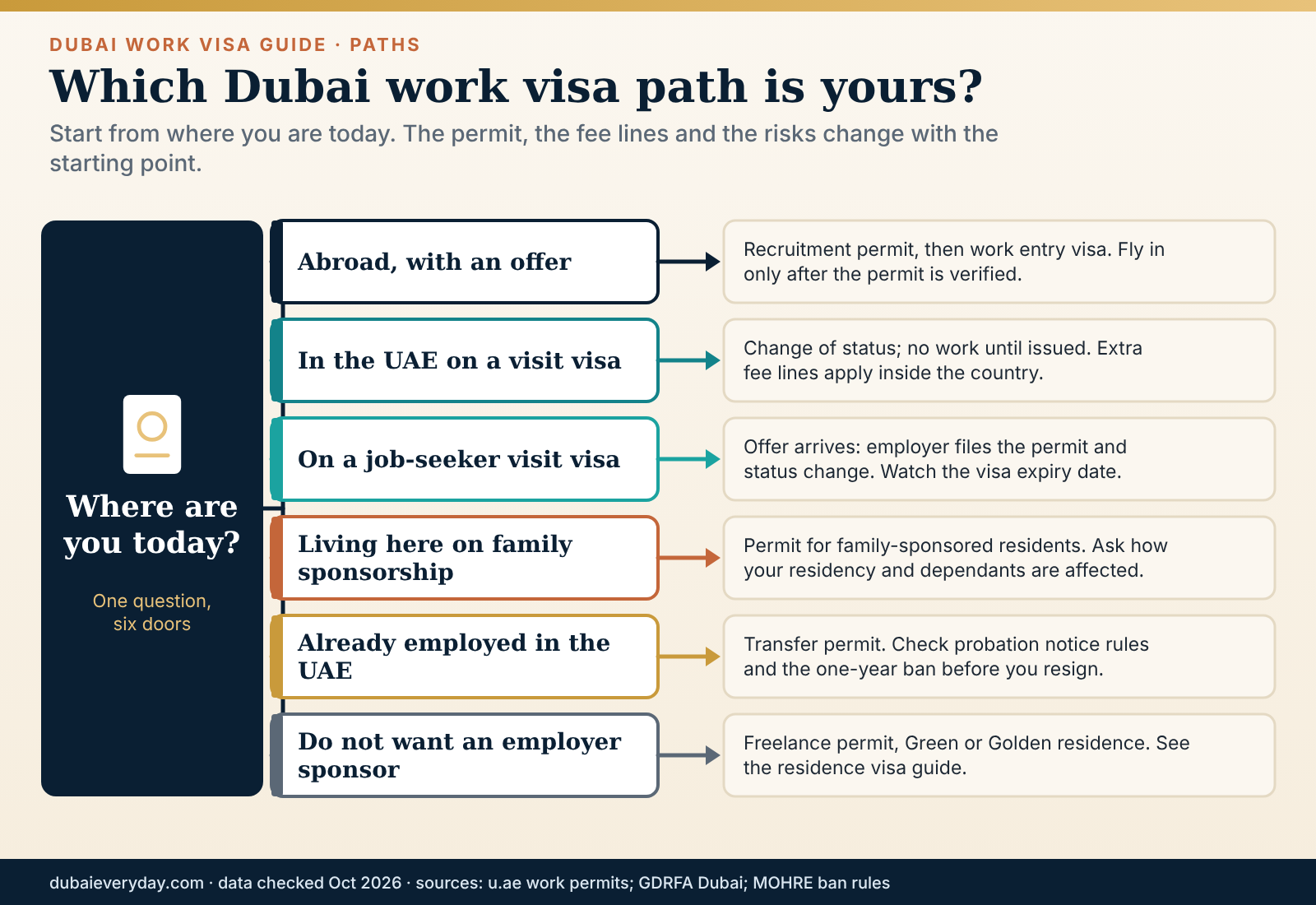
You are outside the UAE with an offer
This is the main route and it is the whole of stages 1 to 7. The permit type is the recruitment-from-abroad permit, the document you travel on is the work entry visa, and nothing needs to be done inside the UAE until you land. The one choice you control is when to leave, and the best answer is: after the entry permit is in your hands and verified, with slack on both sides of its validity.
You are inside the UAE on a visit or tourist visa
You cannot work. The employer can still file for you, using the change-of-status route that replaces the entry permit, and the same MOHRE steps apply. The GDRFA fee lists show extra lines for people inside the country, which we have laid out above. What you should ask for in writing is the sequence: who files, whether you leave and re-enter, what the filing date is, and what your status is on each day between now and the visa. Do not carry on a “trial week” in the meantime.
You are on a job-seeker visa
The job-seeker visit visa, which GDRFA Dubai presents as a single-entry visa for 60, 90 or 120 days with no sponsor needed, is a search tool, not an employment status. Fees and eligibility are covered in the job-search guide, where the sources disagree on who qualifies. For this page, what matters is the moment an offer arrives.
At that point the employer files the work permit and a change of status, and the same rule applies as above: no work until the paperwork is complete. Watch the visa’s expiry date, since the Dubai work visa process is quicker than the clock only if the employer files promptly.
You are living here on a family sponsorship
Case C above applies. The MOHRE permit type exists, the employer can hire you, and the open questions about residency and dependants need answers before you sign. The notable rule from the ban page is that people sponsored under family residence visas are among those exempt from the one-year work-permit ban in work-abandonment cases, a small but real protection if a job goes wrong.
You already work in the UAE and are changing employer
The transfer permit lets a new establishment take on a non-UAE worker who is already in the country, valid for two years. You are allowed to work for the new employer after termination only if your previous contract expired and was not renewed, was ended on one of the legitimate grounds in Articles 42 or 45, or was ended by the employer without fault on your part.
If you are still in probation, the notice rules apply: at least one month’s written notice, with the new employer compensating the old one for recruitment costs unless otherwise agreed.
The sharp edge is the one-year ban. It applies if you quit during probation without the employer breaching its obligations, or if a work-abandonment report against you is proven valid. The ban period starts when you leave the UAE. Before you resign for a new job, ask the new employer in writing whether your move is a transfer, a cancel-and-reapply or something else, and check that you are not inside a probation period.
You work for a free-zone company, or you are moving to or from one
Free zones have their own authorities and the government pages we read do not describe them. The u.ae workers’ rights page lists a separate “free zone complaints” service among MOHRE’s online channels, which suggests free-zone workers have some recourse to the ministry, but the permit and visa mechanics may differ. If your offer comes from a free-zone entity, ask three things: which authority issues the permit, which authority issues the residence visa, and whether the visa allows you to take a job with a mainland company if you later move.
You do not want an employer to sponsor you
Some people do not need this page at all. MOHRE issues a freelance permit with no employer sponsorship or employment contract required. The Green residence, per the ICP page logged in our moving research, offers five-year self-sponsored residency to skilled workers who have a contract, a skill level of 1 to 3, a bachelor’s degree and a salary of AED 15,000 or more, and to freelancers who meet an income test.
Golden visas, per the u.ae page, include a ten-year category for people with exceptional talent or rare specialisations, with each subcategory carrying its own conditions, and holders can stay outside the UAE for longer than the usual six months. The remote-working visa figures conflict across sources and are covered in the moving guide. All of these are compared in the residence visa guide.
If your aim is to run your own company and sponsor yourself, that is a different search job. Start with the business setup guide.
What a Dubai work visa costs and who pays
The cost question has two halves that readers often mix up. One is what the government charges for each step. The other is who is supposed to pay it. The first is a matter of published fee lists, which we can quote with sources. The second is a matter of law, and the law on this point is clear and favourable to the worker.
The legal rule on who pays
The u.ae workers’ rights page states that charging recruitment fees to prospective employees is illegal, and that the employer you contract with must pay recruitment and travel costs plus the cost of your UAE residency permit. The Labour Law text logged in our job-search research adds that an employer may not charge workers recruitment fees and may not withhold their documents. The same point is made in the government’s job-search guidance: a genuine company never asks you for money for the visa or the medical.
That leaves a small zone of things that are legitimately yours. Examples are renewing your own passport, personal travel beyond what the contract provides and, in many cases, getting your own certificates attested at home. The last item is common but we could not verify a rule, so settle it in the offer. The test is whether the cost is a business cost of hiring you. If it is, the law points at the employer.
The official Dubai work visa fee lines, laid out
The figure below stacks the government fee lines we could read for a new hire arriving from abroad. All are employer-side costs. The MOHRE permit appears as a range because the page gives a span by company category and keeps the line items in images.

- MOHRE work permit: AED 250 to AED 3,450 depending on company classification A, B or C (u.ae work-permits page).
- GDRFA work entry visa: AED 200 plus 5% VAT, which is AED 210. Inside the country, add AED 10, AED 10 and AED 500.
- GDRFA residence permit: AED 200, AED 10, AED 10, AED 500 for applying inside the country and AED 20 for delivery, which is AED 740 in total on our reading.
- Emirates ID: AED 100 per year of residence plus AED 100 smart service fee. Our reading for a two-year visa is AED 300.
Our calculation of the lines we can read is AED 1,250 without the MOHRE permit: AED 210 plus AED 740 plus AED 300. At the 3.6725 peg that is about USD 340. Adding the MOHRE range gives AED 1,500 at the lowest classification and AED 4,700 at the highest, or about USD 410 to USD 1,280. The total excludes the medical, health insurance, typing or service-centre charges and any attestation. The number is a floor for what the employer spends, not the total.
What a Dubai work visa can cost you, even if the employer pays
The Dubai work visa chain also costs the worker time and some money that does not appear on a government fee list. These are the ones to plan for.
The first is paperwork you pay for at home: passport photos, certified copies, translations and attestation fees, and courier costs for originals. The second is time off your current job, since the notice period at your old employer may cost you pay if you leave early.
The third is the temporary stay while the Dubai work visa process runs, covered in the cost of living guide and the single-person budget. The fourth is the gap between landing and first salary, which a monthly pay cycle makes longer than most people expect.
What you should never pay for
Against the legal rule, the following are red flags, and they are the pattern behind most visa scams.
- A “processing fee”, “visa fee”, “registration fee” or “security deposit” asked by someone claiming to represent the employer.
- A payment to a personal bank account or a transfer service for an “approved” visa.
- A payment to book a medical test with someone you have not been told to expect.
- A visa sold through social-media advertisements, which the Dubai Police has warned against in 2026, according to headlines in our sibling research.
- A request for your passport original before you hold a verified entry permit.
If any of these appear, stop and use the verification steps in the next section. If you have already paid, the job-search guide explains what to do next, including reporting to the police.
Checking that your Dubai work visa papers are real
Visa fraud works because the Dubai work visa process really is opaque from the outside. You cannot see the MOHRE file, the GDRFA queue or the employer’s internal steps, so a scammer only has to supply convincing-looking documents at the right moment. The defence is not suspicion in general. It is a short list of checks that the government itself recommends, each tied to one document in the Dubai work visa chain.
Five gates before you rely on anything
Think of the checks as gates in a funnel. A genuine process passes through all of them without complaint, and a fake one fails at one of them. The figure shows the order; the text explains each gate.

Gate one: the offer
Per the u.ae fraud-tips page, a legitimate offer is an offer letter from MOHRE signed by an authorised manager, and its reference number can be checked on the MOHRE enquiry service. Our job-search research logged the same advice from Gulf News: a genuine MOHRE offer form carries a unique serial or barcode, and the MOHRE app, website and call centre can verify it. If the sender will not give you the transaction number, or sends only a PDF on plain letterhead, that is the answer.
Gate two: the company
The government page tells you to search the company’s English and Arabic names in the National Economic Register. Check that the legal name, the activity and the emirate match the offer. For recruiters, the u.ae recruitment-agencies page says MOHRE licenses agencies and lets you check a licence. Also look at the email address: the job-search guidance says the sender’s domain should match the organisation, not a free mail service.
Gate three: the entry permit
An entry permit is a document you can check. The u.ae page says Dubai-issued visas and entry permits are verified on the GDRFA website, and permits from the other six emirates on the ICP e-channels platform. Do this before you buy a ticket. Be aware of one look-alike: the same page notes that tourist entry permits can be issued by UAE airlines, licensed hotels and licensed travel agencies. A tourist permit looks similar and does not let you work.
Gate four: the money rule
No payment to the employer, an agent or a “processing team” for the visa or medical, as set out above. This gate is the cheapest to apply and the most effective. It costs you nothing to say, “I understand the employer covers visa and recruitment costs under UAE law; please send the invoice to the company.”
Gate five: official contacts
Use channels you found yourself. The u.ae page lists MOHRE on 009716-802-7666 and [email protected], live chat for Dubai visa matters through the Amer contact page, and ICP live chat for the other emirates. Do not use phone numbers or links supplied by the person offering the job. If the answer from the official channel does not match what you were told, believe the official channel.
The patterns behind the common scams
Four patterns recur in the warnings we read. The first is the fake offer using a real company’s name, which Dubai Police warned about in January 2026, according to The National as logged in the job-search research. The second is the “tourist first, work later” arrangement, where you are asked to arrive on a visit visa with a promise to convert.
This is exactly what MOHRE warns against, since working on a visit visa is a serious offence. The third is the advance-fee request framed as a government charge. The fourth is the sale of visas through social media, which we know only from a headline.
If you have already paid or shared documents, keep every message and receipt and report it. The job-search research records reporting through the Dubai Police app or eCrime, or by calling 999 or 901, and it explains the order of steps. The jobs guide and the legal basics guide cover the wider consumer and employment protections.
When the process stalls, and mistakes that cost weeks
Most Dubai work visa applications go through without drama, but the ones that do not tend to fail at the same few points. Knowing the pattern lets you ask the right question at the right time.
The permit does not arrive
If the offer is signed and a week or two passes without an entry permit, assume the problem is upstream of GDRFA. The entry permit needs MOHRE’s endorsement, so the first question is whether the work permit has been filed and approved. Ask HR for the MOHRE transaction number and status. If the employer cannot give one, the application may not have been filed. If it is filed and waiting, the employer’s own account may be the cause, such as a block on new permits for compliance reasons.
The entry permit has an error
A misspelt name or wrong passport number should be corrected before you fly, because the airline and passport control read the same data. Ask the employer to apply for the correction through GDRFA, and do not travel on a document you know to be wrong in the hope that it will not matter. This is a case for patience, because the fix runs through the same authority that issued the permit.
The medical goes wrong
A delayed result stalls everything, but a failed or inconclusive result raises a different issue. We could not find an official explanation of the next steps, so the right action is to ask the centre and the employer, and to take medical advice. If your employer is unsupportive, MOHRE’s contact channels exist for disputes about the employment process, though not for medical questions.
The visa is not issued after the medical
The Dubai government page says the visa is issued within 48 hours of the result being released. If three or four days pass, ask the employer whether the application has been filed, since an employer that is waiting on its own approvals can leave a file sitting. A common cause of silence is simply that the person handling your file is covering many files. A polite message with the date of the medical and a request for the application number usually gets a real reply.
The employer goes quiet or withdraws
This is the hardest case, because by now you may have resigned and travelled. If the offer is withdrawn after you arrive, the position is difficult and the details depend on how far the process had gone. Keep copies of the offer and all messages, and contact MOHRE through 600590000 or the 80084 labour-claims line, which the u.ae rights page lists. Ask your own embassy for help if you are stranded. Prevention is better: do not resign from your current job until the verified entry permit is in your hands.
A simple escalation ladder
- HR or the PRO.Ask for the transaction number, the date filed and the expected next step. Put the question in writing.
- The service centre handling the file.Many employers use accredited centres. They can tell you the status of their own submissions.
- GDRFA Dubai.Use the contact page and Customer Happiness Centres for immigration questions on Dubai permits and visas.
- MOHRE.For work-permit and contract issues, use 600590000, the 80084 labour-claims line, or the online grievance and complaint services.
- Police.If money has been taken under false pretences, report it as fraud.
Mistakes that cost weeks
The mistakes below are the ones the official pages implicitly warn against. They come from our reading of the rules, not from anyone’s personal story.
Resigning before the entry permit exists is the most expensive. A signed offer is not a permit, and the permit is the proof that MOHRE has approved the hire. Booking a non-refundable ticket for a date the permit does not support comes second, particularly in a year when flights have been disrupted. Third is arriving on a passport with less than six months’ validity, which can stop the Dubai work visa process before it starts.
A fourth mistake is starting work early. The prohibition on working on a visit or tourist visa applies to paid and unpaid work, and it is not softened by the employer’s goodwill.
A fifth is letting the one-month residency clock slide because you are enjoying the first weeks, and a sixth is signing a contract on day one that differs from the offer without asking for the difference to be fixed. A seventh is assuming a friend’s route applies to you: the transfer, the freelance permit and the family-sponsored permit each have different rules.
The eighth mistake is quieter. People lose their copies. Keep the offer, the registered contract, the permit and visa documents, the medical result and the Emirates ID on two separate backups. A renewal in two years, or a dispute in five, will start with those papers.
Leaving the job, renewing the visa, staying valid
A Dubai work visa is tied to a job, and the end of the job starts a clock. Most readers do not need this section on the day they land, but they will need it eventually, and the rules interact with everything above: probation, notice, cancellation and the one-year ban. Knowing the shape of the exit in advance also makes you a better negotiator at the start, when you are still reading the offer.
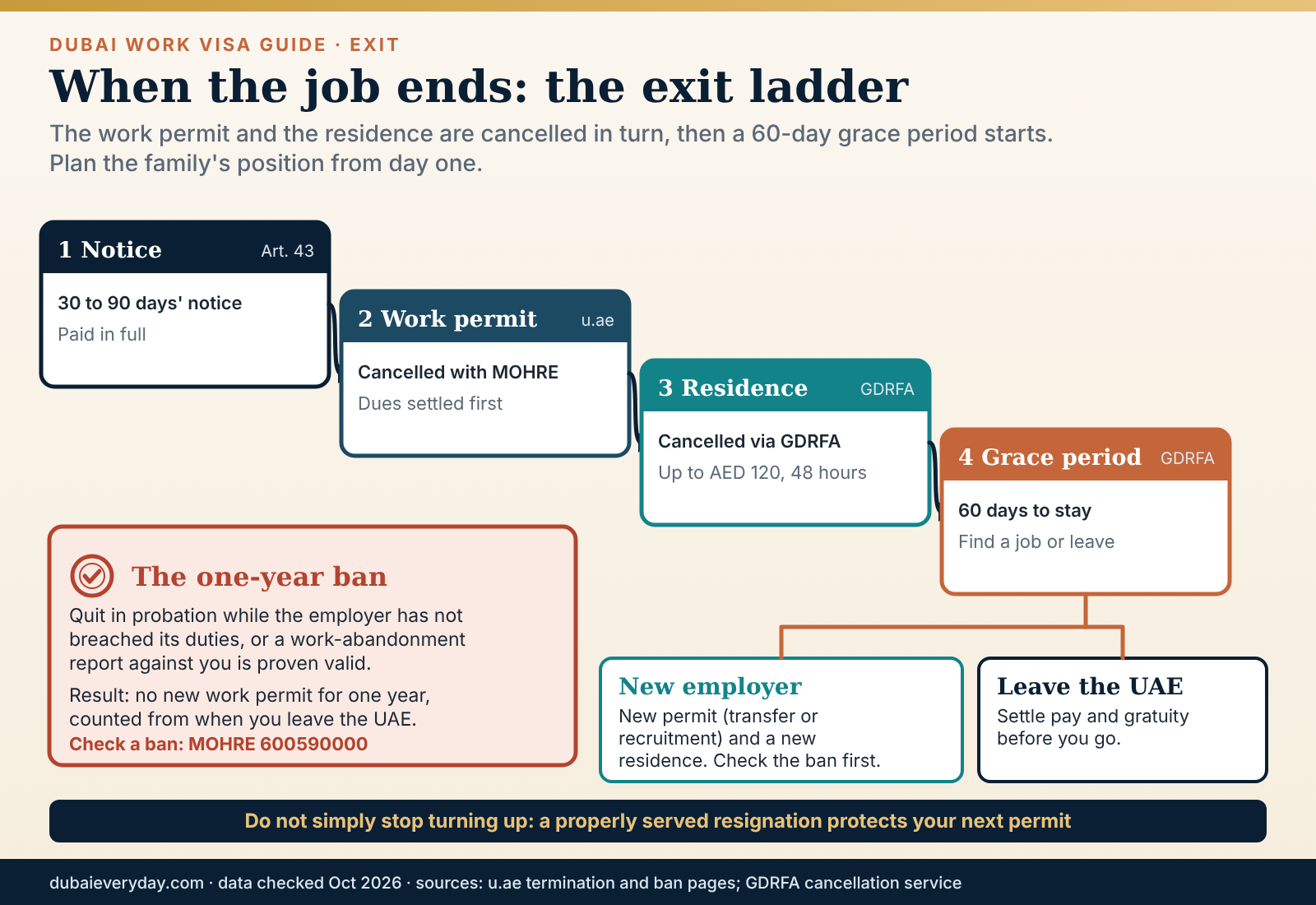
How a contract can end
The u.ae page on termination lists the grounds under Article 42 of the Labour Law. They include mutual written agreement, expiry of a fixed-term contract without renewal, notice by either party, the death or permanent inability of the worker, a final court sentence of at least three months, permanent closure of the establishment, the employer’s bankruptcy or exceptional economic reasons, and the worker failing to meet permit-renewal conditions for reasons outside the employer’s control.
For notice, Article 43 sets a minimum of 30 days and a maximum of 90, in writing. The contract continues during notice with full pay on the latest salary. A party who skips notice owes the other an allowance calculated on the last wage. If the employer terminates, the worker may take one unpaid day off a week to look for work, with at least three days’ notice of which day.
Dismissal without notice, and leaving without notice
The employer can dismiss without notice only on a closed list of grounds in Article 44, after a written investigation and with a written, justified notice. They include use of false identity or forged documents, deliberate damage, repeated failure to perform after two warnings, disclosure of confidential information, working under the influence, assault, unexcused absence of more than 20 non-consecutive days in a year or more than 7 consecutive days, and joining another establishment without following procedure.
Workers have a mirror list in Article 45, which lets them leave without notice and keep end-of-service entitlements. It covers an employer who breaches contract or legal duties (with a notification to MOHRE 14 working days before quitting), assault or harassment (reported within five working days), fundamentally different work without written consent, and known grave dangers to health or safety. Dismissal triggered by a valid complaint to MOHRE or a lawsuit is arbitrary under Article 47, and a court may award up to three months’ wages in compensation.
What happens to the permit and the residency
When employment ends, the employer cancels the work permit with MOHRE, then the residence permit through GDRFA. The GDRFA cancellation service lists the required documents as the sponsor’s passport, the sponsored person’s passport and, for private-sector employees, an extract of the work-permit cancellation from MOHRE. The fee is AED 100, with a Knowledge Dirham and an Innovation Dirham of AED 10 each which may also apply, for a possible total of AED 120. Processing is stated at 48 hours.
Then comes the number that matters most for planning. The GDRFA page states that after cancellation or expiry of the residence permit there is a grace period of 60 days during which you may remain in the country.
The u.ae termination page confirms that there is a grace period to find a new job and obtain a new work permit, or to leave, but does not state its length, so rely on the GDRFA figure and check your own cancellation notice for the exact end date. Your salary, gratuity and other dues should be settled in this window, not after you have left. The jobs guide works through gratuity examples.
The one-year work-permit ban
A worker can be banned from receiving a new work permit for one year if they quit during probation where the employer has not breached its obligations, if a work-abandonment report against them is proven valid, or if their permit at a fictitious establishment was cancelled. The u.ae page lists exemptions in abandonment cases for family-sponsored residents, those applying with the same establishment, workers with skills the UAE needs and Golden visa holders. The employer files the complaint and MOHRE reviews it in stages before imposing a ban.
You can check for a ban on 600590000, which the page lists as available from 8 am to 8 pm in several languages. To contest one, file a grievance through MOHRE’s approved channels with documents showing that it is unjustified. The ban lifts automatically when its period ends, and the period starts when you leave the UAE. The practical lesson: do not simply stop turning up. A resignation done properly, with notice served, is the cheapest way to protect your future permits.
What happens to dependants
If you sponsor family members, their residency depends on yours. The u.ae family-sponsorship page, as logged in our moving research, gives dependants a six-month grace period after the sponsor’s visa is cancelled or expires. That is longer than your own 60 days, but it is not a reason to relax: the family’s position needs a plan from the day your own notice is served. The sponsorship rules are in the residence visa guide.
Unemployment insurance as a cushion
The UAE’s mandatory unemployment insurance scheme pays a share of basic salary for up to three months after involuntary job loss, if you have paid contributions for twelve months. The premium bands and caps are in the job-search guide, and the scheme’s own site is iloe.ae. It does not cover resignation, and it does not replace the 60-day residency clock, but it does give you a sum to plan with during the grace period.
Renewing a Dubai work visa, and long absences
The Dubai work visa, meaning the residence visa, is valid for two years and renewable for similar periods under the same conditions as the original grant, with GDRFA noting a AED 100 per year increase in the issuance fee when residency exceeds two years.
Employers usually handle renewal, but the dates are yours to track. Late Emirates ID renewal costs AED 20 a day after the first month, capped at AED 1,000. A calendar entry six months before the visa expiry date is a sensible prompt for the conversation about whether you are staying.
On absences, the u.ae Golden visa page presents the ability to stay outside the UAE for more than the “usual” six months as a Golden visa benefit, which implies that ordinary residents face a six-month limit. The page does not state what happens when an ordinary resident exceeds it, so check with ICP or GDRFA before a long stay abroad. A sabbatical or a long family stay in your home country is where this rule bites.
What a Dubai work visa lets you do next
Once the residence visa and Emirates ID are in hand, the practical doors open. You can sponsor family if you meet the salary rule (AED 4,000, or AED 3,000 plus accommodation, per the u.ae family-visa pages we logged). You can exchange a foreign licence if your country is eligible, as covered in the licence exchange guide. You can sign a lease and open the utilities. If children are coming, start school research early using the schools guide. These are other search jobs, each with its own page.
The plan in one page
Everything above compresses to a short sequence you can print. It assumes a standard overseas hire with a mainland employer, and every item has a section behind it.
- Before you sign.Check the offer in the MOHRE enquiry service and the employer in the National Economic Register. Confirm job title, workplace, term, probation and who pays what. Ask for a third-language version if you need one.
- While the employer files.Renew the passport if it has under six months to run. Start attestation if your job needs it. Do not resign yet.
- When the entry permit arrives.Verify it on the GDRFA site, check every character of your name and passport number, and only then give notice and book a changeable flight.
- In the first days.Land inside the permit window. Take the medical on day one or two. Confirm that health insurance is arranged.
- In the first month.Provide biometrics for the Emirates ID, sign and register the contract within 14 days of arrival, and keep digital copies of every document.
- For the next two years.Diary the visa and card expiry dates, know your notice and probation terms, and never let anyone hold your passport.
The Dubai work visa process rewards people who treat it as a project with a checklist, a contact at the employer and a paper trail. It punishes the ones who treat it as someone else’s problem. Most of the steps are short once they start. The long parts are the waiting between them, and the only way to shorten that is to make sure nothing is missing when each step begins.
Dubai work visa FAQ
How long does a Dubai work visa take?
No authority publishes an end-to-end figure for a Dubai work visa. The stated service times are five working days for the MOHRE work permit under the Work Bundle description, 48 hours for the GDRFA entry permit, 48 hours for the residence visa after the medical result, and five days for the Emirates ID.
Our illustrative sequence adds up to roughly six weeks from signed offer to card, with the medical result time assumed. Real timelines depend mostly on how quickly the employer files and how quickly the medical result comes back.
Who pays for a Dubai work visa?
The employer. The u.ae workers’ rights page says charging recruitment fees to prospective employees is illegal and that the employer must pay recruitment and travel costs plus the cost of your UAE residency permit. Things such as renewing your own passport or attesting your own certificates at home are usually negotiated, so settle them in the offer. If anyone asks you to pay a visa fee, a processing fee or a deposit, treat it as a warning sign and verify through official channels.
Can I work on a tourist or visit visa while my Dubai work visa is processed?
No. The u.ae portal states that working on a visit or tourist visa is prohibited, whether paid or unpaid, and that both employees and employers who violate the rule face fines and legal accountability. A change-of-status permit exists for people already inside the country, but you should not start work until the work permit and residence are issued. If the employer wants you to start earlier, ask for the start date to move.
Can I apply for a Dubai work visa myself?
For the standard employee route, no: the employer is the sponsor and applies for the permits. The u.ae page says plainly that the employer must apply for the standard Dubai work visa. Some routes are self-sponsored, including the freelance permit from MOHRE, the Green residence for skilled workers and freelancers, and Golden visa categories. Each has its own eligibility rules, which the residence visa guide compares.
How long is a Dubai work visa valid?
The standard residence visa for work is valid for two years and can be renewed for similar periods under the same conditions as the original grant, according to the Dubai government and GDRFA pages. The entry permit that precedes it is much shorter: you must use it within about 60 days, and it lets you stay 60 days from entry to complete residency. The GDRFA page notes the issuance fee rises by AED 100 per year if residency exceeds two years.
What is the difference between a work permit and a residence visa?
A Dubai work visa is really several documents. The work permit is MOHRE’s approval for an employer to hire you for a particular job. The residence visa is the immigration permission to live in the UAE, issued by GDRFA in Dubai after the medical. They are linked, since cancelling a private-sector residence requires an extract of the work-permit cancellation, but they are separate documents from separate authorities. The Emirates ID is a third thing, the federal identity card issued by ICP.
What medical tests are needed for a Dubai work visa?
The Dubai government page says the medical fitness test is done at an authorised centre in Dubai and typically includes a blood test and a chest X-ray. The u.ae portal cites Cabinet Resolution No. 5 of 2016 for the requirement. Earlier summaries of that portal named HIV, hepatitis B, syphilis, tuberculosis and leprosy, but we could not reconfirm the list today, so check with the centre. Fees and turnaround were not published on the pages we read.
Do I need to be in Dubai when the Dubai work visa is issued?
For the residence visa, yes. The u.ae portal says residency visas cannot be processed for applicants outside the UAE, so you must first enter on a valid entry permit and stay in the country until the Dubai work visa process is complete. You do not need to be in Dubai for the work permit or the entry permit, which the employer applies for while you are abroad. This is why the medical happens after you land.
Can I change jobs on a Dubai work visa?
Yes, a Dubai work visa holder can change jobs within the rules. You can work for a new employer after your contract expired and was not renewed, was ended on legitimate grounds, or was ended by the employer without fault on your part.
Your new employer can use a transfer permit for a worker already in the UAE. The risk points are probation, where you must give at least one month’s written notice and the new employer compensates the old one, and the one-year ban in cases of quitting in probation or proven work abandonment.
What happens to my Dubai work visa if I lose my job?
When a job ends, the employer cancels the work permit with MOHRE and the residence with GDRFA, and the GDRFA service page states a 60-day grace period after cancellation or expiry during which you may stay. In that time you can find a new employer who obtains a new permit for you, or you can leave. Your dependants have a longer six-month grace period per the u.ae family-sponsorship page. Your final pay, notice pay and gratuity should be settled before you go.
How do I check that an entry permit or offer is real?
To check a Dubai work visa document, verify the offer’s reference number on the MOHRE enquiry service, search the company in the National Economic Register in English and Arabic, and verify Dubai-issued visas and entry permits on the GDRFA website. Remember that tourist entry permits issued by airlines, hotels and travel agencies look similar but do not allow work. Never pay a fee to anyone for the visa or medical, and use official contact details you found yourself.
Can my family join me on my Dubai work visa?
Often, once your Dubai work visa is issued and you hold residency and meet the sponsor conditions. The u.ae family-sponsorship pages logged in our moving research give a sponsor salary of at least AED 4,000, or AED 3,000 plus accommodation, and cover spouses, unmarried daughters, sons under 25 and children with special needs, with parents possible on a yearly basis. Dependants aged 18 and over need a medical test. Verify the current conditions and the document list in the residence visa guide and on the official pages.
Is a free-zone Dubai work visa the same as a mainland one?
The shape is similar, with an offer, a permit, an entry permit, a medical, a residence visa and an Emirates ID, but the authorities and fee schedules can differ. The government pages we read do not describe free-zone mechanics, and we could not verify free-zone fees. Ask the employer which authority issues your permit and your visa, and whether your residency lets you move to a mainland employer later.
Related reading
Sources and further reading (21 links)
- Dubai government: Residence visa for work — the stage sequence, 60-day entry window, 48-hour issuance, two-year validity
- u.ae: Preparing to work — passport validity, entry permit validity, attestation, visit-visa work ban
- u.ae: Job offers and the employment process — offer requirements, languages, contract registration within 14 days
- u.ae: Employment contracts, duration and models — contract models, probation, non-compete
- u.ae: Work permits — the 13 permit types, conditions, fee range, Work Bundle
- u.ae: Professional levels of jobs in the UAE — levels 1 to 5 and the skilled-labour conditions
- u.ae: Terminating employment contracts — termination grounds, notice, arbitrary dismissal
- u.ae: Banning the issuance of a new work permit for one year — ban triggers, exemptions, checking and appeal
- u.ae: Tips to stay safe from labour and visa fraud — offer and visa verification, contacts
- u.ae: Protection of workers’ rights — who pays, passport rule, hotline 80084
- u.ae: Residence visa for working in the UAE — standard Dubai work visa, two-year validity, employer applies
- GDRFA Dubai: Visa issuance for foreigners linked with job contract — work entry visa fees, documents, 60-day stay, 48 hours
- GDRFA Dubai: Issuing residence permits for the private sector — requirements, fee lines, validity, grace period
- GDRFA Dubai: Cancellation of all types of residence permits — cancellation documents, fee, 60-day grace period
- u.ae: Golden visa — talent category and the six-month absence benefit
- ICP: Emirates ID new issuance — fees, five-day completion, passport and biometric rules (via DubaiEveryday moving-to-Dubai research log)
- u.ae: Emirates ID — late renewal, change and loss rules (via DubaiEveryday relocation-checklist research log)
- Dubai government: Health insurance — mandatory cover and who insures whom (via relocation-checklist research log)
- ILOE: Unemployment insurance scheme — mandatory scheme, benefit and eligibility (via job-search research log)
- MOHRE: Federal Decree-Law No. 33 of 2021 and amendments — probation, notice, recruitment fee and document-withholding rules (via job-search research log)
- UK FCDO: UAE travel advice — travel-disruption context (via relocation-checklist research log)
Update log: 29 October 2026 — first publication; the government pages listed above were re-read on this date. Items marked as taken from a sibling research log were read by other DubaiEveryday writers on the same date. Next review due: within three months, or immediately after any change to MOHRE, GDRFA or ICP rules. Corrections welcome. This page is general information, not legal or immigration advice; confirm your own case with your employer’s government-relations team, the official authorities or a licensed adviser.
About DubaiEveryday and this guide
DubaiEveryday.com is an independent editorial project that publishes practical, research-based guides to everyday life in Dubai: where to live, what things cost, how the rules work and how to get around. This page was written and edited by the DubaiEveryday editorial team. It is not signed by a named expert, doctor, lawyer or adviser, and we do not claim first-hand testing of a venue, clinic or service unless the page says so.
Each guide is built from official sources such as government and regulator pages, operator websites and established news outlets, cross-checked where we can. When we could not confirm something, we say so in the text, and examples that use made-up numbers are labelled as illustrations. Mentions are editorial choices, not paid placements, and a link is not an endorsement.
Dubai changes quickly. If you spot something that is out of date or wrong, please tell us through the contact options on DubaiEveryday.com and we will check it and correct the page.