
Choosing veneers in Dubai comes down to five decisions: porcelain or composite, how much enamel you are willing to give up, who is licensed to do the work, what the price really includes and how long the result should last. This guide works through each one using Dubai Health Authority documents and published clinical studies, checked on 29 October 2026.
A veneer is a very thin shell, but the decision behind it is not thin at all. Once enamel has been trimmed it does not grow back, which is why the first consultation matters more than the logo on the clinic door. Then the quotes arrive, and they sit so far apart that you start to wonder whether the clinics are even pricing the same treatment. Quite often, they are not.
This veneers dubai guide sorts out the parts that matter before you sit in the chair: porcelain against composite, how much tooth is removed, who may place veneers under Dubai Health Authority rules, what published prices actually cover and how long a set can reasonably last. It is built from official documents and published studies rather than clinic brochures. It is general information only, so the final call belongs to a licensed dentist who has examined your mouth.
Veneers Dubai clinics offer are thin shells of porcelain or composite resin bonded to the front of a tooth to change its colour, shape or length. Porcelain is made in a laboratory, usually takes more visits and costs more per tooth. Composite is built up on the tooth by the dentist, often needs less enamel removal and is easier to repair, but it stains and wears sooner. Either way, some enamel is normally trimmed, so the decision is treated as irreversible.
For veneers Dubai rules come from the Dubai Health Authority (DHA), which lets general dentists place them only with specific extra training, and its scope document points aesthetically demanding front-tooth work towards prosthodontists. Look the dentist up on the DHA registry and ask for the veneer training in writing. Published per-tooth prices run from AED 800 to AED 9,500 (nine prices from six providers, read 14 October 2026), and that spread mostly reflects different materials, scope and VAT wording rather than proven quality differences.
A pooled review of 25 studies put the ten-year survival of porcelain veneers at 95.5%, with fractures and debonding as the usual failures. This page is general information, not dental advice. A licensed dentist has to examine you first.
This is a research-based guide, not a clinic review. We did not visit any clinic, have no treatment of our own to report and hold no clinical qualification. No dentist has reviewed this draft yet, so read it as an informed layperson’s summary of official documents.
The Dubai rules come from DHA documents read on 29 October 2026: the dental scope-of-practice standard (SP-04), the prosthetic dentistry guideline (CG-05, which contains the veneer protocol), the restorative dentistry guideline (CG-01) and the social media advertising standard (ST-21). Clinical background comes from the American Dental Association and from three published reviews or studies named in the text. Prices come from one healthcare directory that reads clinics’ own websites, and its veneers Dubai data set is small.
We name no clinic and rank none. Inclusion was not paid for, and there are no affiliate links. Anything we could not confirm is flagged in the text. Illustrative numbers are labelled as such and are never market facts.
Veneers Dubai: what they are and what they are not
A veneer covers the front surface of a tooth. A crown wraps the whole tooth. That single difference decides most of the rest: how much tooth is removed, what a dentist can still repair later and why veneers sit in the cosmetic corner of dentistry while crowns are mostly structural. The American Dental Association (ADA) lists the usual reasons people choose veneers: chipped or broken teeth, stains that bleaching does not shift, teeth that are misshapen or crooked, and small gaps.
The DHA’s prosthetic dentistry guideline, CG-05, issued on 31 December 2025 and effective from 1 March 2026, lists a similar set: discolouration, shape defects, mild misalignment, wear from grinding or acid erosion, and gaps at the contact points between teeth. It also calls veneer work technique-sensitive and often irreversible. Those two words, technique-sensitive and irreversible, are the reason this veneers Dubai guide spends so much time on who does the work and how it is planned.
What veneers Dubai patients should not expect them to do
They do not fix decay, gum disease or a bad bite. The ADA says existing decay or gum disease must be treated first, because a veneer over an unhealthy tooth can make the problem worse. The DHA guideline says the same, and adds that people who clench or grind should be given a night guard.
They also do not straighten teeth. The DHA text says mild misalignment can be improved by a visual illusion, which is a polite way of saying the dentist can change how teeth look, not where the roots sit. If your teeth are properly crowded or your bite is off, veneers may hide the problem while leaving it in place.
The “Hollywood smile” label
Veneers Dubai adverts use phrases such as Hollywood smile for a full upper set, often eight to ten teeth. That is a marketing label, not a clinical term, and nothing in the DHA guideline defines it. When a package carries that name, ask four plain questions: how many teeth, which material, how much enamel will be removed and who makes the veneers.
Where this page stops
This veneers Dubai guide covers veneers only. For how to check a clinic, how DHA and Dubai Healthcare City licensing differ and what dental work costs in general, the Dubai dentist guide goes wider. If your real problem is a missing tooth rather than a discoloured one, the dental implants guide covers that job, and the All-on-4 guide covers full-arch replacement.
Porcelain vs composite veneers: the honest comparison
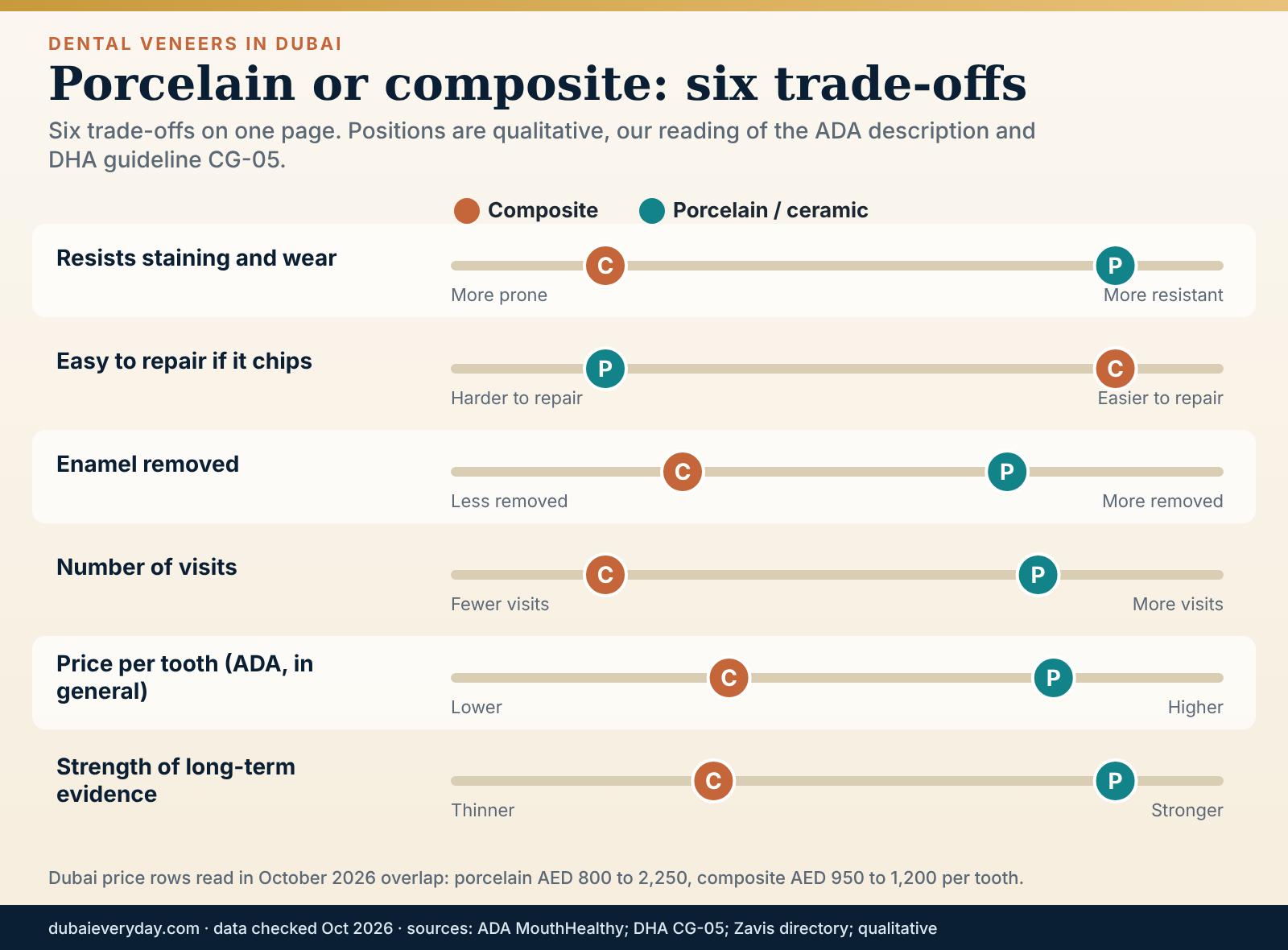
Most veneers Dubai patients are offered fall into two families. Porcelain, which dentists often call ceramic, is a thin shell made outside the mouth by a dental laboratory or a milling machine and bonded on at a later visit. Composite is a tooth-coloured resin that is sculpted onto the tooth, hardened with a curing light and polished. The ADA describes porcelain as strong, long-lasting and natural-looking, and as the more expensive option. It describes composite as quicker, easier to repair, and less resistant to staining and wear.
Which ceramic?
“Porcelain” is a loose word. The DHA guideline names two ceramic families. Lithium disilicate is described as offering strength together with translucency. Feldspathic ceramic is described as offering very high aesthetics and a polishable surface, and it often needs only minimal preparation. A third material, zirconia, shows up in one clinic price listing in Dubai but is not discussed in the DHA veneer protocol, so we leave it with a question mark: if a quote says zirconia, ask why that material suits a front-tooth veneer in your case.
There is some evidence that the ceramic type matters. A 2021 systematic review in the Journal of Clinical Medicine, covering 25 clinical studies and about 6,500 porcelain laminate veneers, found that non-feldspathic ceramics had fewer failures than feldspathic ones: 40 failures among 1,576 veneers against 66 among 1,614. Studies differ in era, operator and patient, so it is a reason to ask which ceramic is proposed and why, not a reason to demand one.
Where composite fits
The DHA guideline describes composite as the additive approach and ceramic as the subtractive one. It says composite veneers suit young patients and minimally invasive cases. The ADA notes that composite may need less enamel removal and fewer visits. It still lists enamel removal as part of both routes, so “no drilling” claims deserve a follow-up question.
The longevity data for direct composite is looser than for porcelain. A 2022 review in the Journal of Conservative Dentistry looked at 25 studies of front-tooth composite restorations. Across nine studies of veneers or gap closures followed for between about 2.5 and 11 years, survival ranged from roughly 74% to 95%. Fracture was the main reason for failure, and teeth that had lost their nerve failed about twice as often in one study. The review itself warns about high variation between studies, so treat the range as a mood, not a forecast.
| Point | Porcelain / ceramic | Composite resin |
|---|---|---|
| Where it is made | In a laboratory or milled to order, then bonded | Built directly on the tooth, or in a lab in indirect versions |
| Typical visits | Usually more than one, with a gap for fabrication | Often one, according to the ADA |
| Enamel removal | Small amount from front and sides (ADA); depth depends on style | May be less, but not zero (ADA) |
| Staining and wear | Resists both better (ADA) | Less resistant (ADA) |
| If it chips | Often replaced; repair is limited | Easier to repair (ADA) |
| Evidence summary | Pooled ten-year survival 95.5% (25 studies, 2021) | Survival about 74% to 95% across nine veneer or gap studies (2022) |
| Dubai published price rows | AED 800 to 1,000 and AED 1,950 to 2,250 per tooth in two rows | AED 950 to 1,200 per tooth in one row |
Table sources: ADA MouthHealthy veneers page; DHA CG-05; the two reviews named above; Zavis directory read 14 October 2026. The price row counts are tiny, so the last line is a sample of rows, not a market.
What the veneers Dubai price rows suggest, and what they do not
You might expect composite to be the cheap end of veneers Dubai pricing. In the small Dubai data set, it was not: one composite row (AED 950 to 1,200 per tooth) sits above the cheapest porcelain row (AED 800 to 1,000). We read that as a warning about the porcelain rows, not about composite. A very low porcelain price may be for a basic shell, a single tooth, a promotional offer, or something else that the advert does not spell out. Ask for the material, the laboratory arrangement and the number of visits in writing.
A simple way to choose
Porcelain tends to fit when
You want colour that stays put through coffee and tea, the teeth are healthy with enough enamel to bond to, and you accept a higher upfront price and a later replacement cycle. It also suits cases where the shape change is larger.
Composite tends to fit when
The change is small, the patient is young, budget matters, or you want something a dentist can touch up. It asks for more upkeep and a realistic view of staining.
That is our reading of the ADA and DHA descriptions, not a clinical rule, though it is the framework we would use to sort any veneers Dubai quote. The right material also depends on bite forces, tooth position and how much of the surface is enamel, none of which can be judged from a website. If a clinic recommends one material for every veneers Dubai patient, treat that as information about the clinic.
Tooth preparation: no-prep, minimal and conventional
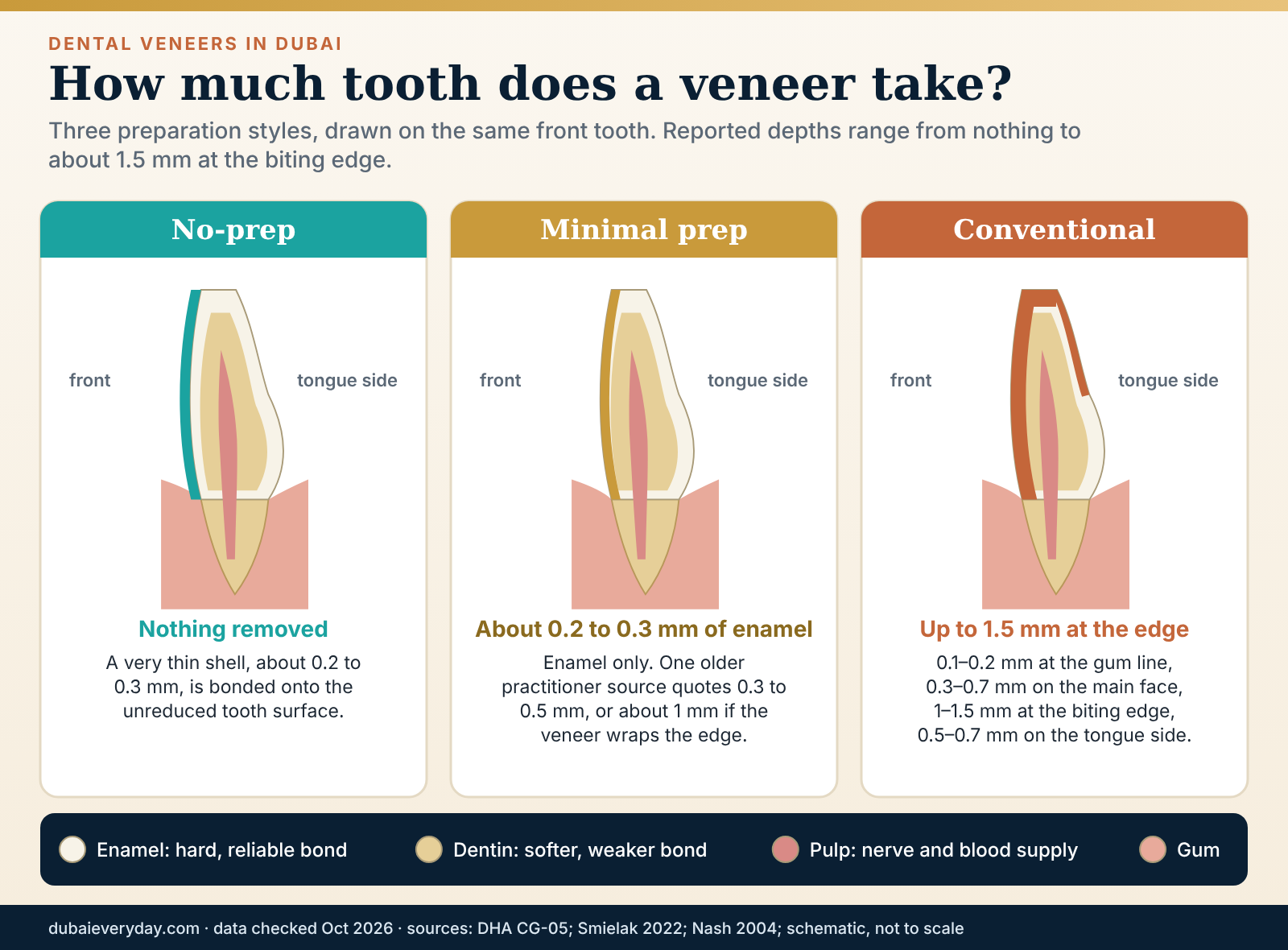
Preparation is the step veneers Dubai patients worry about, and rightly. It is the part that cannot be undone. Dentists describe three broad styles, and the words are used loosely in adverts, so it helps to know what each one usually means in numbers.
The three styles in millimetres
A prospective study published in Clinical Oral Investigations in 2022 followed 186 feldspathic porcelain veneers placed in 35 patients for about nine years on average. It reports the depths its dentists used.
For conventional veneers, they removed about 0.1 to 0.2 mm near the gum line, 0.3 to 0.7 mm over the main face, 1 to 1.5 mm along the biting edge and 0.5 to 0.7 mm on the tongue side where the veneer wraps. For minimally invasive veneers, they removed about 0.2 to 0.3 mm of enamel. For no-prep veneers, they removed nothing and used shells about 0.2 to 0.3 mm thick.
An older practitioner article from Oral Health Group (2004) gives a slightly different picture: 0.3 to 0.5 mm of facial reduction for minimal preparation, with about 1.0 mm if the veneer wraps over the biting edge, and at least 1.0 mm of reduction for pressed ceramic. The two sources do not agree to the decimal, which is the point: there is no single correct depth, and it depends on the tooth, the material and the technique.
Why staying in enamel matters for veneers Dubai cases
Enamel is the hard outer layer. Underneath it sits dentin, which is softer and bonds less reliably. The 2021 systematic review we cited above says bonding to dentin is weaker than bonding to enamel, with a higher risk of microleakage and debonding, and that preparations reaching dentin were linked to more fractures and debonding. The DHA guideline lands in the same place: it names enamel-based preparation as a condition of success and prefers an enamel-limited chamfer with smooth margins. So the first technical question for any veneers Dubai dentist is whether the plan stays inside enamel.
The DHA text also tells dentists to avoid second premolars where possible because of higher debonding rates. That is a rare, specific line. It is worth knowing when a veneers Dubai plan covers more teeth than usual.
The ADA states plainly that veneer treatment cannot be undone because enamel is permanently removed, and the DHA calls it often irreversible. Before you consent to any veneers Dubai plan, ask for the planned reduction in writing, ideally as “enamel only” or in millimetres, and ask what happens if you want the veneers removed in ten years. An older dental article notes that removing a bonded porcelain veneer means cutting it off, which inevitably takes more tooth with it.
Does no-prep mean no risk?
No. It is the more conservative style by definition, but conservative is not the same as risk-free. The Clinical Oral Investigations study did report that its no-prep and minimal-prep group lasted at least as long as the conventional group.
We would not lean on that finding, for three reasons. The study was small. It was not randomised, and the conventional veneers were placed a year before the other group, so technique and timing are tangled together. And the paper’s own numbers contain inconsistencies, which is why we quote only its preparation depths and design.
The practical questions for a no-prep offer are about shape and gum health. If nothing is removed from a tooth, the shell has to sit on top of it. Ask how the dentist will keep the outline natural and the edge of the veneer clear of the gum, and ask whether the tooth is a suitable candidate at all.
What you may feel afterwards
The DHA guideline warns that an adjustment period is normal and that temporary sensitivity is common. The ADA says it can take a few days to adjust to a veneer and that any bite discomfort should be reported so the dentist can correct it. A bite that feels high after bonding is worth reporting early rather than waiting out.
Smile planning: wax-up, mock-up and the shade conversation
Good veneers Dubai work is decided before anyone picks up a drill. The DHA protocol in CG-05 lists what the evaluation should include: a clinical examination, your goals and expectations, an assessment of the gums and the lining of the mouth, a review of X-rays, and a diagnostic wax-up with a mock-up trial. Everything on that list happens while your teeth are still untouched, which makes it the cheapest moment to change your mind.
Wax-up and mock-up, in plain words
A wax-up is a model of your teeth with the planned shapes added in wax, so the dentist and the technician can see the proposed result before it exists in porcelain. A mock-up transfers that plan into your mouth, usually as a temporary resin layer that comes off again, so you can see it in the mirror, speak with it and photograph it. The DHA guideline names both but does not describe the steps, so what a clinic actually does under those words can vary.
Digital previews are a recognised planning aid: the DHA restorative guideline, CG-01, mentions digital simulations and mock-ups in tooth-wear cases. A screen image is not a try-in on your own teeth, though. If a clinic shows you a polished preview on a tablet, ask whether you will also see a physical mock-up before any enamel is touched.
What the plan is trying to achieve
The DHA lists the objectives of veneer treatment: correct tooth shape and colour, harmonise tooth size and proportions, mask mild misalignment by visual illusion, control the smile line and how much of the teeth show, improve the contour of the gum edge, and achieve overall dental and facial harmony. Notice what is missing: any target number of teeth. Our reading is that the number should follow your smile, meaning how many teeth actually show when you talk and laugh, not the package on offer. If a plan covers more teeth than show, ask why.
Whiten first, then match
One practical rule appears in the DHA restorative guideline. Restorative materials cannot be whitened, and composite used in veneers and crowns does not change shade after bleaching, so teeth should ideally be whitened before restoration, and existing restorations may need replacing afterwards. For veneers, that means the bleaching decision comes first and sets the colour the veneers will be matched to. The same guideline warns that patients who expect a “blinding white” result may be disappointed, and that smokers’ results can be limited.
The DHA veneer protocol does not set out shade selection steps, so there is nothing official to hold a clinic to here. Reasonable questions are who chooses the shade, whether you will see it on a try-in, and whether the laboratory gets photographs or the dentist’s written shade notes. A shade that looks perfect under dental lights can look different in daylight.
Gums, lips and the rest of the face
Veneers sit against the gum, and the gum line decides how the teeth look. CG-05 notes that crown lengthening, a gum procedure, may be needed to improve the gum contour before restoration, and the scope-of-practice document lists aesthetic gum surgery under periodontists. If a smile looks “gummy”, the answer may be a gum procedure, a different tooth length, or something outside dentistry altogether.
Lip and facial treatments belong to a different rulebook. DHA’s scope standard says general dentists and dental specialists may not perform Botox or fillers, with exceptions for licensed orthodontists, prosthodontists and maxillofacial surgeons working under DHA’s non-surgical cosmetic privileges. Our guides to Botox in Dubai and dermal fillers in Dubai explain how provider checks work for those treatments, which are separate from any veneers Dubai plan.
What a veneers Dubai planning visit should leave you with
- A written list of the teeth to be treated, the material and the preparation style.
- A date for a wax-up or mock-up, and confirmation that you will see it before enamel is trimmed.
- A plan for decay, gum disease and whitening, in the order they will happen.
- A night-guard recommendation if you clench or grind.
- An itemised price with VAT shown, and what is excluded.
- The name and DHA licence details of the dentist who will do the preparation and bonding.
If a veneers Dubai clinic cannot produce those six things before asking for a deposit, you have learned something useful. Moving on at that stage costs you only time.
Who may place veneers Dubai rules allow, and how to check
This is the section where Dubai differs most from a generic veneers article, and it is why veneers Dubai rules deserve their own reading. The DHA publishes a scope-of-practice standard for dentists, SP-04 (issue 2, issued 25 December 2023, effective 25 February 2024), and it speaks directly about veneers. Three clauses matter.
What the scope standard says
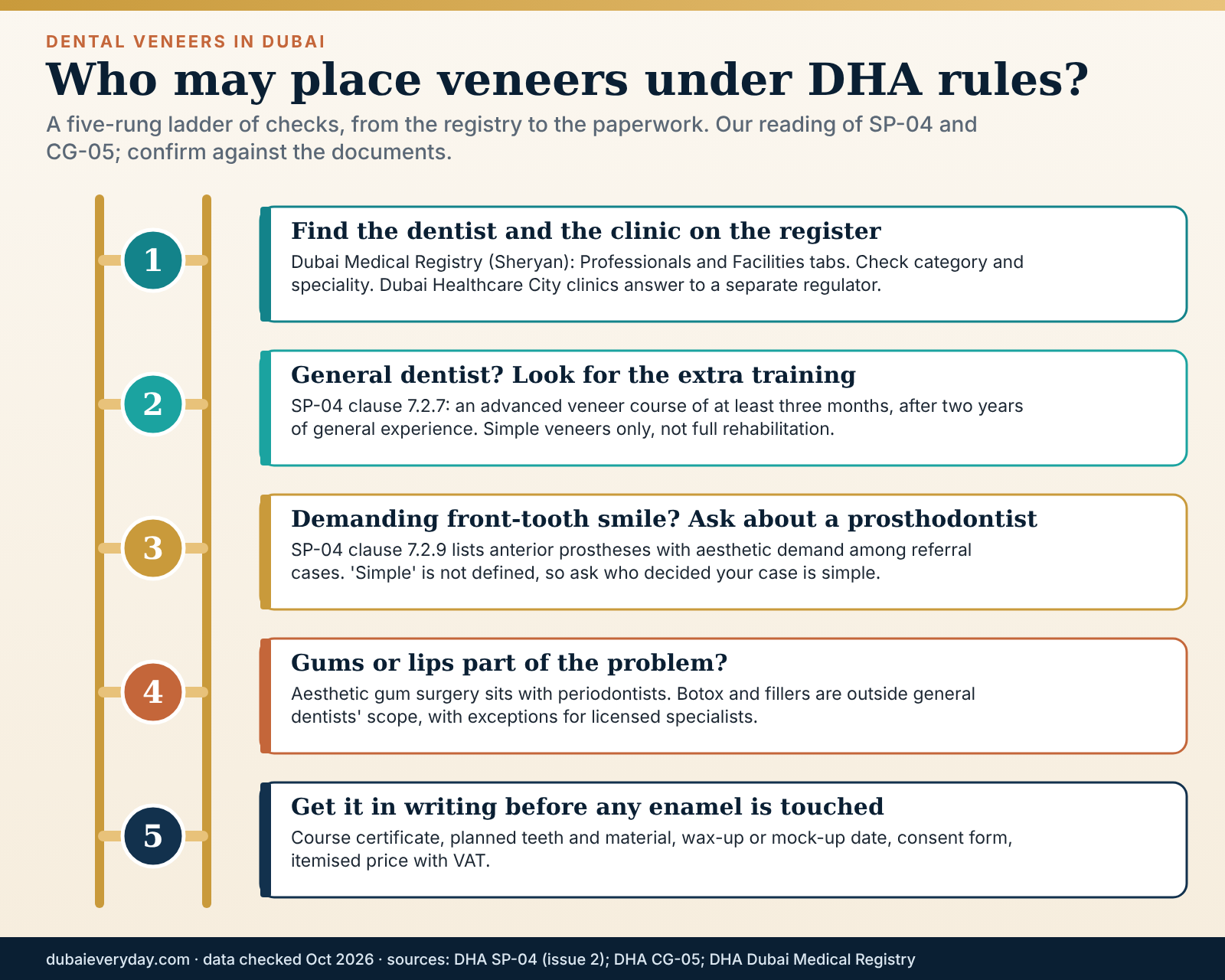
Under the restorative heading, clause 7.2.7(c) ties veneers for general dentists to an advanced veneer course of not less than three months, and the standard pairs this with two years of general dental experience. Clause 7.2.7(g) says a general dentist may provide simple veneers or crowns once the diagnosis is correct, but not as part of a full rehabilitation. Under the prosthodontic heading, clause 7.2.9(c) lists, among cases a general dentist should refer, anterior prostheses with aesthetic demand.
Read together, those clauses leave a grey zone for veneers Dubai patients, and it is worth being honest about it. A front-tooth veneer is exactly an anterior restoration with an aesthetic purpose.
The standard permits “simple” veneers for trained general dentists but also suggests referral for aesthetically demanding anterior work. It does not define “simple”. We could not find an official definition in the documents we read, so we cannot say where the line sits. A patient can still ask the practical question: is my case simple, who decided that, and what is the plan if it turns out not to be?
Who else is in scope
CG-05 says its veneer protocol applies to DHA-licensed prosthodontists and general dental practitioners. Prosthodontists are the specialists in crowns, bridges and restoring appearance; the scope standard lists restoring form, function and aesthetics among their duties, though it does not name veneers in that clause. Endodontists and paediatric dentists have veneers in their listed scope too, which matters mostly for children and for root-treated teeth. We found no veneer clause for orthodontists or periodontists in the documents we read, though a periodontist may be the right person for gum contour work beforehand.
The same standard says dentists may only perform procedures authorised by DHA and their facility, and that privileges are granted after competence is verified. In plain terms, a licence alone does not prove that a given dentist has been cleared for every procedure.
How to check a veneers Dubai dentist before booking
- Find the professional on the DHA registry. The Dubai Medical Registry, run through DHA’s Sheryan portal, has Professionals and Facilities tabs. Filters include licence type, category, speciality, language, area and facility. Search the dentist’s name and check the category and speciality match what the clinic says.
- Check the facility too. Use the Facilities tab to confirm the clinic itself is on the register, and ask which regulator licenses it. Clinics inside Dubai Healthcare City answer to Dubai Healthcare City’s own regulator and standards, not to DHA.
- Ask for the veneer training in writing. For a general dentist, that means the advanced course certificate, its duration and the date. We could not run a live registry search, so we cannot confirm whether the registry displays veneer training at all. Assume it does not until you see it.
- Ask who makes the veneers. The DHA dental laboratory standard, ST-59, says the dentist stays legally responsible for laboratory work and that laboratories need their own licence. You are entitled to know whether the lab is in-house or external.
- Keep the record. Save the dentist’s name, licence details, the plan and the consent form. If something goes wrong, those papers are what a complaint rests on.
Our Dubai dentist guide goes further on reading the registry, what complaint routes exist and how DHA and Dubai Healthcare City licensing differ. For a wider look at how to compare clinics for any service, see the guide to the best clinics in Dubai.
What we could not confirm
We did not run live registry searches. We also could not read the sample veneer consent form that CG-05 lists in its appendix, so we cannot tell you what risks it names. Ask the clinic to show you the consent form before the day, not on it.
The veneers Dubai process, visit by visit
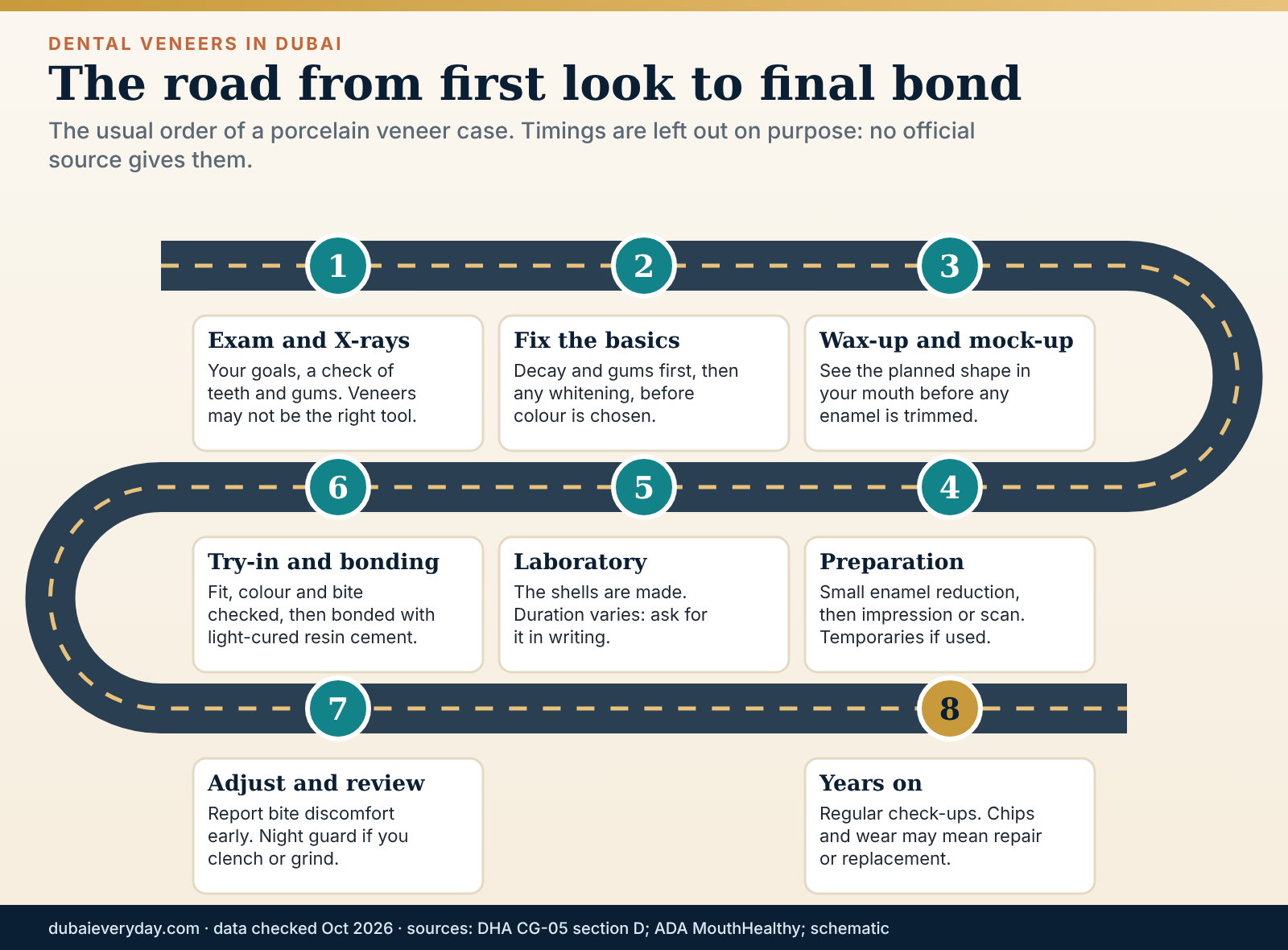
Public sources do not agree on a single veneers Dubai timeline, because it depends on the material, the number of teeth and the laboratory. The Zavis directory describes porcelain veneers as typically taking two to three visits of one to two hours each, under local anaesthetic, with a day or two of sensitivity. Treat that as a general description from a directory, not a DHA standard. The ADA gives the sequence rather than the clock.
The sequence for porcelain
- Consultation and examination. Examination, X-rays, your goals, and an honest conversation about whether veneers are the right tool. Decay and gum problems are dealt with first.
- Planning. Photographs, impressions or a 3D scan, then the wax-up and mock-up described above. This is where you approve the shape.
- Preparation. The dentist removes a small amount of enamel from the front and sides, then takes an impression or scan. A temporary covering may be used while the laboratory works, according to the ADA.
- Fabrication. A dental laboratory or milling unit makes the veneers. The duration varies and is the single most useful thing to ask about if you are travelling.
- Try-in and bonding. The dentist checks fit, colour and bite, cleans the tooth and bonds the veneer. CG-05 sets out a detailed bonding sequence: the inside of the porcelain is roughened, etched and treated with a silane coupling agent, the tooth is etched and primed, and a light-cured resin cement joins them.
- Adjustment and check-ups. Expect to report any bite discomfort, and expect regular reviews. The guideline names a night guard for people who clench or grind.
What changes with composite
With direct composite, steps 3 to 5 collapse into one visit. According to the ADA, the dentist prepares the tooth, sculpts and bonds the material, hardens it with a light, then smooths and polishes it. That is why composite is often the faster option, and why the result leans heavily on the individual dentist’s sculpting skill.
Planning veneers Dubai treatment around daily life
Residents can fit veneers Dubai visits around work, but avoid scheduling the gap between preparation and bonding just before a wedding, a photo shoot or a long trip. Leave slack for the follow-up too: a case that needs a check after bonding is better started when your own dentist will be available to see it through.
Visitors weighing veneers Dubai clinics offer face a harder puzzle. A case that needs several visits and a laboratory gap does not fit every holiday, and a bite adjustment needed after you fly home becomes a conversation across time zones. If you are considering treatment during a stay, ask for a written calendar showing the preparation date, the laboratory turnaround, the bonding date and a post-bonding check, and ask what the clinic does if your bite needs adjusting after you leave.
The Dubai travel guide covers the wider planning of a trip, and our notes on choosing a hotel by area help if you need a base close to a clinic for several days.
Residents who are new to the city may also want the basics of appointments, records and insurance cards. The Dubai healthcare guide explains how those work across clinics and hospitals.
Veneers Dubai cost: what published prices show
Price is the weakest part of public information on veneers Dubai patients can find. No regulator publishes a tariff, and clinics set their own fees. The best we could do was read one healthcare directory, Zavis, which collects prices that clinics publish on their own websites.
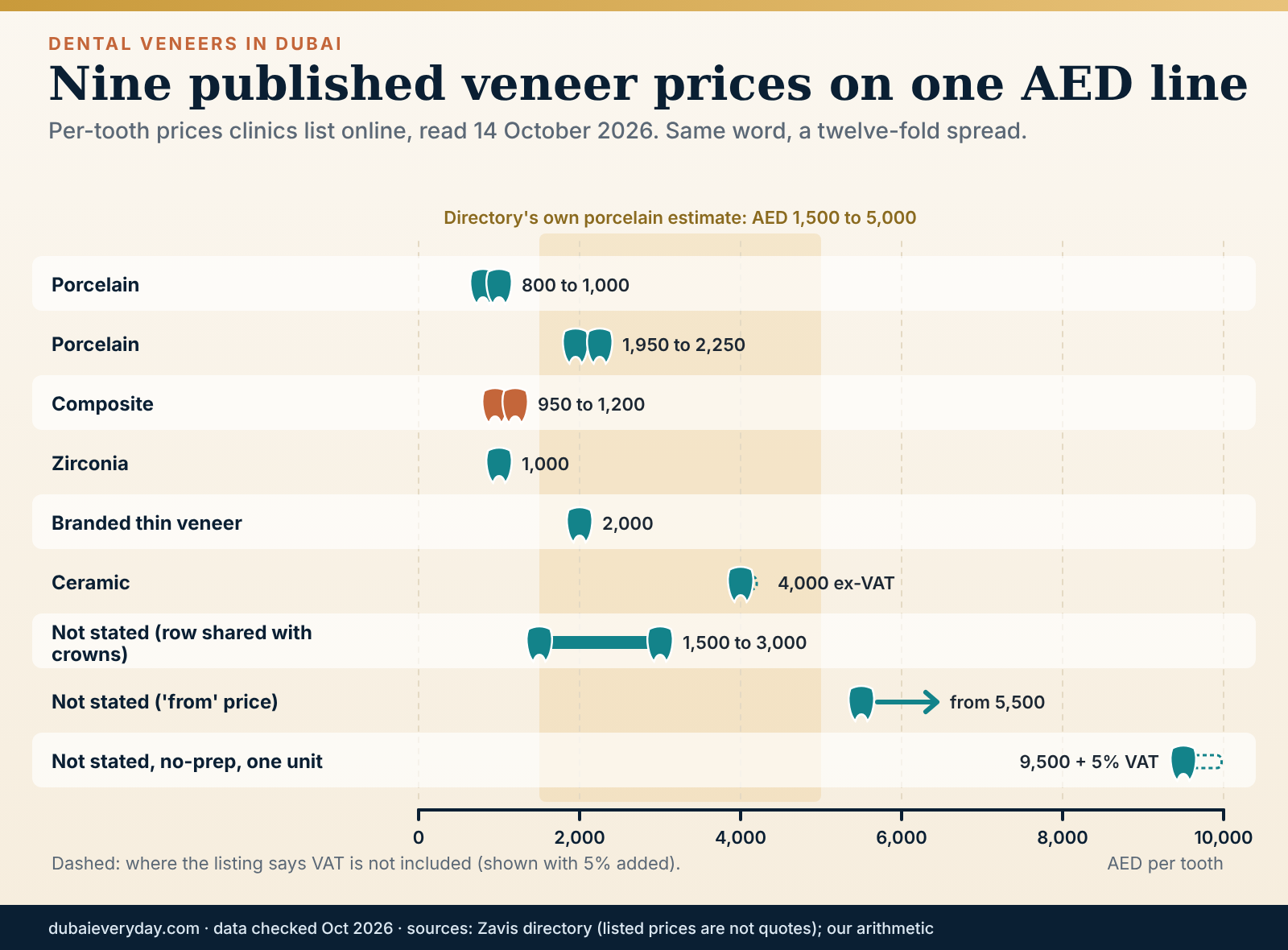
On 14 October 2026 its veneer page held nine published prices from six providers, spanning AED 800 to AED 9,500 per tooth, or roughly USD 220 to USD 2,590 at the long-standing peg of about 3.67 dirhams to the dollar. The directory itself says a listed price is not a quote and that rows differ in what they include.
The nine rows, without the clinic names
| Stated material or type | Listed price per tooth (AED) | What the listing says |
|---|---|---|
| Porcelain | 800 to 1,000 | VAT not stated |
| Porcelain | 1,950 to 2,250 | VAT not stated |
| Composite | 950 to 1,200 | Listed per tooth |
| Zirconia | 1,000 | VAT not stated |
| Branded thin veneer | 2,000 | VAT not stated |
| Ceramic | 4,000 | VAT not included |
| Not stated | 1,500 to 3,000 | Shares a row with crowns |
| Not stated | From 5,500 | A “from” price |
| Not stated, no-prep, one unit | 9,500 | VAT not included |
Source: Zavis directory, Dubai veneer page, read 14 October 2026. No E-max row appeared on the page. The same directory shows a separate, looser “indicative” range of AED 1,500 to 5,000 for a porcelain veneer, which it compiled itself without a count of providers or a published price list, so we use it only as background.
Why the spread is so wide
Three things separate AED 800 from AED 9,500 in veneers Dubai listings. The first is the product: a basic shell and a custom-layered ceramic are different objects. The second is scope: some prices cover the veneer only, others fold in the examination, X-rays, mock-up and follow-up.
The third is VAT. Two of the nine rows say VAT is excluded, and the other seven do not say either way. Adding 5% to AED 4,000 gives AED 4,200, and adding it to AED 9,500 gives AED 9,975. The gap between those rows and the cheapest ones is not 5%; it is more than a factor of ten.
From one tooth to a full veneers Dubai set
Veneers Dubai clinics price per tooth but patients buy in sets, so the arithmetic matters more than the headline. Our calculation, using only the published rows and a set of six front teeth:
- At AED 800 per tooth, six teeth come to AED 4,800.
- At AED 2,250 per tooth, they come to AED 13,500.
- At AED 4,000 per tooth plus 5% VAT, they come to AED 25,200.
- At AED 9,500 per tooth plus 5% VAT, they come to AED 59,850.
That is a twelve-fold range for the same word, “veneers”. It does not tell you which price is fair. It tells you that comparing two quotes without comparing material, preparation style, laboratory and inclusions is meaningless.
What the per-tooth price usually leaves out
We found no verified veneers Dubai prices for the extras, so we list them without numbers. Ask whether the quote includes the consultation and X-rays, treatment of any decay or gum disease, whitening beforehand, the wax-up and mock-up, temporary coverings, a night guard, bite adjustments after bonding, the first review visit and a replacement or remake policy if a veneer fails. A low price with most of those excluded can end up above a higher price that includes them.
Insurance, VAT and instalments for veneers Dubai patients
Veneers are treated as cosmetic. The ADA says insurance may not cover them unless they are medically necessary, and a UAE comparison site, InsuranceMarket.ae, says cosmetic veneers are generally excluded, with costly dental work often needing insurer pre-approval and co-pays commonly in the range of 20% to 30%. Our health insurance guide for Dubai residents explains how benefit tables, limits and exclusions work, and it is worth reading the dental section of your own policy before you book.
On VAT, a 2018 PwC guide on healthcare says preventive and treatment services from a licensed dentist are zero-rated, while cosmetic procedures may attract the standard 5% rate. We found no Federal Tax Authority ruling specific to veneers, so the position is uncertain. The practical step is to ask whether the quoted price includes VAT and to get that on the paper. As we read the DHA advertising standard, instalment offers are allowed when they are advertised accurately with their conditions, so check the total across all instalments, not just the monthly figure.
Illustrative example: the twenty-year view
The following numbers are invented to show the logic and are not quotes or market facts.
Suppose porcelain for six teeth costs AED 12,000 today and two veneers need replacing at year twelve for AED 4,000, a total of AED 16,000 over twenty years. Suppose composite for six teeth costs AED 6,600 today and needs a repair or redo of about half its value at years six, twelve and eighteen, at AED 3,300 each, a total of AED 16,500. The cheaper start finishes level in this made-up case. Swap in your own quote and your dentist’s honest estimate of repairs, and the answer may tip either way.
How long veneers last, and what shortens it
Veneers Dubai adverts like to quote a number of years. The research prefers a different framing: what share of veneers are still functioning after a given time, and why the others failed. The best single source we found is the 2021 systematic review by Alenezi and colleagues in the Journal of Clinical Medicine.
What the 95.5% means
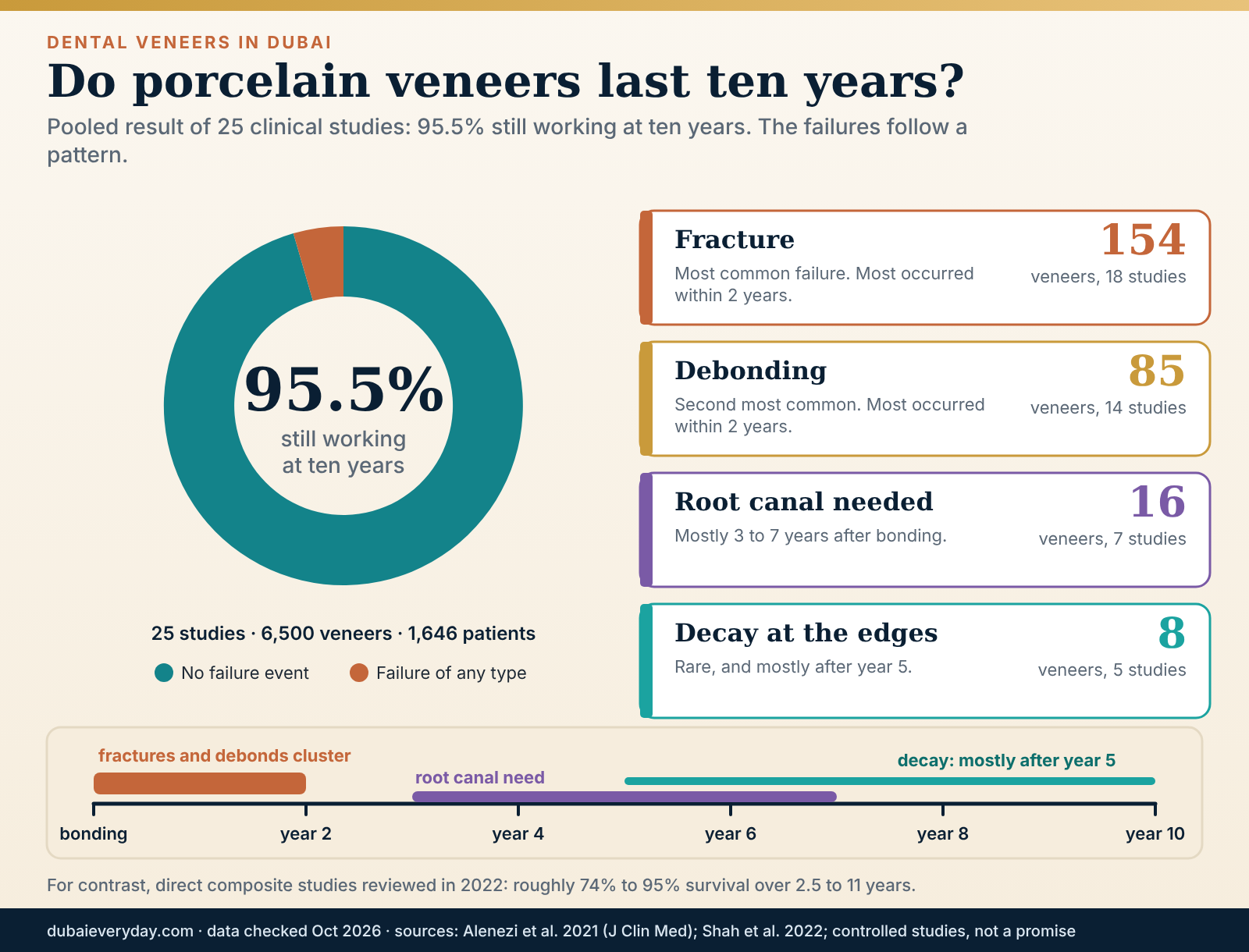
The review counted a veneer as a failure if it fractured, debonded, developed secondary decay or needed root canal treatment on its tooth. Slight marginal discolouration was not counted as failure because it is cosmetic and can be repolished. So “95.5% survival” means the veneer was still in place and working, not that it looked new. It also describes studies, usually run under controlled conditions, so a specific clinic’s results can sit above or below the average.
The failures are informative. Fracture was the most common complication (154 veneers across 18 studies), followed by debonding (85 veneers across 14 studies). Most fractures and debonds happened within two years. Secondary decay was rare, with eight cases, and mostly appeared after five years. Cases needing root canal treatment numbered sixteen and mostly appeared three to seven years after bonding. Reading that pattern, the first two years test the fit and the bond, and the long run tests your oral hygiene and your habits.
What raises the risk for veneers Dubai patients
- Grinding and clenching. The review notes that one study found significantly higher failure in people who grind. The ADA says veneers may not suit people who clench or grind, and DHA CG-05 recommends a night guard.
- Dentin instead of enamel. Preparations that reached dentin were linked with more fractures and debonding.
- Edge design. Veneers without coverage of the biting edge failed more often in raw counts (157 of 1,092 against 213 of 4,240), but the authors said a formal comparison was not possible, so do not read that as a rule.
- Material. Non-feldspathic ceramics outperformed feldspathic in the pooled counts, as noted earlier.
- Hard objects. Nail biting, ice and pen chewing are on the ADA’s avoid list.
Composite, in contrast
The direct composite evidence is patchier and less flattering. In the 2022 review in the Journal of Conservative Dentistry, annual failure rates in the veneer and gap-closure studies ranged from about 1.25% to 7.4%, and fracture was the main reason for failure. Annual failure rates compound: at 3% a year, roughly one in four restorations would be gone or in need of repair after ten years. That figure is our arithmetic on a mid-range value, not a result from the review, and the review warns that its studies vary widely.
Looking after them
The ADA’s care advice is short: avoid nail biting and hard objects, wear a mouthguard for contact sports, go easy on coffee, tea and red wine, brush twice a day with fluoride toothpaste and clean between the teeth daily. Decay can still form under or around veneers, and veneers may chip, wear down or loosen and need re-bonding, repair or replacement.
About guarantees
Some veneers Dubai clinics advertise a warranty or a lifetime promise. The DHA advertising standard ST-21 bans claims such as assured success and 100%, and the August 2026 DHA circular, as reported by The National, restates that outcome claims must be substantiated and results cannot be implied as guaranteed. A written warranty can still be real, so ask what it covers, for how long, what voids it and whether grinding without a night guard is an exclusion. If the paper and the advert differ, the paper counts.
Risks, red flags and advertising traps
A fair risk list for veneers Dubai clinics place is short but real. Teeth can be sensitive for a while, which both the DHA and the ADA acknowledge. The bite can feel wrong until it is adjusted. A veneer can chip, crack or come loose; in the pooled porcelain review, those were the main failures. A tooth under a veneer can develop decay at the edges or, occasionally, need root canal treatment, which the review recorded in sixteen cases. Colour can drift out of step with neighbouring teeth, particularly if you whiten them later.
The DHA protocol lists gum health, tight fit at the edges and resistance to leakage among the factors behind success. Active gum disease is therefore a reason to pause, as the ADA also says, and the fit of the margins is something you can ask about at the review visit.
In May 2024 the ADA issued a statement warning against “veneer technicians”, people who place veneers without a dentist diagnosing and supervising. It names infection from unsterilised adhesives and curing devices, veneers placed over unhealthy teeth or untreated cavities, nerve damage from improper trimming and a choking hazard. The statement is American, but the logic applies in Dubai: if the person doing the work does not appear as a dentist on the DHA registry, you have failed the first test, whatever the price looks like.
Reading a veneers Dubai advert
Veneers Dubai adverts lean heavily on social media, as The National’s report notes of cosmetic dentistry, and the DHA has rules about it. Its advertising standard, ST-21, bars absolute or exaggerated claims such as “best”, “100%” or “miraculous”, and says professional titles must match the licence. Before-and-after photos must show the same person with the same lens and no editing, with a risk disclaimer and written consent. Facility accounts must show a MOHAP medical advertisement licence number.
In an August 2026 circular, reported by The National on 3 September 2026, the DHA tightened enforcement, including responsibility for content filmed on clinic premises by patients or influencers. We read the report, not the circular, and the report does not say whether dental clinics are named, though it mentions cosmetic dentistry.
Taking those rules together, these are the warning signs worth noticing:
- A price with no material, no tooth count and no mention of what is excluded.
- Before-and-after images with no disclaimer, or where the lighting and angle differ.
- Superlatives, guarantees of results or promises of “painless” or “instant” outcomes.
- Pressure to pay a deposit before an examination has taken place.
- A treatment plan covering a full set when the problem is one tooth.
- Reluctance to name the dentist who will do the work or to show the consent form.
None of these proves bad care on its own, but several in a row is a pattern. DHA runs a complaints process for patients, and complaints about clinics in Dubai Healthcare City go to that area’s own regulator. The federal health ministry’s private-facility complaint service does not cover Dubai.
If veneers Dubai treatment goes wrong
Photograph the problem, keep every document and ask the clinic for a written explanation first. If the answer is unsatisfactory, check which regulator licenses the clinic and use that regulator’s complaint channel. The Dubai Healthcare City and federal complaint pages we checked both put billing and insurance disputes outside their scope, so keep the payment trail. Our hospital comparison guide may help if you need a second opinion from a facility with a wider range of specialists.
Alternatives, scenarios and a final checklist
The honest answer to “do I need veneers?” is sometimes no. The DHA guideline calls both composite and ceramic veneers conservative options, but conservative is relative: a polish, a filling or a whitening session removes less, or nothing at all. Each alternative below solves a narrower problem than a veneers Dubai package promises.
- Colour is the issue: whitening comes first, and the DHA restorative guideline says teeth should ideally be whitened before restorations are placed.
- One tooth has a chip: a bonded composite repair may be enough. The same guideline notes that composite restorations can treat localised wear on front teeth.
- A tooth is badly broken or heavily filled: a crown may be the sounder structure, because it covers the whole tooth rather than the front only.
- Crowding or a gap comes from tooth position: orthodontic movement addresses the cause. DHA’s scope standard places clear aligner treatment outside the general dentist’s scope, so ask who is supervising the aligners.
- The smile looks gummy: a gum procedure or a lip treatment may be the better first step, as covered above.
- Nothing is diseased and nothing hurts: leaving things alone is also a choice.
Four veneers Dubai scenarios
These are constructed examples, not case histories. They show how the checks above change the decision.
One chipped front tooth
Everything else is healthy and the colour is fine. A direct composite repair is the least invasive option and can usually be revised later. A porcelain veneer on one tooth raises a colour-match question that you should put to the dentist, because the neighbouring teeth stay as they are. Ask for both options priced.
Eight upper veneers and a grinding habit
The ADA says veneers may not suit people who clench or grind, and CG-05 calls for a night guard. Ask whether the smile really needs eight teeth, which ceramic is proposed, what the warranty says about grinding without a guard, and whether the guard is in the price. If the answers are vague, pause the plan.
A visitor with six nights in Dubai
A porcelain case needs preparation, a laboratory gap and a bonding visit. Whether that fits depends on the lab, which you cannot judge from outside. A consultation and mock-up in Dubai, with treatment started when you can return, may be the safer shape. Get the full calendar and the post-bonding plan in writing.
A budget of AED 5,000 and a quote of AED 800 a tooth
Six teeth at AED 800 is AED 4,800, or AED 5,040 with 5% VAT, already over budget. The bigger question is what is missing. Ask whether it includes the examination, X-rays, mock-up, a night guard and bonding adjustments, and what material and laboratory sit behind that price.
In every veneers Dubai scenario the same pattern shows up. The cheapest-looking quote usually has the largest set of unanswered questions, and the answers belong on paper before any enamel is removed.
Ten checks before you sign for veneers Dubai treatment
This is the working checklist for a veneers Dubai consultation. Print it or keep it open on your phone; each line maps to a section above.
- The dentist appears on the DHA Dubai Medical Registry with the right category, and the clinic appears as a facility.
- If the dentist is a general dentist, you have seen proof of the advanced veneer course (at least three months) and know how much experience they have.
- You know whether your case counts as simple and who decided so.
- The plan names the teeth, the material, the ceramic type and the preparation style, and says enamel only.
- You will see a wax-up or mock-up before any enamel is trimmed.
- Decay, gum health and whitening are sequenced before the veneers.
- A night guard is discussed if you grind or clench.
- The price is itemised, shows VAT and lists exclusions and the cost of any remake.
- You have seen the consent form, and the warranty, if any, is on paper.
- The advert you responded to follows the DHA’s rules: no guarantees, no unexplained superlatives, no edited before-and-after images.
Booking after those ten is not a guarantee of a good result. It does make sure the factors you can influence are covered.
Veneers Dubai FAQ
How much do veneers Dubai clinics charge?
Published veneers Dubai prices we could read ranged from AED 800 to AED 9,500, from nine prices across six providers, on 14 October 2026. Most of the spread comes from material, what the price includes and whether VAT is added. A set of six teeth therefore ranges from a few thousand dirhams to tens of thousands. Treat these as a sample of adverts, not a tariff, and ask for an itemised written quote.
Are porcelain or composite veneers better?
Neither wins in every case for veneers Dubai patients. Porcelain resists staining and wear better and has the stronger long-term evidence, with a pooled ten-year survival of 95.5% in one review. Composite is quicker, often needs less enamel removal and is easier to repair, but stains and wears sooner. The better choice depends on your teeth, your bite, your budget and how much upkeep you accept.
Are veneers permanent?
The treatment is permanent in the sense that enamel is removed and does not grow back, so the ADA and the DHA both call it irreversible. The veneers themselves are not permanent. They can chip, wear, loosen or stain and may need repair or replacement. Plan on an eventual replacement conversation rather than a lifetime promise.
How long do veneers last?
No honest number fits everyone. A 2021 review of 25 clinical studies found 95.5% of porcelain veneers still functioning at ten years, with most fractures and debonds in the first two years. Direct composite studies show a wider range, with survival of roughly 74% to 95% in the veneer and gap-closure studies reviewed in 2022. Grinding, dentin exposure and hard objects shorten the life of a veneer.
Can any dentist in Dubai place veneers?
Not on paper. DHA’s scope standard SP-04 ties veneers for general dentists to an advanced veneer course of at least three months and two years of general experience, allows simple veneers but not full rehabilitation, and suggests referring aesthetically demanding anterior work. Prosthodontists work in this territory too. Check the dentist on the DHA registry and ask for the training in writing.
Does insurance cover veneers Dubai residents want?
Usually not. The ADA says insurance may not pay for veneers unless they are medically necessary, and a UAE comparison site says cosmetic veneers are generally excluded, with insurer pre-approval often needed for costly dental work. Read the dental section and exclusion list of your own policy, and ask the clinic to request pre-approval in writing if any part might qualify.
How many visits does it take?
A directory description puts porcelain veneers at two to three visits of one to two hours each, with a laboratory gap between preparation and bonding. Direct composite can often be done in a single visit, according to the ADA. No official source gives a standard timeline, so ask the clinic for a dated calendar that includes the follow-up check.
Can veneers be removed or reversed?
They can be removed, but the tooth underneath cannot be restored to its original state. An older practitioner article notes that taking off bonded porcelain means cutting it away, which inevitably removes more tooth structure. Removal usually leads to replacement veneers or a crown, so ask what the exit plan is before you start.
Can tourists get veneers Dubai clinics offer during a stay?
Consultations are easy to book, but lab-made veneers need several visits and a fabrication gap, which does not fit every itinerary. Ask for a written calendar, the lab turnaround and the plan if your bite needs adjusting after you travel home, and check the dentist on the DHA registry in advance.
Are no-prep veneers better?
They are more conservative, since little or no enamel is removed, and a 2022 study of 186 feldspathic veneers reported good survival for them. That study was small, not randomised and had inconsistent figures, so it is suggestive only. No-prep is not suitable for every tooth, and shape and gum fit still matter. Ask the dentist why it fits your teeth.
Can veneers be whitened?
No. DHA’s restorative guideline says restorative materials cannot be whitened, and that composite used in veneers does not change shade after bleaching. If you plan to whiten your natural teeth, do it before the veneers are made so the colour can be matched. Whitening afterwards may leave a mismatch and mean replacing the veneers.
Keep reading
Sources and further reading (20 links)
- Dubai Health Authority: Scope of Practice and Core Competencies of General and Specialists Dentist (SP-04) — veneer clauses, referral rules, privileging, cosmetic limits
- Dubai Health Authority: Clinical Guidelines for Prosthetic Dentistry (CG-05) — composite and ceramic veneer protocol, preparation, bonding, patient information
- Dubai Health Authority: Clinical Guidelines for Restorative Dentistry (CG-01) — whitening before restoration, composite shade behaviour
- Dubai Health Authority: Circular CIR-2026-00000050, Updated Dubai Dental Guidelines Version 2 — list of the clinical guidelines in force
- Dubai Health Authority: Standards for Medical Advertisement Content in Social Media (ST-21) — advertising claims, titles, before-and-after images
- Dubai Health Authority: Standard for Dental Laboratory Services (ST-59) — dentist responsibility for laboratory work
- Dubai Health Authority: Dubai Medical Registry (Sheryan) — professional and facility search filters
- Dubai Healthcare City Authority: FAQ — separate regulator and complaints route
- Ministry of Health and Prevention: complaints about private health facilities — scope excludes Dubai
- American Dental Association, MouthHealthy: Veneers — materials, steps, care, irreversibility, insurance
- American Dental Association: Statement on recent reports of veneer technicians — risks of unlicensed providers
- Alenezi et al., Journal of Clinical Medicine: Long-term survival and complication rates of porcelain laminate veneers, a systematic review — survival and failure data
- Shah et al., Journal of Conservative Dentistry: Long-term survival and reasons for failure in direct anterior composite restorations — composite veneer and gap-closure data
- Smielak et al., Clinical Oral Investigations: Conventional vs no-prep/minimally invasive veneers over a mean of 9 years — preparation depths and study design
- Oral Health Group: Minimal preparation for elective porcelain veneers — practitioner article on preparation depths
- Zavis healthcare directory: dental veneer prices in Dubai — nine clinic-published prices, indicative only
- Zavis healthcare directory: dental veneer vs dental crown in Dubai — visits per treatment, indicative range
- InsuranceMarket.ae: dental insurance in Dubai — cosmetic exclusions, pre-approval, co-pays
- PwC Middle East: How VAT impacts you, healthcare — VAT treatment of dental and cosmetic services
- The National: Dubai aesthetic clinics to face disciplinary action over edited social media images — August 2026 DHA advertising circular as reported
Update log: 29 October 2026 — first publication; all facts re-checked against the sources above. Next review due: April 2027 (six-month cadence), or sooner if DHA revises the veneer protocol, the scope standard or the advertising rules. Corrections welcome.
This page is general information, not medical, legal or insurance advice. A DHA- or DHCC-licensed dentist must examine you and decide on treatment, and your insurer must confirm what your policy covers. No dentist has yet reviewed this draft; clinical statements summarise the cited sources.
About DubaiEveryday and this guide
DubaiEveryday.com is an independent editorial project that publishes practical, research-based guides to everyday life in Dubai: where to live, what things cost, how the rules work and how to get around. This page was written and edited by the DubaiEveryday editorial team. It is not signed by a named expert, doctor, lawyer or adviser, and we do not claim first-hand testing of a venue, clinic or service unless the page says so.
Each guide is built from official sources such as government and regulator pages, operator websites and established news outlets, cross-checked where we can. When we could not confirm something, we say so in the text, and examples that use made-up numbers are labelled as illustrations. Mentions are editorial choices, not paid placements, and a link is not an endorsement.
Dubai changes quickly. If you spot something that is out of date or wrong, please tell us through the contact options on DubaiEveryday.com and we will check it and correct the page.