

A family of four can live in Dubai on roughly AED 20,000 a month or on more than AED 66,000, and the gap is mostly a rent decision and a school decision. This Dubai family cost of living guide prices three dated, illustrative budgets for two adults and two children, line by line, then shows the pay each one needs.
A job offer, a lease draft and two school fee letters land on the same kitchen table, and not one of them mentions what the others will cost. Families who plan this move often find that rent and school decide almost everything, while the groceries everyone worries about decide very little. The invoices also arrive in lumps, which makes the “average month” a poor guide to what your account will actually do.
If you are researching the Dubai family cost of living, you probably want a number you can plan around rather than a slogan. Below are three dated, illustrative budgets for two adults and two children, from about AED 20,000 to more than AED 66,000 a month. Every line is shown, so you can swap in your own lease and fee letters. We also map the months when the cash leaves fastest, because that is where plans usually break.
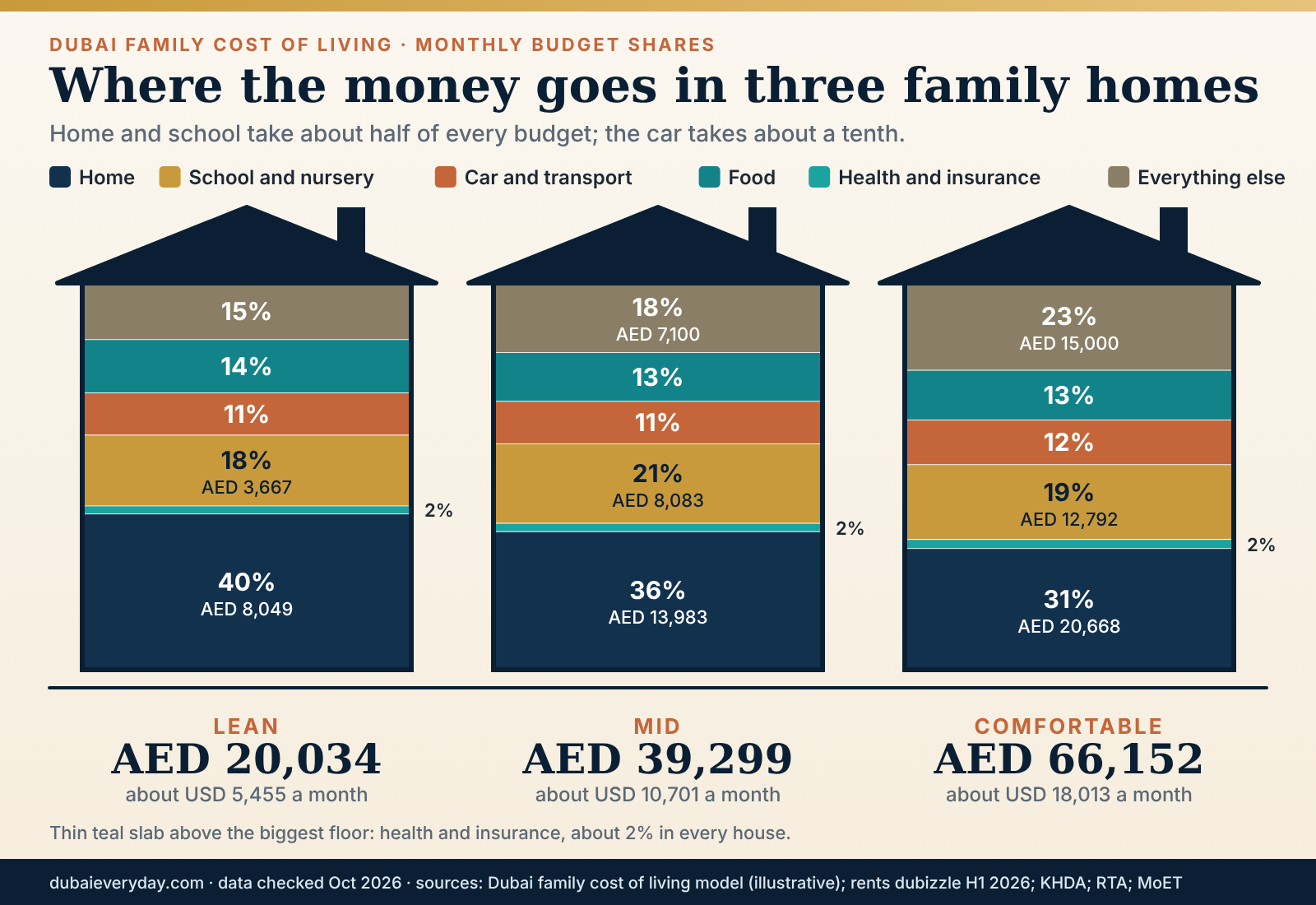
The Dubai family cost of living for two adults, a three-year-old in nursery and a seven-year-old in primary school comes to about AED 20,000 a month (roughly USD 5,450) on a lean plan, about AED 39,300 (USD 10,700) on a mainstream plan and about AED 66,150 (USD 18,000) on a comfortable one. Those are our own illustrative models, built from dated inputs. They are not market averages or quotes.
Rent plus school and nursery fees take between 47 and 54 per cent of each Dubai family cost of living budget. Housing alone is 35, 31 and 28 per cent. The car adds another 10 per cent, and it is the line a family can change fastest. Food, DEWA, phones and activities matter less than they feel.
To save a fifth of take-home pay, you need roughly AED 25,000, AED 49,100 or AED 82,700 a month. Dubai has no personal income tax, but it does have a big cash demand on day one and school invoices that arrive in lumps. This is general information, not financial advice: replace our assumptions with your own lease and fee letters.
This is desk research. Nobody at DubaiEveryday has enrolled a child, signed a lease or run a household for this page, and we claim no first-hand experience. On 29 October 2026 we read the Dubai Media Office release on the 2026-27 school-fee decision, the RTA Nol fare page, the UAE government sponsorship and newborn pages, a KHDA service page, a nursery group’s published fee table, and several operator and press pages for activity prices.
Rents, nursery ranges, insurance premiums and helper costs come from portals, brokers and press, and are labelled that way. Where a page would not open or sources disagreed, we say so. Every Dubai family cost of living total is our own arithmetic, and every car, leisure and savings line is an allowance, not a measured price. Inclusion was not paid for. General information only, not individual financial, legal or insurance advice.
How this Dubai family cost of living model works
Search for the Dubai family cost of living and you meet two kinds of page. One gives a single “average” that matches nobody. The other lists forty prices and never adds them up. Neither helps when you hold a job offer, a lease draft and two fee letters. This page does one job: it builds a complete monthly budget for a family of four, shows every line, and lets you swap in your own numbers.
Two neighbouring jobs belong elsewhere. The citywide picture sits in the cost of living in Dubai guide. The same arithmetic for adults without children sits in the monthly budget for a couple in Dubai and the monthly budget for one person. This page covers what children add to the Dubai family cost of living: school, nursery, bigger homes, a bigger car and fees that arrive in lumps.
The household behind every Dubai family cost of living figure
Every Dubai family cost of living scenario uses the same people. Two adults. A child aged three, in nursery on a school-day timetable. A child aged seven, in primary school. We picked those ages so both children are in paid education at once, before the secondary fee jump.
One adult holds an employment contract whose employer pays for that person’s own health cover, which is the usual arrangement under Dubai’s health insurance law. The family pays for the spouse and both children. If both parents have employer-paid cover, remove the spouse’s premium and the budget falls a little. Rent, school and car are unchanged.
Lean
A two-bedroom apartment at AED 81,000 a year, a school at AED 16,000, a lower-tier nursery, one used compact car, mostly home cooking and one weekly class.
Mid
A three-bedroom villa at AED 141,000 a year, a mid-fee school at AED 45,000, a mid-range nursery, one family SUV and two paid activities.
Comfortable
A three-bedroom villa in a master community at AED 211,000 a year, a school at AED 80,000, a premium nursery, an SUV plus a small second car.
What is in a Dubai family cost of living budget, and what is left out
Eighteen lines sit in every scenario, from rent and the municipality housing fee to school, nursery, the car, groceries, health premiums for the dependants, activities and an annual sinking fund for flights and renewals. We leave out savings (treated later), debts other than an assumed car instalment, remittances, furniture, a domestic helper (priced as an add-on) and the one-off cost of moving in. Move-in cash gets its own section, because it is the biggest single demand on a newly arrived family. USD figures use the long-standing peg of 3.6725.
Dubai family cost of living: three monthly budgets side by side
Here are the Dubai family cost of living totals first, then the lines. The table shows monthly dirhams for the family described above. Rent is a published community average divided by twelve; the housing fee is 5 per cent of annual rent; school and nursery lines include bus, uniform, books and registration spread across twelve months.
| Monthly line (AED, illustrative) | Lean | Mid | Comfortable |
|---|---|---|---|
| Rent (annual rent divided by 12) | 6,750 | 11,750 | 17,583 |
| Municipality housing fee (5% of rent) | 338 | 588 | 879 |
| DEWA, three-season average | 511 | 1,005 | 1,378 |
| Internet and mobile | 450 | 640 | 828 |
| Nursery, with extras | 1,625 | 3,250 | 4,750 |
| School, with bus, uniform and books | 2,042 | 4,833 | 8,042 |
| Car, running costs plus instalment | 1,941 | 3,921 | 6,939 |
| Taxis and other transport | 250 | 400 | 700 |
| Groceries | 2,200 | 3,200 | 4,500 |
| Eating out and delivery | 560 | 1,760 | 4,000 |
| Health premiums for dependants, plus out-of-pocket | 412 | 842 | 1,533 |
| Unemployment insurance (ILOE) | 5 | 10 | 20 |
| Children’s classes and family outings | 550 | 1,500 | 3,500 |
| Adult leisure and fitness | 200 | 600 | 1,500 |
| Shopping and miscellaneous | 700 | 1,500 | 3,000 |
| Annual sinking fund (flights, renewals, surprises) | 1,500 | 3,500 | 7,000 |
| Total per month | 20,034 | 39,299 | 66,152 |
| Total per year | 240,407 | 471,587 | 793,829 |
How to read the Dubai family cost of living table
Three shares do most of the explaining. Housing, meaning rent plus the municipality fee, is 35.4, 31.4 and 27.9 per cent of the three Dubai family cost of living totals. Education for two children is 18.3, 20.6 and 19.3 per cent. The car is 9.7, 10.0 and 10.5 per cent. Add housing and education and a family spends 54, 52 and 47 per cent of its budget before buying a single grocery.
Notice what does not move much in the Dubai family cost of living. Groceries rise by a factor of two from Lean to Comfortable, while rent rises by 2.6 and school by four. The arithmetic says the money is in the lease and the fee letter, which are also the commitments hardest to undo mid-year.
The Dubai family cost of living totals are not a survey. No official body publishes a family budget for the emirate, and we found none. The comfortable plan is a ceiling, not a goal. Prices also move: Dubai’s consumer price index was up 5.54 per cent year on year in August 2026, with food up 7.4, housing and utilities 6.7 and transport 12.7, according to press reports of the official data. Treat the Dubai family cost of living figures here as a snapshot dated 29 October 2026.
Housing: the lease sets the rest of the budget
In the Dubai family cost of living, the lease is the first decision and the most expensive. It fixes your commute, your school options (many schools run buses only within a radius), your cooling bill and the cash you need on day one. Our scenarios pick a published average rent for a named community so that the numbers are traceable. They are advertised-price averages, not what every tenant pays.
Family-sized rents in the Dubai family cost of living, 2026
The portal dubizzle published average annual rents for the first half of 2026. Two-bedroom apartments: International City about AED 81,000, Jumeirah Village Circle (JVC) AED 113,000, Business Bay AED 148,000, Dubai Marina AED 156,000, Dubai Hills AED 164,000 and Downtown AED 223,000. Three-bedroom apartments: Marina AED 243,000, Dubai Hills AED 260,000 and Downtown AED 360,000.
Villas in the same report: a three-bedroom in The Valley at AED 141,000, in Arabian Ranches 3 at AED 170,000 and in DAMAC Hills at AED 211,000, and four-bedrooms from AED 181,000 in The Valley to AED 355,000 in Dubai Hills. Our Lean, Mid and Comfortable rents are the International City two-bedroom, the Valley villa and the DAMAC Hills villa.
Read these with suspicion. In the same report a four-bedroom in DAMAC Hills (AED 230,000) is only 9 per cent dearer than a three-bedroom (AED 211,000). That is a mix effect, not a pricing rule: different sizes, ages and finishes were advertised. Compare homes of the same size and age, and ask for recent signed rents.
Is rent still falling?
For apartments, mostly yes. Savills’ third-quarter 2026 data, reported by Khaleej Times, showed year-on-year apartment rent falls of 12.8 per cent in Dubai Marina, 12.2 in Business Bay, 10.4 in JVC and 7.5 in Al Furjan, against 0.4 in International City. Property Finder data cited by the same paper put median asking rent for apartments at about AED 105,000 in September, down from AED 135,000 in December 2025.
We found no comparable recent source for villas, so we make no claim about them. The apartment data does support a negotiating point: tenants have more choice than a year ago. Ask for a lower rent, more cheques or a repaired kitchen, and read the tenant rights guide for how renewals and notices work.
The costs that sit on top of rent in the Dubai family cost of living
Five charges accompany the lease. The Dubai Municipality housing fee is 5 per cent of annual rent in twelve instalments, according to property-portal guides we could not confirm on an official page. Ejari registration costs AED 177.75 online or AED 220 at a typing centre, per the Dubai Land Department. A refundable deposit of 5 per cent is customary, as is an agency commission of 5 per cent (we assume at least AED 5,000). DEWA asks for a refundable deposit that press guides put at AED 2,000 for a villa.
For renewals, Decree No. 43 of 2013 caps rent increases in bands of 0, 5, 10, 15 and 20 per cent depending on how far your rent sits below the Dubai Land Department’s index average. A landlord who wants to change terms is expected to tell you at least 90 days before the lease ends. The wider framework is in the Dubai legal basics for residents.
Villa or apartment: what changes for a family
A villa brings a garden, a maid’s room and a car-per-adult lifestyle. It also brings a bigger DEWA bill: roughly AED 1,000 a month on average in our Mid model, against about AED 500 for the Lean apartment. Ask who pays for garden watering, community charges and air-conditioning maintenance, and whether a building uses district cooling.
A central tower trades space for time. The Downtown Dubai guide describes the lifestyle, and the portal data shows the price: a Downtown three-bedroom averaged AED 360,000, about 1.7 times our Comfortable villa rent. Our arithmetic for the steps is simple: Lean to Mid adds about AED 5,250 a month once the 5 per cent fee is included, and Mid to Comfortable about AED 6,125. Each step is bigger than the entire Lean grocery budget, which is why the lease deserves more of your time than anything else in a Dubai family cost of living plan.
School fees: tuition is only the first invoice
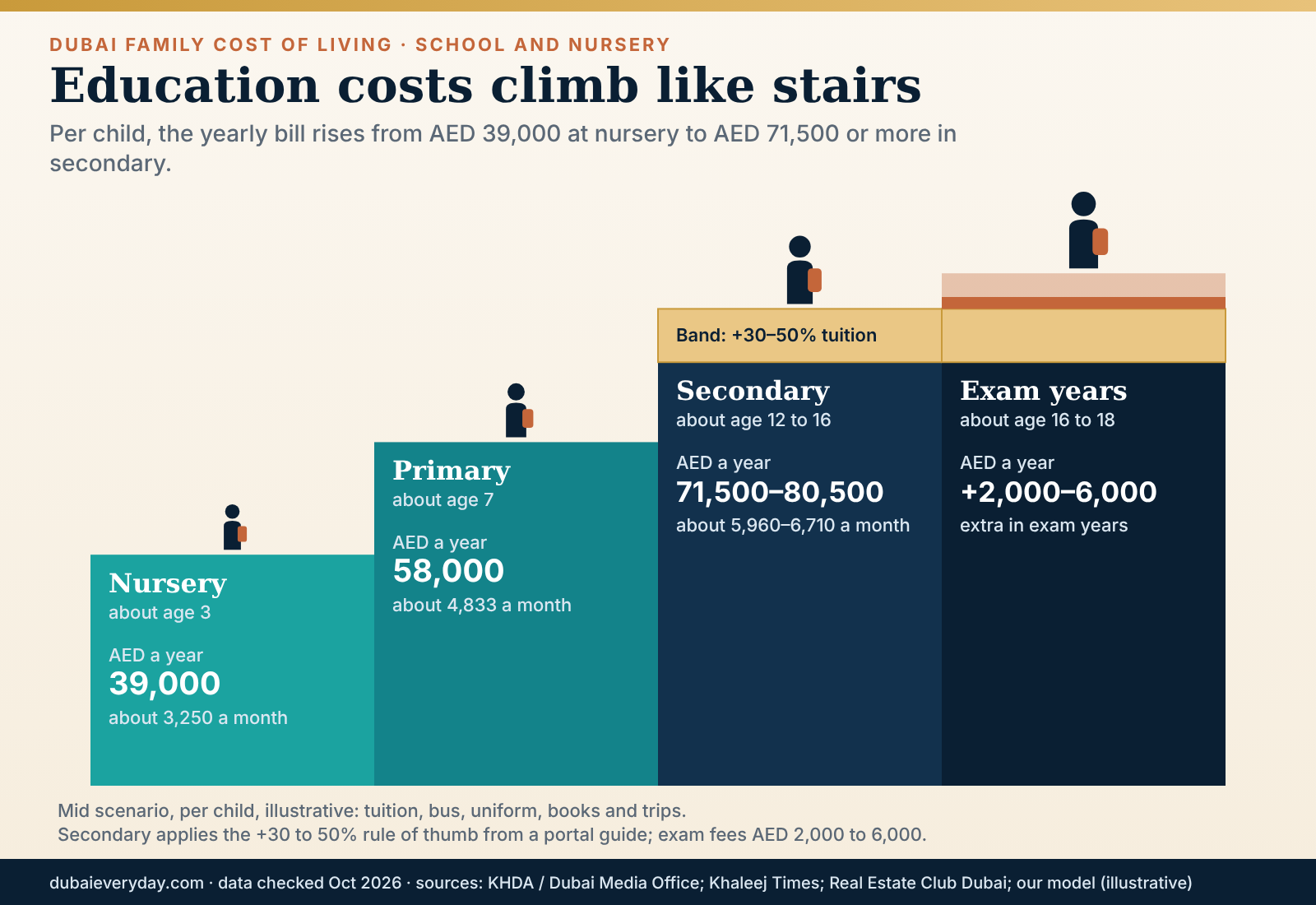
Private education surprises newcomers most in the Dubai family cost of living, because the fee a school advertises is the smallest part of the story. The Knowledge and Human Development Authority (KHDA) regulates private school fees in Dubai. On 22 May 2026 the Dubai Media Office reported that KHDA confirmed no increase in private school fees for the 2026-27 academic year, under directives from Sheikh Hamdan bin Mohammed. That is good news for this year and tells you nothing about the next.
School tuition in the Dubai family cost of living
Fee spreads are enormous. Khaleej Times reported that the 23 schools rated Outstanding charge between AED 29,488 (a preschool year at a French-curriculum school) and AED 111,799 (Year 13 at a British school) in 2026-27. By curriculum: British from AED 43,084 to 111,799, IB from AED 44,616 to 89,889, American from AED 66,185 to 93,300 and Indian from AED 38,246 to 73,876.
The affordable end looks different. A Gulf News list of eleven Very Good schools under a AED 45,000 cap started at AED 7,389 a year for the lowest grade of one school and topped out at AED 41,513 for Grade 12 at another.
A property-portal guide from May 2026 offered rough bands for a first filter: British from AED 25,000 to 110,000 across its three tiers, Indian CBSE or ICSE from AED 6,000 to 30,000. These are the publisher’s estimates; use them to choose which schools to ask, not to budget.
The extras that arrive after the offer letter
The same guide put typical add-ons per child at AED 500 to 1,500 for one-off registration, a refundable deposit of AED 2,000 to 15,000, AED 1,000 to 3,000 a year for books, AED 500 to 1,500 for uniforms and AED 6,000 to 12,000 for school transport. Trips, canteen and exam fees come on top, and it estimates that extras add 15 to 25 per cent to tuition.
Our Dubai family cost of living model treats the bus, uniform, books and trips as part of the school line. In the Lean budget they come to AED 8,500 against AED 16,000 of tuition, 53 per cent of the headline fee. In the Mid budget the ratio is 29 per cent (AED 13,000 on AED 45,000) and in the Comfortable budget 21 per cent (AED 16,500 on AED 80,000). Cheap tuition does not mean a cheap school year.
Why later years and second children raise the Dubai family cost of living
Two patterns catch families out. First, fees rise as children move up. The portal guide says senior-year fees are often 30 to 50 per cent above primary fees. For our Mid family, a AED 45,000 primary fee becomes roughly AED 58,500 to 67,500 in secondary school, or AED 1,125 to 1,875 more every month for that child.
Second, siblings overlap. A third child on the Mid plan would add about AED 3,250 a month at nursery age or about AED 4,830 at primary age, by our arithmetic, plus roughly AED 110 of health premium. That is about 9 and 13 per cent on top of the Mid total.
A headline tuition figure is not a quote. Before paying a seat deposit, ask for the complete schedule: tuition by term, registration, the deposit and when it is refunded, bus, uniform, books, trips and exam fees. Ask how much notice a withdrawal needs. One broker guide reports late-withdrawal penalties of AED 20,000 to 80,000 per child per term when notice is missed; we could not verify that, which is exactly why the contract matters.
Timing, deposits and other routes
Admissions run well ahead of the school year. A commercial adviser says applications for September 2027 typically open around October 2026, with assessments from January and deposits from March, and puts application fees at AED 500 to 600. Treat that as typical: each school sets its own calendar. For first-time registrants in 2026-27, Gulf News reported that KHDA moved the age cut-off to 31 December, so check the year group before assuming a place.
The UAE government’s school-fee page notes that non-UAE nationals may attend government schools as fee-paying students; the expatriate admission page we found was dated 2023, so we have not priced that route. For children with additional needs, KHDA’s inclusion framework says schools should not refuse admission on that basis, and one parent quoted in 2017 estimated a learning-support assistant could add AED 40,000 to 70,000. That is an anecdote, not a policy, but it shows why an early enquiry matters.
Nursery, nannies and helpers
Childcare is the second education-sized line in a Dubai family cost of living budget and the least standardised. Nurseries in Dubai are early childhood centres permitted by KHDA. A KHDA service page says a centre that wants to change its fees applies through the KHDA portal, and the authority has five working days to decide once documents are complete. The Dubai Media Office release did not say whether the 2026-27 school-fee freeze extends to nurseries, so assume nursery fees can change.
What nurseries charge
A portal guide dated 26 May 2026 grouped nursery fees into three tiers: budget at AED 12,000 to 25,000 a year, mid-range at AED 25,000 to 45,000 and premium at AED 45,000 to 70,000 or more. It reported that Edarabia had cited monthly fees from about AED 1,500 to AED 6,500. The Traveler’s May 2026 guide gave a similar full-day range of AED 3,000 to 8,000 a month for Dubai and Abu Dhabi together.
For a published price rather than a range, one large nursery group lists its 2026-27 fees online. They run from AED 27,200 to AED 54,000 a year depending on daily hours, from 8am to 2pm through 8am to 6pm, plus a non-refundable AED 3,000 registration fee and a AED 525 medical fee. The page’s two fee blocks were not labelled clearly, so we use it as a sanity check only.
Two lessons follow. Hours are the lever: in one block, moving from a 2pm finish to a 6pm finish raises the annual fee by 23 per cent, and in the other by 62 per cent. And terms are lopsided: the 16-week first term bills about 39 per cent of the year, so August brings the biggest nursery invoice. One broker claims nurseries do not receive KHDA quality ratings the way schools do; we could not confirm it, so ask any centre for its KHDA permit.
Nannies and helpers in a Dubai family cost of living budget
The Traveler’s guide gives base salaries of AED 1,800 to 3,000 a month for a live-in nanny and AED 2,500 to 4,500 for a live-out nanny across Dubai and Abu Dhabi, with a fully loaded live-in cost 20 to 40 per cent higher. A June 2026 broker guide puts live-in helper salaries at AED 1,300 to 2,500 depending on nationality, year-one government and agency costs at AED 8,800 to 14,500, and mandatory annual insurance at AED 700 to 1,500. It reports a sponsor income requirement of about AED 25,000 a month, which we could not confirm on an official page.
Our add-on calculation, spreading year-one fees over 24 months and adding AED 300 to 500 for food and phone, is roughly AED 2,500 to 3,700 a month, close to the Mid nursery line of AED 3,250. A nursery covers school-day hours for one child; a helper covers longer hours for both children and the household, and needs a room and a visa file. No helper is in the three totals.
Cars for a family: what a month really costs
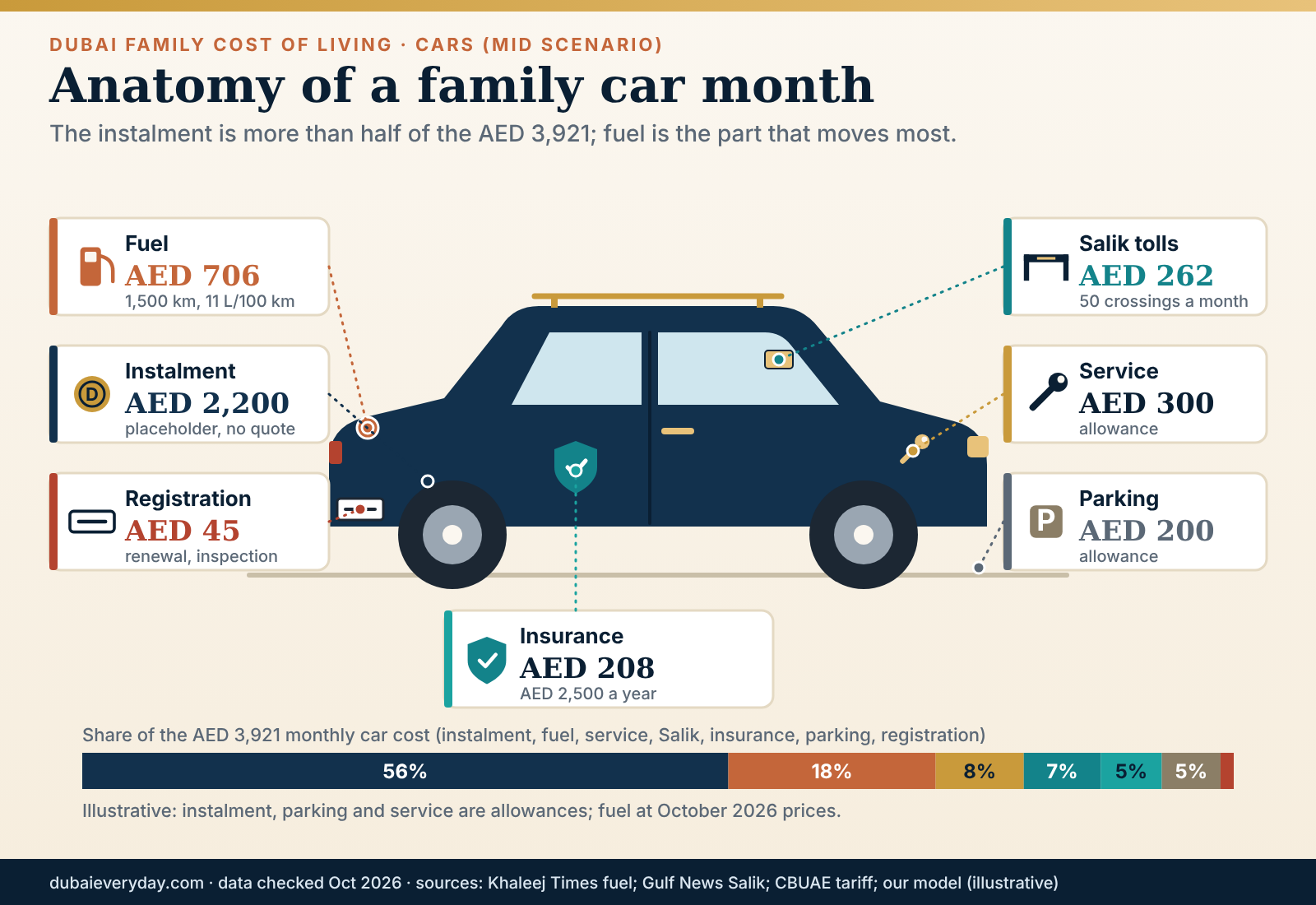
Dubai is built around the car, and a family with a nursery run, a school run and a weekend outing feels that more than anyone. The car is also the line of the Dubai family cost of living that a household can change fastest, because it is a choice rather than a contract. Our three budgets include one used compact (Lean), one family SUV (Mid) and an SUV plus a small second car (Comfortable). Each car line is the sum of seven pieces.
Fuel, tolls and parking in the Dubai family cost of living
October 2026 fuel prices rose sharply. Special 95 was AED 4.28 a litre, up from AED 3.69 in September, Super 98 was AED 4.40, E-Plus 91 AED 4.21 and diesel AED 4.80. For the Mid SUV we assume 1,500 km a month at 11 litres per 100 km, which is 165 litres or about AED 706. At September’s price the same driving would have cost about AED 609. That swing is the largest moving part in the car line of any Dubai family cost of living plan this year.
Salik tolls changed on 1 June 2026. Press reports put the charge at AED 6.30 in peak hours (6am to 10am and 4pm to 8pm, Monday to Saturday) and AED 4.20 off-peak, including VAT (reports differ on Sundays, so check the Salik notice). The school run sits in the peak window. Fifty crossings a month at an average of AED 5.25 is AED 262; all of them at peak would be AED 315. Parking is an allowance here, because building and zone charges vary.
Insurance, registration and the instalment
Motor insurance has a regulated price corridor. Under the Central Bank’s tariff decision, third-party cover for a four-cylinder saloon sits between AED 750 and AED 1,300 a year. Comprehensive cover has a floor of AED 1,300 and a ceiling of 5 per cent of the vehicle’s value, or a floor of AED 2,000 and a ceiling of 7 per cent for four-wheel-drive vehicles. Our Mid allowance of AED 2,500 a year fits inside that corridor. The Dubai insurance guide explains the types of cover.
Annual registration renewal costs about AED 350 plus small fees, and older cars need an inspection, which portals quote at AED 150 to 170. We use AED 45 a month for both, and AED 150, 300 or 450 for servicing. The instalment is a placeholder, not a quote: AED 900, 2,200 and 4,300 for the two cars in the Comfortable case. We did not verify car-loan rates. If you finance, check that the lender appears on the Central Bank’s licensing register.
Child seats and the car-free alternative
Secondary press coverage says children under four must travel in a child seat and that the front seat is for children aged ten and over and at least 145 cm tall, with a fine of AED 400 and four black points. We could not confirm the wording on an official page, so treat it as a prompt to check.
Could you drop the car? The RTA’s Nol page lists a Silver two-zone 30-day pass at AED 230 and a 365-day pass at AED 1,770, which is AED 147.50 a month. Children aged five and under travel free. Two annual passes plus AED 600 of taxis comes to about AED 895 a month. Against the car lines, that saves about AED 1,046 for the Lean family, AED 3,026 for the Mid family and AED 6,044 for the Comfortable family.
The saving only exists if the rest of the week still works. Our reading: families with a school bus, a station within a short walk and a central flat can go car-free, while families in outlying villa communities usually cannot.
Groceries, DEWA, internet and phones
These lines are where most people start their Dubai family cost of living sums, and they matter least. Groceries, eating out, DEWA, internet and phones together take between 16 and 19 per cent of each Dubai family cost of living budget. They still deserve a pass, because inflation bites visibly there: food prices were up 7.4 per cent year on year in August 2026, per press reports of the official data.
Groceries for four in the Dubai family cost of living
The Ministry of Economy and Tourism publishes monthly average prices for staples on its Essential Goods Prices platform. Using August 2026 averages, a staples basket for our family comes to AED 782: 6 kg of basmati rice, 4 kg of flour, 30 litres of milk, two trays of eggs, 8 kg of chicken, 2 kg of sugar, 3 litres of canola oil and 40 small yogurts. The basket is our arithmetic; the prices are official, for example AED 16.62 per kg for rice, AED 9.46 per litre for milk and AED 22.97 per kg for chicken.
It is a floor, not a shopping bill. Our grocery allowances of AED 2,200, 3,200 and 4,500 are 2.8, 4.1 and 5.8 times that basket, which covers fresh produce, fish, snacks, cleaning products, toiletries and school lunches. The platform’s 28 October snapshot listed rice from AED 4.20 to AED 16.00, so the outlet you shop at moves the bill more than the brand does.
Eating out and delivery
We could not find a reliable, dated source for average restaurant prices, so eating out is an allowance: four outings at AED 140 for the Lean family, eight at AED 220 for the Mid family and ten at AED 400 for the Comfortable family, delivery included. Add up one month of your own receipts before choosing a scenario.
DEWA, cooling and the summer spike
Electricity and water are billed by DEWA. Property-portal guides give residential electricity slabs of 23, 28, 32 and 38 fils per kWh, a fuel surcharge of 6 fils per kWh, water at AED 7.70, 8.80 and 10.12 per cubic metre in three bands, and 5 per cent VAT. We could not open DEWA’s own tariff page, so these are second-hand and need checking against your bill.
Our model uses three four-month seasons. For the Lean apartment we assume 700, 1,100 and 1,700 kWh, which gives bills of about AED 353, 491 and 690. For the Mid villa, 1,200, 2,200 and 3,600 kWh give AED 586, 937 and 1,492. The consumption figures are our assumptions, not meter data. The pattern is the point: a villa summer bill runs about 2.5 times its winter bill.
Internet and mobile
Property-portal compilations put home fibre between AED 286 and AED 478 a month after VAT, with a 12-month contract and an early-termination charge of around AED 1,000 reported by one broker. We use AED 300, 390 and 478. Mobile is AED 150, 250 and 350 for the adults’ lines, an allowance. We could not open the operators’ own plan pages, so ask each provider for the price after VAT.
Health cover, visas and the cost of having children here
Health insurance is the one line of the Dubai family cost of living where the legal duty is clearest, and it is not optional. Under the Dubai Health Insurance Law (Law No. 11 of 2013), employers must insure employees and bear the cost, and a sponsor must insure the dependants he or she sponsors, including spouse and children, unless an employer already does. The Dubai government health insurance page and the Dubai Health Authority’s FAQ both say so; the detail sits in the Dubai health insurance guide.
The authority’s FAQ says employers must pay for employee cover and are only encouraged to insure dependants. When they do not, the sponsor is responsible. Ask HR in writing which family members are on the policy, which network applies and whether the cover renews with your visa. A contract that says “medical insurance” can mean an employee-only plan.
What a family premium adds to the Dubai family cost of living
Premiums depend on plan level, age and health. A UAE-wide broker guide from May 2026 put annual family quotes at about AED 2,600 for a basic plan, AED 6,800 for a mid-tier plan and AED 14,900 for a premium plan, in each case for two adults and two children. Its table implies roughly AED 650, 1,300 and 2,550 per child per year. The article covers the UAE rather than Dubai alone, so treat the numbers as a guide, not a quote.
We apply the table to the dependants only. With the sponsor’s employer paying for the sponsor, the family pays for a spouse and two children: AED 1,950 a year on the basic plan, AED 4,700 on mid-tier and AED 10,000 on premium. Those become AED 162, 392 and 833 a month. If the spouse also has an employer-paid policy, subtract the spouse’s share.
What the minimum plan covers
The legal floor in Dubai is the Essential Benefits Plan. We could not open the authority’s own copy of the circular, so the figures below come from an insurer-hosted copy of Circular GC 03/2024 and should be checked. It lists an annual limit of AED 150,000, 20 per cent co-insurance on consultations, laboratory tests and radiology, medicines up to AED 2,500 a year at 30 per cent, a dental limit of AED 500, and maternity of AED 10,000 for a normal birth and AED 10,000 for a caesarean at 10 per cent co-insurance.
Those limits explain our out-of-pocket line of AED 250, 450 and 700 a month for paediatric visits, medicines, dental work and vaccinations, an allowance rather than a measured cost. If you plan to have a baby, ask any insurer how long the maternity waiting period is; the broker article we read did not say.
A newborn and the Dubai family cost of living, step by step
The UAE government’s newborn page sets two clocks. Residents have 30 days to register a child’s birth and 120 days from birth to arrange the birth certificate, passport, Emirates ID and residence visa. After that a fine of AED 100 a day applies, and the baby cannot leave the country until the visa is finalised. The expatriate birth certificate must be attested by the health and foreign-affairs ministries, and one stamped by the Dubai Health Authority is treated as equivalent for the health seal.
The insurer’s circular copy says a newborn is covered for 30 days under the mother’s plan. Put a baby on a policy of their own before that window closes, and do not wait for the visa.
Sponsoring your children: a one-off in the Dubai family cost of living
The government sponsorship page says a sponsor needs a minimum salary of AED 4,000, or AED 3,000 plus accommodation, and has 60 days to apply for dependants’ residence visas after they enter on an entry permit. Family members aged 18 and above need a medical fitness test, so young children do not. The page lists no fees. A Gulf News explainer updated in August 2025 itemised a wife’s visa at AED 550 for the entry permit, AED 300 for the file, AED 385 for a two-year Emirates ID and AED 580 for stamping, plus AED 750 for a status change if the family is already in the UAE.
It gave no child fees. By our arithmetic, the same lines without the medical come to about AED 1,815 per child, or AED 2,565 with a status change, before typing-centre and attestation costs. Over a two-year visa AED 1,815 is about AED 76 a month per child, which sits inside the sinking fund.
One more small line: unemployment insurance (ILOE) charges up to AED 5 a month for basic salaries below AED 16,000 and AED 10 above, per the Dubai government page, with fines for not subscribing. It protects the earner, not the dependants. For cover when grandparents visit, read the travel insurance guide for Dubai visitors.
Activities, classes and weekend outings
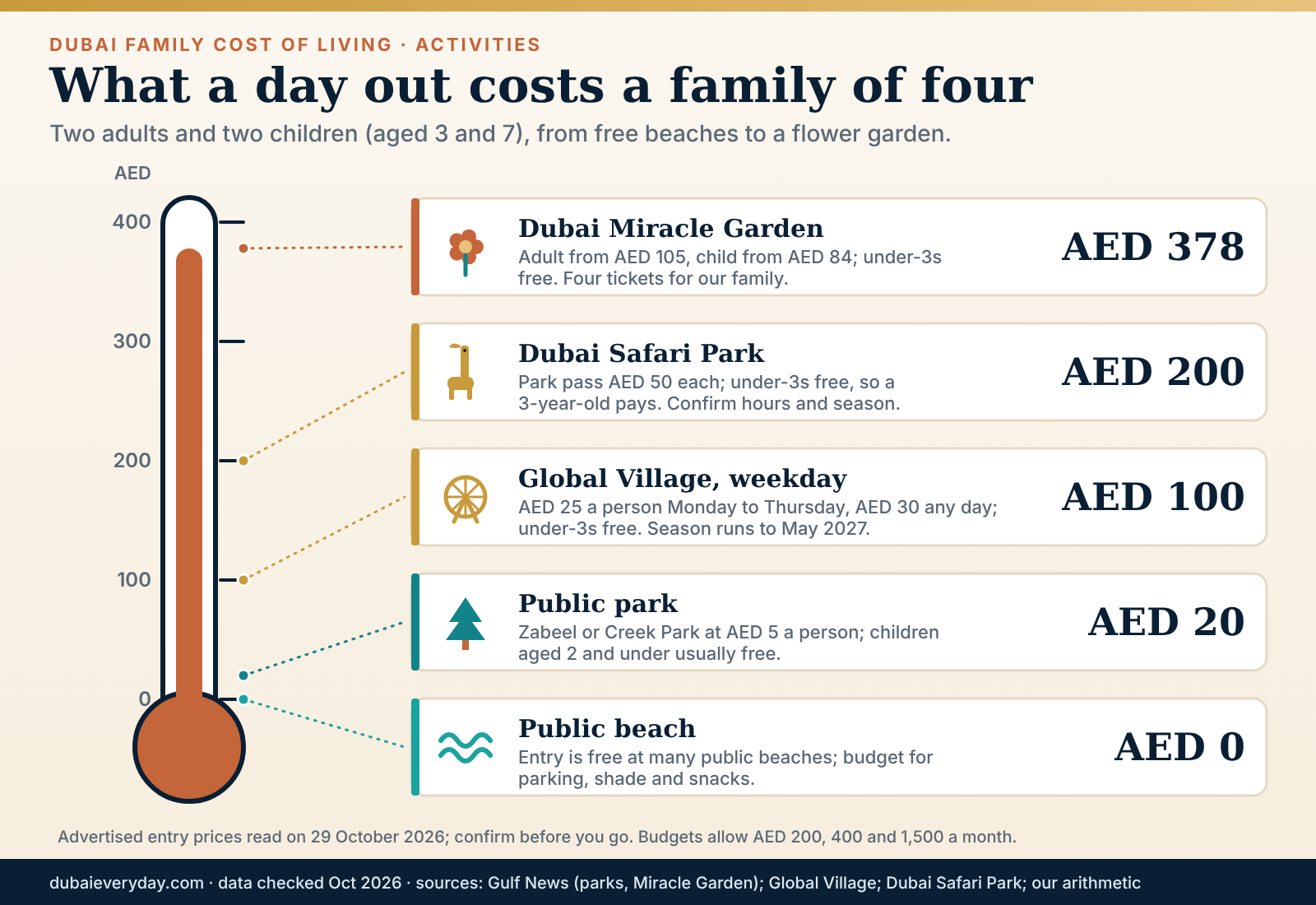
Children add to the Dubai family cost of living between 3pm and 7pm and all weekend. Dubai is better than most cities for cheap family days out, and for expensive ones. The skill is knowing the price ladder before you commit to a routine. All prices below are advertised prices read on 29 October 2026 and need confirming before you go.
A family of four on the price ladder
At the bottom, many public beaches charge nothing for entry, and several municipal parks are free. A Gulf News list updated on 6 October 2026 gave entry of AED 5 per person for Zabeel Park, Creek Park and Al Mamzar Beach Park (AED 30 per car at the beach park), AED 3 for Safa Park and Mushrif National Park, and free entry to several pond parks, JLT Park and Dubai Hills Park. Children aged two and under usually enter free. Four tickets at AED 5 is AED 20. The Dubai beach guide covers free-shore options.
Global Village’s 2026-27 season runs from 14 October 2026 into May 2027. The operator lists entry at AED 25 on Monday to Thursday and AED 30 on any day, children under three free, and Tuesdays reserved for ladies and families. With a three-year-old who needs a ticket, four weekday entries come to AED 100.
Dubai Safari Park’s FAQ lists a park pass at AED 50 and a bundle with a 35-minute tour at AED 117, under-threes free; the page still carried the previous season’s banner and conflicting last-entry times, so confirm on the day. Four passes come to AED 200. At the top, press coverage of Dubai Miracle Garden’s 2026-27 season gives adult tickets from AED 105 and child tickets from AED 84, which is AED 378 for two adults and two children. The things to do in Dubai guide has more ideas by season.
Classes and clubs in the Dubai family cost of living
A published listing of football academies, updated on 1 October 2026, shows how class pricing varies. One academy lists AED 500, 700 and 900 a month for one, two or three sessions a week. Another lists AED 1,560 for 12 weeks of weekly sessions. A third lists AED 4,000 to 4,500 for a 10-month term. Swimming, music and gymnastics prices were not verified.
Our Dubai family cost of living allowances follow: one weekly class at AED 350 a month in the Lean budget, two at AED 1,100 in Mid and three at AED 2,000 in Comfortable, with outings of AED 200, 400 and 1,500. School activities may be extra, at AED 1,000 to 5,000 a term per one portal guide.
Holidays and visiting relatives in the Dubai family cost of living
Flights are the largest family cost that is not in the monthly lines. Airfares were up 23.2 per cent year on year in August 2026 according to press reports of the official data, so a family of four flying home in the summer break can face several thousand dirhams. We keep this in the sinking fund of AED 1,500, 3,500 and 7,000 a month rather than guess a ticket. If relatives visit, the best hotels in Dubai guide and the Dubai travel guide cover where they stay and what to plan.
Day-one cash and the family’s cash year
A monthly Dubai family cost of living figure hides the shape of the year. A family does not pay AED 39,299 on the first of each month; it pays rent by cheque, school and nursery by term, insurance and registration once a year, and groceries and fuel continuously. Two views help: the cash you need to move in, and the months when the account takes the hardest hits.
Cash needed to move in
Our move-in calculation adds the first rent cheque, a 5 per cent deposit, an agency commission of 5 per cent (at least AED 5,000), Ejari registration of AED 177.75, a DEWA deposit of AED 2,000 and about AED 130 of sundry charges. It excludes furniture, movers, cleaning and anything for school. The only variable is how many cheques you give the landlord.
| Move-in cash by number of rent cheques (AED, illustrative) | 1 | 2 | 4 | 6 | 12 |
|---|---|---|---|---|---|
| Lean (rent 81,000) | 92,358 | 51,858 | 31,608 | 24,858 | 18,108 |
| Mid (rent 141,000) | 157,408 | 86,908 | 51,658 | 39,908 | 28,158 |
| Comfortable (rent 211,000) | 234,408 | 128,908 | 76,158 | 58,574 | 40,991 |
Landlords usually charge more for more cheques, so the saving in cash has a price. An illustrative example, not a quote: on a AED 141,000 rent, suppose four cheques cost AED 3,000 more than one. Paying in four instalments leaves you holding on average about AED 52,875 more cash over the year, so the premium is about 5.7 per cent a year on that cash. Whether that is cheap depends on what else the money would do, so ask for each schedule’s price in writing.
The school and nursery bill lands in August
The 2026-27 school calendar, reported by Gulf News, began on 31 August 2026. Billing follows a similar rhythm. The nursery group whose fees we read bills 16 weeks in term one, 12 in term two and 13 in term three, so term one is about 39 per cent of the annual fee. Many schools bill in three instalments too, though each sets its own schedule.
For the Mid family we assume a 40, 30 and 30 per cent split. Tuition for both children is AED 81,000, so the first term is roughly AED 32,400 before bus fees, uniforms or books. Add application fees (AED 500 to 600 per child), registration (AED 500 to 1,500, or AED 3,000 at one nursery group) and a refundable deposit of AED 2,000 to 15,000. A family arriving in summer needs a rent deposit and a term-one invoice in the same month.
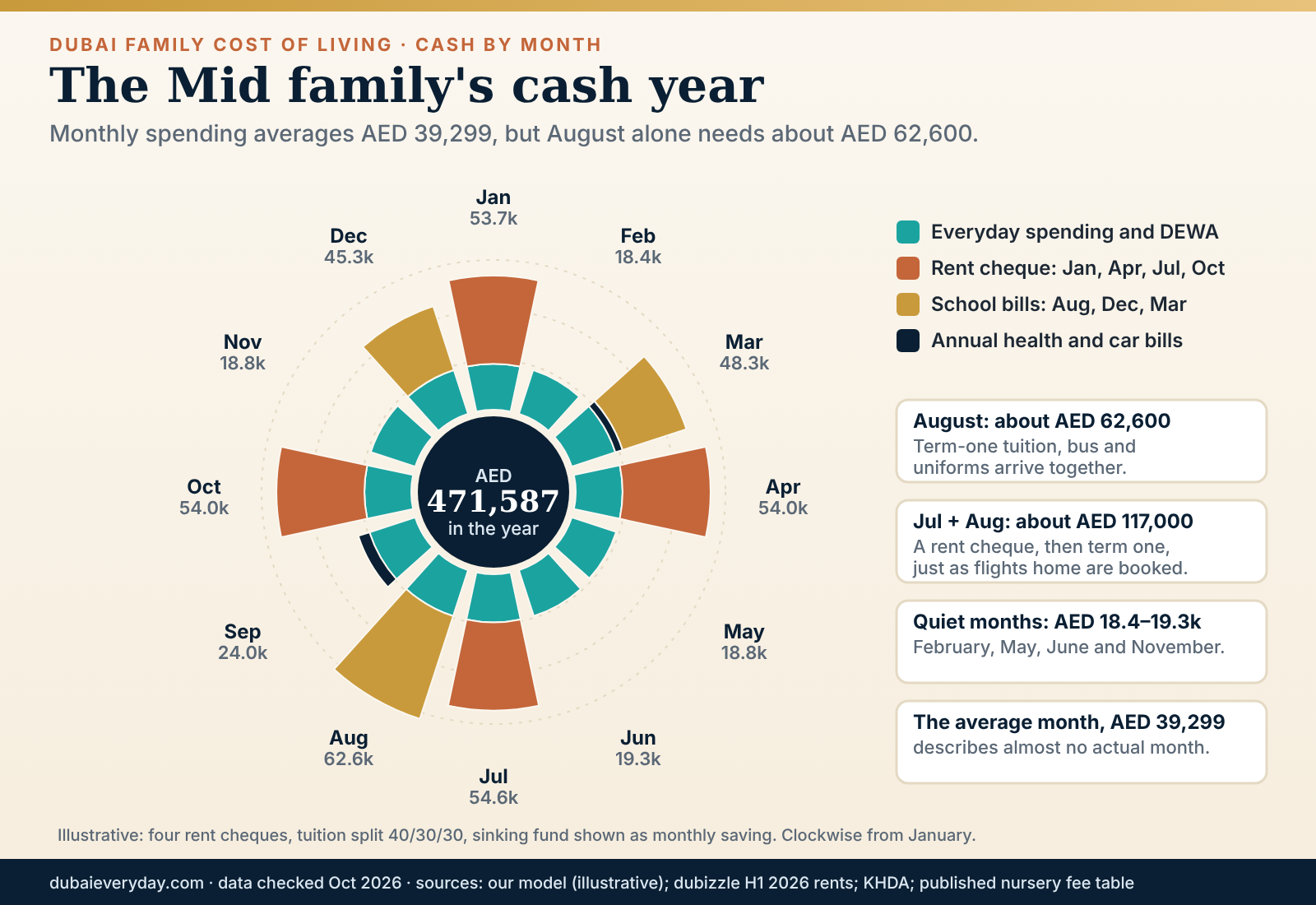
What the wheel shows about the Dubai family cost of living
Under our assumptions the Mid family’s quiet months, such as February or November, cost about AED 18,400 to 18,800. The busy months run from about AED 45,000 to AED 62,600. August is the peak, at roughly AED 62,600, because term-one tuition, bus fees and uniforms arrive together. Rent cheques of AED 35,250 lift January, April, July and October to about AED 54,000.
July and August back to back come to about AED 117,000, which is also when many families buy flights. The twelve months add up to the same AED 471,587 a year as the Dubai family cost of living budget, but the monthly average of AED 39,299 describes almost no actual month. The fix is a separate pot for the lumps: divide the annual total of rent, tuition, insurance and renewals by twelve, move that amount on payday and treat the balance as untouchable.
Which levers change the total, and the money rules behind them
Every household asks the same question: where can the Dubai family cost of living come down without wrecking the year? Using the Mid budget as the base, here are the levers ranked by monthly effect. All are our arithmetic from the inputs above.
- Going car-free, if the school bus and a station make it workable: about AED 3,026 a month lower.
- Moving a nursery child from a 6pm finish to a 2pm finish: between AED 750 and AED 2,000 a month lower, using the 23 and 62 per cent differences in the published table.
- Cutting rent by AED 15,000 a year: about AED 1,313 a month lower, including the 5 per cent fee.
- Choosing a school at AED 30,000 instead of AED 45,000: AED 1,250 a month lower on tuition alone.
- Halving eating out: about AED 880 lower. Cutting groceries by 10 per cent: about AED 320.
- Adding a live-in helper: AED 2,500 to 3,700 higher. Adding a third child at nursery age: about AED 3,360 higher.
The order matters more than the amounts. A family that picks a school after signing a lease inherits a bus radius, a commute and a car decision. A family that shortlists schools first can search for homes inside a sensible radius and often avoids the second car.
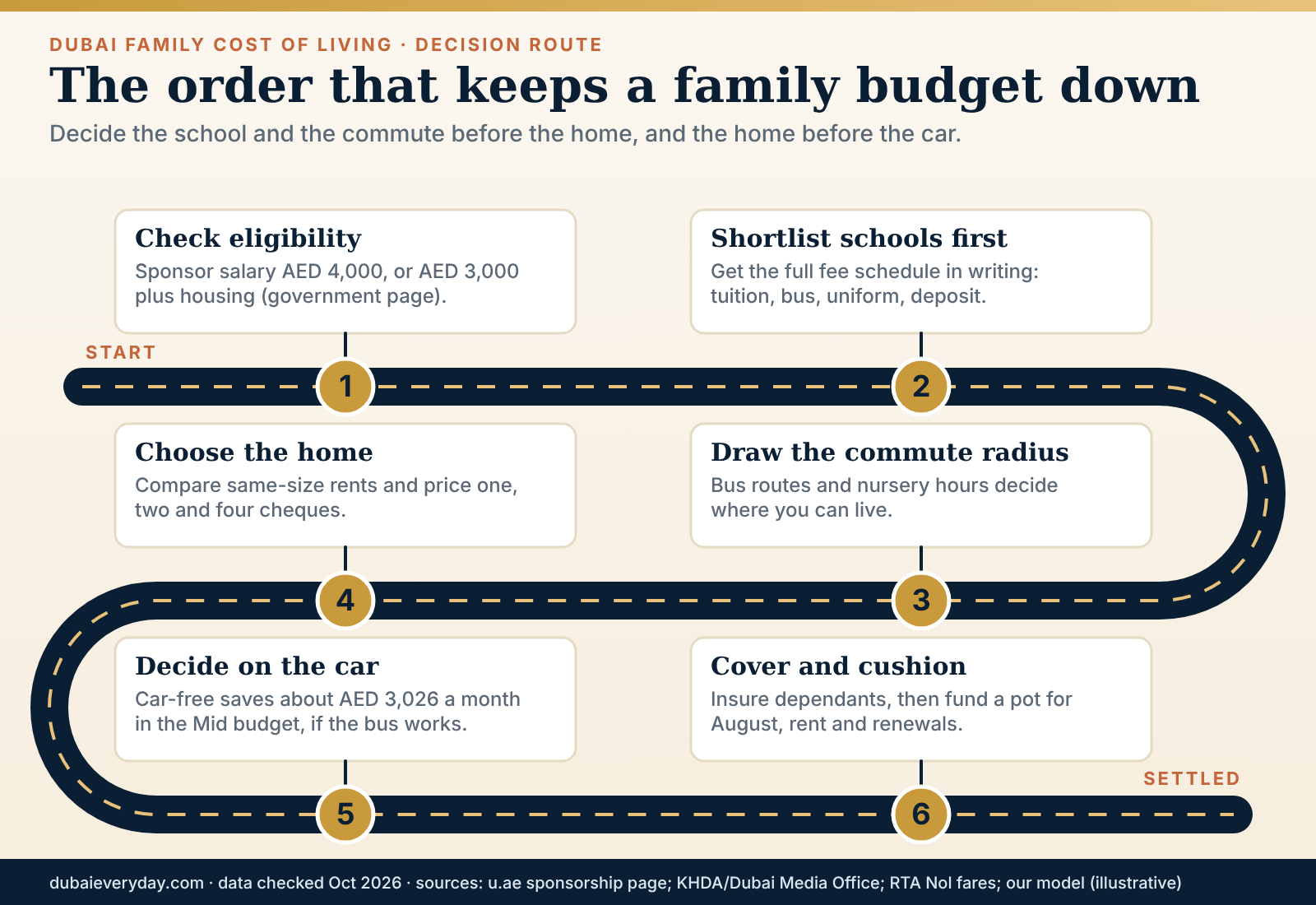
Tax, savings and the pay you need
The UAE government’s taxation page says there is no personal income tax and that value-added tax is 5 per cent. Take-home pay is therefore close to the salary on your contract, less any deductions that apply. The pay needed to fund each Dubai family cost of living budget is the monthly cost divided by one minus the savings rate.
To save 10, 20 or 30 per cent, the Lean family needs about AED 22,260, 25,042 or 28,620 a month. The Mid family needs about AED 43,665, 49,124 or 56,141. The Comfortable family needs about AED 73,503, 82,690 or 94,503. A six-month cost buffer is AED 120,204, 235,793 or 396,914. Unemployment insurance pays 60 per cent of the subscription salary for up to three months with caps, a cushion rather than a substitute for savings.
If you run your own company
Founders and consultants add a layer. The salary on your visa, not the cash in the company account, usually drives sponsorship eligibility, and company costs belong in separate books. If you are still choosing a structure, the Dubai business setup guide and the free zone company guide explain licence and visa routes, and the accounting services guide covers keeping personal and business money apart.
Checking a bank, exchange house or lender
Families deal with banks for salary accounts, exchange houses for remittances and lenders for car loans. The Central Bank of the UAE keeps a licensing page with a searchable register of licensed financial institutions and a separate list of insurance entities; check a name there first. We do not rank or recommend any provider. Compare the all-in cost of a transfer, fee plus exchange-rate margin: a AED 35 difference on a monthly AED 5,000 transfer is AED 420 a year.
Mistakes to avoid, and who this page is not for
Most overspending in the Dubai family cost of living traces back to a few errors made in the first month. These are the ones the numbers above make visible.
- Budgeting from the tuition headline instead of the full fee schedule with bus, uniform, books and trips.
- Signing a lease first and looking for a school second, then finding the bus does not run that way.
- Planning on a spring DEWA bill and meeting the summer one, which can be two to three times higher in a villa.
- Assuming the employer’s health policy covers the spouse and children without asking HR in writing.
- Treating the car instalment as the cost of the car, and leaving out fuel, Salik, parking, insurance and service.
- Relying on the 2026-27 fee freeze to continue.
Who this page is not for
It is not a fit for a household with teenagers, where senior-year fees are 30 to 50 per cent higher, or for three or more children. It is not for a family on a package with a school or housing allowance, because the arithmetic changes. And it is no substitute for advice on tax, immigration or insurance.
Couples and single adults should start with the couple budget or the single-person budget. For the whole city, the Dubai cost of living guide is the broader reference. This page is deliberately narrow: the Dubai family cost of living with two children, priced on 29 October 2026.
Dubai family cost of living: frequently asked questions
How much is the Dubai family cost of living each month for four people?
On our illustrative models for two adults and two children aged three and seven, about AED 20,000 a month on a lean plan, AED 39,300 on a mainstream plan and AED 66,150 on a comfortable plan. Rent and education are 47 to 54 per cent of each. The Dubai family cost of living is built here from dated rents, fees and allowances, not a survey, so replace our inputs with your own lease and fee letters.
How much is rent for a family in Dubai in 2026?
Portal data for the first half of 2026 shows two-bedroom apartment averages from about AED 81,000 a year in International City to AED 223,000 in Downtown, and three-bedroom villa averages from AED 141,000 in The Valley to AED 211,000 in DAMAC Hills. Those are advertised averages, not what every tenant pays. Apartment rents have been falling in most communities, so ask for a discount before you sign.
Will school fees raise the Dubai family cost of living in 2026-27?
No. KHDA confirmed no increase in private school fees for 2026-27, in a decision reported by the Dubai Media Office on 22 May 2026. That applies to school fees, and the release did not say whether nursery fees are included. Fees can still be higher in the next year group, and nothing guarantees the freeze continues, so leave a margin in next year’s plan.
How much do school extras add to the Dubai family cost of living?
A property-portal guide puts extras at 15 to 25 per cent of tuition on average, with school transport at AED 6,000 to 12,000 a year, uniforms at AED 500 to 1,500 and books at AED 1,000 to 3,000 per child. In our Lean case the extras equal 53 per cent of a AED 16,000 tuition fee. Ask each school for the complete fee schedule in writing.
How much does a nursery cost in Dubai?
In the Dubai family cost of living, nursery is the line with the least standard pricing. A May 2026 portal guide groups nurseries into budget (AED 12,000 to 25,000 a year), mid-range (25,000 to 45,000) and premium (45,000 to 70,000 or more). One large group’s published 2026-27 table runs from AED 27,200 to AED 54,000 depending on daily hours, plus registration of AED 3,000. Hours and term-one billing matter as much as the headline rate.
Does a family need a car to keep the Dubai family cost of living down?
Not always, and it is the biggest lever in the Dubai family cost of living. Our Mid car line is AED 3,921 a month all in, against about AED 895 for two annual Nol passes and some taxis, a saving of about AED 3,026. Children aged five and under travel free on public transport.
Who pays for my children’s health insurance in Dubai?
Health cover is a legal duty in the Dubai family cost of living, not a choice. Employers must insure employees. Sponsors must insure the dependants they sponsor unless an employer already covers them, and employers are encouraged, not required, to cover family members, so ask HR in writing. In our Mid case the sponsor’s employer covers the sponsor, and we price AED 4,700 a year for a spouse and two children from a broker’s family table.
What salary do I need to sponsor my family?
The Dubai family cost of living starts with eligibility. The government’s sponsorship page sets the minimum at AED 4,000 a month, or AED 3,000 plus accommodation. That is eligibility, not affordability: our lean Dubai family cost of living budget is five times that. Requirements depend on your visa category and can change, so confirm with the Federal Authority for Identity and Citizenship or GDRFA before you apply.
How much cash do I need when I move in with a family?
In our calculation, with four rent cheques, about AED 31,600 (Lean), AED 51,700 (Mid) or AED 76,200 (Comfortable), covering the first cheque, deposit, commission, Ejari and the DEWA deposit. One cheque pushes the Mid figure to about AED 157,400. School application fees, deposits and the first term’s tuition come on top, and furniture after that.
Related reading
Sources and further reading (46 links)
- Dubai Media Office: KHDA confirms no fee increase — 2026-27 school-fee decision, affordable places, early childhood centre relief
- UAE Government: school fees — how fees are regulated and the government-school option
- KHDA: amending the fees of an early childhood centre — nursery fee change process
- RTA: Nol fares — per-trip fares, 30-day and annual passes, free travel for children aged five and under
- UAE Government: sponsorship requirements for family members — salary threshold and 60-day window
- UAE Government: birth certificate and residence visa for newborn expatriates — 30-day and 120-day deadlines, daily fine
- Dubai government: health insurance — employer and sponsor duties
- Dubai Health Authority insurance FAQ — who pays for employee and dependant cover
- Insurer-hosted copy of DHA Circular GC 03/2024 — Essential Benefits Plan limits and co-pays
- Dubai government: involuntary loss of employment insurance — premiums, benefits and fines
- Dubai Land Department: register or renew an Ejari contract — Ejari fees
- Dubai Legislation Portal: Decree No. 43 of 2013 — rent increase bands
- Ministry of Economy and Tourism: Essential Goods Prices platform — staples price monitoring
- UAE Government: taxation — no personal income tax, VAT at 5 per cent
- Central Bank of the UAE: licensing — register of licensed financial institutions and insurance entities
- Central Bank of the UAE Rulebook: motor insurance tariff — minimum and maximum premium corridors
- dubizzle: Dubai rental market report H1 2026 — average rents by community and bedrooms (portal)
- Khaleej Times: Dubai rents fall in most areas — asking-rent trend (press)
- Khaleej Times: rents fall over 12 per cent in Marina and Business Bay — Savills third-quarter 2026 data (press)
- Khaleej Times: Outstanding school fees 2026-27 — tuition ranges by curriculum (press)
- Gulf News: Very Good rated schools under Dh45,000 — affordable fee ranges (press)
- Gulf News: Dubai school rules 2026-27 — age cut-off and calendar (press)
- Gulf News: UAE school holidays 2026-27 — term and break dates (press)
- Real Estate Club Dubai: Dubai school fees 2026 — curriculum bands and ancillary costs (broker)
- iSchoolAdvisor: international school admissions in Dubai — typical admissions timeline and application fee (commercial)
- Khaleej Times: KHDA inclusive education policy — admission principles for students of determination (press)
- Real Estate Club Dubai: nursery guide for preschool parents — nursery fee tiers and hidden costs (broker)
- Raffles Early Childhood Centres: fees 2026-2027 — an example of a published nursery fee table (operator)
- The Traveler: childcare and nanny costs in the UAE — nursery and nanny ranges (secondary)
- Real Estate Club Dubai: maid visa cost — helper salary bands and visa costs (broker)
- Pacific Prime: UAE family health insurance — family premium table (broker)
- Gulf News: how to sponsor your wife for a UAE residence visa — itemised visa fees (press)
- Khaleej Times: UAE fuel prices for October 2026 — per-litre prices (press)
- Gulf News: Parkin and Salik costs from 1 June — toll and parking rates (press)
- Zigwheels UAE: the true cost of car ownership — registration and inspection ranges (portal)
- Gulf News: UAE seat belt rules and fines — child seat and front seat rules (press)
- EnterpriseAM: Dubai inflation rises to 5.5 per cent — consumer price index by category (press)
- Property Finder: DEWA calculator — electricity and water slabs (portal)
- Bayut: Dubai internet packages — home internet price range (portal)
- Bayut: Dubai Municipality housing fee — 5 per cent fee in twelve instalments (portal)
- Gulf News: renting in Dubai, 11 extra costs — deposit, commission and DEWA deposit (press)
- Gulf News: Dubai’s outdoor parks for kids with entry prices — park entry fees (press)
- Global Village: official website — season dates and ticket prices (operator)
- Dubai Safari Park: FAQs — park pass price and hours (operator)
- Gulf News: Dubai Miracle Garden season 15 — ticket prices (press)
- Edarabia: top football schools in Dubai — published academy fees (portal)
Update log: 29 October 2026 — first publication; figures re-checked against the sources above where the pages would open, and some carried from companion research of the same date. Next review due: by 28 February 2027, or sooner if rents, school or nursery fees, fuel prices, tariffs or regulations change. Corrections welcome. This Dubai family cost of living guide is general information only, not financial, legal, tax, immigration or insurance advice; confirm any figure that affects a contract or a payment with the provider or a licensed professional.
About DubaiEveryday and this guide
DubaiEveryday.com is an independent editorial project that publishes practical, research-based guides to everyday life in Dubai: where to live, what things cost, how the rules work and how to get around. This page was written and edited by the DubaiEveryday editorial team. It is not signed by a named expert, doctor, lawyer or adviser, and we do not claim first-hand testing of a venue, clinic or service unless the page says so.
Each guide is built from official sources such as government and regulator pages, operator websites and established news outlets, cross-checked where we can. When we could not confirm something, we say so in the text, and examples that use made-up numbers are labelled as illustrations. Mentions are editorial choices, not paid placements, and a link is not an endorsement.
Dubai changes quickly. If you spot something that is out of date or wrong, please tell us through the contact options on DubaiEveryday.com and we will check it and correct the page.