
Car insurance Dubai drivers must hold starts with third-party liability and stretches to comprehensive cover, agency repair and an excess you agree to in advance. This guide shows what each level pays, what the regulator fixes, how claims run and how to renew without a gap.
Most people treat car insurance Dubai renewals like a utility bill: get three quotes, pick the cheapest, file the policy and forget it. That works right up to the day something goes wrong. Then the excess, the repair garage, the clause about off-road driving and the age of your car decide whether the claim is a shrug or a fight.
The good news is that Dubai motor cover is less of a free-for-all than it looks. The regulator publishes the standard wording, a price floor and ceiling, and even the number of days an insurer has to pay. This guide uses those official texts to show what third party and comprehensive cover really pay, how agency repair works, what a claim looks like step by step and how to renew without a gap. It is general information, not advice, so check your own policy schedule before you sign.
Car insurance Dubai residents need is, at minimum, third-party liability: it is a condition of registering a vehicle, and it pays for injury and damage you cause to other people and their property, not for your own car. Comprehensive cover adds your vehicle on top, covering accident damage, fire and theft. Both sit inside one regulated frame, a unified policy wording and a tariff that sets a price floor and ceiling for private cars.
For most car insurance Dubai buyers whose car is worth more than a few tens of thousands of dirhams, comprehensive is the sensible choice, and it is normally required if the car is financed. Third party only suits an older, low-value car whose loss you could absorb.
Three details decide whether a policy performs: the excess (the unified form caps it at AED 350 to AED 1,400 for private cars by value, with add-ons for young drivers and modified cars), whether repairs go to the agency or a general garage, and what the wording says about off-road use, floods and driving outside the UAE.
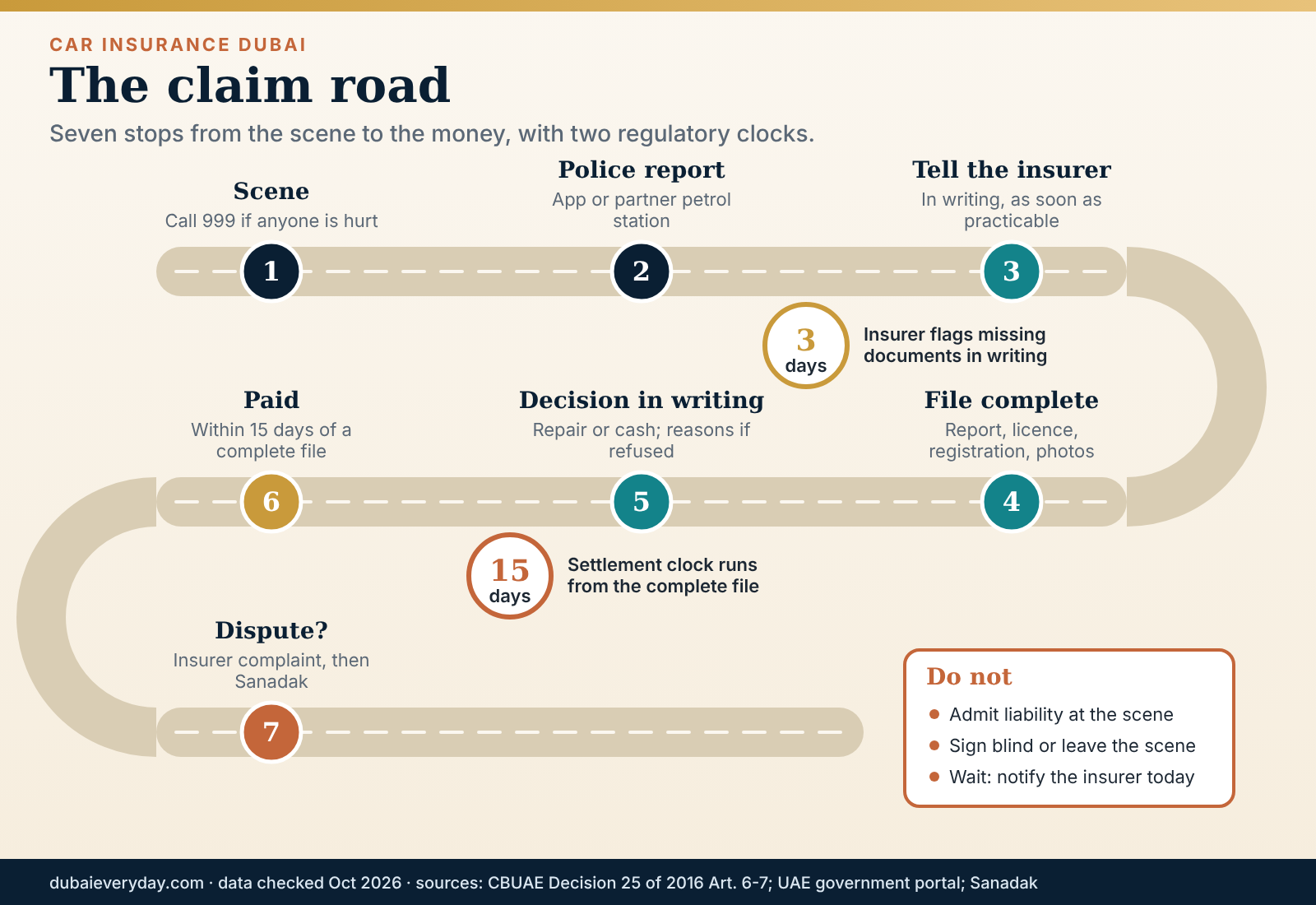
Claims run on clocks. The insurer must flag missing documents within three days and settle within fifteen days of receiving a complete file. The sections below show how to compare quotes, handle a crash and renew on time.
This is a desk-research guide to car insurance Dubai rules. It is built from the Central Bank of the UAE (CBUAE) rulebook texts of the unified motor policy and the motor tariff, the UAE government portal, Sanadak (the CBUAE’s insurance complaints unit), law-firm summaries of the 2023 insurance law, and press reports for market conditions. Rules and figures were checked on 29 October 2026.
We did not buy policies, file claims or phone insurers, so nothing here describes a personal experience of any company, and we rank no insurer. Inclusion was not paid for; there are no affiliate links. Market prices are indicative and come from press reports labelled as such. This is general information, not individual financial or legal advice: confirm your own policy schedule with a CBUAE-licensed insurer or broker.
What this car insurance Dubai guide covers
One job: choosing, buying, claiming on and renewing car insurance Dubai drivers can rely on, meaning a private-car policy for a vehicle registered in the emirate. That means the comparison between third-party and comprehensive cover, what agency repair really is, how the excess works, what the regulator allows insurers to charge, and the steps after a crash. It stays with the motor policy and leaves the wider map of cover types to our Dubai insurance guide.
Two neighbouring jobs are deliberately kept short. Medical cover for injuries sits in the health insurance guides; the motor policy pays other people’s treatment costs when you are at fault, but your own medical bills belong to your health plan, covered in our guide to mandatory health insurance in Dubai. Short-stay visitors who rent a car are a different problem, because the rental contract and the traveller’s own policy decide most of the outcome; the travel insurance guide handles that side.
This car insurance Dubai guide is also not a ranking. There is no “best insurer” list, because the useful comparison is between policy wordings, schedules and service terms, and a price quote without those is half a fact. Where we say “the regulator’s text” we mean the CBUAE rulebook; where we cite press, the text says so.
How motor insurance is regulated: the unified policy and the price band
Car insurance Dubai buyers meet is more standardised than most people expect, because it rests on UAE-wide rules. Three layers shape every car insurance Dubai quote, and knowing them turns a confusing price into something you can audit.
Layer one: the insurance law and who may sell
Federal Decree-Law No. 48 of 2023 is the current insurance law. According to a Clyde & Co summary of it, it took effect on 30 November 2023, replaced Federal Law No. 6 of 2007, and places insurers, agents, brokers, loss adjusters and other insurance professions under CBUAE licensing, with a compliance period that ended on 29 May 2024.
The same summary says buyers may not purchase insurance from unlicensed foreign insurers. In plain terms for car insurance Dubai buyers: the entity selling you the policy and the entity carrying the risk should both appear on a CBUAE register, a check we walk through later in this guide.
Layer two: the unified policy wording
The Insurance Authority issued Board Decision No. 25 of 2016, which created two standard forms: the Unified Motor Vehicle Insurance Policy Against Third Party Liability and the one Against Loss and Damage (the second is what the market sells as comprehensive, since it is paired with the liability form). The Authority’s functions have moved to the CBUAE, and the texts now live in its rulebook. They were amended by Decision 42 of 2017 and Resolution 26 of 2020, the latter in force from 18 January 2021.
The key consequence is that insurers cannot dilute these forms. The decision says the forms may be amended only in the insured’s favour, and it obliges insurers to issue third-party cover on any licensed UAE vehicle when asked. A refused applicant can expect the insurer to justify the refusal to the regulator on request. The practical result is that two car insurance Dubai quotes for “the same” cover are built from the same core wording, so differences come from endorsements, add-ons, the excess actually set, repair-network terms and service.
Layer three: the tariff
Decision No. 30 of 2016 set motor tariffs, effective 1 January 2017, later amended by Decision 41 of 2017 and Resolution 17 of 2020. It prescribes, for each vehicle category, a minimum and maximum premium for third-party cover and a minimum premium plus a maximum percentage of vehicle value for comprehensive cover. The text states that the tariff already includes administrative charges, expenses and commissions, and that insurers, agents and brokers may not collect any extra amount without a decision from the regulator. Extra premiums are allowed only for additional cover you agree to, and these must be stated clearly.
That last sentence is a useful test for any car insurance Dubai quote. If a “policy fee” or “processing charge” appears that is not an add-on you chose, ask which regulatory decision allows it. We could not find in the tariff text we read any mention of VAT or fees, so ask whether a quote is VAT-inclusive rather than assuming either way.
Insurance and registration are one process
Car insurance Dubai rules do not let you separate insurance from the car’s paperwork. The UAE government portal says that registering a vehicle needs an electronic insurance document from an authorised insurer, and a mortgage on the car is added electronically. A technical test is required too, though vehicles produced in the last three years are exempt. The consequence is that a lapsed policy is not an invisible problem: it blocks renewal, and driving without cover is treated as an offence.
How hard the courts treat it varies. One reported Dubai traffic-court case from early 2026 involved a driver convicted of driving an unregistered, uninsured vehicle after a collision; the court imposed a AED 5,000 fine and a three-month licence suspension, treating the offences together. That is a single press-reported case, not a tariff of penalties, so treat it as a signal, not a price list. The wider traffic rules and where to verify them are in our legal basics guide for residents.
Third party vs comprehensive car insurance Dubai: what each pays and which to buy
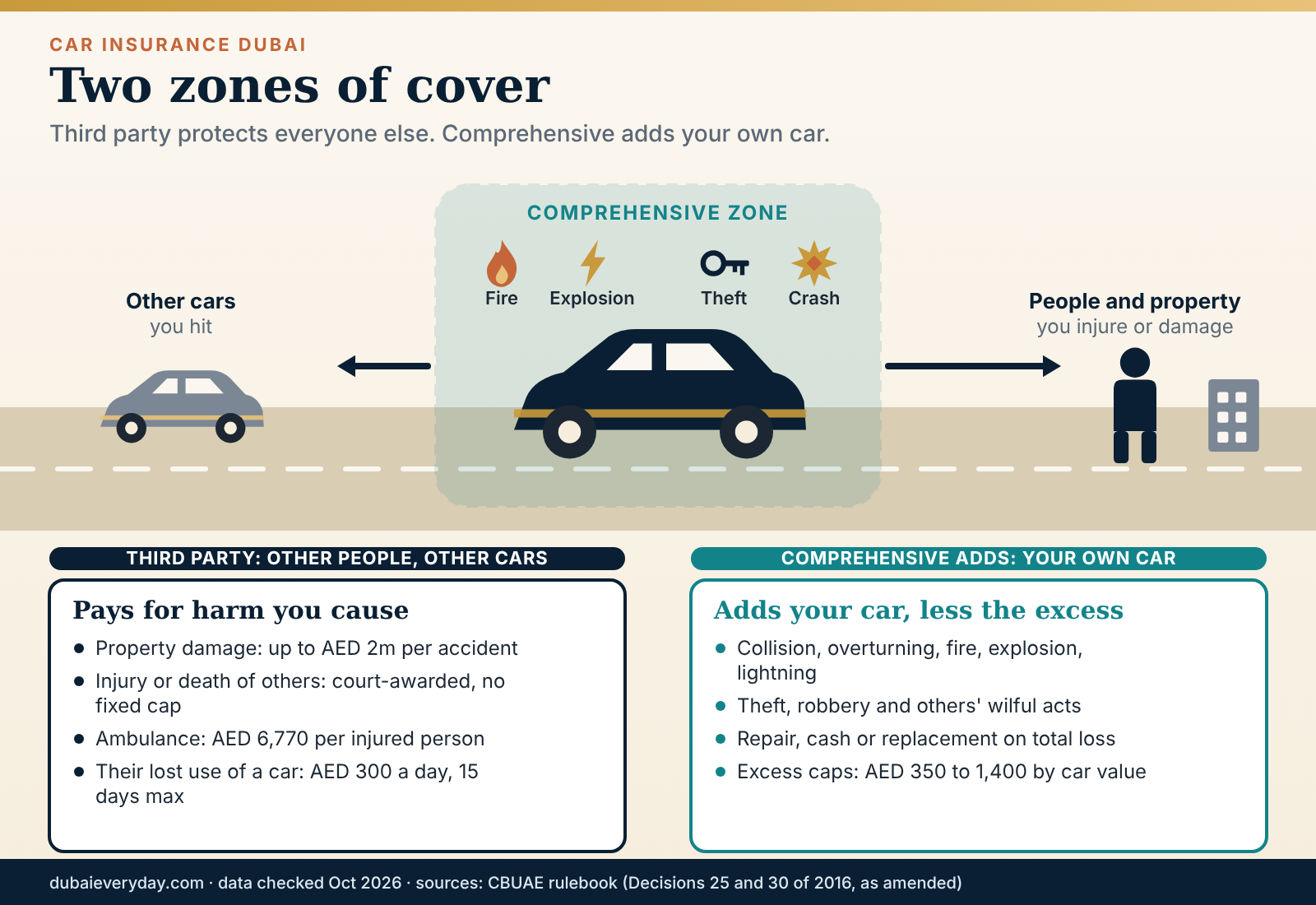
The two car insurance Dubai products answer different questions. Third-party liability answers “who pays the people I hurt or the property I break?” Comprehensive adds “who pays for my own car?” The unified wording is specific about both, so it is worth reading what it actually says before comparing quotes.
What third-party liability pays
The unified third-party form covers the insured and the driver for amounts they must pay as compensation for bodily injury and property damage to others, arising from the use or parking of the vehicle inside the UAE. For injury and death of third parties, the form pays the judicially awarded amount with no fixed ceiling.
For property, the limit is AED 2,000,000 per accident, regardless of how many owners are affected. Treatment costs are paid, ambulance and medical transport carries a stated AED 6,770 per injured person, and a third party who loses the use of their car can claim a substitute-vehicle allowance of up to AED 300 a day for a maximum of 15 days.
Two protections matter to the injured. The insurer may not deduct an excess from compensation owed to an injured third party, and where the policy was obtained dishonestly or the driver was unlicensed or impaired, the insurer still pays the victim and then pursues the policyholder or driver. That right of recourse is how a clause you ignored can turn into a debt to your own insurer.
What the form does not pay: damage to your own car, injuries to you or to the at-fault driver, accidents outside the UAE, losses from natural disasters, war and nuclear events, and injuries to employees while working unless another policy applies. As car insurance Dubai goes, it is a liability policy, nothing more.
What comprehensive adds
The loss and damage form covers damage to your vehicle and its accessories from accidental collision, overturning, external fire, explosion, lightning, theft or robbery, wilful acts by others and transport by land. The insurer may repair, pay cash where agreed, or replace the car on a total loss. A vehicle counts as a total loss when it is irreparable or when repair costs would exceed half its pre-accident value; the 2017 amendment adds that damage needing cutting or welding of fixed parts such as the chassis or pillars is treated as a total loss too.
The exclusions are where comprehensive car insurance Dubai policies disappoint people. The form lists, among others: indirect loss and wear, overloading, damage to a tyre on its own, use for a purpose not declared in the application, speed races, unlicensed drivers or a licence expired for more than 30 days, driving under alcohol or drugs, damage outside the UAE unless a rider extends it, off-road damage unless a rider covers it, and natural disasters. Natural disasters deserve a note, because the 2024 floods taught the market what a clause is worth.
In December 2025 an Emirates Insurance Federation committee head told the press that comprehensive policies include rain and flood damage under their standard terms unless the state declares a natural disaster, in which case compensation passes to the state, and that deliberately driving into wadis or flood channels is not covered. That is a secondary report of a statement, not a regulator’s text, so read your own wording and ask for the flood position in writing.
Car insurance Dubai side by side: eight things that go wrong
| What happens | Third party only | Comprehensive |
|---|---|---|
| You cause a crash; the other car is damaged | Pays the other party, up to AED 2m per accident | Same, plus your own repair after the excess |
| The other driver causes it and is insured | Their insurer should pay; you depend on the police report and fault finding | Same route, with your own insurer as a second door for loss-of-use claims |
| A driver hits your parked car and leaves | No cover for your car | Covered if reported; the excess applies as for an unknown-party accident |
| Theft or robbery of the car | Not covered | Covered |
| Fire or explosion | Not covered | Covered |
| Rain or flood damage | Not covered | Depends on wording; see above |
| Your passengers or a pedestrian are injured by you | Their treatment and compensation covered | Same |
| You are injured | Not under the motor form; use health cover | Not under the motor form unless a personal accident benefit is added |
The break-even test most car insurance Dubai quotes skip
Here is a useful bit of arithmetic for any car insurance Dubai comparison. For a private four-cylinder saloon the tariff’s third-party ceiling is AED 1,300, and the comprehensive floor is also AED 1,300. So at the legal extremes the two can cost the same, and the question is never “is comprehensive affordable” but “what is the actual gap in the quotes I have?” Divide that gap by the car’s realistic value.
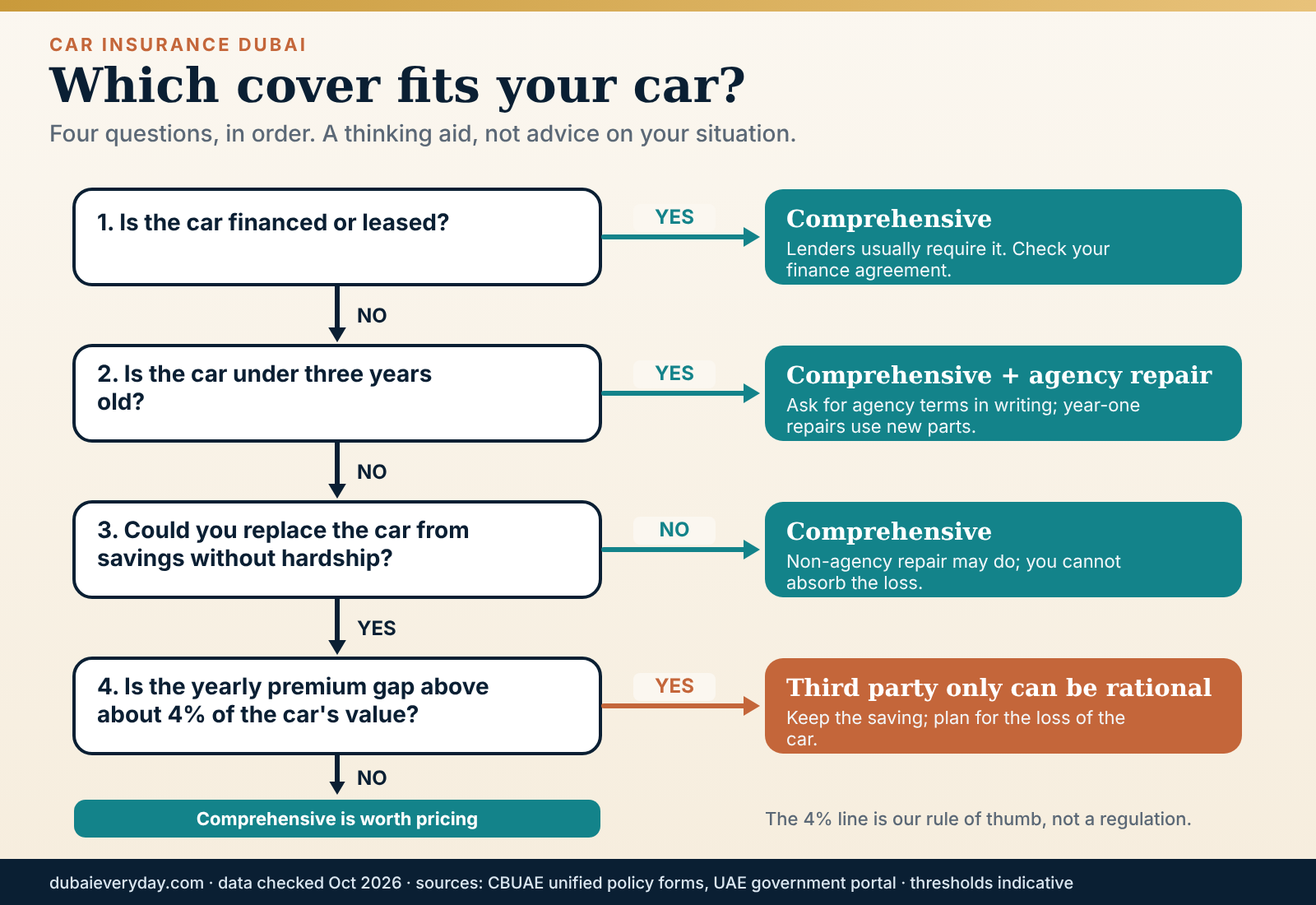
In our calculation, an extra AED 1,000 a year on a car worth AED 25,000 is 4% of its value annually, a heavy price for protection that is capped by that low value. The same AED 1,000 on a AED 90,000 car is about 1.1%.
A second test is liquidity. If losing the car tomorrow would force you into debt or leave you without work transport, you are not choosing third party for savings, you are choosing it for a gamble. A third test is fault. Third-party-only owners are exposed whenever the other driver cannot be identified, is uninsured, or disputes responsibility, because their own repair has no insurer behind it.
Which car insurance Dubai cover to buy: a decision path
The tree below turns the logic into four questions. The cards after it show how it lands for typical situations.
Financed car
A lender normally insists on comprehensive car insurance Dubai cover and a mortgage entry on the registration. Check the finance agreement before shopping. If the car is written off, the 2017 amendment says the insurer must pay outstanding dues and obtain a no-objection letter from the mortgagee.
Car under three years old
Comprehensive with agency repair is the default conversation. The car still holds most of its value, and under the unified third-party form a vehicle in its first year must be repaired at agency shops with new original parts, which sets the standard you will compare your own policy against.
Older paid-off car
Third party is rational if the car is worth less than a few months of your income and you have a plan for replacement. Price comprehensive anyway; for some cars the gap is small.
Second or rarely used car
The risk per kilometre is low, but theft, fire and parking knocks do not care about mileage. The tariff allows insurers to price by kilometres driven when the insured asks, so it is worth asking.
Younger drivers and owners of sports or modified cars get a different car insurance Dubai calculation. The unified form allows additional percentage deductibles for them, covered in the excess section, and the premium rises toward the tariff ceiling. A third-party-only policy avoids the loading but exposes you to the whole repair bill on a car that costs more to fix than most.
Agency repair, explained by car age
Agency repair means the repair is done at the manufacturer’s authorised workshop, normally with genuine parts. The alternative is a non-agency garage, which can be a well-equipped independent workshop or a corner garage, with parts that may be non-original of the same grade. In car insurance Dubai policies the label sounds like a premium feature, and it is also a regulated one, because the unified policy ties it to the age of the vehicle.
What the unified forms say, year by year
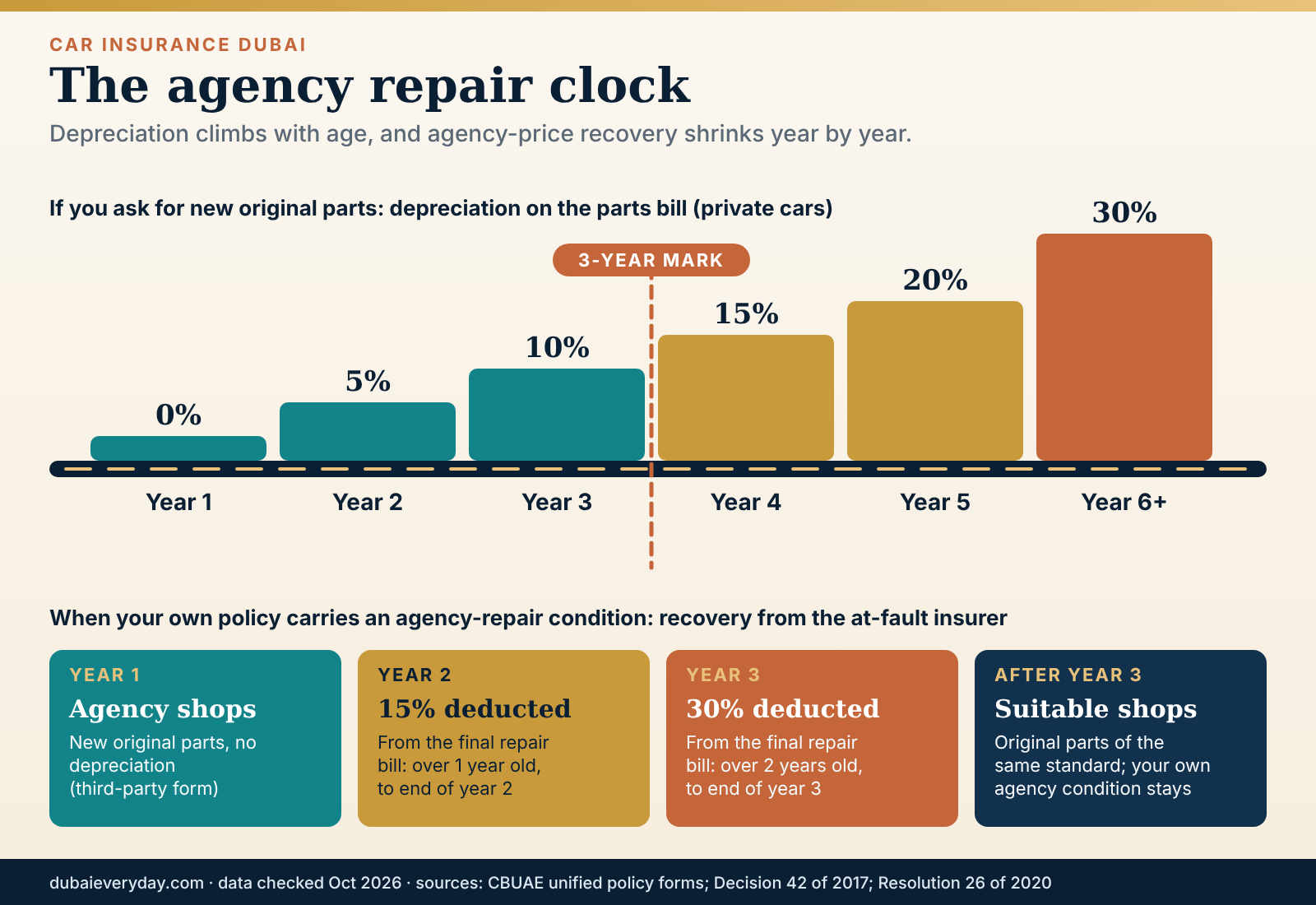
Start with claims made against the at-fault driver’s third-party policy. During the first year after registration, if the injured party agrees to repair rather than cash, the form requires agency repair shops, new original parts and no depreciation on parts. After the first year, repairs may be carried out at a suitable shop with parts of the same grade, which may be non-original, provided the work meets technical standards and carries a warranty.
The complication arises when the injured party’s own comprehensive policy has an agency-repair condition. Decision 42 of 2017 says the repair must then happen in the agency’s workshops, and the injured party’s insurer recovers the cost from the at-fault driver’s insurer less a deduction that rises with age: 15% for a vehicle more than one year old up to the end of year two, and 30% for more than two years up to the end of year three.
After year three the recovery is based on repair at suitable shops with original parts of the same standard, although the agency-repair condition in your own agreement stays in force.
Read that slowly. After about three years, the system stops guaranteeing that the other driver’s insurer will fund agency prices. The gap lands on whoever promised agency repair, which is your insurer, and it explains why agency repair is the first thing underwriters tighten when claims run hot. One Gulf News report from 2024 described owners seeing agency repair removed at renewal.
After year three: you can still ask for it
Resolution 26 of 2020 added a clause to the comprehensive form. If you choose, when the contract is signed, to have the car repaired at agency workshops after its first three years on the road, the insurer may accept and charge an appropriate premium, capped at the tariff maximum.
In other words, the regulator did not ban agency repair for older cars; it made it an option that costs money and sits inside the price ceiling. The text we read says nothing more specific about what a comprehensive policy must offer during the first three years, so your schedule is the authority there.
Depreciation on parts
If you ask for new original parts or cash instead of a repair with used or same-grade parts, the form lets the insurer apply a depreciation percentage to the invoice value. For private vehicles the schedule is 5% in the second year of the car’s life, 10% in the third, 15% in the fourth, 20% in the fifth and 30% from the sixth. Taxis, public transport and rental vehicles use a steeper table, reaching 40% from year six. As we read the third-party form, glass, brake components, steering components and seat belts are exempt from depreciation.
Put that together and “agency repair” on a six-year-old car is not a free upgrade even when your car insurance Dubai policy includes it. The parts bill may still carry a deduction of up to 30% unless your policy states otherwise. That is the sentence to look for in the wording.
Questions that expose the real terms
- Is agency repair included for the whole policy period, or only until a stated vehicle age?
- Does the schedule name the garage network, and can I pick any authorised agency workshop?
- Are parts genuine, and is there any depreciation deduction on parts for my car’s age?
- If the agency is slow to supply parts, what substitute-car or allowance applies?
- What happens to the agency condition if my car passes the three-year mark mid-policy?
Ask for the answers in writing. A call-centre reassurance is not evidence when the claim lands.
Car insurance Dubai excess: what you pay before the insurer pays
The excess on a car insurance Dubai policy (called a deductible in the CBUAE texts) is the part of an own-car claim that stays with you. Under the unified comprehensive form it is a cap, not a fixed charge: the insurer may apply amounts up to those in Schedule 3, per accident, when the accident was caused by the insured or the authorised driver, or is treated as caused by an unknown person.
As we read Chapter Three, clause 6, that makes the fixed excess a feature of at-fault and hit-and-run claims, not of crashes the other driver caused; confirm that in your own schedule.
| Private car (up to 9 passengers), by value | Maximum fixed excess per accident |
|---|---|
| Up to AED 50,000 | AED 350 |
| AED 50,000 to 100,000 | AED 700 |
| AED 100,000 to 250,000 | AED 1,000 |
| AED 250,000 to 500,000 | AED 1,200 |
| Above AED 500,000 | AED 1,400 |
On top of that, the form allows a percentage deductible for riskier profiles: up to 10% for a driver under 25 or for taxi and public transport vehicles, up to 15% for sports cars and modified vehicles, and up to 20% for vehicles modified outside the factory or used for rental. Where more than one applies, the highest percentage is used rather than adding them. No deductible applies to a total loss, and none may be deducted from compensation to an injured third party.
An illustrative example, not a quote: a driver aged 23 in a AED 90,000 car has a fixed excess of up to AED 700. If the insurer also applies a 10% add-on to an AED 8,000 repair bill and calculates it on the claim amount, that adds AED 800, so the driver could carry up to AED 1,500 of the bill. Insurers may set lower excesses, because these are maximums, so the figure on your schedule is the one to read.
Two habits protect you when you buy car insurance Dubai cover. First, compare the excess alongside the premium: a quote that is AED 150 cheaper with a higher excess costs more the first time you claim. Second, if the other driver is at fault, say so in the claim notice and keep the police report close; it is the document that decides whether an excess applies and whether your insurer can recover from the other side.
What car insurance Dubai really costs: the price corridor and discounts
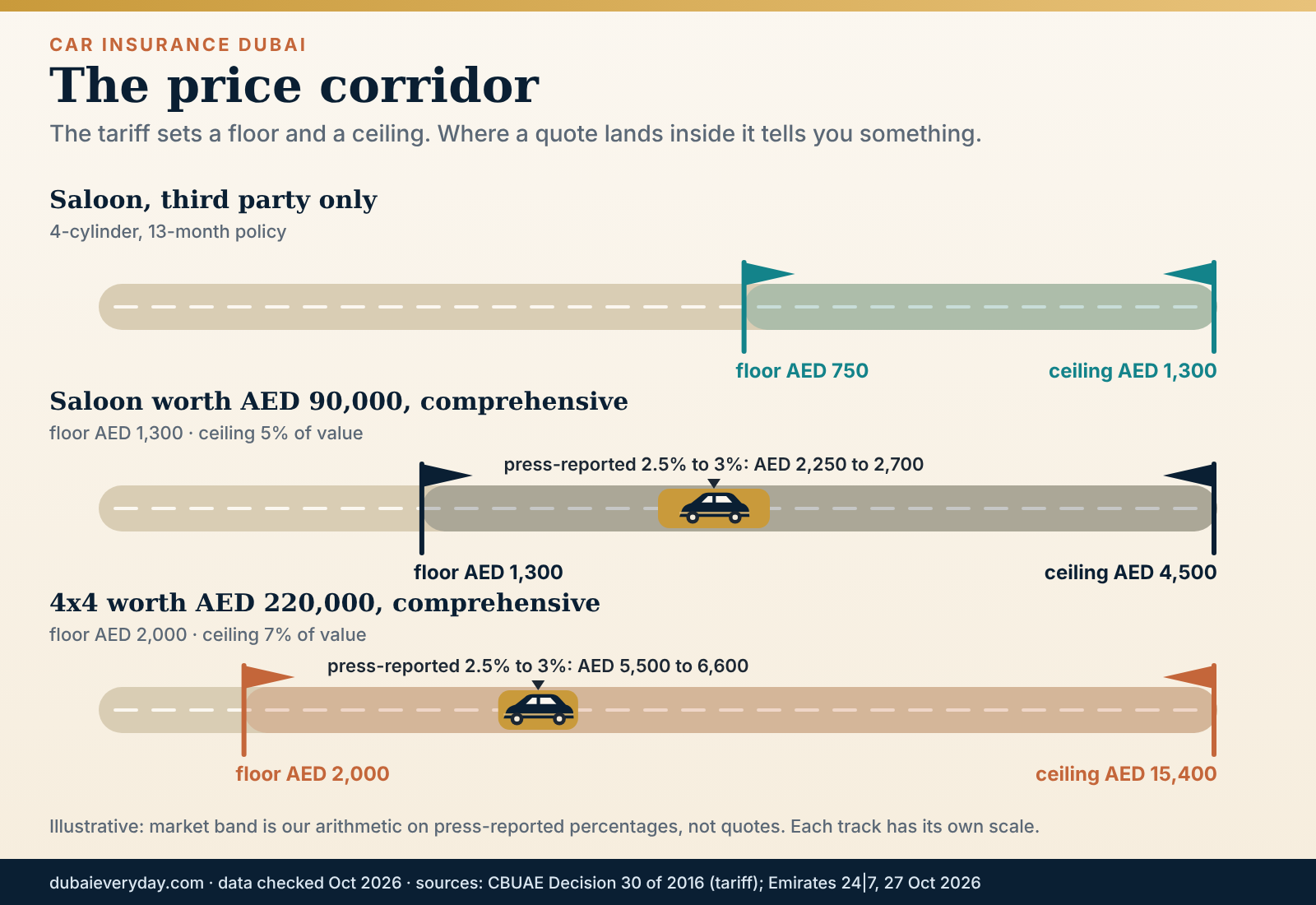
Price is where the regulator’s role in car insurance Dubai is most visible and least understood. The tariff creates a corridor for private cars: for third-party-only cover on a four-cylinder saloon, a minimum of AED 750 and a maximum of AED 1,300 for the policy period (the tables are written for 13 months).
For a comprehensive saloon the floor is AED 1,300 and the ceiling is 5% of the vehicle’s value; for a four-wheel drive the floor is AED 2,000 and the ceiling 7%. Other vehicle classes sit in their own rows, such as AED 1,000 to 1,750 for a pickup up to one tonne on third-party cover.
Car insurance Dubai insurers compete inside that corridor. Decision 41 of 2017 says plainly that companies are free to compete on tariffs within the table limits. A 2023 CBUAE circular, reported by industry press, told insurers not to sell below the minimum and to stop giving 50% discounts on the minimum premium; the circular itself was not available to us, so treat that as a press-reported direction.
Where car insurance Dubai prices sit inside the corridor
For market levels we have only press reports, which we label that way. In March 2025 Gulf News reported that renewals in January and February 2025 averaged roughly 15% to 20% higher than a year earlier, the third straight year of increases, with the April 2024 floods cited as a driver.
On 27 October 2026, Emirates 24|7 reported industry leaders at a Dubai insurance forum saying that prices had peaked and that the era of 10% to 15% annual rises was over, quoting premiums of 2.5% to 3% of vehicle value for conventional cars and 3.5% to 3.75% for Chinese and electric cars. Those are opinions voiced at a conference, not regulator data. Use them only to sanity-check a quote.
Our calculation, applying those percentages to round values: a AED 90,000 saloon at 2.5% to 3% would be AED 2,250 to AED 2,700, against a tariff floor of AED 1,300 and a ceiling of AED 4,500 (5%). A AED 220,000 four-wheel drive at the same percentages would be AED 5,500 to AED 6,600, against a floor of AED 2,000 and a ceiling of AED 15,400 (7%).
A AED 160,000 electric car at 3.5% to 3.75% would be AED 5,600 to AED 6,000. These are illustrations of where a car insurance Dubai quote might land, not quotes or market facts. A quote far outside its corridor means a pricing error, an unusual risk loading or a policy that is not what you think it is.
Car insurance Dubai discounts the tariff actually allows
The tariff lists reductions, and the way they are phrased matters. A claim-free reduction applies to the minimum premium, so it lowers the floor rather than promising a percentage off your quote. For a saloon with a AED 1,300 floor, a 10% reduction for one claim-free year gives a floor of AED 1,170, 15% for two years gives AED 1,105 and 20% for three years gives AED 1,040. The insurer’s own pricing decides how much of that you see.
- Claim-free reductions of 10%, 15% and 20% for one, two and three years without a claim-causing accident, for individual owners.
- A 10% loyalty reduction on renewal with the same insurer, not transferable to another person.
- Up to 25% at renewal for gas or electric vehicles, taking prior claims into account; if several reductions apply, only the highest is used.
- Up to 30% of the minimum premium for fleets of five or more vehicles.
- Pricing by kilometres driven, at the insured’s request and within the maximum tariff.
- A free claims-experience certificate from your insurer, supplied promptly, electronically or in writing.
An older provision also listed a 50% reduction of the minimum for named groups, including medical workers and over-60s. Given the 2023 circular, ask whether any such group reduction currently applies instead of assuming it does. Taxis and rental cars are priced separately, up to 6.5% of value, and classic vehicles at least 30 years old pay the third-party tariff with comprehensive cover negotiated.
Budget context helps here. In a household budget, car insurance Dubai premiums typically arrive as one annual lump alongside registration and servicing; the cost of living guide and the monthly budget pages for a single person, a couple and a family show where it fits.
Add-ons worth pricing, and wording worth questioning
For car insurance Dubai buyers the unified forms are the base. Everything else is a rider or an insurer-specific benefit, and the tariff says extra premium may be charged only for additional cover you agree to and that it must be stated clearly. Availability and prices vary by insurer and we did not collect rate cards, so this is a list of things to price, not a shopping list.
Off-road cover
The comprehensive form excludes off-road damage unless a rider covers it, and the third-party form lets the insurer recover from you if the vehicle was used off-road without cover. The policy defines a road as public or permitted roads and places made available for vehicle crossing, so a desert track is not automatically one. Anyone planning dune drives should read our things to do guide alongside the wording.
Cover outside the UAE
Both forms apply inside the UAE only; a trip to Oman or another GCC state needs a rider or separate cover. The regulator’s text mentions the Orange Card system for extending third-party cover to Arab countries for vehicles entering the UAE, which is the mechanism for foreign-registered cars here.
Loss-of-use or hire car
The third-party form pays an injured party up to AED 300 a day for 15 days. For your own car, a substitute-car benefit is an insurer option. Ask the daily limit, the number of days and whether it starts when the claim is filed or when the repair begins.
Personal accident and passengers
The motor forms are built around other people’s losses. If you want a payment for your own injury or for the car’s occupants, ask for a personal accident benefit with its limit in writing, and keep it distinct from your health plan.
Also ask about roadside recovery and its distance limit, tyres and windscreens (the form excludes tyre damage on its own, so check how glass and tyres are handled), and for electric cars, whether battery and charging equipment are covered and whether there is a loading. The October 2026 press discussion of electric-car premiums suggests insurers price them higher, though that is a market comment, not a rule.
The comprehensive form excludes use for a purpose not stated in the application, and the insurer may recover payments from the insured where the vehicle was used for other purposes or carried too many passengers. Ride-hailing, delivery work and business travel are the common surprises. If you earn money with the car, say so when you buy, and have the use class written on the schedule.
Buying safely: licensed insurers, brokers and the policy schedule
Buying car insurance Dubai residents rely on usually happens through one of three doors: directly with an insurer, through a licensed broker or agent, or through an online comparison platform. We name no platform and rank none. The CBUAE does not tell us which is cheaper, only who may sell.
Check the licence before the price
The CBUAE licensing page points to a register you can search by institution name and licence type, and to a separate insurance entities list you can download. It also warns that in-principle approval is not a licence: an applicant that has not received final authorisation cannot carry out supervised activity. For brokers and agents, the 2023 law brings them within CBUAE licensing, but the licensing page we read describes no separate public register for them, so ask the broker for its licence number and the insurer it is placing you with, then confirm both. If either cannot be found, stop.
The money trail is the second check. Pay the insurer or the licensed broker’s business account against an invoice or policy number, not a personal account, and keep the receipt together with the policy number.
Compare car insurance Dubai wordings, not just totals
Two car insurance Dubai quotes for the same car are comparable only when five items match. Put them in a simple grid before you decide.
- Insured value, and whether it is an agreed value or a market value at claim time.
- Excess per accident, any percentage add-on, and the excess for glass or theft if different.
- Repair terms: agency or non-agency, parts type, depreciation on parts, car age limits.
- Territory and riders: off-road, Oman or GCC cover, hire car, roadside recovery.
- Policy period, renewal terms, cancellation refund and claim contact route.
Read the schedule line by line: plate number, chassis number, registration emirate, declared use, any mortgage entry. Errors there are cheap to fix now and costly to fix after a claim. The vehicle’s insurance document is filed electronically for registration, so confirm that the details on the issued certificate match your registration card.
Red flags
In car insurance Dubai pricing, a price well below the tariff floor for your car class is not a bargain; the regulator told insurers not to sell below the minimum. A “fee” you did not choose, without a stated basis, collides with the rule on extra charges. Pressure to accept before you have seen the schedule, a policy document that arrives only after payment, or an insurer that cannot be found on the register are reasons to walk away. A discount for “no documents needed” belongs on the same list.
Car insurance Dubai claims: from the scene to the settlement
Most car insurance Dubai claim problems begin in the first hour, long before the paperwork. The car insurance Dubai claim sequence below combines the government portal, Dubai Police channels reported in the press and the unified policy’s claim rules.
- Make it safe and call if neededCall 999 from anywhere in the UAE. The government portal says that if the accident is minor and nobody is hurt you should move the car to the shoulder; with injuries, leave vehicles where they are and wait for an ambulance.
- Get the reportFor injuries, or when drivers disagree on fault, wait for the police. For minor crashes without injuries, Dubai residents can report through the Dubai Police app or at partner petrol stations; Gulf News reported more than 130 stations in December 2025, with the liable party paying AED 520 for the report. Bring licence, registration and insurance certificate, and confirm the current fee and channel in the app.
- Photograph and recordBoth cars, plates, positions, damage and the road. Exchange details, but do not accept responsibility or promise payment; the unified forms bar an admission of liability or a payment without the insurer’s written consent.
- Notify the insurer in writingThe forms ask for notice “as soon as practically possible”, and late notice cannot be used to refuse payment if there is an acceptable excuse. Do it the same day by email so you hold a timestamp.
- Submit the file and track the clockPolice report, licence, registration, policy details and photos. The insurer must acknowledge in writing and tell you of missing documents within three days of receipt.
- Agree repair or cashThe insurer must state in writing whether it will repair or pay and how the sum is calculated. If you arrange your own repair, the form allows it only up to a repair value agreed in writing.
- SettlementClaims must be settled without bargaining within 15 days of a complete file; a rejection must give written reasons with supporting documents.
Leaving the scene of an injury accident without a valid excuse can bring a fine of AED 50,000 to AED 100,000 and up to a year in prison, according to Gulf News’s July 2025 report on Federal Decree-Law No. 14 of 2024. Do not sign a settlement, an admission or a blank form to speed things along. Insurers may recover from a driver who was unlicensed, impaired or acting intentionally, so accuracy in your statement protects you.
Total loss and valuation
A total loss follows its own rules. The insurer pays within 15 days of the file being complete, and unjustified delay can oblige it to compensate for resulting costs. Under the comprehensive form, the amount is based on the value agreed in the policy, and the form’s formula deducts 20% and adjusts for the portion of the policy period elapsed; read the exact wording on your own schedule.
If there is a loan, the insurer must settle outstanding dues and obtain the lender’s no-objection letter. If you think the valuation is wrong, the form lets the insurer appoint a licensed surveyor and, if you still dispute it, either side can request an Authority-appointed expert, with the losing party bearing the cost.
If your car insurance Dubai insurer says no or goes quiet
Start with a written complaint to the insurer and keep it. Sanadak, the CBUAE’s unit for financial and insurance complaints, accepts complaints from individuals and small businesses against licensed insurers, and filing a complaint is free. Its pages disagree with each other on the waiting period before you can escalate, one saying 15 calendar days and another 30, so check the current rule before you count.
The complaint cannot already be before a court, and its FAQ says insurance disputes go to Sanadak before the courts. Time limits exist: the forms bar lawsuits after three years from the event, and Sanadak sets its own limits of three years from the conduct or two from when you became aware.
For injuries, your own treatment goes through your health plan first, which we cover in the health insurance guide. If a dispute is large or involves a death, get legal advice; this page does not replace it.
Car insurance Dubai renewals: dates, documents and switching
Renewal is the one moment in a car insurance Dubai policy’s life where you hold real bargaining power, and most people use it for a signature. The mechanics are simple once you see how the three clocks interact: the insurance expiry, the registration expiry and, for older cars, the technical test.
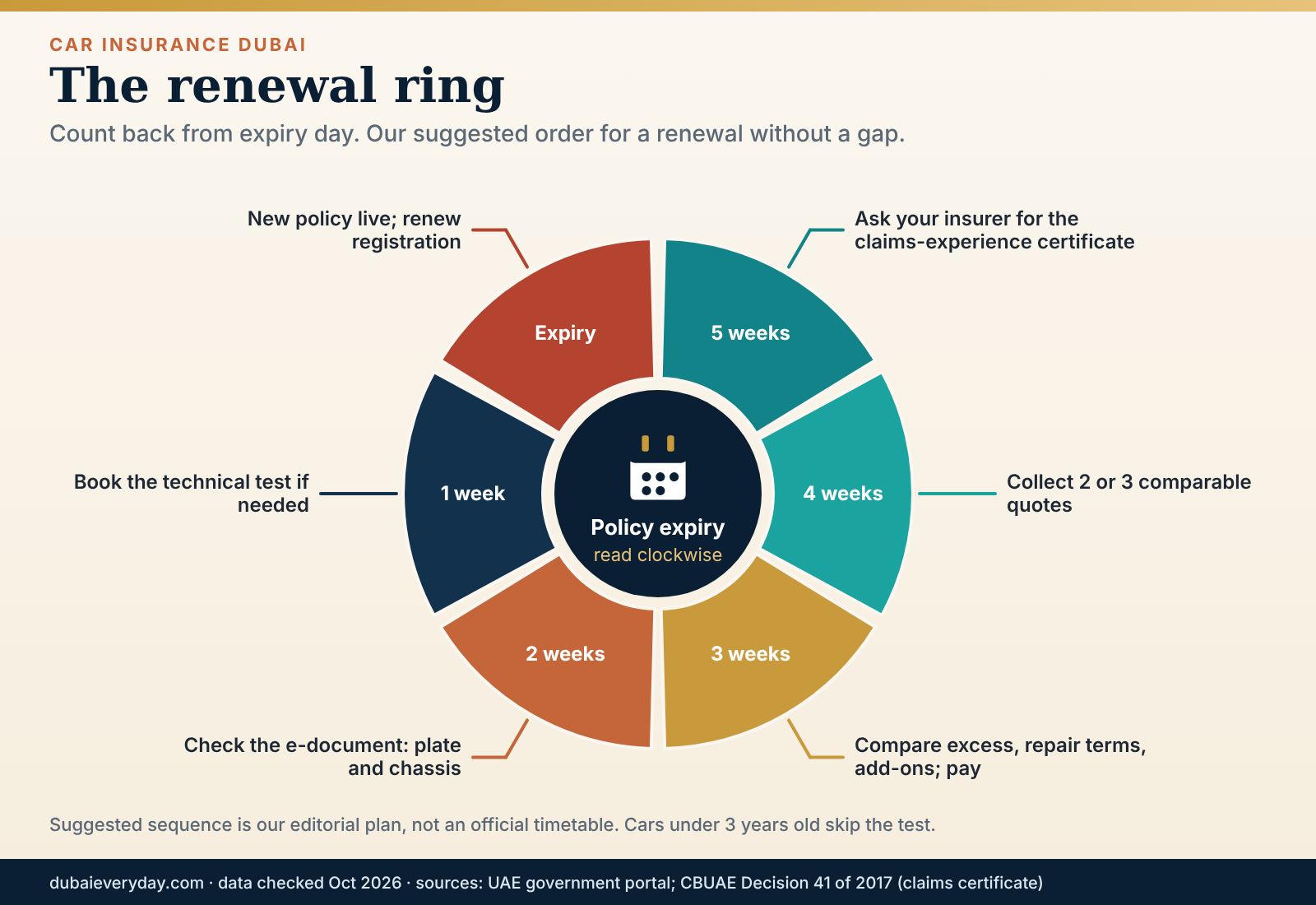
The sequence that avoids a gap
The government portal says registering or renewing a vehicle requires an electronic insurance document from an authorised insurer, and a positive technical test result unless the vehicle was produced in the last three years. The RTA’s own ownership e-card page notes that insurance details appear on the card. So insurance comes first in the chain: no valid document, no registration renewal.
Our suggested order for car insurance Dubai renewals, an editorial judgement and not an official timetable: start comparing about five weeks before the policy ends, ask your current insurer for the claims-experience certificate (the tariff text obliges insurers to provide it free and promptly), collect two or three comparable quotes, choose and pay, confirm that the new electronic document has been issued with the correct plate and chassis details, then book the test if you need one and renew the registration. Leaving the test until the last day with a car that might fail is where people lose a week.
Why car insurance Dubai renewal prices change
The price at renewal reflects your claims record, the car’s age and value, the insurer’s own losses and the market. The Gulf News report from March 2025 described renewals in early 2025 around 15% to 20% higher than a year earlier on average, with vehicles needing flood-related repairs seeing 20% to 30% increases and claim-free vehicles 5% to 15%.
By October 2026, press coverage of an industry forum was describing prices as having peaked. Neither is a guarantee about your quote, so ask for a written breakdown: base rate, claim-free reduction, loyalty reduction, add-ons and excess. If your total exceeds the tariff ceiling for your class (5% of value for a saloon, 7% for a four-wheel drive), you have found a question worth asking.
Switching insurer or staying put
When switching car insurance Dubai providers, remember that the loyalty reduction of 10% is tied to renewing with the same insurer and cannot be transferred, so a competitor must beat your loyalty price by more than that gap, not just your old premium. Claim-free reductions travel with your history: the certificate is how you prove it. When you compare, hold the excess, repair terms and add-ons constant, or you are comparing different products.
Ending a policy early costs money. The comprehensive form allows the insured to terminate on seven days’ written notice, with a refund on a short-rate scale rather than pro rata: 80% of the recoverable premium for a period up to one month, 70% to the end of month four, 50% to month six, 30% to month ten, and nothing beyond that, with no refund where you caused a paid or pending claim.
The third-party text we read has slightly different bands, so ask your insurer to show the clause that applies to you. An insurer can cancel only for serious grounds, with 30 days’ written notice and a pro rata refund.
Selling or scrapping the car? A policy ends when the registration is deleted after a total loss, and a buyer must arrange their own cover to register the car. Keep your cover until the ownership transfer is complete and the registration shows the change, then ask for a written cancellation and refund calculation.
Special situations: new arrivals, company cars, EVs and visitors
New arrivals and licence status
A newcomer buying a car needs a licence that is valid in the UAE, because the exclusions cover unlicensed drivers and licences expired for more than 30 days. That makes your licence a policy condition, not just a driving one. Sort the licence first, then price the policy with the driver details exactly as they appear on it, since a mismatch gives the insurer a reason to argue later.
Visitors and short stays
A visitor driving a hire car is mostly governed by the rental contract, so the policy to read is the one the rental company provides, alongside the traveller’s own cover; our travel insurance guide and Dubai travel guide deal with the trip side. The unified forms add one rental-specific wrinkle: rental vehicles carry a higher percentage deductible of up to 20%, and recourse for unlicensed or impaired driving runs against the renter.
Company cars and fleets
Business-owned vehicles are registered and insured in the company’s name, and the tariff offers up to 30% off the minimum premium for fleets of five or more. Use must match the declared purpose. If you are still choosing a structure, our business setup guide, the mainland company page and the free zone company page explain where vehicles sit in the licensing picture. Treatment of premiums in accounts and tax is a separate matter: see accounting services in Dubai and talk to a professional.
Electric, hybrid and imported cars
The tariff allows up to 25% off at renewal for gas or electric vehicles, taking claims into account; the October 2026 press quote of 3.5% to 3.75% of value for electric and Chinese cars shows the market pricing them above conventional models. Ask your car insurance Dubai provider about battery cover, charging equipment and whether repairs must be done at a certified workshop. Imported or modified cars attract the percentage deductibles discussed above.
Parking, valets and shared garages
Third-party cover applies to the use or parking of the vehicle in the UAE. Damage in a mall or tower car park raises two separate questions: who caused it, and whether you claim on your comprehensive policy. Take photos before you leave and report it to the venue. For busy districts, the Downtown Dubai guide covers parking logistics.
Car insurance Dubai mistakes that cost the most
Buying car insurance Dubai cover on premium alone is the usual mistake. A quote AED 200 lower with a higher excess, no agency repair or a missing off-road rider can cost thousands the first time you claim. The cure is the five-item comparison in the buying section.
The second is silence about use. Declaring a private-use policy and then doing delivery shifts hands the insurer an exclusion and a recourse right. The third is leaving the notice late and the evidence thin: photographs, the police report and a same-day email make a claim straightforward, and their absence turns it into a debate.
Fourth, assuming the insurer’s repair promise lasts for the car’s life. The age bands in the agency section show the system stops backing agency pricing for older cars. Fifth, cancelling a policy before a replacement is in force; registration renewal needs a valid electronic document, and a gap leaves you driving an uninsured car. Sixth, trusting an informal broker whose licence you did not check. Seventh, taking a settlement figure you do not understand: ask in writing how it was calculated, because the regulator requires that explanation.
Eighth, treating press or forum car insurance Dubai price talk as a quote. Use it as a range for sanity checks, and get the schedule before paying. Every figure in this guide that comes from the press is marked as such, and if a number matters to your decision, confirm it with the CBUAE rulebook or your insurer in writing.
FAQ: car insurance Dubai questions
Is car insurance mandatory in Dubai?
Yes, at the third-party level. Car insurance Dubai registration rules work this way: the UAE government portal says registering a vehicle needs an electronic insurance document from an authorised insurer, and the unified policy obliges insurers to issue third-party cover on any licensed UAE vehicle when asked. Comprehensive cover is not required by law, but lenders usually insist on it for financed cars. Driving without valid cover is treated as an offence, so do not let a policy lapse between insurers.
What is the difference between comprehensive and third party car insurance Dubai drivers can buy?
Third-party liability, the legal minimum for car insurance Dubai registration, pays other people for injury and damage you cause, with property damage limited to AED 2,000,000 per accident. Comprehensive adds your own car for collision, fire and theft, subject to an excess and the exclusions in the wording. The cover people overlook is for hit-and-run and theft, which third party never pays. The earlier sections give a side-by-side table and a break-even test.
How much does car insurance cost in Dubai?
Car insurance Dubai pricing depends on the car, the driver and the insurer, inside a regulated corridor. For a four-cylinder saloon the tariff allows AED 750 to AED 1,300 for third-party cover, and comprehensive from AED 1,300 up to 5% of the car’s value; four-wheel drives start at AED 2,000 and rise to 7%. Press reports in October 2026 quoted 2.5% to 3% of value for conventional cars as typical. Treat that as a sanity check, not a quote.
What is agency repair and do I need it?
Agency repair means the manufacturer’s authorised workshop does the work, usually with genuine parts. The unified third-party form requires it in the first year of a car’s life; after that the rules allow suitable non-agency shops, and the recovery deduction from the at-fault insurer reaches 15% and 30% in years two and three. If you want agency repair on a car over three years old, you must ask for it when the contract is signed, and the insurer may charge up to the tariff maximum.
What is a normal excess on car insurance in Dubai?
The regulator sets maximums, not a standard figure. For private cars up to nine passengers the Schedule 3 caps run from AED 350 for a car worth up to AED 50,000 to AED 1,400 above AED 500,000. Extra percentage deductibles of up to 10%, 15% or 20% can apply for drivers under 25, sports or modified cars and rentals. Your schedule shows the real figure, so compare it between quotes.
How long does an insurer have to pay a motor claim?
For car insurance Dubai claims, Decision 25 of 2016 says the insurer must acknowledge the claim in writing, notify missing documents within three days of receipt, and settle within a period not exceeding fifteen days of receiving the completed documents, without bargaining. A total loss follows the same 15-day limit. A rejection needs written reasons and copies of the supporting documents. If the insurer misses these, put a written complaint on file and, after the waiting period, take it to Sanadak.
Does my UAE car insurance cover Oman or other GCC countries?
Not automatically. The unified third-party and comprehensive forms apply inside the UAE only, and cover abroad needs a rider or separate cover. The regulator’s text refers to the Orange Card arrangement for extending third-party cover to Arab countries for non-UAE vehicles entering or crossing the UAE. If you are planning a cross-border drive, ask your insurer in writing what is covered, for how long, and what to carry.
What do I need to renew car insurance in Dubai?
For car insurance Dubai renewals, bring your current policy details, vehicle registration card, Emirates ID, driving licence and, ideally, the claims-experience certificate your insurer must provide free. Insurance then feeds registration: the portal requires an electronic insurance document and, unless the car was produced in the last three years, a positive technical test. Check the plate and chassis details on the new document before you move on to registration.
Can I cancel my car insurance mid-year and get a refund?
You can end a comprehensive car insurance Dubai policy on seven days’ written notice, but the refund follows a short-rate scale: 80% of the recoverable premium in the first month, 70% to month four, 50% to month six, 30% to month ten and nothing after that, and none if you caused a paid or pending claim. Third-party wording may differ. Do not cancel before the replacement or the ownership transfer is complete.
Does car insurance in Dubai cover floods and heavy rain?
Car insurance Dubai flood cover is a wording question. The unified form lists natural disasters among exclusions, yet in December 2025 an insurance federation committee head told the press that comprehensive policies include rain and flood damage unless the state declares a natural disaster, and that deliberately driving into wadis or flood channels is not covered. That is a reported statement, not a rule. Ask your insurer to confirm flood cover in writing and check what the schedule says.
What can I do if my insurer rejects my claim?
Ask for the rejection and its reasons in writing, which the regulation requires, then send a written complaint to the insurer. Sanadak, the CBUAE’s complaints unit, accepts complaints from individuals and small businesses once you have waited the period it states and if no court is already handling the matter. Its pages mention both 15 and 30 days, so check which applies. Valuation disputes have a separate surveyor route in the policy forms.
Related reading
Sources and further reading (21 links)
- CBUAE Rulebook: Motor Insurance (Decision No. 25 of 2016 and unified policy forms) — claim handling timings, cover scope, exclusions, deductibles, cancellation
- CBUAE Rulebook: Unified Motor Vehicle Insurance Policy Against Third Party Liability — limits, agency repair, depreciation, ambulance and loss-of-use amounts
- CBUAE Rulebook: Unified Motor Vehicle Insurance Policy Against Loss and Damage — comprehensive cover, Schedule 3 excess, total loss, short-rate refunds
- CBUAE Rulebook: Insurance Authority Board Decision No. 30 of 2016, Motor Vehicle Insurance Tariffs — minimum and maximum premiums, discounts
- CBUAE Rulebook: Board Decision No. 41 of 2017 amending the tariff — price competition, claim-free and loyalty reductions, claims certificate
- CBUAE Rulebook: Board Decision No. 42 of 2017 amending the unified policy — agency repair recovery deductions, total loss for structural damage
- CBUAE Rulebook: Board Resolution No. 26 of 2020 amending the unified policy — agency repair option after three years, total loss basis
- Central Bank of the UAE: Licensing — registers of licensed financial and insurance entities, in-principle approval note
- Sanadak: Complaint submission process — steps and eligibility for insurance complaints
- Sanadak: FAQs — fees, time limits, insurance disputes before courts
- UAE government portal: Registering vehicles — insurance document, technical test, three-year exemption
- UAE government portal: In case of a road accident — 999, minor accident steps
- RTA: Renew and Amend Vehicle Data Ownership — insurance details on the ownership e-card
- Clyde & Co: The new UAE insurance law — Federal Decree-Law No. 48 of 2023, licensing, consumer points (law-firm summary)
- Gulf News: How to report minor traffic accidents in the UAE — Dubai Police app and petrol-station reporting, fee (press)
- Gulf News: UAE insurers required to cover flood damage under comprehensive motor policies — flood position as reported (press)
- Emirates 24|7: UAE car insurance prices have peaked — market percentages from an industry forum (press)
- Gulf News: UAE car owners must wait longer for insurance rates to cool off — 2025 renewal increases (press)
- Middle East Insurance Review: Central Bank directive restores order to motor insurance pricing — 2023 circular on minimum premiums and 50% discounts (trade press)
- Gulf News: Dh100,000 fine, one year jail term for drivers who flee UAE accident scenes — penalty for leaving injury accident scenes (press)
- Gulf News: Expired registration, no insurance: Dubai driver fined Dh5,000 — one reported traffic-court outcome (press)
Update log: 29 October 2026, first publication; all facts re-checked against the sources above. Next review due: 29 January 2027, or sooner if the CBUAE changes the motor tariff or unified policy. Corrections welcome.
This page is general information, not individual financial or legal advice, and it is not an offer or recommendation of any insurer, broker or policy. Confirm your policy schedule, excess and claim terms with a CBUAE-licensed insurer or broker before acting.
About DubaiEveryday and this guide
DubaiEveryday.com is an independent editorial project that publishes practical, research-based guides to everyday life in Dubai: where to live, what things cost, how the rules work and how to get around. This page was written and edited by the DubaiEveryday editorial team. It is not signed by a named expert, doctor, lawyer or adviser, and we do not claim first-hand testing of a venue, clinic or service unless the page says so.
Each guide is built from official sources such as government and regulator pages, operator websites and established news outlets, cross-checked where we can. When we could not confirm something, we say so in the text, and examples that use made-up numbers are labelled as illustrations. Mentions are editorial choices, not paid placements, and a link is not an endorsement.
Dubai changes quickly. If you spot something that is out of date or wrong, please tell us through the contact options on DubaiEveryday.com and we will check it and correct the page.