

Accounting in Dubai is no longer a once-a-year chore handled by whoever set up your licence. This page explains which accounting services Dubai businesses actually need in 2026, what each layer costs you in time and risk, and how to pick an outsourcing model without buying more than you use.
Picture a bank, a free zone or a prospective partner asking for your last twelve months of numbers, and all you can offer is a shoebox of invoices and a half-finished spreadsheet. That is an uncomfortable meeting. Accounting used to be a quiet yearly task near licence renewal, but VAT, corporate tax and monthly reporting now all draw on the same ledger.
When you type accounting services dubai into a search bar, the real question is rarely who is cheapest. It is what exactly you are buying, and what you can safely leave out for now. This guide separates bookkeeping, VAT, corporate tax and management accounts, shows where audit and advisory fit, and helps you avoid paying for layers your business does not need yet.
Accounting services Dubai businesses rely on come in four working layers: bookkeeping, VAT, corporate tax and management accounts. Audit and advisory sit on top and are only needed when a regulator, free zone, lender or investor asks for them. Bookkeeping is the base. If the ledger is wrong, the VAT return, the corporate tax return and every monthly report built on it are wrong too.
Since corporate tax began applying to financial years starting on or after 1 June 2023, nearly every licensed company has had to deal with the Federal Tax Authority (FTA), including free zone companies, and individual licence holders once business turnover passes AED 1 million. VAT registration becomes mandatory once taxable supplies pass AED 375,000. Small Business Relief now runs to tax periods ending on or before 31 December 2029, and e-invoicing goes live for larger businesses on 1 January 2027.
Our reading of the evidence: an owner-run company with modest volume is usually best served by a monthly bookkeeping retainer from a firm that also files its VAT and corporate tax returns. A full-time hire only makes sense later. Below you get the rules, a decision path, outsourcing models, a fee logic and a vetting checklist.
This is a desk-research guide to accounting services Dubai businesses can buy. DubaiEveryday.com has not hired, audited or been served by any accounting firm, and nothing here describes a personal engagement. The regulatory facts come from official sources read on 29 October 2026: the Federal Tax Authority (VAT registration, corporate tax records), the Ministry of Finance (Small Business Relief, e-invoicing providers) and the Ministry of Economy and Tourism.
This is not a ranking of firms. We do not name or recommend any accountant, audit firm or software vendor, and inclusion was not paid for. What we checked is the rulebook and the official registers you can use to test any provider yourself. Fee figures in the cost section are labelled illustrative because no official price list exists. General information only: it is not individual tax, legal or financial advice, and a registered professional should confirm your own position.
What accounting services Dubai businesses actually buy
The phrase accounting services Dubai firms use covers more than people expect, and the confusion costs money. A freelancer asking for “accounting” may mean a person to file one VAT return a quarter. A start-up founder may mean a monthly profit-and-loss pack for investors. A trading company may mean someone to keep the stock, receivables and bank in order so nothing surprises the owner in December. Same word, four jobs, four price levels, which is why buyers compare quotes so badly.
Accounting services Dubai companies buy make more sense once you separate the work into layers, and it helps to see them in order. Each one has a different output, a different deadline and a different consequence if it is skipped. The ladder below is the structure used throughout this page, and the sections that follow take the layers in order.
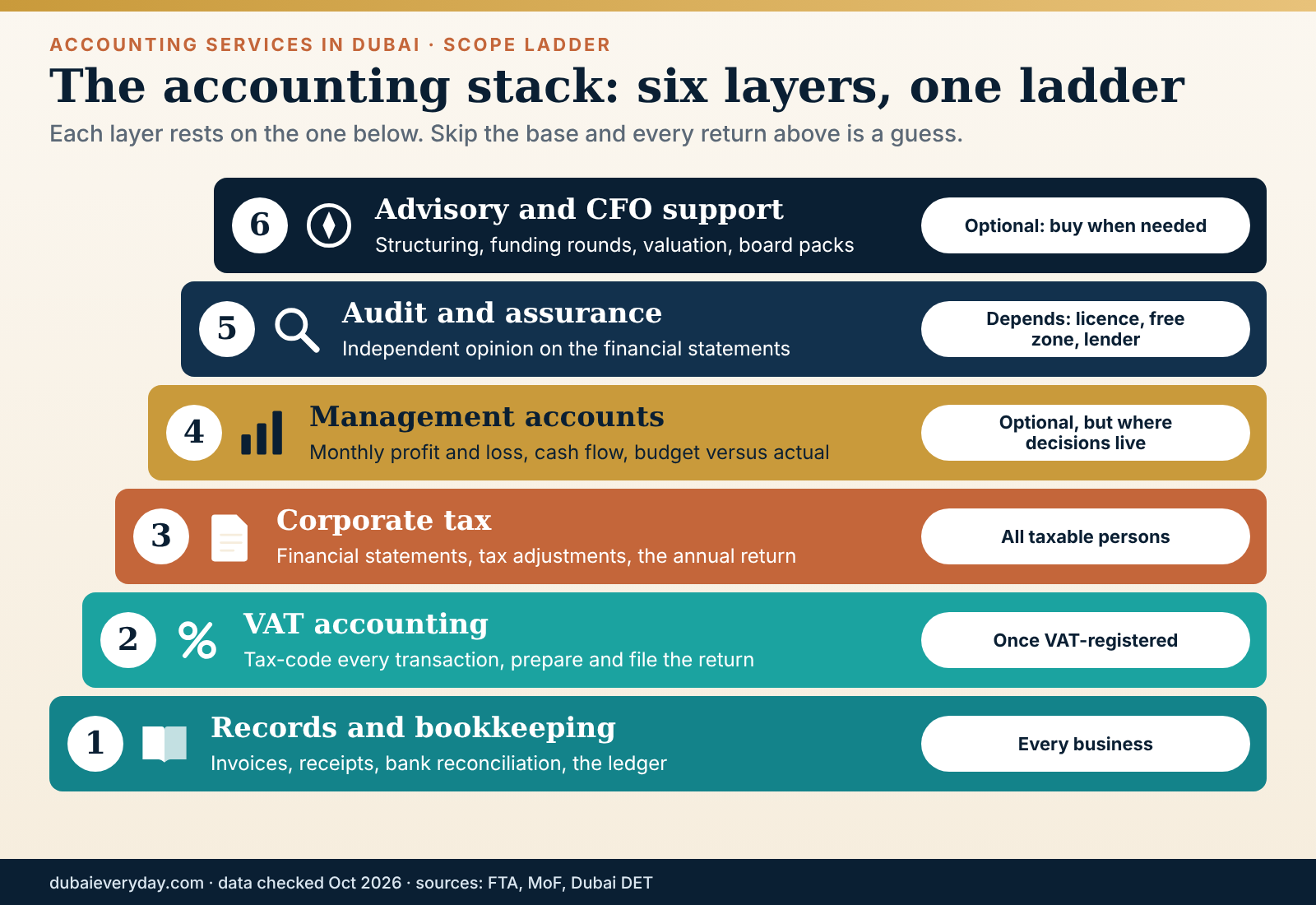
Four different jobs inside accounting services Dubai firms sell
Bookkeeping is the recording job: capturing invoices and receipts, matching the bank, coding each transaction to an account, keeping the ledger current. Accounting uses that ledger to produce financial statements, make year-end adjustments and explain what the numbers mean. Tax compliance turns accounting records into returns for the FTA. Audit is an independent opinion on the statements, and it is a different professional activity from the other three.
In practice one firm often sells several of these accounting services Dubai clients ask for under one retainer, which is convenient and also the source of most misunderstandings. When a quote says “accounting and VAT,” ask whether bookkeeping is included or whether you are expected to hand over a finished ledger. Those are not the same product, and the price gap between them is wide.
The three common package shapes
Most accounting services Dubai providers sell fall into three shapes. The first is compliance-only accounting services Dubai small firms often start with: you keep your own books, and the provider prepares the VAT return, the corporate tax return and the year-end statements from what you hand over. It is cheap and puts the quality risk entirely on your records.
The second is bookkeeping plus compliance: the provider keeps the ledger monthly and files the returns from it. This is the default for small and medium companies. The third is an outsourced finance function: bookkeeping, payroll processing, management accounts, budgeting and a named finance lead who attends your monthly review. It costs the most and suits companies with staff, stock or outside investors.
Cannibalisation note: what this page covers. This page maps the whole field and the buying decision. For the monthly mechanics of recording (bank reconciliation, receivables, expense control and software choice) read Bookkeeping in Dubai. For choosing a licence type or free zone before you start trading, see the Dubai business setup guide. Here we stay on what to buy, from whom, and what the rules require.
What sits outside accounting services Dubai providers quote
Three adjacent services get bundled into quotes for accounting services Dubai firms advertise, and they deserve separate scrutiny. Company formation and licence renewal are administrative services, not accounting. PRO and visa processing are government-paperwork services; the Dubai work visa guide covers that side. Legal advice on shareholder agreements or disputes belongs to a lawyer. A provider may offer all of these, but they should appear as separate lines so you can see what the accounting itself costs.
One more boundary matters for trust. Preparing the books is one thing; signing off the books as an independent auditor is another. A firm cannot credibly do both for the same client in the same period, because the auditor would be checking their own work. We come back to this in the audit section.
Why accounting services Dubai buyers cannot copy a generic UAE template
The job is not identical everywhere in the UAE. Dubai businesses sit under different layers at once: a mainland licence issued through the Department of Economy and Tourism, or a free zone licence with its own authority and its own annual requirements, plus federal tax obligations that apply the same way to both. Free zone rules on audited accounts, office requirements and renewal paperwork differ from zone to zone, which is why generic UAE templates mislead.
Dubai also has a large, competitive market for accounting services Dubai residents and founders buy, with providers ranging from solo freelancers to international networks, and many companies buy accounting as part of a licence-and-visa bundle at setup. That bundle is worth examining: it is often priced to win the licence, not to run the books well. The vetting section explains how to separate the two. If you are still choosing between mainland and a free zone, the mainland company setup guide covers the licence side of that decision.
What changed between 2023 and 2029
If your last real look at the rules was before 2023, the map for accounting services Dubai companies buy has moved. Corporate tax arrived, a deadline-driven e-invoicing programme was announced, penalties and limitation periods were reworked, and in August 2026 a relief that small businesses were counting on was extended. Several of these changes landed in the last twelve months, so older articles and many brochures for accounting services Dubai firms circulate are already out of date.
The path below puts the dated milestones for accounting services Dubai companies must follow on one line. Every date in it comes from an official announcement or the legal text, which makes it a safe base for planning the accounting services Dubai teams deliver this year. One of them is 30 October 2026, the day after this page was last verified: the deadline for the largest businesses to appoint an e-invoicing provider.
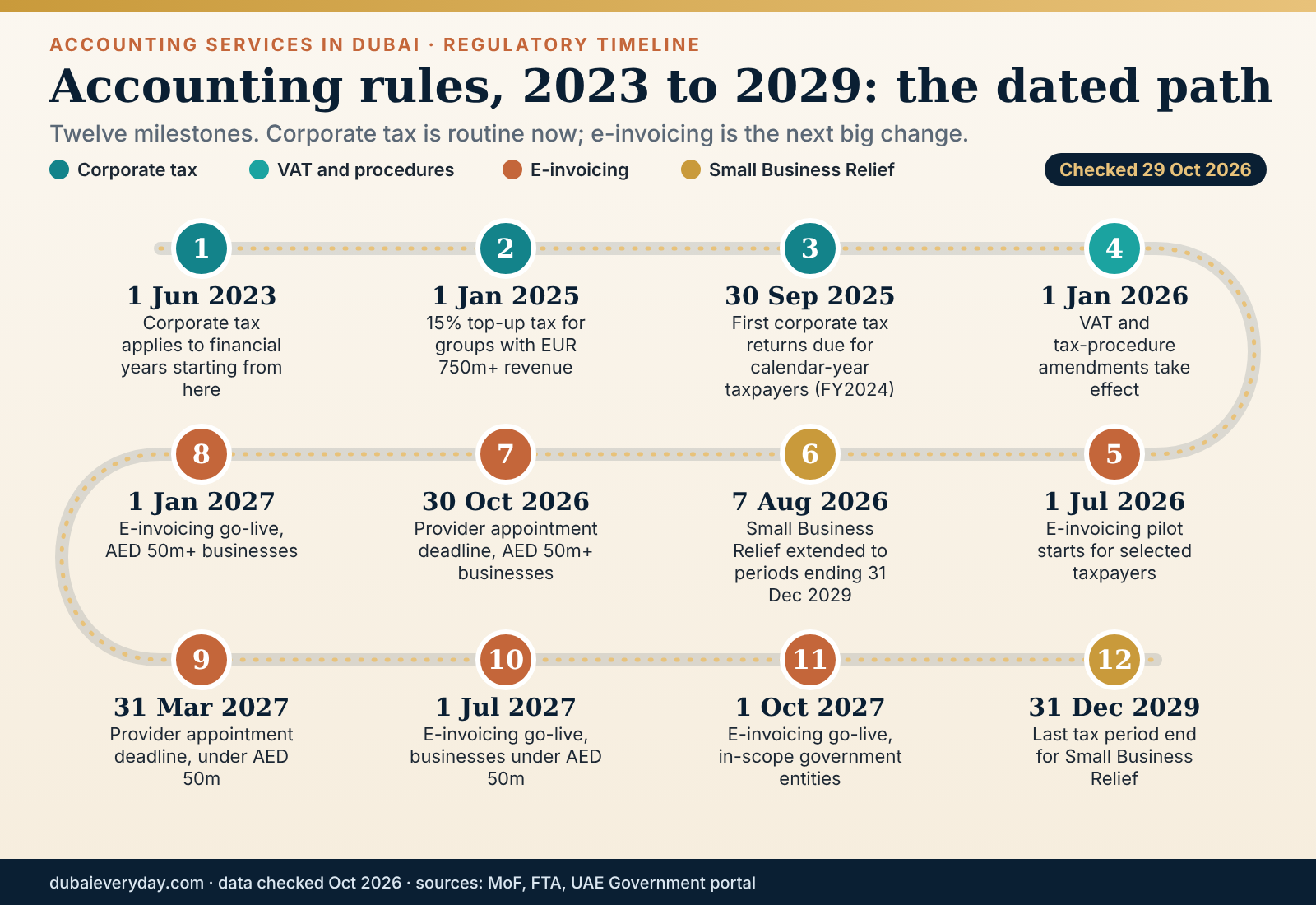
Corporate tax: from announcement to routine
The federal corporate tax law applies to financial years beginning on or after 1 June 2023. The UAE government portal states the structure plainly: 0% on taxable income up to AED 375,000, and 9% above that. A company with a calendar financial year therefore had its first taxable year in 2024, and its first return fell due nine months after that year ended, on 30 September 2025.
The FTA’s own wording on timing is useful for planning: a return and any payment are due within nine months of the end of the tax period. A 31 December 2025 year-end meant filing and paying by 30 September 2026. If you run a different financial year, the deadline moves with it. Our compliance calendar works through the dates.
Small Business Relief: extended in August 2026
Small Business Relief lets an eligible resident person elect to be treated as having no taxable income for a period, with simplified compliance. The revenue ceiling is AED 3 million, tested for the current period and every previous period. The Ministry of Finance announced on 7 August 2026, through Ministerial Decision No. 131 of 2026, that the relief can be claimed for tax periods ending on or before 31 December 2029. Earlier it was due to stop after 2026.
The relief is not open to everyone. The FTA says qualifying free zone persons cannot elect it, nor can members of a multinational group with consolidated revenue above AED 3.15 billion. It is also elected period by period, and other reliefs and deductions are unavailable when you use it. The corporate tax section explains why this matters for how you keep your books.
VAT and the procedures law: effective 1 January 2026
Two federal decree-laws, numbers 16 and 17 of 2025, amended the VAT law and the tax procedures law with effect from 1 January 2026, according to a law-firm summary of the texts. The accounting-relevant points: a five-year limit now applies to carrying forward or claiming refunds of excess input VAT, minor errors can be corrected in the next return instead of through a formal voluntary disclosure, and input VAT can be denied where a business knew or should have known a purchase was part of an evasion chain.
That last point changes supplier due diligence, and it changes what good accounting services Dubai clients should expect. A provider who only types invoices into software without checking who issued them is not doing the job any more. Treat this as secondary-source information: the summary is from a law firm, not the FTA, so ask your adviser to confirm how it applies to you.
E-invoicing: the biggest operational change for accounting teams
The Ministry of Finance announced a phased electronic invoicing system in September 2025 through Ministerial Decisions 243 and 244. A pilot began on 1 July 2026 for selected taxpayers.
Businesses with annual revenue of AED 50 million or more must appoint an accredited service provider and go live on 1 January 2027. The appointment date was moved from 31 July to 30 October 2026 by a May 2026 amendment. Businesses under AED 50 million appoint by 31 March 2027 and go live on 1 July 2027; in-scope government entities follow on 1 October 2027.
A further amendment, Ministerial Decision No. 197 of 2026 (effective 1 October 2026), excludes transactions within the same VAT tax group for 24 months from 1 January 2027, removes the rule that e-invoice data must be stored inside the UAE, and repeals the duty to notify the FTA of a system failure within two business days. A PDF or emailed invoice is not an e-invoice under the programme.
Already live
Corporate tax at 0% and 9% for financial years from 1 June 2023. The 15% top-up tax for large multinational groups from 1 January 2025. VAT and tax-procedure amendments from 1 January 2026.
Changed in 2026
Small Business Relief extended to periods ending 31 December 2029. E-invoicing dates and scope amended in May and October. Administrative penalty tables revised under a 2025 Cabinet Decision, per secondary sources.
Still to come
E-invoicing go-live for AED 50 million-plus businesses on 1 January 2027, then 1 July 2027 for the rest. Provider appointments for smaller businesses by 31 March 2027.
Cabinet Decision No. 129 of 2025 revised the administrative penalty schedules, according to a British Chamber of Commerce Dubai summary, but that summary gave no amounts and we could not read the decision text. The one figure we confirmed from an official FTA page: a natural person who must register for corporate tax and misses the deadline faces an AED 10,000 penalty. Check the current penalty table on the FTA site before you quote any other figure to a client or a board.
Which accounting services Dubai freelancers, founders and investors need
The right package of accounting services Dubai firms offer depends less on how big you are than on what kind of legal person holds the licence. A company, whether mainland or free zone, is a juridical person and sits inside corporate tax from day one. An individual with a trade licence is a natural person and is only drawn in above a turnover line. That single distinction changes the compliance load, and the accounting services Dubai clients need, more than almost anything else. Many people discover it late.
Here is the logic for choosing accounting services Dubai owners need, in the order it should be applied. It is a screening tool, not advice: confirm your position with a registered adviser.
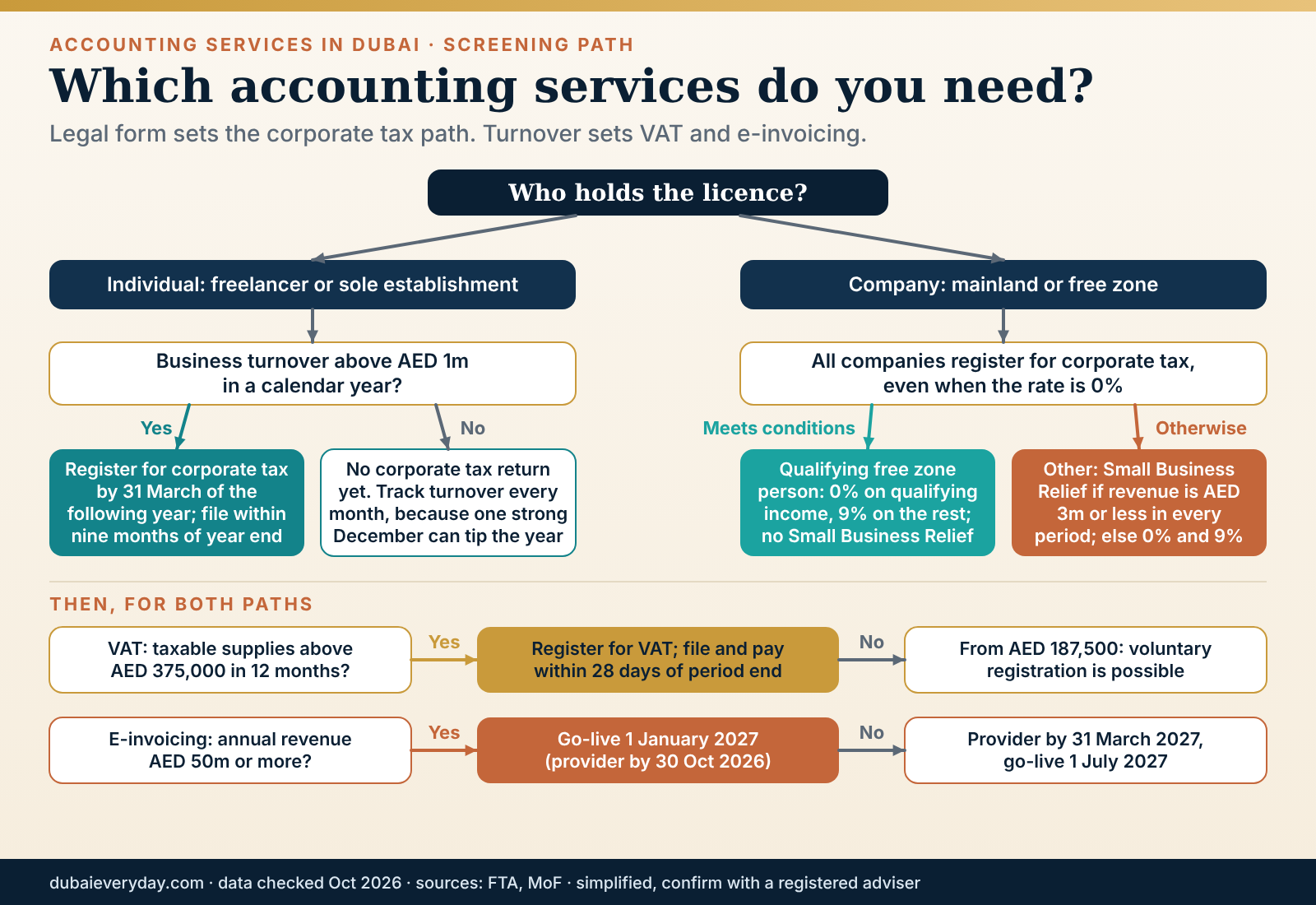
Freelancer or sole establishment (natural person)
For a natural person doing business in the UAE, the FTA says corporate tax applies once total turnover in a calendar year exceeds AED 1 million. Registration is due by 31 March of the following year; for 2024 activity that meant 31 March 2025, with the first return due on 30 September 2025. Missing the registration date carries the AED 10,000 penalty mentioned above.
Take a freelancer billing AED 800,000 a year. Below the AED 1 million line for corporate tax, but well over the AED 375,000 VAT threshold, so VAT registration is mandatory. Our calculation: this person needs bookkeeping and VAT filing, but not a corporate tax return, as long as turnover stays under the line. At AED 1.1 million both apply. Watch the calendar-year test, because a strong December can tip the whole year.
One-person company in a free zone
Many solo consultants and e-commerce operators hold a free zone company licence for the visa and the office, then discover what accounting services Dubai free zone companies need. That structure makes them a juridical person. The Ministry of Finance states that all taxable persons, free zone persons included, must register for corporate tax and obtain a registration number. FTA Decision No. 3 of 2024 set a three-month window for companies incorporated on or after 1 March 2024.
A free zone person that meets the qualifying conditions can benefit from 0% on qualifying income, but that status has strings: it is not available to everyone, income outside the qualifying categories is taxed at 9%, and a qualifying free zone person cannot use Small Business Relief. Our reading: a free zone company is the structure most likely to need more accounting services Dubai owners budgeted for, so cost it before you sign.
Mainland LLC trading goods or services
A mainland trading company usually needs the heaviest set of accounting services Dubai offers, because of the recurring load: stock or job costing, customer credit, supplier payments, VAT on most sales, staff and payroll, and corporate tax. It is the profile where monthly bookkeeping plus management accounts pay for themselves, because the owner’s decisions depend on receivables and cash timing. If this is you, plan for e-invoicing early and read the mainland company guide alongside this page.
For the accounting services Dubai mainland firms rely on, turnover decides the e-invoicing date: AED 50 million or more goes live on 1 January 2027, below that on 1 July 2027. Many mainland SMEs sit under that line, which gives a few extra months to choose software and a provider.
Property investor holding through a company
Investors who buy through a company need a clean ledger for rent, service charges, maintenance and finance costs, because the yield numbers they quote to themselves depend on it. The rental yield guide and the property ROI calculation guide show the inputs; an accountant’s job is to make sure those inputs are recorded consistently so net yield is not a guess.
We did not verify how every form of personal property income is treated for corporate tax purposes. That question turns on whether the activity counts as business activity, and the answer is worth paying a registered adviser to confirm before you decide whether a holding company helps or hurts. Our property investment guide covers the commercial side.
Start-up with investors or a funding round
Investors expect the accounting services Dubai start-ups hire to deliver monthly management accounts, a cap table and runway numbers, and in later rounds audited statements. A start-up that treats accounting as compliance-only usually ends up redoing a year of records for due diligence, which costs more than keeping them right. The sensible package of accounting services Dubai start-ups can buy is bookkeeping plus management accounts from the first month, with an audit engagement arranged only when a lender or investor requires it.
Professionals with a salary and a side business
Employment income is not what corporate tax on individuals targets: the FTA says natural persons are taxed only when they conduct business in the UAE. A salaried resident with an occasional side project rarely needs the full range of accounting services Dubai firms sell, only a simple income log and a check against the turnover threshold. Anyone moving to the UAE should also see the moving to Dubai guide for the wider setup, and the single-person budget for personal money planning.
Bookkeeping: the layer everything rests on
Every tax return and management report is a summary of the ledger, so all accounting services Dubai firms provide depend on it. A ledger is only as good as the documents behind it and the discipline of matching them to the bank each month. This section covers what bookkeeping must achieve for the tax layers above it; the day-to-day workflow is in Bookkeeping in Dubai.
What the law expects you to keep
The FTA’s August 2025 release on corporate tax records is the clearest official statement. Taxable and exempt persons must keep relevant records for seven years from the end of the tax period they relate to. The categories named are transaction records, asset records including purchases and disposals, liability records, and records of any shares held at period end. Exempt persons must also keep documents that prove the basis of their exemption.
The same release warns that failing to keep required records can lead to administrative penalties, and that late filing or payment can add fines. It does not give amounts, so we do not either. For VAT-specific retention rules, ask your adviser for the current period; we could not confirm it from an official page today. The practical rule: keep the longest applicable period and keep it in a form the FTA can read on request.
What good monthly bookkeeping produces
A month-end that serves tax work produces five things: a bank reconciliation for every account including payment-gateway balances, a list of unpaid customer invoices with ages, a list of unpaid supplier bills, a tax-coded ledger with VAT separated from the net amount, and a short list of unresolved items the owner needs to answer. If a provider cannot show you a sample of these five, you are not buying bookkeeping that tax work can rest on, you are buying data entry.
The unresolved-items list matters most. Unexplained transfers, personal spending on a company card and undocumented cash payments are the three items that most often blow up at year-end. Cleaning them monthly costs minutes. Reconstructing them eleven months later costs days and sometimes the deduction itself.
Accrual or cash: a question your accountant should settle in writing
Taxable income starts from accounting profit, which the corporate tax law bases on adequate standalone financial statements prepared under accounting standards accepted in the UAE. The law also lets the Minister prescribe circumstances where cash-basis accounting is allowed and lets a taxpayer apply to move from cash to accrual. In practice many Dubai companies follow IFRS or IFRS for SMEs, but which basis suits you, and whether any cash-basis option applies, is a point to settle in writing with a qualified accountant.
The reason to settle it early: switching basis midstream creates adjustments and timing differences in tax. A small firm that keeps books on a cash-in, cash-out view all year and then asks for accrual statements at year-end is asking for a rebuild, and will be quoted for one.
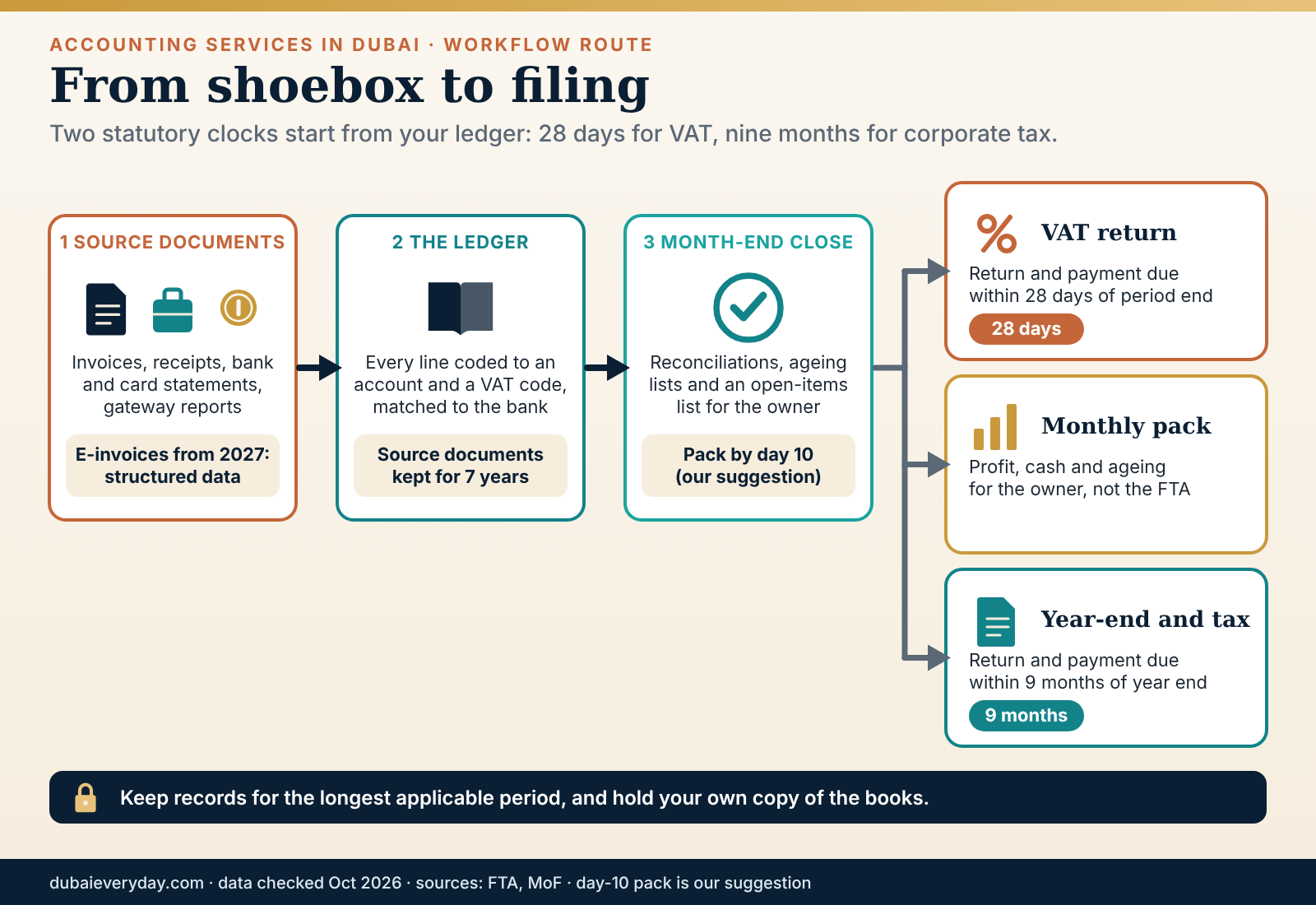
The handover list for a new provider
Whatever you hire, you will be asked for the same starting pack. Preparing it before the first meeting saves a paid week.
- Trade licence, establishment card or free zone licence, and the memorandum or articles of association
- VAT and corporate tax registration numbers and the UAE PASS account holder details used for FTA services
- Bank statements for every account since the start of the current financial year, including card and gateway statements
- Sales and purchase invoices, receipts, and contracts for any recurring or large arrangements
- Payroll records, employment contracts and visa-cost invoices if you have staff
- Prior financial statements, previous VAT returns and any FTA correspondence
- A fixed asset list with purchase dates and costs, and a list of loans or shareholder loans
VAT accounting in Dubai: registration, returns and records
VAT is the layer of accounting services Dubai businesses meet most often, with the most frequent deadlines, so it is where careless bookkeeping shows up first. The rate shown on the FTA’s own VAT page is 5%. The mechanics are simple on paper: you charge VAT on taxable sales, reclaim VAT on business purchases, and pay or recover the difference each period. The accounting services Dubai VAT clients pay for are mostly about proving every figure on the return.
Who must register and when
The FTA sets mandatory registration at AED 375,000: if your taxable supplies and imports exceeded that over the previous 12 months, or you expect them to within the next 30 days, you must register. Voluntary registration is possible from AED 187,500, measured on taxable supplies and imports or on taxable expenses. The mandatory threshold does not apply to foreign businesses, which have separate rules.
Two points catch people out. The test is forward-looking as well as backward-looking, so a big signed contract can trigger registration before the turnover arrives. And the FTA page we read does not state a late-registration penalty, so check the current schedule rather than relying on a figure you heard from a provider. Registration happens through the FTA’s online services, which require a UAE PASS account; the internet and mobile guide explains UAE PASS and digital ID.
The return and the 28-day clock
After registration you file a VAT return and pay any VAT due within 28 days of the end of your tax period. That clock is short. A quarter that ends on 31 March means a return due on 28 April, which leaves about four weeks to close the quarter’s books, reconcile input VAT and review the figures. A provider that closes books on day 25 leaves you exposed to a rushed, error-prone filing.
The return reports VAT on sales and other outputs, VAT on expenses and other inputs, and the net amount due. Each box has to be supported by transactions in the ledger. That is why tax-coding at the point of recording is worth more than any amount of last-minute checking.
A worked example of the arithmetic
Illustrative example (not a quote or market fact). A trading company records AED 1,000,000 of standard-rated sales in a quarter and AED 18,000 of VAT paid on eligible purchases and expenses. At 5%, output VAT is AED 50,000. Net VAT payable is AED 50,000 minus AED 18,000, which is AED 32,000, due within 28 days of quarter end. If AED 4,000 of that input VAT sits on invoices missing the supplier’s registration number, the recoverable input falls to AED 14,000 and the payment rises to AED 36,000. The figures are invented to show the logic.
That last step is the point of the example. The input VAT you can recover depends on having valid tax invoices, so the accountant’s most valuable VAT habit is rejecting bad documents at entry, not fixing them at filing.
Input VAT, time limits and supplier checks
According to a law-firm summary of the 2025 amendments, excess input VAT can only be carried forward or refunded within five years of the end of the tax period in which it was recorded, with transitional relief for pending requests until 31 December 2026. If you hold an old credit balance, ask your accountant whether it is inside the window. Old balances left unclaimed are a recurring finding when a new provider reviews previous years.
The same amendments sharpen the supplier-verification angle: input tax can be denied where a business knew or should have known a supply was tied to evasion. Practical response: keep supplier registration details on file, check that invoices show a valid number, and be cautious about unusual pricing or payment requests. This is one reason cheap, volume-based bookkeeping at the bottom of the market is risky for VAT-registered companies.
VAT and e-invoicing meet at the invoice
An e-invoice under the UAE programme is structured data exchanged through an accredited provider and reported to the FTA, not a PDF. For VAT work that has two consequences: your invoicing system must be able to produce the structured format, and your accountant needs reliable access to those records. Read the software and e-invoicing section before renewing any accounting software subscription.
Corporate tax accounting: registration, returns and the 0% trap
The most common misunderstanding about accounting services Dubai companies need for corporate tax is that 0% means no work. The UAE government portal confirms the rate structure: 0% on taxable income up to AED 375,000 and 9% above. But the Ministry of Finance is equally clear that all taxable persons, free zone persons included, must register, file a return and keep records. A company with a loss or a small profit still has a compliance calendar, and the accounting services Dubai firms provide must cover it.
Registration: who, when, and where mistakes happen
For companies, the FTA’s registration decision set staged deadlines for existing licences during 2024 and a three-month window for companies incorporated on or after 1 March 2024, free zone companies included. A foreign company effectively managed and controlled from the UAE registers within three months of its financial year end, and non-resident companies with a permanent establishment have their own windows. If your company is older than 2024, you should already be registered; if it is newer, the clock started on the incorporation date.
For individuals, the test is turnover in a calendar year above AED 1 million from business activity in the UAE, with registration due by 31 March of the next year. Penalties for missing registration are set under Cabinet Decision No. 75 of 2023, according to the FTA. The one amount we confirmed is AED 10,000 for natural persons.
The return: nine months and a self-assessment
Corporate tax is self-assessed. You prepare the return, calculate the tax and pay it, all within nine months of the end of the tax period. The FTA’s example is a 31 December 2025 year-end with filing and payment due by 30 September 2026. Nine months sounds generous, and it is a trap for the same reason: nothing forces the year-end close until the deadline is near. A company that starts in August usually discovers unreconciled balances in September.
A practical target for owner-run companies: have draft financial statements within three months of year end, and the return prepared within six. That leaves a buffer for questions on related-party items, shareholder loans and anything needing a signed document from a bank or landlord.
From accounting profit to taxable income
Taxable income begins with the accounting net profit or loss in the financial statements, then adjusts for items such as exempt income and non-deductible expenditure. This is why the quality of the statements matters in any accounting services Dubai engagement: errors in the ledger flow straight into the tax number. The adjustments themselves are technical, and deductibility rules for specific categories should come from the law and FTA guidance or a registered adviser, not from a forum thread.
Illustrative example (not a quote or market fact). A company’s accounting profit is AED 900,000 and its adviser identifies AED 60,000 of expenditure that is not deductible, so taxable income is AED 960,000. The first AED 375,000 is taxed at 0%. The remaining AED 585,000 is taxed at 9%, which gives AED 52,650. Our calculation, using only the published rate structure. The adjustment amount is invented to show the steps.
Small Business Relief: when it helps and when it does not
The FTA’s rule is strict on the revenue test. The AED 3 million ceiling must be met in the current tax period and in all previous tax periods. The FTA gives its own example: a business with AED 4.3 million of revenue in an earlier period is not eligible for the following period even if that period’s revenue is only AED 1.9 million. One strong year permanently closes the door.
When you elect the relief, you are treated as having no taxable income for that period, but other exemptions, reliefs and deductions are unavailable. Transfer pricing documentation is not required, although the arm’s-length principle still applies. The FTA lists two groups that cannot elect: qualifying free zone persons and members of a multinational group with consolidated revenue above AED 3.15 billion.
Our reading: the relief is simple and valuable for stable small companies, and it deserves a second look when a business expects early losses.
If you will lose money for a few years and then grow past the ceiling, electing the relief in the loss years could mean forgoing losses you might have used later. A secondary source says businesses that decline the relief keep access to loss carry-forwards; ask your adviser to confirm for your case. The August 2026 extension means the question now applies to periods ending up to the end of 2029. Weighing the relief against a full return is the kind of judgement that separates basic accounting services Dubai filing from real advice.
Free zone companies and the qualifying test
Qualifying free zone persons can benefit from 0% on qualifying income and pay 9% on other taxable income. The conditions for qualifying are detailed, and the FTA publishes a guide on free zones and designated zones for tax purposes, issued on 2 October 2026. In practice this makes the free zone company the structure where accounting must separate income streams from the first invoice, because qualifying and non-qualifying income are taxed differently. If revenue lines are mixed in one ledger code, the split has to be reconstructed later.
We could not verify from an official page today whether and when audited financial statements are required for qualifying free zone persons or larger taxpayers under current ministerial rules. Many free zone authorities also ask for annual audited accounts as a licence-renewal condition, but each authority sets its own rule. Ask your free zone and your adviser, and get the answer in writing.
Large groups and top-up tax
A separate regime applies to multinational groups. The Ministry of Finance says the UAE’s domestic minimum top-up tax applies to constituent entities of groups with global revenue of at least EUR 750 million, effective for financial years starting on or after 1 January 2025. The consolidated law text sets that top-up tax at 15%.
A Ministerial Decision in August 2026 specifies which entities must file the related information return. For an owner-run company none of this applies, but if you are a subsidiary of a large foreign group, your accountant should be familiar with it.
Related-party and shareholder items
Owner-managed companies generate the same awkward transactions again and again: the owner paying company costs personally, the company paying personal costs, loans in both directions, and rent paid to a shareholder. Under corporate tax, transactions with related parties draw attention, and even under Small Business Relief the arm’s-length principle still applies. The fix is mundane: written loan agreements, a clean shareholder current account, and a monthly review of anything involving the owner.
What a corporate tax return engagement should include
A fair engagement letter for the return names the period, the basis of preparation, what documents you provide and by when, who signs, and what happens if the FTA asks questions later. It states whether the fee includes responding to FTA queries or only the filing. It should say whether the firm is acting as your registered tax agent, which has specific implications covered in the credentials section below.
Ask also whether the return preparer reconciles the tax calculation to the financial statements and gives you the working file. You should be able to see how accounting profit became taxable income. If you cannot, the next person to review the return will have to rebuild it.
Management accounts that drive decisions
Tax returns look backwards and are written for the FTA, so accounting services Dubai owners buy for tax alone leave a gap. Management accounts look at the month just closed and are written for you. They are also the layer of accounting services Dubai small companies most often leave out of their packages, because nothing in the law forces you to buy them. That is exactly why owners who add management reporting to their accounting services Dubai package tend to spot problems earlier.
What a useful monthly pack contains
Five pages cover most owner-managed companies. A profit and loss statement for the month and year to date, a balance sheet, a cash-flow view, an ageing of receivables and payables, and a one-page commentary that explains the three biggest movements in plain words. Budget-versus-actual columns are added once a budget exists. Anything longer than about eight pages is usually decoration.
The commentary is what separates a pack from a printout. If gross margin dropped two points, the page should say whether the cause was pricing, a supplier increase or mix, and what the owner might do. A provider that sends numbers without a commentary is giving you a report to interpret yourself, which you could have bought software to produce.
Close speed is a feature you can negotiate
The monthly close is a timetable: bank statements and documents in by a set day, books closed by another, pack delivered by a third. A common and sensible target for small firms is a pack by the tenth working day. This is our suggested benchmark, not a rule. What matters is writing the dates into the engagement letter and holding both sides to them.
The cost of a late close compounds in Dubai because of the VAT clock. A quarterly VAT return due 28 days after quarter end cannot be reviewed properly if the quarter’s last month is closed on day 25. Teams that close monthly find the return nearly prepared by the time the quarter ends.
The measures worth tracking by business type
Service and consulting
Billable utilisation, debtor days, revenue per head, and the gap between invoiced and collected cash. Late payment is the usual killer.
Trading and e-commerce
Gross margin by product line, stock days, payment-gateway fees and returns. Gateway balances need their own reconciliation.
Hospitality and retail
Sales per square metre or per seat, staff cost as a share of sales, and rent as a share of sales. Fixed costs set the break-even.
Property holding
Occupancy, service-charge recovery, maintenance spend and net rent after costs, consistent with the yield measures in our rental yield guide.
A worked example of why cash and profit diverge
Illustrative example (not a quote or market fact). A consultancy invoices AED 300,000 in a month and records AED 180,000 of costs, so accounting profit is AED 120,000. But customers pay on 60-day terms, so only AED 100,000 of earlier invoices is collected that month, while AED 150,000 of costs are paid. Cash falls by AED 50,000 in a month that shows a healthy profit. The numbers are invented. The lesson is that a profit-only view hides the squeeze that receivables create.
For owners, that single insight pays for the pack. For founders with investors, the same gap becomes the runway figure. Management accounts translate between the ledger and the question every owner actually asks: can I pay next month’s bills?
What management accounts are not
They are unaudited and not prepared for the FTA, so they do not replace the financial statements that tax returns depend on. They also should not be presented to banks or investors as audited figures. Be clear about which version of the numbers goes to whom. If you hold business insurance or are comparing cover, the Dubai insurance guide explains how premiums and claims should appear in your costs.
Audit, tax agents and who may do what
“Qualified” is the most abused word in marketing for accounting services Dubai firms offer. In the UAE several different credentials sit behind it, regulated by different bodies, and a firm can hold one without holding the others. Knowing which credential matters for which job is the quickest way to cut through any brochure for accounting services Dubai buyers receive.
Bookkeeper or accountant
Records and prepares statements. The Ministry of Economy and Tourism lists Federal Decree-Law No. 41 of 2023, which regulates the accounting and auditing profession, so ask any provider for evidence of authorisation and professional-liability cover.
Auditor
Gives an independent opinion. The Ministry’s legislation page refers to auditors registered with the Ministry and to Federal Law No. 12 of 2014 on the auditing profession and its executive regulations.
Registered tax agent
Represents taxable persons before the FTA. The FTA publishes a public register and sets entry requirements including a degree, experience, a VAT or corporate tax diploma and indemnity cover.
Licensed business
The firm itself needs a valid trade or free zone licence whose activity covers the service sold. Ask for the licence copy and check the activity wording.
Checking a registered tax agent
The FTA lists registered tax agents in a searchable directory. When we checked on 29 October 2026 it showed 802 entries, with filters for emirate (Dubai among them) and for experience categories such as VAT-registered businesses, corporate tax and small and medium enterprises. Each entry shows a tax agent number, the firm name and contact details. The page states no ranking and offers no individual verification tool, so treat it as a way to confirm that a person or agency is registered, not as a measure of quality.
The entry requirements, as stated by the FTA under Cabinet Resolution No. 74 of 2023, include a relevant degree or an international tax certificate, proven experience, a clean police record, a VAT or corporate tax diploma, the FTA’s own training and examinations, and professional indemnity insurance.
The agent registration fees are AED 3,000 for an individual and AED 10,000 for a firm. A registered agent must be appointed by a company or agency to start work, and must not suggest any affiliation with the FTA. Two practical consequences follow. First, a tax agent number is real evidence of some vetting. Second, it is not a guarantee: a firm can be registered and still be slow, expensive or poorly matched to your sector.
What we could and could not confirm about the accounting profession law
The Ministry of Economy and Tourism’s page lists Federal Decree-Law No. 41 of 2023 regulating the accounting and auditing profession, a 2022 Cabinet Resolution on professional liability insurance controls, and Ministerial Resolution 3-195 of 2024 adopting professional standards for practising accounting and auditing. The pages are in Arabic and we did not read the full texts, so we cannot tell you which services require which registration. Our reading from the titles alone: the profession is regulated more tightly than many provider brochures suggest, so asking for evidence is reasonable.
Independence: do not let the preparer audit the books
If one firm prepares your accounts and the same firm audits them for the same period, the auditor is checking its own work. Independence rules in most professional codes treat that as a conflict, and sensible clients avoid it altogether. When an audit is required by a free zone, lender or investor, use a different firm from your bookkeeper. The cost of a second firm is usually smaller than the cost of an opinion your counterparty does not accept.
When you actually need an audit
There is no single audit rule for the accounting services Dubai companies buy. Audit requirements come from several places: the free zone authority at licence renewal, a bank or lender covenant, an investor agreement, a tender, or specific ministerial conditions for tax purposes that we could not verify today. The sensible approach is to list every party who might ask for audited accounts, ask each in writing, and plan the year-end timetable around the strictest answer.
A common waste: paying for an audit when the only requirement is a set of management-prepared statements, or the reverse, assuming no audit is needed and then missing a licence renewal deadline. Settle the requirement before the year-end, not after. If you are still weighing the structure behind your licence, the business setup guide sets out the trade-offs.
Outsourced accounting services Dubai models compared
There are seven realistic ways to buy accounting services Dubai businesses use. None of these accounting services Dubai delivery models is best for everyone, and the right one changes as a business grows. The comparison below describes how each model works, where it tends to fail and what to confirm before signing. It describes models, not firms: we do not rate or name any accounting provider in Dubai.
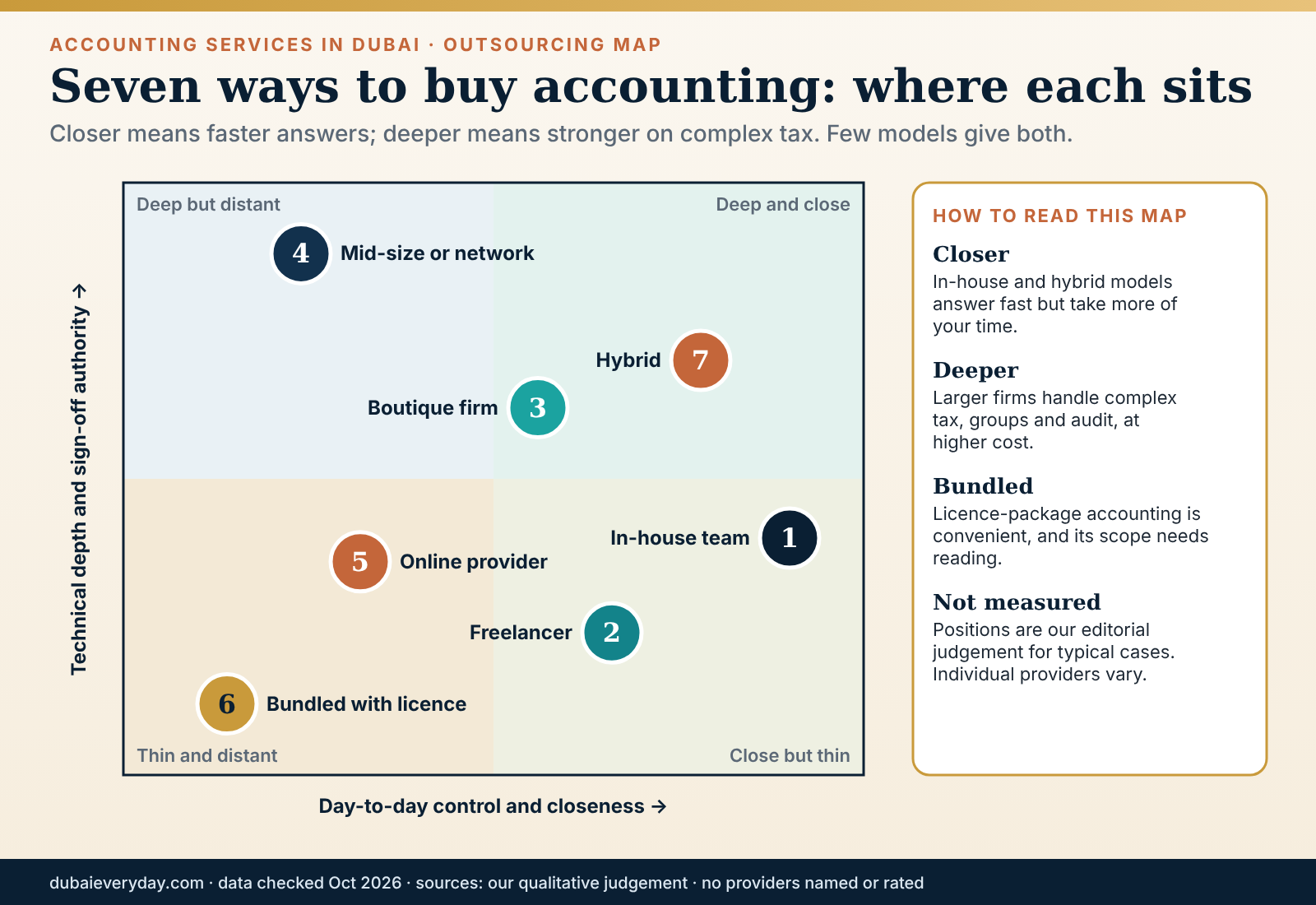
1. In-house accountant or finance team
You employ a bookkeeper or accountant who works in your office. Control and speed are the highest: questions are answered the same day and documents never leave the building. The weaknesses are cost, key-person risk and limited technical depth. One employee rarely knows VAT, corporate tax, payroll and reporting equally well, and when they leave the knowledge leaves too.
The cost is not only salary. Add visa and insurance costs, leave cover, software and the supervision time you spend. This model suits companies with enough daily transaction volume to keep a person busy and an owner who can review their work. Our work visa guide and health insurance guide show what employing someone in Dubai involves.
2. Freelance accountant or bookkeeper
A self-employed professional handles the books, often remotely, for a flat monthly fee. It is flexible and usually the most personal service at the lower end of the price range. The risks are single-person dependency, variable quality and unclear authorisation. Ask for the licence they trade under, their professional-liability cover and whether they are a registered tax agent if they will deal with the FTA on your behalf.
Check continuity: who covers during illness or holidays, and where your data lives. A freelancer who keeps your ledger only on a personal laptop is a risk you can remove with one sentence in the contract.
3. Boutique or local accounting firm
A small firm with several accountants offers a team rather than a person, which gives you cover for absences and some specialisation. Fees are usually higher than a freelancer’s and lower than a large network’s. The firm is often a good fit for SMEs with VAT, payroll and a year-end report to produce.
The test is who actually does your work. Some firms sell with a senior partner and deliver through junior staff, which is not wrong, but you should know the ratio and the review process. Ask for the name of the person who prepares your return and the person who reviews it.
4. Mid-size or international network firm
Larger firms bring depth in tax, audit, group structuring and regulatory change, and often have specialist teams for free zones, funds or large groups. They are better equipped for complex questions and for audit, though not for both on the same client in the same period. Fees are higher, minimum engagements are bigger, and routine bookkeeping may be handled by an offshore centre.
This model suits businesses with group structures, investor reporting, lenders requiring audited accounts or multinational links. For a ten-person company the service level can feel disproportionate; for a larger company the depth may be what you need.
5. Online or software-led provider
These providers combine accounting software, a document-capture workflow and a remote team, typically for a subscription. Strengths: predictable cost, fast onboarding and a digital record trail. Weaknesses: less human attention to unusual transactions, templated advice and dependence on the provider’s platform. If the platform is also the invoicing system, check how it will handle e-invoicing and whether you can export your data in a usable format.
Platform lock-in deserves a clear answer before you sign. If you leave, can you take the full ledger, documents and history in a standard format, and at what charge? A good provider answers this without hesitation.
6. Accounting services Dubai licence providers bundle with formation or PRO work
Many companies are offered accounting services Dubai licence providers bundle into a licence package. It is convenient and often cheap at the start. The trade-off is that the provider’s main business is licensing, and accounting may be a secondary line staffed accordingly. Look at what the bundle names: a “VAT filing” line is not bookkeeping, and an “annual accounts” line may mean a template statement produced from your summary figures.
That is not a reason to refuse a bundle. It is a reason to read the scope and ask what happens when volume rises. If you are still choosing between licence routes, see the business setup guide before you accept the bundle that comes with one.
7. Hybrid: software, a clerk and an external reviewer
The hybrid combines low-cost internal capture (a part-time clerk or the owner using accounting software) with an external accountant who reviews monthly, prepares returns and signs off statements. It is often the best value for companies with moderate volume, because it keeps day-to-day control inside while buying expertise only for the parts that need it.
It fails when nobody owns the monthly deadline. Name an owner for the document hand-off and set a calendar reminder for the reviewer’s date.
The comparison at a glance
| Model | Best for | Main risk | Confirm before signing |
|---|---|---|---|
| In-house | High daily volume, owner who can supervise | Key-person loss, shallow tax depth | Who reviews their work; cover for leave |
| Freelancer | Low volume, tight budget | Single point of failure, authorisation unclear | Licence, indemnity cover, backup, data location |
| Boutique firm | SMEs with VAT and payroll | Junior staff doing senior work | Named preparer and reviewer |
| Mid-size or network | Groups, investors, complex tax | Cost, minimum fees, offshore bookkeeping | Who does the routine work; scope of tax advice |
| Online provider | Standard SMEs wanting predictable cost | Platform lock-in, templated advice | Data export, e-invoicing path, human escalation |
| Bundled with licence | Early-stage, minimal activity | Accounting as a secondary line | What “accounts” means; scaling terms |
| Hybrid | Moderate volume, hands-on owner | No owner for monthly hand-off | Review date, who gets the access |
What accounting services Dubai providers charge and why quotes differ
There is no official price list for accounting services in Dubai, and we did not find a verified market survey, so this page gives no market rates. What it gives instead is the logic: what drives a quote up or down, which pricing structures hide cost, and an illustrative model you can rebuild with your own quotes. Treat any fee for accounting services Dubai sites publish as marketing unless the source shows how it was built.
The drivers that move a quote
Quotes for accounting services Dubai firms sell mostly track the work, and work follows a handful of factors. Transaction volume and the number of bank accounts and currencies come first. VAT status and return frequency come next, followed by payroll headcount, stock, intercompany transactions and the state of your records. Whether the provider also prepares financial statements, handles FTA queries or attends monthly reviews matters as well. A backlog of unrecorded months is priced separately in almost every case, and rightly so.
Turnaround adds a premium. A one-week close costs more than a three-week one. So does an unusual sector, a multi-entity structure or a language requirement. If two quotes for the “same” accounting services Dubai package differ by half, the scope is almost certainly different, and the lower one is leaving something out.
Four pricing structures and their traps
- Fixed monthly retainer. Predictable, but check the transaction cap and what happens above it.
- Per-transaction or tiered. Fair for low volume, punishing for growth.
- Hourly. Transparent, but open-ended without a monthly cap.
- Per-deliverable. Common for returns and year-end accounts; watch what is excluded, such as queries from the FTA after filing.
The costs that appear after signing
Ask directly about each of these before you sign. Setup or clean-up fees for existing records. Software subscriptions passed through at a markup. Extra charges for amended returns or voluntary corrections. Fees for year-end statements that are not part of the retainer. A charge for responding to FTA queries. A termination or data-export fee. None of these is unreasonable by itself. All of them should appear on paper before work starts.
An illustrative fee model you can rebuild
Illustrative example (not a quote or market fact). Assume a blended team rate of AED 200 an hour, a placeholder for the arithmetic and not a market price. A company with 60 transactions a month and one bank account might need 6 hours of bookkeeping each month (72 hours a year), 3 hours for each quarterly VAT return (12 hours) and 22 hours for year-end statements and the corporate tax return. That is 106 hours: AED 21,200 a year, or about AED 1,770 a month at the placeholder rate. Swap in the rate and hours from your own quotes.
The model works as a sanity check on any quote for accounting services Dubai firms send. If a quote is far below the arithmetic of your own hours, ask what is missing. If it is far above, ask what is included that you do not need. A transparent provider will explain the difference without defensiveness.
One verified cost fact is worth knowing, though it is not a price list: the FTA charges registered tax agents AED 3,000 for an individual registration and AED 10,000 for a firm, and requires professional indemnity cover. Regulated providers carry those overheads, which is one reason a very low fee for filing and representation is a signal to ask who is accountable if something goes wrong.
How to vet a provider: a due-diligence checklist
When you buy accounting services Dubai providers sell, you are handing a stranger your bank statements, your customers’ names and the numbers the FTA will hold you responsible for. A short, structured check of accounting services Dubai providers is worth far more than a polished proposal. The steps below take a week of part-time effort and can be done without paying anyone.
- Write a one-page scope briefDescribe your licence type, VAT status, monthly transaction count, bank accounts, staff numbers, software and what you want delivered by when. Send the same brief to every provider so quotes are comparable.
- Check the licence and its activityAsk for a copy of the trade licence or free zone licence and read the permitted activities. A firm selling accounting services Dubai clients can rely on should hold a licence whose activity fits. For a mainland firm, the issuing authority is the Dubai Department of Economy and Tourism; the DET licences page is the starting point for what exists.
- Check tax agent status if they will represent youSearch the FTA registered tax agents directory by name and emirate. If they will speak to the FTA for you, they should appear there or be linked to a registered agency.
- Ask for anonymised sample deliverablesA monthly pack, a reconciliation, a VAT return working file and a year-end statements extract. If nothing can be shown because of confidentiality, ask for a mock-up. Firms that do this work regularly have templates.
- Meet the people who will do the workAsk for the names and roles of the preparer, the reviewer and the escalation contact. Check how long they have been with the firm and what share of their time your account would take.
- Call two references in a similar positionSame size and sector. Ask about missed deadlines, how errors were handled, and how long onboarding took. A provider unwilling to share references is telling you something.
- Start with a defined pilotA one-month or one-quarter paid pilot, with written exit terms, reveals more than any meeting. Judge it on timeliness, questions asked and the quality of the first reconciliation.
- Read the engagement letter before you signThe next block lists what it should say.
What a proper engagement letter says
- The exact services, periods and deliverables, and what is excluded
- Fee structure, volume limits, and the price of work above the limit
- Deadlines on both sides: when you provide documents, when the provider delivers
- Who is responsible for errors and what insurance applies
- How the provider accesses your FTA and bank accounts, and who holds the credentials
- Ownership of records, data export format and any fee for handover on exit
- Confidentiality and how long data is kept after the engagement ends
- Notice period and what happens to work in progress if either side leaves
Do not hand over your personal UAE PASS login or one-time codes to anyone as a shortcut. FTA services run through UAE PASS, so credentials are the keys to your tax record. Ask the provider how it will act for you through a proper appointment, and confirm in writing who is responsible. We did not verify the FTA’s current delegation steps for this page, so ask the FTA or your provider to show you the official process.
Red flags that justify walking away
A guarantee of zero tax or “no corporate tax for your company” is the clearest one. No provider can promise an outcome that depends on your facts, and the law applies the same rules to everyone. Others: a quote that avoids defining scope, pressure to sign in the first meeting, refusal to name the preparer, requests to back-date invoices or move transactions between periods to improve a figure, a payment request to a personal account, and advice that you can skip record-keeping because “the FTA never checks”.
A softer warning is the price that cannot be explained. If a provider is far cheaper than the rest and cannot say what is left out, the usual answers are more junior staff, less review or hidden extras. Cheaper is not wrong. Unexplained is.
If you are comparing in person
Many founders compare providers during a single visit. If you are not yet a resident and are planning that trip, the Dubai travel guide covers the practical side of getting in and around. If you are cluster-booking meetings in one area, the Downtown Dubai area guide describes travel and daily logistics there. Video calls are normal and cost nothing, so meet in person only the shortlisted two or three.
Where to verify rules and resolve problems
For disputes over a service contract, start by reading what the engagement letter says about complaints and notice. For general routes and where to verify Dubai rules, see the Dubai legal basics guide. For tax questions, rely on the FTA and Ministry of Finance rather than on a provider’s own summary. If a provider’s advice contradicts an official page, the official page wins, and the provider should be able to show you the reason.
Software and e-invoicing readiness
Accounting software is where the e-invoicing programme will hit most small companies first. The software you choose in 2026 must either produce compliant structured invoices itself or connect to an accredited service provider. Buying a tool that cannot do either is the avoidable mistake of the next two years, and it limits which accounting services Dubai providers can support you.
What to look for in accounting software
For the accounting services Dubai businesses run, the features that matter in software are VAT coding with the 5% rate and zero-rated or exempt categories, multi-currency handling with a clear exchange-rate method, bank and card reconciliation, an audit trail for edits, role-based permissions so a clerk cannot alter closed periods, and a complete export. Every feature should be tested on your own data before you commit, using a trial ledger of a real month.
Also check how the tool handles data you must retain for years. The FTA’s seven-year corporate tax retention period means your records have to survive a change of software or provider. Exports in a readable open format are insurance against that.
What the e-invoicing rules mean for your software
An e-invoice is structured invoice data exchanged between supplier and buyer and reported to the FTA through accredited providers; a PDF, scan or email is not an e-invoice. The system applies to business-to-business and business-to-government transactions, with e-credit notes for cancellations, refunds and corrections. The Ministry of Finance says businesses may issue e-invoices voluntarily even where exclusions apply.
The Ministry’s list of accredited service providers showed 80 entries on 29 October 2026, up from the 32 approved when the May 2026 amendments were announced. The list shows company name, accreditation number, website and contact details. If your software vendor says it is e-invoicing ready, ask which accredited provider it uses and check that name against the official list. Do not rely on a logo or a sales page.
The dates, restated for planning
Dates can move, as the May and October 2026 amendments showed, so check the Ministry of Finance e-invoicing page before you plan around any of them. For smaller businesses the practical sequence is: confirm your revenue band, shortlist providers from the official list, pick software that integrates with one, update invoice templates and customer data, then test before the go-live date.
Questions to ask your accountant about e-invoicing
Ask which revenue band you fall into and on what basis they measured it. Ask who owns the project: you, your accountant or your software vendor. Ask how e-credit notes will be handled, how rejected invoices will be reconciled to the ledger, and who monitors the reporting. A competent accountant has answers to these by now. If yours does not, that is useful information about the next two years of the relationship.
The annual compliance calendar
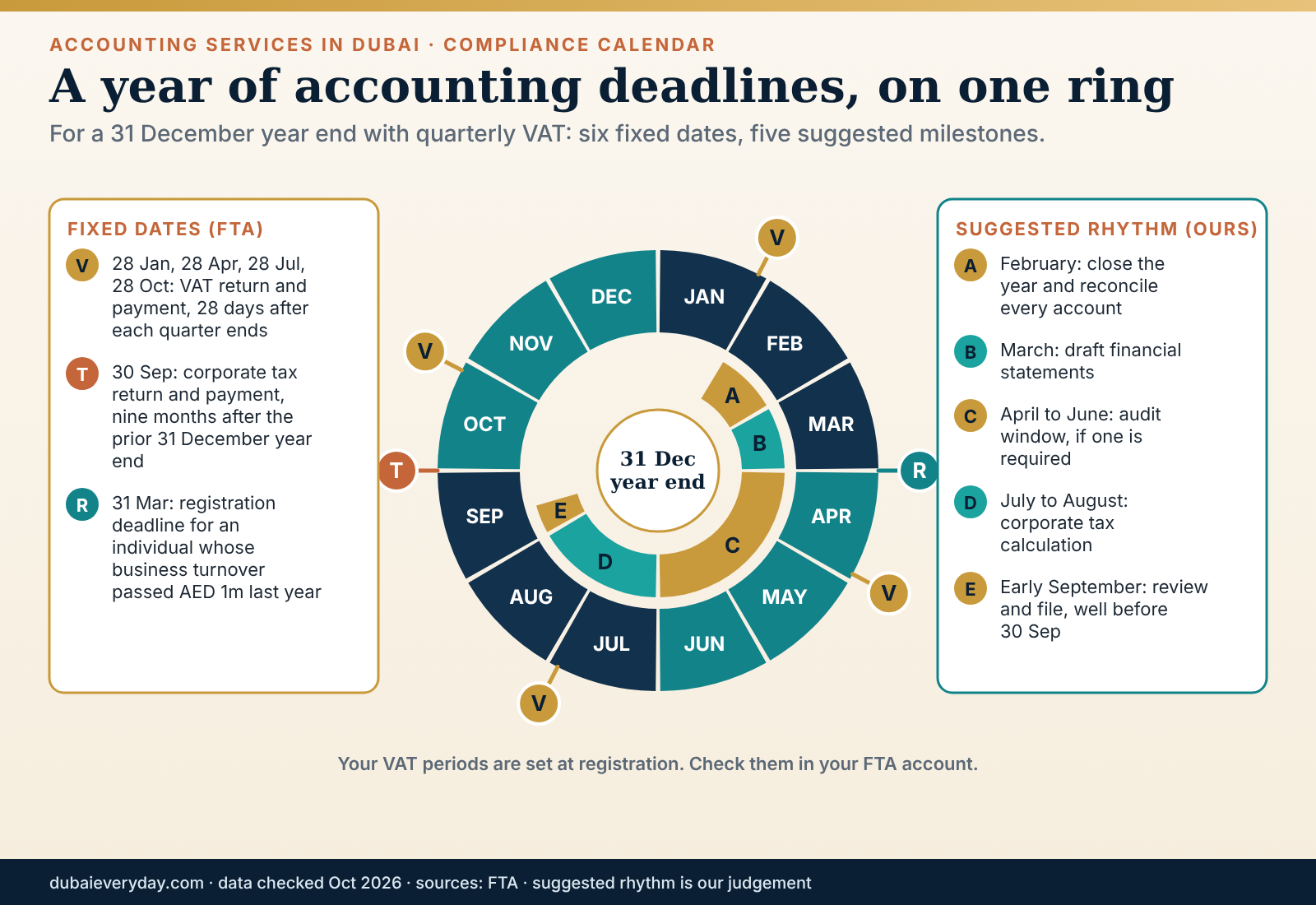
A year of accounting services Dubai companies schedule follows a handful of fixed dates and a lot of internal deadlines that you set yourself. The ring below shows the fixed ones for a company with a 31 December year end and quarterly VAT periods ending in March, June, September and December. Your own VAT periods are set at registration, so confirm them in your FTA account before copying this layout.
The fixed dates, worked out
VAT returns and payment are due 28 days after the tax period ends. For quarters ending 31 March, 30 June, 30 September and 31 December, that gives 28 April, 28 July, 28 October and 28 January. The corporate tax return and payment are due nine months after year end, so a 31 December 2026 year end means 30 September 2027. For a company with a 30 June year end, the return is due on 31 March the following year. A 31 March year end gives 31 December.
Individuals subject to corporate tax register by 31 March of the year after their turnover passed AED 1 million. That date sits just after the calendar-year close, so a freelancer who finishes December above the line should check the threshold in January, not in March.
Internal milestones we would add
These are suggestions based on how the fixed dates compress the work, not legal requirements. Close the year’s books and reconcile every account by the end of February. Produce draft financial statements by the end of March. If an audit is required, schedule fieldwork for April to June with a firm that is not your bookkeeper. Prepare the corporate tax calculation in July and August, review it in early September and file well before 30 September.
The reason for working back from the deadline: the last four weeks before any statutory date fill with other companies’ filings, and your provider’s capacity shrinks. Early work costs the same and arrives with fewer errors.
Where e-invoicing and other deadlines land
Add the e-invoicing dates that apply to your accounting services Dubai plan: 31 March 2027 and 1 July 2027 for businesses under AED 50 million, or 1 January 2027 for larger ones. The March date falls in the same month as year-end drafting and individual registration, so a small business that waits until March to choose software will be competing for attention with everything else. Free zone licence renewals and any audited-accounts requirement set by the zone authority add their own dates, which we cannot generalise.
Common mistakes and what they cost
These are the errors that recur in the official guidance and in how the rules are built. None of them requires bad faith, only inattention. Most are cheap to prevent, whichever accounting services Dubai model you use, and expensive to repair.
Treating 0% as “no filing”
A company with taxable income below AED 375,000 still registers, files and keeps records. A free zone company with no mainland revenue is still a taxable person that must register. The cost of ignoring this is administrative penalties, plus the cost of rebuilding records you did not keep.
Assuming Small Business Relief is open when it is not
The AED 3 million test covers the current period and every previous period. A company that crossed the line once cannot return to the relief by shrinking later. Check revenue history, not just this year’s forecast, before you decide the strategy for a period.
Mixing personal and business money
Personal expenses paid from the company account and company bills paid personally turn the ledger into a puzzle. They also create shareholder balances that need documenting. Keep a clean company account and record anything crossing the line the same week.
Leaving the year-end close until the deadline is near
The nine-month window sounds long. In practice the work bunches into the last six weeks, when providers are stretched. If your accountant starts in August, expect errors, a rushed review and no time to question unusual items.
Weak supplier checks on VAT-registered purchases
Input VAT depends on valid documents, and the 2025 amendments, as summarised by a law firm, allow input tax to be denied where a business knew or should have known a supply was part of an evasion chain. Collect supplier registration details and question anything unusual.
Forgetting old VAT credits
A five-year limit now applies to carrying forward or refunding excess input VAT, with transitional relief that the same summary says runs to 31 December 2026 for pending requests. A credit nobody noticed is money you may lose on a date.
Keeping the only copy of the books with one person
A freelancer’s laptop or an employee’s personal spreadsheet is not a safe place for seven years of records. The fix is a shared cloud ledger, access held in your company’s name and a periodic export you store yourself.
Choosing software that cannot handle e-invoicing
If your tool cannot produce structured invoices or connect to an accredited provider, you will face an unplanned migration under deadline pressure. Ask the question at purchase, not at renewal.
A note on penalties. We confirmed one official penalty amount: AED 10,000 for a natural person who must register for corporate tax and does not by the deadline. One third-party blog describes a monthly shortfall charge under Cabinet Decision No. 129 of 2025 from 14 April 2026, but we could not confirm it from the decision text, so we do not rely on it. Check the FTA’s current penalty table before you plan around any figure.
Switching or starting: the first 90 days
Moving to new accounting services Dubai providers, or buying them for the first time, goes better with a plan. The sequence below is built for a small or medium company and works for either case. The aim is a clean first quarter, not a perfect one.
- Days 1 to 14: access and scopeSign the engagement letter. Share the handover list from the bookkeeping section. Agree who holds which credentials. If you are switching, send a written handover request to the outgoing provider asking for the ledger export, working files and a list of open items.
- Days 15 to 30: opening balances and backlog checkThe new provider agrees opening balances with the last signed statements or tax returns and assesses any backlog. Get a written estimate for catching up before work begins. Reconcile the bank accounts to a fixed date.
- Days 31 to 60: the first monthly closeDeliver documents by the agreed date. Review the first reconciliation and the list of unresolved items. Expect questions. A provider who asks no questions in month one is either very lucky or not looking.
- Days 61 to 90: the first VAT cycle and reviewIf you are VAT-registered, review the return working file before filing, not after. Hold a first review meeting to check the management pack, the close speed and whether the engagement scope still fits your volume.
Switching without losing the thread
When changing provider, overlap the old and new accounting services Dubai arrangements by one month if you can. Ask the outgoing firm for the prior VAT returns, the corporate tax return and the supporting calculations, and any FTA correspondence. Confirm who will be your registered tax agent going forward, if you use one, and that the FTA record reflects the change. Give the outgoing provider written notice according to the contract, and settle outstanding fees so handover is not held up.
Keep a copy of everything outside the provider’s systems. If the relationship ends badly, your records are the one thing you control.
What to do this month
You do not need to fix every part of your accounting services Dubai setup at once. Five actions cover most of the risk and can be done in a week. Each one maps to a section above, so you can go back for the detail.
- Write down your legal form, licence type, financial year end and VAT status, then run the decision path in the screening figure
- Check your revenue history against the AED 375,000 VAT threshold, the AED 1 million individual corporate tax line and the AED 3 million Small Business Relief ceiling
- Find your next three FTA deadlines in your own account and put them in a shared calendar with a date three weeks earlier for your internal cut-off
- Ask your software vendor and your accountant, in writing, how you will handle e-invoicing, and check any named provider against the Ministry’s list
- If you are shopping for a provider, send the same one-page scope brief to three candidates and compare scope before price
The honest position on accounting services Dubai businesses buy is that the rules are mostly learnable and the discipline is the hard part. Pick the model that makes the monthly routine hard to skip, and let the tax layers sit on top of it.
Those five steps turn a vague worry about accounting into a short list of owners and dates. They also give any accountant you hire a better starting point than a shoebox of receipts.
FAQ about accounting services in Dubai
Do I need accounting services Dubai firms sell, or can I keep my own books?
The law requires you to keep records and file returns; it does not require you to hire an accountant. A sole trader with few transactions can keep clean books in accounting software. The risk is judgement: VAT coding, year-end adjustments and the corporate tax calculation. Many owners do their own recording and pay a firm for returns and a periodic review, which is the hybrid model in this guide. If your time is worth more than what accounting services Dubai firms quote, that is the point to outsource.
How much do accounting services Dubai providers charge?
There is no official price list for accounting services in Dubai and we found no verified market survey, so we do not publish market rates. Cost follows transaction volume, bank accounts, VAT status, payroll and the state of your records. Use the illustrative model in the fees section: estimate monthly and annual hours, multiply by a rate from real quotes, and compare. Treat any figure that does not show its scope as marketing, and ask what is excluded.
Is bookkeeping mandatory for a small business in Dubai?
Keeping records is required. The FTA states that taxable and exempt persons must keep relevant corporate tax records for seven years from the end of the tax period, covering transactions, assets, liabilities and shareholdings. It also warns that failing to keep required records can lead to administrative penalties. The law does not say you must use a particular method or hire a bookkeeper, but accurate returns depend on a reliable ledger, so in practice bookkeeping cannot be skipped.
When must a business register for VAT in Dubai?
According to the FTA, registration is mandatory when taxable supplies and imports exceeded AED 375,000 in the previous 12 months, or are expected to within the next 30 days. Voluntary registration is possible from AED 187,500, measured on taxable supplies and imports or taxable expenses. Foreign businesses follow different rules. Registration is done through FTA services with a UAE PASS login. Check the current late-registration penalty on the FTA site before assuming a figure. Watching the threshold monthly is part of basic accounting services Dubai VAT clients pay for.
Do free zone companies pay corporate tax?
Free zone companies are taxable persons that must register and file. Qualifying free zone persons can receive 0% on qualifying income and 9% on other taxable income, subject to conditions set in law and guidance; they cannot use Small Business Relief. A free zone company that fails the conditions is taxed under the standard structure. Because qualifying and non-qualifying income are treated differently, the accounting services Dubai free zone companies need start with separating income streams in the ledger.
Does a freelancer in Dubai need to register for corporate tax?
Only if the freelancer is a natural person doing business in the UAE with total turnover above AED 1 million in a calendar year, according to the FTA. Registration is due by 31 March of the following year, and missing it carries an AED 10,000 penalty. A freelancer who operates through a company, including a free zone company, is a juridical person and registers as a company regardless of turnover. VAT registration is a separate test at AED 375,000.
What is Small Business Relief and is it still available?
It lets an eligible resident person elect to be treated as having no taxable income for a tax period, with simplified compliance. The revenue ceiling is AED 3 million for the current and all previous periods.
Ministerial Decision No. 131 of 2026, announced on 7 August 2026, extended it to tax periods ending on or before 31 December 2029. Qualifying free zone persons and members of very large multinational groups cannot elect it, and other reliefs and deductions are unavailable when it is used. Whether to elect it is a decision for your adviser, not a default setting in accounting services Dubai packages.
When is the corporate tax return due?
Within nine months of the end of the tax period, with any tax due paid by the same date. The FTA’s example is a 31 December 2025 year end, with filing and payment due by 30 September 2026. A 30 June year end gives 31 March of the next year. Exempt persons that must register submit annual declarations on the same nine-month timetable. If you miss the date, penalties and late charges can apply under the FTA’s schedule. Good accounting services Dubai firms provide will schedule the draft well before the date.
Do I need audited accounts in Dubai?
It depends on who is asking. Free zone authorities often require audited accounts at licence renewal, banks and investors may require them, and ministerial conditions can apply for tax purposes. We could not verify the current official thresholds from a government page today, so confirm with your free zone, lender and registered adviser. Settle the requirement before year end so the audit can be scheduled with a firm that is not your bookkeeper.
What is e-invoicing and when do accounting services Dubai clients need it?
E-invoicing means issuing structured invoice data through an accredited service provider, which reports it to the FTA; PDFs and emails do not count. Businesses with annual revenue of AED 50 million or more go live on 1 January 2027. Those under AED 50 million must appoint a provider by 31 March 2027 and go live on 1 July 2027. Scope covers business-to-business and business-to-government transactions. Dates have been amended before, so check the Ministry of Finance page.
How do I check whether an accountant or tax agent is registered?
To vet accounting services Dubai providers, start with the FTA’s public registered tax agents directory, which showed 802 entries on 29 October 2026 and can be filtered by emirate. For the firm, ask for the trade or free zone licence and read the activity. For auditors, the Ministry of Economy and Tourism’s legislation page refers to auditors registered with the Ministry, so ask for evidence of registration. Being listed shows registration, not quality: also take references and ask for sample work.
Should I use the accounting services Dubai licence or free zone provider offers?
Bundled accounting services Dubai licence providers offer can be a reasonable start, particularly when activity is minimal, but read the scope. A bundle line called “VAT filing” or “annual accounts” may not include monthly bookkeeping or review. Ask who prepares the work, what volume is covered and what happens when you grow. You are free to move later, as long as the contract lets you export your records.
Can the same firm do my bookkeeping and my audit?
It is not sensible for the same period. An auditor who also prepared the books would be reviewing their own work, which undermines the point of an independent opinion, and counterparties such as lenders may not accept it. Use a separate firm for the audit when one is required. A single provider can handle the accounting services Dubai companies usually bundle, namely bookkeeping, VAT and corporate tax returns, which is the usual and acceptable arrangement.
How long should I keep accounting records in the UAE?
For corporate tax, the FTA says at least seven years from the end of the tax period the records relate to. E-invoices and related data must be kept for the period set by the Tax Procedures Law and made available to the FTA on request, and under the October 2026 amendment they no longer need to be stored inside the UAE. For VAT and other records, ask your adviser for the current period and keep the longest applicable one. Whichever accounting services Dubai providers you use, keep your own copy of the records.
Related reading
Sources and further reading (20 links)
- UAE Ministry of Finance: Small Business Relief extension to 31 December 2029 — Ministerial Decision No. 131 of 2026
- Federal Tax Authority: Small Business Relief — eligibility, AED 3 million test, exclusions
- UAE Government portal: Corporate tax — 0% and 9% structure, AED 375,000, start date
- Ministry of Finance: Corporate Tax in the UAE — registration, nine-month filing, accounting-profit basis
- Ministry of Finance: Federal Decree-Law No. 47 of 2022 and amendments (unofficial translation) — financial statements, cash basis, top-up tax
- Federal Tax Authority: record retention release — seven-year retention and filing example
- Federal Tax Authority: natural persons and corporate tax registration — AED 1 million threshold, AED 10,000 penalty
- Federal Tax Authority: corporate tax registration timeframes — company and individual deadlines
- Federal Tax Authority: Registration for VAT — AED 375,000 and AED 187,500 thresholds
- Federal Tax Authority: Filing VAT returns and making payments — 28-day deadline
- Ministry of Finance: e-invoicing scope and timelines — phases and revenue bands
- Ministry of Finance: targeted amendments to e-invoicing decisions — provider appointment extended to 30 October 2026
- Ministry of Finance: e-invoicing amendments — Ministerial Decision No. 197 of 2026
- Ministry of Finance: accredited e-invoicing service providers — 80 listed on 29 Oct 2026
- Federal Tax Authority: Tax Agent registration — requirements and fees
- Federal Tax Authority: Registered tax agents directory — 802 entries, filters
- Ministry of Economy and Tourism: accounting and auditing profession legislation — Federal Decree-Law No. 41 of 2023 and related resolutions
- Ministry of Finance: Top-up Tax — EUR 750 million scope, effective date
- Dubai Department of Economy and Tourism: Licences and permits — mainland licensing entry point
- Baker McKenzie: VAT and Tax Procedures Law amendments (secondary; law-firm summary) — context only
Update log: 29 October 2026 — first publication; all facts re-checked against the sources above. Next review due: by 29 January 2027, or immediately after any change to e-invoicing dates, Small Business Relief, penalties or corporate tax rules. Corrections welcome.
General information only. This is not individual tax, legal, accounting or financial advice; confirm your own position with a registered professional or the Federal Tax Authority.
About DubaiEveryday and this guide
DubaiEveryday.com is an independent editorial project that publishes practical, research-based guides to everyday life in Dubai: where to live, what things cost, how the rules work and how to get around. This page was written and edited by the DubaiEveryday editorial team. It is not signed by a named expert, doctor, lawyer or adviser, and we do not claim first-hand testing of a venue, clinic or service unless the page says so.
Each guide is built from official sources such as government and regulator pages, operator websites and established news outlets, cross-checked where we can. When we could not confirm something, we say so in the text, and examples that use made-up numbers are labelled as illustrations. Mentions are editorial choices, not paid placements, and a link is not an endorsement.
Dubai changes quickly. If you spot something that is out of date or wrong, please tell us through the contact options on DubaiEveryday.com and we will check it and correct the page.