

Choosing among schools Dubai families can actually reach takes four decisions in a fixed order: curriculum, commute, fee band, then rating. This guide walks through each one using the figures KHDA and the Dubai government published for the 2026-27 academic year.
Choosing a school for your child can feel like a decision you only get one shot at. Add a city with 17 different curricula and the shortlist gets heavy before it even starts. Many parents open with a rating and work backwards, and that is often where the stress begins. Curriculum, commute and fees matter just as much, and they come first.
This guide works in a calmer order. It walks you through the schools Dubai families can realistically reach, using what KHDA published for 2026-27, including a fee freeze and a change to the entry-age cut-off. You also get an admissions roadmap and a method for building a shortlist you can live with. It will not rank schools or tell you which one is right for your child.
The practical way to choose between schools Dubai offers is to work backwards from where your child will be in five years. Pick the curriculum that lets them move on without friction, then a school you can reach in a commute you will tolerate every morning, then a fee band you can sustain for years, and only then compare KHDA inspection ratings.
Four facts frame 2026-27. Dubai’s regulator confirmed on 22 May 2026 that approved tuition fees stay unchanged. The system teaches 17 curricula, and a 2024-25 official release put 227 private schools and 387,441 students on the map; 406,563 students were enrolled at the start of the new year. Full inspections were paused from June 2024, so most published ratings date from the 2023-24 round. And first-time registrants must now reach the entry age by 31 December rather than 31 August.
Below you get the system explained, curricula compared, fees broken down with worked examples, an admissions roadmap, a location map, special-needs and nursery guidance, four hypothetical family scenarios and a shortlist method. This page does not rank any of the schools Dubai families ask about, and nothing here was field-tested.
This is a desk-research guide. DubaiEveryday.com has not visited, toured, enrolled a child in or paid any school mentioned here, and nothing on this page describes a personal visit. Facts were read on 29 October 2026 from Dubai government releases (the Dubai Media Office fee-freeze announcement and its 2025 sector statistics), the UAE government portal, and press reports of KHDA briefings. KHDA’s own website blocks automated readers, so we could not open its data pages directly.
Fee ranges and ratings come from published lists of the 23 schools Dubai’s regulator rated Outstanding in the 2023-24 round; they describe that group only, not the whole market. Anything from commercial advisory blogs is labelled as indicative and not official. No school or consultant paid for inclusion, and no school is ranked. This is general information, not individual education, legal or financial advice: confirm every fee, date and rule with the school and KHDA before paying anything.
What this guide covers and what sits elsewhere
This page answers one job: how a family new to Dubai, or new to its school market, goes from “which schools Dubai has” to a short list and a place. It covers the regulator behind the schools Dubai families compare, plus curricula, ratings, fees, admissions, locations, early years and support needs. Think of it as the decision map. The deep material sits in sibling guides, and where an adjacent question comes up we say so rather than repeat it.
The closest sibling is the KHDA school ratings guide, which goes deep on inspection reports, wellbeing measures and what ratings do not capture. Here you get only the part of ratings that changes your shortlist. For the wider relocation sequence, including visas, housing and banking, use the moving to Dubai guide and the Dubai relocation checklist.
Universities, tutoring centres and home-schooling are out of scope. Two new international higher-education institutions opened for 2026-27, but choosing a university is a different search with different rules. Nurseries get a section here because the age rules for early years now run through the same KHDA chart as schools.
How to read the dates on this page
Data on the schools Dubai regulates goes stale quickly, and it goes stale unevenly. Fees are frozen for 2026-27, so fee figures here should hold until the next announcement. Ratings are older than most parents assume. Admissions rules changed for the 2026-27 intake. Each figure carries its source date so you can judge it, and the update log at the end states when the page will be rechecked.
One convention is worth fixing now. The schools Dubai families compare use mixed naming. The British system counts Foundation Stage 1 and 2 and then Year 1 to Year 13; the American and Indian systems count kindergarten and then Grade 1 to Grade 12. KHDA publishes a conversion in which KG2 corresponds to Year 1 and Grade 12 to Year 13. We use British year names first and give the grade equivalent where it helps.
Who runs the schools Dubai families choose from
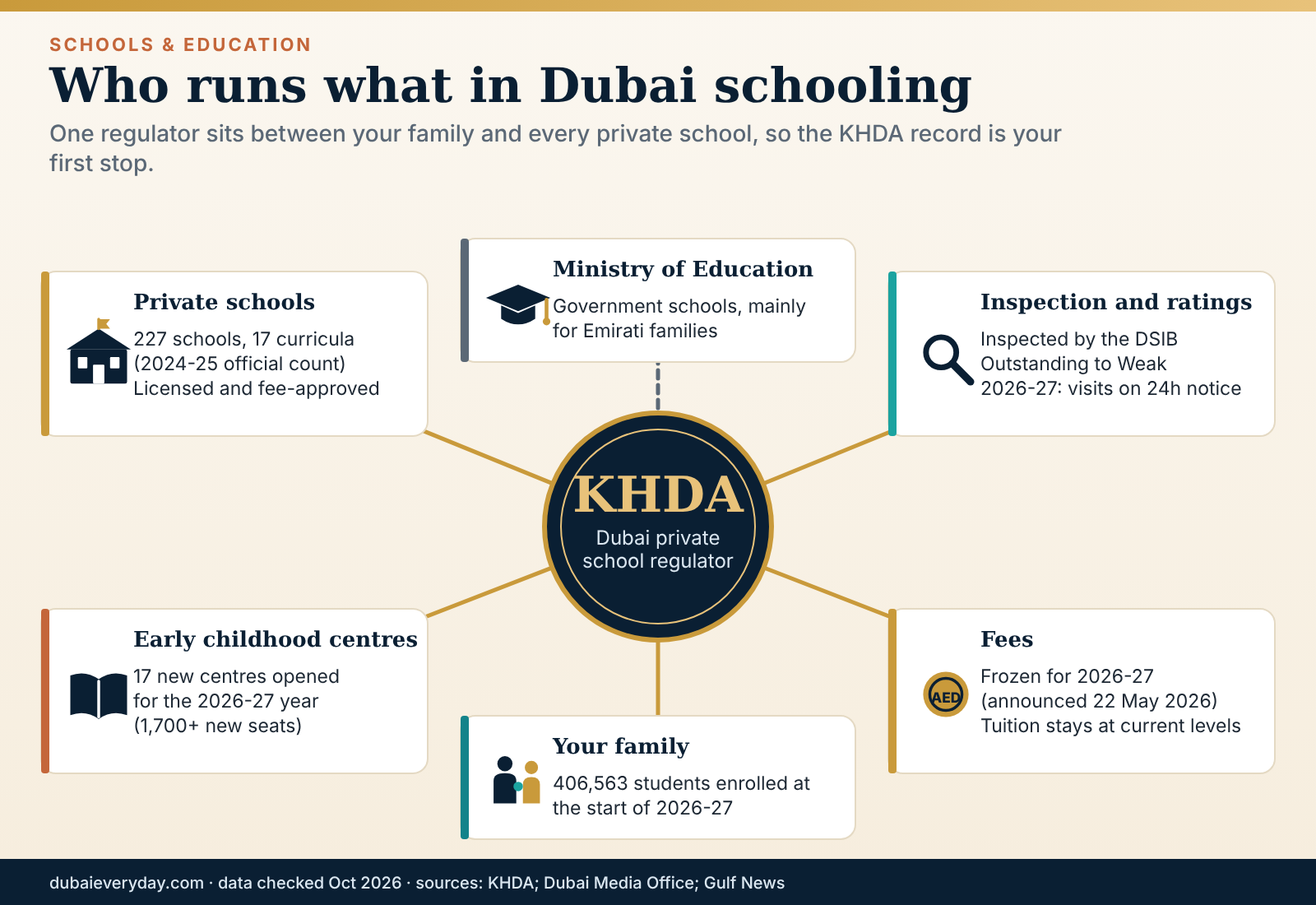
Every one of the private schools Dubai families compare sits under one regulator, the Knowledge and Human Development Authority, KHDA. It licenses schools and early childhood centres, oversees fee approval, publishes the data that parents use, and commissions inspections through the Dubai Schools Inspection Bureau, known as DSIB. A government portal summarises the rating system on its Dubai schools rating page, and fee regulation is summarised on the UAE portal’s school fees page, last updated 21 October 2026.
The government school sector sits separately under the UAE Ministry of Education. For most expatriate families it is not a practical route, which is why the schools Dubai newcomers shortlist are in practice almost all private. An official page, last updated in September 2023, describes a narrow door: grades 2 to 12, a parent working for a government, semi-government or local entity, minimum scores of 85% in Arabic, English and mathematics, valid residence visas, an AED 6,000 tuition fee, and a cap of 20% expatriates per school and per classroom. Treat that as a historical snapshot and check with the Ministry before relying on it.
The market for schools Dubai offers, in numbers and with dates
A Dubai Media Office release in January 2025 gave the last full official picture we found: 227 private schools Dubai-wide, 387,441 students, 185 nationalities, 27,284 teachers and 17 curricula. Enrolment had grown 6%. Curriculum shares were UK 37%, Indian 26%, American 14%, International Baccalaureate 7% and a UK/IB hybrid 4%. Press reports of a KHDA briefing in autumn 2026 put enrolment at 406,563 at the start of 2026-27, up about 4.6% from roughly 388,731 in June.
The supply of schools Dubai families can choose from is growing too. Khaleej Times reported on 25 August 2026 that Dubai would open 26 new private institutions for the year: seven schools with nearly 17,000 seats, 17 early childhood centres with more than 1,700 places, and two international higher-education institutions. Four of the new schools follow the UK curriculum and three the IB. Three were named in the report: Harrow International School Dubai, Queen Elizabeth’s School Dubai Sports City and Rugby School Dubai.
Our arithmetic on those figures: the number of seats added by the new schools (about 17,000) is close to the rise in enrolment between June and the autumn start (about 17,800). That does not prove the new seats absorbed the growth, since new pupils also join existing schools. It does suggest that adding capacity is keeping pace with demand in aggregate while specific year groups and districts can still be tight.
What “affordable” means, and why it matters
The Dubai Media Office’s May 2026 release says KHDA introduced about 9,000 new affordable places in 2025-26, that schools in this segment serve about 230,000 students, and that about 7,500 more places are planned over the next two academic years. A later press report puts the pipeline at around 18,000 affordable seats over two years. The release does not define “affordable” in AED terms.
On our arithmetic, 230,000 is more than half of the roughly 387,000 to 407,000 students enrolled, which means the affordable segment is not a niche. For you it has a practical meaning. If your budget is tight, the schools Dubai places in that band are not a compromise tier at the margin of the market; they teach the majority of children. What you need to check is the school’s own fee schedule and its inspection record, not the label.
One more structural fact helps when you read a school’s marketing. The schools Dubai has licensed operate under a named curriculum and a fee structure that the regulator knows about. If a school cannot show you its approved fee schedule on request, treat that as a reason to pause. Everything in the fee section builds on that principle, and it is why the Dubai cost of living guide treats schooling as a line item you can plan, not a surprise.
Curricula: choosing between the 17 systems in schools Dubai offers
Most guides to schools Dubai offers start a curriculum discussion by describing each system. That is the wrong order. A curriculum is a pipeline, and what matters is where it leads. A child who finishes a British pathway holds GCSE or IGCSE results and A-levels; a child who finishes an American pathway holds a high-school diploma and often Advanced Placement scores; a child who finishes the IB holds a Diploma. Each of those is read differently by universities, employers and the next school you might move to.
So the useful question is not “which curriculum is best?” but “which exit do we want to keep open?” Answer that honestly, including the unglamorous possibility that your employer may move you in three years, and the curriculum choice mostly makes itself. Dubai is unusual because the schools Dubai has licensed cover all of the main exits inside the same city, so you are not forced to compromise.
The four systems that teach most children in schools Dubai-wide
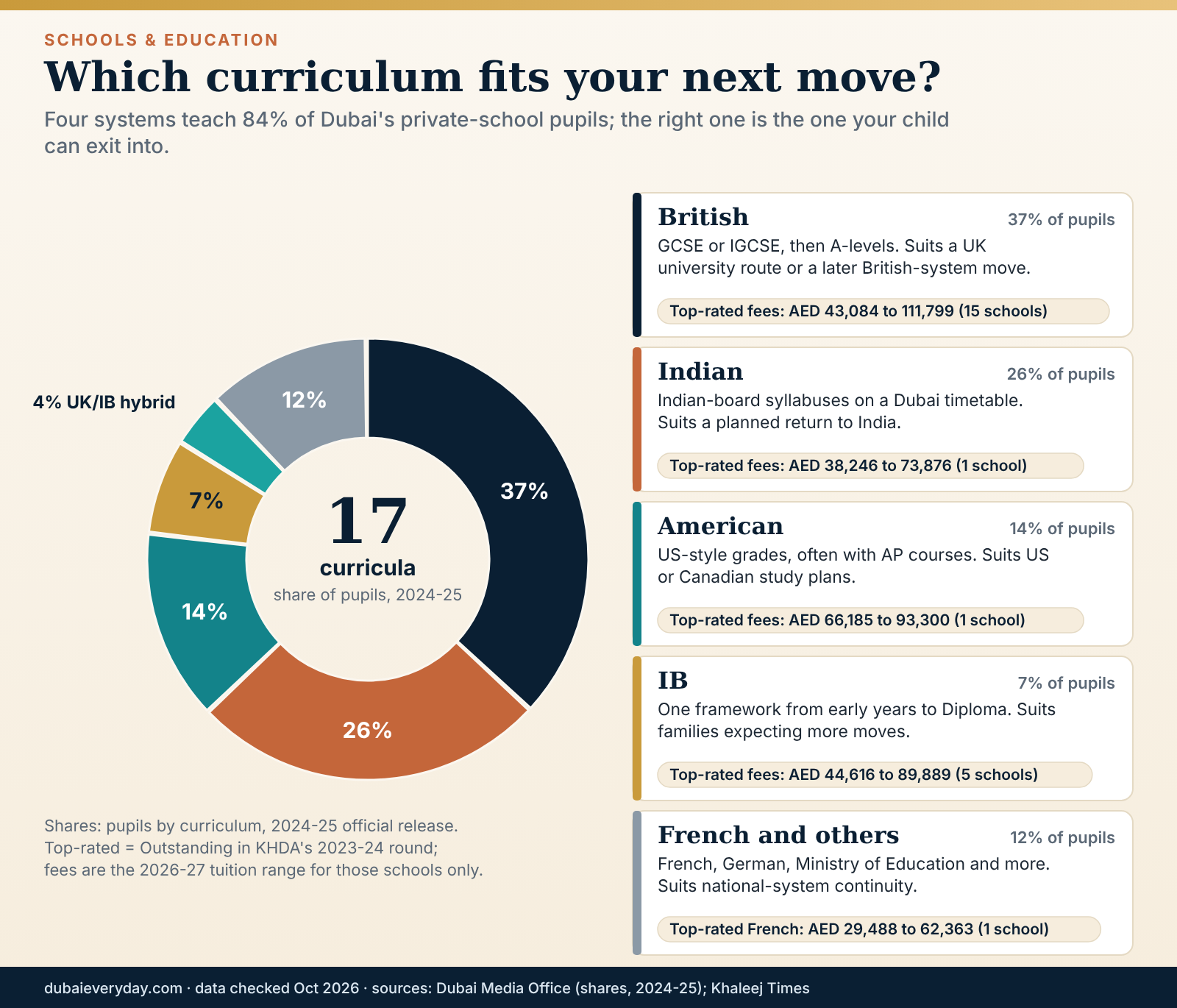
The official 2024-25 shares put four systems at 84% of pupils: British 37%, Indian 26%, American 14% and IB 7%. A further 4% attend schools classed as UK/IB hybrids, and the remaining 12% sit in French, German, Ministry of Education and other national systems that the release did not break out. The 17-curriculum count comes from the same Dubai government releases. Here is how each major system tends to be organised across schools Dubai-wide, described at the level of detail that affects your choice.
British schools
British-curriculum schools Dubai families use run Foundation Stage 1 and 2, then Year 1 to Year 13. Pupils usually sit GCSE or IGCSE exams at the end of Year 11 and A-levels or equivalent at the end of Year 13. The sheer number of British schools in the market means this is the system with the widest range of fees and locations, and also the one where individual school quality varies most.
It suits families who expect a UK university route, or a later move to another British-system school anywhere in the world. Two cautions apply. The KHDA transfer timetable treats Years 11 to 13 as a tight window, because those are exam courses that start in September and do not welcome late entrants. And British schools differ in which exam board and which subjects they offer, so “British” is the start of the question, not the end.
Indian-curriculum schools
Indian-curriculum schools Dubai families use follow Indian board syllabuses, with board exams at the end of Grade 10 and Grade 12 under the usual national pattern. A portion of them run an April-to-March academic year, which the 2026-27 age rules acknowledge directly: April-start schools use a 31 March age cut-off, where September-start schools use 31 December. If you land in Dubai in September, an April-start school means you join mid-year or wait.
The official share is 26%, so Indian-curriculum schools teach roughly one pupil in four. That scale supports a deep ecosystem of schools Dubai-wide, which is useful for a family who want a school close to home. Fees in this segment cluster lower than the British and American ranges in the published Outstanding-rated data (the Indian-curriculum school in that group charged AED 38,246 to 73,876), but the sample is a single school, so use it as a pointer, not a norm.
American-curriculum schools
American-curriculum schools Dubai offers count kindergarten and then Grade 1 to Grade 12. Older pupils typically take Advanced Placement courses and graduate with a high-school diploma. This pathway suits families who expect study in the US or Canada, or who are on a US employer’s rotation and plan to return. The 14% share is smaller than the British and Indian shares, so the choice of school in a given district can be narrower.
In the Outstanding-rated group, the one American-curriculum school listed charged AED 66,185 to 93,300 across its grades. Again, a single school cannot tell you what the American segment costs overall. What it does tell you is that a top-rated American-curriculum seat sat in the upper half of that group’s price range in 2026-27.
IB schools
The International Baccalaureate runs as a continuum: a Primary Years Programme from about age 3, a Middle Years Programme in the early teens, and the Diploma Programme for the final two years. Because the framework is the same worldwide, it travels well for families who expect several more moves. Five IB schools were in the Outstanding-rated group, charging AED 44,616 to 89,889.
The trade-off is flexibility in the other direction. A child can join an IB school at the start of a programme without much difficulty, but entering mid-Diploma is hard, and a few schools offer a different programme combination. Ask which programmes the school offers and for which years. The 7% share, plus the 4% hybrid category, means IB seats are fewer than British ones, and popular schools Dubai-wide may keep waiting lists.
French, German and national systems
French schools Dubai families choose follow the French national programme and are chosen largely by families who want continuity with the French system, including its qualification at the end. The Outstanding-rated list included one French school with a range of AED 29,488 to 62,363, the lowest starting fee in that group. German and other national-system schools serve similar logic: you pick them for the destination.
An additional rule applies to Emirati families. A KHDA admissions document published in 2024 says Emirati students may join only schools offering the Ministry of Education, American, UK, IB, SABIS, French, German, Canadian, Chinese or Japanese curricula, and may not join schools rated Weak or below. That does not affect most expatriate families, but it explains why some schools mention nationality in their admissions pages.
A decision table for the exit-first method
The table pulls the official shares and the published fee ranges into one view of the schools Dubai families can choose between. The fee column covers only schools rated Outstanding in the 2023-24 round, as listed by Khaleej Times in July 2026, so it shows the top of each segment, not the middle. The “suits” column is our editorial reading of the logic above.
| System | Share of pupils (2024-25) | Typical exit exams | Suits a family expecting… | Outstanding-rated tuition, 2026-27 (AED a year) |
|---|---|---|---|---|
| British | 37% | GCSE or IGCSE, then A-levels | UK university, or a move to another British-system school | 43,084 to 111,799 (15 schools) |
| Indian | 26% | Board exams, Grade 10 and 12 | A return to India or Indian entrance exams | 38,246 to 73,876 (1 school) |
| American | 14% | High-school diploma, often with AP | US or Canadian study, or a US posting | 66,185 to 93,300 (1 school) |
| IB | 7% (plus 4% hybrid) | IB Diploma | Several more international moves | 44,616 to 89,889 (5 schools) |
| French, German, other | 12% combined, not broken out | National qualifications | Continuity with a specific national system | French school: 29,488 to 62,363 (1 school) |
Our calculation from the same data: the cheapest published entry fee (AED 29,488, preschool at a French school) and the most expensive published top-grade fee (AED 111,799, Year 13 at a British school) differ by a factor of about 3.8. Within a single curriculum the spread can be wider than the gap between curricula, which is why we do not treat any system as the cheap one.
Testing the choice before you commit
Three questions expose most weak curriculum decisions. First: if we move again in three years, what is the receiving school likely to be, and what year group will our child be in? Second: if our child struggles with the exam years, what is the fallback inside this system? Third: how many of the school’s pupils finish the full pathway there? A school with strong primary years and a thin sixth form may suit you perfectly for six years and badly for the next four.
Switching is possible, but it is not free. The 2024 KHDA guidance says pupils in Grades 9 to 12 moving to a different curriculum need Ministry of Education approval, which is a signal that the system treats late switches as a special case. The 2026-27 placement rules reinforce that: year-group placement follows the official age-grade chart from Foundation Stage to Grade 9, and a change after enrolment needs an approved exceptional-placement process. If you are likely to move curriculum, do it before the exam years begin.
Residence status also shapes the decision. If your family’s right to stay depends on an employer sponsor, the realistic planning horizon is the length of the contract plus whatever notice period applies. The Dubai work visa guide explains how residency attaches to employment, and the Dubai residence visa guide covers the dependants’ route that most school applications rely on.
KHDA ratings in 2026-27: what you can and cannot lean on
Every one of the private schools Dubai has put through a full inspection carries one of five main grades from the Dubai Schools Inspection Bureau: Outstanding, Very Good, Good, Acceptable or Weak. Older reporting also records a Very Weak grade, which had no schools in the latest full round. The KHDA ratings guide explains how to read a full report; this section covers the narrower question of how much weight a rating deserves when you shortlist schools Dubai parents are comparing in late 2026.
The honest answer is: less than the headline suggests, for a reason most articles skip. The ratings are old.
The last full round for schools Dubai-wide, in numbers
Khaleej Times reported the 2023-24 outcomes as follows. We converted the counts to shares ourselves. Treat the counts as approximate, because another outlet we read gives slightly different numbers for Good and Acceptable, and the Khaleej Times article itself says only that “more than 200” schools were inspected.
| Rating (2023-24 round) | Schools | Share of the 209 counted (our calculation) |
|---|---|---|
| Outstanding | 23 | 11.0% |
| Very Good | 48 | 23.0% |
| Good | 85 | 40.7% |
| Acceptable | 51 | 24.4% |
| Weak | 2 | 1.0% |
| Very Weak | 0 | 0% |
Two further figures from the same report matter. About 81% of Dubai’s private-school students attended a school rated Good or better, and 83% of schools were rated Good or higher for wellbeing. Put together, the numbers say that “Good” is the centre of the system, and that Outstanding is a distinction held by roughly one school in nine. If your shortlist of schools Dubai offers is limited to Outstanding grades, you are choosing from a small group before you have looked at a single commute.
Why the ratings you see are older than they look
KHDA paused standard full inspections of schools Dubai-wide in June 2024, and the pause was extended into 2025-26. According to Khaleej Times in November 2025, only four schools received full reviews that year, all newer schools: two came out Good and two Acceptable. In July 2026 the same outlet reported that KHDA retained existing ratings for 2025-26. The practical effect is that for most schools the grade on the public record was awarded during the 2023-24 year, more than two years before this guide was verified.
Two years is long in a school’s life. Principals change, intakes shift, and a school can improve or slip. A rating from 2023-24 is evidence about that school at that time. It is not a verdict on 2026-27. This is the single most useful thing to say to a parent comparing a Good school with an Acceptable one on a published list.
The new inspection model for 2026-27
Gulf News reported the revised approach for 2026-27. The private schools Dubai inspects will be subject to either a comprehensive inspection that produces a full performance rating, or a shorter monitoring visit that concentrates on priority areas flagged by performance data. Inspectors will give no more than 24 hours’ notice, with the aim of seeing ordinary teaching rather than a prepared day. Schools entering their third year of operation automatically receive a full inspection.
As of 29 October 2026 we found no published new overall ratings round under this model, so the 2023-24 distribution above remains the latest complete picture we could verify. That may change during the academic year, and the update log lists ratings as the first item to recheck. If you are reading this later, look at the date on any rating before you give it weight.
The seven schools Dubai opened for 2026-27 will not have ratings yet, and the model implies they will receive a full inspection in their third year. A new school can be an excellent choice, but you are judging leadership, facilities and curriculum plans, not outcomes. The newer the school, the more weight should shift to what you can see and ask yourself.
A five-step way to use a rating when comparing schools Dubai offers
- Find the grade and its yearCheck the school’s page on the KHDA site and note which inspection year the grade belongs to. A 2023-24 grade and a 2025-26 new-school review are not the same evidence.
- Read the report, not the labelThe written findings on attainment, progress, teaching, curriculum, care and leadership say far more than a single word. Look for the areas rated lower than the overall grade.
- Compare with what the school says nowAsk what has changed since the inspection: leadership, staffing, building, results. A confident school answers with specifics.
- Weigh fit above gradeA Good school that is twenty minutes away and teaches the right curriculum usually beats an Outstanding school you cannot realistically reach.
- Treat the monitoring visit as a signalIf a school has been visited under the new model, ask what it found, since short visits focus on priority areas and are therefore informative about weak spots.
Agents, social posts and some portals publish “rankings” built from inspection grades and fees. KHDA’s grades are categories, not ranks. Two schools both rated Outstanding are not ranked against each other, and we do not rank any of the schools Dubai families ask about on this page.
What a rating does not tell you about schools Dubai families compare
Ratings do not tell you whether a school’s pastoral culture suits a shy child, how large the classes are in the year your child will join, whether the bus route reaches your street, or how the school handles a child who needs extra support. They also say little about the experience of a teenager arriving mid-year in an exam course. Those questions need a visit, a conversation and sometimes an honest word from current parents.
There is also a rule where a rating has legal weight. The UAE Ministry of Education’s 2016 resolution, summarised on the UAE government portal, bars UAE nationals from registering or funding private schools rated Very Weak, and the 2024 KHDA admissions guidance states that Emirati students may not join schools rated Weak or below. For expatriate families the rating carries no equivalent legal effect, which is why the interpretation work falls on you.
Do ratings affect fees in 2026-27?
Historically they did. The UAE portal explains that for-profit schools in Dubai could raise fees based on their DSIB grade and the Education Cost Index, which was set at 2.35% for 2025-26. Because KHDA confirmed no increase for 2026-27, the grade is not changing what you will be charged this year. Our reading: for 2026-27 a higher grade will not translate into a higher fee, so the label cannot stand in for what you will pay at schools Dubai-wide.
School fees in Dubai: tuition, extras and the 2026-27 freeze
Fees are the part of choosing among schools Dubai offers where marketing and reality drift furthest apart. The advertised number is tuition for one year group. The number that leaves your account is tuition plus a set of charges that vary by school, and for some families a support or transport line that exceeds everything else. This section separates what is verified from what is indicative, then shows the arithmetic with clearly labelled examples.
What the 2026-27 fee freeze covers
On 22 May 2026 the Dubai Media Office published KHDA’s confirmation that fees at private schools Dubai-wide would not increase for the 2026-27 academic year, a decision attributed to the directives of Sheikh Hamdan bin Mohammed, Crown Prince of Dubai. A Gulf News report describes the approved tuition fees as staying “at current levels”. The same announcement tied the freeze to a second economic incentives package, and it lists support measures for education providers, including deferred licence-renewal payments.
The announcement concerns approved tuition. We did not find official wording that extends the freeze to every other charge, so ask the school whether registration, transport and activity fees are also unchanged. We also found no statement about 2027-28. Planning on the basis that the freeze is a one-year pause is the safer assumption, and the update log flags fees for a recheck when KHDA publishes its next fee decision.
For context, the system that normally governs increases is the Education Cost Index. The UAE government portal states that for-profit schools can raise fees according to their inspection grade and the index, and that the index was 2.35% for 2025-26. Khaleej Times reported in June 2025 that families then saw increases from about AED 200 a year to almost AED 5,000 a year per child, depending on the school.
Our calculation of what the freeze avoids, if a school had applied 2.35% in full: AED 1,175 on a AED 50,000 fee, AED 1,410 on AED 60,000 and AED 2,350 on AED 100,000, per child per year. Multiply by the number of children and the number of years you expect to stay and the freeze is a real, if one-off, saving.
What tuition looks like across schools Dubai offers
No official source we could read publishes a market-wide fee distribution, so any “average fee at schools Dubai-wide” you see in an article is someone’s estimate. What is published is school-level data for the 23 Outstanding-rated schools, and that gives hard anchors for the top of the market. Across those schools, 2026-27 annual tuition ranged from AED 29,488 (a French school’s preschool) to AED 111,799 (a British school’s Year 13). British schools in the group spanned AED 43,084 to 111,799, IB schools AED 44,616 to 89,889, the American school AED 66,185 to 93,300 and the Indian-curriculum school AED 38,246 to 73,876.
Khaleej Times also listed a per-school average for each. Those averages ran from about AED 41,000 at the lowest to about AED 103,900 at the highest, and the article notes inconsistencies between its summary table and its school list, so treat individual figures as indicative and confirm with the school. The outlet does not say whether the figures include registration, books, uniforms or transport; we read them as tuition.
Fees at schools Dubai parents compare also rise with the year group. Primary years cost less than the sixth form in every school-level range we read. A family planning for a Year 2 child and a Year 9 child will pay two quite different fees at the same school, and the gap grows as the older child moves into exam years. That is why the total-cost picture for a long stay is much larger than a first-year quote suggests.
The costs below the waterline at schools Dubai families apply to
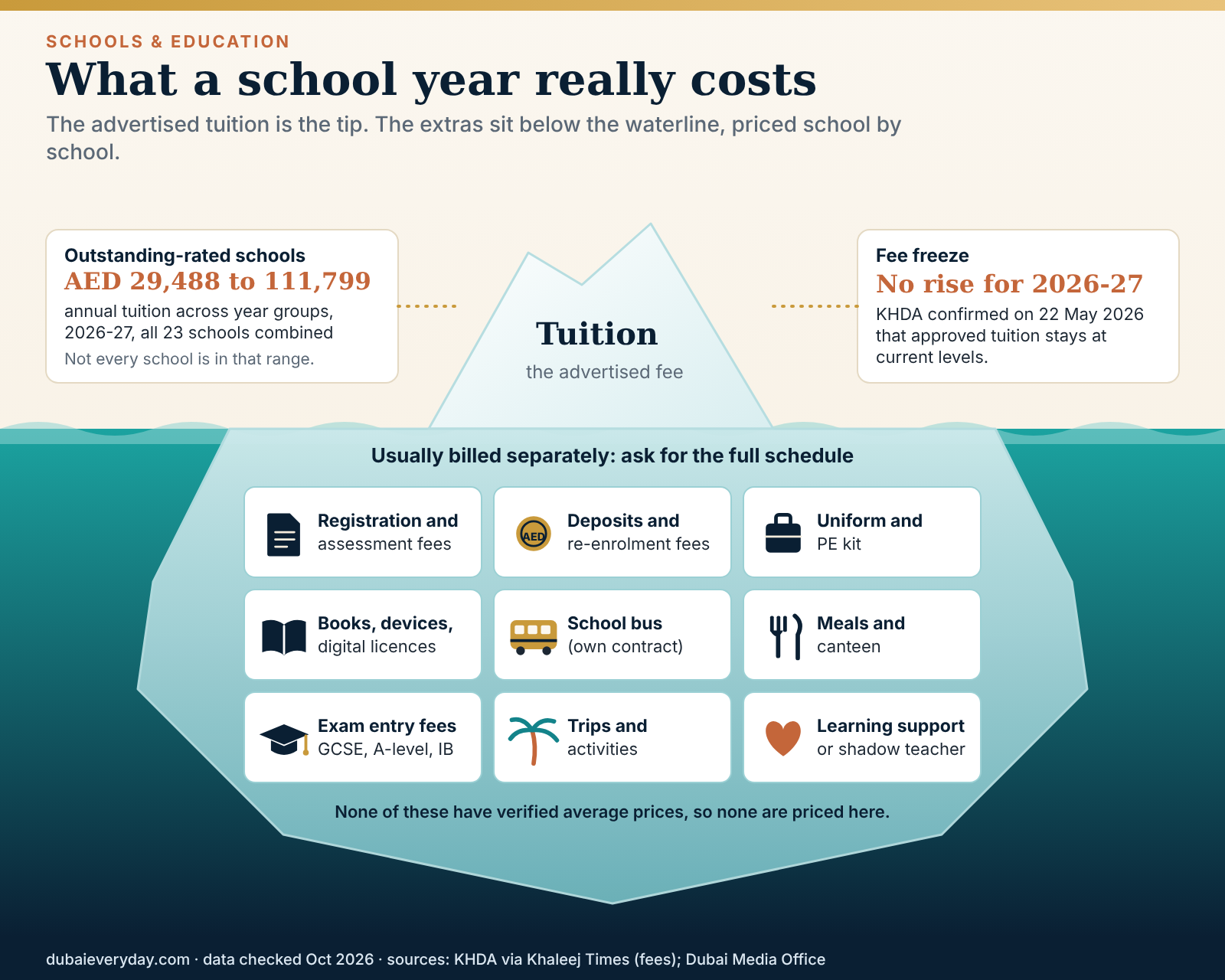
The schools Dubai families apply to publish their own fee schedules, so the exact list varies. These are the lines to look for, and the questions to put to each school in writing. Where a figure appears below it comes from commercial advisory guides, not an official source; treat it as indicative and confirm before you budget.
- Registration or assessment fee, usually one-off and often non-refundable. Two advisory guides quote roughly AED 500 to 1,000 per application.
- Seat deposit or re-enrolment fee, often credited against tuition. Those guides quote AED 2,000 to 10,000, or around a tenth of tuition at the upper end.
- Uniform and PE kit, and books or digital licences. One guide quotes AED 500 to 2,000 for uniform and AED 500 to 3,000 for books and stationery each year.
- School bus, usually a separate contract. The guides quote about AED 5,000 to 12,000 a year per child, with distance as the main driver.
- Meals, trips, activities and exam entry fees for GCSE, A-level, IB or board exams.
- Learning support, a shadow teacher or specialist therapy where a child needs one (covered in the special educational needs section).
The ranges above are not KHDA figures. Two commercial guides disagree with each other on registration fees and deposits, and neither names an official register. The reliable number is the one on the school’s current fee schedule, in writing, with the date it was issued and a line saying whether it matches the fee approved by the regulator.
Illustrative example: two children, one year, tuition plus extras
Illustrative example (not a quote or market fact). A family enrols one child in an early-years year group and one in Year 4 at a mid-priced school. Assume tuition of AED 45,000 and AED 60,000, which sit inside the published top-of-market ranges but are chosen only to make the arithmetic clear. Tuition is AED 105,000.
Now add the indicative extras for two children: assessment fees of AED 1,000 to 2,000, uniform AED 1,000 to 4,000, books AED 1,000 to 6,000 and buses AED 10,000 to 24,000. First-year extras total AED 13,000 to 36,000, which makes the all-in cost AED 118,000 to 141,000. Deposits of AED 4,000 to 20,000 would also leave your account up front, though they are normally credited against fees.
Our reading of that arithmetic: extras add roughly 12% to 34% on top of tuition for this family, and transport is the swing factor. The lesson is not the number, which is a teaching device, but the method. Ask each school for the same list, put the answers in one column and compare totals, not tuition lines.
Illustrative example: the cost of a whole school career
Illustrative example (not a quote or market fact). Take two published school-level averages from the Outstanding-rated list, which are 2025-26 schedules that stay unchanged for 2026-27. An Indian-curriculum school ran from KG1 to Grade 12 with an average of about AED 47,500 across its grades; a British school ran from FS1 to Year 13 with an average of about AED 88,759.
If a child stayed from KG1 to Grade 12 (14 grades) at the first average, tuition would total about AED 665,000. If a child stayed from FS1 to Year 13 (15 year groups) at the second, tuition would total about AED 1,331,000. Neither includes extras, inflation or any lifting of the freeze. They show the scale: a full school career in Dubai is a six- or seven-figure commitment before the first university application.
A fair question is whether you should plan on a full career in one school at all. Many expatriate families do not stay that long. The more useful use of the arithmetic is to ask what annual figure you can sustain for however long you expect to remain, and then to check that your chosen school’s fee for the oldest year group you will have is still inside it. The cost of living guide places schooling beside rent and insurance so you can see the whole budget at once.
How people pay at schools Dubai-wide, and what to ask about it
Billing patterns vary across schools Dubai-wide: some bill termly, others offer annual payment. A Khaleej Times report from June 2025 quotes one parent at a premium school who paid the full year upfront in return for a lump-sum discount, and others who cut activities or moved children to cheaper schools. Those are individual accounts, not policy, but they point to questions worth asking: is there a discount for annual payment, a sibling discount, a staff-child rate, and what is the instalment calendar?
Some employers contribute to school fees as part of the package, usually as an allowance, a direct payment or a capped reimbursement. Check your contract and its wording about who pays, which children qualify and what happens if you leave mid-year. The jobs in Dubai guide covers how to read an offer, and the tenancy and cooling guides cover the other big bills.
The fee questions that protect you
- Can you send the full current fee schedule for the year group my child will join, and for the oldest year group I would reach?
- Which of these charges are covered by the 2026-27 freeze, and which are set separately?
- What is refundable, when, and under what conditions, if the visa or the place falls through?
- What deposit or re-enrolment fee do you charge, and is it credited against tuition?
- What is the notice period if we leave, and is the term paid in advance?
- What does the bus cost from my address, and is a seat guaranteed or wait-listed?
Keep every answer in writing and keep receipts. The regulator’s fee rules are published in the School Fees Framework linked from the UAE portal’s school fees page; we could not open the framework itself, so we do not summarise it here. If a school’s charges look out of line with its own schedule, KHDA is the body to ask.
Admissions: how to get into schools Dubai families want
Admission to schools Dubai-wide is a school-by-school process sitting on top of a regulator-by-regulator one. Each school decides whether to offer a place, which assessments to use and how much to charge for applying. KHDA decides who can be registered in the system, which age rules apply and what documents must exist. Parents who understand both layers lose far less time than parents who treat admission as a single form.
A timing note for readers in late October 2026. Advisory guides commonly report that applications for the following September open around October, and recommend applying ten to twelve months ahead. That is a commercial source and a general pattern, not a rule, so check each school’s own dates. If your move is for September 2027, you are at or near the start of the usual window.
The age gate at schools Dubai-wide in 2026-27
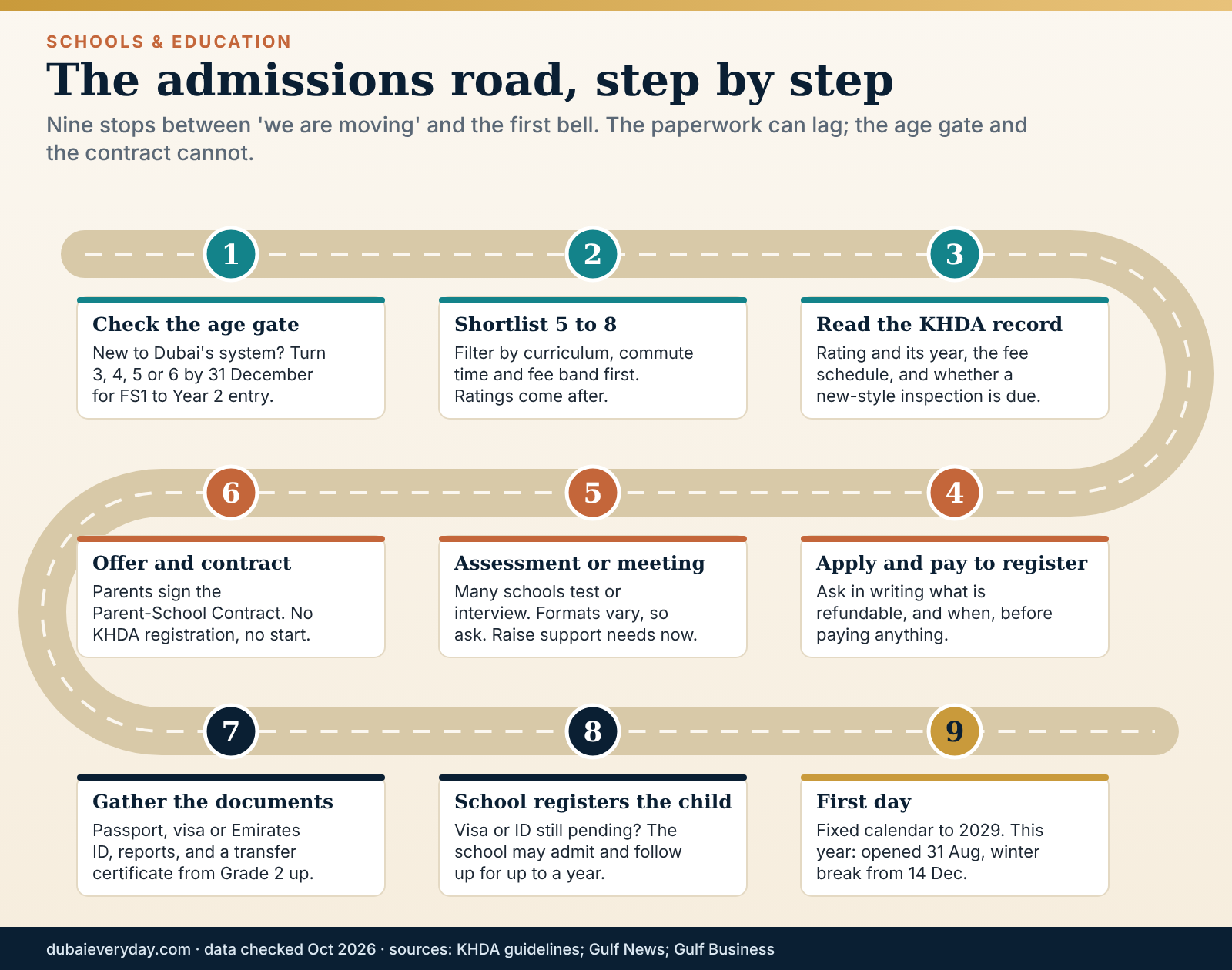
This is the rule that changed most and that older articles still get wrong. Gulf News and Gulf Business reported that from 2026-27, the age cut-off for children registering in Dubai’s system for the first time applies at 31 December for September-start schools. Pre-KG or FS1 needs the child to turn three by that date, KG1 or FS2 four, KG2 or Year 1 five, and Grade 1 or Year 2 six. April-start schools use 31 March.
The earlier KHDA guidance, published in a 2024 document, measured age on 31 August for September starts. Our reading of the shift: the cut-off moved four months later in the calendar year, so the youngest children in a new September cohort are now about four months younger than before. Parents of children born between September and December may find a door that was shut last year now open, and parents who planned to hold a child back for maturity face tighter rules.
The rule applies only to children registering for the first time. Children already enrolled, and children transferring between Dubai schools, are not affected. Children born between 1 September and 31 December 2022 who are not in any education setting may be placed in FS1 or FS2 for 2026-27 only, depending on developmental readiness assessed by the school. Gulf Business quotes the guidance as saying this cannot set a precedent for future admissions.
Placement rules at schools Dubai-wide that limit what you can negotiate
The 2026-27 framework also tightens year-group placement from Foundation Stage to Grade 9. Age is the main criterion in the early years. Repeating a year is not an approved fix for academic difficulty; the schools are told to use differentiated teaching and interventions. Moving a child up or down after enrolment needs an approved exceptional-placement process and written KHDA approval, which Gulf Business says is generally reviewed within ten working days for complete submissions.
The same report lists grounds that do not justify a year-group change: poor exam results, interrupted schooling, late school entry, language barriers, parental preference, English proficiency alone and academic giftedness. Requests to repeat FS1 or FS2 for maturity alone are also excluded. Only schools can appeal a decision, within 30 days, not parents, so you work through the school. If you are hoping to place a child in a different year group from the one the chart implies, raise it in the first conversation, and expect to be told no.
Documents: what to gather before you apply to schools Dubai-wide
KHDA’s published admissions and transfer guidance (the 2024 version, hosted by a school) says a child may start only once registered in the KHDA system and once parents have signed the Parent-School Contract. A transfer certificate is mandatory for children entering from UAE schools. For children arriving from outside Dubai and entering Grade 2 or Year 3 or above, a transfer certificate from the last grade completed is needed. Advisory guides add the usual supporting items.
- Passports for the child and both parents, with residence visas or proof of a visa in process.
- Emirates ID once issued.
- Recent school reports, commonly the last two years, and any assessment or educational psychologist reports.
- Immunisation records, as many schools ask for them.
- A transfer certificate from the current school, attested if it comes from outside the UAE.
- Passport-size photographs and the application form, plus proof of payment for any application fee.
The attestation requirements for foreign certificates differ by country of origin. The 2024 guidance describes three tiers. Certificates from another emirate or a GCC country need the principal’s signature and stamp plus attestation by that authority. Certificates from North America, Western Europe and Australia need the principal’s signature and stamp. Other regions need the principal’s signature and stamp, the origin country’s Ministry of Education attestation and a UAE consulate, embassy or Ministry of Foreign Affairs attestation.
Start the attestation early. The consular step is the slowest part of the paperwork for families arriving from the third tier of countries. Request the transfer certificate and begin attestation before you travel, because a certificate you cannot produce can delay registration even if the place is offered. The relocation checklist shows where the school paperwork fits in the overall timeline.
If the visa or Emirates ID is not ready
This worries parents more than it needs to. The 2024 KHDA guidance allows a school to admit a child while a residence visa or Emirates ID is still being processed, and the school then has up to one academic year to upload them. It describes a registration category for pending cases, with approval for selected services and monthly follow-up. If the school fails to follow up, the guidance says the child cannot be registered in any school the following year.
The practical translation: do not let a pending visa stop you applying, but do not let it drift. Tell the school the timeline, give them each document as it arrives, and keep a copy of the visa application receipt. The residence visa guide covers how a dependant’s visa and Emirates ID are obtained, and the health insurance guide covers the insurance that usually accompanies it.
Timelines, waitlists and the cost of applying to several schools Dubai-wide
One advisory guide describes a typical pattern: applications and fees from October to December, assessments and first offers from January to March, deposits from March to May, and waiting-list movement from June to August. The same guide says places are scarcer at entry points such as FS1, Year 1, Year 7 and Year 12, and that mid-year entry is common because expatriate families move often. We could not verify those patterns with a primary source, so use them as a prompt to ask each school what is typical for the year group you want.
A sensible approach is to apply to three or four of the schools Dubai offers at once. Our arithmetic with the indicative figures from earlier: four applications at AED 500 to 1,000 each is AED 2,000 to 4,000 in non-refundable fees. That is cheap insurance against a missed place. Where it stops being sensible is in paying several deposits to hold seats you do not intend to use, so ask in writing whether a deposit is refundable before you pay it.
Assessments and interviews
Schools Dubai-wide set their own formats. Advisory guides report that many British and IB schools use cognitive testing plus age-appropriate reading and writing tasks from about Year 2, and that early-years entry often involves informal, play-based observation. Treat that as a general pattern. What you can do is ask each school what the assessment involves, whether it is used for placement or only for support planning, and whether a result can lead to a refusal.
If your child needs learning support, tell the school at application stage. Under the Dubai inclusion framework, discussed in the special needs section, a school that cannot meet a child’s needs must go through a formal non-admission process rather than a quiet refusal. A frank early conversation produces better outcomes than discovering the gap after enrolment.
Offers, contracts and what to do if you are refused
When an offer arrives, read the contract before the deposit. Check the term dates, the fee schedule, the refund conditions and the notice period for leaving. The Parent-School Contract is a KHDA requirement for registration, so the school will present it; the useful step is reading what the school adds on top.
If a place is refused or waitlisted, ask where you sit on the list and how often it moves, and keep applying elsewhere. The new age rule means a school that said no last year because of age may say yes this year, so ask again. If the refusal is about support needs, ask whether the school submitted the required non-admission notification to KHDA, and ask what alternatives the school suggests. Keep the conversation factual and in writing.
Locations: where the schools Dubai parents shortlist sit
Dubai is long and thin: a coastal strip with a handful of parallel highways running from the south-west to the north-east. That shape makes the location of schools Dubai families shortlist a travel-time question first and a distance question second. Two schools five kilometres apart can sit on different sides of a congested interchange. Families who choose a home first and a school second often discover this in the first week of term.
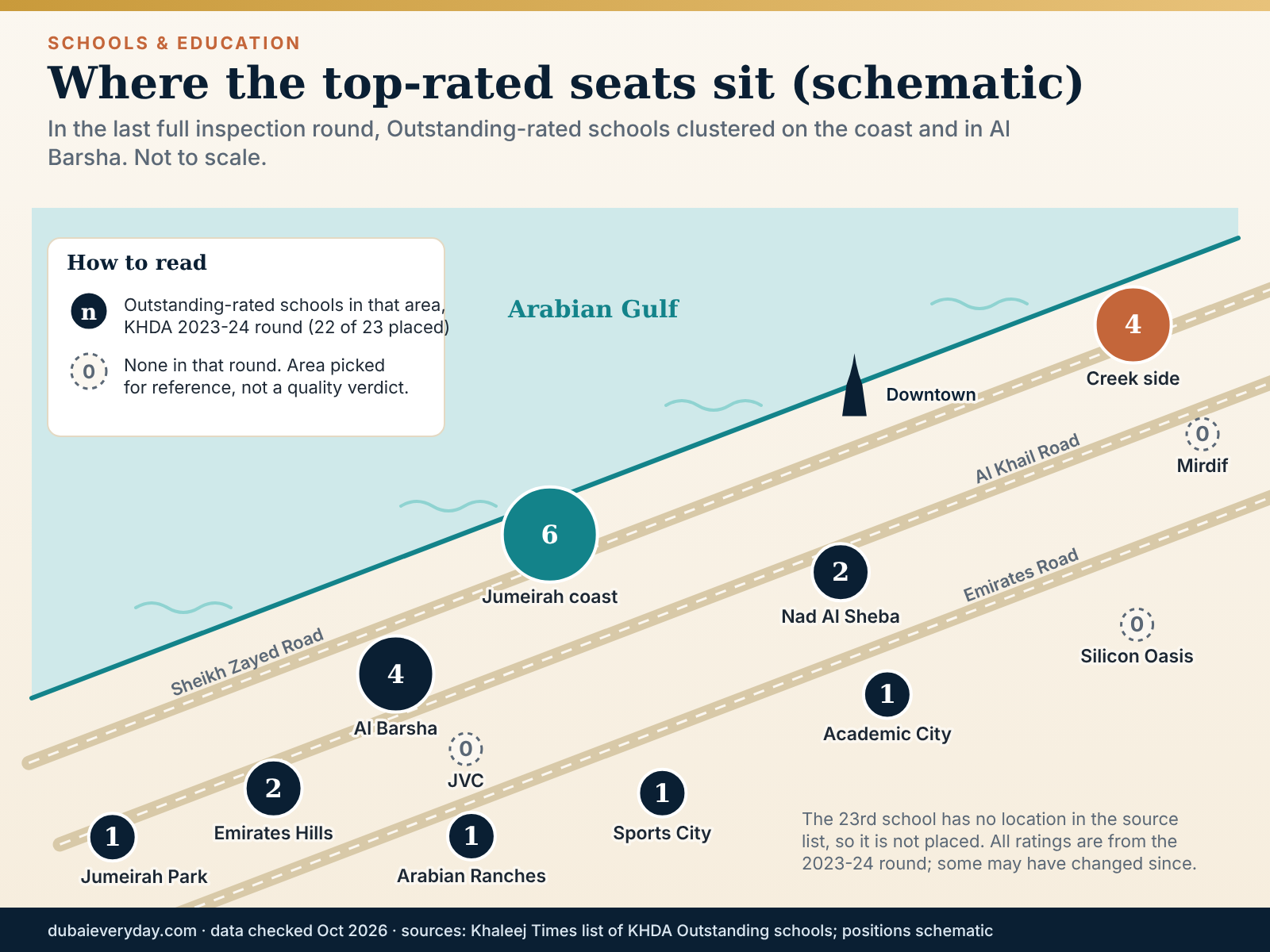
To give the question some shape, we mapped where the schools rated Outstanding in KHDA’s 2023-24 round are located, using the 23-school list published by Khaleej Times. It is a partial picture, because most schools are not in that group, but it is the only location-linked rating dataset we could verify, and it shows which districts have the deepest supply of top-rated schools Dubai has inspected.
What the map of schools Dubai has rated shows, and what it does not
Our tally from the published list: six of the 23 schools are along the Jumeirah coast, grouping Al Sufouh, Umm Suqeim, Jumeirah, Al Safa and Al Wasl; four are in Al Barsha; two each in Emirates Hills, Nad Al Sheba and Oud Metha; and single schools in Arabian Ranches, Sports City, Academic City, Festival City, Umm Hurair and Jumeirah Park. Twenty-two of the 23 can be placed; one has no location in the source.
The pattern is that top-rated supply concentrated on the coast and around the Al Barsha corridor. Districts such as Mirdif, Silicon Oasis and Jumeirah Village Circle had no Outstanding-rated school in that round, and the map marks them with a zero so you can see the gap. A zero is not a verdict. Schools in those districts may hold other grades, and a Good school close to home is a legitimate first choice. The map says only where the highest grade clustered when the last full round was run.
Read it alongside the age of the data. A school’s grade can change, and some schools may have been inspected since. A district without an Outstanding-rated school today could have one after the next inspection round. Use the map to understand shape, then check the KHDA page of each school on your list.
Time beats distance: a commute budget
Set a one-way school-run budget in minutes and test it at the time you would actually travel, not on a quiet Saturday. Most of the grid’s long parallel roads move well at off-peak hours and badly at the school-run peak. The practical test is to drive or ride the route on a weekday morning and again in the afternoon, and to note the journey door to door including parking or drop-off queues.
Our calculation, as a teaching device rather than a measurement. Suppose a parent drives both ways, morning and afternoon, which makes four legs a day. If a school sits 35 minutes away instead of 15, that adds 20 minutes a leg, or 80 minutes a day. Over an assumed 180 school days, which is our illustrative assumption and not a KHDA figure, the difference is 240 hours a year, or ten full days. A school bus changes who spends that time but not whether the child spends it.
For young children the bus ride is the cost. A child on a 50-minute bus ride each way is out of the house for a long school day even before lessons start. Ask the school for the actual route length and pick-up time from your address, not the average, and ask about the last child dropped off as well as the first picked up.
Choosing between home-first and school-first
If you have flexibility on housing, the best-value move is usually to fix your pick from the schools Dubai offers first and then choose a home inside the commute budget around it. That is the opposite of how many families proceed, because the lease comes with a deadline and the school offer does not. The renting guides help here: the renting in Dubai guide covers contracts and Ejari, the villa rental guide covers family-sized homes with gardens, and the apartment rental guide covers buildings and amenities.
If you must sign before you have a school place, build in flexibility. Ask about break clauses and the notice period on the lease, and avoid committing to a distant district solely because rent is cheaper. The saving can disappear into fuel, bus fees and time. The tenant rights guide explains what a tenant can and cannot negotiate in Dubai.
Area notes for families comparing schools Dubai-wide
These are orientation notes, not recommendations. Each district has different housing, and you should confirm the school options on KHDA’s site and on the school’s own pages.
Jumeirah coast
The coastal belt from Al Sufouh to Al Wasl held the most Outstanding-rated schools in the 2023-24 round (six). It sits close to the central business areas. If you want a coastal location, see the beach guide for weekend options.
Al Barsha corridor
Four Outstanding-rated schools in the list sit here, between the two main parallel highways. It works for families who want central access without coastal prices, but the interchanges at either end are where journey times tend to stretch.
Inland communities
Emirates Hills, Arabian Ranches, Sports City and Nad Al Sheba hold smaller clusters. The trade is more space per dirham against a longer drive to anything outside the community. Many families in these areas rely on the school bus.
Creek side and central
Oud Metha, Umm Hurair and Festival City hold four Outstanding-rated schools between them, close to the city’s older centre. If your work is in Downtown, see the Downtown Dubai guide for the area’s housing and transport.
New schools and what they change
The schools Dubai added for 2026-27 include seven new ones. Khaleej Times named three: Harrow International School Dubai, Queen Elizabeth’s School Dubai Sports City and Rugby School Dubai. Only the Sports City location is stated in the report, and none of the three has an inspection grade. New campuses add capacity in specific places, but their first years are a matter of facilities, leadership and teacher recruitment, which you can check in person. We did not verify opening status, fees or admissions for any named school, so contact the school directly.
For families arriving from abroad, the metro and bus networks may not connect neatly to the gates of the schools Dubai families shortlist, so the school run is mostly by car or school bus. The Dubai Metro guide is worth a look if an older child could travel independently, and the driving licence guide matters if one parent will need to drive for the first time.
The daily run: buses, timings and the calendar
Once a place is confirmed, the quality of daily life depends on transport and the calendar. Both are less glamorous than ratings and both cause more first-term stress. This section covers what we could verify and what you should ask.
School buses: what is verified
Dubai’s Roads and Transport Authority issues reminders each year before term. Khaleej Times summarised the August 2025 reminder: operators must instruct drivers to follow traffic rules near schools and avoid blocking other vehicles, provide RTA-supervised training for drivers and bus attendants, equip buses with safety features, keep parents informed about children’s journeys, and have attendants escort pupils to the point nearest their home at drop-off. Students must follow attendants’ instructions when boarding and alighting.
That list does not give speed limits, minimum ages, fines or camera rules, so we do not either. It also leaves a gap between rules and your own child’s route. What you can ask the school or operator is concrete: who operates the bus, how long the route is from your address, when pick-up and drop-off occur, whether an attendant rides on every journey, and how you are told if a bus is late or changed.
Questions for the transport office. Ask for the route time from your front door, not the average for the area. Ask whether the seat is guaranteed once paid for, what happens if you move house mid-year, and what the cancellation terms are. A bus seat that takes a month to confirm is a poor start to term.
The calendar for 2026-27 and beyond
Gulf News reported that the UAE now uses a fixed three-year academic calendar covering 2026-27, 2027-28 and 2028-29. Schools welcomed students back on 31 August 2026. For most schools, the mid-term break ran from 12 to 18 October 2026 and the winter break runs from 14 December 2026 to 3 January 2027. Schools following Indian, Pakistani and Bangladeshi curricula may follow different schedules and holidays, and private schools in Sharjah follow the emirate’s own calendar.
The Sharjah detail matters for commuters. If you live in Sharjah and send a child to a Dubai school, or the other way round, the two calendars may not match, and the family’s holidays will not always line up with a sibling’s. We did not find term end dates or the summer break in the source, so confirm them with the school before booking summer travel.
A fixed three-year calendar is genuinely useful. It lets you book flights home months ahead and reduces the risk that a school shifts a break at short notice. For events and school-holiday travel peaks, the Dubai events calendar and the airport guide help you plan around the busiest weeks.
Nurseries and early years
The early years are where Dubai’s school system and its childcare market overlap, and where the rules changed most for 2026-27. A nursery in Dubai may be a day-care setting, an early-learning programme or the first stage of a school. What links them is licensing: KHDA licenses early childhood centres, which it calls ECCs, alongside schools. The Dubai Media Office’s May 2026 release treats ECCs as KHDA-licensed providers, with licence-renewal fee exemptions among the support measures.
Supply is growing quickly. Khaleej Times reported that 17 new ECCs opened for 2026-27 with more than 1,700 early-learning places, using UK Early Years Foundation Stage, Montessori, Ontario, French and Indian programmes. The same report counts 87 new ECCs over the past three academic years, with ECC enrolment up 2.6%. We could not find a published count of all licensed ECCs, so we do not give one.
The age rules now reach nurseries
Gulf Business reported that nurseries and ECCs must follow the same age-grade chart as the private schools Dubai licenses. For September-start settings in 2026-27, that means the 31 December cut-off for first-time registrants described in the admissions section: three years for FS1, four for FS2. UK-curriculum schools may use readiness assessments at Foundation Stage entry, but only under the transitional arrangement for this year.
Two practical consequences follow. A nursery cannot promise to keep your child in an FS1-type class when the chart says they belong in FS2, and a child who moves from a nursery to a school is placed by the age chart, not by the nursery’s view of readiness. If a nursery tells you something different, ask them to point to the rule.
Nursery or in-school foundation stage?
The cleaner route for many families is to enter the foundation stage of a school, because the child is then inside a system with a clear progression. The trade-off is lock-in and fees. A school’s FS1 fee is part of a long relationship, and the seat is often scarce. A standalone nursery is more flexible, usually closer to home, and a useful bridge if you are not yet sure which school you will get.
The question to ask a nursery is whether it has a feeder or priority arrangement with any school, and in writing, what exactly the arrangement guarantees. In most cases it will guarantee nothing more than an assessment. Do not assume an ECC place secures a school place.
What to check at a nursery
- Ask to see the current KHDA licence and check the centre appears on the regulator’s records.
- Ask which programme it follows and who trained the lead staff in it.
- Ask the staff-to-child ratio for your child’s age group, in numbers, and how it is maintained at the start and end of the day.
- Ask about sickness, medication and emergency procedures, and who the on-site first-aider is.
- Ask about outdoor play and shade, especially from May to September.
- Ask for the full fee list, including registration, meals, nappies or extra hours.
- Ask what happens at transition: how the child’s progress is recorded and shared with the next school.
We did not verify any official staff-ratio numbers for Dubai nurseries, so we give none; ask the centre and compare answers between settings. The healthcare in Dubai guide explains where paediatric and urgent care sits if you are choosing a nursery with an eye on nearby clinics.
Special educational needs and inclusion in schools Dubai licenses
In the schools Dubai regulates, the term for children with disabilities and special educational needs is students of determination. The framework behind it is the Dubai Inclusive Education Policy Framework, launched by KHDA in 2017. Khaleej Times reported at its launch that schools may not refuse admission to students with special needs, must set aside a budget for the facilities and resources required, and must ensure that costs to families for required services are reasonable and good value. In rare cases involving complex and severe needs, additional fees must reflect the actual cost of services.
Later guidance gives the process some teeth. KHDA’s 2024 admissions guidance says a school declining a student of determination must upload a non-admission form to the KHDA system within two working days, and says students of determination are admitted after a school’s internal assessment. A 2026 report on the revised rules says a non-admission notification form is required when admission is declined because of inclusion capacity or specific educational needs. That means a refusal leaves a record.
The gap between policy and experience
The policy is clear; the experience varies. At the framework’s launch, parents told Khaleej Times they had been turned away by mainstream schools and that schools often charged more, including for shadow teachers. One parent estimated that a learning support assistant could add AED 40,000 to 70,000 on top of tuition. That is a single parent’s estimate from 2017, not a policy figure and not a current price, but it explains why this is the fee line to ask about first.
We have no verified current data on how many schools Dubai-wide meet the framework’s expectations, nor on how much support costs in 2026-27. What we can say is that the right questions are specific. A school that has thought through its provision can describe it in terms of named roles, hours and costs. A school that answers in general terms is telling you something too.
What to ask, and when
Disclose needs at the application stage and bring any reports. Ask the school to describe how it identifies needs, what support is included in tuition, what is billed separately, who delivers it and how often it is reviewed. Ask how the school handles exams: arrangements for extra time or other access, and the school’s experience with your child’s type of need, in numbers where possible.
- Can I see your inclusion or learning-support policy, and who is responsible for it?
- What support is included in tuition, and what is charged separately, with prices?
- Do you use shadow teachers or learning support assistants, and who employs them?
- How are individual plans written, shared with parents and reviewed?
- What therapies are on site, and which would need an outside provider?
- If you decide you cannot meet my child’s needs, what is the process and the timeline?
This is general information, not medical or educational advice. If you are concerned about a child’s development or learning, seek assessment from a qualified professional; the healthcare guide explains how care is organised, and the health insurance guide for residents explains what cover usually includes for dependants.
Arabic, Islamic education and language support
All the private schools Dubai licenses sit inside a national framework that makes Arabic and Islamic education part of the offer. The government portal’s description of DSIB inspections lists students’ progress in Arabic as a first language and in Islamic Education among the areas reviewed. We did not verify the exact weekly hours, entry levels or exemptions that apply to each curriculum, so we give none. Ask every school on your list how Arabic and Islamic education are timetabled for your child’s year group and nationality, and ask to see the weekly timetable.
Why it matters when you choose: the amount and quality of Arabic teaching differs between schools Dubai-wide and between curricula, and it is one of the places where a child arriving mid-year can feel behind. Ask how Arabic is assessed for a child who has never studied it, whether there is a beginner pathway, and whether the grade appears on reports and transcripts.
English as an additional language
For families arriving with a child who is not yet fluent in English, the 2026-27 placement rules help. Gulf Business reports that English proficiency alone is not grounds for changing a year group, and schools must provide English-as-an-additional-language support instead. Your child should be placed with their age group and supported, not held back for language.
Ask the school how long EAL support lasts, how many hours per week it covers, whether it takes the child out of core lessons, and how progress is measured. In a French or German school, the language of instruction is not English, so the same question becomes how the school supports a child arriving without French or German. Those answers are specific and revealing.
Mid-year moves, teenagers and exam years
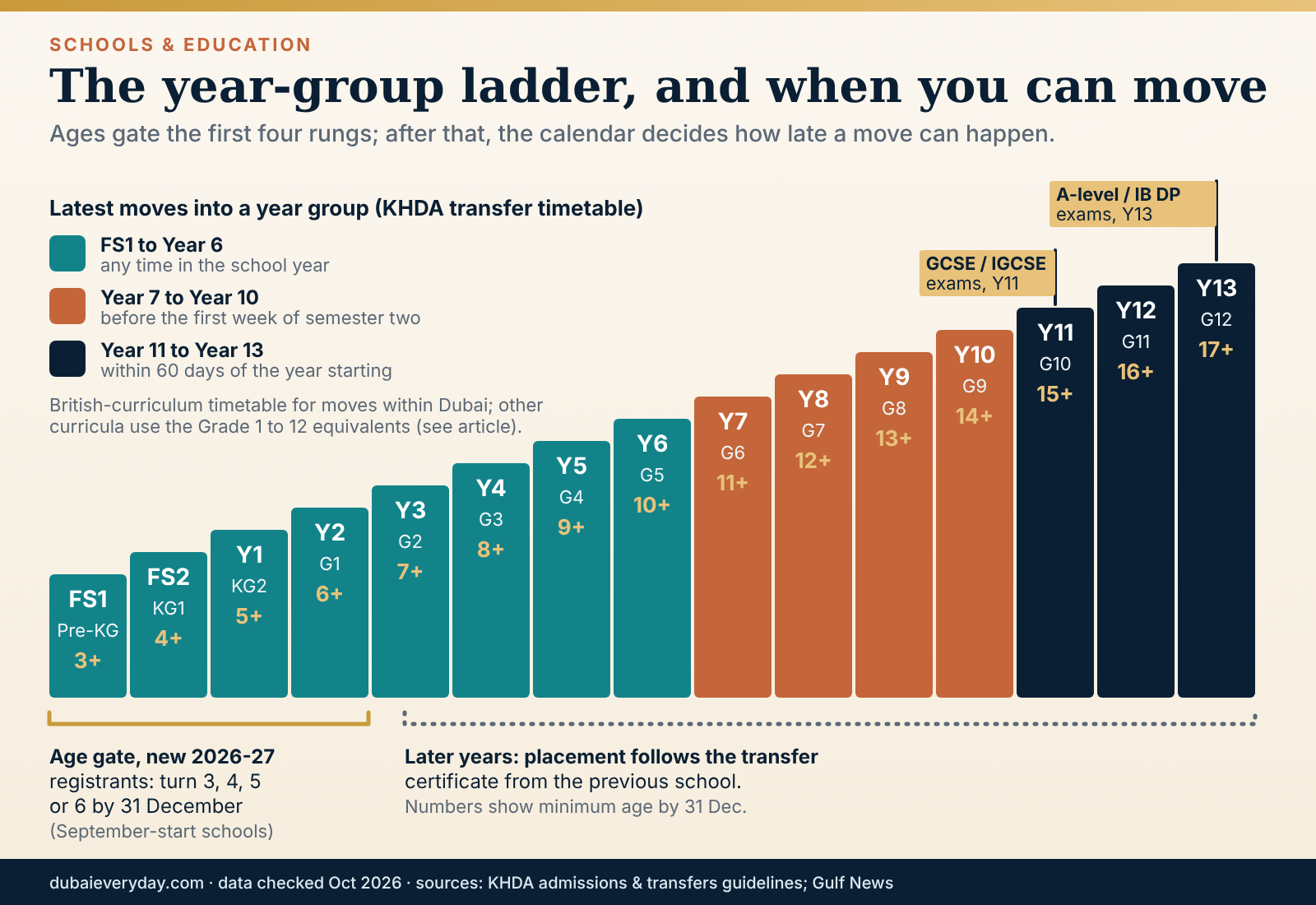
Many families do not arrive in August. Jobs start in March, contracts end in November, and a move from the UK or India rarely respects the school calendar. The schools Dubai regulates are more flexible about this than many parents expect, but the flexibility shrinks sharply as children approach exam years. The ladder below shows both halves of that: the age gate that applies to the first four year groups and the latest point in the year when a move into each stage can happen.
The transfer timetable between schools Dubai-wide
KHDA’s 2024 admissions and transfer guidance sets out how late in the school year a transfer between schools Dubai licenses can happen. For British-curriculum schools, which run 13 year groups, a move into FS1 to Year 6 is possible throughout the year. A move into Years 7 to 10 must happen before the first week of the second semester. A move into Years 11 to 13 must happen within 60 days of the school year starting, and must follow educational council policies.
For schools on other curricula, with 12 grades, the pattern is similar: Pre-KG to Grade 5 any time, Grades 6 to 9 before the second semester, and Grades 10 to 12 within 60 days. For moves from other emirates or from abroad, the guidance allows entry throughout the year for all curricula and ages, subject to educational council policies. In every case the receiving school must approve the move.
The translation for parents: a primary-age child can usually be placed at any point, a lower-secondary child has until roughly the end of the first semester, and a child entering Year 11, 12 or 13 effectively has to arrive at the start of the year. If you are moving a teenager in the exam years, an early autumn arrival is not a preference but a deadline.
Placement when you arrive from abroad
For children aged between Pre-KG and KG2, Gulf Business reports that age determines placement under the 2026-27 rules, regardless of the placement abroad, and children should be realigned to the UAE chart. From Grade 1 onward, a valid transfer certificate confirming completion of a higher grade can be the primary reference. If the overseas placement is more than one year ahead of Dubai’s chart, the school must notify KHDA and obtain exceptional-placement approval before admission.
A seven-year-old with no prior formal schooling may enter Grade 1 if they meet the UAE age requirements, and gaps are addressed through intervention. This is a significant point for families arriving from systems with a later starting age. Your child may be placed in a different year group from the one they would have joined at home, and the rules are designed to prevent bespoke deals. Ask the school which year group the chart implies before you tell your child.
Teenagers and exam years
The riskiest move is into the two-year exam courses. A child entering Year 10 or Year 11 in a British system, or Grade 9 to Grade 10 in other systems, arrives partway through a course whose content, exam board and coursework deadlines are already set. The questions that matter are about the course, not the school: which exam board, which subjects are offered, what has already been covered, and how the school will help a new arrival catch up.
Under the KHDA guidance, pupils in Grades 9 to 12 moving to a different curriculum need Ministry of Education approval. The 2026-27 placement framework notes that Grades 10 to 12 fall outside its scope because they depend on IGCSE, A-level, IB and AP programmes and exam board requirements, with senior placement following Ministry rules. If your teenager is switching curriculum, start the approval conversation with the school early.
Our reading for sixth-form arrivals: the two-year A-level or IB Diploma pathway is the hardest to enter late, and the places are scarce. If your move can be timed, an August arrival before Year 12 or Grade 11 is worth significant effort. If it cannot, ask the school whether a one-year pathway or a bridging plan is available, and be realistic about what a late entrant can cover.
September-start and April-start schools
Among schools Dubai-wide, those on the April-to-March calendar, mostly Indian, Pakistani and Bangladeshi curricula, have different intake points and different age cut-offs. The 2026-27 age rule applies 31 March to April-start schools. If you arrive in the autumn and want an April-start school, you may join mid-year. The 2024 guidance says children from KG1 to Grade 1 transferring between September and April schools are placed by the age-grade table alone, which can place a child in a different year group from the one they left.
The same point shapes a decision for families who may move between systems. A child who transfers between a September-start and an April-start school can experience a gap or an overlap in their year, and the year group may differ from the one on their last report. Ask the receiving school to state the year group in writing before you commit, and ask what happens at the next transition.
Leaving Dubai: records and certificates
The same guidance contains practical points for leavers. Schools must upload results for all year groups to KHDA, with promotion deadlines of 30 May for April-start schools and 31 July for August and September-start schools. Schools must keep digital copies of pupils’ work, projects and grades for up to two academic years after a pupil leaves, and must keep final grades digitally and permanently.
In practice: before you leave, request the transfer certificate, the last reports and the exam certificates, and ask what attestation the receiving country requires. Starting that in the term before the move avoids the situation where a signed form is waiting in an office while you are on another continent. If you are heading home, check whether the home system expects a specific exit grade or placement test.
A shortlist method for schools Dubai families compare, and the questions to ask
A long list of schools Dubai offers is easy to build and hard to cut. The method below is deliberately plain. It is our editorial framework, not a KHDA process, and the weightings are a starting point you should adjust.
- Fix the exit and the horizonWrite down the likely curriculum destination and how many years you expect to stay. This removes most of the long list before you open a directory.
- Set an all-in annual budgetUse tuition plus the extras for your own children, including transport, and decide the maximum for the oldest year group you will have.
- Set a commute budget in minutesChoose a one-way limit you can live with, then test routes at the real time of travel.
- Build a list of up to tenUse KHDA’s school information and the school websites to list the schools Dubai offers that match curriculum and area. Note each rating and the year of the inspection.
- Send the same question sheet to each schoolUse the fee, transport, support, assessment and availability questions from this page, and compare answers in one table.
- Visit three to fiveGo on a school day and note what you see and hear as much as what you are told. Take the child to the ones that are real contenders.
- Decide, then apply to a spreadRank your top choices, apply to three or four, and keep documents ready so you can accept an offer quickly.
A weighting to start from
If you want numbers, score each shortlisted school from one to five on these criteria and weight them. Our suggested starting weights follow, and you should change them if your situation differs. A family with a child who needs support will put the support criterion higher; a family on a tight budget will raise cost.
Fit with your exit route: 30%
Does the curriculum, the exam board and the school’s results pattern lead where you want to go?
Commute and daily logistics: 20%
Door-to-door time at the real hour, bus availability, and parent sanity.
All-in cost: 20%
Tuition plus extras for the whole family and for the oldest year group you will have.
Support and wellbeing: 15%
Learning support, EAL, pastoral care, and how the school treats children who are different.
Inspection evidence: 10%
The grade, its year and the written findings; weigh a new school’s lack of a grade here.
Everything else: 5%
Facilities, activities, community feel and how easy the school makes it to talk to a person.
What to look and ask for on a visit
Remember that you are researching a school, not being sold one, and that a school day is more informative than an open evening. Arrive early enough to watch drop-off. Notice how staff greet children and how the children talk to each other. Look at the work on display and whether it looks like it was written by children or prepared for visitors. Check the shade, water points and indoor space for the heat months.
- How does the school describe its weakest area, and what is it doing about it?
- What proportion of the current Year 6 or Year 11 stays on into the next phase?
- How many children are in the class my child will join, and how many classes per year group?
- How has the school changed since its last inspection, in leadership, staffing and results?
- How do you communicate with parents day to day, and who do I contact first about a problem?
- What would you do if my child did not settle in the first term?
A school that welcomes unscripted questions is usually confident in its answers. One that deflects the question about its weakest area is a different kind of signal. For a wider view of family life once the choice is made, the Dubai with kids guide covers family logistics, and the moving to Dubai guide covers the first month.
Four worked scenarios
These are hypothetical composites built to show the reasoning, not real families. Every number is either a published figure quoted earlier or an arithmetic example labelled as such. Use them as templates for your own spreadsheet, not as predictions.
Scenario one: a UK family arriving in January with two children
A family relocating from England has a child turning four in the spring and another in Year 5. They expect to stay three to five years and may return to the UK. The exit-first method points to a British-curriculum school among the schools Dubai offers. Year 5 is in the band where a transfer is possible at any point in the year, so a January start is workable.
The younger child is the issue. Under the 2026-27 rules, a first-time registrant for FS2 must turn four by 31 December of the year the school year begins, so the family must check the birth date against the cut-off, not the child’s apparent readiness. The fix is to apply to a school that can confirm the placement in writing and to ask what happens if the answer is FS1. The parents should also request attested transfer certificates now, because the older child’s records must arrive before the school registers them.
Scenario two: an Indian-curriculum family with a Grade 9 child
A family moving from India has a Grade 9 daughter and a Grade 4 son and expects to return in four years. They want to keep the board-exam route open, so they look at Indian-curriculum schools. The first discovery is the calendar: some of these schools start in April, while others follow the September pattern, and an autumn arrival could fall mid-year for the former.
For the daughter, a move into Grade 9 on the 12-grade timetable must happen before the first week of the second semester, and Grades 10 to 12 allow only 60 days from the start of the year. The family should ask each school the exact date the window closes and whether a bridging plan exists. For the son, any point in the year works. The family should also confirm the Grade 9 syllabus and board requirements in writing, because they are the biggest risk to her result.
Scenario three: a two-year secondment with children in Grade 3 and Grade 7
A US family on a two-year assignment has children in Grade 3 and Grade 7 and a clear return plan. The exit-first method points toward an American-curriculum school or an IB school that matches the home school’s grade structure. They do not need a long-term pathway, so the question is smoothness of return, not final qualifications.
Here the fee arithmetic helps. Using the published Outstanding-rated ranges as anchors, the American-curriculum school in that group charged AED 66,185 to 93,300 and the IB schools AED 44,616 to 89,889. If the employer pays an education allowance, the cap matters more than the average. The family should ask the employer how the allowance is calculated, then ask each school for the all-in annual cost for both children, transport included, and compare it with the cap.
Scenario four: a single parent on a tight budget
A parent with one child entering Year 2 needs a school with a low all-in cost and a commute under 25 minutes. The affordable segment is the right place to look for schools Dubai families on a budget can reach. KHDA’s May 2026 release says about 9,000 new affordable places arrived in 2025-26 and the segment serves about 230,000 students, so the search is not a narrow one.
Because the published fee ranges cover only the top-rated schools, this parent should not extrapolate from them. Instead, they should list five to eight schools within the commute budget, ask each for a full fee schedule including transport and uniform, and compare the totals. Applying to four schools at AED 500 to 1,000 each is a few thousand dirhams at most, and the parent should ask about refundability before paying. If the child has any learning needs, the parent should ask the support questions early.
Mistakes and red flags
The same errors recur across families new to Dubai’s school market. None is a disaster on its own; together they cost money, months and a lot of goodwill. These are the ones we would warn a friend about.
Seven errors that cost families time or money
Choosing among schools Dubai-wide by rating alone, when most ratings date from 2023-24 and say little about fit. Signing a lease before a school place, then discovering the commute budget is blown. Paying several non-refundable fees without reading refund terms. Assuming a nursery place guarantees a school place. Starting transfer-certificate attestation after arrival. Ignoring the exam-year deadlines and arriving in Year 11 in November. And comparing tuition lines instead of all-in totals.
An eighth deserves its own paragraph: treating the fee freeze as permanent. The 2026-27 decision covers one academic year. A family that budgets on the assumption that schools Dubai-wide will hold fees flat for a decade is making a planning error, however welcome the pause.
Red flags when dealing with a school
- The school cannot or will not send a written fee schedule that matches its published one.
- Pressure to pay a deposit immediately, with refund terms left vague.
- Claims about “guaranteed” places, results or ratings that you cannot verify on KHDA’s records.
- Agents or portals that charge you for introductions or present an inclusion fee as unavoidable.
- Vague answers about support for children who need it, or about what happens if you leave mid-term.
- A rating quoted without a year, or a “ranking” that KHDA does not publish.
If a problem persists after you have raised it with the school in writing, the regulator is the next step, and its website explains the current route for parent concerns. The Dubai legal basics guide shows where to verify rules in general.
The short version: schools Dubai parents can stand behind
If you remember five things, make them these. Pick the exit before the school: the curriculum is a pipeline, and the schools Dubai offers cover every major one. Set two budgets, one in dirhams for the all-in annual cost and one in minutes for the school run, and test both against real quotes and real roads.
Treat inspection grades as dated evidence. Most come from the 2023-24 round, and the schools Dubai opened this year have none yet. Respect the rules that cannot be negotiated, which are the 31 December age gate for first-time registrants, the transfer windows for exam years and the paperwork chain for transfer certificates. And ask for everything in writing, from fee schedules to refund terms to bus routes.
None of this requires luck. It requires sequence and a spreadsheet. A family that works through it, applies to three or four schools and keeps its documents ready will usually land a sensible place, even in a market as busy as this one. The schools Dubai families trust most are the ones that answer plain questions plainly, so let that be your last filter.
FAQ
Which are the best schools Dubai parents can choose, and is there an official ranking?
KHDA does not publish a ranking. It publishes categories: Outstanding, Very Good, Good, Acceptable and Weak. The latest full round (2023-24) rated 23 schools Outstanding out of about 209 counted, and a school’s grade is not ranked against another’s. The best school for you is the one that fits your exit route, commute and budget. Use the shortlist method on this page, and treat any list that calls itself a ranking as someone’s editorial judgement.
How much do private schools Dubai-wide cost?
There is no official market average we could read. For the 23 Outstanding-rated schools, 2026-27 annual tuition ranged from AED 29,488 to AED 111,799 depending on the school and year group. Extras such as buses, uniforms, books and registration come on top; commercial guides put buses at roughly AED 5,000 to 12,000 a year. Ask each school for its own current fee schedule and confirm what the total includes.
Are school fees going up in 2026-27?
No. On 22 May 2026 KHDA confirmed there would be no fee increase for private schools Dubai-wide for 2026-27, under the directives of Sheikh Hamdan bin Mohammed. The Education Cost Index for 2025-26 had been 2.35%. The announcement concerns approved tuition, so ask your school whether other charges are also unchanged. We found no statement on fees for 2027-28, so do not assume the freeze continues.
What curriculum is best for expat children in Dubai?
Among schools Dubai-wide there is no best curriculum, only a best fit for your child’s next destination. British schools teach 37% of pupils, Indian 26%, American 14% and IB 7%. If you expect a UK university, choose British; a return to India, Indian-curriculum; US or Canada, American; several moves, IB. Check the exam board and subjects offered, not just the label, and consider the year groups where switching is harder.
What age can my child start at schools Dubai-wide in 2026-27?
For children registering in Dubai’s system for the first time at September-start schools, the child must reach the required age by 31 December: three for FS1, four for FS2, five for Year 1 and six for Year 2. April-start schools use 31 March. The rule does not affect children already enrolled or transferring between Dubai schools. A one-off flexibility applies to some children born from 1 September to 31 December 2022 who are not in any setting.
Can expat children attend government schools in Dubai?
Only in narrow circumstances. A UAE government page last updated in September 2023 describes admission for expatriates to grades 2 to 12 where a parent works for a government, semi-government or local entity, with scores of at least 85% in Arabic, English and maths, valid residence visas, AED 6,000 tuition and a 20% expatriate cap. That is a historical snapshot, so confirm current conditions with the Ministry of Education.
Do KHDA ratings still matter if inspections were paused?
They matter as historical evidence, with a date. Full inspections of schools Dubai-wide were paused from June 2024, and most published ratings are from 2023-24. For 2026-27 KHDA has described a two-tier model of comprehensive inspections and shorter monitoring visits, with no more than 24 hours’ notice. Check the year on any rating, read the written report, and ask the school what has changed since.
When should I apply to schools Dubai-wide for a September 2027 place?
Advisory guides commonly say applications for the next September open around October and recommend applying ten to twelve months ahead, particularly for entry points such as FS1, Year 1, Year 7 and Year 12. That is a general pattern from commercial sources, not a KHDA rule. Ask each school for its own dates, apply to three or four, and check refund terms before paying any deposit.
What documents do schools Dubai-wide ask for when I enrol my child?
Typically passports for the child and parents, residence visas or proof of a pending visa, an Emirates ID once issued, recent school reports, immunisation records and a transfer certificate. KHDA’s guidance makes a transfer certificate mandatory for children from UAE schools and for Grade 2 or Year 3 and above from abroad, with attestation requirements that depend on the country. Each school may ask for more.
Can my child start school before the visa and Emirates ID arrive?
Often yes. KHDA’s 2024 guidance allows a school to admit a child with a visa or Emirates ID still in process, and says the school has up to one academic year to upload them, with monthly follow-up. Do not let it drift: provide each document as it arrives and keep proof of the application. Confirm the school’s own policy before you rely on this.
Is school transport included in the fees?
Usually not at schools Dubai-wide. Transport is normally a separate contract, and commercial guides quote roughly AED 5,000 to 12,000 a year per child depending on distance. RTA rules require trained drivers and bus attendants and set out safety duties for operators. Ask the school who operates the bus, the route length from your address, whether a seat is guaranteed and what the cancellation terms are.
What if my child has special educational needs?
Dubai’s inclusion framework, launched in 2017, says schools Dubai-wide may not refuse admission to students with special needs, and requires that costs to families be reasonable. A school that declines must submit a non-admission form to KHDA. Disclose needs early, ask what support is included and what is billed, and get answers in writing. This is general information; consult a qualified professional about your child.
Can I move my child mid-year?
Usually yes in primary years, with limits later. KHDA’s 2024 timetable allows moves between schools Dubai-wide: into FS1 to Year 6 any time, Years 7 to 10 before the second semester starts, and Years 11 to 13 only within 60 days of the year beginning. All transfers need the receiving school’s approval. Moves from abroad may happen all year, subject to educational council policies and the placement rules.
Related reading
Sources and further reading (19 links)
- Dubai Media Office: KHDA confirms no fee increase for private schools — 2026-27 fee freeze, 17 curricula, affordable places, ECC support measures
- Dubai Media Office: Dubai’s private school sector (2024-25) — school and student counts, nationalities, curriculum shares
- UAE Government Portal: School fees — fee regulation, ECI 2.35% for 2025-26
- Dubai.ae: Schools rating — rating categories and DSIB
- UAE Government Portal: Admission of expatriates in government schools — conditions
- Gulf News: Dubai schools 2026-27, the four major rules — age cut-off, three-year calendar, inspection model
- Gulf Business: KHDA rolls out new rules for age limits and admissions — placement rules for 2026-27
- Gulf News: Dubai schools to add 18,000 affordable seats as student numbers climb — 406,563 enrolment
- Khaleej Times: Dubai to open 26 new private education institutions in 2026-27 — new schools and ECCs
- Khaleej Times: Dubai school fees 2026-27 at Outstanding schools — fee ranges by curriculum
- Khaleej Times: Total fees for all 23 Outstanding institutions — school locations and averages
- Khaleej Times: Dubai schools, new KHDA ratings and what parents should know — 2023-24 distribution, inspection pause
- Khaleej Times: RTA reminder on school bus safety — operator duties
- Khaleej Times: Parents hail KHDA’s new inclusive policy — 2017 framework details
- Khaleej Times: Dubai schools hike fees, how parents manage — 2025 fee increases
- KHDA Updated Guidelines for Admissions and Transfers (hosted by a school) — documents, transfer timetable, registration
- KHDA: Data and statistics — the official dataset; our reader could not open it, so figures above come from the releases listed
- iSchoolAdvisor: International school admissions in Dubai — commercial guide, used only for indicative timelines and costs
- Takween Advisory: Dubai schools guide — commercial blog, used only for indicative ranges
Update log: 29 October 2026 — first publication; all facts re-checked against the sources above. Next review due: January 2027 (admissions season), or sooner if KHDA publishes new inspection results or a fee decision for 2027-28. Corrections welcome. This page gives general information, not individual educational, legal or financial advice; confirm fees, dates and rules with the school and KHDA before you pay or decide.
About DubaiEveryday and this guide
DubaiEveryday.com is an independent editorial project that publishes practical, research-based guides to everyday life in Dubai: where to live, what things cost, how the rules work and how to get around. This page was written and edited by the DubaiEveryday editorial team. It is not signed by a named expert, doctor, lawyer or adviser, and we do not claim first-hand testing of a venue, clinic or service unless the page says so.
Each guide is built from official sources such as government and regulator pages, operator websites and established news outlets, cross-checked where we can. When we could not confirm something, we say so in the text, and examples that use made-up numbers are labelled as illustrations. Mentions are editorial choices, not paid placements, and a link is not an endorsement.
Dubai changes quickly. If you spot something that is out of date or wrong, please tell us through the contact options on DubaiEveryday.com and we will check it and correct the page.