

Cats in Dubai do best as indoor cats in a secured, air-conditioned home with a current microchip record. This guide covers indoor living, balcony and window safety, vet care, summer heat, boarding and moving, using official sources read on 29 October 2026.
Picture a young kitten, a sunny balcony door and a landlord who has never been asked about pets. Cats in Dubai have an easy life on paper, with air-conditioning everywhere and no winter to survive, but the flat itself is where most of the risk sits. A balcony door left open for a minute, a window screen that gives way, a carrier carried through a car park in July: none of these is exotic, and all of them are avoidable.
This guide pulls together what the municipality, federal government, developers and veterinary organisations actually say, then adds our own reasoning where the sources run out. You will find the registration basics, the vet question, the summer plan, boarding, moving and the costs that can and cannot be pinned down. Read it before you adopt, or before the next heat spike, and the whole thing becomes a checklist instead of a worry.
Cats in Dubai are best kept as indoor cats, and the city makes that easier than most places: every home is air-conditioned and the outdoors is punishing for about half the year. The law asks little that is specific to cats. Dubai Municipality expects a microchip, vaccination (it names rabies and FVRCP for cats) and a registration record, and your landlord or developer can add stricter rules of its own.
The real risks are practical. An open balcony door or a loose window screen causes falls from height. Summer heat punishes any cat caught outside, in a car park or in a car. A building can also change its pet rules faster than you can change flats, so permission belongs in writing.
If you are deciding whether to get a cat, check the lease and building rules first, then budget for registration and a vet routine. If you already share your home with cats in Dubai, the three jobs that matter most are balcony and window security, a summer plan for heat and travel, and a record that matches the chip. The mechanics of registration sit in our pet registration guide.
This is a desk-research guide. DubaiEveryday.com has not adopted, boarded, flown or treated any cat for this page, and nothing here describes a personal experience. Where a paragraph reads like lived detail, it is reasoning from the sources, and we say so.
Facts come from pages read on 29 October 2026: Dubai Municipality’s veterinary release, Veterinary Services Section page and grooming-salon requirements, the UAE government portal, the United States animal-health agency’s UAE import page, Canada’s export form, airline animal rules, a developer’s published pet guidelines, a taxi terms page and veterinary welfare organisations. News explainers and a property portal are used for context only and are labelled as secondary, with their age.
Anything we could not read is left out or hedged, including the federal ministry’s own import-permit page and every market price. No clinic, boarder or seller is recommended by name, and inclusion was not paid for. This is general information, not veterinary or legal advice; if a cat is unwell, call a licensed vet.
Cats in Dubai: who decides what
Owning cats in Dubai involves three decision-makers, and only one of them is a government. Federal law decides which animals a private person may keep at all. Dubai Municipality registers pets, vaccinates, licenses vets and handles strays. Your landlord, owners’ association or master developer then writes the rules that you meet every day: lifts, balconies, common areas, numbers. The third layer is the one that ends tenancies, so it comes first in any plan.
On the federal side, the UAE government portal says private ownership of dangerous and wild animals is banned, and Dubai Municipality’s own FAQ says only domestic companion animals may be raised at home. An ordinary domestic cat sits comfortably inside that. The dog-specific parts of the federal wording (a licence, a leash and collar) are about dogs. We found no cat licence and no federal leash rule for cats in Dubai, and no published cap on how many cats a household may keep.
What the municipality expects of cats in Dubai
Dubai Municipality says owners can register cats and dogs, microchip them and update records, and it names the vaccines it administers: rabies plus FVRCP for cats, which covers feline herpesvirus, calicivirus and panleukopenia. In the first half of 2026 it reported roughly 4,100 pets registered and 6,585 cat and dog vaccinations through its own channels. Private clinics also chip and vaccinate, so those figures understate the population. They show scale, not the number of cats in Dubai.
What this page covers, and what it leaves to others
This page is about living with cats in Dubai: the home, the vet, the summer, the trips. Registration steps, documents and renewals are covered in depth in the pet registration guide. The all-animals overview, with rules that apply to every species, is in the pet ownership guide. If a dog shares your home, the guide to dogs in Dubai covers walks, parks and breed rules, which hardly touch cats.
Indoor living for cats in Dubai: what the flat has to provide
Most cats in Dubai live in apartments, and the practical question is not whether a flat is allowed but whether it is enough. The answer depends less on square metres than on what is inside them. A cat needs places to climb, hide, scratch, eat, drink and use a tray, arranged so that one cat or one visitor cannot block them all.
Why indoors is the default for cats in Dubai
Several local facts push cats in Dubai the same way. Mean afternoon highs run above 39 degrees Celsius from June to September. Traffic is heavy around most residential areas. A developer’s published guidelines for one large group of communities state that cats must stay within the owner’s property. And a Gulf News report from 2018 quotes a cat-rescue founder urging residents to keep cats inside or in an enclosure because so many pets are lost, stolen or killed; it is old and secondary, but the advice has not aged badly.
Indoor-only does not mean a poor life, even for cats in Dubai. The UK charity PDSA says many cats can live happy, healthy indoor lives if their environment meets their needs, and lists busy roads, illness and theft risk among the reasons owners choose it. The risk it names is the loss of climbing, hunting and exploring. In a flat, you have to supply those on purpose.
What indoor cats in Dubai need
PDSA’s practical advice is a useful baseline, and it is easy to follow in a rental because most of it is furniture. Provide two of each key resource, including litter trays and water, so a cat never feels it might lose access. Keep the litter tray well away from food. In a multi-cat home, aim for one more of each resource than you have cats. Add a cat tree for climbing and scratching, and a window perch so the cat can watch outside.
Weight and boredom are the quiet problems for indoor cats in Dubai. PDSA notes that indoor cats can gain weight and suggests play before meals, puzzle feeders and varied toys. Its signs of boredom or stress are weight gain, furniture scratching and toileting outside the tray. If the cat starts doing these things, treat it as information about the home before you treat it as bad behaviour.
Our reading for cats in small Dubai flats
Studios and one-bedroom units are the commonest homes for new arrivals, so here is our reasoning, not a rule. Usable vertical space beats floor area: a tall tree plus a shelf or two by a window gives a single cat more territory than an empty living room. Place the tray and the food in different rooms, even if that means the tray goes in a bathroom.
And think about glass. A perch on a west-facing window in an air-conditioned flat can sit in direct sun for hours in summer, so shade it or place it where the afternoon sun does not reach.
Outdoor time for cats in Dubai without the fall: a ladder of access
Some cats in Dubai want more than a window. The sensible response is a ladder, where each rung adds outdoor experience and adds a specific risk, and you only climb as high as the home and the cat allow. The picture shows our ranking for Dubai. Rungs three and four need the building’s permission, and anything outdoors between June and September needs to be short, shaded or skipped.
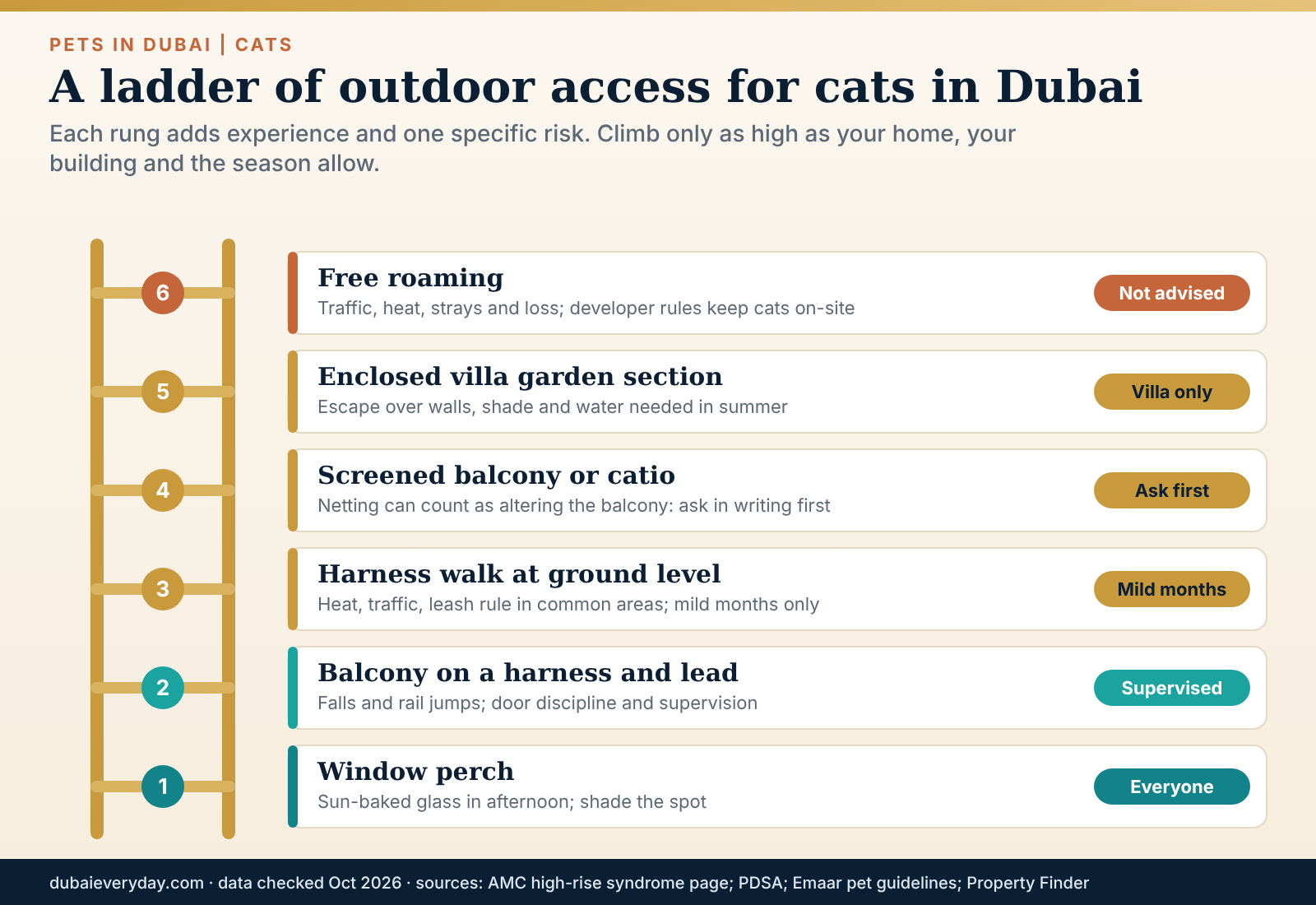
Harness walking suits only some cats in Dubai, and only in the mild months, and common areas in managed communities require pets to be on a leash, which in practice means a harness and lead for a cat. A screened enclosure, sometimes called a catio, is the middle path, but on an apartment balcony it can count as altering the structure, which is why the next section tells you to ask first. For villa owners, an enclosed garden section is the most realistic route to safe outdoor time.
Apartment safety for cats in Dubai: balconies, windows, doors and hazards
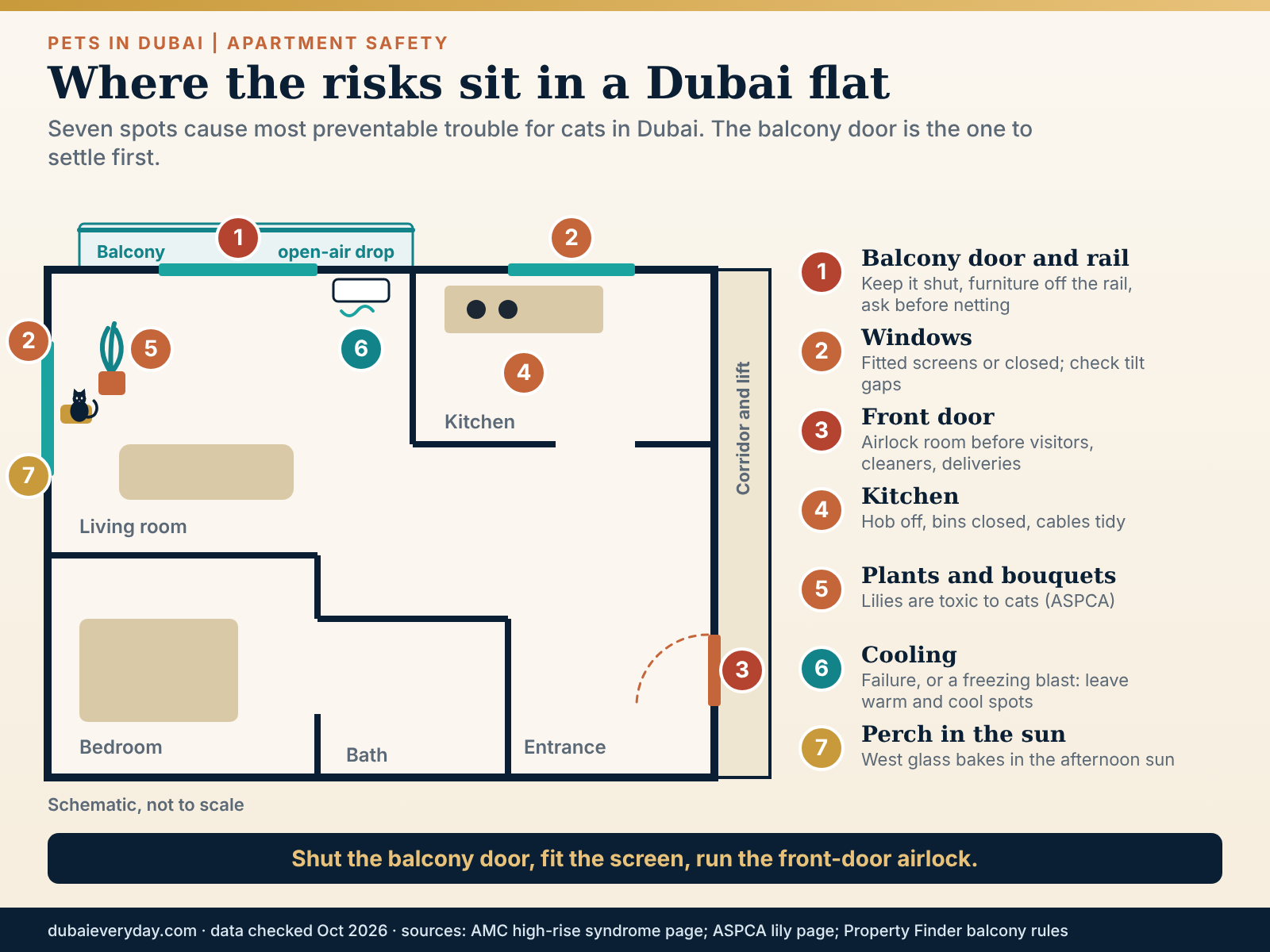
High-rise living is where cats in Dubai meet their most preventable injuries. For cats in Dubai the risk is not exotic. It is a cat on a balcony rail, a window with a loose screen, or a door held open for a delivery. The picture below maps the usual trouble spots in a typical flat, and the sections after it deal with each in turn.
The balcony: what the evidence says about falls
Veterinary hospitals have a name for the injury pattern: high-rise syndrome. The Animal Medical Center in New York says cats fall when a window is open too wide, when they push through a loose screen, or when a noise startles them from a sill. Kittens and young cats fall more often because of inexperience. Typical injuries are chest and lung trauma, head and facial injuries, broken limbs and abdominal bleeding.
The same hospital reports that, in a 1980s review, about 90 percent of 132 fallen cats survived, but many had serious injuries. Do not read that as reassurance. It describes cats that reached a clinic, in New York, not Dubai, and survival is not the same as an uninjured cat. The hospital’s advice is simple: keep screens fitted, close windows that have none, keep cats off open balconies, keep balcony doors shut, and do not feed birds on the balcony.
Treat every balcony door and every window without a fitted screen as closed to the cat, always, including when you are at home. If a cat does fall, go to a vet emergency service at once even if it looks fine; the hospital notes that some serious injuries are not visible and that early assessment improves recovery.
Balcony rules for cats in Dubai buildings
The second problem is what you are allowed to do about it. A property portal summarising Dubai Municipality guidance says balconies and slabs above two metres must have protective grills or railings, that climbable objects and projections should not sit near the railing, and that altering the balcony structure with dividers, wires or nets needs the authorities’ consent. It lists fines of AED 500 to AED 1,500 from local authorities, and developers can add their own. That is a secondary source, and it does not mention cats.
Our reading: a cat net or mesh screen fixed to a balcony is likely to count as an alteration, so ask the landlord and the building manager in writing before you buy anything. Ask for the answer by email. Some buildings have approved designs; some prohibit anything visible from outside; some have never been asked. Until you have a yes, the safe plan is a closed door, a supervised balcony only if the cat is on a lead, and furniture moved away from the rail so there is no step up.
Windows, doors and the escape dash
Many Dubai flats keep windows shut because of the cooling, which helps keep cats in Dubai off the sill. Check anyway: which windows open, how far, and whether a screen is fitted and firmly seated. A tilt window with a gap a cat can squeeze through is as dangerous as an open one. Do not rely on a friction-fit screen that a cat can push; the hospital mentions loose screens specifically.
Front doors cause the other common loss: the cat that slips out into a corridor and finds the stairwell or lift lobby. Cleaners, maintenance staff, AC technicians and delivery drivers all open the door. Make an airlock a habit: shut the cat in a room before any visit. If you use a home-cleaning service, tell the cleaners about the cat before the first booking and agree where the cat will be; the cleaning services guide covers how to brief and check a provider.
Hazards inside the flat
Lilies are the best-known plant hazard for cats in Dubai homes, where bouquets are a common gift. The ASPCA lists lilies as toxic to cats, with kidney failure as the clinical sign it names, and says to contact a vet or poison-control service as soon as possible. Bouquets are a common gift, so tell visitors, and ask your vet about any other plant, diffuser or cleaning product you use regularly. We are not giving a toxin list, because we could not verify one from a veterinary source for this page.
Kitchen and cables come next. Keep hobs off when you are not in the room, keep bins closed, and tidy loose charging cables and blind cords that a young cat can chew or tangle in. Apartment buildings also schedule pest-control visits. Ask the building or provider what product is used, and ask your vet when the cat can return to a treated room, rather than guessing.
Carpets and sofas take cat damage in a different way: scratching, hairballs and the occasional accident. A scratching post placed beside the favourite sofa arm solves most of it. If a stain does happen, our sofa cleaning guide and carpet cleaning guide explain what professional methods can and cannot do, which is worth knowing before a move-out inspection.
Cooling that cats in Dubai can live with
Air-conditioning is part of the safety system here, and it has two failure modes. One is no cooling at all: a tripped breaker, a building fault or a power-related shutdown while you are at work. The other is cooling set so cold that a cat has no warm spot.
Leave a choice of surfaces, such as a shaded bed, a cool tile corner and a blanket, rather than setting one temperature for the whole flat. If you are setting up a new rental, the home setup guide and the DEWA move-in guide explain how cooling and utilities get switched on, which affects when a flat is actually liveable for a cat.
Getting a cat in Dubai: adoption and other routes
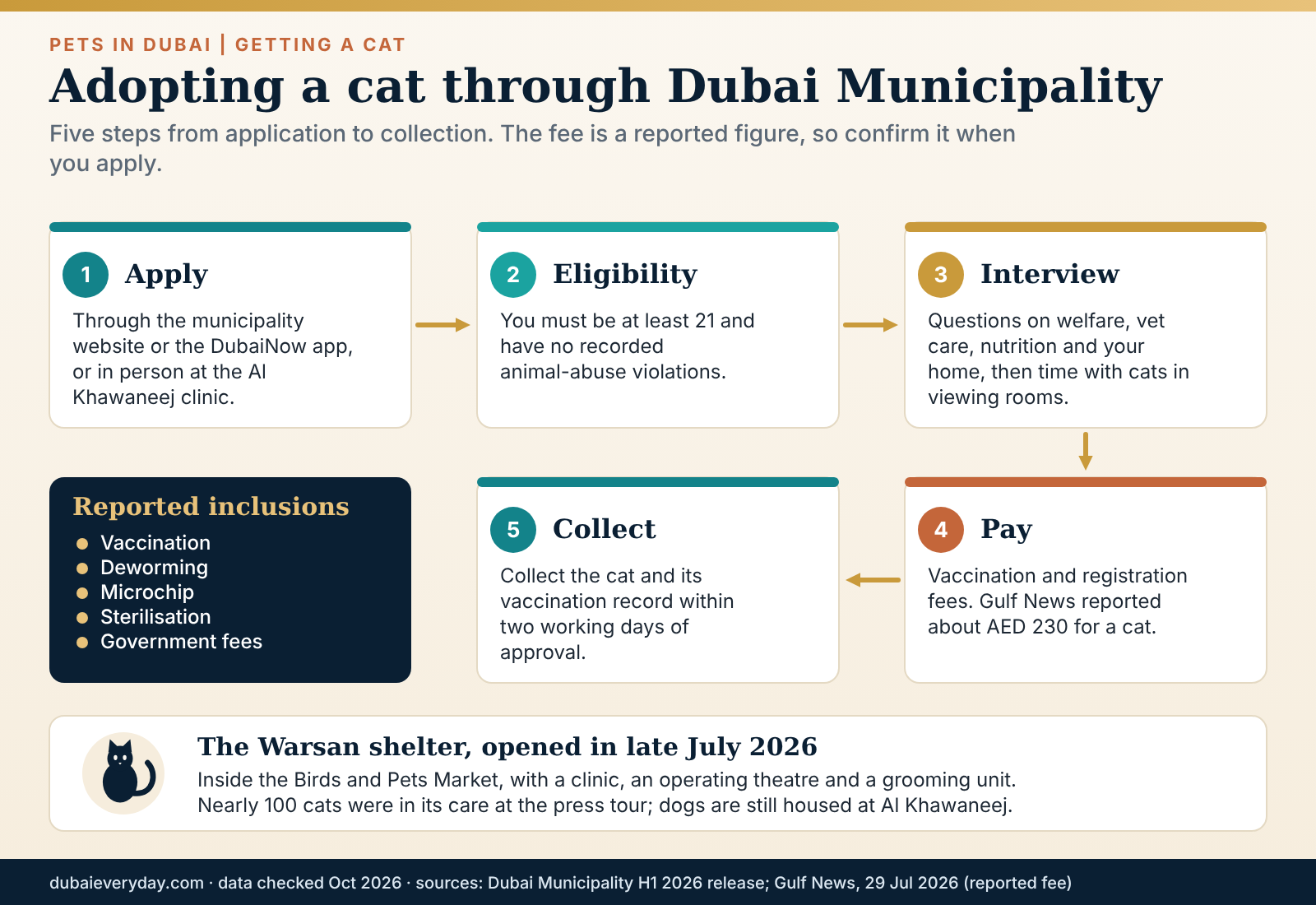
The cleanest route to vaccinated, microchipped and neutered cats in Dubai is the one run by the municipality, and it was expanded this year. Dubai Municipality opened an integrated pet shelter in Warsan, inside the Birds and Pets Market, in late July 2026, with a clinic, an operating theatre and grooming facilities. Dogs are still housed at the first shelter at Al Khawaneej Veterinary Clinic, according to Gulf News, which counted nearly 100 cats in the new building at the time of its tour.
How municipal adoption works
Applications go through the municipality’s website or the DubaiNow app, or in person at the Al Khawaneej clinic. Adopters must be at least 21 and have no recorded animal-abuse violations. According to Gulf News, applicants are interviewed about animal welfare, veterinary care, nutrition and whether the home is suitable, and can spend time with animals in viewing rooms. After approval, the municipality’s release says you pay the vaccination and registration fees and collect the animal and its vaccination record within two working days.
Gulf News reported the cat adoption fee as about AED 230 (roughly USD 63 at the 3.6725 peg), covering vaccination, deworming, microchipping, sterilisation and associated government fees. Treat that as the best available figure, not an official tariff; the municipality’s release does not state it. If it holds, that bundles several separate vet jobs into one payment. We did not verify what private clinics charge for each of them, so we cannot say how it compares.
Other ways to find cats in Dubai, and what to ask
Private rescues, breeders, pet shops and online sellers all offer cats in Dubai. We could not verify a licensing regime for each, so the checks fall to you. Ask to see vaccination records and the chip number, scan the chip at a vet before you pay, and get the handover in writing. For a kitten, ask to see the mother or the litter, and be cautious about very young animals.
One local check is useful. Importing a cat requires a permit, cargo transport and a minimum age of 15 weeks according to the US agency’s UAE page, so a “just arrived from abroad” kitten that looks younger is a red flag. Flat-faced breeds such as Persians are riskier in Dubai summers, because a veterinary service lists flat-faced cats among those at higher risk of heatstroke. That is a reason to think about breed, not a reason to avoid a cat you love.
Kitten, adult or stray: which cats in Dubai suit a flat
For a flat with a balcony, our judgement is that an adult cat is often the easier first choice. The hospital data above says young cats fall more, and kittens test every window. Adults are also easier to read, because their temperament is already visible. A stray you have taken in needs a vet check and a chip scan first; it may already be microchipped, and it may be a neutered community cat, in which case ask neighbours before treating it as abandoned.
Microchip, vaccines and registration for cats in Dubai
Registration for cats in Dubai follows the same municipal system as for dogs, with a different vaccine pair. The sequence matters more than the detail: chip first, rabies record second, municipal record third. The chip number is the thread that ties everything together, so it must be written identically on every document.
The version for cats in Dubai
Dubai Municipality names rabies and FVRCP as the vaccines it administers to cats. Rabies is the one with legal and travel weight, because it drives the record and the export paperwork. A developer’s published pet guidelines for one large community group say cats must be microchipped and vaccinated annually under municipal rules, and encourage spaying or neutering and an identification tag. Indoor cats in Dubai are not exempt: the record is what proves ownership if a cat bolts, and it is what a boarder or airline will ask for.
Gulf News, in an explainer updated in September 2024, describes the online route as a UAE Pass login, a “Register Pets and Farm Animals” service, a clinic appointment and a fee of AED 10 for registration plus AED 20 for a knowledge and innovation fee, both subject to VAT. Our calculation: AED 30 plus 5 percent VAT is AED 31.50, about USD 8.60. An older summary used a different structure, so confirm the fee at the time of your visit. The step-by-step version is in the pet registration guide.
What to keep in one folder
- The chip certificate or implant record, with the 15-digit number as the clinic wrote it
- The vaccination card, with rabies date and next-due date
- The municipal registration reference and tag details
- Two clear photos of the cat, front and side, for lost-pet posters and for forms
- The adoption or purchase paperwork, with the seller’s name and contact
A chip is not a tracker; it is an identifier that a vet or shelter reads with a scanner. If your cat goes missing, call Dubai Municipality on 800 900 and your own vet, and keep the chip number to hand. The municipality’s July 2026 shelter announcement says it reunites lost pets with owners after verifying identity and ownership, which is the practical reason the record has to match you.
Vet care for cats in Dubai: clinics, emergencies and the first year
Vets for cats in Dubai are licensed by the municipality, which reported 176 licensed veterinary establishments in July 2026: 103 comprehensive clinics, 67 primary clinics, 2 specialist clinics, 3 comprehensive hospitals and 1 specialist hospital. Our calculation: 103 of 176 is 58.5 percent, and only 4 of 176 are hospitals. We read the categories as a rough ladder of scope, and the municipality’s detailed requirement documents are Arabic-only, so ask any clinic what its licence covers before relying on it for surgery or overnight care.
Choosing a vet for cats in Dubai without a ranking
We do not rank vets here, because no official source ranks them and we did not visit any. A sensible choice rests on questions you can check. Is the clinic licensed in the category you need? Do vets there see cats routinely, or mostly dogs? Who answers out of hours, and where do emergencies go? Do you receive digital copies of records, with the chip number on each page? Does the clinic quote before treatment?
Municipal clinics exist at Al Khawaneej, Al Lisaili and Hatta. For pet clinics at Al Khawaneej and Hatta, the municipality lists Sunday to Thursday 07:30 to 14:30 and Friday 08:00 to 11:30, with requests made through its website. That is a daytime service, so most working owners will lean on a private clinic with evening hours. Our calculation: the listed municipal pet-clinic hours add up to 38.5 hours a week.
Your first year with cats in Dubai, in outline
A vet sets the schedule, and we are not giving a clinical timetable. What can be said from official rules is a set of fixed points. Rabies vaccination is not accepted for import before the cat is 12 weeks old, and the record needs the cat microchipped. Municipally adopted cats come vaccinated, dewormed, chipped and sterilised, so the first-year to-do list shrinks. For other cats, plan the chip, vaccines, a neutering decision and a parasite-control plan with the vet in the first weeks.
Neutering deserves a sentence of its own. A rescue founder quoted in 2018 noted that unneutered cats roam in search of mates and that one female can have several litters a year, and the municipality’s own shelter runs a trap-neuter-return programme for strays, which tells you where it sees the problem. For household cats in Dubai, neutering also reduces the pull to bolt through a door. Timing and technique are for your vet.
Emergencies for cats in Dubai, and getting there
Know three things before the night you need them: which clinic is open overnight now, how long it takes by car, and what its call-ahead process is. We did not verify any clinic’s 24-hour status, so ask. If you do not drive, remember that the Roads and Transport Authority’s taxi terms state that you cannot bring a pet on board. We found no RTA statement on cats on the Metro, buses or trams, so do not assume. A friend with a car, a private pet-transport service (unverified here) or a clinic that offers collection are the realistic options.
Insurance for cats in Dubai is a gap in our research: we could not verify which insurers sell pet cover, on what terms. If you are offered a policy, read the exclusions on pre-existing conditions and the waiting periods before you pay.
Heat: keeping cats in Dubai safe through summer
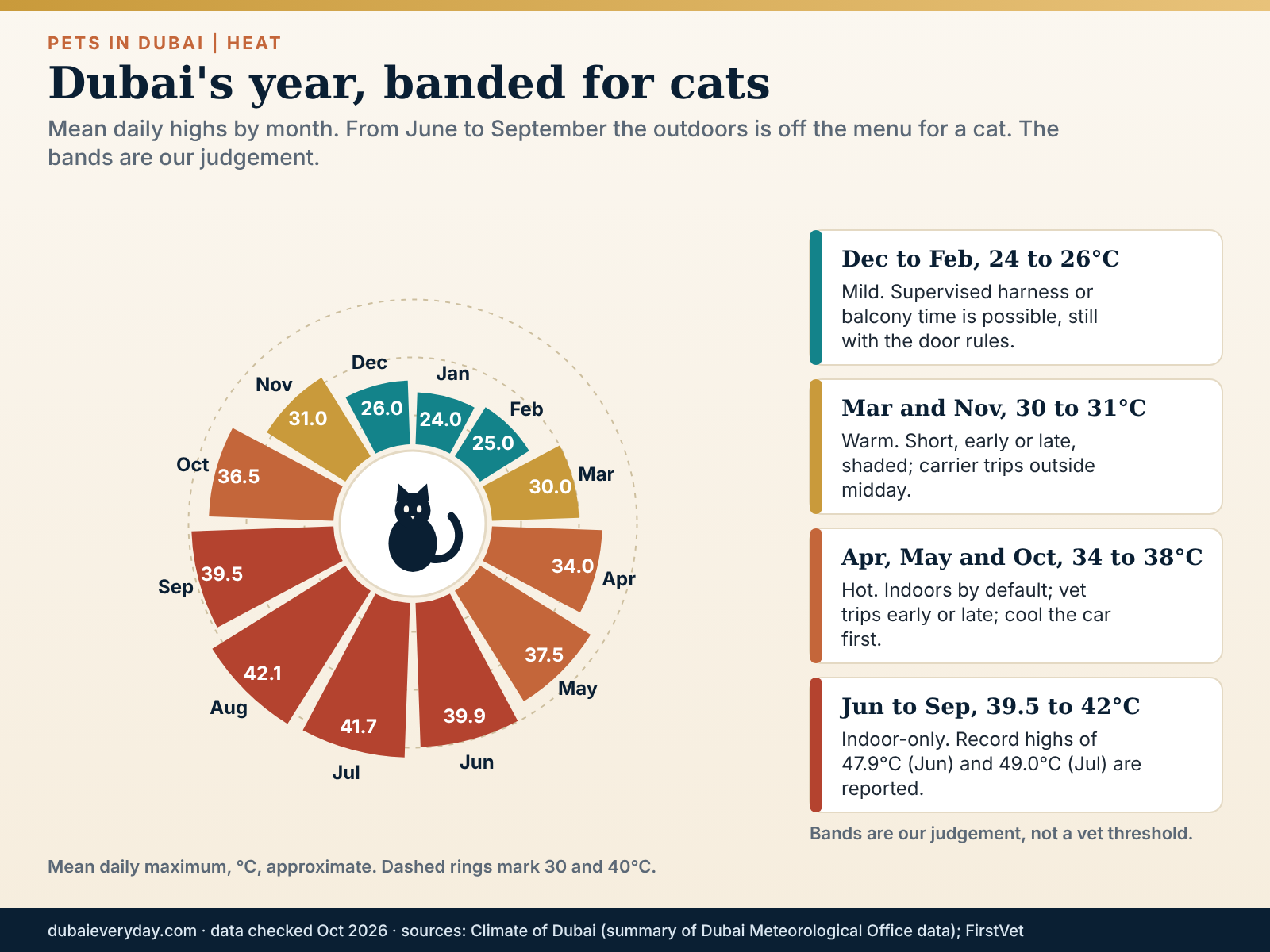
Heat shapes the whole year for cats in Dubai, even though most of them never leave an air-conditioned room. The numbers are stark. Mean daily maximums run from about 24 degrees Celsius in January to 42 degrees in August, with record highs of 47.9 in June and 49.0 in July. Those figures come from a secondary summary of Dubai Meteorological Office data, so treat the monthly values as approximate.
Where the heat actually reaches cats in Dubai
Even indoors, cats in Dubai meet heat at four moments, and each can be managed. The first is the carry from the lift to the car, which can be a couple of minutes through a hot car park. The second is the car itself. The third is a sun-baked balcony or window perch. The fourth is a cooling failure while no one is home.
The FirstVet service says a cat’s body temperature above 42 degrees can lead to death, that a UK summer car can reach 56 degrees inside, and that a cat can die of heat illness in as little as 15 minutes. If that is a UK car, a Dubai car in July is no gentler.
Our rules follow from that. Never leave a cat in a parked car, even with the engine running and the cooling on, because cooling can fail and a locked car is a trap. Cool the car before the carrier goes in, cover the carrier so the sun does not heat it directly, and keep the carry as short as the layout allows. From June to September, go to the vet in the early morning or late evening for routine visits, and book a time that minimises time in the car park.
A plan for cooling failure
Cooling is the sort of system you only notice when it stops. Give a neighbour or a building contact your number and a key or access card, and know the building’s emergency line. A cheap room thermometer with an alert, or a smart plug and sensor that report to your phone, turns a silent failure into a message; those need a working connection, and the home internet guide explains how building availability and routers behave. If you ever have to evacuate a hot flat, the carrier and the records folder should be by the door.
Expect a higher DEWA bill if you keep the cooling running while you travel; the DEWA move-in guide explains how activation and deposits work, which helps you budget. Setting the flat very warm to save money is a false economy for a cat. A moderate setting with a sitter who checks is safer than a warm flat and a hope.
Heatstroke: signs and first steps for cats in Dubai
FirstVet lists these signs: panting with a dark red tongue, very pale or dark red gums, lethargy or wobbliness, vomiting or diarrhoea, difficulty breathing, collapse, seizures and loss of consciousness. Cats at higher risk are flat-faced breeds, elderly cats and kittens, overweight cats, thick-coated or long-haired cats and cats with heart or lung disease.
Move the cat to a cool, quiet place, offer fresh water without forcing it, cool with cool (not iced) water and wet towels on the belly, armpits and paw pads, and call a vet immediately, calling ahead so the clinic is ready. Do not submerge the head, and do not give anti-inflammatory medication. This is general first-aid information from a veterinary service, not individual advice.
Boarding and sitters: leaving cats in Dubai when you travel
Many residents leave Dubai for weeks in July and August, which is exactly when cats in Dubai are hardest to look after remotely. The municipality’s own announcement on feeding stations urged pet owners to care for their animals responsibly, especially when they leave home or travel, which tells you the problem is common enough to mention. There are four realistic options, and the right one depends on the cat more than on the price.
Four ways to look after cats in Dubai during a trip
Boarding facility
The cat goes to a cattery or pet hotel. Sensible when the cat is healthy, sociable and the trip is long, and when you cannot arrange daily human contact at home. Stress at a new place is the trade-off.
Visiting sitter
A sitter comes once or twice a day. Cats usually prefer their own territory, but the flat is unattended for most of the day, so a cooling failure goes unnoticed for hours in summer.
Live-in sitter
Someone stays in the flat. Most reassuring for an anxious or elderly cat, and the hardest to arrange. You need access cards, perhaps building approval for a guest, and a written handover.
Friend or neighbour
Free and familiar, but only as reliable as the person. Give them the vet, the records folder and permission to call a vet without waiting for you.
What the municipality inspects, and what that tells you
We found no published municipal requirement document for cat boarding. We did read the requirement sheet for licensed pet-grooming salons, which is in English. It requires a valid commercial licence on record, checks of vaccination records before any animal is accepted, stainless-steel cages that are easy to sterilise, ventilation, equipment to control the temperature all year, and a microchip reader. Dangerous animals under the federal law must not be groomed.
That sheet does not cover boarding, so do not assume boarders are held to it. It does show what the authority thinks matters in a pet premises, and our checklist borrows its logic. Ask any boarder to show its trade licence, how it checks vaccination records at intake, how it controls temperature and what happens if the power drops.
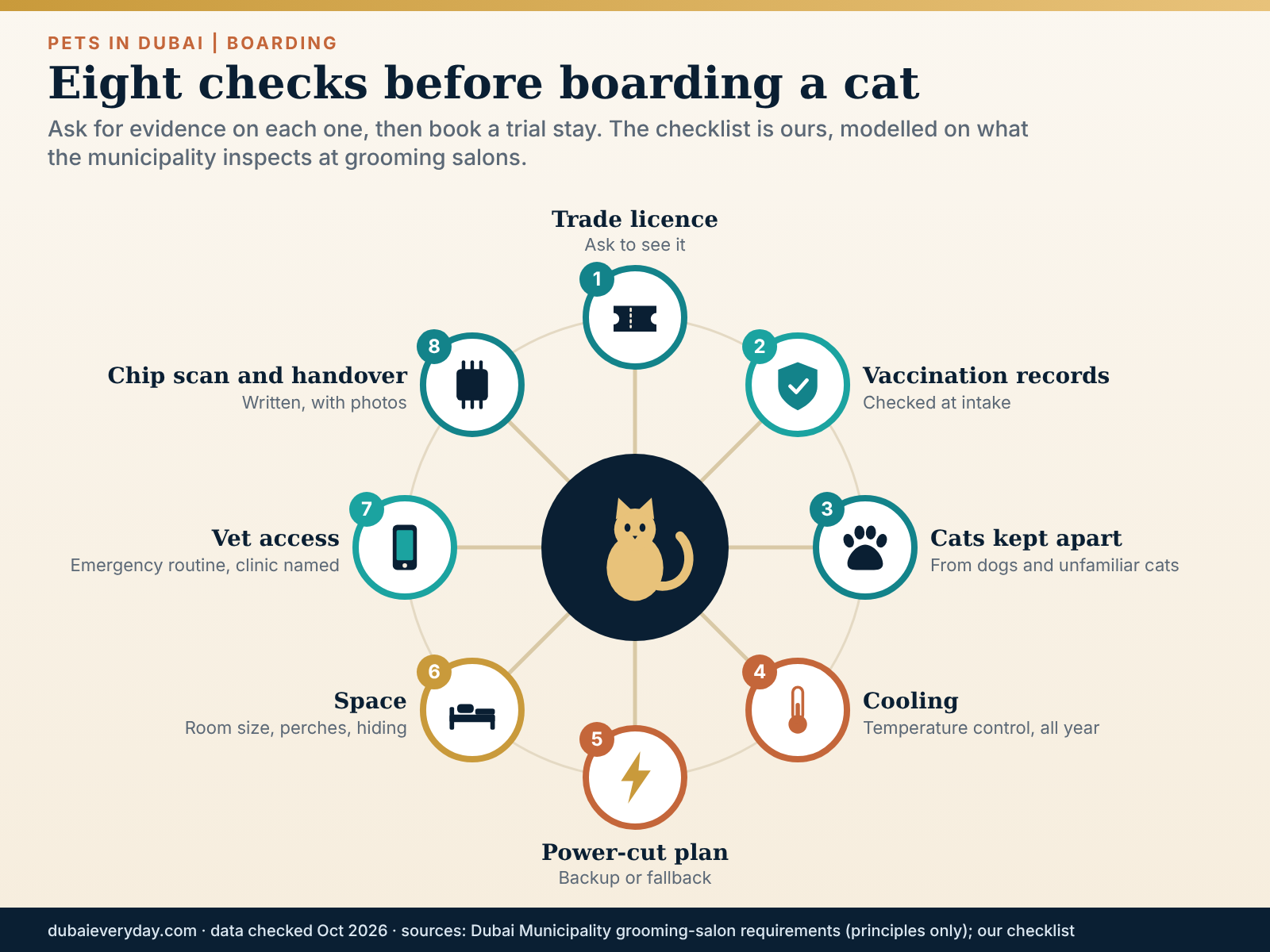
Planning boarding for cats in Dubai around the calendar
Demand for boarding and sitters is likely to cluster around school holidays and long public holidays, so ask early. We did not verify availability or prices, and anyone who quotes you a number in October for July should be asked how long the quote holds. A trial stay or a trial visit, a few weeks before a long trip, shows you how the cat copes and how the provider communicates.
Illustrative example (not a quote or a market fact): if a boarder charged AED 100 a night, a 21-night summer trip would cost AED 2,100, plus VAT if it applies. The nightly figure here is a placeholder to show the arithmetic. Replace it with a written quote, and ask what is included: food, litter, medication handling, daily updates and any extra charge for a vet visit.
Moving a cat to Dubai, within Dubai or out of it
Moves are where the paperwork for cats in Dubai gets serious, because a missed date can cost weeks. There are three kinds of move, and the first is the most demanding.
Bringing a cat to Dubai: an example timeline
The federal ministry’s own import-permit page returned an error when we attempted to read it, so we cannot quote its fees or processing times. What we can do is read two exporting countries’ official pages, which agree on the core points. The US Department of Agriculture’s animal health agency says an import permit from the UAE Ministry of Climate Change and Environment is needed, valid for 30 days, and that the cat must travel as manifested cargo. Canada’s June 2026 export form has similar timing rules.
The fixed points from those pages: the cat must be microchipped; it must be at least 15 weeks old at import; rabies vaccination must happen when the cat is at least 12 weeks old and at least 21 days before travel; a rabies titre of at least 0.5 IU/mL is required on a blood sample drawn within the 12 months before travel (for a first-time vaccination, at least 21 days after it); parasite treatment must be documented within 14 days; and the health certificate is valid for 10 days.
The US page also names feline panleukopenia, rhinotracheitis and calicivirus vaccines, and limits importers to two cats, or two dogs, or one of each, per year.
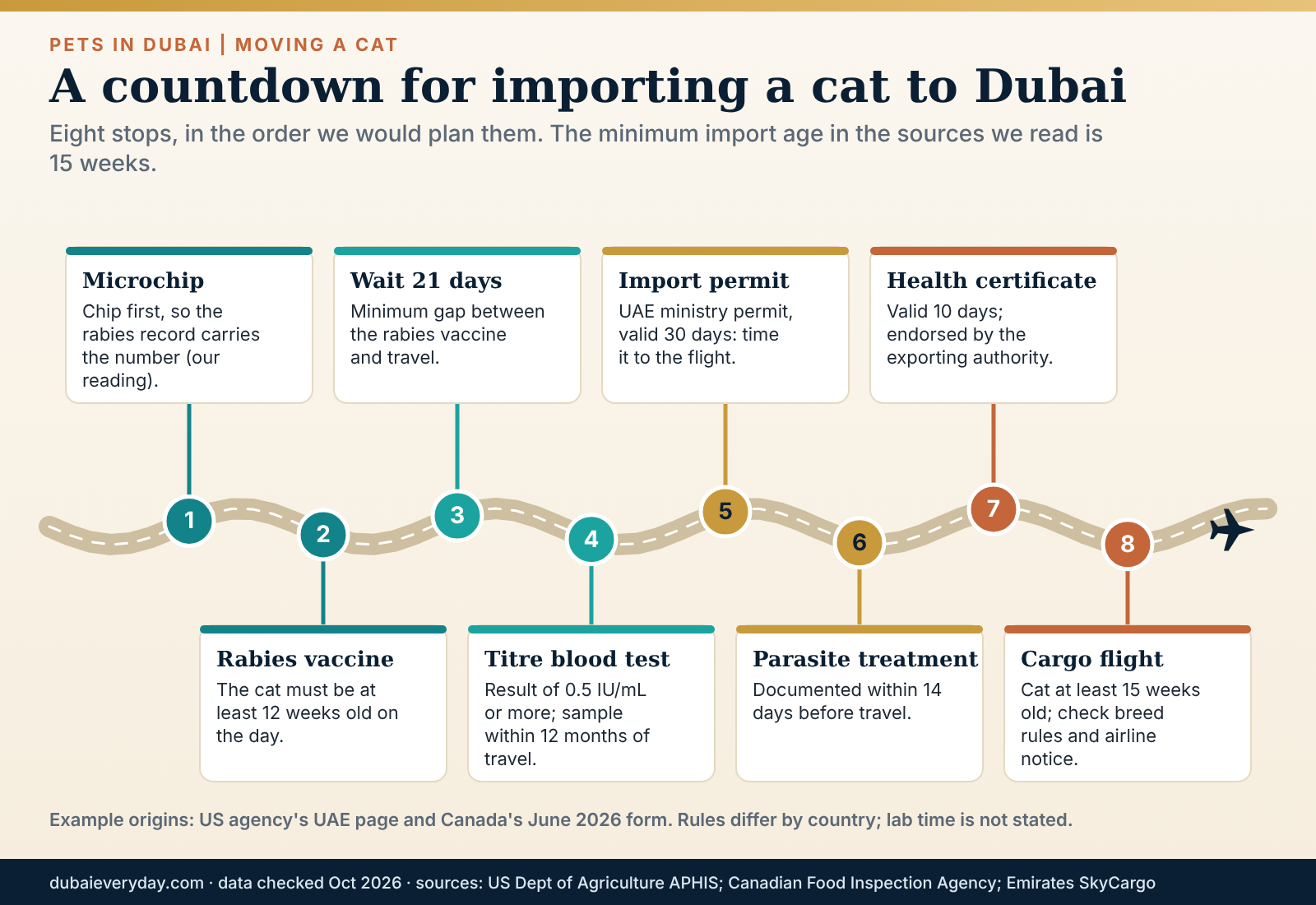
Our calculation: a kitten vaccinated at the earliest allowed point, 12 weeks, reaches the 21-day mark at 15 weeks, which is also the minimum import age, so the youngest arrival the sources allow is a 15-week-old cat that was vaccinated on schedule. The sources do not say how long the lab takes for a titre result, so build in a margin. Chip first is the safe order because the vaccine record then carries the chip number; neither source states an order.
Check before you plan. These requirements come from exporting countries’ pages, not from the UAE ministry, and they depend on the country of origin; the airline’s leaflet mentions a longer minimum age of 27 weeks for animals from countries it classes as high-risk. Treat the timeline as a template to take to your vet and your airline, and confirm the permit rules with the ministry directly.
Airlines, breeds and cargo
Emirates’ US-site FAQ says animals generally do not travel in the cabin, that cargo is required for any itinerary ending in Dubai, and that the hold or excess-baggage route applies only to itineraries starting in Dubai for countries that accept animals as baggage. It gives US-site fees as checked baggage of USD 500 for a container up to 23 kg and 150 cm, which is AED 1,836 at the peg, and asks for a week’s notice. The SkyCargo leaflet says snub-nosed dog and cat breeds are not permitted except under specific conditions in the winter months, November to April.
For a Persian, Exotic Shorthair or similar cat, that is the first thing to check, before the vet and before the date. Both sources set a minimum age (15 weeks in the leaflet, four months in the FAQ), so take the stricter one. Another form we read asks for a fifth-generation or later pedigree for Bengal and serval-type cats, a reminder that hybrid cats attract extra scrutiny. If you own one, ask the ministry before you book.
Moving house with cats in Dubai
An in-city move is mostly logistics. Keep the cat in one closed room with water, a tray and a sign on the door while movers work; carry it in its carrier, not in arms; and bring it to the new flat last, once windows, balcony doors and screens have been checked. Switch utilities with the DEWA move-to guide in hand, and run the cooling for a few hours before the cat arrives. After a move, update the address on the registration record; the registration guide explains what we could and could not confirm about amendments.
Leaving Dubai with a cat
Dubai Municipality’s release says a veterinary health certificate for export is available for animals that are microchipped, registered and fully vaccinated, and tells owners to check export rules with the federal ministry, the destination country and the airline. Some destinations ask for a blood test and a waiting period before arrival, so find out early. The DEWA move-out guide covers the utilities side so the cat is not the only thing on your list.
Strays, neighbours and building rules around cats in Dubai
Owners of cats in Dubai will meet community cats whether or not they keep one, and your own cat lives alongside them. The municipality’s approach is trap, neuter, return: Gulf News, reporting on the new Warsan shelter, says stray cats are humanely trapped, sterilised, treated if needed and returned to their territory, and that residents can report a stray or injured cat on 800 900 so the Animal Control Section can collect, treat and return it. Residents can also bring a stray in for neutering.
Ear tips, feeding and what the rules say about cats in Dubai
One large developer’s pet FAQ explains the local logic: its community uses trap, neuter and return, and cats near a villa that are not ear-tipped and do not look like pets should be reported to the community team. The wording implies that an ear-tip marks a community cat already in the programme. The same developer’s 2022 guidelines tell residents not to feed stray cats and to keep their own cats within their property, with AED 500 per violation after a notice. These are one developer’s rules, and others may differ.
In March 2026 the municipality announced 12 automated “Ehsan” feeding stations, ten in public parks and two in Dubai Holding facilities, as a trial. The release says the units use artificial intelligence to recognise stray animals and release food, and are meant to curb unplanned feeding that affects public spaces. The takeaway is that the authority prefers managed feeding to ad hoc feeding. If you want to help a stray, ask the building or community team what is allowed first.
Neighbours and shared spaces for cats in Dubai
Most friction with neighbours comes from noise, smell and escapes. Keep trays scooped, keep the balcony door closed so night calling and scent do not carry, and keep waste out of corridors. The Dubai Hills FAQ warns that owners can be fined for pet waste left in public areas even if someone else was walking the pet, and says pets must be leashed in common areas. A cat in a carrier or harness in the lift is therefore both considerate and rule-compliant.
Tenancy is the last piece. Pet policy is a private matter between landlord, building and tenant. A 2018 Gulf News report described residents in several communities receiving pet-ban notices partway through a contract, and the pet-adoption founder quoted advised getting written permission from both the landlord and the building manager before moving in. It is old and secondary, but the practical advice stands: keep the email. Municipal beaches are generally closed to pets as well; the guide to Dubai’s beaches is the place to check current rules before a day out.
What cats in Dubai cost: verified figures and honest gaps
Few of the costs of cats in Dubai have a published official tariff, so this section separates three kinds of number: official or reported fees, known fines, and prices we could not verify. We would rather leave a cell empty than put in a market figure we did not read in a source.
| Item | What we found | Status |
|---|---|---|
| Municipal cat adoption | About AED 230, covering vaccination, deworming, chip, sterilisation and government fees | Reported by Gulf News, July 2026 |
| Municipal pet registration | AED 10 plus AED 20, plus 5% VAT, so AED 31.50 | Reported by Gulf News, September 2024; confirm |
| Developer fine for a rule breach | AED 500 per violation after notice | One developer’s 2022 guidelines |
| Balcony rule fines | AED 500 to AED 1,500 | Property portal summary; secondary |
| Leaving Dubai by hold, Emirates | USD 500 (AED 1,836) up to 23 kg and 150 cm | Emirates US site; other regions may differ |
| Import permit fee | Not found | Ministry page unreadable |
| Vet visits, vaccines, neutering, food, litter, boarding, insurance | No verified price | Get written quotes |
Food and litter are the recurring costs of cats in Dubai, and they follow where you shop. Our guides to Dubai supermarkets and to Carrefour and Lulu show how price levels and delivery differ between chains, but we did not verify stock or prices of any cat product in any of them, so compare your own basket.
Budgeting for cats in Dubai without made-up numbers
Split the year into four buckets and fill each with real quotes. Setup: adoption or purchase, chip, first vaccines, neutering, carrier, tree, trays. Recurring: food, litter, parasite control, yearly vaccination and registration. Away: boarding or sitters for each trip. Reserve: an amount you can reach for an emergency, because the fall or poisoning that sends a cat to an overnight clinic is the expense you cannot schedule. Write each bucket down in AED and update it each January.
Match the home to the cat, and nine mistakes to avoid
The table below is our reasoning, not an official classification. It pairs common Dubai homes with their main risk for cats in Dubai and the set-up that answers it.
| Home | Main risk | Set-up that helps | Cats that fit |
|---|---|---|---|
| Studio or one-bedroom with balcony | Falls, boredom | Door always shut, vertical space, two trays | Adults; calm indoor cats |
| Apartment without a balcony | Cooling failure, boredom | Window perch (shaded), play routine, cooling plan | Most indoor cats |
| Villa with garden | Escape, heat, traffic | Enclosed garden section, chip, tag, no unsupervised roaming | Active cats, with a secure enclosure |
| Short lease or shared flat | Permission, tenancy change | Written consent, portable set-up | Adaptable adults |
If you are still choosing an area, tower-heavy districts such as those in the Downtown Dubai guide put more glass and balconies between your cat and the ground, while villa communities give gardens but have the strictest outdoor rules. Neither is wrong for cats in Dubai, but the checks differ.
Nine mistakes new owners of cats in Dubai make
- Treating a closed balcony door as optional when you are home.
- Installing netting before asking the landlord and the building manager.
- Waiting for a bolting cat to discover that the chip number was never registered.
- Putting the litter tray beside the food bowl.
- Placing a perch in an afternoon sun patch that heats up in summer.
- Carrying a cat to the car in midday heat or leaving it in a parked car.
- Leaving a cat alone for a long summer trip with no one checking the cooling.
- Assuming a taxi or the Metro will take the carrier to the vet.
- Booking a flight before checking the breed restriction, permit and titre timeline.
FAQ: cats in Dubai
Can you keep cats in Dubai in an apartment?
Yes, if your lease and building rules allow pets. The law does not forbid ordinary domestic cats, and apartments suit indoor cats that have climbing space, hiding places and two of each key resource. Building rules are private and can be stricter than the law, so get permission in writing from the landlord and the building manager before you adopt, and keep the email. Balcony doors need to stay shut and windows need fitted screens.
Do cats in Dubai need to be registered?
Dubai Municipality says owners can register cats, microchip them and keep records updated, and one developer’s guidelines tell residents to do so. We did not find a published penalty for not registering a cat, and we could not verify whether registration is mandatory by a specific order. Regardless, a chip and a record are what make a lost cat returnable. The registration guide covers steps and fees.
What vaccines do cats in Dubai need?
Dubai Municipality names rabies and FVRCP for cats. Rabies carries the legal and travel weight, and import rules we read require it at 12 weeks of age or older and at least 21 days before travel. Your vet sets the exact schedule and boosters, including for an indoor-only cat. Keep the vaccination card with the chip number on it.
Is it safe to let cats in Dubai onto the balcony?
Not unsupervised. Veterinary hospitals describe high-rise syndrome, with chest, head, limb and abdominal injuries after falls, and kittens and young cats fall more often. Keep balcony doors shut, keep furniture away from the rail and ask your landlord before fitting any net or mesh, because a property portal says altering the balcony structure needs consent. A lead and harness is safer than free access.
How hot is too hot for cats in Dubai?
We cannot give a safe outdoor temperature, because we could not verify a threshold from a veterinary source. Mean daily highs are above 39 degrees from June to September, so we treat those months as indoor-only apart from the shortest carrier trips. A veterinary service says heat illness can kill a cat in as little as 15 minutes. If your cat pants heavily or collapses, call a vet immediately.
Can cats in Dubai travel by taxi or on the Metro?
Not in a taxi: the Roads and Transport Authority’s taxi terms say you cannot bring a pet on board. We found no RTA statement on cats in the Metro, buses or trams, so do not assume they are allowed. For vet visits, plan a lift with a friend, a private pet-transport service (which we have not verified) or a clinic that offers collection, and cool the car before the carrier goes in.
Can I bring my cat to Dubai?
Yes, with planning. The US agency’s UAE page asks for a UAE import permit valid 30 days, a microchip, rabies vaccination at 12 weeks or older and 21 days before travel, a rabies titre of at least 0.5 IU/mL, a health certificate valid 10 days, and cargo travel. Limits are two cats, or two dogs, or one of each, per year. Your country of origin may differ, so check with the ministry.
How much does it cost to adopt a cat in Dubai?
Gulf News reported about AED 230 for a cat from the municipal shelter in July 2026, covering vaccination, deworming, microchipping, sterilisation and associated government fees. That is a reported figure, not an official tariff, so confirm it when you apply. Applicants must be at least 21 with no recorded animal-abuse violations and are interviewed about welfare and the home. Private rescues and sellers set their own terms.
Can I feed stray cats in Dubai?
It depends on where you are. One developer’s 2022 guidelines tell residents not to feed stray cats, and the municipality’s March 2026 feeding stations are meant to curb unplanned feeding. We found no federal rule on the subject. To help a stray, report it on 800 900 or ask your community team, since the municipality’s programme traps, sterilises and returns community cats.
Where can I board cats in Dubai?
We cannot recommend a facility, because we did not visit any and found no official register of boarders. Ask to see the trade licence, how vaccination records are checked at intake, how temperature is controlled and what happens in a power cut. A trial stay a few weeks before a long trip tells you how your cat copes. Book early around school holidays.
Sources and further reading (25 links)
- Dubai Municipality: Nearly 183,700 veterinary services delivered in H1 2026 — registration, microchipping, cat vaccines, adoption rules, export certificate guidance and licensed clinic counts
- Dubai Municipality: Veterinary Services Section — clinic locations, hours and contact details
- Dubai Municipality: services directory — names of registration, vaccination, adoption and health-certificate services
- Dubai Municipality: requirements for pet grooming salons — licence, vaccination checks, cages, ventilation and temperature control
- Dubai Municipality: Ehsan Stations initiative to feed stray animals — automated feeding units, number and purpose
- Dubai Municipality: FAQ — domestic companion animals only
- Dubai Media Office: Dubai Municipality opens integrated pet shelter — Warsan shelter, clinic and lost-pet reunification
- UAE Government portal: Banning private ownership of dangerous animals — federal framework for keeping animals
- US Department of Agriculture APHIS: Pet travel to the United Arab Emirates — cat import permit, vaccines, titre and certificate timing
- Canadian Food Inspection Agency: Health certificate for dogs and cats to the UAE — import timing example and hybrid-cat pedigree note
- Emirates: Rules and charges for travelling with animals — cargo and hold rules, US-site version
- Emirates SkyCargo: Emirates Pets leaflet — snub-nosed breed restriction, minimum ages and documents
- Emaar Community Management: Pet guidelines reminder — cats within property, no feeding strays, AED 500 fines
- Emaar Community Management: Pets in Dubai Hills Estate FAQ — microchip and vaccination, leash in common areas, trap-neuter-return and ear-tipping
- Roads and Transport Authority: taxi service terms — no pets on board
- Gulf News: Inside Dubai Municipality’s new pet shelter — secondary; cat adoption process, reported fee, trap-neuter-return
- Gulf News: How to microchip and register your pet in Dubai — secondary; online registration steps and reported fees
- Property Finder: Dubai Municipality balcony rules — secondary; balcony railing, alteration and fine summary
- Animal Medical Center: High-rise syndrome in cats — causes, injuries, prevention and what to do after a fall
- PDSA: Keeping indoor and house cats — enrichment, resources and indoor-only living
- FirstVet: Heat stroke in cats — signs, first steps and higher-risk cats
- ASPCA: Lily toxicity — lilies listed as toxic to cats
- Gulf News: Don’t let the cats out for their own safety — secondary and dated; indoor-keeping advice from a rescue founder
- Gulf News: Pet owners hit hard with more buildings imposing bans — secondary and dated; mid-contract pet bans and written permission advice
- Wikipedia: Climate of Dubai — secondary summary of Dubai Meteorological Office monthly temperatures
Update log: 29 October 2026, first publication; all facts re-checked against the sources above. Next review due: April 2027, or sooner if Dubai Municipality changes registration fees, shelter rules or clinic hours, or the ministry changes import rules. Corrections welcome.
General information only, not individual veterinary or legal advice. If a cat is ill, injured or overheated, call a licensed vet at once, and confirm fees and requirements with Dubai Municipality and the federal ministry before you act.
About DubaiEveryday and this guide
DubaiEveryday.com is an independent editorial project that publishes practical, research-based guides to everyday life in Dubai: where to live, what things cost, how the rules work and how to get around. This page was written and edited by the DubaiEveryday editorial team. It is not signed by a named expert, doctor, lawyer or adviser, and we do not claim first-hand testing of a venue, clinic or service unless the page says so.
Each guide is built from official sources such as government and regulator pages, operator websites and established news outlets, cross-checked where we can. When we could not confirm something, we say so in the text, and examples that use made-up numbers are labelled as illustrations. Mentions are editorial choices, not paid placements, and a link is not an endorsement.
Dubai changes quickly. If you spot something that is out of date or wrong, please tell us through the contact options on DubaiEveryday.com and we will check it and correct the page.