

Registering a dog or cat with Dubai Municipality takes a microchip, a current rabies vaccination and one online application. This guide covers the paperwork only: what to gather, what each step costs, how renewals work and where records usually go wrong.
Your pet is chipped, vaccinated and fast asleep on the sofa, yet the paperwork feels like a small mountain. Which document goes first? Which number does the system actually want?
Pet registration dubai residents handle is simpler than it sounds once you see the order. A vet implants the microchip, the rabies vaccination must be current, and one municipality record ties everything to your Emirates ID and address. This guide covers the paperwork only, listing what to gather, what each step costs, how renewals work and where records most often go wrong, so you can finish in one sitting instead of three.
Pet registration Dubai is a three-part job. A licensed vet implants a microchip, the animal carries a valid rabies vaccination, and you file a Dubai Municipality record that ties the chip number to your Emirates ID, your home address and a photo of the animal. The municipality’s own service statistics list registering and microchipping cats and dogs, plus updating the record, as part of its pet services.
A 2024 explainer from Gulf News describes the online route: sign in with UAE Pass, choose the pet registration service, enter the Makani number of your home and the chip number, upload a photo and the vaccination record, then attend a short appointment at a municipal or accredited private clinic. The same source gives AED 10 plus an AED 20 knowledge and innovation fee, both plus VAT, and says tags are renewed each year at the rabies visit. We could not read the municipality’s own fee page, so confirm the figure before you go.
This is a desk-research guide. The DubaiEveryday team has not registered a pet through these systems for this guide, and we describe no personal experience of the clinics or the online form. Everything below comes from documents we read on 29 October 2026: Dubai Municipality pages and news releases, the federal government’s dangerous-animals page and the English text of Federal Law 22 of 2016, a Canadian export form for the UAE, Emirates’ pet-travel rules, a developer’s community guidelines and one detailed 2024 press explainer.
Where a fee or step comes only from that press explainer, we say so. The municipality’s service detail pages are blocked to automated readers and the ministry’s import-permit page returned an error, so some figures are labelled “reported” or “confirm first”. Nothing here was paid for, no clinic is recommended, and this is general information rather than individual veterinary or legal advice.
What pet registration Dubai covers, and what it does not
People use “registration” for at least five different things, and mixing them up is how an owner ends up with a chip that nobody can trace. Pet registration Dubai means one specific act: your animal’s record is entered in the Dubai Municipality veterinary system, linked to a chip number and to you. The microchip, the vaccination card, the metal or plastic tag and the federal dog licence are related, but they are not the same document.
Dubai Municipality’s July 2026 release on its veterinary services is the clearest official description we found. It says owners can register cats and dogs, have them microchipped and update their records, and that this supports identification and health monitoring. It also says the municipality regulates the entry of pets into the emirate. In the first half of 2026 it reported about 4,100 pets registered, 6,585 cat and dog vaccinations and about 183,700 veterinary services in total.
The five records, in plain terms
Think of them as a stack. At the bottom is the microchip: a small implant that carries a number and nothing else. Above it sits the vaccination record, which proves the animal’s rabies status and the date it expires. Then comes the municipal registration, which connects the number to a person, an address and a photo. The tag is the visible proof that the record is current. Last is the licence, which in federal law applies to dogs and is a separate concept from the municipal record.
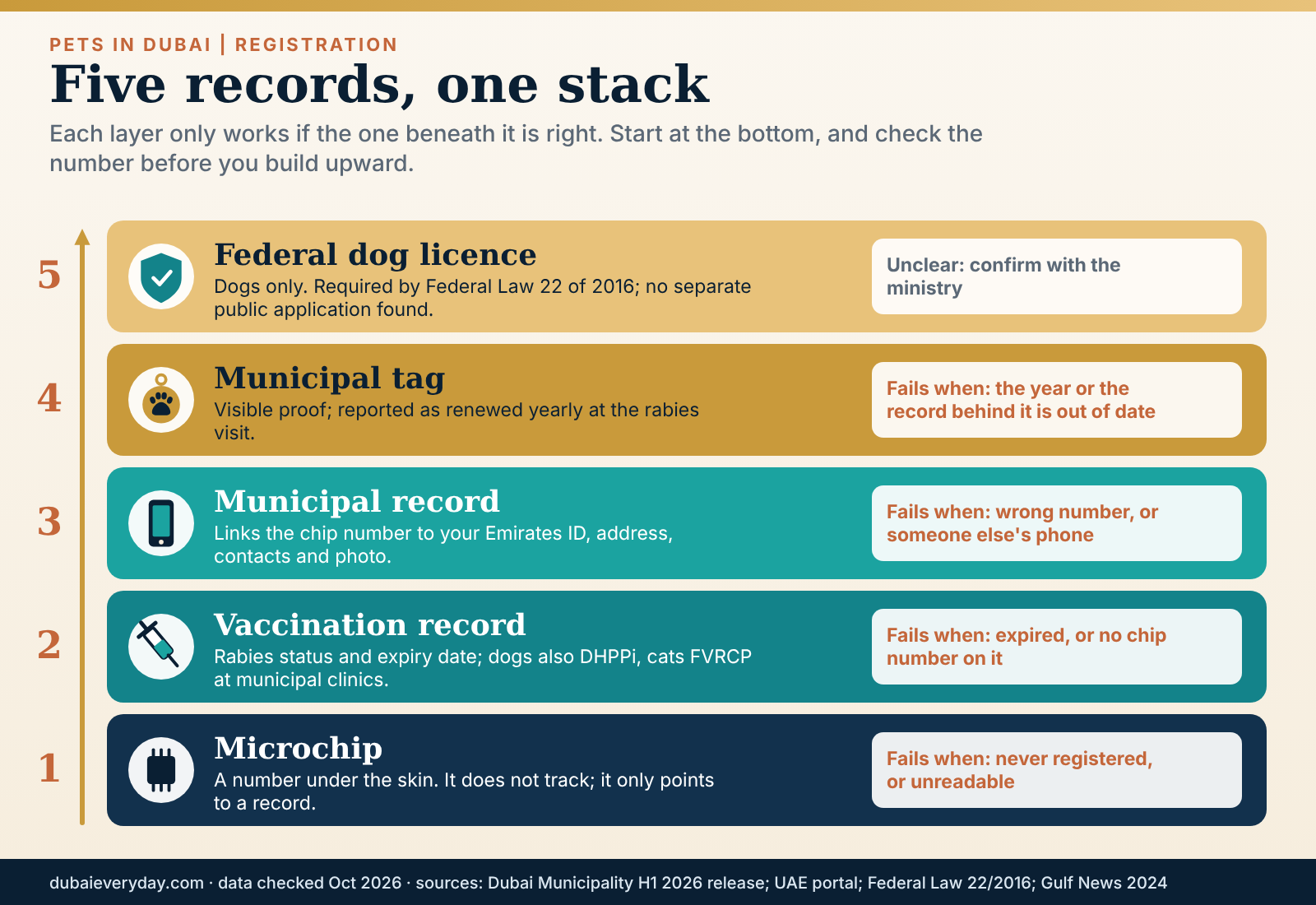
The stack explains most of the pet registration Dubai mistakes later in this guide. A tag without a valid rabies date is a paper trail that will not survive a vet’s scrutiny. A municipal record with the wrong chip number is worse than no record, because it looks complete. A chip implanted but never registered is a number that leads nowhere when a stranger scans a lost animal.
Who this page is for, and what it leaves to other pages
This page is for people who own, are about to own or are adopting a dog or cat in Dubai, and who want the administrative sequence in one place. It is not a general pet guide. Housing rules, choosing a vet, summer heat, parks, travel costs and daily budgets are all in our wider pet ownership in Dubai guide. This page stays with pet registration Dubai itself: chip, vaccination, municipal record, renewal and the documents that connect them.
Beaches show why the wider guide matters: the municipal beach rules we have seen do not allow pets, so confirm before you go and see our Dubai beaches guide for the human side.
Which animals are covered? The municipality’s FAQ says only domestic companion animals may be kept at home, with exceptions for the types covered by the federal dangerous-animals law. Its pet registration Dubai wording refers to cats and dogs. If you keep a bird, a rabbit or anything more unusual, this guide cannot tell you what record applies, and the municipality’s contact centre on 800900 is the place to ask.
Visitors do not go through pet registration Dubai because they are not setting up a household here. If you are travelling through with an animal, the relevant paperwork is import and airline paperwork, which our Dubai travel guide does not cover in detail and which depends on the country you start from.
A note on terms: licence, registration, numbering
The municipality’s service directory lists a service called “Animal Registration and Numbering”, described as registering and numbering animals to identify them and monitor their health. The Gulf News explainer calls the online service “Register Pets and Farm Animals”. We use “pet registration Dubai” for the whole process because that is what owners search for, but when you are on the website, look for those titles.
The federal government’s page on dangerous animals uses the word licence. It says a person may own a dog of an approved breed after obtaining a licence from the competent authority. We found no separate public dog-licence application, so for most households the municipal pet registration Dubai record is the nearest practical equivalent. Whether the two are formally the same step is something we could not confirm, and we say so rather than guess.
The rules behind pet registration Dubai
Four layers of rules touch a pet in Dubai, and they are enforced by four different bodies. Knowing which layer is speaking helps you judge how much a given requirement matters, and who will actually notice if you skip it. The layers are federal law, Dubai Municipality, your community or developer, and your tenancy contract or building. Only the first two are official in the legal sense.
Federal law: the dog licence and the national register
Federal Law 22 of 2016 regulates the possession of dangerous animals, and in practice it is also the main federal rule for dogs. We read its English text on the government’s content portal. Article 12 says no one may possess a dog without a licence from the competent authority. Article 13 describes a register of licensed dogs that includes the microchip number and the vaccination record. Article 15 requires dogs to be leashed outside shelters, with an appropriate collar.
The penalty article is the sobering part. As printed in the 2016 text, breaching Article 12 or 15 carries a fine of AED 10,000 to AED 100,000. Keeping a banned breed is treated far more severely, with a jail term of one to six months, a fine of up to AED 500,000, or both. We cannot tell you how often the fine is applied or whether later ministerial resolutions changed the amounts, because those resolutions were not readable when we checked. Treat the figures as the ceiling of exposure, not as a typical outcome.
The 2016 law text is the version we could read. The ministry has issued later resolutions that may amend the breed lists and the licensing conditions. Before you adopt or import a dog of a breed that sounds like a bull terrier, mastiff, Rottweiler, Doberman or Boxer type, check the current list with the Ministry of Climate Change and Environment first, and do it before you pay anything for the animal.
The government’s page on banning private ownership of dangerous animals, updated in August 2026, repeats the licence idea in plain language: an approved breed may be owned with a licence, and a dog in public must be on a leash with a suitable collar. It gives no application link and does not state penalties. That gap matters for this guide, and we come back to it in the section on what we could not verify.
Dubai Municipality: the record you can actually apply for
The municipal layer is where an ordinary owner meets the system. The municipality lists a registration-and-numbering service, a vaccination-and-treatment request service for pets and farm animals, a veterinary health certificate for export, and an adoption service. Its own travel guidance says an animal must be microchipped and registered in the approved system before an export health certificate can be issued. That last point makes pet registration Dubai a practical gate rather than a formality.
The municipality’s FAQ adds the baseline: only domestic companion animals may be raised at home. For anything beyond that, or for a question the website does not answer, the contact centre number is 800900, and the veterinary section lists [email protected] for enquiries. We did not test either, so treat them as published contact details, not as a promise of a reply time.
Community rules: the layer you will meet first
In day-to-day life the most likely enforcer is your community. The Emaar pet guidelines we read (a document dated April 2022, reissued as a reminder in 2023) tell residents to register pets with Dubai Municipality, to vaccinate them, and to have dogs microchipped by a licensed clinic. They also keep dogs on leads in common areas, forbid pets in community pools and children’s play areas, and set a fine of AED 500 per violation after a notice. Other developers publish their own versions, and the details vary.
The point for pet registration Dubai is simple. If a neighbour complains about a barking or off-lead dog, the first thing a community manager is likely to ask for is proof that the animal is registered and vaccinated. Having the tag and a PDF of the record ready turns a potential dispute into a two-minute reply. Our tenant rights guide explains how community rules sit alongside the tenancy contract itself.
Your landlord and building
Pet registration Dubai does not grant a right to keep a pet. The official sources we read do not turn a pet into a tenant entitlement, so the lease and the building’s house rules decide. Get permission in writing and name the species and number of animals. Our guides to renting in Dubai and to renting an apartment cover viewings and contract clauses, and they are the right place to add pet questions before you sign.
What we could not find
We found no municipal statement of a penalty for failing to register a cat or dog. The Gulf News explainer says plainly that it does not mention penalties either. It describes online pet registration Dubai as mandatory since 2015, but we could not locate the municipal order behind that wording. So the honest position is this: the federal law requires a dog licence, the municipality offers and expects pet registration Dubai, communities and travel rules depend on it, and the exact sanction for an unregistered pet is not something we can quote.
We also found no description of routine inspection for unregistered pets. The practical triggers we can infer are a vet or boarding kennel asking for the record, a community complaint, an export health certificate request, and a lost animal. That is our reading, not a municipal statement.
Documents for pet registration Dubai: what to gather first
Most failed applications fail on small mismatches rather than big problems. A chip number typed one digit wrong, a vaccination date that has expired by the day of the appointment, an Emirates ID in a different name spelling from the vet’s record. Spending twenty minutes assembling everything before you open the form removes most of that risk.
- Your Emirates ID, front and back, valid on the day of the appointment.
- A working UAE Pass account, or a plan to apply in person at a clinic instead.
- The Makani number of the home where the animal will live.
- The microchip number, copied from the vaccination record or the chip certificate.
- The animal’s name, species, breed, sex, colour and date of birth (an estimate if it is a rescue).
- The current rabies vaccination record with the expiry date visible.
- A clear photograph of the animal, saved as a file you can upload.
- A mobile number and email address that you actually check.
Identity: Emirates ID and UAE Pass
The online route, as the Gulf News explainer describes it, uses UAE Pass to sign in, and the system fills in your Emirates ID details automatically. That is convenient if your digital identity is already set up and a reason to set it up early if it is not. The same explainer says you can also register in person at a local vet clinic or at the municipal clinic in Al Khawaneej, which is the fallback if you are still waiting for your ID.
If you have only just arrived, the sequence of Emirates ID, UAE Pass and mobile number is part of the wider settling-in routine. Our residence visa guide covers the identity card, and our internet and mobile guide explains digital ID and the apps you will need. Do those first, then start pet registration Dubai.
The Makani number
The online form asks for a Makani number when the animal lives in Dubai. The explainer describes it as a ten-digit code that identifies a property. It is Dubai’s address system, so your tenancy paperwork, your landlord or your building manager should be able to supply it. Villas and apartment towers each have their own numbers. If you share a building with other pet owners, each household uses its own address, not the building’s general one.
Households that are mid-move should note that the number belongs to the property, not to you. If you register while still in temporary accommodation, the record carries that address until you amend it. Our home setup guide covers Ejari and utilities, which are the other documents that tie you to an address.
The animal’s own details
Most of these are routine, but two cause delay. First, breed: choose honestly, and if the animal is a mix, use the vet’s description rather than a guess from a website. Breed matters more in Dubai than in many places because of the restricted-breed rules, so a casual label that sounds like a restricted type can raise questions that a vet’s description would not. Second, date of birth: for a rescue, the vet’s age estimate is normally acceptable, but ask the vet to write it down.
Name and colour are free-text fields in the form as described, so keep them simple and consistent. If the vaccination record says “Luna” and the form says “Luna Bella”, nothing will break, but a vet scanning through records later will appreciate the match. Put the same spelling on every document that you control.
The vaccination record
The form asks whether the rabies vaccination is valid or not and for its expiry date. Upload the vaccination record as a PDF, and make sure the page shows the animal’s name, the chip number, the product, the date given and the date of the next dose. If the vet only stamped a booklet, photograph it flat in good light and convert the image to PDF. A blurred phone photo taken at an angle is the likeliest reason for a request to resubmit.
Tip. Create one folder on your phone named after the animal before you start, and save the chip certificate, vaccination PDF, photo and Emirates ID copy in it. You will use that folder again at every renewal and every vet visit. The section on a pet records file shows how to extend it.
Pet registration Dubai step by step: the online route
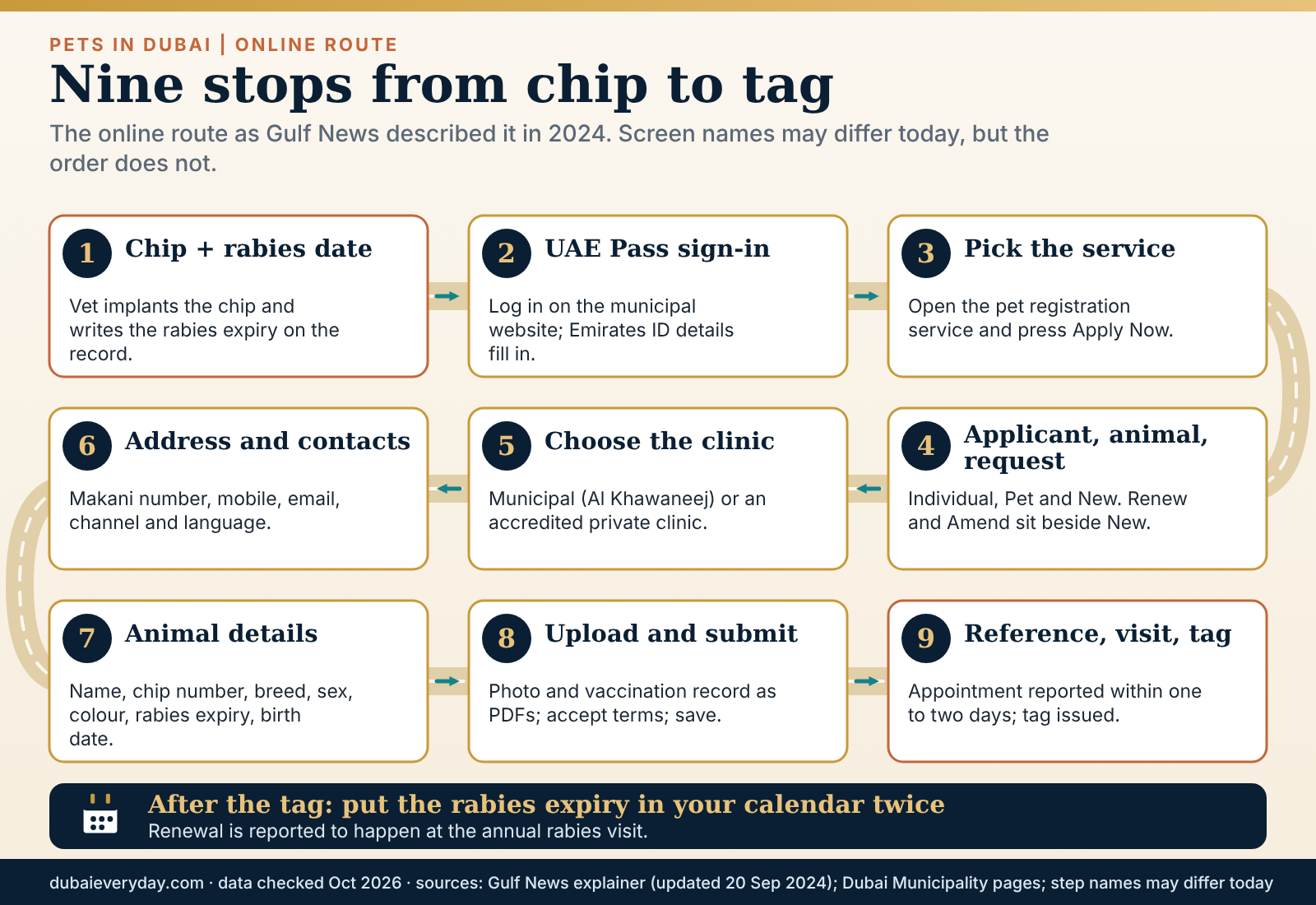
The sequence below follows pet registration Dubai as the 2024 Gulf News explainer describes it, cross-checked against what Dubai Municipality says on its own pages. Online forms change, so read it as a map, not as a screen-by-screen script. Where the live form differs, trust the form. The municipality’s service directory confirms that the service exists under the title Animal Registration and Numbering, but its detail page is closed to automated readers, so we could not compare the fields line by line.
- Get the chip and vaccination done firstA vet implants the microchip and records a current rabies vaccination. Ask for the chip number in writing on the vaccination record.
- Sign in with UAE PassOn the Dubai Municipality website, log in with UAE Pass. Your Emirates ID details fill in automatically.
- Find the registration serviceSearch the services list for the pet registration service, which the explainer names “Register Pets and Farm Animals”, and select Apply Now.
- Choose applicant and animal typeSelect Individual as the applicant type and Pet as the animal type.
- Select the request typeThe options reported are New, Renew and Amend. A first pet registration Dubai application is New.
- Choose where the appointment happensPick the municipal clinic (only Al Khawaneej was listed) or an accredited private clinic from the list.
- Enter address and contact detailsAdd your email and mobile number, your preferred channel and language, and the Makani number of the home.
- Enter the animal’s detailsName, chip number, species, breed, sex, colour, rabies status and expiry, and date of birth.
- Attach files and submitUpload the photo and the vaccination record as PDFs, accept the terms and save the application.
What happens after you submit
According to the explainer, you receive a reference number by email or SMS. If you chose Al Khawaneej, the notice comes from the clinic. If you chose a private clinic, the clinic contacts you by call or SMS. Appointments are described as typically within one to two days. The municipality’s veterinary page says requests for pet clinic appointments go through its website, and that confirmations are sent by SMS and email, which fits that description.
Bring the Emirates ID, the latest vaccination record with the rabies shot up to date and, if the animal is already chipped, proof of the chip. At the appointment the vet checks the animal, checks the chip and the vaccination, completes the pet registration Dubai record and issues the tag for the year. We could not find a description of the tag itself, so what it looks like, and whether it is metal or plastic, is not something we can state.
Timing: how long to allow
The online part of pet registration Dubai takes as long as it takes to find the chip number and upload the files, which is why the preparation section matters. The appointment follows within days, by the explainer’s account. The municipality’s directory states a target time of 15 minutes for its vaccination and treatment service at clinics and one hour for adoption, but gives no target for pet registration Dubai applications, so we will not invent one.
A reasonable planning assumption is a fortnight from “animal at home” to “tag in hand”, with the slack in the vaccination and chip steps rather than the online form. That is our planning judgement, not a service level, and the 14-day plan later in this guide uses it.
In-person pet registration Dubai, if you skip the online form
The explainer says you can also register in person at a vet clinic, or at the municipal veterinary clinic in Al Khawaneej, and then finish the process at the vet. Whether every private clinic offers this, and whether the clinic submits the application on your behalf, varies, so ask when you book the chip appointment. A clinic that handles all three steps in one visit is saving you most of the effort, but you should still receive copies of everything it submits.
Tip. When you book the chip appointment, ask three questions in one message: do you register animals with Dubai Municipality as part of the visit, what is the all-in price including the municipal fees, and will you send me the chip certificate and vaccination record as PDFs? The answers tell you more about a clinic’s paperwork habits than any review.
Microchips: the number everything hangs on
A microchip is a small implant, described in the Gulf News explainer as about the size of a grain of rice and placed under the skin, usually near the back of the neck. It carries a number. It does not track location, and in the explainer’s account your details sit in a database linked to that number rather than on the chip. The number matters only because it is linked, in a database, to your details. That link is what pet registration Dubai creates.
The vet quoted in that explainer compared the implant to a vaccination in how it is done. The explainer does not state a price, and neither does the municipality. We give none, because every clinic sets its own. If a clinic quotes a bundle including chip, vaccination and registration fees, ask for the line items so you can compare it with another quote.
What the clinic needs from you
The explainer lists what a clinic asked for when chipping: a booking, a quick health check by the vet, the animal’s name, date of birth and breed, the front and back of your Emirates ID, your address and phone number, and a rabies vaccination certificate. In other words, the chip appointment is already half of the pet registration Dubai paperwork. Bring everything you would need for the municipal form and the clinic can often complete both in one go.
Check the number three times
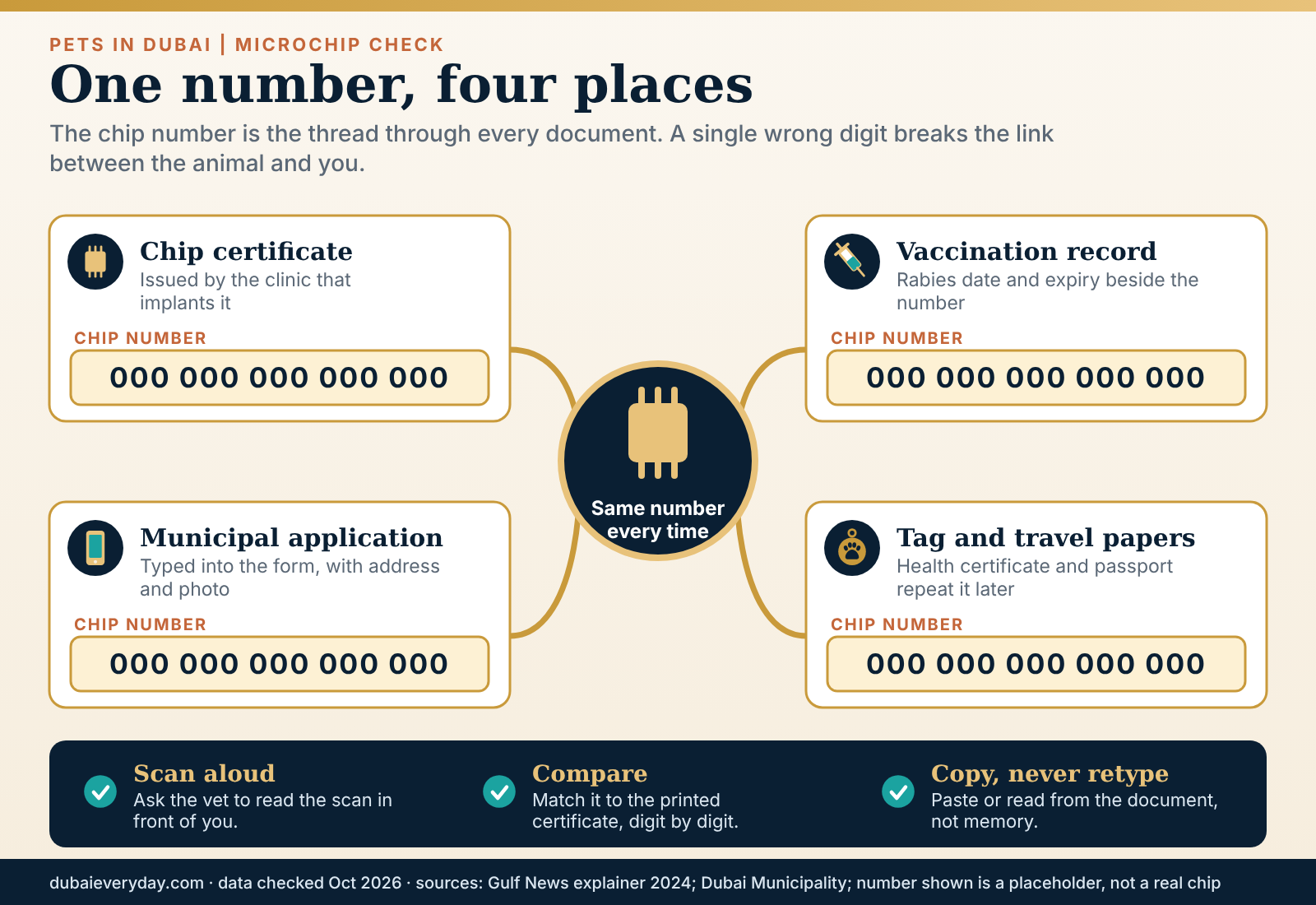
The chip number appears in four places during pet registration Dubai and afterwards: on the chip certificate, on the vaccination record, on the municipal application and, later, on any travel certificate. It is long, so a transposed digit is easy. Ask the vet to scan the animal in front of you and read the number aloud, and compare it with the printed certificate. Then copy it into the form from the document, not from memory.
Many international health forms ask for an ISO-compatible chip so that a standard scanner can read it. We could not verify the exact standard each destination or the UAE uses, so ask the vet to confirm that the chip they implant is the type accepted by any country you might move to. If you expect to relocate, mention it at the booking stage.
Chip first, then the shots that depend on it
Import health forms are often written so that the chip must exist before the vaccination that counts. The Canadian form for the UAE that we read lists a microchip among its requirements alongside the rabies vaccination, without spelling out the order. The safest working rule, which comes from how such forms are usually built rather than from a UAE statement, is to have the chip implanted first. A vaccination given to an unchipped animal can be hard to link to that animal afterwards.
For an animal that is already chipped abroad, you do not need a second chip just to register. You need the existing number, a vet who can scan it and the paperwork that shows it. If the scan and the paper disagree, stop and ask the vet to reconcile them before you apply. Two numbers on one animal is a problem best fixed early.
What a chip cannot do
A chip is not a tracker. If an animal runs away, nobody can see where it went. The chip only helps once someone, usually a vet, a shelter or a municipal clinic, scans the animal and finds the number. Then the pet registration Dubai record decides whether anyone can phone you. The explainer notes that veterinary clinics in Dubai reportedly share lost-pet information with each other. The municipality’s new Warsan shelter, opened in July 2026, says it reunites lost pets with owners after verifying identity and ownership.
A GPS collar is a separate product with its own subscription and its own risks. The vet quoted in the explainer warned that tag collars are not ideal because they can cause injury or come off. That is a clinical point, and it is one to raise with your own vet, not to take from a guide. For this article the takeaway is narrower: the chip stays in, the collar might not, so the record must be right.
Medical records attached to the chip
The same explainer says test results, such as rabies and blood tests, can be stored against the chip number. This is useful for animals that travel. A dog or cat that has had a rabies titre test, for example, can have the result linked to the same number that appears on the health certificate. Ask your clinic whether it does this routinely, and keep your own copy regardless, because records held only by a clinic are hard to move when you change vets.
Vaccinations and the rabies date
The rabies vaccination is the one hard requirement in the pet registration Dubai form as described. The explainer says the form asks whether the vaccination is valid or invalid and asks for its expiry date. If it is invalid, the owner must update it before or during pet registration Dubai. So the sequence is never “register, then vaccinate”. It is vaccinate, record, then register, and keep the date where you can see it.
What the municipality names
Dubai Municipality’s veterinary statistics release is specific about which vaccines its clinics gave: rabies and DHPPi for dogs, rabies and FVRCP for cats. The release spells the letters out as protection against parvovirus, distemper, adenovirus and parainfluenza in dogs, and against herpesvirus, calicivirus and panleukopenia in cats. The municipality administered 6,585 cat and dog vaccinations in the first half of 2026, which averages about 36 a day across the 181 days (our calculation).
Which vaccines your own animal needs, and on what schedule, is a veterinary decision that depends on age, health history and lifestyle. We give no schedule and no advice on timing beyond what an official form requires. If your vet recommends additional vaccines, for example before boarding or daycare, those are separate from pet registration Dubai.
What a good vaccination record shows
Pet registration Dubai is easier when the record is easy to read. Look for the animal’s name, species and chip number, the name of each vaccine, the date it was given, the date the next dose is due, the vet’s name and clinic, and a signature or stamp. A handwritten note that says only “vaccinated” does not meet that bar. If your clinic issues digital records, request a PDF and keep it. If it issues a booklet, photograph each page the day it is stamped.
Watch the dates. A vaccination that is valid on the day you apply may have expired by the day of the appointment, especially if the appointment is days away. If the rabies date is within a few weeks, book the renewal vaccination before you start the municipal form, so the record you upload is the one you will present.
Young animals: the age arithmetic
Puppies and kittens raise the most questions, because their vaccination timing is tied to age. We cannot give veterinary advice, but one worked example shows how the arithmetic behaves. The Canadian form for dogs and cats entering the UAE, in force as of June 2026, requires that the animal was at least 12 weeks old at the rabies vaccination, that the vaccination was at least 21 days before departure and that the animal is at least 15 weeks old at travel.
Add those together and a puppy vaccinated at exactly 12 weeks reaches day 21 at 15 weeks, which is the minimum travel age (our calculation: 12 weeks plus 21 days equals 15 weeks, or 105 days). That is an import rule for one origin country, not a rule for registering a puppy born in Dubai. If you are buying or adopting a young animal locally, ask the vet when the first rabies vaccination can be given and how pet registration Dubai works until then.
Rabies and registration for imported animals
For animals arriving from abroad, the rabies record has a second job: it is also evidence for the import health certificate. The same Canadian form asks for a rabies antibody titre of at least 0.5 IU/mL within 365 days of arrival, an examination within five days before departure, parasite treatment within 14 days and a certificate valid for ten days. These requirements depend on the country of origin, so the form is an example, not a universal rule.
The full import sequence, including the ministry’s permit, is outside this page. The ministry’s import-permit service page is the authority, and it returned an error when we attempted to read it, so we cannot quote its fees or validity. Our wider pet ownership guide includes the import path as a worked example. What belongs here is the final step: once the animal has landed, pet registration Dubai is where the imported paperwork is converted into a local record.
Keeping the date visible
The renewal logic in the explainer is simple. The tag is renewed each year at the annual rabies vaccination visit, when the vet re-registers the animal, updates the details and issues the tag for the new year. So the rabies expiry date is effectively your pet registration Dubai deadline. Put it in your phone calendar twice: once about a month before, as the booking reminder, and once on the day. The month’s margin is our planning judgement, not an official window.
Pet registration Dubai fees, VAT and the bills around them
The fee for pet registration Dubai is small, and it is the smallest bill in the process. What costs real money is the veterinary work around it: the chip, the vaccinations and the consultation. This section separates what we could source from what we could not, so you can budget without a false sense of precision.
The pet registration Dubai fee line items
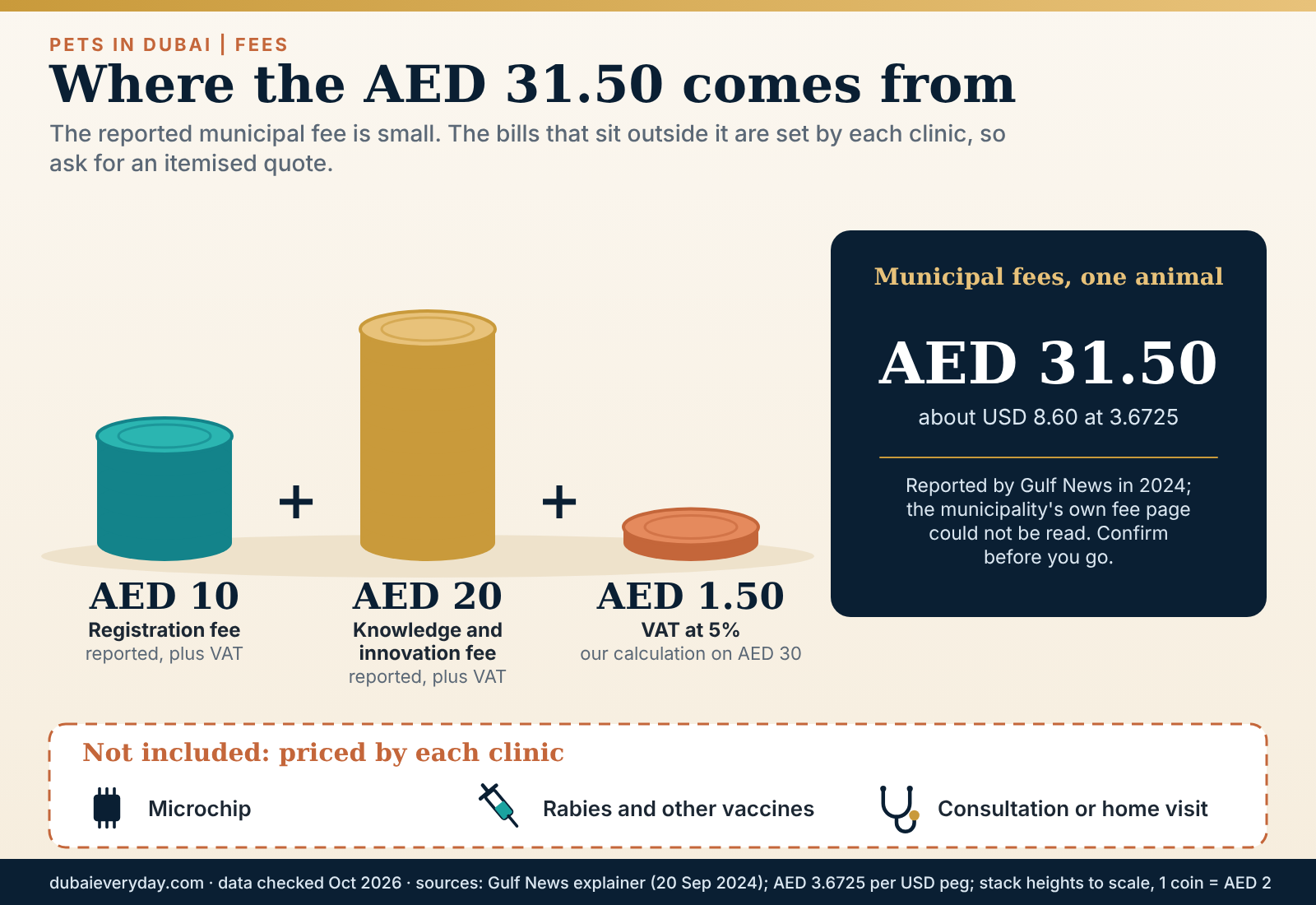
The 2024 explainer gives two line items for registering a cat or dog at Al Khawaneej or an accredited private clinic: a registration fee of AED 10 plus VAT and a knowledge and innovation fee of AED 20 plus VAT. Together that is AED 30 before VAT. At the standard 5% UAE VAT rate it comes to AED 31.50, roughly USD 8.60 at the fixed peg of 3.6725 (our calculation).
| Item | Amount | Status |
|---|---|---|
| Registration fee | AED 10 + VAT | Reported by Gulf News, Sept 2024 update |
| Knowledge and innovation fee | AED 20 + VAT | Reported by Gulf News, Sept 2024 update |
| VAT at 5% | AED 1.50 | Our calculation on AED 30 |
| Total, one animal | AED 31.50 | Confirm on the municipal service page |
| Microchip, vaccination, consultation | Set by each clinic | No official or reliable figure found |
| Renewal fee | Not stated | Explainer says tags renew yearly; fee not given |
An earlier community summary we saw cited a different structure, AED 10 for registration and AED 50 for numbering. The two cannot both be current. We treat the 2024 explainer as the later one, but we also could not read the municipality’s own fee table, so confirm at booking. If a clinic quotes a different total, ask which line items it includes.
What the fee leaves out
The registration fee does not include the chip, the vaccination, the vet’s consultation or any home-visit charge. Those are priced by the clinic and vary. We found no official price list for them and refuse to publish a “typical” number we cannot source. The practical consequence is that the all-in price for a first pet registration Dubai visit can be several times the municipal fee, and the only way to learn it is to ask two or three clinics for an itemised quote.
If you adopt from the municipality, the picture changes. Its adoption rules say the adopter pays the vaccination and registration fees, collects the animal within two working days after being contacted, and must be at least 21 with no recorded animal-abuse violations. So pet registration Dubai is effectively part of collection, and you should ask at the clinic what is already included.
The household arithmetic
If the reported fee is charged per animal, which is how we read the explainer, a household with one cat and two dogs would pay 3 times AED 31.50, or AED 94.50, in municipal fees at first pet registration Dubai. Over ten years of ownership, if the renewal fee equalled the first fee and never changed, one animal would cost AED 315 in municipal fees. Both figures rest on assumptions the sources do not confirm, which is why we label them illustrative.
Illustrative example, not a quote. Fill in your own pet registration Dubai worksheet before you book. Municipal fee, reported: AED 31.50. Microchip: ask the clinic. Rabies vaccination, if due: ask. Consultation: ask. Home visit, if any: ask. Total = the sum. Do the same for a second clinic and compare the totals, not the headline prices. Our cost of living guide shows how to fold a recurring pet line into a household budget.
Insurance is a separate product
Pet registration Dubai does not insure the animal. Pet insurance is a commercial product with its own exclusions and waiting periods, and we have not verified which Dubai insurers offer it or on what terms. Our Dubai insurance guide explains how to read a policy schedule, and the same logic applies to any pet policy you are offered. An insurer may ask for your registration record and vaccination history, so check what it wants before you buy.
Municipal clinic or private clinic?
The online form asks you to choose where the pet registration Dubai appointment happens, and the explainer lists two options: the municipal clinic or an accredited private clinic. Both charge the same pet registration Dubai fees according to that source. The choice is therefore about time, travel and what else you want done in the same visit. Neither route is better in general, but one will suit your week.
The municipal clinics
Dubai Municipality’s Veterinary Services Section lists three clinics: Al Khawaneej, in Wadi Al-Amardi on Al Khawaneej Road near the UAE Football Association; Al Lisaili; and Hatta, near Hatta Heritage Village. All three use the same contact centre number, 800900. For Al Khawaneej and Hatta the page gives Sunday to Thursday, 07:30 to 14:30, and Friday, 08:00 to 11:30. Al Lisaili is listed with longer weekday hours, but the page does not say whether those apply to pets or to farm animals.
Add up the Al Khawaneej hours and you get 38.5 hours a week: five weekdays of seven hours plus a three-and-a-half-hour Friday morning (our calculation). No Saturday hours are listed. For a full-time employee that is essentially a weekday-morning errand, and a Friday slot is short. The online form, as reported, lists only Al Khawaneej as the municipal choice, so Al Lisaili and Hatta may serve other needs.
Accredited private clinics
The municipality’s July 2026 release counts 176 licensed veterinary establishments: 103 comprehensive clinics, 67 primary clinics, 2 specialist clinics, 3 comprehensive hospitals and 1 specialist hospital. That tells you licensing is widespread. It does not tell you how many are accredited for pet registration Dubai. The form’s drop-down list of accredited clinics is the authority, so choose from it and confirm with the clinic that it will process your application.
Private clinics are convenient for owners who need several things at once. A single visit can cover the chip, the rabies shot and the pet registration Dubai record, which is the best case for someone with a full diary. Many will also have longer or later hours than the municipal pet clinic, though we have not verified any individual clinic’s hours, and you should check before you plan around them.
Getting there with an animal
Al Khawaneej is on the eastern side of the emirate, so for residents of Dubai Marina, JLT or Palm Jumeirah, or of Downtown Dubai, it is a real journey. The RTA’s taxi terms say you cannot bring a pet on board, and its page says nothing about the Metro, buses or trams, so we cannot confirm that any public transport takes animals. Most owners will need a car, a friend’s car or a pet-transport service, which we have not verified. Our Dubai Metro guide covers the system for people.
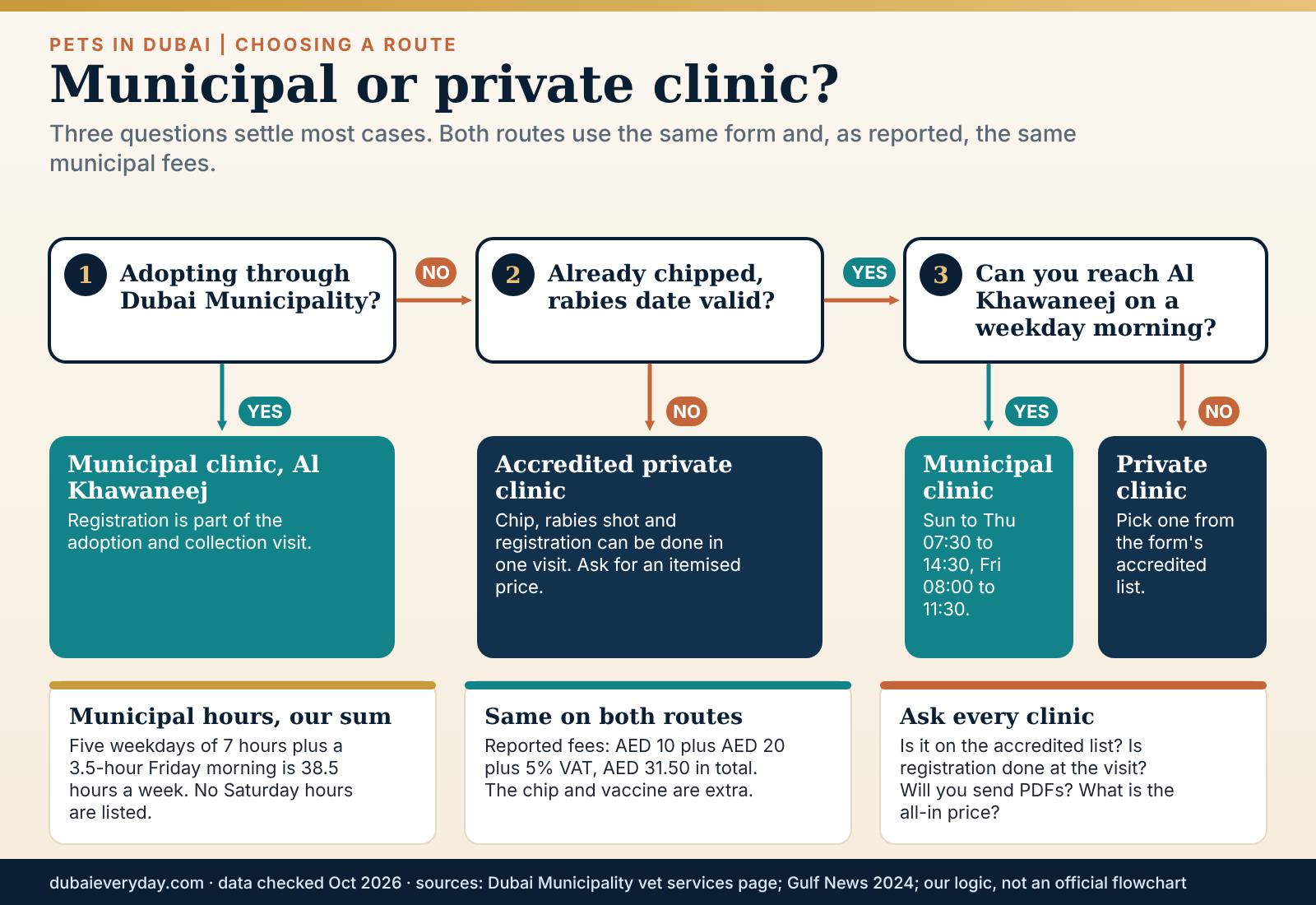
Questions that decide your pet registration Dubai route
If you are adopting through the municipality, the Al Khawaneej clinic is part of the process anyway, so register there. If you already have a regular vet whose clinic is on the accredited list, start there, because the vet already holds the vaccination history. If you cannot take a weekday morning off, a private clinic with later hours is probably the only workable option. If you live far from the east, count the travel time as a cost.
Before booking a private clinic, ask whether it appears on the municipal form’s accredited list, whether the registration is submitted at the same visit, what the all-in price is, whether you will receive PDFs of the chip certificate and vaccination record, and how renewal reminders are handled. A clinic that cannot answer those clearly is unlikely to manage your records well later.
Eight situations that change pet registration Dubai paperwork
The standard sequence assumes a healthy adult animal that is already vaccinated and about to be chipped. Real households rarely start there. The table summarises eight common starting points; the sections below explain the ones that need more than a line. The situations are our research-based scenarios, not case histories.
| Starting point | What you need | Main watch-out |
|---|---|---|
| Adopting from Dubai Municipality | Age 21 or over, clean record, in-person visit | Collect within two working days |
| Adopting from a rescue group | Chip number, vaccination record, transfer papers | Confirm whose name is on the record |
| Buying from a breeder or shop | Chip scan, vaccination record, breed proof | Check the breed against the restricted lists |
| Arriving from abroad | Import permit, health certificate, chip number | Register in the first days |
| Puppy or kitten under vaccination age | Vet’s age and vaccination plan | Do not leave it unrecorded |
| A stray you have taken in | Chip scan, vet check, vaccinations | It may already belong to someone |
| Inheriting a previously registered pet | Old records, chip number, an Amend request | The record may still show the old owner |
| Moving house or emirate | New Makani number, updated contact details | Amend before you need the record |
Adopting from Dubai Municipality
The municipality’s own adoption rules are the most detailed official statement we found about a pet registration Dubai process. Applications can be made online, through its website or the DubaiNow app, or in person at the Al Khawaneej Veterinary Clinic. The adopter must be at least 21 and have no recorded animal-abuse or mistreatment violations. After the requirements are met, the applicant is contacted and must attend the clinic in person for examination and collection.
The adopter pays the vaccination and registration fees and collects the animal and its vaccination record within two working days of being contacted. In the first half of 2026 the municipality reported 298 animals adopted and 2,274 strays treated and rehabilitated. If you are adopting, you do not need to arrange a chip or pet registration Dubai beforehand. Ask the clinic what is included, then keep the vaccination record safe.
Adopting from a rescue group or shelter
Rescue organisations work differently, and we have not verified how any of them handle municipal records. The questions are the same. Is the animal chipped, and what is the number? Is the rabies vaccination current, and where is the record? Who is named on any existing municipal record, and how will it be transferred to you? Ask for these in writing before you hand over any fee, and read the contract for what happens if you cannot keep the animal.
A reputable group will have answers ready. If the animal is described as “registered” but nobody can name the chip number, treat that as unconfirmed. The same applies to the municipality’s new Warsan integrated shelter, which opened in July 2026 with a clinic, a grooming unit, lost-pet reunification services and a digital adoption platform. Whatever the shelter, ask about registration status explicitly at the point of adoption.
Buying from a breeder or a pet shop
We have no verified information on how the licensing of breeders and pet shops interacts with registration, and we will not guess. What we can say is what to ask for. A scan in front of you that matches the chip number on the papers. A vaccination record with dates and the vet’s details. A clear statement of breed. And, for a dog, the check against the federal restricted-breed lists before you pay. The Emaar guidelines we read forbid commercial breeding in its communities, which is a further reason to ask where a litter came from.
The municipality’s FAQ points to the Birds and Pets Market as an open venue, and its service list includes a permit for admitting animals to the market. That is a trade permit, not a registration. Whatever the source of the animal, the pet registration Dubai step afterwards is yours, and a seller’s promise that “it is all done” is not a substitute for checking the record.
An animal arriving from abroad
An imported animal arrives with a stack of paper: the exporting country’s health certificate, the vaccination record, the microchip number, the ministry’s import permit number and the airline’s documents. Emirates SkyCargo’s pet leaflet lists the types of paper it expects, from vet reports and vaccination certificates to the health certificate, fit-to-fly confirmation and microchip details. After arrival, keep the originals together and register in the first days. The imported record is the foundation of the local one.
If the chip is not readable by a standard scanner, tell the vet before you arrive, not at the appointment. And do not discard the original health certificate once the local record exists. A later move or a boarding application may ask for it. The full import route is in our pet ownership guide, and the wider move is in our moving to Dubai guide.
A puppy or kitten too young for the shots
Very young animals can sit in a gap where no vaccination record yet exists. We do not know how the municipal system treats an application for an animal that has not yet had a rabies vaccination, because the form as described asks for a valid or invalid status. Ask your vet about the right timing and whether pet registration Dubai should wait. What you should not do is let the gap run on with no plan. Write the date the animal becomes eligible in your calendar and book the visit.
A stray or rescued animal you have taken in
Taking in a stray is a kind act with a paperwork tail. The first step is a vet scan, because the animal may already have a chip and an owner who is searching for it. If it has a chip, the vet can follow the registered details; if not, the sensible assumption is that it is unregistered. Then the usual sequence applies: examination, vaccination, chip and pet registration Dubai. Our pet ownership guide covers the law on strays and feeding, including the community rule against feeding them.
Inheriting or taking over a registered pet
If a friend or a departing colleague hands you an animal that is already registered, the municipal record still shows them. The explainer reports an “Amend” request type next to New and Renew, which suggests a route for changing details, but we could not confirm whether it covers a change of owner. Ask the clinic or the municipality’s contact centre. Get the chip number, the vaccination record and a signed handover note before the previous owner leaves the country.
Moving between homes or emirates
A move changes the Makani number and probably your phone number. The reported request types include Amend, and the form includes “Dubai” or “Other Emirates” as the animal’s location. Whether another emirate’s authority recognises a Dubai record is not something we could check, and the rules for Abu Dhabi, Sharjah and the rest are not covered by our sources. The moving section below says what to update in Dubai and what to confirm elsewhere.
Pet registration Dubai renewals, amendments and lost tags
First pet registration Dubai gets the attention, but renewal is where records decay. A tag that was fine in 2025 means nothing if the rabies date behind it has passed. The explainer’s account is short and clear: tags are renewed every year, and the annual rabies vaccination visit is when the vet re-registers the animal, updates its details and issues the tag for the new year. The practical rule is that your renewal date is your vaccination date.
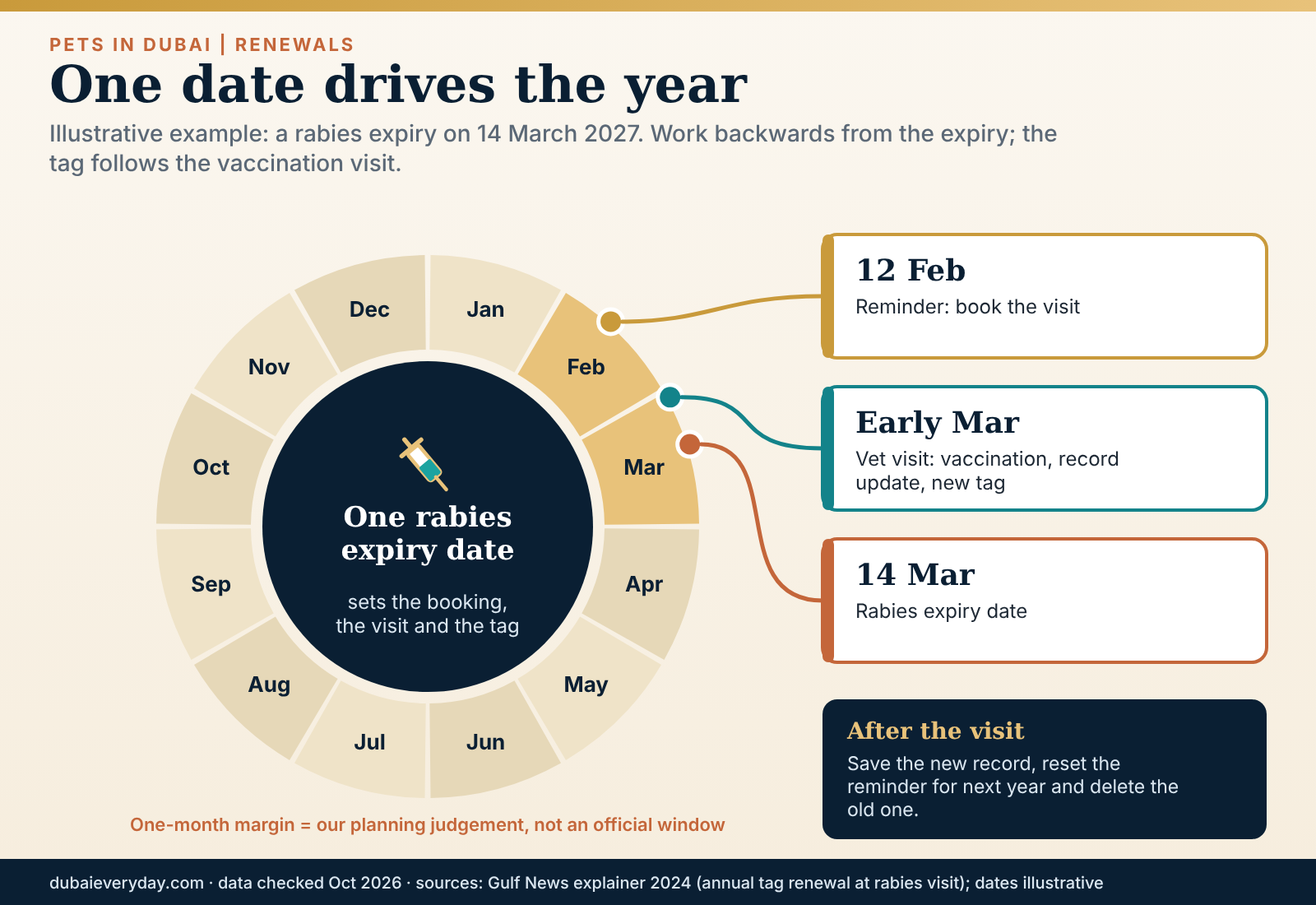
A worked renewal calendar
Illustrative example, not a real record. Suppose a dog’s rabies vaccination expires on Sunday 14 March 2027. Working backwards, a reminder around Friday 12 February 2027 gives a month to book. If you want the municipal clinic, remember its Friday window closes at 11:30, so the realistic options are a weekday morning or a private clinic. Book the visit for the first week of March, which leaves slack if the animal is unwell or the clinic is full.
At the visit, the vet gives the vaccination, updates the municipal record and issues the new tag. Take the old tag, your Emirates ID and your phone with the digital records. Afterwards, save the new certificate, update the calendar to the next expiry and delete the old reminder. Two minutes of tidying keeps the next renewal as boring as this one.
New, Renew, Amend: which request when
The online form, as reported, offers three request types. New is for a first pet registration Dubai application. Renew is for the annual update. Amend, as the name suggests, is for changing details on an existing record. Use Amend when your mobile number or email changes, when you move home and get a new Makani number, when you have corrected a breed or colour entry, and, if the municipality accepts it, when the animal changes hands.
We could not test how the system handles a renewal made before the old tag expires, or how it prices an amendment. Both are reasonable questions for the clinic at booking. If you ever suspect the record is wrong, the cleaner path is a short call to 800900 rather than submitting new applications on top of an old one.
If the rabies date has passed
An expired vaccination does not delete the record, but it does make the record unhelpful. The form as described asks for a valid or invalid status and says invalid vaccinations must be updated before or during pet registration Dubai. Book the vaccination straight away, mention that the date lapsed, and ask whether anything else is needed. We found no published penalty for a lapse, and we will not invent one. The sensible cost is practical: boarding, travel and community checks all ask for current proof.
A lost tag, a lost phone, a lost animal
We did not find a published process for replacing a lost tag. Ask the clinic that issued it, or the municipality’s contact centre, and keep the record number in your phone. For a lost animal, the explainer’s advice is to contact the municipality and your vet, give the last-seen place and time and send a photo. It says clinics reportedly share the information. A scanned chip only helps if your phone number on the record is the one you still answer.
Why bother: what a current record unlocks
Four practical things depend on a current record. A lost animal can be matched to you if a clinic or shelter scans it. A veterinary health certificate for export is issued only for animals that are microchipped and registered in the approved system, per the municipality’s travel guidance. A community manager or landlord can see at once that you meet the rules. And a vet or boarder who asks for proof of vaccination gets it without a day’s delay.
There is also a quieter benefit: the municipality uses pet registration Dubai statistics for planning. The explainer reports that the data helps it plan facilities such as dog parks. That is a secondary source’s claim about intent, so treat it as an interesting aside rather than a reason to register.
When the worst happens
We found no published municipal procedure for closing or updating a record after an animal dies or is rehomed overseas. If it happens to you, ask the clinic what it can do and keep a note of the date. Leaving a record open does not appear to create a bill in the sources we read, but we cannot rule out an administrative consequence, and an old record that lists you as the owner of an animal you no longer have is not something you want to discover later.
Moving house, changing emirate or leaving Dubai
A move is a pet registration Dubai event, even though nobody tells you so. A new home means a new Makani number, a new building and perhaps a new community’s pet rules. A new country means a different system entirely. The earlier you treat the record as part of the move, the less it will cost you in lost time.
Moving within Dubai
Update your pet registration Dubai record when the address changes, using the Amend request type as reported or the clinic’s process. Do it at the same time as your utilities and internet, because those are the other records that tie you to the address. Our DEWA move-in guide and move-out guide cover the household side of that sequence, and the new community’s pet guidelines should be read before the keys arrive.
Check, too, that the new building allows the species and number of animals you have. A lease or a developer’s rule can differ from the old home’s, and being told at the lift that the animal is not welcome is a bad place to learn it. Our villa rental guide is relevant if you are trading a flat for a garden.
Moving to another emirate
We did not find a published rule on how a Dubai record is treated in Abu Dhabi, Sharjah or elsewhere, and the sources we read are about Dubai. The reported online form lists “Other Emirates” as an animal location option, which suggests the system can hold an address outside Dubai, but we cannot say what that implies for recognition by another authority. Ask the receiving emirate’s veterinary authority or a vet there before you move, and carry the full record.
Leaving the UAE with an animal
For travel out, Dubai Municipality’s guidance is direct. The animal must be microchipped and registered in the approved system, must have all mandatory vaccinations and must hold an approved veterinary health certificate. The municipality’s service list includes the Veterinary Health Certificate, described as covering live animals or veterinary products for export or re-export. The same release tells owners to check export requirements with the ministry, confirm the destination’s rules, including tests or quarantine, and contact the airline.
The practical lesson for pet registration Dubai is timing. If the record has lapsed, fix it before the certificate appointment, not on the day. The explainer says the chip number must appear on the pet’s passport when travelling or relocating, which is another reason to verify the number early. Emirates, for itineraries starting in Dubai, has its own notice period and documents list, which our wider pet guide summarises.
If you are leaving for good, our Dubai relocation checklist sets out the rest of the timeline, and our Dubai airport guide covers the terminal side. Start the animal’s paperwork well before you cancel the lease. The destination country’s rules, not Dubai’s, usually set the longest lead time.
A pet records file and a 14-day plan
Pet registration Dubai produces documents, and documents are only useful if you can find them in the wrong moment: the clinic that wants proof, the airline desk, the community office, the lost-animal call. A tidy file is the cheapest insurance you will buy. It also makes the first fortnight less chaotic, because every step produces something that goes in the same place.
What goes in the file
- Chip certificate showing the number, the date and the clinic.
- Rabies and other vaccination records, as PDFs, with the next-due dates highlighted.
- The municipal registration confirmation and the reference number.
- A clear photo of the animal from both sides, and one of any distinguishing marks.
- Your Emirates ID copy, the Makani number and the lease page naming the pet.
- Any import or export certificates, kept as originals plus scans.
- Veterinary history, including test results, from every clinic you have used.
Name the files so that they sort sensibly: animal name, document type, year. Keep one copy on your phone, one in cloud storage and, if you can, one printed set in the car or the carrier bag. Share the folder with anyone who might need to act when you are away, such as a partner or sitter, and tell them where the tag lives.
The 14-day plan
This is our planning sequence for pet registration Dubai, not an official timeline. It assumes an adult animal that is not yet chipped and a rabies vaccination that is due. If you are adopting from the municipality, the clinic handles several of these steps at collection. Adjust the days to the clinic’s availability.
- Day 0 to 1: identifyPhotograph the animal and its existing papers. Ask the vet to scan for an existing chip at the first visit.
- Day 1 to 2: bookAsk the clinic the three questions about registration, all-in price and PDFs. Check that the clinic is on the accredited list.
- Day 3 to 4: chip and vaccinateGet the chip and the rabies shot, with the number and the dates written on the record. Verify the scan.
- Day 5: set up accessCheck that UAE Pass works and that you have the Makani number to hand.
- Day 5 to 6: applySubmit the online application with the photo and vaccination PDF. Save the reference number.
- Day 7 to 10: appointmentAttend with your Emirates ID, the latest vaccination record and the chip proof. Confirm the tag details before you leave.
- Day 10 to 14: file and diarisePut every document in the pet file. Set two reminders for the next rabies date.
If anything slips, the vaccination step is the one that will move, because clinics book up and animals get unwell. Keep the sequence but not the dates. The one hard stop is the order: chip and vaccination before the municipal application, so that the form has a number and a date to enter.
Nine mistakes that break a pet registration Dubai record
These are patterns that follow from how the process is built, not stories from particular owners. Each one is a place where the chain of chip, vaccination, municipal record and contact details can snap without anyone noticing until the record is needed. They are listed in roughly the order you would meet them.
1. Chipping the animal and stopping there
A chip with no municipal record behind it is a number that leads nowhere. Whoever scans a lost animal sees a digit string and then has to guess. Pet registration Dubai is the step that links that string to you, so treat the chip appointment as the start of the job, not the end of it.
2. Typing the chip number from memory
A long number is easy to transpose, and a municipal record with a wrong number is worse than none, because it looks finished. Copy the number from the chip certificate or the vaccination record, ask the vet to read the scan aloud, and compare. If the form accepts a pasted value, paste it.
3. Starting the form with a rabies date that is about to expire
The form asks for validity and an expiry date. If the date is a week away, your appointment may fall after it. Renew the vaccination first, then upload the new record. It costs one extra visit and saves a second application.
4. Putting someone else’s phone number on the record
Landlords, agents, clinic receptionists and former owners sometimes appear as the contact. If your animal is found, the call goes to them. Use your own mobile and an email you read. Add a second contact only if the system allows it, and check that the person has agreed.
5. Treating the tag as the registration
The tag is the visible proof; the municipal record is the real thing. A tag with an old year on it, or one issued by a seller with no application behind it, does not prove a current record. If you are unsure, ask the clinic to look up the animal by its chip number.
6. Assuming the seller or the rescue registered the animal
“It is all done” is a claim, not a document. Ask for the reference number, the chip number and the vaccination record. For a dog, ask for the breed in writing as well. If the seller cannot produce them, plan to do the process yourself from the start.
7. Skipping the breed check
The federal restricted-breed lists, the import lists and your community’s rules do not match exactly, and later resolutions may have changed them. Check the ministry’s current position before you pay for an animal that looks like a mastiff, bull terrier or similar type. Our legal basics guide explains where to verify rules.
8. Forgetting to amend after a move or a number change
A pet registration Dubai record goes stale quietly. A new Makani number and a new mobile are the two changes that matter most. Put “update pet record” on the same checklist as utilities and internet, so that it happens when you move rather than when the animal goes missing.
9. Believing a bundle price covers everything
Some clinics quote a single figure for chip, vaccination and pet registration Dubai. That is convenient, but ask what is inside it, whether the municipal fees are included, whether you get PDFs and whether renewal is covered. Compare two itemised quotes. The cheapest headline can be the most expensive visit once extras appear.
Frequently asked questions
Is pet registration mandatory in Dubai?
Dubai Municipality offers registration for cats and dogs, community rules we read require it, and its travel guidance assumes it. Federal law separately requires a licence to possess a dog. Gulf News describes online registration as mandatory since 2015, but we could not find the municipal order behind that wording or a published penalty for not registering. Treat pet registration Dubai as expected for every cat and dog, and confirm specifics with the municipality on 800900.
What does pet registration Dubai cost?
A 2024 Gulf News explainer reports AED 10 for registration plus an AED 20 knowledge and innovation fee, both plus VAT. At 5% VAT that is AED 31.50 for one animal. An older summary cited different line items, and we could not read the municipality’s own fee page, so confirm before you go. The chip, vaccination and consultation are priced separately by each clinic and are not covered by that figure.
How do I register my dog or cat online?
As described by Gulf News: sign in to the Dubai Municipality website with UAE Pass, open the pet registration service, choose Individual, Pet and New, pick a municipal or accredited private clinic, enter your contact details, the Makani number, and the animal’s details including chip number and rabies expiry. Upload a photo and the vaccination record as PDFs, then save. You receive a reference number and an appointment within a day or two.
Do I need a microchip before I register?
Yes, in practice. The online form as reported asks for the microchip number, and the municipality says an animal must be microchipped and registered before an export health certificate is issued. The Emaar guidelines require dogs to be chipped by a licensed clinic. So get the chip first, read the number back against the certificate, and then apply. A chip implanted abroad is fine as long as it can be scanned and the number matches your papers.
Which documents does pet registration Dubai require?
Your Emirates ID, a UAE Pass account (or an in-person visit to a clinic), the Makani number of your home, the animal’s chip number and details, a current rabies vaccination record and a clear photograph. At the appointment, bring the Emirates ID, the latest vaccination record and proof of the chip. For imported animals, keep the import and health certificates as well. The checklist near the start of this guide lists everything in one place.
How often does pet registration Dubai need renewing?
Every year, according to the Gulf News explainer, which says the tag is renewed at the annual rabies vaccination visit when the vet re-registers the animal and updates its details. The renewal fee is not stated in the sources we read. Because the rabies expiry date drives the renewal, set a reminder a month ahead and another on the day. That margin is our suggestion, not an official window.
Can I register a pet without UAE Pass?
The online route as described uses UAE Pass to sign in. The same explainer says you can also register in person at a vet clinic or at the municipal clinic in Al Khawaneej. If you are still waiting for your Emirates ID, ask a clinic whether it can start the pet registration Dubai process for you. We could not verify which clinics offer this, so ask before you travel.
Do cats need to be registered as well as dogs?
Yes. The municipality’s own wording covers registering cats and dogs, and the online form as described has species options for both. Federal law’s licence provisions refer to dogs, so a cat is not covered by the dog-licence article, but the municipal record, microchip and rabies vaccination apply. The municipality names rabies plus FVRCP as the vaccines its clinics give cats. Your vet decides what else your cat needs.
Does registration give me the right to keep a pet in a rented flat?
No. Pet registration Dubai is a record with the municipality, not a tenancy right. Whether you can keep an animal depends on your landlord, your lease and the building or community rules. Get permission in writing, naming the species and number of animals. Our tenant rights and apartment renting guides explain how to add pet clauses, and a registered, vaccinated animal makes the conversation easier.
What if I adopt from Dubai Municipality?
You apply online through the website or DubaiNow, or in person at Al Khawaneej Veterinary Clinic. The adopter must be at least 21 with no recorded animal-abuse violations, attends in person for the examination, pays the vaccination and registration fees, and collects the animal and its vaccination record within two working days of being contacted. Ask at the clinic exactly what the fees cover, so pet registration Dubai is not done twice.
What should I do if my registered pet goes missing?
The explainer advises contacting Dubai Municipality and your vet, giving the last-seen place and time and a photo. It says clinics reportedly share the details. A scanned chip helps only if your record shows a number you answer, so check that now. Our wider pet guide covers lost pets and strays in more detail. If you cannot find a number for your own record, call 800900.
Do I need to update the record if I move home?
Yes, and the sooner the better. A pet registration Dubai record holds your Makani number and contact details, and the online form as reported has an Amend request type for changing them. Update it when you change address, mobile number or email, and when the animal’s ownership changes if the municipality allows that. For moves to another emirate or country, ask the receiving authority what it needs, and carry the full record with the animal.
Related reading
Sources and further reading (14 links)
- Dubai Municipality: Nearly 183,700 veterinary services delivered in H1 2026 — registration, microchipping, vaccination names, adoption rules and export-certificate guidance
- Dubai Municipality: Veterinary Services Section — clinic locations, hours, contact details and appointment route
- Dubai Municipality: services directory — names of animal registration, vaccination, adoption and health certificate services
- Dubai Municipality: FAQ — domestic companion animals only
- UAE Government portal: Banning private ownership of dangerous animals — dog licence, leash and collar statements
- UAE Government portal: Federal Law 22 of 2016, English text — licence, register and penalty articles, as originally published
- Gulf News: How to microchip and register your pet in Dubai — online steps, fees and renewal, secondary source
- Canadian Food Inspection Agency: Health certificate for dogs and cats to the UAE (HA2839) — import timing example
- Emirates: Rules and charges for travelling with animals — airline rules for pets, US-site version
- Emirates SkyCargo: Emirates Pets leaflet — documents the airline expects
- Emaar Community Management: Pet guidelines reminder — community registration, chip and fine rules
- Roads and Transport Authority: taxi service terms — no pets on board
- Dubai Media Office: Dubai Municipality opens integrated pet shelter — Warsan shelter and digital adoption platform
- Ministry of Climate Change and Environment: import permit for pets — page returned an error when we attempted to read it, so no figures were taken from it
Update log: 29 October 2026 — first publication; all facts re-checked against the sources above. Next review due: April 2027, or sooner if Dubai Municipality changes the pet registration Dubai service, its fees or its clinic hours. Corrections welcome.
General information only, not individual veterinary or legal advice. Confirm fees, forms and requirements with Dubai Municipality and the federal ministry before you act.
About DubaiEveryday and this guide
DubaiEveryday.com is an independent editorial project that publishes practical, research-based guides to everyday life in Dubai: where to live, what things cost, how the rules work and how to get around. This page was written and edited by the DubaiEveryday editorial team. It is not signed by a named expert, doctor, lawyer or adviser, and we do not claim first-hand testing of a venue, clinic or service unless the page says so.
Each guide is built from official sources such as government and regulator pages, operator websites and established news outlets, cross-checked where we can. When we could not confirm something, we say so in the text, and examples that use made-up numbers are labelled as illustrations. Mentions are editorial choices, not paid placements, and a link is not an endorsement.
Dubai changes quickly. If you spot something that is out of date or wrong, please tell us through the contact options on DubaiEveryday.com and we will check it and correct the page.