
Lulu is the supermarket name many Dubai households reach for when the list leans towards basmati, atta, fresh Kerala produce and big family packs. This Lulu Dubai guide covers store formats, locations, South Asian foods, bulk buying, delivery and value, checked against official sources on 29 October 2026.
Big sacks of rice, a long aisle of dals, fresh curry leaves near the vegetables: a large Dubai hypermarket is built for people who cook from scratch. That is a lovely thing until the trolley is full and the bill is not what you expected. Where does the money actually go?
This Lulu Dubai guide separates what can be checked from what cannot. It covers the store formats and the branches, the South Asian food ranges and the festival seasons, and the delivery routes for the days you cannot face the car park. It also shows where public price data really backs Lulu up (rice, sugar and flour in October 2026) and how bulk packs change the cost per kilo. Read it before your next big shop, or before you sign up for anything with the word points in it.
Lulu Dubai means the Dubai branches of the Lulu Group’s hypermarkets, Express stores, Lulu Daily neighbourhood shops and mini markets. It is the chain most closely tied to South Asian groceries, festival produce and large family packs. Company figures for its 2025 financial year put the UAE total at 43 hypermarkets, 64 Express stores and 8 mini markets. No page we could read gives a current Dubai-only count, so use the app or website store finder to choose a branch.
On price, the best public evidence is the Ministry of Economy and Tourism’s essential-goods platform. In the 8 October 2026 data cut reported by Gulf News, Lulu Dubai held the lowest listed price for 5 kg basmati rice (AED 21.90, or AED 4.38 a kilo) and 5 kg sugar (AED 11.75, or AED 2.35 a kilo), and shared the lowest flour price at AED 6 a kilo. That covers staples only, not a whole trolley.
The Lulu Dubai app lists Quick and Scheduled delivery, but fees, minimum baskets and slot times were not readable, so confirm them at checkout. Use Lulu Dubai for the staple shop, festival season and bulk packs. Do not assume it is cheapest for everything.
This Lulu Dubai guide is desk research. DubaiEveryday.com has not shopped at these stores, placed these orders or used these loyalty accounts, and nothing below describes a personal visit. Inclusion was not paid for, there are no affiliate links, and Lulu Group and every other company named here had no say in the content.
On 29 October 2026 we read Lulu Retail’s investor and newsroom pages (store-opening releases, the second-quarter 2026 earnings release and the store-formats page), the Lulu app listing on the App Store, the Ministry of Economy and Tourism’s price platform, pricing-policy page and August 2026 monthly table, and Gulf News reports used for context and labelled as secondary. Lulu’s own website, FAQ and store locator blocked or failed our reads, so delivery fees, minimum baskets, slot times, Happiness earning rates and the live Dubai branch list are not verified.
Where a number is our own arithmetic it says so, and every worked example is labelled illustrative. This is general consumer information, not financial advice. Prices, offers and delivery terms change often; confirm them in the app or at the shelf.
Lulu Dubai in 2026: who runs it and how big it is
Start with the company, because it explains how the shops behave. Lulu Retail is headquartered in the UAE and, according to its own site, operates in more than 25 countries, although its grocery network sits in six GCC states. Its second-quarter 2026 earnings release counts 283 hypermarket, Express and mini-market stores across those six countries at 30 June 2026. That is a regional total. It does not split out the UAE or Dubai.
The same release says the group serves more than 695,000 shoppers a day from 130 nationalities and buys from 85 countries, with its own sourcing teams on the ground in 19. Treat those as the company’s figures, not audited facts about your local branch. They do tell you something useful: the Lulu Dubai customer base is already multinational, which is why a Dubai store can carry Kerala banana leaves on one shelf and Italian pasta on the next.
A listed company with a food-first message
Lulu is no longer a purely private family operation. Its recent releases refer to an IPO, an annual general meeting and dividends: the April 2026 AGM approved a second-half 2025 dividend of AED 361.5 million, bringing the 2025 total to AED 723 million. For a shopper, the relevance is modest but real. A listed retailer reports quarterly, and those reports contain statements that can be compared with what happens at the shelf.
Two statements stand out in the 2026 results. The release describes competitive food pricing as a stated priority, and it describes private-label ranges as expanding in food. It also reports a gross margin of 23.0 percent, broadly stable against 23.2 percent a year earlier despite input-cost pressure, and e-commerce revenue of USD 165 million, 8.9 percent of retail sales, up 53 percent. In our reading, that says online is now a core channel, not a side project, which matters when you reach the delivery section.
What 2026 changed for the Lulu Dubai shopper
Supply was the story of the first half. In March 2026, Gulf News reported that Lulu was chartering cargo flights to keep UAE shelves stocked, including a shipment of about 80,000 kg of fresh produce from India and an earlier consignment of roughly 80 tonnes of meat from New Delhi. In April, the company said it had moved more than 3,000 tonnes of Kerala produce into the Gulf by air ahead of Vishu. The chairman gave an assurance of adequate stock and stable pricing for the festive period.
Those are company statements, relayed by a newspaper, and they do not tell you what any one product cost on any one day. They do show that a large share of the fresh and festival range travels by air and sea from India, which is worth remembering when a favourite vegetable disappears for a week. It also explains why festival weeks are the busiest for fresh stock, a point we return to in the festival calendar.
What this page covers, and what it leaves to its neighbours
This page answers one job: how to use Lulu Dubai well, with the weight on locations, South Asian foods, bulk buying, delivery and value. If you want Lulu Dubai set side by side with Carrefour, Spinneys, Waitrose and Union Coop, the Dubai supermarket guide does the multi-chain comparison. For Carrefour on its own terms, including its delivery modes and loyalty scheme, see the Carrefour Dubai guide. We avoid repeating either here.
One more boundary. Lulu Dubai also runs fashion, electronics and home departments, and those are outside this guide except where they affect a grocery decision. Prices for TVs and wardrobes move on a different rhythm from the price of rice, and the public price monitoring that makes the grocery section checkable does not exist for them.
Lulu Dubai store formats: hypermarket, Express, Daily and mini market
“Lulu” on a Dubai street can mean four quite different shops, and choosing the wrong one is the commonest way to waste a trip. According to the company’s store-formats page for the 2025 financial year, the group runs three formats plus e-commerce. The fourth, Lulu Daily, appears in a July 2025 newsroom release but not on the formats page, so treat it as a newer, small-footprint concept.
The Lulu Dubai hypermarket: weekly shop, bulk and everything else
The formats page describes the hypermarket as the large store for weekly shopping and bulk purchases, with an average size of about 9,200 square metres and roughly 200,000 SKUs across food, non-food, lifestyle and electronics. That is a group-wide average across six countries. Dubai’s own hypermarkets range widely.
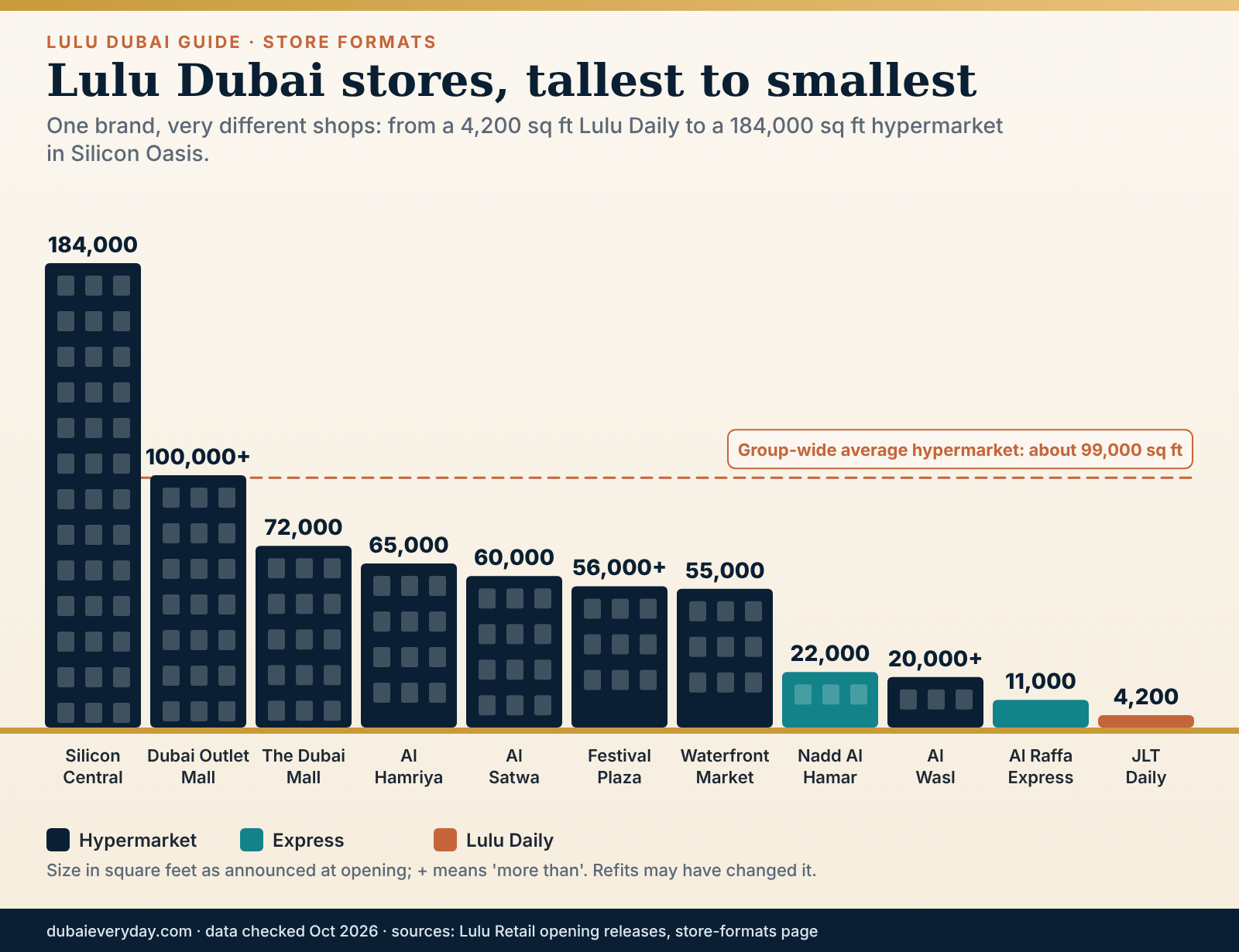
The Al Wasl store on Jumeirah 1 was described at its 2018 opening as more than 20,000 square feet; the Dubai Mall store is 72,000 square feet; the Dubai Outlet Mall store is over 100,000 square feet; and the Silicon Central store in Dubai Silicon Oasis was announced at 184,000 square feet over two levels.
The practical meaning: a small-format hypermarket such as Al Wasl is a neighbourhood supermarket with a Lulu sign, while Silicon Central is closer to a department store with a food hall. Do not expect the same range, the same queues or the same parking in both.
Express: the neighbourhood top-up
Express stores are the second-largest category in the UAE by count. The company describes them as daily-needs stores focused on groceries and fresh food, averaging about 2,400 square metres across the group. Dubai examples from newsroom releases include Al Raffa in Bur Dubai (about 11,000 square feet when it opened in August 2021), Barsha South (opened February 2020) and Nadd Al Hamar (22,000 square feet, announced in August 2025).
The Nadd Al Hamar release lists fresh produce, bakery, meat and seafood, deli, frozen and chilled items, dairy, a roastery and household basics, and says the store supports deliveries through grocery aggregators and Lulu’s own platform.
Express stores are where Lulu Dubai competes with the building-corner supermarket. They suit a quick restock of milk, vegetables and bread. They are a weaker choice for a 20 kg sack of atta, because the group describes the Express range as daily needs rather than bulk.
Lulu Daily and the mini market
The July 2025 release for Lulu Daily in Cluster L, Jumeirah Lake Towers, calls it the second store of a neighbourhood grocery concept at 4,200 square feet, with fruit and vegetables, bakery, fish and meat, deli, frozen, dairy, grocery essentials and basic household items. It adds that groceries can be ordered through the Lulu website and app for delivery to JLT and Dubai Marina “in minutes”, which is the company’s phrase, not a measured time.
The mini market is the smallest format, averaging about 160 square metres, and the formats page puts eight in the UAE. A mini-market opening in Dubai was reported in the trade press, but the details we could read were thin, so we do not describe individual mini markets here. Think of the format as a convenience shop that happens to share a supplier with the big stores.
Which format for which job
Weekly staples
Hypermarket. Rice, atta, dals, oil, frozen items and household goods are where the large stores earn their size. Go with a list and a car, or a taxi booked for the return leg.
Daily top-up
Express or Lulu Daily. Milk, bread, vegetables and herbs. If an Express store is a short walk away, it will beat a drive to a hypermarket for anything you can carry.
Festival preparation
The largest hypermarket you can reach. Festival markets and pre-order counters are described in company releases for stores across the UAE, and bigger stores have more floor space for them.
Urgent single items
App delivery from the nearest Express or Daily store, if your address is covered. Check coverage and the fee in the app first, because neither was readable on the pages we could access.
Lulu Dubai locations: where the branches are and how to pick one
The honest starting point is that we could not read the live Lulu Dubai store locator, and no public page we could access gives a clean, current list of Dubai branches. What follows is a dated Lulu Dubai dataset built from the company’s own opening releases, with a second tier from a property-portal directory that is clearly secondary. Use it to understand the pattern of the network, then confirm any Lulu Dubai branch in the app or on the website before you set off.
The dated Lulu Dubai dataset: what was announced, and when
Each row below comes from a Lulu Retail newsroom release. The size is the figure given at opening, so a store that has since been refitted may differ. The date is the release date, not necessarily the first trading day.
| Area | Format | Size at announcement | Release | Detail from the release |
|---|---|---|---|---|
| Al Wasl, Jumeirah 1 | Hypermarket | 20,000+ sq ft | Oct 2018 | Premium meat and fish, bakery, hot food counter, organic range |
| Waterfront Market, Deira | Hypermarket | 55,000 sq ft | Apr 2019 | Inside the fresh-food market; underground and outdoor parking |
| Al Hamriya, Bur Dubai | Hypermarket | 65,000 sq ft | Nov 2019 | Near Burjuman Metro Station, Exit 4 |
| Festival Plaza, Jebel Ali | Hypermarket | 56,000+ sq ft | Jan 2020 | First Lulu branch with the coffee-shop concept |
| Barsha South | Express | Not stated | Feb 2020 | Opposite Nord Anglia International School |
| Silicon Central, Dubai Silicon Oasis | Hypermarket | 184,000 sq ft | Apr 2021 | Two levels; grocery, fashion and lifestyle |
| Al Raffa, Bur Dubai | Express | 11,000 sq ft | Aug 2021 | Single level in a residential district |
| The Dubai Mall | Hypermarket | 72,000 sq ft | Oct 2023 | Entrance via the mall’s Zabeel parking area |
| Dubai Outlet Mall | Hypermarket | 100,000+ sq ft | Mar 2024 | In the extension area; called the 25th Lulu store in Dubai |
| Al Satwa | Hypermarket | 60,000 sq ft | Feb 2025 | Fish, meat, bakery, hot food stations, electronics |
| JLT, Cluster L | Lulu Daily | 4,200 sq ft | Jul 2025 | Delivery to JLT and Dubai Marina through the app |
| Nadd Al Hamar | Express | 22,000 sq ft | Aug 2025 | Described as the 112th store in the UAE |
A Dubai South residential-district hypermarket of about 50,000 square feet was also reported by Gulf News, and company news pages carry titles for Rashidiyah and Al Warqa openings, but we could not read their details. They are real stores in the network, not entries we can describe.
The second tier: a secondary directory
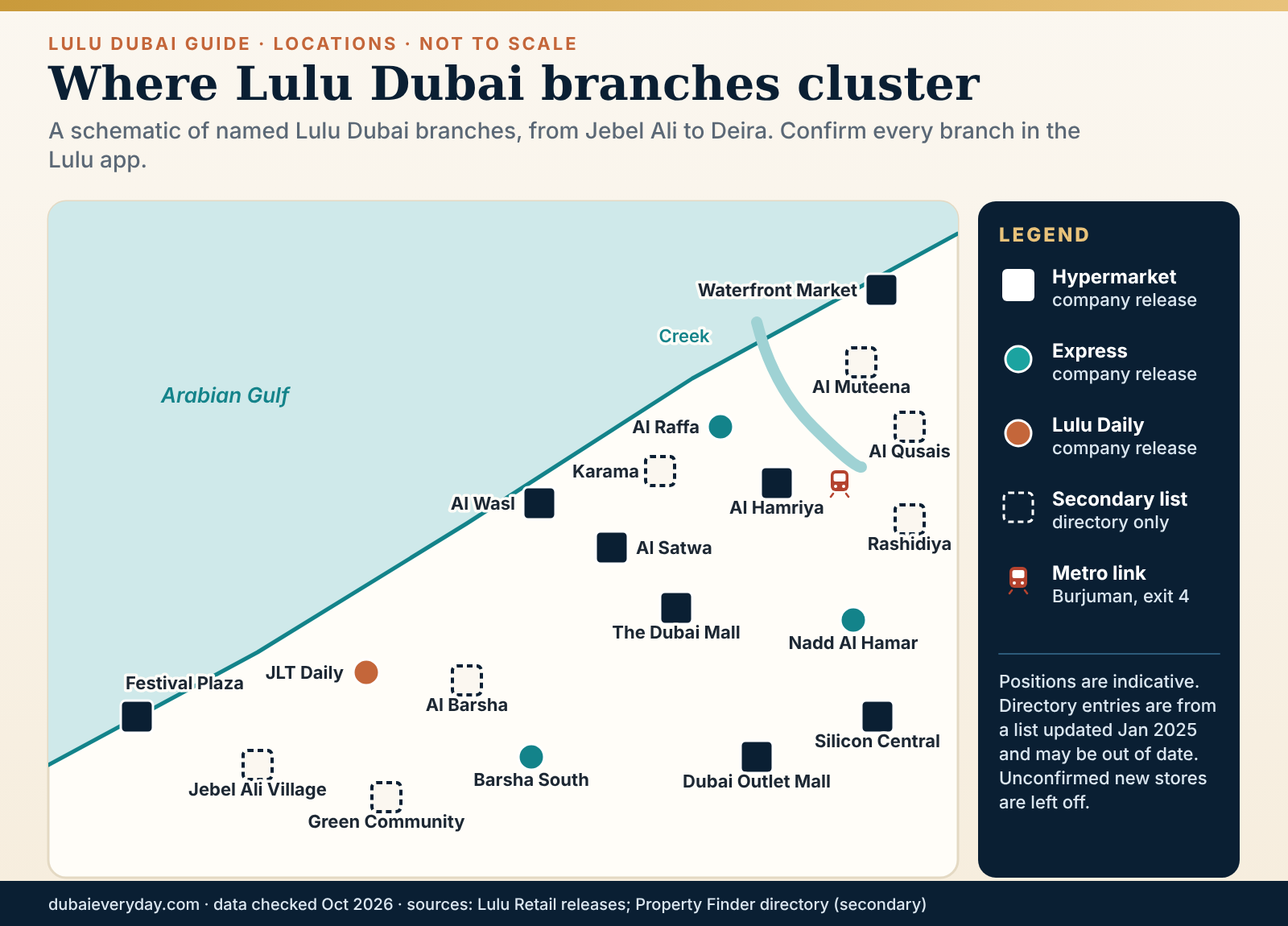
A Property Finder explainer, published in July 2024 and updated in January 2025, lists eight Dubai branches with addresses: Al Rashidiya, Green Community Village in Dubai Investment Park, Karama (Al Karama Park, opposite Zabeel), Al Hamriya (opposite Medeor Hospital), Deira (Al Muteena Street), Al Qusais (Al Nahda 1, near Stadium Metro), Al Barsha (Umm Suqeim Road) and Jebel Ali Village. It lists most branches as open from 8 am to midnight, with Deira shown as 9 am to 11 pm and Jebel Ali Village as 8 am to 11 pm on weekdays.
Treat those hours as a starting guess. The article itself writes “12:00 am” for closing time, which is ambiguous, and hours shift in Ramadan, on public holidays and between stores. A directory is also not a licence to assume a branch is still open. Confirm before you drive.
How many Lulu Dubai stores are there?
Published counts disagree, and we will not pick a winner. A Lulu release and Gulf News in October 2023 said the Dubai Mall opening raised the Dubai count to 24. The Dubai Outlet Mall release in March 2024 called that store the 25th in Dubai. A Gulf News report on the bag ban in May 2024 quoted Lulu as having 110 outlets in the UAE and “over 60” in Dubai. The Satwa release in February 2025 named another set of planned Dubai openings.
Our reading is that the lower numbers count hypermarket-scale stores and the higher number counts every format, but nothing we read confirms that. The company’s own FY2025 formats page gives UAE totals only: 43 hypermarkets, 64 Express stores and 8 mini markets, which adds up to 115 across the country by our addition. If an article, including this one, quotes a precise Dubai figure without a date, be suspicious.
Not yet confirmed as open. The Satwa release in February 2025 listed Al Jaddaf, JLT, Nad Al Hammar, Dubai Expo City, Khorfakkan and Oud Al Muteena as upcoming. We found openings for JLT (Lulu Daily) and Nadd Al Hamar (Express) only. We found no confirmation for Al Jaddaf, Expo City or Oud Al Muteena, so they are not in the table. Check the app before you plan a trip around a new-store rumour.
A neighbourhood-by-neighbourhood reading
Plot the table and a Lulu Dubai pattern appears. Old Dubai is dense: Deira, Al Muteena, Waterfront Market, Karama, Al Hamriya, Al Qusais and Rashidiya all have a branch, which matches where Dubai’s long-established South Asian communities live, though Lulu does not say it planned the network that way. The Jumeirah and Satwa corridor has Al Wasl and Satwa.
Downtown has one very large, mall-based hypermarket. The south and west, from Barsha and JLT to Jebel Ali and Dubai Investment Park, are served by a mix of hypermarkets and smaller formats. The east and the fringe, from Silicon Oasis to Nadd Al Hamar and the Outlet Mall, show where family housing has spread.
That is our reading of the map, not a statement from Lulu. It still helps: if you live in a newer district with only an Express store, plan big shops around the nearest hypermarket and treat the Express store as the daily shop.
Metro, parking and the Dubai Mall quirk
Only two metro connections appear in our sources. The Al Hamriya release places the store near Burjuman Metro Station, Exit 4, and the secondary directory places the Al Qusais branch near Stadium Metro. Everything else is a car or taxi trip. Metro is not a practical way to carry a 10 kg sack home in any case.
The Dubai Mall store has an unusual entrance. Lulu’s release says access is through the Zabeel parking of The Dubai Mall, so it is not inside the mall’s main retail floors. If you are staying nearby, the Downtown Dubai guide covers daily convenience in the area. The Outlet Mall store sits in a mall extension on the Dubai-Al Ain Road, described by Lulu as about 20 minutes from Downtown, and the release notes more than 7,000 parking spaces at the mall.
How to pick a Lulu Dubai branch in five steps
- Match the format to the jobWeekly shop or bulk packs: hypermarket. Top-up: Express or Daily. Do not drive to a 4,200 sq ft shop for a 20 kg sack.
- Check the hours in the appListings disagree, and Ramadan and holiday hours differ from normal ones.
- Work out the parking or drop-offMall stores such as Dubai Mall and Outlet Mall add mall parking time and sometimes a walk. Stand-alone stores are quicker to enter and exit.
- Choose the hourOff-peak is a weekday morning or late evening. Payday weekends and the days before festivals are the opposite. This is our reasoning, not a measured crowd figure.
- Keep a second optionIf the first branch is out of a key item, the app’s stock view, where available, or a phone call to the next branch saves a wasted trip.
South Asian foods at Lulu Dubai: what to expect and how to shop it
This is the reason many readers search for Lulu Dubai in the first place, and it is also the part of the topic where marketing language runs furthest ahead of evidence. So the section is split in two: what Lulu and credible reporting actually say about the South Asian range at Lulu Dubai, and a practical method for judging any shelf, whichever country the product comes from.
What can be verified about the Indian range at Lulu Dubai
Lulu Dubai’s strongest documented link is with India. During its India Utsav promotion in August 2025, Gulf News reported the group describing itself as the largest importer of Indian products into the UAE and targeting USD 2 billion of imports that year. That is a company claim, and we have not seen an independent trade statistic to confirm it. The same report lists the promotion’s range: organic goods, millets, nutritious grains, popular street foods, traditional sweets, biryanis and regional delicacies, available in stores and online.
The Kerala calendar is the best-documented part. The April 2026 Vishu coverage lists kani konna flowers, jackfruit, banana leaves and coconuts, with most produce bought directly from farmers through a Lulu division the report calls Fair Exports. The August 2026 Onam coverage, which Gulf News labels as partner content, lists banana leaves, flowers, fruit, vegetables, coconuts, pappadams and payasam ingredients.
It describes a 24-dish Onasadhya meal that can be pre-booked and more than 25 payasam varieties. The Lulu Retail homepage also lists a Mango Mania promotion in May 2026 with more than 85 premium mango varieties across the GCC.
Lulu says it sources from 85 countries and keeps buying teams on the ground in 19. The company does not publish which 19, so we cannot tell you how many sit in South Asia.
What cannot be verified: the rest of South Asia
We found no Lulu release describing Pakistani, Bangladeshi, Sri Lankan or Nepali ranges, and the store pages we could read do not list brands. Titles of earlier Lulu promotions show national food festivals, including Filipino ones, but a festival title is not a shelf list. It would be wrong to claim that every Dubai branch stocks every regional staple. Ranges are set store by store, and a branch serving a mostly Filipino or Arab neighbourhood will not look like one serving Karama.
The practical advice is boring but sound. If a particular brand of ghee, pickle or frozen paratha matters to you, check the app’s product search before going, and keep a specialist grocery as a back-up. Specialist shops can be better for one narrow range, and a hypermarket is better for the other forty items on your list.
A pantry method: eight shelf zones
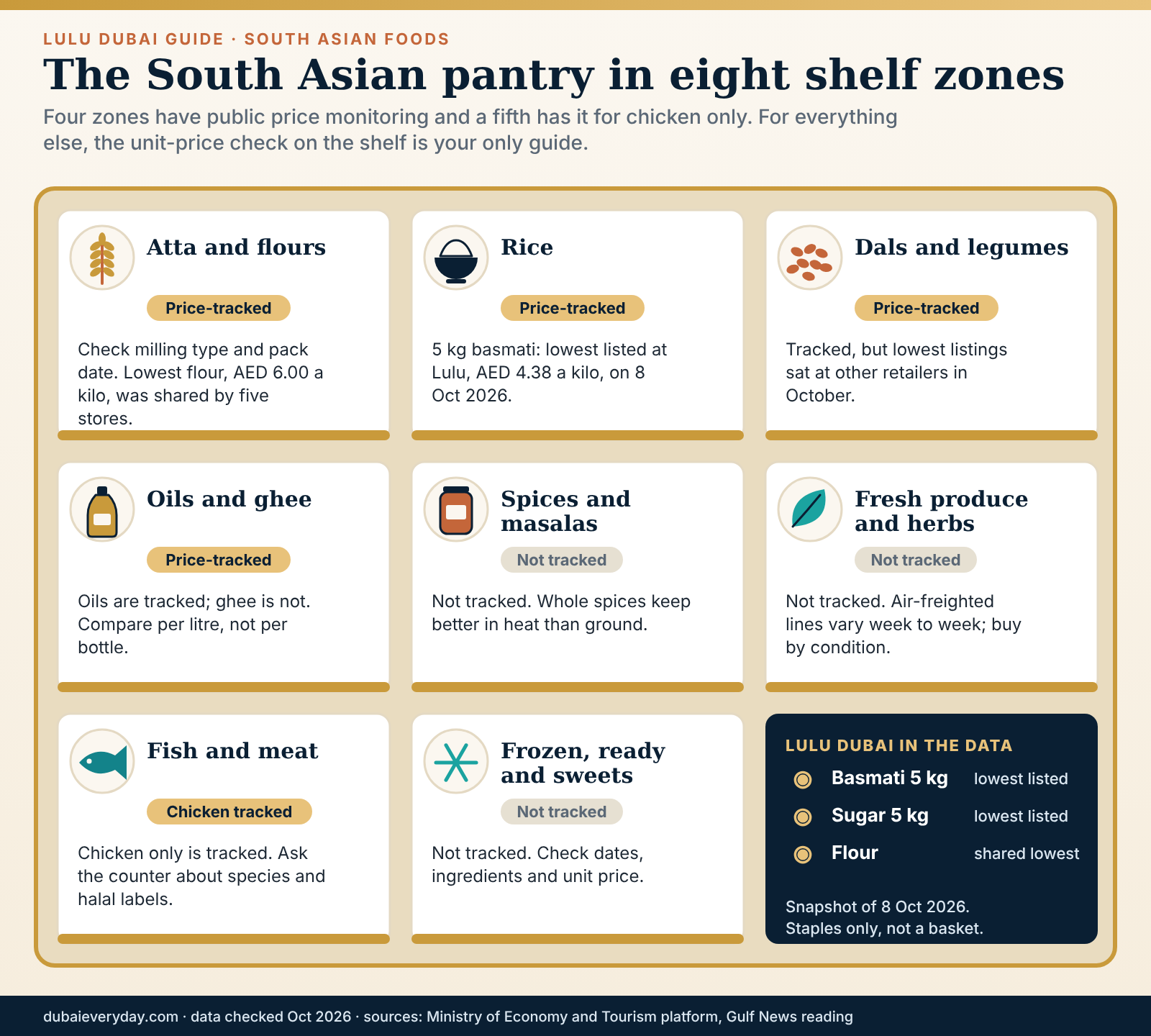
Rather than list products Lulu Dubai may or may not carry, here is a way to approach any South Asian pantry shop. The eight zones below cover the bulk of everyday cooking. Four of them line up with the nine essential categories that the ministry’s price platform monitors, and a fifth does so partly through chicken, which becomes important when we reach value.
Atta, flours and the flour trap
Wheat flour is where a quick comparison misleads. The ministry platform tracks “flour” by price per kilo, and Gulf News’s 8 October 2026 reading shows AED 6.00 a kilo as the lowest listed price shared by five retailers, Lulu among them. That does not tell you the figure applies to chakki atta, which many households buy by milling type and brand.
Check the pack for what it is, then check the unit price on the shelf label. The August 2026 ministry average for a 1 kg flour pack was AED 7.76 and for a 2 kg pack AED 12.26, which hints at how much the pack size matters.
Rice: the one category with strong evidence
Basmati is the clearest Lulu Dubai story in the data. The Gulf News reading of the ministry platform lists Lulu Dubai’s 5 kg basmati at AED 21.90, or AED 4.38 a kilo, as the lowest listed. The ministry’s own August 2026 averages are higher: AED 16.62 for 1 kg and AED 45.53 for 5 kg.
The two are not like-for-like, because the lowest listing is one specific product while the averages mix brands and grades. Even so, the gap is a reason to compare unit prices across brands instead of buying the name you grew up with. Other rice types, such as parboiled, matta or sona masoori, are not on the platform, so we have no public price evidence for them.
Dals, oils, spices and the rest
Legumes are tracked, but not in Lulu Dubai’s favour in the October reading: green lentils were lowest at Umm Al Quwain Coop and Union Coop, red lentils and beans at Al Maya, white chickpeas at Carrefour, and fava beans at Emirates Coop. That is a useful reminder that a chain can be lowest on rice and not on dals.
Oils are tracked by type (canola, corn, sunflower), and Lulu Dubai did not hold any lowest listing for them in that reading. Ghee, mustard oil, coconut oil, pickles, masalas and frozen breads are not tracked at all, so for those the only check is your own unit-price comparison.
For spices, buy whole where the recipe allows, and buy ground spices in packs you will finish within a couple of months. Heat and humidity dull ground spices faster than most people expect. That is general kitchen sense, not a Lulu fact.
Fresh produce, curry leaves and fish
Fresh produce is where air freight shows. Lulu’s own statements describe fresh and festival items flown in from India, and the March 2026 cargo-flight coverage names New Delhi and says more consignments were planned from Mumbai and Bengaluru. In practice, this means fresh herbs, curry leaves and specialist vegetables can vary week to week. Buy what is in good condition today and plan the recipe afterwards.
For fish and meat, the Waterfront Market release is the clearest documented link, because the market houses fish and seafood, fruit and vegetables, and meat and poultry sections alongside the Lulu Dubai hypermarket. The release does not say which of those the Lulu Dubai store itself sells, so we do not claim any particular species. If halal certification matters to you, read the label or ask the counter, because we did not verify certification at any Lulu Dubai counter.
Buy at the hypermarket
Rice, atta, sugar, oil, dals in bulk, frozen items and household goods. These are the long-life items where pack size and unit price matter most.
Buy fresh and close to home
Curry leaves, coriander, green chillies, drumstick and soft fruit. Buy them where you can use them within two days.
Check before you commit
Brands of ghee, pickles and frozen breads. Use the app search or a quick look at the shelf before you plan a recipe around them.
Six checks that work on any shelf
- Read the unit price on the shelf label. Under the ministry’s Decision 245 of 2024, retail stores and online merchants with premises over 1,000 square metres must show prices per standardised unit.
- Check the production and expiry dates on flour, spices and oils; long-life does not mean old stock is fine.
- Compare two pack sizes of the same brand before you reach for the biggest one.
- Look at the country of origin on rice and dals, which is printed on the pack and can affect taste and cooking time.
- Squeeze bags of flour and rice to check for dampness or tears; damaged packs go off faster in Dubai heat.
- Buy one small pack of a new brand before you buy the family sack.
If you are building a home from scratch and want the rest of the first-week list, the home setup guide covers the utilities, cooling and furniture side that sits around the shopping.
The festival calendar: Vishu, Onam, India Utsav, mangoes and Ramadan
Lulu Dubai is unusually open about its festival rhythm, and that rhythm shapes what is on the shelf more than any weekly promotion leaflet. The caveat is that nearly every number below comes from the company or from partner content, so read the figures as intent and scale, not as proof of price or availability on a particular day.
The Lulu Dubai year in six moments
India Utsav: January and August
Lulu newsroom titles show editions around Republic Day and Independence Day. The August 2025 edition ran for 10 days to 22 August across all hypermarkets in the region, covering organic goods, millets, street foods, sweets and biryanis, in stores and online.
Ramadan: February 2026, February 2027
For 2026, Gulf News reported up to 65 percent off more than 5,500 products and a price freeze on 300 essentials. Ramadan 2027 is projected to begin on 8 February, with Eid Al Fitr expected on 9 or 10 March, subject to moon sighting.
Vishu: April
In April 2026 the company said it had moved over 3,000 tonnes of Kerala produce into the Gulf by air ahead of Vishu, with a Payasam Festival of more than 20 varieties and pre-orders for a Vishu sadya.
Mango season: May
The Lulu Retail homepage lists a May 2026 Mango Mania promotion with more than 85 premium mango varieties across the GCC.
Onam: late summer
August 2026 partner content describes Onam markets in stores across the UAE, a 24-dish Onasadhya for pre-booking and over 2,500 tonnes of perishables and essentials brought to Gulf markets.
World Food Festival: spring
The company’s news list shows a GCC-wide World Food Festival on 20 April 2026. It is a general promotion of international products, not a South Asian one.
Diwali, Eid Al Adha, Christmas and other occasions also drive demand, but we found no Lulu release for them from the past year, so we do not describe their stock or offers. Absence from our sources does not mean absence from the shelves.
What the Lulu Dubai festival coverage actually tells you
Strip the language and four things survive. First, festival fresh produce is air-freighted in volume, so it is typically available but not cheap to move. Second, sadya and similar meals are sold as pre-orders, so the sensible time to commit is days before, not on the day. Third, loyalty points are used as a lever: the Onam coverage says customers who pre-order the sadhya in store receive 600 Happiness Points. Fourth, headline discounts are selective.
That last point deserves arithmetic. Lulu’s group-wide formats page puts the average hypermarket at roughly 200,000 SKUs. The Ramadan 2026 headline of “up to 65 percent off” applied to more than 5,500 products. Our calculation: 5,500 divided by 200,000 is 2.75 percent of the range, and the discount was a ceiling, not an average. The 200,000 figure includes non-food and is a group-wide average, so this is a rough yardstick, but it is a useful corrective to a banner that makes a whole store sound reduced.
The Onam article we read is labelled partner content from Reach by Gulf News, which means the company supplied or shaped it. We use it for what Lulu says it is offering and the promotion terms it states (spend AED 200, get AED 50 off, plus selected bank-card offers). We do not use it as evidence of fair pricing or stock levels. Check offer terms, dates and exclusions in the app or on the shelf label.
How to use the Lulu Dubai calendar without overspending
- Buy long-life items before the rushRice, atta, oil and sugar do not spoil. Buy them when the weeks before a festival look quiet rather than when the offers are loudest.
- Pre-order what must be freshSadya and festival boxes need a booking. Ask what is included and the pick-up or delivery time, since details were not readable on pages we could access.
- Keep fresh shopping close to the dayBanana leaves, flowers and soft fruit are best bought one to two days ahead. This is common sense, not a Lulu rule.
- Use the nine protected categories as an anchorUnder Decision 246 of 2024, price rises on nine essential categories need ministry approval, with at least six months between rises. A festival offer on rice or oil is competing against a regulated baseline, not an open market.
- Keep the receipt for anything promotedIf a displayed offer does not scan at the till, the receipt is your evidence for a staff correction or a complaint.
If you are planning around the 2027 holy month in detail, the supermarket guide sets out how the main chains approach Ramadan, and visitors planning a trip around the holy month can start with the Dubai travel guide.
Fresh counters, hot food and central kitchens
A Lulu Dubai hypermarket is a grocery store with a restaurant’s worth of production attached. The company’s formats page says it runs 33 stand-alone central kitchens, 20 of them in the UAE, producing about 600 fresh SKUs per store. It also states that in-house fresh food accounts for 22 percent of fresh private-label SKUs, a figure we quote as published without being able to unpack its definition.
What the stores say they sell
Company releases consistently describe the same fresh set: fruit and vegetables, bakery, meat and fish, deli, dairy, a roastery and hot food stations. Several releases go further. The Festival Plaza store was the first with a Lulu coffee-shop concept, serving café-style dishes, coffee, smoothies and baked goods. The Dubai Outlet Mall and Satwa releases both mention hot food stations offering world cuisines and a roastery. The Dubai Mall release stresses a larger food area, an in-store café and specialty ranges (organic, vegan and free-from).
For Ramadan 2026, Gulf News reported Ramadan combo boxes, Arabic grills and ready-to-eat meals from Lulu’s central production kitchen, sold in stores and online. That tells you the kitchens feed both counters and the app, which is useful when you decide whether a cooked item is worth ordering for delivery.
The Waterfront Market link
The Waterfront Market store in Deira is the odd one out. Lulu’s 2019 release says the hypermarket opened in the market on the Deira Corniche at the junction of Al Khaleej Road and Abu Hail Street, and the market’s own sections include grocery, spices and dry goods, fish and seafood, fruit and vegetables, and meat and poultry. The release calls the market the region’s largest fresh-food facility and says it has underground and outdoor parking, air conditioning, a pharmacy, a money exchange and cafés.
If fish is your main reason to shop, ask whether the species you want comes from the Lulu Dubai counter or a market stall, since the release does not say which sells what. The advantage of the site is that you can compare in one trip.
Pork, labelling and dietary needs
Dubai Municipality requires food outlets to hold a permit to sell pork and to store it separately, according to a 2018 Gulf News report on the municipality’s rules, which also mentions fines of AED 5,000 to AED 20,000. That report is old, and we found no Lulu Dubai statement on how each branch handles it. If you avoid pork for any reason, check labels and ask staff how it is handled. For allergies or intolerances, treat the “free-from” ranges as a starting point and read the ingredient list yourself every time.
Getting fresh food home in Dubai heat
From late spring to early autumn, a parked car can reach temperatures that spoil dairy and fish within an hour or two. Shop for chilled and frozen items last, ask for them to be bagged together, use an insulated bag, and go straight home. If your trip includes the school run or a second stop, split the shopping or use delivery instead. The Dubai with kids guide covers the wider heat-and-logistics planning for family days.
Bulk buying at Lulu Dubai: when big packs really save money
Bulk buying is the habit that defines the stereotype of a Lulu Dubai trolley: a 5 kg bag of rice, a 5 kg bag of sugar, a tray of 30 eggs and a bottle of oil big enough to need two hands. It is also the habit most often justified by feeling rather than arithmetic. We could not find a Lulu Dubai wholesale scheme or a published bulk-discount policy, so “bulk” here simply means larger consumer packs from the normal shelf.
What we can do is use the ministry’s public data to test whether bigger packs are cheaper per kilo or per litre, and by how much. The answer is: often, but not always, and the biggest savings come from changing the brand as well as the pack size.
The pack-size arithmetic behind Lulu Dubai bulk buying
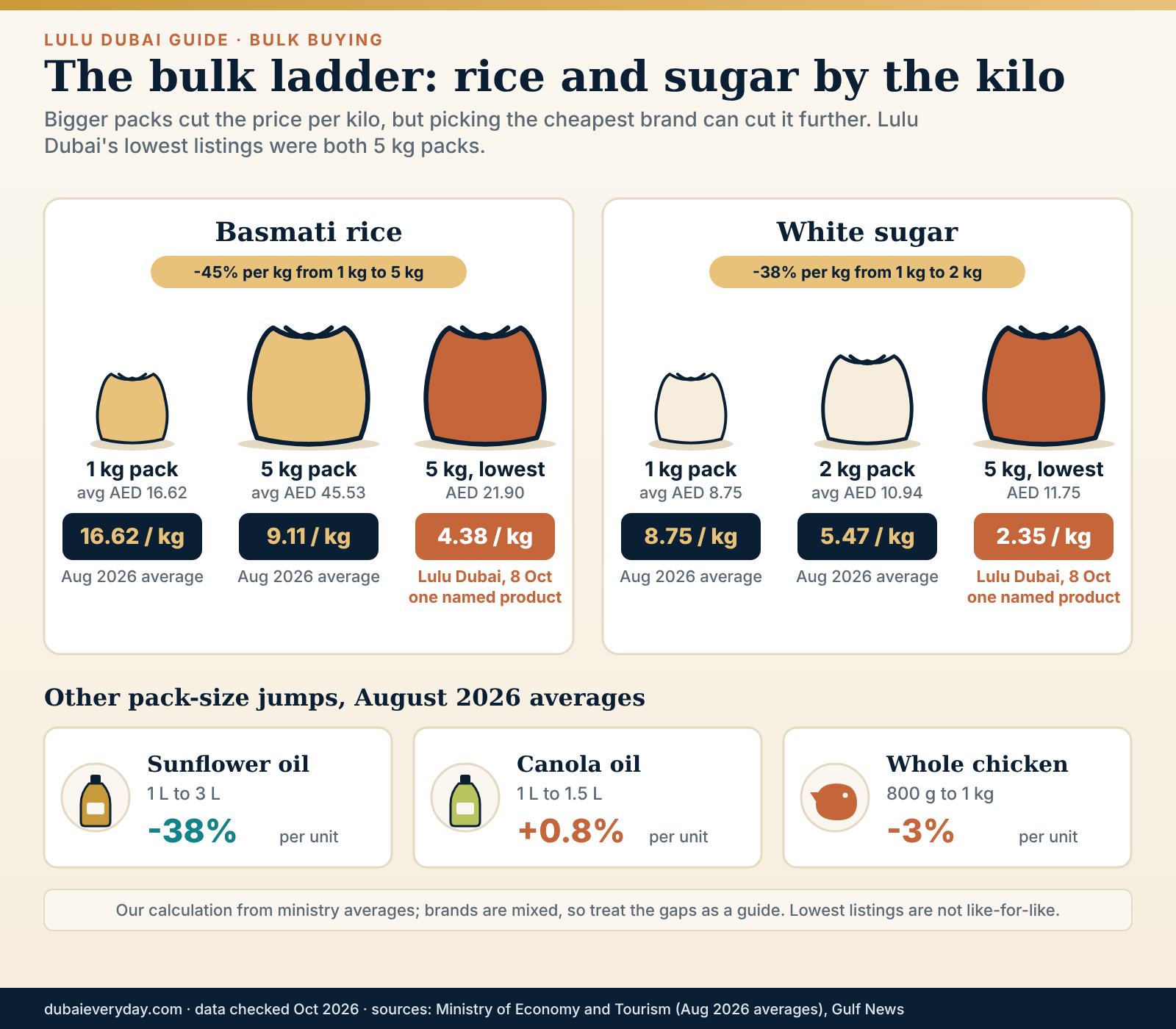
The Ministry of Economy and Tourism published average prices for August 2026 across the 13 outlets on its platform. Using those averages, our calculation of the price per unit for a smaller and a larger pack of the same commodity looks like this.
| Commodity | Smaller pack (average) | Per kg or litre | Larger pack (average) | Per kg or litre | Change |
|---|---|---|---|---|---|
| White sugar | 1 kg, AED 8.75 | 8.75 | 2 kg, AED 10.94 | 5.47 | -37.5% |
| Basmati rice | 1 kg, AED 16.62 | 16.62 | 5 kg, AED 45.53 | 9.11 | -45.2% |
| Flour | 1 kg, AED 7.76 | 7.76 | 2 kg, AED 12.26 | 6.13 | -21.0% |
| Sunflower oil | 1 L, AED 19.31 | 19.31 | 3 L, AED 35.70 | 11.90 | -38.4% |
| Corn oil | 0.75 L, AED 13.85 | 18.47 | 1.5 L, AED 24.92 | 16.61 | -10.0% |
| Canola oil | 1 L, AED 15.86 | 15.86 | 1.5 L, AED 23.97 | 15.98 | +0.8% |
| Whole chicken | 800 g, AED 18.94 | 23.68 | 1 kg, AED 22.97 | 22.97 | -3.0% |
Read the table with care. The ministry averages mix brands and outlets, so the smaller and larger packs are not guaranteed to be the same product, and the 5 kg basmati average may include cheaper brands that the 1 kg average does not. The pattern is still instructive. For rice, sugar and sunflower oil, the larger pack cuts the unit price by more than a third. For canola oil there is no saving at all in this sample, and for a whole chicken the saving is small and the perishable risk is large.
Where Lulu Dubai’s lowest listings fit
Now add the October reading. Lulu Dubai’s 5 kg basmati at AED 21.90 works out at AED 4.38 a kilo, about 52 percent below the August average of AED 9.11 a kilo for 5 kg packs. Its 5 kg sugar at AED 11.75 is AED 2.35 a kilo, about 57 percent below the August average of AED 5.47 a kilo for 2 kg sugar. Both comparisons are our own calculation, and they mix a single named product with a market-wide average and two different months.
What they do show is the spread inside the market. The gap between an average pack and the cheapest listed pack can be larger than the gap between a small and a large pack. The shelf label on the cheapest sack in the aisle may do more for your budget than moving up one pack size.
An illustrative annual rice bill
Illustrative example (not a quote or market fact). Say a household cooks with 3 kg of basmati a month, which is 36 kg a year. At the August average for a 1 kg pack, AED 16.62 a kilo, that is about AED 598. At the August average for 5 kg packs, AED 9.11 a kilo, it is about AED 328.
At Lulu Dubai’s lowest listed unit price, AED 4.38 a kilo, it would be about AED 158, if that product suits your cooking. The point is not the exact figures; it is that pack size and brand together can move one staple by several hundred dirhams a year.
Two limits apply. The cheapest sack is not always the grain you want for biryani, and price per kilo ignores how much rice you waste through poor storage. If you cook a basmati-heavy menu, taste before you commit to 36 kg of anything.
When bulk becomes a false economy
Perishables
Chicken showed a 3 percent unit saving in the sample. Fresh produce, bread and dairy rarely repay a bigger pack unless you freeze or cook in batches.
Small kitchens
A 20 kg sack in a studio flat is a daily obstacle. If a pack lives on the floor in the heat, the saving shrinks.
Slow-use items
Ground spices, specialist flours and cooking oils lose quality over months. Buy the quantity you will finish in that window.
Cash flow
If a month of bulk shopping squeezes the week before payday, you pay for it elsewhere. The best bulk strategy is the one your wallet can repeat.
Storage in a Dubai kitchen
Heat and humidity are the real enemies of dry goods in a Dubai apartment, particularly in summer and in kitchens without good ventilation. Insects in flour and rice are a common household problem anywhere warm, and the standard defence is simple. Decant into airtight containers, keep them off the floor and away from the cooker, and label them with the purchase date. Some households also freeze flour for a few days before storing it. That is a widely repeated kitchen practice, not an official recommendation we have verified.
- Decant large sacks into two or three airtight containers instead of one, so you open less at a time.
- Keep oil in a cool, dark cupboard away from the hob.
- Put new packs behind older ones so the oldest is used first.
- Write the buy date on the lid in permanent marker.
- Check rice and flour for clumping or odd smells every few weeks in summer.
- Do not stack heavy sacks on high shelves; a split bag over a hot hob is a mess.
Sharing a big buy
Two flats splitting a 20 kg sack is the oldest bulk strategy there is, and it works for the same reason in Dubai as anywhere: you get the large-pack unit price without the large-pack storage problem. Agree the split, buy on one receipt for simplicity, and settle by app or cash that day. It is not a Lulu service, and Lulu has no stake in it, but it is a useful workaround for people in small flats.
Getting heavy shopping home
Bulk shopping has a transport cost that rarely appears on the receipt. Rice, sugar, oil and water bottles weigh a lot, and the bags have to get from the car park to the lift. If you shop by car, check whether your branch offers trolley assistance; we could not verify a trolley or valet service at any Lulu Dubai branch.
If you shop by taxi, ask the driver whether the boot is big enough before loading. And if you shop heavy often, price the delivery option against the cost of the trip, which the delivery section sets out step by step.
Once a household is set up, the cost of keeping a kitchen stocked becomes a regular line in the monthly budget. To see how Lulu Dubai sits against the other big chains on price level, the chain-by-chain supermarket comparison is the better companion.
Lulu Dubai prices and value: what the ministry data shows
“Is Lulu Dubai cheaper?” is the question underneath most searches for this topic, and it is the one where bad answers are easiest to give. A single basket test on a single day tells you very little, and promotional leaflets tell you about promotions. The strongest public evidence for the UAE is the ministry platform, so we start there and are strict about what it can and cannot support.
The ministry platform in one paragraph
The Essential Goods Prices Platform is run by the Ministry of Economy and Tourism and sits in its open-data section. It covers nine categories (cooking oil, wheat, rice, dairy, legumes, sugar, eggs, bread and chicken) with subcategories such as basmati rice, brown eggs and sliced white bread. Its store filter lists 13 outlets, including “LuLu hypermarket” and “Carrefour hypermarket”, alongside Spinneys, Union Coop, Nesto, Choithrams, Emirates Coop, Al Maya and others. On 29 October 2026 the dashboard showed “Last updated” as 28 October.
There are limits. The platform shows hypermarket-level pricing for Carrefour and Lulu, not necessarily the Express or Daily formats. The page text we could read did not allow us to map every price to its store reliably, so we rely on the ministry’s own summary lines and on a Gulf News reading that calculated unit prices from the platform’s pack prices.
The October 2026 tally
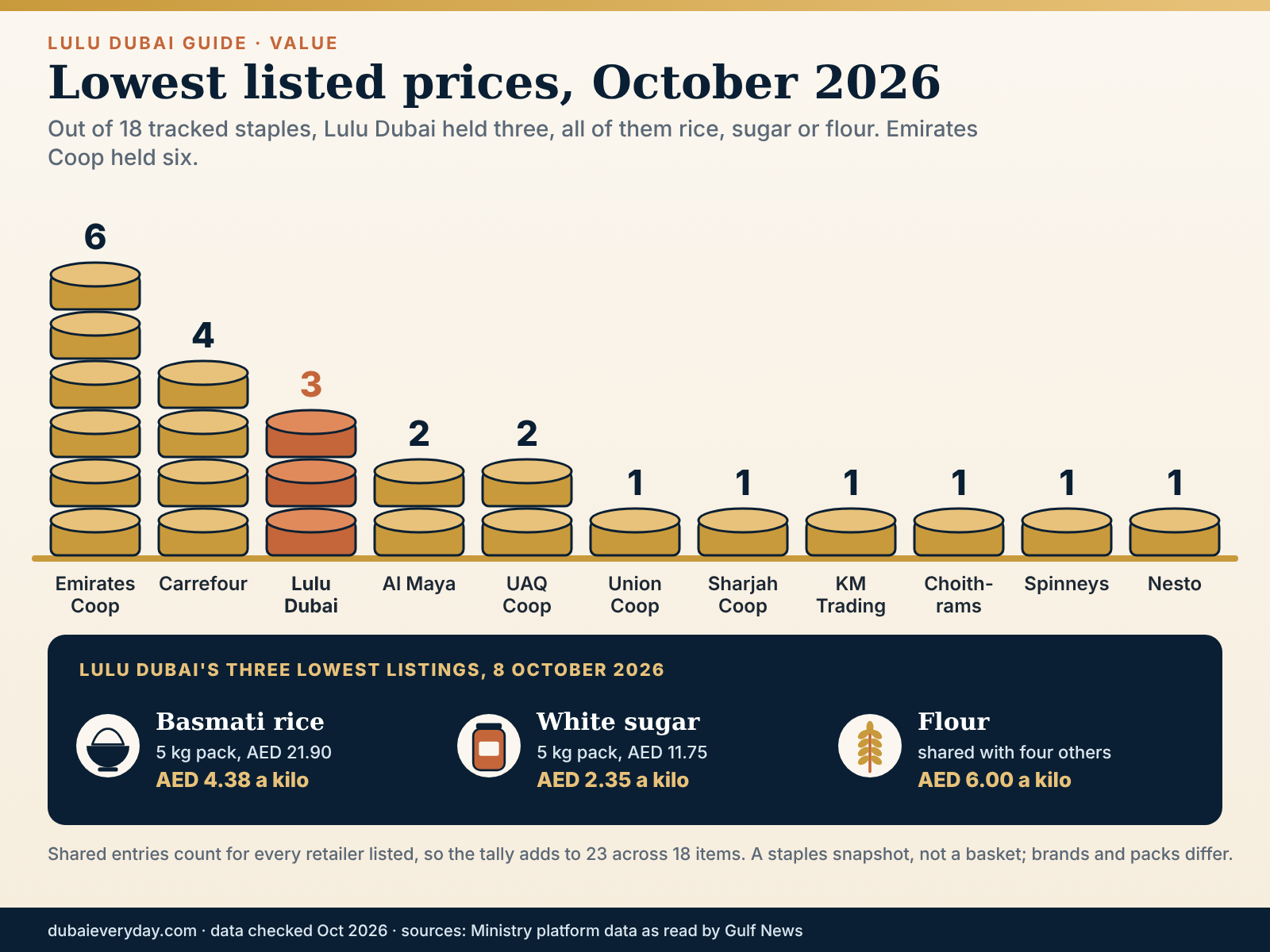
Gulf News, using platform data dated 8 October 2026 and updated on 23 October, listed the lowest price for 18 products. Counting shared entries for every retailer that appears, the tally was Emirates Coop 6, Carrefour 4, Lulu 3, Al Maya 2, Umm Al Quwain Coop 2, and one each for Union Coop, Sharjah Coop, KM Trading, Choithrams, Spinneys and Nesto.
Lulu Dubai’s three entries were basmati rice (AED 4.38 a kilo, from a 5 kg pack at AED 21.90), white sugar (AED 2.35 a kilo, from a 5 kg pack at AED 11.75) and flour, shared at AED 6.00 a kilo with four other retailers.
What the tally says, and what it does not
It says that on three of the staples that matter most to South Asian household cooking, Lulu Dubai held or shared the lowest listed price on one specific day. It says Lulu Dubai is not the lowest everywhere: eggs, corn oil and chickpeas went to Carrefour, chicken, milk and two oils to Emirates Coop, and lentils to others.
It does not say that Lulu Dubai is cheaper than the other chains overall, or that the rice and sugar you buy are the lowest-priced product. The 18 lowest entries are 18 numbers out of a 200,000-SKU hypermarket. It does not cover fresh vegetables, fish, packaged snacks, frozen foods, ghee, spices, baby products or any non-food item. And it describes a single day. The article’s own caveats say it is not a full basket comparison and that brand, size and specification vary.
Our inference, labelled as such: Lulu Dubai’s two outright wins were both 5 kg packs. That is consistent with a large-pack, volume-led pricing approach on staples, which would also match the group’s description of hypermarkets as stores for weekly shopping and bulk. The data cannot prove that.
What Lulu says about its own pricing
The second-quarter 2026 release says competitive pricing in food is a stated priority, that private-label ranges are expanding in food, and that lifestyle products saw market-driven price reductions. It reports a gross margin of 23.0 percent, versus 23.2 percent in the same quarter of 2025. A broadly stable margin tells you about the company’s finances. It does not tell you whether any given product is priced above or below its competitors.
Private label deserves a sentence of its own. The release says the private-label share rose but gives no figure. Own-brand rice, oil, pasta and tinned goods are often where a chain’s price advantage sits, so it is worth comparing a Lulu-branded pack against the national brand on the unit price. We have no verified price comparison for Lulu Dubai private label, and we will not invent one.
Build your own Lulu Dubai basket in 20 minutes
Because the public data covers so little, the most reliable value check is your own. This method takes about twenty minutes and repeats well.
- Write down twelve things you buy every monthInclude a brand and a pack size for each. Use exactly the same list at every store you compare.
- Record the unit price, not the shelf priceThe unit price is the price per kilo, litre or piece. Stores above 1,000 square metres must show it under Decision 245 of 2024.
- Check the nine tracked categories on the ministry platformLook at rice, flour, sugar, oil, eggs, dairy, legumes, bread and chicken, and note the date shown.
- Add the cost of getting there or having it broughtInclude parking, taxi fares, your time or the delivery fee, because a lower shelf price can disappear into the journey.
- Repeat in a different weekOne snapshot can be a promotion. Two snapshots a fortnight apart show the pattern.
Illustrative example (not a quote or market fact). Suppose your twelve-item list costs AED 400 at a store 10 minutes away and AED 380 at Lulu Dubai. The Lulu Dubai saving is AED 20, or 5 percent. If reaching Lulu Dubai costs an extra AED 15 in a taxi each way, the saving turns into a AED 10 loss. If you drive and the store is on your commute, the same saving is real. The percentages are invented to show the logic; the lesson is to price the journey as well as the basket.
Value beyond the shelf price
Range
If a shop saves AED 20 but cannot supply the three items that make the meal, the lower bill is no use. For South Asian cooking, range often matters more than a few fils.
Freshness
A short-dated bag of vegetables costs more per useful kilo. Check dates and condition first, and compare price second.
Time and place
A store you can reach in ten minutes will be used more often, and small frequent shops waste less food than one enormous weekly trip.
Loyalty and offers
Member prices and points can be worth having, but only if you would shop there anyway. Never choose a store for points alone.
Happiness rewards, payment options and promotions
Lulu’s loyalty scheme is called Happiness, and it is worth understanding because it is the lever behind many of the in-store prices that differ for members and non-members. It is also one of the places where the public information stops short of the numbers you need.
What is known about Happiness at Lulu Dubai
Lulu launched the scheme on 21 March 2023, timed to the International Day of Happiness, with a ceremony at Mushrif Mall in Abu Dhabi. Gulf News reported that it started in the UAE and would extend to the group’s stores across the GCC. Shoppers can join through kiosks in hypermarkets or online. The company listed key benefits: instant additional discounts, reward points, exclusive member prices, and offers from other brands and tenants. Rewards are applied at the till through the Lulu app or the shopper’s registered mobile number.
The App Store listing for the Lulu app adds recent version notes: an update lets you reach Happiness points and a QR code from the app, and another shows in-store receipts. The Onam coverage says that pre-ordering the sadhya in store earned 600 Happiness Points. It does not say what those points are worth in dirhams.
What is not known
We could not find a public earning rate, a redemption value, an expiry rule or a tier structure. Third-party articles describe co-branded bank-card offers, but the figures vary by source and we have not verified them, so we do not quote them. Before you rely on points, find three things in the app: how many points you earn per dirham, how many points equal one dirham at redemption, and when the points expire.
Check before you chase points. A scheme that gives you points on spending can still push you to spend more than you planned. Compare the value of a typical week’s points with what a cheaper basket elsewhere would save. If the points are worth less than the price gap, the cheaper basket wins. This is general consumer information, not financial advice.
Payment options
The App Store listing says the app accepts credit and debit cards and “secure digital payments”, and mentions buy-now-pay-later through Tabby. A property-portal directory lists cash, cards, Samsung Pay and Apple Pay at branches, which is secondary and undated, so confirm at the till. We would be cautious about using instalment products for groceries. Food is a recurring expense, and spreading it over weeks can hide how much you are spending each month.
If you want help setting up the phone side of this properly, including payment apps and digital ID, the Dubai internet and mobile guide covers apps and payments in a resident-friendly way.
Lulu Dubai promotions: how to read them
In our reading, retail promotions in Dubai tend to follow three patterns. Event campaigns, such as Ramadan or festival weeks, apply to a selected range and run for a fixed period. Weekly offers rotate lines. Bank-card offers add a discount for specific cards on top.
Read three things on every offer: the dates, the pack size it applies to, and whether a minimum spend applies. The Onam promotion we read is a good example. It applied to spending AED 200 or more for an AED 50 discount, with extra offers on selected cards, which is a headline of 25 percent only at the threshold and falls as the basket grows.
That last sentence is our calculation: AED 50 off AED 200 is 25 percent; on a AED 400 basket it is 12.5 percent. We do not know if the offer applied once per customer, per transaction or per day, and the partner article did not say.
Lulu delivery in Dubai: app, Quick, Scheduled and third-party routes
Delivery is where this guide has to be most careful. Lulu’s own website, FAQ and help pages blocked or failed our reads, so we cannot quote delivery fees, minimum baskets, slot windows or coverage areas. What we can document is the set of channels the company describes and the features its app listing advertises. Everything else you must read in the app at checkout.
The Lulu Dubai delivery channels that exist
The company’s store-formats page lists e-commerce as its own website and the Lulu app, plus third-party platforms: Amazon UAE and Talabat across the GCC. It also reports more than 300,000 daily visitors to its online properties in 2025. The Q2 2026 release puts online revenue at USD 165 million, up 53 percent, which is 8.9 percent of retail sales. So this is not an experiment; it is a large and growing share of the business.
Lulu app and website
The App Store listing advertises Quick Delivery, described as essentials “in minutes”, and Scheduled Delivery for a time you choose. Recent version notes mention delivery-availability checks before ordering, live rider tracking, order tracking and one-time-password security for high-value deliveries.
Express and Daily stores
The Nadd Al Hamar release says the Express store supports deliveries through grocery aggregators and Lulu’s own platform. The JLT Lulu Daily release says orders can be delivered to JLT and Dubai Marina through the website and app.
Amazon UAE
A 2022 Gulf News report said Lulu groceries launched on Amazon with a trial in Dubai, with Lulu supplying stock and Amazon handling the last mile. The formats page still lists Amazon UAE. Check the Amazon app for current coverage.
Talabat and other aggregators
The formats page lists Talabat as a third-party platform. We could not confirm which Dubai stores or ranges appear on any aggregator on a given day.
One more fact helps with expectations. A 2021 release describes Lulu’s e-commerce fulfilment centre in Al Quoz as 60,000 square feet, temperature-controlled for fresh and frozen goods and the company’s third worldwide. In plain terms, some app orders are picked from a central warehouse and some from stores, and the product mix may differ between the two.
What is not confirmed about Lulu Dubai delivery
We found no readable page giving Lulu’s delivery charges, minimum order values, delivery windows, coverage map, substitution policy, cold-chain handling for online orders or online returns process. A property-portal directory says most Dubai branches offer same-day delivery by phone, but that is secondary and undated. A company news list shows a “Lulu Minutes” ultra-fast service launched in Saudi Arabia in April 2026; we found nothing saying it exists in the UAE, so do not assume it.
Be sceptical of any article, including search snippets, that quotes a Lulu Dubai delivery fee or minimum with confidence. Those numbers change, vary by store and slot, and are easy to get wrong.
How to order from Lulu Dubai without surprises
- Set your address firstThe app’s availability check runs before ordering, according to its version notes. If your address is not covered, you will see that before you fill a basket.
- Pick the delivery type for the jobQuick for items you need now, Scheduled for the weekly shop. Compare the fee shown for each before choosing.
- Check the substitution settingIf an item is out of stock, find out whether the app swaps it or removes it. For rice and atta, a swapped brand can change a recipe.
- Read unit prices before you addPack sizes in apps are easy to misread on a phone screen. Compare per kilo or per litre.
- Check the fee and minimum at the payment screenThis is where the final number appears. If a free-delivery threshold exists, the app should show how far you are from it.
- Be there, or tell someone to beChilled and frozen goods should not sit at a door in summer heat.
- Check the order on arrivalLook at dates, damage and quantities while the rider is present, and take photos of anything wrong.
- Raise problems the same dayUse the in-app help and keep the order number and receipt.
A break-even you can run yourself
Delivery makes sense when the fee is lower than the cost of fetching the shopping yourself. That cost has three parts: the journey (taxi, fuel and parking), your time, and the food you buy impulsively when you are in the aisle. A fourth part works in the opposite direction: apps make it easier to notice an unplanned item and add it, so you can overspend on delivery too.
Illustrative example (not a quote or market fact). Say the nearest hypermarket costs AED 30 return by taxi and you spend an hour on the trip. A hypothetical delivery fee of AED 15 saves AED 15 in travel before you count the hour. Raise the fee to AED 35 and the trip wins on cash, though not on time. Replace “AED 15” with the fee you actually see at checkout, and delivery’s break-even is your own number. If you drive and parking is free, the maths flips for small baskets.
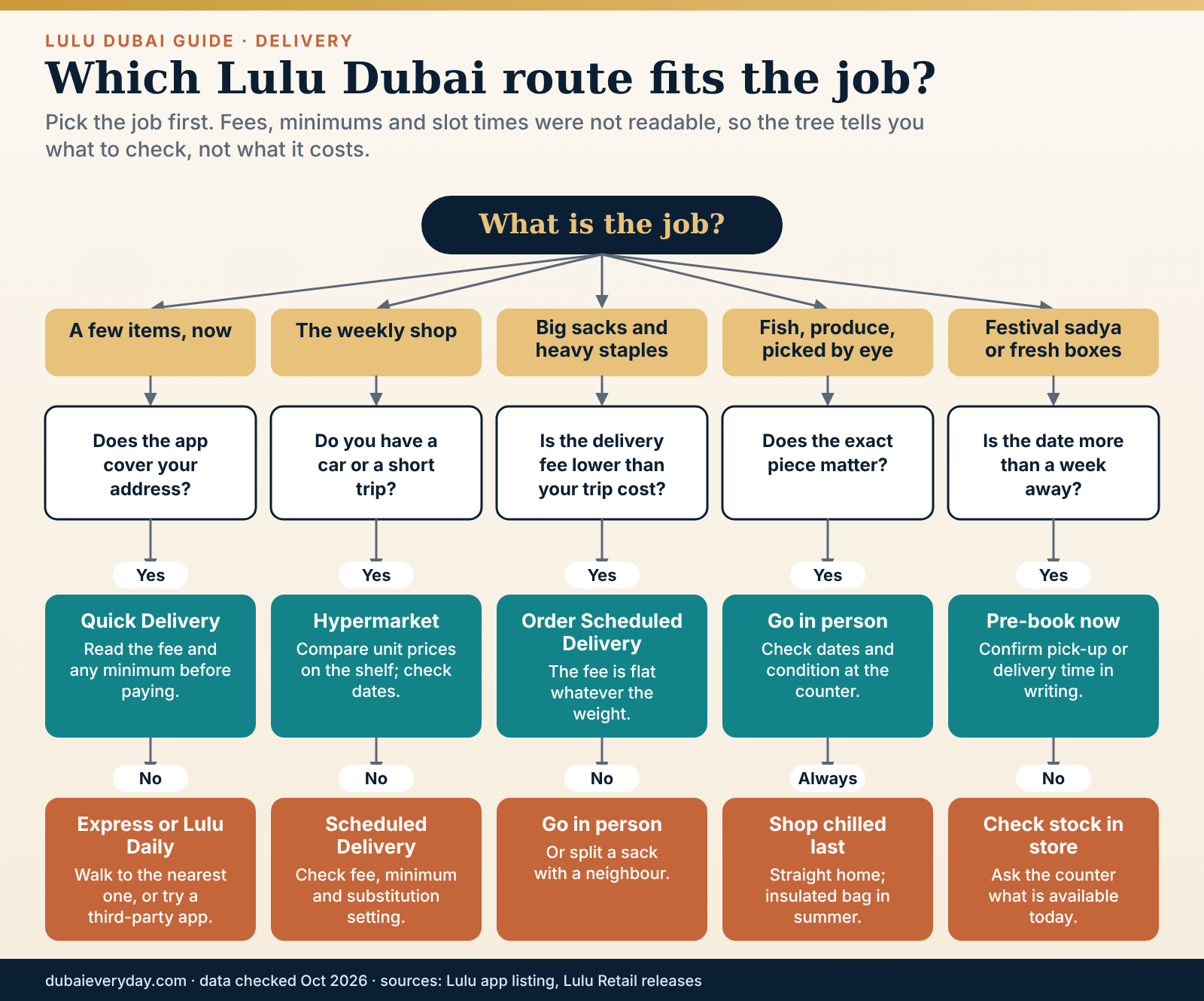
For heavy staples, delivery tends to look better than it does for light ones. A 10 kg bag of rice and a 5 L oil are awkward, and the fee is a fixed amount whatever the weight. For cheap, light items, the fee is a large share of the basket.
When Lulu Dubai delivery is the wrong tool
For fish you want to inspect, produce you want to pick, or any item where the exact piece matters, go in person. For festival sadya, book by pre-order. For a one-item emergency at 10 pm, check whether a quick-commerce app or a nearby Express store is faster. And if you are comparing delivery modes across chains, the Carrefour Dubai guide sets out its Scheduled, NOW, Rapid and Bulk options, which is a useful reference point for the fees you see on the Lulu app.
Keeping the app safe
Download only the official app from the App Store or Google Play, and log in there rather than through links sent by message. Unsolicited messages offering Lulu vouchers or points are a common scam format everywhere. The company’s own version notes mention one-time-password security on high-value deliveries, which is a reasonable control; use it and never read a code out to a caller.
Lulu Dubai for eight kinds of household
The right way to use Lulu Dubai depends on who is shopping. These eight scenarios are built from the documented facts above and our reasoning, not from anyone’s reported experience.
1. The new arrival sharing a flat
You need a starter pantry within the first days: rice, atta, oil, salt, sugar, tea, lentils, spices, eggs, bread and cleaning basics. Buy small to medium packs from the nearest Express or hypermarket, and save the 5 kg sacks until you know your housemates’ habits. The DEWA move-in guide and the home setup checklist help you sequence the first week so groceries are not competing with utility activation for your time.
2. The family of five in an older district
A branch within a short drive, a car and a weekly list favour the hypermarket. Buy staples in bulk, use the unit-price rule, and keep a small monthly budget for festival weeks. If the same store is also your fish and fresh-produce stop, fix one regular day and time so you learn its rhythm.
3. The couple in Marina or JLT
The Lulu Daily store in JLT and the app’s delivery to JLT and Marina are built for you. Use Quick delivery for gaps, Scheduled for the weekly basket, and stay away from five-minute impulse orders that drive up the average basket. Check the fee at checkout, because it is the number we cannot give you.
4. The Kerala family planning Onam or Vishu
Pre-book the sadya, if you want one, early. Buy banana leaves and flowers close to the day, and pick the largest nearby hypermarket for the festival market. Watch the promotion terms on spend-and-save offers. The company’s coverage is the best-documented set of festival facts we found for any Dubai grocer.
5. The Pakistani or Bangladeshi household in Ramadan
Our sources document Lulu Dubai’s Indian and Kerala ranges far better than its Pakistani or Bangladeshi ones. So test before you rely on one store for iftar essentials: look for your brands of dates, gram flour, vermicelli and masalas in the app, and keep a specialist grocer as a second source. With Ramadan 2027 projected to begin on 8 February, the weeks beforehand are the time to build a stock of dry goods.
6. The household with a baby or toddler
Lulu’s app lists baby products among its categories. We did not verify which brands each store carries, so check formula and nappy brands before you plan around them, read dates carefully, and keep a backup option. The Dubai with a baby guide and the toddler guide cover feeding and logistics in more depth.
7. The pet owner
The property-portal directory mentions pet food and toys in Lulu Dubai’s range. Check your pet’s exact food and any vet-prescribed diet before you buy, because ranges vary. For registration, vets and heat rules, the pet ownership guide is the place to start.
8. The visitor in a hotel apartment
If you are staying near Downtown with a kitchen, the Dubai Mall store is documented as serving both residents and tourists, with a large food area and cooked-food options. Remember that its entrance is through the Zabeel parking area. For a wider visitor plan, the Dubai travel guide is the better starting point.
Receipts, bags, unit prices and complaints
Most shopping problems in Dubai are small: a till price that differs from the shelf, a short-dated pack, a bag charge you did not expect. The rules around them are clearer than many shoppers assume, and the routes for complaints are free and fairly quick. None of this is individual legal advice.
The price rules that protect staples at Lulu Dubai
The Ministry of Economy and Tourism’s pricing policy took effect on 2 January 2025. Under Decision 246 of 2024, prices for nine essential categories (cooking oil, eggs, dairy, rice, sugar, poultry, legumes, bread and wheat) can only be raised with prior ministry approval, with at least six months between consecutive rises. Under Decision 245 of 2024, retail stores and online merchants with premises over 1,000 square metres must show prices per standardised unit. Decision 247 sets a code of conduct for supplier and retailer relationships, which is about trade between businesses, not about your receipt.
The ministry page does not list penalties, and we will not guess at them. It does say that consumers can complain about violations, and it gives a call centre and WhatsApp number: 800-1222.
Shelf price versus till price
If the till charges more than the shelf label, say so before you pay and ask for the item to be corrected. Photograph the label if you can. Keep the receipt. If the store will not correct it, the next step is the Dubai Department of Economy and Tourism complaint route described below. We found no published Lulu Dubai price-matching or “shelf-price guarantee” policy, so do not assume one exists.
How to complain in Dubai
According to Gulf News’s October 2026 guide, the Dubai Department of Economy and Tourism handles consumer complaints through the Consumer Rights service, and the business must hold a Dubai trade licence. First raise the problem with the store and ask for a manager. If that fails, file on the consumer rights website with your name, mobile number, the company name, a description and supporting documents, including a valid invoice. The call centre number is 600 545 555.
The same guide says a service employee contacts you within two working days, and the whole process generally takes four to ten working days. It mentions no filing fee. The consumer rights site we opened is available in Arabic and English and has a submit-a-complaint option in its main navigation.
Bags, charges and the 2024 ban
Dubai banned all single-use bags of 57 microns or less from 1 June 2024, whatever the material. Gulf News reported fines of AED 200 for violators, doubling on a repeat within a year up to AED 2,000. At that time Lulu said it had moved to reusable plastic bags charged at 25 fils and sold reusable cloth, jute and recycled bags at between 25 fils and AED 7. Those were May 2024 prices. Check the current charge at the till, and carry your own bags: it is the easiest saving in the shop.
VAT, expiry dates and food safety
The Federal Tax Authority’s VAT page uses a 5 percent rate in its calculator. We did not verify the VAT treatment of any individual food, so rely on the receipt, which should show tax. For expired, damaged or unsafe food, tell the store, keep the pack and the receipt, and use the Dubai economy and tourism complaint route. Food safety in Dubai is regulated by Dubai Municipality, which is the body behind the pork-handling permits mentioned earlier.
Twelve mistakes that cost money at Lulu Dubai
- Buying the biggest pack by defaultThe table in the bulk section shows that canola oil gave no saving in the larger pack and chicken only a small one. Check the unit price every time.
- Trusting the shelf price, not the unit priceUnit prices exist for a reason. Compare per kilo or litre, especially between brands.
- Assuming Lulu Dubai is cheapest for everythingThe October tally gave Lulu Dubai three of 18 lowest listings. Eggs, oils, lentils and chicken went elsewhere.
- Driving to the wrong formatA Lulu Daily store will not stock a 20 kg sack. Match the format to the job.
- Shopping at peak times before a festivalThe days before Onam, Vishu and Ramadan are busy. Stock long-life items weeks earlier.
- Reading “up to 65%” as store-wide5,500 products out of roughly 200,000 is a small slice, and the percentage is a ceiling.
- Ignoring substitutions on deliveryA swapped brand of atta or basmati can change a dish. Choose the substitution setting deliberately.
- Chasing pointsPoints are worth having only if the basket is competitive without them.
- Leaving chilled food in the carDubai heat can spoil dairy, fish and meat within an hour or two. Shop for chilled items last and go home directly.
- Skipping the receiptThe receipt is your evidence for a price correction, a return or a complaint.
- Relying on an old directoryHours, stores and phone numbers in portal articles go stale. Confirm in the app.
- Storing sacks badlyRice and flour kept in humid kitchens can attract insects. Decant into airtight containers and write the date on them.
Your next steps
Pick the nearest hypermarket and one Express or Daily store. Write a twelve-item list with brands and pack sizes. Check the nine tracked categories on the ministry platform, compare unit prices on the shelf, and add the cost of reaching the store. Try one Scheduled delivery order for a weekly basket and read the fee at checkout. Then decide where each kind of shop belongs. That routine does more for a grocery bill than any single offer, and it keeps working after the promotions change.
Lulu Dubai FAQ
Is Lulu Dubai cheaper than Carrefour?
It depends on the product. In the ministry platform data dated 8 October 2026, as read by Gulf News, Carrefour held four of 18 lowest listings (corn oil, brown eggs, white chickpeas and shared flour) and Lulu Dubai held three (basmati rice, white sugar and shared flour). Emirates Coop held six. That is a staples snapshot, not a basket. For a fuller comparison, see the supermarket guide and the Carrefour guide, and build your own twelve-item basket.
How many Lulu Dubai stores are there?
No current Dubai-only count is published on the pages we could read. Company releases put the number at 24 in October 2023 and called the Dubai Outlet Mall store the 25th in March 2024, while a May 2024 Gulf News report quoted “over 60” outlets in Dubai. Lulu’s FY2025 formats page lists 43 hypermarkets, 64 Express stores and 8 mini markets across the UAE. Use the app’s store finder for a live list.
Does Lulu Dubai deliver, and what does it cost?
Yes, Lulu Dubai delivers, and the Lulu app lists Quick Delivery and Scheduled Delivery, and the group lists Amazon UAE and Talabat as third-party platforms. We could not read delivery fees, minimum baskets or slot times, so do not rely on figures quoted elsewhere. Set your address in the app, which checks availability before ordering, and read the fee and minimum on the payment screen before you confirm. Compare the fee with the cost of making the trip yourself.
What are Lulu Dubai’s opening hours?
Hours vary by branch and change in Ramadan and on holidays. A Property Finder directory, updated in January 2025, lists most Dubai branches as open from 8 am to what it writes as 12 am, with Deira shown as 9 am to 11 pm. Those are secondary, undated listings, so use them as a rough guide and confirm the hours in the Lulu app or by phoning the branch before a long drive.
What is the Lulu Dubai Happiness programme?
Happiness is Lulu’s loyalty scheme, launched on 21 March 2023. It offers instant additional discounts, reward points, member prices and partner offers, applied at the till through the app or your registered mobile number. You can join at in-store kiosks or online. We could not find a public earning rate, a redemption value or an expiry rule, so check those in the app before you rely on the points.
Where is the Lulu Dubai hypermarket in The Dubai Mall?
Lulu’s release says access to the 72,000 square foot hypermarket is through the Zabeel parking area of The Dubai Mall, so it is not on the mall’s main retail floors. The release calls it part of an effort to diversify the mall’s retail mix and describes a large food area, an in-store café and specialty ranges. If you are planning around Downtown, the Downtown guide gives wider context, and you should confirm the entrance and hours before you go.
Does Lulu Dubai sell Indian and South Asian groceries?
Lulu’s documented ties to India are strong: it describes itself as the largest importer of Indian products into the UAE, and it runs India Utsav, Vishu, Onam and mango promotions. We found no equivalent documentation for Pakistani, Bangladeshi, Sri Lankan or Nepali ranges, and the pages we read did not list brands. Ranges also vary by store, so check the app’s product search for a specific item.
Can I buy fresh fish and meat at Lulu Dubai?
Company releases for Al Wasl, Al Hamriya, Satwa, Dubai Outlet Mall and the JLT Daily store all list meat and fish among their departments. The Waterfront Market store sits inside a market with its own fish, meat and produce sections, and the release does not say which of those the Lulu store itself sells. If halal certification or a particular species matters, ask the counter and read the labels. We did not verify certification.
Are unit prices shown on Lulu Dubai shelves?
They are meant to be. Under Decision 245 of 2024, retail stores and online merchants with premises over 1,000 square metres must show prices per standardised unit, according to the ministry. Most Lulu Dubai hypermarkets are well above that size. We did not audit shelf labels, so check the label yourself, and if a product has no unit price, calculate it from the pack size before you compare.
What if the shelf price and the till price differ?
Raise it at the till before paying and ask for a correction. Photograph the shelf label and keep the receipt. If the store will not resolve it, the Dubai Department of Economy and Tourism has a consumer complaint route that needs an invoice from a Dubai-licensed business. Its call centre is 600 545 555. We found no published Lulu Dubai price-match policy, so do not assume one.
Do I need to bring my own bags to Lulu Dubai?
It saves money. Dubai has banned single-use bags of 57 microns or less since 1 June 2024. In May 2024, Lulu said it charged 25 fils for reusable plastic bags and sold cloth, jute and recycled bags for between 25 fils and AED 7. Those prices may have changed, so check at the till. A few sturdy reusable bags also protect heavy bags of rice and sugar better than thin ones.
When is Ramadan 2027, and will Lulu Dubai run offers?
The UAE Astronomy Centre projects Ramadan 2027 to begin on 8 February 2027, with Eid Al Fitr expected on 9 or 10 March, subject to moon sighting. For Ramadan 2026, Gulf News reported Lulu offering up to 65 percent off on more than 5,500 products and a price freeze on 300 essentials. Expect a similar pattern but check the actual terms when the campaign is announced.
Related reading
Sources and further reading (35 links)
- Lulu Retail: Q2 2026 earnings release — store total, e-commerce, daily shoppers, margin and pricing statements
- Lulu Retail: retail formats — hypermarket, Express and mini-market counts, central kitchens and online channels
- Lulu Retail: company home page — group scale, dividend and Mango Mania headline
- Lulu Retail: Dubai Mall hypermarket opening — size, Zabeel parking access and Dubai store count
- Lulu Retail: Dubai Outlet Mall opening — size, location and store count
- Lulu Retail: Al Satwa hypermarket opening — size, departments and planned Dubai stores
- Lulu Retail: Nadd Al Hamar Express opening — size, departments and delivery support
- Lulu Retail: Lulu Daily in JLT — format, size and delivery to JLT and Dubai Marina
- Lulu Retail: Silicon Central hypermarket and Al Quoz fulfilment centre — sizes and fulfilment details
- Lulu Retail: Waterfront Market hypermarket — location, size and market departments
- Lulu Retail: Al Hamriya hypermarket — size and metro access
- Lulu Retail: Festival Plaza hypermarket — size and coffee-shop concept
- Lulu Retail: Al Wasl store — size and departments
- Lulu Retail: Al Raffa Express — size and format
- Lulu Retail: Barsha South Express — location and format
- App Store: LuLu Hypermarket app listing — delivery features, payment options and version notes
- Ministry of Economy and Tourism: Essential Goods Prices Platform — categories, stores and last-updated status
- Ministry of Economy and Tourism: pricing policy for nine essential categories — approval rule, unit-price duty and hotline
- Ministry of Economy and Tourism: August 2026 monthly price monitoring — average prices by pack size
- Gulf News: UAE grocery prices for rice, eggs and oil this October — lowest listed prices and retailer tally (secondary)
- Dubai Consumer Rights portal — complaint submission route
- Gulf News: how to file a consumer complaint in Dubai — steps, documents and timing (secondary)
- Gulf News: Lulu launches Happiness Rewards — launch and stated benefits (secondary)
- Gulf News: Lulu flies 3,000 tonnes of Kerala produce — Vishu supply (secondary)
- Gulf News: Lulu chartered cargo flights — March 2026 supply logistics (secondary)
- Gulf News: Lulu India Utsav — Indian range and import claims (secondary)
- Gulf News: Onam shopping rush (partner content) — festival range and promotion terms (secondary; promotional)
- Gulf News: how UAE retailers plan to keep Ramadan food prices low — Lulu Ramadan 2026 plans (secondary)
- The National: Ramadan 2027 UAE dates — projected start and Eid dates (secondary)
- Gulf News: Dubai ban on single-use bags — ban rules, fines and Lulu bag prices (secondary)
- Gulf News: Lulu enters Dubai Mall — Dubai store count and store features (secondary)
- Gulf News: Lulu groceries on Amazon — 2022 Amazon tie-up and fulfilment roles (secondary)
- Gulf News: penalties for flouting pork-sales rules — dated context on Dubai Municipality permits (secondary)
- Property Finder: All about LuLu Hypermarkets in Dubai — branch addresses and listed hours (secondary directory)
- Federal Tax Authority: VAT — VAT calculator rate
Update log: 29 October 2026 — first publication; all facts re-checked against the sources above. Next review due: February 2027, ahead of Ramadan 2027, and sooner if Lulu changes its delivery terms, Happiness scheme or Dubai store list, or if the ministry’s price platform changes. Corrections welcome. This page is general consumer information, not financial, legal or individual shopping advice; prices, offers and delivery terms change often, so confirm them in the Lulu app or at the shelf.
About DubaiEveryday and this guide
DubaiEveryday.com is an independent editorial project that publishes practical, research-based guides to everyday life in Dubai: where to live, what things cost, how the rules work and how to get around. This page was written and edited by the DubaiEveryday editorial team. It is not signed by a named expert, doctor, lawyer or adviser, and we do not claim first-hand testing of a venue, clinic or service unless the page says so.
Each guide is built from official sources such as government and regulator pages, operator websites and established news outlets, cross-checked where we can. When we could not confirm something, we say so in the text, and examples that use made-up numbers are labelled as illustrations. Mentions are editorial choices, not paid placements, and a link is not an endorsement.
Dubai changes quickly. If you spot something that is out of date or wrong, please tell us through the contact options on DubaiEveryday.com and we will check it and correct the page.