
An overnight desert safari in Dubai is one long block of roughly 16 to 20 hours: a dune drive, dinner at a camp, a night under the stars and a breakfast before the drive home. This guide covers camp comfort, stargazing, meals, morning activities and packing, using operator pages and official sources checked on 29 October 2026.
Everyone pictures the same thing: a tent, a fire, a sky full of stars. Far fewer people ask whether the tent has air-conditioning, whether there is a shower, or what happens when the power is switched off at 11 pm.
An overnight desert safari Dubai package can mean a cooled tent with a buffet and a fire show, or a stone room with no shower and a dark, silent night. The price does not tell you which one you are buying. This guide reads the booking pages, the moon calendar and the weather figures, so you can choose the night you actually want and pack for it.
An overnight desert safari Dubai trip is a single package of about 16 to 20 hours. You are collected from your hotel in the afternoon, driven to a camp, fed, entertained or shown the night sky, put to bed in a tent or a stone room, and driven back after breakfast. The word “overnight” hides large differences. On 29 October 2026 we read three operator pages: a tented camp in the Lahbab dunes from AED 473, a heritage camp from AED 1,195 per adult, and a small reserve camp of eight tents listed at USD 539 (about AED 1,980) per adult.
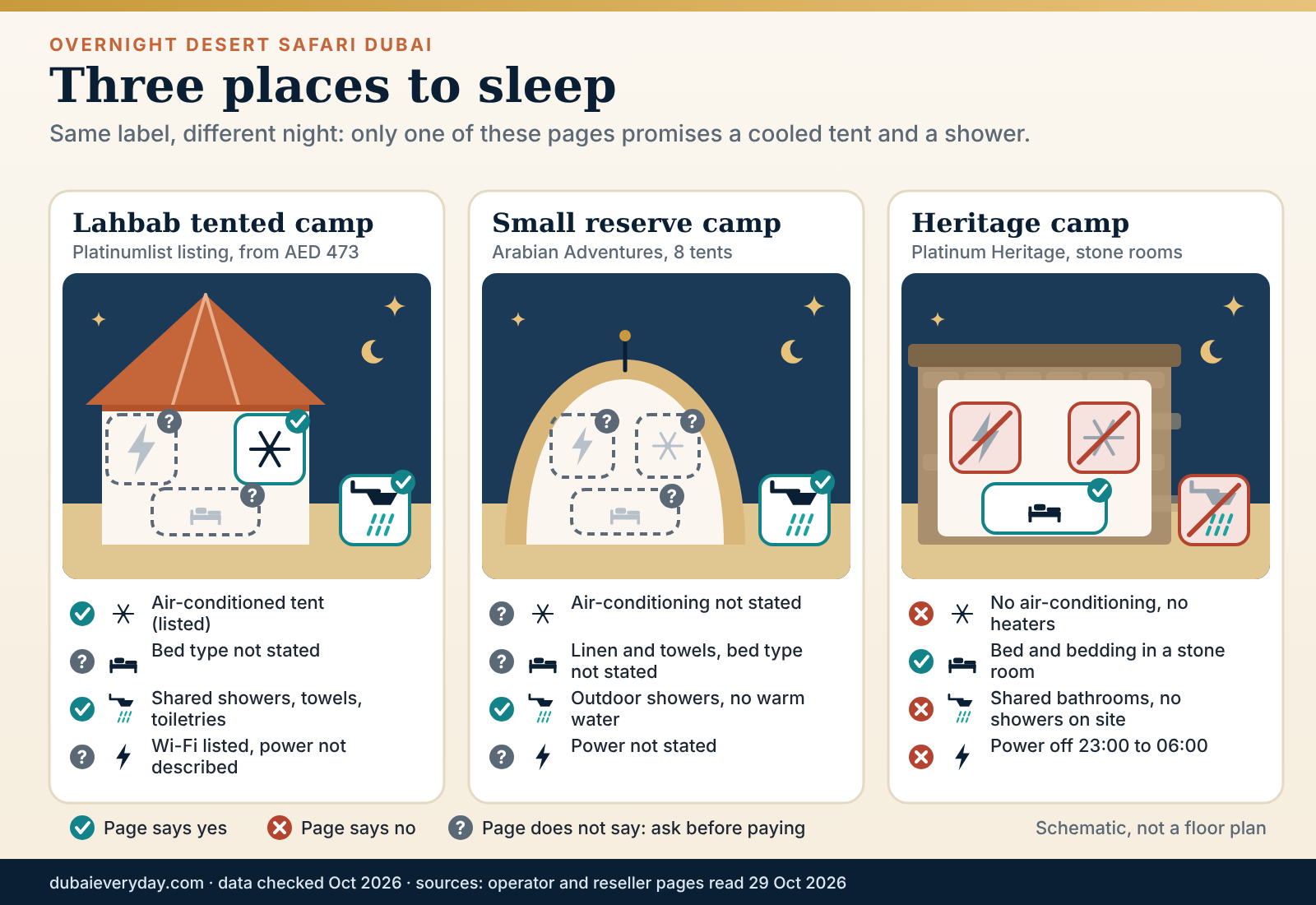
Price tells you little about comfort. The cheapest of the three has an air-conditioned tent with shared showers. The heritage camp has a bed in a stone room with no air-conditioning, no heating and no showers, and switches the power off from 23:00 to 06:00. Before paying, check four things: air-conditioning, a shower, power at night and the time you will be back in the city.
Go between November and April, pick a week around the new moon if the stars matter, and pack warm layers into one small bag. Skip an overnight desert safari Dubai booking if you need a full night’s sleep before a flight.
This is desk research. DubaiEveryday.com has not slept at any of these camps, eaten the food or watched the sky from them, and nothing below describes a personal night out. Where the page says what a camp is like, it relays what operators and official bodies publish, in the third person.
On 29 October 2026 we read the booking pages of three overnight desert safari Dubai products (a Lahbab red-dune camp sold through Platinumlist, a small reserve camp from Arabian Adventures, and the Platinum Heritage camp), plus an astronomy listing, an Associated Press light-pollution report and a meteor calendar. Sunrise, sunset, twilight and moon figures are our calculation for central Dubai. Prices and policies move quickly, and some listings contradict each other.
We did not field-test anything. Inclusion was not paid for. This is general information, not individual medical, legal or financial advice.
What an overnight desert safari Dubai trip is, and what it is not
The label covers a family of products with one shared feature: you do not come home that night. Everything else is negotiable. An overnight desert safari Dubai package normally starts with a hotel pickup between roughly 14:00 and 16:30, a drive to a camp in the dunes, an evening programme, a sleeping place and a breakfast the next morning. Operators list the whole thing at 16 to 18 hours (the Lahbab camp) or, going by pickup and return windows, 18 to 20 hours (the heritage camp).
It is easy to confuse with three neighbours. The ordinary evening desert safari is the six-to-seven-hour version that returns you to your own bed. A morning trip is covered in our morning desert safari guide. Pitching your own tent is a separate activity with different rules, touched on near the end of this page. A hotel in the desert is a hotel, not a safari.
This page answers one question about the overnight desert safari Dubai format: what is the night actually like, and how do you prepare for it? If you are still choosing between morning, evening, private and luxury formats, the wider comparison sits in our guide to the best Dubai desert safari, and we will not repeat it here. The dune drive is still part of the package, usually 30 to 45 minutes on the tented-camp listing, but the headline is what happens after dark and before breakfast.
That sounds restful, and it can be. It also means you are committed. If the tent is too warm, the shower is cold or the neighbouring camp is playing music, there is no hotel room to retreat to. Nearly every decision about an overnight desert safari Dubai booking is about reducing that risk before you pay.
Where the camps are
The Lahbab red dunes host the tented overnight desert safari Dubai camp on the Platinumlist listing. The Dubai Desert Conservation Reserve hosts the Arabian Adventures and Platinum Heritage camps. The Emirates group says the reserve covers about 225 square kilometres, roughly 5% of Dubai’s land, and that part of the revenue funds conservation. That is the operator’s own claim, so treat it as context.
Dubai Municipality describes eight protected areas covering about 31% of the emirate, with rules on hunting, plants and vehicles, which is one reason you cannot simply drive off and camp where you like. The pages we read did not publish drive times from the city, so ask for pickup and return times in writing.
Overnight desert safari Dubai camps compared: three types
The three pages we read are not three prices for the same thing. They describe three different ideas of a night in the desert, and the sensible way to choose an overnight desert safari Dubai camp is to decide which idea you want. We call them the entertainment camp, the small reserve camp and the heritage camp. These are our labels, not the operators’.
Type 1: the tented entertainment camp
The Platinumlist listing is the most conventional overnight desert safari Dubai product. It promises a 4×4 pickup, 30 to 45 minutes of dune bashing, sandboarding and a camel ride, then arrival at Al Khayma Desert Camp for Arabic coffee, dates and sweets. Cultural activities include henna, traditional dress, falcon photos, a Yola dance, a horse show, falconry and a fire show. Dinner is a buffet of Emirati, Moroccan and Arabian dishes, followed by a telescope session.
The sleeping place is described as a private, air-conditioned Bedouin-style tent with “modern comforts”, with shared washrooms and showers. The page does not state bed type or tent size. The next morning brings a sunrise camel trek and an Arabian breakfast. Duration is roughly 16 to 18 hours, and the price is “from AED 473”.
Type 2: the small reserve camp
The Arabian Adventures overnight desert safari Dubai product describes a private deluxe tent for up to two guests in a camp of eight tents with a maximum of 16 guests. The programme runs from a dune drive and a camel ride into camp, through sundowners and a set-menu barbecue, to a walking night safari. After sunrise there is a morning wildlife drive to look for Arabian oryx and gazelles, then a hot breakfast.
The notable omission is entertainment: no live entertainment is included, though background music plays in the evening. Air-conditioning, bed type and power are not stated on either version of the page, so ask before you pay.
Type 3: the heritage camp
The Platinum Heritage overnight desert safari Dubai package begins with a 60-minute nature safari by vintage Land Rover or on camel, followed by a falcon show at sunset, a torch-lit camp, live bread-making, a four-course dinner, Emirati performances and stargazing around a fire. Sleeping is in a stone dwelling room with a bed and bedding.
The honest detail is in the small print. The rooms have no air-conditioning and no heaters, power is switched off from 23:00 to 06:00, and bathrooms are shared with no showers on site. The page says camps hold 75 to 100 guests, and its season runs from 1 November to 30 April. The price is AED 1,195 per adult and AED 995 per child aged 5 to 11, VAT included, with an optional sunrise balloon flight priced separately.
What about desert resorts?
A desert resort is a hotel stay, not a camp safari. Visit Dubai’s article on desert hotels names Bab Al Shams and Al Maha as luxury desert getaways, and earlier research for our safari comparison recorded Al Maha at about 50 minutes from the city, with children admitted from eight. We did not read current rates for either, so we do not price them. For a proper bed and bathroom, start with our guides to luxury hotels in Dubai and the wider best hotels in Dubai.
| What the page says | Lahbab tented camp | Small reserve camp | Heritage camp |
|---|---|---|---|
| Listed price (29 Oct 2026) | From AED 473 (basis not stated) | USD 539 per adult, shared transfer | AED 1,195 adult, AED 995 child |
| Sleeping place | Private air-conditioned tent | Private deluxe tent, up to two guests | Stone room with a bed |
| Air-conditioning | Listed | Not stated | None, no heaters |
| Showers | Shared, with towels and toiletries | Outdoor, cold water on one page | None; shared bathrooms |
| Power at night | Wi-Fi listed | Not stated | Off 23:00 to 06:00 |
| Evening | Shows, buffet, telescope | Barbecue, night walk, background music | Falcons, four courses, stargazing |
| Morning | Sunrise camel trek, breakfast | Wildlife drive, hot breakfast | Breakfast; optional balloon |
| Cancellation | Free up to 24 h before | 24 h (operator) or 48 h (reseller) | Full refund over 18 h before pickup |
How to read the table
First, in this set of overnight desert safari Dubai options, price does not track conveniences. The reserve camp is the dearest, at about AED 1,980, yet its pages do not state air-conditioning, bed type or night power. The heritage camp, at AED 1,195, has the fewest conveniences on paper. What the money buys at those two is small numbers, a conservation setting and a programme without mass-market shows. Whether that is worth it is a taste question, not a quality ranking.
The cheapest option is the only one that clearly promises a cooled sleeping space and a shower. At 3.6725 dirhams to the dollar, the price gap is about 2.5 times from the Lahbab camp to the heritage camp and about 4.2 times to the reserve camp.
Camp comfort: beds, air-conditioning, showers and power
Comfort at an overnight desert safari Dubai camp comes down to five questions: what you sleep on, what keeps you at a bearable temperature, where you wash, whether there is power and how loud the night is. Each operator page says a lot about the programme and a little about the bed, which is the wrong way round for anyone who plans to sleep.
Air-conditioning, heating and the cold you will meet
Dubai’s reputation is heat, which is slightly misleading for the camp season. The 1991 to 2020 monthly normals for Dubai International Airport, tabulated on Wikipedia from NOAA and WMO data (a secondary compilation), put the mean daily minimum at 21.1°C in November, 17.4°C in December, 15.3°C in January, 16.4°C in February and 18.6°C in March. An airport is not a dune, and desert air commonly cools faster than the coast after dark, which is our inference rather than a measurement.
Overnight desert safari Dubai operators agree on the direction. The heritage camp tells guests to bring warm clothing for the night, especially from November to March, and the Lahbab listing recommends a light jacket or sweater in winter. Air-conditioning is therefore a feature for April and late October. From December to February the better question is whether there is heating or a thick blanket.
Showers, toilets and water
Three pages, three answers. The Lahbab tented camp lists shared washrooms and showers, with toiletries, towels and slippers included. The reserve camp’s reseller page lists outdoor showers without warm water, plus sterilised towels, linen and an amenities kit. The heritage camp has shared bathrooms with no showers on site. None of these is a hotel bathroom, and none claims to be.
The practical effect is a walk, possibly at night, to a shared facility. An outdoor cold shower at a January night minimum of 15°C is a different proposition from the same shower in November. Our reading is that the comfortable plan is to wash before dinner while the day is still warm.
Power, lights and Wi-Fi
The heritage camp is explicit: the power is off from 23:00 to 06:00, so no lights and no noise. That suits stargazers and traps anyone who forgot to charge the phone they use as an alarm. The Lahbab listing advises charging phones and cameras before departure and also lists Wi-Fi. The reserve camp’s pages say nothing about power. A power bank and a small torch cost little and remove the problem.
Beds, bedding and privacy
The heritage camp says each stone room has a bed and bedding. The reserve camp mentions sterilised linen and towels but no bed type. The Lahbab page says nothing about bedding. At least one marketplace title we saw refers to sleeping bags for an overnight desert safari Dubai trip, which is a different standard from a bed. Ask for the bed type and whether to bring a sleeping liner.
The reserve camp states that there are no lockers for valuables, jewellery or extra bags, and the heritage camp limits each guest to one overnight backpack. Take only what you can keep on you or under the bed.
Noise and sleep
No overnight desert safari Dubai operator we read publishes a noise policy, so this is our reading. A camp that runs a horse show, a fire show and a dance programme, as the Lahbab listing does, is a camp where the evening ends later and louder. The heritage camp’s 23:00 power cut is the only hard curfew any of the three pages states.
Before paying for an overnight desert safari Dubai package, get written answers to three questions: is the sleeping space air-conditioned or heated, is there a shower you can actually use, and is the power cut overnight? In our three examples, the answers differ from camp to camp. If an operator cannot answer, assume the weaker version and pack for it.
The overnight clock: from hotel lobby to breakfast
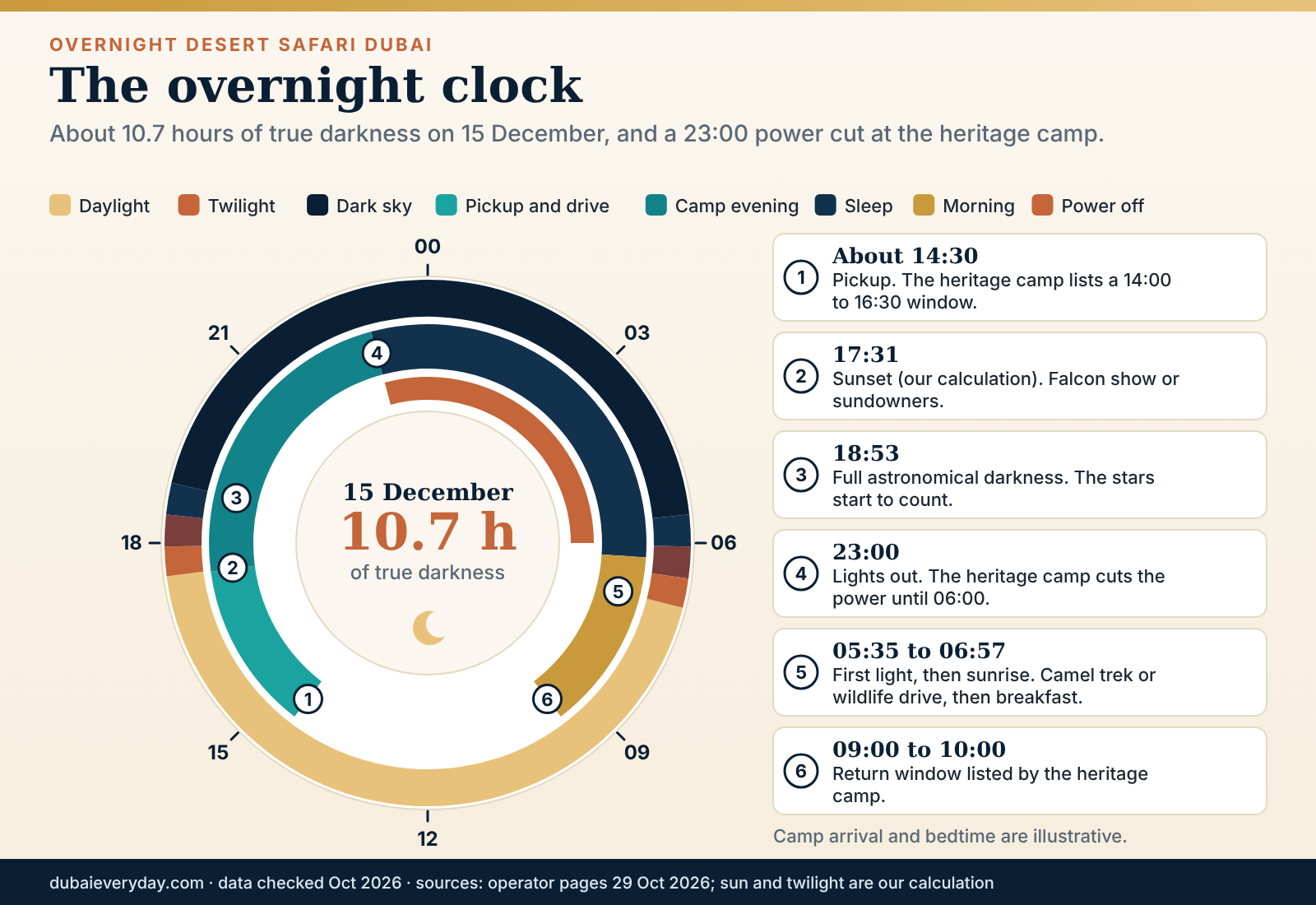
An overnight desert safari Dubai trip is easiest to judge on a clock. The operators publish only fragments: a pickup window of 14:00 to 16:30 at the heritage camp, a return at 09:00 to 10:00, a power cut from 23:00 to 06:00, a sunrise camel trek at the Lahbab camp. The rest we build from the sun, using our calculation of sunset, twilight and sunrise for central Dubai on 15 December.
Reading the dial
On 15 December the sun sets at about 17:31 and the sky reaches full astronomical darkness at about 18:53. Dawn starts to lighten at about 05:35, and the sun rises at about 06:57. For an overnight desert safari Dubai trip in mid-December, that leaves roughly 10.7 hours of true darkness. The same calculation gives about 10.4 hours in mid-November, 10.6 in mid-January, 10.1 in mid-February, 9.5 in mid-March and 8.7 in mid-April.
If the plan is to look at stars, the useful window opens around 19:00, and at the heritage camp the power cut at 23:00 helps because the lights go off. If the plan is to see the sunrise, you need to be up by about 06:15 in midwinter, which after a 23:00 lights-out gives a sleep window near seven hours. That is respectable, provided the neighbours cooperate.
An illustrative overnight evening
The sequence below is an illustrative example, not a quote or a timetable. It strings together the activities the operators list, in the order they list them, with clock times that fit a mid-December sunset.
- About 14:30, pickupBe in the lobby 15 minutes early where the operator advises it. The heritage camp sends its exact time around noon on the day.
- About 16:00, reserve arrivalHeadscarf and water bottle at the heritage camp, a dune drive and camel ride at the others.
- About 17:30, sunsetA falcon show at the heritage camp, sundowners at the reserve camp, sandboarding and camels at the tented camp.
- About 19:00 to 21:00, dark camp eveningCoffee and dates, dinner, shows or a walking night safari, then a telescope or fireside stargazing session.
- About 23:00, lights outHard curfew at the heritage camp, where the power goes off.
- About 06:15, wakeSunrise is about 06:57. Camel trek or wildlife drive, then breakfast.
- 09:00 to 10:00, departThe heritage camp lists this window for the return to the city.
The bit nobody lists: the day after
You are unlikely to be at your hotel before late morning. That is the real cost of the overnight desert safari Dubai format. A same-day departure flight is a gamble, a hotel checkout at 12:00 can become tight, and a heavy day of sightseeing after a short night is a poor plan. Our Dubai 4-day itinerary includes a desert evening; if you swap that evening for an overnight, leave the following morning empty.
Meals: dinner, drinks and breakfast at a desert camp
Food is the one area where the three operators are fairly clear, because meals are easy to list. Every overnight desert safari Dubai package includes a dinner and a breakfast, and the differences are in format. The format affects both the pace of the evening and the odds that someone in your group is left picking at a plate.
Dinner: buffet, set menu or four courses
The Lahbab tented camp describes a buffet of Emirati, Moroccan and Arabian dishes, preceded by Arabic coffee, dates and sweets on arrival. A buffet suits mixed tastes and children who graze, and the cost is queueing at the busiest moment.
Arabian Adventures describes a set-menu barbecue with waiter service in a camp of at most 16 guests. A set menu is calm and quick, and a poor fit for fussy eaters unless the kitchen is told in advance. Platinum Heritage describes a four-course traditional dinner, with lamb ouzi and charcoal-grilled chicken as example mains, which implies a slower, seated evening.
Dietary needs and allergies
Only two of the three pages say anything useful here. Platinum Heritage says vegetarian, vegan, gluten-free and kosher-style options are available if requested at booking. The Lahbab listing says vegetarian options are available on request. The reserve camp’s pages did not mention dietary requests. None of the pages states halal status or allergen handling, so we make no claim either way.
Declare every requirement when you book your overnight desert safari Dubai package, in writing, and again at check-in. A camp is a long drive from a supermarket, so there is no fallback at 21:00 if the kitchen has not prepared your meal. Pack a few snacks you can eat safely, particularly for children.
Drinks, water and alcohol
Arabian Adventures lists unlimited soft drinks and mineral water on the drive, with a premium beverage package as an option, and its reseller page tells guests not to bring alcohol. Its price grid mentions unlimited premium beer, wine and spirits on one two-guest option, but the grid is hard to read and we would not rely on our parsing of it.
The Lahbab listing excludes premium shisha and any food or drink not on its list, without giving prices, and does not mention alcohol. Platinum Heritage includes shisha and gives each guest a stainless-steel water bottle. The UK Foreign Office’s UAE safety page sets out the alcohol rules for visitors, including a legal drinking age of 21, and is worth reading before you plan to drink at a desert camp.
Breakfast
Breakfast is where the heritage camp is most specific: a spread with a live egg station, Middle Eastern, Asian and continental options, Arabic coffee, tea and juices. The Lahbab camp serves an Arabian breakfast after the sunrise camel trek, and the reserve camp a hot breakfast after the wildlife drive.
Ramadan
Ramadan 2027 is projected to begin around 8 February, subject to moon sighting, according to The National. Overnight desert safari Dubai operators adjust rather than stop. Arabian Adventures says belly dancing cannot be added during Ramadan and live music depends on local approval, and a Platinum Heritage page we read for our wider safari comparison says cultural entertainment is not offered during the month. We found no page that explains dinner timing for fasting guests, so ask before you book.
Stargazing on an overnight desert safari Dubai trip
The night sky is the reason many people choose an overnight desert safari Dubai package over an evening one, so it deserves a straight answer: it is good, not spectacular, and the quality of your particular night depends more on the moon and the cloud than on which camp you pick.
How dark the sky really is
An Associated Press report published in May 2026 puts the problem plainly. It cites a 2016 study finding that about 99% of Emirati residents cannot see the Milky Way from home, notes that LED screens and billboards are spreading in Dubai, and mentions the Burj Khalifa light show. It describes the far desert of Abu Dhabi, about 100 km from Abu Dhabi city, as one of the darkest places left in the UAE, and points to Al Qudra Lakes as a rural area with less light pollution.
None of the three overnight desert safari Dubai camps we read is that far out or publishes a darkness rating. Our reading is that a Dubai desert camp gives you a proper night sky with a visible glow on the city side of the horizon. You will see the moon, bright planets and the main constellations clearly. Do not expect the dense Milky Way of astronomy photographs.
What each camp actually offers
Among the overnight desert safari Dubai listings we read, the Lahbab tented camp lists a telescope stargazing session. The heritage camp lists stargazing around the campfire, and Platinum Heritage sells a separate private night safari with a telescope for the moon and planets, which falls back to a talk if cloud hides the stars. Arabian Adventures lists no dedicated stargazing: dinner is served under the sky and there is a walking night safari.
No page named the astronomer or gave credentials, so treat “stargazing” as a guided look at what happens to be up. On a bright-moon night a telescope shows the moon and little else.
The sky calendar for the camp season
The heritage camp’s stated season runs from 1 November to 30 April, the other pages gave no season, and the cooler months are the sensible window anyway. Within it, the moon matters more than anything else you control when you book an overnight desert safari Dubai night. We calculated moon illumination for every night from November 2026 to April 2027 at 22:00 Dubai time. Roughly nine or ten nights around each new moon have a moon under about 20% lit. Full moons fall on 24 November, 24 December, 22 January, 21 February, 22 March and 20 April.
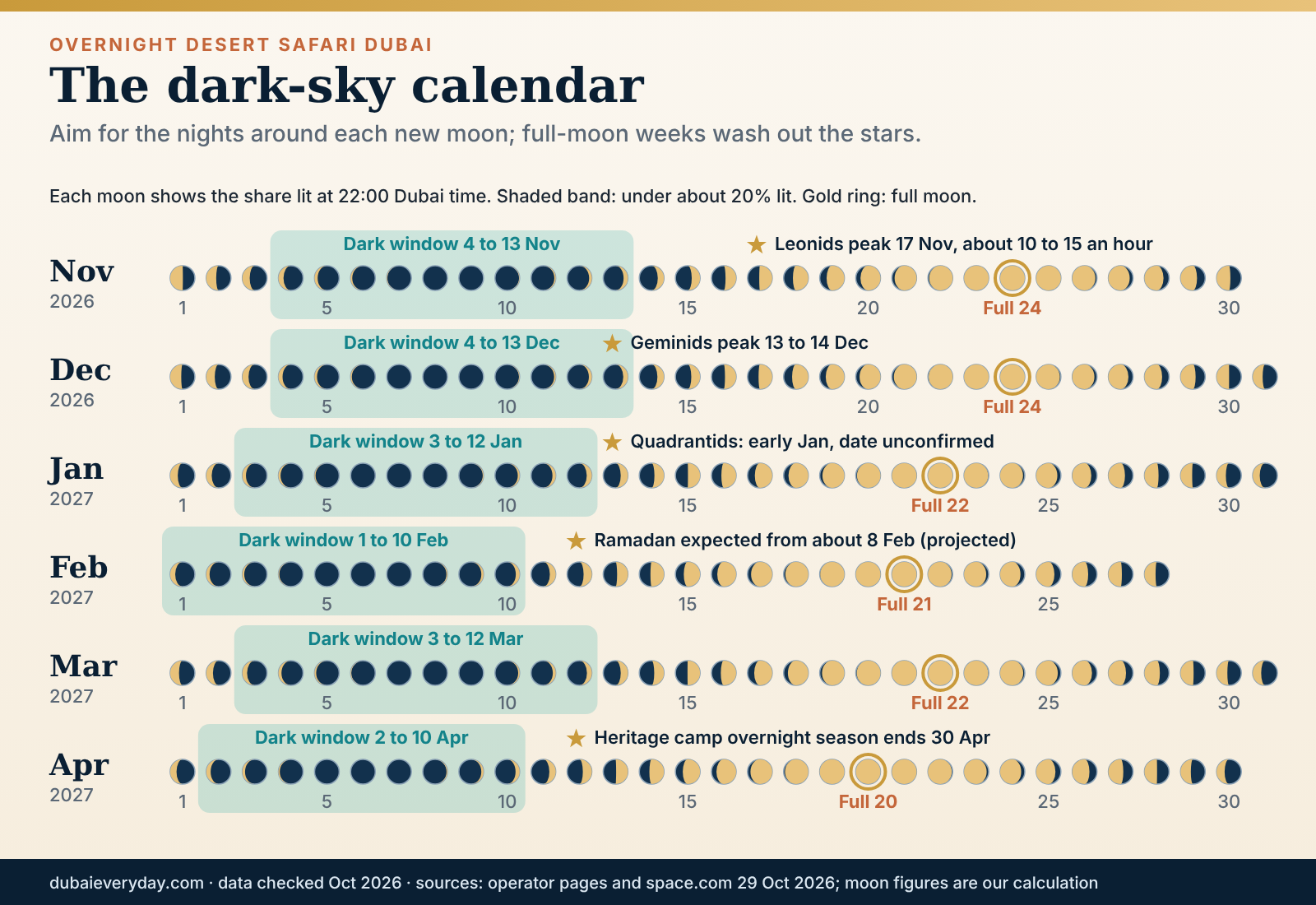
The windows, by our calculation, are 4 to 13 November, 4 to 13 December, 3 to 12 January, 1 to 10 February, 3 to 12 March and 2 to 10 April. Christmas week is the opposite: the moon is full on 24 December, and on 31 December it is still about 40% lit at 22:00. We would expect demand for those dates to be high, which makes them a poor choice for stargazers.
Meteor showers
Space.com’s 2026 meteor guide gives the Leonids a peak around 17 November, at about 10 to 15 meteors an hour under clear skies, with a half-lit moon causing moderate interference. Our moon calculation agrees: about 43% to 53% lit at 22:00 on 16 and 17 November. The same guide puts the Geminids on the night of 13 to 14 December, with up to 120 an hour under perfectly dark skies, which matches our figure of a crescent about 19% to 27% lit.
Dubai is not perfectly dark, so the real count will be a fraction of the headline rate, but 13 to 14 December is the best-aligned night of the season for an overnight desert safari Dubai trip. The Quadrantids usually peak in early January; we could not confirm the 2027 date, so check an astronomy calendar.
What you can see in the winter sky
This part is general astronomy, not something the operators state. In the northern winter, Orion is a prominent evening constellation, with Sirius, the brightest star in the night sky, nearby, and the Pleiades cluster is easy to spot.
The Milky Way’s brightest core belongs to summer, and the AP report notes the Dubai Astronomy Group regards late May as a good time to see it. That falls outside the heritage camp’s season, so anyone chasing the Milky Way should plan a different trip. Whatever the sky, give your eyes 20 to 30 minutes to adapt and use a red-light torch rather than a white phone screen.
Morning activities: sunrise, camels, wildlife and balloons
The morning is the part of an overnight desert safari Dubai package that an evening trip cannot give you, and it is where the three camps diverge most. One schedules a camel trek, one a wildlife drive, one a slow breakfast with an optional balloon flight. All three are shaped by the same fact: the sun comes up late in the cool season, so nobody needs a punishing alarm.
Sunrise times for the camp season
Our calculation for central Dubai gives sunrise at about 06:36 on 15 November, 06:57 on 15 December, 07:06 on 15 January, 06:54 on 15 February, 06:29 on 15 March and 05:57 on 15 April. First light comes about 25 minutes earlier. Treat these as approximate and ask the operator for the actual wake-up time.
In midwinter a sunrise activity on an overnight desert safari Dubai trip means a 06:15 wake-up, which is gentler than it sounds. By April it is a 05:30 wake-up, and with only 8.7 hours of darkness the night is shorter for both stargazing and sleeping.
What the three camps schedule
The Lahbab tented camp lists a sunrise camel trek followed by an Arabian breakfast, and notes that sunrise viewing depends on the weather. The reserve camp lists sunrise and then a morning wildlife drive, the aim being to spot Arabian oryx and gazelles, followed by a hot breakfast. The heritage camp lists a gourmet breakfast and the return to the city, with the sunrise balloon as an optional extra.
The balloon question
The heritage camp’s page says the camp is about 15 minutes from the balloon take-off site and does not list the add-on price. In research for our wider safari comparison, a separate listing for the overnight with a balloon flight showed AED 2,940 for adults, against AED 1,195 for the overnight alone on the operator’s own page, which would put the flight at well over a thousand dirhams. Treat that as an indication and confirm the price in writing.
The same research recorded a stand-alone balloon operator flying from September to May, excluding children under five and pregnant guests, and the heritage balloon version as not admitting children under seven and banning drones.
Return times and the shorter alternative
The heritage camp lists a return to the city between 09:00 and 10:00. The other two pages did not state a return time, so the sunrise activity plus breakfast suggests a similar late-morning arrival. If you have a flight or a 12:00 checkout, the return window is the number to pin down.
If what you want is a desert sunrise rather than an overnight desert safari Dubai package, the shorter route is the dedicated morning desert safari, which brings you back by midday but lacks the stars and the quiet. The January mean minimum is 15.3°C at the airport station, so a thin jacket that is not needed at noon is needed at 06:30.
What to pack for an overnight desert safari Dubai trip
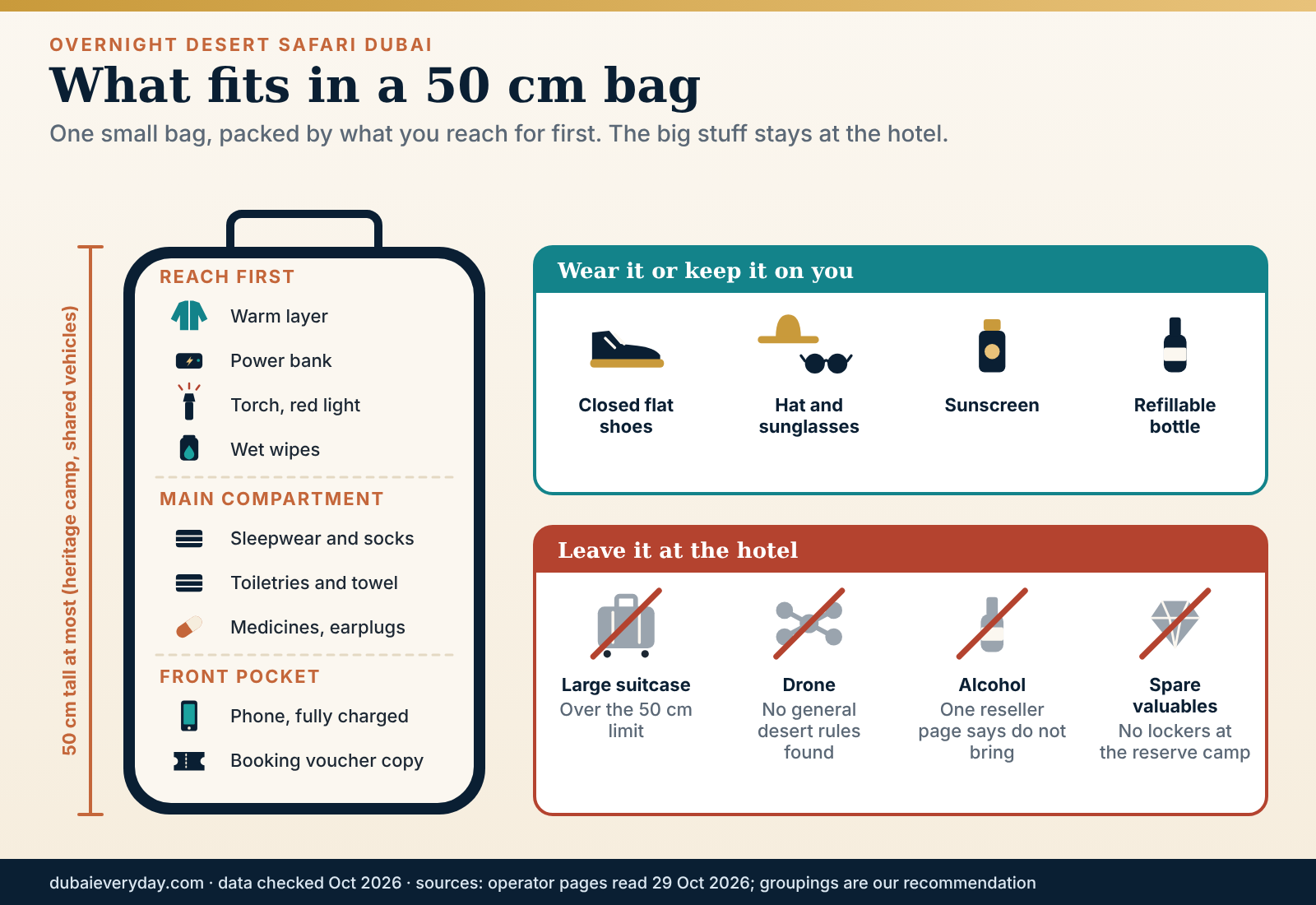
Packing for an overnight desert safari Dubai trip has a hard constraint and a soft one. The hard one is size: Platinum Heritage allows one overnight backpack or carry-on per guest, no taller than 50 cm, in its shared vehicles, and the reserve camp has no lockers. The soft one is temperature, which swings by about 9 to 10 degrees between the mean minimum and maximum of a winter day at the airport station, so the bag must cover a warm afternoon and a cold dawn.
Dress in layers, by month
Our layer plan for an overnight desert safari Dubai night is an interpretation of the airport figures and the operators’ advice, not a forecast. It assumes you will be outdoors at the coldest hours, such as stargazing at 21:00 or waiting for sunrise at 06:30, with no heating in a stone room.
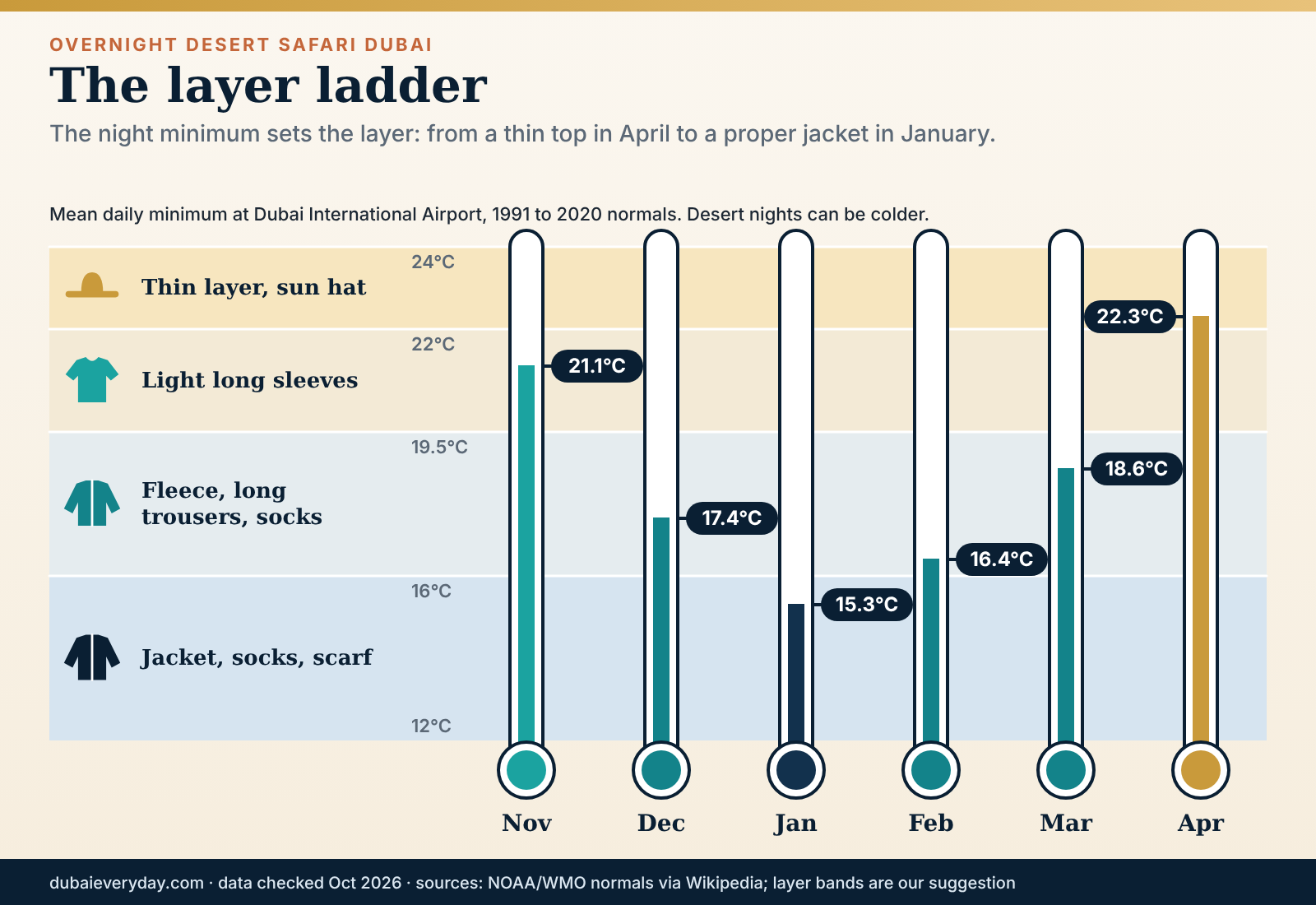
In November the mean minimum is 21.1°C, so a light long-sleeved top is enough for most people. From December to February the means are 17.4°C, 15.3°C and 16.4°C, and the combination of a light wind, a stone room and no heating argues for a fleece or jacket, long trousers and socks. March sits near 18.6°C and April near 22.3°C, but the afternoon is hot, so the bag needs a sun layer as well as a night layer.
The short list
- Warm layer for the night (fleece or jacket), plus a thin top for the daytime
- Closed-toe, flat shoes, which the Lahbab page recommends and the reserve camp’s page echoes as walking shoes
- Hat, sunglasses and sunscreen for the afternoon
- Sleepwear and socks
- Small power bank and a torch, ideally with a red-light mode
- Phone and camera fully charged before pickup
- Your voucher or booking copy, which the reserve camp asks for
- Personal medicines and any dietary essentials
- Wet wipes and a small towel for cold or absent showers
- Earplugs for a camp with a show
What the camps provide, and what to leave behind
Each overnight desert safari Dubai operator supplies some basics. Platinum Heritage gives a headscarf and a stainless-steel bottle. The Lahbab camp provides towels, toiletries and slippers. The reserve camp provides an amenities kit with sterilised towels and linen, though it tells guests to bring their own toiletries as well.
Leave behind large suitcases, valuables you cannot carry and, on at least one reseller page, alcohol. Drones were listed as not permitted on the heritage balloon trip, and we found no general rules for flying one in the desert, so we advise leaving it at the hotel. Operators recommend modest, comfortable clothing.
Safety, weather and health at a desert camp
An overnight desert safari Dubai stay adds exposure that an evening trip does not: hours of cold, a night away from medical help and a camp you cannot easily leave. None of that makes a licensed camp unsafe, but it means the usual safari advice needs extending. This is general information, not medical advice.
Rules that apply to tourist camps
Dubai regulates tourist camps, including those that host an overnight desert safari Dubai stay, through Administrative Resolution 39 of 2023. In the summary we used for our wider safari comparison, it requires a camp permit valid for one year, sorts camps into Economy, Premium and Luxe classes, and sets expectations for insurance, first aid, fire safety, a published price list and 24-hour contact numbers, with complaints answered within seven days. We read it through a summary of the PDF, not the original, so check the source if the detail matters.
We could not find a public lookup of which camps hold a permit. The practical step is to ask the operator for the camp’s permit and insurance details in writing. The UK Foreign Office advises using a reputable company for desert tours and checking that your own insurance covers the activity.
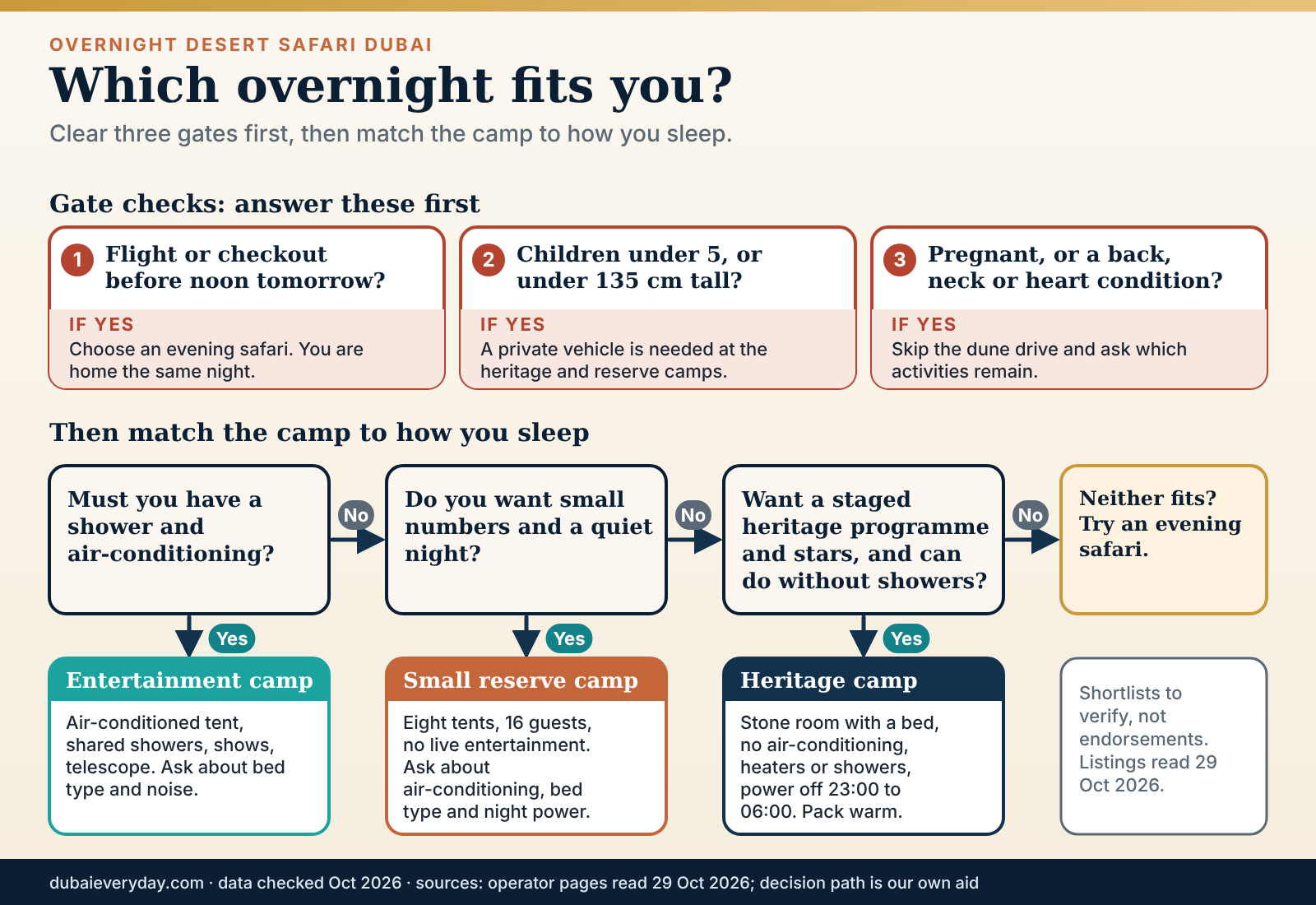
Every overnight desert safari Dubai listing we read excludes or warns some guests from the dune drive. The Lahbab page does not recommend dune bashing for pregnant women, people with serious back, neck or heart conditions, or infants. Arabian Adventures says expectant mothers and guests with pre-existing conditions cannot join the dune drive but can join other activities, while a reseller version says they should not take part at all. Platinum Heritage does not recommend its nature drive beyond six months of pregnancy. Read the wording for your booking and ask a doctor if in doubt.
Children
Rules differ more than people expect. Arabian Adventures bars children under two from dune drives and other off-road activities, and requires a private vehicle for children under 135 cm so that a child seat fits. Platinum Heritage requires a private car for under-fives. The Lahbab page says only that children must be accompanied by an adult. For the hotel side of a family trip, see our family hotels guide.
Heat, cold and water
October’s mean maximum at the airport station is 35.9°C and April’s is 33.7°C, so the afternoon of an overnight desert safari Dubai trip in the shoulder months is hot, while November (30.7°C) and March (28.9°C) are milder. The NHS describes heat exhaustion as tiredness, dizziness, headache, nausea, heavy sweating and strong thirst, and treats heatstroke, with hot skin that stops sweating and confusion, as an emergency. Winter nights are cold rather than dangerous, but young children and older relatives feel the cold sooner, so pack for them first.
The World Health Organization recommends sun protection when the UV index reaches 3 or higher; we did not check a Dubai reading, so assume a hat and sunscreen from March onward.
Insects, snakes and scorpions
The heritage camp’s page says harmless insects may occasionally be present and pest control is regular, and its astronomy listing describes a night walk to look for sandfish and scorpions. Ordinary precautions are enough: closed shoes, a torch and shaking out shoes before putting them on.
Quad bikes and weather
Quad bikes are an optional extra at the Lahbab camp, paid for on the spot. The Foreign Office’s safety page and a Dubai Pass listing we read for the wider comparison both treat them as a risk, with the listing noting that its price does not insure them. Do not assume your travel insurance covers one without reading the policy.
Rain, fog, wind and dust can spoil or cancel a desert night. Arabian Adventures says weather and force majeure may lead to a partial or full refund at its discretion. We found no operator procedure for official weather alerts while guests are already in the dunes, so ask directly. The UAE National Centre of Meteorology publishes forecasts, and the Foreign Office’s UAE page, updated on 27 October 2026, was the best place to check the regional situation. Check both again on the day.
What an overnight desert safari Dubai trip costs, worked through
Overnight desert safari Dubai prices span a factor of about four on the three pages we read, from AED 473 to roughly AED 1,980 per adult for the standard options, read on 29 October 2026.
The advertised prices
The Lahbab tented camp lists “from AED 473” without separating adult and child prices. The heritage camp lists AED 1,195 per adult and AED 995 per child aged 5 to 11, including VAT. The reserve camp lists its shared-transfer option at USD 539 per adult, about AED 1,980 at the 3.6725 peg, and its private-transfer option at USD 1,048, about AED 3,850. Its page metadata shows AED 850 and a “from” figure of USD 231 that no option matches, and every option showed as sold out, so treat that price grid with caution.
A price drift is visible too. Research for our wider safari comparison, done on the same day, recorded the heritage overnight at AED 1,095 per adult, while the operator’s own page showed AED 1,195. We cannot say which was current, which is the point: confirm the total on the booking screen.
Five worked budgets
The table, for an overnight desert safari Dubai booking, is an illustrative example, not a quote or a market fact. It multiplies the listed prices by party size and converts at 3.6725 dirhams to the dollar. It excludes everything in the next list.
| Illustrative party | Price basis | Sum in AED | About USD |
|---|---|---|---|
| Couple, tented camp | 2 x AED 473 | 946 | 258 |
| Couple, heritage camp | 2 x AED 1,195 | 2,390 | 651 |
| Family of four, heritage camp | 2 x AED 1,195 + 2 x AED 995 (children 5 to 11) | 4,380 | 1,193 |
| Couple, reserve camp, shared transfer | 2 x USD 539 | 3,959 | 1,078 |
| Couple, reserve camp, private transfer | 2 x USD 1,048 | 7,698 | 2,096 |
On our arithmetic, a couple choosing the heritage camp over the tented camp pays AED 1,444 more, and the reserve camp’s shared option costs about AED 3,013 more than the tented camp. The private transfer adds a further AED 3,739. Each premium buys something specific: fewer guests, a conservation setting or a vehicle of your own. None of them buys a hotel-grade bed.
Cost per hour, and why it misleads
Per listed hour, the tented camp costs about AED 28 and the heritage camp about AED 63 (on an assumed 19 hours), which ignores that seven or eight of those hours are sleep. A better comparison is the uplift over a normal evening safari: a standard red-dune evening listing was recorded at AED 150 for an adult, so the tented overnight adds roughly AED 320 for a bed, a night under the sky and breakfast.
What is usually not in the price
- Quad bikes at the Lahbab camp, paid on the spot with no price published
- Premium shisha and any food or drink outside the inclusions (Lahbab)
- Gratuities and travel insurance, both listed as excluded on the Lahbab page
- The sunrise balloon flight at the heritage camp, with no price on its overnight page
- A private vehicle, required for under-fives at the heritage and reserve camps
- Hotel transfers at the reserve camp, which one page lists as optional and another as included
The hidden line: the room you do not use
If your hotel charges you for the night you spend on an overnight desert safari Dubai trip, the camp’s price is not the whole cost. As an illustration only, a room at AED 600 a night would turn the AED 2,390 heritage couple’s trip into AED 2,990 for one night away. The AED 600 is an invented figure to show the logic, not a Dubai rate. If you can, shift the hotel booking so the night is not paid for twice. Our best hotels guide covers how to compare rooms by area and trip style.
Who it suits, and when to go
Whether an overnight desert safari Dubai package is the right call depends on how you sleep, who is travelling with you and which week you pick. The decision map below turns the operator details we read into a path. It is our own decision aid, built from listed features rather than a field test, so treat the endpoints as shortlists to verify.
Travellers it suits
Couples and photographers
The format’s natural audience. The reserve camp’s two-person tents and the heritage camp’s quiet after 23:00 suit couples. For photographers, a new-moon week matters more than the camp.
School-age children
The heritage camp has a child rate for ages 5 to 11 and a private-car rule for under-fives. The reserve camp requires a private vehicle for anyone under 135 cm.
Travellers who should think twice
Anyone planning an overnight desert safari Dubai booking with a flight, a business meeting or a hotel checkout in the first half of the next day should plan a buffer, because the return runs to late morning. Light sleepers should avoid the entertainment camp unless the tents are well away from the stage. People who need a hot shower should not book a camp without one. Arabian Adventures says its overnight is not wheelchair accessible, and pregnant guests and those with back, neck or heart conditions are excluded from the dune drive on every page we read.
Business travellers and stopover visitors have a particular trap. An overnight desert safari Dubai package looks efficient, but the long block of time and the late return make it a poor fit for a one-day visit. With one evening in Dubai, a standard evening desert safari returns you to a real bed. The Dubai airport guide covers arrival and departure timing if you are connecting.
The best months for an overnight desert safari Dubai trip
Our reading is that the comfortable core for an overnight desert safari Dubai trip is late November to early March. The airport normals put the mean maximum at 30.7°C in November, 26.5°C in December, 24.4°C in January, 26.1°C in February and 28.9°C in March, so the afternoon is pleasant and the night is cool. October (35.9°C) and April (33.7°C) are shoulder months, workable with air-conditioning and water. The heritage camp ends its overnight season on 30 April.
May to September is a different proposition. The mean maximum exceeds 38°C from May and the mean minimum stays above 26°C, so a tent or stone room without cooling is a poor idea. The heritage page gives a November-to-April season and the other pages state none. Our best time to visit Dubai guide shows how the seasons play out across a whole trip.
Peak weeks, Ramadan and demand
A trade publication reports that the Dubai Shopping Festival runs from 4 December 2026 to 17 January 2027, overlapping Christmas and New Year. We found no data on camp occupancy, so our expectation of heavy demand in those weeks is an inference. Our Dubai events calendar and January events guide show what else is on. Ramadan 2027 is projected to begin around 8 February, and camps may adjust the programme, as covered in the meals section.
Booking an overnight desert safari Dubai trip: questions and a decision
Booking an overnight desert safari Dubai trip is where the gaps in the listings turn into a bad night or a good one. The aim is to get the missing answers in writing before you pay, while the cancellation terms still favour you. The steps are ordered by how much each answer can change your decision.
- Pick the night firstChoose a date inside a new-moon window if the stars matter, outside Christmas week if you can, with a clear morning afterwards.
- Ask the four comfort questionsAir-conditioning or heating, a usable shower, power overnight and the time the programme ends. Ask by message so there is a record.
- Confirm who sleeps wherePeople per tent or room, bed type, bedding, and whether a family can stay together.
- Check age and health rulesUnder-fives, children under 135 cm, pregnancy and back, neck or heart conditions change what you can do.
- Ask for permit and insurance detailsAsk the operator to confirm both, and for a 24-hour contact number.
- Read the cancellation clause against the weatherAsk what happens if an official alert hits.
- Confirm pickup mechanicsGive the hotel name exactly and ask when the final pickup time arrives.
Fitting the night into a trip
The block of time is the real cost, so place your overnight desert safari Dubai night where it hurts least. A good slot is the middle of a stay with a flexible morning afterwards: our Dubai 3-day itinerary shows a trip without a day lost in taxis, and an overnight could replace one of its evenings. A late arrival flight leaves you tired for a night in a tent, and a late-morning return makes any early departure flight risky. A first visit is better organised through the first time in Dubai planner and the Dubai travel guide.
For comparison with other outdoor options, see outdoor things to do in Dubai and the wider things to do in Dubai. A beach day is a cooler way to recover afterwards, and our best beaches in Dubai guide lays out the options.
If you want to camp yourself
A Gulf News explainer, last updated on 31 October 2025, reports Dubai Municipality as saying a short weekend desert tent does not need prior permission, while seasonal camping needs permission and a fee. It says authorities prefer designated areas and reports federal fines of up to AED 30,000 for dumping or burning waste outside them. That is a news report, not the regulator, so check Dubai Municipality directly, and note that, unlike an overnight desert safari Dubai booking, you would have none of an operator’s food, safety cover or conservation setting.
Making the call
An overnight desert safari Dubai booking is worth it if you want the night more than the show: the quiet, the sky, the sunrise and the slow breakfast. It is worth less if you want to see the dunes on a tight schedule, if you sleep badly outside your own bed or if you are travelling with under-fives. Choose the entertainment camp for conveniences and a lively evening, the reserve camp for small numbers and a quiet night, and the heritage camp for a staged heritage programme with few conveniences.
Whatever you choose for your overnight desert safari Dubai night, put the four comfort answers in writing, pick a dark-sky night, pack one warm layer more than you think and leave the morning after empty.
Overnight desert safari Dubai FAQ
How much does an overnight desert safari Dubai package cost?
On 29 October 2026 we read AED 473 for a Lahbab tented camp, AED 1,195 per adult for a heritage camp (AED 995 for children aged 5 to 11) and USD 539, about AED 1,980, per adult for a small reserve camp on shared transfers. These are listing prices and extras can raise the total, so confirm on the booking screen.
Do the tents have air-conditioning and showers?
It depends on the camp. The Lahbab tented camp lists a private air-conditioned tent and shared showers. The heritage camp’s stone rooms have no air-conditioning or heating, power is off from 23:00 to 06:00 and there are no showers on site. The reserve camp’s pages mention outdoor showers on one page and say nothing about air-conditioning. Ask in writing before paying.
Can children join an overnight desert safari Dubai trip?
Often, with conditions. The heritage camp has a child rate for ages 5 to 11 and requires a private car for under-fives. The reserve camp bars under-twos from dune drives and requires a private vehicle for children under 135 cm. The Lahbab listing says only that children must be accompanied by an adult. A balloon add-on has stricter limits.
Is stargazing good on an overnight desert safari Dubai trip?
Good rather than spectacular. UAE cities are heavily light-polluted, according to an Associated Press report, so a camp near Dubai still has a glow on the city side. Expect the moon, bright planets and the main winter constellations. Moon phase matters most: aim for the nights around a new moon, shown in our dark-sky calendar.
What should I wear and pack for an overnight desert safari Dubai trip?
One small bag: a warm layer for the night, a thin top for the afternoon, closed flat shoes, sleepwear, hat, sunscreen, a power bank, a torch and wet wipes. The heritage camp limits guests to one backpack or carry-on up to 50 cm. Winter night minimums at the airport station are 15°C to 17°C, and the desert may be colder.
Is an overnight desert safari Dubai trip safe?
Licensed camps operate under Dubai’s tourist-camp rules, which cover permits, insurance, first aid and fire safety, according to a summary we read. The main risks are the dune drive, quad bikes, cold nights and shoulder-month heat. Pregnant guests and people with back, neck or heart conditions are excluded from the dune drive. Ask for the permit and insurance details in writing.
Can I drink alcohol at a desert camp?
It depends on the operator. Arabian Adventures sells premium beverage packages and tells guests on one page not to bring their own. The Lahbab and heritage pages do not mention alcohol. The UK Foreign Office’s UAE page sets out the visitor rules, including a legal drinking age of 21. Ask what is served before you book.
Do overnight desert safari Dubai trips run in summer?
The heritage camp gives a 1 November to 30 April season. The other pages stated none, and the airport normals show night minimums above 26°C from May. Even if one is on sale in summer, a tent or stone room without cooling is a poor idea, so ask for written confirmation of air-conditioning.
Is an overnight desert safari better than an evening one?
Neither is better; they suit different priorities. An evening safari costs far less (a standard red-dune listing was around AED 150) and returns you to your own bed. The overnight adds the night sky, quiet and a sunrise, at the cost of a long block of time and variable comfort. Our reading is that people who care about the stars and the morning should consider it.
Related reading
Sources and further reading (18 links)
- Platinumlist: Overnight Red Dune Desert Safari (Lahbab) — price, itinerary, tent, showers, cancellation
- Arabian Adventures: Overnight Desert Safari — price grid, tent, programme, age and health rules
- Visit Dubai Experiences: Arabian Adventures Overnight Safari — camp size, showers, entertainment, cancellation
- Platinum Heritage: Overnight Desert Safari — price, season, stone rooms, power, meals, luggage
- Platinum Heritage: Private Night Safari and Astronomy — telescope session, night walk
- Associated Press via WTOP: UAE darkest spot and the Milky Way — light pollution context
- Space.com: Meteor showers 2026 — Leonids and Geminids peaks
- Gulf News: UAE camping rules explained — independent camping context
- Visit Dubai: Dubai desert hotels and resorts — resort alternatives
- Dubai Municipality: About Dubai protected areas — protected-area context
- Emirates: Dubai Desert Conservation Reserve — reserve size (operator claim)
- Dubai Legislation Portal: Administrative Resolution 39 of 2023 on Tourist Camps — camp permit and obligations
- UK FCDO: UAE safety and security — desert tours, alcohol, quad bikes
- Wikipedia: Climate of Dubai — NOAA/WMO monthly normals (secondary compilation)
- The National: Ramadan 2027 dates — projected start of Ramadan
- NHS: Heat exhaustion and heatstroke — symptoms and first steps
- WHO: The ultraviolet (UV) index — sun-protection guidance
- TradeArabia: Dubai Shopping Festival 2026-27 dates — festival period
Update log: 29 October 2026, first publication; all facts re-checked against the sources above. Next review due: annually, or sooner if camp prices, seasons, age rules or operator status change. Corrections welcome. This page is general information, not individual medical, legal or financial advice.
About DubaiEveryday and this guide
DubaiEveryday.com is an independent editorial project that publishes practical, research-based guides to everyday life in Dubai: where to live, what things cost, how the rules work and how to get around. This page was written and edited by the DubaiEveryday editorial team. It is not signed by a named expert, doctor, lawyer or adviser, and we do not claim first-hand testing of a venue, clinic or service unless the page says so.
Each guide is built from official sources such as government and regulator pages, operator websites and established news outlets, cross-checked where we can. When we could not confirm something, we say so in the text, and examples that use made-up numbers are labelled as illustrations. Mentions are editorial choices, not paid placements, and a link is not an endorsement.
Dubai changes quickly. If you spot something that is out of date or wrong, please tell us through the contact options on DubaiEveryday.com and we will check it and correct the page.