
The best swimming beaches Dubai has are the lifeguarded municipal beaches along Jumeirah and Al Mamzar, and which one suits you depends on the month, the hour and how strong a swimmer you are. This guide sorts them by water setup, lifeguard cover, facilities and seasonal comfort.
Dubai has a lot of coastline and surprisingly little agreement about which part of it you should actually swim from. Some stretches are built for strolling and photographs, some are shared with kites and jet skis, and a few come with lifeguards, marked swim areas and floodlit water after dark. The sea itself changes character through the year, from a brisk 22 °C in February to something close to bathwater in August.
This guide sorts the swimming beaches Dubai’s municipality runs by what matters once you are wet: who is on duty and when, how the water is set up, what the facilities really are and how the seasons change the answer. You will see which beaches suit proper laps, which suit a gentle paddle and which to skip on a July afternoon. Nobody here has swum at these beaches for you, so every claim comes from official pages and dated reports.
For swimmers, the swimming beaches Dubai Municipality runs along the Jumeirah coast and at Al Mamzar are the strongest choice, because they are the ones with published lifeguard cover and marked swimming areas. Jumeirah 1, Jumeirah 2 and Umm Suqeim 2 are the most swim-focused of the Jumeirah group. Khor Al Mamzar, opened on 5 May 2026, adds a 3.6 km swimming shoreline with 12 lifeguard towers. Jumeirah 2, Jumeirah 3 and Umm Suqeim 1 have floodlit night swimming.
Municipal lifeguards are generally on duty from sunrise to sunset, so by our calculation the guarded day runs from about 10.5 hours in December to nearly 14 hours in June. The sea is coolest in February (around 22 °C) and warmest from July to September (around 33 °C). November to April is the comfortable stretch; from June to September, swim in the first and last hours of daylight. Public beaches charge no entry fee, so the cost you actually feel is parking. Everything below is research-based, not field-tested.
We built this guide to the swimming beaches Dubai offers from official and primary material read on 29 October 2026: Dubai Municipality beach profile pages and its night-swimming announcement, the Dubai Media Office release on Khor Al Mamzar, RTA timetables, Visit Dubai, a UK government safety page and public-health references on UV and rip currents. Where a fact came from press coverage rather than an official page, the text says so.
Nobody on this site has swum, stayed or dined at the places described, so there are no personal impressions here. Selection is by published evidence: lifeguards, swim-area set-up, access, facilities and opening status. Inclusion was not paid for, and nothing is ranked by commission. This is general information, not safety, medical or legal advice. Prices, hours and beach layouts change; confirm on the day.
What makes the best swimming beaches Dubai can offer
Dubai has plenty of sand, but sand and swimming are different jobs. A beach can be wide, photogenic and busy, and still be a poor place to put your head under water if jet skis run close by, nobody is watching the sea, or the nearest shower is a long walk. So this guide judges the swimming beaches Dubai offers on four things, in this order: water conditions, lifeguards, facilities, and seasonal comfort.
Water conditions means what you are swimming in: temperature, how the sea behaves, and whether the swimming area is separated from motorised traffic. Lifeguards means who is on duty, between which hours and where. Facilities means the practical kit around a swim: access paths, lockers, showers, parking, food. Seasonal comfort means whether the sea and the air are pleasant at the hour you can actually go.
The scope of this page, and where the neighbours pick up
Three sister guides cover adjacent questions, so we do not repeat them. For the full map of public, hotel and club beaches, read our overview of the best beaches in Dubai. For fee-free sand, showers and parking in detail, see the guide to free public beaches. For shallow water, play areas and shade with small children, use the family beaches guide. This page stays with the swimmer and the swimming beaches Dubai has for actually getting wet.
The criteria, in plain terms
We gave each of the swimming beaches Dubai residents use a simple read against five questions, using only what an official page or dated report states. Is there a published lifeguard arrangement? Is the swimming area swim-only, or shared with kite-surfing or surf? Is swimming possible after dark? Is there a step-free access corridor to the sand? And is the beach open to the public today? A “not published” answer is not a failure, but it is a reason to ask before you rely on something.
Dubai Municipality’s own beach profiles are detailed about lifeguards, track lengths and lounges, and almost silent on showers, toilets and water depth. For swimming beaches Dubai-wide, we found no official, per-beach figures on water quality or seabed slope, and we have not made any up. Where the gap affects your swim, the text says what to check on arrival.
Who this page is for
It is written for anyone comparing swimming beaches Dubai-wide who wants to actually swim: a few lengths parallel to the shore before breakfast, a long cooling dip after work, an evening swim after sunset, or a paddle that does not turn into a rescue. If you want a lounger, a DJ and a cocktail with your swim, that is a beach-club question; the hotel and club section only sets out what to ask.
If you are still choosing where to base yourself, the beach hotels guide covers private beach quality, and the best time to visit Dubai sets the wider weather picture.
Water conditions: what the sea is actually like
Dubai sits on the southern side of the Arabian Gulf, a shallow, warm, salty sea that is not much like an open ocean. That is general geography, not a measurement taken at a particular beach, but it explains most of what swimmers notice: calm water on most days, very little cool relief in summer, and a sea that clouds quickly after wind. It shapes every one of the swimming beaches Dubai has, starting with temperature.
Temperature: the one number that changes with the calendar
Published monthly averages put Dubai’s sea at roughly 22 to 23 °C from January to March, climbing to about 25 °C in April and December, 28 to 29 °C in May and November, and 31 to 33 °C from June to October. These are rounded, indicative figures from climate references, not live readings, and a single beach on a single morning can differ. They are still enough to compare swimming beaches Dubai-wide by season.
Our reading of those numbers is simple. Below about 24 °C, a slow, casual swim feels cool, and fitness swimmers will like it. Between about 25 and 29 °C, most people find it comfortable for long. From about 30 °C upwards the water is close to skin temperature, which means it stops cooling you down. A 33 °C sea in August is pleasant to float in and nearly useless as relief from the heat.
Waves, wind and the odd current
The Gulf is usually gentle, and many days the surface is close to flat. That is not a guarantee. Wind can build chop quickly, and Dubai Municipality’s own profile pages reflect it: Jumeirah 3 and Umm Suqeim 1 carry kite-surfing areas, and Umm Suqeim 2 has surf-only zones. Kite and surf areas exist where there is wind and some wave, so among the swimming beaches Dubai offers, expect those two to be livelier than a swim-only one. That inference is ours, not the municipality’s.
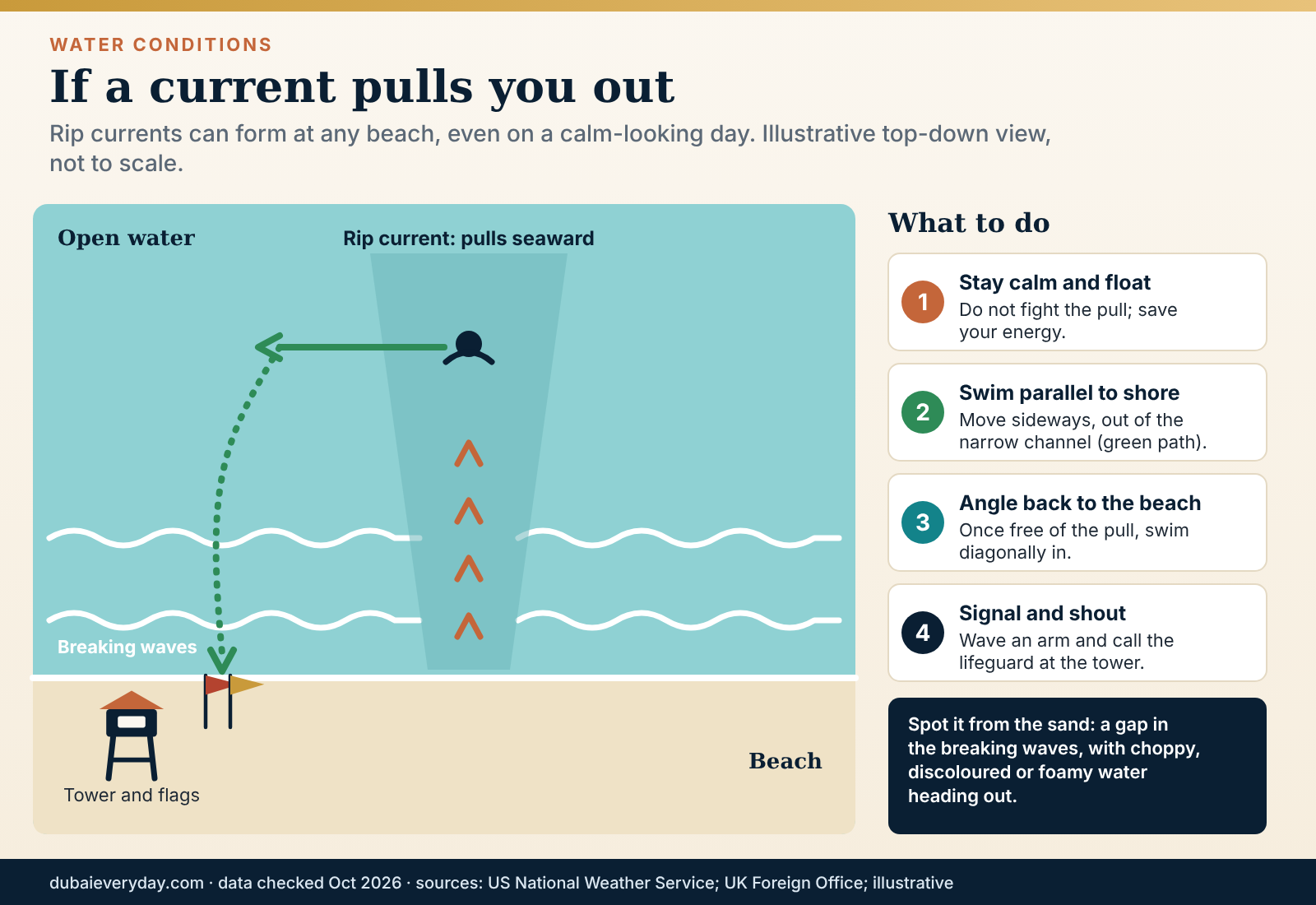
Safety guidance published in October 2026 for families tells beachgoers to check depth, waves, currents and tides before going in at any of the swimming beaches Dubai residents use, and the UK government’s travel advice warns that rip currents can form at any beach. We found no official page giving depth profiles for individual beaches, so treat any claim of “perfectly shallow for 100 metres” as unverified unless a lifeguard confirms it for that day.
Clarity, jellyfish and algae
Do not expect Caribbean visibility at the swimming beaches Dubai has. Wind-stirred water at a city beach is often cloudy, and that is normal rather than a warning sign. Separately, news archives have recorded episodes of jellyfish, algal blooms and, in December 2023, an oil-slick sighting along the Dubai coast. We read the headlines, not the full stories, so we cannot describe their scale or dates reliably. The point is narrower: sea conditions are not constant, and purple flags exist for a reason.
On water quality, we found no published per-beach results and are not claiming any. If the water looks discoloured, smells wrong, or the lifeguards have raised a warning flag, the answer is to skip that day and try another beach or a pool. Nothing is lost by waiting.
Separation from motorised traffic
For a swimmer, the layout of the water matters more than its colour, and it differs between swimming beaches Dubai-wide. Municipal pages describe Jumeirah 1 and Jumeirah 2 as swim-only, Umm Suqeim 2 as having separate swim-only and surf-only areas, and the Mamzar lagoon beach as swim-only with no water sports. Umm Suqeim 1 separates motorised sports from the rest. Khor Al Mamzar lists kayaking and other water sports among its features, so ask where the swimming zone ends there.
Lifeguards and flags at swimming beaches Dubai-wide
On the swimming beaches Dubai Municipality runs, its beach profiles describe lifeguards on duty from sunrise to sunset at Jumeirah 1, Jumeirah 2, Jumeirah 3, Umm Suqeim 2 and the Mamzar lagoon beach. The Umm Suqeim 1 profile says lifeguards are there from sunrise, and that the lit night area has lifeguards until midnight. At Khor Al Mamzar, the opening release counts 12 lifeguard towers and 12 emergency call points, but gives no duty hours.
“Sunrise to sunset” is not a fixed clock time, so we calculated it for Dubai’s coordinates. In mid-December the guarded day runs from about 06:57 to 17:31, around 10 hours 35 minutes. In mid-June it runs from about 05:28 to 19:10, around 13 hours 42 minutes. The December window closes before many people have left the office, which is the main reason the night beaches matter.
What the flags mean
The flags at swimming beaches Dubai-wide follow press guidance based on Dubai Municipality practice, repeated by The National in October 2026, which gives the standard meanings. Green is safe to swim. Yellow means caution. Red means do not enter the water. Purple warns of harmful marine life. Red and yellow flags together mark the area patrolled by lifeguards. If the flags and a lifeguard’s whistle disagree with your plan, the flags win.
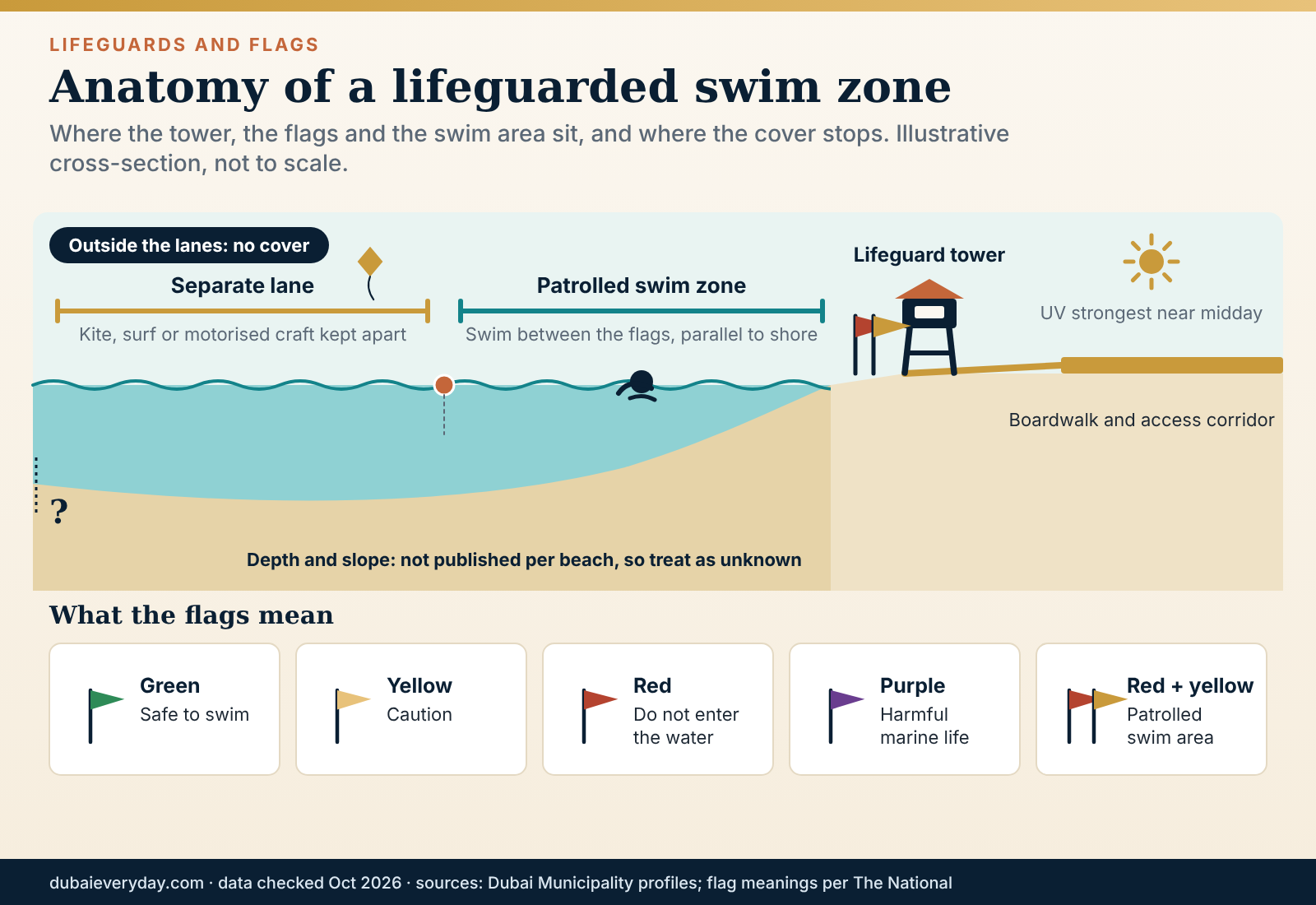
Even at the best swimming beaches Dubai has, Dubai Municipality’s advice is to swim only in designated zones and stay out of the sea elsewhere, and UK government travel advice says the same about approved, lifeguarded beaches with flags. Unguarded rocks, breakwaters, hotel frontages without a lifeguard and the sea after dark outside night-swimming zones are all outside the safety net. Strong swimmers drown too, usually because of a current, cramp, a medical event or tiredness. This is general information, not individual safety advice.
How to use a lifeguard well
At any of the swimming beaches Dubai runs, find the tower first and set your towel within sight of it. Swim parallel to the shore, inside the flagged area, rather than straight out. If you plan a long swim, tell the nearest lifeguard where you are going. Ask a quick question about the day’s current or marine life before you get in, because they see the water every hour. If you swim alone, keep it short and keep it near the tower.
Children and weak swimmers need an adult within reach, not a lifeguard on the horizon. The family guide covers that in depth, including how the officials’ advice on supervision works in practice, so we leave it there.
Staffing at busy times
Lifeguard presence at swimming beaches Dubai-wide is not static through the year. When Dubai Municipality reserved eight public beaches for families over Eid Al Adha in 2024, it reported 140 rescue personnel and 65 field supervisors on duty across the beaches. Four beaches were reserved the same way for New Year’s Eve 2025 into 2026. “Family” was not defined in the reports we read, so check the holiday notice before planning a swim on those dates.
The shortlist: nine swimming beaches Dubai residents and visitors use
The table below puts the swim-relevant facts of nine swimming beaches Dubai residents use side by side. Every cell comes from an official municipal profile or a dated report; blanks mean “not published”, not “does not exist”. Lengths are as published and are not always measured the same way. Order runs roughly from the northeast (Al Mamzar) to the southwest (Umm Suqeim).
| Beach | Published size | Swim set-up | Lifeguards | After dark |
|---|---|---|---|---|
| Khor Al Mamzar | 3.6 km swimming shoreline | Swimming plus kayaking and water sports | 12 towers, 12 call points; hours not stated | 300 m night beach, 24/7 |
| Mamzar lagoon beach | About 3.5 km | Swim-only, no water sports | Sunrise to sunset | Open round the clock; no night swimming listed |
| Al Mamzar Beach Park | Five beaches (Visit Dubai) | Gated park with pools | Not covered in sources | Park hours 08:00 to 22:00 |
| Jumeirah 1 | 1,350 m track; over 1.4 km reported | Swim-only | Sunrise to sunset | Not listed |
| Jumeirah 2 | 648 m | Swim-only | Sunrise to sunset | Night swimming (2023 announcement) |
| Jumeirah 3 | 1,980 m | Kite-surfing area on the same beach | Sunrise to sunset | Night swimming (2023 announcement) |
| Umm Suqeim 1 | 2.4 km | Kite area; motorised sports separated | From sunrise; to midnight in lit zone | Lit zone until midnight |
| Umm Suqeim 2 | 615 m | Separate swim-only and surf-only areas | Sunrise to sunset | Not listed |
| JBR The Beach | 600 m track | Public frontage, mixed use | Not stated on operator FAQ | Not stated |
One caution on the first two rows: the older Mamzar lagoon profile (about 3.5 km, swim-only) and the May 2026 Khor Al Mamzar release (3.6 km, with kayaking) may describe the same stretch before and after redevelopment. We could not confirm that, so we list both and treat the older page as possibly dated. Two other data conflicts are worth knowing about.
The first concerns lengths. The 2023 night-swimming announcement gives 800 m as the length for each of three beaches, while the Jumeirah 2 profile says 648 m; the likeliest explanation is that 800 m describes the lit zone, but that is a guess. And the Umm Suqeim 1 page says lifeguards stay until midnight, whereas the announcement says night swimming runs from sunset to sunrise. Plan on midnight and be pleasantly surprised if it is longer.
Beach by beach, from Al Mamzar to Umm Suqeim
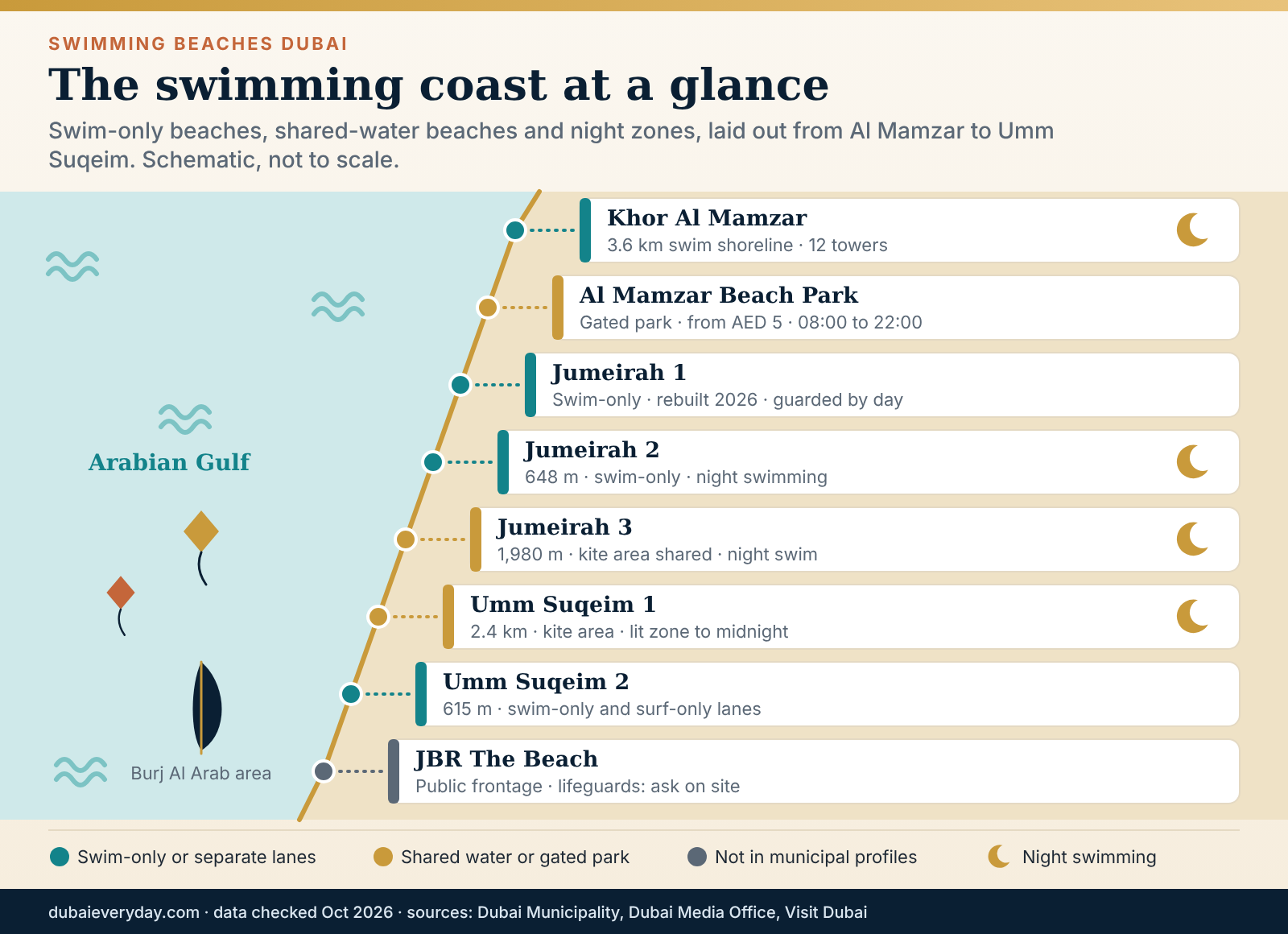
The map below is schematic and not to scale. It covers the swimming beaches Dubai has, running from Al Mamzar in the northeast to Umm Suqeim in the southwest, and marks which beaches are swim-only, which share the water with kites or surf, and which have a lit night zone. The short profiles that follow give the reasoning, with a plain “best for” and “less good for” line for each.
Khor Al Mamzar and Al Mamzar Beach Park
Khor Al Mamzar is the newest of the swimming beaches Dubai has to show, opened on 5 May 2026 as the first phase of the wider Al Mamzar Beaches project. The Dubai Media Office release gives a 3.6 km swimming shoreline, 182,000 square metres of sand, 12 lifeguard towers, 12 emergency call points, a 300 m night beach, a floating walkway, more than 5.5 km of tracks and a list of food outlets and public facilities.
If towers were spread evenly, 3,600 m across 12 towers would be one about every 300 m. That is our arithmetic, and the real spacing is not published. The release also gives no opening hours, fees, parking details or shower and toilet lists, so confirm those before you go. Best for: long, continuous swims along a guarded shoreline, and a night swim. Less good for: anyone who needs published rules and opening hours before leaving the hotel.
Next door, Al Mamzar Beach Park is a different product: a gated park rather than open municipal sand. Visit Dubai describes it as opening daily from 8am, with five beaches, swimming pools, bike paths, picnic areas and rentable chalets, with entry from AED 5. A 2024 Gulf News report gave AED 5 per person plus AED 30 per car, with under-twos free. Treat both as starting points, and note that we found no source describing lifeguard arrangements inside the park.
Jumeirah 1
Jumeirah 1 was rebuilt and reopened in 2026, with reports of a larger beach, smart lockers, Wi-Fi and monitoring technology. Dubai Municipality’s profile describes it as designated entirely for swimming, one of the quieter beaches and mainly used by local residents, with lifeguards from sunrise to sunset and round-the-clock access. Reports put the track at 1,350 m, and a Gulf News guide places the entrance off D94 after Dubai Canal.
Of all the swimming beaches Dubai Municipality describes, this is the most explicit about being for swimmers. Best for: swimmers who want no jet skis or kites in sight, and short dips with lockers close by. Less good for: evenings, since no night swimming is listed, and for anyone who needs a published list of toilets and showers, which we could not find.
Jumeirah 2
Jumeirah 2 is compact at 648 m. The municipal profile lists swimming only, gym equipment, a jogging track, a boardwalk, beach lounges, a children’s playground, a library and an access corridor, with lifeguards from sunrise to sunset. It is one of the three beaches named in the 2023 night-swimming announcement. A Gulf News guide places it after Mercato Mall.
Best for: a straightforward swim with a night option, which only a handful of swimming beaches Dubai-wide offer. Less good for: space, since a short beach fills up quickly on weekends. That last point is our inference rather than a published figure.
Jumeirah 3
Jumeirah 3 runs 1,980 m and mixes uses: a kite-surfing area, a jogging track, a boardwalk, an outdoor gym, lounges, playground areas, a library and a 125 m “happiness platform” for sunset seating and fishing. Lifeguards cover it from sunrise to sunset, and it is on the night-swimming list. Access is via Umm Al Sheif Road from the E11, according to the Gulf News guide.
Best for: a long, well-equipped beach with a night option. Less good for: swimmers who want a swim-only setting, because kite areas share the coast. The profile does not say how far apart the zones are, so ask the lifeguard where the kite lane sits before you head out.
Umm Suqeim 1
Umm Suqeim 1 is 2.4 km long, with a kite area, a jogging track, a boardwalk and a stated separation of motorised sports from other water users. Its profile says lifeguards are on duty from sunrise, and that a lit night swimming area stays open until midnight with lifeguards present. Many visitors know this stretch as Kite Beach; matching the two names is our reading, not a municipal statement. The page also attributes some facilities to “Umm Suqeim 2”, which looks like a naming slip.
Best for: an active, social swim and after-dark swimming until midnight. Less good for: a quiet, glassy-water session, because wind sports are the point of the place.
Umm Suqeim 2
Umm Suqeim 2 is 615 m, around 1 km from Burj Al Arab according to its profile, with separate swim-only and surf-only areas, a jogging track, lounges, an access corridor and lifeguards from sunrise to sunset. Best for: a swimmer who wants a landmark behind them and surfers kept to their own lane. Less good for: night swimming, which is not listed for this beach.
Works and changes to watch
The map of swimming beaches Dubai offers is still changing. Dubai’s multi-year beach programme, reported by Gulf News at AED 3 billion and running to 2030, includes major investments at Al Mamzar and Umm Suqeim, and a master plan for Jebel Ali beach with no opening date. A women-only Corniche at Al Mamzar had been announced, but a Khaleej Times report in September 2026 still described it as being prepared. Construction can move fences, entrances and swim zones, so check the municipality’s channels before a long drive.
Swimming after dark: the night beaches
Night swimming is the biggest practical change to the swimming beaches Dubai has offered in recent years. In May 2023 Dubai Municipality announced night swimming at Jumeirah 2, Jumeirah 3 and Umm Suqeim 1, with lighting, rescue equipment and trained lifeguards, plus electronic screens carrying safety messages. Khor Al Mamzar now adds a 300 m night beach. Everywhere else, the municipal rules we saw state that swimming after sunset is not allowed outside night zones.
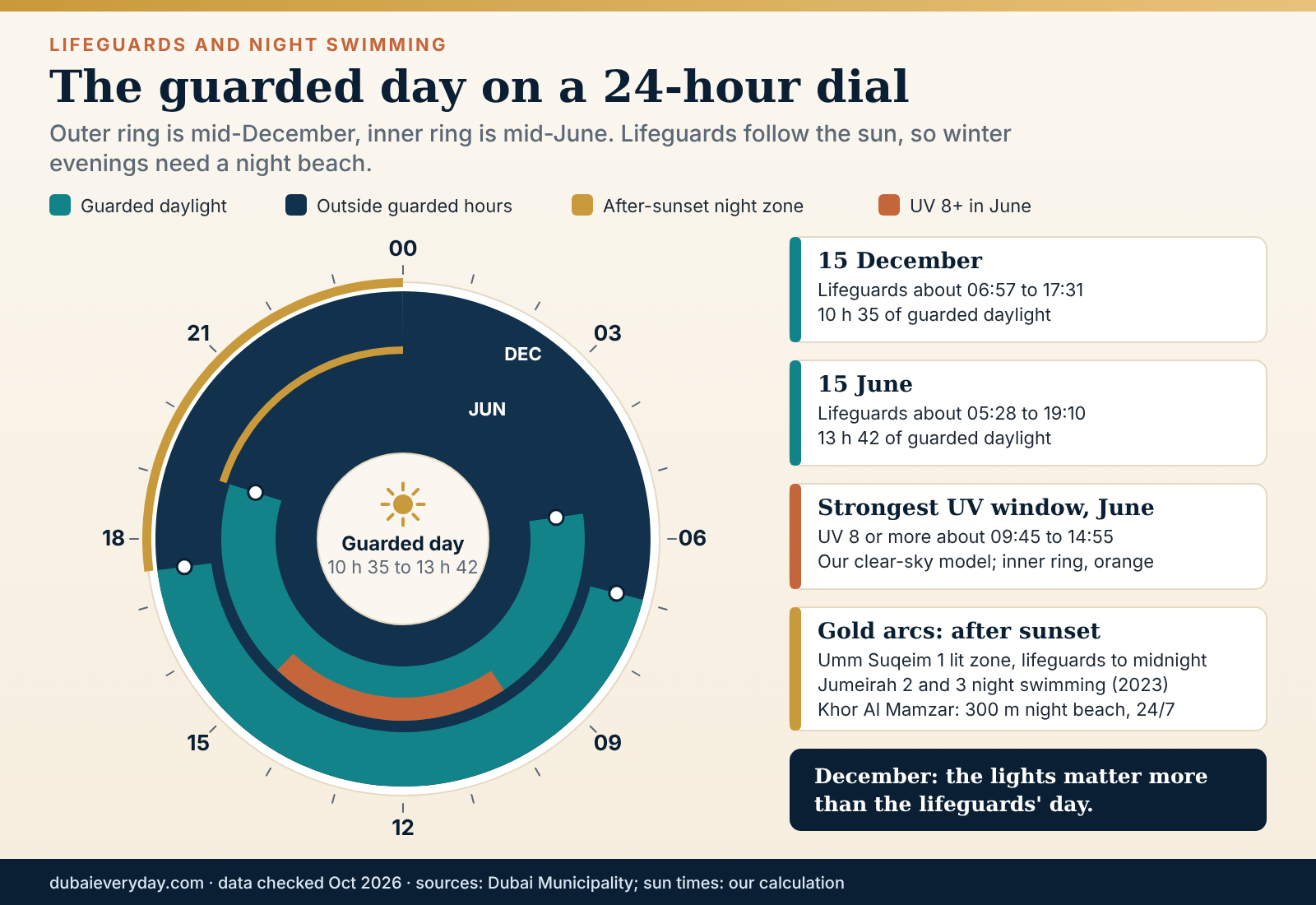
Why the dial matters
Look at December. Sunset is around 17:31, so the guarded day ends before many people finish work, and the evening swim only exists if you head for a night beach. In June, sunset is close to 19:10, so a straight-from-work swim is possible in daylight, but the sea is 31 °C and the air is hot. The night beaches matter all year, for different reasons: in winter they give you a swim at all, and in summer they give you a cooler hour.
Safety after dark
Lighting helps at the swimming beaches Dubai has lit, but depth and distance are harder to judge at night. Swim shorter and closer to the shore than you would in daylight, keep to the lit zone, go with someone, and wear a bright cap or swimwear so lifeguards can see you. The National’s October 2026 guidance suggests bright colours such as orange or pink for children because they stand out against the water. The same logic applies to adults.
Plan on lifeguards until midnight at Umm Suqeim 1, the only duty time the municipality has stated for the night zones. The 2023 announcement describes swimming around the clock, but a published duty roster would be better evidence than a headline, and we found none. If you intend to swim late, ask the lifeguard before you start. For events that may block or fill the night beaches, the Dubai events calendar is a useful check, and the January events guide covers the busiest cool-season month.
Beyond municipal sand: JBR, hotel beaches and clubs
Not every swim happens on one of the municipal swimming beaches Dubai runs. Plenty of visitors swim from the JBR frontage, from the beach of the hotel they are staying at, or from a beach club on a day pass. Those places run on different rules, and the public sources we could read say much less about their swimming set-up. That does not make them worse. It means you have to ask more questions.
JBR The Beach
The Beach at JBR is a public frontage with no entry fee. Its operator’s FAQ describes a 600 m track, baby-changing rooms, a prayer room and free Wi-Fi. Parking is charged at AED 20 per hour, with the first three hours free when you validate a bill of AED 100 or more at participating outlets, one validation per car. For public transport, the usual route is Metro to DMCC, then the tram to JBR 1 or JBR 2. RTA runs the tram Monday to Saturday 06:00 to 01:00 and Sunday 09:00 to 01:00.
What the FAQ does not say is who guards the water, where the swimming zone ends and how water sports are kept apart. Dubai Municipality’s profiles of the swimming beaches Dubai residents use do not cover JBR either. So before you commit to a long swim there, look for flags and a lifeguard tower, and ask. For the wider picture of how JBR sits among Dubai’s beaches, the best beaches overview sets it in context.
Hotel beaches: questions that decide the swim
Hotel beaches are the least documented of all the swimming beaches Dubai visitors use. A hotel beach can offer calm, sheltered water, a lifeguard of its own and clean sunbeds. It can also be a strip of sand with a pool bar and no one watching the water. The difference is rarely visible in a photo. Before you book a stay or a day pass for the swimming, ask these questions in writing and keep the answers.
- Is there a lifeguard on the beach during swimming hours, and what are those hours?
- Is the swimming area marked with buoys or flags, and are water sports kept outside it?
- Can day-pass guests swim in the sea, or only in the pool?
- What happens when the sea is closed by a red flag: is there a pool alternative at no extra cost?
- Are showers and changing rooms included for day-pass guests?
Our beach hotels guide goes into private beach quality, and the luxury hotels guide explains what the premium buys. If you are choosing a base around children, the family hotels guide covers pools and kids’ clubs.
Beach clubs and day passes
Club day passes are mostly sold as a lounger or cabana, and swimming is a side benefit, which makes them an expensive route to swimming beaches Dubai already provides free. A What’s On report dated 19 August 2026 listed weekday and weekend lounger rates at several family-friendly clubs from roughly AED 150 to AED 300, with some rates marked as valid only through June, and some venues adults-only or restricted to older children. Treat that as the scale of spend, not a quote: prices, minimum spends and opening status change fast, and clubs have closed and reopened this year.
A fully redeemable minimum spend is a different thing from an entry fee. If AED 300 buys AED 300 of food and drink, the real cost of the swim is the part you would not have spent anyway. If it is a flat access charge, the cost is all of it. Read the conditions before you pay.
Pool or sea?
On a 33 °C August afternoon, a pool is often the better swim: it can be shaded and is not subject to flags. Our reading is that the sea wins from November to April for casual swimmers, while a pool or an early-morning sea swim wins in summer. If the flags are red, the choice is made for you.
Facilities, parking and getting there
Facilities are where the profiles of swimming beaches Dubai Municipality runs get thin. They list access corridors, jogging tracks, boardwalks, outdoor gym equipment, beach lounges, playgrounds and a library at Jumeirah 2 and 3. They say little or nothing about showers, toilets, changing rooms and car parks. So we can tell you what exists on paper, and we can tell you what to carry to cover the gaps.
What is published, and what is not
Published: access corridors at Jumeirah 2, Jumeirah 3, Umm Suqeim 2 and the Mamzar lagoon beach, which are the step-free routes to the sand. Smart lockers were reported for the rebuilt Jumeirah 1. Khor Al Mamzar lists 20 public facilities and 19 food and drink outlets, without breaking them into showers and toilets. Not published, as far as we could find: shower and changing-room counts at any municipal beach, and whether shade tents or umbrellas are allowed on the sand. Dubai Municipality’s service line, 800900, is the number to ask.
A swimmer’s kit, because the facilities are patchy
- A quick-dry towel and a dry change of clothes in a waterproof bag.
- Sandals you can wear on hot sand and wet paths.
- A swim cap in a bright colour if you plan to swim at dusk or after dark.
- Water in an insulated bottle; the WHO heat guidance suggests roughly a cup an hour for adults in heat.
- Water-resistant sunscreen of SPF 30 or higher with good UVA protection, reapplied about every two hours and after swimming, as NHS guidance advises.
Swimwear rules on the way in and out
Municipal rules we saw restrict swimwear to the beach itself. Walking through passageways, car parks or nearby streets in swimwear is not allowed, so bring something to pull on. The UK government’s travel advice for the UAE says much the same: swimwear belongs on beaches and by pools. Changing in your car is a common solution, but check that you have somewhere discreet to do it.
Parking: the cost you actually feel
Entry to the swimming beaches Dubai Municipality runs is free, but cars are not. A March 2025 Gulf News report on Dubai’s parking changes said paid parking runs from 08:00 to 22:00, is free on Sundays and public holidays, and costs more in peak windows of 08:00 to 10:00 and 16:00 to 20:00. Standard peak tariffs were reported at AED 4, 8, 12 and 16 for one to four hours, and premium zones at AED 6, 12, 18 and 24. The report did not say which zone the bays beside each beach fall into, so the figures below are ranges.
Dawn swim, June
05:30 to 07:30. Parking starts at 08:00, so this costs nothing. Lifeguards are on duty from about 05:28.
Swim then breakfast
07:00 to 09:30 on a Saturday. Paid time is 08:00 to 09:30, billed as two hours: up to AED 8 standard peak or AED 12 premium.
After-work and night swim
17:30 to 21:00. Billed as four hours at peak, up to AED 16 standard or AED 24 premium. The after-20:00 off-peak rate may lower this.
Sunday or holiday
Reported as free. Check the holiday timetable, because beaches fill up on the same days.
These are illustrative examples (our calculation from the reported tariffs), not quotes. Look at the Parkin sign or app at the bay, and remember the four-hour roadside limit that has been reported in the past.
Getting there without a car
Reaching swimming beaches Dubai-wide without a car is possible but takes planning. The Metro runs inland along Sheikh Zayed Road, a few kilometres from the Jumeirah beaches, so there is no Metro stop on the sand at Jumeirah 1 to Umm Suqeim 2. That is our reading of the network, not a quoted fact. The usual answer is a taxi or ride-hailing leg from the nearest station, or a local bus that you should check on the RTA journey planner.
For Al Mamzar, a Gulf News report from 2024 described a weekend bus W20 from Stadium Metro, running 17:00 to 23:00 every 30 minutes at AED 3. Confirm it before relying on it.
RTA’s timetable has the Metro running from 05:00 to midnight Monday to Thursday and Saturday, from 05:00 to 01:00 on Friday, and from 08:00 to midnight on Sunday. If you stay for the midnight limit at Umm Suqeim 1, the Metro will have closed. Budget for a taxi back. On arrival, the airport guide covers the first leg from DXB, and the first-time plan sets out transport and money basics.
Seasonal comfort: swimming beaches Dubai month by month
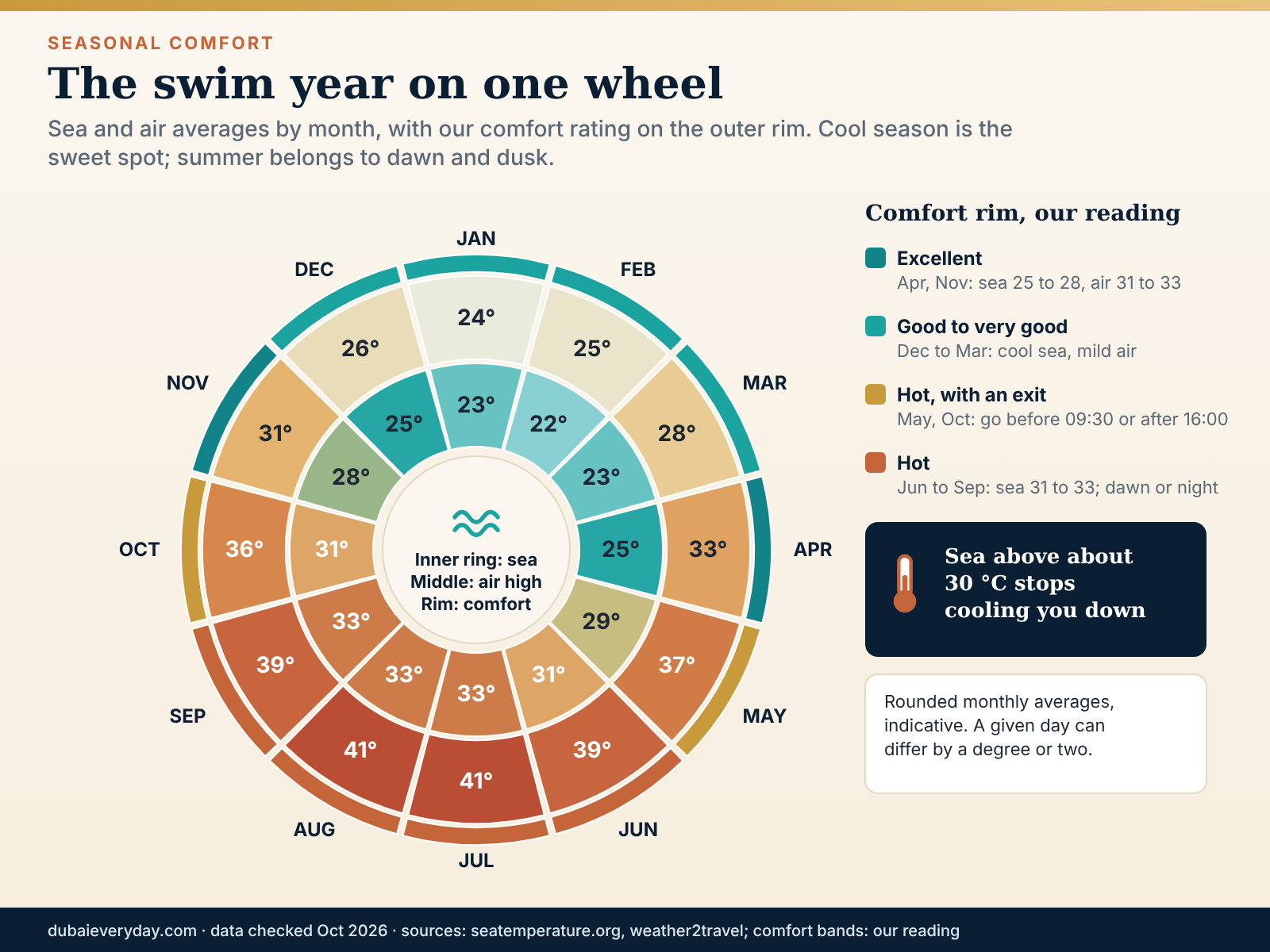
The year for swimming beaches Dubai-wide splits into three: a comfortable cool season from November to April, a hot shoulder in May and October, and a summer from June to September when the sea itself is as warm as a bath. The wheel below puts sea temperature, air highs and our comfort rating on one circle, so you can see where your dates fall.
The month table
The table adds the guarded day and the strongest-UV window to the monthly picture of swimming beaches Dubai-wide. Sunrise, sunset and UV windows are our calculations for central Dubai on the 15th of each month, assuming clear skies and a typical ozone level, and are accurate to roughly half an hour. Sea and air figures are rounded averages. Treat the whole table as indicative.
| Month | Guarded day (sunrise to sunset) | Sea | Air high | UV 8 or more (our model) | Our swim rating |
|---|---|---|---|---|---|
| January | 07:06 to 17:49 | 23 °C | 24 °C | None | Good; brisk water |
| February | 06:54 to 18:12 | 22 °C | 25 °C | Borderline | Good; coolest sea |
| March | 06:29 to 18:28 | 23 °C | 28 °C | 11:00 to 14:00 | Very good |
| April | 05:57 to 18:41 | 25 °C | 33 °C | 10:10 to 14:35 | Excellent |
| May | 05:34 to 18:56 | 29 °C | 37 °C | 09:50 to 14:45 | Warm; go early or late |
| June | 05:28 to 19:10 | 31 °C | 39 °C | 09:45 to 14:55 | Hot; edges of the day |
| July | 05:38 to 19:12 | 33 °C | 41 °C | 09:55 to 15:00 | Hottest; dawn or night |
| August | 05:52 to 18:55 | 33 °C | 41 °C | 10:05 to 14:50 | Hottest; dawn or night |
| September | 06:04 to 18:24 | 33 °C | 39 °C | 10:20 to 14:10 | Hot; dawn or night |
| October | 06:16 to 17:53 | 31 °C | 36 °C | 11:20 to 12:50 | Easing; avoid midday |
| November | 06:36 to 17:32 | 28 °C | 31 °C | None | Excellent |
| December | 06:57 to 17:31 | 25 °C | 26 °C | None | Very good |
November to April: the comfortable stretch
These months are why people book Dubai in winter, and why swimming beaches Dubai offers feel easy then. The sea runs from the low twenties to the high twenties, the air from the mid-twenties to the low thirties, and the UV index is moderate in the dead of winter and only reaches the very high band around the middle of the day from March. The trade-off is the guarded day: in December it is just over 10 hours and ends before 17:35.
January and February are the coolest swim months. A sea around 22 to 23 °C is invigorating for fitness swimmers and chilly for children and for anyone who stays still. A thin wetsuit or rash vest helps with a long swim; for a few minutes of splashing, a towel and a warm layer are enough. March and April are the sweet spot for many people, because the sea has started to warm and the day is long, but the midday sun is already strong. Time your swim for the first and last two hours of daylight.
May and October: hot, but with an exit
May jumps to a sea around 29 °C and an air high around 37 °C. That is comfortable water, hard air. October is its mirror: the sea remains around 31 °C while the strongest UV band shrinks to about 90 minutes around solar noon in our model. If your trip falls in either month, the rule is simple: swim before 09:30 or after 16:00 and spend the middle of the day indoors.
June to September: swim at the edges
With the sea at 31 to 33 °C, the water does little to cool you, and the air high of 39 to 41 °C does the rest.
The guarded day runs from about 12.3 hours in September to 13.7 hours in June, but our UV windows put roughly 3 hours 50 minutes to 5 hours 10 minutes of it in the 8-or-more band. Subtract it and you are left with roughly 8.3 to 8.5 hours of guarded, lower-UV swimming time. That is the useful budget. Spend it before 09:45 and after 15:00, or at a night beach. That is the real constraint on swimming beaches Dubai-wide in summer: not the sea, but the sun.
WHO guidance on heat notes that sunlit surfaces can be 10 to 15 °C hotter than the air, and the WHO’s UV index scale treats 8 and above as very high. On a July afternoon, hot sand, hot air and a 33 °C sea combine into a real risk of heat illness, even for people who are fit. Drink regularly, stay in shade between swims, and leave if you feel dizzy, nauseous or confused. This is general information, not medical advice.
Ramadan, holidays and school breaks
Ramadan 2027 is expected around February and March, with exact dates depending on moon sighting. UK government advice for the UAE reminds visitors about public behaviour during daytime Ramadan hours, which in practice means being discreet with drinks and snacks on the beach.
School holidays and long weekends change crowd levels at swimming beaches Dubai-wide more than weather does. The 2026-27 calendar reported a winter break from 14 December to 3 January and a spring break from 5 to 11 April, so the best swimming months also include the busiest ones. For the whole-year view, the best time to visit Dubai weighs weather against hotel prices and crowds.
Which of the swimming beaches Dubai has suits which swimmer
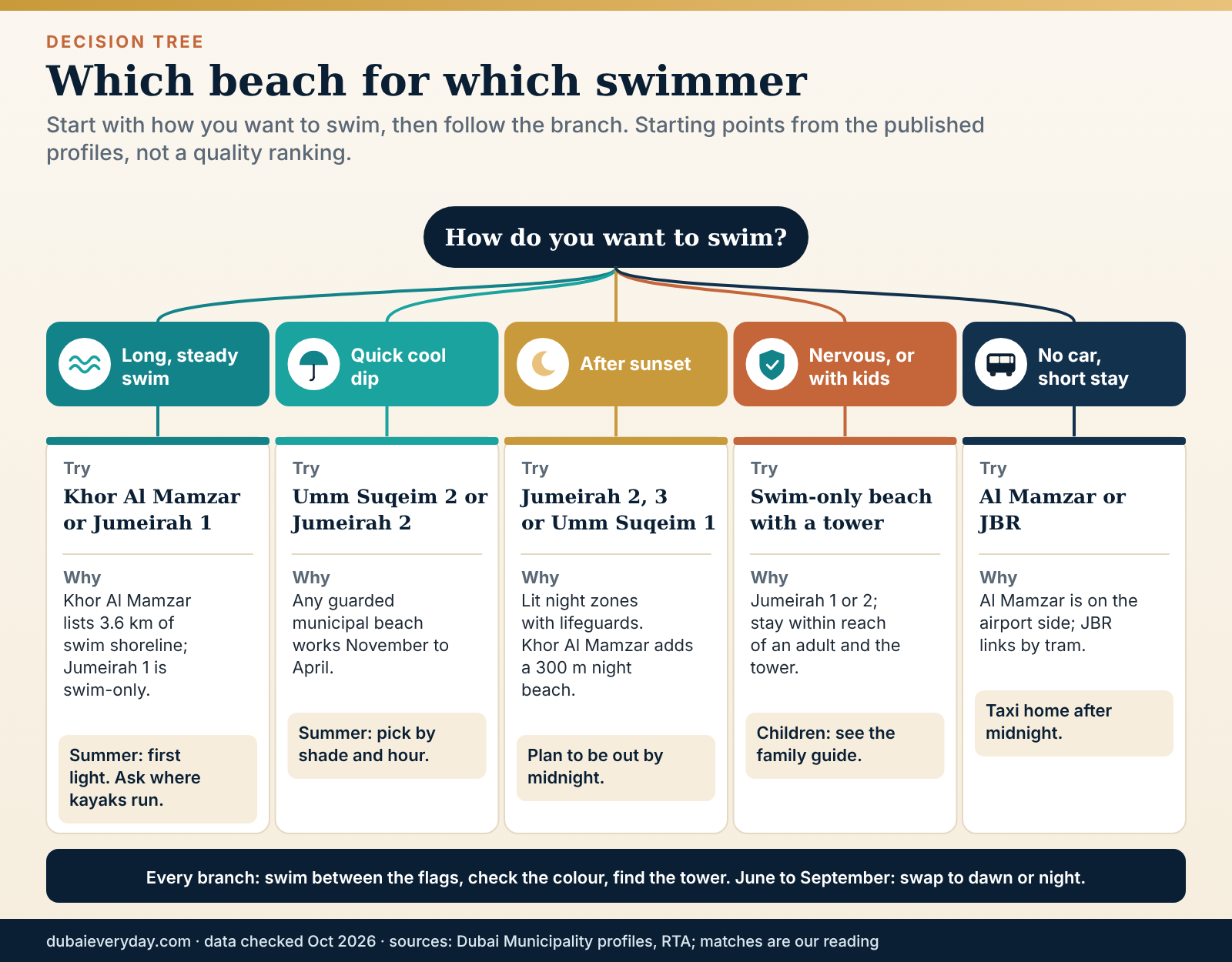
The decision tree below turns the research on swimming beaches Dubai-wide into a first answer. Start with how you want to swim, follow the branch, and read the matching notes underneath. It is a starting point; the beach profiles above carry the detail.
The lap or fitness swimmer
Among swimming beaches Dubai-wide, you want one with a long, uninterrupted line of water. Khor Al Mamzar’s 3.6 km guarded shoreline is the largest on paper, but it lists kayaking and water sports, so ask where they run. Jumeirah 1 is swim-only. In summer, go at first light, when the guarded day has begun and the UV is still low. Swim parallel to the shore, inside the flags, and keep the lifeguard in view. A bright cap makes you easy to spot.
The casual cooling-off swimmer
You want a dip, a view and maybe a coffee. Umm Suqeim 2 puts you around a kilometre from Burj Al Arab with separate swim and surf lanes, and Jumeirah 2 packs the most on-paper facilities into a short beach. Between November and April, any of the lifeguarded swimming beaches Dubai Municipality runs does the job. In summer, choose by shade and time of day, not by view.
The nervous or weak swimmer
Among swimming beaches Dubai-wide, pick a swim-only beach with a visible tower, stand where you can touch the bottom, and keep the lifeguard in sight. Do not rely on inflatables, because they can deflate or drift. If you are unsure, a hotel pool with a lifeguard is a gentler first step, and lessons before a holiday are cheaper than a bad day. For children, use the family beaches guide rather than this page.
The after-work or night swimmer
Pick Jumeirah 2, Jumeirah 3, Umm Suqeim 1 or Khor Al Mamzar and check the lit-zone hours. In December you will arrive after sunset, so the night zone is the only legal option. In summer, aim for the hour after sunset: the sun is gone and the water is lit, though we have no data on night-time air temperature.
The stopover or short-stay visitor
For a stopover, choose one of the swimming beaches Dubai has, go early, and do not cross the city twice. By our reading of the map, Al Mamzar sits on the airport side of Dubai, which makes it the least cross-town option for a stopover; check road conditions on the day. If you have a morning only, the 3-day itinerary shows how to fit a beach slot without spending the trip in taxis, and the 4-day plan adds a dedicated beach morning.
Swimmers who want privacy
Dubai Municipality has announced a women-only beach at the Al Mamzar Corniche, but press reporting in September 2026 still described it as being prepared, so do not plan around it. Secondary sources have reported ladies’ days at Al Mamzar Beach Park, which we could not verify on an official page. Some hotels and clubs may run women-only sessions or areas; we have not verified any, so ask the operator directly and keep the answer in writing.
Rules, etiquette and the mistakes to avoid
The rules at swimming beaches Dubai-wide are not complicated, but they are enforced, and visitors from beach cultures with looser habits get caught out. The municipal text we saw bans pets on the beach, barbecues, open fires and shisha outside designated areas, overnight stays, and photography that intrudes on others. It also restricts swimwear to the beach, so no walking through passageways in a bikini or trunks, and it prohibits swimming after sunset outside the night-swimming zones.
The UK government’s UAE travel advice adds three points worth repeating. Swim only at approved, lifeguarded beaches with flags, because rip currents can occur anywhere. Do not photograph people without permission, as men have been arrested for photographing women on beaches. And drinking or being drunk in public is illegal, with a legal drinking age of 21 in Dubai. For a deeper look at what to wear where, our first-time visitor plan covers dress and everyday etiquette.
Drones are a special case. Rules tightened in January 2025, and recreational use was reported as under review. Leave the drone at the hotel unless you have checked the current position with the aviation authority.
The eight mistakes that spoil a swim at swimming beaches Dubai-wide
- Turning up at sunset in winter.In December, sunset is around 17:31. If you arrive at 17:40 expecting lifeguards, you will find none, unless you went to a night beach.
- Swimming outside the flagged area.The lifeguards can only watch the zone they patrol. Swim between the flags, not beside them.
- Trusting a flat sea.Rip currents do not need big waves. A calm day with red flags is still a red-flag day.
- Swimming in the middle of a summer day.At a 33 °C sea temperature the water does not cool you, and the UV is at its peak. Go early or late.
- Assuming every beach has showers and toilets.The municipal pages do not list them. Pack accordingly.
- Forgetting that peak parking begins at 16:00.An after-work swim is more expensive than a morning one. Sunday and public holidays are the exception.
- Booking a club for the swim.A lounger fee buys a lounger. Confirm sea access and lifeguards first.
- Ignoring closures and works.Beach redevelopment is under way across the coast. A two-minute check beats a wasted trip.
A short pre-swim routine
At any of the swimming beaches Dubai has, look for the flag colour before you get in, find the tower, and check that you can see a lifeguard. Walk to the water’s edge and watch for a minute: do the waves break evenly, or is there a channel of choppy, discoloured or foamy water running out to sea? That can be a rip current. If you see one, swim somewhere else.
Frequently asked questions
Which are the safest swimming beaches in Dubai?
No beach is risk-free, but the safest choices are public beaches with published lifeguard cover and marked swim areas: Jumeirah 1, Jumeirah 2, Umm Suqeim 2, the Mamzar lagoon beach and Khor Al Mamzar. Dubai Municipality’s profiles for these describe lifeguards from sunrise to sunset. Among the swimming beaches Dubai residents use, swim-only layouts reduce the chance of meeting a jet ski or kite. Swim only between the flags and in daylight unless you are at a night-swimming beach.
Can you swim at night in Dubai?
Yes, but only at the designated night-swimming beaches among the swimming beaches Dubai runs. Dubai Municipality named Jumeirah 2, Jumeirah 3 and Umm Suqeim 1 in 2023, and Khor Al Mamzar opened in May 2026 with a 300 m night beach. Elsewhere, the municipal rules we saw prohibit swimming after sunset. The Umm Suqeim 1 profile gives a midnight limit with lifeguards, so plan to be out of the water by then and ask on arrival if hours have changed.
Are Dubai’s public beaches free?
Entry to the municipal swimming beaches Dubai runs is free; Dubai Municipality says its beach centres do not charge an entrance fee apart from fees for requested services. The costs you meet are parking, food, and any lounger or umbrella you rent. Al Mamzar Beach Park is a gated park with an entry charge reported from AED 5 per person, plus a reported AED 30 per car in 2024. Check current prices on arrival, because they change.
Are there lifeguards on Dubai beaches, and when?
On municipal public beaches, lifeguards are generally on duty from sunrise to sunset, according to the municipal profiles for Jumeirah 1, 2, 3, Umm Suqeim 2 and the Mamzar lagoon beach. By our calculation that is roughly 06:57 to 17:31 in mid-December and 05:28 to 19:10 in mid-June. Umm Suqeim 1 adds lifeguards until midnight in its lit zone. Hours at hotels, JBR and clubs are set by the operator, so ask.
When is the best time of year to swim in Dubai?
For swimming beaches Dubai-wide, November, December, March and April are the strongest months for comfort: sea temperatures of roughly 23 to 28 °C, air highs of 26 to 33 °C and a long enough guarded day. January and February are good for fitness swimmers but cool for casual dips. May and October are hot. From June to September the sea is 31 to 33 °C, so swim at dawn or at a night beach.
How warm is the sea in Dubai?
Published monthly averages put it at about 22 °C in February and about 33 °C from July to September, with roughly 25 °C in April and December and 28 to 29 °C in May and November. These are rounded figures from climate references, so a given day can differ by a degree or two at any of the swimming beaches Dubai has. In our reading, below about 24 °C feels cool, and above about 30 °C the water no longer refreshes you.
Is the sea in Dubai clean enough to swim in?
We found no official, per-beach water-quality figures, so we cannot give a clean verdict. Municipal beaches are maintained and patrolled, but news archives have recorded jellyfish, algal blooms and an oil-slick sighting in past years. If the water looks discoloured or smells odd, or a lifeguard raises a purple flag for marine life, skip it for the day. This is general information, not a health assessment.
Is JBR beach good for swimming?
JBR is a public beachfront with free access, and the operator’s FAQ lists parking, a 600 m track and a tram link. It does not say who guards the water or where swim zones sit, and Dubai Municipality’s beach profiles do not cover it. So treat it as a place to ask first: look for a lifeguard tower and flags, and confirm before swimming far out. Among swimming beaches Dubai residents compare, the municipal ones have clearer published swimming provision.
Is it safe to swim in Dubai in summer?
It can be safe at swimming beaches Dubai-wide in summer, with changes. The sea is 31 to 33 °C, the air high is 39 to 41 °C and UV is very high from about 10:00 to 15:00 in our model. Swim in the first hour or two after sunrise, or at a night beach, keep drinking water, and avoid hot sand. Heat illness is the main summer risk. If you feel dizzy or sick, get out, shade up and cool down.
Can I swim in a bikini or swim shorts in Dubai?
Yes, on beaches and by pools, including all the swimming beaches Dubai Municipality runs. Swimwear is accepted there, but municipal rules restrict it to those areas, so cover up when walking through passageways, car parks and streets. Many visitors bring a sarong, shorts and a T-shirt. Do not photograph other beachgoers without permission, as the UK government’s advice warns of arrests, and dress more conservatively away from the sand.
Are there jellyfish or harmful marine life in Dubai’s sea?
Jellyfish and harmful algal blooms have been reported in the past, and Dubai Municipality’s flag system includes a purple flag for harmful marine life. We read headlines about these episodes but not full reports, so we cannot say how often they happen. Check the flag, ask the lifeguard before you go in, and do not touch anything you cannot identify. If you are stung, tell a lifeguard.
Do I need a car to reach swimming beaches in Dubai?
A car makes it easier, but it is not essential for swimming beaches Dubai-wide. The Metro runs inland on Sheikh Zayed Road, so reaching Jumeirah beaches usually means a taxi, ride-hailing or bus leg. JBR connects via Metro to DMCC and the tram. Al Mamzar had a reported weekend bus from Stadium Metro. Taxis are the practical way home after a late swim, because the Metro closes around midnight.
The bottom line
For swimming beaches Dubai-wide, if you want one rule: swim where a lifeguard can see you, and swim when the sun is low. Everything else is detail. For a straightforward swim between November and April, Jumeirah 1, Jumeirah 2 and Umm Suqeim 2 are the cleanest on-paper choices, and Khor Al Mamzar is the biggest guarded shoreline. For an evening, pick one of the night beaches. For July, switch to dawn or a pool.
The swimming beaches Dubai offers are changing quickly: a rebuilt Jumeirah 1, a new Khor Al Mamzar, works at Umm Suqeim and a Corniche still being prepared. That is why this page carries a verification date and an update log. If you are building a trip around the sea, pair a beach morning with a desert safari, browse the outdoor activities guide and the free things to do, and start from the Dubai travel guide for the rest of the plan.
Sources and further reading (29 links)
- Dubai Municipality: Discover Dubai beaches — public beach fee statement, Al Mamzar hours
- Dubai Municipality: three new beaches for night swimming — night-swimming beaches, lighting, lifeguards
- Dubai Media Office: Khor Al Mamzar opens to the public — shoreline, lifeguard towers, night beach
- Dubai Municipality: Jumeirah 2 beach profile — length, swim-only, lifeguards, facilities
- Dubai Municipality: Jumeirah 3 beach profile — length, kite area, lifeguards, facilities
- Dubai Municipality: Umm Suqeim 1 beach profile — length, night zone, lifeguards
- Dubai Municipality: Umm Suqeim 2 beach profile — swim-only and surf-only areas, lifeguards
- Dubai Municipality: Jumeirah 1 beach profile — swim-only designation, lifeguards, track
- Dubai Municipality: Mamzar lagoon beach profile — length, swim-only, lifeguards
- Visit Dubai: Al Mamzar Beach Park — park description, entry price, hours
- The National: keeping children safe on UAE beaches — flag meanings, lifeguard hours, safety advice
- UK Foreign Office: UAE safety and security — rip currents, swimwear, photography, alcohol
- Time Out Dubai: Jumeirah Beach 1 rebuild — size, lockers, monitoring technology
- Gulf News: Dubai’s Dh3 billion beach transformation — beach programme and works
- Khaleej Times: Dubai public parks footfall — public beach portfolio, Corniche status
- Gulf News: guide to Dubai’s public beaches with night swimming — access roads, track lengths
- Gulf News: Dubai parking fee changes — paid hours and tariffs
- Gulf News: public beaches reserved for families during Eid Al Adha — rescue staffing example
- Gulf News: New Year 2026 beaches reserved for families — holiday beach restrictions
- The Beach at JBR: FAQ — access, parking and facilities
- RTA: public transport timetables — Metro and tram operating hours
- Gulf News: Al Mamzar Beach Park weekend bus — park prices and bus route reported
- What’s On: Dubai beach clubs open and closed — day-pass price scale, club status
- Sea Temperature: Dubai monthly sea temperatures — rounded sea temperatures
- Weather2Travel: Dubai climate — rounded air temperatures and UV
- WHO: the ultraviolet index — UV categories
- WHO: climate change, heat and health — hydration and surface heat
- NHS: sunscreen and sun safety — SPF and reapplication
- US National Weather Service: rip currents — escape guidance
Update log: 29 October 2026 — first publication; facts checked against the sources above. Next review due: April 2027, or sooner if beach access, lifeguard hours or opening status change. Corrections welcome. This page is general information, not individual safety, medical or legal advice.
About DubaiEveryday and this guide
DubaiEveryday.com is an independent editorial project that publishes practical, research-based guides to everyday life in Dubai: where to live, what things cost, how the rules work and how to get around. This page was written and edited by the DubaiEveryday editorial team. It is not signed by a named expert, doctor, lawyer or adviser, and we do not claim first-hand testing of a venue, clinic or service unless the page says so.
Each guide is built from official sources such as government and regulator pages, operator websites and established news outlets, cross-checked where we can. When we could not confirm something, we say so in the text, and examples that use made-up numbers are labelled as illustrations. Mentions are editorial choices, not paid placements, and a link is not an endorsement.
Dubai changes quickly. If you spot something that is out of date or wrong, please tell us through the contact options on DubaiEveryday.com and we will check it and correct the page.