
Holding hands is generally fine, kissing in public is a genuine legal risk, and the stretch between the two is where most visitors get confused. This guide separates what the law says from what venues and neighbours expect, so you can plan a day in Dubai without guessing.
It is the third evening of a Dubai trip, the sun is dropping behind the skyline, and the person beside you reaches for your hand. That part is fine. Then the moment grows, and you realise you have no idea where the line sits, because the public affection Dubai rules are scattered across a criminal code, a few official guides and a lot of rumour.
Here is the short version: a held hand is widely accepted, a long kiss is a gamble, and the person who decides is rarely a police officer. This guide shows what the official sources say, what we could not confirm, and how to read each place before you act. By the end you will have a four-question test that takes two seconds.
The public affection Dubai rules come down to one habit: keep it discreet, keep it brief, and treat anything beyond hand-holding as a risk. Visit Dubai’s own city guide calls hand-holding acceptable and asks visitors to avoid dramatic displays. The UAE government portal is blunter and says kissing and hugging in public are not acceptable. Foreign government travel advice warns that kissing in public can lead to arrest.
In practice, reported cases usually begin with a complaint from a bystander or venue staff, not with a patrol officer watching couples. That is why context matters more than any list of public affection Dubai rules. A quiet hotel pool deck, a crowded mall, a public beach and a family restaurant have different audiences, and the person who objects is the one who decides whether it becomes a problem.
Marriage does not make a public kiss safe, and being unmarried is no longer a crime in itself for consenting adults, although a complaint from a spouse or guardian can still trigger a case. Below you will find the legal layer, the custom layer, a place-by-place guide, a decision test and what to do if someone objects. It is general information, not legal advice.
This is a research-based guide. Nobody on the DubaiEveryday team has tested venues or been stopped, questioned or reported, and nothing here is presented as personal experience. To map the public affection Dubai rules, on 29 October 2026 we read the UAE legislation portal entry for the Crimes and Penalties Law, the UAE government portal’s visitor guidance, Visit Dubai’s 2025 Cultural Explorer city guide, the UK and US government travel advice for the UAE, and Dubai tourism statistics. We also read press reports of court cases and legal explainers, which we treat as context, not as law.
What we could not confirm: the exact current article numbers and penalty wording for public indecency, because the online legal text we could open was truncated. Where that matters, the page says so. Where a place-by-place rating is ours, it is labelled as our reading. Nothing here was paid for, and no venue is recommended.
How the public affection Dubai rules work: law, venue and custom
Most pages on this subject swing between two extremes. One gives you a list of horror stories involving jail and deportation. The other shrugs and tells you Dubai is relaxed as long as you are sensible. Neither helps you apply the public affection Dubai rules to a real moment, such as holding your partner’s waist in a lift. A more useful picture has three layers, and a gesture has to survive all three.
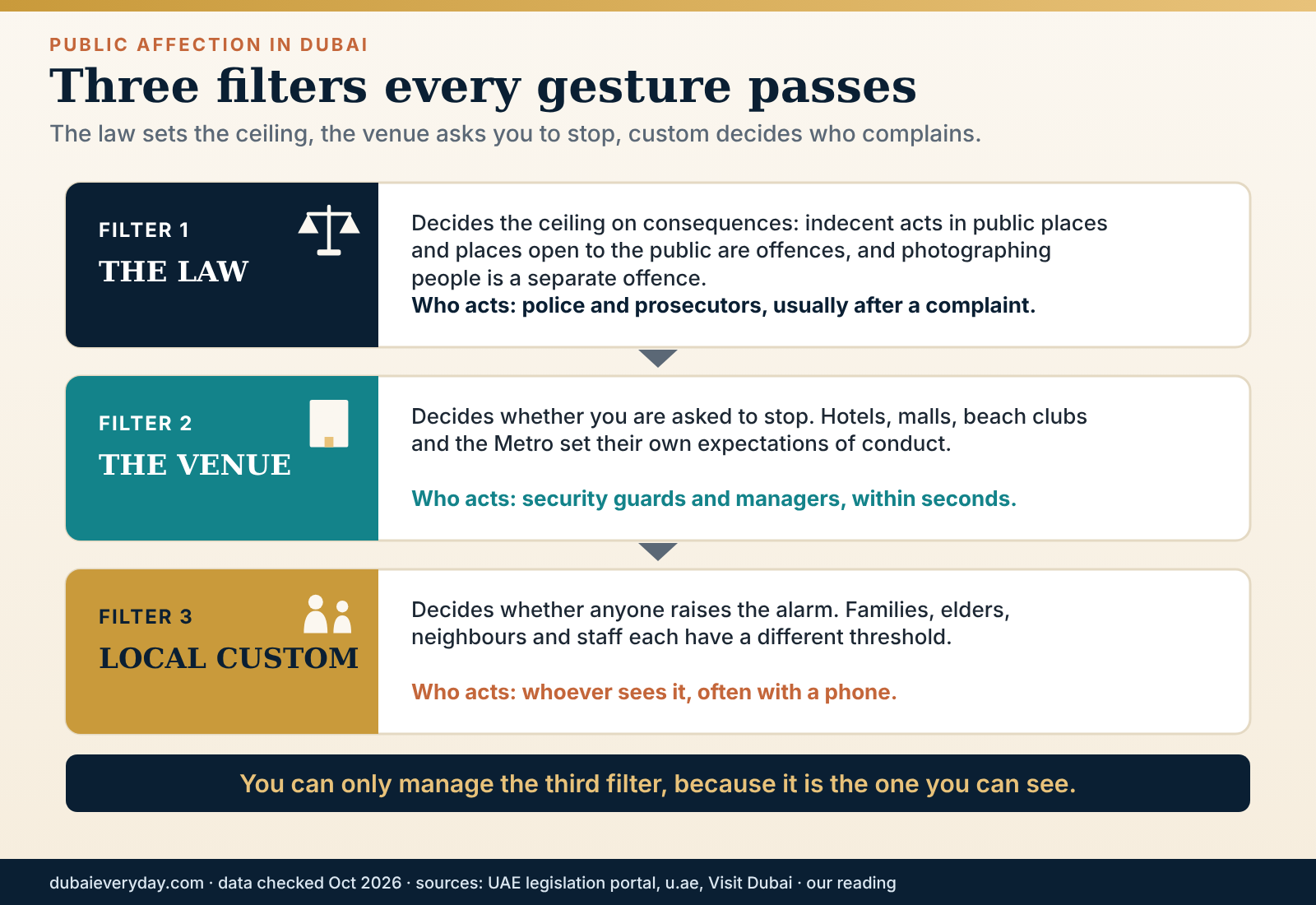
Layer one: the law behind the public affection Dubai rules
The federal Crimes and Penalties Law, issued as Federal Decree-Law No. 31 of 2021 and in force since 2 January 2022, is the backbone. It treats indecent acts committed in public as criminal offences, and its general provisions define “publicity” to include acts carried out in public places or places open to the public. That second phrase matters, because a restaurant, a hotel lobby and a beach club are open to the public even though they are privately run.
A separate privacy and cybercrime law governs cameras and posting. That layer sets the ceiling on consequences: fines, jail, and, for non-citizens, the possibility of deportation. It does not tell you how likely any of those outcomes is on a given evening.
Layer two: venue policy
Malls, hotels, beach clubs, restaurants and the Metro are run by operators who can ask you to stop whatever the law says. Security staff are usually the first people to notice and the first to speak. A polite request from a guard is not a legal process, but ignoring it is how a small moment turns into a bigger one. Venue policy is the least codified part of the public affection Dubai rules. It also varies, so a rooftop lounge that welcomes a late-night embrace in one corner will not necessarily welcome it by the entrance.
Layer three: social custom
Dubai is a Muslim-majority country with a large, mixed expatriate population, and public modesty is a shared norm even among people who do not share a religion. Custom is where the public affection Dubai rules stop being law and start being “frowned upon”. It is not enforced by statute, but it shapes who complains. A family with children at the next table, an older Emirati couple, a school-run parent: any of them can change your evening with one phone call.
Our reading of the public affection Dubai rules is simple. The law decides what the consequence could be, venues decide whether you are asked to stop, and custom decides whether anyone raises the alarm. If you want to stay out of trouble, you manage the third layer, because it is the one you can see.
What this page covers, and what it leaves to others
This guide deals with the public affection Dubai rules, meaning affection between people in public: hand-holding, hugging, kissing, closeness and what to do if someone objects. Clothing has its own page in our Dubai dress code guide. General manners, greetings and tipping sit in the wider Dubai etiquette guide, fasting-month rules are in Ramadan etiquette in Dubai, and prayer-space conduct is in mosque etiquette in Dubai.
The trap for returning visitors is memory. A relaxed evening in a hotel district two years ago says little about a public beach this weekend, and the public affection Dubai rules do not change because the skyline looks cosmopolitan. If you are still planning the trip around this, the Dubai travel guide covers the rest of the preparation.
What the law says, and what we could not confirm
Questions about the public affection Dubai rules deserve a clear boundary between what we verified and what we did not. Here is the verified part. The UAE legislation portal lists the Crimes and Penalties Law as active, effective from 2 January 2022, with its record last updated on 1 October 2025. Press reports from December 2025 describe a further federal decree-law amending some of its provisions, mostly on offences involving abuse and exploitation. The code is a living text, so any article number quoted in an old news story may no longer match.
The offence behind the public affection Dubai rules, in plain language
The code criminalises indecent or lewd acts carried out in public, and the same family of provisions covers indecent words and gestures. “Indecent” is not defined by a checklist of gestures, which is the root of the confusion. A court looks at the act, the place, who could see it and whether anyone was offended. Reported charges in kissing cases over the years have used phrases such as public indecency and committing a lewd act in public.
The law also defines what counts as public. Under its general provisions on publicity, speech, acts and displayed material count as public when they happen in a public place or in a place open to the public. Our reading is that a hotel restaurant, a mall corridor, a beach club and a rooftop terrace all qualify, while a closed hotel room or a private villa garden do not.
Penalties: why we are not quoting one number
This is where honesty is more useful than confidence. In May 2021, UAE prosecutors posted a public warning about indecent acts, which Gulf Business, Gulf News and Sharjah24 reported. The summaries gave a fine from AED 1,000 to AED 50,000 for a first public indecent act, and jail plus a fine of up to AED 100,000 for repeated offences. The outlets disagree on whether the jail term is “up to three months” or “at least three months”. Another report, from October 2021, quoted a month in jail and a fine of up to AED 100,000 for a related offence.
All of those were written under the numbering of the earlier penal code, before the January 2022 reissue. We could not open the current article text to confirm the present tariff. So we use them only as a signal of seriousness: a fine in the thousands is realistic, jail is possible, and the figures should be checked against the official text or a lawyer before anyone relies on them.
Deportation is the consequence people overlook
For tourists and residents alike, the sentence is often not the main worry. The UAE government portal warns that noise, bad language, obscene gestures and disrespect may lead to legal trouble and deportation. The UK advice says swearing and rude gestures, including online, can lead to jail or deportation. In reported kissing cases, courts have ordered deportation alongside short jail terms or fines. For a resident, that can mean losing a job and a home as well as paying a fine.
Deportation is not automatic in every case, and the outcomes of reported cases vary. One case reported by Gulf News involved two women in a mall food court who were convicted, given a jail term and a deportation order, then acquitted on appeal after the defence challenged the witness account and the way they were detained. The point is not that appeals always work. It is that facts are contested, and the process is slow and stressful even when it ends well.
Complaint-driven in practice: how the public affection Dubai rules get enforced
Our reading of the reported cases is that enforcement depends heavily on a trigger. A British couple was reported in a widely covered case from around 2010 after an Emirati woman complained about what she saw in a restaurant at Jumeirah Beach Residence. The couple said it was a peck on the cheek. Dubai’s appeal court upheld a fine, a month in jail and deportation, and the alcohol was part of the charge. In the mall case, a man at a food court called the police.
Neither case started with an officer patrolling for kissing couples. That does not make the risk theoretical. It means the risk lives in who is nearby and how they react, which is why the venue and audience matter as much as the gesture.
Government advisories on the public affection Dubai rules do not fully agree
Two official sources show how emphasis differs. The UK government says you can be arrested for kissing in public, and adds that consensual relationships between unmarried adults are generally legal unless a spouse, parent or guardian files a complaint. The US State Department says public decency laws are much stricter than in the United States and that sex outside marriage is illegal. The difference reflects the 2020 reforms and how each government chooses to warn its citizens. For a traveller, the safe response is to read both and follow the stricter one in public.
Hand-holding, hugs and kisses: a ladder, not a switch
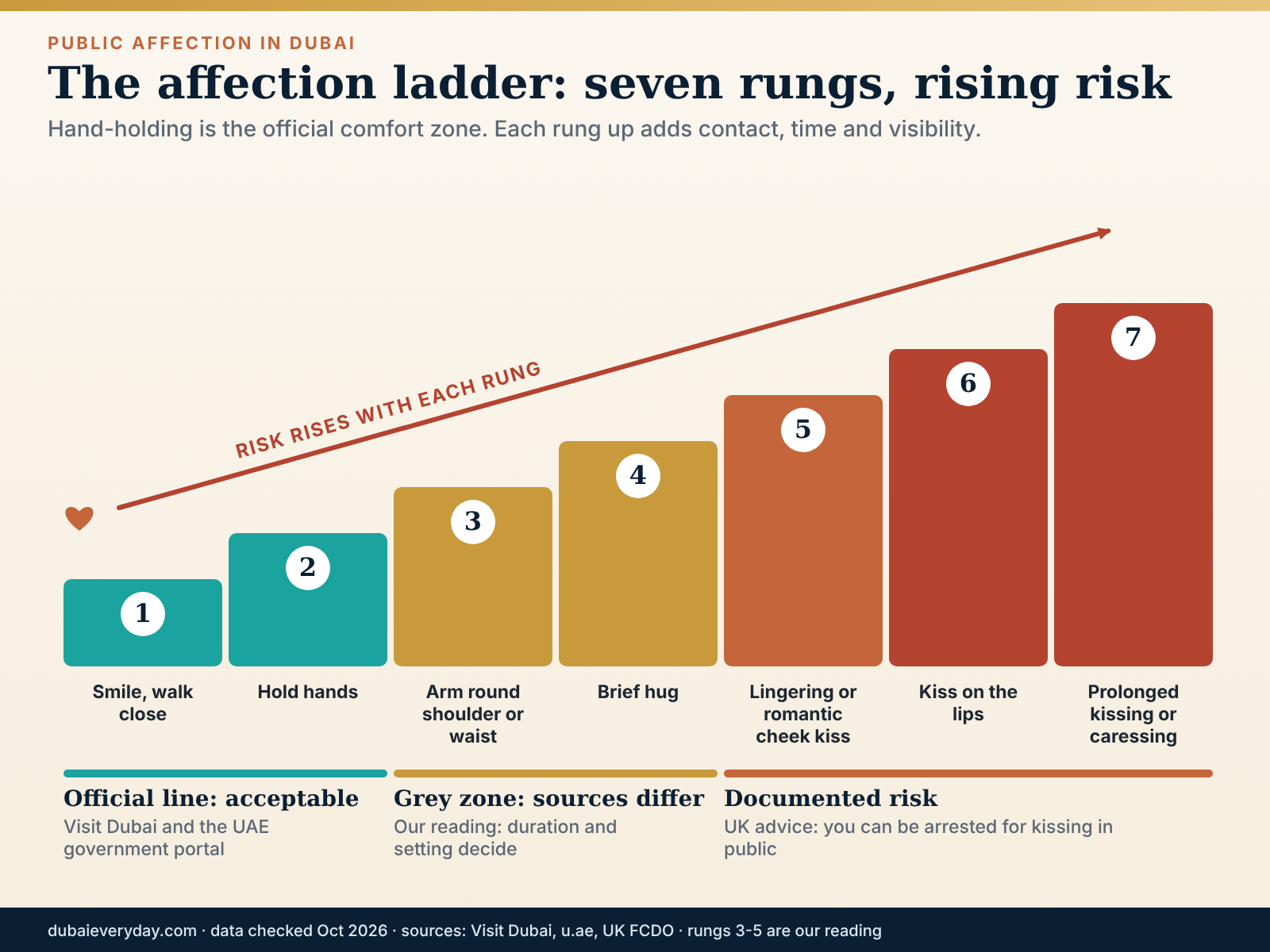
The question “is PDA allowed in Dubai?” gets a yes-or-no answer online and deserves neither, because the public affection Dubai rules are a matter of degree. Affection runs along a ladder, and each rung adds duration, body contact and visibility. The official line sits at the lower rungs. Visit Dubai’s guide says holding hands is acceptable and asks you to avoid dramatic displays. The UAE government portal says holding hands is acceptable while kissing and hugging in public are not. A December 2025 Gulf News explainer says a hug is acceptable if brief and discreet.
The first two rungs: nothing to worry about
Walking close, sharing a joke, a smile, a hand on the arm to steer someone through a crowd and holding hands are the baseline of normal couples in Dubai. Both Visit Dubai and the government portal describe hand-holding as acceptable. Nobody serious is going to read a brisk walk with a partner as indecency, and you do not need to change anything.
The middle rungs: an arm, a waist, a hug
An arm around the shoulders, a hand at the small of the back, linked arms and a head on a shoulder sit in the grey zone. These are fine in many tourist settings and unremarkable among residents, but they read differently in a family area. A brief hug at an airport arrival hall or at a goodbye is common and rarely a problem. A long embrace in a mall corridor is the sort of thing the official guidance means by dramatic.
The cheek kiss deserves a note. Friends and relatives greet each other with cheek kisses across many cultures that live in Dubai, and that is a different gesture from a romantic one. Our reading is that courts and complainants look at intent and manner. A couple’s kiss on the cheek that lingers, or one that is clearly romantic, is judged on the romantic scale, not the greeting scale.
The top rungs: where the risk is documented
A kiss on the lips, a prolonged kiss, caressing, lying across each other on a beach towel, or anything with sexual overtones belongs on the clearly risky end. The UK advice says plainly that you can be arrested for kissing in public, and the cases reported in the press involved kissing, not worse. Where a couple is on a public beach, in a restaurant or in a mall, the risk is real whether or not they are married.
Three variables that shift the public affection Dubai rules in practice
- Duration: a second is not a minute, and an unhurried kiss is a different matter from a quick peck at a goodbye.
- Audience: families with children, older residents, staff and security change the picture, and an empty corner of a rooftop changes it back.
- Setting: a public street, beach or Metro carriage is more exposed than a licensed hotel lounge, and a lounge is more exposed than your own room.
When two of the three are against you, step down a rung. That is the whole method for applying the public affection Dubai rules, and it is more reliable than memorising which gesture is “allowed”. If you want to see how the same logic plays out on sand, the best beaches in Dubai guide covers public and hotel beaches in terms of facilities and crowds.
Public affection Dubai rules for tourists, place by place
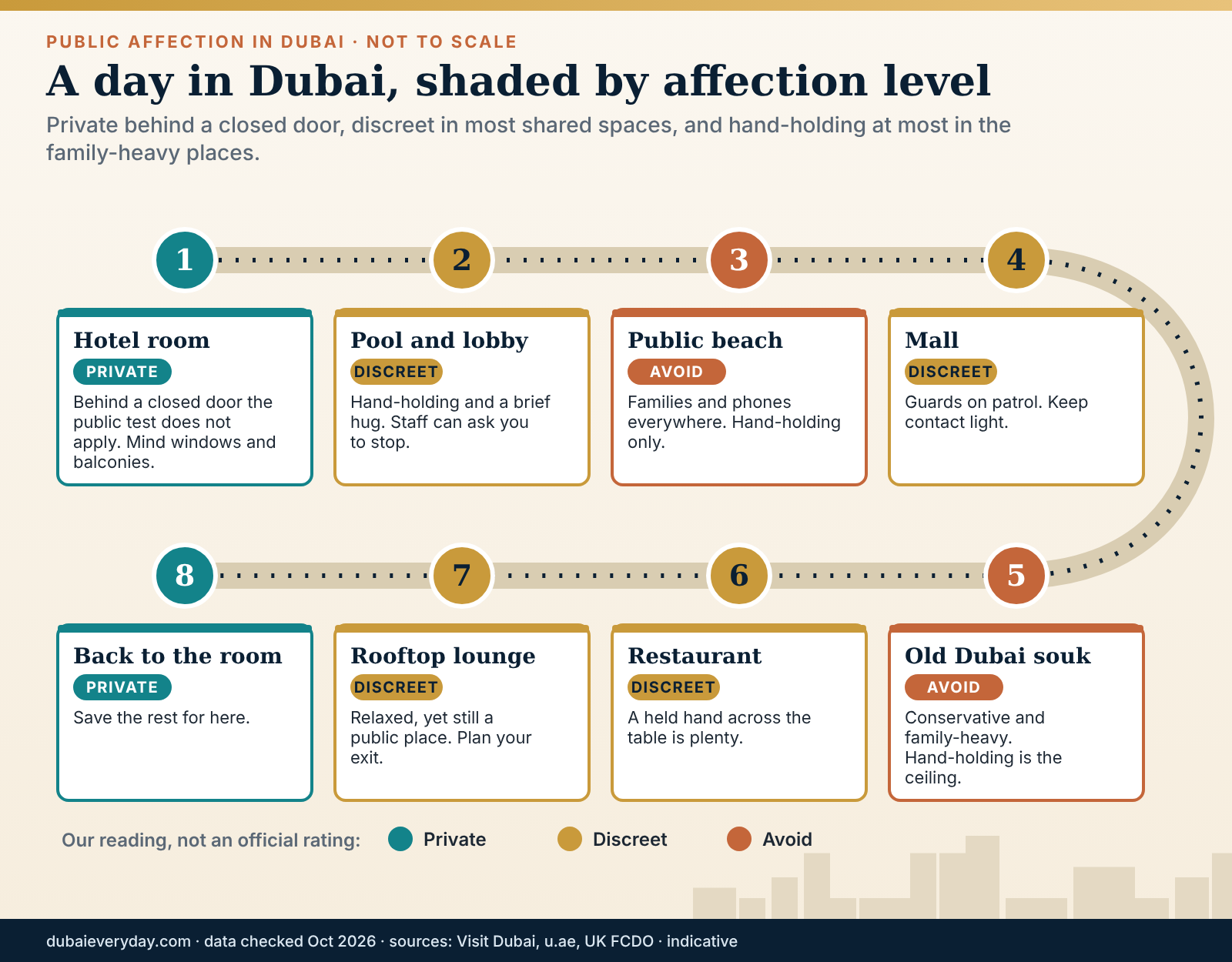
Visitors tend to ask about “Dubai” as if it were one room. It is a set of very different audiences, and the same gesture lands differently in each. The guide below is our reading of the public affection Dubai rules, based on the official guidance, the reported cases and the way each type of place works. It is not a legal ruling and it cannot tell you how a particular person will react. Think of it as a way to pick your moments.
| Place | Who is usually there | Our reading | Practical note |
|---|---|---|---|
| Your hotel room or private villa | Nobody else | Private | Private spaces are outside the “public” test, but anything visible from a street, corridor or open balcony may not be. |
| Hotel lobby, restaurant, lift | Guests, staff, families | Discreet | Hand-holding is fine. A quick hug is fine. Save kisses for later. |
| Hotel pool and private beach | Guests, children, staff | Discreet | Swimwear is expected here. Keep contact light and avoid lingering on loungers. |
| Public beach | Families, mixed groups, lifeguards | Avoid | Open to everyone and easily photographed. Treat it as a family space. |
| Mall or souk | Families, shoppers, security | Discreet | Holding hands is fine. Anything more draws guards and complaints. |
| Metro, bus, taxi | Commuters, women and children | Discreet | Keep contact minimal in shared carriages. In a taxi, remember the driver can see you. |
| Desert camp or private tour | Groups, guides, staff | Discreet | Staff and other guests are watching. Smaller group does not mean unobserved. |
| Licensed bar, club or rooftop lounge | Adults, staff | Discreet | Relaxed by Dubai standards, but alcohol raises the stakes. See the higher-risk section. |
| Old Dubai, mosques, cultural sites | Residents, worshippers, families | Avoid | Conservative areas. Hold hands at most. |
The ratings are ours, and they apply the public affection Dubai rules to each setting. “Discreet” means hand-holding and brief, light contact; “Avoid” means do not push beyond the first rung.
Hotels, pools and private beaches under the public affection Dubai rules
Hotel properties are where visitors spend most of their time, and they are also where behaviour is most varied. A resort is a licensed, mostly international setting, but it is still a public place in the legal sense, because it is open to guests and visitors. Pools and private beaches run by hotels allow swimwear and a relaxed mood. The public affection Dubai rules still apply, so a relaxed mood is not a licence for prolonged kissing or caressing, and staff can ask you to stop.
If you are choosing a base with this in mind, the best hotels in Dubai guide explains how areas differ, and the Palm Jumeirah area guide and JBR area guide describe how crowded and family-oriented each stretch tends to feel.
Public beaches and waterfronts: where the public affection Dubai rules bite hardest
Open beaches carry two risks. They are crowded with families, and they are full of phones. Photographing strangers without consent is itself an offence, but that does not stop footage circulating, and a long clip of a couple on a towel is the kind of thing that ends up in a complaint. Swimwear is for the beach and pool only, according to the UK advice and the government portal. Keep the contact to a hand, and save the rest for the hotel.
Malls, souks and walking districts
Malls feel like neutral ground but behave like a local high street. Security staff walk the corridors, families pass constantly, and a complaint can reach a guard in seconds. If you plan a big day out, the Dubai Mall guide and the wider Dubai shopping guide are useful for the practical side, and the same discreet baseline from the public affection Dubai rules applies in all of them. In the older souk lanes, assume the more conservative end of the scale.
Restaurants, cafes and the table next to you
Restaurants are where several reported cases began, because people are seated close together and cannot easily look away. A couple leaning in for a kiss at a table is visible to the whole room. For choosing venues where an anniversary dinner can feel romantic without a performance, the best restaurants in Dubai and best cafes in Dubai pages are a better starting point than memorising the public affection Dubai rules. Candlelight, a corner table and a held hand are enough.
Public transport and taxis
Dubai’s Metro and buses are shared spaces used by commuters. The RTA’s Metro page describes cabins designated for women and children only, and its fines list shows AED 100 for using an area designated for another category of passenger. A couple standing very close in a packed carriage is not a legal matter, but sustained physical contact attracts the wrong kind of attention. In taxis, drivers can see the back seat in their mirror and often have strong views. Under the public affection Dubai rules, light and brief contact is all you need.
Tours, desert camps and attractions
The public affection Dubai rules apply on tour as much as anywhere. Group tours feel anonymous, but guides, drivers and other guests are part of your audience. The same goes for observation decks, fountain viewing areas and famous photo spots: they are crowded, and every phone on the platform is a possible witness. If your trip features a proposal or an anniversary photo, the next sections explain how to do it without a scene. For the broader attractions picture, see things to do in Dubai.
Public affection Dubai rules for residents
Residents face the same law as visitors, with more at stake and more repeated exposure. A tourist leaves in a week. A resident lives next to the same security guards, neighbours, colleagues and school parents for years. The public affection Dubai rules for residents are therefore mostly a matter of reputation and relationships, with the legal consequences sitting in the background.
Your building, compound and neighbours
Lifts, corridors, pools, gyms and car parks in residential communities are semi-public. Most have CCTV, security teams and neighbours who know your face. Behaviour that would pass unnoticed in a hotel lobby can be reported to management by a neighbour. The practical advice under the public affection Dubai rules is the same as for hotels: hold hands, keep it brief, and move private moments indoors. If you rent, building rules can also apply on top of the law, so read the community guidelines you were given at move-in.
Work, school gates and the daily commute
The workplace is where residents apply the public affection Dubai rules most carefully, and rightly so. Office behaviour is governed by company policy and by the labour rules that apply to your contract, and a complaint from a colleague can have employment consequences even if no police are involved. School gates are family spaces with children and parents of every background. A greeting hug between friends is normal; a long embrace between a couple is not.
Because a conviction involving a foreign national can affect residence, residents should take the public affection Dubai rules more seriously, not less. Our reading is that a resident’s biggest exposure is not the fine. It is the knock-on effect on a visa tied to an employer, a lease and a family’s plans, which a lawyer can assess for a specific case.
Dating, weekends and the social calendar
Dubai has a lively social scene, from brunch tables to beachfront terraces, and residents move through them routinely. The Dubai nightlife guide and the best bars in Dubai page describe the venues and the alcohol rules, and the same logic from the public affection Dubai rules holds: behaviour inside a licensed venue is relaxed compared with the street, but it is not exempt. Leaving a venue together is where many residents’ evenings go wrong, because the car park, the lobby and the taxi queue are all public.
Residents with visiting partners and family
Visiting relatives and partners usually do not know the public affection Dubai rules, and a resident host is often the person answering for them. A short briefing before a trip is worth more than a fix afterwards. Tell guests that holding hands is fine, that kisses and caresses belong indoors, that cameras are not welcome around strangers and that the host’s neighbours are watching, whether they intend to or not.
Parents and children are a separate case. Affection toward your own children, a parent’s embrace at an airport and a hug between family members are ordinary parts of daily life and are not what the public affection Dubai rules target. The risk comes from romantic or sexual conduct, and from the situations where it is hard to tell the difference, such as an adult greeting a young adult who is not a relative.
Married, unmarried, engaged: what the paperwork changes
People often assume a wedding ring is a shield. For public conduct, it is not. Neither the government portal nor the UK or US advice distinguishes between married and unmarried couples when they describe kissing and hugging in public. The rule is about what happens in a shared space, and a marriage certificate does not change who is sitting at the next table. What the paperwork changes is a different set of questions, covered below, and none of them rewrite the public affection Dubai rules.
Cohabitation and relationships between consenting adults
The legal position moved in 2020. Federal Decree-Law No. 15 of 2020 amended the old penal code, and press reports of a Dubai Court of Cassation ruling in December 2020 show a couple who had been convicted of sex outside marriage being acquitted because the law changed while their case was still on appeal. A Dubai lawyer writing in Khaleej Times in October 2021 gave the practical conclusion that unmarried couples may now live together without a cohabitation offence.
Under the 2021 code, effective from 2 January 2022, Khaleej Times reported that consensual sex between unmarried adults over 18 is prosecuted only if a spouse or the guardian of either person files a complaint, with a penalty of up to six months, and that the case can end if the complaint is withdrawn. The UK advice describes the same structure and says relationships involving someone aged 17 or under are prosecuted. The US advice takes a harder line and describes sex outside marriage as illegal. Read together, the sensible reading is that the 2020 reforms narrowed the law but did not remove every risk.
Hotels, rooms and what to expect at check-in
The question most couples really ask is whether they can share a hotel room. The same Khaleej Times lawyer’s view was that a tourist couple may share a room in Dubai without a cohabitation problem, because the underlying offence was removed. The UK advice does not address room-sharing directly, notes that hotels commonly photocopy passports or Emirates IDs, and says anyone under 18 cannot stay in a hotel without an adult.
We did not find an official Dubai tourism statement that settles the point, so treat this as a lawyer’s reading plus common hotel practice, not as a guarantee. Policies vary by property, and a hotel can set its own check-in conditions. If you are unsure, ask the hotel in writing before you arrive, and read the best hotels in Dubai guide for how to compare areas and properties.
Engagements, proposals and honeymoons
A proposal is a happy event and carries no legal problem in itself. The risk lies in what follows it: the long embrace, the kiss, the camera crew and the cheering crowd. A smart plan sits on the lower rungs of the ladder. Choose a setting where the audience is you and a photographer, keep the physical moment short, and take the kiss somewhere private. A hand held up with a ring is as good a photograph as a kiss.
Honeymooners are in the same position as any couple under the public affection Dubai rules. Booking a romantic hotel, a private dinner or a sunset cruise is the way to get the atmosphere without the exposure, since staff organise those settings for exactly that reason. If you hire a photographer, ask them which locations need permits and what they will and will not shoot. We have not verified the current permit thresholds for personal shoots, so do not assume.
Pretending is the worst plan
Some visitors consider wearing a ring they do not own, or saying they are married, to smooth a check-in or a conversation. That is a bad idea: false statements to a hotel, a security guard or the police create problems of their own and rarely make anything easier. The straightforward approach works better. Stay discreet in public, be honest when asked, and do not give your relationship status any more weight than the situation demands.
Pregnancy and childbirth: a note outside this page’s scope
Both the UK and US advice raise a point that couples sometimes miss. Hospitals may ask for proof of marriage, and an unmarried birth only gets a UAE birth certificate if the parents marry or provide a notarised joint acknowledgement of the child. Insurance may not cover pregnancy outside marriage. That is a paperwork question, not a public affection one, so check the current process with your embassy and the relevant authority.
When the risk rises: alcohol, nightlife, minors and same-sex couples
Most of the cases people remember did not involve a single gesture in isolation. They involved a gesture plus something else: a drink, a late hour, an age gap, a camera or a complaint from a stranger. These are the multipliers that make the public affection Dubai rules bite.
Alcohol
Drinking is allowed in licensed venues for adults aged 21 and over in Dubai, according to the UK advice, and being drunk in public is illegal anywhere in the UAE. Visitors have been charged, often after a related offence such as disorderly behaviour. A reported kissing case involved alcohol as well as the kiss. Alcohol lowers your judgement about audience, so plan your exit, not just your evening.
Late nights and exits
The risky moment is often the walk out. Lobbies, car parks, taxi queues and pavements are public even when the bar behind you is not. Leave a venue with the same discretion you had at the table, and do not assume the music, the dim lights or the other revellers protect you.
Minors
The UK advice says relationships involving someone aged 17 or under are prosecuted, and that people under 18 cannot stay in a hotel without an adult. Teenage couples travelling with families should treat public affection as a firm no. Adults should be especially careful around anyone who may be a minor.
Same-sex couples
The UK and US advisories both say same-sex sexual activity is illegal and same-sex marriage is not recognised. The UK advice says private life is generally respected, but people have been punished where there was a public element or the behaviour caused offence. In public, the sensible approach is to stay on the lowest rungs of the ladder and avoid any display that signals a romantic relationship.
The same advice applies to people who are transgender or who dress in ways that may be read as cross-dressing, which the UK advice lists as illegal. These are areas where the law is stricter than in many visitors’ home countries, and they are also areas where a specialist lawyer or your own embassy is a better source than any blog. We are describing government advisories, not judging anyone’s identity.
If you travel as a same-sex couple, the safest approach is to read your own government’s travel advice for LGBT+ travellers before you go, keep your documents accessible and know how to contact your embassy. The risk is not the same for everyone and it is not evenly enforced, which is exactly why you should not rely on a general statement that it will be fine.
Respect and context: who else is in the room
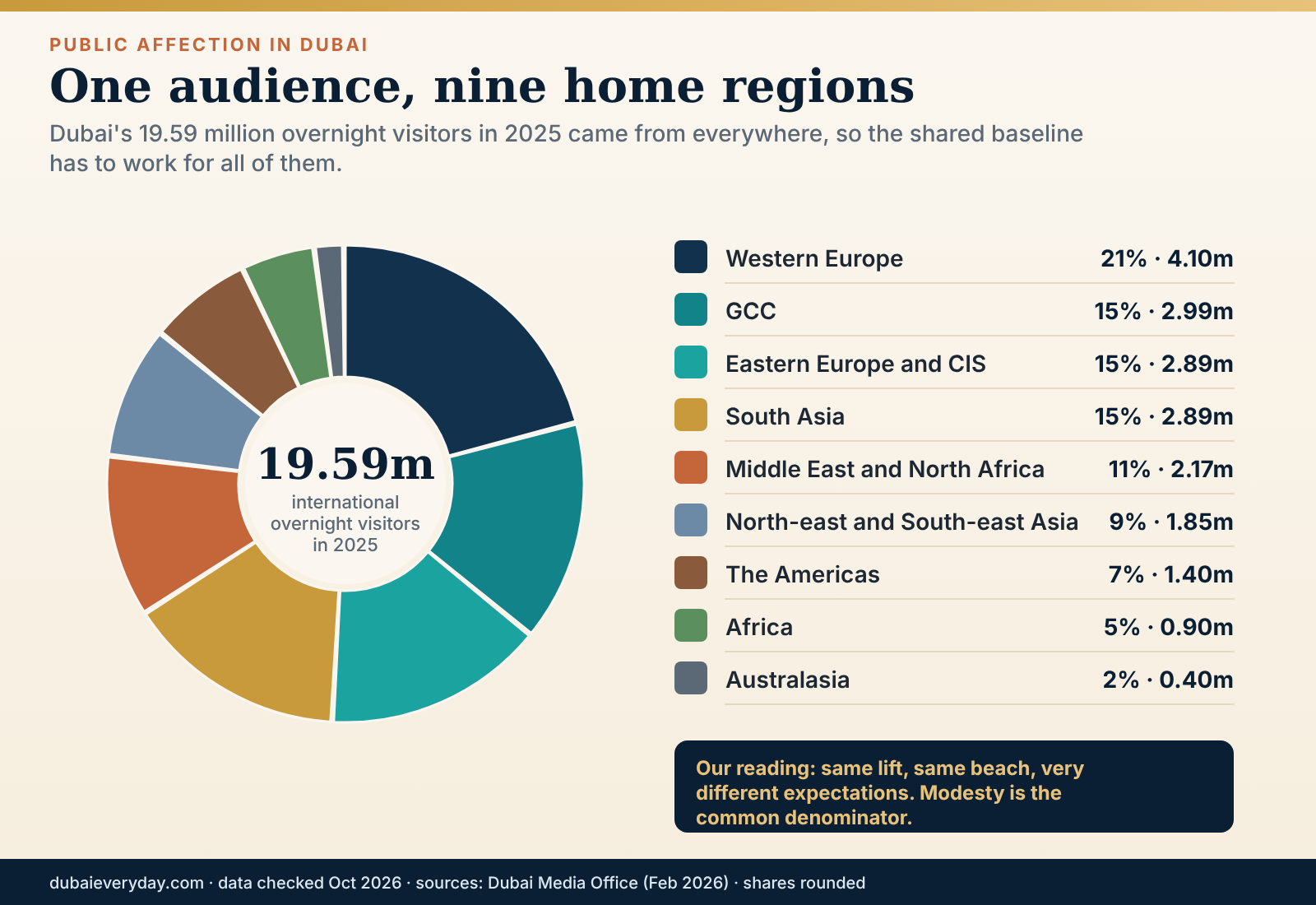
Rules are only half the story. The other half is the audience, and Dubai’s audience is unusually mixed. The Dubai government’s population page gives a figure of 3,863,600 residents at the end of 2024, and Dubai’s tourism authority reported about 19.59 million international overnight visitors in 2025, up 5 percent from 18.72 million the year before. Western Europe was the largest source region, at about 21 percent, followed by the GCC, Eastern Europe and the CIS, and South Asia at roughly 15 percent each.
A mixed audience means mixed expectations
Our reading of that mix is practical, not statistical. At any family-friendly spot, you may be sitting near Gulf families, South Asian families, Russian-speaking tourists, European couples and long-term residents from dozens of countries. What counts as a normal greeting or a relaxed evening differs across all of them. Some will look away and some will not. Public affection Dubai rules exist partly because the shared space needs a baseline that works for the widest range of people, and that baseline sits near modesty.
Greetings are not romance
Greeting customs often confuse visitors. The government portal says Emirati men may greet each other by touching noses and then shaking hands or embracing, and it advises not offering to shake hands with a Muslim of the opposite gender unless they extend a hand first. A hug between friends at an airport, a cheek kiss among relatives and a handshake at a business meeting are normal. The important point is to follow the other person’s lead, not to initiate contact that may be unwelcome.
Respect is a practical skill, not a performance
Respect in the public affection Dubai rules is not about hiding a relationship. It is about shared space. Warm words, eye contact, a compliment, a held hand and a private moment later are all open to you. If it helps, think of the audience as a table of strangers at a wedding: you are welcome, you are visible, and you adjust the volume. The Dubai etiquette guide lists the other everyday habits that go with it.
Ramadan, mosques and heritage districts
Three situations call for an extra margin on top of the public affection Dubai rules. During Ramadan, the UK advice asks people to avoid eating, drinking, smoking or chewing gum in public in daytime and to avoid loud music, dancing and swearing, and visitors should be more reserved than usual. Mosques and their surroundings are conservative settings. Older neighbourhoods and souks attract families and long-term residents, so hand-holding is the ceiling. For detail on all three, see Ramadan etiquette in Dubai and mosque etiquette in Dubai.
Family-heavy landmarks and waterfront promenades
The busiest areas for photos are also the busiest family areas. The fountain and waterfront promenades around Downtown Dubai and the walkways of Dubai Marina are lively at dusk, with children, strollers, tour groups and photographers. A couple’s moment is more visible there than almost anywhere else. If you want a romantic view, choose a table or a terrace with a view, not a crowded rail.
Cameras, selfies and social media
The camera is the part of the public affection Dubai rules nobody plans for. A kiss that lasts three seconds can become a video that lasts forever, and the person who films it, the person who posts it and the person who appears in it can all face consequences. Several of the cases that reach the press begin with a phone, not a patrol.
What the privacy law says
The UAE legislation portal’s text of Federal Decree-Law No. 34 of 2021, the cybercrime law, covers invasion of privacy in Article 44. Using an information system to photograph people in public or private places, or to share, copy or store those photos, without consent and outside what the law allows is an offence. The penalty stated there is imprisonment of at least six months, a fine of AED 150,000 to AED 500,000, or both.
A Gulf News explainer from December 2025 reported a civil example: a man ordered to pay AED 30,000 in compensation, with other penalties bringing the total to AED 40,000, for photographing a family at a coffee shop and posting the images. The UK and US advice both say not to photograph people without permission, and the UK advice notes that men have been arrested for photographing women on beaches.
Do not film strangers, even as background to your own selfie, and never post footage of other people’s affection, arguments or swimwear. The person you photograph does not need to be doing anything wrong for you to be the one in trouble.
Selfies, backgrounds and shared albums
Selfie culture is the everyday version of the risk. Before you tap, check what is behind you. A family at a fountain, a woman in a swimsuit on a beach, a child at a pool: all of them are people you do not have permission to photograph. If you are posting a couple photo, crop or choose a frame that has only the two of you. When someone asks you to delete a photo, delete it. That one small courtesy has prevented more disputes than any legal argument.
The same applies to group chats and shared albums. Forwarding a clip of a stranger’s kiss is sharing it, whatever your intention. Our reading is that anything involving other people’s intimate moments should never leave your phone.
Posting your own relationship online
Your own photos are your own business, but they are also public evidence. A photo of two people kissing on a public beach, posted with a location tag, tells anyone who sees it where and when it happened. Content standards set out in the UAE media rules, as summarised on the government portal, require respect for national culture, identity and values and for privacy. The US advice adds that people have been arrested and convicted over posts judged to disturb public order. Keep location tags and kisses apart.
Couples who want a memory of a romantic moment have better options. A photographer who knows the venue can frame a hand-hold, a laugh or a silhouette on a terrace. These images look better than a kiss in the wrong place, and no one has to be offended for them to exist. If you want ideas for settings that suit it, our rooftop bars in Dubai and fine dining in Dubai pages describe views and atmosphere without any need to push the limits.
A four-question test and ten scenarios
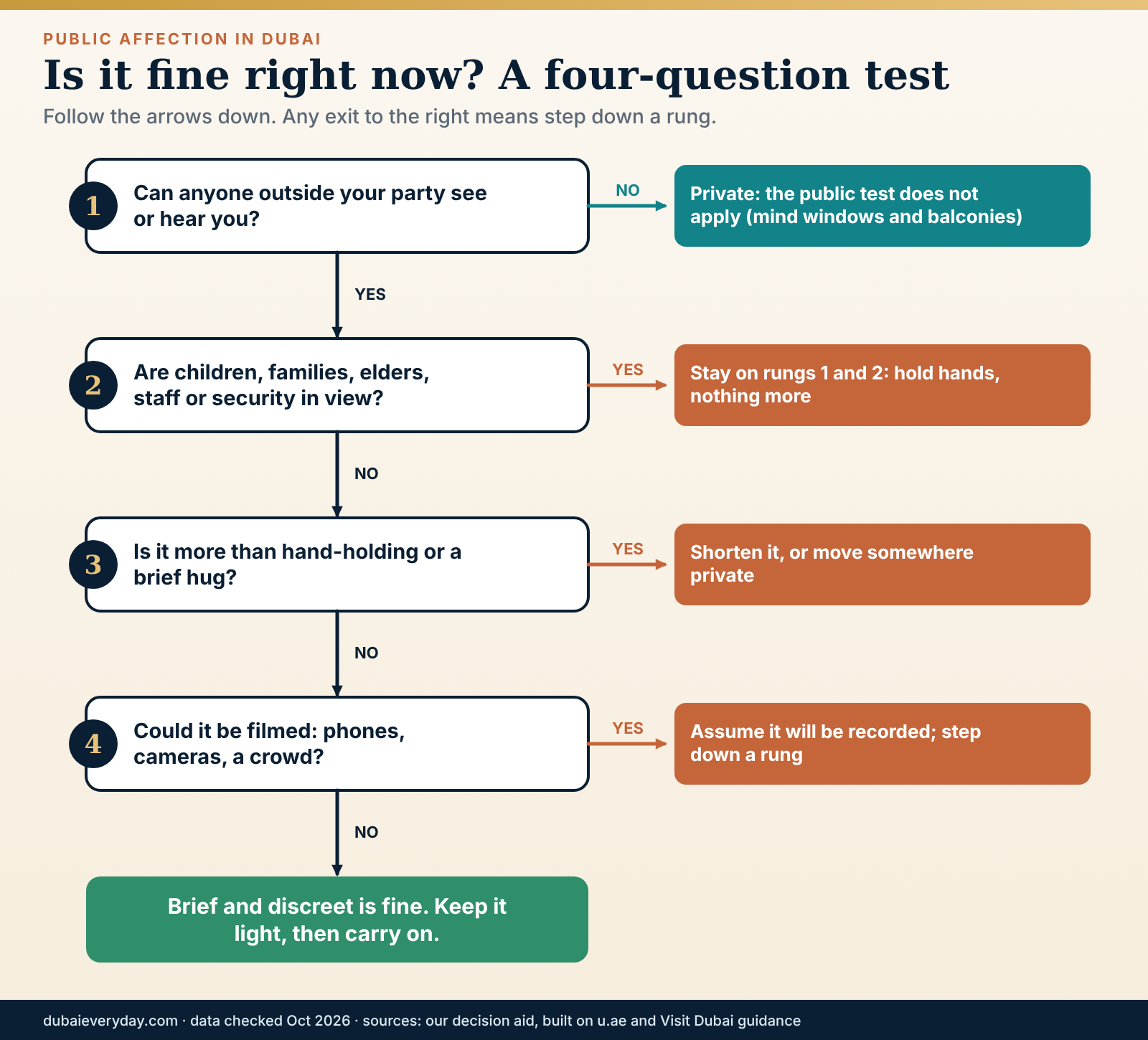
Lists of the public affection Dubai rules break down at the edges. A test you can run in two seconds works better. Ask these four questions in order, and stop at the first yes.
- Is it private?Can anyone who is not part of your party see or hear you, including from a window, a corridor or a terrace? If no one can, you are outside the public test. If someone can, carry on.
- Who is watching?Are there children, families, older people, staff or security within sight? If yes, drop down to the first two rungs of the ladder.
- How far up the ladder?Is the gesture more than holding hands, a brief hug or a light touch? If yes, either shorten it or move it somewhere private.
- Could it be filmed?Are there phones, cameras or a crowd? If yes, assume it will be recorded and decide whether you would be comfortable defending it.
Ten scenarios, run through the test
These are illustrative situations, not reports of real events, and the readings are ours. They show how the test turns the public affection Dubai rules into a decision.
An arrival hall reunion. A long hug after a flight is common and rarely a problem, especially among relatives. Keep it to a hug and a smile, then move on. A lingering kiss is the point at which strangers start to notice.
A sunset terrace at a hotel. A held hand, a head on a shoulder and a toast are fine. The licensed setting is relaxed, but the terrace is still public. If it is crowded, keep your hands above the table.
A towel on a public beach. This one fails the test on every question. It is visible, family-oriented and heavily photographed. Keep a hand in a hand, and keep a respectful distance.
A proposal at a fountain viewing area. The ring and the question are fine. The crowd, the cheering and the phones raise the exposure, so make the embrace brief and the kiss private. Consider a quieter spot with the same view.
Metro at rush hour. Standing close because the carriage is full is not a problem. Sustained contact is. Stay in the general cabin unless you qualify for the women and children cabin.
Brunch with drinks. Relaxed conversation and a held hand are fine. Treat the second glass as a reason to be more careful, not less. The exit is where the evening can unravel.
A residential pool. Neighbours know you and talk. Keep it as modest as you would at a family gathering.
A teenage couple on a family holiday. Public affection is a firm no, and parents should set that expectation before the trip. Adults should not assume everyone is over 18.
A same-sex couple walking through a mall. Walking side by side is fine. Any display that signals a romantic relationship carries added legal risk, because same-sex activity is illegal and the UK advice warns of punishment where there is a public element. Stay on the lowest rungs, and know how to reach your embassy.
Two colleagues greeting at the office. A handshake or a friendly nod. Anything else is a human resources matter before it is a legal one.
If someone complains or you are stopped
Complaints usually begin small. A guard clears his throat, a manager asks you to stop, or a stranger says something sharp. The first minute decides a lot. Most requests end with an apology and a change of pace. The ones that do not end that way tend to be the ones where someone argued.
- Stop and stay calmTake your hands away, step back and lower your voice. Agree with the request before you explain anything.
- Be polite and briefSay that you understand and that it will not happen again. Do not debate what the law allows with a guard or a member of the public.
- Do not film officialsRecording a confrontation can make a small issue bigger, and the privacy law applies to you as well.
- Ask for an interpreter and your embassyIf police become involved, ask for someone who speaks your language and for your embassy or consulate to be informed. The UAE government portal lists a directory of foreign missions in the country.
- Do not sign what you cannot readAsk for a translation before you put your name to any statement.
- Get legal advice earlyA lawyer who handles criminal cases in Dubai can tell you what applies to your situation. This page cannot.
The UAE government portal lists 999 for police, 998 for an ambulance and 997 for the fire service, from anywhere in the UAE. Use 999 for emergencies. Its two Dubai tourist police numbers differ between sections of the same page, so confirm one with your hotel or embassy before relying on it.
How reported cases under the public affection Dubai rules have unfolded
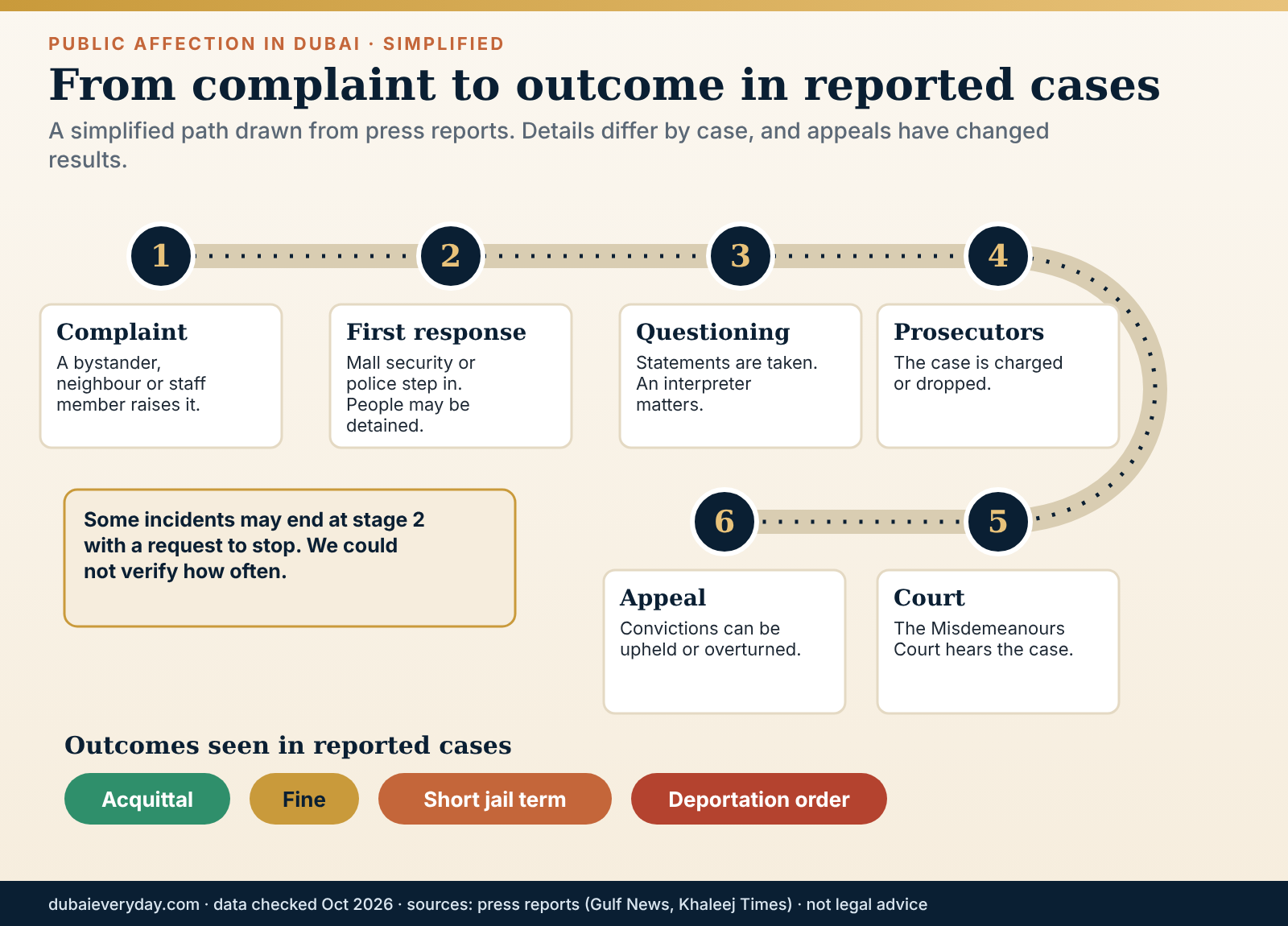
Press reports show a pattern, and no two cases are identical. A bystander or staff member raises a complaint. Security or police respond, and people are questioned and sometimes detained. The matter goes to prosecutors and then to the Misdemeanours Court. Outcomes in the reported cases range from acquittal to a fine, a short jail term and a deportation order, and appeals can change them. In the mall case, the appeal court overturned the conviction and cancelled the deportation order.
Seven mistakes that cause most trouble
Most trouble under the public affection Dubai rules comes from a short list of avoidable habits.
- Thinking marriage is a passNeither the law nor the official guidance exempts married couples from decency rules in public.
- Trusting one penalty figureThe numbers circulating online come from older law numbering. Check the current text.
- Copying other peopleSomeone else getting away with a kiss does not tell you who complained or did not.
- Treating a public beach like a hotel poolThe audience and the cameras are different.
- Filming the momentYour video of strangers is a risk to you, not only to them.
- Drinking and then leaving togetherThe exit is public even if the bar was not.
- Arguing with a guardA small request becomes a police matter when someone insists on being right.
Frequently asked questions about the public affection Dubai rules
Can you kiss in public in Dubai?
Under the public affection Dubai rules, you should assume not. The UAE government portal says kissing and hugging in public are not acceptable, and the UK government warns that you can be arrested for kissing in public. Enforcement tends to depend on a complaint, so many couples are never questioned, but that is luck, not permission. A quick cheek kiss between friends or relatives as a greeting is a different thing from a romantic kiss. Keep romantic kisses for private spaces such as your room.
Is holding hands allowed in Dubai?
Yes, in general, under the public affection Dubai rules. Visit Dubai’s Cultural Explorer city guide calls hand-holding acceptable and asks visitors to avoid dramatic displays, and the government portal says the same about holding hands. In the most conservative settings, such as older neighbourhoods, mosques and during Ramadan, treat it as the upper limit. Same-sex couples face added legal risk because same-sex activity is illegal, so they should read their own government’s travel advice before relying on this.
What are the public affection Dubai rules for tourists in short?
Hold hands if you like, keep hugs brief, and save kisses and caresses for private spaces. Treat public beaches, malls, family restaurants and old districts as the strictest settings, and licensed hotel venues as more relaxed but not exempt. Do not film strangers, do not drink and then linger in the street, and if a guard asks you to stop, stop and be polite. The place-by-place table above applies the same logic to nine common settings.
Can unmarried couples share a hotel room in Dubai?
A Dubai lawyer quoted in Khaleej Times in 2021 said cohabitation stopped being an offence after the 2020 amendments, so a tourist couple may share a room without that legal problem. The UK advice does not address room-sharing directly and notes that hotels commonly copy your passport. We found no official tourism statement that settles it, and hotels can set their own conditions, so ask the property before you travel. Anyone under 18 cannot stay without an adult.
Can you hug in public in Dubai?
Sources differ, which is itself a clue. The government portal says hugging in public is not acceptable, while a December 2025 Gulf News explainer says a brief hug is acceptable. Our reading of the public affection Dubai rules is that a short greeting or farewell hug, for example at an airport, is common and rarely causes a problem, and that a long or romantic embrace in a mall, on a beach or in a restaurant is risky. Duration and setting decide it.
What happens if you are caught kissing in Dubai?
It varies, and the public affection Dubai rules do not come with a single published tariff. Reported cases show a complaint, questioning, a charge, and outcomes ranging from acquittal on appeal to a fine, a short jail term and a deportation order. The exact current penalty wording is something we could not confirm from the official text, and older press figures come from the earlier numbering of the code. If you are stopped, stay polite, ask for an interpreter, ask for your embassy to be informed and get a lawyer.
Do the rules change during Ramadan?
The law behind the public affection Dubai rules does not change, but expectations tighten. The UK advice asks people to avoid eating, drinking, smoking or chewing gum in public in daytime and to avoid loud music, dancing and swearing. A public display that passes unnoticed in January may draw objections in the fasting month, so move closer to hand-holding only. Our Ramadan etiquette guide covers the rest.
Are the rules different for same-sex couples?
The public affection Dubai rules are the same for everyone, but the UK and US advisories both state that same-sex sexual activity is illegal and same-sex marriage is not recognised. The UK advice says private life is generally respected, while people have been punished where there was a public element or offence. Stay on the lowest rungs of the ladder in public, keep documents and your embassy’s details handy, and read your government’s advice for LGBT+ travellers.
Is it okay to photograph or film couples in public?
No. Alongside the public affection Dubai rules, Article 44 of the cybercrime law covers photographing people in public or private places and sharing those photos without consent, with imprisonment of at least six months, a fine of AED 150,000 to AED 500,000, or both. The UK and US advice both say not to photograph people without permission. Keep strangers out of your frame, and delete any photo or video if someone asks.
Can married couples kiss in public in Dubai?
Marriage does not change the public affection Dubai rules. Official guidance on kissing and hugging in public does not distinguish between married and unmarried couples, and the UK advice says you can be arrested for kissing in public. Being married helps with other questions, such as hotel check-in and childbirth paperwork, but it does not make a public kiss safe. Keep it to hand-holding and brief contact outside private places.
Are the rules the same in every emirate?
The public affection Dubai rules rest on the federal Crimes and Penalties Law, which applies across the UAE, but the US advice notes that each emirate has its own judicial system, so procedures and penalties can vary. Local expectations also differ: Sharjah, for example, prohibits drinking and possessing alcohol, according to the UK advice. If you travel beyond Dubai, apply the stricter reading of this page.
Keep reading
Sources and further reading (20 links)
- UAE Legislation Portal: Federal Decree-Law promulgating the Crimes and Penalties Law — status, effective date and the definition of publicity
- UAE Legislation Portal: Federal Decree-Law No. 34 of 2021 on countering rumours and cybercrimes — Article 44 on privacy and photography
- UAE Government Portal: Social responsibility for visitors — official guidance on public behaviour, affection, dress and photography
- UAE Government Portal: Social life — greeting customs and hospitality
- UAE Government Portal: Media regulation — content standards and privacy on social media
- UAE Government Portal: Emergency help for tourists — emergency numbers and embassy directory
- Visit Dubai: Cultural Explorer city guide 2025 — official line on hand-holding and dramatic displays of affection
- UK Foreign, Commonwealth and Development Office: UAE safety and security — kissing, relationships, LGBT+, photography, Ramadan and alcohol guidance
- US Department of State: United Arab Emirates country information — local laws, public decency, unmarried couples and social media
- Dubai Media Office: Dubai tourism achieves third successive record-breaking year — 2025 visitor numbers and source regions
- Dubai Government: Population and vital statistics — Dubai population at the end of 2024
- Roads and Transport Authority: About Dubai Metro — women and children cabins and the fine for designated areas
- Gulf News: Five key rules tourists should know before arriving in Dubai — discreet affection and the photography compensation example
- Khaleej Times: Explained, new UAE law on unmarried parenting and extramarital affairs — complaint-based prosecution under the 2021 code
- Khaleej Times: Can I share a hotel room with my girlfriend? — a lawyer’s view on cohabitation and hotels
- Gulf News: Dubai couple charged with having sex outside wedlock acquitted — effect of the 2020 amendments on a Cassation Court case
- Sharjah24: Public Prosecution explains punishment for public indecency offences — the 2021 prosecutors’ warning on penalty ranges
- Gulf News: British kissing couple loses jail appeal in Dubai — a reported complaint-driven case and its outcome
- Gulf News: Two women cleared of kissing in public in Dubai food court — a reported acquittal on appeal
- Gulf Today: New UAE law tightens penalties for abuse-related cases — December 2025 amendment to the Crimes and Penalties Law
Update log: 29 October 2026, first publication; facts re-checked against the sources above. Next review due: October 2027, or sooner if the law, official guidance or venue practice changes. Corrections welcome.
This page is general information for travellers and residents, not legal advice. Penalties and procedures depend on the facts and on the current text of the law, so consult a licensed lawyer or your embassy about a specific situation.
About DubaiEveryday and this guide
DubaiEveryday.com is an independent editorial project that publishes practical, research-based guides to everyday life in Dubai: where to live, what things cost, how the rules work and how to get around. This page was written and edited by the DubaiEveryday editorial team. It is not signed by a named expert, doctor, lawyer or adviser, and we do not claim first-hand testing of a venue, clinic or service unless the page says so.
Each guide is built from official sources such as government and regulator pages, operator websites and established news outlets, cross-checked where we can. When we could not confirm something, we say so in the text, and examples that use made-up numbers are labelled as illustrations. Mentions are editorial choices, not paid placements, and a link is not an endorsement.
Dubai changes quickly. If you spot something that is out of date or wrong, please tell us through the contact options on DubaiEveryday.com and we will check it and correct the page.