

Every beach in Dubai can hold a family for an afternoon, but only a few publish the things a parent actually needs: a lifeguard window, a playground, somewhere to sit out of the sun and something to eat within walking distance. This guide to family beaches Dubai residents and visitors can use sorts the published facts from the guesswork, checked on 29 October 2026.
Picture it: you arrive with a bag of towels, two tired children and a flask of cold water, and only then discover there is no shade, no toilet nearby and the lifeguard’s day ended an hour ago. Beach days with kids go wrong in small, practical ways. The sea itself is rarely the problem.
What parents actually need is a short list of facts: when lifeguards are on duty, whether there is a playground, where to sit out of the sun and where to buy lunch within walking distance. This guide sorts the published facts about family beaches dubai residents and visitors use from the guesswork, and it says plainly where nobody can confirm something from a desk. You will leave knowing which beach suits which children, and what to pack before the car doors close.
The family beaches Dubai families can rely on most are the lifeguarded municipal beaches that publish a children’s playground: Jumeirah 2 and Jumeirah 3, plus the long Mamzar lagoon shoreline and the new Khor Al Mamzar beach for wide, swim-only water. Dubai Municipality lists a kids’ playground at the first two, lounges and a beach library, and lifeguards from sunrise to sunset. Dubai Municipality’s own listing says the family beaches Dubai residents use for free charge no entrance fee, apart from paid services.
The honest limits matter just as much. No official page we could read gives water depth, slope or a toilet and shower list for any beach, so “shallow” is something you test on the day, not something you can book. Lifeguards stop at sunset except on the lit night-swimming stretches. Shade is mostly what you carry.
For food on a short walk, The Beach at JBR is the best-documented strip. For a fenced, paid day with pools and picnic lawns, Al Mamzar Beach Park is the municipal option. Older children and sunsets suit Umm Suqeim. Below you get the evidence for each of the family beaches Dubai Municipality runs, the safety rules for children, the sun clock, and five worked family days.
This guide to family beaches Dubai wide is desk research. DubaiEveryday.com has not visited these beaches, swum at them, queued for their car parks or eaten at their kiosks, and nothing below describes a personal visit. There is no invented author and no invented anecdote.
Facility and lifeguard facts come from Dubai Municipality beach pages opened on 29 October 2026, plus the operator page of The Beach at JBR, the Visit Dubai listing for Al Mamzar Beach Park, and the World Health Organization and NHS for child safety. Items taken from our sibling research logs of the same date are labelled as carried over.
Selection rules: a beach joins the list of family beaches Dubai residents can use only if it is open to the public now and has at least one published feature that matters to children. Nothing is ranked by commission, and inclusion was not paid for. Anything we could not confirm is marked “Confirm first”. Illustrative numbers are labelled as such. Safety content is general information, not medical or individual advice.
Family beaches Dubai in October 2026: the status board
Start with what is actually open, because the Dubai coast has changed a great deal in the past twelve months. The municipality is in the middle of a multi-year beach programme, and several older guides still describe beaches that were closed for rebuilding or not yet built. The board below separates what you can use this week from what is announced.
Open now
Free entryAmong the family beaches Dubai Municipality lists, Jumeirah 2, Jumeirah 3, Umm Suqeim 1, Umm Suqeim 2 and the Mamzar lagoon beach are open to the public around the clock, with lifeguards on duty from sunrise to sunset. Al Mamzar Beach Park is a separate, paid, gated park open daily 08:00 to 22:00.
Reopened or new in 2026
Confirm firstJumeirah 1 was rebuilt and reported reopened in February 2026. Khor Al Mamzar opened on 5 May 2026 with a 3.6 km swimming shoreline, according to a Dubai Media Office release read for this page. Neither has a published toilet, shower or parking list we could read.
Announced, not open
Do not plan around itThe Al Mamzar Corniche women-only beach was still described as being prepared in a Khaleej Times report dated 14 September 2026. The Jebel Ali beach exists only as a 2024 master plan with no opening date.
Two numbers frame the rest of the page. The municipality’s own listing says its beach centres charge no entrance fee, except for fees tied to services you request. And lifeguards on the municipal pages we read are on duty from sunrise to sunset at dedicated posts, patrolling the length of the beach. Everything about planning a trip to the family beaches Dubai offers hangs off those two facts: the sand is free, and the supervision window is the daylight window.
One note on the wider situation
Travel conditions in the region have been unusually changeable during 2026. The UK government’s travel advice for the UAE, updated on 27 October 2026 and carried over from our sibling log, describes the regional security picture as highly unpredictable and tells travellers to follow local official guidance.
That is outside the scope of a beach guide, but if you are flying in with children, read the current official advice for your passport country before you book, and re-check it close to departure. Our Dubai travel guide covers the planning side.
What changed since older guides were written
If you have an older printout or a saved list of family beaches Dubai parents recommended on a forum, three things are likely wrong. First, Jumeirah 1 has been rebuilt and was reported reopened in February 2026. Second, Khor Al Mamzar now gives the Mamzar area a second, much longer swimming shoreline. Third, the night-swimming stretches, which the municipality introduced in 2023, are now a normal part of planning for families who want to avoid the afternoon sun. We unpack each in the profiles section.
The main best beaches in Dubai guide compares public, hotel and club beaches for every kind of visitor, and the public beaches guide goes deep on free access, parking and lifeguards. This page does something narrower. It looks at the family beaches Dubai offers through the eyes of a parent with a child who cannot swim yet, a buggy to push and a very specific number of hours before a nap.
What this page covers and how the shortlist was built
One page, one job. This guide helps you pick among the family beaches Dubai offers, judged on five things a parent cares about: how shallow and calm the water is likely to be, which facilities are published, whether there is a playground, how much shade there is, and where children can eat nearby. It does not try to cover every beach, every club or every hotel pool in the emirate.
Neighbouring pages cover the rest. The best beaches in Dubai guide compares public, hotel and club beaches for all visitors. The public beaches guide goes deep on parking, showers, lifeguard clocks and general rules. For the whole trip with children, including heat, strollers and transport, see Dubai with kids, and for a first year of life, Dubai with a baby.
The five tests and what counts as evidence
Each test for family beaches Dubai wide has a different kind of evidence behind it, and mixing them up is how lists of family beaches Dubai parents share end up confidently wrong. A lifeguard window is a fact that an authority publishes. A playground is a fact that an authority publishes or an operator lists. “Shallow” is not a published fact about any Dubai beach we could find, so it can only be an informed expectation plus a test you run on arrival.
| Test | What we accept as evidence | What we do not accept |
|---|---|---|
| Shallow, calm water | Official description of a swim-only zone or sheltered lagoon; your own walk-out test on the day | Depth or slope claims from social posts and forum threads |
| Facilities | Dubai Municipality pages, operator FAQ pages, press releases from the Dubai Media Office | Aggregator lists of showers and toilets with no source |
| Play areas | A playground or children’s area named on an official or operator page | Photos, review snippets, “kids love it” claims |
| Shade | Published shaded structures or rentable umbrellas and cabanas; our sun-position calculation | Assumptions that a beach has trees or tents |
| Food nearby | Operator pages listing outlets and hours; press releases counting food outlets | Menus, ratings and price claims we could not read |
Evidence grades and what the shortlist is not
Throughout the profiles we mark facts with three plain grades. Published means we opened an official or operator page on 29 October 2026 and the fact was there. Reported means a news outlet or a sibling research log carried it, and we say so. Not published means we looked and found nothing, which is different from saying the feature does not exist. Many family beaches Dubai wide may have toilets, showers and shade that nobody has listed in a place we could read.
The shortlist of family beaches Dubai covers is not a league table and it is not field-tested. Nothing is ranked by commission or paid placement, and there are no booking links. Beaches are grouped by how well their published features fit particular children, which is why the decision guide later asks about your children’s ages first and the beach second. Entries were limited to places open to the public today and suitable for swimming, with a lifeguard or on-site operator.
Beach facilities change with rebuilding programmes, seasons and operator contracts. Before a long drive with children, call the Dubai Municipality service line listed on its beach page, 800900, or check the venue’s own channels for the day. We could not verify toilets, showers, parking or shade tents for any of the municipal family beaches Dubai Municipality lists, because no page we could read lists them.
Shallow water: what a desk can and cannot tell you
Search for family beaches Dubai parents ask about and “shallow water” comes up in almost every query. It is also the one criterion where no official source gives you a number. None of the Dubai Municipality pages for these family beaches Dubai wide states a depth, a slope, or the distance to where the seabed drops. The National’s October 2026 guide for parents tells them to check the depth, waves, currents, tides and weather before anyone gets in, which is a quiet admission that you cannot assume it.
What the official pages do say
Several municipal pages describe a stretch as “designated entirely for swimming”, which we read as no jet skis or kite lines in that water. That is genuinely useful: the Jumeirah 1, Jumeirah 2 and Mamzar lagoon pages use the phrase, and Umm Suqeim 2 splits its beach into a swim-only area and a surf-only area. Umm Suqeim 1 says motorised water sports are kept apart from swimming areas. Separation from boats and surf lines reduces one kind of risk. It says nothing about depth.
The Mamzar “lagoon” label and the Khor Al Mamzar name both point to a sheltered shoreline, since a khor is a creek or inlet. Sheltered water usually means smaller waves. That is our reasoning from geography, not a published measurement. A creek mouth can also carry tidal flow, so “calm” and “no current” are different claims, and neither is confirmed by the pages we read.
What makes water feel shallow to a child
When parents ask about shallow water at family beaches Dubai wide, they tend to mean four different things, and each depends on something different. Wading depth depends on seabed slope, which no one publishes. Small waves depend on exposure to wind and open water. Clear sight of your child’s feet depends on water clarity, which changes with weather and swimmers. And a quiet entry depends on crowds and on what shares the water with you.
- Slope: a gentle seabed lets a four-year-old wade a long way out before the water reaches their waist, while a steep one does not. Watch how quickly the shore drops away when the first adult walks in.
- Waves: a flat morning can become choppy by afternoon when the wind rises. Check the flag, then watch the shore break for five minutes.
- Currents: flowing water tugs at a child’s legs before it looks dangerous. Watch a floating object, a seaweed clump for instance, to see which way it drifts.
- Crowds: a long, thin line of swimmers along a lifeguard tower is easier to supervise than a scattered group.
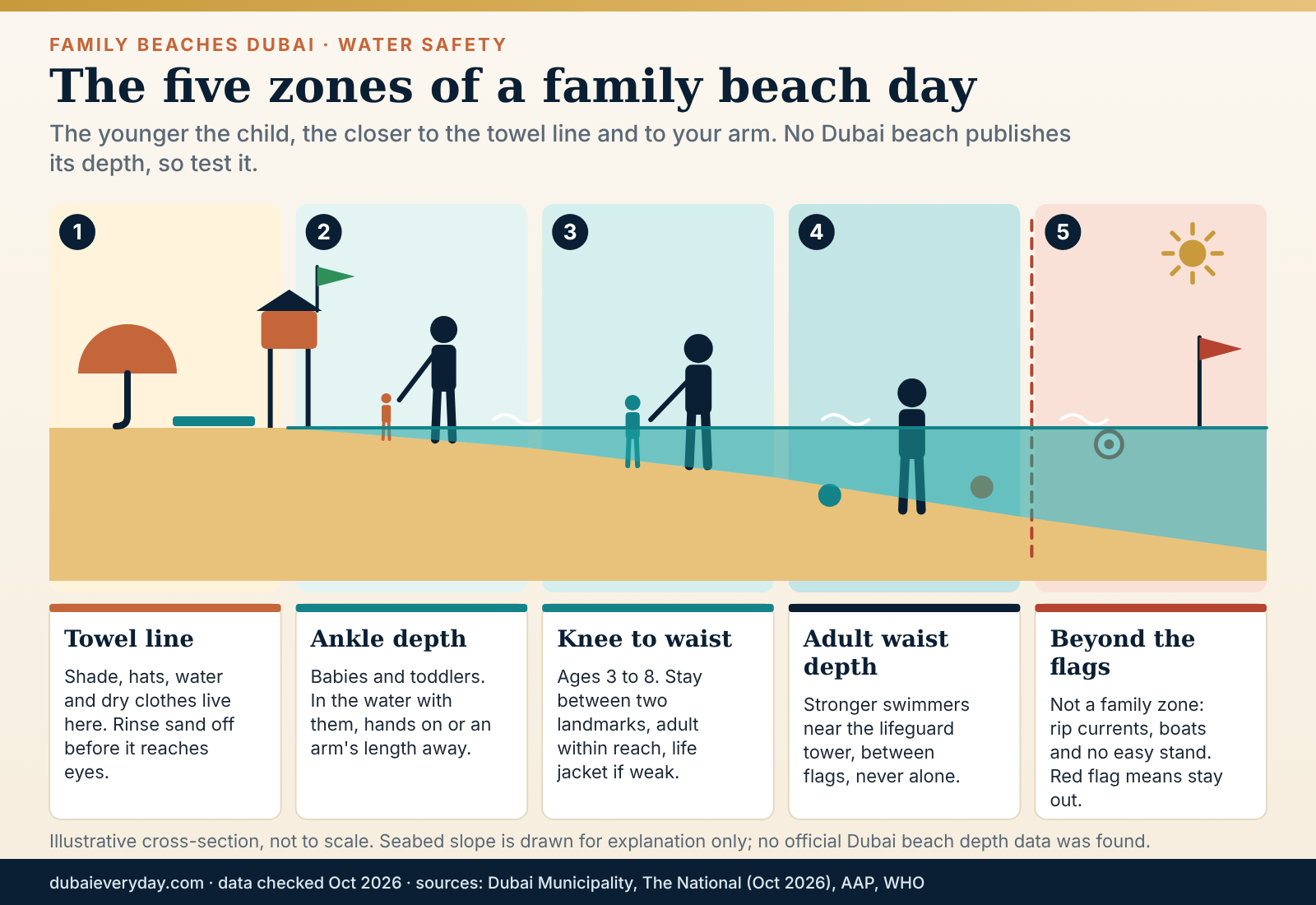
The five-minute walk-out test
Because no one can hand you a depth chart for any of the family beaches Dubai offers, run a quick test every time you arrive somewhere new. It takes a few minutes, and an adult who is a competent swimmer should do it before the children touch the water. The test is general safety practice built on the parents’ checklist in The National’s October 2026 guide, not a municipal procedure, and it does not replace lifeguard instructions.
- Read the flag and the signsFind the lifeguard tower, note the flag colour, and read any signs. Green means safe for swimming, yellow means caution, red means do not enter, and purple warns of harmful marine life such as jellyfish.
- Watch the water for five minutesLook at wave size, how far the water runs up the sand, and whether a floating object drifts sideways along the shore. Drift along the beach hints at a current.
- Walk out aloneWade slowly until the water reaches your own waist, counting steps and noting how suddenly the seabed falls. A sharp step down means a short paddling zone.
- Set a boundary children can seePick two landmarks, such as the lifeguard tower and a bin or pole, and tell children the limit is the line between them and knee depth for the youngest.
- Stay within reachFor toddlers and non-swimmers, stay in the water at arm’s length, the “touch supervision” idea the American Academy of Pediatrics describes for young children.
Honest limit. If the water is flat and sheltered but the lifeguard window is closed, the beach is still not a safe place for unsupervised swimming. Calm water is a comfort, not a guarantee. The sunrise-to-sunset lifeguard rule on the municipal pages applies whatever the sea looks like.
Why a pool-like beach is not the same as a safe one
Some of the most family-friendly water at family beaches Dubai wide is not the sea at all. Many hotel resorts and the Al Mamzar park have pools next to the sand, and a shallow toddler pool, ideally with a lifeguard on deck, is easier to judge than any open sea. We cover that trade-off in the park and hotel sections. If your child is still working out how to float, choose a place where the water is shallow because someone built it that way, and treat the sea as the bonus.
The coast in order: where the family beaches Dubai offers sit
Dubai’s public coastline runs roughly north-east to south-west, and the family beaches Dubai has cluster in three places. In the north-east sits the Mamzar area, the newest and the longest swimming shoreline. In the middle are the four municipal beaches along the Jumeirah strip, from Jumeirah 1 to Umm Suqeim 2. In the south-west, towards the Marina and the Palm, you find the commercial strip at JBR and a couple of newer public stretches.
That order matters more than it sounds. Mamzar and the Jumeirah beaches are municipal and free to enter. The Beach at JBR is a commercial promenade with public sand. The Palm and the Marina side add food and transport links but, in the pages we could read, publish less about children’s facilities. Distance also shapes the day: the drive from Mamzar to Umm Suqeim is long enough to be a separate outing, so most families choose one end of the coast and stay there.
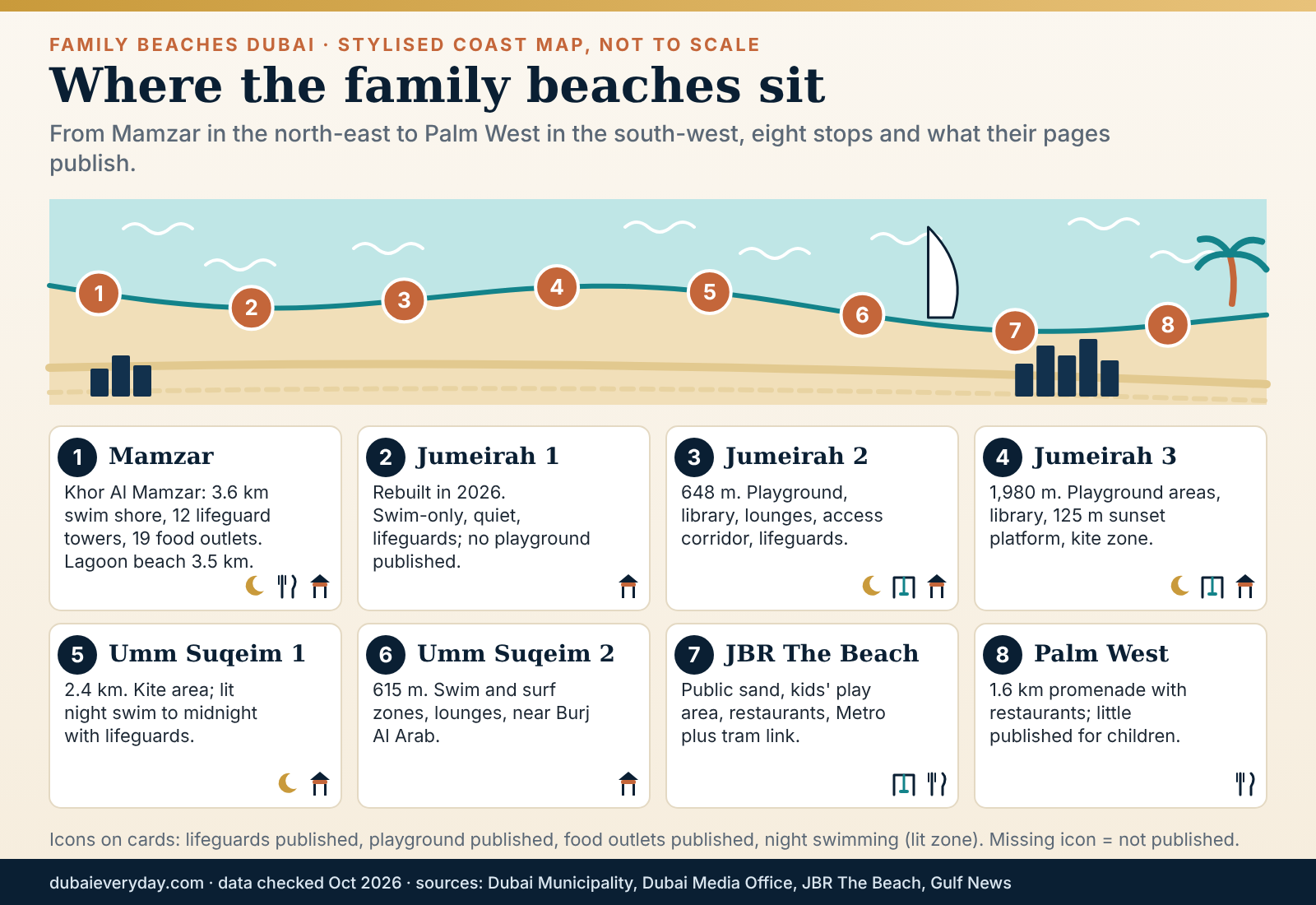
Distances and neighbours, in plain terms
We found no official table of distances between beaches, so we do not quote kilometres. What the municipal pages do give is neighbours: Umm Suqeim 2 is described as the closest beach to Burj Al Arab, about one kilometre away. A Gulf News beach guide updated in May 2025 and read for this page places the Mamzar lagoon on Al Khaleej Street (D92) after the Corniche and the park. Use a map app for door-to-door times and add a margin for school-run traffic.
If you are staying near Downtown or the Marina, the closest of the family beaches Dubai offers is not always the best one. Our Downtown Dubai guide and the Dubai Marina guide show how those districts connect to the coast, and the Palm Jumeirah guide covers the Palm West side.
Family beaches Dubai Municipality runs, one by one
Every fact in this section comes from a municipal or operator page opened on 29 October 2026 unless it is marked reported. The pages for the family beaches Dubai Municipality manages share a template: length, facilities, lifeguards and a statement that the beach is open to the public around the clock. Where a page is silent we say “not published” and leave it there. Silence on a page is not proof of absence, but it is not a promise either.
Jumeirah 2: compact, playground, library
Dubai Municipality lists Jumeirah 2 at 648 metres, designated entirely for swimming. The page names a kids’ playground area, a beach library for all ages, beach lounges, a gym area, a jogging track and boardwalk, and an access corridor for people of determination and the elderly. Lifeguards are on duty from sunrise to sunset at dedicated posts and patrol the full length. The page itself calls it one of the most attractive beaches for families.
That makes it the most complete profile among the family beaches Dubai Municipality lists, and its shorter length is an advantage: it is easy to keep every child in sight. Night swimming was announced for Jumeirah 2 in 2023, a fact carried over from our sibling log, though this beach page does not mention it. Not published: toilets, showers, parking, shade structures. Confirm first for any of those.
Jumeirah 3: the longest list for children
Jumeirah 3 is 1,980 metres, with a kite-surfing area, jogging track, boardwalk and outdoor fitness equipment. The page names beach lounges, kids’ playground areas in the plural, a beach library with books for all ages, and a 125-metre “happiness platform” for sunset seating and recreational fishing. Access corridors exist for people of determination and the elderly. Lifeguards work sunrise to sunset, and the beach is open round the clock.
Unlike Jumeirah 1 and 2, the page does not say the beach is designated entirely for swimming, and the presence of a kite area means you should look for the signs and keep children away from launch and landing zones. Night swimming was announced here in 2023 (carried). A Gulf News guide gives the access as Umm Al Sheif Road from Sheikh Zayed Road (E11), also carried over. For a buggy-and-playground day, this is the strongest published entry among all the family beaches Dubai pages we read.
Umm Suqeim 1: sports, sunsets, night swim
Umm Suqeim 1 is 2.4 kilometres, with a kite-surfing area, jogging track and boardwalk, and a statement that motorised water sports are kept apart from swimming areas. Lifeguards are on duty from sunrise. After sunset, swimming is permitted until midnight in an area lit by smart light poles, with lifeguards present until midnight. That is the only lifeguarded evening swim published on the municipal beach pages we read.
The page has a quirk. It attributes beach lounges, kids’ playground areas and access corridors to “Umm Suqeim 2”, although the page is about beach 1, and it calls Umm Suqeim 1 the “only” night beach while the 2023 announcement names three. We therefore treat playground and lounge provision here as unconfirmed. Families with older children who like watching kites and want an evening swim will find it useful, but verify the toilets and play facilities before bringing toddlers.
Umm Suqeim 2: short, close to the Burj Al Arab
At 615 metres, Umm Suqeim 2 is the shortest beach in the municipal set, split into a swim-only area and a surf-only area. The page lists a jogging track, beach lounges and an access corridor, with lifeguards from sunrise to sunset. It says the beach is about one kilometre from Burj Al Arab, the closest public beach to it, and gives no playground or night-swimming information.
For families the practical point is the zoning. Stay on the swim-only side and keep younger children well away from surfers and boards. The profile is thinner for small children than Jumeirah 2 or 3, but it suits a quick, scenic dip with older ones.
Jumeirah 1: quiet, rebuilt, still thin on published detail
The municipal page describes Jumeirah 1 as one of the quietest beaches, mostly used by local residents and designated entirely for swimming. It lists a 1,350-metre jogging track, lifeguards from sunrise to sunset and round-the-clock public access, and nothing about playgrounds, lounges, toilets or showers. Press coverage in January and February 2026 (carried over) reported a rebuild with a larger beach, lockers and monitoring technology, but the facility list is not on the municipal page we read.
That leaves a gap among the family beaches Dubai Municipality describes. The quiet, swim-only character and the long smooth track suit a family pushing a pram and splashing in calm hours. Families who need a playground should look at Jumeirah 2 or 3 first.
Next door, the commercial J1 Beach is described by Visit Dubai as luxury restaurants and premium beach clubs. A What’s On report of 19 August 2026 lists one venue there, Gigi, as family-friendly with a kids’ club, so the strip is not adults-only, but it is a paid, minimum-spend setting rather than a free municipal beach.
Mamzar lagoon beach and Khor Al Mamzar: the long swim
The municipal page for the Mamzar lagoon gives about 3.5 kilometres, designated entirely for swimming and kept apart from water sports. It lists fitness areas, a walking and jogging track, a bicycle track and access corridors, with lifeguards from sunrise to sunset, and calls it one of the most attractive beaches for families. It does not mention playgrounds, toilets, parking or entry fees.
Khor Al Mamzar, opened on 5 May 2026 according to a Dubai Media Office release read for this page, adds a 3.6-kilometre swimming shoreline, 182,000 square metres of sand, 12 lifeguard towers, 12 emergency call points, 20 public facilities and 19 food and beverage outlets. There is a 300-metre night beach, more than 5.5 kilometres of walking, running and cycling tracks, a floating walkway, kayaking and facilities designed to be accessible.
The release does not state children’s play areas, shade, parking, opening hours or fees. A Gulf News breakdown of the beach programme (April 2026, carried over) lists children’s play areas and shaded spaces among the planned lagoon features, but it does not confirm which are open. Check before you go. Among the family beaches Dubai has opened this year, the lifeguard towers and food outlets are the clearest published reasons for a family with swimmers to try it.
Al Mamzar Beach Park: the fenced, paid option
Al Mamzar Beach Park is a separate gated park, not the free lagoon beach. The municipal listing gives daily opening from 08:00 to 22:00, and Visit Dubai describes five beaches, swimming pools, bike paths, picnic areas and chalets for rent, with entry from AED 5. A 2024 Gulf News report, carried over from our sibling log, gave AED 5 per person and AED 30 per car, with children under two free. Treat those as hedged until you see the gate price.
The park is the best published answer among the family beaches Dubai offers for families who want an enclosed, supervised-feeling day with pools and picnic lawns. Not published on the pages we read: lifeguard schedule for the pools, playground list, kiosk list and shade. Call 800900 to ask, and check the current prices when you arrive.
Al Mamzar Corniche, a smaller beach with playgrounds described in a 2025 Gulf News guide, is part of the redevelopment programme. A Khaleej Times report on 14 September 2026 described it as still being prepared. Do not plan a day around it until the municipality announces an opening.
The decision table: what each beach publishes
This table repeats the facts about the family beaches Dubai Municipality lists in one place. Yes means the item appears on an official or operator page opened on 29 October 2026, or in a press release we name above. A dash means not published, which is not the same as absent.
| Beach | Length | Playground | Lounges | Lifeguards | Night swim | Food published |
|---|---|---|---|---|---|---|
| Jumeirah 1 | Track 1,350 m | – | – | Sunrise-sunset | – | Premium dining next door |
| Jumeirah 2 | 648 m | Yes | Yes | Sunrise-sunset | Reported (2023) | – |
| Jumeirah 3 | 1,980 m | Yes | Yes | Sunrise-sunset | Reported (2023) | – |
| Umm Suqeim 1 | 2.4 km | Unconfirmed | Unconfirmed | From sunrise; to midnight in night zone | Yes, to midnight | – |
| Umm Suqeim 2 | 615 m | – | Yes | Sunrise-sunset | – | – |
| Mamzar lagoon | 3.5 km | – | – | Sunrise-sunset | – | – |
| Khor Al Mamzar | 3.6 km swim shore | – | – | 12 towers | 300 m night beach | 19 outlets |

Beach strips with food and play: JBR, La Mer, Palm West and Dubai Islands
The municipal family beaches Dubai residents use are free, lifeguarded and light on commerce. The strips in this section work the other way round. They are commercial promenades with public sand, so they publish more about restaurants and play areas, and often nothing about lifeguards. For families, that is a real trade-off. You are buying convenience, and you are giving up the municipal lifeguard schedule that the earlier profiles can document.
The Beach at JBR: the best-documented strip
The Beach at JBR publishes more practical detail than any of the municipal family beaches Dubai lists. Its FAQ page, read on 29 October 2026, says the beach is open to the public with no entry fee, and lists baby changing facilities, one prayer room, complimentary shuttle buses, free Wi-Fi and services for children and people of determination. It mentions a kids’ play area but no splash pad, and it does not address showers or toilets.
Food is the main reason families pick it. The page describes a mix of cuisines, including a partly covered, temperature-controlled Pavilion with six licensed restaurants and outdoor terraces. Sea Breeze rents sun loungers, cabanas, day beds, umbrellas and towels, which solves the shade-and-seating problem for a price. A 600-metre running track and a carnival with family rides are also listed. Food and beverage outlets open from 10:00 to midnight Sunday to Thursday and until 01:00 on Friday and Saturday.
Parking is where the day can go wrong. The Beach charges AED 20 per hour. Spending AED 100 or more per bill at participating outlets validates the first three hours, and four hours at some venues, once per car and only with receipts from fixed outlets, not carts or kiosks.
After validation you get a 15-minute grace period to leave. We work through a family example in the plans section. If you do not drive, the page gives the route: Metro to DMCC, then the tram to JBR1 or JBR2, then a walk.
What to check. The JBR page lists no lifeguard schedule and no shower or toilet details. Look for municipal lifeguard towers and flags when you arrive, and ask at a restaurant or the information point about toilets before your toddler needs one. Some venues on the strip are licensed bars and clubs, which may matter for evening plans with children.
J1 Beach, the redeveloped La Mer strip: dining first, family second
Our sibling guides treat J1 Beach as the redeveloped southern part of La Mer, though the Visit Dubai page we read does not use the old name. That page describes J1 Beach as a coastal destination on the shores of Jumeirah 1 with luxury restaurants and premium beach clubs, and names venues such as Gigi, Gitano and Baoli.
It lists no children’s facilities, hours, parking or access rules. The What’s On report of 19 August 2026 is more specific: it lists Gigi as family-friendly with a kids’ club called Gigi Circus, and quotes beach loungers at AED 300, fully redeemable against food and drink from Monday to Thursday and 50% at weekends.
Treat that as a snapshot, not a quote. The report says some summer rates were tied to June and that statuses change, and it does not say whether the price is per person or per lounger. The strip is best understood as an option for a family that wants a managed beach day with lounger service and a kids’ club, and is happy to pay a minimum spend. It is not the choice for a free, low-cost morning.
Palm West Beach and Dubai Islands: promenades, little published for children
A Gulf News beach guide last updated in May 2025 describes Palm West Beach as about 1.6 kilometres of promenade and beachfront with restaurants and a walking and running trail. It names no playground, shade or lifeguard information. What’s On lists beach clubs at Palm West, including SAN and Kyma, with day-pass prices that were summer rates at the time of the report, none of them flagged as children’s offers.
The same Gulf News guide describes Dubai Islands as the first pet-friendly beach, with kayaking, paddleboarding and a leash-free dog area, and gives no children’s facilities or lifeguard details. For a family weighing these two against the other family beaches Dubai offers, the sensible position is simple. Use Palm West for a walk and a meal with a view, and Dubai Islands if your dog is part of the family, and do not assume a lifeguard or a playground until a source says so.
Hotel beaches and day passes for families
Hotel beaches and beach-club day passes can solve three problems the free family beaches Dubai Municipality runs leave open: shade, toilets and food on the sand. They also add three costs: the pass, the minimum spend and the rules about who may bring children. The wider comparison of paid options sits in the best beaches in Dubai guide and the hotel comparisons in our best hotels in Dubai guide. Here the lens is narrow: what a parent should ask before paying.
What the August 2026 report shows about children
The What’s On report of 19 August 2026, which listed which beach clubs were open or closed for the summer, shows how varied the rules are. Some venues are explicitly family-friendly. La Cantine Beach at Bluewaters was reported with a family-friendly pool and an adults-only pool, at AED 250 on weekdays and AED 300 at weekends. Tagomago at Azure Residences on the Palm was reported with a family-friendly beach and an adults-only pool, at AED 150 weekdays and AED 200 weekends.
Others exclude children outright. Mare by Bussola at The Westin was reported as not admitting under-16s, and Wet Deck at W Dubai was reported as adults-only. Many entries said nothing about children at all. The takeaway is that “beach club” tells you very little. Ask about age policy before you travel, and never assume a premium beach welcomes a pram. These prices are June-era or summer rates reported in August, so Confirm first with each venue.
Seven questions to put to any hotel beach or day-pass venue
- Are children admitted, and from what age, on the day and in the area you want to use?
- Is there a separate shallow pool or kids’ zone, and is a lifeguard on duty there and at the sea?
- Is the price per person, per lounger or per family, and are children priced differently?
- Is the minimum spend redeemable against food and drink, and is that the same on weekends?
- How much shade is included: umbrellas, cabanas, covered seating, and are towels provided?
- Are there toilets, showers and a baby-changing space close to where you will sit?
- What happens if the weather turns, or the sea is closed by a red flag, after you have paid?
Hotel guests versus day visitors
If you are staying at a beachfront hotel, its beach is part of the room rate and becomes one of your family beaches Dubai options at no extra cost, often with a kids’ pool and towels, though lifeguard cover varies, so ask. If you are not, you pay for access and, on busy days, may find the best shade already taken by guests.
Tourists on a short stay should compare the cost of a day pass for four people with a hotel upgrade or a drive to a free municipal beach. The budget hotels guide and the luxury hotels guide show which properties have a private beach and which only have a pool.
A family that is staying for a week can mix the two. Use the hotel or club once for a shaded, easy day when the children are tired or when the weather is at its hottest, and use the free municipal beaches for the other days. That tends to cost less than paying a premium every day, and it uses the free family beaches Dubai offers at their strongest hours: early mornings, and the late afternoon after the sun has weakened.
Play areas and things for children to do
What counts as a “play area” at family beaches Dubai wide depends on the child’s age. For a toddler it means a safe, fenced, shaded patch with sand and a slide. For an eight-year-old it means water, a ball, a bike path and a place to run. For a teenager it means something with a net, a board or a kayak. The published detail across family beaches Dubai wide covers all of these, but unevenly.
Playgrounds, libraries and tracks that are actually published
Playgrounds are named on the Jumeirah 2 and Jumeirah 3 municipal pages, and the same pages list a beach library with books for all ages, a feature few beaches anywhere advertise. The Beach at JBR lists a kids’ play area and a carnival with family rides. Gulf News described playgrounds and a library at the old Al Mamzar Corniche in 2025, but that beach is being redeveloped. Nothing we read describes the playground equipment, surface or age range, so do not assume toddler-sized swings.
For wheels, the Jumeirah 1 page cites a 1,350-metre jogging track, the Mamzar lagoon page lists a bicycle track, and the Khor Al Mamzar release lists more than 5.5 kilometres of running, walking and cycling tracks. Those are the places to bring a scooter or balance bike. Khor Al Mamzar also lists beach volleyball, padel courts and kayaking, which suit older children and teenagers.
Sand, water and hot metal: practical play safety
Beach play has its own small hazards. Hot surfaces are the first one. Playground metal and dark plastic can heat far above the air temperature in direct sun, so touch a slide with the back of your hand before a child uses it. The World Health Organization’s heat guidance notes that sunlit surfaces can feel 10 to 15 degrees Celsius hotter than shade, which is a good reason to prefer playgrounds shaded by structures or to visit them before the sun is high.
Digging is the second. Deep holes collapse, and a child standing in one can be trapped, so keep holes shallower than your child’s knee and fill them in afterwards. This is general beach-safety practice rather than a Dubai rule. Third, keep an eye on shells, glass and litter on the tide line, especially on busy weekends, and carry water shoes for children who dislike hot sand.
A short list of low-effort activities by age
- Under 2: shaded sand, a bucket, a shallow splash zone at ankle depth, and short sessions in the cool hours.
- Ages 3 to 5: sandcastles, a lifeguard-tower visit, flag-spotting, and a walk along the boardwalk with a snack stop.
- Ages 6 to 9: body boards in the swim-only zone, a bike or scooter on the track, and a treasure hunt for shells.
- Ages 10 to 14: volleyball, kayaking where offered, and a sunset walk to the Jumeirah 3 platform.
- Teenagers: padel or sports at Khor Al Mamzar, evening swims in the lit night zones with a parent nearby, and kite-watching at Umm Suqeim.
Shade, sun and the clock that decides your beach day
Shade is the hardest of the five tests to verify. None of the Dubai Municipality beach pages we read states how many shaded structures a beach has, whether umbrellas or pop-up tents are allowed on municipal sand, or whether the “beach lounges” they list come with canopies.
The Khor Al Mamzar release is silent on shade, and Gulf News described “shaded spaces” among the planned lagoon features without saying which are open. So the practical rule for free family beaches Dubai wide is simple: assume the only shade is what you carry.
Where shade is actually documented
The Beach at JBR is the clearest case, because its operator page says Sea Breeze rents sun loungers, cabanas, day beds, umbrellas and towels, and the Pavilion offers a partly covered, temperature-controlled space with six restaurants. Hotel and club beaches normally sell shade as part of the pass, which is one reason families sometimes pay for them. Al Mamzar Beach Park lists picnic areas and pools, but the Visit Dubai page does not say how much of that is shaded.
As for tents, we found no page that allows or bans them on the municipal family beaches Dubai lists. Because the question matters (a pop-up shelter is standard kit for families in many countries), call the municipality’s 800900 line, or ask a lifeguard on arrival, before you carry one across the sand. Strong afternoon sea breezes can also lift an unanchored tent, so use it only if it can be pinned down and does not block an access corridor.
What the health agencies say about sun and children
The NHS advice for children is straightforward and applies at family beaches Dubai wide with more force than in Britain. Cover skin with suitable clothing, keep children in the shade especially around midday, and use sunscreen of at least SPF 30 with at least 4-star UVA protection on skin that clothing does not cover.
Apply generously, reapply about every two hours and after swimming, towel-drying or sweating, and choose a water-resistant product for time in the sea. Babies under six months should be kept out of strong direct sunlight altogether.
The World Health Organization adds three points that matter on a beach. Shade can lower how hot it feels by more than 10 degrees Celsius. Sunlit surfaces can feel 10 to 15 degrees hotter than their surroundings. And you should never drape dry fabric over a stroller, because it traps heat, so use a thin damp cloth and a fan if you must keep a baby in a pram outdoors. This is general guidance from public-health bodies, not medical advice for your child.
Our calculation: when the sun is strong enough to matter
To turn “avoid midday” into times, we calculated the sun’s position for Dubai (25.2 degrees north, 55.3 degrees east, UTC+4) for the 15th of each month, then applied a widely used clear-sky approximation that links the UV index to the sun’s height and an assumed ozone level. The results line up with the monthly peak UV values published by weather2travel (carried over from a sibling log): about 5 in December, around 8 in October, and 11 or more from April to September.
Read them as indicative, with an error of about half an hour and roughly one UV unit, ignoring cloud and dust. The WHO treats an index of 8 or more as “very high”, and the NHS advises protection from 3 upwards. Using those two thresholds, here is what the day looks like.
Mid-July, sunrise is at 05:38 and sunset at 19:12, so the guarded low-UV windows at family beaches Dubai wide run from sunrise to about 08:15 and from about 16:35 to sunset: roughly two and a half hours each. Mid-December, sunrise is 06:57 and sunset 17:31. UV stays below 3 until about 10:15 and again after about 14:20, which gives three hours or more at either end and only a moderate peak of about 5 at noon.
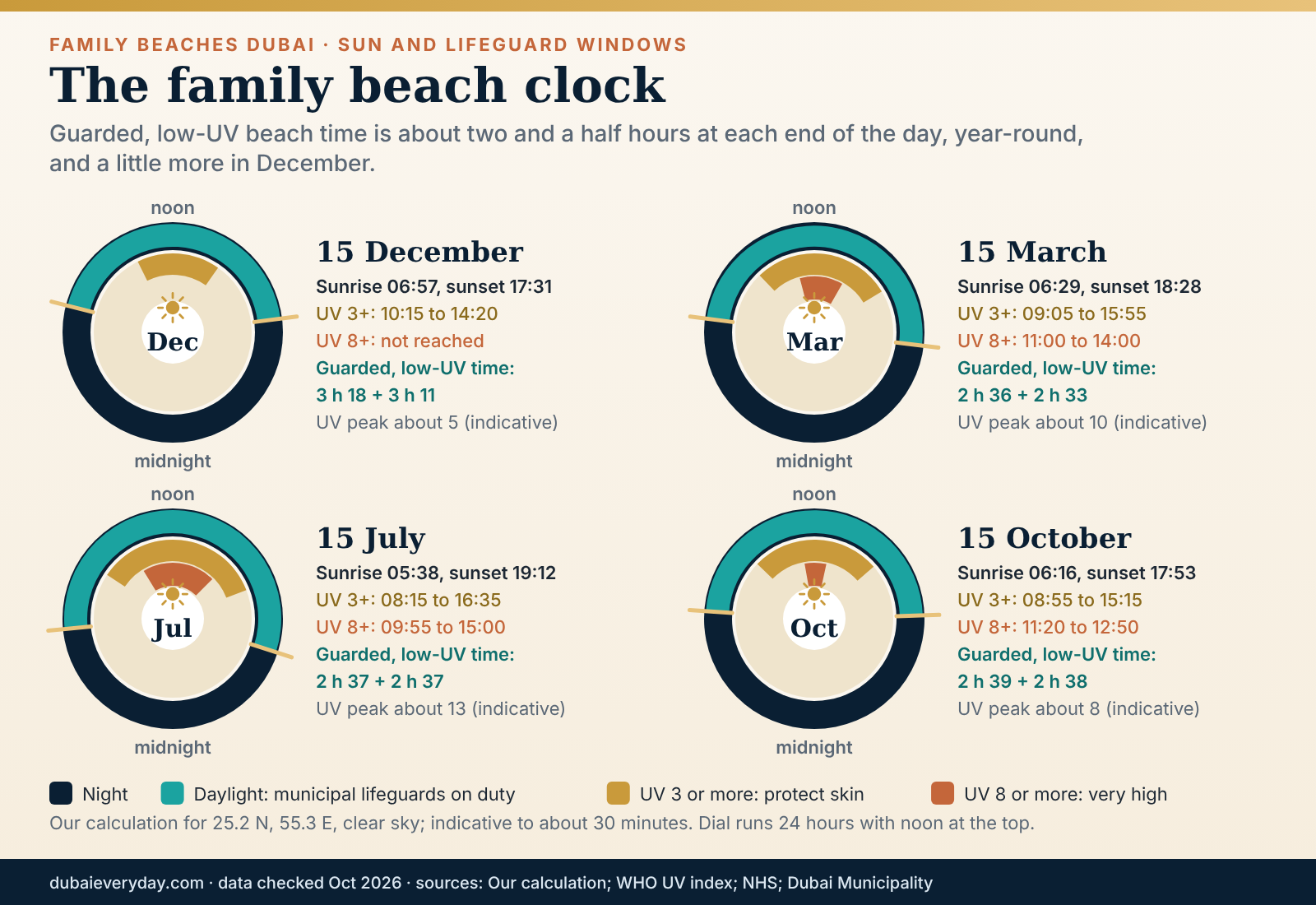
A simple shade ladder for the beach bag
Rank your shade from least to most reliable and stack it. Hats and tightly woven long-sleeved swim tops travel with the child. An umbrella or tent is shade you control, if allowed. A rented cabana or covered restaurant is shade someone else controls. The best plan uses three of them: protection on the child, a shelter on the sand, and a covered place to retreat to when the UV peak arrives, which is usually where you eat lunch.
Heat caution. In summer the average daily high is around 41 degrees Celsius and the sea itself is near 33 degrees (indicative averages from weather2travel and seatemperature.org, carried over). Warm water gives less relief than you might expect. Keep sessions short, offer fluids often, and watch for flushed, floppy or unusually quiet children. If a child seems unwell from heat, move them to shade or an air-conditioned space and seek medical help.
Food, water, toilets and changing near family beaches Dubai parents use
This is where the family beaches Dubai Municipality runs are thinnest on paper. No page we opened lists toilets, showers or changing rooms for Jumeirah 1, 2 or 3, Umm Suqeim 1 or 2 or the Mamzar lagoon. That does not mean there are none. It means you cannot plan around them, and a parent with a toilet-training child should plan as if the nearest facility is in a mall or a cafe. The public beaches guide has a section on planning around the gap.
What is published about food and facilities
Khor Al Mamzar’s release counts 20 public facilities and 19 food and beverage outlets but does not itemise them. The Beach at JBR lists a Pavilion with six licensed restaurants, other cuisines, baby changing facilities and a prayer room, with food outlets open from 10:00 to midnight on weekdays and to 01:00 on Fridays and Saturdays.
Al Mamzar Beach Park lists picnic areas. Everything else, such as kiosks, food trucks or cafes next to the sand at Jumeirah and Umm Suqeim, was not published on a page we could read.
For eating near family beaches Dubai wide, the nearest solid evidence is therefore JBR and Khor Al Mamzar. For the Jumeirah strip, the standard approach is to eat at a cafe or restaurant on the road behind the beach, which our best cafes guide and restaurants guide can help you choose. Neither of those guides is a beach-specific list, so check opening hours and children’s chairs separately.
Packing food and water
- Bring more water than you think you need and offer it before children ask. The WHO’s heat guidance suggests roughly a cup an hour for adults, and children need regular drinks too.
- Choose snacks that survive heat and sand: fruit that peels, wraps, sealed pouches and dry items. Keep perishables in an insulated bag and out of the sun.
- If a child has a food allergy, carry a safe snack and your own medication plan. For Dubai health services and insurance, see our healthcare in Dubai guide.
- Buy supplies before you go. Our supermarkets guide covers where to shop for groceries.
Rules also shape the picnic at family beaches Dubai wide. The municipal beach rules (carried over from our sibling log) bar barbecues, open fires and shisha outside designated areas, and drinking alcohol or being drunk in public is illegal, according to the UK government’s UAE safety page updated on 27 October 2026. A cool bag of sandwiches and fruit is fine; a portable grill is not.
Changing, rinsing and the toilet problem
The same municipal rules, carried over, bar swimwear in passageways, so plan to change at a facility and walk to the sand in cover-ups. A quick-dry towel poncho, a spare set of dry clothes in a sealed bag, and a bottle of fresh water for rinsing sandy feet solve most problems. Wet wipes, a plastic bag for soiled clothes and a travel potty seat make toilet-training outings far easier, since you cannot count on facilities being there.
Not published. We could not find an official list of showers, toilets, changing rooms or car parks for any municipal beach, and none for Khor Al Mamzar. If facilities decide your day, ring 800900 first and treat anything a forum post says as unverified.
Water safety for children: lifeguards, flags and supervision
This section on safety at family beaches Dubai wide is general information drawn from the World Health Organization, the American Academy of Pediatrics, The National’s October 2026 guide to children on UAE beaches and the municipal pages. It is not medical advice, and it cannot replace swimming lessons, first-aid training or the instructions of a lifeguard on the day.
The scale of the problem, in one paragraph
According to the WHO, about 300,000 people drown worldwide each year, children under five account for nearly a quarter of drowning deaths, and drowning ranks fourth among causes of death for ages one to four. Rates are highest in the youngest children, and risk rises when they are near water without active adult supervision. In the UAE, drowning figures are not centrally published every year across all emirates, The National notes, so local numbers are patchy. These are global and regional figures, not Dubai statistics.
Lifeguard hours are the first rule
The municipal pages we read all say trained, licensed lifeguards are on duty from sunrise to sunset at dedicated posts and patrol the length of the beach. Umm Suqeim 1 is the exception on the list, with a lit night zone and lifeguards until midnight, and the 2023 announcement (carried over) names Jumeirah 2 and 3 as night-swimming beaches too. The National adds that many beaches are not always monitored, so check before you swim.
The sensible rule for family beaches Dubai wide follows directly. Swim only when a lifeguard is on duty, between the flags where flags are set, and close to a tower. The UK government’s UAE advice also tells visitors to swim only at approved, lifeguarded beaches with flags, and warns that rip currents can occur on any beach.
The flag system
The National’s guide gives the colour code used on UAE beaches. Green means conditions are safe for swimming. Yellow means use caution. Red means do not enter the water. Purple warns of harmful marine life such as jellyfish. A red and yellow pair of flags marks a lifeguarded swimming area. Teach children the colours before you reach the sand, and treat a red flag as final even if the water looks calm.
Supervision that works
The AAP’s phrase for toddlers, useful at any of the family beaches Dubai offers, is “touch supervision”: stay within arm’s length, in the water with them, and never leave a young child’s safety to a slightly older sibling. At a busy beach, appoint one adult as the water watcher for a fixed shift, phone away, and swap over rather than sharing the job loosely. The National makes the same point that a swimmer can get into trouble within seconds, and drowning is often quiet.
The signs it describes include a non-swimmer upright and facing the shore with climbing-like arm movements, a weak swimmer sitting low with head tilted back, and a child tiptoeing as the water nears their chin. If you see any of them, call for help and alert a lifeguard first, since untrained rescuers can become casualties. The AAP also advises caregivers and older children to learn CPR and safe rescue techniques.
Life jackets, floaties and swimming lessons
Inflatable arm bands, water wings and toys do not prevent drowning and can deflate, the AAP says. It recommends a properly fitting, approved life jacket for weak swimmers. We cannot verify which standards Dubai retailers or venues accept, so choose a jacket certified under a recognised standard in your home country and ask a lifeguard if you are unsure. The AAP also recommends swim lessons for children and parents from around the first birthday, depending on readiness, while the WHO stresses safe, well-run programmes.
Night swimming with children. Only the lit, lifeguarded night zones should be used after sunset, and the municipal page for Umm Suqeim 1 and the 2023 announcement name them. Elsewhere there are no lifeguards after dark. Dress children in bright swimwear, since orange and pink are easiest to see in the water, according to The National, and keep them within arm’s reach.
A family water plan, in four lines
- Agree the boundary: between two landmarks, no deeper than waist height for the child unless an adult is within reach.
- Agree the signal: what every child does when a lifeguard whistles or a flag changes.
- Name the water watcher and swap shifts out loud.
- Check the weather, flags and lifeguard presence again each time you go back in, not just on arrival.
Heat, sea temperature and the best months for family beaches Dubai
The year at family beaches Dubai wide has two halves that behave almost like different destinations. From roughly November to March the air is mild, the sun is moderate and the sea is cool. From June to September the air is extreme, the sea is as warm as a bath, and the beach becomes an early-morning and evening activity. The months either side are where most visitors want to be, which is why hotel prices and crowds follow.
The numbers, rounded and indicative
Monthly averages from weather2travel and seatemperature.org, carried over from our sibling logs and rounded, give a feel for the year. Average daily highs run about 24 to 26 degrees Celsius in December to February, rise to 33 in April and 37 in May, and sit around 39 to 41 from June to August. The sea is around 22 to 23 in January to March, 25 in April, 29 in May, and 31 to 33 degrees from June to October. Treat every figure as an average, not a forecast.
What that means for children
At family beaches Dubai wide, winter has the opposite problem to summer. A sea at 22 or 23 degrees Celsius is cool for toddlers and thin children, who can lose heat quickly even on a sunny day. Short dips, a rash vest, a warm towel and a hot drink afterwards make the session comfortable. Winter days are short, with about ten and a half hours of daylight around 21 December in our calculation, so the sunrise-to-sunset lifeguard window is also shorter than in summer.
In summer the problem is heat, not water. A sea at 33 degrees offers little cooling, the sand burns, and the UV band above 8 lasts most of the middle of the day. Families who live in Dubai tend to treat summer beach days as sunrise outings or sunset outings, and swap the middle for indoor time. Our indoor things to do guide covers what to do instead, and the best time to visit Dubai guide explains the seasonal trade-offs for hotels and crowds.
Our reading of the best months for families
Our reading of the data puts the sweet spot for family beaches Dubai has at late October to early April for most families: sunny and warm air, a sea warm enough in the shoulder months, and a UV peak you can manage with shade. The coolest stretch, December to February, suits walking, play areas and picnics more than long swims for small children. April and October are good shoulder months, with morning and evening swims comfortable and a midday you will want to avoid.
School holidays change the crowd, not the climate. A Gulf News report on the 2026-27 UAE school calendar, carried over from our sibling log, gives a winter break from 14 December to 3 January and a spring break from 5 to 11 April, so expect busy beaches and fuller hotels then, and check the dates with the school or our schools guide if you live here. For the visitor calendar, see the Dubai events calendar, Dubai events in January and Dubai events in February.
Getting to the beach with children: parking, Metro, tram and car seats
The journey is the part of a family beach day most likely to cost you an hour or a fine. The municipal family beaches Dubai lists are mostly reached by car or taxi, since none has a Metro station (our reading of the municipal listings and a sibling log), and the one beach strip with a clear public-transport route is JBR. Plan the route to family beaches Dubai wide as carefully as the beach itself.
By car: parking, seats and the clock
A Gulf News explainer dated 6 March 2025 and read on 29 October 2026 says paid public parking runs from 08:00 to 22:00, free on Sundays and public holidays, with peak hours 08:00 to 10:00 and 16:00 to 20:00 and off-peak 10:00 to 16:00 and 20:00 to 22:00. New tariffs took effect that April.
Standard on-street zones charge AED 4 an hour at peak, and premium zones AED 6 an hour. Premium spaces include high-congestion areas such as Jumeirah, according to the report. The article does not say which tariff applies to bays beside a particular beach, nor which payment methods are accepted, so confirm both on the sign.
At the Jumeirah beaches this suggests a rule of thumb. The clock does not run before 08:00 or after 22:00, the cheapest paid hours are the off-peak 10:00 to 16:00 block, and the peak bands of 08:00 to 10:00 and 16:00 to 20:00 cost the most. We work an example in the plans section. The Beach at JBR is different: it has its own car park at AED 20 per hour, with validation after AED 100 of spend, as described earlier.
Car seats matter for the drive itself. A Gulf News article last updated in November 2025 (a secondary source; we could not read an official legal text) says children under four must be in an appropriate child seat, children under ten should sit in the back, and a child may sit in front only if they are at least ten years old and 145 centimetres tall.
It reports an AED 400 fine and four black points for an unsecured child under four. Never leave a child in a parked car, which the WHO flags as a heat danger even for short periods.
Taxis, hire cars and rides
We could not verify whether taxis or ride-hailing cars carry child seats on request. Our sibling log on family travel reached the same conclusion, so bring a portable booster or infant seat if you plan to rely on taxis, or check the operator in advance. For hire cars, our car rental guide explains how to compare companies and what insurance to look for. Add a seat to the booking and confirm it on collection.
By Metro and tram: the JBR route
RTA timetables read on 29 October 2026 give Metro hours of 05:00 to midnight Monday to Thursday and Saturday, 05:00 to 01:00 on Friday and 08:00 to midnight on Sunday. The tram runs 06:00 to 01:00 Monday to Saturday and 09:00 to 01:00 on Sunday. The JBR operator page gives the route: Metro to DMCC, tram to JBR1 or JBR2, then walk. Our Dubai Metro guide covers fares, nol cards and the stations in detail.
On fares, our sibling log on family travel records that children under six travel free and gives card prices, but we could not re-confirm those on the RTA fares page today, which lists pass prices only. Confirm at a ticket machine.
We also found no published stroller rule for Metro or tram, so fold the buggy and expect a crowd at weekends. Mamzar can be reached by a weekend bus from the Stadium Metro station (route W20, 17:00 to 23:00 every 30 minutes, AED 3 in a 2024 Gulf News report), but check whether it still runs.
Carrying the gear: a short load-in plan
- Pack in two bags, not five: one for sun and water, one for dry change and snacks.
- Use a baby carrier rather than a pram on soft sand, and take a stroller only as far as the access corridor or boardwalk.
- Ask for a sand mat or beach wheelchair via 800900 if someone has mobility needs. We could not verify that municipal beaches loan them.
- Park, change and use the toilet before you walk onto the sand, and do the same in reverse on the way back.
- Photograph your parking bay or note the pay-station number, because large car parks all look alike after two hours of sun.
Which beach for which children: a decision guide
The right beach changes with the age of the youngest child more than with anything else, so start there. The flow below turns the published facts into a short route through the choices. It is our reading of the evidence, not a verdict, and any beach you choose still needs the walk-out test.
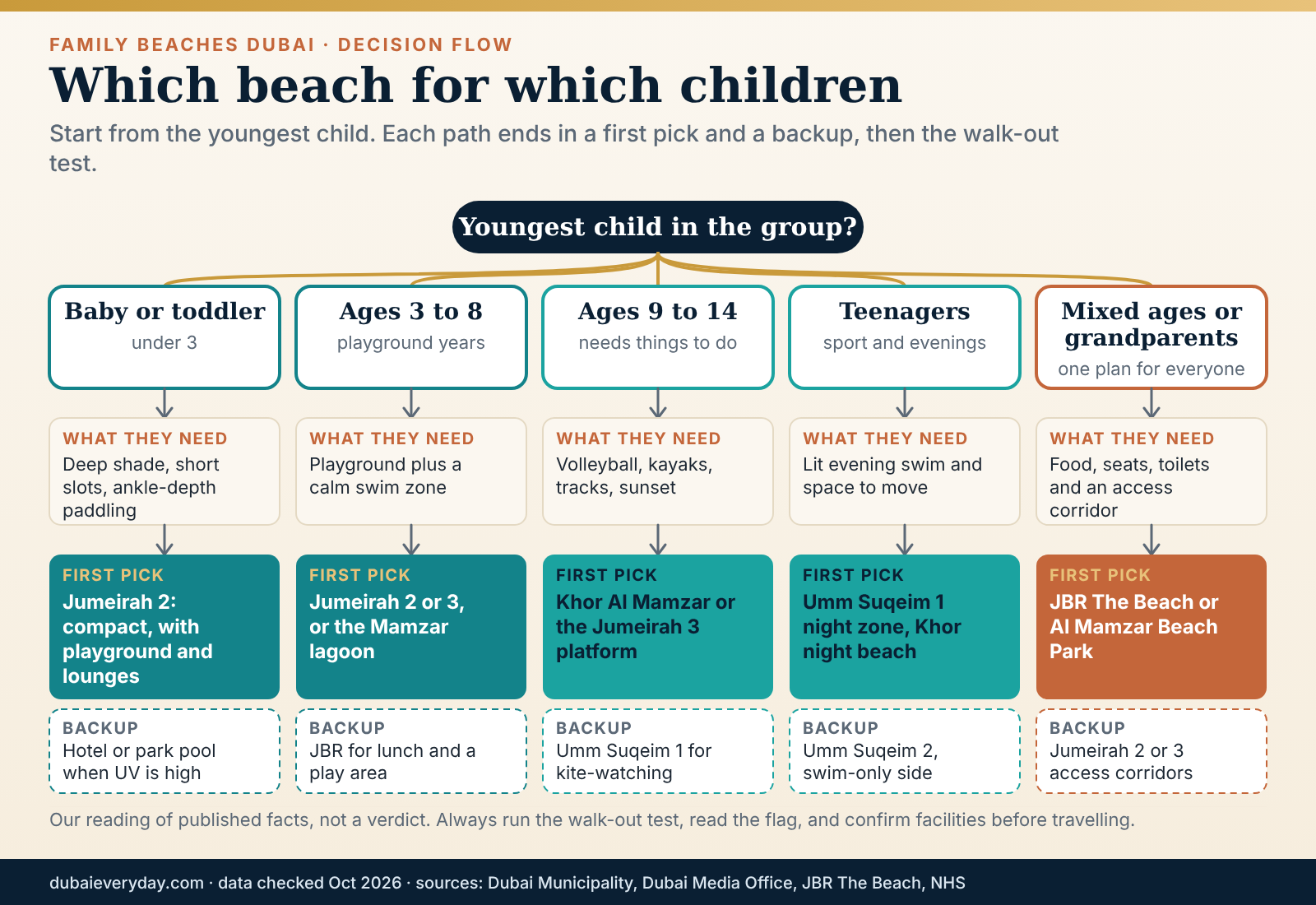
Babies and toddlers
For babies under six months, the NHS advice is to keep them out of strong direct sunlight, so a beach day means deep shade, a short visit in the first or last hour of light, or skipping the sand for a hotel pool.
For toddlers, choose the more compact family beaches Dubai lists, with a published playground, such as Jumeirah 2, and arrive at sunrise or late afternoon. Stay at arm’s length in the water, and keep sessions short. Our guide to Dubai with a baby covers nap schedules and heat rules.
Ages 3 to 8
This age group gets the most from the municipal family beaches Dubai Municipality manages. Jumeirah 2 and 3 give playgrounds and a library, the Mamzar lagoon and Khor Al Mamzar give long swim-only shorelines, and JBR gives food and a play area. Agree boundaries between landmarks, use bright swimwear, and keep an adult in the water. Children here may overestimate their ability once they have had a few lessons, so keep arm’s-length supervision until they can swim well and understand the flags.
Ages 9 to 14 and teenagers
Older children want something to do. Khor Al Mamzar lists volleyball, padel, kayaking, a floating walkway and tracks, Umm Suqeim 1 has a kite-surfing area and the lit night zone, and the Jumeirah 3 platform is a good sunset spot. They also need clear rules about how far out they swim, because confidence rises faster than skill. Water sports are a separate topic; our sports in Dubai guide covers the activities.
Grandparents, mobility and mixed groups
Several municipal pages mention access corridors for people of determination and the elderly: Jumeirah 2, Jumeirah 3, Umm Suqeim 2 and the Mamzar lagoon, with accessible facilities also claimed for Khor Al Mamzar. JBR lists services for people of determination and children. Mixed groups with a long age range usually do best at JBR or Al Mamzar Beach Park, where food, shade and a pool offer something for everyone, at the cost of an entry or parking fee.
Families with a dog, a tight budget or a rainy-day plan
The municipal rule text carried over from our sibling log bars pets at Mamzar, we found no municipal page that welcomes dogs elsewhere, and the Gulf News guide names Dubai Islands as the first pet-friendly beach. Our pets in Dubai guide covers the details. On a budget, the free family beaches Dubai Municipality runs plus a packed lunch are hard to beat, and the free things to do guide lists other no-cost options. If the weather turns, switch to an indoor plan.
Five family beach days, worked through
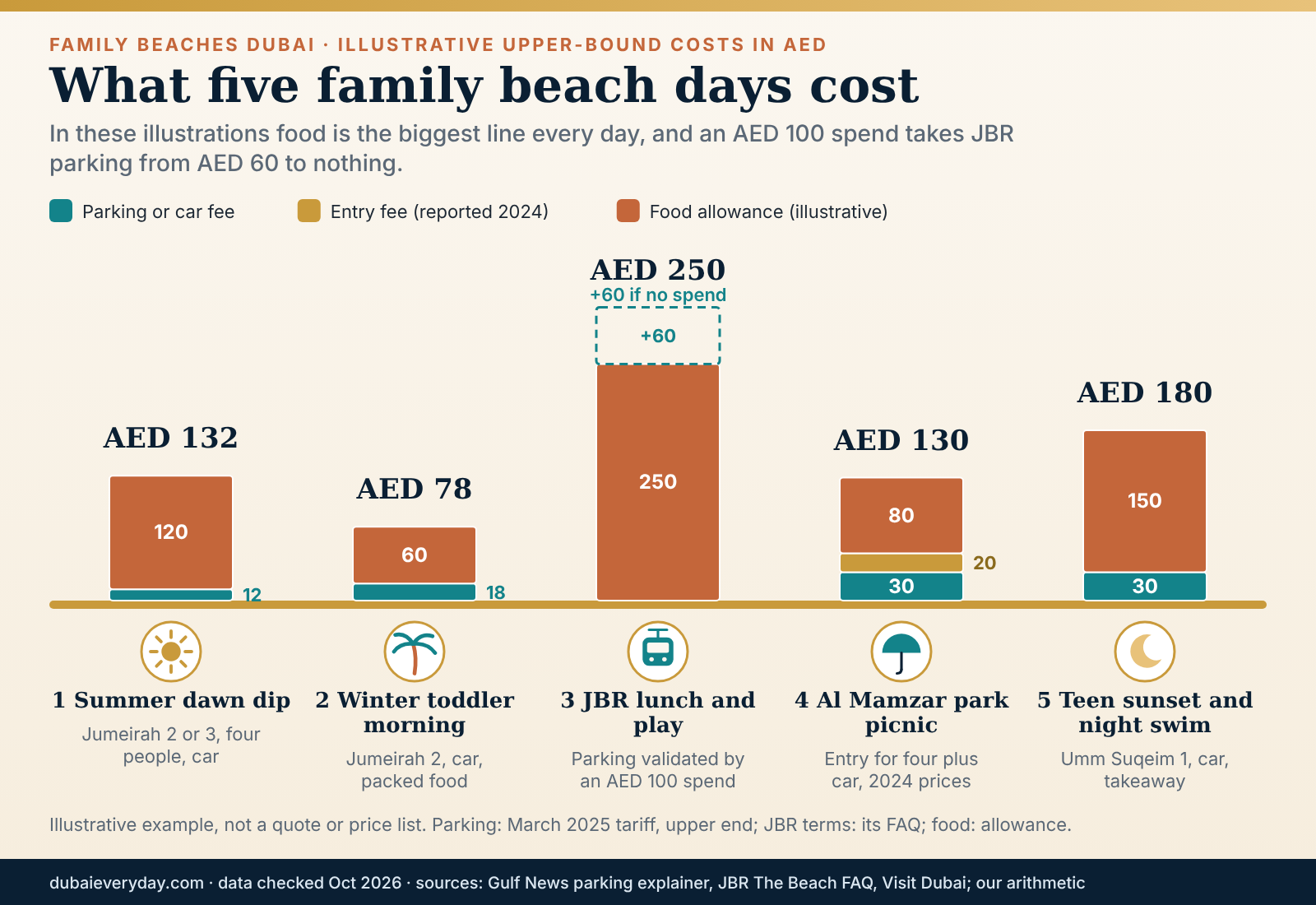
Planning advice for family beaches Dubai wide is easier to judge when it is attached to a concrete day. The five plans below use the published facts in this guide and our own arithmetic. They are not itineraries from a visit. Every cost line is either a verified fee with its source and date, or marked as an illustrative allowance whose job is to show how the sum works.
How to read the costs. Parking uses the March 2025 Gulf News tariff, the latest we could read, with the bay’s zone unknown, so each figure is a range. Entry fees are the 2024 reported Al Mamzar Beach Park prices and the JBR parking terms on its FAQ page. Food is an illustrative allowance, not a quote. Totals use the upper end of each range, so they are deliberately cautious.
Plan 1: a summer dawn dip for two adults and two children (ages 4 and 7)
The aim is sea and play without the heat. Mid-July sunrise is 05:38 in our calculation, UV stays under 3 until about 08:15, and the municipal lifeguards are on duty from sunrise. Arrive at Jumeirah 2 or 3 around 06:00, swim and play until about 08:30, then leave while the UV band is climbing. Municipal parking is chargeable from 08:00, so a stay to 09:30 would bill the 08:00 to 09:30 stretch at peak rates.
On the March 2025 tariff, two hours at peak costs AED 8 in a standard zone or AED 12 in a premium zone, so budget AED 12 if you stay past 08:00. Breakfast at a cafe afterwards is an illustrative AED 120 for four. Illustrative total: about AED 132. Leave before 08:00 and the parking falls to nothing, though the cafe is the real cost. This is the cheapest, coolest and best-supervised way to use family beaches Dubai has in summer.
Plan 2: a winter morning for a baby and a two-year-old
In mid-December sunrise is 06:57 and UV stays below 3 until about 10:15, with a peak around 5. The sea is likely to be cold for a toddler, around 25 degrees Celsius in December on the averages we carried over, so this is a sand-and-playground morning with a paddle at ankle depth. Jumeirah 2 is the published match among the family beaches Dubai lists: compact, with a playground area, lounges and an access corridor for the buggy.
Arrive about 09:30 and stay until 12:30. On the same tariff, one peak hour plus three off-peak hours would cost between AED 9 and AED 18, depending on the zone. Bring food from home and add an illustrative AED 60 for coffee and a snack. Upper-bound total: about AED 78. Keep the baby in deep shade, as the NHS advises for babies under six months, and have a plan for toilets, since the municipal page does not list any.
Plan 3: lunch and play at JBR
Pick JBR when food, shade and a short walk matter more than a free lifeguarded beach. Park at The Beach and spend at least AED 100 on one bill at a participating outlet, and the first three hours are validated, or four at some venues, so a family lunch pays for the parking. If you spend nothing, three hours costs AED 60 at AED 20 per hour. An illustrative family lunch of AED 250 for four then covers the car park.
Without a car, take the Metro to DMCC and the tram to JBR1 or JBR2, as the operator describes. The day suits mixed ages: the kids’ play area and running track are listed, Sea Breeze rents umbrellas and loungers, and the covered Pavilion gives a cool lunch spot. Check lifeguard presence on the sand before anyone swims, since the operator page does not mention it. Upper-bound total: about AED 250 with validation, or AED 310 without.
Plan 4: a picnic day at Al Mamzar Beach Park
This one suits families who want a fenced day with pools and lawns. Visit Dubai lists entry from AED 5, and a 2024 Gulf News report gave AED 5 per person and AED 30 per car, with under-twos free. For two adults and two school-age children by car, that is AED 20 for entry plus AED 30 for the car, AED 50 in total at those reported prices. Add an illustrative AED 80 for a supermarket picnic: about AED 130.
The park is open daily from 08:00 to 22:00 on the municipal listing. Pool charges, shade, lifeguard cover at the pools and whether stroller access is easy were not published on the pages we read, so call 800900 before you commit to a hot August outing. Prices may have changed since 2024, so treat AED 130 as a planning figure, not a quote.
Plan 5: a teenager-friendly sunset and night swim at Umm Suqeim 1
For older children, Umm Suqeim 1 combines a kite-surfing area, a boardwalk and a lit night-swimming zone with lifeguards until midnight. In mid-November sunset is at 17:32 in our calculation, so arrive around 16:00 to watch the kites, swim in daylight, and stay for a short lit swim after dark. Keep children in bright swimwear and within the lit zone, and agree a firm meeting point by the lifeguard tower.
Parking from 16:00 to 22:00 would mix four peak hours with two off-peak ones on the same tariff, which we calculate at roughly AED 20 to 30 depending on the zone. Add an illustrative AED 150 for a takeaway dinner: about AED 180. Because the municipal page for this beach mislabels some facilities, call 800900 to ask about toilets and playground provision before bringing small children.
Rules and etiquette on family beaches Dubai families should know
Law and manners overlap at family beaches Dubai wide, and families are often more visible than other groups because of the sheer volume of kit. This section covers the rules that matter most with children, using the UK government’s UAE safety advice (updated 27 October 2026) and the municipal rules carried over from our sibling log. For the long version, read our Dubai etiquette guide and dress code guide.
The rules that most often catch families out
- Swimwear belongs on the beach and at the pool. Cover up when walking to the car or into a cafe, and do not change in passageways.
- Photography needs care. The UK advice warns against photographing people without permission and reports men arrested for photographing women on beaches. Keep strangers out of holiday photos.
- Drinking alcohol or being drunk in public is illegal across the UAE, and the legal drinking age in Dubai is 21, so a cool bag with a few beers is a problem even on a family outing.
- Barbecues, open fires, shisha, pets and overnight stays are not allowed on municipal beaches outside designated areas, per the municipal rule text carried over.
- Swimming after sunset is allowed only in the lit night zones, not along the whole beach.
- Drones: the rules tightened in January 2025 and recreational use was reported under review (carried over from our sibling log), so leave the drone at home unless you have checked.
Family-only days and what “family” means
Dubai Municipality turns some of the family beaches Dubai offers into family-only beaches on certain holidays. Gulf News reported that Jumeirah 2, Jumeirah 3 and Umm Suqeim 1 were made exclusively for families from 31 December 2025 to 1 January 2026, and that eight beaches were reserved during Eid Al Adha 2024. Neither report defined “family”. If your holiday dates coincide with a festival, check municipal announcements, and do not assume a group of friends or a solo adult will be admitted.
Ramadan with children
The UK advice asks visitors to avoid eating, drinking, smoking or chewing gum in public during daylight hours in Ramadan, including in the car. It does not say how that applies to small children, and we did not find an official statement on it. If you travel in Ramadan, plan to give snacks and drinks discreetly or at a venue that serves food, and keep sun-safe fluids available for babies. Dates follow the moon, so confirm them nearer the time.
Etiquette that costs nothing
Keep music low, take rubbish with you, and keep children out of other people’s spaces, especially near loungers, prayer areas and anyone changing. Dress codes are looser at beaches than on streets, but modest swimwear and cover-ups are the norm for visitors of all ages. When in doubt, follow the lifeguards and the signage. Our Dubai laws for expats guide covers the wider legal context, which is general information rather than legal advice.
Mistakes that spoil a family beach day, and a packing checklist
Most failed days at family beaches Dubai wide come from a short list of avoidable mistakes. They are about timing and assumptions more than about the beach itself.
- Arriving at midday in summerThe UV 8-plus band runs from about 09:55 to 15:00 in mid-July in our calculation, and sunlit surfaces feel far hotter than the air. Go at sunrise or after about 16:30.
- Assuming shade will be thereNo municipal page lists shade structures. Carry a hat, a swim shirt and a shelter you know is allowed, or choose a venue that sells shade.
- Treating a flag as optionalRed means do not enter the water. A calm-looking sea can still carry rip currents, as the UK advice reminds visitors.
- Staying after the lifeguards leaveThe guarded window is sunrise to sunset on the municipal pages. Outside the lit night zones, the beach is unsupervised at dusk and after dark.
- Believing arm bands make a child safeThe AAP says inflatables and water wings do not prevent drowning. Stay within arm’s reach of non-swimmers.
- Relying on facilities nobody publishedIf you need a toilet, shower or changing room, plan for it. Treat any facility not on an official page as unconfirmed.
- Letting a parking clock runThe paid window starts at 08:00 and JBR charges AED 20 an hour unless validated. Note your arrival time and the end of the free period.
- Forgetting a lost-child planAgree a meeting point at the nearest lifeguard tower, write a phone number on a wristband, and tell children to find a lifeguard.
- Using old informationOlder guides to family beaches Dubai describe beaches that were closed or have since been rebuilt. Check a date on anything you read, including this page.
- Overpaying for the wrong venueA beach club that excludes under-16s or charges a minimum spend can waste half a day. Ask the seven questions in the day-pass section first.
The packing checklist
- Wide-brimmed hats, UV swim tops and sunscreen of at least SPF 30 with strong UVA protection, enough to reapply every two hours.
- Two water bottles per person and an insulated bag for snacks.
- A pop-up shelter only if you have checked the rules, plus pegs or weights for the wind.
- Bright swimwear for every child, a properly fitting approved life jacket for weak swimmers, and a whistle clipped to a bag.
- Water shoes for hot sand, spare dry clothes in a sealed bag, wet wipes and a bin bag.
- A first-aid kit, your child’s regular medication and a charged phone with the municipal number, 800900, saved.
- A lightweight baby carrier instead of a heavy pram for soft sand.
Family beaches Dubai: frequently asked questions
What are the best family beaches Dubai has to offer?
Among the family beaches Dubai Municipality lists, and on the published evidence, Jumeirah 2 and Jumeirah 3 lead for families with younger children, because Dubai Municipality lists kids’ playground areas, lounges, a beach library and lifeguards from sunrise to sunset.
The Mamzar lagoon and Khor Al Mamzar suit families who want long swim-only shorelines. The Beach at JBR is the best-documented option for food and a play area, and Al Mamzar Beach Park is the fenced, paid choice. “Best” depends on your children’s ages, so use the decision guide above.
Which Dubai beach has the shallowest water?
No official source we could read gives depth or slope for any of the family beaches Dubai offers, so we cannot name one honestly. The Mamzar lagoon and Khor Al Mamzar are described as sheltered shorelines, and sheltered water usually means smaller waves, but that is our reasoning rather than a measurement. Run the five-minute walk-out test on arrival, watch the flag, and keep non-swimmers within arm’s reach. A hotel or park pool is the nearest thing to shallow water by design.
Are the public family beaches Dubai offers safe for children?
The family beaches Dubai Municipality runs can be safe, if you use them the way the rules intend. The municipal pages we read put licensed lifeguards on duty from sunrise to sunset, and The National’s October 2026 guide advises choosing lifeguarded beaches, staying in designated swimming areas and keeping constant adult supervision. Rip currents can occur at any beach, according to UK government advice. No beach is safe without supervision. This is general information, not medical or safety advice for your family.
Do family beaches Dubai Municipality runs have lifeguards, and until when?
Dubai Municipality’s pages for Jumeirah 1, 2 and 3, Umm Suqeim 1 and 2 and the Mamzar lagoon say trained, licensed lifeguards are on duty from sunrise to sunset at dedicated posts and patrol the beach. Umm Suqeim 1 has a lit night zone with lifeguards until midnight, and a 2023 announcement names Jumeirah 2 and 3 as night beaches too. Khor Al Mamzar lists 12 lifeguard towers. Outside those windows, do not swim.
Which family beaches Dubai has to offer come with a playground?
Jumeirah 2 and Jumeirah 3, among the family beaches Dubai Municipality lists. It names a kids’ playground area at Jumeirah 2 and kids’ playground areas at Jumeirah 3, together with beach libraries, and The Beach at JBR mentions a kids’ play area. Umm Suqeim 1’s page attributes a playground to “Umm Suqeim 2” by mistake, so treat that one as unconfirmed. We found no description of equipment or age ranges, so do not assume toddler-sized swings. Confirm first if play is the reason for the trip.
Do family beaches Dubai wide have toilets and showers?
We could not confirm it. None of the municipal beach pages, and not the Khor Al Mamzar release, lists toilets, showers or changing rooms, and The Beach at JBR lists baby changing and a prayer room but does not address toilets or showers. That is a gap in what is published, not proof of absence. Plan as if the nearest facility is a mall or cafe, and ring 800900 for the beach you choose.
Do you pay to enter the public family beaches Dubai offers?
No entrance fee is charged at the municipal beaches, according to Dubai Municipality’s listing, apart from fees for services you request. Al Mamzar Beach Park is different: it is a gated park with entry from AED 5 per Visit Dubai, and a 2024 report gave AED 5 per person and AED 30 per car. Parking is the hidden cost, with paid bays from 08:00 to 22:00 except Sundays and public holidays, and AED 20 an hour at JBR unless validated.
What is the best time of day to visit family beaches Dubai wide?
Sunrise to about two and a half hours later, and the last hours before sunset, are the low-UV windows in summer in our calculation. In mid-July, UV is below 3 until about 08:15 and again after about 16:35. In winter you can stay longer, with UV below 3 until about 10:15 in mid-December. These are indicative clear-sky figures. Lifeguards work from sunrise, so early starts also give you supervision.
What is the best time of year for family beaches Dubai has?
Our reading puts the best months at late October to early April, when air is mild and the sun is manageable. The sea is cooler from December to March, around 22 to 23 degrees Celsius on indicative averages, so small children need short dips. From June to September the average high is near 41 degrees Celsius and the sea is about 33, so beach days become sunrise or sunset outings. Winter school holidays bring crowds.
Can babies go to the beach in Dubai?
NHS advice is to keep babies under six months out of strong direct sunlight, which rules out most open family beaches Dubai has around midday, and WHO advises keeping young children out of direct sun in the hottest hours and never draping dry fabric over a pram. In practice that means deep shade, very short visits at the edges of the day, and plenty of fluids. Our Dubai with a baby guide covers more. Ask your own doctor about your baby’s needs, as this is general information.
Can I put up a tent or umbrella at family beaches Dubai Municipality runs?
We could not find an official statement either allowing or banning them on municipal beaches, so the honest answer is to ask. Call Dubai Municipality on 800900 or ask a lifeguard on arrival, and avoid blocking access corridors or walkways. At JBR, Sea Breeze rents umbrellas, cabanas and day beds, and hotel beaches usually include shade in the pass. Strong afternoon breezes can lift an unanchored shelter, so weigh it down.
Where can we eat near family beaches Dubai parents use?
The best-documented option is The Beach at JBR, with a six-restaurant Pavilion, outdoor terraces and food outlets open until midnight or 01:00 depending on the day. Khor Al Mamzar’s release counts 19 food and beverage outlets. Along the Jumeirah strip the municipal pages list no food outlets, so eat at a cafe on the road behind the beach, or bring a packed lunch from a supermarket. Barbecues and shisha are not allowed outside designated areas.
Can we swim at night with children?
Only in the lit, lifeguarded night zones of the family beaches Dubai Municipality lists. Umm Suqeim 1’s municipal page allows swimming after sunset until midnight in a lit area with lifeguards, a 2023 announcement names Jumeirah 2 and 3, and Khor Al Mamzar lists a 300-metre night beach. Everywhere else, swimming after sunset is outside the lifeguard window and the municipal rules carried over bar it. Dress children in bright colours and keep them within arm’s reach.
Are some family beaches Dubai Municipality runs reserved for families only?
On certain holidays, yes. Gulf News reported Jumeirah 2, Jumeirah 3 and Umm Suqeim 1 as exclusively for families from 31 December 2025 to 1 January 2026, and eight beaches reserved during Eid Al Adha 2024. The reports did not define “family”. Normal days are open to everyone. Check municipal announcements near any holiday, and expect crowds and checks if you travel then.
The bottom line, and what to read next
If you want one plan for the family beaches Dubai offers, it is this. For children under eight, pick Jumeirah 2 or 3 among the family beaches Dubai Municipality runs, for the published playground, lounges and lifeguards. Go in the first hours after sunrise or the last before sunset, and treat shade and toilets as things you bring.
For long swimming and teenagers, pick the Mamzar lagoon and Khor Al Mamzar, or Umm Suqeim 1 for a lit evening. For food and a mixed-age group, pick JBR and read the parking terms first.
The shortlist of family beaches Dubai has will age. Beaches are being rebuilt, operators change, and the facilities that nobody has published may appear tomorrow. We review this page when access, price or operator status changes and at least once a year.
If you spot something that has moved, tell us, and until then run the walk-out test, read the flag and keep your eyes on the water. A little preparation makes a day at the sea with children a calmer one.
Sources and further reading (32 links)
- Dubai Municipality: Discover Dubai beaches — no entrance fee statement, Al Mamzar Beach Park hours, 800900 service line
- Dubai Municipality: Jumeira 1 Beach — swim-only, 1,350 m track, lifeguards, round-the-clock access
- Dubai Municipality: Jumeirah 2 Beach — length, playground, library, lounges, access corridor, lifeguards
- Dubai Municipality: Jumeirah 3 Beach — length, playgrounds, library, platform, kite area, lifeguards
- Dubai Municipality: Umm Suqeim 1 Beach — length, night swimming to midnight, motorised sports separated
- Dubai Municipality: Umm Suqeim 2 Beach — length, swim-only and surf-only zones, lounges, lifeguards
- Dubai Municipality: Mamzar Lagoon Beach — 3.5 km, swim-only, tracks, lifeguards, family description
- Dubai Media Office: Khor Al Mamzar beach opens — shoreline, lifeguard towers, outlets, night beach
- Dubai Municipality: three beaches for night swimming — Jumeirah 2, Jumeirah 3, Umm Suqeim 1 (carried over)
- The Beach at JBR: FAQ — public access, parking terms, baby changing, kids’ play area, hours, transit route
- Visit Dubai: Al Mamzar Beach Park — entry from AED 5, pools, picnic areas, chalets
- Visit Dubai: J1 Beach — dining and beach clubs at Jumeirah 1
- World Health Organization: Drowning fact sheet — child drowning facts and supervision
- World Health Organization: Climate change, heat and health — heat advice for young children, shade, prams
- World Health Organization: The UV index — index 8 and above as very high (carried over)
- NHS: Sunscreen and sun safety — SPF, UVA stars, reapplication, babies and shade
- American Academy of Pediatrics: Water safety and young children — touch supervision, life jackets, swim lessons
- The National: How to keep children safe on UAE beaches — flags, lifeguard hours, drowning signs
- UK Foreign, Commonwealth & Development Office: UAE safety and security — rip currents, swimwear, photography, alcohol, Ramadan
- Roads and Transport Authority: Metro and tram timetables — operating hours
- Gulf News: Dubai parking fee changes — paid hours, zone tariffs from April 2025 (news report)
- Gulf News: UAE seat belt rules and fines — child seat and front seat rules (secondary source)
- Gulf News: Guide to Dubai’s public beaches — Palm West, Dubai Islands, lagoon access (context only)
- What’s On: Dubai beach clubs open and closed this summer — family-friendly and age-restricted examples, reported rates (context only)
- Khaleej Times: Dubai public parks footfall — Corniche still being prepared (carried over)
- Gulf News: Al Mamzar Beach Park and the weekend bus — AED 5 per person and AED 30 per car, under-twos free, route W20 (carried over; hedged)
- Gulf News: Dubai’s AED 3 billion beach transformation — planned lagoon play areas and shaded spaces (carried over)
- Gulf News: New Year 2026 family-only public beaches — Jumeirah 2, Jumeirah 3, Umm Suqeim 1 reserved for families (carried over)
- Gulf News: Eid Al Adha family-only beaches — eight beaches reserved in 2024 (carried over)
- Gulf News: UAE school holidays 2026-27 — winter and spring break dates (carried over; confirm with your school)
- weather2travel: Dubai climate — monthly air temperature and UV averages (carried over; indicative)
- seatemperature.org: Dubai sea temperature — monthly sea averages (carried over; indicative)
Update log: 29 October 2026 — first publication; facts re-checked against the sources above. Next review due: after the first Dubai Municipality announcement of a new or reopened family beach, or by 29 October 2027 at the latest. Corrections welcome.
Scope: this page is general information compiled from public sources, not medical, safety, legal or financial advice. Beach facilities, fees and rules change; confirm with Dubai Municipality (800900) or the venue before you travel.
About DubaiEveryday and this guide
DubaiEveryday.com is an independent editorial project that publishes practical, research-based guides to everyday life in Dubai: where to live, what things cost, how the rules work and how to get around. This page was written and edited by the DubaiEveryday editorial team. It is not signed by a named expert, doctor, lawyer or adviser, and we do not claim first-hand testing of a venue, clinic or service unless the page says so.
Each guide is built from official sources such as government and regulator pages, operator websites and established news outlets, cross-checked where we can. When we could not confirm something, we say so in the text, and examples that use made-up numbers are labelled as illustrations. Mentions are editorial choices, not paid placements, and a link is not an endorsement.
Dubai changes quickly. If you spot something that is out of date or wrong, please tell us through the contact options on DubaiEveryday.com and we will check it and correct the page.