

A villa gives you space, a garden and a front door that opens onto your own patch of Dubai, and it also hands you jobs that a flat quietly bundles into the building. This rent villa Dubai guide covers maintenance, garden, pool, cooling, community fees and the move-in inspection, checked against official sources on 29 October 2026.
A villa looks wonderful on a viewing day: a garden, a private front door, room for the whole family. Then July arrives, the lawn browns, a pool pump coughs, and you wonder whose job it is to fix any of it. A flat hides these chores inside the building. A house hands them straight to you.
If you plan to rent villa dubai style, the rent figure is the easy part. The year goes well or badly depending on who services the air conditioning, who looks after the garden, who pays the community fees and what condition the house was in on day one. This guide covers each of those, plus a move-in inspection routine, so you can sign knowing exactly what you are taking on.
If you rent villa Dubai style, the rent is the easy number. What decides whether the year goes well is everything a flat hides inside the building: who services the air conditioning, who keeps the garden alive in July, who answers for the pool, who pays the community, and what condition the house was in on day one.
Dubai’s tenancy law puts maintenance and repairs on the landlord unless your contract says otherwise, and it expects you to look after the home like a careful owner. A villa stretches that split. Roof tanks, outdoor pipes, irrigation, pool equipment and several separate AC units all sit on the line between “major” and “routine”.
So do three things before you sign any rent villa Dubai lease. Get the maintenance split for each system written into a signed addendum. Ask whether the villa has its own AC units or district cooling, because that decides your bills and your deposit. And book a proper walk-through before you accept the keys, because the standard Ejari contract records that you inspected the home and accepted it as it stands. Anything you do not photograph on day one becomes your word against theirs on the last day.
This rent villa Dubai page covers only what changes with a villa. The general search-to-renewal process, flats, tenant rights and DEWA activation each have their own guide, linked below.
This rent villa Dubai guide is desk research. DubaiEveryday.com has not rented, inspected or maintained any of the villas or communities mentioned, and nothing here describes a personal experience. There is no author persona behind it, only a reading of the sources below.
Facts come from sources read on 29 October 2026: the Dubai tenancy law (Law No. 26 of 2007) on the Dubai Legislation Portal, the Ejari Unified Tenancy Contract, Dubai Land Department (DLD) service and FAQ pages, Dubai Municipality’s private pool guideline, the UAE government portal, DEWA, an operator FAQ from Emicool and community-manager pages from Emaar Community Management. Press and property-portal pages are used for market context and are labelled secondary.
What we did not or could not check: DEWA’s own fee pages (they would not load), current district-cooling tariffs, the text of the fire-alarm resolution, the rules of master communities other than the Emaar-managed ones, and any price for gardeners, pool care or pest control. Those items are marked “Confirm first” or “Illustrative example”. Inclusion of any company, community or platform was not paid for. This is general information, not legal advice.
Rent villa Dubai: what changes when the home is a villa
Most Dubai rental advice is written for flats, and for good reason: flats are most of the market. A rent villa Dubai search throws up a different set of questions. Nobody asks about the lift or the gym in a villa. They ask about the roof, the pool, the grass, the number of AC units outside the back wall and what happens to the gate remote when the lease changes hands.
Three things change structurally in any rent villa Dubai decision. First, there is no building management standing between you and the house, so small jobs that a concierge or facilities team would absorb land on you or on a landlord who may live abroad.
Second, the home has outdoor systems with their own failure modes: irrigation, tanks, pumps, pool filtration, perimeter walls. Third, many villas sit inside master communities with their own permits, access cards and rules, and those rules bind tenants even though the owner is the one paying the community.
What this page covers, and what it leaves to others. This guide sticks to villa-specific ground: maintenance, garden and pool, cooling, community fees and the move-in inspection. For the full process from search to renewal, read our general Dubai renting guide. For towers, chillers, parking and viewing flats, use the apartment guide. For notice periods, disputes and deposits as a matter of law, see tenant rights in Dubai. For switching on electricity and water, see the DEWA move-in guide.
The rent villa Dubai market you are negotiating in
For a rent villa Dubai search, timing helps. Property Finder tracked ten villa communities between the third quarter of 2025 and the third quarter of 2026, and Khaleej Times reported that eight of them showed lower median asking rents than a year earlier. Al Furjan was the clear exception at +15.15%, which the report links partly to more five-bedroom villas reaching the market. Dubai Hills Estate was roughly flat.
A second data set points the same way, with a wrinkle. A betterhomes Q3 2026 report put median villa and townhouse rents down about 2.3% between June and September, yet Jumeirah Islands rose 29.1% year on year. Savills, as reported by Khaleej Times on 13 October, had Arabian Ranches 3 down 15% and Damac Lagoons down 13.4% year on year.
Our reading of this rent villa Dubai data: villa rents are not moving as one market. Community by community, the direction differs, so a headline “rents are falling” is a reason to ask for a concession, not a promise of one. Property Finder’s own commentary was that renters should compare options and negotiate. These are asking-price and index figures from secondary sources, they change monthly, and none of them tells you what your specific house will rent for.
Who should rent a villa, and who should stay in a flat
A rent villa Dubai plan is a lifestyle purchase made with a lease. It buys room for children, pets, a home office that is not the dining table and a bit of outdoor space. It costs you more in rent, more in cooling, more in upkeep and, in most communities, more in car dependence. Any rent villa Dubai plan should start with the honest question: will you use what you are paying for?
A villa tends to suit you if
- You have children or pets that need a garden more than a lift, and you will actually use the outdoor space between roughly October and April.
- You work from home most days and the extra rooms replace a coworking membership.
- You are comfortable owning small jobs: a call to the AC contractor, a word with the gardener, a check on the pool pump.
- You have a car, or two, and your day does not depend on the Metro. Some villa communities sit near a station; others assume you drive.
- You can absorb a summer electricity bill that is several times your winter one.
A flat is usually the better call if
- You travel often. An empty villa still needs a gardener, pool care and someone to notice a leak.
- You want a gym, pool and concierge included and do not want to manage vendors.
- You are on a one-year horizon and want the lowest total cost, since mover quotes reported for a villa (AED 2,000 to 3,000 or more) run above those for a one-bedroom flat (AED 1,000 to 1,500), per Gulf News in October 2026.
- You live alone and rely on walkability. Our Dubai Marina guide and Downtown Dubai guide describe the high-density alternative.
One more rent villa Dubai filter: household size. If the plan is a flatshare in a villa, read the shared-housing section in the scenarios later, because a 2026 law now restricts subletting rooms. And if you are still deciding how much house your income supports, the cost of living guide shows how rent fits into a whole budget.
Villa, townhouse, compound: know what you are renting
In rent villa Dubai listings, “villa” covers at least four different living arrangements, and the differences matter more than the bedroom count. The label tells you who handles the outside of the house, which rules you sign up to and how many of the maintenance questions in this guide even apply.
| Setting | Who usually manages the surroundings | What to ask before you sign |
|---|---|---|
| Villa in a master community | A community manager appointed for the whole development, funded by owners’ service charges | Move-in permit steps, access-card limits, house rules, whether the landlord has paid the current service charge |
| Townhouse in a cluster | Community manager for roads and parks; sometimes a smaller cluster arrangement for shared walls, roofs or parking | Who maintains the party walls and roof, parking bays per unit, noise rules for shared walls |
| Compound villa | A single landlord or a property manager for the whole compound | Shared pool or gym access, who cleans the common areas, whether your lease names the facilities (the Unified Contract has a line for pool, gym and parking) |
| Independent villa on its own plot | Often nobody: the landlord, or an agent acting for them | A named maintenance contact, written response times, who holds the AC and pool contracts |
Nothing in this rent villa Dubai table is a ranking. A master community gives you rules, security and a number to call, and it also gives you permits and a rulebook. An independent villa gives you freedom and a landlord who may or may not pick up the phone. Pick the arrangement that matches how much management you want, and trim your rent villa Dubai shortlist to that type.
Check who you are actually renting from
The Ejari registration page states that the landlord must be the owner or a legal representative holding a valid power of attorney, so ask for the title deed and, where someone else is signing, the POA. The standard contract also has fields for the plot number, the Makani number and the DEWA premises number. Those are the identifiers that tie a contract to one specific house, so make sure all three are filled in and match the front door.
For rent villa Dubai advert checks, DLD’s Madmoun QR system (announced April 2023) lets you scan an advert and see the authorised details, rented or sold status, advertiser and condition. DLD advises dealing only with adverts that carry the QR. That detail was carried over from our general renting guide and not re-fetched today, so confirm it on the DLD announcement. The step-by-step version of search and viewing sits in the main renting guide.
If a rent villa Dubai listing says “district cooling included” or “all community fees included”, ask which party the word “included” binds. Property sources disagree on the meaning of “chiller-free” for flats, and the same ambiguity exists in villa ads. Get the sentence into the contract, naming the charge and the payer.
Rent villa Dubai budgets: the real cost of a villa year
In any rent villa Dubai budget, advertised rent is only a fraction of the cash that leaves your account in year one. The rent villa Dubai figures below use official rules for fixed items (Ejari fee, housing fee, electricity and water tariffs) and market custom for the rest. Market custom is not law, and several items are only reported by property portals, which is why they carry a label.
The fixed and customary rent villa Dubai costs
- Ejari registration costs AED 177.75 online (AED 100 registration, AED 10 knowledge fee, AED 10 innovation fee, AED 55 service-partner fee and AED 2.75 VAT) or AED 220 at a Real Estate Trustee Centre, according to DLD’s Ejari page.
- The Dubai housing fee is 5% of annual rent, collected through your electricity and water bill, per the UAE government portal. On a villa rent that is a large monthly line, and it is easy to forget when comparing listings.
- A landlord deposit is customary, not statutory: Gulf News reported in October 2026 about 5% of rent for unfurnished homes and 10% for furnished. The tenancy law only says a deposit may be taken and the balance returned.
- Agent commission of about 5% of annual rent, often with a minimum of AED 5,000, is also reported as custom. Check whose agent it is and who is paying before you agree.
- A DEWA deposit of AED 4,000 for a villa (AED 2,000 for a flat), plus roughly AED 130 to 155 in fees, is reported by property portals quoting DEWA. DEWA’s own page would not load, so treat the amounts as reported and see our DEWA guide.
- If the villa has district cooling, Empower’s reported deposit for a villa is AED 3,000 (a 2024 report), while Emicool’s published rule is a deposit of eight months of your contracted capacity charge. The cooling section works through both.
Illustrative example: a rent villa Dubai year
Illustrative example, not a quote or a market average: take a villa rented at AED 240,000 a year (about USD 65,350 at the fixed peg of 3.6725). We assume unfurnished, a 5% deposit, a 5% commission, one online Ejari registration, a mid-range mover quote, and a placeholder AED 12,000 a year for garden, pool, pest control and AC servicing combined. That placeholder is not a market price. Get real quotes.
For electricity we assume a made-up usage profile: 1,100 kWh in winter months climbing to 3,500 kWh in July and August (26,800 kWh over the year), priced at the official residential slabs of 23, 28, 32 and 38 fils per kWh plus a 6 fils per kWh fuel surcharge reported by property portals. Water assumes 35 to 65 cubic metres a month, priced at the metric rates a portal quotes. Our calculation: AED 8,102 electricity and AED 4,837.80 water, before VAT and meter fees.
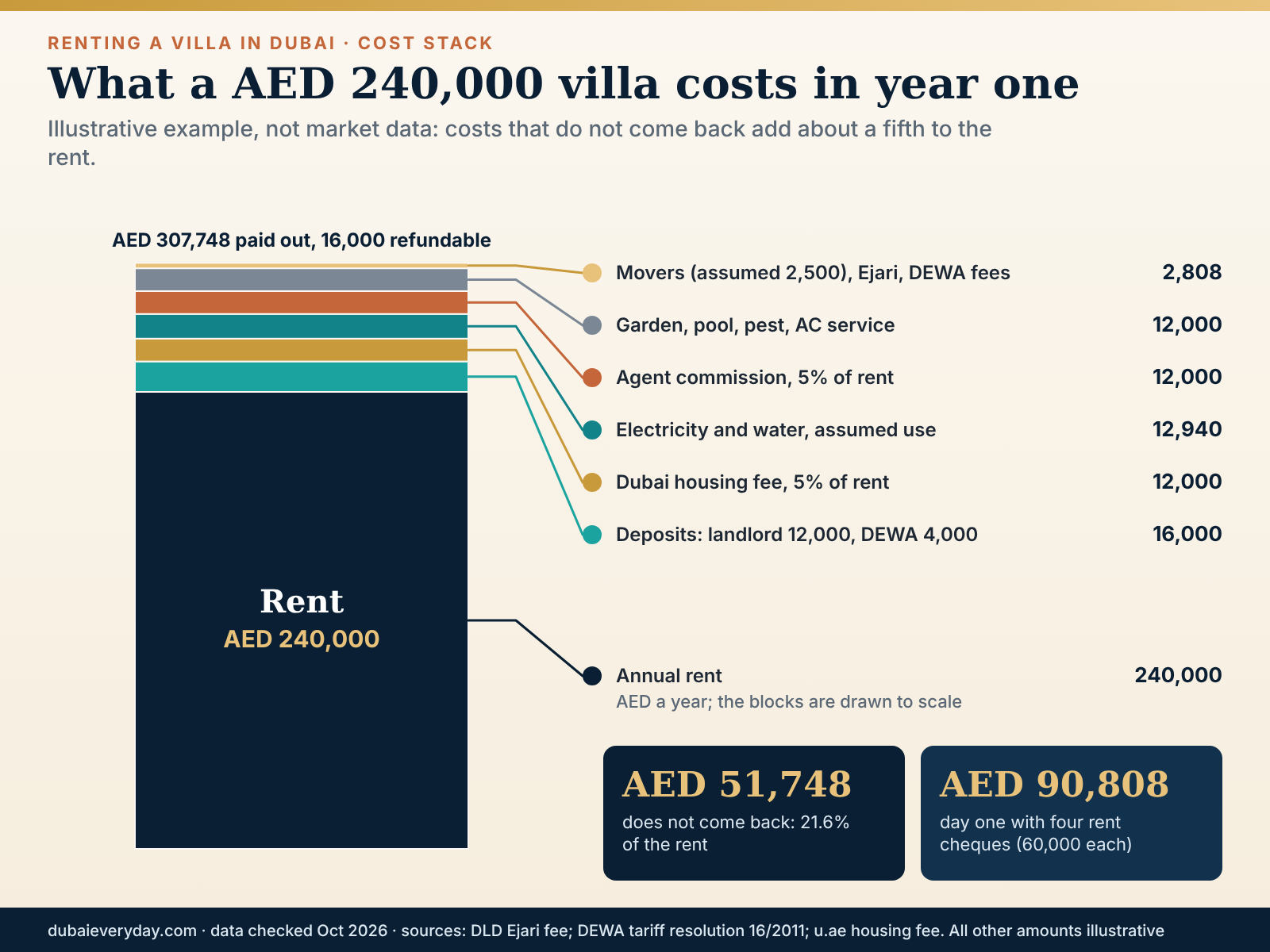
On those rent villa Dubai assumptions, the costs that do not come back add up to about AED 51,750, or roughly 21.6% of the rent. That is housing fee 12,000, electricity and water 12,940, commission 12,000, upkeep placeholder 12,000, movers 2,500 and the Ejari and DEWA fees. Another AED 16,000 goes out as refundable deposits (landlord 12,000, DEWA 4,000), so day-one cash is much higher than the rent cheque alone suggests.
What cheque plan does to day-one cash
On the same AED 240,000 rent, one cheque means AED 240,000 on the table plus the day-one extras. Two cheques is AED 120,000 each, four is AED 60,000, six is AED 40,000 and twelve is AED 20,000, all before deposits and fees.
Add the day-one extras from the example (landlord deposit 12,000, commission 12,000, Ejari 177.75, DEWA deposit and fees 4,130, movers 2,500, which total AED 30,807.75) and four cheques mean about AED 90,808 leaving your account on day one. One cheque means about AED 270,808. That gap is why the cheque plan is worth negotiating before the contract is drawn up.
The law’s default for unspecified terms is four equal advance instalments (Article 12 of Law 26/2007, as summarised in our tenant rights research), but landlords usually decide. Paying in fewer cheques is something a tenant can trade for a discount or a concession, so ask what a single payment is worth to the landlord before you assume the instalments are fixed.
A final rent villa Dubai budgeting habit: keep a small “house fund” in the plan for things that break in the first month, such as a gate motor, irrigation timer or pool pump. Your lease may make them the landlord’s problem, but the days between breakage and repair are your problem. The single-person budget guide shows how to fold a sinking fund like this into a monthly plan.
Maintenance in a rented villa: who pays for what
In a rent villa Dubai lease, the law gives you a default, the contract can change it, and a villa multiplies the places where the two meet. Start with the default, because every negotiation below is a departure from it.
What the law and the standard contract say
Under Law No. 26 of 2007, as we read the text on the Dubai Legislation Portal, the landlord must hand over the property in good condition for the use the lease allows (Article 15). Unless the parties agree otherwise, the landlord carries out maintenance and repairs needed during the lease for that intended use (Article 16), and answers for defects and wear that are not the tenant’s fault (Article 17).
The tenant, for their part, pays rent on time and looks after the home as a careful person would look after their own (Article 19). Alterations, or repairs beyond agreed or customary ones, need the landlord’s permission and any official licences. The landlord may hold a deposit to cover upkeep and must return it, or the balance, at the end (Article 20). The home goes back in the condition received, allowing for ordinary wear (Article 21).
For a rent villa Dubai lease, the Ejari Unified Tenancy Contract adds practical wording. Clause 8 says the landlord must let you use the premises and facilities such as the pool, gym and parking, and handles regular maintenance unless you agree otherwise in writing.
Clause 3 bars any change or addition without the landlord’s written approval. Clause 4 makes you pay electricity, water, cooling and gas unless a different arrangement is written down. Extra terms go in an addendum signed by everyone, and Clause 12 says an added condition is ignored if it conflicts with the law.
How the split tends to work in practice
A Gulf News explainer of 11 August 2026, quoting a lawyer, describes the usual line this way: landlords pay for structural problems and major systems, while tenants pay for routine upkeep such as AC filters, light bulbs and basic drain clearing, plus damage they cause. It adds a point many tenants miss: if you delay reporting a small leak and it becomes a big one, the extra cost can land on you.
The same piece says contracts can set a threshold under which the tenant pays, with AED 500 given as an example, but that clauses pushing major repairs or essential systems onto the tenant, or capping the landlord’s total liability, would probably not be enforced. A 2023 dubizzle explainer mentions AED 1,000 as another threshold some contracts use and warns that cost-based splits invite inflated quotes. These are press and lawyer commentary, not rulings. A tribunal would read your actual contract.
System by system: default and what to write down
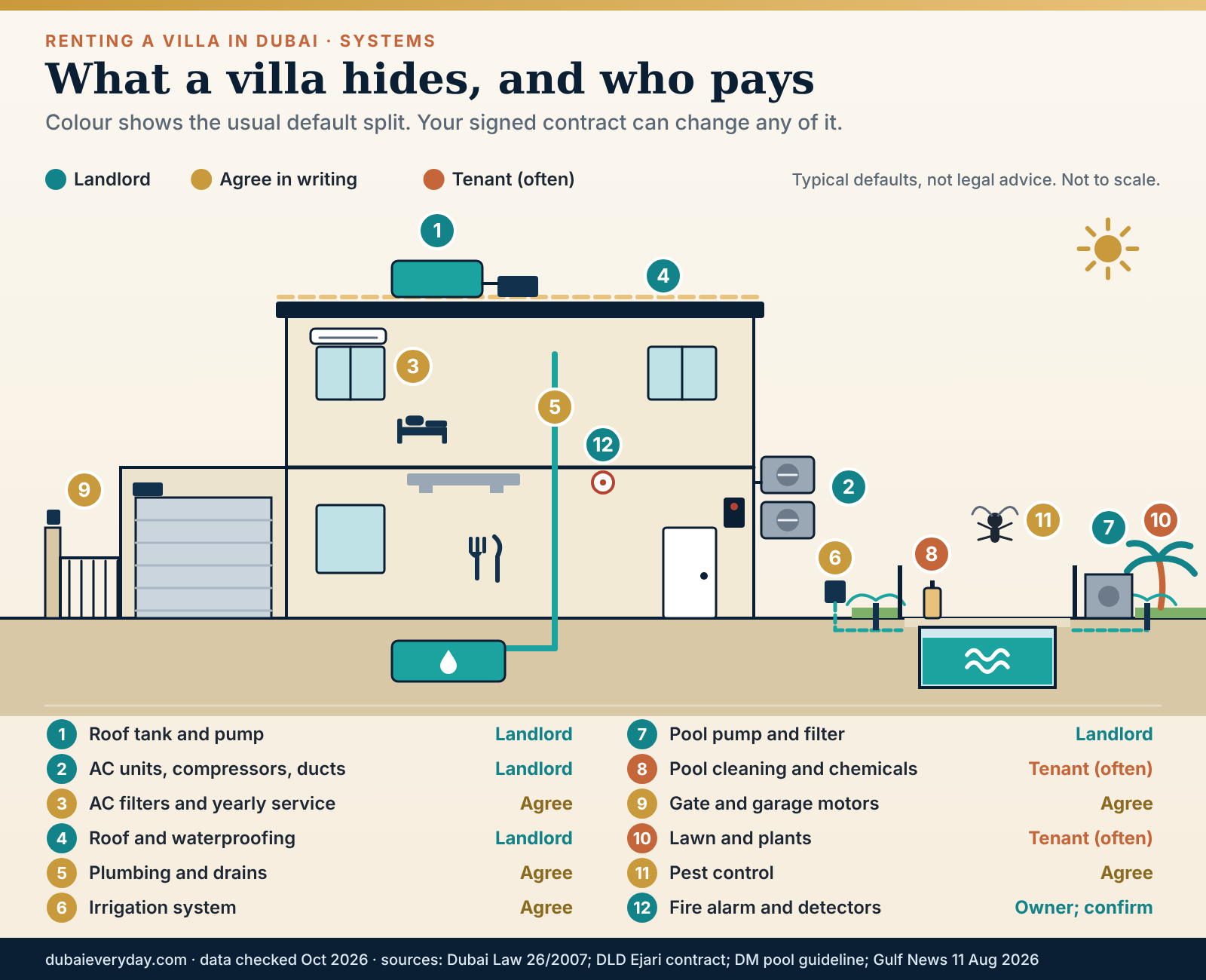
This rent villa Dubai table is our synthesis. The “typical default” column follows the legal baseline above and the press commentary; the “ask for in writing” column is a drafting suggestion, not legal advice. Contract wording should be checked by someone qualified, especially anything with a money threshold.
| System | Typical default | Villa catch | Ask for in writing |
|---|---|---|---|
| AC compressors, coils, ducting | Landlord (major equipment) | Several units, each with its own age and gas type | Landlord replaces or repairs failed units; list the units and their ages on the inventory |
| AC filters and routine servicing | Tenant does filters; servicing is often agreed | Neglected units fail and the cause gets argued | Who books the annual service, who pays, and a copy of the last service report |
| Water heaters and pumps | Landlord (major) in most readings | Booster pumps and roof tanks are easy to forget | Name them as landlord items |
| Water tanks | Landlord, per DM guidance as reported | Villa tanks are small and underground or on the roof | Date of the last cleaning and lab test; cleaning at least twice a year by an approved company |
| Roof, walls, waterproofing | Landlord (structural) | Rain and condensation show up as stains first | Photo record on day one; landlord repairs leaks on report |
| Plumbing, drains | Landlord for faults; tenant for blockages from use | Outdoor drains and septic-type issues, where they exist | Where the tenant’s job ends and a plumber’s begins |
| Irrigation system | Often silent in the contract | Timers, valves and leaks sit in the garden, out of sight | Landlord repairs the system; tenant runs the schedule |
| Pool equipment | Landlord for pump, filter and heater; tenant for cleaning and chemistry (often) | Safety rules also apply to the occupier | Who pays for equipment servicing and for chemicals |
| Gate, garage and access motors | Silent | Remotes and cards are lost between tenants | Handover count of remotes and cards; replacement cost |
| Lawn, plants, trees | Often the tenant | Dead grass in August is a heat issue, not necessarily neglect | Baseline photos; who replaces dead plants and when |
| Pest control | Silent or tenant | Termites, rats and mosquitoes are a property problem as well as a habit problem | Landlord pays for structural infestations; tenant for routine visits |
| Fire alarm and detectors | Owner obligation in the sources we read | Tenant duty is not stated in any source we found | Proof of installation and subscription; see the safety section |
Reporting problems so they get fixed
Rent villa Dubai maintenance disputes are won and lost on paper. The Gulf News explainer says Dubai’s Rental Disputes Settlement Centre looks at check-in and check-out reports, whether the fault came from inside or outside, independent technician reports and whether the tenant reported promptly. Build your habits around those four.
- Report in writing the same dayMessage or email the landlord or manager with a photo and a plain description. A phone call is not evidence.
- Give a fair deadlineName a date for an inspection and a date for the fix, and say whether the issue affects use of the home. A broken AC in July is not a two-week item.
- Keep the home usable while you waitStop the damage getting worse where you safely can: turn off the water at the isolation valve, switch off a tripping unit.
- Get an independent view for anything expensiveA technician’s report that names the cause helps if the landlord blames you.
- Keep paying rentRent keeps accruing while a dispute is open, so withholding rent usually hands the landlord an argument.
For what happens if the landlord still refuses a rent villa Dubai repair, notice rules and the dispute centre’s process, the tenant rights guide covers the law in more depth. One reminder from Article 34 of the tenancy law: a landlord may not cut services to pressure a tenant, and a tenant who is hit by that can seek a police report or claim damages.
Drafting suggestion, not legal advice. If you want one clause that does most of the work in a rent villa Dubai lease, ask for a short schedule that lists each major system, its approximate age, who maintains it and who pays. When a unit fails in month eight, an agreed list beats a debate about what “major” meant. Have a qualified person review any wording before you sign.
Cooling a villa: own units, ducted systems and district cooling
Cooling is the biggest variable cost of any rent villa Dubai decision and the one that surprises newcomers most. The numbers behind that are simple. At Dubai International, the 1991 to 2020 normals compiled from NOAA data (summarised on Wikipedia’s climate page, so treat it as context) give a mean daily maximum of 41.5 C in July and 41.9 C in August, and a mean daily minimum above 31 C in both months. January’s mean maximum is 24.4 C.
Heat reality. From June to September the villa never really cools down overnight, so the AC has little chance to rest. A rent villa Dubai viewing in December has tested nothing about summer. If your viewing falls in winter, ask for last July’s and August’s electricity or district cooling bills for the same premises, and ask how many units run in the evening.
Two very different cooling set-ups
Most homes in a rent villa Dubai search are cooled by their own AC equipment: split or cassette units in rooms, ducted systems, or a mix, all powered by the house’s electricity supply. You pay for it through your DEWA bill, and the landlord owns the equipment. A smaller number of villas, mainly in certain master communities, are connected to a district cooling network, which sends chilled water to the house and bills you separately.
Property portal Bayut’s list of district cooling areas (published October 2025, updated 15 October 2026) names Jumeirah Village Circle and Jumeirah Village Triangle (Empower) and DAMAC Hills and Motor City (Emicool) as having villas and townhouses on the network, and Dubai Sports City and Green Community (Emicool) with flats and villas. It does not mention Dubai Hills, Arabian Ranches or Meydan, which means nothing either way. This is a secondary source: treat it as a prompt to ask, not as a confirmation.
If the villa has its own AC units
Your questions are about the equipment and the bill. DEWA’s own advice is to set the thermostat to 24 C in summer and use auto mode, seal gaps around doors and windows, and clean filters at regular intervals.
In a Gulf News summary of DEWA tips updated 6 August 2026, the utility says each degree lower can raise AC electricity use by around 5%, that units more than ten years old could be replaced by models using up to 25% less cooling, and that four- or five-star ESMA units are the target.
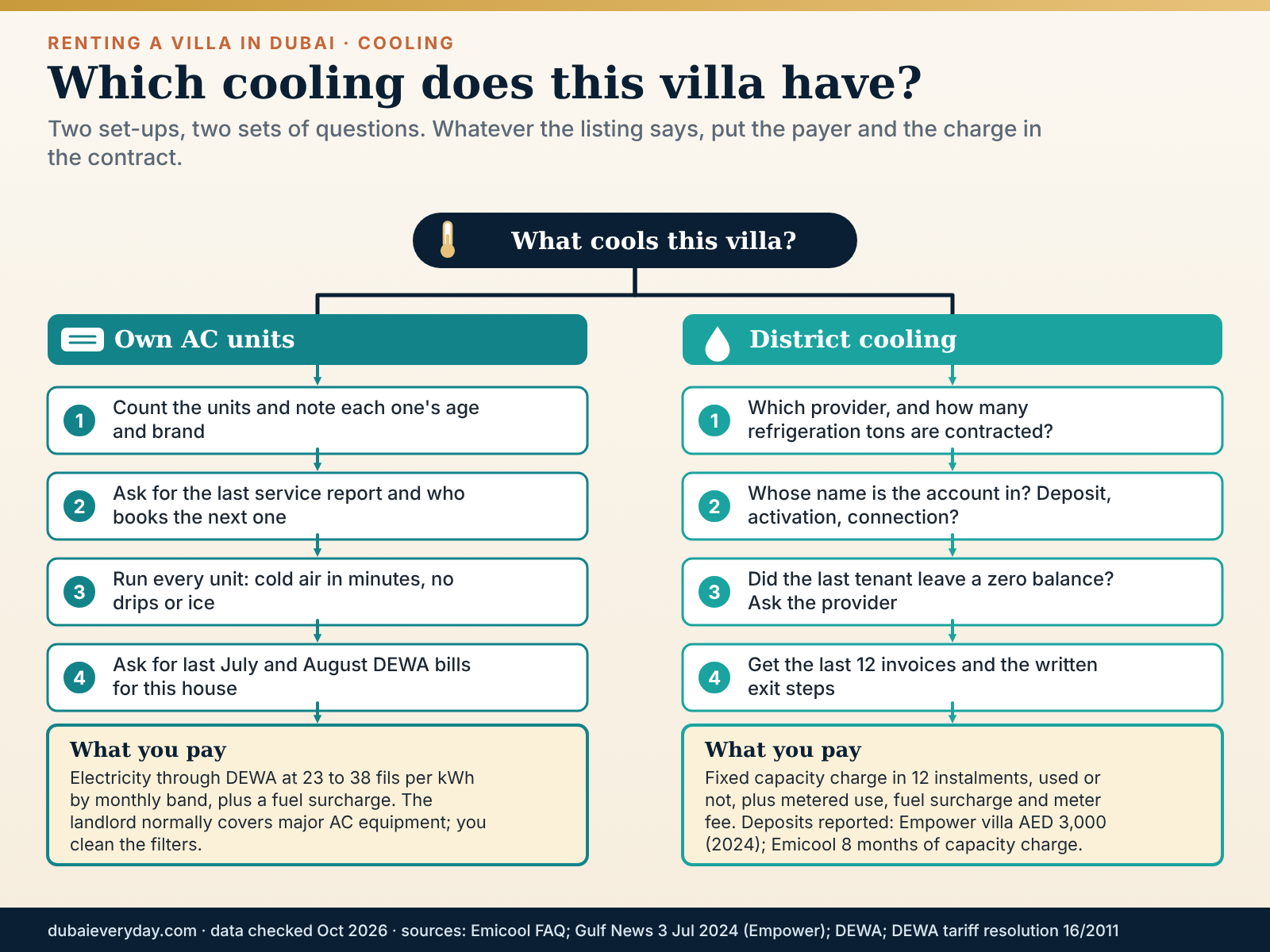
Turn that into a rent villa Dubai viewing routine. Ask the number of units and where each one sits, the age and brand of each, the date and report of the last service, and which rooms have a working thermostat. Then run every unit during the viewing. You are looking for cold air within a few minutes, no dripping or ice on the unit, and no grinding or rattling. That checklist is our suggestion, not an engineering standard.
A practical point on age: Gulf News quotes DEWA on units over ten years old, but there is no Dubai rule that says the landlord must replace them. If a unit fails, Article 16 and the market custom described earlier point to the landlord for major equipment. If you suspect a unit is near the end of its life, ask for that to be reflected in the rent or in a written commitment to replace it on failure.
If the villa is on district cooling
For a rent villa Dubai home on district cooling, the equipment question shifts to the contract and the meter. Emicool’s own FAQ sets out how a bill is built, and it is a useful template even if your villa uses another provider. Treat the following as Emicool’s published terms at the date we read them, and confirm yours.
- A capacity charge equal to your contracted capacity in refrigeration tons multiplied by an annual rate, split into 12 monthly payments, due whether you use the cooling or not.
- A consumption charge per refrigeration-ton-hour measured by your meter, a fuel surcharge linked to DEWA’s published tariff, and a fixed monthly metering fee.
- A refundable security deposit equal to eight months of your contracted capacity charge, and a one-time AED 200 activation fee plus a one-time connection charge at first connection.
- Invoices on the first of the month, due 15 days later, with a AED 100 late fee, and estimated billing if a meter fails, based on the same month of the previous year for up to two billing cycles.
- Registration within two business days once documents and fees are in place. Tenants need an Ejari, passport and Emirates ID copies, a mobile number, email and IBAN.
For Empower, the most recent figures we found are a Gulf News report updated 3 July 2024, which is old enough that you should confirm everything: a refundable deposit of AED 2,000 for a flat or AED 3,000 for a villa, a demand charge of AED 750 per refrigeration ton per year billed monthly, a meter charge of AED 30 monthly or AED 50 quarterly, and an AED 1,000 charge for disconnection over non-payment. We have not quoted consumption rates because sources print the unit inconsistently.
Illustrative example, not a quote: if a villa had 8 refrigeration tons of contracted capacity and the demand charge were AED 750 per ton per year, the fixed part would be AED 6,000 a year, or AED 500 a month, before you switched anything on. Under Emicool’s eight-month deposit rule, a monthly capacity charge of AED 500 would imply a AED 4,000 deposit. These are arithmetic examples. The RT figure is invented, and Empower’s and Emicool’s rates are different.
What to ask the landlord about district cooling
- Which provider, and how many refrigeration tons the villa is contracted for.
- Whether the account will be in your name, and the exact deposit, activation and connection amounts you must pay.
- Whether the last tenant left with a zero balance. We found no source saying how providers treat arrears on a premises, so ask the provider directly before you pay a deposit.
- How your exit works: one property-portal report says that a settlement and final bill come in a few working days and that one provider asks for a landlord-signed cancellation form. See the DEWA move-out guide for the electricity side of leaving.
- A copy of the last 12 monthly invoices, which will show how the fixed and variable parts behave across a summer.
The same rent villa Dubai logic applies to anything listed as “chiller-free”: get the payer and the charge in the contract, and see the apartment guide’s chiller section for how the term trips people up in flats. For a wider look at the first-week setup, including internet and gas, the home setup guide has the sequence.
Cheap ways to cut a villa’s cooling load
None of these replaces a working AC, but each helps a rent villa Dubai bill in a house with a lot of glass. DEWA advises keeping curtains and blinds closed during the day and opening them in the late afternoon or evening. It also suggests room-level controls, so unused rooms are not cooled. The Gulf News summary adds avoiding heavy appliances between noon and 6 pm, and using DEWA’s High Water Usage Alert and Away Mode if you have a smart meter and travel.
At a viewing, notice which way the large windows face, whether there is shade over patio doors and whether the garage or a hot roof sits against a bedroom. That is our reasoning rather than a sourced rule, but a west-facing wall of glass with no shading is a cooling cost you will pay every afternoon. For a sense of how the seasons shift, our best time to visit Dubai guide covers the same heat curve that drives your bill.
Garden, pool and outdoor space
The outdoor half of a rent villa Dubai home is where lease clauses go quiet and where costs hide. Nobody writes down who owns the sprinkler timer. A landscape that looked lush at the viewing can turn brown by the second summer. And a pool, however nice at a weekend barbecue, comes with safety duties that the Municipality spells out for owners and occupiers alike.
The garden: water, upkeep and what you are allowed to change
Garden water comes off the same DEWA meter as the kitchen tap, billed in tiers. DEWA’s official residential water tariff is written in imperial gallons (3.5, 4.0 and 4.6 fils per gallon across three bands), and DEWA moved its billing to cubic metres from March 2025. The metric rates quoted by a property portal, AED 7.70, 8.80 and 10.12 per cubic metre across the bands, match the gallon tariff on conversion in our check.
Illustrative example for a rent villa Dubai garden, not a bill: a household using 35 cubic metres in a winter month pays about AED 278 at those rates. Add a summer lawn that takes the month to 65 cubic metres and the same tariff gives roughly AED 557, so 30 extra cubic metres cost about AED 279. The point is the shape: the top band is the most expensive, and irrigation tends to land there. Sewerage, meter fees and VAT are extra and not modelled.
On timing, DEWA advice reported by Gulf News (a page last updated in August 2021, so old) recommends running light sprinklers in the early evening, roughly 6 to 8 pm, to cut evaporation, using soil moisture sensors where possible, and checking connections regularly for leaks.
In its 2026 summer tips, DEWA also lists irrigation systems and outdoor pipes among the places to look for leaks and points to its High Water Usage Alert. If the bill doubles and nobody has been home, the irrigation line is the first suspect.
- Ask where the irrigation controller is, how many zones it runs and whether it has a rain or moisture sensor.
- Run the system once at the viewing and watch for broken heads, flooding and wet patches near the wall.
- Agree who pays the gardener, if the house comes with one, and what “garden maintenance” includes in writing.
- Photograph every bed, tree and lawn patch on day one so dead plants are not your problem later.
- Do not remove, replant or restructure the landscaping. Clause 3 of the standard contract bars changes without written approval, and community rules often add a separate approval step.
One caution about community gardening crews: in the Emaar-managed communities we read about, service providers work a six-day week including Saturdays, avoid noisy work early in the morning where possible, and do not work on Fridays or public holidays. If your lease includes community landscaping, find out what the crew covers and what stays your job.
The pool: safety rules that bind the occupier
Dubai Municipality’s Private Swimming Pools Safety Guidelines (reference DM-HSD-GU80-PRSPS2, issued January 2020) is the document every rent villa Dubai tenant with a pool should know. It divides duties. The owner designs the pool to standard, registers it with the Municipality, fits the safety features and maintains it. The occupier, which is you, must not allow use without the safety measures in place, keep barriers and covers closed when the pool is unused, supervise users, lock gates, remove climbing hazards and keep the water clean.
The physical requirements for a rent villa Dubai pool are specific. As summarised from the guideline, solid walls and fences around a pool must be at least 1.20 metres high measured from outside ground level. Climbable objects such as furniture, plants and structures must stay at least 1.20 metres outside the enclosure, or the enclosure must be raised to 1.80 metres with a larger setback.
Gates must open outward, be self-closing and self-latching, and a lock alone does not count. Windows overlooking the pool need a stopper that limits the opening to under 100 millimetres, or fixed screens. A competent adult must supervise whenever the pool is in use, and safety signage must show emergency numbers: Police 999, Civil Defence 997, Ambulance 998, Dubai Municipality 800900.
Water quality is also spelled out. The guideline asks for water turned over at least every four hours, free chlorine of 1 to 2 mg/L, a pH of 7.4 to 7.6, and cyanuric acid of 20 to 60 mg/L. pH, chlorine and temperature are to be tested daily before use, other parameters every 15 days and microbiology every two months, with results logged. A villa tenant with young children should read the whole document, which is general guidance and not individual safety advice.
A rent villa Dubai viewing checklist for the outdoors
- Does the pool gate close and latch by itself every time you test it, and is the latch out of a child’s reach?
- Is there any furniture, planter or wall within 1.2 metres of the pool fence that a child could climb?
- Is there a log book, and where are the chemicals stored? The guideline asks for a locked area.
- Is the equipment room dry, tidy and quiet, and is there a spare pump or filter schedule?
- Is the water level stable? A pool that needs frequent topping up may have a leak, which the DEWA water bill will show.
- Who pays for chemicals, weekly cleaning and pump servicing? Those splits are market custom, not law, so write them down.
Mosquitoes, pests and tanks
After heavy rain in April 2024, Dubai Municipality reported disinfecting more than 100 water collection sites and treating drainage outlets, and its advice to residents was practical: check for leaks from taps, air conditioners and fridges, and remove standing water from swimming pools, plant containers and barrels. For a rent villa Dubai household that translates into a weekly walk-round of plant saucers, buckets and covers.
The Municipality says it issues guidelines to approved, licensed pest-control contractors, but we did not find a tenant-facing checklist or complaint route for private villas. The sources we read also do not say who must pay for a structural infestation, so settle it in writing: a landlord pays for problems that come from the building, a tenant for routine visits. Confirm first that any company you hire is approved by Dubai Municipality, and ask for its licence.
Water tanks need the same attention. Under the Municipality’s Food Code 2020, as reported by Gulf News in 2022, tanks should be cleaned and disinfected at least twice a year with a lab test afterwards, and landlords are responsible for tank cleanliness under Municipality guidance as reported.
Villa tanks may be underground or on the roof and are usually smaller than a tower’s. Ask for the date of the last cleaning and the lab result, and use a company approved by the Municipality. That source is from 2022, so confirm the current rule.
Waste, bulky items and garden clippings
In a rent villa Dubai community, the rules decide a lot here. The Arabian Ranches III page from Emaar Community Management says bins stay inside the villa boundary wall, recyclables go in a separate bin, and garden clippings must not be left in common areas. Bulky items such as furniture are arranged separately through the Municipality or a licensed provider.
Dubai Municipality’s free bulky-waste service, described in a 2022 release, is for Dubai residents but excludes real estate development zones and free zones, so a villa inside one of those may not qualify. Confirm first whether your community is covered, and ask the community manager what it offers.
Community fees, permits and house rules
Many villas on a rent villa Dubai shortlist sit inside a master community with a manager, a rulebook and a service charge. As a tenant you rarely see the charge, but you live under the rules and you can be blocked by the charge if it is unpaid. Understanding the three pieces, fees, permits and rules, avoids the commonest move-in surprises.
Service charges: usually the owner’s bill, sometimes not
According to DLD’s FAQ, owners of units in jointly owned property pay annual service charges that cover management, security, cleaning, maintenance contracts, common-area utilities, insurance and a reserve fund. The share is based on the floor area in the title deed, the budget has to be approved by the Real Estate Regulatory Agency (RERA) after audit, and managers cannot demand charges before that approval. The same FAQ states that the landlord is responsible for paying service fees on a property.
A 2020 law-firm article on Law No. 6 of 2019 reads the rent villa Dubai default the same way, with a caveat: the owner pays unless the lease says otherwise, and even where a lease moves the cost to the tenant, the owner stays answerable to the community manager. So a lease clause that makes you pay service charges is possible, but it should be rare, itemised with an amount, and treated as part of the rent when you compare listings.
You can check an amount yourself. DLD’s Service Charge Index service shows RERA-approved fees for jointly owned property: log in on the DLD website or the Dubai REST app, choose the service, then pick the project, the property use and the year. If a landlord quotes a figure that looks high, compare it there before you agree.
For scale, a betterhomes explainer from March 2026 puts the average villa service charge at about AED 7.35 per square foot per year, against about AED 20 for apartments. Illustrative arithmetic only: at 4,000 square feet that is roughly AED 29,400 a year, which shows why a clause that quietly passes it to you is a rent increase in disguise.
Move-in permits and access cards
Rent villa Dubai rules differ by community, and we only read the Emaar-managed ones. Emaar Community Management’s pages for Dubai Hills Estate and Arabian Ranches say a Move-in Permit is required to enter the community, applied for on the community portal at least one business day before the move, with an Ejari copy, Emirates ID (both sides) and passport with the visa page. If there are outstanding service fees on the property, the tenant may be unable to apply and should ask the landlord to settle them.
Vehicle access cards come from the landlord and are activated on the portal, usually within one business day. The number is capped by the villa’s parking bays, validity follows the tenancy contract (so after renewal you upload the new contract and cards are reactivated within two working days), and a lost or damaged card costs AED 200 to replace, payable by credit card. Cards go back to the landlord when you leave. Other developers run their own systems, so ask the landlord which portal or office applies.
Ask the landlord for confirmation that service fees on the villa are paid up before you sign, and ask how many access cards and gate remotes come with the house. An unpaid balance can stop a tenant’s move-in permit in the communities we read about, and it is the landlord’s debt to clear, not yours.
House rules you should read before signing
For a rent villa Dubai tenant, the rulebook is not a formality. Emaar’s published community FAQs include rules that surprise new tenants: one for-rent or for-sale sign per unit at a maximum of 90 by 65 centimetres, no signs on villa walls, festive lights only for ten days either side of a holiday and without visible glare, gatherings of up to eight at the nearest park with alcohol prohibited, and cars washed only in the private carport with limited water.
Visitor parking is short-term and offending vehicles can be towed at the owner’s expense. Alterations to a villa need approval through the community portal.
One rule deserves a line of its own. The same page says employing household staff who are sponsored by someone else is illegal and can be fined by local authorities up to AED 100,000. If you plan to hire help, read our legal basics guide for where to verify employment rules, since we did not research domestic-worker law for this page.
Subletting rooms in a villa
Shared villas are a real part of the rent villa Dubai market, and the rules changed this year. Dubai’s Law No. 4 of 2026 on shared housing, announced on 11 March, requires a permit before a unit is allocated for shared housing, limits who can let such a unit to the owner or an authorised establishment, and prohibits tenants from subleasing any part of the unit.
Fines run from AED 500 to AED 500,000 and can double to AED 1 million for a repeat offence. Press reports put the law in force from 26 August 2026.
The Media Office page does not name villas specifically, so we cannot say how it applies to a given house. The point for a tenant is plain: do not rent a villa and let out rooms on your own account. The older tenancy law (Article 24) already required the landlord’s written consent to sublet. For the deeper legal picture, see tenant rights in Dubai.
Fire alarm, safety and insurance
Fire detection and the civil defence connection
The UAE government portal’s fire safety page says owners of residential houses must install fire detection devices and sign up to the civil defence eSystem, while commercial buildings and residential apartments are monitored through the Hassantuk command system. Property portals and press often use “Hassantuk” for villas too. A dubizzle explainer (updated September 2026) calls it mandatory for villas under a 2020 resolution, with subscriptions from about AED 236, but its scope is unclear and its figure is secondary.
What no source we found makes clear, for a rent villa Dubai tenant, is whether the tenant has any duty here. The reporting we read speaks of owners, landlords and facility managers. Press from September 2020 added that existing homes had three years to comply and that a completion certificate for new homes depends on the system.
Confirm first with the landlord: ask for proof that detectors are installed and the subscription is active, and what happens to it when the tenancy changes. A 2018 Gulf News report also says tenancy contracts should set out tenants’ fire-safety roles, and names cigarette butts, barbecues and shisha as hazards. It is old, so use it as a prompt, not a rule.
- Locate every detector and the control panel at the viewing, and press the test button on the day you move in.
- Photograph the panel status on day one, including any fault light.
- Ask who to call if the alarm sounds, and write down the number.
- Know where the main electrical board and the water isolation valve are, before you need them.
Contents and liability insurance
Insurance for a rent villa Dubai tenant is not mandatory, according to a Bayut guide updated 19 October 2026. The same guide and a dubizzle piece agree that a landlord’s policy covers the building, not your belongings or your liability. Tenant cover can include contents, liability for damage to the landlord’s fixtures and fittings (which otherwise may come out of your deposit), personal items outside the home and alternative accommodation if the house is unlivable.
Bayut puts the price of rental property insurance at about 0.5% of the insured value a year, roughly AED 500 per AED 100,000 insured, and says it varies with insurer and claims history. On that rule of thumb, an illustrative AED 150,000 of contents would cost about AED 750 a year. Check exclusions before buying. Our Dubai insurance guide explains how to compare policies. A pool, a garden full of equipment and a houseful of staff or guests are good reasons to look at liability cover specifically.
Move-in inspection: how to walk a villa before you accept it
Every rent villa Dubai tenant should treat this as the step that most affects a deposit dispute, and it is the step people skip because the movers are waiting. The reasons to slow down are written into the documents.
Clause 1 of the Ejari contract records that the tenant inspected the unit and agreed to lease it in its current condition. Article 21 of the tenancy law says you return the home in the condition you received it, apart from ordinary wear. If the starting condition is not on record, the second sentence has nothing to measure against.
The Gulf News explainer of August 2026 notes that Dubai’s rental dispute centre considers check-in and check-out reports. DLD’s tenancy guide, as we read it, contains no move-in checklist of its own, so the report you create is the one that counts. A rent villa Dubai handover is harder than a flat’s because there is simply more of it: outdoors, roof, tanks, pool, several AC units and a boundary wall.
Before the day
- Fix the inspection for daylight, before furniture arrives, with the landlord or agent present if possible.
- Ask for the keys, remotes and access cards in advance, plus the inventory the landlord is working from.
- Check that the contract has the plot number, Makani number and DEWA premises number filled in, and that Ejari is registered or in progress.
- Ask the landlord to show the last DEWA final bill and settlement for the previous tenant. DLD’s tenancy guide says the final electricity and water invoice and the settlement must be presented before a new contract is registered for the same property.
- Bring a charged phone, a torch, a phone charger to test sockets, a notebook and a second pair of eyes. Do the rooms in a fixed order so nothing is skipped.
The twelve-stop route
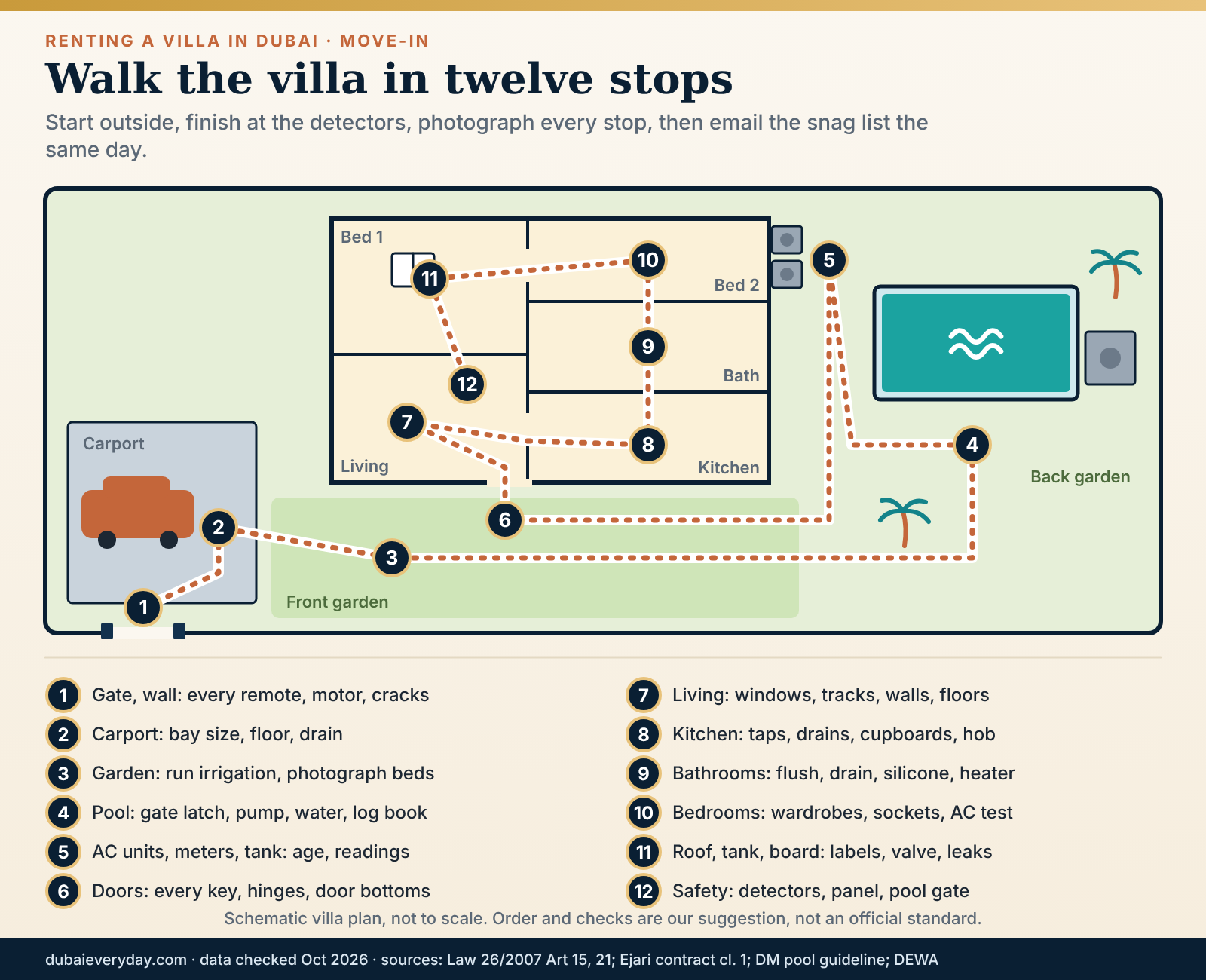
The twelve-stop route for a rent villa Dubai handover starts outside, since the garden and the pool are the parts you cannot properly test once the house is full. Each stop lists what to test, not just what to look at, because many defects only appear when something runs.
- Front gate and boundary wallOpen and close the gate, test the motor and every remote, and photograph cracks, rust and damaged render. Count the remotes and cards you receive.
- Carport and parkingCheck the bay size against your cars, floor damage and the drain. Photograph any oil stains and kerb damage.
- Garden and irrigationPhotograph each bed and tree from two angles. Run the irrigation and watch every zone for leaks and broken heads. Find the controller.
- Pool and equipment roomTest the gate latch, look for climbable objects, check the water level and clarity, start the pump and look for leaks and noise. Check the log book and the chemical storage.
- Outdoor AC units, meters and tanksNote each condenser’s condition and make a note of age labels. Photograph the electricity and water meters with readings, and any district cooling meter.
- Entrance, doors and locksTry every key in every lock, then check hinges, door stops and frames. Look at door bottoms for water damage.
- Living and dining areasOpen every window and sliding door fully, then lock them. Check tracks, mosquito screens, floors, skirting, ceilings and paintwork, especially under windows.
- KitchenRun every tap, test drainage, open each cupboard and check hinges, seals and extractor. Run the hob and oven if they belong to the house.
- BathroomsFlush, run hot and cold, fill the basin and watch it drain, check silicone, grout and under-sink cupboards for dampness. Test the water heater.
- Bedrooms and wardrobesCheck built-in wardrobes, sockets and window locks. Run each room’s AC for several minutes: cold air, no dripping, no ice, no rattle.
- Roof, tank and electrical boardWhere access is safe, look at the roof waterproofing, tank cover and pump. Find the main distribution board and the water isolation valve and photograph labels.
- SafetyPress the test button on each smoke or fire detector, note the control panel status, locate any extinguisher and check the pool gate once more on the way out.
Where a step needs access you do not have, such as a locked roof hatch, write that down. A note that says “roof not accessed on handover” is better than silence, and it avoids a later argument about whether you were shown it.
Documenting what you find
For a rent villa Dubai report, photograph each room wide and then close up on every defect, and shoot a continuous walk-through video with a spoken commentary naming each room. Keep the originals unedited, because file dates and metadata are part of the evidence. Take meter readings in the same session. Then write the snag list on the same day, send it by email to the landlord or manager, and ask for a written acknowledgement.
Illustrative example of how to phrase rent villa Dubai snag entries: “Kitchen, wall under the window: water stain about 15 cm wide, dry to touch, photo K-07.” “Master bedroom AC: cold air after five minutes, water dripping from the unit, photo and video MB-02.” “Pool gate: does not latch without a push, photo P-01.” Precise, located, dated and tied to a photo. Say “present at handover” so nobody can claim it appeared later.
What to do about defects you find
Sort rent villa Dubai defects into three groups: items the landlord must fix before you move in, items to be fixed within an agreed number of days, and cosmetic items you simply want on record. The deadlines are negotiable and our suggestion is a short fixed period for anything that affects safety or cooling. Put the agreed fixes into a signed addendum, because Clause 12 of the standard contract means only legal and documented terms count.
If the villa is not finished or needs significant work, the amended tenancy law allows the parties to agree that the tenant completes works, provided the contract states who pays. Never accept that informally. A deep clean is a separate matter: our deep cleaning guide compares apartment and villa jobs for move-in use, and the cleaning services guide covers licensing and quotes.
Decide the order up front. Cleaning first shows the real surfaces, but then any damage by the cleaners muddies the record; inspecting first means dirt can hide marks. Either way, write on the snag list which came first.
Our suggestion. Do not sign a handover note that says the villa is in perfect condition if you have a snag list. Write “accepted subject to the attached snag list dated [date]” and attach the list. That wording is a drafting suggestion, not legal advice, but it keeps the clause from standing alone.
The lease year: from viewing to deposit return
A rent villa Dubai lease has more moving parts than a flat’s and more dates that matter. The road graphic below puts them in order. The details of each step are in the sections above and in the main renting guide.
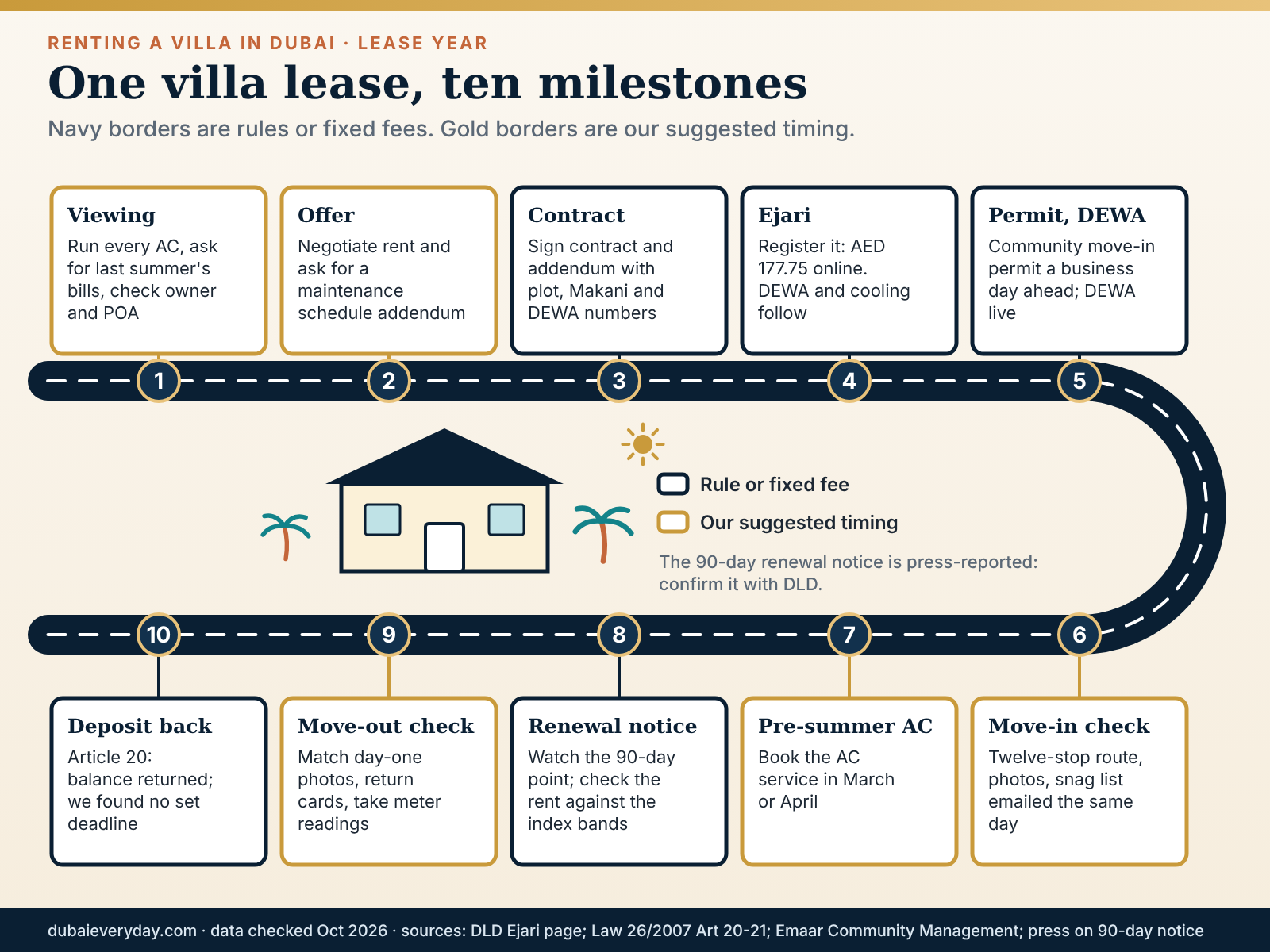
Renewal, rent increases and the index
Dubai links rent increases at renewal to the gap between your rent and the average rent for similar property. Under Decree No. 43 of 2013, as summarised in our tenant rights guide, a rent more than 10% below the average gets no increase, 11 to 20% below allows up to 5%, 21 to 30% below up to 10%, 31 to 40% below up to 15%, and more than 40% below up to 20%.
The UAE government portal confirms Law 43 of 2013 and the use of the RERA calculator. Press reports describe a 90-day notice period for increases, and a DLD page cited a different decree number, so confirm with DLD before relying on a figure.
DLD announced a Smart Rental Index in January 2025 that classifies buildings by factors including maintenance, finishes and services, and officials said landlords who want higher rents must improve their classification. We found no public tenant lookup. If a landlord raises a villa’s rent at renewal, ask for the calculation and use the tools in the tenant rights guide. These figures were carried over from our other guides and not re-fetched today, so confirm them with DLD.
Deposit and dispute arithmetic
At the end of the lease, Article 20 requires the landlord to return the deposit, or the balance, and Article 21 requires the home back in the received condition apart from ordinary wear. There is no statutory timeline for the refund in the text we read.
If it comes to a claim, DLD’s Rental Disputes Centre filing fee for most claims is 3.5% of the amount, with a minimum of AED 500 and a maximum of AED 15,000 for financial claims, according to DLD’s page as read for our other renting guides. On a AED 12,000 deposit dispute, 3.5% is AED 420, so the AED 500 minimum applies. That is our calculation.
Leaving a villa
On a rent villa Dubai exit, book a move-out inspection a few weeks early so you have time to fix what is yours, and compare it line by line with your day-one report. Return access cards and remotes, take a final set of photos of the garden and pool, and capture meter readings.
Then close the utilities. Our DEWA move-out guide covers the final bill and deposit refund. If you are relocating at the same time, the relocation checklist lays out the timeline, and the moving to Dubai guide covers the first month.
A villa upkeep calendar for Dubai’s seasons
The rhythm of a rent villa Dubai year follows the weather more closely than the lease does. The temperature numbers below are the NOAA-based 1991 to 2020 normals for Dubai International as summarised on Wikipedia, so they describe the airport, not your street. The task list is our synthesis, with the sourced anchors named. Everything else is a planning suggestion.
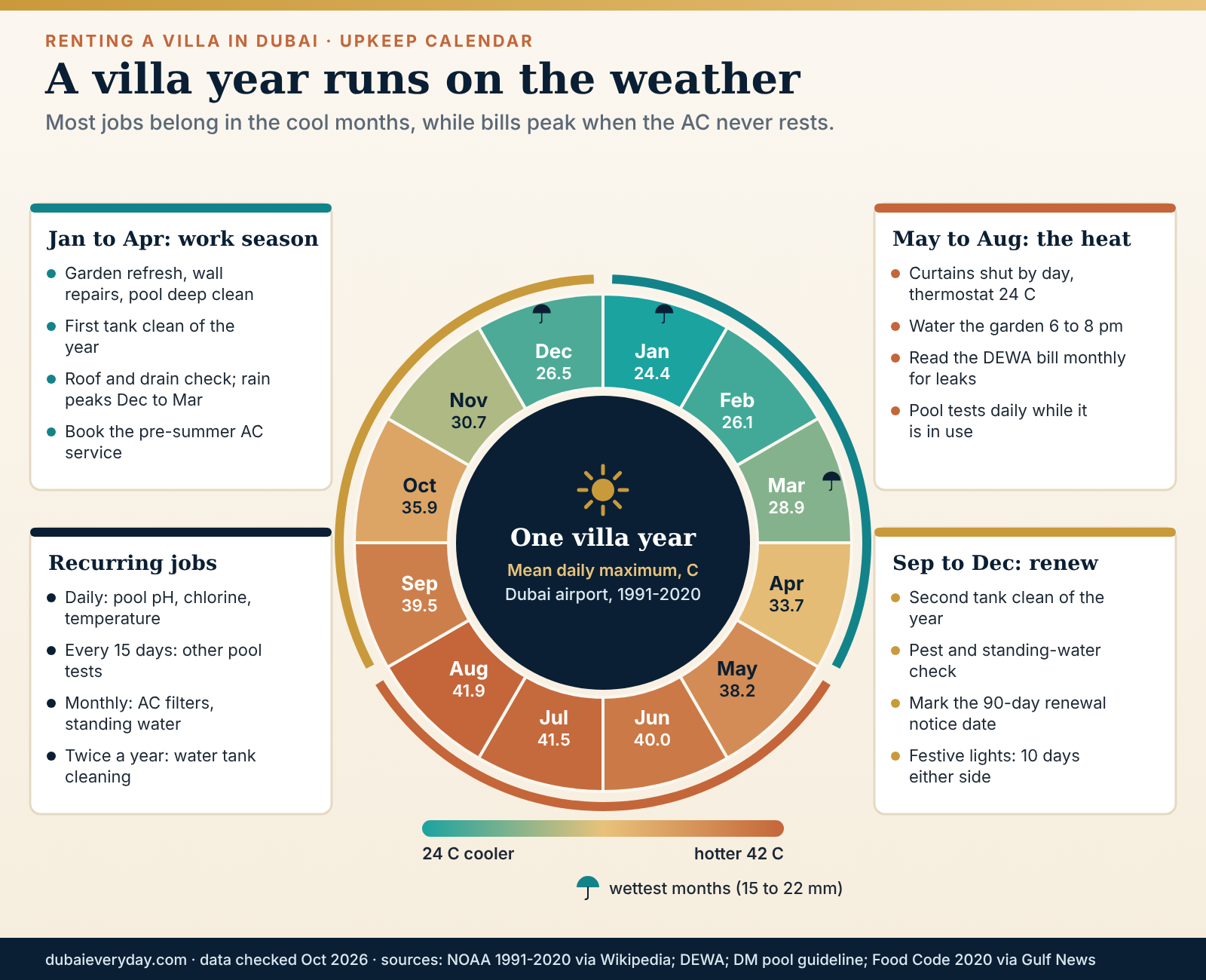
January to April: the working season
For a rent villa Dubai calendar, January’s mean maximum is 24.4 C, February’s 26.1 C and March’s 28.9 C, which is why this is the season for jobs that need open doors and outdoor time: garden refresh, boundary wall repairs, pool deep clean, tank cleaning.
Any alteration needs your landlord’s written consent and, in many communities, a portal approval, so start early. The normals also show most of the year’s rain falling from December to March (14.8 mm in December, 20.8 in January, 21.7 in March), so a roof and drainage check in this window is cheap insurance.
April’s mean maximum jumps to 33.7 C, and May reaches 38.2 C. Book the pre-summer AC service in March or April, when contractors are less stretched than in July. That timing is a suggestion. The sources agree on the part that matters: DEWA advises regular filter cleaning and a 24 C thermostat, and a unit that has not been serviced is the one that fails at 40 degrees.
May to August: manage the heat
June’s mean maximum is 40.0 C, July’s 41.5 C and August’s 41.9 C, with night-time minimums above 31 C in July and August. From here, the job is to limit demand and leaks.
Keep curtains closed in the day, avoid running heavy appliances between noon and 6 pm as DEWA suggests, and water the garden in the early evening rather than the middle of the day. Check the DEWA bill monthly for any jump, because a leak shows up in water consumption before it shows up on a wall.
If you travel for the summer, remember that DEWA’s Away Mode (for smart-meter customers) sends daily or weekly consumption reports. An empty villa still needs someone with a key to check the pool, the irrigation and the AC, and your community rules may limit who can enter. Ask a neighbour or an agent, and tell the landlord. Pool testing under the Municipality guideline is daily, so do not assume a closed pool is a safe pool.
September to December: reset and renew
September’s mean maximum is 39.5 C and October’s 35.9 C, so the garden starts to recover and the AC load falls. This is a good window for the second tank clean of the year if you follow the twice-yearly guidance, for a pest check before the winter indoor season, and for a first look at your renewal. If your lease ends in the winter, the 90-day notice window falls in the summer or early autumn. Mark it now.
November (30.7 C) and December (26.5 C) bring the best weather for hosting. In Emaar-managed communities, festive lights may go up ten days either side of a festival or holiday as long as they cause no visible glare. It is also a fair season to ask whether the villa still works for you in the other eight months.
Recurring rent villa Dubai jobs by frequency
- Daily: pool pH, chlorine and temperature tests before use, as the Municipality guideline requires for private pools, with results in the log.
- Every 15 days: the other pool chemistry tests; every two months: microbiological testing.
- Monthly: AC filters (DEWA suggests about monthly use-based cleaning), a walk-round for standing water, a check of the DEWA bill.
- Twice a year: water tank cleaning and disinfection, per the Food Code 2020 guidance reported in 2022.
- Yearly: AC service before summer, a roof and drainage check before winter rain, a read of the lease dates and renewal notice.
Mistakes that cost villa tenants money
These rent villa Dubai mistakes are patterns in the rules and sources, not stories from named people. Most are avoidable with one email or one photo.
Signing without the AC history
A villa with six units of unknown age is six unknown bills. Ask for age, service reports and last summer’s electricity data before you commit.
Skipping the inspection
The Ejari contract records that you accepted the home as it stood. A rushed handover means your day-one evidence is your memory.
Letting “included” stay vague
Chiller, community fees, gardener, pool care: if the word “included” is not tied to a charge and a payer in writing, expect a dispute.
Delaying a leak report
Press commentary on rental repairs says a tenant who sits on a small leak can end up paying for the bigger damage. Report on the day, in writing.
Ignoring the pool rules
The Municipality guideline gives the occupier duties around gates, supervision and water. A closed gate that does not latch is a safety defect and a liability issue.
Assuming the community fee is not yours
The owner usually pays it, but an unpaid balance can block your move-in permit, and some leases try to pass it on. Ask for proof it is paid, and check clauses.
Altering without consent
New shade structures, painted walls, replaced gardens and removed trees all need written approval. Improvements typically stay with the property.
Sublet rooms without a permit
Law No. 4 of 2026 bars tenants from subletting any part of a shared-housing unit, with fines up to AED 500,000, doubling for repeat breaches.
Six villa scenarios, worked through
All six rent villa Dubai scenarios are illustrative. The amounts are made up to show the arithmetic and the logic, and none is a market quote.
1. A family of four arriving in July
This rent villa Dubai case starts with a family signing a four-bedroom villa in a master community and moves in during the hottest month. The main risk is that every AC unit runs flat out while nobody knows the house.
They should demand last summer’s bills, run each unit at handover, photograph the control panel and pool gate, and apply for the community move-in permit at least a business day ahead. They should also ask that any unit that fails in the first summer is replaced rather than patched. The Dubai with kids guide and the schools guide help with the rest of the move.
2. A remote-working couple in a district-cooling area
In this rent villa Dubai case, two people work from the spare room all day and are home for the whole summer. District cooling’s fixed monthly capacity charge arrives whether they run the AC or not, so their bill has a floor.
Their questions: contracted tons, account in whose name, deposit, activation and connection charges, and the last 12 invoices. They should also confirm how a failed meter would be billed. Emicool’s FAQ says an estimate can use the same month a year earlier for up to two billing cycles.
3. An overseas landlord and a slow repair loop
In this rent villa Dubai case, the landlord lives abroad and an agent manages the house. Messages are friendly, repairs are slow. The tenant asks for a named maintenance contact, a response-time clause and a list of major systems with ages, all in a signed addendum.
They also send a short email after any call so there is a record. If something serious fails, the first message goes to the landlord and agent together. The tenant keeps paying rent and gathers photos, a technician’s note and dates. Tenant rights in Dubai covers the next steps.
4. Three friends who want to share a villa
Three professionals on a rent villa Dubai search want to split a five-bedroom house. The safest structure is that all three are named on one lease or that the landlord approves each tenancy in writing.
Informal room-letting by one tenant to others runs into Law No. 4 of 2026 and Article 24 of the tenancy law. They also need to check occupancy rules with the Municipality and the community, and confirm what the contract says about guests. The single-person budget guide can be used to model each person’s share.
5. The AC dies in August
In this rent villa Dubai case, a unit stops cooling the master bedroom. The tenant reports it that day with photos and a short video, asks for a technician within a stated number of days, and keeps the report.
If the landlord replies that the tenant caused it by not cleaning filters, the dispute turns on evidence: service reports, check-in photos and a technician’s view of the cause. Gulf News’s lawyer commentary says a landlord cannot refuse to fix an essential system on an unproven claim of misuse, though the final word belongs to a tribunal reading your contract.
6. A dog, a lawn and a lease
A pet owner on a rent villa Dubai search wants the garden. They check the lease and community rules on pets, make sure the fence has no gaps a dog could use, and keep pet registration and vaccinations current.
They photograph the lawn on day one because a dog on grass in August will leave marks. The pets in Dubai guide and the pet registration guide cover the rules that apply to the animal itself. Whether a landlord allows pets at all is a contract matter to settle before signing.
Before you sign: a rent villa Dubai checklist
If you keep only one page of this rent villa Dubai guide, keep this one. It puts the questions in the order they come up, from the first viewing to the first week in the house, so you can tick them off before any cheque leaves your account.
- The landlord is the owner or holds a valid power of attorney, and the contract shows the plot, Makani and DEWA premises numbers.
- A signed addendum lists each major system, its approximate age, who maintains it, who pays and how fast the landlord must respond.
- Every AC unit has been run, the last service report is in your hand, and you have seen last summer’s electricity or district cooling bills.
- The garden, irrigation, pool equipment, chemicals and pest control each have a named payer in writing.
- The pool gate latches on its own, nothing climbable stands near the fence, and a pool log exists.
- The landlord has confirmed that community service fees are paid and has explained the move-in permit and access-card steps.
- Fire detection and the civil defence subscription are confirmed in writing, and you have tested every detector.
- Every cost is on one list: deposit, commission, Ejari, DEWA deposit, cooling deposit, housing fee and movers.
- The inspection is booked in daylight, the twelve-stop route is printed and the snag list will be emailed the same day.
- Three dates are in your calendar: the pre-summer AC service, the second tank cleaning and the renewal notice window.
Every rent villa Dubai lease is different, and this list is general information, not legal advice. When a clause involves money thresholds, liability or eviction, ask a qualified professional to read it. For the wider rental process, return to the main renting guide.
Rent villa Dubai FAQ
Who pays for maintenance in a rented villa in Dubai?
In a rent villa Dubai tenancy, by default, the landlord. Under Law No. 26 of 2007 the landlord handles maintenance and repairs needed for the agreed use unless the contract says otherwise, and answers for defects and wear not caused by the tenant.
In practice tenants cover routine upkeep, such as AC filters, bulbs and basic drain clearing, and damage they cause. Contracts can set a cost threshold under which the tenant pays, and press commentary says clauses that push major systems onto the tenant may not be enforced. Read your contract and any addendum.
Is the tenant or the landlord responsible for the garden and pool?
In a rent villa Dubai tenancy the law is silent on gardens and pools by name, so the contract decides. Many agreements leave the tenant to water and tidy the garden and keep the pool clean, while the landlord repairs the irrigation system and pool equipment. Dubai Municipality’s private pool guideline separately puts safety duties on the occupier: barriers, gates, supervision and water quality. Get the split in writing, list the equipment, and photograph both on day one.
Do tenants pay community or service charges in a villa?
Usually not. DLD’s FAQ says owners pay service charges and that the landlord is responsible for paying them. A 2020 law-firm article adds that the owner pays unless the lease says otherwise. If a lease asks you to pay, ask for the amount and compare it with DLD’s Service Charge Index. Also confirm the landlord’s charges are paid up, because an unpaid balance can stop a tenant’s move-in permit in the Emaar-managed communities we read about.
How much does it cost to rent villa Dubai tenants should budget for in year one?
We found no verified average, because villa rents vary by community and change monthly. What can be said: on top of rent you face a deposit (custom is about 5% unfurnished), commission of about 5% if an agent is involved, Ejari at AED 177.75 online, a reported DEWA deposit of AED 4,000 for a villa, a 5% housing fee and a summer electricity bill. In our illustrative AED 240,000 example, extras that do not come back were about 21.6% of the rent.
Does my villa have district cooling?
Some do, most do not. A property portal lists villas and townhouses in Jumeirah Village Circle, Jumeirah Village Triangle, DAMAC Hills and Motor City as connected, and villas in Dubai Sports City and Green Community. That list is secondary and could be incomplete. Ask the landlord, look for a district cooling meter, and ask for the last 12 invoices. If there is no district cooling, your AC runs on DEWA electricity and the equipment belongs to the landlord.
Who pays for AC repairs in a rented villa?
The landlord usually pays for repairs to major AC equipment, according to Gulf News and dubizzle commentary, and the tenant cleans filters and keeps units reasonably cared for. If a landlord says the tenant caused the fault, the dispute turns on evidence: service records, check-in photos and a technician’s report. Put the unit list, ages and who books the annual service into an addendum, and report faults in writing on the day.
What should I check during a villa move-in inspection?
Work from the outside in: gate and remotes, parking, garden and irrigation, pool gate and equipment, meters and outdoor AC units, then doors, windows, kitchen, bathrooms, bedrooms and each room’s AC. Look at the roof and tank if safe access exists. Photograph everything, take meter readings, press the fire detector test buttons, and email a dated snag list the same day. The twelve-stop rent villa Dubai route above gives the order.
Do I need a move-in permit to move into a villa community?
In the Emaar-managed communities we read about, yes. Dubai Hills Estate and Arabian Ranches require a Move-in Permit applied for on the community portal at least one business day before the move, with an Ejari copy, Emirates ID and passport with visa. Other developers run their own systems, so ask the landlord which applies. Unpaid service fees on the property may block the application, so ask the landlord to settle them first.
Do I need to arrange the fire alarm or Hassantuk as a tenant?
Confirm first. The UAE government portal says owners of residential houses must install fire detection devices and subscribe to the civil defence eSystem. The sources we read speak about owners, landlords and facility managers, and none states a tenant duty. Ask the landlord for proof that detectors are installed and the subscription is active, and test the detectors on move-in day.
Can I sublet a room in my rented villa?
Not safely. Article 24 of the tenancy law requires the landlord’s written consent to sublet, and Law No. 4 of 2026 on shared housing prohibits tenants from subleasing any part of a shared-housing unit and sets fines from AED 500 to AED 500,000. The Media Office page does not name villas, so check how it applies to your house, and ask the landlord to approve every occupant in writing.
How much is the DEWA deposit for a villa?
Property portals report AED 4,000 for a villa and AED 2,000 for an apartment, refundable when the account closes, plus about AED 130 to 155 in activation fees. DEWA’s own page would not load for us, so treat those as reported and confirm on DEWA’s site when you activate. Our DEWA move-in guide explains how Ejari links to activation.
Can my landlord raise the rent on a villa at renewal?
Increases are tied to the gap between your rent and the average for similar property under Decree No. 43 of 2013, with bands from 0% to 20%, and press reports describe a 90-day notice period. A rent more than 10% below average gets no increase, while one more than 40% below can rise up to 20%. Confirm your figure with DLD’s calculator and see the tenant rights guide for notice and dispute routes.
Is it better to rent a villa or buy one?
That depends on time horizon, finance and tolerance for upkeep, and we do not give individual financial advice. Renting avoids purchase costs, service charges and market risk but gives you no equity. Buying brings ownership duties, including the service charges tenants usually avoid. For the buy side, start with the buying property guide and the rental yield guide, which explains net returns for owners.
Related reading
Sources and further reading (32 links)
- Dubai Legislation Portal: Law No. 26 of 2007 on tenancy — landlord and tenant duties, deposit, sublease, services
- Dubai Land Department: Ejari Unified Tenancy Contract — condition, alterations, utilities, maintenance clauses
- Dubai Land Department: Register or renew Ejari — fees, documents, channels
- Dubai Land Department: FAQ — service charges, tenant duties, maintenance
- Dubai Land Department: Service Charge Index — how to look up approved charges
- Dubai Land Department: Tenancy guide — maintenance, handover, registration checks
- Dubai Municipality: Private Swimming Pools Safety Guidelines — fencing, gates, water quality, duties
- Dubai Media Office: Dubai Municipality pest control strategies — mosquito advice to residents
- Dubai Media Office: Law No. 4 of 2026 on shared housing — permit, subletting, fines
- UAE Government Portal: Leasing a property — Ejari, housing fee, rent-increase law
- UAE Government Portal: Fire safety — owner duties for detectors and civil defence eSystem
- DEWA: Electricity management — air conditioning advice
- Dubai Legislation Portal: Executive Council Resolution No. 16 of 2011 — electricity and water slab tariffs
- Emicool: FAQ — district cooling charges, deposit, billing
- Emaar Community Management: Moving in, Dubai Hills Estate — permits and access cards
- Emaar Community Management: Moving in, Arabian Ranches — permits and access cards
- Emaar communities: Noise, rules and parking FAQ — house rules
- Emaar Community Management: Waste collection, Arabian Ranches III — bins and green waste
- Dubai Municipality: Free bulky waste disposal service — eligibility, 2022 release
- Gulf News: Dubai rental repairs, who pays — practice commentary; secondary
- Gulf News: How to reduce your DEWA bill in summer — DEWA tips; secondary
- Gulf News: DEWA advice on smart irrigation — garden watering; secondary
- Gulf News: District cooling charges in Dubai — Empower deposit and demand charge; secondary
- Gulf News: Is my home’s water tank clean? — tank cleaning guidance; secondary
- Khaleej Times: Dubai rents fall in most areas — villa community rent data; secondary
- betterhomes: Q3 2026 market report — villa and townhouse rent change; secondary
- Bayut: Residential areas in Dubai with district cooling — areas including villas; secondary
- Bayut: Tenants’ home insurance in Dubai — not mandatory, cover types; secondary
- dubizzle: Hassantuk in the UAE FAQs — villa fire alarm context; secondary
- betterhomes: Understanding service charges — average villa rate per square foot; secondary
- Mondaq: Non-payment of service charges in Dubai and Abu Dhabi — owner pays by default, 2020; secondary
- Wikipedia: Climate of Dubai — NOAA 1991 to 2020 normals for Dubai International; context only
Update log: 29 October 2026 — first publication; facts re-checked against the sources above, except items marked as carried over from our other guides. Next review due: by 28 February 2027, or sooner after any change to tenancy rules, DEWA or district cooling tariffs, or community permit rules. Corrections welcome. This guide is general information, not legal, financial or safety advice, and a qualified professional should review any contract wording.
About DubaiEveryday and this guide
DubaiEveryday.com is an independent editorial project that publishes practical, research-based guides to everyday life in Dubai: where to live, what things cost, how the rules work and how to get around. This page was written and edited by the DubaiEveryday editorial team. It is not signed by a named expert, doctor, lawyer or adviser, and we do not claim first-hand testing of a venue, clinic or service unless the page says so.
Each guide is built from official sources such as government and regulator pages, operator websites and established news outlets, cross-checked where we can. When we could not confirm something, we say so in the text, and examples that use made-up numbers are labelled as illustrations. Mentions are editorial choices, not paid placements, and a link is not an endorsement.
Dubai changes quickly. If you spot something that is out of date or wrong, please tell us through the contact options on DubaiEveryday.com and we will check it and correct the page.