

All on 4 Dubai treatment replaces a whole arch of teeth with a fixed bridge carried by four implants, and the decision turns on bone, gum health, who is licensed to do the surgery and what the final bill really contains. This guide works through candidacy, temporary teeth, bone, costs, risks and the alternatives, checked against Dubai Health Authority documents on 29 October 2026.
Picture a consultation room, a glowing scan on the screen and a clinician explaining how a whole arch of teeth could be fixed in place. It sounds wonderful. Before you nod, three questions matter more than the number on the quote. Is there enough bone? Are your gums healthy? Is the person holding the drill licensed for implant surgery?
Those answers decide whether all on 4 Dubai treatment is a sensible plan for you or an expensive detour. This guide sorts out who is a realistic candidate, what temporary teeth actually mean, and how to read a quote, so you can check the plan before any money changes hands and without feeling rushed.
All on 4 Dubai treatment means one full arch of fixed teeth (upper, lower or both) supported by four implants in the jaw, usually two straight at the front and two tilted at the back. The Dubai Health Authority (DHA) lets only licensed dentists whose licence carries a separate implantology privilege place implants. Advanced bone surgery, such as a sinus lift, is restricted to oral surgeons, maxillofacial surgeons and periodontists.
Candidacy depends on health, gums, the amount of bone and how well you can keep the teeth clean, not on age or how bad the teeth look. Temporary teeth on the day are possible only when the implants are stable enough, and the DHA guideline treats immediate loading as a risk factor, not a given. Expect months, not days, before the final teeth are fitted.
Price is the weakest public fact. We found no verifiable published all on 4 Dubai package price, only per-unit lists and aggregator ranges, so every full-arch figure here is labelled illustrative. Success claims are rare in this guide on purpose: the one peer-reviewed overview we cite found most of its source reviews to be of low methodological quality. This is general information, not medical advice, and no dentist has reviewed this draft.
This is a research-based guide, not a clinic review. We did not visit any clinic, had no treatment, and have no clinical qualification. No dentist has reviewed this draft, so read it as an informed layperson’s summary of official documents, and let a licensed clinician correct anything that clashes with your own mouth.
Rules and clinical expectations come from DHA documents read on 29 October 2026: the Clinical Guidelines for Implant Dentistry (CG-06, effective 1 March 2026), Prosthetic Dentistry (CG-05), Oral and Maxillofacial Surgery (CG-04), Periodontics (CG-03), Dental Radiology (CG-11), the implantology privilege policy (PI-01) and the dental scope-of-practice standard (SP-04). Background comes from the US FDA, Mayo Clinic, Cleveland Clinic, the American Academy of Periodontology, the European Federation of Periodontology and the World Health Organization. Effectiveness comes only from a 2025 overview of systematic reviews, a 2017 systematic review and a 2002 consensus statement, all linked where used.
We name no clinic and rank none. Inclusion was not paid for, there are no affiliate links, and no clinic has seen this page. Where something could not be verified it is marked “Confirm first”, and every invented price is labelled “Illustrative example”. Nothing here replaces an examination by a DHA-licensed dentist.
All on 4 Dubai: what the treatment is and what it is not
In plain terms, an all on 4 Dubai plan is a way of giving someone with few or no usable teeth in an arch a fixed set of replacement teeth on four implants.
The manufacturer that markets the name, Nobel Biocare, describes it as two straight implants at the front and two implants at the back that tilt by up to 45 degrees, with the arch of teeth fixed on top. Its own page calls the approach “graftless”, which is a marketing description, not a guarantee that no one in your position will need bone work.
The tilt is the clever part. Instead of placing every implant straight down into the back of the jaw, where the sinus or a nerve may be in the way, the back pair leans forward. The manufacturer’s stated aim is to avoid those anatomical structures, and the angle also spreads the four implants further apart. The bridge can then reach back a little beyond the last implant. DHA’s guideline lists the length of that extension, called a cantilever, among the biomechanical factors a dentist has to weigh.
The name, the trademark and the copycat terms
The page we read marks “All-on-4” with a registered trademark symbol and lists Nobel Biocare as its publisher. In everyday searching, people write it as all on 4, and clinic pages often do the same, which is why this guide uses the search spelling when it talks about the local market. Treat the spelling as a signal of nothing: the real question is what is planned for your jaw.
You will also meet “teeth in a day”, “All-on-6”, “full-arch fixed bridge”, “fixed hybrid” and “implant-supported denture”. Cleveland Clinic uses the last one for any denture attached to implants, in a removable version or a fixed (hybrid) version that only a dentist can take out. These terms overlap, they are not protected, and clinics use them loosely. Ask for the number of implants per arch, whether any are tilted, whether the prosthesis is fixed or removable, and what it is made of.

What this guide covers, and where the neighbours take over
This page is about all on 4 Dubai treatment and full-arch work generally: who is a candidate, what temporary teeth mean, how bone changes the plan, what drives the cost, what can go wrong and what else you could choose.
Single-tooth and partial implants, implant systems, how a CBCT scan works in general, and the DHA privilege rules at length are in our dental implants in Dubai guide. Choosing a general dentist, routine prices and the licence check are in our Dubai dentist guide. We repeat only what an all on 4 Dubai decision needs.
It is also worth saying what all on 4 Dubai treatment is not. It is not a way to keep failing teeth, because the usual first step is removing whatever cannot be saved. It is not a one-day cure, because the final teeth come after healing. And it is not the only fixed option: a plan with more implants, or a removable denture held by two implants, may suit some jaws and some budgets better. We take those up in the alternatives section.
DHA’s implant guideline (CG-06) has no dedicated section on All-on-4, tilted implants or zygomatic implants. We checked, and said so in the research log. That does not make all on 4 Dubai treatment improper, since the guideline covers full-arch cases in general terms and the privilege rules still apply, but it means no Dubai regulator has published an All-on-4 protocol for you to hold a clinic to. Ask your surgeon what protocol they follow and why.
A short vocabulary for the consultation
A handful of words will keep you from nodding through an all on 4 Dubai appointment. Edentulous means without teeth in the arch. Provisional or temporary teeth are the interim set, and DHA defines a provisional prosthesis as time-limited, to be replaced by a definitive one. Loading means putting biting force on the implants, and immediate loading means doing it soon after surgery. Osseointegration is the bone bonding to the implant surface over months. A surgical guide is a template that steers drill positions from a digital plan.
Two more terms matter for money. A definitive prosthesis is the final set of teeth. A hybrid prosthesis, in the usage Cleveland Clinic describes, is the fixed type of implant-supported denture. Knowing which one is in your all on 4 Dubai quote, and when each is made, tells you more than the headline figure does.
Candidacy: who is a realistic fit for all on 4 Dubai clinics offer
The textbook all on 4 Dubai candidate has lost most or all of the teeth in one arch, or has teeth that cannot be saved, and wants a fixed replacement rather than a denture that rests on the gums. Cleveland Clinic describes implant-supported dentures as suitable for people missing most or all teeth, provided there is enough jawbone, with a dentist deciding the best route. That is the entry ticket. The harder questions come after it, and they are about you, not about the teeth.
DHA’s implant guideline sets out the screening a dentist is expected to do before any all on 4 Dubai surgery: medical and medication history, periodontal charting, a look at the soft tissue, an extra-oral check of the jaw joint, lip support and smile line, and then imaging. Everything in this section is drawn from that structure. It is a map of what the consultation is for, not a self-diagnosis tool, and none of it replaces an examination.
The four things an all on 4 Dubai assessment really turns on
Strip away the jargon and a full-arch assessment keeps returning to four areas. First, your general health and medicines, because surgery and healing depend on them. Second, the state of the gums and any teeth that will stay, because infection in the mouth is what implants fear most. Third, the jaw itself: bone, sinuses, nerves and how widely you can open. Fourth, you: habits, expectations, and whether you can clean a large bridge every single day.
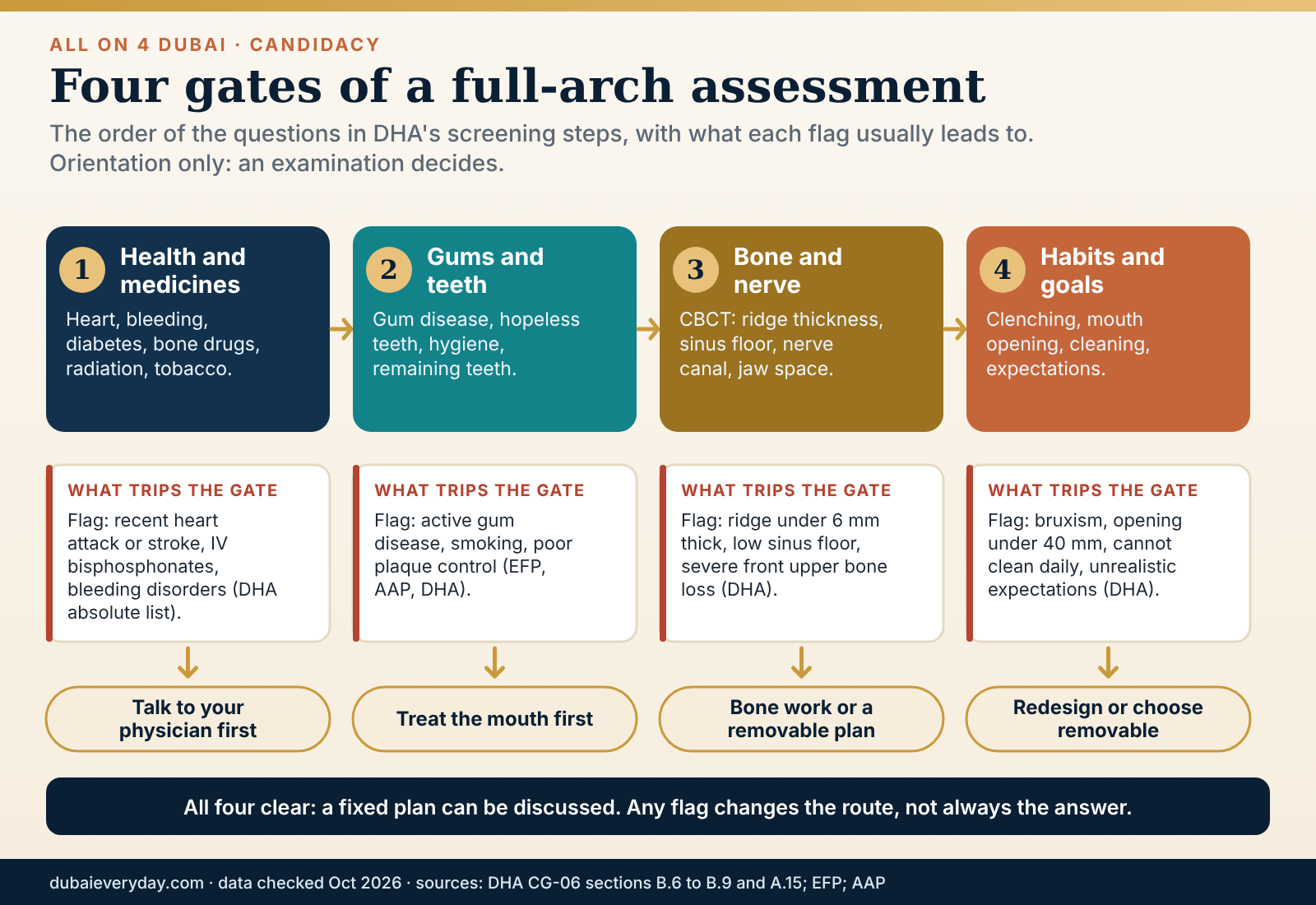
Health and medicines: what DHA lists as stop signs
DHA’s guideline splits medical conditions into absolute and relative contraindications. The absolute list is short and serious: a recent heart attack, stroke or heart-valve surgery, bleeding disorders, intravenous bisphosphonate treatment, terminal illness, radiation aimed at the jaw at tumour-killing doses, and conditions such as collagen or bone disease and immunosuppressive disorders. Unrealistic expectations and an inability to restore the case prosthetically are on the same list, which tells you the dentist is meant to judge the plan as well as the patient.
The relative list is longer and, importantly, not a set of automatic refusals. It includes blood disorders, lung problems, anticoagulant therapy, chemotherapy, tobacco use, osteoporosis, uncontrolled diabetes, HIV, immunosuppression, lupus, kidney insufficiency, scleroderma, pregnancy, older age and radiation to the neck and face. DHA states that these are not automatic bars to treatment. The practical message is that a long medication list means more conversation with your own physician, not an automatic no.
What to bring to the consultation.
- A current medication list with names and doses, including supplements and any injections for bones or osteoporosis.
- Letters or results from your doctor about diabetes control, heart conditions, kidney function or past radiation.
- Any earlier dental X-rays, scans or denture details, plus the date your teeth were last all present.
- A short list of what you want to eat, say and show again. It anchors the discussion in daily life.
Bone-drug questions deserve their own paragraph
One category trips people up because the medicine may have been taken years ago for a reason unrelated to teeth. DHA’s oral surgery guideline discusses medication-related osteonecrosis of the jaw, a rare problem of poorly healing jawbone linked to certain bone-strengthening drugs. It reports incidence of 1 to 10 per cent with intravenous bisphosphonates in people with metastatic disease, and 0.001 to 0.01 per cent with oral bisphosphonates taken for osteoporosis. Risk rises with the intravenous route and longer duration.
Those numbers are DHA’s, quoted for context, and they do not predict your own case. The same guideline discusses pausing oral bisphosphonates around elective jaw surgery where other conditions permit, and scheduling reviews afterwards. Any such decision belongs to the surgeon and the doctor who prescribed the drug. Never stop a medicine yourself on the strength of a web page.
Gums, habits and the cleaning question
The European Federation of Periodontology says the most common causes of implant failure are poor oral hygiene, a history of periodontitis and smoking, and advises that people should be free of periodontitis before placement. The American Academy of Periodontology lists the same culprits plus diabetes as risk factors for inflammation around implants. DHA’s guideline calls smoking the greatest risk factor for surgical complications, and the World Health Organization names tobacco the main risk factor for gum disease.
For an all on 4 Dubai patient, this has a particular edge. The prosthesis is large, it sits over the gum, and the cleaning route runs underneath it. Cleveland Clinic advises brushing fixed implant dentures with a soft brush and cleaning underneath with floss threaders or interproximal brushes. If the thought of that routine, every day, for decades, fills you with dread, say so at the consultation. A removable option exists precisely for people who prefer to take the teeth out to clean them.
Jaw mechanics: opening, clenching and the bite
DHA lists a minimum mouth opening of 40 millimetres to reach the back of the mouth with instruments for implants. It also names jaw-joint disorders, clenching and grinding (bruxism), and occlusal trauma among risk factors, and explains that overloading from poor angulation, inadequate back support, poor bone or bruxism can end in fractured restorations, loosened screws or implant loss. Tell the dentist if you wake with sore jaw muscles, have worn teeth or have a history of cracked fillings. That history is information, not an embarrassment.
The extra-oral part of the assessment looks at lip support, smile line and facial symmetry. Our reading is that the smile line matters because a fixed bridge has to hide where the prosthesis meets the gum when you smile broadly. Ask the dentist to show, on a wax-up or digital preview, where that junction will sit for you.
Expectations: the one candidacy test you control
DHA’s guideline requires the case presentation to cover limitations and risks, estimated treatment duration, provisional options, maintenance, possible complications, fees and financing. It also lists unrealistic expectations as an absolute contraindication. In ordinary language, a good dentist should be willing to say “this is what I cannot promise” without being asked twice. An all on 4 Dubai clinic that answers every worry with a before-and-after gallery is skipping the part of the consultation DHA wants done.
Age deserves a one-line mention in any all on 4 Dubai guide because it generates so much worry. DHA lists extremes of age as a risk factor and children under 16 as an absolute contraindication, but the text we read sets no upper age limit. Health, bone and gums decide, not the birth certificate.
Teeth that might stay
Not every case is a clean sweep. DHA notes that teeth with a poor prognosis may be kept temporarily to support a fixed interim prosthesis or to preserve the bite height while implants heal. That is one reason the first plan on paper can differ from the one on the day of surgery: the dentist may find a tooth is less salvageable than the scan suggested, or more. Ask what happens to the plan if teeth are lost during treatment, and whether that changes the price in writing.
Bone, scans and the graft question
Bone is the currency of every all on 4 Dubai plan. Full-arch work is often chosen because bone has shrunk, and the idea of angling the back implants is a way to use the bone that is left instead of rebuilding what is gone. A 2017 systematic review of 24 studies framed the concept as an option for shrunken jaws in people who prefer to avoid regenerative procedures, and it noted that evidence was limited by short follow-up and patient dropout. Read that as a reasoned trade-off, not a free pass.
What the scan has to answer
A flat X-ray cannot show how thick a jaw is. DHA’s radiology guideline (CG-11, effective 1 March 2026) says cone-beam CT, or CBCT, must be justified for each patient and used only when lower-dose conventional imaging cannot answer the clinical question. It asks for the smallest field of view that does the job and a request form that states the field and the area. It also expects a report on the full data set, written by a dental radiologist or a suitably trained clinician, and it says repeat scans need fresh justification.
For an all on 4 Dubai scan the area of interest is large, so the field of view may be larger than for a single gap. The guideline’s reference for dento-alveolar imaging is about 8 by 8 centimetres or smaller. Whether your plan needs more is a clinical call, but the justification and field should still be written down. If a clinic proposes imaging both jaws and the sinuses “to be safe”, ask which question each part of the scan answers.
Numbers the DHA guideline uses for bone
DHA’s implant guideline gives working thresholds. For regular-diameter implants (3.5 to 4.1 millimetres), it asks for at least 6 millimetres of ridge thickness, and for wide implants of 4.5 millimetres and above, at least 7. Bone-level implants should sit at least 1.5 millimetres from a tooth and 3 millimetres from the next implant.
For the sinus, 5 millimetres or more of bone height can allow simultaneous placement with less predictability, 6 to 8 millimetres may allow an internal sinus lift, and a standard lateral lift usually means waiting 5 to 6 months before the implant.
Treat these as general values from the guideline, mostly framed around single and multiple implants. An all on 4 Dubai surgeon who tilts the back implants may be working around a sinus rather than lifting it, and may accept different geometry. The thresholds are still useful for the conversation, because they tell you which measurements to ask about: thickness, height under the sinus, and distance to the nerve canal.
The lower jaw has a nerve, the upper jaw has a sinus
In the lower jaw the inferior alveolar nerve runs inside the bone, and DHA says it must be visualised before planning. Options DHA lists for the back of a shrunken lower jaw include short wide implants, nerve repositioning, which it calls high in morbidity, or letting the bridge extend beyond the last implant. In the upper jaw the sinus sits above the back teeth, and shrinking bone brings it closer to the ridge. Tilted implants are the manufacturer’s answer to both, which is why the angle exists.
Numbness of the lip or chin and sinus perforation both appear in the risk lists from the FDA and Cleveland Clinic. They are why the scan matters and why you should ask where, on your scan, the surgeon sees the nerve and the sinus floor. Anyone competent will point to the picture.
Front of the upper jaw: the honest limit
DHA’s guideline carries a sentence that deserves more attention than it gets: where there is significant bone loss in the front of the upper jaw in a person with no teeth, treatment may be limited to a removable overdenture, and this should be explained to the patient. In other words, an all on 4 Dubai bridge is not always on offer for every upper jaw, and a clinic that promises one before the scan is ahead of the evidence.
When bone is thin: grafts, lifts and who may do them
Bone grafting and sinus lifting are covered in our dental implants guide, so only the all on 4 Dubai angles are here. DHA’s privilege policy restricts advanced implant surgery, meaning sinus lifts and advanced bone grafting, to oral surgeons, maxillofacial surgeons and periodontists. If a plan involves either, check that the person doing the surgery holds one of those licence categories. Mayo Clinic notes that grafted bone can take several months to integrate, and Cleveland Clinic says healing and integration after grafting may take longer than the usual three to six months.
Some clinics describe more extreme approaches, such as long implants anchored in the cheekbone for severely shrunken upper jaws. The manufacturer’s page shows a zygomatic implant product line, and DHA’s guideline does not address zygomatic implants. We cannot assess them from the sources we read. If one is proposed, ask who in the team has performed them regularly, what the complication plan is, and whether a second surgical opinion is available.
Space for the teeth is a bone question too
Surprisingly, you can have too much room as well as too little. DHA’s prosthetic guidance says porcelain is preferred for multi-unit fixed prostheses when the available vertical space is under 15 millimetres, while a hybrid prosthesis, one using other materials, is considered when it exceeds 15. For removable implant-retained overdentures it asks for at least 14 millimetres with ball or locator attachments and 17 with a bar. Bone that has shrunk leaves a long gap between jaw and bite, and the design has to fill it.
Clinics sometimes reduce the bone ridge to create room or even out the base. DHA’s oral surgery guideline has no dedicated section on that for implants, so we cannot tell you what DHA expects. What you can do is ask whether bone will be trimmed, how much, and what it does to the cost and recovery.
Questions to put to the surgeon about your bone.
- Which scan was used, what was its field of view, and who wrote the report?
- Where exactly are the sinus floor and the nerve canal on my images?
- Which of my four implants are tilted, and by how much?
- Is a graft, a sinus lift or bone trimming planned, and who performs it?
- If the bone looks different once the gum is lifted, what is plan B and what does it cost?
Who is allowed to treat you: licence, privilege and the team
The detailed licence ladder is in our dental implants guide, so here is the short version for anyone weighing an all on 4 Dubai clinic. A dentist in Dubai needs a DHA licence.
To place implants, the licence must also carry an implantology privilege, which DHA’s policy PI-01 grants after a recognised course of at least 12 months, a logbook of at least 30 implants that can include full-arch cases, and a DHA assessment. The scope-of-practice standard SP-04 says implantology is not a specialty, so the privilege must match what the licence allows.
DHA’s implant guideline repeats the rule in its own words: surgical work is for DHA-licensed dentists and specialists privileged for implantology, and the same group plans and restores the case, with prosthodontists also covered for the prosthetic phase. Dental radiology and forensic dentistry licences are excluded. Confirm first: PI-01 was last revised in August 2021 and carried a revision date of August 2026, so the current text may differ, and we could not read a newer version.
An all on 4 Dubai plan is a team job
DHA’s guideline describes a team approach in which periodontists, orthodontists, endodontists, oral and maxillofacial surgeons and prosthodontists consult one another and share findings. For an all on 4 Dubai case, the two roles that matter most are the surgeon and the person who designs and fits the teeth. They can be one dentist or two, and neither arrangement is automatically better. What matters is that someone is accountable for the whole sequence, including what happens if the implants are placed but the bite is wrong.
The dental laboratory is the third role. DHA’s laboratory standard (ST-59) makes the dentist legally responsible for lab services the clinic accepts, requires written specifications for each job, and brings implant-supported prostheses within scope. It says nothing we could find about imported lab work. Ask where your teeth are made, and whether the laboratory is licensed in Dubai.
The five-minute licence check for an all on 4 Dubai clinic
- Search the register.Use the DHA’s Dubai Medical Registry on the Sheryan portal to find the dentist and the facility. Filters include licence type, category, speciality and facility.
- Ask about the privilege in writing.We could not verify that the registry displays the implantology privilege, so ask the clinic to state it and quote the licence number.
- Match the surgeon to the surgery.For sinus lifts or advanced grafting, check for oral surgeon, maxillofacial surgeon or periodontist status.
- Ask who makes the teeth.Name the prosthodontist or restorative dentist, and the laboratory.
- Keep the paperwork.Ask for the implant brand, model and size for each of the four sites, as the FDA advises for any implant, and keep them with your records.
Clinics inside Dubai Healthcare City are regulated by the DHCC’s own regulator rather than DHA, and operate to their own dental standard. The check is similar but the register is different. If your treatment happens outside Dubai, the rules may differ again, and our healthcare in Dubai guide explains how the regulators divide the territory.
The treatment path, from first scan to final teeth
Marketing for all on 4 Dubai treatment likes a single dramatic day. The DHA guideline describes something calmer: a pathway of consultation and examination, investigations, risk assessment, treatment planning, case presentation and consent, surgical placement, restoration and follow-up. Each stage is a place where a plan can change, which is why it helps to know the order and what each step should leave you holding in writing.
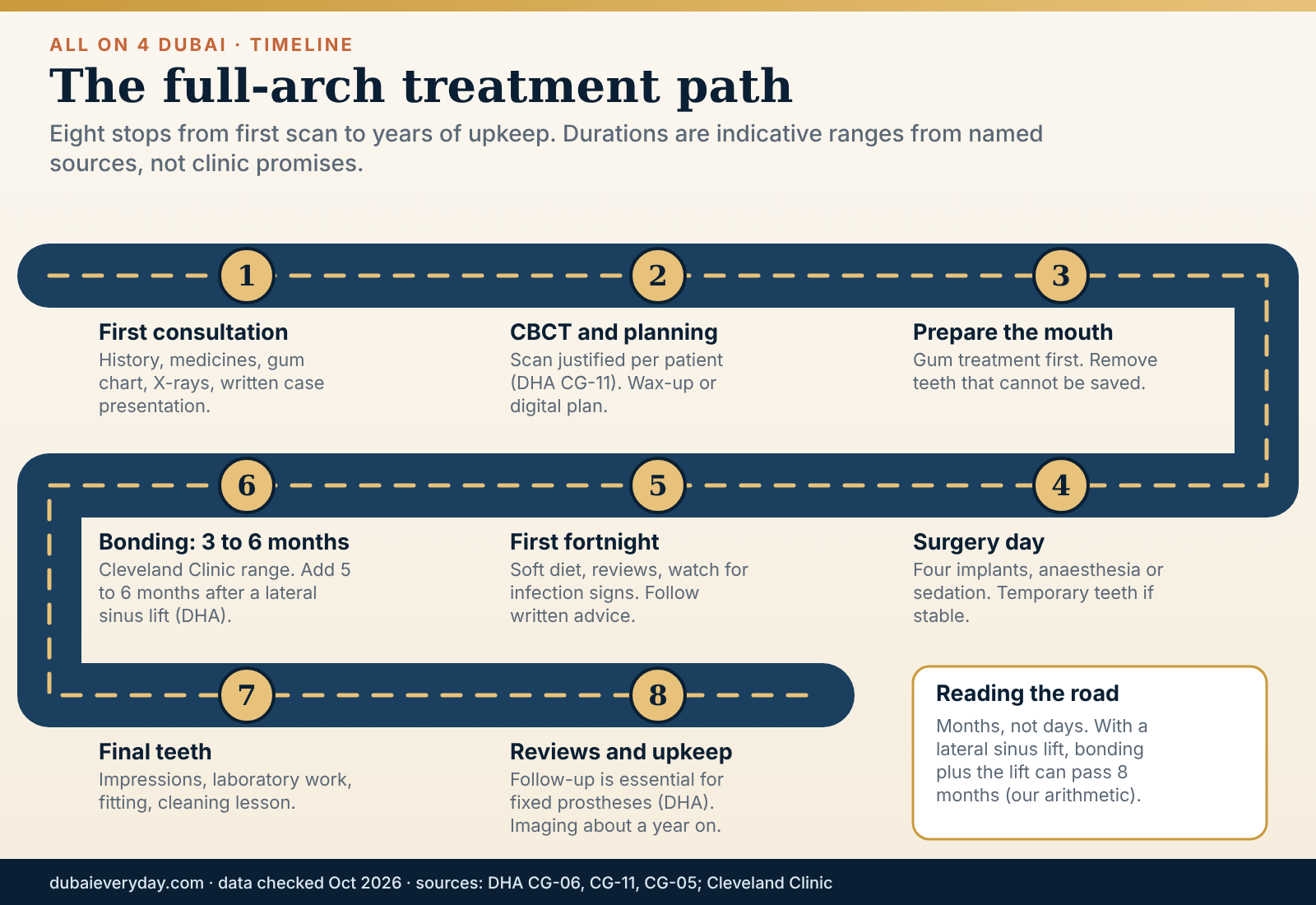
Stage one: records, scan and the case presentation
The first visits for an all on 4 Dubai plan gather the evidence: medical history, gum charting, X-rays, a CBCT scan where justified, moulds or digital scans, and in a complex case a diagnostic wax-up, a trial of the planned teeth. DHA expects the case presentation to include the wax-up, the limits and risks, estimated treatment duration, provisional options, maintenance, possible complications, fees and financing. You should leave this stage with a written plan, not a verbal impression.
DHA also says financial obligations, consent and aesthetic goals should be settled before treatment begins. That sequence protects you. If the price conversation happens on the morning of surgery, with sedation already arranged, you are negotiating from your weakest position.
Stage two: preparing the mouth
Gum disease needs to be under control before implants go in. DHA’s phased treatment-planning model puts urgent care and disease control ahead of pre-prosthetic work and the definitive prosthesis, and its periodontal guideline includes smoking-cessation counselling in the early phase.
Teeth that cannot be saved are removed, and the DHA guideline notes that some doubtful teeth can be kept briefly to carry a fixed interim prosthesis. If a graft is needed first, the timeline stretches: Cleveland Clinic describes healing for a few months after pre-prosthetic surgery, sometimes in a healing denture, before implants are placed.
Sometimes extractions and implant placement are done in one session, and sometimes the gum is left to settle first. Which of these your case allows is a clinical decision. What matters for planning is that “teeth in a day” may include several things on the same day: removing teeth, placing implants and fitting temporary teeth, all under one anaesthetic.
Stage three: surgery day
Surgery day for an all on 4 Dubai patient is usually one long appointment under local anaesthesia, sedation or general anaesthesia. DHA’s scope-of-practice standard says the facility must hold a DHA licence for sedation and have a trained team, so ask which type is planned and who monitors you.
Our dental implants guide covers sedation and sterility rules in more depth, so only the all on 4 Dubai points are here: DHA’s infection control guideline requires sterile water or saline as coolant for implant placement and sterile instruments for oral surgery, which are reasonable things to ask the nurse about.
DHA’s oral surgery guideline lists implant placement among procedures where preventive antibiotics are indicated, while saying they are not needed for routine clean dental surgery in healthy patients. That is a clinician’s call, informed by your health, and not something to arrange yourself. What you can do is ask what medicines you will be given and for how long, in writing.
Stage four: the first fortnight
Cleveland Clinic says most people feel normal within about a week of implant placement for implant-supported dentures, can usually resume routine activities in two to three days and should avoid strenuous exercise for at least 48 hours. Those are general figures for the broader procedure, not a promise for an all on 4 Dubai case with extractions and sedation, so treat your surgeon’s written instructions as the controlling document.
DHA’s oral surgery guideline offers generic after-surgery advice for extractions: bite on gauze for 30 to 45 minutes, keep to a cold soft diet for 24 hours, avoid rinsing for the first 24 hours and then rinse gently with warm salt water three times a day for 3 to 4 days.
An all on 4 Dubai protocol will be more specific. Call the clinic, not a search engine, if bleeding does not stop, pain is not controlled by the prescribed medicine, pus appears or a fever reaches 38.3 degrees Celsius (101 degrees Fahrenheit), which are the warning signs Cleveland Clinic lists.
Before the day, ask who answers the phone at midnight, which hospital the clinic would send you to, and whether the clinic covers the cost of an emergency visit that follows its own treatment. We found no DHA rule setting an out-of-hours standard for dental clinics, so this depends on the clinic’s own policy. Put the answer in your phone.
Stage five: healing and bonding
Bone takes months to bond to an implant. Cleveland Clinic gives three to six months on average for integration, possibly longer after grafting. DHA’s guideline groups the risks by time, noting surgical risks such as bleeding and nerve injury, early risks in the first 3 to 6 months such as infection and failure to osseointegrate, and long-term risks such as peri-implantitis and mechanical failure. The early window carries the infection and bonding risks, so do not book a long trip for it.
Review visits fall in this period. Neither DHA nor the sources we read set an exact schedule for all on 4 Dubai reviews, so the right question for the clinic is: when are the reviews, what is checked at each, and are they included in the price?
Stage six: final teeth
When the surgeon and restorative dentist are satisfied, the final prosthesis is made. In Cleveland Clinic’s description, the dentist takes impressions, sends them to a lab, attaches the custom denture and teaches hygiene and care. DHA’s prosthetic guideline requires post-delivery instructions for care and maintenance and says regular follow-up is essential for fixed prostheses. The materials and design depend on how much space the bone loss left, as explained in the bone section.
DHA’s imaging guideline lists routine imaging about one year after implant placement among the uses of radiographs after surgery. Ask whether your clinic follows that kind of schedule. If you will leave Dubai after the final fitting, ask for the records and imaging before you go.
How long does the whole all on 4 Dubai sequence take?
Our composition from the sourced figures goes like this. Planning and any preparatory gum or extraction work are variable. Integration is three to six months on Cleveland Clinic’s numbers.
A case that needs a standard lateral sinus lift adds the 5 to 6 months DHA gives as the wait before implants, so integration and the lift together can run to roughly 8 to 12 months before final teeth, which is long enough that you need a temporary solution in the middle. A case without graft work is shorter, but still measured in months. These are our reading of the sources, not a clinic promise.
Straightforward case
Planning, surgery, temporary teeth if stability allows, then 3 to 6 months of bonding before final teeth (Cleveland Clinic range).
Case with extractions first
Add gum healing time before implants, plus whatever time the clinic allows for the gum shape to settle.
Case with sinus lift
Add 5 to 6 months for a lateral lift (DHA), then the usual bonding time. Our arithmetic gives roughly 8 to 12 months before final teeth.
Temporary teeth: what “teeth in a day” means in practice
In all on 4 Dubai adverts the phrase promises the most and defines the least. Nobel Biocare’s page offers “provisional teeth in a day” for patients who meet the criteria for immediate loading, and a footnote adds that this holds if patient criteria are met and adequate stability is achieved. It does not describe the criteria. In other words, the fixed temporary teeth are conditional on how firmly the implants hold on the day, not guaranteed by the booking.
DHA’s loading categories in plain words
DHA’s guideline separates the possibilities by timing and by how much force the teeth take. Immediate occlusal loading means biting force on the new teeth within 2 weeks of placement. Early occlusal loading means between 2 weeks and 3 months. A non-functional immediate restoration means teeth fitted within 2 weeks but kept out of direct bite contact, and non-functional early restoration is the same idea between 2 weeks and 3 months. Delayed loading means waiting more than 3 months after implant placement.
Our reading is that “teeth in a day” can therefore mean at least two different things. One is a set that looks complete and takes some chewing from day one. The other is a set that looks complete but is designed to take little or no bite force while bone bonds. Ask which of the five you are being offered and what you may and may not chew. The category is the same word in the same guideline, so a good clinic will understand the question.
Why DHA lists immediate loading as a risk factor
DHA lists immediate loading among biomechanical risk factors, next to cantilever length, implant number and diameter, bruxism and passive fit of the prosthesis. This is not a reason to avoid it. It is a reason to ask why your case is suitable. The pattern in the guideline is consistent: more force, earlier, on fewer implants, needs more care in planning, and clinicians are expected to say so when they present the case.
If the dentist decides that your implants are not stable enough on the day, a sensible plan B is a removable temporary denture during healing. Cleveland Clinic mentions a healing denture worn during integration. Ask for this plan in advance, so a change on the day is a branch of the plan and not a surprise.
What to ask about the temporary set
- Is the temporary bridge fixed in place, and can I remove it myself?
- Is it designed to take full bite force, or limited force while bone bonds?
- What is it made of, and what happens if it cracks?
- What foods and habits are off the list, and for how long?
- Is the temporary set included in the price, and who pays to repair or remake it?
- Will the final teeth be designed from this set, and how many visits does that take?
DHA’s case presentation guidance says provisional options must be presented to the patient. If a clinic describes only the dramatic version, ask for the alternative to be written out too. A plan with only one door is not a plan, it is a sales script.
Temporary teeth are a comfort tool, not proof of success
There is a quiet trap in the same-day promise. Leaving the clinic with teeth feels like the all on 4 Dubai treatment is finished. In clinical terms the treatment has barely started, since bonding and the final prosthesis lie ahead and most of the risks DHA lists for the first 3 to 6 months still apply. Keep the review appointments even when you feel fine, and keep chewing within the limits you were given. The temporary set earns its keep by getting you through the healing months, not by shortening them.
All on 4 Dubai cost: why an honest single price does not exist
You will see all on 4 Dubai numbers in adverts. We could not verify one that deserves to be called the price of all on 4 Dubai treatment. What we could verify is how little the public numbers say, and that is useful in itself, because it explains why two quotes for “the same treatment” can differ by tens of thousands of dirhams. Everything below is dated October 2026 and marked as indicative, illustrative or published, so you can tell them apart.
What the public numbers show
Three data points are worth knowing. First, a directory that compiles clinics’ published prices (Zavis) shows a single-implant pathway in Dubai at AED 6,700 to 23,300 in total, built from a consultation, an X-ray or CBCT, an optional extraction, the implant itself and a crown.
The page does not say how many providers, gives no date and does not state whether VAT is included. A second page from the same directory, which we read for our implants guide, showed a single implant at AED 3,627 to 9,000 from only two published prices. The directory disagrees with itself, which tells you how soft the data is.
Second, one Dubai dental clinic’s own blog, dated 20 July 2026, lists per-unit starting prices: an implant from AED 6,160, an implant crown from AED 3,850, a bone graft from AED 6,050, a sinus lift from AED 6,050 and a specialist consultation at AED 250, with a free first consultation, all subject to 5 per cent VAT. The same page says the clinic has not published an all-inclusive All-on-4 package price. We cite it for what it reveals about structure, not as an endorsement or a market rate.
Third, to show how a headline can mislead, a directory of clinics outside the UAE (WhatClinic) displays an All-on-4 headline of “from US$3,593” while two listed clinics show US$16,890 to 19,704 and “from US$3,600”. It does not say whether any figure is per arch or for the full mouth. That is a spread of more than five to one under one label, in other markets, and it makes the point: the same words can describe very different bundles.
What we could not verify. We found no official price list for all on 4 Dubai treatment, and no Dubai provider that publishes an all-inclusive package we could read. The aggregator pages we read give no All-on-4 price. Where this guide gives an all on 4 Dubai figure, it is an invented round number labelled illustrative, built to show arithmetic and never to suggest a market level.
The trap in multiplying by four
It is tempting to price an all on 4 Dubai plan from the per-unit list and do the sum. Our arithmetic from that published list: four implants at AED 6,160 come to AED 24,640 (about US$6,700 at the long-standing peg of 3.6725 dirhams to the dollar, which you should confirm), or AED 25,872 once the clinic’s stated 5 per cent VAT is added. Adding a sinus lift at AED 6,050 gives AED 30,690 before VAT. That is a figure for implants alone. It tells you nothing about the teeth.
The teeth are the problem. A full-arch prosthesis is a bridge or a hybrid denture carrying a whole row of teeth, not four crowns. Four crowns at AED 3,850 would add AED 15,400, giving AED 40,040, but that is the wrong object.
The prosthesis is designed, made in a laboratory and fitted in stages, and its material depends on the space available, as DHA’s prosthetic guidance explains. The right conclusion is that per-unit lists cannot be scaled up to an all on 4 Dubai price, and any clinic that offers a package should itemise what is inside.

The items that make up an all on 4 Dubai bill
Each of the following can sit inside an all on 4 Dubai headline, outside it, or nowhere in the paperwork. Go through them with a pen.
- Consultation and specialist consultation fees, and whether they are credited to the treatment.
- Imaging: panoramic X-ray, CBCT, and any report by a radiologist.
- Treatment of gums and teeth before surgery, and extraction of every tooth that will go.
- Bone work: graft material, sinus lift, bone trimming, and the surgeon’s fee for each.
- Surgery: the four implants (brand, model, size), the surgical guide, anaesthesia or sedation, and the facility fee.
- The temporary teeth, and the cost of repairing or remaking them.
- The final prosthesis: design, material, laboratory, and the number of visits to deliver it.
- Review visits, adjustments, medicines and emergency visits during the first year.
- Maintenance: professional cleaning, imaging and any replacement of worn parts.
DHA’s guideline instructs dentists to explain fees and financing at case presentation, which is the right moment to ask an all on 4 Dubai clinic for this list in writing. If a clinic cannot itemise, it may be quoting a bundle with elastic edges.
Illustrative example: two quotes that look 42 per cent apart
Illustrative example (not a quote or market fact). The numbers are invented round figures to show the arithmetic. Clinic A advertises AED 30,000 for “fixed teeth on four implants”. Its written plan adds a separate final prosthesis at AED 18,000, a CBCT at AED 700, extractions at AED 2,400 and a sedation and facility fee of AED 1,800. Clinic B quotes AED 52,000 and lists all of those items inside it.
Added up, Clinic A comes to 30,000 + 18,000 + 700 + 2,400 + 1,800 = AED 52,900. Clinic B is AED 52,000. The headline of A is (52,000 − 30,000) ÷ 52,000, about 42 per cent below B, yet the total is AED 900 higher.
If both add 5 per cent VAT, as one Dubai clinic states for its own prices, the totals become AED 55,545 and AED 54,600. Confirm first whether VAT applies to your treatment, because we could not verify the tax treatment of dental work from an official source.
Doubling the same case for both arches would take A to AED 105,800 on these invented numbers, though clinics may price a second arch differently. Ask whether there is a second-arch rate in writing, and what the arithmetic looks like if you do the arches months apart.
A longer view: dentures against fixed teeth over twenty years
Illustrative example (not a quote or market fact). Suppose a conventional denture set costs AED 6,000 and a reline AED 1,000. Cleveland Clinic gives an average denture lifespan of seven to ten years and recommends a reline every one to two years, so assume new sets at years 0, 8 and 16 and relines in years 2, 4, 6, 10, 12, 14 and 18, seven in all.
That is 3 × 6,000 + 7 × 1,000 = AED 25,000 over twenty years, or AED 1,250 a year. Now take the fixed route at Clinic B’s AED 52,000, add AED 1,500 a year for reviews and hygiene (20 × 1,500 = 30,000) and one replacement prosthesis at year 15 for AED 12,000, since Cleveland Clinic suggests replacing the overdenture portion every 15 to 20 years. The total is 52,000 + 30,000 + 12,000 = AED 94,000, or AED 4,700 a year.
The gap is AED 3,450 a year in this invented case. Whether that buys something worth having is for you to judge: no adhesive, a bridge that does not slip, a different relationship with eating. It does not say which option is better, and the arithmetic changes with every assumption. The useful part is the method. Put every option on the same twenty-year line, including the unglamorous items, before you compare.
Insurance, instalments and deposits
Dental cover for all on 4 Dubai treatment varies enormously. Dubai’s health insurance law requires employers to insure employees, and a basic plan for lower earners is described in a 2014 DHA information pack whose own wording on dental is inconsistent, so read your own table of benefits rather than a summary.
Comparison sites note that implants are often excluded or sit in higher tiers, that annual dental limits are low, that waiting periods can apply and that costly work needs pre-approval. Those are market observations from an insurance comparison site, not regulator rules. For the basics see our health insurance for Dubai residents guide and the wider Dubai insurance guide.
Illustrative example (not a quote or market fact). Assume a plan pays 80 per cent of eligible dental costs up to an annual limit of AED 5,000 for implants and prostheses. On Clinic B’s AED 52,000, 80 per cent would be AED 41,600, but the cap binds, so the insurer pays AED 5,000 and you pay AED 47,000. The limit, not the percentage, decides the outcome.
Payment plans for all on 4 Dubai work are allowed. DHA’s social media advertising standard says fees and instalment plans may be advertised if accurate and accompanied by their conditions, and it rejects discounts that cannot be honoured. Ask for the plan in writing: interest, fees, what happens if you stop paying midway, and how it interacts with the treatment stages.
Deposits deserve the same care. On Clinic B’s AED 52,000, a 30 per cent deposit would be AED 15,600. Before paying anything, ask what the deposit secures, whether it is refundable if the CBCT shows you are not a candidate, and what happens to it if the plan changes. An all on 4 Dubai budget belongs in your wider finances, and our cost of living in Dubai guide and monthly budget for one person show how to place it next to rent and insurance.
Risks, complications and what the evidence can and cannot say
A responsible guide to all on 4 Dubai treatment has to be as clear about risk as about hope. The sources agree on the shape of the risks even when they disagree on emphasis. Some belong to the day of surgery, some to the first months of healing, and some to the years afterwards, and the last group is the one adverts rarely mention.
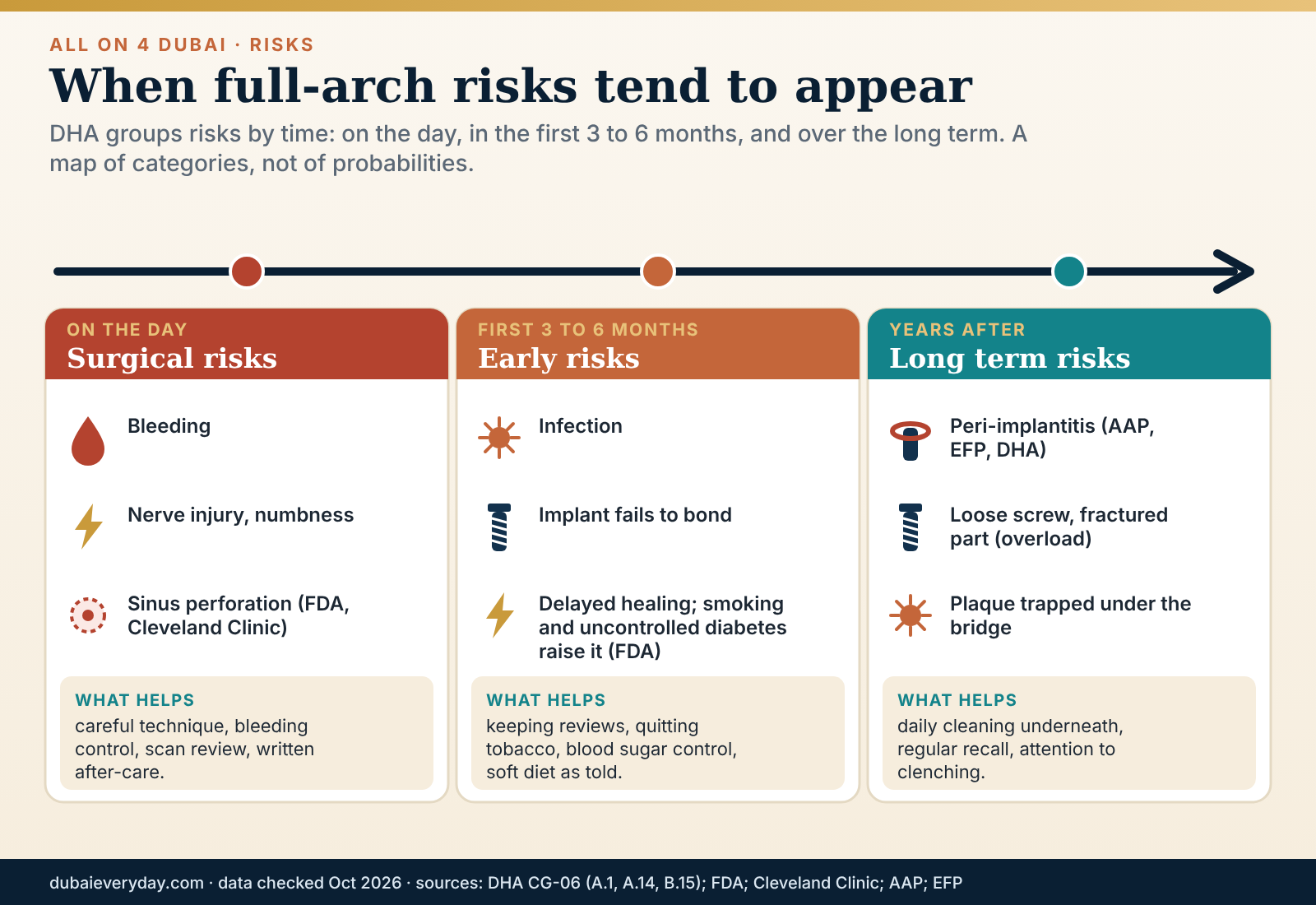
The three-phase risk model in DHA’s guideline
DHA’s guideline groups risks by time. Surgical risks include bleeding and nerve injury. Early risks, in the first 3 to 6 months, include infection and failure of the bone to bond to the implant. Long-term risks include peri-implantitis and mechanical failure. The same document says careful flap design, gentle tissue handling, bleeding control and tension-free closure reduce surgical complications, and that smoking is the greatest risk factor. A clinic that can talk about each phase calmly is behaving the way the guideline expects.
Surgical and early risks, per the FDA and Cleveland Clinic
The FDA lists, for dental implants in general, damage to nearby teeth, sinus perforation, jaw fracture, loosening of the screw that holds the tooth to the implant, implant loss from infection, delayed healing, smoking or uncontrolled diabetes, difficulty cleaning, untreated gum disease and nerve numbness. Cleveland Clinic lists infection, nerve damage, injury to the mouth and sinus perforation for implant-supported dentures, and describes them as usually minimal. Neither source attaches probabilities to an all on 4 Dubai case.
Numbness is the one to understand before consent to any all on 4 Dubai surgery. DHA’s oral surgery guideline says patients must be told about temporary or permanent numbness of the lip or tongue when nerves are near the surgery, and recommends CBCT when the lower-jaw nerve is a concern. If your lower jaw is shrunken, ask the surgeon how close the plan runs to the nerve, and what the plan is if the scan and the surgery disagree.
Mechanical risks specific to a large bridge on few implants
Full-arch work concentrates force. DHA’s guideline says overloading, from off-axis forces, poor angulation, inadequate back support, poor bone or bruxism, can show up as fractured restorations, screws, abutments or implants, bone destruction around the implant, cement failure or plaque trapped under the false teeth. It also warns that implants placed too deep or too shallow can cause bone loss, trouble seating parts or aesthetic compromise.
Our reading is that four implants carrying a whole arch leave less in reserve than a design with more implants: if one is lost, the others take more load and the plan needs rethinking.
DHA does not say this in so many words, and a 2025 overview we cite below found no statistically significant disadvantage for the four-implant concept in the reviews it covered, so treat our reading as a question to ask, not a verdict. The question is: what is the written plan if one implant fails during healing, and who pays?
Phone the clinic the same day. Cleveland Clinic advises contacting the dentist for severe bleeding, pain that medication does not relieve, pus or signs of infection near the implants, or a fever of 38.3 degrees Celsius or higher. The FDA says to contact your dentist if an implant feels loose or painful. If a medical emergency such as breathing difficulty or heavy uncontrolled bleeding arises, go to emergency care. Our best hospitals in Dubai guide explains how to compare emergency services.
Peri-implant disease: the long game
The American Academy of Periodontology defines peri-implant mucositis as inflammation of the gum around an implant without bone loss, and peri-implantitis as inflammation together with deterioration of the supporting bone. It says mucositis may be treated successfully and is reversible if caught early, while peri-implantitis usually requires surgical treatment. Listed risk factors are a history of gum disease, poor plaque control, smoking and diabetes. The European Federation of Periodontology lists bleeding gums, swelling, bad breath or taste and loosening among warning signs.
The EFP patient page also states that, in patients with periodontitis, around 22 per cent of implants develop peri-implantitis. The page gives no study, population or timeframe for that figure, so treat it as an unreferenced statement from a professional body, not a precise rate. DHA’s implant guideline names peri-implantitis only as a long-term risk and gives no diagnostic criteria, and its periodontal guideline does not cover the topic in detail. We found no Dubai-specific peri-implantitis figure.
How clinicians define success and failure
DHA’s guideline includes a health scale for implants over time. At the top, “success” means no pain on function, no mobility, about 2 millimetres of bone loss from the initial surgery and no discharge. “Satisfactory survival” allows 2 to 4 millimetres of bone loss.
“Compromised survival” involves possible sensitivity, about 4 millimetres of bone loss (under half the implant length), a probing depth of 7 millimetres and possible discharge. “Failure” means pain on function, mobility, bone loss of half the implant length or more, uncontrolled discharge or an implant that is no longer in the mouth.
The distinction matters because “survival” and “success” are not synonyms. An implant that is still in place but surrounded by shrinking bone can count as surviving. When an advert quotes a percentage, ask which definition sits behind it, whether it counts implants or patients, and how long the follow-up was.
What the best evidence we could read does and does not say
A 2025 overview of systematic reviews in Oral and Maxillofacial Surgery looked for the All-on-Four concept compared with other full-arch approaches. It searched ten databases, found 4,468 records and included eight systematic reviews published between 2013 and 2021. For All-on-Four it reported cumulative survival rates ranging from 94.8 to 99.3 per cent and mean marginal bone loss of 1.1 to 1.5 millimetres.
None of the reviews found the concept statistically significantly worse than approaches using more implants. The authors also state that most reviews had a high risk of bias and low methodological quality, and that the evidence is limited by those weaknesses.
We quote the numbers because the source is peer-reviewed and linked, but read them with care. They come from studies of selected patients treated by teams that often had specialist training, over follow-up periods that differ between studies, and the abstract does not say whether survival is counted per implant or per prosthesis.
They are not a forecast for your mouth, a clinic’s results or a Dubai figure. The 2017 systematic review of 24 studies we mentioned earlier likewise called for clearer success and survival criteria and flagged short follow-up and sample attrition.
The manufacturer’s page makes its own survival, satisfaction and time-saving claims, mostly sourced to internal data on file. We do not repeat them, since they cannot be checked from the page. No source we read supports any claim that all on 4 Dubai treatment is risk-free or guaranteed.
When things go wrong: records, second opinions and complaints
Keep a folder for your all on 4 Dubai treatment with the consent form, the written plan, the scans, the implant brand and model details and every invoice. The FDA advises asking for the implant brand and model and keeping the record, which matters if a part needs replacing years later. If something looks wrong, ask the treating clinic first, in writing. If you are not satisfied, a second opinion from another DHA-licensed implant dentist is a sensible step, and our Dubai dentist guide explains the complaint routes.
For clinics in Dubai outside the free zone, DHA runs an online medical complaints process, described in a 2018 report, and the national patients’ rights charter (Ministerial Resolution No. 14 of 2021) is displayed at clinics and hospitals. For clinics in Dubai Healthcare City, complaints go to the DHCC regulator.
The Ministry of Health and Prevention complaints service covers private facilities in other emirates but not Dubai. For fee disputes, our Dubai legal basics guide points to where consumer rules are verified. We found no DHA rule on warranties for implant work, so a warranty is whatever the clinic puts in writing.
Alternatives to all on 4 Dubai quotes: dentures, overdentures, bridges and more implants
A fair all on 4 Dubai consultation presents a ladder, not a single door. Each rung trades surgery, cost, stability and upkeep differently, and the best rung depends on bone, health, budget and how you feel about taking teeth out at night. DHA’s prosthetic guideline lists the options for a person with no teeth as removable complete dentures, implant-supported or implant-retained removable dentures, and fixed implant-supported prostheses. Anything else is a variation on those themes.

Rung one: keep and repair what you can
Before any all on 4 Dubai plan, ask whether the teeth can be saved. Gum treatment, root canal work and crowns are less dramatic than implants and cost less, if the teeth are truly salvageable. DHA’s prosthetic guideline favours conservative options first and notes that a functional approach does not need to replace every missing tooth if function can be met with fewer teeth. A second opinion on whether teeth are really hopeless is one of the most useful consultations in this whole process.
Rung two: a conventional complete denture
A complete denture rests on the gums, is held by the palate or the lower ridge and may use adhesive. Cleveland Clinic describes the downsides: traditional removable dentures often shift or slip when speaking or chewing, sore spots are common, an adjustment period of weeks or sometimes months is normal and the average lifespan is seven to ten years with a reline every one to two years. The jawbone also keeps shrinking after tooth loss, which is part of why dentures fit worse over time.
The advantages are real. No surgery, the lowest upfront cost of the ladder, and no dependence on bone for implants. For someone with serious health limits or a tight budget, a well-made denture is a legitimate choice, not a consolation prize. Immediate dentures, worn right after extractions, can bridge the gap while the gums heal, though Cleveland Clinic notes they may be temporary until healing is complete.
Rung three: an overdenture on two implants
An overdenture is a removable denture that clips onto implants. The 2002 McGill consensus statement, published in several dental journals, concluded that a mandibular two-implant overdenture should be the first-choice standard of care for edentulous patients, over a conventional lower denture. It is a position paper from 2002, so it does not cover fixed full-arch work, but it is the best-known statement about this rung. Cleveland Clinic says implant-retained dentures are more stable than traditional ones and do not need adhesive.
DHA’s guideline adds practical limits: overdentures may use ball or locator attachments, or a bar, and need at least 14 millimetres of vertical space for ball or locator systems and 17 millimetres for a bar. DHA also says severe bone loss at the front of the upper jaw may limit treatment to a removable overdenture. Removable also means you clean it out of the mouth, which some people see as a feature.
Rung four: more implants, fixed or removable
Some surgeons place more than four implants per arch, whether for a fixed bridge or a bar-retained overdenture. DHA’s guideline does not specify a number for full-arch work, and the 2025 overview compared the four-implant concept with approaches using more implants and found that none of the included reviews showed it to be significantly worse, with the quality caveats we described.
More implants cost more and may need more bone, but they spread load differently. If a clinic recommends four because that is its package, and not because it fits your jaw, ask why not more.
Rung five: the fixed bridge on four
This is the all on 4 Dubai option itself. DHA’s prosthetic guideline says fixed prostheses are generally preferred, citing better patient satisfaction, oral-health-related quality of life and chewing function. That is a general statement about fixed over removable restorations, not a finding about four-implant bridges, and DHA’s guidelines do not mention All-on-4 by name. For many people fixed teeth are a deciding factor, as long as bone, gums, hygiene habits and budget allow.
Rung six: grafting and complex reconstruction
At the top of the ladder are staged plans that rebuild bone before or during implant placement, or that use specialised implants anchored beyond the usual bone. These need the surgeons DHA restricts to advanced procedures, longer timelines and bigger budgets. They suit people who want a fixed result and whose bone does not allow the four-implant approach, or who want more implants than a graftless design would use. They also carry the most surgery.
| Option | Implant surgery | Can you take it out? | What the sources flag |
|---|---|---|---|
| Complete denture | No | Yes | Slipping, sore spots, reline every 1 to 2 years, replacement after 7 to 10 years (Cleveland Clinic) |
| Two-implant overdenture (lower) | Yes | Yes | Vertical space of 14 mm or 17 mm (DHA); McGill 2002 first choice for lower jaw |
| Bar or multi-implant overdenture | Yes | Yes | Bar needs 17 mm (DHA); cleaning out of the mouth |
| Fixed bridge on four implants | Yes | Only by the dentist | Immediate loading and cantilever listed as risks (DHA); daily cleaning underneath |
| Fixed on more implants, with grafting | Yes, plus bone surgery | Only by the dentist | Advanced surgery restricted to specialists (DHA); longest timeline |
A word on partial cases
If you still have some sound teeth, a full-arch plan may be more than you need. DHA’s prosthetic guideline notes that implant-supported fixed prostheses can avoid using sound natural teeth as abutments, and that resin-bonded bridges are a conservative option to consider first. Partial dentures with clasps rest on remaining teeth, per Cleveland Clinic. Single-tooth and partial implant choices belong to our dental implants guide, and the general dentures, bridges and crowns picture is in the Dubai dentist guide.
Living with a fixed full arch: cleaning, reviews and wear
An all on 4 Dubai treatment does not end when the final bridge goes in. DHA’s guideline says maintenance must be discussed before treatment starts and that regular follow-up is essential for fixed prostheses. Think of the first year after an all on 4 Dubai fitting as a probation period and the decades after as a standing appointment with your hygienist.
Daily cleaning
Cleveland Clinic advises cleaning a fixed implant denture with a soft toothbrush and non-abrasive toothpaste, using floss threaders or interproximal brushes underneath, and keeping up regular dental examinations and cleanings. For a removable overdenture it recommends cleaning at least twice daily and soaking overnight in denture solution. The American Academy of Periodontology says implants should be brushed and flossed like natural teeth and monitored as part of a periodontal evaluation.
Ask your all on 4 Dubai clinic to show you, with your own bridge, which tools reach where, and to watch you do it. A demonstration at the final fitting is a better test of the design than any brochure, because a bridge you cannot clean invites the gum problems described in the risk section.
Professional maintenance and its rhythm
Cleveland Clinic says a fixed denture can only be removed by a dentist, typically for maintenance. DHA gives no single recall interval for implants. Its periodontal guideline sets maintenance for gum disease at around every six months for gingivitis and at least four times a year for periodontitis with attachment loss, and notes that harmful bacteria tend to return to baseline within 9 to 11 weeks of a deep clean.
For implant patients with a gum-disease history, our reading is that the interval is likely to be shorter, and the clinician should say what theirs is and why.
Imaging is part of the schedule too. DHA’s radiology guideline lists routine imaging around one year after placement among post-surgery uses. After that, scans should be justified for a reason and not repeated by habit, in line with the guideline’s justification rule.
Wear, repairs and replacement
Prostheses wear, and DHA lists fracture of restorations, screws and abutments as consequences of overloading. Cleveland Clinic suggests replacing the overdenture portion every 15 to 20 years and says implants themselves can last a lifetime with good care. Treat that as a general expectation from a hospital information page, not a guarantee, and ask the clinic what it covers if the prosthesis chips in year three and what a replacement costs in year fifteen.
Health habits that decide the long run
The risk factors repeat: smoking, poor plaque control, a history of gum disease and diabetes. DHA’s guideline names smoking as the greatest surgical risk, and the EFP and AAP list smoking and diabetes among causes of problems around implants. Managing blood sugar with your physician and keeping tobacco out of the picture are the least glamorous parts of maintaining an all on 4 Dubai bridge, and probably the most effective.
Finally, tell anyone who images you that you have implants. The FDA notes that implants can distort MRI and X-ray images, and radiographers can adjust if they know. Carry a card with the implant brand, model and the clinic’s contact details, and keep a copy of the records on your phone.
Checking a plan before you pay: quotes, adverts and second opinions
All on 4 Dubai offers are widely advertised online, and the adverts follow a pattern: big promise, small print. DHA has rules about this, and knowing them gives you a free filter. If an advert breaks them, you have learned something about the clinic before spending a minute in its chair.
What DHA’s advertising rules ban
DHA’s standard for medical advertising on social media (ST-21) prohibits absolute or exaggerated claims such as “best”, “unique”, “safest”, “the only”, “100%” and “assured success”, and it bans superiority claims. Professional titles must match the licence. Facility accounts must show the Ministry of Health and Prevention advertisement licence number.
Before-and-after images must show the same person, the same lens and no editing, include a risk statement and state that there is no guarantee the result will be the same. Patient images and testimonials need written consent, and discounts that cannot be honoured are not acceptable.
A tightened enforcement push was reported on 3 September 2026 following an August circular, according to The National. We have not read the circular itself, so treat the date and detail as secondary reporting. The practical conclusion is that “lifetime guarantee”, “100% success” and “the best All-on-4 in Dubai” are phrases that should make you pause, since they sit squarely in the banned list.
Reading an all on 4 Dubai advert
“Teeth in a day”
Ask which loading category it is and whether it depends on implant stability on the day. See the temporary teeth section above.
“From AED …”
A starting price ends at an unstated stage. Ask what is excluded, per arch or both, and whether VAT is added.
“No bone graft needed”
The manufacturer calls the concept graftless. Whether you need a graft depends on your scan, not on the label. Ask for the written reasoning.
Before-and-after galleries
DHA requires same-person, unedited images with a risk statement. Ask if the shown patients resembled your bone and gum situation.
What a useful written plan contains
DHA’s guideline tells dentists what the case presentation should cover, and it is the best checklist you can have. It lists the diagnostic wax-up, limitations and risks, estimated treatment duration, provisional options, maintenance, possible complications, and fees and financing. The patient then signs informed consent and receives pre- and post-operative instructions and any prescriptions. An all on 4 Dubai plan missing several of these is not a DHA-style plan, however well designed the brochure.
- Diagnosis in your name.The findings from your examination and scan, not a template, with the tooth-by-tooth status.
- The proposed design.Number of implants per arch, which are tilted, fixed or removable teeth, and the material.
- Who does what.The surgeon, the restorative dentist and the laboratory, with licence details.
- The stage list with dates.Each visit, what happens, what you can eat and what you pay.
- The contingency clauses.What if the scan was wrong, an implant does not bond, a tooth fails, or a graft is needed after all.
- The money.Itemised fees, VAT stated, deposit terms, instalment terms and a refund position.
Comparing two or three plans fairly
Ask each all on 4 Dubai clinic to quote the same scenario: one arch, in your own words, with the stage list above. Put the quotes side by side and mark what each includes. A quote that is cheaper because it leaves out the final prosthesis, the CBCT or the sedation is not cheaper. A quote with more implants is not necessarily better, and one with fewer is not necessarily leaner. Compare the plans on the questions of how they handle failure, who is accountable and what you can reach after hours.
If the clinics disagree about the number of implants, whether you need a graft, or whether teeth can be saved, that disagreement is a signal to get a second opinion rather than to pick the one you like best. Our Dubai dentist guide explains how to run a licence check and what a second opinion typically involves.
When a second opinion earns its fee
- You are told that most or all of your teeth are hopeless and you did not expect that.
- A graft, a sinus lift or a zygomatic implant is proposed as the only route.
- Two clinics propose different numbers of implants or fixed versus removable teeth.
- You have a medical condition or medicine that may affect healing.
- The deposit is large and requested before the scan is read.
A second opinion costs a consultation fee and a little time. Against a bill of this size, it is cheap. The second dentist should have access to your scan, so ask the first clinic for a copy of the images, which are your records.
Pressure signals worth slowing down for
Be wary of a discount that expires the same day, a “limited slots” claim, a deposit requested before the diagnosis is finished, a refusal to put the plan in writing, and a clinic that discusses price before examining you.
A promotion tied to posting a review or appearing in marketing content should also give you pause: DHA’s advertising standard requires written consent for patient images and testimonials, and consent given under a discount is hard to call free. None of these signals proves wrongdoing. Each is a reason to take the paperwork home and read it without a salesperson present.
Residents, newcomers and visitors: logistics that change the plan
The all on 4 Dubai treatment is the same for everyone, but the logistics are not. Residents can attend frequent reviews at modest cost. Newcomers face waiting periods and paperwork. Visitors face the hardest problem, because bone healing does not follow flight schedules. Pick the group that fits and adjust.
If you already live in Dubai
You have time and proximity. Staged all on 4 Dubai treatment suits you, because review visits cost an hour and a taxi. Distance becomes a clinical factor: a clinic that is a short Metro ride away is easier to keep attending than a famous one across the city. Our Dubai Metro guide helps you plan the journeys. Check your employer cover early, since pre-approval for costly work can add weeks to the timeline.
If you have just arrived
All on 4 Dubai treatment is rarely an urgent job in a first month crowded with visa stamping, housing and bank accounts. Settle the address and insurance first, then ask the insurer about waiting periods before you assume a claim is possible. Our Dubai relocation checklist and the broader moving to Dubai guide show where health cover and dental care sit in the sequence. If a tooth is infected or painful now, that is urgent care, to be treated first and planned around afterwards.
If you are travelling for all on 4 Dubai treatment
The CDC’s travel health guidance for medical tourism recommends seeing a healthcare provider or travel medicine clinician at least four to six weeks before travelling, checking the clinician’s qualifications and the facility’s credentials, arranging how you will communicate and confirming follow-up care at home. It also advises carrying copies of your records and obtaining all records from the destination facility before you leave, with translations if needed. It notes that accreditation does not guarantee a good outcome.
For flying, the CDC page says to wait 10 to 14 days after major surgery before flying. Full-arch surgery is not always major surgery in that sense, and we found no DHA rule on flying after dental implant surgery. So ask your surgeon in writing how long to wait, and plan the flight accordingly. A swollen, sore mouth on a long-haul flight is a poor way to discover the schedule was too tight.
Medical visas: confirm first. Gulf News reported in early June 2026 that Dubai’s immigration authority (GDRFA Dubai) and DHA signed an agreement to simplify medical visa procedures and integrate their systems, through members of the Dubai Health Experience network. The report names no visa categories, durations or fees. We did not verify any entry rule for medical travel, so check with the clinic and the official GDRFA or federal channels before you book. Our Dubai travel guide covers arrival basics.
Travel arithmetic for a staged all on 4 Dubai plan
Illustrative example (not a quote or market fact). Take Clinic B’s invented AED 52,000. Suppose the plan needs two trips, one of 7 nights for surgery and temporary teeth, and one of 5 nights for final teeth, with a return flight at AED 2,500 and a hotel at AED 450 a night.
Flights come to 2 × 2,500 = AED 5,000, and hotel nights to 12 × 450 = AED 5,400, so travel is AED 10,400 and the total is AED 62,400, with treatment at about 83 per cent of the whole. One unplanned extra trip of two flights and four nights adds 2,500 + 4 × 450 = AED 4,300, bringing the total to AED 66,700. Add time off work, and the cost of a complication that appears after you are home. The structure matters more than the invented figures.
Recovery days in a hot city
Plan for quiet days, not itineraries. Cleveland Clinic advises avoiding strenuous exercise for at least 48 hours after implant placement, and a Dubai summer walk is strenuous in its own way. Our best time to visit Dubai guide explains the seasons, the indoor things to do guide suits low-effort days and the wider things to do in Dubai guide helps once your surgeon says you can resume normal activity.
Staying near the clinic is a clinical convenience, and our best hotels in Dubai guide shows how to choose by area. The Dubai airport guide covers the DXB side of the journey.
Finally, plan the handover for your all on 4 Dubai treatment. Ask who handles a problem after you leave, whether the clinic offers photo-based remote review, and whether a dentist at home is willing to take over maintenance. A treatment with no handover plan is a loose end that tends to unravel at the least convenient moment.
Six scenarios, worked through
These are invented composites for all on 4 Dubai readers, not patient cases, and none describes a real person or clinic. They show how the pieces of this guide interact. In each, the real decision belongs to a licensed dentist after an examination, and the figures, where there are any, are the illustrative ones used above.
Scenario one: a resident with failing upper teeth and controlled diabetes
A man in his late fifties has loose upper teeth from long-term gum disease. He does not smoke and his diabetes is well managed. The sensible route is to get a letter from his physician about blood sugar control, a periodontal assessment, and a CBCT to see how much bone sits under the sinus.
DHA lists uncontrolled diabetes as a relative contraindication, and the periodontal societies list diabetes as a risk factor, so his own control is the lever. If the bone is adequate, a fixed plan could be discussed; if it is thin, tilted implants, a sinus lift or a removable overdenture would come into the conversation. Two written quotes and one second opinion are proportionate.
Scenario two: a long-term lower denture wearer on a modest budget
A woman has worn a full lower denture for many years and finds it moves when she eats. Her gums are healthy and her bone has shrunk. Her priority is stability, not a fixed bridge. The McGill consensus statement points to a two-implant lower overdenture as a first-choice standard of care for edentulous patients, and DHA’s guideline tells her to check vertical space, 14 millimetres for ball or locator attachments.
This route usually involves less surgery and fewer implants than an all on 4 Dubai bridge, and it keeps the option of taking the teeth out to clean them. She should still ask for the all on 4 Dubai quote for comparison, in the same written format, so the choice is informed.
Scenario three: a smoker who wants “teeth in a day”
A man in his early fifties smokes daily, has bleeding gums and has seen an all on 4 Dubai advert for same-day teeth. DHA names smoking as the greatest risk factor for surgical complications, and the EFP lists smoking among the most common causes of implant failure.
A responsible clinic would discuss stopping tobacco before and after surgery, treat the gum disease first and be candid that immediate loading carries extra mechanical risk. If he cannot stop, a removable option may be the better fit. Ask whether the clinic offers cessation support or a referral, and whether the plan changes if he restarts.
Scenario four: a visitor with ten days in Dubai
A woman living abroad has a gap of ten days and is attracted by an all on 4 Dubai quote. An all on 4 Dubai plan needs surgery and temporary teeth in one visit, a healing wait of months, and a final fitting later, so one trip cannot do the whole job.
On the illustrative numbers, two trips take travel to AED 10,400 and the total to AED 62,400. She should confirm which stages are done in Dubai, take the scans, implant details and plan home, check that a dentist at home will provide reviews, and ask her surgeon in writing when she may fly. If the plan cannot be completed on schedule, she should know what happens to the deposit.
Scenario five: severe bone loss at the front of the upper jaw
A man in his sixties has worn an upper denture for decades and has little front bone. DHA’s guideline says that in this situation, treatment may be limited to a removable overdenture, and that this should be explained.
If he wants fixed teeth, a graft, a sinus lift or more complex surgery by an oral surgeon, maxillofacial surgeon or periodontist could be on the table, with a longer timeline. A second opinion from a surgeon who does this work regularly is worth the fee, and he should ask for an overdenture quote as a baseline.
Scenario six: a patient who has had intravenous bone medication
A woman received intravenous bisphosphonate treatment as part of cancer care. DHA’s guideline lists intravenous bisphosphonate use as an absolute contraindication for implants, and its oral surgery guideline discusses the risk of jaw osteonecrosis with this route. The first call should be to her oncologist, and the second to a dentist who works with medically complex patients. Conventional dentures and conservative care may be the sensible plan. This is a case where elective implant surgery is for specialists to assess, not for a price list.
Common mistakes and a pre-booking checklist
Most problems with all on 4 Dubai plans are not exotic surgical failures. They are failures of process: a decision made before the scan, a price compared without the fine print, a plan with no failure clause. These are the mistakes the sources in this guide most directly warn against.
The most common mistakes in all on 4 Dubai decisions
- Booking on the advertised price before knowing what it includes, and discovering the final prosthesis is extra.
- Treating “teeth in a day” as a guarantee instead of asking which loading category applies and what happens if stability is not enough.
- Skipping the licence and privilege check because the clinic looked impressive.
- Not telling the dentist about bone-strengthening drugs, diabetes, smoking or clenching.
- Paying a large deposit before the scan has been read and the plan written.
- Comparing a fixed bridge only with another fixed bridge, and never pricing a two-implant overdenture.
- Ignoring cleaning, then discovering that the design needs daily tools and visits.
- Flying home too soon, or booking a holiday inside the early healing window.
- Leaving without the implant record, scans and written plan.
A pre-booking checklist
Use this as a one-page test for any all on 4 Dubai offer. If you cannot tick most of it, the plan is not ready, however good the sales conversation felt.
- Licence and privilege.The surgeon and the restorative dentist are on the DHA register, and the clinic has confirmed the implantology privilege in writing.
- Scan and field of view.A written, justified CBCT report exists, and you have seen the nerve and sinus on your own images.
- Design in writing.Number of implants, tilt, fixed or removable, material, and the laboratory.
- Loading category.Immediate, early or delayed, and the fallback if stability is not enough.
- The money line by line.Per arch or both, VAT stated, deposit and refund terms, instalments and what happens if the plan changes.
- Failure clauses.What happens if an implant fails, the temporary breaks or a graft is needed later, and who pays.
- Reviews and out-of-hours.Review schedule, emergency contact, and a hospital fallback.
- Alternatives costed.At least a denture or overdenture quote in the same format.
- Your own side.A letter from your physician if relevant, a plan for cessation or blood sugar, and a way to clean the design.
All on 4 Dubai FAQ
What is all on 4 Dubai treatment?
It is the use of four implants in one jaw to support a fixed set of replacement teeth, usually with two straight implants at the front and two tilted ones at the back. The name All-on-4 is marked as a registered trademark by Nobel Biocare, while clinics in Dubai and elsewhere use the phrase more loosely for similar full-arch designs. Ask for the number of implants, the angle, and whether the teeth are fixed or removable. This is general information, not medical advice.
Who can place the implants for an all on 4 Dubai plan?
A dentist with a DHA licence that also carries the implantology privilege. DHA’s guideline says implant surgery is for DHA-licensed dentists and specialists privileged for implantology, and its privilege policy restricts advanced work such as sinus lifts and advanced bone grafting to oral surgeons, maxillofacial surgeons and periodontists. Check the register and ask the clinic to confirm the privilege in writing. We could not verify that the public register shows privileges, so do not rely on it alone.
Am I a candidate if I have little bone?
Possibly, but for all on 4 Dubai treatment it depends on where the bone is missing. The concept was designed partly to use remaining bone by tilting the back implants, and a systematic review framed it as an option for shrunken jaws in people who prefer to avoid regenerative procedures. DHA’s guideline, however, says severe bone loss at the front of an upper jaw may limit treatment to a removable overdenture. Only a CBCT-based examination can say. Ask to see the sinus and nerve on your own scan.
Will I leave the clinic with teeth on the day of surgery?
Sometimes. The manufacturer offers provisional teeth in a day for patients who meet criteria for immediate loading and achieve adequate implant stability, and does not list the criteria. DHA classes immediate loading as within two weeks and lists it as a risk factor, and also describes non-functional restorations that look like teeth but avoid direct bite force. Ask which one is planned, and ask for a written fallback, such as a removable temporary denture, if stability on the day is not sufficient.
How long does all on 4 Dubai treatment take?
Months. Cleveland Clinic gives three to six months on average for the implants to bond, longer after bone grafting. A case needing a standard lateral sinus lift adds the 5 to 6 months DHA gives as the wait before implant placement, so our arithmetic puts that route at roughly 8 to 12 months before final teeth. Planning and preparatory treatment add to this. The final teeth are made and fitted after healing, so one visit never completes the job.
How much does all on 4 Dubai treatment cost?
We could not verify a published Dubai price for a full arch. One Dubai clinic’s blog lists per-unit prices from AED 6,160 per implant, but says it has no all-inclusive All-on-4 package price, and aggregator pages we read do not cover it. Any all on 4 Dubai number in this guide is illustrative. Ask each clinic for an itemised written quote, per arch, stating VAT, the scan, extractions, sedation, temporary teeth, final prosthesis and reviews.
Does health insurance cover all on 4 Dubai treatment?
Often not fully, and sometimes not at all. Comparison sites report that implants are commonly excluded or limited to higher tiers, with low annual dental limits, waiting periods and pre-approval for costly work. DHA’s 2014 pack for the basic plan is internally inconsistent on dental. Read your table of benefits, ask the insurer in writing about implants and prostheses, and ask the clinic to submit a pre-approval request before you pay a deposit. A low annual cap can leave most of the bill with you.
What are the main risks of all on 4 Dubai treatment?
DHA groups them by time: surgical risks such as bleeding and nerve injury, early risks in the first 3 to 6 months such as infection and failure to bond, and long-term risks such as peri-implantitis and mechanical failure. The FDA also lists sinus perforation, loosening screws and numbness. Overloading from clenching, poor angulation or poor bone can fracture parts of the bridge. The surgeon should explain each before you sign consent. Smoking and uncontrolled diabetes raise several of them.
How long do the implants and the teeth last?
No source we read gives a guaranteed lifespan for all on 4 Dubai work. Cleveland Clinic says implants can last a lifetime with proper care and suggests replacing the overdenture portion every 15 to 20 years. A 2025 overview of systematic reviews reported cumulative survival of 94.8 to 99.3 per cent for the concept, but also that most reviews were of low quality, so those are not predictions. Maintenance, gum health and bite forces decide a great deal, and the prosthesis wears even when the implants do not.
Is all on 4 Dubai treatment better than dentures?
It depends on what you value and what your jaw allows. DHA’s prosthetic guideline says fixed prostheses are generally preferred for satisfaction, quality of life and chewing, while Cleveland Clinic notes conventional dentures can slip, need relining every one to two years and often last seven to ten years. Dentures need no surgery and cost less upfront. A two-implant lower overdenture is a middle path that the McGill consensus statement supports for the lower jaw. Get all options costed in the same format.
Can I have all on 4 Dubai treatment on just one arch?
Yes. The design is applied per arch, so a plan can cover the upper jaw, the lower jaw or both, and many people treat the arches separately. Costs and the second-arch discount, if any, vary by clinic, and headline prices are sometimes per arch and sometimes for the full mouth, so ask which. The bite between arches also matters, so even when only one jaw is treated the dentist has to plan around the opposing teeth or denture.
Can I travel to Dubai for all on 4 treatment?
You can plan it, but allow for at least two visits, because healing takes months. The CDC advises seeing a clinician four to six weeks before travelling, checking qualifications and credentials, carrying records and obtaining all records before leaving. We found no DHA rule on flying after dental implant surgery, so ask the surgeon in writing. A June 2026 report mentions plans to simplify medical visas, but gives no details, so confirm entry rules with official channels before booking.
Can smokers or people with diabetes have all on 4 implants?
Sometimes, with more care. DHA lists tobacco use and uncontrolled diabetes as relative contraindications and says relative contraindications are not automatic bars. It calls smoking the greatest risk factor for surgical complications. The EFP and AAP both list smoking, and the AAP diabetes, among the risk factors for problems around implants. A dentist should discuss stopping tobacco, working with your doctor on blood sugar and whether a removable option would be safer for you.
How do I check an all on 4 Dubai clinic before booking?
Look up the dentists and the facility on the DHA’s Dubai Medical Registry, ask for the implantology privilege in writing, and match the surgeon to the surgery, since sinus lifts and advanced grafting need an oral surgeon, maxillofacial surgeon or periodontist. Then request an itemised written plan with the loading category, failure clauses and review schedule. DHA’s advertising rules ban claims such as 100 per cent success and the best, so treat those as a warning. For Dubai Healthcare City clinics, the DHCC regulator applies instead.
Keep reading
Sources and further reading (34 links)
- Dubai Health Authority: Clinical Guidelines for Implant Dentistry (CG-06; issue 2) — full-arch, loading categories, bone thresholds, contraindications, risks, health scale
- Dubai Health Authority: Clinical Guidelines for Prosthetic Dentistry (CG-05; issue 2) — complete dentures, implant-supported prostheses, fixed versus removable
- Dubai Health Authority: Clinical Guidelines for Oral and Maxillofacial Surgery (CG-04; issue 2) — antibiotic prophylaxis, bisphosphonate risk, post-operative advice, consent
- Dubai Health Authority: Clinical Guidelines for Periodontics (CG-03; issue 2) — maintenance intervals, smoking and diabetes as risk factors
- Dubai Health Authority: Clinical Guidelines for Dental Radiology (CG-11) — CBCT justification, field of view, reporting, post-surgery imaging
- Dubai Health Authority: Clinical Guidelines for Infection Control in Dentistry (CG-10) — sterile coolant and surgical instrument requirements
- Dubai Health Authority: Dental Implantology Privilege Requirements (PI-01; issue 3) — privilege, training, logbook, advanced surgery restriction
- Dubai Health Authority: Scope of Practice and Core Competencies for Dentists (SP-04) — implantology not a specialty, sedation facility rule
- Dubai Health Authority: Standard for Dental Laboratory Services (ST-59) — dentist responsibility for laboratory work
- Dubai Health Authority: Standards for Medical Advertisement Content in Social Media (ST-21) — banned claims, before-and-after rules, fees and instalments
- Dubai Health Authority: Circular CIR-2026-00000050, Dubai Dental Guidelines v2 — release of the 11 clinical guidelines in March 2026
- Dubai Health Authority: Dubai Medical Registry (Sheryan) — professional and facility search filters
- US Food and Drug Administration: Dental Implants, What You Should Know — components, risks, record keeping, imaging
- Mayo Clinic: Dental implant surgery — grafts, healing, staged procedure
- Cleveland Clinic: Implant-Supported Dentures — All-on-4 description, healing time, risks, care, replacement interval
- Cleveland Clinic: Dentures — denture types, lifespan, relining, adjustment
- American Academy of Periodontology: Peri-Implant Diseases — mucositis, peri-implantitis, risk factors
- European Federation of Periodontology: Peri-implant diseases — warning signs, causes, unreferenced 22 per cent statement
- World Health Organization: Oral health fact sheet — tobacco and diabetes links with gum disease
- Nobel Biocare: All-on-4 treatment concept — manufacturer’s description, marketing claims noted, not repeated
- PubMed: Figueiredo et al., overview of systematic reviews on the All-on-Four concept (Oral Maxillofac Surg) — survival range, bone loss, quality caveats
- PubMed: Soto-Penaloza et al., The all-on-four treatment concept: systematic review (J Clin Exp Dent) — 24 studies, evidence limits
- PubMed: Feine et al., The McGill consensus statement on overdentures — two-implant mandibular overdenture as first-choice standard of care
- CDC Travelers’ Health: Medical Tourism — pre-travel planning, records, follow-up, flying
- Gulf News: Dubai simplifies medical visas to boost health tourism — GDRFA and DHA agreement; secondary report
- Zavis directory: Full Dental Implant Cost in Dubai, indicative range — single-implant pathway ranges; aggregator, no All-on-4 data
- Zavis directory: Dental Implant (single tooth) cost in Dubai — AED 3,627 to 9,000 from two published prices (for our implants guide)
- WhatClinic: All-on-4 Dental Implants, Middle East — example of ambiguous headline prices outside the UAE
- Dubai dental clinic blog on All-on-4 pricing — per-unit prices and no package price; cited for structure only, not an endorsement
- InsuranceMarket.ae: Dental insurance in Dubai — market observations on implant exclusions and limits; comparison site, not a regulator
- DHA Employer’s Information Pack on the Dubai Health Insurance Law — employer obligation and basic plan dental wording
- Dubai Healthcare City: FAQ — DHCC regulator and complaints
- Ministry of Health and Prevention: Complaints about private health facilities — scope outside Dubai
- The National: Dubai aesthetic clinics to face disciplinary action over edited social media images — tightened advertising enforcement; secondary report
Update log: 29 October 2026, first publication; all facts re-checked against the sources above. Next review due: 29 April 2027 (six-monthly), or sooner if DHA publishes a new implant, prosthetic or advertising document. Corrections welcome.
This page is general information, not individual medical, dental, legal or financial advice. No dentist has reviewed it. A DHA-licensed clinician must examine you before anyone can say what you need.
About DubaiEveryday and this guide
DubaiEveryday.com is an independent editorial project that publishes practical, research-based guides to everyday life in Dubai: where to live, what things cost, how the rules work and how to get around. This page was written and edited by the DubaiEveryday editorial team. It is not signed by a named expert, doctor, lawyer or adviser, and we do not claim first-hand testing of a venue, clinic or service unless the page says so.
Each guide is built from official sources such as government and regulator pages, operator websites and established news outlets, cross-checked where we can. When we could not confirm something, we say so in the text, and examples that use made-up numbers are labelled as illustrations. Mentions are editorial choices, not paid placements, and a link is not an endorsement.
Dubai changes quickly. If you spot something that is out of date or wrong, please tell us through the contact options on DubaiEveryday.com and we will check it and correct the page.