

Dubai has one season that suits ordinary sightseeing, one that suits pool-and-mall holidays, and a few weeks in between where the right dates matter more than the right month. This guide works out the best time to visit Dubai from official climate normals, hotel-market data and the 2026 to 2027 event calendar, checked on 29 October 2026.
Say you have already booked the flights, and then a friend mentions it can be 42 degrees in August. Suddenly the date you picked feels like a gamble. Dubai does not have one good month and eleven bad ones, though. It has a long comfortable stretch, a punishing summer and a few awkward weeks where the exact dates matter more than the month.
Most people only find that out after they have paid. If you are trying to work out the best time to visit Dubai for your own plans and budget, this guide lays out weather, crowds, hotel prices and the events calendar side by side. You will see which weeks to grab, which to avoid, and what a cheap date really costs you.
The best time to visit Dubai for most people is November to March, when average afternoon highs run from about 24 °C to 31 °C and the outdoor city works as advertised: beaches, old-town walks, desert drives, open-air markets. Inside that window, the least stressful dates are the second half of November and the weeks after the Dubai Shopping Festival peaks in mid-January. The most expensive and crowded dates are the school winter break (14 December 2026 to 3 January 2027) and New Year’s Eve.
Outside that window, April and October are the shoulder months for anyone chasing the best time to visit Dubai on a budget: workable in the morning and evening, hot at midday. June to September is the cheap, quiet and punishing season. Average highs are 40 to 42 °C and nights stay around 28 to 31 °C, so the sensible plan is hotel, pool, mall and museum, with anything outdoors before about 9 am.
In 2027, Ramadan is expected to run from about 8 February to 8 or 9 March, which takes most of February off the list for people who want normal daytime dining. And this year has a second filter that no weather chart captures. Governments disagree about regional security, flights are still recovering, and hotel prices are behaving oddly. Read the conditions section first, then pick your month.
This guide to the best time to visit Dubai is desk research. DubaiEveryday.com has not stayed in these hotels, sat through these summers, queued at these events or measured any temperature, and nothing below describes a personal visit. The page has no named author because no one on the site travelled for it; it is an editorial synthesis of published data.
Climate figures are the 1991 to 2020 airport normals compiled by NOAA and tabulated on Wikipedia’s Climate of Dubai page, which is a secondary compilation. Tourism figures come from Dubai’s tourism department as reported by the Arabian Gulf Business Insight (AGBI), The National and Khaleej Times. Safety wording comes from the UK FCDO, Australia’s Smartraveller and the US State Department, all read on 29 October 2026.
Anything labelled “our calculation” or “our reading” is our own arithmetic or judgement built on those inputs, and anything labelled “Illustrative example” uses made-up numbers to show logic, not market facts. Event dates are as reported on 29 October 2026 and can move. Some details were carried over from other DubaiEveryday research notes written the same day, as flagged in the sources box. No hotel, airline or attraction paid for a mention, and there are no affiliate links. This is general travel information, not individual safety, medical, insurance or legal advice.
The best time to visit Dubai in late 2026: check conditions before seasons
Normally a page on the best time to visit Dubai would start with temperatures. In late 2026 it has to start with conditions, because three things changed the calculation this year and a good-weather month is no use if the flights do not run or the trip is uninsurable.
Governments are giving different advice
As read on 29 October 2026, the UK Foreign, Commonwealth and Development Office (FCDO) page for the UAE was last updated on 27 October. It describes the Middle East as deeply unpredictable, with a high risk of sudden escalation, and tells travellers to prepare for flight cancellations and airspace closures. The summary we read showed no advise-against-travel notice for the UAE, but pages like this change, so read it yourself before booking.
Australia’s Smartraveller says “reconsider your need to travel” to the UAE, and says that includes transit. The US State Department lists the UAE at Level 3, Reconsider Travel, in advisory text dated 3 March 2026 that cites hostilities between the US and Iran from 28 February 2026. Three governments, three wordings, one country.
This page cannot make that decision for you. What it can do is say that if you travel, the best time to visit Dubai and the decision to go at all are separate questions: a perfect November does not cancel a risk, and a hot summer is not automatically unsafe.
Read your own government’s current advice, not a summary of it. Buy travel insurance that you have actually read for war, terrorism, airspace-closure and cancellation wording, because many policies exclude events that were already public when you bought. Prefer flexible or refundable bookings for the first leg. Agree a plan with everyone travelling for what you will do if the flight home is cancelled.
Flights and hotels are recovering, unevenly
Dubai Airports reported 31.5 million guests in the first half of 2026, down 31.3% on the same period of 2025, with about 50 international airlines against 108 in 2025. Several foreign carriers have published return dates stretching into 2027, according to Time Out Dubai on 27 October. Emirates and flydubai are flying, and the airport is open 24 hours, but a route that existed in 2025 may not exist on your dates. The Dubai airport guide tracks the terminal and airline picture.
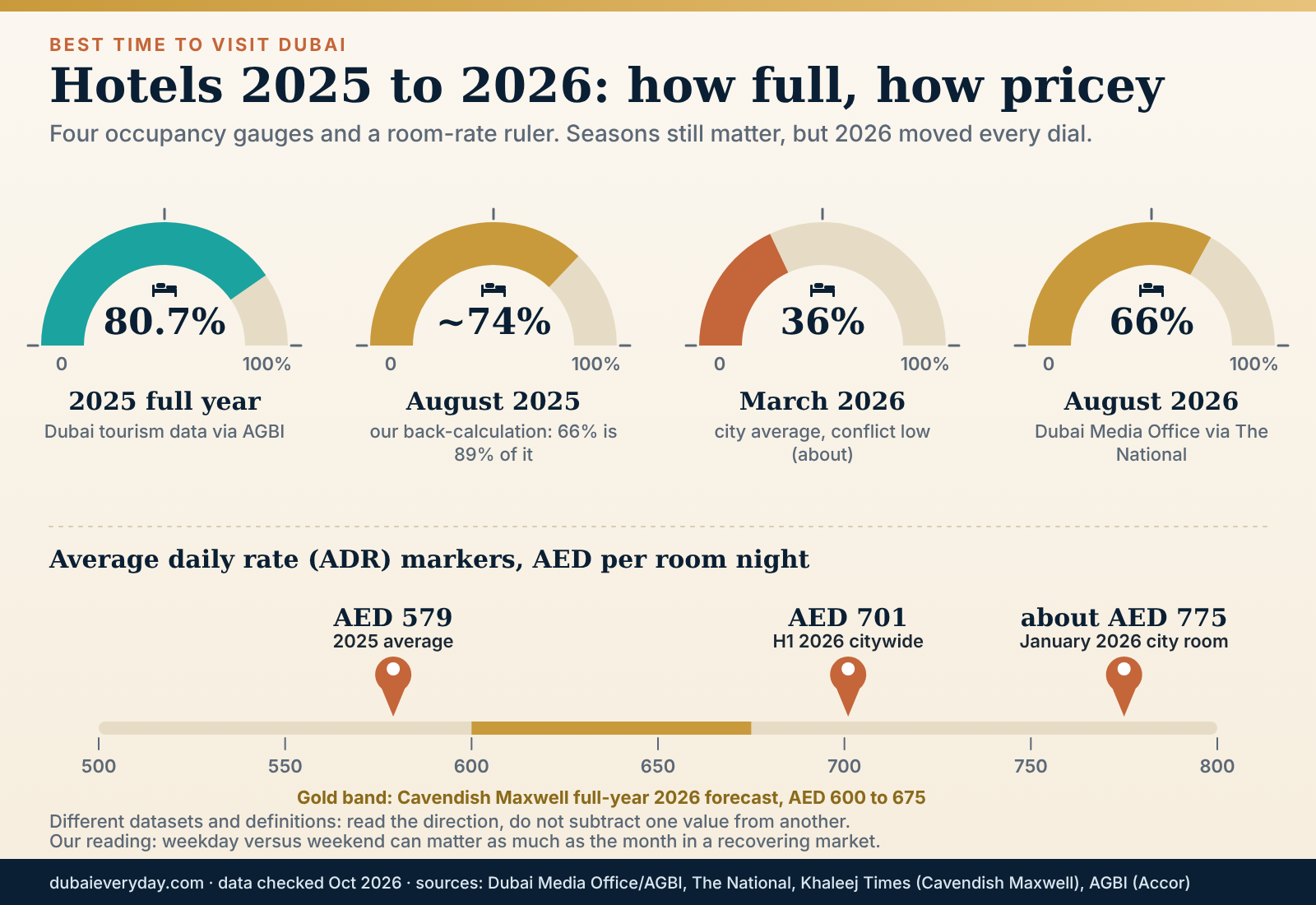
On the hotel side, Dubai’s own figures put average occupancy at 80.7% for 2025, with an average daily rate (ADR) of AED 579, about US$158 at the fixed peg of 3.6725. Then 2026 happened. Reporting based on the city’s data says March 2026 occupancy averaged about 36%, with some hotels in single digits, and August recovered to 66% with 869,000 international overnight visitors. The consultant Cavendish Maxwell put the first-half 2026 ADR at AED 701, down 7% on the year before, and forecast full-year occupancy of 60.4% to 66.2%.
An Accor executive told AGBI in July that visitor volumes should return in the fourth quarter of 2026 but that rates would lag, with the market getting “close to where we were” by the end of the first quarter or the second quarter of 2027. Our reading: this winter may offer a smaller peak premium than normal, mainly outside the festive fortnight, but that is a forecast by an interested party, not a price guarantee.
Some landmarks are closed
Gulf News reported this month that the Museum of the Future closed on 1 September 2026 and is due to reopen in the first quarter of 2027, that the Burj Al Arab closed in April for an 18-month restoration, and that the Armani Hotel and Barasti beach club are also shut for now. Closures change what a trip is worth in a given month, so check each must-see on its own website before you lock dates. The things to do in Dubai page keeps the wider attraction list.
What this page covers, and what it leaves to others. This page answers one question, the best time to visit Dubai: which months and weeks suit which kind of trip, and what you trade off by choosing each. The broader first-trip checklist lives in the Dubai travel guide, the dated list of festivals and fixtures is the Dubai events calendar, and hotel selection by area is in best hotels in Dubai. We link to them rather than repeat them.
How we judged the best time to visit Dubai
The best time to visit Dubai depends on what you want to do, so we split the question into six tests and scored each month against all six, instead of declaring one winner. The scores are our reading of published data, not a survey, and the month sections below explain each one.
- Weather you can useThe first test of the best time to visit Dubai: how many daylight hours are comfortable enough to be outside, using NOAA monthly highs and lows. Humidity makes this harsher, so it is a floor, not a promise.
- Sea and pool comfortIndicative sea temperatures from seatemperature.org, via Wikipedia. Below about 22 °C the Gulf feels cold to many swimmers; above 31 °C it stops cooling you down.
- Crowd pressureSchool holidays, public holidays, big events and hotel occupancy. No month-by-month occupancy series was available to us, so this test is a judgement.
- Price pressureHotel rates move with demand. We use annual and half-year ADR figures plus the pattern of holidays.
- What is openSeasonal attractions such as Global Village, Miracle Garden, Hatta’s activity season and balloon flights only run for part of the year.
- Calendar frictionRamadan, Eid, trade shows and sports events that change opening hours, traffic or room availability.
Two limits are worth stating plainly. First, the 2026 to 2027 winter is not a typical year, so we lean on structural patterns (holidays, climate) more than on 2025 prices. Second, we did not look at live fares or live room rates for any date, so nothing here says that a given week will be cheap. For the sibling question of which Dubai events fall on which dates, use the events calendar; this page uses events only to decide the best time to visit Dubai.
Dubai weather by month: the numbers behind the best time to visit
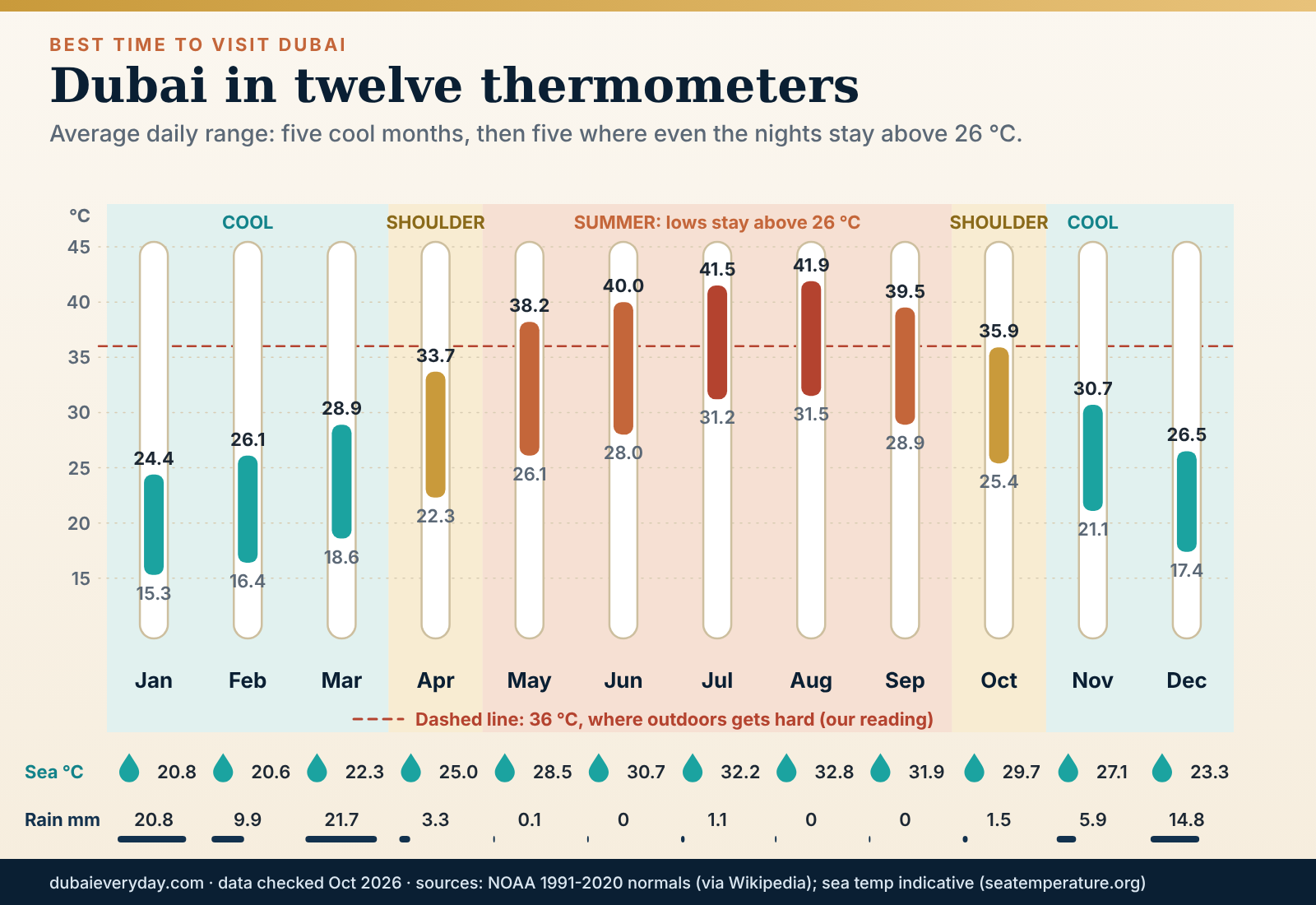
The best time to visit Dubai starts with the fact that its year is not four seasons. It is closer to three: a cool season from about November to March, a short hot-but-workable shoulder in April and October, and a long summer from May to September. The table gives the airport’s 1991 to 2020 normals, which are the standard long-term averages that climate agencies use. Real days run hotter or cooler, so treat them as the middle of a range.
| Month | Mean daily high (°C) | Mean daily low (°C) | Rain (mm) | Sunshine (hours) | Sea (°C, indicative) |
|---|---|---|---|---|---|
| January | 24.4 | 15.3 | 20.8 | 253 | 20.8 |
| February | 26.1 | 16.4 | 9.9 | 251 | 20.6 |
| March | 28.9 | 18.6 | 21.7 | 288 | 22.3 |
| April | 33.7 | 22.3 | 3.3 | 316 | 25.0 |
| May | 38.2 | 26.1 | 0.1 | 350 | 28.5 |
| June | 40.0 | 28.0 | 0.0 | 345 | 30.7 |
| July | 41.5 | 31.2 | 1.1 | 340 | 32.2 |
| August | 41.9 | 31.5 | 0.0 | 334 | 32.8 |
| September | 39.5 | 28.9 | 0.0 | 308 | 31.9 |
| October | 35.9 | 25.4 | 1.5 | 300 | 29.7 |
| November | 30.7 | 21.1 | 5.9 | 268 | 27.1 |
| December | 26.5 | 17.4 | 14.8 | 257 | 23.3 |
Air temperature, rain and sunshine: NOAA 1991 to 2020 normals for Dubai International Airport, as tabulated on Wikipedia’s Climate of Dubai page (secondary compilation, read 29 October 2026). Sea temperatures are seatemperature.org averages from the same page and are indicative only. Annual rain is about 79 mm.
The cool season: November to March
Average highs in these five months run from 24.4 °C in January to 30.7 °C in November, and nights fall to 15 to 21 °C. That is shirt-sleeves weather by day and a light layer after dark, which is the reason the best time to visit Dubai for sightseeing sits here. It is also the only time the old-town walking routes, the beach promenades and the desert are comfortable for most of the day rather than a couple of hours.
Rain is the cost. Almost all of Dubai’s roughly 79 mm a year falls between December and March, with January and March each averaging more than 20 mm. That is still only a handful of wet days, and showers are usually short, but a downpour can close roads and cancel outdoor events. Treat a wet forecast as a reason to swap an outdoor day for an indoor one, not as a reason to cancel the trip.
The shoulder months: April and October
April averages 33.7 °C and October 35.9 °C. In both, mornings are pleasant and afternoons are hot, so the daily rhythm changes: outdoor plans early, indoor plans from late morning, outdoors again once the sun drops. October is a half-step hotter than April, and the sea is warmer (29.7 °C against 25.0 °C), so swimmers lean towards October while walkers lean towards April. For the best time to visit Dubai on weather and price together, both months sit at an awkward point, which the demand section covers.
Summer: May to September
Mean highs reach 38.2 °C in May, 41.9 °C in August and still 39.5 °C in September. The detail that surprises visitors is the night: July and August average lows of 31.2 and 31.5 °C, which means there is no real overnight recovery: the average July night (31.2 °C) is warmer than the average January afternoon (24.4 °C). The sea in August averages about 32.8 °C, which is bath temperature. In short, summer is the cheapest answer to the best time to visit Dubai question and the hardest one to enjoy.
The airport has logged 49.0 °C on record (the Dubai Meteorological Office series, July). Australia’s Smartraveller warns that June to September can pass 50 °C across parts of the UAE. Neither figure is typical, but both show the range you are signing up for. Families should read the heat planning in the Dubai with kids guide before committing to summer.
Two datasets, one story. Wikipedia also tabulates a Dubai Meteorological Office series with slightly different means (for example, a March mean high of 30.0 °C against NOAA’s 28.9 °C). The two never differ by more than about a degree, and the pattern of seasons is identical. We use the NOAA series throughout so that the numbers on this page agree with each other.
Heat, humidity, sun and the odd storm
A temperature chart tells you less about the best time to visit Dubai than it seems to. What decides whether a day outside is enjoyable is the combination of air temperature, humidity, direct sun and wind, and Dubai’s coast makes humidity the multiplier. The monthly mean humidity tabulated on the climate page runs from about 50% in May to 65% in January and December, while the same page says summer humidity can average over 90% at certain times. Both can be true. Mid-afternoon is drier than a summer night.
What humidity does to a hot day
Sweat cools you by evaporating. In humid air it evaporates slowly, so the same 40 °C feels harsher on the Gulf coast than in dry inland desert. We have no official “feels-like” series for Dubai, so we do not give one. What we can say from the data: in July and August the average low is above 31 °C, so a night walk after dinner starts hot and humid and stays that way. The practical result is that summer plans need a destination with air conditioning every 15 to 20 minutes.
Sun and UV
Sun strength is the other half of the summer problem. Our calculation puts the sun’s height at local noon at about 88 degrees above the horizon in June, which is almost straight overhead, against about 42 to 44 degrees in December and January. A high sun means short shadows and little relief from shade. UV index values tabulated for Dubai reach 11 or more from April to September, and the World Health Organization classes 8 and above as very high, a level at which it advises minimising midday exposure and using shade, clothing, a hat and sunscreen.
You do not need to burn to be affected. Winter is gentler, but the same page shows a UV index around 5 to 6 in December and January, enough to catch an unprotected visitor on a long beach day. In any month, the best time to visit Dubai still comes with a sun-protection bill: if you plan pool time, plan the hat and sunscreen too.
Heat illness is a real planning input
The UK’s National Health Service lists the signs of heat exhaustion as heavy sweating, headache, dizziness, nausea, intense thirst and muscle cramps, and says to cool down, drink water and rest. Heatstroke is an emergency. NHS guidance also advises avoiding strenuous exercise in the hottest part of the day, roughly 11 am to 3 pm.
In Dubai’s summer that window is wider than the guidance implies, and our reading is that anyone with heart or breathing conditions, young children and older adults should treat June to September as a hotel-based trip, so for them the best time to visit Dubai is outside those months. That is general information, not medical advice; your own doctor can tell you what applies to you.
A public signal that summer heat is serious. UAE labour rules ban outdoor work in direct sun between 12:30 and 15:00 from 15 June to 15 September each year (Ministerial Resolution 44 of 2022, as summarised on the government portal u.ae). If the country restricts midday outdoor work for three months, a midday walking tour in July is not a bargain.
Dust, wind, fog and flooding
Heat is not the only hazard. Smartraveller notes frequent dust and sandstorms that can aggravate breathing problems, winter morning fog that can disrupt flights and driving, and rare but severe thunderstorms and flash floods in spring and autumn. Wikipedia’s climate page adds that strong north-westerly shamal winds lift dust in summer and can last several days, and that a record storm on 16 April 2024 delivered about 255 mm in a single event, more than three times the annual normal.
The point for planning the best time to visit Dubai: the cool season is not weatherproof. A winter forecast of heavy rain should push you to indoor options in Dubai, and the UAE’s National Centre of Meteorology (ncm.gov.ae) publishes the official warnings. Red tide algal blooms are another seasonal risk that Smartraveller flags for beaches and shellfish; if a beach is closed or flagged, follow the lifeguards.
Daylight and the comfortable-hours window
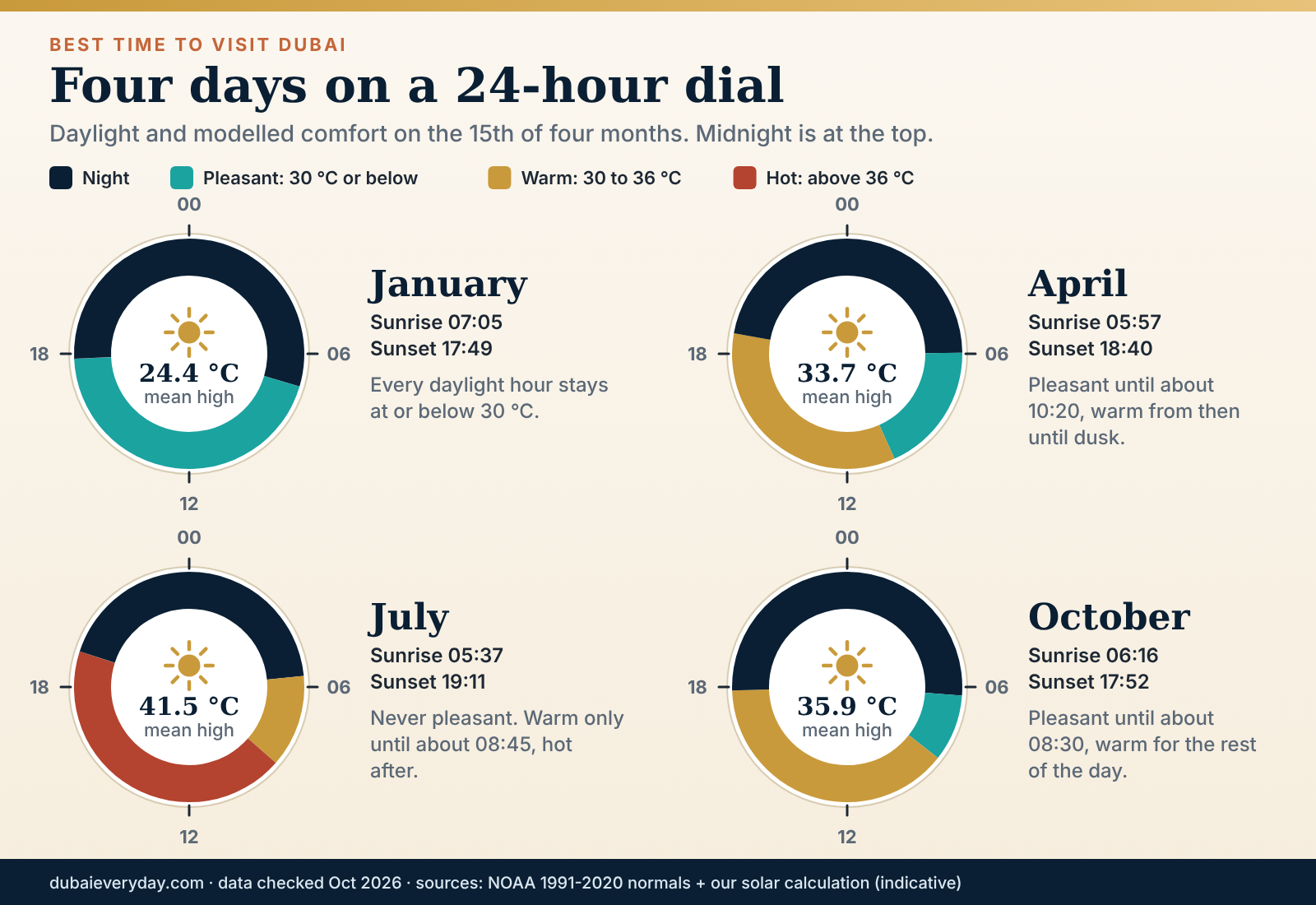
Monthly averages hide what matters most when you pick the best time to visit Dubai as a sightseer: how many hours of the day are usable. Two numbers decide it, when the sun is up and how hot it is while it is up. We combined them. The sunrise and sunset times in the table are our calculation for central Dubai on the 15th of each month, using a standard solar-position method and rounded to the minute. They are not an official almanac.
The three right-hand columns come from a deliberately simple model: a smooth day curve between NOAA’s mean low (at about 3 am) and mean high (at 3 pm) for each month, counting the daylight hours when the air temperature stays at or below 30 °C, 33 °C and 36 °C. It ignores humidity, wind, cloud, shade and the fact that real days are not average, so use it to compare months, not to forecast a day.
| Month (15th) | Sunrise | Sunset | Daylight (h) | Hours at or below 30 °C | At or below 33 °C | At or below 36 °C |
|---|---|---|---|---|---|---|
| January | 07:05 | 17:49 | 10.7 | 10.7 | 10.7 | 10.7 |
| February | 06:54 | 18:12 | 11.3 | 11.3 | 11.3 | 11.3 |
| March | 06:29 | 18:27 | 12.0 | 12.0 | 12.0 | 12.0 |
| April | 05:57 | 18:40 | 12.7 | 4.4 | 8.9 | 12.7 |
| May | 05:34 | 18:55 | 13.4 | 2.0 | 4.0 | 6.6 |
| June | 05:28 | 19:09 | 13.7 | 0.8 | 2.9 | 4.8 |
| July | 05:37 | 19:11 | 13.6 | 0.0 | 0.7 | 3.1 |
| August | 05:52 | 18:55 | 13.0 | 0.0 | 0.1 | 2.6 |
| September | 06:04 | 18:24 | 12.3 | 0.0 | 2.1 | 4.3 |
| October | 06:16 | 17:52 | 11.6 | 2.3 | 4.5 | 11.6 |
| November | 06:35 | 17:31 | 10.9 | 6.8 | 10.9 | 10.9 |
| December | 06:56 | 17:31 | 10.6 | 10.6 | 10.6 | 10.6 |
Our calculation. Sunrise and sunset from a standard solar algorithm for 25.20 N, 55.27 E, UTC+4. Temperature hours from NOAA 1991 to 2020 monthly highs and lows with a sinusoidal day curve peaking at 15:00. Indicative only.
Reading the daylight table
The first thing to notice about the best time to visit Dubai is the cliff between March and May. In March the whole day, all twelve hours, stays at or below 30 °C by this model. By May only about two hours do, and by July none. The second thing is how the comfortable window moves: in the shoulder months it is a morning window. In April, the model keeps the air at or below 33 °C until about 1 pm and again after about 5 pm. In October, until about 10:45 am.
The third point is the least obvious. In July the model has the air still above 36 °C from about 8:45 am to sunset, and at sunset it is still near 38 or 39 °C. “Go out after dark” is true in the sense that the sun is gone, not in the sense that it is cool. That is why Dubai’s summer outdoor life relies on air-conditioned malls, indoor attractions and pools.
Using the window to plan a day
In the cool season, plan the day around the light, not the heat. Sunset is early (about 17:30 in November and December), so outdoor sightseeing has to finish by late afternoon if you want daylight photographs. In April and October, put anything walking-heavy in the first four hours after sunrise. From May to September, treat the outdoors as a before-breakfast activity and schedule everything else under a roof. The morning desert safari exists for this reason, and the evening desert safari works best in the cool months, when the dunes are not holding the day’s heat.
Month by month: what each month gives you and costs you
Read this section as a month-by-month answer to the best time to visit Dubai question. The pills under each month are our reading, not official ratings: weather is about comfort outdoors, crowds about people on the ground, and price about hotel-rate pressure. Dates for 2026 and 2027 events are as reported on 29 October 2026 and can move, so use them to understand the shape of the month, then confirm anything you will rely on. For a dated list, the Dubai events calendar is the better place.
January: the best weather, with a festival hangover
Weather: excellentCrowds: busy early, moderate laterPrice: high
January has the lowest temperatures of the year (24.4 °C mean high, 15.3 °C mean low), about 21 mm of rain, and the coolest sea apart from February at around 20.8 °C. Sunrise is about 07:05 and sunset about 17:49, so the usable day is short. Winter morning fog can delay flights and driving, according to Smartraveller. For people who want to walk, cycle or sit outside for hours, this is the month to beat when choosing the best time to visit Dubai.
The first three days are the tail of the school winter break (14 December 2026 to 3 January 2027 on the calendar reported by Gulf News) and are priced accordingly. After that the Dubai Shopping Festival keeps going until 17 January, the Dubai Marathon is on Sunday 17 January, the Hero Dubai Desert Classic golf runs 21 to 24 January, and the Burj2Burj half marathon is on 24 January. The Dubai events in January guide covers each, and the golf courses guide covers where to play.
On cost, AGBI’s July report on Accor’s outlook gave the average city room rate as about AED 775 in January 2026, without naming its source, against a 2025 full-year average of AED 579. That is one data point rather than a series, but it matches the idea that January is expensive. Our reading: if January is your best time to visit Dubai, aim for 5 to 15 January or the last week of the month, avoiding race and golf weekends if you are price-sensitive.
February: great weather, but Ramadan lands on it in 2027
Weather: excellentCrowds: moderatePrice: high outside Ramadan
February averages a 26.1 °C high and a 16.4 °C low, with the lowest sea temperature of the year at about 20.6 °C and about 10 mm of rain. In an ordinary year it would sit among the top three or four contenders for the best time to visit Dubai. In 2027 it is complicated by Ramadan, which is expected to start on about 8 February (the UAE Astronomy Centre’s projection, subject to moon sighting). That would put roughly 21 of February’s 28 days inside the fasting month.
Ramadan does not close Dubai. Hotels, malls and tourist sites operate, evenings are lively, and some travellers choose the month for exactly that. What changes is daytime dining, music and opening hours, plus a conduct code for eating and drinking in public. We cover the trade-off in the events section and the rules in the Dubai etiquette guide.
Sports fans get a full month: the Dubai Duty Free Tennis Championships (14 to 27 February), the men’s UAE Tour (15 to 21 February) and cycling races earlier in the month, all from the Dubai Sports Council list reported by TradeArabia. The Dubai events in February page goes through them. If your dates are fixed in February and you want an ordinary daytime schedule, the first week (1 to 7 February) is the cleaner slice.
March: the last comfortable month
Weather: very goodCrowds: event-drivenPrice: medium to high
March is the last month in which the whole day is usable: by our model, all twelve daylight hours stay at or below 30 °C. The mean high is 28.9 °C, the mean low 18.6 °C, rainfall about 22 mm, and the sea starts to warm at about 22.3 °C. Sunrise is 06:29 and sunset 18:27 on the 15th, so the days are lengthening.
In 2027 the month starts inside Ramadan, which is expected to end around 8 or 9 March, with Eid Al Fitr expected on 9 or 10 March and a public holiday of three or four days that can stretch longer if the government bridges it with a weekend. Gulfood, the trade show, is listed for 15 to 19 March, and the Dubai World Cup meeting is on Saturday 27 March. Business events like Gulfood press on hotel availability in the Trade Centre district, and race day is a one-off.
Our reading is that 12 to 26 March 2027 could be an unusually good fortnight and a strong candidate for the best time to visit Dubai in 2027, with Ramadan finished, spring break not yet begun (5 to 11 April), and temperatures still comfortable. Its two risks are the Gulfood hotel squeeze and the Eid dates moving by a day or two.
April: the underrated shoulder
Weather: warm to hotCrowds: spring-break spikePrice: medium
April averages 33.7 °C by day and 22.3 °C at night, with almost no rain (about 3 mm) and a sea of about 25 °C. By our model about nine daylight hours stay at or below 33 °C, which is why mornings and evenings in April still feel good. UV index values are in the 11-plus range from this month, so sun protection stops being optional. Sunrise is about 05:57 and sunset about 18:40.
The spring break reported for 2027 runs 5 to 11 April, and Western Easter falls on 28 March, so the first half of the month can be busy with families. Our reading: 12 to 30 April is the part of the month most likely to combine decent weather with lighter demand, and it is the last stretch before the heat becomes a main character. Hatta’s activity season ends in early May according to the Hatta tourism site, so a day trip to the mountains is easier in April than later.
April suits travellers who want the beach and pool more than they want to walk around, which makes it a niche pick for the best time to visit Dubai: the water is warm enough, the days are long, and the prices are usually off the winter peak. It is a weaker fit for first-timers who plan a full sightseeing day on foot.
May: the heat settles in
Weather: hotCrowds: lightPrice: falling
May is the sunniest month in the NOAA series, at about 350 hours, with a mean high of 38.2 °C and a mean low of 26.1 °C. The model has only about four daylight hours at or below 33 °C.
Global Village and Dubai Miracle Garden, two of the cool season’s biggest outdoor draws, finish their current seasons around the end of the month (Miracle Garden’s current season is listed to 31 May 2027; Global Village’s last season ran to 31 May 2026 after an extension), so early May is the last good chance for them, and the closest May gets to the best time to visit Dubai.
Eid Al Adha is expected around 15 to 18 May 2027, with Arafah Day on the 15th or 16th and the holiday moving with the moon. Eid weeks fill hotels with regional travellers even in hot weather, so the “May is cheap” assumption can fail on those dates. The weeks either side of Eid are the safer bet if price is your reason for coming.
June: the start of true summer
Weather: very hotCrowds: lightPrice: low
June averages 40.0 °C by day and 28.0 °C at night. The sun is almost overhead at noon (our calculation: about 88 degrees), daylight lasts nearly 13.7 hours, and the sea is about 30.7 °C. Short bursts outdoors are manageable, but the model leaves under one hour a day at or below 30 °C and under three at or below 33 °C. The statutory midday outdoor-work ban starts on 15 June.
June is also when many residents leave. School terms end, families go abroad, and the visitor mix shifts towards regional travellers. Islamic New Year is expected around 5 to 7 June 2027. If you come in June, shape the trip around hotel facilities, shopping malls and indoor attractions; the indoor things to do in Dubai list is built for this.
July: record heat, record tolerance needed
Weather: extremeCrowds: light in the city, heavy at the airportPrice: lowest
July’s mean high is 41.5 °C and the mean low 31.2 °C. Dubai’s record high of 49.0 °C in the Dubai Meteorological Office series was logged in July. The sea sits around 32.2 °C. By our model there is under an hour at or below 33 °C and about three hours at or below 36 °C, all of it just after sunrise. There is nothing subtle about this month, and nobody should call July the best time to visit Dubai for sightseeing.
The paradox is the airport. Dubai Airports reported about three million guests in the first 15 days of July 2026, with daily numbers above 200,000 and about half of them transfer passengers. A packed terminal in July says little about a crowded city. Our reading is that it reflects residents flying out and connecting traffic, while the city itself is at its quietest. And the Dubai Summer Surprises campaign (2 July to 30 August in 2026; the 2027 dates are not announced) is the official attempt to give indoor visitors a reason to come.
August: cheapest, but not empty
Weather: extremeCrowds: light to moderatePrice: low
August is the hottest month on average (41.9 °C high, 31.5 °C low) and has the warmest sea (about 32.8 °C). Its reputation for being empty is only partly deserved. Reporting on the city’s August 2026 figures says hotel occupancy was 66%, which was 89% of the August 2025 level. Our back-calculation: 66 divided by 0.89 gives roughly 74% for August 2025, against 80.7% for 2025 as a whole. In other words, even the deadest month of 2025 ran at about nine-tenths of the annual average occupancy.
That suggests even the cheapest answer to the best time to visit Dubai question is not empty, and that the summer discount comes more from rates than from vacant rooms, which is relevant if you expect to bargain. The back-to-school return also loads the airport: Dubai Airports counted more than 3.6 million guests across 13 to 25 August 2025. Prophet Muhammad’s birthday holiday is expected on or around 14 August 2027, subject to confirmation.
September: the cheap window closes
Weather: very hotCrowds: lightPrice: low, rising late
September’s mean high is 39.5 °C, mean low 28.9 °C, and the sea is a still-warm 31.9 °C. The summer midday outdoor-work ban ends on 15 September. Daylight is shrinking (sunrise 06:04, sunset 18:24 mid-month), so evenings get a little longer in practical terms, even though the air temperature barely moves.
Several seasonal attractions begin to restart, a useful signal that the trip calendar is moving: the ninth season of Hatta Wadi Hub reopened on 28 September 2026 and balloon flights over the desert are listed by one operator as running September to May. The Arabian Travel Market trade event was moved to 14 to 17 September in 2026, according to Gulf News, so check whether a trade fair sits on your dates. Our reading: late September is a bargain only if you accept 39 °C afternoons, and it is not the best time to visit Dubai for anything outdoors.
October: the month Dubai restarts its outdoor life
Weather: hot, easingCrowds: buildingPrice: medium, rising
October averages 35.9 °C by day and 25.4 °C by night, with about 1.5 mm of rain, UV still in the high bands and a sea of about 29.7 °C. By our model, about 4.5 daylight hours stay at or below 33 °C, almost all of them before 11 am. The first half of the month feels like a long September and the second half starts to behave like autumn.
The calendar tells you the season has turned. In 2026, Dubai Miracle Garden’s 15th season began on 8 October, Dubai Parks and Resorts reopened on 7 October, Dubai Safari Park opened its season on 12 October and Global Village’s 31st season opened on 14 October. Combine a swimmable sea with these reopenings and late October can be a good choice for a pool-and-beach trip with a few outdoor evenings. It is a weaker choice for a long walking itinerary at midday, so October is a conditional answer to the best time to visit Dubai.
November: our pick for the best time to visit Dubai on a first trip
Weather: very goodCrowds: moderatePrice: medium to high
November is the best time to visit Dubai for a balance of comfort and warm water. The mean high is 30.7 °C, the mean low 21.1 °C, rain about 6 mm, and the sea about 27.1 °C, which is the warmest the Gulf is while the air is also comfortable. By our model, nearly all of the 10.9 daylight hours are at or below 33 °C, and about seven are at or below 30 °C. Sunrise is around 06:35 and sunset around 17:31.
The calendar is full without being festival-level crowded: the Dubai Fitness Challenge runs 31 October to 29 November 2026, Dubai Ride is on Sunday 1 November, the DP World Tour Championship is on 12 to 15 November, Dubai Run is on 22 November (Sheikh Zayed Road closes to cars for the morning), and the Emirates Dubai 7s runs 27 to 29 November. The racing season at Meydan starts on 6 November. Those are demand bumps on specific weekends, not a month-long squeeze.
Our reading is that the stretch from about 8 to 26 November is the best-value slice of the whole year and the single best time to visit Dubai for a first visit: warm sea, comfortable days, no school break, and the Shopping Festival still two to three weeks away. The risks are the Dubai 7s weekend if you want a quiet hotel, and the 30 November to 3 December National Day holiday cluster, which the 2026 retail calendar calls Eid Al Etihad and which may bring regional visitors.
December: perfect weather, peak prices
Weather: excellentCrowds: very busy from mid-monthPrice: peak
December has a 26.5 °C mean high, 17.4 °C mean low, about 15 mm of rain and a sea of about 23.3 °C. Sunrise is about 06:56 and sunset about 17:31, so there are less than 11 hours of light. Dubai’s tourism data show the effect of all that good weather: December 2025 was the first month in which more than two million international visitors stayed in the emirate, and Dubai International had its busiest month of 2025, at 8.7 million passengers.
The month has two halves. Up to about 13 December you get comfortable weather and the start of the Dubai Shopping Festival (4 December 2026 to 17 January 2027), the National Day holiday (expected 2 and 3 December) and the GITEX technology show (listed for 7 to 11 December, though an August trade-centre release printed different dates for part of it).
From 14 December, school winter breaks begin, flights fill, and New Year’s Eve demand follows. Our reading: December is the best time to visit Dubai for weather and the worst for prices, and for the same weather at less pressure you should choose 1 to 13 December over 20 December to 2 January.
The three-line verdict. The best time to visit Dubai for weather and warm sea together is November. For weather alone, at the highest pressure, it is 14 December to 3 January. The lowest price, with the most compromise, is June to September. Everything else is a trade between these.
A one-paragraph scorecard of the year
If you want a scorecard for the best time to visit Dubai, here is ours in prose. November, March (after Eid) and the first half of December score best across all six tests. January and the second half of December win on weather but lose on price and crowds. February would be in the top group in a normal year and is complicated in 2027 by Ramadan.
April and October are good for beach-and-pool trips and mediocre for walking. May is a shorter version of summer, with a hotel discount. June to September is for travellers who have decided that heat is the price of a cheap, quiet city.
Crowds and hotel prices: how demand moves through the year
Hotel prices in Dubai follow the same shape as the weather, upside down: when it is comfortable outside, rooms cost more. That tension is why the best time to visit Dubai is never only a weather question. The detail is where it becomes useful. We did not find a published month-by-month occupancy series for 2025 or 2026, so the evidence is a set of snapshots, which we assembled into one picture.
What the snapshots say
For 2025 as a whole, Dubai recorded 19.59 million international overnight visitors, average hotel occupancy of 80.7%, an ADR of AED 579 and RevPAR (revenue per available room) of AED 467, across about 154,000 rooms in 827 establishments. December alone passed two million visitors. January 2025 had about 1.94 million. Western Europe was the largest source market at 4.1 million, and the average stay was 3.7 nights.
For 2026, the pattern is distorted by the conflict. March occupancy averaged about 36%, the low point, and August recovered to 66%. Cavendish Maxwell’s half-year data put luxury hotels at 51.2% occupancy and the upper-midscale segment at 65.7%, with luxury rates down 6.2% on the year but still the highest. The luxury and upper-upscale tiers took the biggest occupancy drops, while the upper-midscale tier held up best on occupancy.
The Accor view quoted earlier says weekends have been strong and weekdays weak. That is a useful reminder that in a hotel city, the day of the week can matter as much as the month, especially in a recovering market. If you have flexibility, test midweek nights against weekends when you search.
Why the numbers are hard to compare
One report relaying Dubai government data, which we did not read directly, put the January to August 2026 ADR near AED 470, while Cavendish Maxwell’s first-half figure is AED 701 and the January 2026 city average in the AGBI piece is AED 775. These come from different datasets, with different definitions of ADR and different hotel samples, and they do not reconcile. Our conclusion: use them to see direction when judging the best time to visit Dubai, not to price a trip.
A fair question is whether 2025’s pattern will return. Accor’s executive expected volumes in the fourth quarter and fuller price recovery by the second quarter of 2027. Cavendish Maxwell forecast a full-year 2026 ADR of AED 600 to 675. Neither is a guarantee, and both are forecasts by firms with a stake in the answer. What we can say is that the next few months are likely to be priced more softly than a normal winter at the margins, and that the school break and New Year’s Eve are the least likely dates to be soft.
The sweet-spot map
To compare months on one picture we plotted each month’s mean high temperature, which is verified, against our reading of how much booking pressure it carries, which is judgement. The y-axis has no numbers on purpose. The shape is the useful part: pressure and comfort rise together until the shoulder months, then comfort falls faster than pressure does.
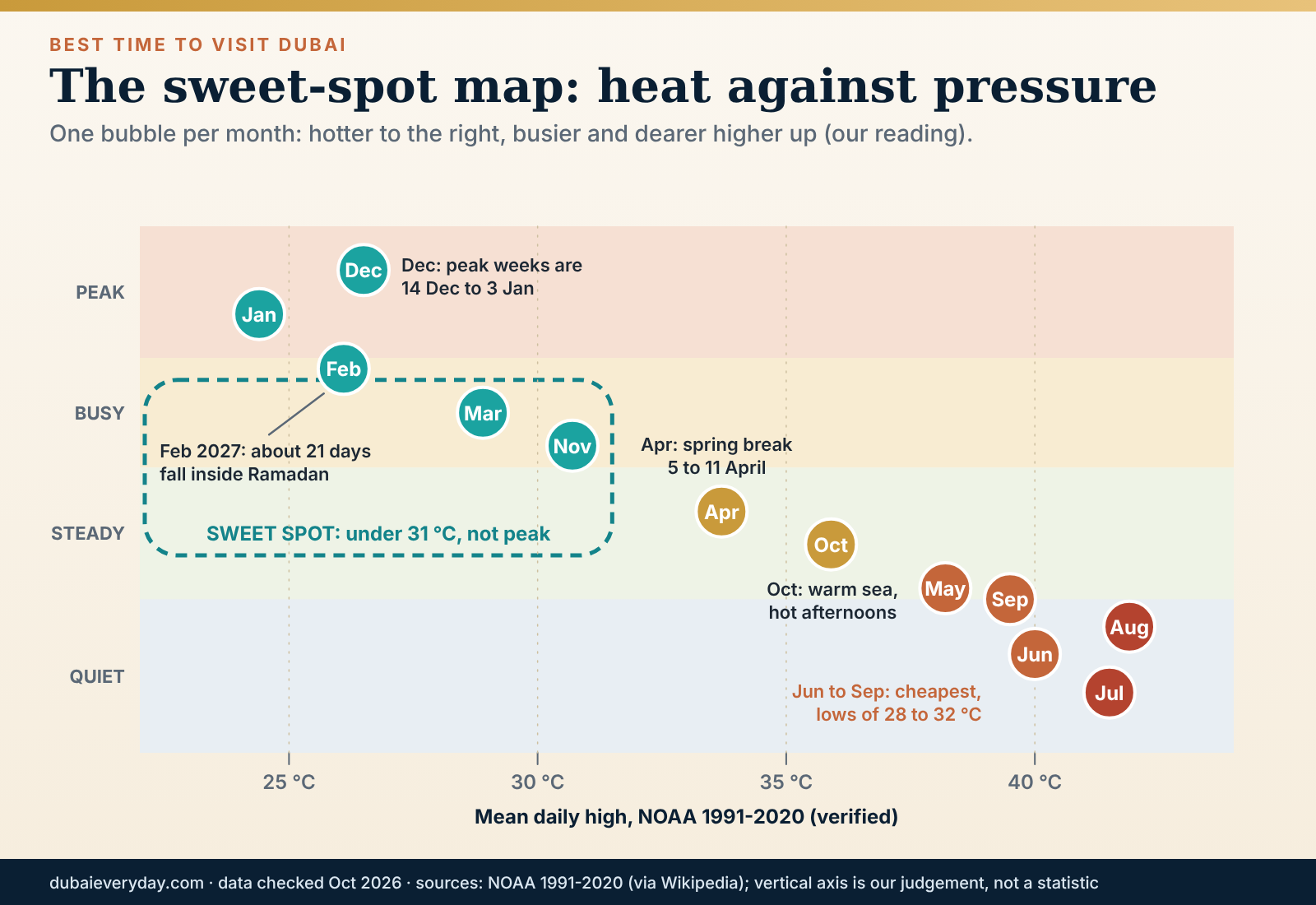
On this map the sweet spot, our best time to visit Dubai in a normal year, is the zone where temperature is under about 31 °C and pressure is “steady” rather than “peak”. In a normal year that points at November and March; the map shows December and January sitting just above it on pressure, and April sitting just beyond it on heat. If you must go in a peak month, the hotels guide on how to choose a Dubai hotel and the best budget hotels in Dubai help you spend flexibility where it counts.
Events, holidays and Ramadan: dates that move the best time to visit Dubai
Weather sets the season; dates set the price, and event dates can move the best time to visit Dubai more than the weather does. A fortnight of school holidays can add more pressure than the difference between January and March. The Dubai events calendar keeps the full dated list, and this section only picks out the dates that change when you should go.
The Dubai Shopping Festival and the winter stack
The 32nd Dubai Shopping Festival is listed for 4 December 2026 to 17 January 2027, 45 days, according to Visit Dubai and TradeArabia. The previous edition ran 5 December 2025 to 11 January 2026, 38 days. In practice the festival overlaps the school winter break and New Year’s Eve, which is why December and early January are expensive.
If you want the sales and the shows without the highest hotel prices, the 7 to 17 January stretch is the part of the festival that falls after the holiday break. See the Dubai shopping guide for how the discounts actually work.
School calendars and public holidays
School calendars drive family travel, both inbound and outbound. The reported 2026 to 2027 breaks are the winter break from 14 December 2026 to 3 January 2027 and a spring break from 5 to 11 April 2027. Those dates were reported for the unified Ministry of Education calendar; individual schools can differ by days, so families should check with their own school.
Public holidays in the UAE are announced by the Cabinet, and Islamic holidays depend on moon sighting. The dates below are press expectations as of 29 October 2026, not confirmed decisions.
- National Day: expected Wednesday 2 and Thursday 3 December 2026; the authorities can move holidays to create a longer weekend.
- New Year’s Day: Friday 1 January 2027.
- Eid Al Fitr: expected from about 9 March 2027, for three to four days, and sometimes extended with a weekend.
- Arafah Day and Eid Al Adha: about 15 to 18 May 2027.
- Islamic New Year: about 5 to 7 June 2027, depending on the month starts.
- Prophet’s Birthday: about 14 August 2027.
Our reading of those dates: the most disruptive for a visitor are the Eid breaks, when residents travel, domestic and regional tourists fill hotels, and attractions run to busy-day crowds. The least disruptive are the one-day holidays in summer.
Sports and trade events
Big events shift room supply more than they shift the headline crowd. The ones that matter for timing in the next twelve months are the DP World Tour Championship (12 to 15 November 2026), the Emirates Dubai 7s (27 to 29 November), the Hero Dubai Desert Classic (21 to 24 January 2027), the Dubai Duty Free Tennis Championships (14 to 27 February), Gulfood (15 to 19 March) and the Dubai World Cup (Saturday 27 March).
Business-heavy events such as GITEX Global (listed for 7 to 11 December 2026) tend to compete with leisure travellers for rooms near the trade centres. The next Dubai Airshow is listed for 15 to 19 November 2027 at Dubai World Central.
If you are not going for an event, avoid its weekend, since event weekends are rarely the best time to visit Dubai for a quiet stay; if you are, book the hotel before the tickets. The Dubai sports guide and the golf courses guide give the venue side.
A twelve-month window finder, 2026 to 2027
Putting the dates, the climate and the demand pattern together, here are the windows we would flag as the best time to visit Dubai over the next year. They are our reading, built from the dates above, not a forecast of prices.
8 to 26 November 2026
Warm sea, comfortable days, no school break, festival crowds still ahead. Watch the 7s weekend (27 to 29 November) and the 2 to 3 December National Day holiday.
1 to 13 December 2026
Excellent weather and the start of the Shopping Festival, but GITEX week and National Day pull in business and regional visitors. Book early.
14 December to 3 January
Peak weather, peak price, peak crowds. Choose it for the festive atmosphere, not for value.
25 January to 7 February 2027
After the golf and marathon weekends and before the expected start of Ramadan. Our reading: a quieter slice of the cool season, though no source confirms it.
12 to 26 March 2027
Ramadan is over, spring break has not begun, and the air is still comfortable. Gulfood (15 to 19 March) is the pressure point.
12 to 30 April 2027
Warm to hot, lighter on crowds and often lighter on price. Best for pool-and-beach trips.
Ramadan 2027: a trade-off, not a barrier
Ramadan is expected to begin about 8 February 2027 and last 29 or 30 days, with Eid Al Fitr on about 9 or 10 March. The Islamic calendar moves roughly 10 to 11 days earlier against the Gregorian one each year, so the fasting month will sit in the cool season for several years. That is a real change: in the mid-2010s Ramadan fell in the hottest months, and since about 2023 it has landed in the cooler ones.
What does it change for a visitor? The UK FCDO advises visitors not to eat, drink, smoke or chew gum in public during daylight hours in Ramadan, including in a car. It also advises avoiding loud music, dancing and swearing in public, and notes that hotels and restaurants that serve food in daylight may screen their dining areas. Dress matters more, and working hours for private-sector employees are cut by two hours a day under UAE labour law, which affects opening times for offices and services.
The trade-off looks like this. You lose the easy daytime lunch, some daytime entertainment, and the ability to snack as you walk. You gain evening life built around iftar and late nights and a different atmosphere. Hotel pricing in Ramadan is a gap in our research: we found no data, so do not assume a discount. Whether that makes Ramadan the best time to visit Dubai or the worst depends on what you want from the trip.
It suits visitors who are curious about local culture, fine with dining after sunset and able to adapt; it is a poor fit for visitors with young children who need frequent snacks, or a trip packed with daytime restaurant bookings. The Dubai etiquette guide and the Dubai dress code page set out the conduct rules, and the Ramadan section of the hotels guide covers practical checks.
The days around Eid Al Fitr are the opposite of quiet. Public holidays, festive crowds, higher demand for hotels and restaurants, and heavier traffic mean that the last days of Ramadan and the first days of Eid are the worst dates in the Islamic calendar for a visitor who values calm. Book flights and rooms early, or avoid the 8 to 12 March 2027 stretch altogether.
What opens and closes with the seasons
Many of Dubai’s best-known outdoor attractions run only in the cool season, so the best time to visit Dubai also depends on the list of things you want to do. The picture below pulls the 2026 to 2027 season dates we could verify into one view. Where a closing date has not been announced, the ribbon fades out rather than guessing.
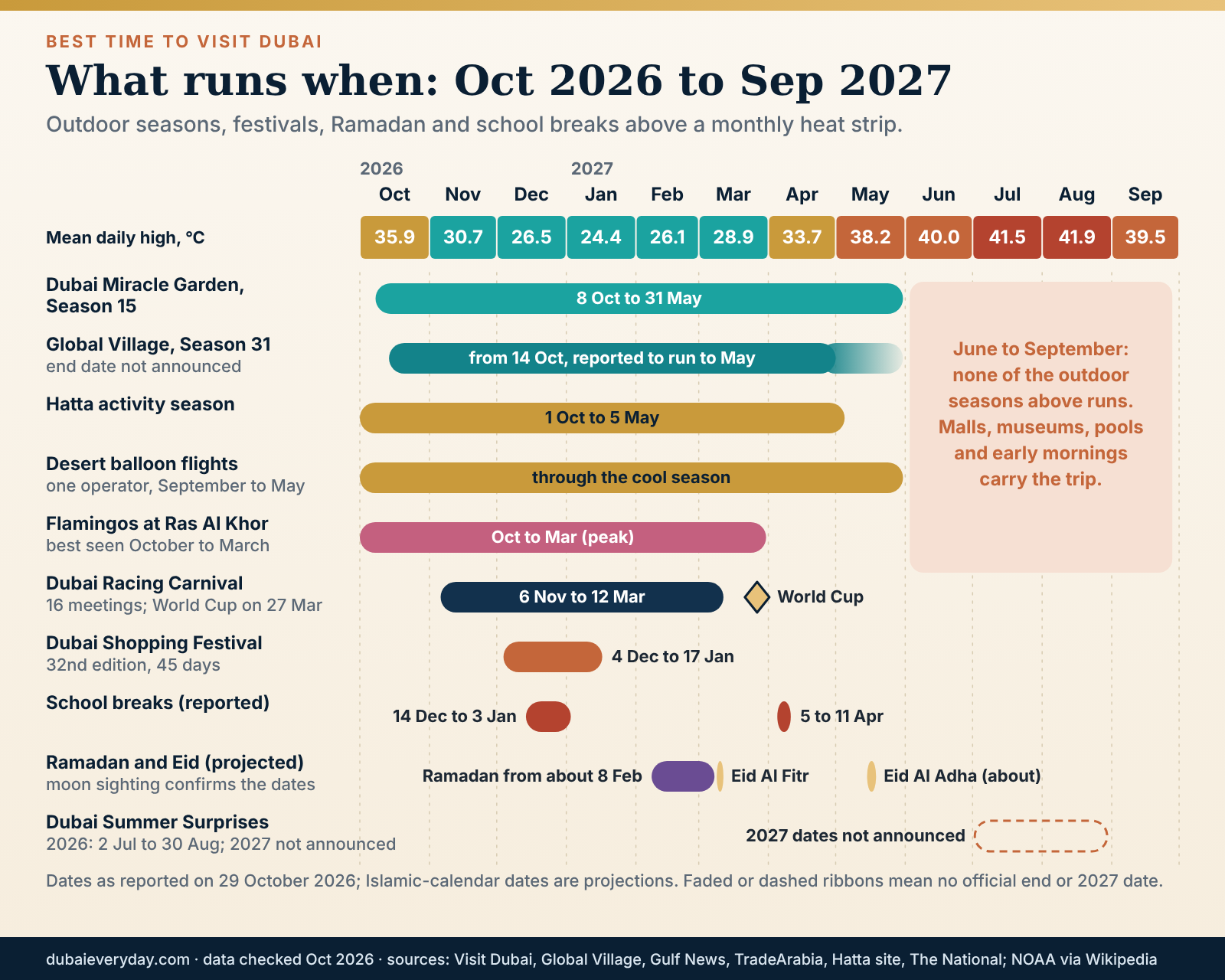
The outdoor season: roughly October to May
Dubai Miracle Garden’s 15th season runs from 8 October 2026 to 31 May 2027. Global Village’s 31st season opened on 14 October 2026 and is expected to run to May 2027, without an official end date yet; entry was reported at AED 25 on weekdays and AED 30 on any day.
Hatta’s activity season runs from 1 October to 5 May, according to the Hatta tourism site, and Hatta Wadi Hub reopened for its ninth season on 28 September. Balloon flights are listed by one operator as running September to May. Flamingos at Ras Al Khor are best seen between October and March, according to Emaar’s blog. Public parks cost AED 0 to 5, according to Gulf News.
The things to do in Dubai guide covers each attraction in more depth. The point here is the inverse: if your trip is in June, the outdoor half of that list is simply not available, and what remains is shopping, indoor family attractions, museums, dining and the hotel pool.
What stays open all summer
A summer trip has to be built from this list, because summer is not the best time to visit Dubai for outdoor sights. Indoor attractions such as malls, aquariums, indoor ski slopes, indoor theme parks and museums operate year-round, though the Museum of the Future is closed for now.
Beaches stay open too, but midday use in summer is rarely wise. The sea is about 30 to 33 °C from June to September, which is pleasant to wade in and not very refreshing. A shaded or hotel pool with cooling or an evening swim are the realistic summer options, and the best beaches in Dubai and public beaches guides cover which sand suits which season.
Desert trips also adapt. Morning and evening safaris continue in summer with earlier pickups; one listing says summer pickups are an hour earlier than winter. The same listing’s earlier summer start tells you that operators plan around the heat. For a look at the operators and the format, see the desert safari comparison.
Best time to visit Dubai by traveller type
The best time to visit Dubai for a honeymoon is not the best time for a family on a school calendar or a golfer chasing a tournament. The recommendations below are our reading of the climate, calendar and market data above. They are not field-tested, and every one is a trade-off.
Best time to visit Dubai for first-timers who want to see the city
Choose the second half of November, early December before the 14th, or mid-March after Eid. These are the dates when the Old Dubai walks, the Creek, the beach promenades and the desert are comfortable and the crowds are workable. Avoid the festive fortnight unless the atmosphere is the point. The first time in Dubai guide has the arrival-to-bookings sequence, and the Dubai travel guide is the umbrella planning page.
Couples and honeymooners
For most couples, the best time to visit Dubai is decided by weather and sea more than by events. Late October to November gives a warm sea and evening terraces; January to early March gives crisp air but a sea of only 20 to 22 °C, so the pool will matter. Peak-season prices apply at the best resorts, and the Burj Al Arab is closed for restoration until October 2027, according to Gulf News. The best luxury hotels in Dubai page covers what the premium buys, and the Palm Jumeirah guide covers the resort-island option.
Best time to visit Dubai with school-age children
Families are usually locked into school holidays, so the best time to visit Dubai becomes a narrower question: which holiday? The winter break (14 December to 3 January) has the best weather and the highest prices. The spring break (5 to 11 April) is a good compromise on both. Summer holidays are cheap and hot, and need an indoor-first plan.
For travelling with little ones, the Dubai with kids and Dubai with a baby guides cover strollers, shade, feeding and heat. Children and heat do not mix well: July and August temperatures are a reason to cap outdoor time hard, not to push through.
Best time to visit Dubai for beach and pool trips
The air-and-water sweet spot is late October to mid-December, and again April to early May, when the sea is 25 to 28 °C and the air is hot but not punishing. From January to March the Gulf is 20 to 22 °C, which most swimmers find cool; from June to September it is over 30 °C, which feels like a warm bath. The family beaches and best beaches in Dubai pages sort the sand by facilities.
Desert, dunes and outdoor adventure
For the desert, the best time to visit Dubai is November to March, with cool mornings and evenings and a desert that is not holding the sun’s heat. Hatta’s activity season runs October to early May and balloon flights September to May, so shoulder-month trips can still include them. Our reading is that a desert safari in summer is a risk-management exercise (hydration, early pickups, vehicle air conditioning) rather than a highlight. Read the desert safari comparison for the format options.
Shopping and dining
For shoppers the best time to visit Dubai is a choice between festival crowds and summer promotions. The Dubai Shopping Festival (4 December to 17 January) concentrates sales and entertainment, while Dubai Summer Surprises (2 July to 30 August in 2026) concentrates promotions for a quieter city. Neither is a guarantee of lower prices on a specific product, so compare against your home price first. The shopping guide covers tourist VAT refunds, and the Michelin restaurants page covers booking pressure for top tables, which rises in the cool season.
Golf, running and sport
The best time to visit Dubai for sport is a cool-season story: the Marathon on 17 January, the Desert Classic on 21 to 24 January, the tennis in February, and the World Cup meeting on 27 March. Plan accommodation first; event weekends squeeze the hotels closest to the venues.
Older travellers and anyone with a medical condition
December to February is the best time to visit Dubai for older travellers. Heat is a health factor, and the gap between a 26 °C and a 41 °C afternoon is bigger for people with heart, lung or kidney conditions, and for those on medicines that affect fluid balance. Ask your own doctor and read the heat guidance in the heat section. Make sure insurance covers pre-existing conditions and evacuation, since Smartraveller notes tourists pay for medical care in the UAE.
Business travellers and stopovers
For business travellers, trade-show calendars shape the best time to visit Dubai more than weather does, because they decide your hotel price. GITEX in December, Gulfood in March and the Airshow in odd-numbered Novembers all squeeze supply. For stopovers, Emirates’ own Dubai Connect programme offers eligible long connections a hotel and a visa, according to the airline’s page, though the page contradicts itself on the booking deadline; see the Dubai airport guide before relying on it.
Pick your month in four questions
If the sections above feel like a lot, the diagram below turns them into four questions. Start at the top, answer honestly, and it lands on a month range. It is a simplification, so read the month section before booking.
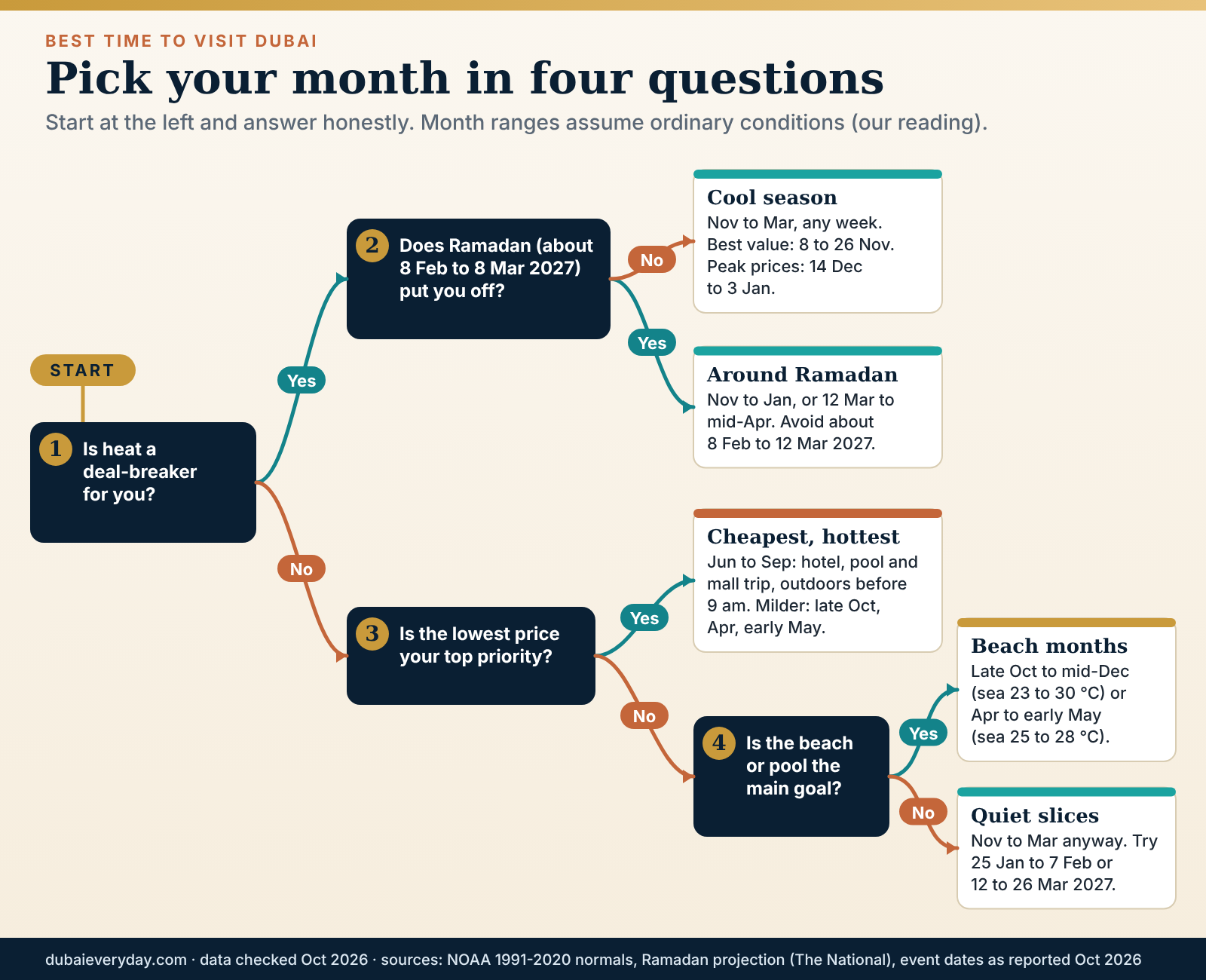
The logic behind each branch is the same as the rest of the page, and the flow answers “what is the best time to visit Dubai for me?” rather than “for everyone?”
If heat is a deal-breaker, you are in November to March by default. If cost is the main constraint and you can live with heat, you are in June to September or the shoulder months. If you need the beach, the sweet spot sits at the edges of the cool season. If Ramadan is a problem for your plans, avoid roughly 8 February to 12 March 2027 and choose the other half of the winter.
The cheapest time to visit Dubai, and what cheap really costs
The cheapest rooms are in June to September, when average highs are 40 °C and above. That is not the same thing as the best value, and it is rarely the best time to visit Dubai for a first-timer, because cheap rooms come with a trip that has fewer options. The calculation below shows how much the room-rate gap matters once fees are added, and then what you give up for it.
Worked example: one room, two seasons
Illustrative example (not a quote or market fact). Imagine the same four-star room at AED 400 a night in August and AED 900 a night in December. We use Dubai’s published fee structure as reported: a 10% service charge, a 7% municipality fee on the room rate, 5% VAT on the subtotal, and a Tourism Dirham that we assume at AED 10 per room per night (the published range is AED 7 to 20, and we did not confirm which grade pays what).
In that order, AED 400 becomes 400 + 40 + 28 = 468, plus VAT of 23.40, plus AED 10, so about AED 501 a night. AED 900 becomes 900 + 90 + 63 = 1,053, plus VAT of 52.65, plus AED 10, so about AED 1,116 a night. Over five nights the gap is about AED 3,070.
The order of charges and the Tourism Dirham amount are our assumptions, and a May 2026 relief package reportedly exempted DET-registered establishments from collecting the Tourism Dirham and some sales fees, with no end date found. Ask the hotel for an all-in price. The point stands without the exact figures: the fees add about a quarter to the headline rate, so the gap between seasons grows in absolute terms.
What the saving costs you
The summer saving is real, and so are the substitutions. You will take taxis for distances you might have walked; the airport taxi start fare is AED 25 and the metered minimum is AED 12 to 13, so a few short rides add up. You will spend more on indoor entertainment, because the free outdoor options (beaches, parks, promenades, walks) are largely unusable at midday. Many of the cool-season highlights are closed. And your itinerary will be shorter by hours each day. The free things to do in Dubai list is mostly a cool-season list for that reason.
Cheaper without going to summer
Four levers bring a cheaper best time to visit Dubai without going in August, and they cost less comfort. Shift your dates a week away from school breaks. Choose weeknights over weekend nights, since Accor’s executive said weekday occupancy is where the weakness is. Take the shoulder months: late October, April, and the first half of May. And book a free-cancellation rate early, then watch the price. The best budget hotels in Dubai guide is built around Metro-adjacent options, which is how you avoid the taxi cost.
When to book, what to keep flexible, and what to re-check
Once you have picked the best time to visit Dubai, the next question is when to book. No official source publishes booking lead times for Dubai, so we do not claim one. What we can offer is a way of thinking about it that follows from the pattern of demand: book earliest where supply is tightest, and stay flexible where the unknowns are largest. In late 2026 the unknowns include flights and the security situation, so flexibility has more value than usual.
Book first, and keep refundable, what is hardest to replace
For the festive fortnight (14 December to 3 January) and for event weekends such as the Dubai 7s or the Desert Classic, hotel inventory near the action runs out first, and that is where an early booking pays for itself. For November, mid-March and April, you have more room to wait and watch. For summer, there is little to gain from booking early except a free-cancellation rate. Whatever the month, a refundable rate is a cheap form of insurance while flight schedules are still moving.
Flights deserve extra care. Dubai Airports’ first-half figures show about 50 international airlines operating against 108 in 2025, and press reports list suspensions into 2027 for some carriers. Check your airline’s own page and use the fare conditions, not the search result, to judge flexibility. The Dubai airport guide explains terminals and connections once the ticket is settled.
Insurance: read the exclusions before you pay
The US State Department, the FCDO and Smartraveller all tell travellers to buy insurance that matches their itinerary, activities and risks, including evacuation and cancellation. Policies differ on whether they cover cancellation because of war or terrorism, whether an advisory level changes cover, and whether events known at the time of purchase are excluded. Read the wording, not the brochure, and put the question to the insurer in writing if it matters to you. The Dubai insurance guide explains the local products, though most visitors will buy cover in their home country. This is general information, not insurance advice.
A re-check routine
Plans for Dubai age quickly. A short, repeatable routine catches most surprises. Our suggested timings below are a habit, not an official requirement.
- Eight weeks outRead your government’s travel advice again. Confirm that your airline still flies your route on your dates, and that your planned attractions are open (Museum of the Future, Burj Al Arab and several hotels are closed for now). Check whether a large trade show or sports event lands on your dates.
- Four weeks outIf your dates touch Ramadan or Eid, check the moon-sighting announcement and the Cabinet’s holiday decisions. Re-read the hotel’s cancellation terms, and ask for an all-in price including service charge, municipality fee, VAT and Tourism Dirham.
- One week outCheck the National Centre of Meteorology forecast and any weather warning, the event schedule, and attraction opening hours. Plan your outdoor hours around the sunrise and sunset times, not around breakfast.
- Day beforeCheck your flight status, your terminal and your transport. Download offline maps and keep your accommodation address and the local emergency numbers handy; the Dubai Metro guide covers the cheapest way into town.
If an alert sounds. FCDO guidance for the UAE says to follow the authorities, shelter indoors or in the nearest safe building if told to, stay away from windows where possible (an interior stairwell or a room with few outside walls may be safer), and not to approach or touch any debris. Know where your hotel’s shelter areas are before you need them. Reading this does not mean the risk is high; it means being prepared costs a minute.
Mistakes that spoil the timing
Most disappointing Dubai trips trace back to a handful of errors in choosing the best time to visit Dubai. They are listed here from the most expensive to the easiest to fix.
Choosing summer for sightseeing because the room is cheap
A low rate buys a pool, a mall and a short list of outdoor hours. If you want old-town walks, the Creek or a desert day, the saving is a false economy.
Ignoring the school break
Dates that look flexible are priced as peak when they sit inside 14 December to 3 January or the April break. A shift of a few days can matter more than a change of month.
Booking Ramadan by accident
With the month expected to start about 8 February 2027, a “February trip” is mostly a Ramadan trip. It can be good, but only if you chose it.
Assuming winter means cold
January highs average 24.4 °C, but the sea is about 21 °C and air-conditioned interiors can feel chilly. Pack a light layer and plan pool time accordingly.
Forgetting the sun in winter
UV levels stay moderate to high in December and January. A long beach day without protection still burns.
Trusting averages
April’s 33.7 °C mean high is an afternoon number, and mornings are far cooler. Use the daylight table to plan hours, not the month’s headline number.
Counting on a seasonal attraction without checking its dates
Global Village, Miracle Garden and Hatta have opening and closing dates. Early October and late May are the risky edges.
Buying non-refundable everything
With flights and conditions still moving, flexibility is worth paying for on the first leg and the first hotel.
Skipping the insurance wording
A policy that excludes the risk you are worried about is a receipt, not protection. Read the exclusions.
Six trips worked through
These are planning scenarios that apply the best time to visit Dubai logic to specific trips, built from the data above, not accounts of anyone’s trip. The numbers inside them are either from the sources earlier on the page or are labelled as illustrative.
1. A couple on a first visit, five nights, flexible dates
With freedom to choose, the best time to visit Dubai is clear: 8 to 26 November 2026, or 12 to 26 March 2027 if Ramadan is over. Both give comfortable days (30.7 °C and 28.9 °C mean highs) and avoid school breaks. In November the sea is about 27 °C, so a hotel beach is a real option; in March it is about 22 °C, so the pool is better. Book the hotel with a free-cancellation rate and check that no tournament or trade show lands on the dates.
2. A family of four tied to the winter break
Peak dates cannot be avoided, so manage them. Book the hotel first and the flights second, ideally with refundable fares. Choose the 14 to 20 December or 2 to 3 January edges rather than the New Year’s Eve centre. Plan outdoor sightseeing for the mornings, since sunset is around 17:30. Use the Dubai with kids guide for the family logistics and keep one or two indoor days spare for the rain that December and January occasionally bring.
3. A solo traveller on a tight budget in July
July is not the best time to visit Dubai, but it can work if you accept what it is. The room is the cheapest of the year; in the illustrative example earlier it costs less than half of December’s. Choose a hotel near a Metro station and plan outdoor activities before 9 am, when the model has the air at or below about 36 °C.
Fill the middle of the day with malls, museums and indoor attractions from the indoor list, and do not walk anywhere that is more than a few minutes from air conditioning. Skip the desert and Hatta.
4. Two golfers who want to play, not watch
The Hero Dubai Desert Classic is on 21 to 24 January 2027, which means rooms near Emirates Golf Club will be dearer that week. Playing the week before or after avoids the squeeze. In January the air is comfortable and the morning start is cool, but sunrise is around 07:05 so early tee times are in the dark until then. See the golf courses guide for course choices.
5. An older couple who want mild weather and quiet
The best time to visit Dubai for this couple is 1 to 13 December 2026, 25 January to 7 February 2027, or 12 to 26 March 2027, in that order of confidence. Choose a hotel with a lift, a shaded pool and a short transfer from the airport. Ask a doctor about any condition that heat or flying might aggravate, and make sure insurance covers pre-existing conditions. Check step-free access at every Metro station or attraction you plan to use, and keep a taxi option for the evenings.
6. A 36-hour stopover in August
Check whether your airline offers a hotel and visa programme for the connection, and check the terms. If you leave the airport, the day has two options: an early-morning outdoor hour near the hotel, then indoors. A mall and an indoor attraction fill the afternoon; dinner is the main outdoor event, after sunset, in air that is still hot. Leave a longer buffer for the airport than you think you need, because August has some of the year’s busiest departure days, as the Dubai Airports figures for 13 to 25 August 2025 showed.
Best time to visit Dubai: FAQ
What is the best time to visit Dubai?
For weather, the best time to visit Dubai is November to March, when average afternoon highs run from 24.4 °C to 30.7 °C. Within that window, our pick for a first visit is the second half of November, then 1 to 13 December and 12 to 26 March 2027 (after the expected end of Ramadan). The most crowded and expensive dates are 14 December 2026 to 3 January 2027. If your priority is price rather than comfort, June to September is the cheapest, with highs of 40 °C and above.
What is the cheapest month to visit Dubai?
The cheapest time is not the best time to visit Dubai for most people, but rooms are usually cheapest in the summer months of June to September, when average highs run from 39.5 to 41.9 °C. We did not find a published month-by-month price series, so we cannot name a single cheapest month. Hotel data show August 2025 occupancy of about 74% by our calculation, so even the quiet season is not empty. Compare the all-in price including service charge, municipality fee, VAT and Tourism Dirham, and check whether fee relief applies.
Is Dubai too hot to visit in summer?
It depends on what you plan to do. From June to September the average high is 40 to 42 °C and the average night is 28 to 31 °C, with a record of 49.0 °C. By our model there are under three comfortable daylight hours a day in July. A hotel, pool, mall and museum trip works, and a walking trip does not. Children, older adults and people with heart or lung conditions should be especially cautious. This is general information, not medical advice.
Is it safe to visit Dubai right now?
Governments disagree, and whatever the best time to visit Dubai is, safety is a separate question that this page cannot decide for you. As read on 29 October 2026, the UK FCDO called the Middle East deeply unpredictable and advised preparing for flight cancellations, while Australia’s Smartraveller said to reconsider your need to travel and the US State Department’s text, dated 3 March 2026, listed Level 3, Reconsider Travel. Read your own government’s advice, buy insurance that you have checked for war and cancellation terms, and keep your bookings flexible.
Is Ramadan a bad time to visit Dubai?
It is a different time rather than a bad one. Hotels, malls and attractions operate, and the weather in 2027 will be pleasant, with Ramadan expected from about 8 February to 8 or 9 March. You should not eat, drink, smoke or chew gum in public during the day, daytime dining options are reduced, and evenings are busy. It suits travellers who want the atmosphere and can live with the rules; it is harder with young children or a daytime restaurant itinerary.
What is the best time to visit Dubai for the beach?
For the sea itself, late October to mid-December and April to early May give a sea of 25 to 30 °C with air that is hot but workable. From January to March the Gulf is about 20 to 22 °C, which feels cool to many swimmers, and from June to September it is over 30 °C, so it does not cool you down. Use early mornings and late afternoons in the shoulder months, and remember UV is high all year.
What is the best time to visit Dubai with kids?
For comfort, the best time to visit Dubai with children is November to March, but that coincides with the school winter break from 14 December to 3 January, when prices peak. The April break (5 to 11 April 2027) is a compromise, with highs near 34 °C. Summer suits an indoor-first plan only. Toddlers and babies tolerate heat poorly, so cap outdoor time hard and use the family guides on this site for shade, feeding and strollers.
When is the rainy season in Dubai?
Dubai has no monsoon-style rainy season, so rain rarely decides the best time to visit Dubai. Most of the roughly 79 mm of annual rain falls between December and March, with January and March averaging more than 20 mm, usually in short showers. Heavy storms are rare but possible, as the record storm of 16 April 2024 showed, when about 255 mm fell in one event. Check the National Centre of Meteorology forecast before outdoor plans, and move to indoor options if a warning is issued.
When is Dubai’s peak season?
The peak is also the best time to visit Dubai for weather, which is the tension. Peak demand runs from about late November to mid-January, spiking in the school winter break from 14 December 2026 to 3 January 2027 and around New Year’s Eve. Dubai recorded more than two million international visitors in December 2025, the first time in any month. There are shorter peaks around Eid holidays, the April spring break and large events. In 2026, hotel occupancy fell sharply after the conflict began, so the usual patterns are less reliable than in 2025.
What is the best month for a desert safari?
November to March, for cool mornings and evenings. Evening safaris suit the cool months; morning safaris suit the shoulder months, when afternoon dunes are too hot. In summer, operators move to earlier pickups, and anyone with heat, back, neck or heart concerns, or who is pregnant, should check the operator’s terms. See the morning and evening safari guides on this site for format details and which one suits which season.
Is August a bad time to go?
It is rarely the best time to visit Dubai for outdoor plans. It is the hottest month on average, at 41.9 °C by day and 31.5 °C by night, with a sea near 32.8 °C. It is also one of the cheapest months, and not empty: occupancy was 66% in August 2026 and about 74% in August 2025 by our back-calculation. It is a good month for a pool and mall holiday and a poor month for walking, the desert or Hatta. Airport traffic is heavy around the back-to-school return, so allow extra time.
How far ahead should I book a trip to Dubai?
No official source publishes a lead time for the best time to visit Dubai. Our suggestion: book earliest for the 14 December to 3 January peak and for event weekends, and keep rates refundable while flight schedules and conditions are still moving. For November, March and April you can wait and watch; for summer there is little to gain from booking early except a free-cancellation rate. Re-check flights, advisories and attraction closures eight, four and one weeks out.
What is the best time to visit Dubai for shopping?
For shopping, the best time to visit Dubai depends on your priorities. The Dubai Shopping Festival (4 December 2026 to 17 January 2027) is the biggest promotional window and also the most expensive time for hotels. Dubai Summer Surprises (2 July to 30 August in 2026) offers promotions in a quieter city. Neither guarantees a lower price on a particular item, so compare with your home price first. Tourists may claim a VAT refund on eligible purchases; check the Federal Tax Authority rules and our shopping guide before relying on it.
Related reading
Once you know the best time to visit Dubai for your trip, these pages cover the questions that usually come next, from dated events to where to sleep and what to do.
Sources and further reading (27 links)
- UK FCDO: United Arab Emirates travel advice — security wording, alert guidance, insurance
- UK FCDO: UAE safety and security — Ramadan conduct, beaches, local laws (carried over from a same-day DubaiEveryday research note)
- Australian Government Smartraveller: United Arab Emirates — advice level, heat, dust, fog, flooding, red tide, medical costs
- US Department of State: UAE travel advisory — Level 3 text
- Wikipedia: Climate of Dubai — NOAA 1991 to 2020 airport normals, Dubai Meteorological Office series, sea temperature, UV, shamal, April 2024 storm (secondary compilation)
- AGBI: International visitors gave Dubai hotels a lift in 2025 — 2025 visitors, occupancy, ADR, RevPAR, December record
- AGBI: Accor expects Dubai hotel market to recover fully next year — January 2026 average room rate, recovery timing, weekday and weekend pattern
- Khaleej Times: Dubai hotel occupancy to recover in H2 2026 — Cavendish Maxwell first-half ADR, segment occupancy, 2026 forecast
- The National: Dubai says tourism recovery has begun with nearly 900,000 visitors in August — August and March 2026 occupancy, visitors
- Dubai Media Office: Dubai’s tourism industry achieves third successive record-breaking year — 2025 visitors, occupancy and ADR (figures carried over from a same-day research note)
- Dubai Airports: DXB enters stronger second half — first-half 2026 passengers and airline counts (via same-day note)
- Dubai Airports: DXB set for a busy start to summer — 1 to 15 July 2026 traffic (via same-day note)
- Dubai Airports: DXB set to welcome over 3.6 million guests — 13 to 25 August 2025 traffic (via same-day note)
- Visit Dubai: Dubai Shopping Festival — 4 December 2026 to 17 January 2027 (via same-day note)
- Visit Dubai: Dubai Summer Surprises — 2 July to 30 August 2026 (via same-day note)
- TradeArabia: Dubai launches sports calendar for 2026 to 2027 — sports dates (press; via same-day note)
- Global Village: official site — Season 31 opening and entry prices (via same-day note)
- The National: Ramadan 2027 UAE dates and Eid Al Fitr holiday — projected Ramadan and Eid dates (via same-day note)
- Gulf News: UAE public holidays 2027 — expected 2027 holidays (via same-day note)
- Gulf News: UAE school holidays 2026 to 2027 — winter and spring break dates (via same-day note)
- Gulf News: Dubai landmarks reopening in 2027 — Museum of the Future, Burj Al Arab, Armani Hotel, Barasti closures (via same-day note)
- Gulf News: Dubai Miracle Garden Season 15 — 8 October 2026 to 31 May 2027 (via same-day note)
- UAE Government Portal: working hours in the private sector — summer midday break and Ramadan hours (via same-day note)
- World Health Organization: the UV index — UV categories and protection (via same-day note)
- NHS: heat exhaustion and heatstroke — symptoms, cooling steps, midday exertion advice (via same-day note)
- Time Out Dubai: airlines returning in 2027 — airline return dates (news; via same-day note)
- National Centre of Meteorology (UAE) — named as the place for official forecasts and warnings; not read for this page
Update log: 29 October 2026 — first publication; all facts re-checked against the sources above. Next review due: 30 November 2026 for flights, advisories, hotel-market data and the Ramadan moon-sighting outlook, then monthly through the 2026 to 2027 winter and at least annually afterwards, and sooner if travel advice, closures, event dates or fees change. Corrections welcome. This page is general travel information, not individual safety, medical, insurance or legal advice.
About DubaiEveryday and this guide
DubaiEveryday.com is an independent editorial project that publishes practical, research-based guides to everyday life in Dubai: where to live, what things cost, how the rules work and how to get around. This page was written and edited by the DubaiEveryday editorial team. It is not signed by a named expert, doctor, lawyer or adviser, and we do not claim first-hand testing of a venue, clinic or service unless the page says so.
Each guide is built from official sources such as government and regulator pages, operator websites and established news outlets, cross-checked where we can. When we could not confirm something, we say so in the text, and examples that use made-up numbers are labelled as illustrations. Mentions are editorial choices, not paid placements, and a link is not an endorsement.
Dubai changes quickly. If you spot something that is out of date or wrong, please tell us through the contact options on DubaiEveryday.com and we will check it and correct the page.