
Dubai’s grocery market is dominated by a handful of chains that look similar from the car park and behave very differently at the till. This guide compares the supermarkets Dubai residents actually use, using the government’s own price data, and shows which chain, delivery option and habit suits which household.
Stand in any Dubai car park and the big grocery chains look almost identical: bright signs, wide trolleys, a bakery smell by the door. Then you reach the till. Prices, ranges and habits differ more than the exteriors suggest. The shop you pick for your weekly basket can quietly shape your monthly budget.
This guide compares the supermarkets Dubai households rely on, using the government’s own price data rather than guesswork. It also covers delivery, loyalty schemes and a basket test you can run yourself in about 20 minutes. By the end you can decide which chain suits your household instead of drifting to the nearest one.
The supermarkets Dubai households rely on fall into four working tiers. Carrefour and Lulu are the big, wide-range hypermarket chains and the safe default for a full weekly shop. Union Coop is a Dubai consumer co-operative with roughly 28 branches, strongest in residential districts away from the coast. Spinneys and Waitrose sit at the premium end, with narrower ranges, more imported and organic lines, and higher prices on many staples.
On price, the most useful finding is not a league table. The Ministry of Economy and Tourism’s public price platform, which covered 13 outlets and nine essential categories on 28 October 2026, shows that the gap between the cheapest and dearest listing inside one category (about 3.8 times for rice, 3.7 times for cooking oil) is far wider than the gap between chains. Brand, pack size and format decide your bill more than the logo above the door. Spinneys held the highest listed price in four of the nine categories; Carrefour and LuLu held several of the lowest.
For delivery, start with the app of the chain you already shop in, and use quick-commerce apps for top-ups rather than the weekly shop. Below you get chain profiles, a not-to-scale map, the price spread, a 20-minute basket test, delivery logic, eight household scenarios and a decision tree. All of it is desk research, not field testing.
This is a desk-research guide to supermarkets Dubai residents use. DubaiEveryday.com did not shop, queue or order from any chain below, and nothing here describes a personal visit. The inputs are official or company-level documents read on 29 October 2026: the Ministry of Economy and Tourism’s Essential Goods Prices Platform and its monthly price table, Spinneys’ second-quarter 2026 results, LuLu Retail’s second-quarter 2026 release, operator websites, and news reports from Gulf News, The National and Khaleej Times for dates.
Two limits matter. First, the ministry platform lists prices per store but its page text could not be mapped store by store with confidence, so we use category lows and highs, not a branded league table. Second, delivery fees and minimum baskets change often and most chain help pages did not load for automated reading; we say where a figure comes from a secondary source or was not verified. Inclusion was not paid for, nothing is ranked by commission, and there are no affiliate or booking links. This is general consumer information, not individual financial advice.
What changed for supermarkets Dubai shoppers in 2026
Before comparing chains, it helps to know that 2026 has not been a normal year for food supply. Both of the listed groups that publish detailed results for supermarkets Dubai-wide describe disruption from a regional conflict in the spring. Spinneys reported that sales were hit in March and April, that sea cargo was rerouted to other regional ports to avoid Strait of Hormuz problems, and that shipment delays peaked at 38 days in March before falling to 9 days in June. Its own measure of shelf availability ranged between 83% and 88% in the second quarter.
That is a useful number if you shop at the supermarkets Dubai residents rely on for imported food. It says a premium chain with a long import chain, not a broken one, was missing somewhere between one line in eight and one in six at the low point. LuLu Retail’s release, dated 13 August, took a different tone: all stores remained open and fully stocked, trading conditions had begun to normalise, and input cost pressures continued. We cannot reconcile those two pictures from the documents alone, and a company’s own statement of its availability is not an audit. Read both as management narrative.
The practical trade-off for shoppers at supermarkets Dubai-wide is this. When a favourite imported brand disappears for a few weeks, a chain with a shorter supply line may absorb it more easily, while an import-heavy premium chain simply has gaps. We have no data that proves which chain did better. AGBI reported that Spinneys has made an alternative road freight route from the UK and the EU permanent for medium-shelf-life goods, with 26 shipments completed. Whether that shows up in your basket depends on what you buy.
Three other shifts worth knowing
First, the government now publishes grocery prices that cover several supermarkets Dubai residents use. The ministry’s platform launched in April 2026, according to Gulf News, and it changes the quality of the question you can ask. Until this year, “which supermarket is cheapest” was answered by anecdote, a promotional leaflet or a one-off newspaper basket. Now there is a daily-updated, if narrow, reference for staples. We lean on it heavily below.
Second, price rules for supermarkets Dubai-wide are tighter on nine essential categories. Since 2 January 2025, Ministerial Decision 246 of 2024 requires retailers to get prior approval for increases on cooking oil, eggs, dairy, rice, sugar, poultry, legumes, bread and wheat, and sets a minimum of six months between two consecutive increases. It covers staples, not your favourite granola.
Third, the brand map of supermarkets Dubai shoppers know is stable. Majid Al Futtaim has been moving its Gulf markets away from the Carrefour name toward a house brand called HyperMax. Gulf News reported in September 2025 that Carrefour had left Jordan, Oman, Bahrain and Kuwait, but that senior MAF officials intended to keep the Carrefour name in the UAE. The Carrefour UAE website was live and taking orders on 29 October 2026. Our separate Carrefour Dubai guide goes deeper on that one chain; this page compares it with the others.
This page covers choosing between the main supermarkets Dubai offers, how their prices relate, and how delivery fits in. It does not rebuild a full household budget (see cost of living in Dubai) or the move-in checklist (see setting up a home in Dubai). Alcohol is outside scope; the rules sit in our nightlife guide.
How supermarkets Dubai-wide are organised: hypermarket, supermarket, express and co-op
Before comparing names, it helps to sort the formats, because a hypermarket and a mini market are different tools. The label “supermarket” covers at least four kinds of outlet in Dubai, and the chains deliberately run several of them under one brand. LuLu’s own results, for instance, count “Hypermarket, Express and Mini Market” stores in a single total of 283 across six GCC countries.
Hypermarkets: the stock-up format
A hypermarket sells food and non-food under one roof, often in tens of thousands of square feet. LuLu’s Dubai Mall store is 72,000 square feet and its Al Hamriya store 65,000, according to company announcements. Carrefour’s confirmed Dubai hypermarkets, in the third-party list we read, sit inside large malls. This is the format for the weekly or monthly stock-up, for household goods bought alongside food, and for the widest international ranges. The trade-off is distance, parking and the walk from the entrance to the milk.
Supermarkets and “market” formats: the convenient middle
Smaller supermarkets sit in residential towers and community centres. The Carrefour list includes supermarkets at Al Ghurair Centre, Bunyan Tower in Marina and Town Square, and the premium chains compete in this band too. They stock fewer lines, charge more for the convenience, and win on proximity. Among supermarkets Dubai residents use for the evening shop, this is the format that matters most to people without a car.
Express and mini markets: the top-up format
LuLu’s Express and Mini Market stores and Carrefour’s smaller “market” sites target the quick top-up. LuLu opened an Express store in Barsha South in Dubai, per a company announcement, and said that one Express store and one Mini Market opened in the UAE in the second quarter of 2026. Treat these as the in-person equivalent of a quick-commerce app: handy, with a narrow range.
Co-operatives and independents
Union Coop is the Dubai co-operative, and the ministry platform also lists co-operatives from Sharjah, Ajman and Umm Al Quwain by name. Independents such as Nesto, Choithrams, Al Maya and Safeer Market occupy the same broad middle as the chains. The corner baqala sits outside all of this, and we have no price data on it. For readers weighing up all supermarkets Dubai has to offer, the realistic shortlist is usually one hypermarket, one nearby supermarket and one app.
Our reading. Match the format to the job before you match the brand. A hypermarket wins on range and unit price for a big shop. A neighbourhood supermarket wins on time for the small ones. Using a hypermarket for a one-item errand, or an express format for a family stock-up, is the most common way people overspend on supermarkets Dubai offers, in money or minutes.
The main supermarkets Dubai residents choose between
Dubai has hundreds of grocery outlets, but among supermarkets Dubai households actually use, the choice narrows to five names plus a long tail of neighbourhood and independent shops. The ministry’s own platform is a handy cross-check on who counts as mainstream: its store filter on 29 October 2026 listed Carrefour, LuLu, Spinneys, Union Coop, Choithrams, Nesto, Al Maya, Safeer Market and KM Trading, alongside co-operatives from other emirates. Waitrose was not in that list, although Gulf News described it as a participant at launch in April.
The profiles below describe each of the supermarkets Dubai shoppers meet most, from company documents, news reports and the ministry data. They are not reviews. We have not walked the aisles, so there is no verdict on freshness, queues or staff, which are exactly the things a profile written from a desk cannot judge. What a desk can do is compare the supermarkets Dubai offers on scale, positioning, formats, digital channels and where each chain shows up in the price data.
Carrefour
Mass-market hypermarkets plus smaller supermarkets. Strong digital ordering, with named delivery speeds on its own site.
LuLu
Very large-format stores and a heavy international food range. Frequently among the lowest listed prices on staples.
Spinneys
Premium positioning, more imported and organic lines, and the highest listed price in four ministry categories.
Waitrose
British-branded premium supermarket with a small Dubai network, concentrated in affluent communities and malls.
Union Coop
A consumer co-operative with about 28 Dubai branches. Shareholders can earn a return on purchases.
The long tail
Choithrams, Nesto, Al Maya and neighbourhood grocers. Worth knowing where one sits near your front door.
Carrefour: the default weekly shop
Carrefour in the UAE is run by Majid Al Futtaim under a franchise with the French group. MAF originally brought the brand to the region in 1995, according to the Gulf News report on its Gulf rebranding, and the franchise was renewed in 2025 for a network of more than 400 shops across 20 countries. The UAE count is not given in the sources we read.
A third-party branch list updated in February 2025 shows hypermarkets at Dubai Marina Mall, Dubai Festival City Mall and Mall of the Emirates, plus smaller supermarkets at Al Ghurair Centre, Bunyan Tower in Marina and Town Square. Treat that as a starting sample, not a complete or current network; Carrefour’s own store finder is the authority. The pattern is clear enough: hypermarkets inside large malls, smaller formats in dense residential towers.
Digitally, Carrefour is the most developed of the supermarkets Dubai households use, in what we could read. Its UAE site on 29 October 2026 offered four delivery modes labelled Scheduled, NOW (60 minutes), Rapid (27 minutes) and Bulk, with cash on delivery and an instalment option mentioned in its help links, and a loyalty scheme called SHARE. Fees and minimums were not shown on the pages that loaded, so we do not quote any.
On staples, Carrefour is competitive in the ministry data. Gulf News’s read of the platform as of 8 October gave Carrefour the lowest unit price on corn oil, brown eggs and white chickpeas, and a share of the lowest flour price at AED 6.00 per kilo. Among supermarkets Dubai offers, it suits anyone who wants one big shop with an app that works. Who it does not: shoppers who want a curated premium range or a neighbourhood grocer five minutes away.
LuLu: scale, global ranges and a price reputation the data partly supports
LuLu Retail Holdings is listed on the Abu Dhabi Securities Exchange and, according to its second-quarter 2026 release, operated 283 hypermarket, express and mini-market stores across six GCC countries at 30 June. The UAE split is not disclosed in that document. An October 2023 company announcement put the Dubai count at 24 stores after the Dubai Mall opening, so the current figure is higher or similar but unconfirmed.
For a hypermarket among supermarkets Dubai offers, the format is the point. The Dubai Mall branch is described by the company as 72,000 square feet, reached through the Zabeel parking, with a large international food section and free-from, organic and vegan lines. The Al Hamriya hypermarket opened in 2019 at 65,000 square feet near Burjuman Metro station, exit 4, which puts a very large store within reach of the Metro. LuLu has also announced Dubai branches at Al Wasl, Rashidiya, Festival Plaza in Jebel Ali and Dubai Outlet Mall over the years; confirm each on the chain’s store finder before you plan a trip.
In the ministry data, LuLu holds the lowest unit price for basmati rice (a 5 kg pack at AED 21.90) and white sugar (a 5 kg pack at AED 11.75), plus a share of the lowest flour price. Its e-commerce arm grew 53% year on year to USD 165 million in the second quarter, 8.9% of retail sales, and its Happiness membership grew, though the company gave no member count. Among supermarkets Dubai families compare, it suits large families, shoppers who cook from many cuisines, and anyone buying rice, sugar and cooking staples in bulk.
Spinneys: the premium end, with an honest caveat about price
Spinneys began as a grocery in Al Nasr Square in Dubai in 1961 and listed on the Dubai Financial Market in 2024, raising AED 1.37 billion. By mid-2026 The National described it as a premium operator targeting younger and more affluent shoppers. It had 93 stores across the UAE, Oman and Saudi Arabia, counting 81 it owns and 12 it operates, a group that includes Waitrose-branded stores according to the results pack.
Recent Dubai openings reported by Gulf News include Spinneys Bay Square in Business Bay and The Kitchen by Spinneys at Dubai Airport Free Zone. Online matters to this chain: 19.1% of sales in the first half of 2026, up from 16.2% a year earlier. Its site offers free delivery above AED 350 in Dubai, Abu Dhabi, Al Ain and Fujairah, and the app runs on iOS and Android.
On price, the platform labels Spinneys the dearest outlet in four categories: cooking oil (AED 18.67 per litre), rice (AED 16.00 per kilo), legumes (AED 10.00) and sugar (AED 5.25). Be careful with that. A category maximum usually reflects an organic, specialty or imported SKU, not the basic pack. Spinneys also shares the lowest flour price at AED 6.00 per kilo. Among supermarkets Dubai shoppers compare, it suits those who value range, imported and organic lines, and who will pay for them. Who it does not: anyone shopping purely on staples price.
Waitrose: small network, premium intent
Waitrose arrived in Dubai in November 2008, according to a Bayut branch guide (a property portal, so context only). The guide lists eight Dubai branches: The Dubai Mall, Dubai Marina Mall, Al Thanya Mall in Umm Al Sheif, Motor City, Nakheel Mall on the Palm, Al Barari, The Meadows and Fountain Views near Downtown. It is undated, so check for closures and additions.
Who actually runs those stores is less clear than the shopfront suggests. Spinneys’ results describe its 12 “operated” stores as including Waitrose, and the Bayut guide says the Dubai Mall branch opened through a licensing partnership with Fine Fare Food Market LLC and that some Waitrose products are sold inside selected Spinneys branches. We could not confirm which company operates each branch today, and the Waitrose UAE site refused automated reading. The terms and conditions at checkout will name the legal operator.
Delivery terms, per the same secondary guide: a minimum order of AED 100, an AED 15 charge below that, free delivery over AED 350 in Dubai, card payment, and slots that must be changed before noon the day before. Treat those as a snapshot of unknown age.
The practical reading is simple. Among supermarkets Dubai offers, Waitrose suits a household that wants a British-style range, own-label lines and a calm store, close to one of those eight addresses. It does not suit a budget-led weekly shop, and it was not among the 13 outlets on the ministry’s price platform on 29 October, so there is no official price comparison for it.
Union Coop: the co-operative with branches in residential districts
Union Coop is a consumers’ co-operative founded in Dubai in 1982 and, according to Wikipedia’s summary (secondary, so context only), the first UAE co-operative to list on the Dubai Financial Market, in July 2022. Its own website on 29 October 2026 gave 27 branches and seven malls; a May 2025 trade report called the new Nad Al Sheba Mall store the 28th Dubai branch. We use “about 28” and note the counting difference.
The malls it names are Al Warqa City Mall, Etihad Mall, Al Barsha Mall, Al Barsha South Mall, Nad Al Hamar Center, Al Nahda and Motor City. That geography matters: these are inland, family-heavy districts where a co-operative branch often functions as the anchor tenant of a community mall. For many households in Warqa, Nad Al Hamar or Barsha South it is simply the nearest decent supermarket.
The co-operative structure gives it one feature the others lack. Shareholders can earn a return linked to what they spend. A headline from the news agency Albawaba reports that for the 2025 financial year Union Coop approved a 14% dividend and a 5% purchase return. We could not read the article body, so check the current rate and eligibility rules on the Union Coop website or by phone before buying shares for that reason alone. Its app is on both app stores, and the web shop’s help desk hours on the site were Monday to Thursday 08:00 to 16:00 and Friday 07:30 to 12:00.
In the price data, Union Coop shares the lowest listing for green lentils (AED 4.38 per kilo). That is a thin basis for a ranking, but it shows the co-operative sits in the mainstream price band, not at the premium end. Among supermarkets Dubai has, it suits residents of its home districts, and households that will join as shareholders. Who it does not: people who want a wide international range in a central tourist area.
The long tail: Choithrams, Nesto, Al Maya and the corner grocer
Below the big five, several other supermarkets Dubai residents use appear in the ministry’s price table and so can be compared on staples. Choithrams held the lowest unit price for white eggs on 8 October (a pack of 15 at AED 3.45, about 23 fils each). Nesto held the lowest listing for rice (AED 4.20 per kilo) and bread (AED 4.98). Al Maya held the lowest for beans and red lentils but also the dearest listing for bread (AED 9.17). Safeer Market and KM Trading complete the list; KM Trading had the lowest yoghurt unit price, though that was a 10 kg catering-size tub, which few households would buy.
The point of naming them is not to send you across town. It is to show that “cheap” is spread across outlets and categories, and that the cheapest eggs and the cheapest rice rarely sit on the same shelf. A small grocer (baqala) on your street also changes the maths, because the saving from crossing the city can disappear in fuel, parking and time. We do not have price data on baqalas, so we say only that they are worth testing for milk, bread and eggs.
Our reading. If you live near two or more of the five main supermarkets Dubai offers, you do not need to pick one forever. Treat them as specialists: one for the staples haul, one for the specific brands you cannot do without, and your nearest small shop for the daily top-up.
Where each chain sits on the Dubai map
Dubai is a long coastal strip with sprawling inland communities, and the networks of supermarkets Dubai residents use follow the housing. The schematic below plots the branches we could confirm from company and news documents, grouped by chain. It is deliberately not to scale and not complete: Carrefour and Spinneys do not publish a full Dubai list in the documents we read, so their dots are samples, and any branch opened or closed since those documents is missing.
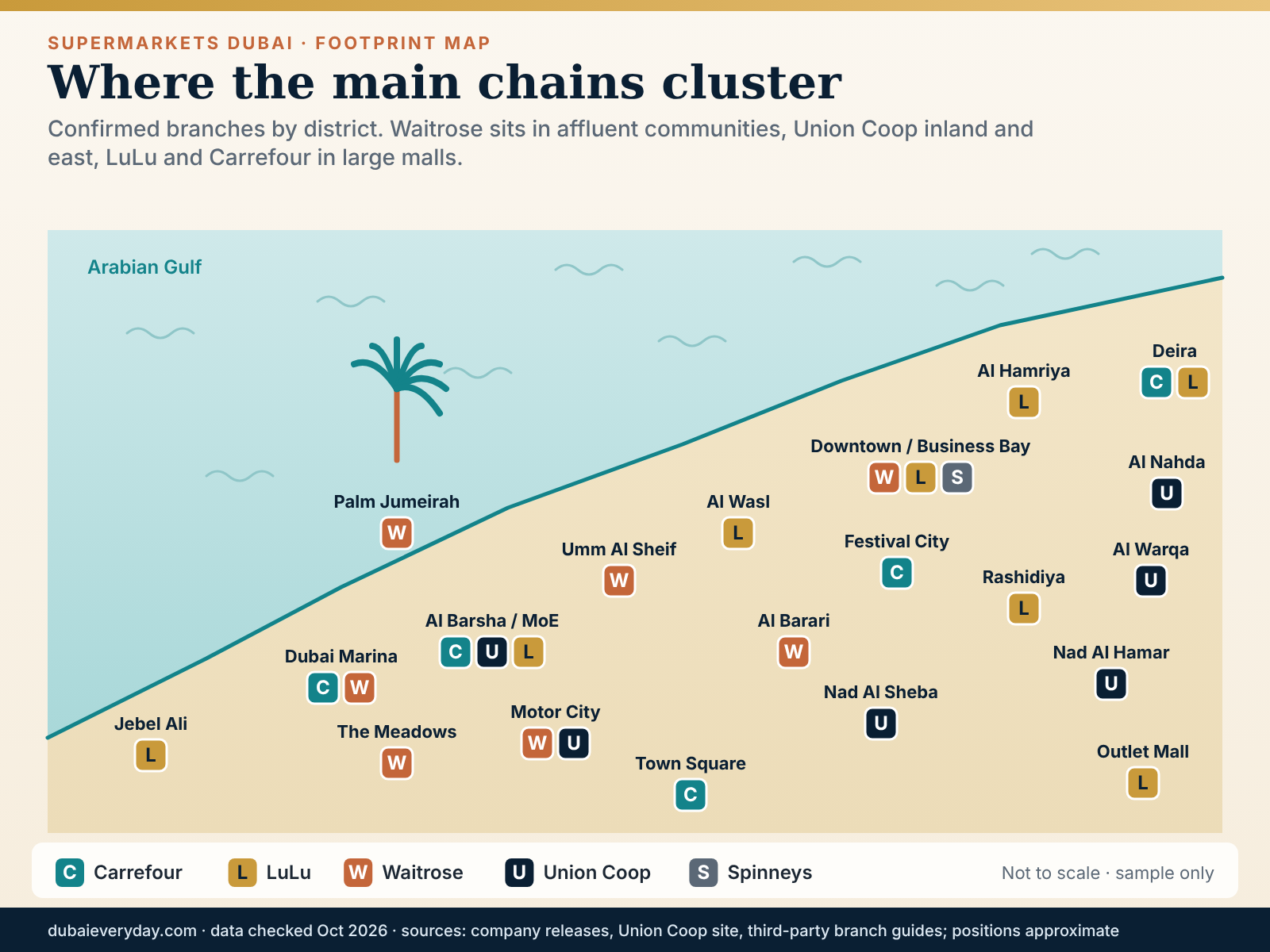
Three patterns show up. Waitrose clusters in affluent communities and malls: Marina, Palm, Downtown, Al Barari, Motor City and The Meadows. Union Coop leans inland and east: Al Warqa, Nad Al Hamar, Al Nahda, Barsha South and Nad Al Sheba. LuLu spreads widest in the sources, from Jebel Ali to Rashidiya and Al Hamriya, and puts its biggest stores in mall or outlet settings. Carrefour’s confirmed branches are mall hypermarkets with smaller formats in dense towers.
The map has a practical use. Before you rely on any of the supermarkets Dubai offers for delivery, check whether a store sits within the express radius. Carrefour’s 24-hour express service, reported by Gulf News in December 2024, ran from a hub at its Dubai Marina store and reached Palm Jumeirah, JBR, JVC, Al Barsha and Emirates Hills, then Downtown, Business Bay, DIFC, Jaddaf and Deira, with Mirdif, Arabian Ranches, Damac Hills and Nad Al Sheba planned. That was nearly two years ago, so confirm your address in the app.
If you are choosing where to live partly on convenience, the neighbourhood guides help: see Dubai Marina, Palm Jumeirah and Downtown Dubai for what daily life looks like there, and renting in Dubai for how to weigh supermarket access against rent.
Price levels across supermarkets Dubai-wide: what the ministry data actually shows
The honest way to talk about price levels across supermarkets Dubai-wide is to start with the only official, multi-chain, regularly updated source and to be blunt about its limits. The Essential Goods Prices Platform, run by the Ministry of Economy and Tourism, lists prices for nine categories (cooking oil, wheat, rice, dairy, legumes, sugar, eggs, bread and chicken) across 13 outlets. The ministry also publishes a monthly table of averages. Gulf News says the figures come from the platform’s pack prices rather than from supermarket websites or delivery apps, which is what makes them more trustworthy than most grocery comparisons.
Now the limits. The platform covers staples, not the branded packaged goods, snacks, cleaning products and imported specialities that fill most of a trolley. Several of the 13 outlets are co-operatives from other emirates, so the cheapest listing in a category may sit in a shop you cannot reasonably reach from Dubai.
The page shows only a lowest and a highest price per category in a form we could read reliably; its store-by-store grid could not be mapped cell by cell from the page text, and the page’s own counters were inconsistent. So we do not publish a ranked league table of chains, and you should be wary of any that does.
The spread inside each category
On 28 October 2026 the platform showed this spread between the lowest and highest listed price per unit. We calculated the multiple from the ministry’s own figures.
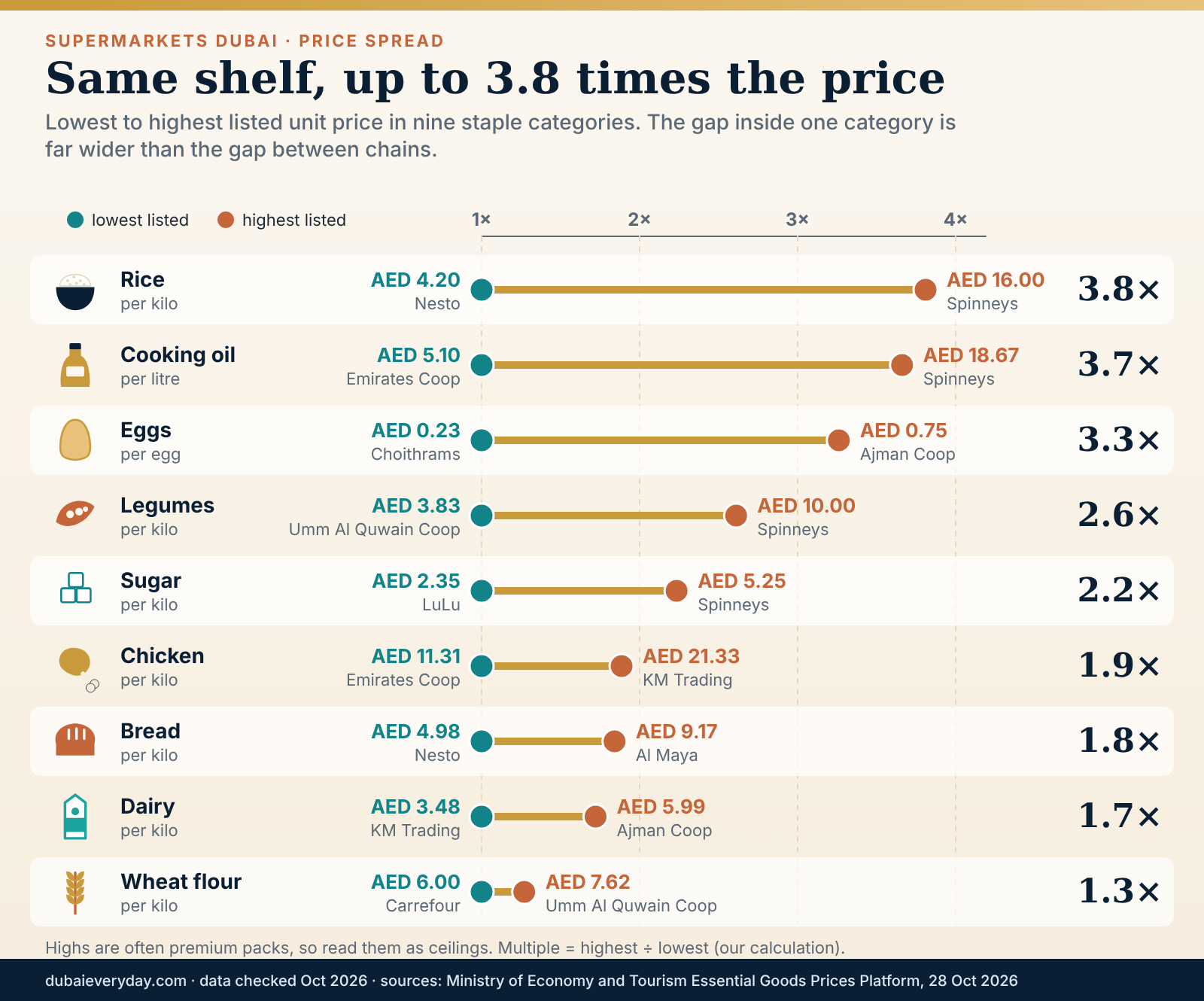
Across supermarkets Dubai-wide, rice shows the widest gap, at 3.8 times between Nesto’s AED 4.20 per kilo and Spinneys’ AED 16.00. Cooking oil follows at 3.7 times (AED 5.10 per litre at Emirates Coop against AED 18.67 at Spinneys), then eggs at 3.3 times, legumes at 2.6, sugar at 2.2, chicken at 1.9, bread at 1.8 and dairy at 1.7. Wheat flour is the outlier: AED 6.00 to AED 7.62 per kilo, a gap of 27%, because it is a commodity with few premium variants.
That pattern is the real lesson for anyone comparing supermarkets Dubai-wide. Where the product is a pure commodity, such as flour or sugar, the choice of chain barely matters. Where there is a wide ladder of brands and origins, such as rice, oil and eggs, a premium pack in any store can cost three times a basic one. Our reading: across supermarkets Dubai-wide, on staples, the choice of pack and brand moves the bill more than the choice between Carrefour, LuLu or Union Coop.
Which supermarkets Dubai-wide tend to be dearest, and what that means
Spinneys is the highest-listed outlet in four categories: cooking oil, rice, legumes and sugar. A maximum is a single product, so it tells you what the dearest thing on the platform costs, not what the typical Spinneys shopper pays. Spinneys is also level with the cheapest on flour at AED 6.00 per kilo. Read together, the data supports a narrow claim: Spinneys stocks premium variants in several staple categories that other outlets either do not list or do not list at that price. It does not support the claim that every Spinneys basket costs three times more.
On the low side, the October read gave Emirates Coop six of the lowest listings, Carrefour three, LuLu two (rice and sugar), Al Maya two and Choithrams, Sharjah Coop, KM Trading and Umm Al Quwain Coop one each. Among the supermarkets Dubai residents can easily reach, Carrefour and LuLu appear most often at the bottom. That fits their reputation as the value hypermarkets. It is a pattern across nine categories on one day, not a guarantee for your full basket.
The lowest egg listing, 23 fils per egg at Choithrams, is a pack of 15 for AED 3.45. The ministry’s August average for a tray of 30 white eggs was AED 22.97, about 77 fils each. A threefold gap on a staple is a prompt to check the pack: egg size, count and date. We cannot tell from the data what explains it. Do the same check on any “bargain” at the shelf.
How to read the platform in five steps
- Open the platform pageGo to the Ministry of Economy and Tourism’s Essential Goods Prices Platform. It sits under the ministry’s open-data menu, and the page showed a last-updated stamp of 28 October 2026 when we read it.
- Pick the category, then the itemThe nine categories include rice, cooking oil, eggs and dairy. Each commodity row carries a unit (kilo, litre or piece) and a pack size beside the price.
- Filter to your storesThe store filter lists 13 outlets, among them the supermarkets Dubai households use most. Tick the ones near you and ignore co-operatives in other emirates.
- Compare pack against unit priceDivide the pack price by the pack size. The same brand in two sizes can differ by more than the gap between two chains.
- Save a short listThe platform lets you add products to a comparison list. Record the winners for your twelve repeat items and re-check monthly.
One honest warning: when we read the page its product counters showed zero while the table below was populated, and the text did not map cleanly to individual stores. If the live page behaves better for you, rely on it over our summary. Our figures are the category lows and highs the page itself states.
Averages versus the cheapest unit price
The ministry’s August table gives averages: AED 45.53 for 5 kg of basmati rice, AED 10.94 for 2 kg of sugar, AED 24.92 for 1.5 litres of corn oil, AED 23.05 for a tray of 30 brown eggs and AED 12.26 for 2 kg of flour. The same pack sizes at the lowest unit prices Gulf News found in October (LuLu rice, LuLu sugar, Carrefour corn oil and brown eggs, and flour at AED 6.00 per kilo) cost AED 21.90, AED 4.70, AED 10.88, AED 14.55 and AED 12.00.
Illustrative example (not a quote or market fact). Add those five items. The August averages total AED 116.70. The cheapest unit prices on 8 October total AED 64.03, about 45% less. That is our calculation, mixing two dates and extrapolating per-kilo prices to pack sizes, and no one can buy all five at the cheapest price at one till (rice and sugar at LuLu, oil and eggs at Carrefour). Use it as a ceiling on what smarter buying of staples could save, not a forecast.
A rough ladder of supermarkets Dubai residents use, labelled as judgement
For orientation only, here is how we would position the main supermarkets Dubai residents use on staples, combining the ministry data with company positioning. This is an editorial reading, not a measured ranking, and the middle is the least certain part.
Value band
LuLu, Carrefour, Nesto, Union Coop, Choithrams. Frequent appearances at or near the lowest listed prices on staples.
Mid band
Al Maya, Safeer, KM Trading and many neighbourhood grocers. Mixed results by category, with some of the lowest and some of the highest listings.
Premium band
Spinneys and Waitrose. Company positioning is premium, and Spinneys tops four categories on the platform. Waitrose has no ministry data.
If you want to see how this plays out for your own household budget, our cost of living guide places food in the wider picture, and the single-person monthly budget shows where groceries typically sit against rent and transport.
A 20-minute basket test you can run yourself
A good basket test beats every league table of supermarkets Dubai publishes, because the only basket that matters is yours. The method below uses the ministry platform for staples and your own receipts for everything else. It takes about 20 minutes once you have a receipt or two in hand, and you can repeat it every few months.
- List your twelve repeat itemsTake your last two receipts or online orders and pick the twelve things you buy most often, with brand and pack size. Include at least four staples from the ministry’s nine categories.
- Convert everything to a unit priceDivide each price by kilos, litres or items. Dubai shelves are meant to show unit prices in standard units under Ministerial Decision 245, so the tag often does this for you.
- Check staples on the ministry platformSearch the category, filter to the stores near you, and note the lowest unit price you can realistically reach. Ignore co-operatives in other emirates.
- Check branded items in the chain appsThe platform will not help with your breakfast cereal. Look up the identical pack in two or three apps and record the price at your delivery address.
- Add the hidden costsDelivery fee, minimum basket, bag charge, parking and the time cost of an extra trip. Do this last, because it often reverses the ranking.
- Decide by job, not by totalKeep the winning chain for each class of item: staples, brands, fresh produce. Re-test in three months.
A worked example of the time-versus-money logic
Illustrative example (not a quote or market fact). Say moving your staples shop to a cheaper chain saves AED 40 a week, and that chain is 25 minutes further each way. Over 52 weeks that is AED 2,080 saved (about USD 566 at 3.6725) against 52 round trips of 50 minutes, or roughly 43 hours. That works out near AED 48 for each hour spent. If your time is worth less than that, switch. If you can fold the trip into a commute or an existing errand, the case gets stronger; if you have to drive and pay for parking, it gets weaker.
The same arithmetic explains why delivery can win even when the shelf price is higher. A fee of AED 10 on a basket you would otherwise collect in a 40-minute round trip is a cheap trade for most professionals. It is a poor one for a retiree with free time and a car at the door. There is no universal answer, which is why the decision tree later in this guide starts from your situation, not from a brand.
Beyond the shelf price: VAT, bags, loyalty and minimums
The number on the tag is only part of what leaves your account. A handful of small, rule-driven items change the real price of a shop at the main supermarkets Dubai shoppers use, and most of them are the same across chains. It helps to separate what is fixed by law from what each chain controls.
VAT and what to look for on the receipt
The UAE’s standard VAT rate is 5%, as the Federal Tax Authority’s VAT page shows. Groceries are generally within it: a Gulf News report from the introduction period carried the headline “All food set to be taxed under VAT in UAE”. We did not complete a check of every food category, so if you need to know how a specific item is treated, ask the FTA, not a supermarket. In everyday terms, the shelf price in a Dubai supermarket is normally the price you pay, with VAT shown as a line on the receipt. Check once, on a receipt, that the number matches the tag.
Unit price is the tool most people ignore
Ministerial Decision 245 requires retail stores to display prices in standardised units, which means a price per kilo, litre or item beside the pack price. This is the single most useful number on the shelf. A “family size” pack is not automatically cheaper per kilo than the standard one, and a promotional sticker on a large jar can still be dearer than the small one next to it. Read the small print, not the sticker.

Bags, and the cost of forgetting yours
Dubai banned single-use bags of 57 microns or less from 1 June 2024, regardless of material, according to Gulf News. Shops that break the rule face a fine of AED 200, doubling for a repeat within a year up to AED 2,000. Chains responded with reusable options. Spinneys sold recycled bags at AED 1 and offered 25 fils off for bringing your own at the time of the ban. LuLu offered reusable bags from 25 fils and cloth, jute and recycled bags from 25 fils to AED 7. Prices may have moved since 2024.
For a family making two shops a week, bag charges are small but real. The fix is boring: keep two or three sturdy bags in the car or by the door, and decline the new bag. One caution is that the 2024 report did not cover how online orders are packed, so do not assume delivery is bag-free or bag-cost-free. Check the order summary.
Loyalty schemes at supermarkets Dubai-wide: worth joining, not worth chasing
Each large chain runs a scheme. Carrefour’s is SHARE, which the Carrefour UAE site links under “Helping you save”. LuLu’s is Happiness, which the company says grew its membership in the second quarter and uses for traffic and basket insights. Union Coop runs Tamayaz, which Wikipedia cites at over 740,000 members in August 2022, and its shareholders can earn a return linked to their purchases. We found no loyalty scheme named for Spinneys in the documents we read.
The cleanest way to value a scheme is to ignore its marketing and ask: after a month of your normal shopping, how many dirhams of benefit did you get? Free enrolment means no downside to joining the scheme of the chain you already use. The downside appears when a scheme nudges you to switch stores or buy things you did not plan. If points are redeemable only on non-grocery items, count them at a discount.
Minimum baskets and free-delivery thresholds
Thresholds create their own incentives. Spinneys’ site on 29 October said delivery is free above AED 350 in Dubai, Abu Dhabi, Al Ain and Fujairah, about USD 95. A secondary guide put Waitrose’s Dubai minimum order at AED 100 with an AED 15 charge below that, free above AED 350. A flat AED 15 fee is 15% of a AED 100 basket and under 5% of a AED 350 one, so the fee gets steadily cheaper as the basket grows. That is why a weekly delivery usually beats three small ones.
The trap is padding the basket to reach the threshold with things you do not need. If the shortfall is under about AED 30, add something you know you will finish. If it is more, pay the fee or move an item to next week’s order. Treat any threshold as a number to check at the time, not a constant.
Grocery delivery in Dubai: chain apps, quick-commerce and real cost
Delivery is where the supermarkets Dubai residents rely on are changing fastest. Spinneys’ online share rose from 16.2% to 19.1% of sales in a year. LuLu’s e-commerce revenue rose 53% to USD 165 million in the second quarter and was 8.9% of its retail sales. These are company figures about their own businesses, but they show the direction: more of the basket is leaving the store on a rider’s bike.
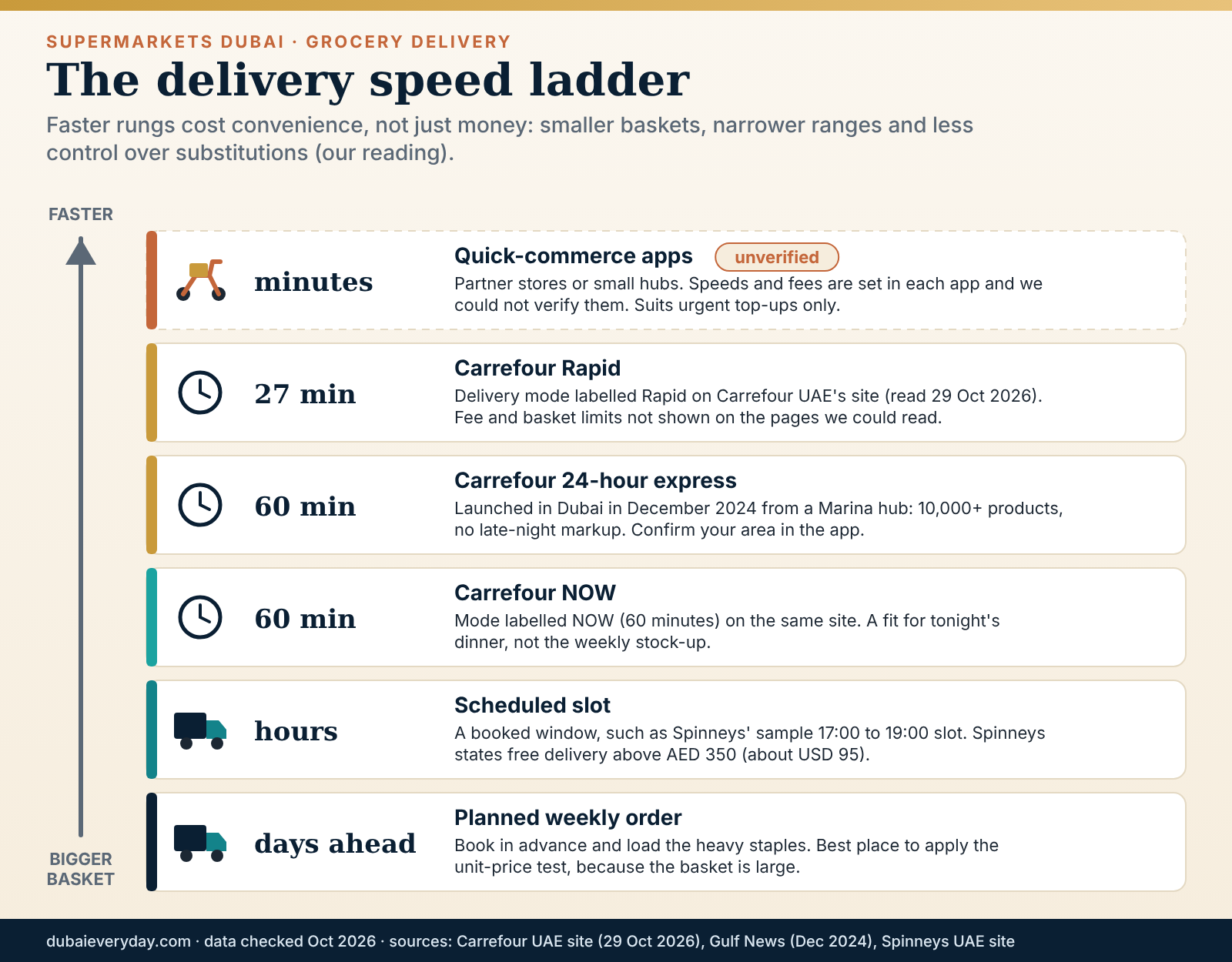
It helps to think of three models for supermarkets Dubai delivery rather than a list of apps. The first is the chain’s own app, where store staff pick from the shelves of a nearby branch, usually for a scheduled slot. The second is the quick-commerce layer, where apps such as Talabat’s grocery service promise rapid delivery from partner stores or small hubs. The third is the specialist: fresh produce boxes, marketplace grocery and similar. Each of these ways to shop supermarkets Dubai offers trades speed, range and price control differently.
Chain apps: the sensible default for supermarkets Dubai-wide
Carrefour’s UAE site, read on 29 October, showed four delivery modes: Scheduled, NOW at 60 minutes, Rapid at 27 minutes and Bulk. In December 2024, Gulf News reported a 24-hour express service in Dubai delivering within 60 minutes from a Marina hub, with more than 10,000 products and no extra markup for late-night orders. We could not read a current fee or minimum for either mode. Cash on delivery is mentioned in Carrefour’s help links, which matters if you do not want to put a card on a new account.
Spinneys’ app is on iOS and Android, and its site on 29 October showed a single sample slot for same-day delivery, 17:00 to 19:00, which suggests slots are windows measured in hours. LuLu’s site blocked automated reading, so we cannot confirm its current terms. Union Coop has an app on both major app stores and a web shop. Our advice is to use the chain you already shop in; the range and loyalty benefits match, and the substitution policy is the one you are used to.
Quick-commerce: fast, convenient, and priced for convenience
The fast apps exist because people forget milk. Talabat’s grocery page describes a model where you choose a nearby store and staff pick, pack and send an order. noon’s Minutes and Careem’s Quik compete in the same space, and a 2026 consumer blog test (secondary, March 2026) put speeds in the 15 to 30 minute range for the quick apps. We could not confirm any app’s current fees or minimums from official pages, so we do not publish them.
What does the one published basket test say about price? The Real Estate Club Dubai test, a blog and so a secondary source with an unspecified item list, priced a ten-item basket in March 2026 at AED 150.15 through LuLu, AED 161.15 through Carrefour NOW and Amazon Fresh, AED 168.65 through Talabat Mart and AED 170.10 through noon Minutes, with delivery fees excluded.
By our calculation that is 7% above LuLu for Carrefour NOW, about 12% for Talabat Mart and about 13% for noon Minutes. It is one test, on one day, and the article was internally inconsistent in places, so treat it as an order-of-magnitude hint: speed apps often cost more per item.
Our reading. Use quick-commerce for the last-minute, high-value-per-minute purchases: baby formula at midnight, ice before guests, an ingredient you need now. Put the predictable bulk of the week into a scheduled chain order. If you do the reverse, you pay a convenience premium on the heavy, cheap items, which are exactly the staples where the ministry data shows chain choice matters least.
Heat and the last hundred metres. From June to September, the weak point of any grocery delivery is the wait between the van and your fridge. Chilled items that sit in a lobby, a car boot or a rider’s bag lose their margin quickly in Dubai heat. We have no data on cold-chain performance for any supermarkets Dubai residents order from, so the safest assumption is yours to control: choose a slot when someone is home, and put chilled and frozen items away first.
Handling the delivery itself
When you order from supermarkets Dubai-wide, a few habits reduce the cost of things going wrong. Open the bags at the door or in the lobby and check chilled and frozen items first, especially in summer, when a lift ride and a waiting rider can add warm minutes. Check expiry dates on dairy and meat, which is easier than arguing later. Decide your substitution preference before the order, not after: most apps let you approve or refuse swaps. Keep the receipt or order screenshot, because a complaint needs an invoice.
If you are new to a building, find out whether riders can come up or must hand over at reception. Our home setup guide covers the first-week checklist, and the internet and mobile guide covers the payment and digital-ID basics that most delivery apps assume you have sorted.
Fresh food, halal and pork: where supermarkets Dubai offers differ
Staples are easy to compare because a kilo of sugar is a kilo of sugar. Fresh food is where supermarkets Dubai offers differ most, in ways a price table cannot show, and this is also where a desk-based guide has to be most careful. We have not judged freshness, butchery or fish counters, and no source we read ranks them. What we can say comes from company descriptions, regulation and official price listings.
Counters, kitchens and international aisles at supermarkets Dubai-wide
LuLu describes its Dubai hypermarkets as full-service formats. At Al Hamriya, the company’s announcement lists fresh food, fish and meat, deli, freshly baked bread and pastries, and kitchen-made hot food alongside non-food ranges. At the Dubai Mall branch it highlights a large global food section and a healthy-eating range covering free-from, organic, sustainable and vegan products. Spinneys has a store concept called The Kitchen at Dubai Airport Free Zone, and Gulf News describes it as a recent opening. These are positioning statements, not quality verdicts.
The practical value of an international aisle depends on what you cook. Households that rely on specific regional ingredients, whether South Asian pulses, Filipino condiments, Levantine cheeses or East African flours, are likely to find the widest range at the big-box chains, going by how those chains describe their food sections; we have not counted shelves. Premium chains, on the same evidence, lean toward imported and organic lines. If the one ingredient you need is only sold in one chain, that chain wins the item regardless of its overall price band.
Fresh produce, fish and markets
The ministry’s early coverage of its platform described 33 monitored items, including fruit and vegetables such as bananas, oranges, apples, cucumbers, tomatoes, potatoes, garlic and onions. The live price table we read on 29 October showed 18 commodity items in the nine categories, none of them fresh produce, so we cannot give a price comparison for fruit and vegetables across chains. The most reliable way to compare produce is the basket test above, on identical items, at the same time of week.
For fish and some produce, Dubai also has dedicated markets. A press release from the developer Ithra Dubai said the legacy Deira Fish Market moved to the Waterfront Market in Deira. We did not verify its opening hours or current stall list, and prices there are negotiated or posted by vendors, so there is no official reference. If you try it, go with a clear idea of the fish you want, compare two stalls before buying, and check that the vendor can clean and pack the catch.
Halal, pork and special diets
Pork is regulated in Dubai. Dubai Municipality’s Food Control Department requires food retail outlets to have a permit to sell it, and a municipality circular requires pork to be stored and handled separately from other food, with its own utensils and equipment. A 2018 Gulf News report cited fines of AED 5,000 to AED 20,000 and possible licence revocation for violations. That report is dated, so check the current position with Dubai Municipality if it matters to you. Our reading is that stores which carry pork keep it apart from other food, and that not every store carries it.
For halal meat, rely on the label and the counter, not assumptions. We did not find a primary source in this research that sets out how halal claims on packaged goods are certified, so we do not describe the system. If halal status is a firm requirement for you, ask the store, check the certification mark on the pack, and shop at counters you trust. The same applies to allergens and special diets: read ingredient lists on every pack, because recipes differ by market and by brand.
Specialist needs raise the stakes at any of the supermarkets Dubai offers. If you shop for an infant, a person with allergies or someone on a medical diet, the supermarket is a supply point, not an adviser. Ask your doctor or dietitian what to buy, and check expiry dates on specialist products every time. Our Dubai healthcare guide explains where to get that advice, and our Dubai with a baby guide covers feeding logistics for visitors.
Which supermarket for which life: eight scenarios
Rules of thumb are useful, but most readers are in a particular situation. These eight scenarios apply the evidence above to how people actually use supermarkets Dubai-wide. They are our reasoning from the sources, not reports of what anyone did.
The single professional in a Marina or JLT tower
A one-person household buys small quantities, so the shelf-price gap matters less than convenience and food waste. The confirmed footprint of supermarkets Dubai Marina residents can reach is thick: a Carrefour hypermarket at Dubai Marina Mall, a Carrefour supermarket at Bunyan Tower, and a Waitrose at Marina Mall. A sensible pattern is a scheduled Carrefour order for pantry staples once or twice a month, a walk-in shop for fresh items, and a quick-commerce app for forgotten items. Our single-person budget guide shows where this spending sits.
The family of four in an inland community
For Al Warqa, Nad Al Hamar, Al Nahda or Barsha South, Union Coop has confirmed community mall branches and is the closest of the larger supermarkets Dubai households there can reach. LuLu’s Rashidiya store and Carrefour’s planned express expansion toward Mirdif add options. A family buys more rice, oil, milk and chicken, which are exactly the staples with the largest spreads, so a basket test pays quickly here. Consider the shareholder return at Union Coop if you will shop there for years.
The villa household in a master community
Villa communities are car-dependent and often far from the nearest hypermarket. Carrefour’s supermarket at Town Square and Waitrose branches at The Meadows and Al Barari are confirmed; the 24-hour express service listed Arabian Ranches and Damac Hills as planned in December 2024. For this household delivery is not a luxury but the default, so choose based on whether your address is covered and on the free-delivery threshold. Plan a monthly bulk order and a weekly fresh order. See renting a villa in Dubai for the wider villa logistics.
The premium-convenience household on the Palm or in Downtown
Waitrose has confirmed branches at Nakheel Mall on the Palm, at The Dubai Mall and at Fountain Views near Downtown. LuLu’s Dubai Mall store, at 72,000 square feet, is a different proposition: large, global in range, and reached through the Zabeel parking. Spinneys’ Bay Square branch is in Business Bay. These households pay for proximity and range, and the mixed-band approach works best: a premium branch for the dinner party and a hypermarket order for everything heavy.
The budget-first household in Deira, Karama or Al Nahda
Here the value band is the answer. LuLu’s Al Hamriya hypermarket is near Burjuman Metro station, Union Coop has a branch at Al Nahda, and Carrefour is at Al Ghurair Centre in Deira. The ministry data suggests Nesto, Choithrams and Al Maya are worth testing for rice, eggs, beans and lentils. Use the unit price, buy staples in larger packs when storage allows, and skip delivery for the weekly shop if a store is walkable.
The new arrival in the first week
A new arrival needs a lot of things at once: bedding, cleaning supplies, kitchen basics, and food, before a delivery address, local phone number and payment method are fully sorted. The big hypermarkets are the efficient answer because they sell food and household items under one roof. Then shift to apps once your address and Emirates ID details are settled. Our relocation checklist and moving to Dubai guide place this in the wider timeline.
The household with a baby or a pet
Predictable repeat purchases, such as formula, nappies and pet food, reward a scheduled order and a stock buffer. The risk is expiry: always check dates on delivery, and avoid buying large quantities of specialist products that your baby or pet may outgrow or reject. Our pets guide covers registration and everyday costs, and the Dubai with kids guide covers family logistics for visitors.
The visitor with a kitchen
Visitors in a serviced apartment or holiday rental need water, breakfast items, snacks and sun protection more than full pantry staples. Walk to the nearest Carrefour or LuLu for a single practical shop and skip the apps unless you are stuck. Our Dubai travel guide sets this in the context of a whole trip.
What the eight scenarios have in common
Read across the scenarios and a pattern appears. No household is best served by a single outlet. The ones living close to several supermarkets Dubai chains operate gain most from splitting the basket, while villa and inland households gain most from choosing the right delivery coverage. Premium convenience households pay for proximity, and budget households are best off with unit prices and larger staple packs. In every case the winning move is to decide the job first and the brand second.
The other common thread is that nobody here needs a perfect system. A rough split is enough: a hypermarket or co-operative order for the heavy, cheap items; a nearby shop for fresh food; and an app for emergencies. If you refine only one habit, make it reading the unit price before the pack price, because that single habit works at every one of the supermarkets Dubai residents use and costs nothing.
A decision tree for choosing between supermarkets Dubai offers
The scenarios above can be compressed into a few questions about supermarkets Dubai households face. Start with how much you need and how fast, then work down to price sensitivity and the specific products you will not compromise on. The tree below is our editorial logic, built from the evidence in this guide, and it points you to a type of outlet before it points you to a brand.
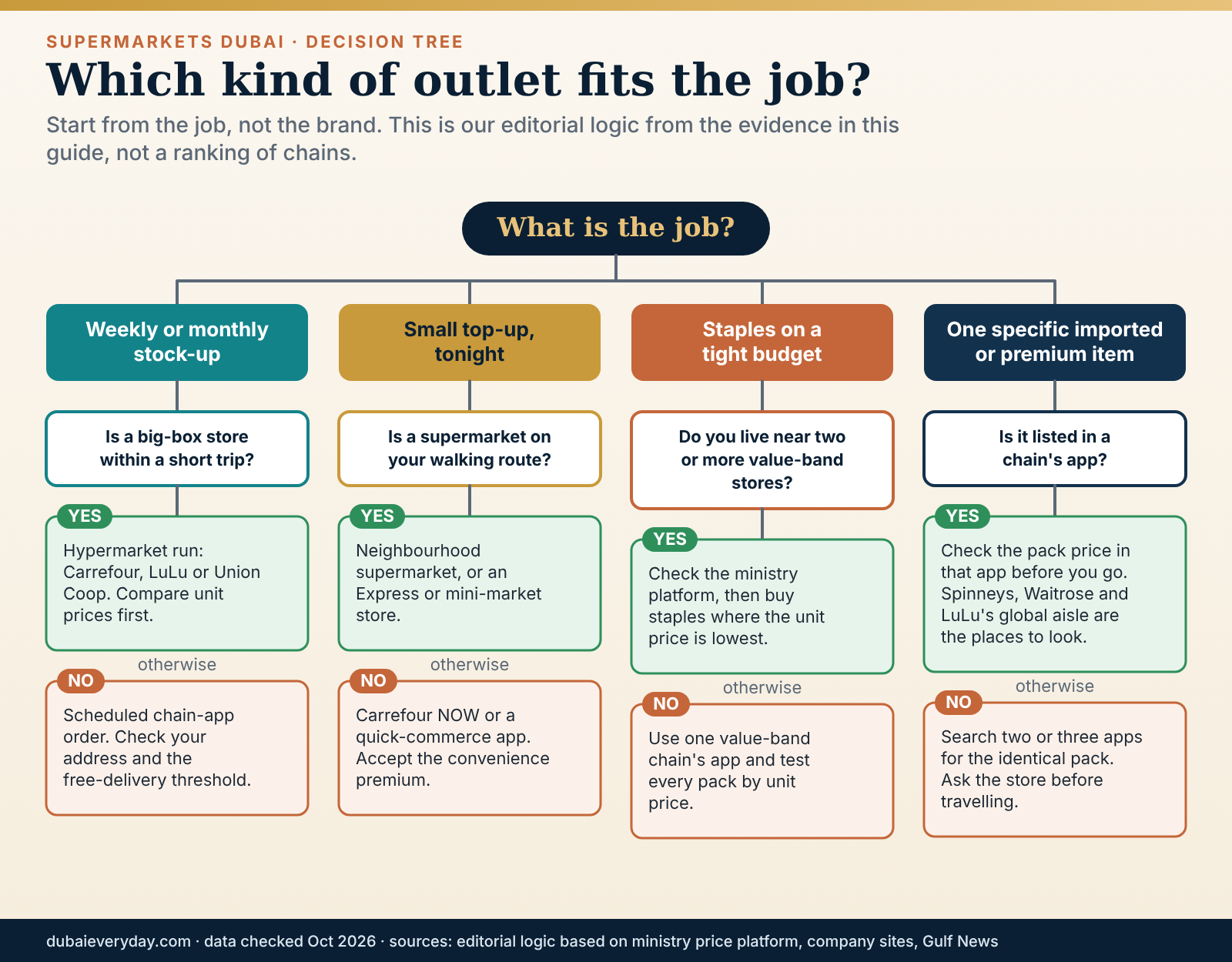
Two branches deserve a note. The first is the “urgent” branch. If you need something within the hour, the tree sends you to quick-commerce or a chain’s rapid mode, accepting a premium. The second is the “price-sensitive staples” branch, which sends you to the value band and to the ministry platform, because that is where the evidence says the spread is widest and your own checking pays most.
Notice what the tree does not do. It does not tell you to pick one chain for life. Real households use two or three outlets for different jobs, and the cheapest combination is usually a hypermarket for staples, a nearby shop for top-ups and one premium or specialist source for the handful of items nothing else matches.
Spending less without chasing every promotion
Saving at supermarkets Dubai-wide is mostly a matter of boring habits. The aggressive tactics, such as driving to three stores for the weekly offers, rarely beat the quiet ones once time and fuel are counted. These are the habits the evidence supports.
Habit one: buy staples by unit price, in the right pack
The ministry data showed that rice, oil and eggs can vary threefold between the cheapest and dearest listings. The cheapest isn’t always a poor product, just a plainer one. Choose a brand you are happy with at the low end of the ladder, check unit price against two alternatives, and buy bigger packs for non-perishables if you have storage. The example earlier suggested the gap between an average staples basket and the cheapest unit prices was around 45% on five items. You will not capture all of it, but half of it is worth having.
Habit two: split the basket by job
At supermarkets Dubai-wide the pattern is simple: staples from the value-band chain, brand-specific items from wherever you can verify the pack price, and fresh food from the place you trust. Splitting is where most of the saving lives because the supermarkets Dubai offers are each cheapest at something. The only cost is organisation, and an app list per chain solves most of it.
Habit three: use the free tools
The ministry platform is free, and the ministry’s call centre and consumer-protection line, 800-1222, takes price questions. Chain loyalty schemes are free to join. The Ministry’s rule on prior approval and six-month gaps between increases for nine categories acts as a check on sudden jumps: if a staple rises sharply, you can compare it on the platform and ask the retailer why.
Habit four: reduce waste before you chase discounts
A discount on food you throw away is not a discount. Shop for the meals you will actually cook this week, put the first-in, first-out rule into practice in your fridge, and freeze portions. In hot weather, perishable items spend less time out of the fridge if you shop in the evening or order delivery to a time when someone is home.
Habit five: treat bulk and wholesale with care
Warehouse-style bulk buying is only a saving if you finish what you buy. Rice and oil keep well; fresh herbs, bread and berries do not. We did not find an official source comparing Dubai wholesale outlets with supermarkets, so we offer the principle and not a list: bulk beats unit price only on non-perishables you actually use.
Habit six: re-test twice a year
Prices, promotions and delivery terms drift. Rerun the basket test in January and again in the summer, when many families travel and spending patterns change. Grocery retail is a competitive market and promotions rotate, so a gap that justified a switch last year may have closed. Put the date in your calendar and treat it as a ten-minute chore, not a project.
Our reading. For most households, the biggest controllable saving is not the chain but the habit of comparing unit prices across two or three brands of the same staple. That alone is worth more than a loyalty card, and it works anywhere.
Ramadan, Eid and the calendar effect
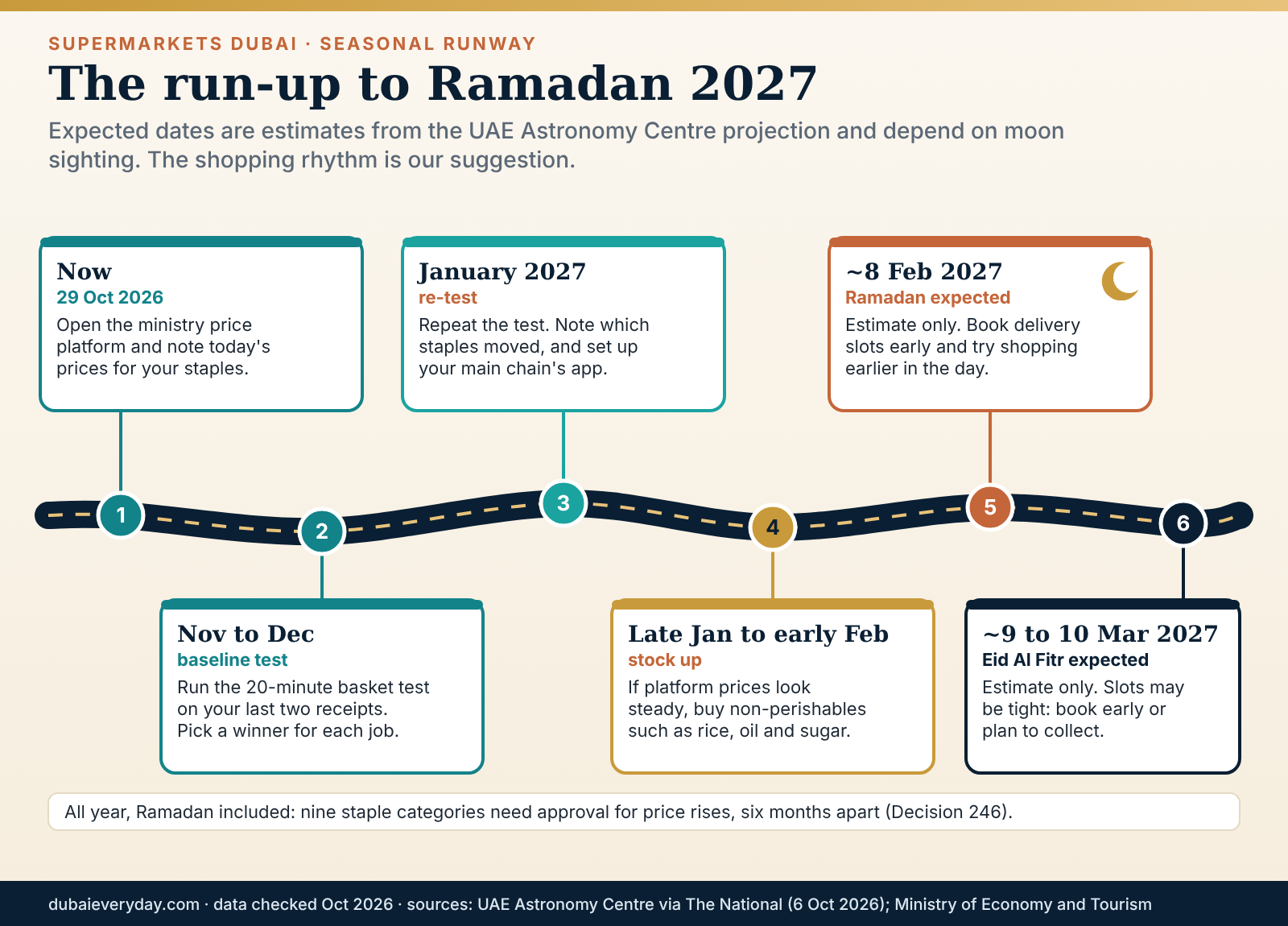
Ramadan reshapes the year for the supermarkets Dubai shoppers rely on. Opening hours stretch, evening queues lengthen, and promotions multiply on staples. The UAE Astronomy Centre’s projection, reported by The National on 6 October 2026, puts the start of Ramadan 2027 at 8 February, with Eid Al Fitr expected on 9 or 10 March, subject to moon-sighting confirmation. Treat both as estimates until the official announcement. Our events calendar guide tracks how to follow such dates.
The ministry’s 2026 Ramadan messaging, summarised in a Gulf News headline, was that the nine essential categories could not see price rises without approval. That rule has applied since January 2025 regardless of season, so a Ramadan promotion is a discount on top of a price that the ministry controls the increases of, not a freeze on everything. Union Coop has historically run Ramadan price cuts; a Gulf News headline from an earlier year referred to cuts on 25,000 products. We have not verified the scale or terms of any 2027 campaign, which will not be announced until much closer to the date.
How to use the calendar
For shoppers at supermarkets Dubai offers, our suggestion, from the logic of the data, is to run your basket test in January, before promotions begin, so you have a baseline. Stock up on non-perishables in the weeks before Ramadan if the staple prices on the platform stay stable, because we would expect delivery slots and popular lines to be tighter in the first days of the month. That is our assumption, not a measured pattern. During Ramadan, try shopping earlier in the day; we assume evenings are busier but have no queue data. Around Eid, expect the same pressure on delivery slots, so book early or plan to collect.
If you are new to the practices of the month, the Dubai etiquette guide explains public behaviour during Ramadan, including eating and drinking in public, which matters if you are carrying groceries in daylight. Retail hours during the month are announced by individual chains; we did not verify any 2027 hours.
Mistakes, complaints and your rights
Most problems at supermarkets Dubai-wide are small: an expired item, a price at the till that differs from the tag, a missing delivery item, a substitution you did not want. The best response is to solve them at the store or in the app quickly. Where that fails with supermarkets Dubai-wide, there is a formal route, and knowing it exists tends to change how a manager responds.
Common mistakes shoppers make
- Comparing pack prices instead of unit prices, then buying the “bargain” that costs more per kilo.
- Padding a basket to reach a free-delivery threshold with items that go to waste.
- Paying a quick-commerce premium for the heavy staples of the week.
- Not checking expiry dates on delivery, or accepting substitutions by default.
- Assuming a promotional sticker means a lower price than the next pack along.
- Treating a category’s cheapest listing as a typical price.
- Trusting any single comparison, including this one, without a basket test of your own.
How to file a consumer complaint in Dubai
According to a Gulf News guide updated on 3 October 2026, the Dubai Department of Economy and Tourism (DET) handles complaints against Dubai-licensed businesses through the consumerrights.gov.ae portal, and its Consumer Rights call centre is on 600 545 555. You should first raise the issue with the business and ask for a manager. If that fails, you submit a complaint with your invoice, evidence of what was promised and what you received, and your contact details. A DET employee contacts you within two working days; DET then mediates, and typical cases take four to ten working days.
Two limits apply. The business must hold a Dubai trade licence, so a complaint against a business licensed in another emirate goes elsewhere. And you will need an invoice, which is why we advised keeping receipts and order screenshots. For price-rule questions on staples, the Ministry of Economy and Tourism’s call centre and consumer protection line is 800-1222. For wider consumer rules, our Dubai legal basics shows where to verify them.
General information only. This guide is general information about consumer shopping, not legal or financial advice. Rules, hotlines and procedures change. Confirm the current process on the official DET and Ministry of Economy and Tourism channels before you rely on it.
Your next three steps
You do not need to memorise any of this. Do three things and you will have captured most of the value in this guide. First, run the 20-minute basket test on your own receipts, using unit prices, and keep the winning chain for each class of item. Second, set up the app of your main chain and check that your address is covered, noting the free-delivery threshold. Third, bookmark the ministry’s price platform and glance at it before a big staples purchase.
That small routine beats any league table of supermarkets Dubai publishes, including ours, because it uses your basket, your address and today’s prices. If you want to go deeper on one chain, our Carrefour Dubai guide is the place to start.
What this guide cannot tell you. No document we could read ranks service, freshness or queues across supermarkets Dubai residents use, so we have not judged them. Delivery fees and minimums differed between sources, so we left most of them out. The ministry’s table covers nine staple categories, not branded goods or fresh produce. For everything outside those, the only valid comparison between supermarkets Dubai offers is your own basket, priced on the same day with the same pack sizes.
FAQ: supermarkets Dubai residents ask about
Which of the supermarkets Dubai residents use is the cheapest?
No single chain is cheapest on everything. In the ministry’s price platform, Carrefour and LuLu appeared most often among the lowest listings for staples such as rice, sugar, corn oil and eggs, while smaller chains like Nesto and Choithrams held the lowest listing in a few categories. Spinneys held the highest listed price in four categories, though often for premium packs. Your own basket, compared by unit price, is the reliable answer, because brand and pack size move the bill more than the chain.
Is Carrefour or LuLu cheaper in Dubai?
Among supermarkets Dubai-wide, on the staples the ministry tracks, the two traded the lowest listings in October 2026: LuLu for basmati rice and white sugar, Carrefour for corn oil, brown eggs and white chickpeas, and both shared the lowest flour price. A March 2026 blog test of delivery apps found Carrefour NOW about 7% dearer than LuLu on a ten-item basket, but it was a single test. Treat them as roughly equal and compare your own regular items.
Is Spinneys worth the extra cost?
It depends on what you buy. Among supermarkets Dubai offers, Spinneys positions itself as a premium operator and held the highest listed price in cooking oil, rice, legumes and sugar, but it also shared the lowest flour price. If you value imported, organic or specialty lines and a more curated range, the premium may be worth it for those items. For plain staples, you will likely pay less elsewhere. Splitting your basket between a value chain and Spinneys is a common compromise.
How many Waitrose stores are there in Dubai, and who runs them?
A Bayut guide lists eight Dubai branches: The Dubai Mall, Dubai Marina Mall, Al Thanya Mall, Motor City, Nakheel Mall, Al Barari, The Meadows and Fountain Views. That guide is undated, so confirm on the Waitrose UAE site. Operator details are less clear: Spinneys’ results mention that its operated stores include Waitrose, and the Dubai Mall branch is described as a licensing partnership with Fine Fare Food Market LLC. We could not confirm who runs each branch.
Do I need to be a shareholder to shop at Union Coop?
Among supermarkets Dubai shoppers can use, Union Coop is unusual in being a co-operative. We found no source saying shareholding is required to shop there, and Union Coop runs a public web shop and app. What shareholding adds is a return linked to purchases: a headline reports a 14% dividend and a 5% purchase return for the 2025 financial year. We could not read the details, so check eligibility, share prices and current rates directly with Union Coop before buying shares for that purpose. Its phone number on the website is 8008889.
Which supermarkets in Dubai deliver, and what does delivery cost?
All five of the main supermarkets Dubai households use run online shopping, and Carrefour’s site labels modes from Scheduled to Rapid at 27 minutes. Spinneys states free delivery above AED 350. A secondary guide gives Waitrose a minimum order of AED 100 with a fee below that. Current fees and minimums for the others could not be verified from official pages, and they change often, so read the checkout screen for your address before you commit.
Are quick-commerce apps more expensive than the supermarket?
The one published basket test we found, a March 2026 blog comparison on ten items, put Talabat Mart about 12% and noon Minutes about 13% above LuLu, before delivery fees. It is a secondary source with an unspecified item list, so treat it as a hint, not a fact. The sensible use of quick apps alongside supermarkets Dubai-wide is for urgent top-ups. For the weekly shop, a scheduled order from a chain app is the lower-risk default.
Can I see official grocery prices in Dubai?
Yes, for staples at the main supermarkets Dubai residents use. The Ministry of Economy and Tourism runs the Essential Goods Prices Platform, launched in April 2026, with nine categories and 13 outlets, plus a monthly average price table. It does not cover everything in a trolley, and the outlets include co-operatives from other emirates. The platform’s own page says prices were last updated on 28 October 2026. Use it to benchmark rice, oil, eggs, sugar, flour, dairy, legumes, bread and chicken.
Do Dubai supermarkets charge for bags?
Single-use bags of 57 microns or less have been banned in Dubai since 1 June 2024, so the supermarkets Dubai shoppers use now sell reusable bags instead. At the time of the ban, LuLu’s started at 25 fils and Spinneys sold recycled bags at AED 1, giving 25 fils off if you brought your own. Prices may have changed since. Keep reusable bags handy, and check your delivery order summary, because the 2024 report did not say how online orders are packed.
Are Dubai supermarkets open 24 hours?
Opening hours at supermarkets Dubai-wide vary by branch and we did not verify them for any chain, so check the store page or app. What we can say is that Carrefour launched a 24-hour express delivery service in Dubai in December 2024, delivering within 60 minutes or less from a hub in Dubai Marina, so late-night delivery exists even where shops close. Coverage and hours may have changed since then, so confirm your address in the app.
Can I pay cash on delivery for groceries?
Carrefour’s help links on its UAE site mention cash on delivery, secured online payment and an easy payment plan. The Waitrose guide we read mentioned card payments and some gift cards. For other chains and quick-commerce apps we did not verify payment options. If you prefer not to save a card, look for cash on delivery at checkout. Remember that cash on delivery can carry its own conditions, so read them before you place the order.
Where can I complain if a supermarket overcharges me?
First raise it at the till or in the app and keep your invoice. If you are not satisfied, a Dubai-licensed business can be reported to the Department of Economy and Tourism through consumerrights.gov.ae or its Consumer Rights call centre on 600 545 555. DET contacts you within two working days and typical cases take four to ten working days. For staple price rules, the Ministry of Economy and Tourism line is 800-1222. These details were current in a guide updated 3 October 2026.
Related reading
Sources and further reading (31 links)
- Ministry of Economy and Tourism: Essential Goods Prices Platform — outlets, categories, lowest and highest listed prices
- Ministry of Economy and Tourism: August 2026 monthly price monitoring table — average prices
- Ministry of Economy and Tourism: pricing policy for nine essential categories — Decision 246 of 2024, six-month rule, hotline
- Khaleej Times: UAE prohibits retailers from increasing prices of nine goods — effective date and unit-pricing decision
- Gulf News: UAE grocery prices, lowest costs for rice, eggs and oil — unit prices by retailer as of 8 Oct 2026
- Gulf News: how to compare grocery prices with the essential goods platform — launch and coverage
- Spinneys: Q2 2026 earnings pack — store count, online share, availability, shipment delays
- The National: Spinneys increases holding in Saudi unit — history, listing, positioning
- AGBI: Spinneys posts higher profit as it rebuilds logistics route — freight corridor
- Gulf News: Spinneys revenue spike on new openings — Bay Square and The Kitchen openings
- Spinneys UAE online store — free-delivery threshold, app
- LuLu Retail: Q2 2026 earnings release — stores, e-commerce, loyalty, trading conditions
- LuLu Retail: Dubai Mall hypermarket opening — store size, Dubai store count in October 2023
- LuLu Retail: Al Hamriya hypermarket — size, Metro proximity
- Carrefour UAE website — delivery modes, loyalty and payment links
- Gulf News: Carrefour UAE all-day express delivery in Dubai — December 2024 express service and coverage
- Gulf News: Carrefour, HyperMax and the UAE — brand status
- Property Finder blog: Carrefour branches in the UAE — sample Dubai locations, secondary
- Union Coop website — branches, malls, app, help-desk hours
- Images Retail ME: Union Coop Nad Al Sheba branch — 28th branch
- Wikipedia: Union Coop — background only, secondary
- Albawaba: Union Coop approves 14% dividend and 5% purchase return for FY2025 — headline only
- Bayut: Waitrose branches in Dubai — branch list and delivery terms, secondary and undated
- Real Estate Club Dubai: grocery delivery in Dubai 2026 — blog basket test, secondary
- Talabat UAE groceries — how store-picked grocery orders work
- Gulf News: Dubai’s ban on single-use bags — rules, fines, chain bag prices
- Gulf News: how to file a consumer complaint in Dubai — DET route and timings
- Gulf News: tough penalties for flouting rules on pork sales — Dubai Municipality handling rules, 2018
- Federal Tax Authority: VAT — 5% standard rate
- The National: Ramadan 2027 expected dates — projected start and Eid
- Ithra Dubai: Deira Fish Market moves to Waterfront Market — headline only
Update log: 29 October 2026 — first publication; all facts re-checked against the sources above. Next review due: 29 January 2027 for prices, delivery terms and chain news, and again before Ramadan 2027 (expected from 8 February). Corrections welcome. This page is general consumer information, not individual financial or legal advice; it is desk research and nothing in it was field-tested.
About DubaiEveryday and this guide
DubaiEveryday.com is an independent editorial project that publishes practical, research-based guides to everyday life in Dubai: where to live, what things cost, how the rules work and how to get around. This page was written and edited by the DubaiEveryday editorial team. It is not signed by a named expert, doctor, lawyer or adviser, and we do not claim first-hand testing of a venue, clinic or service unless the page says so.
Each guide is built from official sources such as government and regulator pages, operator websites and established news outlets, cross-checked where we can. When we could not confirm something, we say so in the text, and examples that use made-up numbers are labelled as illustrations. Mentions are editorial choices, not paid placements, and a link is not an endorsement.
Dubai changes quickly. If you spot something that is out of date or wrong, please tell us through the contact options on DubaiEveryday.com and we will check it and correct the page.