

Dubai etiquette is a short list of rules that carry real penalties, a longer list of venue rules, and a set of customs that decide whether people warm to you. This guide separates the three, covering dress, greetings, public behaviour, Ramadan, alcohol, tipping and photography, using sources checked on 29 October 2026.
Most visitors worry about the wrong thing. They fret over how to shake hands, while the more serious trouble can come from a rude gesture in a message, a photo of a stranger or a drink in the wrong place. A clumsy hello is rarely the problem. A few rules, though, carry real penalties.
Good Dubai etiquette sits in three layers: law, venue rules and plain custom. Once you can tell them apart, most of the anxiety fades. This guide sorts dress, greetings, Ramadan, alcohol, tipping and photography into those layers, so you know which slips cost a smile and which could cost a fine.
Dubai etiquette works in three layers, and mixing them up is where visitors and new residents go wrong. The top layer is law: swearing and rude gestures (online too), kissing in public, drinking outside licensed venues, drugs, and photographing people without consent can all lead to fines, arrest or deportation. The middle layer is venue and official rules: dress codes, Metro conduct, beach regulations, hotel policies. The bottom layer is custom: how you greet, accept coffee, behave during Ramadan or dress for a government office.
In practice that means covering shoulders and knees in malls and public buildings, keeping swimwear for pools and beaches, waiting for a person of the opposite sex to offer a handshake, drinking only in licensed venues and only from the age of 21, and asking before you point a camera at anyone. During Ramadan, avoid eating, drinking or smoking in public in daylight, and expect shorter working days. Tipping is optional and unregulated, and a 10% service charge on the bill means you have probably already paid it.
The rest of this page turns those one-liners into decisions you can act on, with the evidence and the limits of that evidence stated plainly.
This is a desk-research guide to Dubai etiquette. DubaiEveryday.com has not attended the events, hosted the meals, visited the offices or taken the photographs mentioned here, and nothing below describes a personal experience. Legal points come from sources read on 29 October 2026: the text of the federal cybercrime decree-law on the UAE Legislation portal, the UK Foreign, Commonwealth and Development Office (FCDO) travel advice for the UAE, updated 27 October 2026, and UAE government pages for labour and tourist-tax rules.
Customs such as greetings and coffee etiquette are, in Dubai etiquette terms, widely published community guidance, not law, and individual hosts differ. We could not read the body text of Visit Dubai’s essentials page (which lists etiquette among its topics) with our tools, so we do not claim to summarise it. Where a point rests on a news explainer or an older article, we say so. Inclusion was not paid for, nothing here is sponsored, and this is general information, not individual legal advice.
Dubai etiquette in three layers: law, house rule and habit
Most guides to Dubai etiquette give you one long list of dos and don’ts, as if wearing shorts into a mosque and kissing in a car park carried the same weight. They do not. One is a house rule that gets you a polite refusal at the door. The other is, according to the FCDO’s summary of local law, something that can lead to arrest. If you sort your behaviour into three layers, almost every awkward question answers itself.
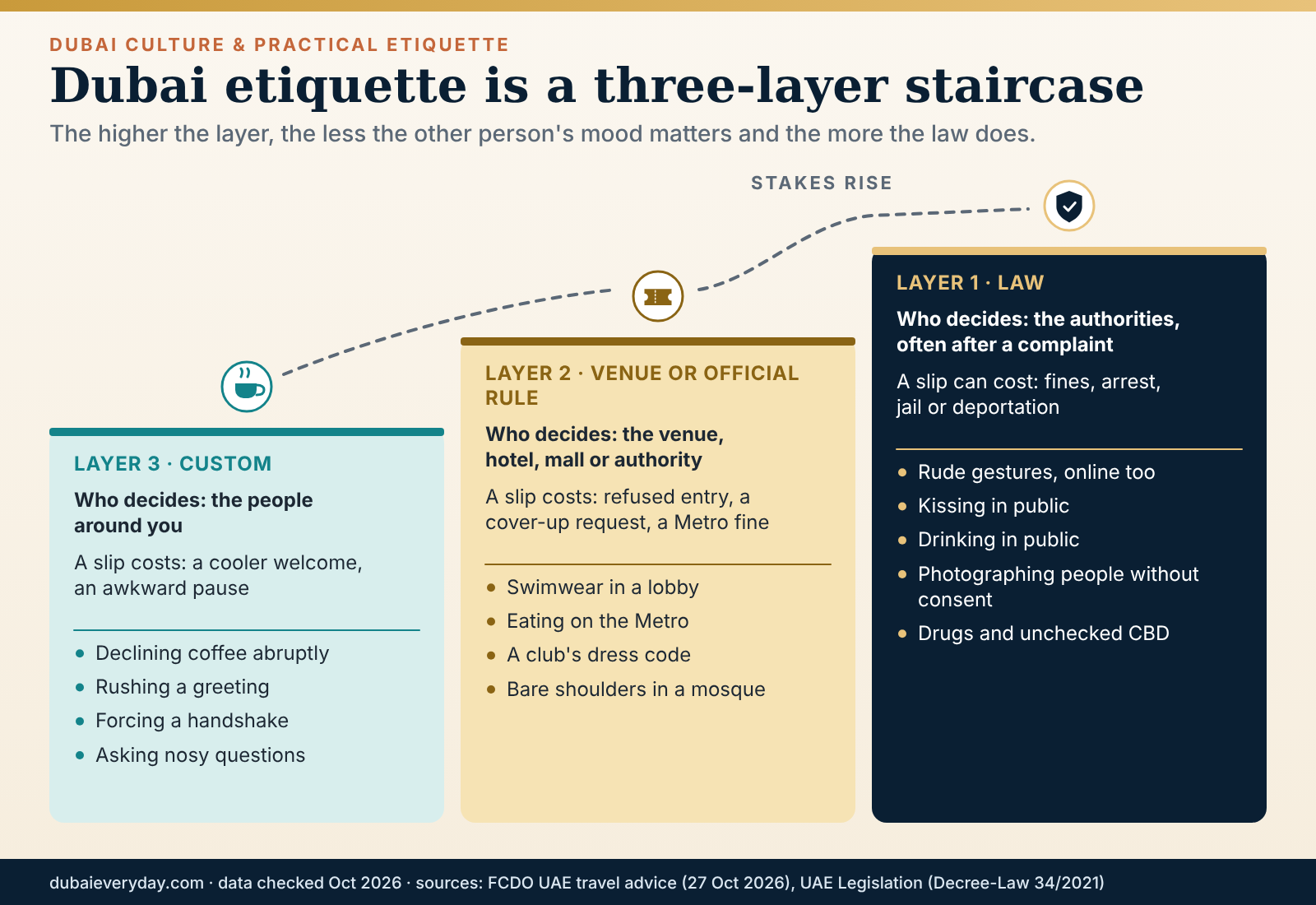
Layer one of Dubai etiquette: law
These are behaviours where the state, not a doorman, decides the outcome. The FCDO’s advice for the UAE lists swearing and rude gestures (including online), kissing in public, drinking in public, drug possession, photographing people without permission and photographing sensitive sites. The penalties vary from a warning or fine to jail and deportation, and they depend on the facts, the complainant and sometimes your nationality or residency. The next section goes through them one by one.
Law is also where good intentions are worth least in Dubai etiquette. Nobody asks whether you meant to offend. If a photo shows a stranger who did not consent, or a message insults someone, the offence is in the act. That is why this guide to Dubai etiquette spends more space on photography and online conduct than on how to hold a coffee cup.
Layer two of Dubai etiquette: venue and official rules
Here the penalty is local and practical. A hotel pool can ask you to cover up before you walk through the lobby. A mall can turn away swimwear. A club sets a door policy, a government office can refuse to serve you, and the Metro can fine you. These rules are usually posted, and they are the easiest layer to follow, because the venue tells you what it wants. The skill is knowing that they exist before you arrive, especially for dress codes in specific venues, which our separate dress-code guide covers venue by venue.
Venue rules also move. A restaurant may relax its code in winter or tighten it for a private event. The honest approach is to treat anything printed here as the default, and let the venue’s own sign, booking page or message override it.
Layer three of Dubai etiquette: custom
Custom has no enforcer, which is why people dismiss this part of Dubai etiquette. That is a mistake. Customs decide whether a colleague invites you to lunch, whether a neighbour helps with a parcel, and whether a shop assistant treats you as a guest or an obstacle. They are also the layer where Dubai is most mixed. The city’s population is made up largely of people from elsewhere, so the habits you meet on any given day range from strict traditional courtesy to relaxed international norms, sometimes within the same lift.
That variety is the reason a single rule of thumb works well for Dubai etiquette: be a little more formal than the room, start with the conservative option, and relax when the people around you show you what is normal. It costs almost nothing and it fails safely.
The one-sentence version. When in doubt, cover up, lower your voice, ask before you photograph, wait for the other person to offer a handshake, and keep alcohol inside the licensed room. Almost everything else in Dubai etiquette is a refinement of those five habits.
Why Dubai etiquette needs its own guide
Generic “UAE etiquette” pages tend to blend Dubai with Abu Dhabi, Sharjah and the northern emirates, as though one rulebook covered all of them. It does not. The FCDO’s advice, for instance, treats Sharjah separately because alcohol is illegal there, while Dubai licenses venues and individuals. A visitor who drinks at a hotel in Dubai and then drives to Sharjah for lunch has moved from one regime to another in about half an hour. This guide stays in Dubai: its licensing, its beaches, its Metro, its malls and the hospitality sector that most visitors actually touch.
There is also the question of audience. Tourists need a checklist they can use in a week. New residents need habits that hold up for years, including how to behave in a building, a school car park or an office. Returning visitors usually need a refresh because something changed. We try to serve all three, and where advice differs by audience, we mark it. If you are still planning the wider trip, the Dubai travel guide covers the logistics around this Dubai etiquette, and the first-time-in-Dubai plan lines it up with arrival, money and bookings.
What this page does not cover
Three neighbours cover adjacent jobs. Venue-by-venue clothing, from malls to government buildings, sits in the Dubai dress code guide; here we give the principle and the exceptions. Alcohol rules for a full night out, including transport and costs, belong to the Dubai nightlife guide; here we cover Dubai etiquette around drinking and not drinking. Wider legal basics such as tenancy, employment and consumer rights are in the Dubai legal basics for residents.
Everything else in Dubai etiquette, from how to take coffee in a majlis to how to react when a colleague is fasting, is here.
The Dubai etiquette points that are actually laws
Start with the part where being wrong is expensive. The list below draws on two kinds of source: the UK government’s travel advice for the UAE, which summarises local law for travellers and was updated on 27 October 2026, and the text of the federal cybercrime decree-law on the UAE Legislation portal. A foreign government’s summary of Dubai etiquette is not the statute, so we quote it as its summary. Neither is individual legal advice.
Outcomes depend on the facts, the person who complains and the authorities’ discretion. Some cases end with a warning; others end with a court, a fine, jail or deportation. Nobody can promise you which. The safest reading of Dubai etiquette in this layer is simple: do not test it.
Swearing, rude gestures and insults
Dubai etiquette on language is stricter than many visitors expect. The FCDO says it is illegal to swear or make rude gestures, including online, because they are treated as obscene acts, and that offensive gestures or language aimed at other drivers can lead to fines, jail or deportation. That covers the middle finger in traffic, but also a heated voice note, a sarcastic post about a neighbour and the comment section under a restaurant review.
The cybercrime decree-law goes further for written insults. Article 43 provides for imprisonment, a fine of AED 250,000 to 500,000, or both for insulting a person, or attributing to them something that would expose them to punishment or contempt, through an information network. The penalty rises where the target is a public official acting in that role. Read that as a reason to disagree politely in writing, and to leave a screenshot of an argument unposted.
Public displays of affection
Dubai etiquette on affection is a legal matter before it is a social one. The FCDO’s wording is measured: public displays of affection are frowned upon, and kissing in public can lead to arrest. It does not claim that every embrace is an offence, and neither do we. What it tells you is where the sharp edge is. A brief hug at an arrivals gate or a goodbye on a cheek among relatives sits in a different place from a kiss on a beach or in a car.
Judgement here is partly about audience. A complaint needs someone who is offended enough to make one, so the practical rule is to keep romance private. Hold hands if you are comfortable and married, but save everything beyond that for a room with a door. Couples who ignore this are rarely punished harshly, but the downside is out of proportion to the pleasure.
Drinking in public, drugs and medicines
This part of Dubai etiquette has the least room for interpretation. Drinking outside a licensed venue is illegal, and the FCDO notes that being under the influence in public is also an offence, with visitors sometimes charged after another incident such as disorderly behaviour. Alcohol gets its own section below because the etiquette around it is richer than the rule. Drugs are not complicated: the FCDO describes a zero-tolerance approach, a minimum three-month prison term or a fine of AED 20,000 to 100,000 for possession, and says drugs detected in the bloodstream are treated as possession.
Two details catch people out. Some CBD products and e-cigarette refills containing CBD oil can be confiscated and may lead to charges, and some prescription medicines are controlled. The FCDO points travellers to the UAE Ministry of Health and Prevention for the controlled-substance list and personal-use rules. If you take regular medication, check it there before you pack, not at the airport. Our healthcare guide covers pharmacies and prescriptions for residents.
Dress, hotels and relationships
Dubai etiquette in these areas leans on the FCDO’s summary, so we quote it as such. The FCDO’s dress advice is a guideline for women to cover shoulders and knees in public places such as malls, avoid underwear showing or see-through clothing, avoid slogans or images that could offend, and keep swimwear to beaches and pools. It also notes that cross-dressing is illegal. Hotels, according to the same page, will not accept unaccompanied guests under 18, which matters for teenage travellers and school groups.
On relationships, the FCDO summary says consensual sex between an unmarried man and woman is generally legal if both are 18 or over, but that a complaint from a spouse or a parent or guardian can lead to a minimum of six months in prison. It also states that same-sex sexual activity is illegal and that people have been punished, particularly where there was a public element or the behaviour caused offence. This is an area to read directly from official sources before travel, not from any article, including this one.
Photography and other conduct
The FCDO says you should not photograph people without permission and gives the example of men arrested for photographing women on beaches. It also says some government buildings and military sites cannot be photographed. The full picture, including the privacy article of the cybercrime law, is in the photography section further down, because it affects almost every visitor and most residents.
The Dubai etiquette cheat sheet: law versus custom
The table below puts the common behaviours in one place. The middle column says which layer each belongs to, using the sources above; the last column is our suggested move, not a legal opinion.
| Behaviour | Layer | What the sources say | Safer move |
|---|---|---|---|
| Swearing or rude gesture, including online | Law | Treated as obscene acts; jail or deportation possible (FCDO) | Keep disputes polite, in person or in writing |
| Kissing in public | Law | Can lead to arrest (FCDO) | Keep it private |
| Drinking outside a licensed venue | Law | Illegal; being under the influence in public too (FCDO) | Drink only where served |
| Photographing a stranger | Law | Privacy offence under Art 44 of the cybercrime law | Ask, or frame the person out |
| Swimwear in a mall | Venue and law-adjacent | Swimwear is for beaches and pools (FCDO) | Cover up outside the pool area |
| Eating in public at midday in Ramadan | Strong custom | Avoid, including in the car (FCDO) | Eat at a venue that serves, or in private |
| Offering a handshake to the opposite sex | Custom | Practice varies by person | Wait for them to offer |
| Refusing coffee in a majlis | Custom | Community guidance, not rule | Accept one small cup |
Why Dubai etiquette enforcement feels uneven
Visitors often report two contradictory impressions of Dubai etiquette: that Dubai is strict, and that it is relaxed. Both can be true because enforcement tends to follow complaints, public visibility and context. A tourist in a hotel pool bar is in a very different position from the same person on a public beach or in a street. The law is the same; the chance of someone invoking it is not.
That asymmetry is a trap for newcomers, who calibrate by what they see others get away with. Calibrate instead by the worst plausible outcome. If the worst outcome of an action is a stern word, relax. If it is a police report, do not rely on having seen others do it unchallenged. For a wider orientation on how Dubai’s rules fit together for residents, the legal basics guide maps tenancy, employment, consumer and traffic law, and tells you where to verify each.
Dress: how Dubai etiquette changes from room to room
Clothing is where Dubai etiquette is most visible and most misread, so we start there. The city is not uniformly conservative. A resort beach, a rooftop bar and a government counter sit within a short taxi ride of each other and expect completely different outfits. The useful question is therefore not “what can I wear in Dubai?” but “what does this particular room expect?” Our venue-by-venue dress code guide answers it for malls, beaches, mosques, restaurants, offices, nightlife and government buildings. This section gives the Dubai etiquette logic so you can improvise sensibly.
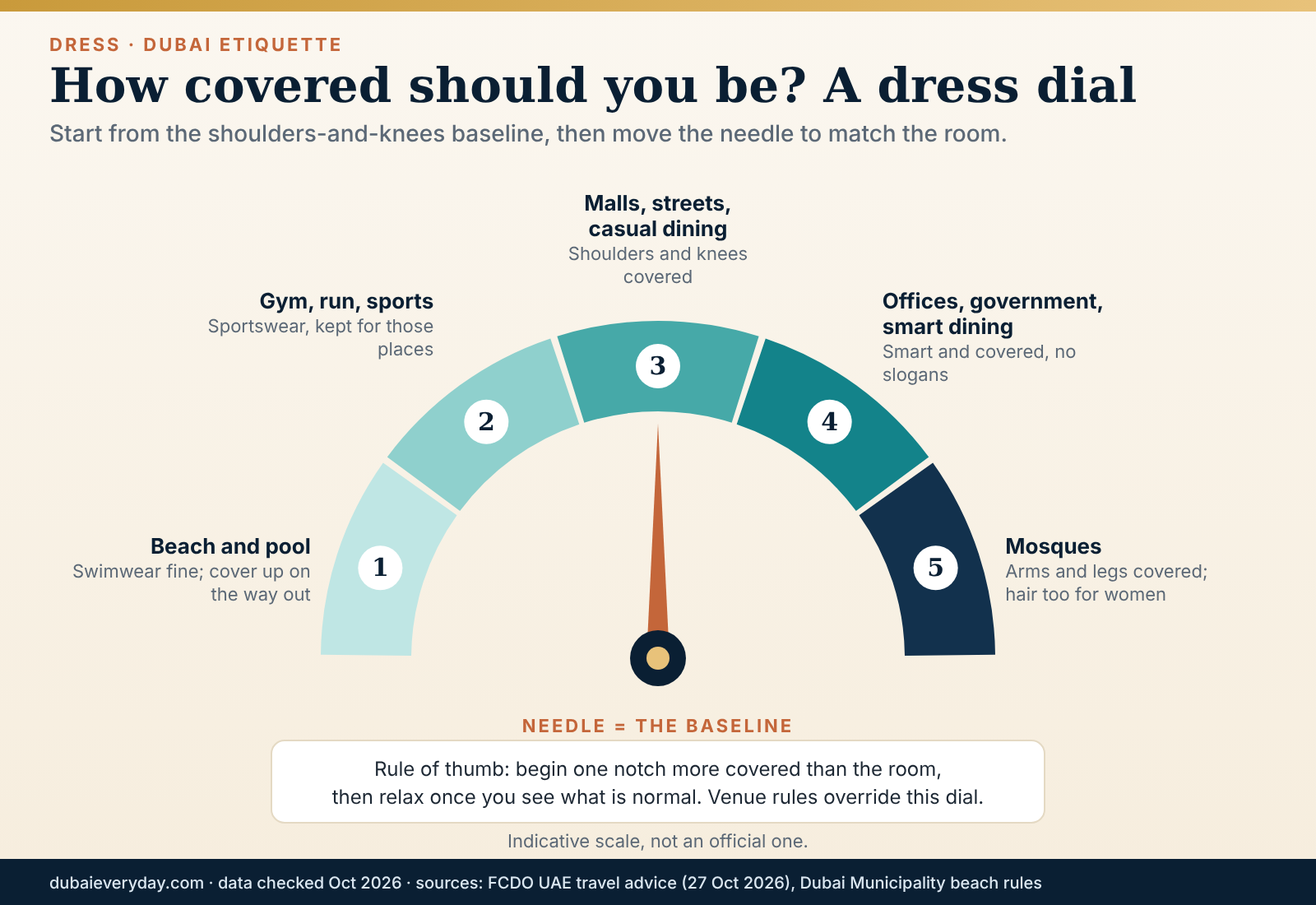
The Dubai etiquette baseline: shoulders and knees
The FCDO’s advice for women is to cover shoulders and knees in public areas such as shopping malls, to avoid showing underwear or wearing see-through clothing, and to avoid clothing with images or wording that could offend. For men the same principle is generally followed in practice: shorts that reach the knee are common in malls, vests and very short shorts are not. That second half is community guidance, not a statute. It still works, because the standard is the same one hotels, malls and offices apply informally.
Think of the Dubai etiquette baseline as a default for anywhere that is not explicitly a pool, beach, gym or club. It gives you a margin for error: if a venue is more relaxed, you are still fine; if it is stricter, you are close enough to adjust.
Beaches and pools: swimwear stays at the water
Dubai etiquette for beachwear is short: swimwear stays at the water. The FCDO is clear that swimwear is appropriate on beaches and at pools, which implies, correctly, that it is not appropriate elsewhere. Dubai Municipality’s beach rules, as summarised in our beaches guide, ban swimwear in passageways, which in practice means putting on a cover-up when you leave the sand. Hotels apply the same logic to lobbies and restaurants: a sarong or shirt over swimwear is expected between pool and room.
Treat topless sunbathing as unacceptable on public beaches, and ask a hotel about its own pool policy rather than assume it is relaxed. If you are choosing a beach with family in mind, the family beaches guide notes facilities and the more relaxed days, and the public beaches guide covers the free municipal stretches.
Malls, streets and restaurants
Malls are public spaces with security staff and a mixed crowd, and the baseline applies. In restaurants, dress rises with price: casual but covered for most places, smart for fine dining, and whatever the venue states for the few that publish a code. The Michelin restaurants guide flags dress where it matters. For shopping routes and what to wear while walking between them, see the Dubai Mall guide.
Heat creates a practical wrinkle. In July you may be tempted to dress for the pavement, then discover the mall air conditioning is cold enough to want a layer. Light long sleeves and loose trousers breathe better than they look, and a linen shirt or a scarf covers shoulders in seconds. For summer planning, the best time to visit Dubai page explains how heat shapes what people wear, and when.
Offices, government buildings and mosques
Dubai etiquette is at its most conservative here. Official buildings call for the most conservative version of the baseline: covered arms and legs, no slogans, no beachwear and no flip-flops if you can avoid them. Treat a visa office, a court, a municipality counter or a police station as a place where you want to be taken seriously on the first look. Offices vary by company, but a business-casual default works in nearly every case.
Mosques require full coverage of arms and legs, and women are expected to cover their hair. If you want to see inside one, the Sheikh Mohammed Centre for Cultural Understanding’s website says visits take place at the Jumeirah Mosque, one of the few in Dubai that welcome non-Muslims, with visitors registering at the majlis opposite. The prayer section below covers manners inside and around the building.
Nightlife and special venues
Dubai etiquette at night is mostly the venue’s call. Clubs, lounges and beach clubs publish or enforce their own codes, and these are venue rules rather than cultural rules. Smart casual is usual, trainers and shorts are often refused, and door staff have the final word. Our nightlife guide covers the details; for etiquette purposes, remember to cover up again when you leave. The street outside is public space governed by the baseline, even at 1 a.m.
National dress is not a costume
Emirati men typically wear a white kandura with a headcloth, and women wear a black abaya with a headscarf. Both are everyday clothes and signal a family tradition. Do not photograph people in them without permission, do not touch the clothing, and do not wear a version of it as fancy dress. If a host invites you to wear traditional dress for an occasion, that is a different matter, but ask rather than assume.
A packing rule that saves arguments. Pack one light layer that covers shoulders and one pair of loose trousers or a long skirt for every day of a trip, even in summer. They double as sun protection, handle air conditioning, and turn a casual outfit into a mosque-ready or office-ready one in a minute.
- Shoulders and knees covered in malls, public buildings and on public transport
- Swimwear only at beaches and pools, with a cover-up between water and door
- No offensive slogans or images on clothing
- Full arm and leg coverage, plus a headscarf for women, for mosques
- Follow a venue’s own code when it publishes one
Greetings and first meetings
Greetings are the cheapest Dubai etiquette investment in the city. A warm, unhurried hello opens doors in banks, offices, taxis and shops, and a rushed one marks you as a customer to be processed. Dubai etiquette in this area is mostly custom rather than law, which means it varies by person, and the best approach is to read the other person’s lead.
The spoken greeting
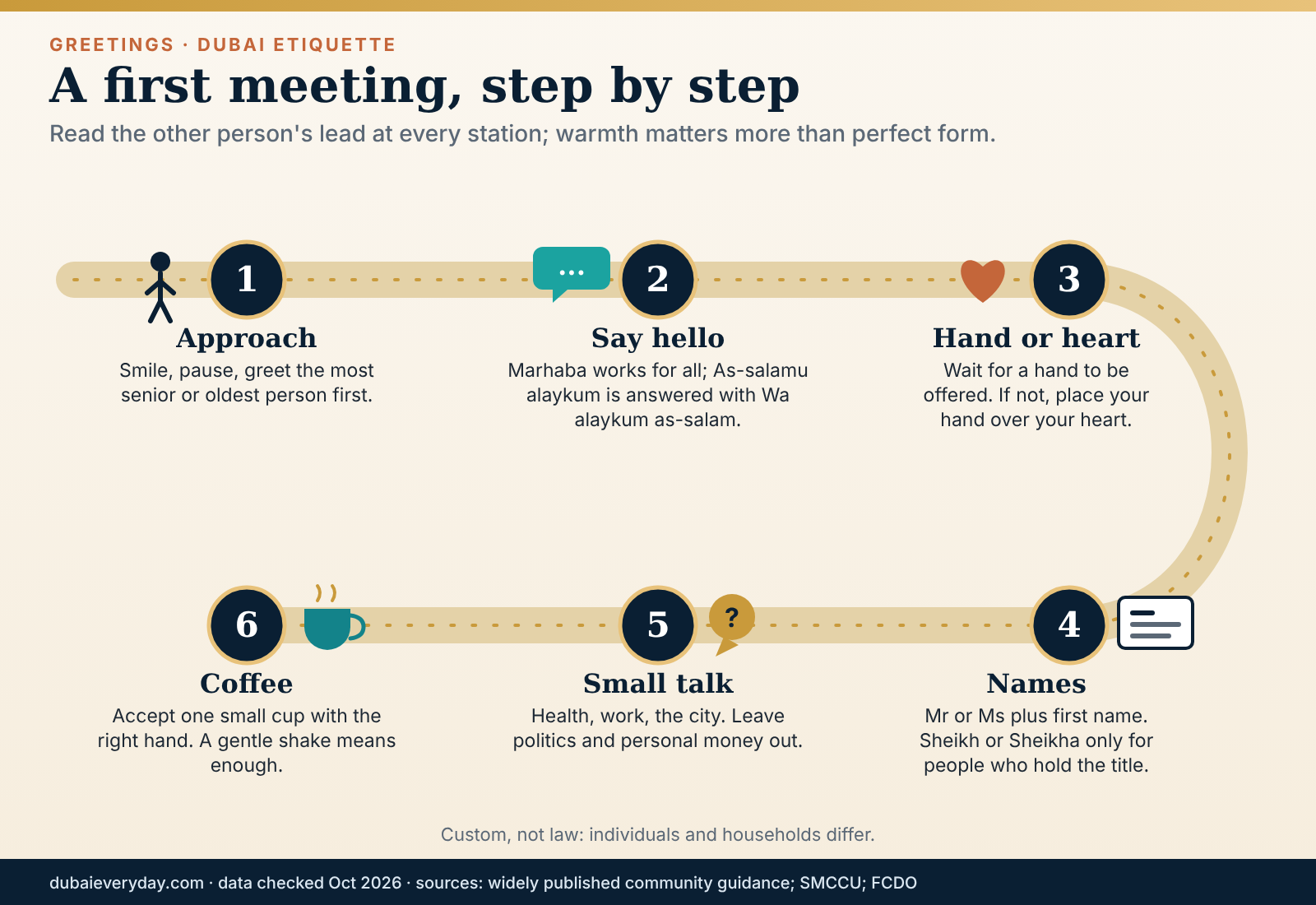
Good Dubai etiquette starts with the words. The standard Muslim greeting is “as-salamu alaykum”, roughly “peace be upon you”, answered with “wa alaykum as-salam”. Non-Muslims are not expected to use it, and many people do, with good reception. “Marhaba” (hello) and “ahlan” (welcome) work for everyone, “shukran” means thank you, and “sabah al-khair” and “masa al-khair” cover good morning and good evening. English is the common working language across the city, so a few Arabic phrases are a courtesy rather than a requirement.
Pronunciation does not need to be perfect. Effort registers more than accuracy. What does matter is not rushing straight to business: a greeting, an inquiry about how the person is, and a brief pause before the request is the pattern most people follow.
Handshakes, hands and hearts
Between men, a handshake is normal, often longer and softer than a Western one, sometimes followed by a hand to the chest. Between a man and a woman, practice varies. Some Muslim men and women do not shake hands with the opposite sex, and others do. The safe sequence is to wait for the other person to offer a hand. If they do not, a slight nod with a hand placed over the heart is a courteous alternative that offends nobody.
Emirati men sometimes greet one another with a nose-to-nose touch. It is a traditional gesture between people who know each other, and a visitor does not need to copy it. If someone leans in, follow their lead; if they do not, a handshake is enough. Use your right hand for greeting, passing, receiving and eating. Left-handed readers should know the convention exists; it is observed more in traditional settings than in a glass office tower.
Names, titles and small talk in Dubai etiquette
Emirati names often follow a given name, the father’s name and a family or tribal name, linked by “bin” (son of) or “bint” (daughter of). Address someone by “Mr” or “Ms” and their first name unless invited otherwise, and use “Sheikh” or “Sheikha” only for people who hold the title. In business, titles matter and seniority is acknowledged; greet the most senior person first.
Small talk usually starts with health and general wellbeing and stays away from politics, religion as a debate, money and personal life. Men asking men about each other’s family is typically fine in general terms; asking after a conservative man’s wife or daughters in detail is not. If you are unsure, ask about work, travel or the city. People in Dubai tend to have an interesting answer, because most arrived from somewhere else.
When the greeting goes wrong. If you extend a hand and it is not taken, withdraw it naturally, place it over your heart and smile. That small move turns a stumble into a gesture. Nobody expects you to know every convention, and people notice recovery more than error.
Hospitality: coffee, dates, invitations and homes
Hospitality is the part of Dubai etiquette that is most often described in romantic terms and least often explained in useful ones. The reality is straightforward. Hosts, especially Emirati hosts, take pride in offering coffee, dates and food, and a guest’s job is to accept graciously, not to perform. Everything below is community guidance on custom, not rule, and individual households differ.
Arabic coffee and dates
Coffee is the centrepiece of Dubai etiquette at home. Arabic coffee, gahwa, is poured in small handleless cups, usually without milk or sugar and often flavoured with cardamom, and it arrives with dates. Accept with your right hand. A single cup is polite; a second is welcome if offered. The widely described signal that you have had enough is to give the cup a gentle shake from side to side when handing it back. Without that gesture, the server may refill it, so learn the signal rather than leave a stack of half-drunk refills.
If you cannot drink coffee, say so warmly and accept a date or water instead. Declining everything at once can look abrupt. If the host is offering from a tray, take what you want, not what looks most generous.
If you are invited to a home
An invitation to an Emirati home, or to a majlis, is a sign of trust, and the unspoken rules are short. Dress modestly, arrive close to the time given, follow the host on shoes (remove them if others have), and wait to be shown where to sit. Greet elders first and let the host start the conversation. Do not photograph the house or its occupants without asking, and keep your voice level.
Bring something small: good dates, sweets or flowers are the usual suggestions. Avoid alcohol as a gift unless you know your host, and avoid items that are obviously religiously awkward. Expect more food than you can eat; a clean plate can prompt a refill, and leaving a little signals you are full. When you leave, thank the host personally and reciprocate when you can. That last step matters more than any phrase.
An official way to practise. If you would like to see how this works before you are invited, the Sheikh Mohammed Centre for Cultural Understanding in Al Fahidi Historical Neighbourhood runs guided cultural meals, described on its website as a sit-down Emirati breakfast of about an hour and a half with Arabic coffee, dates and local dishes, served in a courtyard. We have not attended one, so check current availability and prices with the centre directly.
Inshallah, and what it means in practice
“Inshallah”, God willing, is attached to future plans in everyday speech. It is sincere, not evasive, but it can also soften a commitment. Visitors sometimes read it as a polite no. A better reading is: this is intended, with the usual uncertainty about the future. If timing matters, restate it plainly, confirm by message the day before, and avoid treating the phrase as either a promise or a refusal.
The same flexibility appears in dinner invitations, which may start later than you expect, and in the pace of meetings. The point is not to match it exactly but to avoid taking it personally. For a visitor, this is mostly relevant when arranging private tours or social meetings. For tours, our guide to things to do in Dubai notes what to book in advance, and booking confirmations remove the guesswork.
Public behaviour: queues, voices, affection and the Metro
Public Dubai etiquette is a mix of formal rules and what any crowded city expects. The twist for Dubai etiquette is that this city is crowded by a population from many places with different norms, so the useful rule is predictability: do what people around you can anticipate. The sections below cover the places where visitors most often get it wrong.
Voices, phones and personal space
Everyday Dubai etiquette begins with volume. Keep your voice moderate in malls, restaurants, lifts and on transport. Speakerphone calls in public are common but unwelcome; headphones are the courtesy. Personal space tends to be reasonable in malls and offices, and shrinks at peak times on the Metro. Queues in banks, airports and at counters are generally respected, and cutting in is noticed. Where there is no visible queue, such as a busy taxi rank, look for the unspoken order and do not push past it.
Shouting at staff is a fast way to lose cooperation. Many service workers in the city are expatriates working long shifts, and politeness is not only decent but practical. In the worst case, insults can cross into the territory the cybercrime and obscenity provisions cover, as the law section above explains.
On foot and on the road
Dubai etiquette on the road is mostly self-restraint. The FCDO says jaywalking is illegal and that drivers often do not stop at zebra crossings, so cross at designated crossings and treat a crossing as a request, not a guarantee. On the road, rude gestures and offensive language to other drivers can lead to fines, jail or deportation, according to the same page. Tailgating, flashing headlights and weaving are common, and the best response is to let it pass. Do not escalate.
If you plan to drive, read our guide on comparing car rental companies before you rent, and the driving licence guide if you are staying. Around sunset in Ramadan, the FCDO warns of erratic driving as people rush home for iftar, so leave extra room.
Metro, tram and taxis
The Metro has a reserved Women and Children cabin and a premium Gold class. Men should stay out of the reserved cabin, and Silver-card holders should not sit in Gold. Priority seats are for people who need them; offering your own seat is expected. Reported fines include about AED 100 for eating or drinking on the system and up to AED 300 for sleeping, but those amounts come from secondary sources, so confirm them with the Roads and Transport Authority. Our Dubai Metro guide covers fares, cards and hours.
For taxis, the FCDO notes that Dubai taxis are cream with coloured roofs, that pink roofs signal female drivers, and that special taxis exist for women and children. Greet the driver, sit in the back unless invited otherwise, and confirm the route if you have a preference. Tipping is covered later; for now, note that nobody expects you to negotiate.
Malls, buildings and shared spaces
Malls are the closest thing Dubai has to a public square, which makes mall behaviour a good proxy for public behaviour overall. Dress as the baseline requires, keep affection modest, and respect the signed prayer rooms. In lifts, let people out first. In residential buildings, noise after late evening is a frequent source of complaints, many buildings restrict drying laundry on balconies (check your community’s rules), and pool rules are posted and enforced by building management.
Smoking and vaping are restricted in many indoor public places, and signs vary by venue, so follow the signs rather than the person beside you. Littering and spitting can attract municipal fines, which change over time, so check Dubai Municipality’s current schedule rather than rely on a number from a blog.
Children and families
Children are welcome in most public places, and tolerance for noise is generally higher than in many Western cities. That tolerance runs out in quiet settings: mosques, some restaurants in the evening, and hotel adult pools. If you are travelling with younger children, our Dubai with kids guide and the guide for travelling with a baby cover logistics such as changing rooms and heat. The etiquette point is simple: if your child is loud, move.
Prayer, mosques and Fridays
You do not need to be religious to benefit from knowing the rhythm of Muslim prayer, because it shapes the city’s day in small, visible ways. Muslims pray five times a day, and mosques broadcast the call to prayer. Malls, airports and many offices have prayer rooms, usually signed and divided by gender. None of this requires you to do anything except avoid getting in the way.
Around people who are praying
The Dubai etiquette here is about space and silence. Do not walk directly in front of someone who is praying, keep your voice down near prayer rooms and mosque entrances, and do not photograph worshippers. If a room is marked for prayer, it is not a place to rest, charge a phone or take a call. In a mall, you may pass a queue of shoes outside a prayer room; step around them and carry on. The courtesy is the same one you would extend to someone in a library: quiet and distance.
The call to prayer is amplified, and it is a feature of living near a mosque. If you rent an apartment close to one, expect it, and treat it as part of the area’s character rather than a noise complaint. Our renting in Dubai guide suggests viewing a flat at different times of day for exactly this sort of reason.
Visiting a mosque as a non-Muslim
Most mosques in Dubai are for worshippers only. The Sheikh Mohammed Centre for Cultural Understanding states on its website that visits take place at the Jumeirah Mosque, one of the few that welcome non-Muslims, and that visitors register at the majlis across the road, where a light breakfast with Arabic coffee and tea is served. Opening days, times and prices change, and the page we read gave none, so confirm directly with the centre before you plan around it.
For a visit, wear loose, full-length clothing that covers arms and legs, women should cover their hair, and shoes come off at the entrance. Follow the guide’s instructions, stand or sit where you are directed, do not touch religious texts, and ask before taking any photograph. The same guidance holds on any mosque visit, but only some mosques admit visitors at all, so do not turn up uninvited at one that is not open to the public.
Fridays
Friday shapes Dubai etiquette around timing more than behaviour. Friday is the day of the congregational midday prayer. Roads around big mosques get busy at that hour, and some businesses open late or close briefly. As widely reported, the UAE moved its working week in 2022 so that federal government staff have Saturday and Sunday off and a shorter Friday; we did not re-verify that for this page, and private employers set their own patterns, so check your employer’s rules rather than assume. For visitors, the effect is mostly practical: expect traffic near mosques, and plan the middle of Friday for indoor activities.
Ramadan: how Dubai etiquette shifts hour by hour
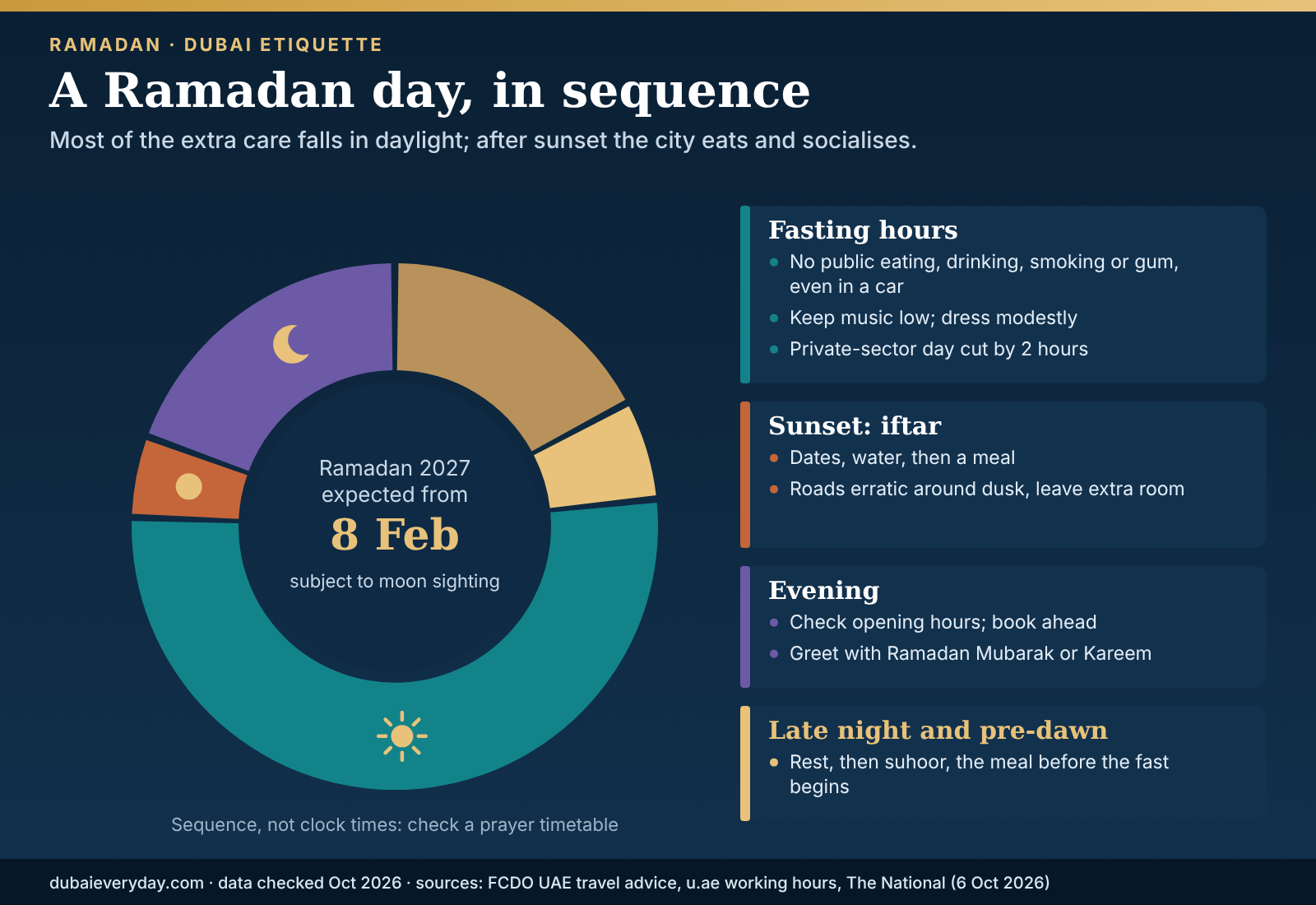
Ramadan is the month when the same city behaves differently from dawn to dusk, and it is the single biggest seasonal shift in Dubai etiquette. Muslims fast from dawn to sunset, with no food, drink or smoking, and break the fast at sunset with iftar. Non-Muslims are not expected to fast. What is expected is consideration in public during fasting hours. The detail below is practical rather than theological, and it covers visitors, residents and people working alongside fasting colleagues.
When is Ramadan 2027?
The UAE Astronomy Centre’s projection, reported by The National on 6 October 2026, puts the start of Ramadan around 8 February 2027, lasting 29 or 30 days and ending around 8 or 9 March. Eid Al Fitr is expected on 9 or 10 March, with a break running from 9 to 11 March if Ramadan has 29 days, or 9 to 12 March if it has 30. These are projections. The official start and end of each Islamic month are confirmed by the UAE moon-sighting committee, so treat dates as provisional until announced.
By our calculation, if Ramadan begins on 8 February, 21 of February 2027’s 28 days fall inside it, and the whole of the first week of March. That matters for anyone planning a February trip, a house move or a conference. Winter weather is gentle, which makes fasting easier for those who observe it and daytime outdoor plans easier for visitors, but the etiquette applies regardless of temperature. For event planning around the month, the Dubai events calendar guide and the February events guide show how the calendar shifts.
What changes in daylight
Daytime Dubai etiquette in Ramadan is mostly about discretion. The FCDO’s guidance is to avoid eating, drinking, smoking or chewing gum in public during daylight hours, including in your car. It also advises against playing loud music, dancing or swearing in public, notes that shops and restaurants may change their hours, and says dress codes matter more. Hotels and restaurants that serve food during fasting hours may use screens to separate diners from Muslim guests. That is a rule of consideration for the fasting majority, not a request that you also go hungry.
For visitors, that translates into a handful of decisions. Plan lunch at a hotel restaurant or a venue that is serving, not at a street kiosk. Keep a snack and water in your bag for private moments. Step into a hotel lobby café instead of eating on a pavement. If you are in the heat and need water for health reasons, drink discreetly; health comes first, and most people understand. Do not make a point of refusing to adapt, and do not eat in front of someone you know is fasting.
Summer Ramadan versus winter Ramadan. Ramadan moves about eleven days earlier each Gregorian year. In 2027 it falls in February, when daytime temperatures in Dubai are mild. In years when it lands in summer, fasting hours are longer and hotter, which raises the importance of discreet hydration for non-fasting visitors and of avoiding midday outdoor plans. The Dubai etiquette stays the same, but the practical stakes change.
Working life in Ramadan
For private-sector employees, UAE labour law cuts working hours by two hours a day during Ramadan, as summarised on the UAE government’s working-hours page. In practice, that means earlier finishes, fewer late meetings and a lower tolerance for scheduling lunch. Many offices keep the day short and the pace gentler. If you manage a team, move key meetings to the morning, avoid lunchtime meetings, and keep coffee and snacks away from desks where fasting colleagues sit.
Do not assume your colleagues are or are not fasting. Some observe fully, some partially and some not at all, and the polite approach is to avoid asking and to follow their lead. When they offer to share a break-fast treat, accept. When they decline lunch, do not press.
Iftar, invitations and greetings
Iftar etiquette is among the warmest parts of Dubai etiquette. The fast breaks at sunset, traditionally with water and dates, followed by a meal. Hotels, restaurants and mosques host iftars, and many private homes and offices do too. If you are invited, arrive a little before sunset, wait to eat until the host begins, and expect a break for prayer. “Ramadan Mubarak” or “Ramadan Kareem” are the standard greetings and are welcome from non-Muslims. A small gift of dates or sweets for the host fits the occasion.
After iftar, the city comes alive. Many malls and restaurants run late hours during Ramadan, though schedules vary by venue, and the FCDO advises checking opening times. If you are dining out, book ahead on busy nights and allow extra travel time around sunset, when the roads are at their least predictable.
Eid Al Fitr
Ramadan ends with Eid Al Fitr, a multi-day holiday. “Eid Mubarak” is the greeting, and giving money gifts to children is a common tradition among families. Hotels, beaches and attractions get busy, and the holiday’s length depends on the moon sighting, so avoid booking non-refundable plans that hinge on exact dates before the announcement. The 2027 range is 9 to 12 March, as above.
Dubai etiquette at Eid is mostly warmth. Greet people, accept sweets, and if you work in an office, expect a quieter week either side. For a wider picture of how the holiday interacts with travel demand, see the best time to visit Dubai guide.
Alcohol: Dubai etiquette for drinking and not drinking
Alcohol is where the gap between law and etiquette is widest, and where many visitors, correctly, assume Dubai is permissive and, incorrectly, assume it is permissive everywhere. The legal frame is narrow. The social frame, meanwhile, is broad and sensible. For the full night-out picture, including bars, transport and costs, the Dubai nightlife guide and the best bars guide take over. This section is about the manners.
The legal frame in five lines
The legal side of alcohol sits underneath all Dubai etiquette on drinking. According to the FCDO’s advice, the legal drinking age in Dubai is 21, and drinking in public is illegal anywhere in the UAE, including being under the influence. Licensed venues such as hotel bars, restaurants and pubs do not require you to hold a licence.
Residents need a liquor licence to buy alcohol for drinking at home or at private gatherings, although the FCDO notes that enforcement in private settings may be lax. Visitors can obtain a one-month temporary licence from one of two official distributors, MMI or African and Eastern, valid in Dubai only. Drink-driving is illegal at any level, and your insurance is likely to be void if you crash after drinking.
One extra point of context: the same page notes that alcohol is illegal in Sharjah. A weekend that crosses the border between Dubai and Sharjah crosses a legal border, and you should not carry alcohol into a place where it is prohibited. Rules may change, so confirm the current position before you rely on this summary.
Drinking well inside the licensed room
The etiquette inside a venue is the same as anywhere: pace yourself, treat staff politely, do not pressure non-drinkers and do not film strangers. The Dubai-specific extras are about the edges of the room. Do not carry an open drink onto a street, a beach or a public terrace outside the venue’s licensed area; the licence applies to the venue, not to you. Do not wander through a hotel lobby with a drink in hand if the venue has not said that is fine. If a bar closes at the same time as the Metro, plan your way home before you start.
Public intoxication is the line that sinks evenings. The FCDO notes visitors have been charged for being under the influence in public, often after another offence such as disorderly behaviour. An argument that would earn a shrug in many cities can become a police matter here. If someone in your group is past their limit, get them to a licensed room or a ride and out of the public eye. Stay with them until they are home.
Hosting and being hosted
Do not assume Muslim colleagues or neighbours will drink, object or care. Equally, do not put alcohol on the table at a mixed work event unless the venue and organiser have agreed it. Offer good non-alcoholic options, and treat them as proper choices rather than consolation prizes. Gifting alcohol to someone is only fine when you know they drink; otherwise flowers or sweets are safer.
If you are a resident who drinks at home, the licence rule exists even where enforcement may be lax, and the sensible approach is to keep to the rule, keep noise low, and not store or transport alcohol visibly. Do not treat lax enforcement as permission. Note also that an incident in a building shared with neighbours can make a private matter public.
Not drinking is perfectly normal
Under Dubai etiquette, nobody needs to explain a soft drink. Plenty of residents and visitors do not drink, for religious, health or personal reasons, and there is no pressure to explain. Hotels and restaurants have well-developed non-alcoholic menus, and a cafe culture runs alongside nightlife. If you are looking for places that suit that choice, the best cafes in Dubai and best restaurants guides give you a place to start without alcohol being part of the plan.
During Ramadan, sale and service rules at individual venues can change. We did not find an official source for 2027 arrangements, so the practical advice is to ask the venue directly, not to assume. Dress and conduct expectations also tighten, which is a good reason to keep late nights quiet during the month.
Tipping and service charges: reading the bill
Tipping is a source of more anxiety than it deserves, and the honest starting point is that Dubai has no official tipping schedule. The UAE government’s page on taxes in tourist facilities lists the Tourism Dirham, which is AED 7 to 20 per room per night depending on hotel category and applies for up to 30 consecutive nights, but says nothing about tipping. So the practice is custom, and the real question is what is already on your bill.
Service charge: when it exists
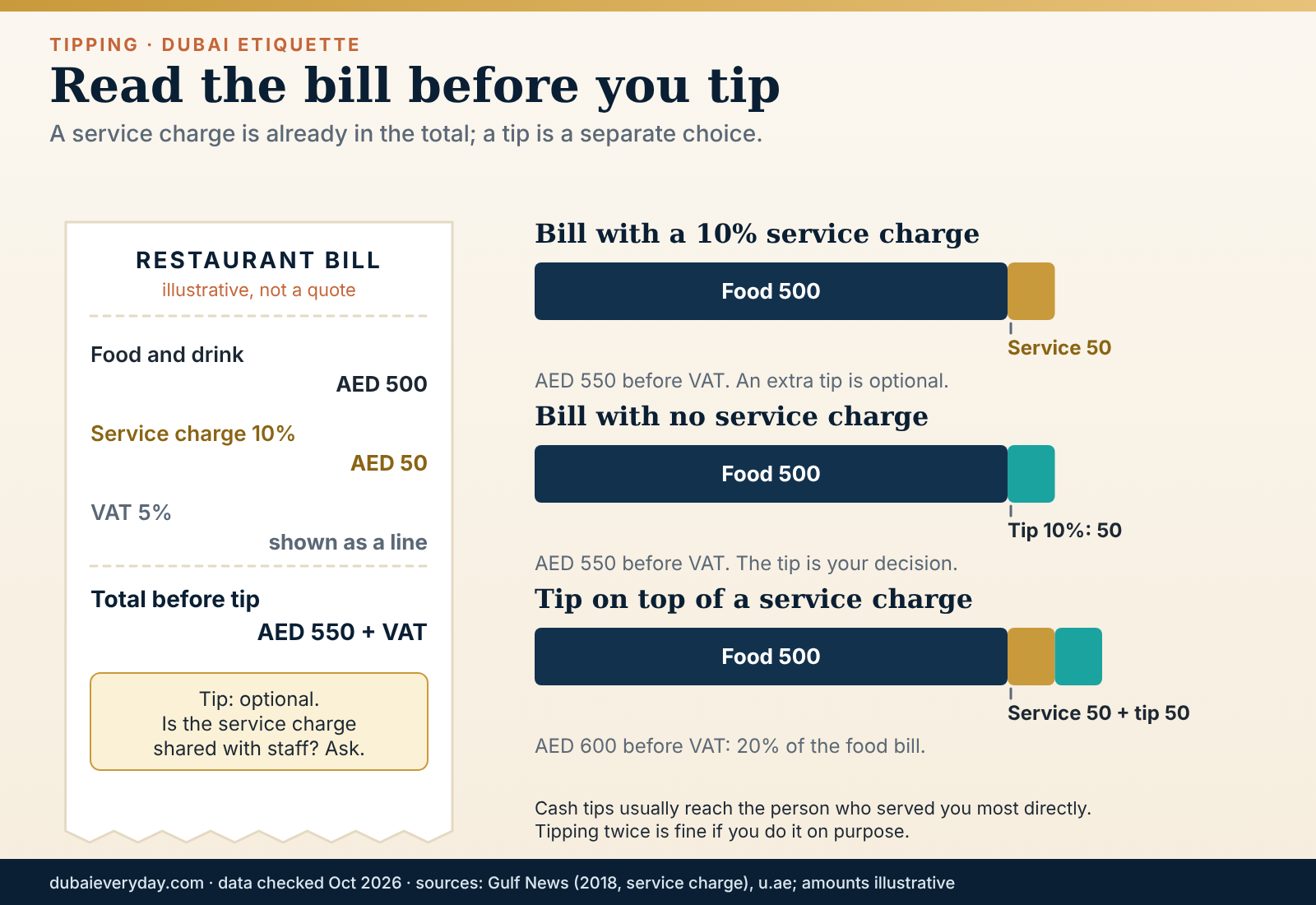
Tipping etiquette in Dubai depends on this line of the bill. A Gulf News explainer, last updated in September 2018, quotes a Department of Economic Development official saying restaurants may not add a 10% service charge under the consumer protection law unless they are inside a hotel, where Dubai Municipality regulations allow it, or in a special zone such as the DIFC. The article also notes that one branch of a restaurant may charge while another does not.
It is old and it did not say who receives the money, so treat it as background rather than a current rule.
The practical reading is this. Look at the bill. If it shows a service charge line, you have already contributed something, and an additional tip is optional. If it does not, a tip is a courtesy you decide on. Ask the server if the service charge goes to staff; the answer varies by employer and we cannot verify it from an official source. Cash tips are usually the surest way to reach the person who served you, though that too is a custom, not a rule.
Our suggested ranges
These are Dubai etiquette conventions, not rules. The ranges below are editorial conventions based on common practice, not an official schedule or survey. Adjust for service quality, venue type and whether a service charge is already on the bill.
| Situation | Common practice (our suggestion) | Note |
|---|---|---|
| Restaurant, no service charge on bill | About 10%, more for exceptional service | Check the bill first |
| Restaurant or hotel with 10% service charge | Nothing extra required; small cash extra optional | Charge may not all reach the server |
| Cafe or counter service | Round up, or small change in a tip jar | Never expected |
| Taxi or ride-hail | Round up to a convenient figure | Fares are metered |
| Hotel porter or housekeeping | A small cash amount per service | Nothing is mandatory |
| Delivery rider, valet | A small cash amount | Optional |
| Home cleaner, spa therapist | Optional; check the provider’s policy | Some firms say tips are optional |
A worked example, illustrative only
Illustrative example (not a quote or market fact): suppose a table orders AED 500 of food and drink in a hotel restaurant that adds a 10% service charge. The service charge is AED 50. If you also tip another 10% on the base, you pay AED 50 more, so AED 100 in total on top of the AED 500, which is 20%. Whether that is generous or doubled-up depends on whether the staff receive the service charge, which you may want to ask. In a restaurant with no service charge, a 10% tip would be AED 50 in the same example.
The point of the arithmetic is to make a choice visible. Tipping twice is not wrong, but it is worth doing deliberately. For hotel stays, our hotels guide covers area and budget choices, and for residents budgeting for regular services, the cost of living guide shows where small recurring amounts accumulate.
Haggling, paying and splitting
Bargaining is normal in the gold, textile and spice souks and not in malls or supermarkets. Keep it friendly, start lower than your target but not insultingly low, and walk away politely if the price does not suit. Do not bargain for something you do not intend to buy. Our Dubai shopping guide covers where it is worth it.
When a host insists on paying for a meal, accept graciously and reciprocate later. Contesting the bill repeatedly can be read as rejecting hospitality. Pay and hand over cash with the right hand where you can, and use cards if you prefer. Check receipts for service charge and VAT lines before you sign, and ask politely if something is unclear. Politeness has a good return when you need a correction.
Photography, filming and posting online
Of all the Dubai etiquette topics, photography is the one where a casual habit most often collides with a serious law. In many countries, taking a photo in a public place is unremarkable. In the UAE, the cybercrime decree-law treats photographing other people as a privacy matter, and the penalties are heavy. Visitors who film a crowd, residents who post a neighbour’s parking and tourists who snap a stranger on a beach are all in the same legal territory.
What the law says
The legal core of Dubai etiquette on photography is one article. Article 44 of Federal Decree-Law 34 of 2021, as published on the UAE Legislation portal, provides for imprisonment of at least six months, a fine of AED 150,000 to 500,000, or both, for using technology to invade someone’s privacy or family life without consent.
The article lists conduct that includes taking photographs of others in public or private places, creating, sending or storing electronic photographs of them, recording or broadcasting conversations, publishing news, photos or comments about someone with intent to harm them even if the content is true, photographing injured or dead people or accident and disaster victims without permission, and tracking or disclosing someone’s location.
A related provision covers altering a photo or recording to defame or insult someone, with a minimum of one year in prison and/or a fine of AED 250,000 to 500,000. Article 52 addresses false news: sharing information that contradicts official announcements, or misleading reports that stir public opinion or spread fear, carries a minimum of one year and AED 100,000, with higher minimums in emergencies. These are the texts as summarised from the decree-law; we are not lawyers and cannot say how any authority would treat a specific photo.
Our reading for everyday use
For everyday Dubai etiquette, the question is how identifiable the person is. The decree-law’s wording is broad, and in everyday life most people are not prosecuted for a landscape photo with strangers in the distance. That is our reading, not a legal safe harbour. The sensible rule is a gradient. A skyline with incidental crowds is low risk. A portrait of a stranger is high risk. A photo of a stranger posted online with a joke at their expense is the highest risk, because it combines photography, publication and potential insult.
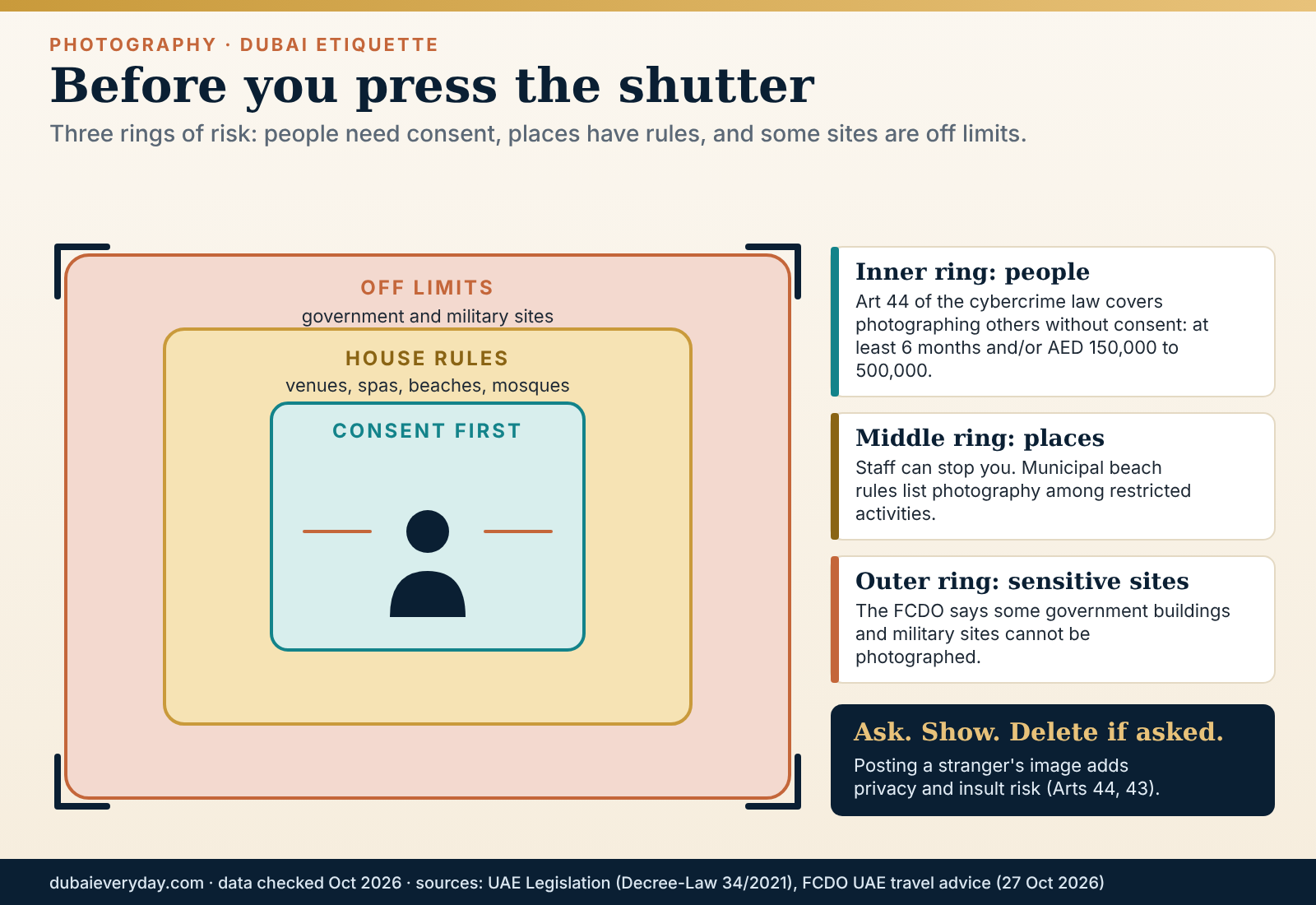
Practical habits follow from that. Ask before photographing a person, and accept a no. Frame strangers out of selfies. Do not photograph children who are not yours. Show the picture if asked and delete it if requested. Never photograph women on beaches or by pools without explicit permission: the FCDO says men have been arrested for photographing women on beaches. Be especially careful at mosques, in cultural districts and around Emirati families, where a camera is more likely to be read as intrusive than flattering.
Places with their own rules
Photography etiquette in Dubai also depends on the venue. Venues set their own photography policies, and staff will tell you. Spas, gyms, changing areas, beaches, prayer rooms and many museums restrict cameras. The municipal beach rules, as read for our beaches guide, list photography among restricted activities on public beaches; check the municipality’s beach pages for the exact wording before you rely on a beach for filming. Private properties such as malls can require you to stop, and security guards will say so.
The FCDO states that some government buildings and military sites cannot be photographed, and warns that birdwatching or plane spotting near sensitive sites can be misread. Treat airports, ports, police stations, palaces, embassies and anything with uniformed guards as no-photo zones unless a sign says otherwise. The same page notes that satellite phones, radio transmitters, recording devices, powerful cameras and binoculars may need a licence, so check before packing professional kit.
Drones, creators and commercial shoots
Drones are regulated in the UAE. Check the General Civil Aviation Authority’s current requirements and any venue restrictions before flying one, and do not assume that a beach or park is open for it. Professional shoots and sponsored content are another category: the FCDO says media activity of any kind, whether printed, digital, audio, video or visual, requires permits from the National Media Council. Whether your content counts is a legal question we cannot answer, so ask the council before you shoot for money or a brand.
Posting, tagging and reviews
Online Dubai etiquette is a legal matter as well as a social one. The risk does not end when the shutter closes. Publishing a photo of someone with intent to harm them is covered by Article 44 even if the content is true, and a post that insults a person can fall under Article 43.
This catches the common habit of posting a “naming and shaming” video of a driver, a neighbour or a shop. If you have a genuine complaint, use the proper channel: a regulator, a landlord, the police or a consumer complaint route. Our legal basics guide points to where each one lives.
Reviews should describe your experience, not the individual. “The waiter ignored us for twenty minutes” is a fair complaint; naming and photographing the waiter is not. WhatsApp groups are not private in law, and a screenshot sent to a building group travels fast. If you manage a community chat, set a rule against posting photos of residents or staff. Personal-data protection has its own federal decree-law (No. 45 of 2021, listed on the UAE government’s cyber-laws page), so do not assume group chats and shared albums sit outside the law. For digital life more generally, see the internet and mobile guide.
The FCDO’s travel advice for the UAE, updated on 27 October 2026, describes an unpredictable regional situation and advises people to follow local authorities and avoid areas around security or military sites. Given Articles 44 and 52, our cautious reading is that you should not film or post emergency responders, sirens, debris or damage, and that you should share only information that comes from official channels. Check the current advice yourself before travelling.
Workplace and business etiquette
An office in Dubai is a small version of the city: colleagues from a dozen countries, English as a working language, and a mix of formal and informal habits. The workplace Dubai etiquette that matters most is less exotic than visitors expect, and more about hierarchy, relationships and scheduling than about customs. The legal frame is the labour law, which also shapes some etiquette points. For job-seekers, the jobs in Dubai guide covers applications and scam checks.
Time, meetings and hierarchy
Be punctual yourself. Dubai traffic is unpredictable, so build a buffer, and treat late starts by others as normal rather than personal. Meetings often begin with small talk and tea or coffee before business, and rushing straight to the agenda can read as abrupt. Seniority is respected: greet the most senior person first, let them lead, and avoid contradicting them in front of the room. Disagree privately or in writing, politely.
Business cards can still be useful, especially in traditional and government-adjacent sectors. Present and receive them with your right hand, or with both hands, and read the card rather than pocketing it. Titles matter, so use them in email until invited to drop them.
Messaging and tone
WhatsApp is a normal business channel in Dubai. Keep messages courteous, avoid late-night demands, and do not treat voice notes as private. Written tone tends to be warm and slightly formal. A direct “no” is often softened, so read the hedge: “let me see” and “we will try” can mean no. If you need a real answer, ask a question that has one, such as “what would need to change for this to work?”
Work, religion and diversity
The UAE government’s labour-rights page, read for our legal research, states that discrimination on grounds including gender, race, colour, religion, national or social origin and disability, as well as harassment and bullying, is prohibited in private-sector employment. Take that as the frame for office behaviour: avoid jokes about religion, nationality or appearance, and do not ask colleagues about their beliefs. During Ramadan, expect shorter working hours, as described above, and a quieter pantry.
For new arrivals, the moving to Dubai guide sets work etiquette within the wider first-month setup, and the work visa guide explains the sponsorship steps behind a job offer.
Eight situations worked through
Dubai etiquette rules are easiest to remember when they are attached to a scene. The eight below are built from the sources above and common sense, not from anyone’s anecdote: they are constructed examples, and the reasoning matters more than the details. Each one names the layer involved, so you can see which part is law, which is a house rule and which is custom.
1. From the pool to lunch
You are at a hotel pool and want lunch in the restaurant. This is layer two. Swimwear is for the pool and beach, so put on a cover-up and dry shoes before you walk through the lobby, and check whether the restaurant has its own code. If it has, a shirt and shorts will often be enough for a casual poolside spot; a formal indoor restaurant will want more. A thirty-second change avoids a conversation with the maître d’.
2. A colleague invites you to iftar
You have been invited to break the fast. This is layer three. Say yes if you can, arrive a little before sunset, dress modestly, bring dates or sweets, and wait for the host to begin. Do not ask whether alcohol will be served; assume it will not be. Offer to help clear up, stay long enough to show you are not rushing, and thank the host the next day. The invitation is a gesture of friendship, and a prompt, warm answer is the right return.
3. A photo at the fountain
You are at a crowded viewing area and want a photo. This is layer one in miniature. A wide shot of the fountain with incidental crowds is low risk. A close shot of a family in the foreground is not. Wait for a gap, frame people out, or ask, and never post a picture of a recognisable stranger without their agreement. Remember that Article 44 refers to photographs in public places. If someone asks you to delete a photo, do it on the spot and let them watch.
4. A handshake across genders
You meet a client of the opposite sex at a business lunch. This is layer three. Wait for them to extend a hand, and if they place theirs over their heart instead, do the same with a smile. Do not comment on it. Use titles until invited otherwise, and keep eye contact natural. The reverse also applies: if you do not wish to shake hands for religious reasons, the hand-on-heart gesture works for you too.
5. Hungry at midday in Ramadan
You are a visitor, it is a fasting day, and you need lunch. The FCDO advises against eating, drinking, smoking or chewing gum in public in daylight, including in a car. Go to a hotel restaurant or other venue that is serving, expect a screen or a quiet section, and keep snacks for private spaces such as your room. Before you set out, call to confirm hours, because they can change. If you feel unwell from heat, drink water discreetly; health comes first.
6. A couple on the beach
Two people want an afternoon at a public beach. This is layers one and two. The FCDO says kissing in public can lead to arrest, and swimwear belongs on the sand and in the water, not on the road. Keep contact casual and the cover-up in the bag. If you want more privacy and fewer rules, a resort beach or a quieter hour at a municipal beach helps, but no stretch of beach is exempt from the law. See the best beaches guide for the options.
7. A dinner in an Emirati home
A new acquaintance invites you home. This is layer three at its warmest. Dress modestly, arrive near the time given, remove your shoes if others have, accept coffee with the right hand, take a second small serving if offered and leave a little on the plate. Ask before photographing anything. When you leave, thank the host personally. If you cannot attend, decline early and warmly, with an offer to meet another time.
8. A row with a taxi driver, or a neighbour
Tempers rise. This is layer one. Any rude gesture or swearing, including a message afterwards, is a risk. Step back, say you will report it through the proper channel, and do. For a taxi dispute, note the car number and use the operator’s complaint line. For a neighbour, use building management. Never film the other person and post it. Our tenant rights guide explains dispute routes for renters.
If you live here: neighbours, buildings and the long game
Visitors can get away with a week of careful behaviour. Residents cannot, because Dubai etiquette for people who live here is built from small repeated courtesies. The city’s towers pack hundreds of households into one lift and one car park, and a good name with the security desk, the neighbours and the building manager is worth more than any single rule on this page.
Buildings, noise and shared spaces
Resident Dubai etiquette is mostly building etiquette. Most communities publish rules for noise, pools, gyms, parking, balconies and visitors. Read them when you move in, because enforcement runs through building management and, ultimately, through your landlord. Keep late-evening noise down, treat shared pools and gyms as shared, and follow the dress expectations for common areas. For renters, our apartment renting guide includes a viewing checklist, and the home setup guide covers the first-week tasks.
Residential complaints are often settled informally. A note, a polite word or a call to the building manager resolves most. Escalate to a formal complaint only after that, and never by public post.
Staff, deliveries and domestic help
A great deal of daily life in Dubai runs on the work of people from the service and delivery sector. Say hello to the security guard, thank the delivery rider, and give cleaners proper breaks and clear instructions. If you hire help, read the cleaning services guide for licensing and booking quality. Politeness here is not a tip; it is the base of an arrangement that works for years.
Pets, children and neighbours
Pets are subject to registration and building rules; the pets in Dubai guide covers the paperwork, parks and heat. Children are welcome, and neighbours generally appreciate it when a parent apologises quickly for a noisy morning. A small gesture such as sharing sweets at Eid or leaving dates by the lift at Ramadan costs little and is widely appreciated. Keep it simple and avoid religious messaging unless you share the faith.
Learning more over time
The most effective long-term habit is to learn a few Arabic phrases, attend a cultural event or two and ask questions with curiosity rather than judgement. The centre mentioned earlier is one route. A second is simply asking colleagues and neighbours, who are usually pleased to explain. If you are settling in, the relocation checklist puts social setup alongside documents and utilities.
The costliest Dubai etiquette mistakes, and how to recover
The list below ranks common slips by how bad the worst plausible outcome is, not by how often they occur. It is our judgement, built from the sources above; there are no statistics behind the order, and nothing here is a prediction about any individual case. The first five carry a legal edge. The rest are about goodwill.
1. Photographing and posting strangers
The privacy article of the cybercrime law covers photos, recordings and publication. Recovery: delete in front of them, apologise, do not post.
2. Insults and rude gestures, online or off
Treated as obscene acts by the FCDO’s summary, and covered for written insults by Article 43. Recovery: stop, apologise, remove the post.
3. Drinking or being drunk in public
Illegal outside licensed venues. Recovery: get the person to a licensed room or a ride, and do not argue with staff or police.
4. Kissing in public
FCDO says it can lead to arrest. Recovery: stop and move on; do not escalate if challenged.
5. Drugs, CBD and unchecked medicines
Zero tolerance. Recovery starts before packing: check the Ministry of Health list and carry prescriptions.
6. Swimwear outside the pool
A venue and custom issue. Recovery: cover up and apologise if asked.
7. Public eating at midday in Ramadan
Strong custom. Recovery: finish quietly, move to a venue that serves, and be courteous.
8. Forcing a handshake or hug
Custom. Recovery: smile, place a hand over your heart, move on.
9. Assuming every emirate has the same rules
Alcohol alone differs between Dubai and Sharjah. Recovery: check before you cross.
10. Filming sensitive sites or flying a drone
Government and military sites are off limits per the FCDO. Recovery: stop, delete, comply with staff.
11. Refusing hospitality abruptly
Custom. Recovery: accept one small cup, then decline the rest kindly.
12. Ignoring the bill
Tipping on top of a service charge is optional, but double tipping by accident is common. Read the receipt.
A Dubai etiquette recovery sequence that works for most slips
- Stop the behaviour.Put the camera down, lower your voice, step back from the argument or finish the drink somewhere licensed.
- Apologise once, sincerely.Say sorry in plain words and offer to fix it, such as deleting a photo. Over-explaining reads as excuse-making.
- Fix the visible part.Delete the post, cover up, leave the queue, or move to the right room.
- Do not argue with officials.If police or security are involved, stay calm and polite, answer questions, and ask to contact your embassy or a lawyer if matters are serious.
- Check the rule afterwards.Read the primary source, so the mistake is not repeated.
The point of the sequence is speed and humility. Most people who handle an error quickly and without defensiveness find the matter closed in a minute. The exceptions are the first five, where the other party or the authorities decide. For those, early legal advice and consular help matter more than any etiquette.
FAQ
What is the single most important rule of Dubai etiquette?
Ask before you photograph, and keep affection and alcohol in their proper rooms. If you only remember one thing from Dubai etiquette, remember that the serious penalties attach to behaviour that affects other people: photographing them, insulting them, or making a public scene. Dress, greetings and coffee matter for goodwill, but a mistake there costs you a raised eyebrow. A mistake with a camera, a rude gesture or a drink on the street can cost you far more. Be a little more formal than the room, and relax once you see what is normal.
Is kissing in public against Dubai etiquette and law?
The UK Foreign Office’s summary of local law says public displays of affection are frowned upon and that kissing in public can lead to arrest. That makes it a legal risk and not just a point of manners. Brief, modest contact such as a hug at an airport is different from a kiss on a beach, but nobody can promise how a particular situation will be judged, because a complaint or an observer often triggers action. The safest approach is to keep romantic gestures private. We are not lawyers, and this is general information.
What should tourists wear under Dubai etiquette?
The baseline in Dubai etiquette is to cover shoulders and knees in malls and public places, avoid see-through clothing and offensive slogans, and keep swimwear to beaches and pools. For summer heat, loose light fabrics work better than skimpy ones, and a light layer helps with air conditioning. Mosques and government buildings need more coverage, and nightlife venues have their own dress codes. For specifics by venue, our Dubai dress code guide goes place by place.
Can tourists drink alcohol in Dubai?
Yes, under Dubai etiquette and law, if you are 21 or older and drink in a licensed venue such as a hotel bar or restaurant. The FCDO says drinking in public is illegal anywhere in the UAE, including being under the influence, and that drink-driving is illegal at any level. Visitors can get a one-month temporary licence from MMI or African and Eastern to buy alcohol, valid in Dubai only. Alcohol is illegal in Sharjah. Rules can change, so confirm before you rely on them. For venues and costs, see our nightlife guide.
Can you eat or drink in public during Ramadan in Dubai?
The FCDO advises avoiding eating, drinking, smoking and chewing gum in public in daylight, including in your car, and notes that hotels and restaurants serving food may use screens. As a visitor you are not expected to fast, but you are expected to be discreet. Eat at venues that are serving and keep snacks for private spaces. If you need water for your health in the heat, drink discreetly. Ramadan is expected to begin around 8 February 2027, subject to moon sighting.
Is tipping part of Dubai etiquette?
There is no official tipping rule, and the UAE government’s page on tourist-facility taxes does not mention it. Many hotel restaurants add a 10% service charge, so look at the bill before you add anything. Where there is no service charge, about 10% is a common practice for good service, and rounding up is typical for taxis and cafes. These are our suggested conventions, not rules. Cash is usually the surest way to reach the person who served you.
Does Dubai etiquette allow photos of people?
Only with their consent under Dubai etiquette and law. Article 44 of the federal cybercrime decree-law provides for at least six months in prison and/or a fine of AED 150,000 to 500,000 for using technology to photograph or record others without consent, or to publish material about them with intent to harm. The FCDO adds that men have been arrested for photographing women on beaches and that some government buildings and military sites cannot be photographed. Ask first, frame strangers out of selfies, and never post a recognisable stranger.
What is Dubai etiquette for shaking hands with Emiratis?
Between men, a handshake is normal. Between a man and a woman, practice varies, and some Muslims do not shake hands with the opposite sex. Wait for the other person to offer a hand; if they place a hand over their heart instead, do the same with a smile. Use your right hand, greet elders and the most senior person first, and do not take a declined handshake personally. This is custom rather than law, and individuals differ.
Can unmarried couples stay in the same hotel room in Dubai?
The FCDO’s summary says consensual sex between an unmarried man and woman is generally legal if both are 18 or over, but that a complaint from a spouse or a parent or guardian can lead to at least six months in prison. Hotel policies are a separate matter, and we did not verify them for this guide. The FCDO also says hotels will not accept unaccompanied guests under 18. Confirm a hotel’s policy with it directly and read official advice for your situation.
Can I visit a mosque as a non-Muslim in Dubai?
Only some. The Sheikh Mohammed Centre for Cultural Understanding says on its website that visits take place at the Jumeirah Mosque, one of the few in Dubai that welcome non-Muslims, with registration at the majlis across the road. Dress in loose full-length clothing, women should cover their hair, shoes come off, and photos need permission. Times and prices change and we could not confirm them, so contact the centre first. Do not turn up uninvited at a mosque that is not open to visitors.
Is it rude to refuse Arabic coffee in Dubai?
Declining abruptly can look dismissive, but you can refuse kindly. Accept one small cup with your right hand if you can, and signal you have had enough by gently shaking the cup from side to side when you return it. If you cannot drink coffee, take a date or water and say thank you. This is common community guidance on Dubai etiquette rather than a rule, and hosts vary. Warmth and a smile matter more than the exact gesture.
Is Dubai etiquette different from Abu Dhabi or Sharjah?
The core values are shared, but legal details differ by emirate. The FCDO notes that alcohol is illegal in Sharjah while Dubai licenses venues and individuals, and its dress and conduct advice applies across the UAE. Venue rules, beach regulations and Metro conduct are local. The practical lesson is to check rules when you cross an emirate border, especially with alcohol in the car, and to follow the posted rules of each venue.
What gift fits Dubai etiquette when invited to a home?
Dates, good sweets or flowers are widely suggested and rarely wrong, and a small gift at Ramadan or Eid fits the occasion. Avoid alcohol unless you know your host drinks, and avoid anything that could be religiously awkward. Do not expect the gift to be opened in front of you, and do not be surprised if you are given more food than you can eat. Thank the host personally when you leave and reciprocate when you can.
Related reading
Sources and further reading (14 links)
- UK FCDO: UAE travel advice, safety and security — local laws, dress, alcohol, Ramadan, drugs, photography, conduct summaries
- UK FCDO: UAE travel advice, warnings and insurance — regional tension warning and shelter guidance
- UAE Legislation: Federal Decree-Law 34 of 2021 on combating rumours and cybercrimes — Articles 43, 44 and 52
- UAE Government Portal: cyber laws — list of cybercrime, data protection and electronic transactions laws
- UAE Government Portal: taxes in tourist facilities — Tourism Dirham AED 7 to 20 per room per night, no tipping rule
- Gulf News: 10% service fee in some Dubai restaurants — service-charge background; old, secondary source
- The National: Ramadan 2027 UAE dates and Eid Al Fitr holiday — projected dates (news)
- UAE Government Portal: working hours in the private sector — Ramadan reduction of two hours a day
- UAE Government Portal: labour rights in the private sector — discrimination, harassment and bullying prohibited
- Sheikh Mohammed Centre for Cultural Understanding — cultural meals and Jumeirah Mosque visits
- Visit Dubai: Essentials and practical information — official hub for etiquette and practical questions; body text could not be read with our tools
- Dubai Municipality: discover Dubai beaches — public beach listing; no entrance fee
- Property Finder: Dubai Metro timings and fines — reported Metro fine amounts; secondary source, confirm with RTA
- UAE Ministry of Health and Prevention — the FCDO points travellers here for controlled medicines; page not read by us (pointer only)
Update log: 29 October 2026 — first publication; facts re-checked against the sources above, except where we say a page could not be read. Next review due: 8 January 2027, ahead of Ramadan 2027, then annually, and sooner if the FCDO advice, the cybercrime law, alcohol licensing, service-charge rules or Ramadan dates change. Corrections welcome. This page is general information about local customs and law, not individual legal advice.
About DubaiEveryday and this guide
DubaiEveryday.com is an independent editorial project that publishes practical, research-based guides to everyday life in Dubai: where to live, what things cost, how the rules work and how to get around. This page was written and edited by the DubaiEveryday editorial team. It is not signed by a named expert, doctor, lawyer or adviser, and we do not claim first-hand testing of a venue, clinic or service unless the page says so.
Each guide is built from official sources such as government and regulator pages, operator websites and established news outlets, cross-checked where we can. When we could not confirm something, we say so in the text, and examples that use made-up numbers are labelled as illustrations. Mentions are editorial choices, not paid placements, and a link is not an endorsement.
Dubai changes quickly. If you spot something that is out of date or wrong, please tell us through the contact options on DubaiEveryday.com and we will check it and correct the page.