

Renting in Dubai is a fixed sequence of steps with a handful of fees, one registration that matters (Ejari) and one date you must not miss (the 90-day renewal window). This guide walks the whole path, from the first search to the day you hand the keys back, using Dubai Land Department and Dubai legislation sources checked on 29 October 2026.
Imagine you have found a flat you like and the agent says it must be signed today. Your pulse quickens, and so does the temptation to skip the questions. Slow down for ten minutes.
Renting in Dubai follows a fixed path, from permitted listing to signed contract, Ejari registration and move-in. Along the way sit a handful of fees and one date you cannot afford to miss. This guide walks the whole route, including the deposit, the renewal window and where to turn if a dispute starts, so you sign knowing exactly what you are agreeing to and what each fee is for.
Renting in Dubai runs in one order: find a permitted listing, view the unit, agree terms, sign the Unified Tenancy Contract, register it on Ejari with the Dubai Land Department (AED 177.75 online, about AED 220 at a Trustee Centre), then activate DEWA and move in. On day one you normally pay the first rent cheque, a refundable security deposit (customarily 5% of annual rent unfurnished, 10% furnished), agent commission (customarily about 5%, often with a floor near AED 5,000), the Ejari fee and a DEWA deposit of AED 2,000 for an apartment or AED 4,000 for a villa.
Three habits protect most of your money. Deal only with advertisements that carry a Trakheesi permit and QR code. Get every defect written into the contract, because the printed form says you accept the unit as inspected. And diarise the 90-day notice window before expiry, because rent increases are capped by Decree 43 of 2013 and the rental index, and notice has to arrive on time.
The market is also on your side for now: rents fell in most communities through 2026, so negotiate. Disputes go to the Rental Disputes Centre, and the sections below cover each step. This is general information, not legal advice.
This is a desk-research guide to renting in Dubai. DubaiEveryday.com has not signed a lease, queued at a Trustee Centre or paid any of the fees below, and nothing here describes a personal rental. Rules and fees were read on 29 October 2026 from the Dubai Land Department (DLD) Ejari service page, the DLD Rental Disputes Centre filing page, the Dubai Legislation Portal texts of Law No. 26 of 2007, Law No. 33 of 2008 and Decree No. 43 of 2013, the DLD Unified Tenancy Contract template, and the Dubai Media Office announcement of the shared-housing law.
Market figures come from Savills, Property Finder, betterhomes and CBRE as reported by Khaleej Times and Gulf News; we label them as market context, not rules. Commission, deposit percentages and moving costs are market custom reported by Gulf News and Bayut, not law. DEWA’s own site blocked automated reading, so DEWA charges are quoted from a Bayut page that cites DEWA. Listing examples and live asking prices were deliberately left out because they go stale within days. Inclusion was not paid for, nobody pays us to mention a platform, and there are no booking or lead links. This is general information, not individual legal or financial advice.
Renting in Dubai in October 2026: what has changed
Before any checklist for renting in Dubai, you need to know which Dubai you are renting in. Three things are different from the guides written even two years ago, and they change how you should negotiate and what you should ask for.
A softer market for renting in Dubai, but not a uniform one
Rents have been falling, which matters if you are renting in Dubai right now. CBRE’s Q2 2026 review, as reported by Gulf News, put average Dubai residential rents 6.2% lower than the previous quarter and 2.6% lower than a year earlier. Savills’ Q3 2026 figures, reported by Khaleej Times on 13 October, showed year-on-year apartment rent falls of 12.8% in Dubai Marina, 12.2% in Business Bay and 10.4% in Jumeirah Village Circle. Villas and townhouses in Arabian Ranches 3 and Damac Lagoons fell 15% and 13.4%.
Property Finder’s asking-rent tracker, covered by Khaleej Times on 18 October, adds the supply side: apartment listings per day in September 2026 were 55.1% higher than a year earlier, while enquiries per listing fell 23%. Its combined median asking rent across ten tracked apartment communities was AED 135,000 at the December 2025 peak, AED 100,000 in June 2026 and AED 105,000 in September. That is a basket of ten communities, not a Dubai average, and you should not treat it as one.
Now the counterweight. betterhomes’ Q3 report, summarised on its blog, recorded record leasing enquiries, median apartment rents down 3.8% from June to September, and exceptions such as Jumeirah Islands, up 29.1% year on year. Property Finder found Al Furjan villas up 15.15%. So the honest reading is this: the average person renting in Dubai has more choice and more leverage than a year ago, but a specific building or community can still run against the trend. Price the building you want, not the headline.
Our reading of the data. A falling market rewards tenants who ask. It does not reward tenants who assume. When renting in Dubai, compare at least three comparable units in the same building or the next street before you accept an asking price, and ask for concessions you can verify in the contract: more cheques, a lower rent, a free parking space, a repaired appliance written into the addendum. The data above is a quarter-old snapshot, so recheck before you sign.
The rental index is now a building-rating system
On 2 January 2025 the DLD announced its Smart Rental Index, which values residential buildings on technical and structural features, finishes, maintenance, location and services, and says it uses artificial intelligence. Khaleej Times reported that buildings are ranked from one to five stars using more than 60 criteria. It covers freehold and non-freehold areas, special development zones and free zones. We explain how it feeds the rent-increase caps in the renewal section.
A caution on the official wording. DLD’s announcement page describes the top rent-increase band as rents “more than 40% above” the average and refers to Decree No. 34 of 2013. The Dubai Legislation Portal text of Decree No. 43 of 2013 says the top band applies to rents more than 40% below the average. In our reading the DLD page contains a typo, and the decree text is the one to follow. If a landlord quotes the page to you, quote the decree back.
Shared housing now has its own law
Law No. 4 of 2026 regulates the management and occupancy of shared housing in Dubai. Per the Dubai Media Office announcement and The National, it took effect on 26 August 2026. Units let as shared housing need a Dubai Municipality permit, only the owner or an authorised establishment may let them, occupants may not sublet any part, and existing operators have one year to comply. If you plan to rent a room or a partitioned space, read the shared housing part of this guide before you pay anything.
This guide has one job: to take you through renting in Dubai, from “I need somewhere to live” to a registered, correctly documented tenancy, and then through renewal and exit. Where an adjacent job has its own page, we link instead of repeating it. Unit-level inspection detail, chillers and parking sit in the guide to renting an apartment in Dubai, and gardens, cooling and community fees sit in the villa rental guide. A deep legal reading of tenant protections lives in Tenant Rights in Dubai, and buying is covered in the property-buying guide.
The renting process in eight steps
Most confusion about renting in Dubai comes from not knowing the order of operations. People pay a deposit before they have seen a contract, or book movers before DEWA is live, or discover on moving day that the building will not issue an access card without a registered contract. The sequence below is the safe one, and the rest of this page expands each step.
- Fix your budget and your documentsWork out annual rent, not monthly, because Dubai quotes and contracts are annual. Gather your passport, visa or Emirates ID, and proof of income. Section 3 builds the full day-one number.
- Search and shortlistUse listings that show a Trakheesi permit and QR code. Pick two or three buildings rather than twenty listings. A shortlist of buildings beats a shortlist of units, because the building decides your noise, cooling bill, parking and lift waits.
- View and inspectVisit at the time of day you will actually use the place. Photograph defects and ask for them to be fixed or recorded in writing before signing.
- Agree termsRent, number of cheques, deposit, commission, move-in date, repairs, parking, and any break clause. Anything not in writing is a favour, not a right.
- Sign the Unified Tenancy ContractCheck the owner details, the DEWA premises number, the contract value and the additional-terms addendum before you sign or issue a cheque.
- Register on EjariThe registration certificate is what DEWA, the immigration system and the Rental Disputes Centre will ask to see.
- Activate DEWA and the restElectricity, water, cooling, gas, internet. Pay the deposits and keep the receipts.
- Move in, record condition, diarise renewalPhotograph every room on day one and put the 120-day, 90-day and 60-day reminders in your calendar before you unpack.
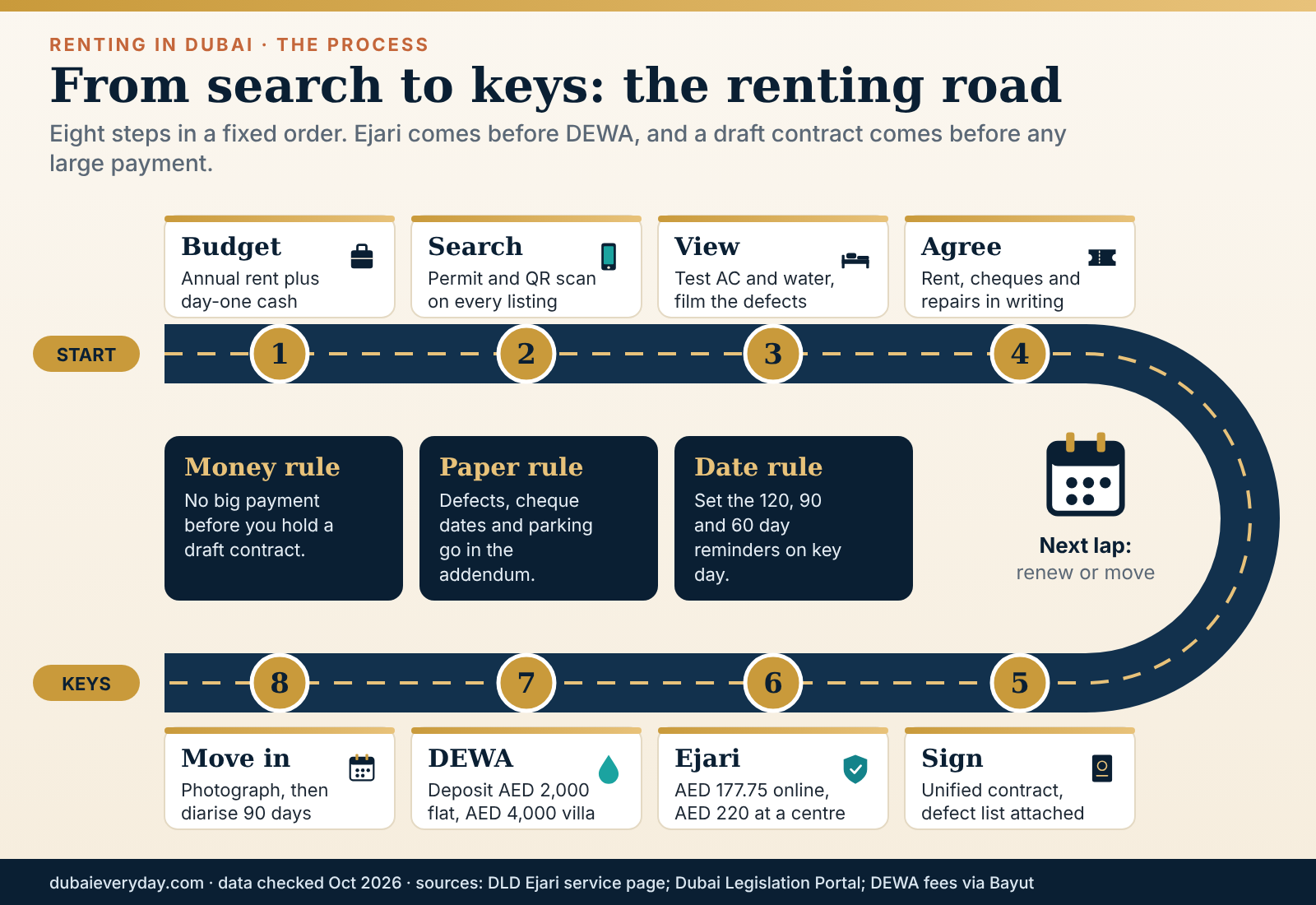
Timing for renting in Dubai varies more than the steps do. In a quiet market, a prepared tenant can move from first viewing to keys in a week or two. In a busy season you may lose a unit within a day of viewing it. Whichever applies, do not compress the order. A signed contract with no Ejari certificate leaves you without the document the Rental Disputes Centre asks for, and Law No. 26 of 2007 itself says courts and government bodies will not hear disputes over unregistered leases.
Who does what when renting in Dubai
Four parties appear in almost every case of renting in Dubai. The landlord (or an authorised representative with a notarised power of attorney) owns the unit and signs the contract. The agent or broker introduces the parties and, by custom, collects a commission. The tenant (you) pays rent, keeps the unit in good order and registers or co-operates in registering the contract. And the DLD, through its Ejari system and the Rental Disputes Centre, holds the record and settles disputes.
Some buildings add a fifth party: a property management company that handles keys, maintenance and sometimes rent collection. If one exists, ask early whether it can register Ejari for you, because the DLD notes that a Trustee Centre can only register a contract if the property is not managed by a real estate company or by an owner with Ejari access. The practical effect is that in managed buildings the manager often does the registration, and the cost question (who pays) becomes a negotiation point.
The most expensive errors in renting in Dubai are sequence errors: paying a “holding” amount to an individual before seeing a permitted listing, handing over post-dated cheques before reading the contract, or moving in before Ejari exists. Each has a recovery path, but each is slower and more stressful than doing the steps in order. If an agent insists that you must pay first and read later, treat that as information about the agent.
If you are arriving from abroad and sorting visa, banking and housing at once, the sequencing across all of them is covered in the moving to Dubai guide and the Dubai relocation checklist. This page stays with the tenancy.
What renting in Dubai really costs on day one
The advertised price of a flat is its annual rent. The real price of renting in Dubai is considerably larger on day one, and it is spread across half a dozen payees. Most first-time renters budget for the rent and the deposit, then discover the commission, the Ejari fee, the DEWA deposit, the movers and the first cooling bill arriving within the same fortnight. This section builds the number properly, using official fees where they exist and clearly labelled market custom where they do not.
The day-one cost list for renting in Dubai: law versus custom
| Item | Amount (checked Oct 2026) | Status and source |
|---|---|---|
| First rent payment | Annual rent divided by the number of cheques you agree | Negotiated. Not set by law. |
| Security deposit | Customarily 5% of annual rent unfurnished, 10% furnished | Custom, per Gulf News (22 Oct 2026). The 2007 law lets landlords collect a deposit and requires its return. |
| Agent commission | Customarily about 5% of annual rent, often with a minimum near AED 5,000 | Custom, negotiable, per Gulf News. |
| Ejari registration | AED 177.75 via Dubai REST or the website; AED 220 at a Trustee Centre | Official, DLD service page. Tenant usually pays unless the contract says otherwise. |
| DEWA deposit | AED 2,000 apartment; AED 4,000 villa | Quoted by Bayut and Gulf News from DEWA. Refundable on closing the account. |
| DEWA connection and fees | About AED 130 for small meters, plus VAT where applicable | AED 100 connection plus AED 10 registration, knowledge and innovation fees each, per Bayut citing DEWA. |
| Movers | AED 1,000 to 1,500 for a one-bedroom; AED 2,000 to 3,000 or more for larger units | Market estimate, Gulf News. Get quotes. |
| Gas connection (if piped) | About AED 600 to 800 | Market estimate, Gulf News. |
| Municipality housing fee | 5% of annual rent, billed monthly on the DEWA bill | Recurring, not day-one. Bayut (updated 15 Sep 2026). |
Two items on that list are not real costs but cash you must have on hand: the security deposit and the DEWA deposit. Both are refundable. They still leave your account on day one, and the refund timing is in the landlord’s and DEWA’s hands, so treat them as money you will not see for twelve months.
A worked example (our calculation)
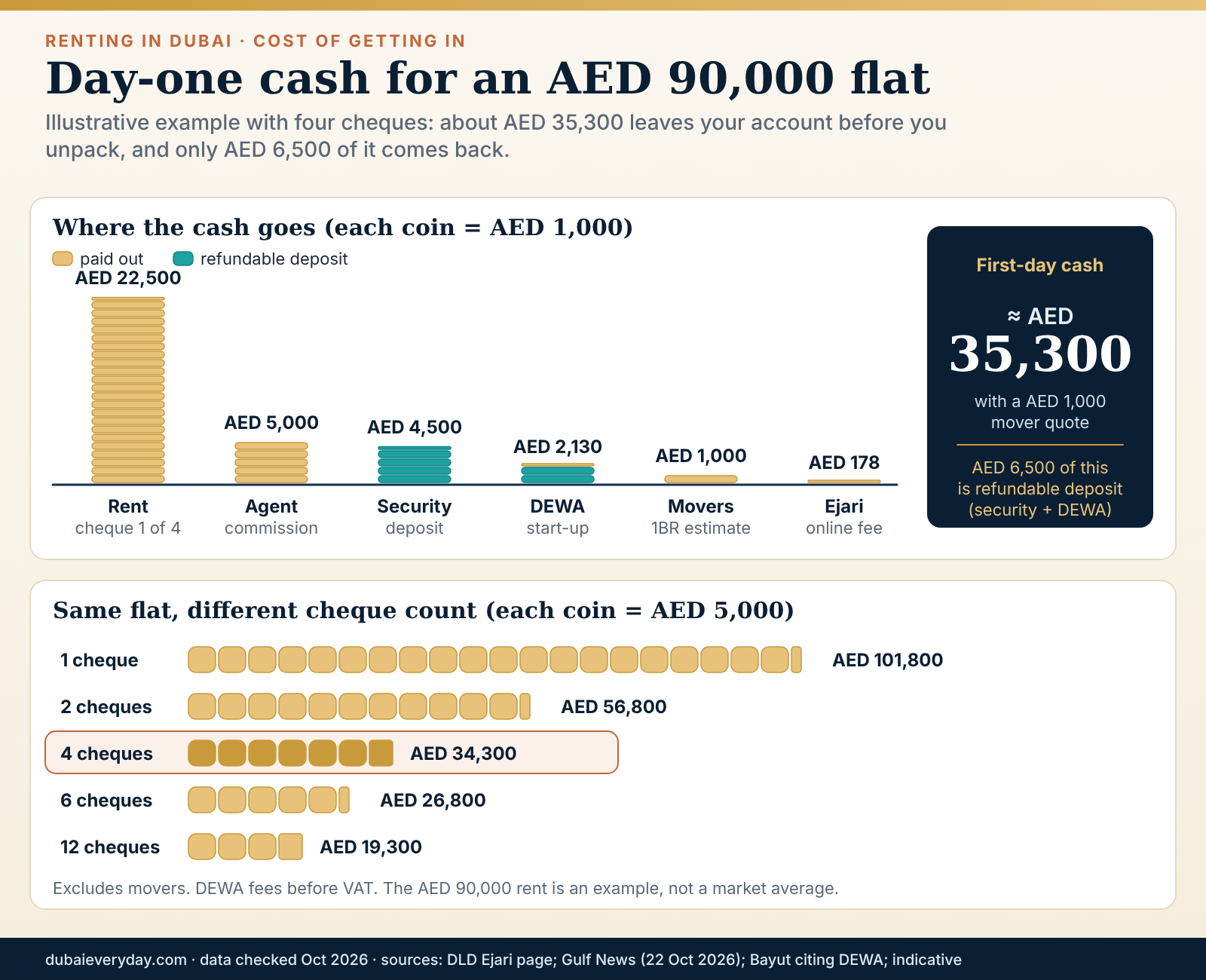
To price renting in Dubai in practice, take an unfurnished one-bedroom apartment at an annual rent of AED 90,000. That number is illustrative, chosen for easy arithmetic, and is not a market average for any area. We use 5% for the deposit, the AED 5,000 commission floor (5% of 90,000 is AED 4,500, so the floor applies), the AED 177.75 Ejari fee, and a DEWA package of AED 2,000 deposit plus AED 130 in connection and fees before VAT.
Excluding movers, the non-rent costs come to AED 11,807.75: AED 4,500 deposit, AED 5,000 commission, AED 177.75 Ejari and AED 2,130 DEWA. Add the first rent payment and the cheque count becomes the biggest lever on your cash.
1 cheque
First payment AED 90,000. Day-one cash about AED 101,800, before movers and VAT on DEWA fees.
2 cheques
First payment AED 45,000. Day-one cash about AED 56,800.
4 cheques
First payment AED 22,500. Day-one cash about AED 34,300, rising to about AED 35,300 with a AED 1,000 mover quote.
12 cheques
First payment AED 7,500. Day-one cash about AED 19,300, if the landlord accepts monthly cheques at all.
Six cheques land at about AED 26,800 on day one. The point is not that more cheques are better. Each extra cheque is a landlord concession, and in a firm market it may cost you rent. When renting in Dubai in the 2026 market, where listings are plentiful, it is a reasonable thing to ask for and to trade against a modest rent reduction. We return to that in the negotiation section.
What keeps costing after move-in
The housing fee is the cost that surprises people renting in Dubai most, because it is not on the contract. For an AED 90,000 rent, 5% is AED 4,500 a year, billed in twelve instalments of AED 375 on your DEWA bill. Bayut reports that the fee applies to expatriate tenants and that UAE nationals are exempt. It is calculated on the annual rent in your Ejari record, which is one more reason the Ejari figure must match the contract.
Beyond that, the monthly outgoings of renting in Dubai are electricity and water (DEWA), cooling if your building uses district cooling, gas if piped, internet, and any building charges the landlord has passed on. We build those into a monthly picture in the utilities section. For how rent fits into a whole-household budget, the cost of living in Dubai and single-person monthly budget pages put rent beside food, transport and insurance.
Check before you budget. When renting in Dubai, ask the agent two questions in writing: “Is cooling included in the rent or billed separately?” and “Are there any charges from the building for parking, access cards, move-in or gym?” The 2007 law text says rent covers shared amenities such as pools, gyms, playgrounds and parking unless the parties agree otherwise. If a building bills them separately, that should appear in the agreement before you sign, not on the first invoice.
Furnished versus unfurnished
Furnished flats cost more per year and carry a larger deposit by custom (10% against 5%). They suit people who are in Dubai for months rather than years, or who do not want to buy furniture they may ship out again. Unfurnished suits a stay of two years or more, because the furniture cost is spread over a longer period.
If you are deciding on renting in Dubai for 12 months or less, add up furniture purchase plus resale loss against the furnished premium. If you want a temporary landing while you search, short stays and serviced options are discussed in the hotels guide, which is a different product with a different legal footing from a tenancy.
Searching: where to look, which area, how to spot a fake
Search is where most people renting in Dubai lose time and some lose money. The work is not finding listings, because there are thousands. It is narrowing them to buildings that fit your life and filtering out the ones that are not what they claim to be.
Where listings come from
Most listings for renting in Dubai come from licensed brokerages advertising on property portals, from brokerages’ own sites, and from owners who let directly through a property management company or an agent. The main portals include Property Finder, Bayut and Dubizzle. We mention them neutrally; none is endorsed here and none paid for placement. The portals are not regulators, so a listing on a famous site does not prove the unit is real or available, and that is why the permit check below matters.
The market data above says supply is high. That has a practical effect on renting in Dubai: you can afford to be slow and picky. A tenant who views five units in two buildings and compares them will usually do better than one who signs the first acceptable flat. Equally, units priced at or below the going rate in sought-after buildings still move fast, so be ready to decide within a day or two on a unit you like.
The permit check: Trakheesi and the QR code
Under the DLD’s Madmoun service, launched in April 2023, every real estate advertisement needs a permit issued through the Trakheesi system, and the QR code that comes with the permit must appear on the ad. The DLD says scanning the code shows the property’s authorised details and whether it has been sold or rented. It also shows the advertising company and the property’s condition and specifications, and the link is secured against changes. DLD advises customers to deal only with ads that show the code.
Do this on your phone, standing in front of the screen, every time. Check that the unit type, size, building and price on the scanned page match what the advertisement says. Mismatches are not always fraud (listings go out of date), but they are always a reason to ask a direct question before you spend an afternoon on a viewing.
The five gates before you pay anything
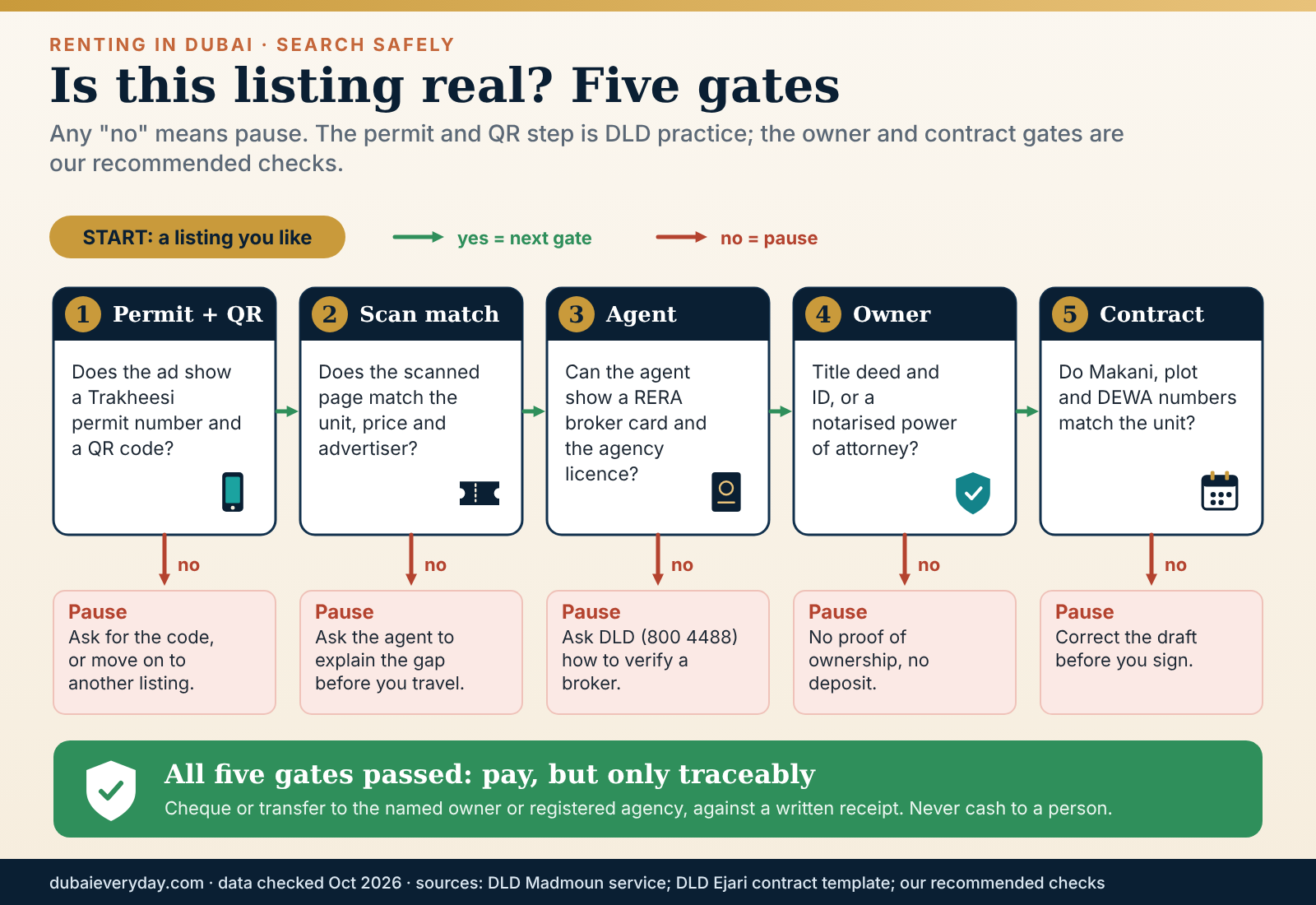
- The advertisement shows a Trakheesi permit number and a QR code, and the scanned page matches the unit, building, price and advertising company.
- The agent can show a RERA broker card and the agency’s trade licence. Ask for both and ask which company the commission invoice will come from. (We could not confirm DLD’s public lookup page today, so ask the DLD contact centre on 800 4488 how to verify a broker registration.)
- The landlord can show proof of ownership: a title deed copy and the owner’s Emirates ID, or a notarised power of attorney for the representative. The printed contract itself has a clause in which the landlord confirms being the owner or an authorised representative.
- The details on the draft contract match the building: Makani number, plot number, DEWA premises number and area.
- Payments go by traceable methods (cheque in the owner’s or agency’s registered name, or a bank transfer you can document) against a written receipt, never cash to an individual.
A rent far below comparable units in the same building. An owner “abroad” who will courier the keys once you transfer a deposit. An agent who refuses a viewing or pushes you to pay before you have seen the contract. A permit number that does not scan. Photos that do not match the building you are shown. Any one of these is enough to walk away; two together should end the conversation.
Choosing the area for renting in Dubai: a four-question filter
When renting in Dubai, do not start from the area. Start from four constraints and let the area fall out of them.
Where will you spend most weekday hours? Test the real commute at the real hours on a weekday morning, by car and, if you will use it, by Metro. The Dubai Metro guide explains lines and fares; the point here is that a flat a short walk from a station often rents at a premium that can be worth paying if you do not own a car, and not worth paying if you do.
What will cooling cost? Some buildings charge district cooling separately from the rent. Ask for the last twelve months of cooling invoices for a similar unit, because the difference between “cooling included” and “cooling billed” can be larger than a rent discount.
What does the building offer that you will use? Parking spaces allocated per unit, pool, gym, a play area, a pet policy. Read the building rules, not the brochure. If you have a dog or cat, the pet ownership guide covers what building and municipality rules to confirm.
What is the building’s condition and rating? Under the Smart Rental Index, buildings carry a classification that links to permitted rents. A newer, well-maintained building with a better rating can legitimately command a higher index value, which also affects how much your landlord can ask at renewal. Older buildings with weaker ratings give tenants stronger arguments when a landlord asks for large increases.
Area examples, and what we deliberately do not claim
Savills’ Q3 2026 data suggests tenants in Dubai Marina, Business Bay and Jumeirah Village Circle have the most room to bargain on apartments, since those communities saw the biggest year-on-year falls. If you want a feel for daily life, the Dubai Marina area guide, Downtown Dubai guide and Palm Jumeirah guide describe traffic, transport and lifestyle. If beach access drives your choice, the best beaches guide shows what public and hotel beaches offer.
What we do not give you is a table of “average rent per area”. Such tables go out of date within weeks, differ by source, and mix up asking rents with signed rents. The DLD’s own Ejari data records signed contracts, but we could not verify a public, current area-by-area rent table on the official site today, so we point you to the Rental Index route in the renewal section instead. Use portal asking prices as a ceiling and the Smart Rental Index as the legal reference.
School-run radius matters as much as price for families: the Dubai schools guide and KHDA ratings guide explain how to read admissions and inspection results before choosing a catchment. Choose the school first, then the building, and verify the actual driving time on a school morning.
Documents to have ready before renting in Dubai
Landlords and agents move faster for a tenant who can produce paperwork on the spot when renting in Dubai. What they ask for is custom rather than law, and varies, but a prepared tenant normally carries the following in digital form.
- Passport copy and a copy of your UAE residence visa or entry permit.
- Emirates ID, front and back. The DLD lists the applicant’s Emirates ID among the documents for Ejari registration at a Trustee Centre, and the Unified Tenancy Contract has a field for the tenant’s Emirates ID.
- Proof of income: an employment contract or salary certificate, and sometimes recent bank statements. Self-employed tenants should expect a request for a trade licence and statements.
- For a company let, the trade licence and an authorised signatory’s ID.
If you have just arrived, your Emirates ID may not exist yet, because it follows the residence visa. Ask the agent and the Trustee Centre what they accept in the gap, and do not pay a large amount on the strength of a promise that “Ejari can be done later.” The sequence of visa, medical, Emirates ID and banking is laid out in the residence visa guide and the work visa guide, and the job search guide helps if you are still looking for the employer who will sponsor you.
Viewings: inspecting a rental in 30 minutes
A viewing is the only time in the whole process of renting in Dubai when you hold leverage over the physical unit. After you sign, the printed contract says you accepted the premises in their current condition, and the law puts the burden of ordinary upkeep on you. So the viewing is where you find what needs fixing, decide whether you can live with it, and arrange for the rest to be repaired or recorded in writing.
This section is the process version of an inspection for renting in Dubai. Unit-specific detail, including balcony drainage, chiller access, parking bays and kitchen fittings, sits in the apartment rental guide, and garden, pool, irrigation and AC for houses are in the villa rental guide. Use them as second-pass checklists after you pick a shortlist.
When to view, and how many times
When renting in Dubai, view at least once at the time of day you will actually be in the flat, and ideally a second time after dark or at the morning rush. A flat that is quiet at 11 am on a Tuesday can be loud when the building opposite starts work, when a nearby road backs up, or when residents return in the evening. Many agents will not offer a second viewing unless you ask. Ask.
If you are renting in Dubai during summer, use the heat as a test rather than an inconvenience. Ask for the air conditioning to be on for ten minutes before you arrive, or run it yourself on arrival, and see whether a bedroom drops in temperature or merely moves air about. Dubai’s summer afternoons are an honest quality test for insulation, window seals and AC capacity, and a unit that struggles in October will struggle more in August.
The thirty-minute sequence
- Arrive early and walk the building firstEntrance, lobby, lifts, corridors, bins, parking entry and visitor parking. Count how many lifts serve the floor. Note whether security staff are present and whether the access system works.
- Test the water and powerRun the kitchen and bathroom taps together, flush each toilet, check hot water arrives, and switch on every light and socket group you can reach. Look under sinks for damp or stains.
- Test coolingSwitch every AC unit on. Listen for rattles. Check that the thermostat responds. Ask where the unit, filters and chiller valve are and who services them.
- Inspect windows, doors and balconyOpen and close each window and door. Look for gaps at the seals, signs of water ingress on window frames and balcony thresholds, and a balcony door that locks properly.
- Look up and downCeilings for stains, corners for dark patches, floors for lifted tiles, skirting for gaps. A musty smell in a closed room is data.
- Check fittings and appliances that are listedAnything the listing says is included must work on the day. Write down what is not working and who will fix it.
- Find the meter board and note the premises numberThe DEWA premises number goes on the contract and is what DEWA uses to activate the account. Check that the number on the paperwork matches the one in the unit.
- Take a dated video walk-throughNarrate defects in plain words. This is your private record, and it makes any addendum much easier to write.
Questions that earn their keep
Ask why the unit is vacant and how long it has been on the market, since a long-listed unit gives you more leverage. Ask what the previous tenant paid. The caps in Decree 43 of 2013 apply to rent increases at renewal, not to a new tenant, so a landlord can reprice a vacant unit, but a landlord who dropped the rent to fill it knows exactly what you are comparing it to.
Ask who handles maintenance (the owner, an agent or a management company), how requests are submitted, and what the typical response time is. Ask whether the owner plans to sell. Under Article 28 of Law No. 26 of 2007, a change of ownership does not affect a tenant’s right to remain for the fixed term, which is reassuring, but a sale shortly after your lease starts can still mean a new landlord with different habits.
Ask what the building charges for move-in permits, lift booking, access cards, parking and visitors. These administrative charges are small individually and annoying collectively, and they are frequently omitted from listings. The Gulf News list of extra move-in costs says amounts vary building by building and may be free or involve admin fees or refundable deposits.
Why the defect list matters. The printed Unified Tenancy Contract says in its first clause that the tenant has inspected the unit and accepts it in its current condition. In our reading, that sentence is the reason to record defects. If the landlord agrees to repair something, put the repair, the deadline and the consequence of missing it in the additional-terms section. If you do not, the first thing a landlord will say at deposit time is that you accepted the unit as you found it.
Remote and overseas viewings for renting in Dubai
If you are still abroad, you can narrow your options for renting in Dubai remotely but should not commit money sight unseen. Use video tours to cut the shortlist, then book a few nights in a hotel or serviced apartment and view in person (see the Dubai travel guide for planning a scouting trip). If you absolutely cannot attend, ask a trusted contact to inspect and video the unit, and still run the permit scan, the ownership check and the contract review described above. Never pay a deposit to secure a unit you have not seen or a person you have not verified.
Negotiating rent, cheques, deposit and commission
Almost every term of renting in Dubai that is not in the law is negotiable. In the 2026 market, where listings are up and enquiries per listing are down, you have more room than in most recent years. Using that room well means knowing what is negotiable, what is customary, and what the law fixes.
What the law fixes in renting in Dubai, and what it leaves open
The law fixes some things and leaves most of the rest to you. It requires a written, Ejari-registered contract (Article 4 of the 2007 law). It lets the landlord collect a security deposit and requires its return at the end (Article 20). It says the tenant pays government fees and taxes on the unit’s use unless the contract says otherwise (Article 22). It gives the landlord responsibility for maintenance and repairs affecting use unless the parties agree otherwise (Article 16). And it prohibits subletting without written consent (Article 24).
It does not set the rent for a new tenant, the number of cheques, the percentage of the deposit, the commission, the break clause, or who bears the Ejari fee. Those are commercial terms. The 5% unfurnished, 10% furnished deposit and the 5% commission are market customs reported by Gulf News, and they bend.
Building a credible ask when renting in Dubai
Landlords respond to evidence more than to complaints. “The market is down” invites the answer “not for this building.” Bring three comparable units: same building or next door, same bedroom count, similar floor and view, ideally with Trakheesi-verified listings. Then state a number, not a feeling. A tenant with an organised paper trail, a stable income and a quick close is attractive to a landlord who would otherwise leave the unit empty and still pay service charges.
Property Finder’s Cherif Sleiman, quoted by Khaleej Times, noted that landlords may need more than price cuts, since listing quality, visibility and response speed matter. Read that two ways. A landlord with a well-presented, well-priced unit has less need to discount; a landlord whose unit is overpriced or poorly marketed has more. Your viewing tells you which one you are dealing with.
The levers, in the order we would pull them
1. Annual rent
The number that compounds through every renewal, because future increase caps are calculated on it. A AED 3,000 reduction now is worth more than most other concessions combined.
2. Number of cheques
Costs the landlord nothing in headline rent but costs them cash flow. Useful if you are cash-constrained. Weak if you would rather have a lower rent.
3. Repairs and condition
Ask for defects to be fixed before move-in, with a date, written in the addendum. This is often easier to win than a rent cut and protects your deposit.
4. Commission split
Customary 5% often paid by the tenant. In a soft market, ask whether the landlord or the agency will share it. The worst they can say is no.
Smaller levers include a free parking space, an extra parking space at a stated price, appliance repairs or replacement, a rent-free move-in period if the unit becomes available before your lease starts, a break clause with a stated notice period, and a commitment to a repainting standard. Anything the landlord agrees must go into the additional terms section of the contract, because that section is the one part of the Unified Tenancy Contract designed to carry bespoke conditions.
Cheques in practice when renting in Dubai
Cheque count is the lever people renting in Dubai most often misjudge. The tempting option is the most cheques the landlord will accept, since it keeps cash free. The more careful option is the number you can reliably cover on each date, because a cheque that is returned for insufficient funds can lead to legal consequences that are out of scale with the amount involved. If your pay date and the cheque dates do not line up, ask for dates that do. Cheque dates are negotiable and should be.
Issue cheques in the registered owner’s name or in the agency’s name only if the agency is formally authorised to collect rent for the owner, and make sure the cheque payee matches the contract. Write the contract number or unit number on the cheque memo, and photograph each cheque before handing it over. If the landlord offers bank transfers instead, ask for a written payment schedule and keep each transfer receipt.
The deposit when renting in Dubai: how to give it, how to get it back
A security deposit is not rent. It is a sum held against damage and unpaid bills, and Article 20 of the 2007 law requires the landlord to refund it, or the balance, at the end. Pay it only against a receipt that says what it is, who received it, the unit, and the date. If you give a cheque instead of cash or transfer, ask whether it will be banked. A deposit cheque that is cashed is a deposit you have paid. A deposit cheque held uncashed is a deposit you have not, though it still exposes your account if something goes wrong.
At the end of the lease, Article 21 requires you to return the unit in its original condition, excluding ordinary wear and damage beyond your control. Gulf News’s guide to the Rental Disputes Centre states that normal wear and tear is generally the landlord’s responsibility and that tenants are liable for direct damage, unauthorised changes or neglect. The video walk-through you took on day one is the evidence that separates the two. Leaving is covered in its own section.
Commission: what you are paying for
Commission when renting in Dubai is a payment to a licensed agency for finding and documenting the tenancy. It is customary and typically at about 5% of annual rent, often with a minimum floor around AED 5,000, according to Gulf News. It is not set by law and is not owed to an individual who happens to know the landlord. Ask for an invoice from a licensed agency and ask what is included: viewings, contract drafting, Ejari registration, key handover. If the agent’s service stops at the viewing and you do the paperwork yourself, say so and ask for a lower figure.
A note on neutrality: agents are paid when a deal closes, so they are not neutral on whether you sign. That is not a character judgement, it is the structure. It is why this guide has you verify the permit, the broker, the owner and the contract independently of whoever is sitting beside you in the car.
A short script that works. “I like the unit and can sign this week. I have seen three comparable units at AED X to AED Y. If the rent is AED Z, four cheques dated on the 1st, the AC serviced before move-in and the defects on the attached list repaired by the start date, I can close today. Please send the draft contract and Ejari details so I can review them.” Every number in that message can be agreed or countered, and every item lands in writing.
Do not negotiate against the law
One category of concession is worthless when renting in Dubai: promises that conflict with the legal framework. The printed contract itself says added conditions that conflict with the law are disregarded. In our reading, a clause promising a flat 10% rise every year would not override the rent-increase caps, and a handshake does not replace the 90-day written notice. Equally, you cannot agree that the landlord may cut off your water or electricity as a remedy, since Article 34 prohibits it. If you want a deeper reading of the protections on offer, the tenant rights guide and the Dubai legal basics for residents page go further.
The tenancy contract, clause by clause
Renting in Dubai runs on a standard form, the Unified Tenancy Contract, and the DLD’s Ejari service is built around it: the registration page lists a “standard lease contract” as the form and asks for a copy or the original. Because the form is standard, you can learn it once. What changes between rentals is the data in the boxes and what is written in the additional-terms section, and those two things are where almost every problem begins.
The boxes you fill in
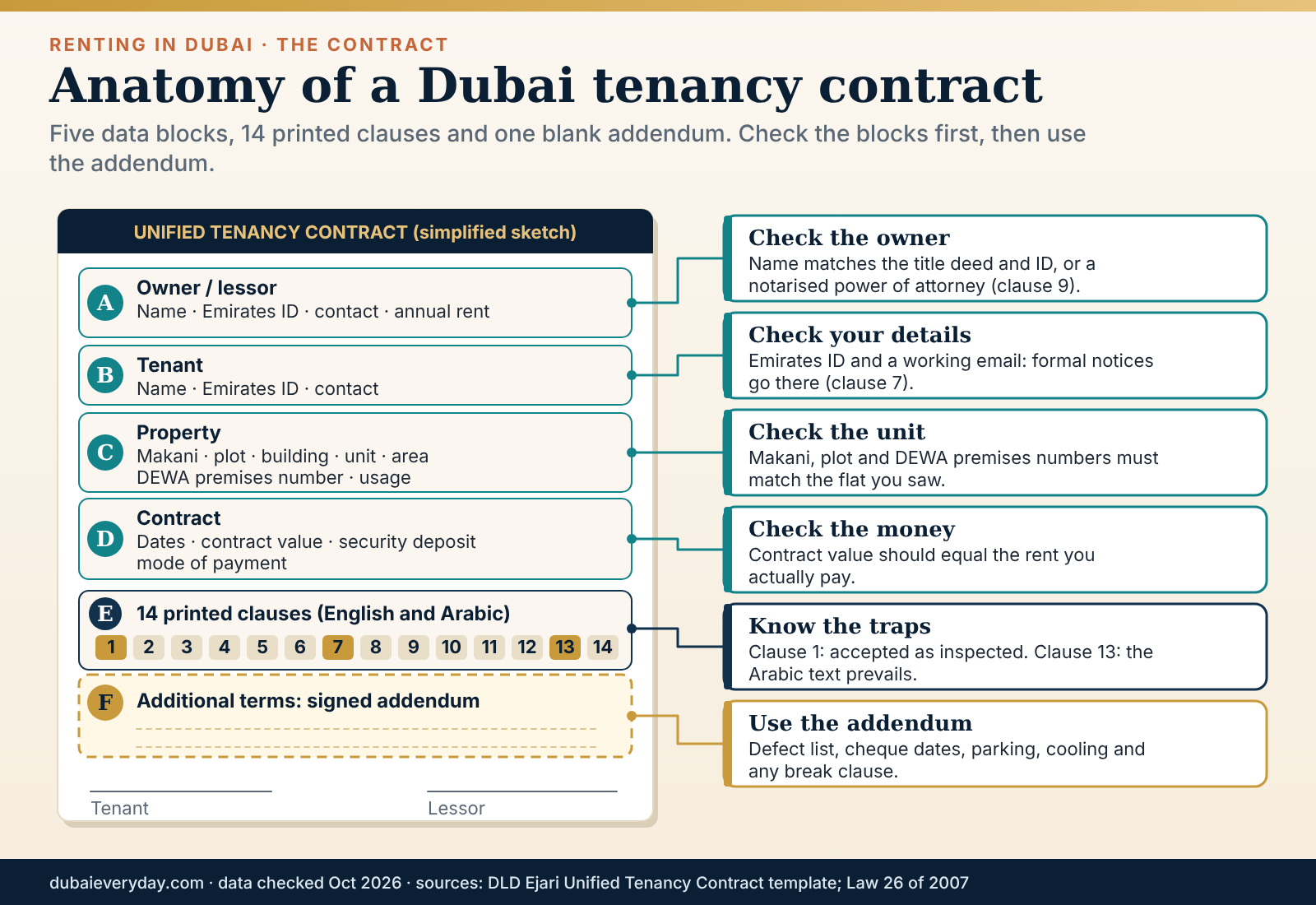
The template published by the DLD has five blocks of data. The owner or lessor block holds the owner’s name, the lessor’s name, the lessor’s Emirates ID, a licence number and licensing authority if the lessor is a company, contact details and the annual rent. The tenant block holds your name, Emirates ID and contact details. The property block carries the Makani number, plot number, location and building name, property type and number, area in square metres, the DEWA premises number and the usage (residential, commercial or industrial).
The contract block holds the start and end dates, the contract value, the security deposit amount and the mode of payment. Finally there is a signature block. Notice what is absent: the template text we read does not provide a separate field for the cheque schedule, so the schedule has to live in the additional terms or in a signed addendum. If your cheque dates are not written down anywhere, they exist only in memory.
The 14 printed clauses in plain English
The printed terms appear in English and Arabic. We read the DLD template and summarise them here in our own words, with comments on what each means for you.
Clauses 1 to 3: condition and use
You have inspected the unit and accept it as it is. Use it for its stated purpose. Transfer or assignment needs the landlord’s written approval, and subletting is allowed only where legally permitted. No alterations without written approval, and you are liable for resulting damage.
Clauses 4 to 6: money and rules
You pay electricity, water, cooling and gas unless agreed otherwise in writing. Rent is paid as agreed. You follow building rules for parking, pools and gym.
Clauses 7 to 9: notices and landlord duties
The emails and phone numbers you declare are treated as correct for formal notices. The landlord gives full use, does regular maintenance unless agreed otherwise in writing, and confirms being the owner or an authorised representative.
Clauses 10 to 14: law and registration
Disputes go to the Rental Dispute Center. Law No. 26 of 2007 as amended governs. Conflicting added conditions are disregarded. If the Arabic and other text differ, Arabic prevails. The landlord registers the contract on Ejari.
Three of those clauses are traps for anyone renting in Dubai who reads past them. Clause 1 means the condition on signing is the condition you are held to. In our reading, clause 7 means a notice sent to the email or phone number in the contract counts as received, so if you change your email and do not tell the landlord in writing, you can miss a rent-increase notice that was validly sent. And clause 13 means the Arabic text prevails, so if an addendum is written only in English and you end up at the Rental Disputes Centre, a certified translation will be needed.
The additional terms: where you protect yourself when renting in Dubai
The template includes a numbered blank section for additional conditions and says extra conditions must be added through a signed addendum. This is the only place to record things the printed form does not cover. A well-used addendum is short and specific. It makes the verbal promises binding, and it spares both parties from arguing about memory.
- The defect list from your viewing, with the repair deadline and who pays.
- The cheque schedule: number, dates, amounts and payee name for each.
- Included items (appliances, curtains, furniture if furnished) with a one-line inventory and condition.
- The number of allocated parking spaces and their bay numbers, and any visitor parking arrangements.
- Cooling: whether it is included, and if billed separately, the provider and any registration deposit you will owe.
- Maintenance: who services the AC and how often, and a contact for urgent repairs. Clause 8 of the template makes regular maintenance the landlord’s job unless agreed otherwise in writing, so be wary of addenda that shift it to you without a price reduction.
- A break clause, if you want one, with the notice period and any penalty written as a fixed figure.
- The deposit refund date: a stated number of days after handover.
The last two items are our recommendations rather than anything required. The law states that neither party may end a valid lease early unilaterally except by agreement or on grounds given in the law (Article 7), so a break clause is only worth having if it is written down and signed by both sides. Agree the penalty before you need it.
Check these five things before you sign
The landlord’s identity. Compare the name on the contract with the title deed copy and the Emirates ID, or with the power of attorney if there is a representative. Clause 9 has the landlord confirm they are the owner or authorised under a notarised power of attorney, so a mismatch is not a technicality.
The property block. Check the Makani number, plot number, building name, area and DEWA premises number against what you saw in the unit and in the listing. A wrong premises number delays DEWA activation. A wrong area figure can affect the index value used at renewal.
The contract value. It should equal the total annual rent you will actually pay. Some people are tempted to register a lower figure, perhaps to reduce the housing fee, and that is a mistake: the Ejari record is what future increase caps, Rental Disputes Centre fees and any claim are calculated from. A tenant who has paid more than the registered value has trouble proving the true rent, and a landlord who registers a lower figure has their own legal exposure. Register what is paid.
The dates. Start date, end date and the match to your move-in. Count back 90 days from the end date and put that in your calendar now.
The language. Read the addendum in the language you understand best, and ask for a translation of anything you cannot read. You are signing it.
Not a substitute for legal advice. This summary of renting in Dubai describes the standard form and the published laws. Your own contract may have extra terms. If a clause worries you, has a large financial consequence (a long lock-in, a large break penalty, a transfer of structural repairs to you), or you are in a company or free-zone structure with different rules, take the contract to a licensed lawyer before you sign. A short review costs far less than a dispute.
Ejari: registering the contract
For renting in Dubai, Ejari is the Dubai Land Department’s tenancy registration system. A registered contract produces an e-Contract Registration Certificate, and that certificate is the document other authorities ask for. It is not a formality. Article 4 of Law No. 26 of 2007 requires the lease to be registered and says courts and government bodies will not hear disputes over unregistered leases. The DLD’s first-instance filing page asks for a translated copy of the latest tenancy contract (Ejari), and DEWA, per Bayut’s summary of its rules, asks tenants outside free zones for Ejari registration when opening an account.
Where and how to register
The DLD lists four channels: the DLD website (the Ejari system), the Dubai REST app, Real Estate Trustee Centres and Dubai Now. Payment is by credit card, cash or Noqodi wallet. Which one you use depends on who holds the property.
Dubai REST app or website
Upload a copy of the Unified Tenancy Contract. AED 177.75 in total: AED 100 registration, AED 10 knowledge fee, AED 10 innovation fee, and a service partner fee of AED 55 plus AED 2.75 VAT. Applies where tenant and landlord are individuals and the owner’s details are current.
Trustee Centre
Bring the original contract, your Emirates ID and, if you act for someone, a power of attorney (one issued in another emirate must be attached). About AED 220 in total. DLD says the service takes about 25 minutes excluding queueing.
Property management company
If a licensed management company manages the unit, it normally registers the contract through the Ejari system. A Trustee Centre will not register contracts for properties managed by a real estate company or by an owner with Ejari access.
After approval, the e-Contract Registration Certificate is emailed to you. Open it immediately and compare every field with the contract: names, unit, Makani and premises numbers, dates, annual rent, deposit. If anything is wrong, ask for a correction the same day. A wrong Ejari value becomes a wrong housing fee, a wrong DEWA record and a wrong reference point at renewal.
Who pays for Ejari when renting in Dubai, and who should file
Gulf News reports that the tenant usually pays Ejari unless the contract says otherwise. That is custom, not law, and the template places the registration duty on the landlord (clause 14). In practice, many tenants pay the fee and let the landlord or agent file. We suggest a different split: if the agent is registering it as part of their commission service, ask for it to be included; if you pay, pay the DLD directly or against an official receipt and not as a cash handover to an individual.
If you prefer to control the process, register it yourself on the app once you have a signed copy. The cost is small, the time is short, and the certificate lands in your inbox, not the agent’s. Check first that the landlord is an individual and that their details on Ejari are current, since DLD lists those as conditions for the app route.
When Ejari goes wrong
- The owner’s details on Ejari are out of date. The app route needs current owner details. A recent sale, a change of name or an expired Emirates ID can block it. The owner has to fix this, not you.
- The landlord is a company. DLD says companies must hold a licence for a property management activity to register on the system. If yours does not, the Trustee Centre route may apply.
- A representative signs. The landlord must own the property or be represented by a valid power of attorney. Ask to see it before you hand over any money.
- The contract was never registered. Some tenants discover this only when DEWA, the bank or a dispute asks for the certificate. Ask for the certificate before your second cheque is due, and register it yourself if the landlord stalls.
Ejari is also the system for renewals. The DLD service page is titled “Register or renew”, and a renewed contract needs a new registration with the updated dates and rent. We return to that in the renewal section. Ejari comes before the household setup that follows, and the home setup guide covers the rest of the first-week checklist.
Utilities, the housing fee and move-in setup
Your tenancy contract tells you who pays for utilities when renting in Dubai. Clause 4 of the Unified Tenancy Contract says the tenant pays electricity, water, cooling and gas charges unless agreed otherwise in writing. So the practical question is not whether you will have utility accounts, but how many, in whose name, and what each one costs to open. The map below shows who bills you after Ejari exists.
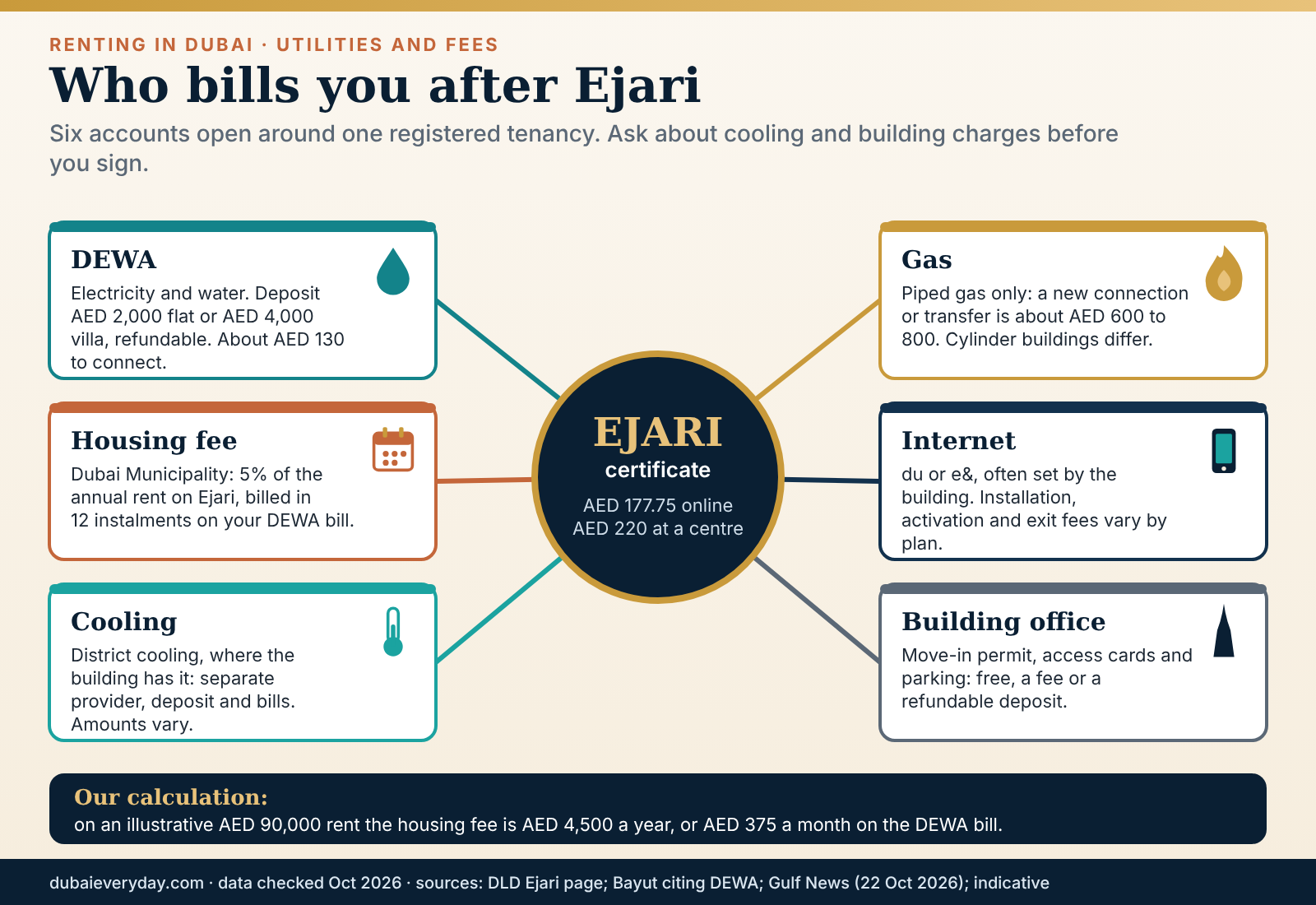
DEWA: electricity and water
DEWA (Dubai Electricity and Water Authority) is the utility for electricity and water in most of Dubai, and the first account most people renting in Dubai open. Its own site blocked our automated reading on 29 October, so the figures below are quoted from a Bayut guide that cites DEWA (published July 2025, updated 21 October 2026). Treat them as likely-current and confirm on DEWA’s site when you apply.
- Documents: Emirates ID for Dubai residents, passport copy for GCC nationals or investors, and Ejari registration for tenants outside free zones (some free-zone tenants are exempt).
- Security deposit: AED 2,000 for an apartment, AED 4,000 for a villa. Refunded when you close the account, after bills are settled.
- Connection and fees: AED 100 for small meters (AED 300 for large), plus AED 10 registration, AED 10 knowledge and AED 10 innovation fees. VAT applies where relevant. Thukher and Sanad cardholders get a 50% discount on activation charges.
- Timing: after online registration and payment, supply is said to be activated within 15 hours.
Two practical points for renting in Dubai. First, the DEWA premises number printed in your contract must be the number of the unit you are renting, since a wrong number gives you someone else’s meter or no match at all. Second, take a dated photograph of the electricity and water meter readings on move-in day. That photograph is the cheapest way to prove, a year later, that a high first bill reflected someone else’s use or a faulty reading.
If you want a deeper walk-through of activating the account and the timing of the owner-versus-tenant transfer, the DEWA move-in guide covers it. We keep to what the tenancy needs.
The Dubai Municipality housing fee
The housing fee on renting in Dubai is 5% of the annual rent registered on Ejari, and it is collected through your DEWA bill in twelve instalments. Bayut (updated 15 September 2026) says the fee applies to expatriates and that UAE nationals are exempt; where a property is let, the tenant pays. On our illustrative AED 90,000 rent, that is AED 4,500 a year, AED 375 a month. The Ejari value drives the fee, which is another reason to keep the contract value honest and to update the record when the rent changes at renewal.
Cooling: the line that varies most
Cooling is where two homes for renting in Dubai with the same rent can have very different annual costs. Some buildings include cooling in the rent, some are served by district cooling and bill you separately, and some use individual split units whose running cost is part of your DEWA bill. Gulf News describes district cooling as potentially needing a separate provider registration, a deposit and separate bills. No standard amount applies, and the deposit and tariff differ by provider.
When renting in Dubai, ask the agent, in writing, which of the three the unit uses. Then ask for the last twelve months of cooling invoices for the same unit or a comparable one in the same building. If the landlord cannot produce them, ask the building management. A flat that looks AED 6,000 cheaper but bills cooling separately may not be cheaper at all. This is the single most useful comparison to run between two otherwise similar listings.
Gas, internet and the building
Piped gas, where available, needs a connection; Gulf News puts a new connection or transfer at about AED 600 to 800. Many buildings use cylinders or electric hobs, so ask. For internet, the choice of provider is often decided by the building, and installation, activation and early-termination charges vary. The home internet guide explains du and e& availability by building, and the internet and mobile guide covers plans and eSIMs.
Buildings often have their own move-in rules for people renting in Dubai: a deposit for lift protection, a booking window for moving day, access cards for lifts and gates, and parking registration. Ask the management office for the move-in checklist before you book movers, since a move that arrives outside permitted hours may be turned away. Contents insurance for your own belongings is optional but cheap relative to the value; the insurance guide explains how home cover works and how to compare policies.
A sensible move-in order
- Before keysGet the Ejari certificate. Confirm the building’s move-in rules and booking window. Apply for DEWA once the certificate is in hand, so activation lines up with the handover date.
- Handover dayMeet the landlord or agent, walk every room with your defect list, photograph meter readings and sign a short handover note with the date and any outstanding repairs.
- First weekSet up internet, gas if applicable and building access. Check that the first DEWA bill matches the housing-fee logic (5% of the Ejari rent, divided by twelve).
- First monthFile any repair requests in writing with photos. If something on the defect list is still unrepaired, raise it now, not at renewal.
Living there: repairs, access, subletting and shared housing
The legal framework for renting in Dubai day to day is short, and most of it fits in a handful of articles of the 2007 law. What matters is how those articles meet daily life: who pays when the AC fails, what happens when you want to change the layout, whether you can have a friend take over a room.
Repairs and maintenance
For repairs when renting in Dubai, Article 16 of Law No. 26 of 2007 puts maintenance and repairs that affect the intended use on the landlord, unless the parties agree otherwise. Article 19 asks you to maintain the unit with the care of an ordinary owner and not to make changes without permission. Clause 8 of the template repeats that the landlord performs regular maintenance unless agreed otherwise in writing. In practice, the dividing line is the addendum: if it says the tenant pays for routine AC servicing or for repairs below a stated amount, that is what you agreed.
Make every request in writing, with a photograph and a date. A message that says “the bedroom AC is leaking, photo attached, please arrange a visit this week” is evidence. A phone call is not. If repairs are refused, you have options, but withholding rent is not one of them. The Gulf News guide to the Rental Disputes Centre states plainly that filing a case does not suspend rent obligations and that tenants should keep paying undisputed rent. Article 31 of the 2007 law says rent continues to accrue while an eviction claim is pending.
Landlord access, alterations and cut-offs
We found no article in the version of the 2007 law we read that sets a notice period for landlord entry. Put one in the addendum if it matters to you, for example “24 hours’ notice except for emergencies.” Alterations need written approval (clause 3 and Article 19). Article 18 requires the landlord to provide the approvals you need for decoration or other works that do not affect the structure, provided you hold the required official documents. Article 23 says that unless agreed otherwise, you cannot remove improvements when you leave.
Utilities are the sharpest edge in renting in Dubai. Article 34 prohibits the landlord from cutting utilities or otherwise disturbing the tenant, and gives the tenant a route through the police or a damages claim at the Tribunal, supported by official reports. If a landlord threatens to disconnect water or power during a dispute, that is a legal red flag, and the Rental Disputes Centre is the correct place to go.
Subletting
For anyone renting in Dubai, subletting without written consent is a ground for eviction under Article 25 of the 2007 law, and Article 24 requires the landlord’s written consent for any sublease or assignment. Clause 2 of the template repeats that transfer needs written approval. A sublease also ends when the head lease ends (Article 8), which means a person who rents a room from you has no rights that outlast your own tenancy. If you are tempted to rent out a room to cover your rent, get written consent first, and read the next part.
Shared housing under Law No. 4 of 2026
Shared housing, a special case of renting in Dubai, covers units where people rent their own space but share kitchens, bathrooms and living areas. Law No. 4 of 2026 took effect on 26 August 2026 and applies across Dubai, including special development zones and free zones, excluding collective labour accommodation. Its main rules for tenants and landlords, per the Dubai Media Office, Gulf News and The National, are these:
- A unit cannot be used for shared housing without a Dubai Municipality permit. Permits last one year and are renewable, with a two-year option at the owner’s request.
- Only the owner or an authorised establishment may let a shared housing unit. Occupants may not sublet any part of their space.
- Dubai Municipality sets occupancy limits and required facilities; The National reports existing rules already require at least five square metres of living space per resident. Dividing a bedroom, living area or balcony with wooden or non-fire-rated gypsum boards needs a Municipality permit.
- The DLD runs an electronic shared-housing registry, sets contract requirements and publishes a rent indicator. The Rental Disputes Centre has exclusive jurisdiction.
- Fines run from AED 500 to AED 500,000, doubling for repeat offences within a year up to AED 1 million. Authorities can suspend operators for up to six months, cancel permits, disconnect utilities, refuse to register tenancy contracts and seek eviction.
- Existing operators have one year from 26 August 2026 to comply, with one possible extension.
For a room tenant renting in Dubai, the practical risks in the next twelve months are the ones that come from landlords who have not yet complied. Ask to see the shared-housing permit and its expiry date. Ask whether the person you are paying is the owner or a licensed operator. Insist on a registered contract with the DLD rather than a handshake, a WhatsApp message or a cash receipt. Practical guidance from the implementing regulations is still expected, so watch for the standard contract templates the DLD is due to issue. If a unit has no permit, you carry the risk if it is disconnected or evicted later.
Our reading, not a ruling. The transition year means some shared units will be legitimate and unpermitted at the same time: the law is in force, but existing operators have until August 2027 to comply. If you need a room now, a permitted unit costs less trouble than a cheap unpermitted one, because disconnections, refused registrations and evictions fall on the occupant first and the owner second. Price the risk, not just the rent.
One small, durable rule applies in all cases of renting in Dubai: keep your own records. A dated contract copy, the Ejari certificate, bank receipts for each payment, photographs of the unit’s condition and an email trail of every request. Those five documents resolve most disputes before anyone files a case.
Renewal and rent increases: the 90-day clock
Renewal is where renting in Dubai stops being a setup task and becomes a financial decision. A tenant who treats it as paperwork usually pays what they are asked. A tenant who treats it as a deadline-driven negotiation, with the legal limits in hand, often pays less or moves on better terms. The clock is simple: everything that matters happens at 120, 90 and 60 days before expiry.
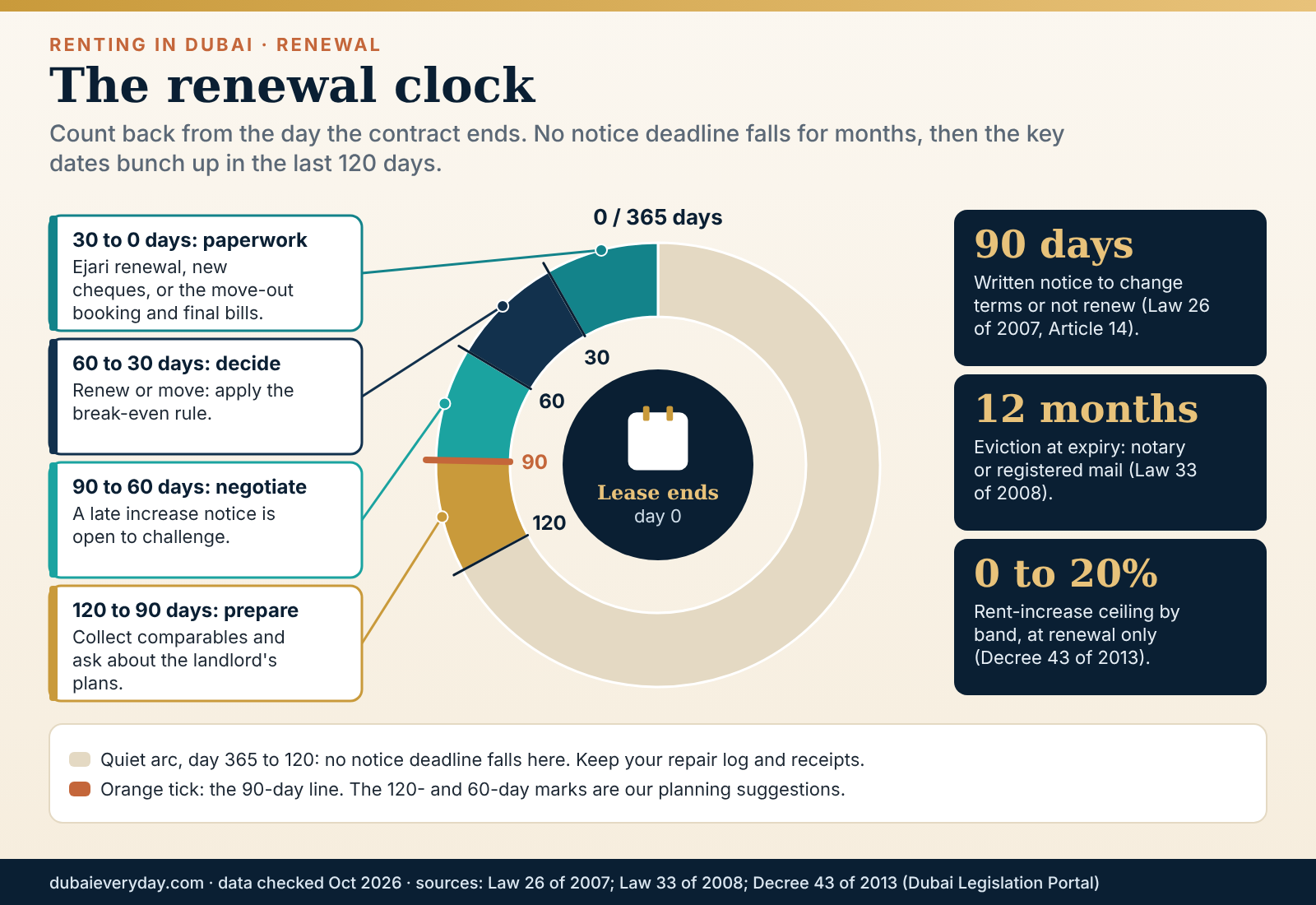
The 90-day notice rule
For renting in Dubai, Article 14 of Law No. 26 of 2007 says a party who wants to change the terms of the lease, or not to renew it, must give notice at least 90 days before expiry, unless the parties have agreed otherwise.
Khaleej Times, explaining the rent-increase rules, says the written notice must reach the tenant at least 90 days before the rental period ends, and Gulf News, discussing a 2025 case, reports that without proper 90-day notice there can be no increase. The consequence is practical: a landlord who writes to you with 60 days left has, on that reading, lost the right to raise the rent for this renewal.
The sources we read do not specify a method or format for a rent-increase notice, so do not assume a WhatsApp message meets the standard. If you want to rely on a missed notice, keep the evidence of when you received it. If you are the one giving notice (to leave, say), send it in writing to the landlord’s declared email and also by a method that gives you proof of delivery, such as registered mail or a notary. Do not rely on telling an agent.
Declared contact details. Clause 7 of the Unified Tenancy Contract treats the declared emails and phone numbers as correct and sends formal notices to them. In our reading, if your declared email is dead and the landlord uses it, you may still be treated as notified. Update your contact details in writing if they change, and keep the acknowledgement.
The caps: Decree No. 43 of 2013 and the rental index
Rent increases when renting in Dubai apply only at renewal, and the maximum depends on how far your current rent sits below the average rent for similar units. Decree 43 sets five bands. The “average” comes from the Rent Index of the Emirate of Dubai approved by RERA, which since January 2025 is the DLD’s Smart Rental Index.
| Your rent is this far below the index average | Maximum increase at renewal |
|---|---|
| Up to 10% | No increase |
| 11% to 20% | 5% of current rent |
| 21% to 30% | 10% of current rent |
| 31% to 40% | 15% of current rent |
| More than 40% | 20% of current rent |
These figures are from the Dubai Legislation Portal text of the decree, read 29 October 2026. They are ceilings, not entitlements. A landlord may ask for less, and a tenant may negotiate any increase down. If the two sides cannot agree, either may go to the Rental Disputes Centre, which can decide the increase, and Article 13 of the 2007 law lets the Tribunal set the rent by reference to comparable properties.
Worked examples (our calculation)
Suppose the Smart Rental Index shows AED 100,000 as the average rent for units like yours. We compute how far your rent is below that figure and read off the band.
Rent AED 95,000
5% below the average. Band: up to 10%. Maximum increase: none. Renewal at AED 95,000.
Rent AED 80,000
20% below. Band: 11% to 20%. Maximum 5%: up to AED 84,000.
Rent AED 70,000
30% below. Band: 21% to 30%. Maximum 10%: up to AED 77,000.
Rent AED 55,000
45% below. Band: above 40%. Maximum 20%: up to AED 66,000.
Two readings follow from those numbers for anyone renting in Dubai. First, the biggest increases are available only to landlords whose rents are far below the index, usually long-term tenants, so a tenant on a below-market lease should expect and budget for a rise. Second, if your rent is at or above the index average, nothing in the five bands authorises an increase. In the 2026 market, where asking rents have fallen in many communities, that is a common position, and it makes the case for a flat or lower renewal.
Check the index before you answer. DLD’s Smart Rental Index announcement says the index covers all residential areas and directs users to DLD’s official channels and support line (800 4488). It does not name a single public lookup tool, and The National notes that building ratings may not be visible to tenants. Ask the landlord to show the index result, ask DLD, and do not accept “the market has gone up” as a substitute. Contracts renewed before 2025 used the previous index; since 2025 the digital index applies.
Renew or move? A break-even rule for renting in Dubai (our calculation)
Moving has a price when renting in Dubai. Using the same market-custom figures as before for an AED 90,000 flat, the avoidable costs of a move are: commission at the AED 5,000 floor (if you pay it), movers at AED 1,000 to 1,500, Ejari at AED 177.75, DEWA connection fees at about AED 130, and a deep clean of AED 200 to 600. That adds up to roughly AED 6,500 to 7,400, or 7% to 8% of the annual rent. The deposits are refundable and excluded, though they tie up cash.
The rule falls out directly. If you plan to stay at least a year in the next place, moving pays only if you can find a comparable unit for at least that amount less per year than the renewal quote. If your landlord asks for AED 99,000 (a 10% rise) and you can find an equivalent flat at AED 90,000, you save AED 9,000 and clear the cost of moving with some left over. If the quote is AED 94,500, a 5% rise, you save AED 4,500 and moving loses. The cap that decides whether a rise is lawful therefore also frames whether leaving is worth it.
Three adjustments push in different directions. Time cost, school terms and commute may outweigh a modest saving. A longer stay spreads the move cost across more years. And a landlord who knows you are comparing is more likely to hold the rent, so the comparison has value even when you stay.
The renewal paperwork for renting in Dubai
When you agree terms, renewal means a renewed or new tenancy contract with the updated dates and rent, registered on Ejari through the same DLD “register or renew” service (AED 177.75 online, about AED 220 at a Trustee Centre). Update the cheque schedule in writing. Check that the addendum from the first year, with its repairs, parking and cooling terms, carries over or is replaced by something equally good. Then check that the new Ejari record matches the contract, since the housing fee and next year’s index comparison both depend on it.
When the landlord wants you out
Under the rules for renting in Dubai, a landlord who does not want to renew has a narrower route than one who wants to raise the rent. Under Article 25(2) of the 2007 law, as amended by Law No. 33 of 2008, a landlord may seek eviction at expiry for specific reasons: demolition or reconstruction with the required permits, restoration that cannot be done with the tenant in place (verified by a Dubai Municipality report), the owner’s own use or that of a first-degree relative where the owner has no suitable alternative, or a wish to sell.
The notice period for these is at least 12 months, served through a Notary Public or by registered mail. If the landlord reclaims the unit for personal or family use, the amended law bars re-letting it to others for a period (two years for residential property, as we read the amended text), and a tenant displaced by redevelopment has a right of first refusal to return, to be exercised within 30 days of the landlord’s notification. A notice that arrives by text message, gives less than 12 months, or names no recognised ground deserves a lawyer’s reading before you respond.
Leaving: notice, move-out and the deposit
Moving out is the same process as renting in Dubai, in reverse, and it deserves the same discipline. The deposit you are owed depends on how well you documented the unit at the start and how cleanly you hand it back at the end.
Ending the lease early
For renting in Dubai, Article 7 of the 2007 law says neither party may end a valid lease early unilaterally; early termination needs mutual consent or a ground under the law. So there is no statutory right for a tenant to leave early on notice. Your routes are the break clause you negotiated (best), a negotiated exit with the landlord, finding a replacement tenant the landlord accepts, or accepting the cost of paying out the term. We did not find an official standard penalty for early exit, so treat any figure an agent quotes as the landlord’s term, to be agreed in writing.
Giving notice at expiry
If you do not intend to continue renting in Dubai at that address, tell the landlord in writing at least 90 days before expiry, even if the contract would simply lapse. It avoids arguments about whether the lease renewed automatically, and it gives the landlord time to relet, which makes a smooth hand-back more likely. Keep proof of delivery.
A move-out sequence that protects the deposit
- Four to six weeks beforeTell the building management your move-out date and ask for the move-out booking rules and any exit fee or refundable deposit return process.
- Two weeks beforeCompare the unit with your day-one video. Repair small damage yourself where cheaper (nail holes, loose handles), and book a deep clean if needed. The deep cleaning guide and cleaning services guide explain what is included and how to compare quotes.
- Handover dayWalk the unit with the landlord or agent. Photograph every room again, note meter readings, return keys and access cards, and get a signed handover note that says the unit was returned in the condition recorded.
- UtilitiesSettle DEWA and cooling and request closure so the deposit is released. The DEWA move-out guide covers the final bill, deposit refund and disconnection timing.
- Cheques and depositAsk for the return of any unused post-dated cheques against a signed receipt, and for the deposit by the date written in your addendum.
If the deposit is withheld
Article 20 requires the landlord to refund the deposit or its balance, and Article 21 says you must return the unit in its original condition, excluding ordinary wear and damage not caused by you. Where they disagree, the Rental Disputes Centre decides. Write to the landlord first, itemise your response to each deduction, and attach the day-one and day-last photographs.
Think about cost before you file. Per DLD, a monetary claim costs 3.5% of the claim value, with a minimum of AED 500 and a maximum of AED 15,000, plus small additional fees. On our illustrative AED 90,000 flat, a AED 4,500 deposit would attract the AED 500 minimum rather than 3.5% (AED 157.50). A claim for part of a deposit therefore costs around AED 500 plus fees whether the sum is AED 1,000 or AED 4,000, which makes it worth filing for larger deductions and often not for small ones.
Gulf News also warns that judgments on claims under AED 100,000 are final, so file once, with a complete bundle.
When it goes wrong: the Rental Disputes Centre
Most cases of renting in Dubai end without a dispute. When one does arise, it is usually about a small set of things: unpaid rent, a deposit deduction, a rent increase the tenant believes is above the cap, a landlord who wants the unit back, or a repair that never happens. The place all of them go is the Rental Disputes Centre (RDC), part of the Dubai Land Department. It replaced the old Rent Committee under Decree No. 26 of 2013, and, as the law firm Al Tamimi summarised it, handles Dubai tenancy disputes through a reconciliation stage, a first-instance stage and an appeal stage.
This section is a map of renting in Dubai disputes, not a litigation manual. For the full legal reading and strategy, see Tenant Rights in Dubai.
Before you file: the written trail
Gulf News’s current guide to the RDC (last updated 28 September 2026) lists the sequence that works: try to settle directly and keep records, gather documents, file online or through a Trustee Centre, then attend hearings by remote litigation. Some claims need a formal notice first. For example, a landlord who wants to evict for non-payment must allow 30 days after a payment notice (Article 25 of the 2007 law), and an eviction at expiry needs 12 months’ notice through a notary or registered mail.
For a tenant renting in Dubai, “before you file” means a short written demand that states the problem, the amount or action you want, a deadline, and the legal or contractual basis. Send it to the declared email and keep delivery proof. A clear demand often ends the matter, and if it does not, it forms the first page of your evidence.
What you need to file
The DLD first-instance filing page lists the requirements. In short, you need a translated copy of the latest Ejari-registered tenancy contract, your Emirates ID (or for companies, the manager’s ID and trade licence), a valid management contract if one applies, a bank letter or statement showing your IBAN, and for eviction cases, a copy of the legal notice with proof of delivery. You also upload supporting evidence such as correspondence, notices, utility bills, cheques and violations. Everything must be in Arabic or legally translated and submitted online; hard copies are not accepted.
- Open an accountSign up or log in on the RDC portal, or visit a Real Estate Services Trustee Centre.
- Select the service and enter the factsChoose the right claim type: eviction, renewal, financial claim or another service. The wrong choice costs time.
- Upload the bundleContract, IDs, IBAN letter, notices and evidence, each translated where required.
- Pay the feesBy Noqodi wallet, credit card or cash at a service centre.
- Attend the hearing remotelySessions run through the remote litigation system. Missing one can hurt your case.
- Receive the judgment on the websiteCheck whether it can be appealed and, if so, the deadline.
Fees and timing
Per DLD, eviction, renewal, new-lease registration, lease annulment and demolition-and-reconstruction cases cost 3.5% of the annual rental value, with a minimum of AED 500 and a maximum of AED 20,000. Financial claims cost 3.5% of the claim value, minimum AED 500, maximum AED 15,000. Other charges include a AED 10 knowledge fee and a AED 10 innovation fee. Submitting through a service centre adds a partner fee of AED 130 plus VAT. DLD says registration takes about ten minutes and service completion can take up to eight business days.
Gulf News reports that the RDC’s legal framework provides for decisions within 30 days of referral, extendable, and that in practice the RDC often rules within one or two hearings, usually in under a month, with complex cases, expert referrals, appeals and enforcement taking longer. Treat that as indicative and not as a promise.
Things people get wrong
- Assuming they can appeal. Judgments on claims under AED 100,000 are final, per Gulf News citing Article 17(a) of Decree 26 of 2013. Al Tamimi’s summary of the decree matches that: a higher-value dispute can be appealed within 15 days, while lower-value disputes can be appealed only on narrow grounds. File once and file completely.
- Submitting English documents untranslated. The RDC works in Arabic.
- Stopping rent payment. Filing a case does not suspend your rent obligation. If a landlord refuses payment, the RDC’s “Offer and Deposit” procedure is the safe route, according to Gulf News.
- Using a payment order when facts are disputed. A payment order works only when the landlord has acknowledged the debt in writing and disputes nothing about repairs or damage.
- Accepting unfair deductions. Normal wear and tear is generally the landlord’s responsibility; direct damage, unauthorised changes and neglect are the tenant’s.
The DLD also offers an amicable-settlement service before litigation. We could not read its detailed page today, so check its fees and steps on the DLD website. Reconciliation is often quicker and cheaper than a judgment, and a signed settlement can be enforced.
Scope. This section summarises published procedures and fees as of 29 October 2026. It is not legal advice, and fees and procedures can change. If the sums are large, the relationship is already broken, you have received an eviction notice, or a company is involved, consult a licensed lawyer or the RDC directly before you act.
For owners and investors: the other side of renting in Dubai
This page is written for tenants first, but the audience for any guide to renting in Dubai includes owners letting their own home and people thinking about buying to let. The tenant view is useful to them because the same rules bind both sides, and a landlord who understands them avoids the disputes that cost the most.
What renting in Dubai requires of landlords
- Deliver the property in good condition and fit for the use stated in the contract (Article 15), and carry out the maintenance and repairs that affect use unless the parties have agreed otherwise (Article 16).
- Do not interfere with the tenant’s use of the unit and do not make changes that prevent full use (Article 17). Do not cut utilities (Article 34).
- Refund the security deposit or its balance at the end of the lease (Article 20).
- Register the contract on Ejari (clause 14 of the template) and keep owner details current so registration is possible.
- Give at least 90 days’ written notice to change terms or not to renew (Article 14), stay within the Decree 43 bands for increases, and give 12 months’ notice for eviction at expiry on the grounds in Article 25(2).
- If letting rooms or beds, hold or obtain the shared-housing permit under Law No. 4 of 2026 before letting. Existing operators have until August 2027.
Index, rating and the “rent will rise” assumption
The Smart Rental Index ties permitted rents to a building classification. Khaleej Times quoted DLD officials as saying landlords who want higher rents must raise their building’s classification and rating, and that the index weighs area averages, the building, old and new contracts and classification. For an owner, that shifts value to maintenance, finishes and services. For an investor, it means rent-growth assumptions in a spreadsheet should be tested against the index and the caps, not assumed from asking prices.
Meanwhile, the 2026 data on renting in Dubai cut the other way: average rents fell. An investor modelling a purchase on the basis of last year’s rents is modelling a market that no longer exists. The yield mechanics, the difference between gross and net, vacancy and service charges are covered in the rental yield guide and the property ROI calculation guide, and the broader strategic frame is in the property investment guide.
If you are buying a tenanted property
Article 28 of the 2007 law says a change of ownership does not affect the tenant’s right to stay for the fixed term. A buyer of a tenanted unit therefore inherits the lease, including the rent and the Ejari registration. Three checks follow from that.
Compare the current rent with the index average, because a rent above the average has no room to rise and one far below has caps that limit how fast it can. Check when the lease ends, because a buyer who wants vacant possession for personal use or resale must give the 12-month notice. And check the tenant’s payment history and the Ejari record before relying on the stated rent.
If you are weighing renting in Dubai against buying, ask the questions in the buying property guide, which walks through search, offer, deposit, transfer and handover. Foreign buyers should read the foreigner buying guide and the freehold property guide to see where ownership is available. We do not give investment advice here: purchase costs, mortgage terms and tax positions need a licensed adviser, and none of the figures in this guide is a forecast.
A rent-or-buy sanity check (our framework). Write down the holding period you honestly expect. If it is short, purchase transaction costs are hard to recover, so renting usually wins on arithmetic. If it is long and your rent would otherwise keep rising within the caps, buying starts to be a real option. In between, the answer depends on deposit size, financing and how much liquidity you need. Run your own numbers with a broker-neutral calculator and verify the fees in the buying guide.
Six scenarios and ten costly mistakes
The scenarios below are hypothetical, built from the rules and figures above to show how decisions about renting in Dubai play out. The people are not real, the rents are round numbers for arithmetic, and none is a market average. Use them as templates for your own case, and change the numbers.
Scenario 1: A new hire renting in Dubai within three weeks
Situation: a professional is relocating on an employer-sponsored visa, with a start date in three weeks and no Emirates ID yet. Budget: up to about AED 100,000 a year for a one-bedroom.
The plan for renting in Dubai on this timetable is to separate the landing from the lease. Book a short stay for the first week (see the first time in Dubai plan for arrival basics) and do the viewings from there, rather than signing a unit remotely.
Shortlist two buildings, scan each listing’s QR code, view each at the time of day you will be home, and ask for the last twelve months of cooling invoices. Offer on the unit you prefer with a written ask: rent, four cheques, repairs on a list. Before paying anything beyond a documented holding amount, get the draft contract, and ask the Trustee Centre what it accepts if your Emirates ID is still being issued. Day-one cash at a AED 100,000 rent, four cheques, is AED 25,000 + AED 5,000 deposit + AED 5,000 commission + AED 177.75 + AED 2,130 DEWA, about AED 37,300 before movers.
Scenario 2: A couple renting in Dubai in a soft market
Situation: a couple wants to rent in an area where Savills’ Q3 2026 data shows rents falling year on year. The advertised rent is AED 110,000, and three comparable units in the same or adjacent buildings list at AED 98,000 to 104,000.
When renting in Dubai in a falling market, present the comparables, offer AED 100,000 with four cheques, ask the landlord to cover half the commission, and request that the AC be serviced before handover.
The landlord can reasonably refuse the commission split and still accept the rent. Moving the rent from AED 110,000 to AED 100,000 saves AED 10,000 a year. It also trims the housing fee by AED 500 a year (5% of the difference) and lowers the base from which every later increase is calculated. Concessions that cost the landlord cash flow, such as more cheques, are usually easier to win than concessions that cost headline rent, so decide which you want most before the call.
Scenario 3: A family renting in Dubai, villa or apartment
Situation: parents of two school-age children, one car, and an offer of a three-bedroom villa and a three-bedroom apartment at similar annual rent.
When renting in Dubai with children, choose the school first and test the morning drive from both addresses on a school-day morning. Then compare running costs: DEWA deposit AED 4,000 for the villa against AED 2,000 for the apartment, cooling type, garden and pool upkeep, community fees and who pays them. The villa guide covers move-in inspection for houses, and the schools guide helps place the catchment. The point of the exercise is to compare total annual cost and daily friction, not the rent line.
Scenario 4: Renting in Dubai in a shared flat after 26 August 2026
Situation: someone looking for a room in a shared apartment, with an advertisement offering a bed at a low monthly price and a cash deposit.
After Law No. 4 of 2026, the unit needs a Dubai Municipality shared-housing permit, only the owner or an authorised establishment may let it, and occupants cannot sublet. Ask to see the permit and its expiry, the identity of the owner or licensed operator, and the registered contract. Decline to pay cash against a handwritten receipt. If the unit is unpermitted, the risk of disconnection, refused registration or eviction falls on you as occupant as well, even though the compliance duty sits with the owner. A permitted room that costs more is a safer purchase.
Scenario 5: A long-term tenant renting in Dubai gets a 12% increase notice
Situation: a tenant pays AED 80,000, and the landlord writes asking for AED 89,600 (12%) on renewal, with 70 days left.
Two checks. First, notice: 70 days is under the 90-day minimum, so the notice is late; on Gulf News’s reading, there can be no increase. Second, the cap: if the index average for similar units is AED 100,000, the tenant’s rent is 20% below it, which falls in the 11% to 20% band with a 5% maximum, so the most the landlord could lawfully ask is AED 84,000.
The tenant replies in writing, cites both points, offers to renew at AED 80,000, and keeps a comparable-listing file. If the landlord insists, a renewal case at the RDC would cost 3.5% of the annual rent, AED 2,800 on AED 80,000, before other fees. That is real money, so the first move is negotiation.
Scenario 6: Renting in Dubai when the landlord is selling
Situation: a tenant receives a message that the owner has sold the unit and the buyer wants vacant possession.
Under Article 28, a change of ownership does not remove the tenant’s right to stay for the fixed term. At expiry, a sale can be a ground for eviction under Article 25(2) as amended, but the notice must give at least 12 months and be served through a Notary Public or registered mail. A message is not that. The tenant keeps paying rent, keeps the Ejari record current, asks for the formal notice and checks its date, and takes legal advice before agreeing to move earlier. If the tenant decides to leave early by agreement, they should get that agreement in writing with the date and the deposit refund terms.
Ten mistakes that cost people money when renting in Dubai
- Paying a holding amount before seeing a permitted listing and a draft contract.
- Skipping the Trakheesi QR scan, or scanning it and not comparing the details.
- Signing without a written defect list, then facing clause 1 (“accepted as inspected”) at deposit time.
- Registering a contract value lower than the rent actually paid.
- Forgetting the cooling line in a rent comparison and discovering a separate district-cooling bill later.
- Agreeing more cheques than your account can cover on the dates written.
- Assuming the landlord can raise the rent by any amount, or that you must accept the first number.
- Missing the 90-day window by relying on a verbal agreement with the agent.
- Withholding rent during a dispute instead of using the RDC’s offer-and-deposit route.
- Moving out without a joint inspection, a signed handover note, closing DEWA or retrieving unused cheques.
The paper trail that wins disputes. Keep one folder with the signed contract and addendum, the Ejari certificate, receipts for the deposit and each rent payment, the day-one video, meter photographs, written repair requests with replies, any increase or non-renewal notices, and the handover note. Nothing here is complicated. It just needs to exist before the argument starts.
FAQ: renting in Dubai
What documents do I need for renting in Dubai?
For renting in Dubai, landlords commonly ask for a passport copy, a residence visa or entry permit, an Emirates ID and proof of income such as a salary certificate. That list is custom, not law. For Ejari registration, the DLD lists the applicant’s Emirates ID and, for the app route, a copy of the Unified Tenancy Contract. A company tenant needs its trade licence and an authorised signatory’s ID. If your Emirates ID has not been issued yet, ask the agent and a Trustee Centre what they accept before you pay anything large.
How much is the security deposit when renting in Dubai?
When renting in Dubai, the law lets a landlord collect a deposit and requires its return at the end of the lease, but it does not set the amount. Market custom, reported by Gulf News in October 2026, is 5% of annual rent for unfurnished homes and 10% for furnished ones. It is negotiable. Pay it against a receipt that states what it is, who received it and for which unit. On an AED 90,000 unfurnished flat, 5% is AED 4,500.
How much does Ejari cost, and who pays?
The DLD lists AED 177.75 through the Dubai REST app or website and AED 220 at a Trustee Centre. The printed contract says the landlord registers the contract, but Gulf News reports that the tenant usually pays the fee unless the contract says otherwise. If an agent files it for you, ask for it to be included in their commission and for an official receipt. Check the certificate against the contract the day it arrives.
How many rent cheques can I give when renting in Dubai?
The number of cheques for renting in Dubai is whatever you and the landlord agree. Law and the template contract leave payment dates and mode to the parties. Common choices run from one cheque to several, and a few landlords accept monthly payments. More cheques lower your day-one cash: on our AED 90,000 example, one cheque needs about AED 101,800 on day one and four cheques about AED 34,300. Only agree dates your account can cover, and write the schedule into the addendum.
How much can a landlord increase the rent when renting in Dubai?
Only at renewal, and within Decree No. 43 of 2013: no increase if your rent is up to 10% below the index average, then 5%, 10%, 15% and 20% maximums as the gap widens (11 to 20%, 21 to 30%, 31 to 40%, over 40%). The average comes from DLD’s Smart Rental Index. The landlord must also give at least 90 days’ notice. If you disagree, either side can take the matter to the Rental Disputes Centre.
How much notice does a landlord have to give to evict a tenant?
At expiry, for the grounds in Article 25(2) of the 2007 law as amended by Law No. 33 of 2008 (demolition, restoration, own use of the owner or a first-degree relative, or sale), the notice must be at least 12 months and served through a Notary Public or by registered mail. During the lease, grounds such as unpaid rent after a 30-day notice are different. A text message is not valid notice. Take advice on any notice you receive.
Can I break my lease early when renting in Dubai?
Article 7 says neither side may end a valid lease early unilaterally; it takes mutual consent or a legal ground. So the safest route is a break clause written into the addendum, with a notice period and a fixed penalty. Otherwise you negotiate an exit, offer a replacement tenant the landlord accepts, or pay out the term. We found no official standard penalty, so any figure an agent quotes is the landlord’s term to be agreed in writing.
Is Ejari mandatory for renting in Dubai?
Yes for practical and legal purposes. Article 4 of Law No. 26 of 2007 requires the lease to be registered, and courts and government bodies will not hear disputes over unregistered leases. The DLD filing page asks for the registered tenancy contract, and DEWA asks tenants outside free zones for it when opening an account. The Dubai Municipality housing fee is also based on the rent recorded there. Treat an unregistered tenancy as one you cannot enforce.
Is renting in Dubai possible on a tourist visa?
We could not confirm an official rule either way on 29 October. The DLD Ejari page lists residency status as “All”, but the standard contract and DEWA’s requirements are built around an Emirates ID for residents, and landlords commonly ask for a residence visa and proof of income. In practice, visitors usually take short stays instead. If you are relocating, follow the sequence in the moving to Dubai guide and ask the agent in writing what they will accept.
How do I check that a listing for renting in Dubai is real?
Scan the QR code that must appear on a compliant advertisement. The DLD says it shows authorised property details and whether the unit has been sold or rented, plus the advertising company. Then ask to see the agent’s RERA broker card and the owner’s title deed or power of attorney, and compare the Makani, plot and DEWA premises numbers with what you see on site. Do not pay by cash or to a personal account before you have a signed contract.
Who pays the housing fee, and how does it work?
For renting in Dubai, the Dubai Municipality housing fee is 5% of annual rent, billed in twelve monthly instalments on the DEWA bill, according to Bayut (updated 15 September 2026). It applies to expatriates and is paid by the tenant when a unit is let. On an AED 90,000 rent it is AED 4,500 a year, AED 375 a month. It is based on the rent in the Ejari record, so keep that record accurate.
Can I sublet a room, or rent a bed?
Not without the landlord’s written consent (Article 24). Under Law No. 4 of 2026, in force since 26 August 2026, shared housing needs a Dubai Municipality permit, only the owner or an authorised establishment may let it, and occupants may not sublet any part of their space. Existing operators have one year to comply. If you are renting a room, ask to see the permit and insist on a registered contract.
What happens to my lease for renting in Dubai if the landlord sells?
Article 28 of the 2007 law says a change of ownership does not affect your right to stay for the fixed term. At expiry, a landlord who sells may seek eviction only on the amended grounds in Article 25(2), with at least 12 months’ notice by notary or registered mail. Keep paying rent to the party named in your contract until you receive written notice of the change, and ask for a new Ejari record if the owner details change.
Is renting in Dubai cheaper than buying?
There is no single answer, and we will not give you a false one. Renting in Dubai keeps cash free and avoids purchase costs, and in 2026 rents were falling in many communities. Buying builds equity and fixes your housing cost if you finance it, but carries transaction fees, service charges and market risk. The deciding variable is how long you will stay, so write that down first, then compare total annual cost both ways using the guides to buying property and calculating ROI. This is general information, not financial advice.
Related reading
Sources and further reading (25 links)
- Dubai Land Department: Register or renew Ejari contract — Ejari fees, documents, channels, conditions
- Dubai Land Department: First instance lawsuit (Rental Disputes Centre) — filing documents, fees, timeline
- Dubai Land Department: Smart Rental Index announcement — launch date 2 January 2025, method, coverage
- Dubai Land Department: Madmoun ad verification service — Trakheesi permit and QR code
- Dubai Land Department: Ejari Unified Tenancy Contract template — contract fields and 14 printed clauses
- Dubai Legislation Portal: Law No. (26) of 2007 — landlord and tenant rights and duties
- Dubai Legislation Portal: Law No. (33) of 2008 — amended eviction grounds and 12-month notice
- Dubai Legislation Portal: Decree No. (43) of 2013 — rent-increase bands
- Dubai Media Office: Law regulating shared housing (Law No. 4 of 2026) — permits, penalties, transition
- Al Tamimi & Company: Solving Dubai’s tenancy disputes — Decree 26 of 2013 structure and appeals (law-firm summary)
- Gulf News: Dubai’s shared housing law takes effect — publication date, effective date, penalties
- The National: Dubai shared housing rules come into effect — occupancy and partition rules
- Mondaq: Dubai regulates shared housing, key takeaways from Law No. 4 of 2026 — tenant-relevant points (law-firm summary)
- Gulf News: Renting in Dubai, 11 extra costs — deposit, commission, moving, gas and cleaning figures (market custom)
- Gulf News: Dubai rental dispute process — procedure, appeals and common mistakes
- Gulf News: Tenants must be told of rent increase 90 days before expiry — notice rule and index transition
- Khaleej Times: How much rent landlords can increase under the rental index — bands and notice period
- Khaleej Times: Smart rental index and property ratings — one-to-five-star classification
- The National: Dubai’s smart rental index and tenants — index operation and caveats
- Gulf News: Dubai rents ease 6.2% (CBRE Q2 2026) — market context
- Khaleej Times: Rents in Dubai fall over 12% (Savills Q3 2026) — market context
- Khaleej Times: Dubai rents fall in most areas (Property Finder) — asking-rent and supply data
- betterhomes: Dubai property market report Q3 2026 — leasing demand and median rents (broker report)
- Bayut: DEWA account guide — DEWA deposit and connection fees quoted from DEWA (secondary)
- Bayut: Dubai Municipality housing fee — 5% fee mechanics (secondary)
Update log: 29 October 2026, first publication; all facts re-checked against the sources above. Next review due: 29 January 2027, or immediately after any change to the Ejari fees, the rent-increase rules, the Smart Rental Index or the shared-housing regulations. Corrections welcome. This guide is general information, not individual legal, tenancy or financial advice; fees, procedures and market figures change, so confirm with the Dubai Land Department or a licensed professional before acting.
About DubaiEveryday and this guide
DubaiEveryday.com is an independent editorial project that publishes practical, research-based guides to everyday life in Dubai: where to live, what things cost, how the rules work and how to get around. This page was written and edited by the DubaiEveryday editorial team. It is not signed by a named expert, doctor, lawyer or adviser, and we do not claim first-hand testing of a venue, clinic or service unless the page says so.
Each guide is built from official sources such as government and regulator pages, operator websites and established news outlets, cross-checked where we can. When we could not confirm something, we say so in the text, and examples that use made-up numbers are labelled as illustrations. Mentions are editorial choices, not paid placements, and a link is not an endorsement.
Dubai changes quickly. If you spot something that is out of date or wrong, please tell us through the contact options on DubaiEveryday.com and we will check it and correct the page.