
The Dubai Metro is two driverless lines, a zone-based fare system and a nol card that most visitors can learn in ten minutes. This Dubai Metro guide covers lines, stations, fares, nol cards, timings and the tourist routes, using RTA sources read on 29 October 2026.
The gate beeps, your card says no, and a queue of commuters is building behind you. That is the picture most first-time riders dread. The train itself is the easy part, since it is driverless and fast. The small stuff trips people up: which card, which zone, and what the clock says on a Friday.
This Dubai Metro guide turns that into a handful of decisions you can make before you leave the hotel or the flat. You will see how the two lines cross, how fares are counted by zones, when the first and last trains run and how to cover the final stretch after you step off. Read it once and the gate stops being a gamble.
This Dubai Metro guide reduces the system to four decisions: which line, which card, what time, and how you finish the last stretch on foot, tram or taxi. The network has a Red Line from Centrepoint to Expo 2020 (with a short branch to Life Pharmacy) and a Green Line from e& to Creek. They cross at Union and BurJuman.
Stations open at 05:00 Monday to Saturday and 08:00 on Sunday, and close at midnight, except Friday, when the last service runs to 01:00. You pay by zones crossed: AED 3, 5 or 7.50 per journey on a Silver nol card, AED 1 more per trip on a Red ticket, double on Gold. A Silver or Gold card costs AED 25 and includes AED 19 of credit, according to secondary sources we could not confirm on an RTA page.
The Metro serves Dubai International Airport Terminals 1 and 3, but not Terminal 2. Two new lines are coming: a Blue Line due on 9 September 2029 and a Gold Line approved in April 2026 for 2032. Nothing in this guide was field-tested, and the method box below says exactly what was checked.
This is a desk-research guide. DubaiEveryday.com has not ridden the Metro for this page, and nothing here describes a personal journey. Hours, station codes, fares, passes, transfer rules and concessions come from the Roads and Transport Authority: its timetable page, its timings PDF, its nol fares page and its nol card page. Ridership and the Blue and Gold Line facts come from Dubai Media Office releases.
Card prices, the daily fare cap, fines and travel times were not on any RTA page we could read, so they come from secondary sources (dubizzle, Property Finder, Wikipedia, press reports) and are labelled each time. Where we calculate something, it says “our calculation”. No link on this page is affiliate or paid, no operator paid for inclusion, and this is general information, not individual travel or legal advice. Confirm prices and hours in the RTA app before you travel.
The Dubai Metro in October 2026: what is current
This Dubai Metro guide checks the live network first. Start with what has changed, because several things have moved this year. The Red and Green lines are the only operating lines. The RTA’s own timetable page still lists the same weekly hours it has used since mid-2024, and the nol fares page still shows the AED 3, 5 and 7.50 Silver tiers. If you read an older blog with different numbers, trust the RTA pages.
For scale, this Dubai Metro guide starts with ridership. The RTA says the Metro carried 294.7 million riders in 2025, about 7 percent more than the year before, and that BurJuman was the busiest station with 17.8 million riders. The Dubai Media Office release puts all modes together at 802.1 million trips. That context matters for one reason: a system this busy has rush-hour crowds, and the advice later in this page about timing, cabins and the Friday close is written with that in mind.
Dubai Metro guide update: three developments to know about
Blue Line is being built
A 30 km line with 14 stations, linking Centrepoint and Creek to Academic City through International City and Dubai Silicon Oasis. The target opening is 9 September 2029. Tunnelling began in May 2026 according to The National. It changes nothing for a 2026 trip.
Gold Line was approved
In April 2026 the Ruler approved a 42 km, 18-station underground line from Al Ghubaiba to Jumeirah Golf Estates, costing about AED 34 billion, with a scheduled opening of 9 September 2032. Tenders are due in 2026 and contract awards in 2027.
Etihad Rail now meets the Metro
Passenger trains between Dubai and Abu Dhabi began on 30 September 2026. Dubai’s station, Al Yalayis, is joined to the Jumeirah Golf Estates Metro station by a pedestrian bridge, per Gulf News.
Any Dubai Metro guide has to deal with sponsor names. One practical wrinkle: station names are sponsor-branded and they change. The RTA timetable PDF lists station R29 as Garmin, while the April 2026 Gold Line release still calls it ONPASSIVE, and Wikipedia lists earlier names such as Noor Bank.
Use the station code (R29) and the line colour when you are unsure, and expect a map printed two years ago to be slightly wrong. Station-by-station detail lives in our Dubai Metro Red Line guide and Green Line guide; this page covers the system, the money and the planning.
What this Dubai Metro guide covers, and what it leaves to others
Scope matters in a Dubai Metro guide of this size. The search job here is “how do I use the Dubai Metro”: lines, stations, fares, nol cards, timings and tourist use. Airport logistics beyond the two Metro stations belong to the Dubai International Airport guide. Car hire, the alternative for people who would rather not use public transport, is covered in the car rental guide. Where an attraction is mentioned, the full picture is in our things-to-do guide.
How the Dubai Metro works in one page
The first thing this Dubai Metro guide should say is that the system is easy to learn. The Dubai Metro is fully automated: trains have no driver, and the stations have platform edge doors, according to the Wikipedia summary of the system (secondary, but consistent with what the RTA publishes).
Through the city centre the track runs underground, and elsewhere it runs on elevated viaducts. Trains are five cars long, from two fleets: older Kinki Sharyo sets that carry about 643 passengers and newer Alstom sets rated at about 696. You will not notice the difference from the platform.
Here is the whole Dubai Metro guide for a rider, in one paragraph. The mechanics from your side are simple. You tap a nol card at a gate to enter, ride, and tap the same card at an exit gate. The system calculates the fare from the zones between the two stations. Cash is not accepted at the gates, so a card or ticket must exist before you reach them.
The RTA states that the gate needs a minimum balance of AED 7.50 to let you in, whatever your fare will turn out to be, and that a Red ticket must have at least one trip left. That one rule causes more stranded tourists than any other, and it gets its own section later.
Who the Metro suits, and who it does not
A fair Dubai Metro guide has to say where the network is strong. The Metro is strong along the corridors it serves: the airport to Deira and Bur Dubai, Sheikh Zayed Road through Downtown, and the run out to Mall of the Emirates, the Marina side and Expo City. It is dependable because it ignores traffic. A taxi from the airport to Downtown spends its time in the same lanes as everyone else, while the train runs at fixed intervals whatever the road is doing.
It is a weaker tool for places between corridors. Much of the coastline between Downtown and Marina has no station, so a beach day usually needs a bus, tram or taxi for the last stretch (the beach guide shows which beaches are easiest).
Palm Jumeirah, Dubai Creek Harbour and many newer communities also sit off the lines. If your plan is mostly in those areas, read the connections section before you rule the Metro out or rely on it. A Dubai Metro guide that ignored this limit would oversell the system.
Our reading of the data. Use the Metro for long, straight hops and the airport, and a taxi or tram for the short final leg. The 2025 ridership figures (294.7 million Metro trips against 209 million taxi trips) show that most people in Dubai already mix the two.
Dubai Metro lines and stations: Red, Green and the Route 2020 branch
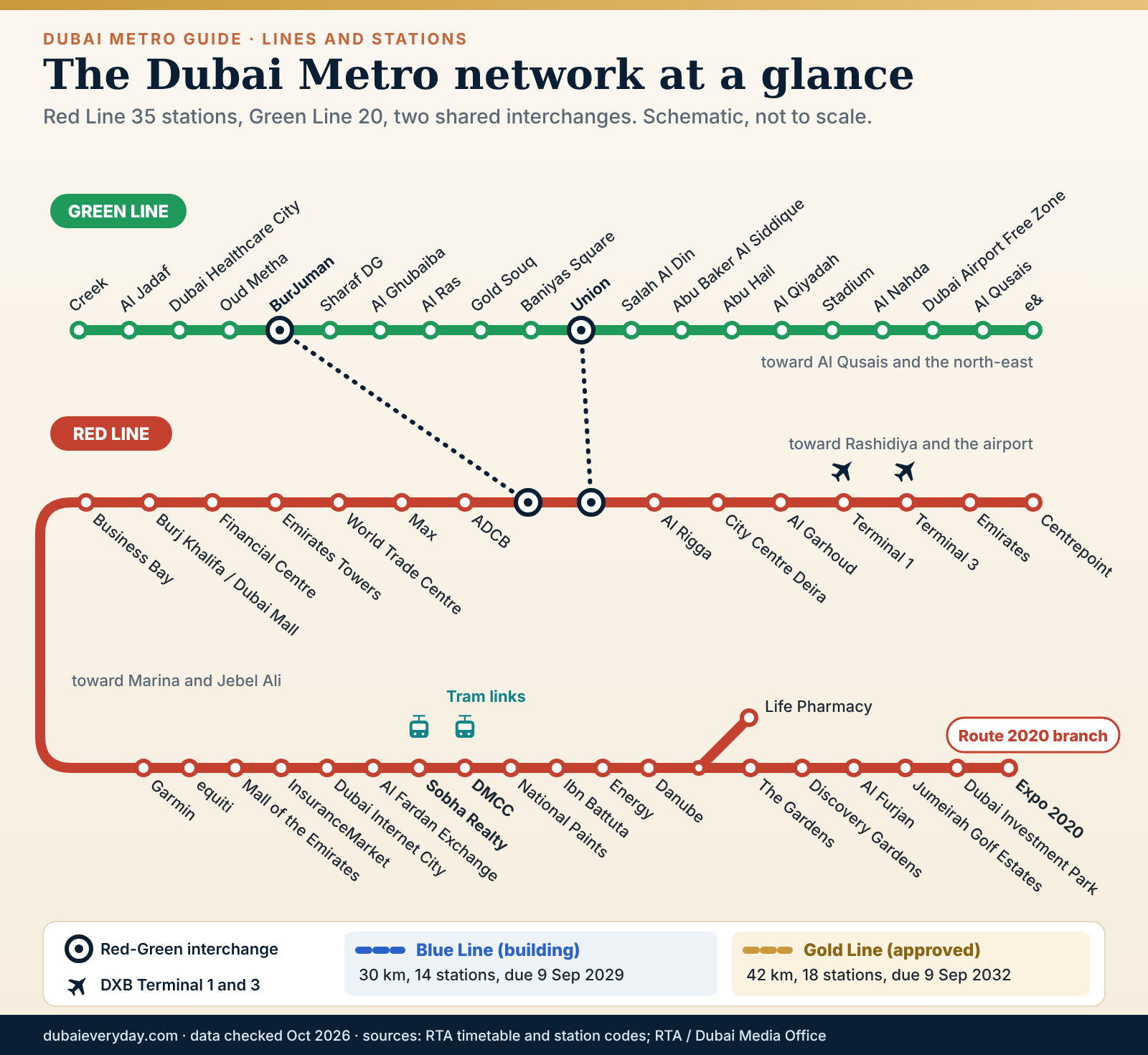
Station codes anchor every Dubai Metro guide worth using. The RTA identifies each station with a code: R for Red, G for Green, then a number. That code is more stable than the sponsor name, and it is what the RTA’s own timings PDF uses. The map below is a schematic built from that PDF, not a geographic map, so spacing is not distance.
The Red Line in this Dubai Metro guide, section by section
The Red Line is the backbone of this Dubai Metro guide. The RTA timetable page describes the Red Line as running between Centrepoint (R11) and either Expo 2020 (R76) or Life Pharmacy (R42). It has 35 stations once the Route 2020 extension is counted, per the RTA’s station list and Wikipedia. It is the line you will use most, so here it is in the order you meet the stations from the north-east.
- Centrepoint to Al Garhoud (R11 to R15). Centrepoint (also known as Rashidiya) is the north-eastern end and the future Blue Line interchange. Next come Emirates (R12), Terminal 3 (R13), Terminal 1 (R14) and Al Garhoud (R15). The two airport stations are the reason this section matters to visitors.
- Deira and the interchanges (R16 to R19). City Centre Deira, Al Rigga, Union and BurJuman. Union (R18) and BurJuman (R19) are where the Green Line crosses. All four are underground.
- Bur Dubai to the Financial Centre (R20 to R24). ADCB (formerly Al Karama), max (formerly Al Jafiliya), World Trade Centre, Emirates Towers and Financial Centre, the stop for DIFC.
- Downtown to Business Bay (R25, R26). Burj Khalifa / Dubai Mall (R25) is the station most visitors want. Business Bay (R26) is a planned interchange with the Gold Line.
- Towards the Marina (R29 to R38). R29 (Garmin on the RTA PDF), equiti (R31), Mall of the Emirates (R32), InsuranceMarket (R33), Dubai Internet City (R34), Al Fardan Exchange (R35), Sobha Realty (R36), DMCC (R37) and National Paints (R38). Sobha Realty and DMCC connect to the tram.
- The far south-west (R39 to R42). Ibn Battuta, Energy, Danube and Life Pharmacy, the short branch terminus.
- The Route 2020 branch (R70 to R76). The Gardens, Discovery Gardens, Al Furjan, Jumeirah Golf Estates, Dubai Investment Park and Expo 2020. The branch leaves the main line near Jabal Ali, so check the destination board before boarding.
The code numbers have gaps (there is no R27, R28, R30 or R75 on the RTA list), which probably reflects planned or renumbered stations. We have not tried to explain them, and you do not need to. Just read the station name on the train display.
The Green Line: Old Dubai, the Creek and the long loop
Old Dubai sits on the Green Line in this Dubai Metro guide. The Green Line has 20 stations, from e& (G11) in the north-east to Creek (G30) in the south.
Its stops read like a tour of the older city: Al Qusais, Dubai Airport Free Zone, Al Nahda, Stadium, Al Qiyadah, Abu Hail, Abu Baker Al Siddique, Salah Al Din, Union, Baniyas Square, Gold Souq, Al Ras, Al Ghubaiba, Sharaf DG, BurJuman, Oud Metha, Dubai Healthcare City, Al Jadaf and Creek. The central stretch from Salah Al Din to BurJuman is underground, according to Wikipedia’s station list.
For most visitors the Green Line is the Old Dubai line. Gold Souq and Al Ras serve the Deira souks, Al Ghubaiba and Sharaf DG sit on the Bur Dubai side, and Creek is the stop for the water. The full set of walking routes and heritage stops is in our Dubai Metro Green Line guide.
Choosing the right interchange: Union or BurJuman
Interchanges are where a Dubai Metro guide earns its keep. Union and BurJuman are neighbours on the Red Line, but on the Green Line they are six stops apart, with the Old Dubai stations between them.
That asymmetry gives you a rule worth remembering. Change on the side you arrive from. If you come from the airport or Deira on the Red Line, Union is first; two Green stops later you are at Gold Souq. If you come from Downtown, BurJuman is first, and Gold Souq is four Green stops away through Sharaf DG, Al Ghubaiba and Al Ras.
Going the wrong way round the loop costs about five extra stops. At roughly two minutes a stop, our rule of thumb from the Red Line figure below, that is ten minutes you did not need to spend. Both interchanges are large underground stations, so allow a few minutes of walking and escalators between the platforms.
Dubai Metro guide to journey times: how long does a Red Line trip take?
Journey times are the part of any Dubai Metro guide that readers want most and sources agree on least. The RTA does not publish a station-to-station table that we could read, so use its app for exact journey times. For planning, a secondary source, Wikipedia’s Red Line article, puts Centrepoint to Expo 2020 at about 74 minutes end to end.
Dividing that by the 30 to 33 gaps between stations on that path (the exact count depends on where the branch splits) gives roughly 2 to 2.5 minutes per gap, dwell time included. That is our calculation, and spacing is uneven, so treat the results as a first estimate.
Terminal 1 to Burj Khalifa / Dubai Mall
Eleven gaps, so roughly 22 to 28 minutes of train. Add the walk through the station and the Dubai Mall link.
Burj Khalifa / Dubai Mall to Mall of the Emirates
Four gaps, so roughly 8 to 10 minutes of train. It is a short, easy hop, and the station connects to the mall.
Union to Sobha Realty
Fifteen gaps, so roughly 30 to 38 minutes. This is the typical cross-city ride, and a good argument for sitting down.
Dubai Metro fares: zones, transfers and what a trip really costs
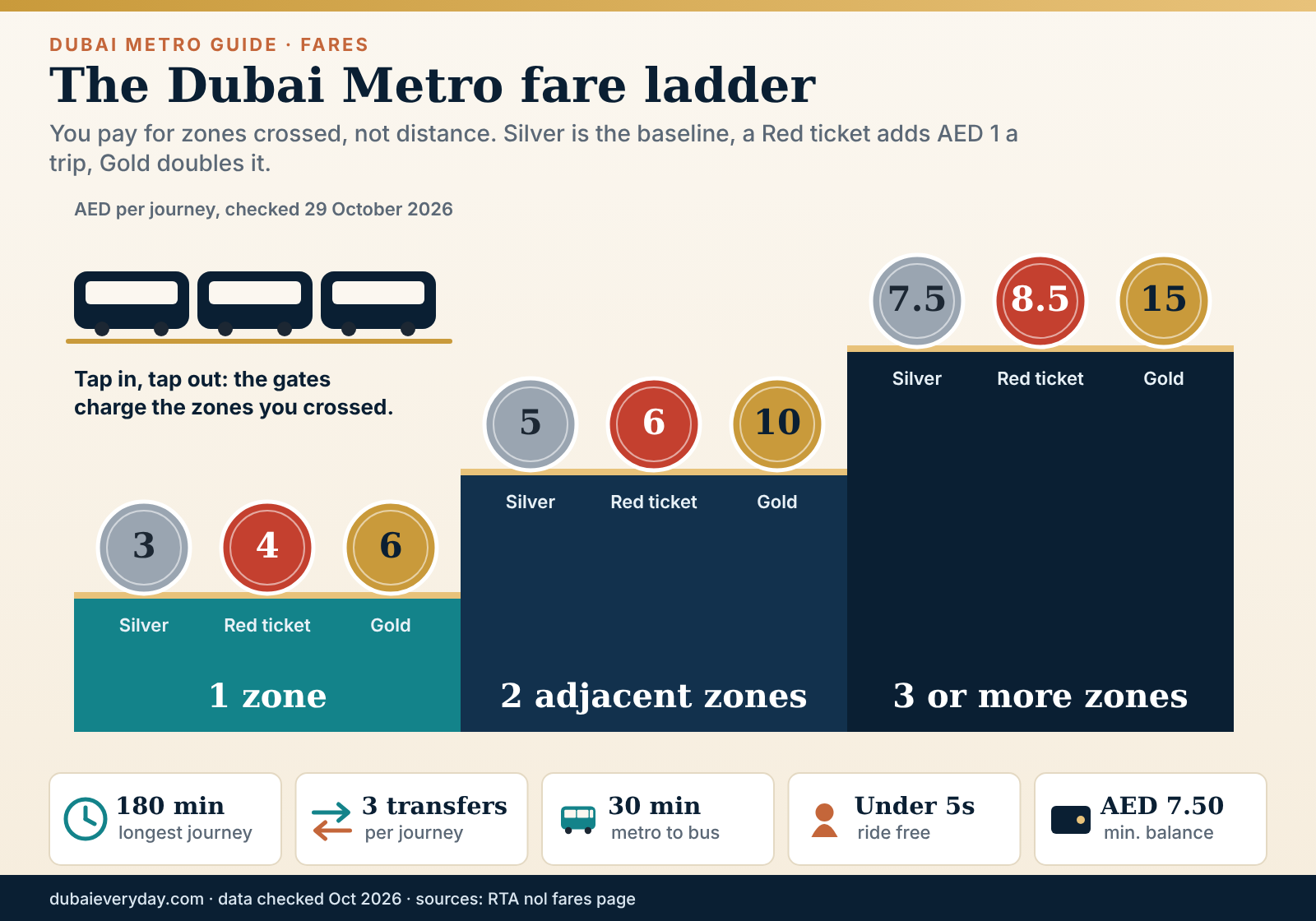
Fares are the section of this Dubai Metro guide where small errors cost real money. Dubai Metro fares depend on how many fare zones your journey crosses, not on distance, time of day or direction. The RTA publishes three tiers, and the whole system resolves to them.
If your journey stays within one zone, a Silver nol card pays AED 3. Two adjacent zones cost AED 5. Anything crossing more than two zones costs AED 7.50, which is the highest Silver fare on the network. These figures come from the RTA’s nol fares page, read on 29 October 2026.
How zones set the price in this Dubai Metro guide
The honest limit of this page is zone counting. The RTA’s zone map is a graphic, and none of the pages we could read lists the zone count for each station pair. So we do not quote “Station X to Station Y costs AED 5”, because we could not verify it and a wrong figure is worse than none. The RTA app’s journey planner and the nol fare calculator show the answer for your exact pair, and the gate shows it again when you tap out.
What you can budget safely is a band: AED 3 to 7.50 per Silver journey. In practice, short hops between neighbouring areas sit at the bottom of the band, and anything that crosses the city sits at the top. A trip from the airport to Downtown, or from Deira to Mall of the Emirates, crosses many stations and will probably land on the top tier. Plan around AED 7.50 for any trip you would call “across town”, and treat a lower fare as a pleasant surprise.
The Red ticket and Gold premiums
The same journeys cost more on other products. A Red ticket, the paper-style card sold to visitors, charges AED 4, 6 or 8.50, which is exactly AED 1 more than Silver on every tier. A Gold card or Gold Red ticket pays double the Silver tier for Gold Class cabins: AED 6, 10 or 15 on a Gold card, and AED 8, 12 or 17 on a Gold Red ticket.
The RTA notes that the Gold surcharge applies to the Metro and tram only, and is charged once per zone, so a zone already charged on the tram is not charged again when you transfer to the Metro. This Dubai Metro guide treats the Red ticket as a visitor product, not a bargain.
Personal (Blue) cards carry the Silver fares, with concessions on top. The RTA lists 50 percent off for students and senior Emiratis on the Personal card only, free travel for people of determination on the Personal card, and free travel on every card and ticket for children aged five and under. The concessions do not apply to Silver, Gold or Red ticket users, which matters if a student visitor expects a discount on a tourist card. They will not get one.
Transfers, the 180-minute window and the bus rule
Transfers are the least understood rule in a Dubai Metro guide. A “journey” in RTA terms can include more than one leg. The maximum duration of a single journey is 180 minutes for every zone combination, and the maximum number of transfers is three. If you change from Metro to bus (or another mode), you must make the connection within 30 minutes. That is long enough for a normal change and short enough to catch out someone who stops for coffee between the station and the bus stop.
Two practical consequences follow. A day of sightseeing with a long lunch is not one journey; each tap-in starts a new fare. And if you plan Metro, then tram at the Marina, then a bus, keep the 30-minute change window in mind.
The AED 7.50 gate rule every Dubai Metro guide repeats
The minimum balance deserves its own space in this Dubai Metro guide. The RTA states that a nol card needs AED 7.50 of balance to check in at a Metro gate (and at bus and marine entrances), no matter what the journey will cost. This is the single most useful fact on this page for a first-time rider, because a balance that looks healthy can still be too low.
Take a fresh Silver card. Secondary sources say it holds AED 19 of credit at purchase. Ride one long journey at AED 7.50 and you have AED 11.50. Ride another and you have AED 4.00, which is not enough to tap in for even an AED 3 hop.
Our calculation: a newly bought card is good for two top-fare journeys, and only a third if you top up. Treat AED 7.50 as the floor you keep, not the fare you pay. The same sources report a minimum top-up of AED 20 at station machines, so top up before you are in a queue.
A balance of AED 6 or less will not open the gate, however short your trip. If you are leaving the Metro to go to a mall or a long lunch, top up on your way out, not on your way back in.
Is there a daily fare cap?
The daily cap is the one fare claim this Dubai Metro guide cannot confirm from the RTA. Two secondary sources, dubizzle and Property Finder, both describe a daily cap of AED 14 on Silver and Blue cards: once you have paid AED 14 in a day, further travel until midnight is free.
The RTA fare page we read does not mention a cap, so we treat it as probable, not confirmed. If it applies to you, it changes the sums. Three top-tier journeys would cost AED 22.50 uncapped and AED 14 capped.
The same sources mention one-day passes at about AED 20 and, for Gold, AED 40, but disagree on which card or ticket buys them. We do not recommend buying any day pass without first checking the machine’s on-screen price against what you expect to ride. For most visitors the cap, if it exists, makes a day pass unnecessary.
Dubai Metro guide budget: what a Metro day costs (our calculation)
The budget below is our own work, and this Dubai Metro guide labels it as such. Because we cannot verify zone counts, here is a bounded budget for a Silver card. The low figure assumes every journey is a one-zone hop, and the high figure assumes every journey is the AED 7.50 tier. The capped figure applies the reported AED 14 daily cap.
| Journeys in a day | Lowest (AED 3 each) | Highest (AED 7.50 each) | Highest with reported AED 14 cap |
|---|---|---|---|
| 2 journeys (there and back) | AED 6 | AED 15 | AED 14 |
| 4 journeys (two outings) | AED 12 | AED 30 | AED 14 |
| 6 journeys (a full sightseeing day) | AED 18 | AED 45 | AED 14 |
Even the pessimistic, uncapped column compares well with a taxi, where the start fare alone is AED 25 at the airport. A Red ticket traveller pays AED 1 more per journey, so six journeys cost AED 6 more, which is why the card choice matters for anyone doing more than a few trips (see the next section).
Metro versus taxi, in one comparison
A Dubai Metro guide should compare the alternative honestly. Dubai Airports says a taxi from its ranks starts at AED 25 before distance charges (DXB taxi page). So one taxi start fare equals more than three top-tier Metro journeys.
For a group of four going from the airport to the Downtown area, four Silver fares (at most AED 30) come in below a taxi that has only just started its meter. For one person at 01:00 with two large suitcases, the taxi wins on convenience, and the Metro is not running anyway.
The honest rule is that the Metro wins on money for solo travellers and groups, on predictability in rush hour, and on air-conditioned comfort, and the taxi wins on door-to-door, on luggage and after hours. Most people end up using both, as the 2025 ridership figures suggest. If you are weighing a hire car against all of this, the cheap car rental guide breaks down the extra charges that make a daily rate misleading.
Nol cards: which one to buy and how not to get stuck at the gate
Cards decide most of what goes wrong, so this Dubai Metro guide spends time on them. A nol card is the RTA’s prepaid travel card. One card works on the Metro, tram, buses and the marine services, so you buy it once and use it everywhere. The RTA’s nol card page names four types: the Red ticket, Silver, Gold and Blue. It also describes weekly, monthly, quarterly and annual bundles for unlimited travel, and a micropayment feature capped at AED 200 per purchase at participating outlets.
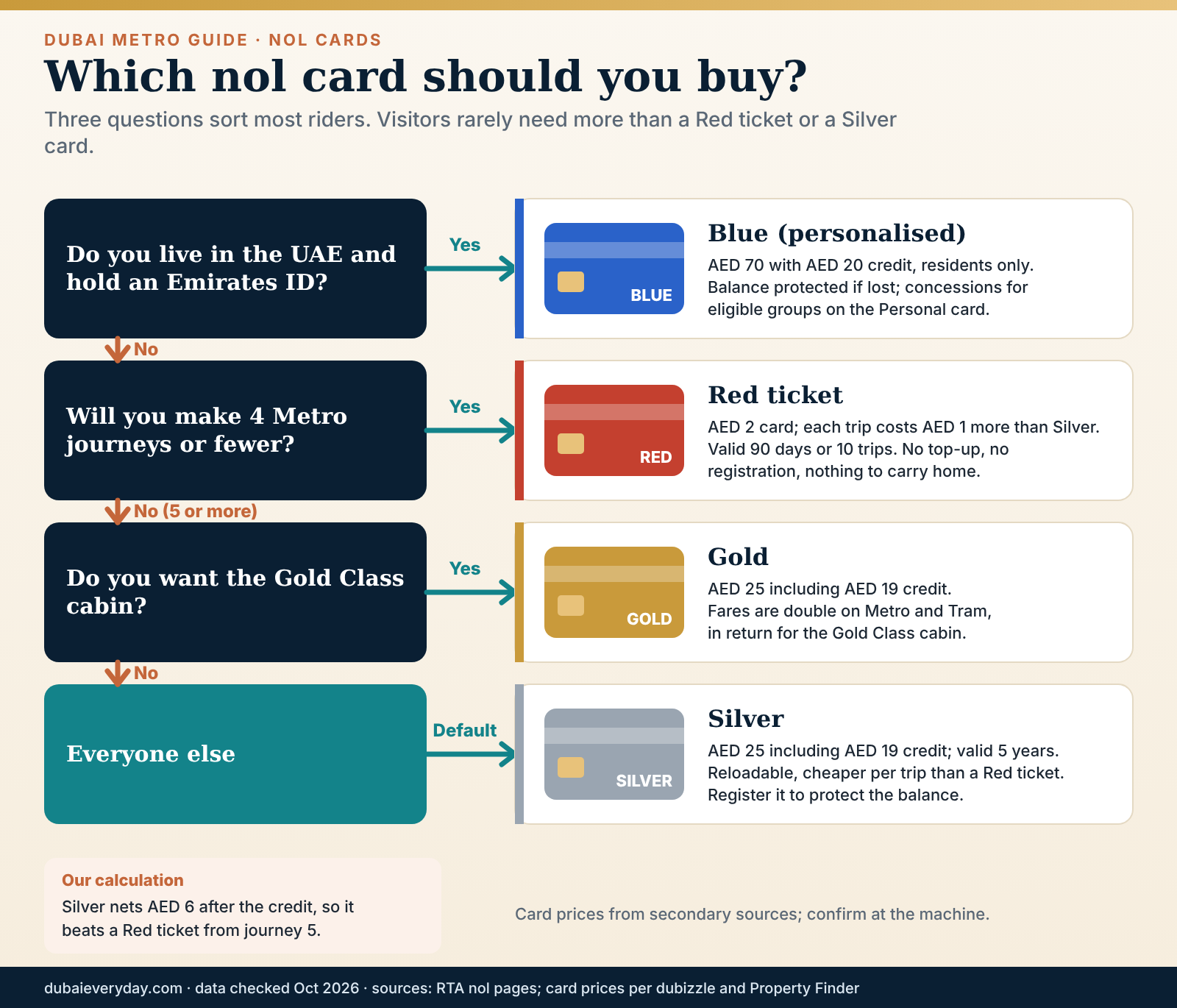
Card prices are the weakest-sourced numbers in this Dubai Metro guide. The RTA’s page does not print card prices, starting credit or validity, so the figures below come from two consistent secondary sources, dubizzle (page last modified 25 September 2026) and Property Finder (published 7 February 2026). Treat them as likely and confirm them on the ticket machine screen before you pay.
| Card | Price | Starting credit | Valid for | Maximum balance | Best for |
|---|---|---|---|---|---|
| Red ticket | AED 2 | Trip-based | 90 days or 10 journeys | Not reloadable | One to four journeys |
| Silver | AED 25 | AED 19 | 5 years | AED 1,000 unregistered; up to AED 5,000 registered | Visitors and most residents |
| Gold | AED 25 | AED 19 | 5 years | Up to AED 5,000 | Riders who want Gold Class |
| Blue (personal) | AED 70 | AED 20 | 5 years | AED 5,000 | Residents with Emirates ID |
Prices, credit, validity and balance limits above are secondary-sourced and were last reported in 2026; the RTA page only confirms the card types, the AED 7.50 minimum balance and the AED 200 micropayment cap. Where the two sources differ on a detail, we have used the figure they agree on.
The Red ticket: right for a short stay, wrong for a week
For a short stay, this Dubai Metro guide favours the Red ticket only in narrow cases. The Red ticket is built for visitors who will ride a handful of times. It costs about AED 2, needs no registration and cannot be topped up.
Each journey costs AED 1 more than on a Silver card, as the fare page shows. It is valid for 90 days or 10 journeys, whichever ends first, according to Wikipedia and Property Finder. The RTA requires at least one single trip remaining on a Red ticket to open the gate.
Use the Red ticket if you are in Dubai for a stopover, or you know you will ride fewer than five times. Do not buy it for a week of sightseeing: the AED 1 premium on every trip adds up, and a ticket cannot be topped up when it runs low.
Silver: the default for almost everyone
Silver is the card this Dubai Metro guide recommends for most riders. A Silver card costs AED 25 and includes AED 19 of credit, which means the real cost of owning one is AED 6. That AED 6 buys you the AED 1 discount on every journey compared with a Red ticket, a card that lasts five years, and the ability to top up.
Our calculation: a Red ticket costs AED 2 up front and AED 1 more per journey, so after four journeys the two options are level, and from the fifth journey Silver is cheaper. That is the break-even in the chooser graphic above.
The AED 19 credit is not lost. It stays on the card, so a second Dubai trip in the next five years starts with whatever is left. We could not verify any refund policy for leftover credit on an RTA page, so assume there is none and avoid loading more than you will use before you fly home.
Gold: pay double for space
Gold has the same purchase price as Silver, but fares double on the Metro and tram because the card gives access to the Gold Class cabin. A top-tier Gold journey is AED 15 against AED 7.50. Press descriptions mention wide leather seats, but we have not seen the cabin, so we cannot compare it with a standard one.
The case for Gold is a rush-hour ride with luggage or a small child when you want guaranteed room. It is not a speed upgrade: the train is the same one. In this Dubai Metro guide, Gold is a comfort choice, not a saving.
Blue: the resident’s card
Residents need a different chapter of the Dubai Metro guide. The Blue (personalised) card is linked to an Emirates ID and carries the Personal fare schedule, concessions for eligible students, senior Emiratis and people of determination, and a protected balance.
The RTA says a lost Blue card should be reported to 800 90 90. If you live in Dubai and ride often, it is the sensible card. Registering a Silver or Gold card is the lighter alternative if you mainly want a protected balance. See the residents section for the break-evens.
Where to buy and top up
The RTA says nol cards are sold at ticket offices, ticket vending machines, customer happiness centres, authorised sales agents and online. Dubai Airports confirms that Terminals 1 and 3 have ticket offices and vending machines for the Red Line, and that Gold and Silver cards are on sale there.
Secondary sources add that vending machines take a minimum top-up of AED 20, ticket offices a minimum of AED 50, and the RTA website and the RTA Dubai and S’hail apps a minimum of AED 20, with auto top-up for registered cards.
First-timers get a simple order in this Dubai Metro guide. A practical order for a first-time visitor: buy a Silver card at the airport station machine, check that the screen shows the price you expect, add at least AED 20 on top of the starting credit, and keep the receipt if one is printed. If you plan to use buses or the tram, the same card works. The airport’s bus stands accept nol cards and no cash, per Dubai Airports.
Registering, losing and phone alternatives
Registration is a small step that this Dubai Metro guide recommends for any card holding real money. The RTA says Silver and Gold cards can be registered online to protect the balance if the card is lost. Secondary sources agree that an unregistered card generally cannot be replaced and that its balance cannot be recovered. A visitor might shrug at AED 19, but a resident who loaded AED 500 should not. Register the card.
We could not confirm that bank cards or phone wallets open the Metro gates. The RTA pages we read describe nol cards only, and the older NFC “Smart nol” scheme mentioned by Wikipedia ties to specific SIM cards, so we would not plan around it.
If you hold a card in a phone wallet, check the RTA Dubai app for the current options; if you cannot, buy the plastic. Newer ways of paying are covered in the internet, mobile and payments guide. Until the RTA says otherwise, this Dubai Metro guide assumes you need a nol card.
Which card for which trip: the Dubai Metro guide shortlist
Stopover of 6 to 12 hours
A Red ticket if you will ride four times or fewer, or a Silver if you are not sure. Keep AED 7.50 on the card for the gate.
Week as a tourist
Silver, topped up in AED 20 steps. Register it only if you are likely to return within five years.
Month on a work trip
Silver or a registered Silver. The 30-day pass is rarely worth it unless you ride every day (see the commuter maths below).
New resident
Blue if you hold Emirates ID, otherwise a registered Silver. Our moving to Dubai guide covers where nol fits in your first month.
Dubai Metro timings: first train, last train, Fridays and holidays
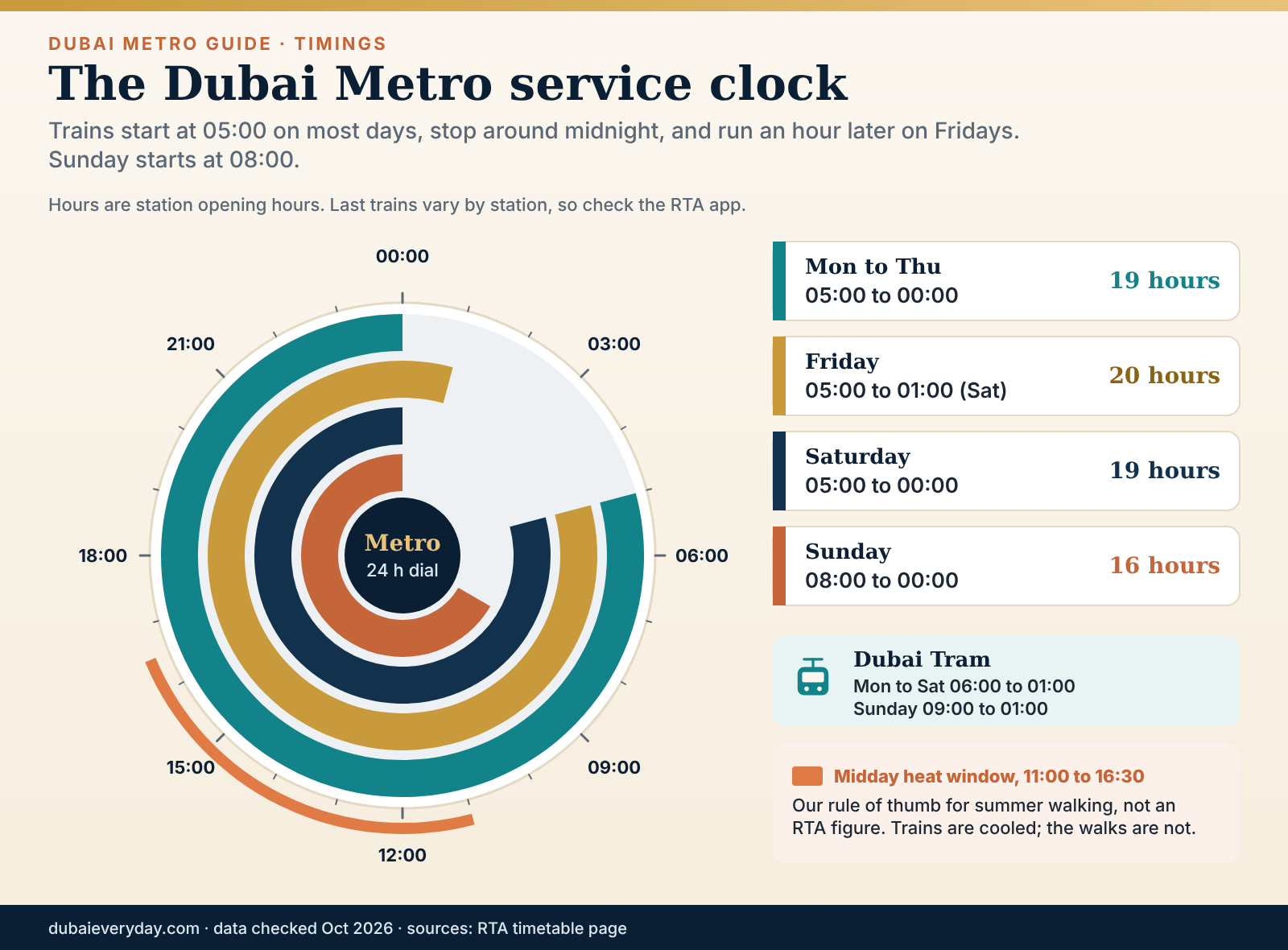
Timings are the most checked part of any Dubai Metro guide. The RTA’s timetable page gives one set of opening hours for every Metro station on both lines. Monday to Thursday, the stations open at 05:00 and close at midnight. On Friday they open at 05:00 and close at 01:00 the next morning. Saturday returns to 05:00 to midnight. Sunday starts later, at 08:00, and closes at midnight. The Dubai Tram runs Monday to Saturday from 06:00 to 01:00, and on Sunday from 09:00 to 01:00.
The weekly pattern in this Dubai Metro guide, and what it means
Our arithmetic from those hours: the stations are open 19 hours on Monday to Thursday, 20 hours on Friday, 19 on Saturday and 16 on Sunday. That adds up to 131 hours a week, or about 78 percent of the 168 hours in a week. The Metro is therefore a daytime and evening system, not a night one. There is no service in the small hours on any day, which is why airport taxis and late-night transfers still matter.
This Dubai Metro guide keeps the pattern simple. Three patterns catch people out. First, the later Sunday start (08:00) means a Sunday morning departure before about 10:30 usually needs a taxi, because the first train and the walk to the terminal will not match a standard three-hour check-in.
Second, Friday is the one late evening: the extra hour to 01:00 suits an evening out, and the other six nights do not. Third, the hours are station opening hours. The RTA’s detailed timings PDF lists first and last trains station by station, and the last trains vary from one station to the next and by direction, as does the final departure.
How often do trains run?
Frequency is another number a Dubai Metro guide can report but not confirm. Sources disagree, and the RTA page we read does not state intervals. Property Finder’s timings article gives two to three minutes at peak and five to seven minutes off-peak. Wikipedia’s Red Line article quotes a theoretical peak headway of about 2 minutes 38 seconds, and an older fares site lists 3.45 minutes at peak and 7 off-peak. The safe planning number is three to seven minutes between trains.
In practice you do not time trains in Dubai. You walk onto the platform and one comes soon. Frequency only matters when you are timing a close connection, such as the last train, a flight or a dinner reservation. In those cases, give yourself 30 minutes of margin and assume nothing will wait for you.
Last-train planning: the Dubai Metro guide rule
Last-train planning is where this Dubai Metro guide asks you to be cautious. If your evening depends on the last train, build the plan backwards from a time that is 30 minutes before midnight (or 00:30 on Friday), not from the printed closing time. A closing time is when the station shuts, not when you can still expect to board.
Check the last train for your own station and direction, and allow time for an interchange if you are changing line. If you miss the last train, the fallback is a taxi or a ride-hailing app (the airport’s taxi page names Uber, Careem and Bolt).
Practical rule. Treat 23:30 (Friday 00:30) as your real last-train time. If your journey has an interchange at Union or BurJuman, treat 23:15 as the deadline, and keep a taxi app ready anyway.
Early flights and first trains
Early flights deserve a note in a Dubai Metro guide. Metro stations open at 05:00 on every day except Sunday, which makes a 07:30 departure easy and a 06:00 one awkward.
The RTA PDF lists first trains for the airport stations, Terminal 1 (R14) and Terminal 3 (R13), so check it for your exact day if your flight leaves before about 07:00. The airport guide covers the terminal side of the story, including why a Terminal 2 departure needs a different plan (see the DXB guide and the Terminal 2 guide).
Special days: New Year, marathons, Eid and Ramadan
Special days are a reminder that a Dubai Metro guide describes a normal week. The normal timetable gives way on big days, and the RTA announces the changes a few days ahead. Some examples show the pattern:
- New Year 2025 to 2026. The Dubai Media Office release says Metro stations ran from 05:00 on 31 December through 23:59 on 1 January, effectively continuous service for about two days. The tram ran until 01:00 on 2 January. Access near the main fireworks areas has been restricted on the night in past years, so plan your route and your exit before you go (see the RTA announcement).
- Dubai Marathon, 1 February 2026. The Metro opened at 05:00 instead of the usual Sunday 08:00, to serve runners and spectators, according to Khaleej Times.
- Eid al-Fitr 2026. Reported hours were 05:00 to 01:00 on 18 to 21 March, then 08:00 to 01:00 on Sunday 22 March, per PitStop Arabia (secondary). Holiday patterns usually extend closing times, not shorten them.
- Ramadan. The RTA publishes revised hours each year. We did not find a verified 2026 schedule, and 2027 dates depend on the moon sighting, so do not plan Ramadan trips from an old article. Check the RTA’s announcement in the days before the month starts.
For events, the Dubai events calendar is the place to see which weekends are likely to change the transport map, and the best time to visit guide explains how season changes your Metro day.
Dubai Metro guide for tourists: a first ride, step by step
A first ride on the Dubai Metro is easier than it looks, because almost everything is the same on every journey. The parts that trip people up are the card, the direction and the final walk. This section is the whole sequence in order, written from RTA rules and station data. It describes what the system requires, not a journey we made, and the steps hold whichever station you start from. That is the whole job of a Dubai Metro guide for tourists.
- Decide on a card before you reach the gateUse the chooser above. A Red ticket for four journeys or fewer, a Silver card for anything more. You cannot pay at the gate with cash.
- Buy and top up at the machine or ticket officeAirport stations at Terminals 1 and 3 have both. Add enough credit that the balance stays above AED 7.50 after your first ride, so you can tap in again later.
- Find your line and direction by terminusPlatform signs name the end of the line. On the Red Line that is Expo 2020 or Life Pharmacy one way, and Centrepoint the other. On the Green Line it is e& one way and Creek the other.
- Tap in at the gateHold the card flat on the reader. A Gold Class cabin needs a Gold card. If the gate refuses you, check the balance first.
- Wait behind the platform doorsThe platform has edge doors. Let people off before you board, and choose your cabin: standard, Gold or Women and Children (see the cabins section).
- Ride and watch the displayUse the in-train announcements and displays to follow the stops, and count them against your plan, not your memory.
- Change at Union or BurJuman if you need the other lineFollow the signs for the Red or Green platforms. The interchange stations are large, so allow a few minutes.
- Tap out at the exit gateThe fare is calculated from the zones between your two taps.
- Plan the last stretch before you leave the platformThe exit you choose decides your walk. Read the station map and exit signs, because the nearest exit is not always the right one.
Our reading of the codes. RTA codes tell you which way to go. On the Red Line the numbers rise away from Centrepoint (R11) towards Expo 2020 (R76); on the Green Line they rise from e& (G11) towards Creek (G30). If your destination’s number is higher than your current station’s, you are riding in the direction of the rising numbers. Beyond Danube, check the branch on the train display.
A first-ride checklist from this Dubai Metro guide
- A card or ticket in hand, with AED 7.50 or more on it
- The station code of your destination written down (for example R25 for Burj Khalifa / Dubai Mall)
- The direction named by terminus, not by “left” or “right”
- A plan for the last stretch: walk, tram, bus or taxi
- A bottle of water for the walk (not to be opened on the train)
- A backup: the RTA app on your phone and a ride-hailing app
Where the Metro actually drops you
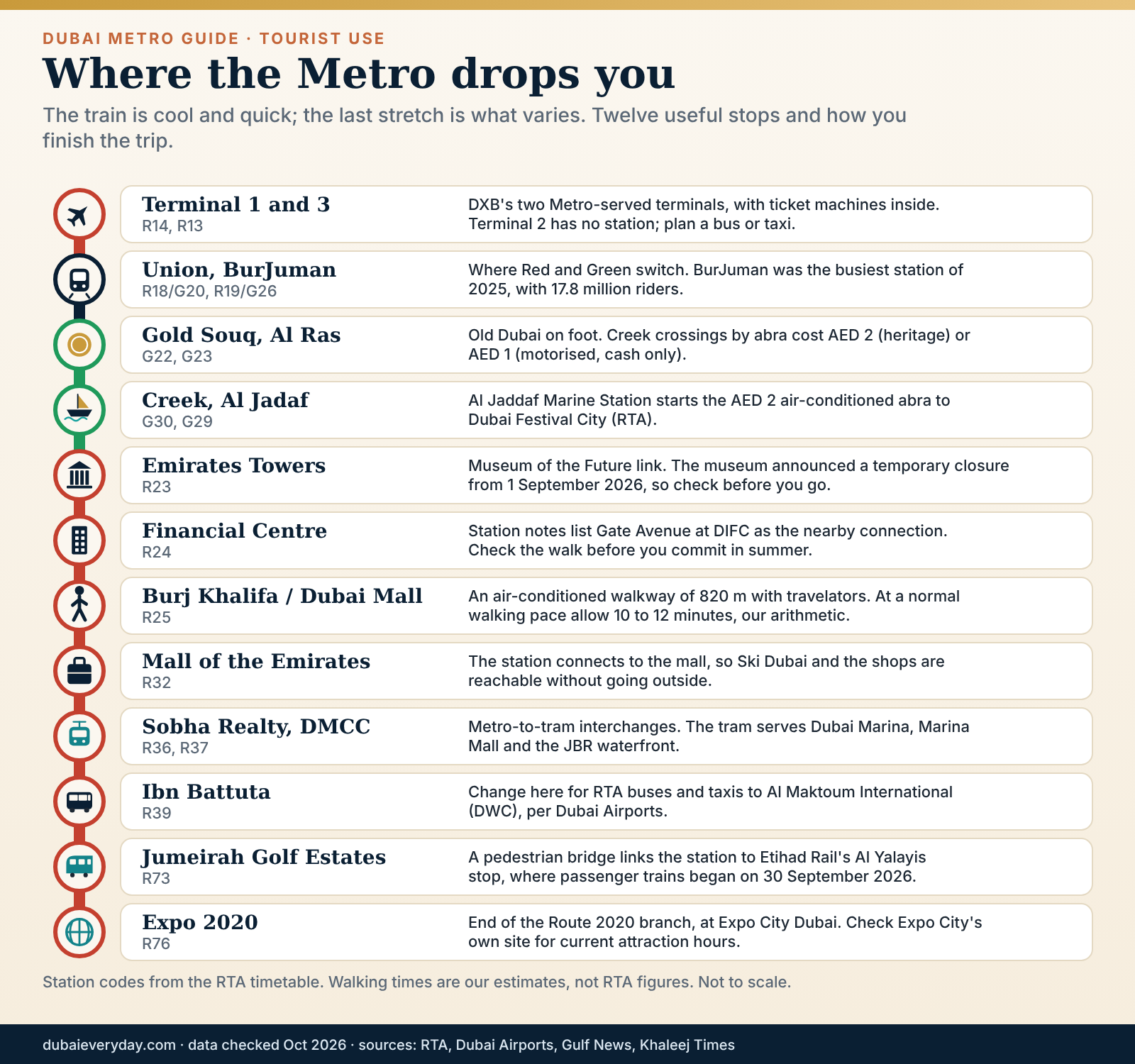
The last mile is the part of a Dubai Metro guide that maps rarely show. The train is the easy part; what varies is how far you still have to go. The infographic below pulls twelve useful stops from the station list and shows how you finish each trip. Some details come from RTA and Dubai Airports pages, some from press reports of walkways and closures, and the walking times are our own arithmetic. Treat all of it as a planning aid.
Downtown: the one stop most visitors want
Downtown is the stop this Dubai Metro guide expects most readers to want. Burj Khalifa / Dubai Mall (R25) is where most first trips end. The Dubai Mall link is an air-conditioned walkway reported at 820 metres, with travelators, in a 2012 Gulf News report. That article describes an average travelator speed of 0.5 metres per second.
Our arithmetic: standing still on the travelators the full 820 metres would take about 27 minutes, but walking along them at an ordinary pace of 1.2 to 1.4 metres per second takes roughly 10 to 12 minutes. Walk; do not ride the walkway like a queue.
The surrounding district, from the fountain to the Burj Khalifa deck, is covered in the Downtown Dubai guide, and what to do inside the mall is in the Dubai Mall guide. Emirates Towers (R23) is a different stop, and the Museum of the Future link there is affected by the museum’s temporary closure, which was announced for 1 September 2026 with a reopening timed for 2027 and no date published, per Khaleej Times.
Old Dubai: Green Line and the Creek
Old Dubai is where this Dubai Metro guide suggests starting a cool-season day. The older districts reward a Metro-and-walking day, and they are friendlier in the cool months. Gold Souq (G22) and Al Ras (G23) put you near the Deira souks, and abra crossings of the Creek cost AED 2 on petrol heritage abras and AED 1 in cash on the motorised ones, according to the RTA marine page.
The same page lists an air-conditioned abra from Al Jaddaf Marine Station to Dubai Festival City at AED 2. Our free things to do guide collects the heritage walks, and the things to do in Dubai guide places them in a wider plan.
Marina, JBR and the Palm side
The Marina needs a change of mode, which this Dubai Metro guide flags early. Metro travellers reach the Marina by changing to the tram at Sobha Realty (R36) or DMCC (R37). The tram’s stops include Jumeirah Lakes Towers, Dubai Marina Mall, Dubai Marina, Marina Towers, Mina Seyahi, Dubai Media City and Palm Jumeirah, per the RTA’s timings PDF, and it runs on the hours given earlier. For the district itself, see the Dubai Marina guide, and for the island, the Palm Jumeirah guide.
Beaches, safaris and other places the Metro does not reach
This Dubai Metro guide also has to say where the Metro does not go. Some of the best-known visits have no Metro station close by, and a plan that assumes there is one will fall apart. Public beaches along the coast road typically need a bus or taxi from the nearest station; the public beaches guide lists facilities and access. Desert safaris normally include hotel pickup, so the Metro is irrelevant to them. Check the pickup arrangement on your booking before you try to build a Metro route.
Staying near a station
Hotel choice is where a Dubai Metro guide can save you the most walking. If you are choosing a hotel, the Metro is a legitimate selection criterion. A hotel within a short walk of a station on the Red Line puts the airport, Downtown and the Marina side within one ride.
Our budget hotels guide is built around staying near the Metro and major districts, and the hotel guide shows how areas differ. A hotel next to a station that sits at the end of an 800-metre outdoor walk in August is not near the Metro, whatever the listing says. Check the walk, not the distance as the crow flies.
Dubai Metro from the airport
This part of the Dubai Metro guide is the airport-specific slice; the wider terminal logic is in the DXB airport guide. The Red Line serves two terminals: Terminal 3 (R13) and Terminal 1 (R14). The Dubai Airports Metro page confirms that Red Line tickets and nol Gold and Silver cards are sold at ticket offices and vending machines in both terminals, and it links to the RTA for hours, fares and zones. Terminal 2 is not mentioned on that page.
Terminal 2 has no Metro station. For a Terminal 2 arrival, the practical options are the airport’s bus stands, which Dubai Airports says serve the arrival levels of all three terminals and accept nol cards only, or a taxi or ride-hailing pickup.
Wikipedia’s Green Line article lists a transfer to Terminal 2 from the Dubai Airport Free Zone station (G13), but we could not confirm the current arrangement on an RTA page, so ask the RTA app or an airport desk before you rely on it. The Terminal 2 guide has the details, and the Terminal 1 guide covers the terminal where the Metro link is strongest.
Three airport journeys, by our counting
Using the same rule of thumb as before (about 2 to 2.5 minutes per station gap), here is how the main airport journeys look by train. These are our calculations from the RTA station order, plus walking and waiting on top.
Terminal 1 to Downtown
Eleven gaps to Burj Khalifa / Dubai Mall (R25), so about 22 to 28 minutes on the train, plus the walkway to the mall. Likely fare: the top tier, AED 7.50 on Silver.
Terminal 1 to Gold Souq
Four Red Line gaps to Union, then two Green Line gaps to Gold Souq (G22). Roughly 15 to 20 minutes of train plus the interchange walk. The most direct route to the Deira souks.
Terminal 1 to the Marina tram
Nineteen gaps to Sobha Realty (R36), so about 38 to 48 minutes of train, then the tram. This is long enough that a taxi may win with heavy luggage.
Luggage on the Metro
Luggage rules are the airport detail this Dubai Metro guide checks twice. Dubai Airports says you may carry up to two pieces of luggage, including hand luggage, and points to the RTA for size and weight limits.
A secondary source, dubizzle, quotes the limit as one large case (81 x 58 x 30 cm) and one small case (55 x 38 x 20 cm) per passenger. A family of four with six large suitcases will not fit that rule, and in that case a taxi or a pre-booked transfer is the right answer.
For solo travellers and couples with carry-on and one large case, the Metro works. Use the lift where available, stand away from the doors on busy trains and keep the case upright between your feet. The women-and-children cabin and Gold Class cabin have their own rules (see the cabins section), and luggage rules apply to all of them.
Arrival and departure timing
Hours, not distance, shape the airport part of this Dubai Metro guide. Metro hours decide the whole airport question. Arrive after midnight (01:00 on Friday) and the Metro is closed, so book a taxi. Depart before 07:00 and, on Sunday, before about 10:30, and you probably need a taxi on the way out.
Between 07:00 and 23:00, on a normal day, the Metro is the cheapest and most predictable way to cross the city. The airport page names Dubai Taxi ranks that run 24 hours, and Uber, Careem and Bolt at marked pickup points.
Al Maktoum International (DWC)
Al Maktoum is the airport this Dubai Metro guide cannot connect by rail. The second airport, Al Maktoum International, is not on the Metro. Dubai Airports says to take an RTA bus or taxi from Ibn Battuta or Expo 2020 Metro stations.
Allow generous time, and do not assume a flight from DWC behaves like a flight from DXB. A separate airport express line between DXB and the new mega-airport has been proposed, according to Skift’s April 2026 report, but we could not find an approved route or date, so do not plan a trip around it.
Cabins, rules and etiquette on the Dubai Metro
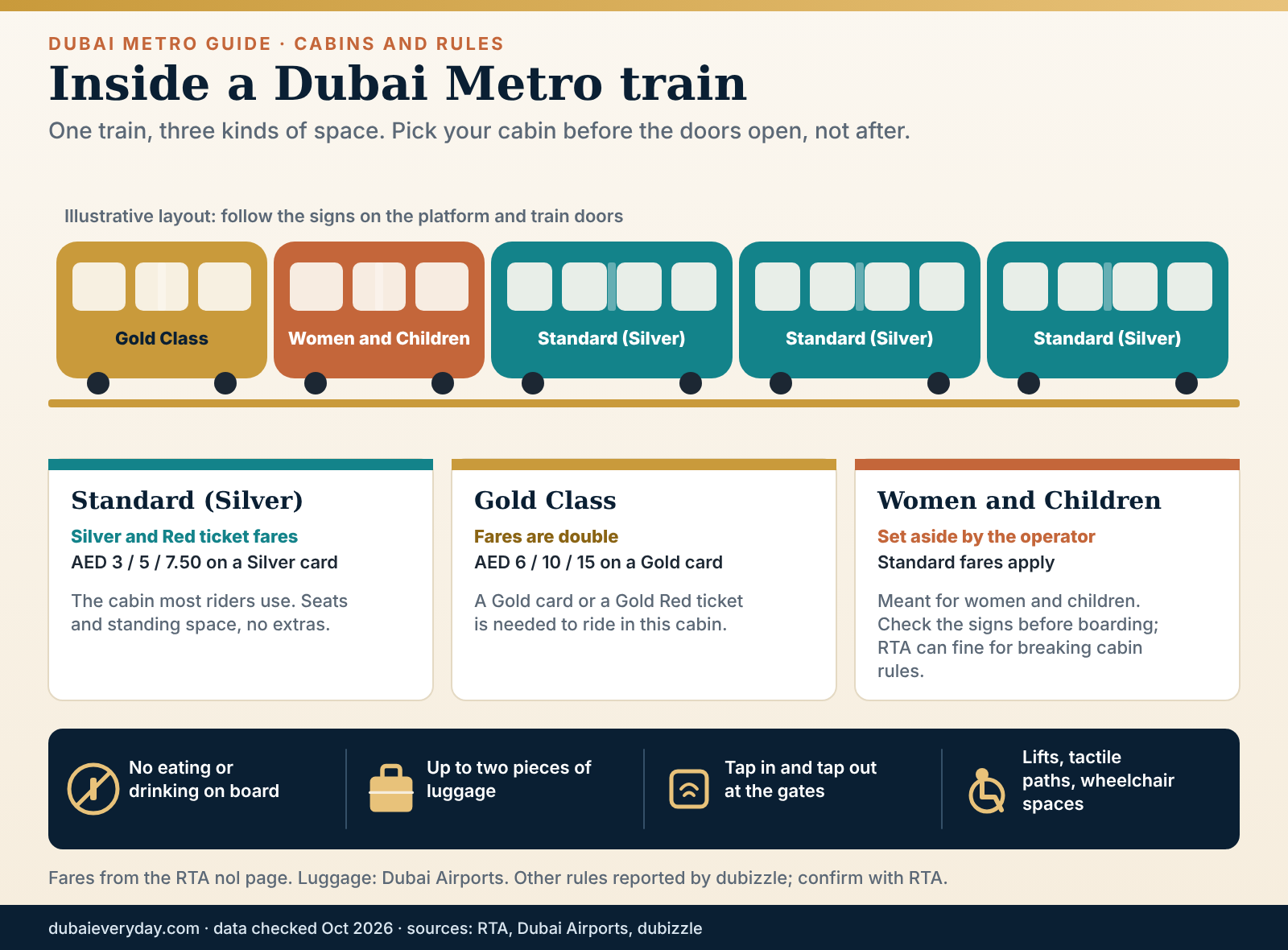
Cabin choice is a small but real decision in this Dubai Metro guide. Dubai Metro trains have three kinds of space: standard (Silver) cabins, a Gold Class cabin, and a cabin for women and children. Fares for Gold Class are double the Silver tier, according to the RTA.
Gold access needs a Gold card or a Gold Red ticket. The women-and-children cabin has standard fares, and its location is marked by signs on the platform and train doors. We could not find an official source for cabin positions, so the infographic below is illustrative.
The rules most visitors need
Rules are where a Dubai Metro guide can save you a fine. Three of them matter every day. First, no eating or drinking on board; secondary sources report fines of up to AED 100 for it. Second, use only the cabin your card covers: a Silver card is for the standard cabins, and a Gold card is for the Gold cabin. Third, a nol card is personal travel money; using another person’s card is reported to cost AED 200.
The list that follows compiles the fines reported by Property Finder and dubizzle, which cite RTA rules. We could not read the underlying RTA regulation, so treat the amounts as likely and confirm with the RTA.
- Eating or drinking in non-designated areas: up to about AED 100
- Entering restricted areas: about AED 100
- Using someone else’s nol card: about AED 200
- Selling goods on trains: about AED 200
- Sleeping on trains: up to about AED 300 (dubizzle)
- Vandalism: about AED 2,000, which is also the ceiling reported for any rule breach
Everyday etiquette
Etiquette is the unwritten half of a Dubai Metro guide. The unwritten rules matter more than the fines. Let passengers leave before you board, stand to the side of the doors, and keep your bag off the seat when it is busy. Offer seats to older passengers and people with children, keep calls short and phone volume low, and keep your voice down in the women-and-children cabin even if you are entitled to be there. Dubai is a place where small courtesies are noticed.
If you are visiting, the Metro is also where first-time visitors meet local dress norms in a confined space. Modest dress is the baseline in public transport and malls; the Dubai dress code guide covers what is expected in each setting, and the Dubai etiquette guide covers behaviour during Ramadan, public photography and greetings. In particular, do not film or photograph other passengers without their consent. It is a sensitive issue in the UAE and not a harmless habit.
If something goes wrong
When something goes wrong, this Dubai Metro guide has one verified number. For a lost card, the RTA gives 800 90 90 for Blue cards, and says registered Silver and Gold cards can protect a balance. For anything else, such as a gate fault or a charge that looks wrong, speak to station staff or the ticket office before you leave the station, while the journey is still fresh in your mind, and keep the card you used.
Metro plus tram, bus, abra and taxi
From here the Dubai Metro guide looks at the rest of the RTA network. The Metro is one layer of a larger RTA network, and the nol card is the common key. The sensible way to use the network is to let the Metro carry the long distance and pick another mode for the short ends. This section explains the add-ons in terms of what a rider needs to know, and where we could not verify a detail it says so.
The Dubai Tram
The tram is the piece of this Dubai Metro guide that serves the Marina. The tram serves Dubai Marina, JLT and the Al Sufouh corridor. It connects to the Metro at two interchanges, Sobha Realty (R36) and DMCC (R37), according to the RTA timetable page, and runs Monday to Saturday from 06:00 to 01:00 and on Sunday from 09:00 to 01:00.
It uses the same nol card and the same fare approach as the Metro: the RTA’s fare notes mention a Gold surcharge on both tram and Metro, charged once per zone, and the transfer rules (180 minutes, three transfers) apply across modes.
Allow a few minutes on foot between the tram stop and the Metro station, and let the RTA app show the route. Our Marina guide shows how the tram fits into a day there. We did not verify the Palm Jumeirah Monorail’s fare or hours on an official page, so check the operator’s own information if your trip includes it.
Buses and the 30-minute change
Buses add one rule that a Dubai Metro guide must not skip. RTA buses run on nol cards, and the RTA’s rule is that a change from Metro to bus must happen within 30 minutes. That window is the reason to look up the bus route before you ride the train.
At the end of the Red Line, Ibn Battuta is also a bus hub, and Dubai Airports points air travellers to RTA buses and taxis from Ibn Battuta or Expo 2020 for Al Maktoum International. Wikipedia also notes bus interchanges at Centrepoint and the Etisalat (e&) bus station on the Green Line.
For travel to Abu Dhabi, the RTA’s New Year release shows how routes are labelled: E100 from Al Ghubaiba and E101 from Ibn Battuta were the Abu Dhabi routes that week. Since 30 September 2026 Etihad Rail also runs a Dubai to Abu Dhabi passenger service from Al Yalayis, next to Jumeirah Golf Estates, with fares from AED 39 (Comfort) and AED 109 (Premium), per Gulf News.
Because the station is linked to the Metro by a pedestrian bridge, the Red Line is now a way to reach it. Schedules and fares change, so confirm them with the operator.
Abras, water taxis and the ferry
Abras sit outside the rails but belong in a Dubai Metro guide. The marine network is the most scenic part of the RTA system and the cheapest.
The RTA marine page lists traditional petrol abras on the Creek at AED 2 per person per trip, motorised abras at AED 1 paid in cash, an air-conditioned abra between Al Jaddaf and Dubai Festival City at AED 2 (where nol cards can be bought at the station), and the Dubai Water Taxi at the Marina at AED 7 for a single segment, rising to AED 21 on the longest route.
A creek crossing is a real part of Old Dubai, and the free things to do guide has the surrounding heritage walks.
Taxis, ride-hailing and the car
Taxis complete the picture in a Dubai Metro guide. Taxis fill the gaps, as the ridership numbers confirm: 209 million taxi trips in 2025 against 294.7 million Metro trips. DXB taxis start at AED 25 (Dubai Airports) and ride-hailing apps use designated pickup points.
If you are weighing a hire car instead, the car rental guide explains how to compare licensed companies, and the airport car rental guide covers pickup and return at DXB. Neither replaces the Metro for a central-Dubai trip in rush hour. For visitors who will stay a long time, the licence exchange guide shows what is needed to drive legally.
Dubai Metro guide rule for the last stretch (our rule of thumb)
Under about 1 km, in winter
Walk. It is quicker than any transfer, and the Metro stations that sit inside malls make this easy.
Over 1 km, in summer
Do not walk it. Take a tram, bus or taxi, or pick a different station. The 11:00 to 16:30 window is the one to avoid.
With luggage or small children
Taxi from the station, or choose a station that connects to a mall or hotel indoors.
After midnight
Taxi or ride-hailing. Metro stations are closed, and the tram stops at 01:00.
Dubai Metro guide for residents and commuters
Residents read a Dubai Metro guide differently from tourists. For residents, the question changes from “which card” to “which pass, if any”. The RTA’s nol products table lists Silver passes for 7, 30, 90 and 365 days, each at three coverage levels: one zone, two zones, or all zones. Registered Silver and Gold cards can apply for all four durations, while anonymous cards can apply only for the 7-day pass. Gold passes cost double, and student and senior Emirati passes cost half.
The numbers (RTA pass prices, Silver card)
- 7 days: AED 50 (one zone), AED 80 (two zones), AED 110 (all zones)
- 30 days: AED 140, AED 230, AED 350
- 90 days: AED 330, AED 550, AED 830
- 365 days: AED 1,060, AED 1,770, AED 2,670
The RTA page’s table header is misaligned, so we read the three columns in the order shown above, which matches the price steps from one zone to all zones. If your zone coverage matters (it does), confirm the prices in the RTA app before you buy.
When a pass beats paying per journey (our calculation)
The pass arithmetic in this Dubai Metro guide is our own. Divide the pass price by the fare you would otherwise pay. For the all-zones passes against the AED 7.50 top tier, the 7-day pass breaks even at about 15 journeys (110 divided by 7.50), the 30-day pass at about 47, the 90-day pass at about 111 and the annual pass at about 356. For a typical commuter, those numbers change the advice:
- A weekday commuter on the 30-day pass loses. Two top-tier journeys a day for 22 working days is 44 journeys, or AED 330, which is AED 20 less than the AED 350 pass. The same is true for two zones (AED 220 against AED 230) and one zone (AED 132 against AED 140). You need to ride on about 24 days a month, weekends included, for the 30-day pass to win at the top tier.
- The annual pass wins clearly. Two top-tier journeys a day for 240 working days is 480 journeys, or AED 3,600, against AED 2,670 for the all-zones annual pass: a saving of about AED 930. Even on the reported AED 14 daily cap, 240 days cost AED 3,360, which the annual pass still beats by about AED 690.
- The 90-day pass is marginal. About 64 working days at two top-tier journeys cost around AED 960, against AED 830, saving about AED 130 if you ride daily.
The takeaway is that passes reward consistency over a year, not a month. If your commute is not yet settled (new job, new flat), pay per journey on a registered card and buy the annual pass once the route is stable. Registered cards also protect the balance if lost, and the Blue card adds concessions if you are eligible.
Testing a commute with this Dubai Metro guide before you sign a lease
Before you sign a lease, apply this Dubai Metro guide to your own commute. If you are choosing where to live in Dubai, a station within walking distance can matter more than a lower rent. Check the commute the way you will actually use it: plan the exact trip in the RTA app for the hours you will travel; walk (or look at a map of) the route from your door to the station, and then picture it at 14:00 in July.
Check the last train against any late shifts, remembering the Sunday 08:00 start and the Friday 01:00 close. Consider the feeder bus too, because a long walk becomes a short bus ride only if the bus runs when you need it.
Our guides to renting in Dubai and renting an apartment cover the lease side, and the relocation checklist puts transport in the timeline. For a budget view, see the cost of living guide and the single-person budget, which show where a transport line fits beside rent and food.
Accessibility, families, heat and safety
Access is part of any serious Dubai Metro guide. The Metro is designed to be usable by everyone, and the RTA’s concession rules back that up. People of determination travel free on the Personal (Blue) card, as noted on the RTA’s nol fares page, and the RTA’s nol card page says the same for buses and the Metro.
Children aged five and under travel free on every card and ticket. Secondary sources describe tactile paths and audio notices for visually impaired passengers, lifts and wheelchair spaces in trains, platform alerts and information screens for deaf passengers. We have not tested any of these, so if a specific station’s access matters, ask the RTA before you travel.
With children and a stroller
Families need practical detail in a Dubai Metro guide, not slogans. Under-fives ride free, which helps with a family budget, but it does not stretch to a seat. Plan for standing room at busy times, travel outside the commute peaks if you can, and use the lift rather than the escalator with a stroller.
The women-and-children cabin exists for exactly this situation, though the signs, not the cabin’s name, decide who may use it. For the wider picture, the Dubai with kids guide deals with heat, attractions and logistics, and the Dubai with a baby guide covers feeding, strollers and changing rooms. On the water, the RTA says children under 12 must wear a life jacket on marine services, and they cannot travel alone.
The heat is a station-to-door problem
Heat shapes every Dubai Metro guide written for summer. The Metro is not hot. Stations and trains are temperature-controlled, according to Wikipedia’s system summary. The heat arrives between the station exit and your destination. Dubai Meteorological Office data, as tabulated by Wikipedia, put the mean daily maximum at about 24.0°C in January and about 42.1°C in August, so the same 800-metre walk is a pleasant stroll in winter and a hazard in summer.
Heat rule. From June to September, treat any outdoor walk of more than about 500 metres between 11:00 and 16:30 as a transport problem to be solved with a taxi or tram, not a walk to be endured. This is our rule of thumb, not an official limit. Carry water, and wear a hat and sunscreen even for short walks.
Choose stations that connect to malls, such as Mall of the Emirates or Burj Khalifa / Dubai Mall, for midday summer trips, and save outdoor stops such as the souks or the Creek for early morning or evening. The indoor things to do guide lists activities that make sense in summer heat, and the best time to visit guide shows how the season changes the whole plan.
Everyday safety
Safety advice in a Dubai Metro guide should be plain. The Metro is a busy public space, so apply the same habits as anywhere: keep bags closed and in front of you at crowded interchanges, stand clear of the platform edge doors, and keep your card where you can reach it.
Report problems to station staff. For the RTA’s customer line, the only number we could verify is the 800 90 90 figure given for lost Blue cards, so use the RTA app or website for other contacts. This page is general information, not individual safety advice.
Three Metro-only days with costs
Sample days make a Dubai Metro guide concrete. These plans test the system rather than recommend a trip. They are built from verified station order, hours and fares, with costs shown as a range, because we cannot verify the zone count for each pair.
All use a Silver card, count each tap-in to tap-out as one journey (an interchange does not add a journey), and treat tram legs on the same fare logic as the Metro. Walking times, where given, are our estimates. All costs are as at 29 October 2026.
Day 1: Deira souks, the Creek and Downtown
Morning: Red Line to Union, change to the Green Line, and ride two stops to Gold Souq (G22). Walk the souks, take an abra across the Creek (AED 2 on a heritage abra, AED 1 cash on a motorised one). Afternoon: Green Line to BurJuman, change to the Red Line, and ride to Burj Khalifa / Dubai Mall (R25), about six stations on. Evening in Downtown, then return.
Journeys: three. Cost: AED 9 to 22.50 in fares, plus AED 1 to 2 for the abra. About AED 14 plus the abra if the reported daily cap applies.
Day 2: Marina and the beach by tram
Early: Red Line from Burj Khalifa / Dubai Mall to Sobha Realty (R36), about eight stations and 16 to 20 minutes by our reckoning. Change to the tram for Dubai Marina and the JBR waterfront. Beach and lunch before the heat, then a mall or indoor stop at midday, and back on the tram and Metro in the evening.
Journeys: four (two Metro, two tram). Cost: AED 12 to 30, or AED 14 if the cap applies. The beach guide helps you choose where to spend the morning.
Day 3: Out to Expo City
Red Line from Union to Expo 2020 (R76). Our calculation: Centrepoint to Expo 2020 takes about 74 minutes, and Union is about seven stations from Centrepoint, so expect close to an hour each way. Check Expo City’s own site for what is open, and decide whether the Etihad Rail link at Jumeirah Golf Estates is relevant to your plan.
Journeys: two. Cost: about AED 15 (two top-tier journeys), or AED 14 with the cap.
Across the three days the fares and the abra come to about AED 37 to AED 70 in total, depending on how many top-tier journeys you make, or about AED 43 to 44 if the reported cap applies on all three days. The Silver card is a one-off AED 25 that includes AED 19 of credit, so the real cost of owning it is AED 6.
Mistakes that cost time or money
Here is the Dubai Metro guide in the form of things not to do. These are the errors the system, the rules and the timetable make easiest. None of them is dramatic. Each costs a few dirhams, a few minutes or a missed connection.
- Letting the balance fall below AED 7.50, which stops the gate opening even for an AED 3 hop.
- Buying a Red ticket for a week of sightseeing instead of a Silver card.
- Treating the printed closing time as the last chance to board. Plan for 23:30 (00:30 on Friday).
- Assuming Sunday starts at 05:00. It starts at 08:00.
- Changing at the wrong interchange, and adding five stops to a Green Line trip.
- Trusting an old map or blog for station names. Use the station code.
- Expecting Terminal 2 to have a station. It does not.
- Expecting a card tap from a bank card or phone to work at the gate. We could not confirm it does.
- Walking 20 minutes outdoors at 14:00 in July.
- Planning a beach or desert day on the assumption that there is a station nearby.
- Buying a 30-day pass for a weekday commute. It loses by a few dirhams.
- Assuming the New Year, Eid or marathon timetable matches a normal day.
- Skipping registration on a card holding real money.
Blue Line, Gold Line and what to plan around
This Dubai Metro guide will need rewriting when the new lines open. Dubai is building two more Metro lines, and both are far enough away that they should not change a 2026 or 2027 trip. They matter for residents choosing where to live and for visitors who return in a few years.
The Blue Line in this Dubai Metro guide
The Blue Line is a 30 km route with 14 stations, costing AED 20.5 billion, scheduled to open on 9 September 2029, per The National.
The Dubai Media Office’s November 2025 release says it connects to the Red Line at Centrepoint and the Green Line at Creek, with an underground interchange at International City 1, and that construction was 10 percent complete five months after the June 2025 groundbreaking, with a target of 30 percent by the end of 2026. The line will serve areas including Mirdif, Dubai Silicon Oasis, Dubai Creek Harbour and International City.
The Gold Line, the next chapter of the Dubai Metro guide
The Gold Line was approved in April 2026: 42 km, 18 stations, about AED 34 billion, running from Al Ghubaiba to Jumeirah Golf Estates, fully underground, with a scheduled opening on 9 September 2032, according to the Dubai Media Office.
Interchanges are planned with the Green Line at Al Ghubaiba, the Red Line at Business Bay and Jumeirah Golf Estates, and Etihad Rail at Meydan and Jumeirah Golf Estates. Gulf Business names stops including Mina Rashid, City Walk, Meydan and Jumeirah Village Circle, and the Media Office timeline puts tenders in 2026 and contract awards in 2027. The full list of 18 stations has not been published in the sources we could read.
What this Dubai Metro guide says not to plan around
Do not book a hotel or sign a lease on the promise of a future station. The dates are targets, and the Blue Line schedule is the only one with construction under way. The Dubai Media Office release also projects that property values near Gold Line stations could rise by up to 20 percent, but a government projection is not investment advice. If a decision involves buying or investing, the property investment guide explains the risks and the fees that decide real returns.
One more report to treat with care: Wikipedia, citing a 2026 report, says the RTA plans to extend the Route 2020 section towards Al Maktoum International Airport. We could not confirm it on an RTA page, so we do not rely on it.
Dubai Metro guide: frequently asked questions
This Dubai Metro guide ends with the questions people most often ask about riding the Metro. Each answer repeats only what is verified above, with its source and its caveats. If a fare or hour matters to your plan, check it in the RTA app first.
How much does the Dubai Metro cost?
On a Silver nol card, a journey costs AED 3 within one zone, AED 5 across two adjacent zones and AED 7.50 across more than two zones, per the RTA fares page. A Red ticket costs AED 1 more on each tier (AED 4, 6, 8.50), and Gold costs double (AED 6, 10, 15). Children aged five and under travel free. We could not verify the zone count for specific station pairs, so budget AED 7.50 for any trip across town.
What time does the Dubai Metro open and close?
The RTA’s timetable page gives station hours of 05:00 to midnight Monday to Thursday and Saturday, 05:00 to 01:00 (the next morning) on Friday, and 08:00 to midnight on Sunday. The Dubai Tram runs 06:00 to 01:00 Monday to Saturday and 09:00 to 01:00 on Sunday. Last trains vary by station and direction, so aim for about 30 minutes before closing, and check the RTA’s timings PDF for your own station. Special dates such as New Year, Eid and big events change the hours.
Do I need a nol card to use the Dubai Metro?
Yes, you need a nol card or a Red ticket. Cash is not accepted at the gates, and the gate needs a minimum balance of AED 7.50 to let you in. Cards and tickets are sold at station machines, ticket offices, RTA customer centres and online, and airport stations at Terminals 1 and 3 sell Red Line tickets and Gold and Silver cards, per Dubai Airports. We could not confirm that bank cards or phone wallets open the gates.
Can tourists use the Dubai Metro?
Yes. The Red ticket is the visitor option: it costs about AED 2, is valid for 90 days or 10 journeys, and is not reloadable, according to secondary sources. For more than four journeys, a Silver card (AED 25 including AED 19 credit, per the same sources) works out cheaper from the fifth journey, by our calculation. Tourists get no special fare, and student and senior concessions apply only to the Personal card, which is for UAE residents.
Does the Dubai Metro go to the airport?
It serves two terminals: Terminal 3 (R13) and Terminal 1 (R14) on the Red Line. Terminal 2 has no Metro station, so use the airport buses (nol only) or a taxi. Al Maktoum International airport is not on the Metro either: Dubai Airports says to take an RTA bus or taxi from Ibn Battuta or Expo 2020 stations. Our calculation puts Terminal 1 to Burj Khalifa / Dubai Mall at about 22 to 28 minutes on the train.
How many Dubai Metro lines are there?
Two are running: the Red Line (Centrepoint to Expo 2020, with a branch to Life Pharmacy) and the Green Line (e& to Creek). The Blue Line, 30 km with 14 stations, is scheduled to open on 9 September 2029. The Gold Line, 42 km with 18 stations, was approved in April 2026 for 9 September 2032. The Red and Green lines connect at Union and BurJuman. Dates for new lines are targets, not commitments.
What is the minimum balance on a nol card for the Metro?
AED 7.50, according to the RTA. The gate checks that balance when you tap in, whatever your fare turns out to be. A Red ticket needs at least one trip left. That means a Silver card with AED 4 on it will not open the gate even for a journey that costs AED 3. Secondary sources say station machines accept a top-up of AED 20 or more, so add credit before the balance falls close to the limit.
Can I take luggage on the Dubai Metro?
Dubai Airports says up to two pieces of luggage, including hand luggage, and directs travellers to the RTA for size and weight limits. A secondary source, dubizzle, quotes one large case (81 x 58 x 30 cm) and one small case (55 x 38 x 20 cm). Larger loads are a taxi job. Keep luggage clear of the doors on a busy train, and note the same limits apply in every cabin, including Gold Class.
How do I get from Dubai Marina to the Metro?
Use the Dubai Tram. The tram and the Metro connect at Sobha Realty (R36) and DMCC (R37), per the RTA timetable page, and the tram’s stops include Dubai Marina Mall, Dubai Marina and Palm Jumeirah. Both modes use a nol card. The tram runs 06:00 to 01:00 Monday to Saturday and 09:00 to 01:00 on Sunday. There is no Metro station inside Marina itself, so plan a short tram ride and a walk.
Is there a women-only cabin on the Dubai Metro?
Yes, a Women and Children cabin is part of the Metro’s classes of accommodation, alongside standard Silver and Gold Class, per Wikipedia’s system summary. It is signed on the platform and train doors, and we could not find an official source for its position, so follow the signs. Standard fares apply. Everyone else uses the other cabins, and breaking cabin rules can be fined, though the exact amount is something to confirm with the RTA.
Is the Dubai Metro open late on Friday?
Yes. Friday is the one night with an extra hour: stations close at 01:00 on Saturday morning instead of midnight. Friday also starts at 05:00, per the RTA timetable page. Sunday is the day with a late start, at 08:00. Plan a margin of about 30 minutes before the last train, and note that last-train times differ by station and direction. After closing, taxis and ride-hailing apps are the only way home.
Is a Dubai Metro pass worth it?
Only for consistent riders. By our calculation against the AED 7.50 top tier, the 30-day all-zones pass (AED 350) pays off at about 47 journeys, so a weekday commuter making 44 journeys loses by AED 20. The annual all-zones pass (AED 2,670) breaks even at about 356 journeys and saves roughly AED 930 for someone commuting twice daily on 240 days. Passes beyond seven days need a registered card, per the RTA.
Related reading
Sources and further reading (26 links)
- RTA: Metro and Tram timetable page — hours, line endpoints, interchanges, tram hours
- RTA: Metro and Tram detailed timings (PDF) — station names and codes, tram stops
- RTA: nol fares — zone fares, Gold and Red ticket tiers, transfers, concessions, passes
- RTA: About the nol card — card types, AED 7.50 minimum balance, micropayment cap, lost-card number
- RTA: Marine transport — abra, water taxi and ferry fares
- Dubai Media Office: RTA records 802 million riders in 2025 — ridership by mode and busiest station
- Dubai Media Office: Gold Line approval — length, stations, cost, dates, interchanges
- Dubai Media Office: Blue Line progress — progress, interchanges, target
- Dubai Media Office: RTA New Year 2026 timings — special-day hours, inter-city bus routes
- Dubai Airports: Metro — Terminals 1 and 3, tickets, luggage, DWC access
- Dubai Airports: Taxi — DXB start fare and ride-hailing pickup
- The National: Blue Line tunnelling — length, stations, cost, opening date
- Gulf News: Etihad Rail stations — Al Yalayis, Metro link, launch date and fares
- Gulf Business: Gold Line stations and route — named Gold Line stops
- Skift: Dubai’s metro expansion — Gold Line context, proposed airport express line
- Gulf News: Metro link to Dubai Mall — walkway length and travelators (secondary; older report)
- Khaleej Times: Museum of the Future temporary closure — closure date and reopening timing
- Khaleej Times: Metro hours for the Dubai Marathon — special-event opening hours
- PitStop Arabia: Eid al-Fitr 2026 Metro and tram timings — holiday hours (secondary)
- dubizzle: Guide to nol cards — card prices, balances, top-ups (secondary)
- dubizzle: Dubai Metro FAQs — rules, luggage sizes, fines (secondary)
- Property Finder: Dubai Metro timings — frequency and fines (secondary)
- Property Finder: Metro fare calculator — reported daily cap (secondary)
- Property Finder: Nol card colours — card prices and validity (secondary)
- Wikipedia: Dubai Metro, with its Red Line, Green Line and Nol card pages — fleet, former station names, journey time, card types (secondary)
- Wikipedia: Climate of Dubai — monthly mean maxima citing the Dubai Meteorological Office (secondary)
Update log: 29 October 2026 — first publication; all facts re-checked against the sources above. Next review due: 29 April 2027, or sooner after any RTA change to fares, hours or stations, before Ramadan 2027, and after major Blue Line or Gold Line milestones. Corrections welcome. This Dubai Metro guide is general information based on desk research, not individual travel, legal or financial advice; confirm fares, hours and rules with the RTA before you travel.
About DubaiEveryday and this guide
DubaiEveryday.com is an independent editorial project that publishes practical, research-based guides to everyday life in Dubai: where to live, what things cost, how the rules work and how to get around. This page was written and edited by the DubaiEveryday editorial team. It is not signed by a named expert, doctor, lawyer or adviser, and we do not claim first-hand testing of a venue, clinic or service unless the page says so.
Each guide is built from official sources such as government and regulator pages, operator websites and established news outlets, cross-checked where we can. When we could not confirm something, we say so in the text, and examples that use made-up numbers are labelled as illustrations. Mentions are editorial choices, not paid placements, and a link is not an endorsement.
Dubai changes quickly. If you spot something that is out of date or wrong, please tell us through the contact options on DubaiEveryday.com and we will check it and correct the page.