

Setting up a home in Dubai is mostly a paperwork sequence, and the sequence has one fixed order: Ejari first, DEWA second, everything else around them. This guide gives you that order, the deposits and fees reported on 29 October 2026, worked bill examples and a first-week checklist.
You have the keys, or you are about to, and the flat is silent, hot and empty. Then you try to switch on the electricity and discover you need a number you do not have yet. Moving into a rented home here is mostly a chain of small papers, and each link waits for the one before it.
Get the order right and a home setup dubai tenants finish in about a week is realistic. Get it wrong and you spend days bouncing between websites that all ask for the same missing reference. This guide gives you the sequence, the deposits and fees reported on 29 October 2026, worked bill examples, and a first-week checklist, so the only surprise on moving day is how quickly the place feels like yours.
A home setup Dubai tenants can finish in about a week follows one sequence: register the tenancy contract with Ejari, activate DEWA electricity and water with the Ejari number, then arrange cooling, internet and gas in parallel before or on the day you collect the keys. Skipping ahead rarely saves time, because DEWA and the district cooling companies both ask for the Ejari number.
A home setup Dubai budget for a one-bedroom rented at AED 70,000 a year is roughly AED 11,100 to 13,800 in one-off cash, before furniture. About AED 5,500 of that is refundable (the landlord’s security deposit and the DEWA deposit). The Ejari fee is AED 177.75 online or AED 220 at a trustee centre, according to Dubai Land Department. DEWA’s deposit is AED 2,000 for an apartment and AED 4,000 for a villa, according to several reports of DEWA’s published fees.
The costs that surprise people are recurring ones: a 5% Dubai Municipality housing fee that lands on the DEWA bill in twelve instalments, and a separate district cooling bill in many towers. This home setup Dubai guide explains both, shows the arithmetic, and tells you what to ask the landlord before you sign.
This is a desk-research guide to home setup Dubai residents go through. DubaiEveryday.com has not rented, moved into or connected a home for this article, and nothing below describes a personal experience. We read the Dubai Land Department Ejari service page, the Dubai Media Office notice on DEWA’s water unit change, Executive Council Resolution No. 16 of 2011 on tariffs, and the Emicool customer FAQ, plus recent guides from Gulf News, Bayut, Engel & Völkers, dubizzle and Property Finder.
Limits you should know about. DEWA’s own website returned an error page to our tools on 29 October 2026, so DEWA fees and timings here are labelled “reported” and come from sources that quote DEWA. Where sources disagree (activation fee, timing) we show the range.
Gas, internet and furniture prices were not verified against provider price lists. Worked bill examples use assumed consumption and are labelled “our calculation”. Inclusion of any company name was not paid for, and there are no booking links. This is general information, not individual legal, financial or engineering advice.
What home setup Dubai tenants actually have to do
Most people picture “setting up a home” as buying a sofa. In a home setup Dubai residents get right, the sofa is the last item. Before a unit has working lights, water and cooling, four separate organisations usually need to hear from you: the Dubai Land Department (tenancy registration through Ejari), DEWA (electricity and water), a cooling provider if the building has district cooling, and a telecom operator. Gas, if the unit has it, adds a fifth.
Each of those parties wants a number from the one before it. That dependency is the whole reason this home setup Dubai guide exists. A resident who orders internet first, books movers second and discovers the Ejari problem third will spend the first week making phone calls from a dark flat.
What this home setup Dubai page covers, and what it leaves to sibling guides
This is the full home setup Dubai guide for the first week: the order of steps, the fees, the bill logic, cooling arrangements, gas, furniture decisions and a day-by-day checklist. It stays at the level of “what do I do and what will it cost”. Three adjacent jobs have their own pages, and we link to them instead of repeating them.
- The detailed DEWA transaction (owner versus tenant, deposits, activation timing) is in the DEWA move-in guide, and the exit side is in the DEWA move-out guide.
- Choosing a provider, comparing fibre speeds and reading contracts is in Home Internet in Dubai, with the wider picture in the internet and mobile guide.
- Finding, viewing and negotiating the lease is in Renting in Dubai. This page starts after you have signed.
Who this home setup Dubai guide is for, and who it is not for
The home setup Dubai guide is written for tenants of residential apartments and villas outside free zones, because that is the largest group. It also covers owner-occupiers and free-zone tenants where the route differs, but only in outline. If you are buying, the ownership steps (title deed, developer handover, service charges) are different, and you should read our property buying guide first. If you are a visitor, none of this applies; you want the Dubai travel guide instead.
A home setup Dubai guide is also not a substitute for your tenancy contract. Several points below (who pays for cooling, who services the air conditioning, whether the landlord or tenant registers Ejari) are contract questions. If the contract and this page disagree, the contract wins, and a disagreement is a signal to ask a licensed professional or consult our tenant rights overview before you sign.
The hidden cost of getting the home setup Dubai order wrong
Order mistakes are expensive in small, irritating ways, and a rushed home setup Dubai tenants attempt is where they happen. A DEWA application submitted without a valid Ejari number cannot complete for a non-free-zone tenant, so the clock on your first night in the dark starts at the Ejari step, not at DEWA. A district cooling account opened late means a summer flat without chilled water. An internet order placed before you know which operator has fibre in the building may be cancelled and re-placed.
There is a cash side to every home setup Dubai tenants complete, too. Several of the early payments are deposits held by different parties, each with its own refund process at the end of the tenancy. If you do not keep the receipts and reference numbers from day one, getting AED 2,000 back from one organisation and AED 3,500 from another a year later becomes a research project. We return to that in the section on moving out and keeping records.
Utility fees in any home setup Dubai guide change by decree and by provider. Everything priced on this page was read on 29 October 2026 from the sources listed at the end. The only number that counts is the one the DEWA, Ejari or provider checkout screen shows you on the day you pay. Treat our figures as planning inputs, not quotes.
The order that works: Ejari, DEWA, then the rest
Think of the home setup Dubai residents complete as a chain with two hard links and several soft ones. The hard links are the ones where a form literally will not submit without the previous number. The soft links are tasks that can run alongside, but cause delays if you leave them until the day you need them.
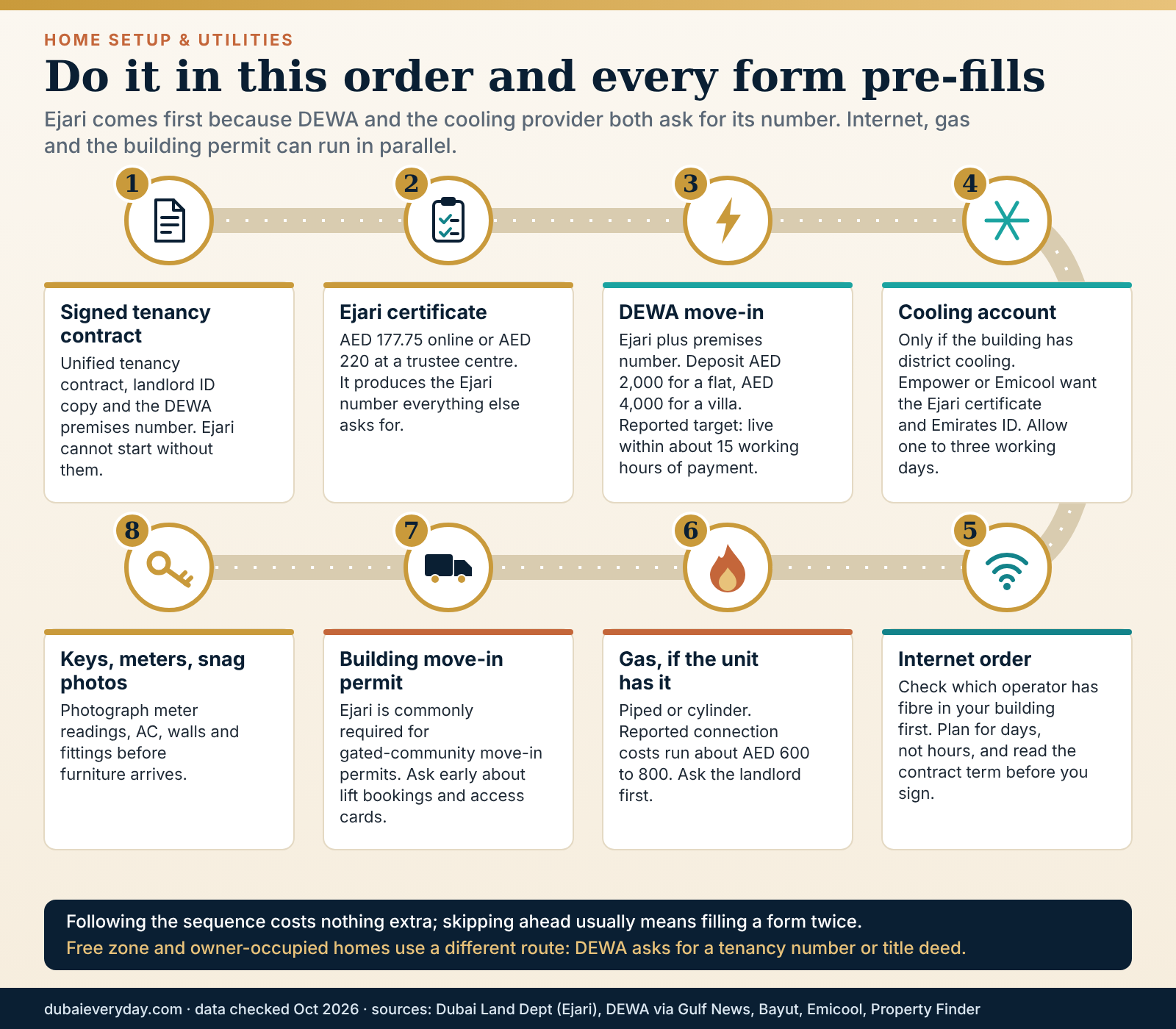
Home setup Dubai hard links: contract, Ejari, DEWA, cooling
The tenancy contract produces the details Ejari needs. Ejari produces the number DEWA asks for. According to a September 2026 Engel & Völkers guide, a tenant outside a free zone who registers the tenancy with Ejari can have the DEWA move-in process started automatically, and dubizzle’s June 2026 guide describes the same integration. In both cases the practical message is identical: get the Ejari certificate first, and DEWA becomes a confirmation screen rather than a form.
District cooling accounts are the third hard link. The Emicool customer FAQ lists an Ejari among the documents for individual tenants, and Property Finder’s January 2026 explainer says the same for Empower. If your building has district cooling and the lease makes you the account holder, the Ejari number gates that account too.
Soft links: internet, gas, building permit
Internet, gas and the building move-in permit do not need the DEWA account number to start, which is why they can run in parallel in a home setup Dubai plan. They do each have their own lead time. Dubizzle’s Ejari explainer (December 2025) notes that Ejari is commonly required for gated-community move-in permits and for telecom connections, so even these soft links often lean on the same certificate.
A useful rule for any home setup Dubai timeline: do the hard links in the first 48 hours after signing, and place the soft orders the same day you have the Ejari certificate in your inbox. That keeps the dependency chain moving instead of queueing behind one slow step.
Realistic home setup Dubai timing from signature to lights on
Our reading of the reported service times gives a home setup Dubai best case of roughly one to two working days from signature to a live DEWA account, assuming the landlord or you can register Ejari promptly. The pieces are these:
- Ejari: the Dubai Land Department page gives about 25 minutes at a trustee centre, excluding queueing; Bayut’s October 2026 guide says a certificate typically arrives within one to two days for other routes.
- DEWA: the September 2026 Engel & Völkers guide quotes activation “within 15 working hours” after the deposit and fees are paid, while another October 2026 guide (uaeinform) says DEWA commits to 24 hours. Plan for a full working day.
- District cooling: Emicool says registration completes within two business days after documents, fees and charges are in place. Property Finder reports one to three working days for Empower.
“Working hours” matters. Apply on a Thursday afternoon and your activation window may run through the weekend. Our practical advice is to treat the weekend as dead time, and to submit before midday on a weekday if you want lights by the evening.
If the landlord or agent says they will “handle Ejari”
Gulf News (January and April 2026) reports that the landlord is legally responsible for making sure the tenancy is registered, while tenants usually pay the fee unless the contract says otherwise; the paper behind that is Dubai Law No. 26 of 2007 as amended by Law No. 33 of 2008. In practice, many landlords delegate the job to the agent or the tenant through a clause in the contract.
That is fine for a home setup Dubai tenants can rely on, provided the handover happens in writing. Ask for the Ejari certificate PDF and the Ejari number by a named date, ahead of the move. A landlord who says “it is being done” with no number a week later is a risk to your DEWA start date and, more importantly, to your standing in any later dispute. Our tenant rights guide explains why a registered contract matters for dispute processes.
Before the keys: paperwork and checks
The cheapest hour of your home setup Dubai timeline is the one you spend before the lease is signed. A few questions asked at the viewing remove most of the surprises later in this guide. Ask them of the landlord or agent, and ask for the answers in writing, even if that is just a message thread you can screenshot.
Home setup Dubai questions to settle before you sign
- Who pays the cooling company each month, and which company is it (Empower, Emicool or another operator), or does each unit have its own AC?
- Does the unit have gas, and if so is it piped from a central system or cylinder-based?
- Which telecom operator has fibre in this building, and is there an active socket in the unit?
- Which appliances come with the unit (oven, hob, fridge, washing machine, water heater), and can you list them in the contract?
- Who registers Ejari, who pays the fee, and by what date will you receive the certificate?
- What does the building charge or require for move-in: permit, lift booking, refundable deposit, access cards?
- Who services the AC and when was it last serviced?
- What is the DEWA premises number, and is the meter registered to the previous tenant or already closed?
The last question deserves a sentence. A DEWA premises number identifies the property rather than you. Bayut’s October 2026 guide lists it as one of the inputs for the Move-in screen, and a June 2026 betterhomes guide says it is usually displayed at the property entrance, so ask for it or look for it when you view.
The home setup Dubai document pack to keep in one folder
A single folder on your phone and a printed copy for the building office will cover almost every request in the first two weeks of a home setup Dubai move. Based on the Dubai Land Department page and the DEWA and cooling guides above, assemble these:
- Your Emirates ID (front and back), and your passport and residence visa copy if the ID is still being issued.
- The signed Unified Tenancy Contract and any addendum.
- The landlord’s passport or Emirates ID copy and the property title deed copy, if the agent can share them.
- The Ejari certificate and number as soon as it exists.
- Your DEWA premises number and, once issued, the DEWA contract account number.
- Receipts for the security deposit, commission and any cheques.
- A mobile number and email address you will keep for the length of the tenancy, because account notices and one-time passwords go there.
New arrivals sometimes ask what to do if the Emirates ID has not arrived yet. For the Ejari route the Dubai Land Department page lists the Emirates ID for trustee-centre registration, and the app route needs a copy of the contract and registered details. Our moving to Dubai guide and the relocation checklist cover the visa and ID sequence; this page assumes you are far enough along to hold a lease.
Where you sleep if the unit is not ready
Leases rarely start the minute your flight lands, so a home setup Dubai newcomers plan should allow for a gap. If the gap between arrival and keys is a few nights, a hotel or serviced apartment is simpler than negotiating an early start with a landlord who has not yet had the unit cleaned.
Our hotel guide helps you choose an area near the new home. If the gap is longer than about two weeks, a monthly-rent furnished unit may cost less overall, though we did not verify monthly-stay prices for this page.
Practical tip. Photograph the DEWA meter, the AC unit’s label and the premises number sticker (where present) at the viewing. Those three pictures answer most of the questions DEWA, the cooling provider and your insurer will ask later in a home setup Dubai move. If you cannot visit before signing, ask the agent to send them.
Ejari: the number every other step asks for
Ejari is Dubai’s tenancy registration system, run through the Dubai Land Department and its Real Estate Regulatory Agency. Registering a lease gives you an e-Contract Registration Certificate and an Ejari number. Every later step in a home setup Dubai tenants complete, from DEWA to the building permit, treats that number as proof that the lease exists and that the landlord and tenant are who they say they are.
Why Ejari comes first in a home setup Dubai
Gulf News’ January 2026 explainer lists the uses: activating essential services such as DEWA, filing rental disputes, completing many residency-related procedures, and having the contract recognised by government authorities. Dubizzle’s December 2025 guide adds telecom connections and gated-community move-in permits, and says a tenancy without Ejari may lack access to the rental dispute process.
Read that last point as the real reason to care about Ejari in a home setup Dubai. A flat with working lights but an unregistered lease is a flat where your rights in a deposit dispute are harder to assert. Our legal basics page for residents explains where tenancy rules are published and how to verify them.
What Ejari costs in a home setup Dubai budget
The Dubai Land Department’s own service page gives two totals. Through the Dubai REST app or the department’s website the fee is AED 177.75: AED 100 registration, AED 10 knowledge fee, AED 10 innovation fee, and a service partner fee of AED 55 plus AED 2.75 VAT. Through a Real Estate Trustee Center the page states AED 220 in total, with service partner fees of AED 95 plus VAT.
Other guides quote slightly different figures. Gulf News’ January 2026 piece says around AED 155 before additional service fees for the app, and a Bayut explainer lists AED 120 for the app and AED 215 plus VAT at a centre. Those figures omit service-partner charges or count them differently. We use the Dubai Land Department totals because they are the primary source, and we label the AED 177.75 to AED 220 range as “checked 29 October 2026”.
Who pays
Gulf News’ April 2026 answer cites Article 22 of Dubai Law No. 26 of 2007 (as amended by Law No. 33 of 2008), which places government fees related to using the property on the tenant unless the parties agree otherwise. The same article notes that the landlord is responsible for ensuring the contract is registered. The two statements fit together: the landlord must make sure it happens, and the tenant usually pays the bill. If your contract says otherwise, the contract governs.
In a home setup Dubai budget the fee is small enough that arguing is rarely worth it. What is worth arguing about is timing. Put the date by which the Ejari certificate will be delivered into the contract or the message thread.
The two routes: app or trustee centre
The Dubai Land Department page lists channels as the Ejari website, the Dubai REST app, Real Estate Trustee Centers and Dubai Now. The eligibility rules differ by channel. The app route requires both tenant and landlord to be individuals with up-to-date owner data; the trustee route requires the original Unified Tenancy Contract, the applicant’s Emirates ID and, for a representative, an official power of attorney. A Dubai-issued power of attorney needs only its number; one issued in another emirate must be attached.
- Collect the contract and IDsSigned Unified Tenancy Contract, your Emirates ID and the landlord’s details. For the app route you need a copy of the contract; for a trustee centre you need the original.
- Choose the channelThe app is cheaper at AED 177.75 and works when both parties are individuals. A trustee centre costs AED 220 but suits corporate landlords, shared meters or properties managed by a company without Ejari access.
- Submit and payEnter the data, upload documents if the app asks, and pay by card, cash or Noqodi wallet, the payment methods listed by the department.
- Wait for approvalAn employee reviews the request in the system. The app route also needs landlord approval, according to dubizzle’s walkthrough.
- Save the certificateThe e-Contract Registration Certificate arrives by email. Store the PDF and the Ejari number in your document folder and send both to the DEWA step.
For home setup Dubai planning, the department gives about 25 minutes for a trustee-centre transaction, excluding waiting time, and does not give a timing for the online channels. Bayut says certificates typically issue within one to two days. We therefore plan for a day, and are pleasantly surprised if it takes an hour.
Three checks before you accept the certificate
Before you move on in your home setup Dubai sequence, open the certificate and compare it line by line with the signed contract. Three fields cause most of the trouble later.
First, the annual rent. Bayut’s guide on the Dubai Municipality housing fee says the tenant’s fee is 5% of the annual rent stated in the Ejari registration. If the Ejari rent is typed higher than the contract rent, your housing fee is higher every month.
Second, the contract start and end dates, because DEWA and the district cooling company read tenancy dates from the same record. Third, the unit and building identifiers (premises number or municipality number), because the Dubai Land Department says certificates are downloaded using your registered mobile number plus the DEWA premises number or municipality number.
If something is wrong, ask for a correction immediately. The same Bayut guide says amended rent or property details have to be updated with the relevant authority, and any overcharge on the housing fee is credited back through DEWA. That is a process you want to avoid by getting the numbers right at the start.
One registration per property. Bayut’s October 2026 explainer states that only one registration can exist per property, so a new tenant cannot register until the previous contract has been cancelled. If your Ejari application bounces for “existing contract” reasons, the previous tenant or landlord has probably not cancelled. Ask the landlord to cancel it. Dubizzle says cancellation is free online and about AED 40 in person.
Free zones, owners and companies
Not every home setup Dubai route needs Ejari. Bayut’s DEWA walkthrough says tenants in free zones that are exempt from Ejari choose “I don’t have Ejari” on the DEWA screen and instead supply the tenancy contract number, the start and end dates, the contract value, the number of rooms and the premises numbers. Owners skip Ejari altogether and use the title deed. If you are an investor or an owner-occupier, the route is the property side of this guide plus our freehold property guide.
Renewal and the annual home setup Dubai rhythm
Dubizzle’s guide says the renewal fee matches the registration fee, and Gulf News says the contract must be re-registered each time the tenancy is renewed, and updated when rent, tenant name or property details change. Put the Ejari expiry date in your calendar alongside the lease end. Letting the registration lapse while the tenancy continues is the kind of low-grade administrative risk that shows up exactly when you need a document, for example at a visa renewal or a deposit dispute.
DEWA move-in: deposit, activation and timing
The Dubai Electricity and Water Authority supplies electricity and water to most homes in the emirate, and its Move-in service is what turns a registered lease into a live meter. This section gives the shape of the DEWA step in a home setup Dubai, the reported fees and the points where people lose a day. The transaction-level detail, including owner-versus-tenant differences, sits in the dedicated DEWA move-in guide.
Three ways to apply
Which route you take in your home setup Dubai depends on your status and your patience. In a September 2026 explainer, Engel & Völkers says tenants outside free zones who register Ejari can find the DEWA Move-in process starting automatically from that registration, with tenancy data pre-filled. Dubizzle’s June 2026 article describes the same integration and adds that no separate activation application is needed for those tenants.
If the automatic start does not appear, the second route is to apply yourself on the DEWA website or smart app. Bayut’s October 2026 guide describes the steps: choose Activation of Electricity and Water (Move-in), pick your customer type (expatriate, GCC national, investor or UAE national) and account type (owner or tenant), then enter your Ejari number and the DEWA premises number. The third route is in person at a Customer Happiness Centre, which suits people who prefer a counter to a screen.
What DEWA asks for
Tenants outside free zones with a valid Ejari number generally do not need to upload extra documents, because the system pre-fills the details, according to the Engel & Völkers guide. A Bayut guide lists the Emirates ID for Dubai residents and notes that logging in with a DEWA ID or UAE Pass is part of the usual flow. Free-zone tenants and owners need more: tenancy contract details or a title deed respectively.
Keep your phone nearby. DEWA sends the contract account number and the security deposit amount by email and text once the application is processed, and one-time passwords go to the same address and number.
Home setup Dubai deposit and activation fees
Every home setup Dubai guide we read agrees on the deposit: AED 2,000 for an apartment and AED 4,000 for a villa, refundable when the account closes and bills are settled. Gulf News’ October 2026 cost list says exactly that, and Bayut, dubizzle and Engel & Völkers repeat it. We could not load DEWA’s own page, so we describe it as “reported”, but the agreement across sources is strong.
The activation fee is where sources diverge. Bayut (October 2026) gives AED 100 for small meters, AED 300 for large meters, plus AED 10 each for registration, knowledge and innovation fees. Engel & Völkers and dubizzle (both 2026) give AED 125 for small meters with the same three AED 10 items. Gulf News (October 2026) says about AED 130 for smaller connections.
Our reading: the all-in total for a normal apartment meter is between AED 130 and AED 155, depends on which base fee is current, and the DEWA checkout screen is the only authoritative figure. Thukher and Sanad cardholders, who are UAE nationals, get a 50% discount on activation charges according to Bayut and dubizzle.
No legitimate home setup Dubai shortcut involves cash to an intermediary. Deposits and activation fees are paid to DEWA through its website, app or Customer Happiness Centres. Do not hand cash for “DEWA activation” to an agent, building staffer or stranger who promises to speed it up. If a landlord wants to reimburse you for a deposit paid under the previous tenancy, do that between yourselves, separately from the DEWA transaction.
How long DEWA activation takes in a home setup Dubai
Engel & Völkers and dubizzle both quote activation “within 15 working hours” after the deposit and fees are paid, assuming the details are complete and correct. Uaeinform’s October 2026 guide says DEWA commits to 24 hours and that same-day activation is common for morning applications. Those two statements are compatible if you read “working hours” strictly: pay at 9:00 on a Monday and you should be live that afternoon or the next morning; pay at 16:00 on a Thursday and the window runs into the following week.
Errors, incomplete details or unpaid balances on the premises can delay activation, according to Engel & Völkers. The single most common cause we would expect, based on the dependency chain, is an Ejari record that has not yet synced or has the wrong premises number. If the status stays on processing, do not submit a second application; contact DEWA with your reference number.
If the power does not come on
Work through four checks before you phone anyone about a stalled home setup Dubai activation. Confirm in the DEWA app or email that you have a contract account number. Confirm that the premises number on the account matches the one at the property. Check the distribution board inside the unit, because breakers left off by the previous occupant look identical to a failed activation. Then, if the account is active and the breakers are on, contact DEWA.
The numbers to keep: DEWA’s customer care line is 04 601 9999 according to the Dubai Media Office notice, and a June 2026 betterhomes guide lists the same line for billing and general enquiries around the clock, with 991 reserved for urgent electricity or water technical issues. Check both on DEWA’s site if the line matters to you, because we could not open it.
Moving between homes in Dubai
If you already have a DEWA account and are changing address within the emirate, use Move-to rather than closing one account and opening another. Bayut’s guide says you log in with DEWA ID or UAE Pass, enter the new Ejari and premises numbers, your current contract account number and your move-out date.
Your existing deposit transfers to the new address, and you pay only the difference if the new home needs a larger one, for example AED 2,000 more when you go from an apartment to a villa. Supply at the old address is deactivated on the move-out date you give. That detail matters; choose it carefully, because you pay for what runs on your meter until then.
The small tasks that follow activation
Within a day of activation, do four things to close this stage of the home setup Dubai. Save the contract account number where you will find it in a year. Photograph the meter reading if the meter is accessible, which gives you an opening figure for bill queries.
Install the DEWA app or bookmark the website and link it to UAE Pass if you use it. And set up automatic payment or reminders, because an unpaid bill on a connected account is more expensive to fix than to prevent. The DEWA move-in guide goes through payment channels and the first bill in more detail.
Reading the DEWA bill: tariffs and worked examples
In a home setup Dubai, a DEWA bill is easier to predict than it looks, because the structure is simple and the one genuinely large fixed element is not DEWA’s at all. This section rebuilds a bill from the published tariff so you can sanity-check your first one. Treat the worked numbers as our calculation, built on assumed consumption, not as DEWA data.
The ingredients of a home setup Dubai electricity and water bill
Executive Council Resolution No. 16 of 2011, which we read on the Dubai Legal Portal, sets residential electricity at 23 to 38 fils per kWh by monthly usage slab and residential water at 3.5 to 4.6 fils per imperial gallon, and lets DEWA add a monthly fuel surcharge set by its chief executive.
Newer guides give the slab limits: Property Finder’s February 2026 calculator article lists 23 fils up to 2,000 kWh, 28 fils from 2,001 to 4,000, 32 fils from 4,001 to 6,000 and 38 fils above 6,000.
Water changed units. The Dubai Media Office reported that DEWA moved to cubic metres from the March 2025 billing cycle, with no meter replacement needed. Property Finder (February 2026) lists residential water at AED 7.70 per m³ up to 27 m³, AED 8.80 from 27 to 54 m³ and AED 10.12 above that. Our arithmetic checks out against the old gallon rates: one cubic metre is about 220 imperial gallons, and 3.5 fils times 220 is AED 7.70.
- Electricity and water on the slabs above.
- A fuel surcharge. Sources put the electricity surcharge at about 6 fils per kWh; it changes periodically, so check your bill.
- Sewerage and meter-related charges, which vary and which we could not price from a primary source.
- VAT at 5% on the bill, according to dubizzle’s DEWA bill explainer.
- The Dubai Municipality housing fee, which is 5% of your annual Ejari rent, collected in twelve monthly instalments on the same bill (Bayut). UAE nationals are exempt.
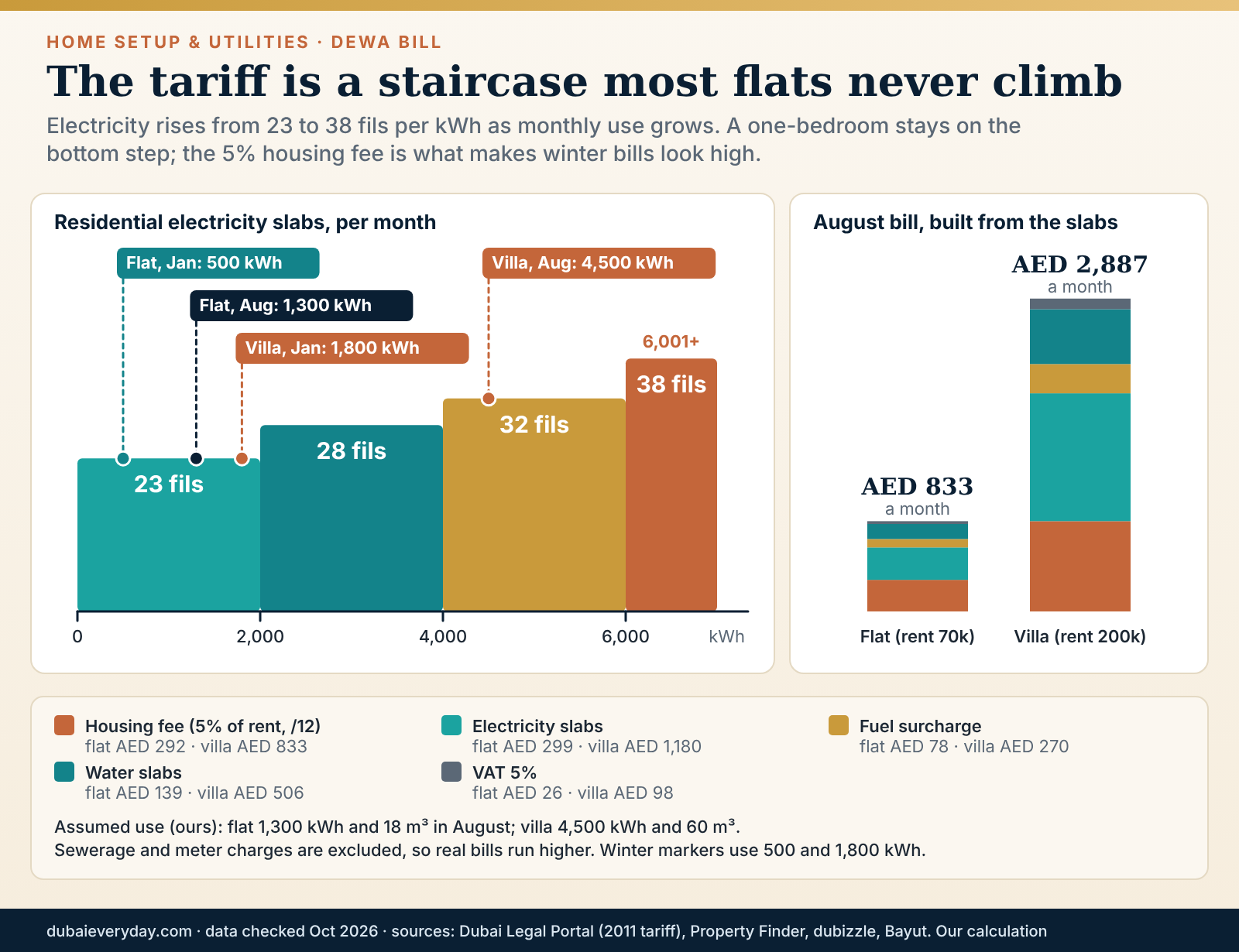
Home setup Dubai bill examples (our calculation)
We built four monthly bills for a home setup Dubai tenants might run, using the rates above. The consumption figures are assumptions chosen to show the shape of the tariff; yours will differ with floor area, occupancy, orientation and how cold you like the bedroom. Rents are the same samples used in the budget section: AED 70,000 a year for the flat and AED 200,000 for the villa. VAT is applied to electricity, surcharge and water only.
| Scenario (assumed use) | Electricity + surcharge | Water | VAT 5% | Housing fee | Total a month |
|---|---|---|---|---|---|
| Flat, January (500 kWh, 15 m³) | AED 145 | AED 116 | AED 13 | AED 292 | about AED 565 |
| Flat, August (1,300 kWh, 18 m³) | AED 377 | AED 139 | AED 26 | AED 292 | about AED 833 |
| Villa, January (1,800 kWh, 40 m³) | AED 522 | AED 322 | AED 42 | AED 833 | about AED 1,720 |
| Villa, August (4,500 kWh, 60 m³) | AED 1,450 | AED 506 | AED 98 | AED 833 | about AED 2,887 |
What the arithmetic tells you
Three things stand out for any home setup Dubai budget. First, a one-bedroom flat never leaves the bottom step. Even at 1,300 kWh in August, every unit is charged at 23 fils, so electricity plus surcharge averages about 29 fils per kWh. A villa at 4,500 kWh reaches the 32 fils slab and averages about 32 fils per kWh including the surcharge. The tariff is progressive, but only large homes feel it.
Second, the housing fee dominates winter bills for renters. On our flat example it is about 52% of the January total and 35% of the August total. When a new tenant says their January bill “is high for a flat that uses almost nothing”, the answer is usually this fee, not the meter.
Third, the seasons move the variable part a lot. Our flat’s electricity and surcharge line rises from AED 145 in January to AED 377 in August, about 2.6 times. The villa’s variable cost, meaning everything except the housing fee, rises from about AED 890 to about AED 2,050. Plan the year as a curve, not a number. The cost of living guide shows how to fit those swings into a monthly budget.
How to check your own first bill in a home setup Dubai
- Find the consumptionRead kWh and m³ for the period from the bill or DEWA’s app. Billing periods may not match calendar months.
- Apply the slabsMultiply each band of consumption by its rate. For electricity, only the kWh above 2,000 move to 28 fils.
- Add the surcharge and VATUse the surcharge printed on the bill, then 5% VAT on the charges it applies to.
- Check the housing feeMultiply the Ejari annual rent by 5% and divide by twelve. If the instalment is larger, your Ejari rent or the municipality’s record may be wrong.
- Look for what you cannot explainSewerage, meter charges and any deposit lines are the usual unexplained items. Ask DEWA what they are rather than guessing.
When the housing fee looks wrong
Bayut’s housing fee explainer says that if rent or the recorded rental value changes you must update details with Dubai Municipality, that an overcharge is refunded as DEWA credit, and that people overcharged under earlier calculations could apply through a refund portal at refundfees.dm.gov.ae. We could not verify the portal’s current status, so treat it as a pointer rather than a promise.
The sensible first step in a home setup Dubai bill query is mundane: compare the Ejari rent with the amount used on the bill. If they match and the fee is still wrong, raise it with Dubai Municipality or DEWA with the Ejari certificate and the bill. Keep the answer in writing. Our tenant rights page points to the official routes for disputes.
Budget rule of thumb. For a rented flat, plan DEWA in your home setup Dubai budget as two separate numbers: the housing fee (rent times 5%, divided by twelve) and a variable part that swings with the season. In our two flat examples the variable part is about AED 270 in January and AED 540 in August. Fix the first number, and review the second after your first full summer.
Cooling: chiller-free, district cooling and the AC bill
Cooling is the largest variable in any home setup Dubai households budget for, and the part most likely to be misunderstood at the viewing. The reason is simple geography. Dubai Meteorological Office figures, as tabulated on Wikipedia’s climate page, give a mean daily maximum of 42.1°C in August and a mean daily minimum of 30.4°C. In July the mean minimum is 30.0°C. At night the air barely cools. In January the mean range is 14.3°C to 24.0°C, and the unit’s cooling system is close to irrelevant.
Our reading of those monthly figures is that cooling is a four-month load (June to September, when the mean maximum is between 39.5°C and 42.1°C) with long shoulders either side. A tenancy signed in November has its worst cooling months nearest the renewal date, which is worth remembering when you estimate yearly costs.
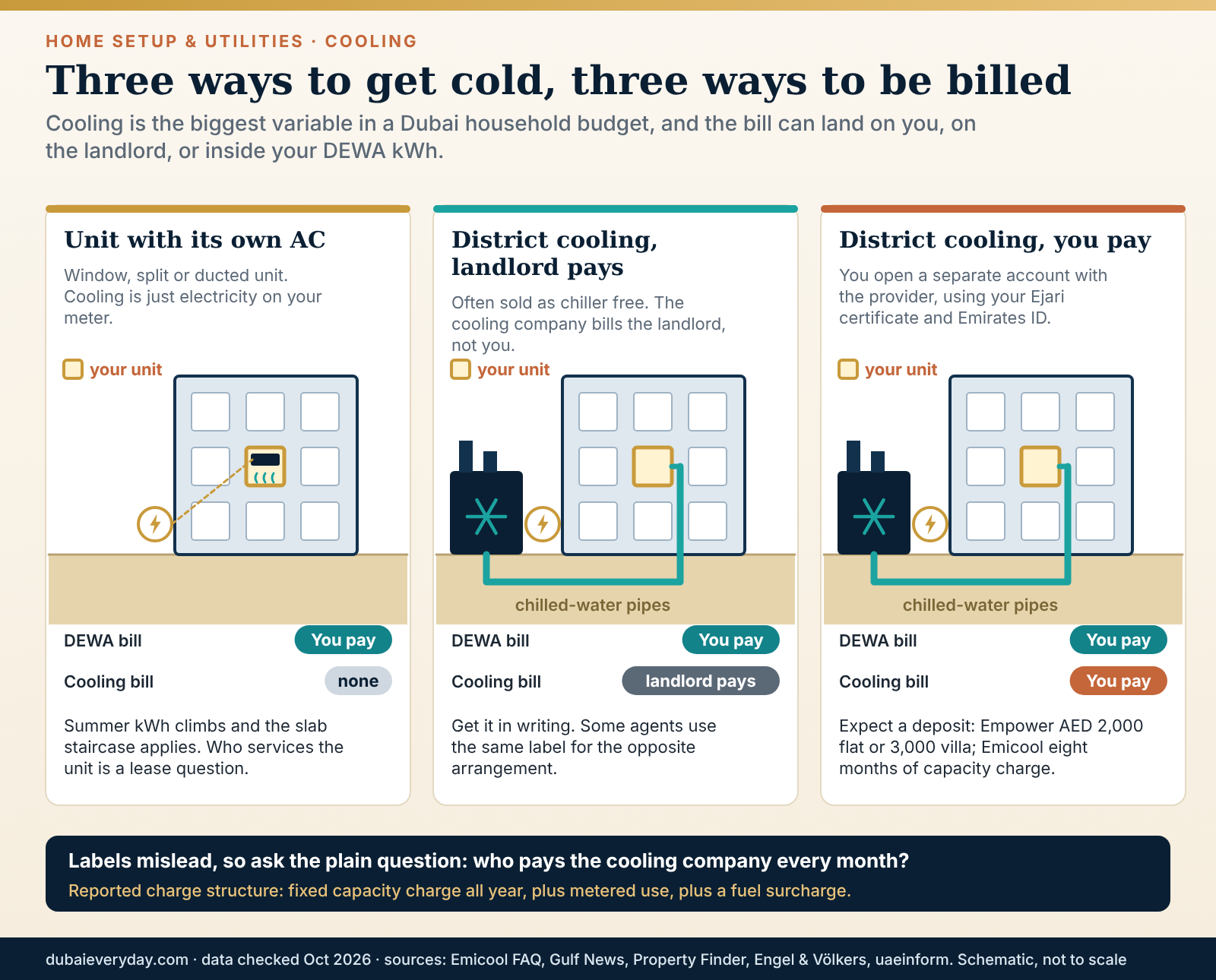
The three arrangements in a home setup Dubai
In nearly every home setup Dubai residents compare, the cooling falls into one of three groups. The first has its own air conditioning, whether split units, window units or ducted equipment, and the cost is simply electricity on your DEWA meter. The second and third sit in buildings or communities served by district cooling, where a central plant chills water and pipes it to each building. The difference between them is who holds the account with the cooling provider.
Gulf News’ 2021 chiller explainer describes district cooling as cold water produced in a central plant and piped underground around the district, typically serving high-rise buildings. It is also referred to as a chiller service, which is where the confusing vocabulary starts.
The terminology trap
Agents use “chiller free” and “chiller included” loosely, and published guides contradict one another. Gulf News (2021) describes a chiller-free arrangement as one where the property management company covers the monthly chiller cost, so the tenant pays only DEWA. A March 2026 betterhomes guide uses the terms the other way round: it says chiller-free means you pay a district cooling company such as Empower directly, and chiller-inclusive means the landlord pays. Both guides are describing real arrangements. They disagree about which label belongs to which.
We would not try to settle the dictionary. The fix, in any home setup Dubai negotiation, is a plain-language question put in writing before you sign: “Who pays the cooling company every month, and what is the provider’s name?” A written answer removes the label from the equation.
What a district cooling bill is made of
The Emicool customer FAQ, which is the most complete operator-level source we could read, describes four recurring items. A contracted capacity charge is an annual fee based on the refrigeration tons (TR) contracted for your unit times a fixed rate, billed in 12 monthly instalments whether or not you use cooling. A chilled water consumption charge is billed per refrigeration ton-hour from metered use. A monthly fuel surcharge follows DEWA’s published tariff. A metering charge is a fixed monthly fee per meter.
Invoices are generated on the first of the month and are due within 15 days, with a AED 100 late fee, according to the same FAQ. If a meter fails, Emicool may estimate charges using the same month’s consumption from the previous year for up to two billing cycles. That estimation rule is one to keep in mind if a summer bill looks oddly flat.
For Empower, we relied on secondary sources, which agree broadly with one another. Gulf News (July 2024) reports a demand charge of AED 750 per refrigeration ton per year, billed monthly, and meter maintenance of AED 50 quarterly or AED 30 monthly depending on location.
Property Finder (January 2026) lists a consumption rate of 0.568 per refrigeration-ton hour, a fixed 15% fuel surcharge, and one-off charges of AED 2,000 connection and AED 1,000 administration plus 5% VAT. Gulf News adds that connection and administration fees may fall on the owner or the tenant depending on the arrangement. Gulf News prints the consumption rate in fils per ton-hour, while Property Finder and betterhomes print dirhams, so confirm the unit with Empower before relying on it.
Unit ambiguity. The Empower consumption rate appears as “0.568 fils” in one source and 0.568 dirhams in another. If it were fils, the consumption part would be tiny and the AED 750 capacity charge would dominate every bill. We use 0.568 dirhams per ton-hour in the arithmetic below because that reading is consistent with the other figures reported, and we flag it as an assumption to verify.
Our calculation: what the fixed charge means for a home setup Dubai budget
Take the reported AED 750 per refrigeration ton per year. Divided over twelve months that is AED 62.50 per ton per month, owed whether or not you switch the AC on. At AED 0.568 per ton-hour, running one ton flat out for a full day costs 24 times 0.568, or AED 13.63. The annual fixed charge equals about 1,320 ton-hours of consumption (750 divided by 0.568), which is roughly 55 days of continuous full load.
That ratio explains, for a home setup Dubai budget, why cooling bills in winter are not zero, and why the summer bill is not an infinite multiple of the winter one. A unit contracted at 3 tons carries about AED 187.50 a month in capacity charge before it cools anything. Whether 3 tons is right for your flat is a number on your contract, which is the figure to ask for.
Betterhomes’ March 2026 illustration puts the average monthly district cooling bill at about AED 900, and AED 1,000 to 1,500 at the summer peak in areas such as Dubai Marina or Downtown Dubai. That is a single brokerage’s example, not a tariff, but it sets the order of magnitude: about AED 10,800 a year.
Comparing a landlord-pays flat with a tenant-pays flat
If two similar units are on the market and one has the landlord paying the cooling company, the rent premium for it is only worth paying if it is smaller than your expected yearly cooling bill. Using the betterhomes example of AED 900 a month, you would be better off up to a premium of AED 10,800 a year. At a premium of AED 5,000 you come out ahead by roughly AED 5,800; at AED 12,000 you lose about AED 1,200.
Two caveats for any home setup Dubai comparison. The district cooling bill is yours alone, so a household that is out for much of the day will pay less than the average. And the comparison ignores deposits: the landlord-pays flat also saves you the cooling deposit, which we cover next.
Home setup Dubai cooling deposits, activation and registration
The tenant-side deposit differs by provider. Gulf News (July 2024) reports Empower’s refundable deposit at AED 2,000 for a flat and AED 3,000 for a villa, and a uaeinform guide updated in October 2026 repeats those figures.
Emicool’s FAQ states the deposit equals eight months of the unit’s contracted capacity charge and the activation fee is a one-off AED 200. On our 3-ton example at the Empower rate, eight months of capacity charge is eight times AED 187.50, or AED 1,500, which shows why the Emicool deposit is unit-specific.
Documents follow the Ejari. Emicool lists an Ejari, passport and Emirates ID copies, mobile number, email and an updated IBAN for individual tenants, and says registration completes within two business days once documents, fees and charges are in place. Property Finder’s Empower guide lists the Emirates ID front and back, the visa copy, the Ejari certificate and the tenancy contract, with accounts usually activating within one to three working days. Registration is not complete until outstanding balances on active accounts in your name are cleared, it adds.
Timing your home setup Dubai around the weather
Do not leave the cooling account of your home setup Dubai to the weekend you move in. Open it as soon as you have the Ejari certificate. If you are moving between June and September, assume that every hour without chilled water is a visible loss of sleep, and ask the building management whether the riser and meter are already live. The apartment rental guide covers what to check on viewing day, including the chiller question.
Your own AC: service and responsibility
When the unit has its own air conditioning, the lease should say who services it and how often, because a neglected unit costs you in the DEWA bill and in comfort. Ask for the date of the last service, request that filters are cleaned before you move in, and keep a record.
Do not assume that maintenance is the landlord’s job or the tenant’s; it depends on the contract. For villas, which often have several units and larger compressors, the question matters more, and our villa rental guide goes into it.
Closing a cooling account when you leave
Plan the exit of your home setup Dubai at the start, because the closing steps differ by provider. Gulf News (July 2024) describes Empower’s process as a settlement request on its e-services portal, a final bill within two working days, and a deposit refund by appointment, with refunds above AED 5,000 paid by cheque.
For Emicool it lists a cancellation form signed by landlord and tenant, a final bill within three working days deducted from the deposit, and the balance refunded within five days. Those are 2024 descriptions; confirm the current process with the provider when you give notice.
Gas: piped, cylinder or none
Gas is the optional utility in a home setup Dubai residents sometimes forget until the first attempt to cook. Many apartments cook on electric hobs and need no gas account. Others, especially in certain towers and villa communities, have piped gas or use cylinders. Whether your home setup Dubai includes it is a fact about the building, so it belongs on the pre-signing question list.
The three gas situations in a home setup Dubai
- No gas. The kitchen uses an electric or induction hob and oven. There is nothing to connect, and nothing to deposit.
- Piped central gas. The building or community supplies gas to each unit through a metered line. You open an account with the supplier, and a connection or transfer fee, plus a deposit, may apply.
- Cylinder-based. You buy or exchange cylinders and the cost structure is different from a metered account.
Gulf News’ October 2026 cost list gives a single figure for the middle case: AED 600 to 800 for a new gas connection or transfer in apartments and villas, with a note that cylinder-based arrangements may cost differently and that a deposit may apply for central gas.
A property-services page from Metropolitan Real Estate puts an estimated deposit at AED 1,000 and an activation fee at about AED 500, both varying by provider and excluding VAT. Those do not match, which is the usual outcome when the supplier differs.
Our reading of the gas cost in a home setup Dubai
Putting the two sources together, a piped gas connection plausibly lands between AED 600 and AED 1,500 once a deposit is included, although we could not verify any supplier’s current price list and we are not naming a provider. The sensible approach is to ask your building management who supplies gas and what the account opening requires. Then ask the supplier for the deposit amount and the refund conditions in writing.
If the unit has electric appliances only and you cook a lot, converting is not something to improvise. Appliances are built for a particular fuel and pressure, so a hob designed for one gas type cannot simply be attached to another, and any new connection should be made by a qualified installer through the supplier or the building. That is general safety logic, not a regulation we cite, and the right person to confirm it is the supplier.
Should your home setup Dubai include gas?
If your cooking is a kettle, a microwave and occasional pasta, an electric hob avoids a connection fee, a deposit and an account to close later. If you cook at high heat several times a week, a wok burner, a large pot, or a tandoor-style routine, gas gives a response that most electric hobs do not. The budget difference is small compared with rent, so choose on cooking style and on what the unit already has.
For families, think about who is at home during cooking and whether children or older relatives share the kitchen. Our family logistics guide and the guide to Dubai with a baby cover household routines that overlap with kitchen safety.
Gas safety basics. Do not move, reconnect or modify a gas hose, regulator or valve yourself. If you smell gas, open windows, avoid switching electrical devices on or off, leave the unit and contact the gas supplier’s emergency line and building security. Ask management for that number on day one and save it. We did not verify specific cylinder rules for apartments or the current emergency numbers for each supplier, so confirm both locally.
Questions to ask the supplier or building
- Who supplies gas to this building, and is the unit connected now or does it need a new connection?
- What are the connection or transfer fee, the deposit and the monthly billing method?
- Is the existing hob suitable for the gas type supplied?
- When was the installation last inspected, and who is responsible for maintenance inside the unit?
- How do I close the account when I leave, and how is the deposit refunded?
Internet and the phone line
Home internet is the one utility in a home setup Dubai where you do not choose first. The building chooses for you. A uaeinform guide updated in October 2026 says that in most buildings only one of the two main operators has fibre, so you check coverage by address before you compare plans. The two operators are du and e& (formerly Etisalat); one of the guides we read still uses both names, so expect to see either on listings.
This home setup Dubai page gives the setup logic only. The comparison of speeds, contract terms, installation and troubleshooting is the job of Home Internet in Dubai and the broader internet, mobile and digital life guide, and we avoid duplicating either.
Home setup Dubai internet steps before the keys
- Ask which operator is liveAsk the agent or building management which operator has fibre in this building. If both do, then you can compare; if only one does, the choice is made.
- Check the socketAt the viewing, look for the fibre terminal and the position of the socket relative to where you will work. A router in a cupboard at the far end of the flat solves nothing.
- Prepare ID and tenancy detailsUaeinform says you need your Emirates ID and tenancy details. Having the Ejari certificate ready is the practical translation.
- Read the contract term and feesGulf News (October 2026) notes that internet and TV set-up may include installation, activation, equipment or early termination fees. Ask what the minimum term is before you accept it.
- Book the install for the day after keysIf the provider allows booking before you hold the keys, choose a date at least a day after collecting them. We did not verify whether installation can be scheduled before the lease starts.
How long it takes
Uaeinform says apartments in connected buildings are usually installed within two to five working days, while villas needing a new fibre run can take considerably longer. A 2021 Gulf News piece on moving utilities puts telephone and internet setup at a few days to a week depending on the provider, and suggests a temporary mobile data package for urgent needs.
Our reading for a home setup Dubai: plan for a week from the order to a working router, and plan your first week of video calls on a phone hotspot.
What it costs
The same uaeinform guide says entry-level fibre plans commonly start around AED 300 to 360 a month, and a Metropolitan Real Estate page estimates a provider deposit of about AED 200, varying by provider. Neither is a price list, so treat them as ranges to test against the operator’s own site. The monthly budget for one person shows where a fibre line sits in the wider picture.
Work-from-home checks after install
When the technician leaves, test before you let them go. Run a speed test next to the router and in the room where you will work. Confirm Wi-Fi coverage reaches the bedroom. Note the support number and your account number. If you work remotely, keep your phone’s mobile plan as a backup for the first month, because the first fault tends to arrive at an inconvenient moment.
Do this the day you get the Ejari certificate. Send the internet order request, the cooling-account registration and the building permit request in the same hour. Each one needs the certificate, and none depends on the others. Done together, you remove two days of idle waiting from the home setup Dubai timeline.
What a home setup Dubai budget really looks like
The advertised rent is the least informative number in a home setup Dubai. Before a Dubai tenant sleeps in a new flat, a stack of smaller payments goes out: some refundable, some not, some paid to government, some to private parties. This section assembles them for one concrete example so that you can see the shape, then shows how to scale it.
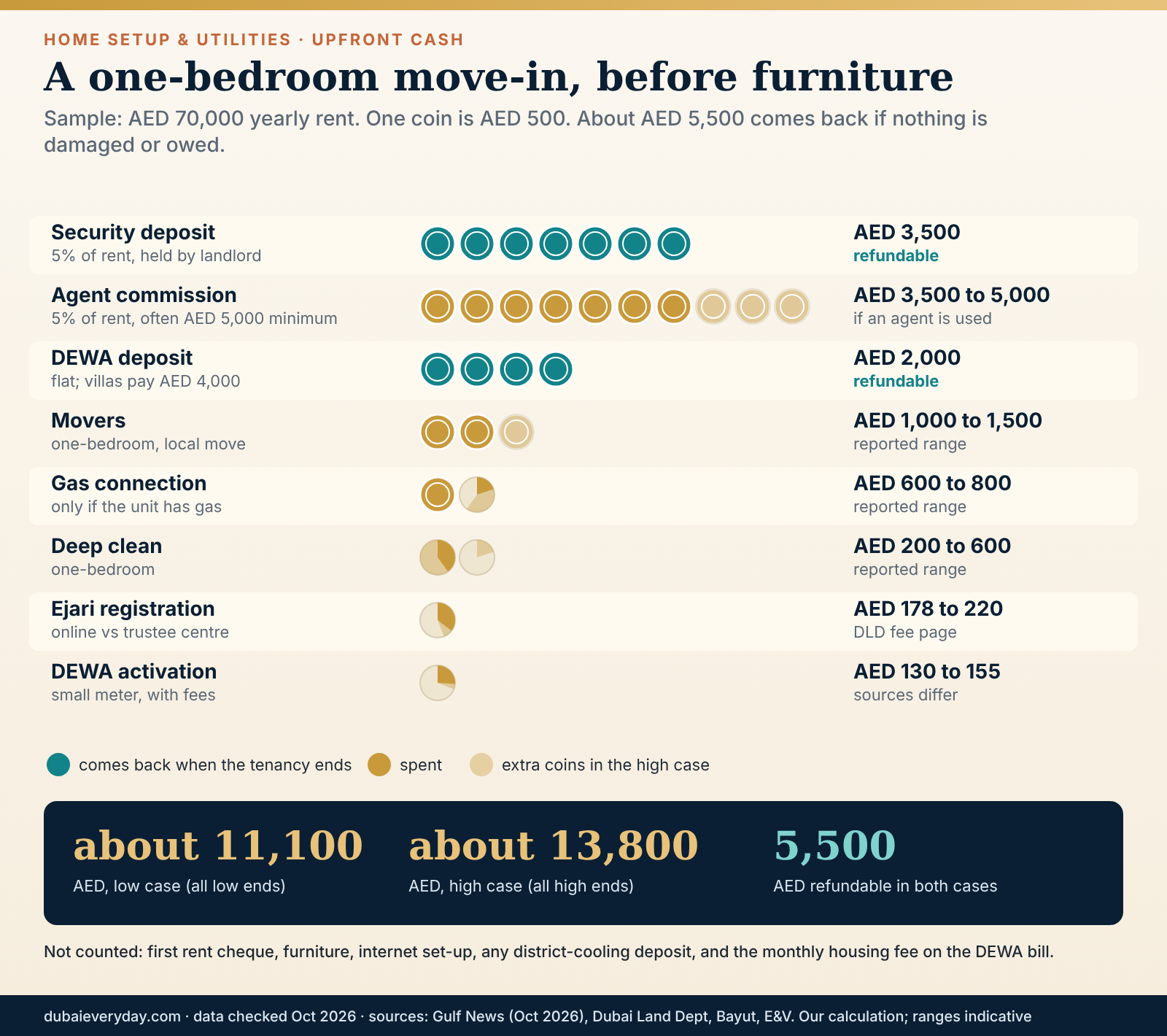
The home setup Dubai sample: a one-bedroom at AED 70,000 a year
We chose AED 70,000 because it makes the percentage-based items easy to check. The list below uses the Gulf News October 2026 cost article for deposit, commission, movers, cleaning and gas, the Dubai Land Department for Ejari, and the DEWA figures reported earlier.
- Landlord’s security deposit: 5% of annual rent for unfurnished units, 10% for furnished, so AED 3,500 here. Refundable if you meet the contract terms.
- Agent commission: about 5% of annual rent, often with a minimum of AED 5,000, and negotiable, according to Gulf News. AED 3,500 to AED 5,000 in our sample, if an agent is involved.
- Ejari: AED 177.75 online or AED 220 at a trustee centre.
- DEWA deposit: AED 2,000 for an apartment, refundable.
- DEWA activation: about AED 130 to AED 155 with the small registration fees.
- Gas connection, if applicable: AED 600 to AED 800.
- Movers: AED 1,000 to AED 1,500 for a one-bedroom.
- Deep clean: AED 200 to AED 600 for a one-bedroom.
Adding the low ends gives about AED 11,100, and the high ends about AED 13,800. Of that, AED 5,500 is refundable if nothing goes wrong: AED 3,500 security deposit plus AED 2,000 DEWA deposit. Our reading is that between 40% and 50% of the one-off cash comes back at the end of the tenancy, and the rest is gone the moment you pay it.
What the home setup Dubai picture leaves out
The pictogram is for the home setup Dubai items only. It does not include the first rent cheque or cheques, which depend on how the landlord wants payment. It does not include furniture or appliances.
It does not include an internet deposit or installation fee, any district cooling deposit (Empower reports AED 2,000 for a flat; Emicool’s is eight months of capacity charge), or the monthly housing fee on the DEWA bill. And it does not include a building move-in permit, which Gulf News says may be free or may involve administrative charges or refundable deposits, without giving amounts.
If your unit uses district cooling and you are the account holder, add the deposit and activation to the list. On the Empower figure that is a further AED 2,000, and on the Emicool figure the AED 200 activation plus an eight-month deposit that depends on your contracted capacity.
When the home setup Dubai payments fall due
The cash does not leave your account at once. Most of the weight lands in the first days.
- On signingSecurity deposit, commission and the first rent payment. These go to the landlord and agent, usually through bank transfer or cheques.
- Within two daysEjari fee, DEWA deposit and activation, and any cooling account deposit. Paid to government and utility channels, not to the landlord.
- Move-in weekMovers, deep clean, gas connection, building permit charges if any, and internet installation or deposit.
- Month one onwardsThe first DEWA bill with housing fee instalments, the cooling bill if you hold the account, and internet.
Scaling the home setup Dubai sample
Two items scale with rent: the security deposit and the agent commission. Everything else is mostly fixed or scales with the size of the move. A two-bedroom at AED 120,000 a year gives AED 6,000 for the deposit and AED 6,000 for commission at 5%.
Add Ejari at AED 177.75 to AED 220, DEWA at AED 2,000 plus AED 130 to AED 155, movers at AED 2,000 to AED 3,000, and gas at AED 600 to AED 800. The total is about AED 16,900 to AED 18,200, excluding cleaning because we have no verified two-bedroom range.
Furnished units change the arithmetic in an unexpected way. With a 10% deposit instead of 5%, a furnished flat at AED 70,000 locks up AED 7,000 instead of AED 3,500, an extra AED 3,500 of your cash sitting with the landlord for a year, even though the DEWA and Ejari costs are unchanged. The single-person monthly budget and the cost of living guide show how to carry these into a monthly plan.
Check your deposit receipts. Ask for a receipt that states the amount, what it is for, the tenancy it covers and the conditions for refund. Keep it with your Ejari certificate. A vague receipt for the landlord’s deposit is the most common reason deposit conversations become difficult a year later.
Apartment or villa: how the home setup Dubai changes
The home setup Dubai sequence for a villa is the same as for an apartment, with Ejari first and DEWA second, but the numbers and the extra questions change. Several of the one-off costs scale with the size of the home, and a villa brings systems an apartment does not: garden, possibly a pool, its own AC units, and often more exterior maintenance.

What is different, with numbers where we have them
The DEWA deposit doubles from AED 2,000 to AED 4,000. If you move from an apartment to a villa within Dubai, Bayut’s guide says your existing deposit transfers and you pay the difference. The district cooling deposit rises from AED 2,000 to AED 3,000 on Empower’s reported figures. Movers cost AED 2,000 to AED 3,000 or more, against AED 1,000 to AED 1,500 for a one-bedroom, according to Gulf News.
The bill logic changes too. In our August example, the villa’s electricity and surcharge average about 32 fils per kWh, against about 29 fils for the flat, because it reaches the 32 fils slab. Water use also rises with a garden. The housing fee scales with the rent, so a villa at AED 200,000 carries AED 833 a month of it before any electricity is counted.
The villa-only questions
Our villa rental guide covers the viewing checklist. For a home setup Dubai villa, three questions matter most.
- Who maintains the garden and irrigation, and is that cost inside the rent, a community fee or yours?
- If there is a pool, who services it, who pays for the pump’s electricity, and is there a separate meter or just your DEWA account?
- How many AC units are there, how old are they, and who pays for repairs and gas top-ups?
We did not verify community-fee levels or typical pool servicing costs for this page, so we leave them out rather than guess. The point is that these are extras on top of the utilities this page prices, and the lease should say who carries them.
Apartments in towers: what is different
Tower living brings its own home setup Dubai tasks. Management may ask for a move-in permit, a lift booking and sometimes a refundable deposit; Gulf News says building permits and access cards may be free or may carry administrative charges, without giving amounts.
Access cards and parking allocations come from the building, not from DEWA. In a tower with district cooling, the pipework is already part of the building, so the open question for you is the account, not the connection. The apartment rental guide goes through the viewing-day checks.
Furniture and appliances: buy, rent or lease furnished
Furniture is where the home setup Dubai residents plan for tends to run over budget, because every other item in this guide has a fee schedule and furniture has only taste. We did not verify retailer prices or delivery lead times for this page, and we do not rank shops. What we can offer is the decision logic, which matters more than the shop name.
Start your home setup Dubai furniture plan with an inventory
Walk the empty unit with the lease in your hand and write down what is already there: kitchen cabinets, built-in wardrobes, oven, hob, fridge, washing machine, dishwasher, water heater, curtain rails, light fittings, AC units. Photograph each. The list does two jobs. It tells you what you must buy, and it is your evidence of the state of the unit on day one, which becomes your defence if the landlord queries the condition at the end.
Then measure what limits delivery rather than what limits layout: the lift’s internal size and door width, the stairwell, the entrance door, the corridor turn. A sofa that fits the living room but not the lift will come back to the shop or be hoisted through a balcony at your expense. If your building has lift booking, find out the permitted delivery hours before you buy anything big.
The four routes
Furnishing a rented Dubai flat in a home setup Dubai comes down to four routes, and most households end up using more than one.
Buy new
Flat-pack or showroom furniture. Predictable condition and delivery windows, highest cash outlay, and resale values that fall quickly. Best when you plan to stay two or more years.
Buy second-hand
Classified marketplaces and resale groups. The cheapest cash route and fast, but you carry the condition risk and the transport. Best for sturdy basics like desks, shelving and dining tables.
Rent furniture
Monthly packages from furniture rental firms. Avoids the buy-and-resell cycle and suits stays of a few months, but the cumulative cost passes the purchase price over a long tenancy.
Lease a furnished unit
Higher rent and, per Gulf News, a 10% security deposit instead of 5%. The fastest route to a bed on day one, but you pay for furniture you cannot choose.
A home setup Dubai decision aid with illustrative numbers
Here is a home setup Dubai way to compare owning with leasing furnished. The inputs below are hypothetical and chosen to show the logic; replace them with real quotes before you decide.
Suppose a furnished flat asks AED 12,000 more rent per year than a similar unfurnished one, and a basic furniture set costs you AED 14,000 to buy. Suppose you could resell it after two years for 35% of what you paid, which is AED 4,900.
Your net cost of owning over two years is AED 9,100, or AED 4,550 a year, against AED 12,000 a year for the furnished premium. Owning wins by about AED 7,450 a year, ignoring the extra AED 3,500 of deposit tied up in the furnished lease (our calculation from Gulf News’ 5% and 10% deposit rule on a AED 70,000 rent).
Now shorten the stay to six months and assume a distressed resale at 60% of cost. Net cost of owning is AED 5,600 for six months. The furnished premium for six months is AED 6,000. The two routes are close, and the furnished one has no assembly, transport or resale effort.
The rule that comes out of the arithmetic: the shorter the stay, the better furnished leasing or rental looks, and past about a year owning usually wins. Your own prices will move the break-even, so run the numbers.
What to buy in what order for a home setup Dubai
In a new home setup Dubai residents manage well, you do not need a living room on day three. You need a place to sleep, a fridge that works, and a way to charge your phone near the bed. Buy in layers and live in the space for a week before you decide on the rest.
- Sleep and washMattress and bed base, bedding, towels, a shower curtain if the bathroom lacks a screen, and basic toiletries.
- Cook and eatKettle, pots, a pan, a knife and chopping board, cutlery, plates, a small table. Stock the kitchen using the supermarket guide or an online order from a hypermarket with delivery.
- WorkA desk, a decent chair and a power strip. If you work from home, this belongs ahead of the sofa.
- StoreShelving, hangers and storage boxes. Built-in wardrobes vary by unit, so check what you have first.
- Sit and decorateSofa, rug, curtains and lamps, once you know how you actually use the room and how the afternoon sun hits it.
Appliances and your DEWA bill
A larger fridge, a dryer or a dishwasher raises consumption, but in a flat the arithmetic from the DEWA section applies: you stay on the bottom 23 fils step well beyond what these appliances add. In our assumed flat the electricity line only moves from AED 145 to AED 377 between January and August, and most of that swing is the air conditioning. A new fridge is not what makes a home setup Dubai electricity bill large. Heavy AC use in the summer is.
If the unit has no washing machine, ask whether the plumbing and drain are in place. Some buildings restrict where machines can be installed, and a delivery turned away at the door costs a day. Ask management before you order.
Delivery day logistics for your home setup Dubai
- Book the building’s lift slot and any delivery permit as soon as the delivery date is fixed.
- Be at home, or leave the key with a trusted person, for the whole delivery window the shop gives you.
- Protect floors and walls, and ask the building whether damage to the lift or corridor during your delivery is charged to the resident.
- Check each item against the order before the team leaves, and photograph damage while they are still present.
- Keep assembly instructions and receipts in case you need to claim under a warranty or return policy.
Cleaning, pests and protecting what you bought
Clean before the furniture arrives, because it makes the whole home setup Dubai easier. A deep clean of an empty unit is cheaper in time and effort than working around a sofa, and Gulf News puts the cost for a one-bedroom at AED 200 to 600. Our deep cleaning guide explains what a move-in clean includes, and the cleaning services guide covers how to check a provider. Upholstery needs its own care later; the sofa cleaning guide explains what fabric methods can and cannot do.
Insurance for your belongings is a separate home setup Dubai decision from the building’s insurance on the structure. We did not verify what a typical landlord’s policy covers, so ask in writing, and read the Dubai insurance guide if you want a contents policy.
Moving day and the first-week checklist
With the paperwork in motion, the physical part of a home setup Dubai is next. Dubai adds two complications that other cities handle more gently: heat, and building rules. The first you manage by choosing the date and the hour. The second you manage by asking early.
Choose your home setup Dubai move date by the weather
The Dubai Meteorological Office’s monthly mean daily maximum, as tabulated on Wikipedia, is 24.0°C in January, 25.0°C in February, 30.0°C in March, 31.0°C in November and 26.0°C in December. From June to September it runs between 39.5°C and 42.1°C. Our reading: if you can choose, moving between November and March means a crew carrying boxes in conditions that are merely warm, and you can leave the balcony door open to ventilate a freshly cleaned flat.
If you must move in July or August, start at first light, keep the lift booking for the earliest slot, and make sure the AC is running before the first box comes in. That is another reason to open the cooling account early. A flat that has sat closed in August will be hot inside long after the electricity is on.
Hiring movers without drama in your home setup Dubai
Gulf News’ October 2026 list gives AED 1,000 to AED 1,500 for a one-bedroom move and AED 2,000 to AED 3,000 or more for a two-bedroom or a villa, varying by distance, volume and services. Those are reported ranges rather than quotes. We could not verify the current licensing requirements for moving companies, so the safest approach is the plain one: get at least two written quotes, ask what is included, and see the company’s trade licence number before you pay a deposit.
- The quote states the date, the time window, the addresses, the floor numbers and the lift situation at both ends.
- It says what is included: packing materials, dismantling and reassembly, number of crew, and any extra charge for waiting.
- It says how damage claims are handled and in what time.
- Both buildings have confirmed your lift booking and any permit.
- You have a parking place or loading zone for the truck, which the building may need to approve.
The keys-day routine for a home setup Dubai
The first hour in the unit is the most valuable of the tenancy, because everything you document now becomes the baseline. Do it before the crew arrives and before anything is unpacked.
- Meter and photo passPhotograph every wall, ceiling, floor, window, door, kitchen unit and bathroom fitting. Photograph the DEWA meter and any gas or cooling meter with the reading visible.
- Run every systemRun each tap and shower. Flush each toilet. Test every socket with a phone charger. Switch on every light. Turn on every AC unit and confirm it blows cold within a few minutes.
- Doors, locks and alarmsTest each lock, the balcony door and window latches. Press the smoke alarm test button if one is fitted, and check whether it is a battery or mains unit.
- Write the snag listNote anything that is broken, missing or stained, with its room and a photo number. Date it.
- Send itEmail or message the landlord or manager the same day, so that the record is timestamped from day one, and keep the thread.
A written, dated snag list on day one is what separates “this was already there” from “this was you” at the end of the tenancy. Our tenant rights overview explains the deposit and maintenance angle, and the DEWA photos help if a bill question arises.
A day-by-day home setup Dubai first week
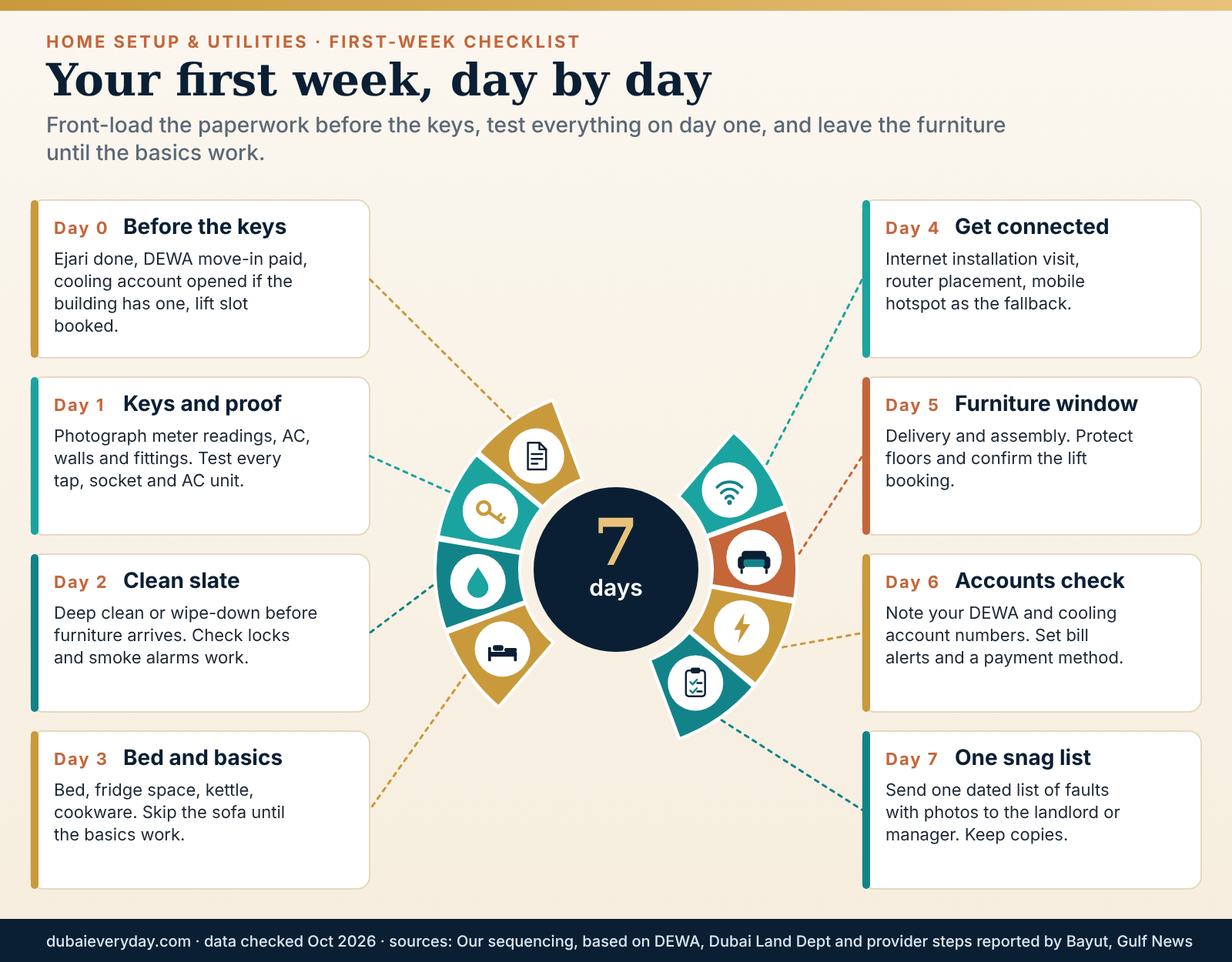
The home setup Dubai checklist above is a template, not a rule. The principle is to do paperwork before the keys, testing on day one, and furniture only after the basics work.
Day 0: before the keys
For a home setup Dubai, have the Ejari certificate, the DEWA contract account number, the cooling account confirmation (if any), the internet order, and the lift booking. If one is missing, decide whether to delay the move. A move into an unpowered flat in summer is a bad trade for a day’s saving on rent.
Days 1 to 3: prove, clean, sleep
In a home setup Dubai, day 1 is the keys-day routine above. Day 2 is the deep clean, if you booked one, with the unit empty. Day 3 is the bed, the fridge, the kettle and a place to put your clothes. By the end of day three you should be able to sleep, wash, cook something simple and charge your devices. Everything after that is improvement.
Days 4 to 7 of a home setup Dubai: connect, furnish, record
Day 4 is the internet visit, where you test speed and coverage before the technician leaves. Day 5 is the furniture window: delivery, assembly and removal of packaging. Day 6 is the accounts check: write down your DEWA contract account number, any cooling account number, internet account number and the Ejari number in one note. Day 7 is the single, dated snag list for anything that appeared after the first pass, with photographs.
If your household includes children or a pet, extend the checklist. Our guides to Dubai with kids, pet ownership and pet registration cover the household items that fall outside this guide, such as vet registration and child-safe fittings.
Does a home setup Dubai have to finish in a week?
No. The only items that cannot wait are those tied to safety and to live services: electricity, water, cooling, locks, and a place to sleep. Internet matters for remote workers, but a mobile hotspot is a workable stopgap. Furniture is the most deferrable thing on the list. A flat with a mattress, a table and a fridge is a functioning home, and there is no prize for finishing the sofa shopping on day six.
One-page summary to keep on your phone. Ejari number, DEWA contract account number, DEWA premises number, cooling account number, internet account number, landlord and manager contact, building security desk, lift booking reference, and the dates for every deposit you paid. One note, updated when anything changes, saves an hour of searching every time a provider asks.
Four home setup Dubai scenarios, worked through
Rules are easier to apply when you see a home setup Dubai run on a case. The four profiles below are hypothetical households, not real people, and every number comes from the reported figures earlier or from assumptions we state. Use them to find the one closest to your own situation, then replace our inputs with your own.
Scenario 1: a solo professional, one-bedroom, landlord pays cooling
The household is one person renting a one-bedroom at AED 70,000 a year in a tower where the landlord covers the cooling company. They sign on a Monday morning, ask the agent for the Ejari certificate by Tuesday and receive it by midday. The DEWA move-in starts from the Ejari registration, so on Tuesday afternoon they pay the AED 2,000 deposit and the activation fee. Lights are expected the same day or the next working morning.
Cash on day one to day three comes to about AED 11,100 to AED 13,800 across deposit, commission, Ejari, DEWA, movers and cleaning, as in the pictogram, with AED 5,500 of it refundable. Monthly running costs, our calculation: the housing fee at about AED 292, a variable DEWA part of about AED 270 in January and AED 540 in August, and fibre internet at about AED 300 to AED 360 (uaeinform’s reported entry range). That is roughly AED 860 to AED 1,190 a month, before food and transport.
Scenario 2: a couple in a district-cooling tower, tenant pays
Same rent, same sequence, one extra account. Before the keys they open a cooling account using the Ejari certificate, passports, Emirates IDs and the tenancy contract. Under the Empower figures reported by Gulf News and uaeinform, that means a further AED 2,000 deposit, plus possible one-off charges that Gulf News says may fall on the owner or the tenant depending on the arrangement. If the building uses Emicool, the deposit is eight months of the unit’s contracted capacity charge and the activation fee is AED 200.
Using betterhomes’ illustration of about AED 900 a month on average and AED 1,000 to AED 1,500 at the summer peak for district cooling, the monthly picture changes. In a mild month: AED 292 housing fee, AED 270 variable DEWA, AED 900 cooling and AED 300 internet, about AED 1,760.
In peak summer: AED 292, AED 540, AED 1,500 and AED 360, about AED 2,690. Compared with Scenario 1, the difference is the cooling bill and nothing else. That is why the question “who pays the cooling company?” deserves to be asked before the lease is signed rather than after the first bill.
Our calculation. Our Scenario 2 home setup Dubai figure adds a single reported cooling illustration to Scenario 1. It is not a prediction for your unit. A smaller contracted capacity, a household that is out most days, or a unit shaded from afternoon sun can all land lower; a large unit with a long summer at home can land higher. Ask the building for last year’s cooling bill for the unit.
Scenario 3: a family of four in a villa
The family rents a villa at AED 200,000 a year with its own AC units on the DEWA meter. With 5% for the deposit and 5% commission, the landlord and agent payments are AED 10,000 each.
Add Ejari at AED 177.75 to AED 220, the AED 4,000 DEWA deposit with AED 130 to AED 155 activation, AED 2,000 to AED 3,000 or more for movers, and AED 600 to AED 800 if the villa has gas. The one-off cash comes to about AED 26,900 to AED 28,200 before cleaning, furniture and any pool or garden set-up.
Running costs are driven by the villa’s own AC. On the assumed use in our worked table, the DEWA bill reaches about AED 2,890 in August, of which AED 833 is housing fee. If the villa also has a pool pump, a garden irrigation system, or both, expect higher figures than our table because we did not model them. The villa rental guide covers inspection of those systems, and the family guide covers the rest of the household logistics.
Scenario 4: an owner-occupier
An owner does not register Ejari, because there is no tenancy to register, and does not pay a landlord’s deposit or an agent’s rental commission. DEWA asks for a title deed or sales and purchase agreement instead of Ejari, according to dubizzle’s June 2026 article, and Metropolitan Real Estate lists a AED 130 connection charge and the same AED 2,000 and AED 4,000 deposits for owners. Dubizzle says owners can reclaim the deposit only when they sell.
The housing fee still applies. Bayut’s explainer says that for owners it is 5% of the property’s average rental value as determined by RERA, so the owner pays it when the property is not rented out.
For district cooling, the Emicool FAQ says owners need an NOC from the master developer or a new title deed, and Property Finder’s Empower guide lists the title deed, passport and sales and purchase agreement. Owners should read the property buying guide and the guide for foreign buyers before relying on any rental-side checklist in this page.
What the four home setup Dubai cases have in common
In each home setup Dubai scenario the same three early actions recur: get the paperwork that proves who occupies the property, convert it into a DEWA account, and settle the cooling arrangement before the weather decides for you. The money differs by an order of magnitude between a one-bedroom and a villa, but the sequence does not. If you remember one thing from this home setup Dubai guide, it is that sequence.
Mistakes, scams and red flags
Most of the problems in a home setup Dubai residents report to forums are not fraud. They are small administrative errors with large consequences. A few real scams exist, and the defence against both is the same: keep everything in writing, pay through official channels, and check numbers against the contract.
The common home setup Dubai mistakes
Ordering furniture before the lights work is the classic home setup Dubai mistake. Delivery crews arrive at a flat with no power, no cooling, and a lift booking that cannot be moved. Close behind is the cooling account left for later, which becomes a summer problem. A third is accepting an Ejari certificate without comparing it with the contract, so that the rent, dates or unit number are wrong and every later record inherits the error.
Others are quieter. People lose the DEWA contract account number and cannot find it a year later. They pay a deposit without a receipt that says what it is for. They forget to close the cooling account when leaving, so the capacity charge keeps accruing on an empty flat. They sign an internet contract without reading the minimum term and then hit an early termination fee when they move. And they accept “chiller free” as a label without asking who pays.
Home setup Dubai scams and pressure tactics to watch for
We did not find a current official fraud notice for this page, and we are not claiming one exists, so these are general-purpose cautions rather than reports of particular scams. Be sceptical of anyone who offers to “activate” your utilities faster for a cash fee.
DEWA, Ejari and the cooling providers have official portals, and the amounts shown on checkout screens are what you owe. Be sceptical of text messages or emails that carry a payment link for a bill or deposit you did not expect. Open the DEWA website or app yourself and look.
Be equally sceptical, in a home setup Dubai deal, of a landlord or agent who asks you to pay the Ejari fee, the DEWA deposit or the cooling deposit to a personal account. Those payments go to the authority or provider, with a receipt. If a request does not fit that pattern, stop and ask for the official channel in writing.
Red flags, in one list.
- No Ejari certificate, or a promise that it will come “later” while you are expected to move in.
- A cooling arrangement described only with the words “chiller free” and no named provider.
- Fees to be paid in cash to a person rather than through an official channel with a receipt.
- Deposit receipts with no amount, purpose or refund terms.
- A rent figure on the Ejari record that differs from the signed contract.
- A reluctance to put the lift booking, permit and move-in rules in writing.
If your home setup Dubai goes wrong
Start with the written record: the contract, the Ejari certificate, receipts, the snag list and the message thread. Raise the issue with the landlord or management in writing, quote the clause, state what you want and give a date.
If that fails, the route depends on the problem: a DEWA billing query goes to DEWA, a registration error to the Dubai Land Department, a deposit or maintenance dispute to the rental dispute process. Our tenant rights guide and the legal basics for residents explain where to verify the current rules, and neither is a substitute for advice from a licensed professional on your specific dispute.
Moving out, renewal and keeping records
The home setup Dubai you do on the way in determines how painful the exit is. Every deposit has a refund process, every account has a closing process, and every registration has an end date. Plan them while the paperwork is fresh, not when the movers are booked.
DEWA: close or transfer at the end of a home setup Dubai
If you are moving to another Dubai address, use the Move-to route from the DEWA section and carry your deposit across. If you are leaving, Bayut’s October 2026 guide describes closing the account online with a DEWA ID or UAE Pass, paying any outstanding bill and choosing a move-out date, with a closing fee of AED 100 for small meters or AED 300 for large ones plus AED 10 each for the knowledge and innovation fees.
The deposit refund method is chosen at closing: bank transfer, cheque or Western Union, according to the same source. The full sequence is in our DEWA move-out guide.
Uaeinform’s October 2026 guide says DEWA reported in April 2026 that deposits up to AED 4,000 can be refunded in as little as eight minutes after account closure. That figure is from a single secondary source quoting an announcement, so do not plan around it; plan around the final bill arriving within 24 hours (Bayut) and the refund following by the method you chose.
Cooling, internet and gas
Cooling is the account most often forgotten. The 2024 Gulf News descriptions of Empower’s settlement request and Emicool’s cancellation form, with final bills in two to three working days, are the pattern to expect. Internet needs the contract end date checked against your move date, because early termination fees are the cost Gulf News flags. Gas needs a closing request and a deposit refund too, with details that depend on the supplier.
Ejari and the landlord’s deposit
Bayut’s Ejari guide says the landlord is responsible for cancelling the registration when the tenant leaves, and that a new tenant cannot register until it is done. Dubizzle says cancellation is free online and costs about AED 40 at a service centre. For your own protection, ask for confirmation that the Ejari was cancelled. The landlord’s security deposit is refunded under the lease, and the written snag list and photographs from your first week are your evidence of the unit’s starting condition.
The home setup Dubai renewal rhythm
If you renew rather than leave, put four dates in your calendar: the lease end, the Ejari expiry, any district cooling contract renewal, and the internet contract end. Dubizzle says Ejari renewal costs the same as registration. The housing fee follows the new Ejari rent, so a rent change shows up on the DEWA bill after the new registration is recorded. The renting guide covers renewal negotiation and notice periods.
The home setup Dubai in one paragraph
The home setup Dubai tenants complete in a week is: sign, register Ejari, activate DEWA with the Ejari number, open a cooling account if the lease makes you the holder, order internet and book the building permit the same day, photograph the unit on day one, and buy furniture last. Keep every receipt and reference number in one note. Expect about AED 11,100 to AED 13,800 of one-off cash on a one-bedroom at AED 70,000, of which about AED 5,500 comes back.
FAQ
How long does a home setup Dubai tenants complete take from signing to working lights?
On the reported service times, one to two working days is realistic if Ejari is registered promptly. The Dubai Land Department page gives about 25 minutes at a trustee centre, Bayut gives one to two days for certificates through other routes, and Engel & Völkers and dubizzle quote DEWA activation within 15 working hours of payment. Add a buffer for weekends and for any delay in the landlord’s part. If you need lights by a specific evening, apply before midday on a weekday.
Do I need Ejari before DEWA in a home setup Dubai?
For a tenant outside a free zone, yes. Bayut’s October 2026 guide says non-free-zone tenants must complete Ejari registration and enter the Ejari number on the DEWA Move-in screen, and Engel & Völkers says registering Ejari can start the Move-in process automatically. Free-zone tenants who are exempt from Ejari supply their tenancy contract number and dates instead. Owners use a title deed. If your Ejari is delayed, ask the landlord for the reason in writing.
How much is the DEWA deposit, and do I get it back?
Reports agree on AED 2,000 for an apartment and AED 4,000 for a villa. It is refundable when the account closes and outstanding bills are settled. Activation fees, reported between AED 130 and AED 155 for a small meter depending on the source, are not refundable. DEWA’s own pages were not readable by our tools on 29 October 2026, so confirm the figures at checkout. Keep the closing confirmation and the refund method you chose for your records.
What is the housing fee on my DEWA bill?
It is the Dubai Municipality housing fee, which Bayut says is 5% of the annual rent recorded in the Ejari registration for tenants, collected in twelve monthly instalments on the DEWA bill. UAE nationals are exempt. For a AED 70,000 rent it is AED 3,500 a year, or about AED 292 a month. If the figure looks wrong, first compare the Ejari rent with your contract, then raise it with DEWA or Dubai Municipality with the certificate and the bill.
What does “chiller free” mean in Dubai?
It depends on who is speaking. A 2021 Gulf News guide uses it for units where the landlord or property manager pays the cooling company, while a March 2026 betterhomes guide uses it for the opposite. Both describe real arrangements. Ask the plain question in writing: who pays the cooling provider each month, and which company is it? Then ask for the unit’s contracted capacity and last year’s bill, so you can price the arrangement.
Can I order internet before I move in?
You can check which operator serves the building before you sign, and uaeinform says that in most buildings only one of du or e& has fibre. Whether an installation can be booked before your lease starts is something we did not verify, so ask the operator. Uaeinform reports installation in two to five working days in connected buildings, and longer for villas needing new fibre. Plan the first week around a mobile hotspot.
Who pays the Ejari fee, the tenant or the landlord?
Gulf News’ April 2026 answer cites Article 22 of Dubai Law No. 26 of 2007, as amended, which places government fees related to the use of the property on the tenant unless agreed otherwise, while the landlord is responsible for ensuring the contract is registered. In practice the tenant usually pays, around AED 177.75 online or AED 220 at a trustee centre per the Dubai Land Department. If your contract says otherwise, follow the contract.
Do I need a gas connection in my home setup Dubai?
Only if your home setup Dubai includes a unit with gas and you want to use it. Many kitchens are electric. Gulf News’ October 2026 list gives AED 600 to AED 800 for a new connection or transfer, with cylinder-based arrangements costing differently and a possible deposit for central gas, while another source estimates a deposit near AED 1,000 and activation near AED 500. Ask the building who supplies gas and get the amounts from the supplier in writing. Never modify gas fittings yourself.
I am buying, not renting. What changes in a home setup Dubai owners face?
You skip Ejari and the landlord’s deposit and commission. DEWA asks for a title deed or sales and purchase agreement instead, according to dubizzle, and the reported deposits of AED 2,000 or AED 4,000 apply. Bayut says owners pay the housing fee as 5% of the property’s average rental value set by RERA when the property is not rented out. For district cooling, Emicool says owners need an NOC from the master developer or a new title deed. Read the property buying guide for the ownership steps.
How much will my first DEWA bill be after a home setup Dubai?
It depends on your consumption and, for renters, the housing fee. In our assumptions, a one-bedroom flat paying AED 70,000 rent comes to about AED 565 in January and AED 833 in August, of which AED 292 is the housing fee. A villa at AED 200,000 rent comes to about AED 1,720 and AED 2,887. Those use assumed kWh and water, exclude sewerage and meter charges, and are not a prediction for your home. Check your own bill against the five steps in the DEWA section.
How do I transfer DEWA when moving to another home in Dubai?
Use the Move-to service rather than closing and reopening. Bayut’s October 2026 guide says to log in with your DEWA ID or UAE Pass, enter the new Ejari and premises numbers, your current contract account number and your move-out date. Your deposit transfers, and you pay only the difference if the new home needs a larger one, for example when going from an apartment to a villa. Supply at the old address ends on the move-out date you give, so choose it carefully.
What should I buy first for a home setup Dubai?
In a home setup Dubai, buy a mattress and bedding, a kettle, basic cookware, a phone charger by the bed and a desk if you work from home. Postpone the sofa, rugs and decorating until you have lived in the space for a week. If the stay is only a few months, furnished leasing or furniture rental may beat buying. If it is a year or more, owning usually wins, and the section on furniture has a simple way to test that with your own prices.
What do I do if the previous tenant left the account open or a bill unpaid?
Engel & Völkers says errors, incomplete details or unpaid balances can delay DEWA activation. Ask the landlord to confirm that the previous tenant’s account was closed and their Ejari cancelled; Bayut says only one registration can exist per property, so the new one will not register until the old one is cancelled. If the problem persists after the landlord confirms, contact DEWA with the premises number and your reference. Keep every reply in writing.
Related reading
Sources and further reading (25 links)
- Dubai Land Department: Register / Renew Tenancy Contract (Ejari) — Ejari fees, channels, documents and service time
- Dubai Media Office: DEWA adopts cubic metre as the unit for water consumption — water billing unit change from March 2025; customer care number
- Dubai Legal Portal: Executive Council Resolution No. (16) of 2011 — legal basis of residential electricity and water tariffs and the fuel surcharge
- Emicool: customer FAQ — district cooling registration, deposit, activation, billing structure
- Gulf News: Moving to a new home in Dubai? 11 additional costs — deposit, commission, movers, cleaning, gas ranges
- Gulf News: What is Ejari? A complete guide — uses of Ejari, responsibility, renewal
- Gulf News: Ejari renewal fees, who pays — Law No. 26 of 2007 reference
- Gulf News: What are the district cooling charges in Dubai? — Empower and Emicool charges, 2024
- Gulf News: Moving out? Discontinuing district cooling services — closing steps, 2024
- Gulf News: All you need to know about chiller services — district cooling explainer, 2021
- Gulf News: Utility connections for a quick move-in — sequence and internet timing, 2021
- Bayut: How to transfer DEWA and move your account in Dubai — move-in, move-to, move-out steps and fees
- Bayut: All about the Dubai Municipality housing fee — 5% rule, billing, owners and refunds
- Bayut: Ejari in Dubai guide — one registration per property, cancellation, timing
- Engel & Völkers: DEWA new connection — Ejari integration, fees, activation timing
- dubizzle: All about opening a DEWA account — free-zone and owner routes, fees
- dubizzle: All about Ejari in Dubai — uses of Ejari, steps, cancellation
- dubizzle: What does your DEWA bill say? — bill components, VAT, surcharge
- Property Finder: DEWA calculator — slab limits and water rates
- Property Finder: Empower Dubai — registration, documents, fees, bill components
- betterhomes: Chiller-free vs chiller-inclusive apartments — terminology and cooling cost illustration
- betterhomes: A complete guide to setting up your DEWA account — premises number, contact lines
- UAEInform: Utilities setup — internet, deposits and DEWA timing
- Metropolitan Real Estate: Utilities connections and payments — gas and internet deposit estimates
- Wikipedia: Climate of Dubai — monthly mean temperatures attributed to the Dubai Meteorological Office; secondary source, used for context only
Update log: 29 October 2026, first publication; all facts re-checked against the sources above. Next review due: April 2027 (six-monthly), or sooner after any change to DEWA deposits or tariffs, Ejari fees or district cooling terms. Corrections welcome. To confirm fees directly, use DEWA and the Dubai Land Department. This page is general information, not individual legal, financial or engineering advice.
About DubaiEveryday and this guide
DubaiEveryday.com is an independent editorial project that publishes practical, research-based guides to everyday life in Dubai: where to live, what things cost, how the rules work and how to get around. This page was written and edited by the DubaiEveryday editorial team. It is not signed by a named expert, doctor, lawyer or adviser, and we do not claim first-hand testing of a venue, clinic or service unless the page says so.
Each guide is built from official sources such as government and regulator pages, operator websites and established news outlets, cross-checked where we can. When we could not confirm something, we say so in the text, and examples that use made-up numbers are labelled as illustrations. Mentions are editorial choices, not paid placements, and a link is not an endorsement.
Dubai changes quickly. If you spot something that is out of date or wrong, please tell us through the contact options on DubaiEveryday.com and we will check it and correct the page.