

Luxury Dubai is eight different buying jobs, and 2026 has changed several of them. This page shows what is open, what the premium really costs once the fees land, and which checks protect your money before you pay.
Imagine saving for months for one special stay, then finding the landmark you came for behind scaffolding. In late 2026 that is a real risk, because some famous names are closed for restoration or renovation. Prices are no safer. A headline rate rarely tells the whole story.
This guide shows how luxury dubai works in practice: what is open on your dates, how service charges, fees and VAT stack on top of a room rate, and which checks protect your money before you hand over a card for a car, a boat or a concierge. The aim is that any surprises arrive before you pay, not after.
Luxury Dubai in late 2026 is a smaller, more selective menu than the brochures suggest. The Burj Al Arab is closed for an 18-month restoration, the Armani Hotel inside the Burj Khalifa is shut until about March 2027, and four Michelin-starred restaurants are listed as temporarily closed. Your first job is checking what is actually open on your dates.
After that, the decisions are about money and licences. A headline room rate can grow by roughly a quarter once service charge, fees and VAT land. A tourist VAT refund on a large purchase returns about 4% of the shelf price, not 5%. Rental cars, yachts, clinics and concierge firms each need a different check before you hand over a card.
The workable rule: book luxury Dubai hotels by the all-in total, dinners by confirmed opening status, cars and boats only from licensed operators, and anything medical only at a facility you can find on the Dubai Health Authority register. The rest of this page covers all eight areas of luxury Dubai with worked arithmetic, three sample plans and an honest list of what we could not verify.
This is a desk-research guide to luxury Dubai. DubaiEveryday.com has not slept in, dined at, driven, sailed on or been treated by anything named below, and nothing here describes a personal visit. Facts were read on 29 October 2026 from official or operator-level pages where they loaded: the UAE Federal Tax Authority, Dubai’s Department of Economy and Tourism (DET), the Dubai Media Office, UK travel advice, the RTA and Visit Dubai. Closures and recovery figures come from Gulf News, The National and Khaleej Times, which we treat as secondary.
Many operator sites block automated reading, so several prices are marked “reported” or “from”. Venue names are examples taken from sources, not recommendations, and inclusion was not paid for. Selection is research-based, not field-tested. Where numbers are illustrative we say so. This is general information, not individual legal, medical, tax or financial advice.
What luxury Dubai means and what this page covers
Luxury Dubai is not one product. It is a bundle of services that happen to share a postcode: a room, a table, a car, a boat, a shop, a treatment room, a ticket and a person who can arrange all of them. The bundle only feels smooth when each part has been checked separately. That is the organising idea of this guide, and the wheel below shows the eight parts and the one question worth asking about each.

The market behind luxury Dubai is large. Dubai recorded about 19.59 million international overnight visitors in 2025, according to figures the Dubai Media Office published in February 2026, with average hotel occupancy around 80.7%. At that scale, the top end of luxury Dubai is crowded with brands competing on adjectives. Adjectives are not evidence, so this page leans on licences, fees, dates and rules instead.
Who this luxury Dubai guide is for
Three readers use luxury Dubai differently. A high-spend visitor wants the shortest path to a good week. An affluent resident wants to host guests, book a yacht for a birthday or find a spa that is not a hotel’s afterthought. A corporate or VIP buyer wants predictable service, receipts and someone to call at midnight. The sections below flag which advice matters most to each, and the sample plans at the end show all three in numbers.
What this luxury Dubai guide covers, and what it does not
This page is the hub, so it explains how to choose and what to check across all eight areas. Hotel-by-hotel comparison for luxury Dubai lives in the sibling guides on ultra-luxury hotels in Dubai and the wider best luxury hotels in Dubai. Restaurant-by-restaurant detail for luxury Dubai dining sits in the Michelin restaurants guide, and rental terms in the car rental guide.
Buying luxury Dubai property is a separate, regulated decision with its own risks, so it is out of scope. If that is your question, start with the buying property guide and the property investment guide. If this is your first visit at any budget, read First Time in Dubai alongside this page.
Luxury Dubai in October 2026: what is closed, what changed
Any honest guide to luxury Dubai has to start with the status board, because 2026 removed some of the city’s best-known addresses from the menu. Check these before you build a luxury Dubai plan around a photograph.
Burj Al Arab
Reported by Gulf News as closed since April 2026 for an 18-month restoration of interiors, suites, restaurants and leisure facilities. Expected back in October 2027. That includes its Michelin-listed restaurants.
Armani Hotel Dubai
Closed on 1 April 2026 for a refurbishment of rooms, spa, pool and dining. Event spaces are due in January 2027, with full reopening reported for March 2027.
Four starred restaurants
Al Muntaha, Dinner by Heston Blumenthal, Ossiano and Smoked Room kept their stars in the 2026 guide while listed as temporarily closed. Michelin says it will re-evaluate them after they reopen.
Other pauses
The Museum of the Future closed on 1 September 2026 and is due back in the first quarter of 2027. Barasti Beach Club at Le Méridien Mina Seyahi closed on 21 June 2026 for redevelopment, with no exact reopening date.
The wider context, without the drama
The National links the softer demand and several venue pauses to disruption after the regional conflict involving Iran, which began in late February. We are an editorial site, not a security assessor, and we do not predict what happens next. What we can report is what official and press sources said this week. The UK’s travel advice, updated on 27 October 2026, calls the regional picture “deeply unpredictable” with a high risk of sudden escalation, and tells visitors to expect possible flight cancellations and airspace closures.
Visitors have nevertheless returned. Khaleej Times reported close to seven million visitors for January to August 2026, with about 870,000 in August alone, and said the UK, US, Australia and Canada have eased their advice since mid-June. Hotel occupancy reportedly sat near 36% in March and 66% in August, according to The National. Read your own government’s current advice, and treat any number here as a snapshot.
What the relief package means for a luxury Dubai bill
On 21 May 2026 Dubai approved an AED 1.5 billion relief package of 33 initiatives, each running three to twelve months. The Dubai Media Office release says establishments registered with DET are exempt from collecting the Tourism Dirham and from sales fees on hotel rooms and restaurants. Press reports describe the sales fee as the 7% municipality charge. Each initiative has its own timeline, so whether a given hotel still applies the relief on your dates is a question for the hotel.
Ask any luxury Dubai venue three questions in writing: is it open on my dates, is the room, table or experience I am booking the one that is operating, and which taxes and fees are in the quoted total. Then buy travel insurance that covers your itinerary, as UK advice recommends. Our insurance guide explains what the main policy types cover.
Our reading of the data, which is an inference and not a forecast: with occupancy still recovering and several flagship rooms out of service, luxury Dubai hotels and restaurants that are open have a reason to be accommodating about upgrades, flexible dates and late checkout. We could not verify live room prices, so treat that as a negotiating angle to test, not a promise. The general trip-planning basics sit in the Dubai travel guide.
What luxury Dubai really costs: the fee stack and a working budget
The most useful number in luxury Dubai is not the room rate. It is the multiplier between the advertised price and the amount that leaves your card. That multiplier is knowable, and it differs by what you are buying, so it is worth fixing in your head before you compare anything.
The hotel bill, layer by layer
Four things can sit on top of a luxury Dubai room rate. A service charge, usually 10%. A municipality or sales fee, which press reports put at 7% of the room rate. VAT at 5%. And the Tourism Dirham, a flat charge per room per night.
The official UAE government portal gives the Tourism Dirham as AED 7 to 20 depending on hotel grade, charged per room per night of occupancy and capped at 30 consecutive nights. Reports of the scheme, which began in 2014, put five-star hotels at the top of that range, at AED 20.
Whether the municipality fee and Tourism Dirham appear on your bill in late 2026 depends on the May relief measures described above. So the same hotel can produce two different totals on two different dates. The figure below shows both for an illustrative AED 1,000 room, using an assumed order of charges.

The arithmetic, for anyone who wants to check it. Room AED 1,000. Service charge 10% adds AED 100. Municipality fee at 7% adds AED 70. The subtotal is AED 1,170, and 5% VAT on that adds AED 58.50. A five-star Tourism Dirham adds AED 20. Total: AED 1,248.50, or 24.9% above the headline. With the municipality fee and Tourism Dirham exempt, the total is AED 1,155, or 15.5% above. At an AED 3,000 room rate, the same stack differs by about AED 240 per night.
Rule of thumb. When you compare two luxury Dubai hotels, compare the all-in total for your exact dates, not the rate card. If a quote does not say whether service charge, fees and VAT are included, assume they are not and multiply by about 1.15 to 1.25. Ask for the figure in writing before you pay a deposit.
Restaurant bills and the service-charge question
Luxury Dubai restaurant totals follow a smaller version of the same logic. VAT is 5% on food and drink. Hotel restaurants and some special zones add a service charge of about 10%, as an older Gulf News explainer described, and the municipality fee on hotel and restaurant sales was part of the 2026 relief. Menus often print prices without these additions.
On an AED 1,000 food-and-drink order, our calculation gives AED 1,050 with VAT only, about AED 1,155 with a 10% service charge and VAT, and about AED 1,228.50 if a 7% fee is also charged. Read the foot of the menu. If service is already included, tip only for something specific, and ask the table what it expects before adding anything on top.
A working budget frame for luxury Dubai
A budget for luxury Dubai splits more cleanly by job than by day. Hotels are the largest single line and the most predictable once you have the all-in rate. Dining swings the most, from a set menu listed at AED 350 at a two-star room to a tasting menu listed at AED 1,350 per person at the top of the pyramid, both prices as listed on operator sites. Cars, boats and private guides are priced by the hour or day and move with season and demand.
Use this planning order for luxury Dubai, which keeps the big decisions ahead of the small ones:
- Fix your dates against the status boardConfirm which flagship rooms and restaurants are operating on those dates, and which events are on. Prices and availability follow.
- Price the hotel all-inGet the total for the full stay, including every fee, and the cancellation rule in writing.
- Book the scarce tables and slots nextStarred dinners, balloon flights, private desert experiences and boat charters sell out before rooms do.
- Add movementA chauffeur, a rental, or taxis and Metro. Decide this after you know where you sleep and eat.
- Leave a buffer for the unplannedSpa upgrades, a shopping afternoon, a venue that closes and forces a substitute. Ten to fifteen per cent is a sensible cushion.
Money logistics for luxury Dubai
The dirham is pegged at 3.6725 to the US dollar, so conversions are stable even when everything else is not. Cards are widely accepted at hotels, restaurants and malls. Carrying large cash sums has a rule: Dubai Airports’ FAQ and Australia’s Smartraveller advice both cite a declaration threshold of AED 60,000 on entry, which matters if you plan to pay a yacht operator or a jeweller in cash. Do not. Card payments leave a record and a chargeback route, and cash does not.
For wider cost context beyond a luxury Dubai week, such as what residents spend monthly, see the cost of living guide. For the metro and taxi basics that sit alongside a chauffeur budget, the Dubai Metro guide covers fares and hours.
Luxury hotels in Dubai: choosing the address
In luxury Dubai, the address usually shapes the stay more than the brand on the door. A beachfront resort on the Palm and a tower hotel in Downtown are different holidays with different transport, different noise and different dinners on the doorstep. Pick the trip first, then the hotel, because luxury Dubai hotels differ more by district than by brand. The schematic below shows where the supply clusters along the coast, with the usual caveat that it is not to scale.

Five addresses, five different trips
The Palm Jumeirah suits a resort week where the hotel is the destination: beach, pools, several restaurants in one place. Its cost is distance from everything else, so a city dinner is a car ride. The Palm Jumeirah area guide covers how the island works day to day.
Dubai Marina and JBR put towers, a promenade and a beach in one strip, with marina boats nearby. It is a good base for a first visit that mixes sea and city, and the Dubai Marina guide explains the layout and traffic habits.
Downtown and DIFC suit business, shopping and dinners. You trade the beach for walkability to the Dubai Mall area and the fountain, which the Downtown Dubai guide covers in depth. The Jumeirah coast, from Madinat Jumeirah to the beach hotels near City Walk, sits between the two ideas. Old Dubai and the Creek offer heritage and a very different price level, but fewer of the flagship resort amenities.
What the premium actually buys in luxury Dubai
Rates at the top of the luxury Dubai market are not buying a bigger bed. They are buying a set of things you can ask about in advance. Our reading, built from how the sources describe these properties and not from staying in them, is that five variables explain most of the gap between a good hotel and an exceptional one.
- Room and suite size, view and floor, stated in square metres rather than adjectives.
- Beach and pool quality: private beach, sun-lounger availability, shade, a quiet adults-only area.
- Food under one roof, and whether that dining is operating on your dates.
- Service structure: a dedicated butler or lounge host, check-in in the room, late checkout as standard.
- Transfers: whether a chauffeur from the airport is included, discounted or an extra.
Because several flagship dining rooms are paused, the third item deserves a direct question. A hotel whose headline restaurants are closed is still a hotel, but it is a different value proposition from the one on its website. For comparisons across the top tier of luxury Dubai, use the ultra-luxury hotels guide, and for a broader view across price levels see how to choose a hotel by area, budget and beach access.
Rooms, suites and villas: the questions that matter
Category names are not standardised. A “deluxe” room at one resort can be larger than a “suite” at another. When you ask for a quote, ask for the room size, the view type, the bedding, whether adjoining rooms are available and what the cancellation window is. If you are travelling with children, ask about family suites and kids’ facilities up front; the Dubai with kids guide covers what families tend to need.
Ask what is included in the rate. Breakfast, lounge access, a resort credit, airport transfers and spa access vary, and a lower rate with nothing included can cost more than a higher rate with breakfast and transfers built in. Late checkout and early check-in are worth requesting at booking, not at the desk, because they are easier to grant when the house is not full.
Licensed holiday homes and private villas
Private villas are popular for groups and long stays in luxury Dubai, and they carry a different risk profile from hotels. DET handles permits for hotels, holiday homes and timeshare providers in Dubai, according to its hospitality services page. In practice that means a legitimately operated holiday home should be able to show you a DET permit, and you can ask for the permit number before you pay.
We could not find a public look-up for it on the pages we could read, so ask the operator and keep the answer in writing.
The Tourism Dirham also applies to holiday homes, so a villa quote that omits it is not the full price. Check the deposit, the damage terms, who handles housekeeping and what the arrangements are if a pipe breaks at 11 pm. A villa with staff and a villa without staff are different products with different price tags, and listings often blur them.
No permit number on request, payment demanded by bank transfer to a personal account, a price far below comparable villas on the same street, and pressure to move the conversation off the booking platform. Each of these has an innocent explanation, but together they are the standard shape of a rental scam. If anything feels off, stop and use a hotel.
Booking tactics that protect the total
Compare the same room, same dates, same cancellation terms across the hotel’s own channel and any platforms you use. We do not recommend a platform and have no booking links on this page. What matters is the all-in figure and the flexibility: a rate that can be changed or cancelled is worth paying a little more for in a year when regional events have led to short-notice flight changes.
Hold deposits and pre-authorisations are normal at luxury Dubai hotels. Ask what amount is blocked on your card, when it is released and in which currency, because a large block can reduce your available credit for the rest of the week. If you plan to hire a car or book a yacht on the same card, plan the limits.
Beaches, pools and what the sea does to the plan
A beachfront hotel in luxury Dubai is not automatically a beach holiday. Between June and September the heat pushes beach time to early morning and evening, and the pool becomes the real amenity. In the cooler months the beach is the draw, and hotel beaches fill. If beach quality is your priority, read the best beaches in Dubai guide and check how your hotel’s beach is managed, including whether non-guests can enter and what the shade situation is.
One reopening is worth a note. Khaleej Times reported that the St. Regis on the Palm was due to reopen on 1 November 2026, but we have not confirmed it with the hotel, so confirm with the property before relying on it. As a general rule for luxury Dubai hotels in 2026, check the status of any renovated or recently reopened property directly, and ask which facilities are fully operational.
Luxury dining in Dubai: Michelin tables, tasting menus and closures
Fine dining is where luxury Dubai is easiest to research and hardest to book. The Michelin Guide gives the city an external yardstick, but 2026 added a wrinkle: some of the rooms it rewarded are not currently serving. Treat the guide as a map of where to look for luxury Dubai dining, and the restaurant’s own page as the authority on whether you can sit down.
Reading the 2026 Michelin pyramid for luxury Dubai dining
The fifth Dubai edition was announced on 6 October 2026. According to The National, it lists 122 restaurants, up from 119: 20 with stars, 22 Bib Gourmand and 80 Selected. Gulf News adds that the selection spans 38 cuisines and includes 19 new entries. The graphic below turns the pyramid into something you can scan.

Two restaurants hold three stars: FZN by Björn Frantzén and Tresind Studio. Four hold two, including Orfali Bros, promoted from one. Fourteen hold one, with two new entries, Birch and Kigo. The Bib Gourmand list, for good-value cooking, gained Middle Child, SEA Bistrot, Three Bros and Yubi Dubai. If your luxury Dubai budget is flexible but not limitless, the Bib list is where the same inspection standard meets a far lower bill.
The closure problem. Al Muntaha, Dinner by Heston Blumenthal, Ossiano and Smoked Room kept their one star while listed as temporarily closed. Michelin said it is in close contact with the teams and will re-evaluate them once they reopen. A food writer quoted by The National asked why at least ten closed restaurants remain in the guide’s lists. The practical point is simple: a star in a headline is not a booking.
What a top tasting menu costs
Prices at the top of the luxury Dubai dining pyramid are published and unambiguous, which makes them easier to plan around than most luxury spending. The Tresind Studio website lists a tasting menu at AED 1,350 per person, with seatings at 18:00 and 21:15, a room of 15 seats and a closing day on Sunday. For two people that is AED 2,700 before drinks, any supplement and whatever service and tax treatment the restaurant applies, so confirm what the listed price includes.
The capacity arithmetic explains why such rooms sell out. Our calculation: 15 seats, two seatings, six nights a week gives a ceiling of 180 diners a week. Demand from a city of nearly twenty million annual visitors does not fit into that. Orfali Bros, now a two-star room, lists set menus on its own website at AED 350 and AED 295 for two different formats, a reminder that a star does not always mean a four-figure bill.
How to book scarce tables
Most starred rooms take reservations through their own site or a booking platform, and some require a deposit or card guarantee. We could not verify booking windows for individual restaurants, because several sites blocked automated reading, so check each one. The method that works across all of them is the same.
- Decide the two or three dinners that matterChoose them first, then plan the rest of the trip around the dates you can actually get.
- Read the restaurant’s own page on the day you bookLook for opening days, seatings, the menu price, the cancellation rule and any note about temporary closure.
- Confirm dietary needs in writingTasting menus are built in advance. Allergies and religious dietary rules need notice, not a mention at the table.
- Ask your hotel concierge about the waitlistCancellations happen, and a concierge with a relationship can sometimes use them. It is not guaranteed.
- Reconfirm two days beforeClosures, seating changes and private events can shift a booking. A short message avoids a wasted evening.
Views, lounges and hotel dining
Dining with a view is its own category in luxury Dubai, and it has been disrupted. Khaleej Times reported that Atlantis paused seven restaurants, and the At.mosphere website carried a notice about its status on 29 October. We cannot say which of these have reopened on your dates, so treat any view restaurant as unconfirmed until its own page or a reply from the venue says otherwise.
For a view without the risk, lean on options that are plainly operating: rooftop and lounge venues attached to open hotels, terrace dining on the water at the marinas, and evening cruises. Our best restaurants guide compares fine dining, local food and view venues by area, and the Michelin restaurants guide goes deeper on the starred rooms, booking and budget.
Alcohol, dress and Ramadan
Alcohol is served in licensed venues, mostly in hotels, and the UK’s travel advice says the drinking age is 21. Dress codes at upscale restaurants vary and are usually published on the venue’s page or confirmed at booking. For the general rules on what to wear and how to behave, the Dubai dress code guide and the etiquette guide cover the basics, and the best bars guide and nightlife guide cover the evening side.
Ramadan in 2027 is expected to begin around 8 February, according to The National, subject to the moon sighting. Many restaurants adjust hours, and some tasting-menu rooms run special iftar or suhoor formats. If your trip overlaps, confirm hours for every dinner and expect different pricing and atmosphere.
Business dinners and groups
For a luxury Dubai client dinner, the main questions are the private room, the minimum spend and whether the service charge is built in. A private dining room in a hotel often carries a minimum, and a set menu for eight or more can simplify the bill. Ask for the total with VAT and service stated, and request a single consolidated invoice with your company’s details if you need it for accounts.
Dietary and cultural needs matter more in groups. Ask about halal sourcing, alcohol-free pairings and seating before you invite anyone. When a restaurant cannot confirm something in writing, choose a safer room. A smooth dinner is worth more to a business relationship than a famous name.
Luxury cars and chauffeurs: renting well in Dubai
Cars are where luxury Dubai gets expensive in ways that have nothing to do with the daily rate. A sports car rental can be perfectly fine, but the deposit, the insurance excess, the toll gates and the fines are where the bill is decided. This section of the luxury Dubai guide gives you the logic to choose between a chauffeur and a self-drive car, and the terms to read before you do either.
Chauffeur or self-drive in luxury Dubai: four questions
In luxury Dubai, a chauffeur solves parking, fines, tolls, drinking at dinner and the first-day jet lag in one go. It costs more per day and, if you have a driver for the whole stay, it can cost far more per week than a rental. Self-drive gives freedom and a lot of liability. The questions below usually settle it.
- Will you drink at dinner on most nights? Then a chauffeur or taxi is the safe choice, whatever the car.
- Do you hold a licence that is valid for visitors, or will you need an international permit? See the licence notes below.
- Is the trip mostly one district, such as the Palm or Downtown? Taxis and a short chauffeur block may cost less than a week of rental plus parking.
- Do you want the car as an experience, say a half day in a performance car, or as transport? An experience is worth a short, well-insured rental, not a week.
Self-drive rental rules to check first
Rules vary by company, so these points come from what mainstream operators publish and not from a single legal code. Avis lists a minimum age of 21 for sedans and 25 for SUVs and larger vehicles, and Hertz and Sixt state 21 with at least a year of driving experience. Performance and luxury categories usually carry stricter terms, and we could not verify them for any specific supercar fleet, so ask for the age, licence-age and experience conditions for the exact car in writing.
Payment is usually by credit card in the renter’s name. Avis and Hertz both say debit and prepaid cards cannot secure the deposit hold. The National has reported typical holds of AED 1,000 to 4,000 for ordinary cars.
Holds for luxury cars are, in our reading, higher, but we found no published figure, so do not assume. A Gulf News report updated on 16 October 2026 says deposits must be refunded within 30 days under a rule attributed to the consumer-protection department of DET, and that complaints can go to DET.
Licences, permits and what visitors can drive
The RTA’s service pages say visitors on a visit visa may drive light vehicles with a valid GCC licence or a licence from an eligible country. Gulf News lists more than 30 recognised countries, including the UK, US, Canada, Germany, France, Japan and South Korea.
If your licence is not on that list, you generally need an international driving permit plus a licence held for at least a year. Rental operators apply their own checks on top, so bring the licence, the permit if needed, your passport and the card used for the booking.
If you are a new resident, the rules change once you have a residence visa, and the driving licence exchange guide explains the process. For visitors comparing rental companies on terms and total cost, the car rental comparison and the page on hidden charges in cheap rentals set out what to ask before you sign.
Salik, parking and fines: the running costs
Salik, Dubai’s toll system, uses variable pricing. According to Gulf News, Monday to Saturday the toll is AED 6 at 6 to 10 am and 4 to 8 pm, AED 4 at other times except 1 to 6 am when it is free, and Sunday is a flat AED 4.
A 5% VAT charge on tolls from June 2026 is reported by Gulf News and other outlets, making the peak figure AED 6.30 and the off-peak figure AED 4.20. Rental companies add their own fee per crossing: Avis lists AED 2 plus VAT and Hertz lists AED 5 to 7.
Our calculation for a day in a rental with six gate crossings, three peak and three off-peak: 3 x 6.30 plus 3 x 4.20 is AED 31.50, and six admin fees of AED 2.10 add AED 12.60, for about AED 44 in total. Small, but it is the pattern: every cost has a layer. The same applies to fines, where operators add an administration charge, such as AED 50 per fine at Avis or a 12% service fee at Hertz.
Fines are not a rounding error. The fines table linked from the UAE government portal, an Abu Dhabi Police excerpt of a 2017 ministerial resolution, lists AED 800 and four black points for using a phone while driving, AED 1,000 and twelve points for running a red light with a 30-day impound, and AED 3,000, 23 points and a 60-day impound for exceeding the limit by more than 80 km/h.
The table carries no effective date, so check the current schedule on the police and ministry apps. The lesson holds regardless: a performance car makes high speeds easy, and the consequences are severe.
Insurance, damage and the police report
Basic collision damage cover is usually included, with an excess. Avis lists excess figures of AED 3,000 or AED 5,000 depending on the car group, with a daily super collision waiver that can reduce the excess to zero, subject to a police report. Hertz also requires a police report for any cover to apply. Tyres, windscreen, interior and key damage are commonly excluded even with the waiver, so read the exclusions as carefully as the headline.
- Film the car at pickupWalk around the whole vehicle, interior included, in good light. Keep the video until the deposit is released.
- Ask about the excess and the waiver in AEDGet the daily waiver price and what it excludes, then decide whether the saving is worth the risk on this car.
- Know the accident procedure before you driveAsk who to call and note that a police report is typically needed for insurance to respond.
- Return on time and fuelled as agreedOperators commonly allow a short grace period and then charge a day. Check the wording.
- Keep every document for at least a monthCharges such as fines and tolls can arrive after the car is returned.
The chauffeur brief
If you book a car and driver, brief them like a service, not a taxi. Give the flight number, the arrival terminal, the number of passengers and bags, any child seats and the hotel address. Ask for a fixed price in writing, what waiting time is included and the cancellation rule. For airport arrivals, the Dubai airport guide explains terminals and meeting points, and the airport car rental guide covers desks and return timing if you decide to drive after all.
Ask any provider whether the vehicle and driver are licensed and insured for hire, and ask for the company’s trade licence details. We could not find a public look-up for chauffeur companies on the official pages we could read, so the check is a conversation, and a good operator answers it without hesitation. A hesitant answer is your answer.
Yacht charters: hiring a boat in Dubai without buying a problem
A yacht charter is the luxury Dubai purchase with the widest gap between the photograph and the paperwork. The photograph shows a white hull and a sunset. The paperwork should show a licensed vessel, a qualified crew, a capacity limit, a clear price and a weather policy. Most disappointments happen because the second set was never requested.
Three ways to be on the water in luxury Dubai
The first is a private charter: you hire the whole vessel, with captain and crew, for a set number of hours. The price is per vessel, not per person, so group size drives the per-head cost. The second is a seat on a shared cruise, such as a dinner or sightseeing cruise, priced per person. The third is the official public option, and it is the cheapest honest benchmark available.
The RTA’s marine transport page lists the Dubai Ferry, with vessels seating up to 98, and the Dubai Water Taxi in Dubai Marina, seating 20. Both are described as offering hourly charter packages, though no prices are published on the page. The page also lists a heritage abra charter on the Dubai Water Canal at AED 300 per hour per charter, with a minimum of six passengers. That is a modest product, but it shows what a regulated hour on the water can cost when it is priced openly.
How a private charter quote is built
Luxury Dubai charter quotes usually combine several lines, and the headline hourly rate is only the first. Expect a minimum number of hours, and ask about fuel, which is often charged separately or per hour of cruising. Crew gratuity, catering, water toys, music equipment, marina or berthing fees, overtime and VAT can each be extra or included. When two quotes differ by 30%, the difference is usually hidden in these lines.
Illustrative example (not a quote or market fact). Assume an invented rate of AED 1,500 per hour for three hours: AED 4,500. Add an assumed fuel charge of AED 600 and catering at AED 150 per guest for eight guests, AED 1,200. The subtotal is AED 6,300. VAT at 5% adds AED 315, for AED 6,615 in total, or about AED 827 per guest. The numbers are made up to show the structure. Ask each operator for its own figures in writing, and compare totals, not hourly rates.
Licensing and safety: the questions to ask
The RTA runs Dubai’s marine transport system, and its page links to services for renting marine vessels and short-term jetty rental. The page we could read does not set out the licensing process or name the certificates, and we could not find a public operator look-up, so we cannot tell you the exact document names. What you can do is ask for evidence and judge the response.
- The vessel’s operating licence for passenger charter, and the authority that issued it.
- The maximum number of passengers allowed on that licence, and the number on your booking.
- The captain’s and crew’s qualifications and whether the crew are employees of the operator.
- Life jackets for every guest, in child sizes if children are aboard.
- Insurance covering passengers, and what it excludes, for example water sports.
- The operator’s trade licence and a written contract with your name on it.
For a sense of the standard, the RTA’s own rules for its marine transport say unaccompanied children under 12 may not travel, and children under 12 with an adult must wear a life jacket. A private operator should be at least as strict. If a broker or an agent is arranging the boat, ask who owns the vessel and who is legally responsible if something goes wrong.
Weather, heat and sea state
Dubai’s coast is generous in winter and punishing in summer. Mean daily highs run from about 24°C in January to about 42°C in August, based on 1991 to 2020 climate normals summarised by Wikipedia from NOAA data, so treat them as approximate. A midday charter in July means deck heat and glare, so sunset and evening slots are the sensible choice, with shade and cold drinks planned. In the cooler months, the same midday slot is the best of the day.
Wind and sea state can cancel or shorten a trip regardless of season. Ask what the operator’s weather policy is: a full refund, a reschedule or a credit. Ask who decides, and by what time before departure. A firm answer written into the contract is worth more than a promise on the phone, because the decision to sail is a safety call and should belong to the captain, not the salesperson.
Contracts, payments and what to photograph
A written contract should cover the departure marina, the start time, the duration, the route or area, the guest limit, what is included and what is extra. It should state the deposit, the balance, the cancellation tiers and how disputes are handled. Pay by card, never in cash to an individual, and ask for a VAT invoice.
On alcohol, music and drones, ask what the vessel and its licence allow, and do not assume that bringing your own is acceptable. If the operator serves alcohol, ask on what licence. For general conduct rules around dress and behaviour on the beach and in public, the etiquette guide is a useful companion.
Where the boats leave from
Many charters leave from the marinas along the coast, including Dubai Marina, with others from the harbour areas near Bluewaters. Departure points change, and a booking that says “Dubai Marina” can mean a specific berth that is not obvious. Confirm the exact berth and the arrival time, plus where to park or where a taxi should drop you. Our Dubai Marina guide explains the area, and the wider list of things to do in Dubai places the boat day in the context of a whole itinerary.
Finally, season matters for price and availability. Events, long weekends and the winter high season tend to fill the best boats. If you can choose, book the weekday and the cooler part of the day. If you cannot, book earlier. This is general advice from how charters work, not a verified price pattern.
Luxury shopping in Dubai: malls, gold, watches and the tourist tax refund
Shopping is the part of luxury Dubai where the rules are most precise and most often missed. VAT, the tourist refund, the gold maths and the receipt you keep decide whether a purchase was a good one. This section covers the luxury Dubai end only. For malls at every price level, outlets, souks and sale seasons, the Dubai shopping guide is the broader read.
Where luxury Dubai retail concentrates
The Dubai Mall’s own site describes its Fashion Avenue as home to more than 200 luxury brands, and gives retail hours of 10:00 to 23:00 Monday to Thursday and 10:00 to midnight Friday to Sunday, with restaurants open an hour later. That makes it the most concentrated single address. Plan a half day, not an hour, and read the Dubai Mall guide for parking, Metro access and time planning. Parking is paid and tiered, charged through Salik according to the mall’s site, so a long afternoon has a cost.
Mall of the Emirates is the other major luxury-adjacent mall on most itineraries, and hotel arcades and standalone boutiques near the beach hotels fill the gaps. Brand availability changes, and we could not verify the tenant lists, so do not plan a trip around one brand’s boutique without checking with the store first. For a Downtown base, the Downtown Dubai guide shows how the mall, the fountain and the hotels fit together on foot.
The tourist VAT refund, step by step
Dubai adds 5% VAT to most purchases, and eligible tourists can reclaim part of it. The UAE Federal Tax Authority’s tourist refund page sets the rules, and the figure below follows them.

You must have entered the UAE on a tourist visa, be at least 18 and not a UAE resident. You buy from a retailer registered with the refund operator, Planet, and spend at least AED 250 before VAT per refund transaction.
Validation must happen within 90 days of the invoice date, using your original passport, and you must then leave the UAE within six hours or the approval is cancelled. Refunds must be requested within a year of validation. Card refunds are expected within nine calendar days, and cash is capped at AED 35,000, while card refunds have no limit.
The operator keeps 13% of the VAT claimed plus AED 3.60 per tax-free transaction. Our calculation, using an illustrative AED 10,500 purchase that includes AED 500 of VAT: 13% of 500 is AED 65, and with the AED 3.60 fee you receive AED 431.40. That is about 4.1% of the shelf price, not 5%. A trade report says the fixed fee was lowered in July 2026, and we cite the AED 3.60 on the FTA page we read. Operator fees can change, so check at validation.
Make the refund easy to collect. Ask for the tax-free tag or digital invoice at the till, keep the item unused and in its packaging in case it is inspected, and validate before you check in luggage if the goods are in your suitcase. City and mall kiosks require an online boarding pass for a flight within 24 hours. Leave extra time at the airport. If you plan to buy several items over a week, validate them together within the 90-day window.
Gold: karats, making charges and receipts
Gold is a long-standing part of luxury Dubai shopping. Dubai’s gold shops, with the Gold Souk in Deira as the best-known cluster, sell jewellery by weight plus a making charge. Karat measures purity: 24K is pure gold, 22K is about 91.7%, 21K is 87.5% and 18K is 75%. A lower-karat piece costs less per gram because it contains less gold, so compare like with like, and compare per-gram rates and making charges across at least three shops before you buy.
Illustrative example (not a quote or market fact). Assume 10 grams of 22K jewellery at an invented AED 400 per gram, a 10% making charge and 5% VAT. Gold: AED 4,000. Making charge: AED 400. Subtotal: AED 4,400. VAT: AED 220. Total: AED 4,620. Change the per-gram rate and the making percentage, and two shops can produce very different totals for the same weight. The numbers show structure only; use the day’s real rate from each shop.
We could not load an official source on gold hallmarking or testing in Dubai, so we state no regime here. What you can do is insist on an itemised invoice that lists the karat, the weight in grams, the rate per gram, the making charge and VAT, along with the shop’s name and address.
Ask about buy-back and exchange terms before paying, and ask whether the shop will test the piece in front of you. Keep the invoice with the item, because it is your record for warranty, insurance and any later sale.
Watches, handbags and authenticity
The safest route for a high-value watch or handbag is the brand’s own boutique or an authorised retailer, where the warranty is clear and the invoice is in your name. For pre-owned pieces, ask for the serial number, the original box and papers, and the seller’s return policy, and have an independent specialist verify authenticity before you finalise a purchase. A price far below the boutique price is information about the item, not a lucky find.
Warranty terms differ by brand and by whether the warranty is international or local to a country, so ask where it applies and who services the piece after you leave. If a Dubai-licensed business fails to resolve a complaint, the DET consumer-protection channel is the route. Gulf News reports its number as 600 545555, and the UAE Ministry of Economy’s line is 800 1222, but contact details change, so confirm them on the official site.
Sales seasons and luxury Dubai shopping
The 32nd Dubai Shopping Festival runs from 4 December 2026 to 17 January 2027, according to Visit Dubai, and the programme had not been published when we checked. Summer Surprises ran from 2 July to 30 August in 2026, and the 2027 dates are not announced. Participation by luxury brands varies and we could not verify it, so a festival is a reason to check, not a reason to wait. For a calendar view of festivals and events, the events calendar guide explains how to track them.
Personal shoppers and private appointments
Brand boutiques and some hotels offer private appointments and personal shopping. Ask who is paying whom. A personal shopper employed by the brand is part of the sale. An independent one may be paid a fee, a commission from the shops, or both, and you are entitled to know which. A sensible fee for time is easier to trust than a free service that steers you to particular stores.
Spas and wellness: hotel spas, hammams and clinic-grade treatments
Spa and wellness spending in luxury Dubai splits into two very different worlds that share a vocabulary. One is relaxation: massage, hammam, facials and thermal circuits. The other is medicine wearing a spa robe: injectables, lasers, IV treatments and “longevity” programmes. The first is a matter of taste. The second is regulated health care, and the checks are different.
Hotel spas and day spas in luxury Dubai: how to choose
A good spa is a function of rooms, therapists, hygiene and calm, and the marketing rarely tells you any of them. Before booking, ask how many treatment rooms the spa has, what training its therapists hold, whether facilities are gender-separated and what the access rules are for non-guests and children. If you are staying at a hotel whose spa has been closed for renovation, as the Armani Hotel’s has, confirm what substitute arrangements exist.
Timing matters in a hot city. A deep massage after a morning on the beach is a different experience from one after a day of sightseeing in 40°C heat, and the best slot for most guests is late afternoon or evening, when the body has cooled and the schedule is lighter. Book spa time before dinner reservations, so you are not choosing between them on the day.
Questions that separate a good spa from a good brochure. What is the cancellation window? Is the quoted price inclusive of service charge and VAT? Is there a minimum age for facilities? Can I use the pool and steam room before and after? What happens if I arrive late? Which treatments are suitable if I am pregnant, sunburnt, or recovering from a medical procedure? A spa that answers these clearly usually runs well.
Hammam and traditional treatments
Traditional hammam-style treatments involve heat, steam and scrubbing, and they are a popular part of luxury Dubai spa menus. They are not for everyone. Ask the spa about heat exposure and contraindications, such as heart conditions, pregnancy, recent sun exposure and sensitive skin. Ask about hygiene practices, for instance whether single-use items are used. Prices vary widely, and we could not verify any current price list, so we do not quote one.
Where wellness becomes medicine
The line is clear in Dubai’s rules even when luxury Dubai marketing blurs it. The Dubai Health Authority (DHA) publishes standards for non-surgical cosmetic procedures that apply to DHA-licensed facilities. They require at least one licensed dermatologist or plastic surgeon at the facility, limit what beauty therapists and nurses can do, and require a face-to-face consultation before any procedure. Laser hair removal and IPL need a separate licence and recognised training. Remote consultations and home visits are described as not acceptable for these procedures.
A later DHA circular, dated 4 June 2025, adds that invasive skin-opening tightening and fat-dissolving treatments on the face and body may only be performed by licensed plastic surgeons, and that beauty therapists may not perform manual lymphatic drainage. We read these documents to understand the rules, not to give clinical advice, and rules are updated, so check the DHA circular and current standards before relying on them.
How to check a clinic before you book
The Dubai Medical Registry, known as Sheryan, lets the public search for professionals and facilities on the DHA’s medical directory. Dubai Healthcare City has its own regulator and licensing, so a clinic located there may be licensed by that authority instead. The steps are short and worth doing every time, including at a hotel clinic or a “medi-spa”.
- Find the facility on the registerSearch by name and area and check that it is licensed and that the listed specialties include what you want.
- Find the practitionerCheck the individual’s licence, category and speciality, and compare the title they use with the one on the register.
- Insist on a consultation before treatmentA face-to-face consultation with risks, costs and complications explained in writing is a standard, not a favour.
- Do not decide on the dayA genuine clinic is comfortable with a pause. Pressure to book now is a warning sign.
- Know the complaint routeThe DHA provides a complaints channel, and the clinic should tell you how to reach it. Confirm the current process on the DHA site.
For clinical topics, the dedicated guides go further than a luxury hub should. See the dermatologist guide, the Botox guide and the dermal fillers guide. For emergencies and routine care while travelling, the healthcare guide explains hospitals, clinics and insurance. None of this is medical advice, and decisions about treatment belong with a licensed doctor.
IV drips, longevity programmes and luxury Dubai wellness marketing
“Longevity” and “biohacking” packages are marketed heavily at high-spend visitors and residents. We could not verify the current Dubai rules on IV therapy and similar services, and we are not in a position to judge their benefits. What we can say is that needles, prescription decisions and diagnostic tests are medical activities. Treat any such service as a clinical visit: a DHA-licensed facility, a licensed doctor, a proper consultation and a clear explanation of risks.
Be wary of packages that promise outcomes, bundle many unrelated tests into one price or are sold under pressure. Ask what each test is for, who interprets the results and what happens next. If a venue cannot show its licence on request, leave. A sensible clinic will not be offended by the question.
Training, pilates and movement
Many luxury hotels and private clubs offer personal training, and the city has a strong studio scene. For choosing among them, the reformer pilates guide, the pilates guide and the gym guide compare locations, class sizes and terms. For a short stay, a single private session with a named instructor is usually a better test than a package.
Luxury Dubai experiences: desert, sky, sport and stage
Experiences are the easiest luxury Dubai purchase to over-pay for, because the product is a few hours and the price is mostly a story. The useful question is what changes when you pay more: group size, vehicle, timing, guide, food, privacy. If the answer is only a nicer adjective, keep your money.
The desert, done privately in luxury Dubai
A shared evening desert safari is a group product, with pickup in a vehicle convoy, a dune drive of around half an hour, dinner and a show. A private version changes the economics. On the marketplace listings we read, a standard shared evening tier sat at about AED 110 to 150 per person, while a private car for up to six guests was listed at AED 900.
Our calculation: for two people, the private car works out at AED 450 each, about three to four times the shared price, and for six it is AED 150 each, which is close to the shared price.
That arithmetic is the whole decision. A private car makes sense for a group of five or six, or for two who value privacy more than the cost. A heritage-style morning safari at Al Marmoom was listed from AED 490 per adult, with a private car for six from AED 2,940.
These are marketplace prices from a single listing site, so confirm with the operator. For a full comparison of the formats, the desert safari guide sets out morning, evening, overnight and private options, with separate pages for evening safaris and morning safaris.
Overnight in the dunes
For an overnight stay, there are two broad types. A desert resort, such as Al Maha, which Marriott and Michelin’s hotel guide describe as about 65 km from the airport and roughly 50 minutes by road, with a minimum child age of 8 and an airport transfer listed at AED 447 each way, is a hotel in the desert.
A camp-style overnight is a tented experience with fewer comforts. Both can be excellent, and both depend on season: the dunes are pleasant from late autumn to spring and hard going in summer.
We could not find a public classification or licence look-up for desert camps, so the check is a conversation. Ask what the camp is licensed for, how the vehicles are maintained, whether the drivers and guides are trained and what the emergency plan is if someone is ill in the dunes. A camp that handles those questions calmly has done the work.
Balloons and the very early start
Hot-air balloon flights are a classic luxury Dubai splurge, and they come with a cost that does not appear on the invoice: sleep. One operator’s FAQ lists pickups between 03:30 and 05:30, a total outing of six to seven hours, a season from September to May and exclusions for young children, pregnancy and certain back and neck conditions. The same operator’s adult price is AED 1,350.
A different format, an overnight heritage experience with stone rooms and a balloon flight, is listed at AED 2,095 on a Visit Dubai page and AED 2,940 on a reseller’s, a gap that is a good reminder to check several sources. Under-sevens are not allowed on that format, and drones are not permitted. Flights depend on wind and visibility, so ask what happens if the balloon cannot launch: a refund, a credit or a rebooking.
Views from the sky, and a note on helicopters
The simplest way to see Dubai from above is an observation deck. A marketplace listing showed the Burj Khalifa’s At the Top deck from AED 161 for adults, with the operator’s own site blocking us, so treat that as an indication. If you want a higher tier, ask what the premium adds, such as timed entry, lounge access or a guide. Our Downtown guide explains how the tower, the fountain and the mall fit into a single evening.
Helicopter and seaplane flights are the other category. We could not verify any operator’s prices or approvals, so we name none. Ask which aviation authority approved the operator and the aircraft, what the safety record and maintenance arrangements are and what the weather policy is. Aviation operators in Dubai fall under civil aviation oversight, and an operator that cannot name its approvals is not one to fly with.
Sport and spectacle with a luxury Dubai layer
Dubai’s sporting calendar is a good source of high-end occasions, and the dates are published. The DP World Tour Championship runs on 12 to 15 November 2026 at Jumeirah Golf Estates, with Visit Dubai showing ticket prices from AED 55 to AED 2,100. The Hero Dubai Desert Classic follows on 21 to 24 January 2027 at Emirates Golf Club. The Dubai Racing Carnival opens on 6 November 2026, and the Dubai World Cup is on Saturday 27 March 2027, according to a trade report on the 2026-27 ticketing arrangements.
Hospitality packages sit on top of those tickets, but we could not verify any package terms or prices, so ask the organisers’ official channels. The Dubai sports guide and the golf courses guide cover the wider picture, and the events calendar guide shows how to keep track of dates that sometimes move.
Stage, art and design
Dubai Opera, at the foot of the Burj Khalifa in Downtown, seats about 2,000 and has been open since 2016. Programmes change, and we did not check the current season, so look at the venue’s own listings.
Art Dubai was held on 15 to 17 May 2026 at Madinat Jumeirah in a tighter format after a postponement, according to a press report, and we could not verify its 2027 dates. Dubai Design Week is reported for 3 to 8 November 2026 at d3, in a travel-blog listing we treat as secondary.
How to judge an experience operator
The tourism sector is licensed. DET’s website has a section for tourism businesses, and a legitimate operator should be able to tell you its licence details. We could not read the detail of that page, so the practical test is the operator’s willingness to answer. Ask who the guide is, how many people are in the group, what insurance covers the activity and what the cancellation terms are. Read the safety briefing carefully when you are given one.
Finally, remember the status board for luxury Dubai. Several outdoor and attraction venues paused in 2026, and some reopened on later dates than first announced. For the broader menu, including free and indoor options, see things to do in Dubai.
Concierge and VIP services: what they do and how to vet them
Concierge is the layer that makes the other seven parts of luxury Dubai feel like one service. It is also the least regulated-looking part, which makes it the easiest to buy badly. The word covers four quite different things, and the first step is to know which one you are paying for.
Four kinds of concierge
Hotel concierge
Included with your room and strongest on local knowledge: tables, transfers, tickets, spa slots. Some hotel concierges belong to Les Clefs d’Or, an international association of professional concierges. Membership signals professional training, not a guarantee of any specific outcome.
Private concierge firms
Companies that arrange trips, events, villas, boats and cars for a retainer or per-request fee. Useful for complex or last-minute plans and for people who want one point of contact. This is where verification matters most.
Card and bank concierge
A benefit attached to some premium cards. Useful for reservations and information, usually limited in what it can book. Read the terms of your own card, because we did not review any.
Airport and VIP services
Meet-and-greet, fast-track and transfer help. Dubai Airports lists Marhaba services across terminals, but prices are not published on the page we read, so ask for a written quote.
How concierge firms charge
There are four common models: a flat fee per request, a membership or retainer, a percentage on top of the supplier’s price, and the supplier’s price with a smaller administration fee. None of them is wrong, but you should know which one you are in. A percentage model creates an incentive to book the most expensive option, and a free service often earns its money from the suppliers it recommends.
Illustrative example (not a quote or market fact). Imagine a concierge arranges a private dinner and a boat for a supplier cost of AED 10,000. On a 15% percentage model the fee is AED 1,500, and on a flat-fee model it might be AED 500 regardless of the supplier cost. The percentage is invented. The point is to ask for the supplier invoice so you can see the true cost and the real fee, and to confirm whether VAT applies to the fee.
The vetting flow: who regulates what
Different parts of a concierge’s work fall under different Dubai authorities. DET deals with hotels, holiday homes, tourism businesses and consumer protection. The RTA oversees marine and road transport. The DHA regulates clinics and practitioners. The figure below turns that into a short decision tree you can run before paying any operator.
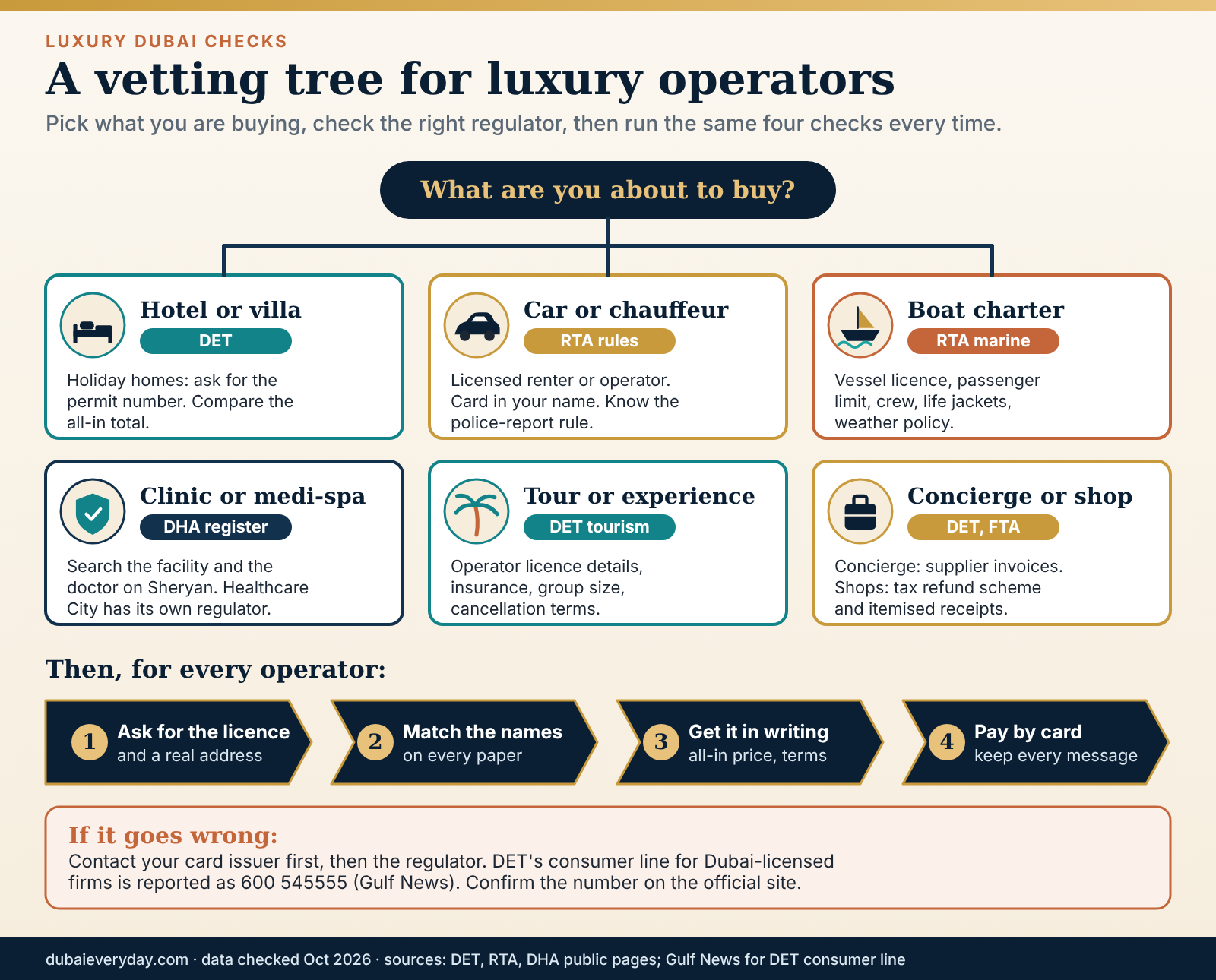
Where a public registry exists, use it. The DHA’s Sheryan directory covers clinics and doctors. For other services we found no public look-up on the pages we could read, so the test is whether the operator will show you a licence and a physical address, and whether the name on the licence matches the name on the invoice. If a firm is Dubai-licensed and a dispute arises, DET’s consumer-protection team handles complaints about Dubai-licensed businesses, per Gulf News, which gives its number as 600 545555.
What a concierge cannot do
A luxury Dubai concierge cannot create capacity that does not exist. A fully booked tasting room, a sold-out match or a closed hotel restaurant remains closed whatever you pay. They can sometimes use a relationship to find a cancellation, suggest an alternative or negotiate a better table, and that is where a good one earns its fee. They cannot waive laws, fines or licensing rules, and anyone who offers to do so is a risk to you.
Be sceptical of promises about “guaranteed” access to anything scarce, queue-skipping that involves breaking venue rules and prices that depend on a favour. If the explanation sounds like a favour, you are probably being asked to pay for something you cannot verify.
Scam patterns in luxury Dubai
- A villa, yacht or car listed far below comparable prices, with pressure to pay quickly.
- Payment requested by bank transfer to a personal account or in cryptocurrency, with no invoice.
- A “VIP ticket” resold at a markup with no confirmation from the organiser.
- A company that will not state its licence number or physical address.
- A deposit that is non-refundable with no written contract or terms.
Pay by credit card where you can, because it adds a dispute route. Keep every message and invoice. If something goes wrong, contact the card issuer promptly and then the relevant regulator. For wider consumer rights, the legal basics guide explains where to verify rules and which complaint channels apply to what.
Questions for your luxury Dubai hotel concierge on day one
- Which of your restaurants and facilities are operating this week?
- Which tables, tickets or slots can you request for me, and what lead time do you need?
- Which transfer and driver services do you recommend, and what are the prices?
- Is there any fee on top of the supplier’s price for bookings you arrange?
- Who do I call out of hours if something goes wrong?
When to book luxury Dubai: seasons, events and Ramadan
Timing changes both price and quality in luxury Dubai. The coolest months are the busiest, summer is the quietest, and the calendar is crowded with sport, trade shows and festivals that change hotel demand. Mean daily highs run from about 24°C in January to about 42°C in August, according to climate normals summarised from NOAA data, so the season shapes what is comfortable outdoors as well as what it costs.
In 2025 the city averaged roughly 80.7% hotel occupancy, per the figures the Dubai Media Office published. 2026 looked different: reported occupancy near 36% in March and 66% in August. We cannot say what the winter will look like, and the UK’s advice describes the region as unpredictable. Our reading, labelled as an inference, is that flexible rates are worth paying for this season even if the headline is slightly higher.
Dates worth knowing
The Dubai Shopping Festival runs from 4 December 2026 to 17 January 2027. Golf’s DP World Tour Championship is on 12 to 15 November, and the Dubai Marathon is reported for 17 January 2027.
The Dubai Duty Free Tennis Championships are on 14 to 27 February 2027, the Gulfood trade show is on 15 to 19 March, and the Dubai World Cup is on 27 March. Business events such as GITEX Global, reported for 7 to 11 December 2026, can tighten corporate hotel supply in their weeks. That last point is our inference, not a verified rate pattern.
Ramadan is expected to begin around 8 February 2027, with Eid al-Fitr around 9 or 10 March, subject to moon sighting. During Ramadan, daytime dining hours change and some venues alter their formats, so plan dining and spa times accordingly. The best time to visit Dubai guide explains the weather and crowd trade-offs, and month pages such as Dubai events in January and in February give details.
A booking order by lead time
Our judgement, not a verified rule: book the scarcest, least movable items first, the flexible ones last. Starred dinners, a boat for a specific evening and event tickets come before the hotel’s extras. Hotels can often be adjusted, and transfers and spa slots can be arranged closer to the date. Where a booking is non-refundable, wait until your flights are secure, because flight disruption has been a feature of 2026.
Three luxury Dubai plans with worked costs
The plans below show how the pieces of luxury Dubai fit together, and how the totals behave. Every figure marked “assumed” is an invented placeholder used to show arithmetic, not a market price or a quote. Figures with a source, such as the AED 1,350 tasting menu or the AED 900 private desert car, are labelled as listed on operator or marketplace pages and should be reconfirmed. Hotel figures follow the fee stack from earlier.
Plan A: three nights of luxury Dubai for a couple on a first visit
The brief: a city-and-sea long weekend with one headline dinner, one desert evening and a spa session. Our assumptions: a five-star room at AED 3,000 per night, two ordinary dinners at AED 700 each all-in, an AED 1,200 spa session for two and AED 1,500 for transfers and taxis.
- Hotel: AED 3,000 plus service charge AED 300 plus municipality fee AED 210 is AED 3,510. VAT adds AED 175.50, and the Tourism Dirham adds AED 20, giving AED 3,705.50 a night, or AED 11,116.50 for three. With the relief applied it is AED 3,465 a night, or AED 10,395.
- Headline dinner: two tasting menus at AED 1,350 each is AED 2,700, before drinks and any service or tax the restaurant adds.
- Two other dinners: AED 1,400, assumed. Private desert car at the listed AED 900. Spa AED 1,200, assumed. Transfers AED 1,500, assumed.
- Subtotal at the standard stack: AED 18,816.50. A 12% cushion adds about AED 2,260, for roughly AED 21,000 in all, or about AED 7,000 per night.
What this shows: the hotel is close to 60% of the total, so the most useful single action is to confirm the all-in room price and whether relief applies. The dinner is the biggest “decision” line, but it is not the biggest cost. A trip like this can run more smoothly with a short chauffeur block on arrival day and taxis after that. For the route and timings of a first visit, First Time in Dubai adds the arrival basics.
Plan B: a resident hosting a luxury Dubai birthday on the water
The brief: eight guests, an evening cruise and dinner, with a private chauffeur for the host. Using the illustrative charter from the yacht section, three hours cost AED 6,615 in total, including fuel, catering and VAT. Dinner for eight at an assumed AED 600 per head all-in is AED 4,800, and assumed transfers are AED 1,500, for AED 12,915. Per guest, that is about AED 1,614.
What this shows: the boat is a minority of the per-head cost if the group is large, and the cost per guest falls fast as the group grows. With four guests instead of eight, hire and fuel (AED 5,100 before VAT) would cost each guest about twice as much. The decision points are the cancellation policy and the weather rule, so read those before the price. For a resident’s budget view of daily life beyond a party, the cost of living guide is the companion read.
Plan C: a two-night corporate luxury Dubai visit with a client dinner
The brief: a senior visitor, one client dinner for six and a driver. Assumptions: a room at AED 2,500 a night. Our stack gives AED 2,500 plus AED 250 plus AED 175 is AED 2,925, VAT of AED 146.25 and a Tourism Dirham of AED 20 for AED 3,091.25 a night, or AED 6,182.50 for two. The client dinner at an assumed AED 5,000 all-in, a driver block at an assumed AED 2,000 and a concierge flat fee at an assumed AED 500 bring the total to AED 13,682.50.
What this shows: for corporate buyers, the invoice is part of the product. Ask for a consolidated VAT invoice in the company’s name and confirm the format in advance, because rebuilding receipts after a trip is slow. If the visit coincides with a major trade event, expect hotels to be tighter, which is an inference rather than a verified pattern. Make sure that the concierge’s fee and the supplier invoices are both visible.
Luxury Dubai mistakes and risks
Most luxury Dubai regrets come from a handful of avoidable habits. The decision table below puts the checks in one place, and the list after it covers the mistakes that cost the most.
| Area | Who to check with | What adds to the headline | Check before paying |
|---|---|---|---|
| Hotels | DET for hotel and holiday home permits | Service charge, fees, 5% VAT, Tourism Dirham AED 7 to 20 | All-in total, permit number for villas |
| Dining | The restaurant’s own page | 5% VAT, service at some venues | Open status, what the menu price includes |
| Cars | A licensed renter, RTA rules | Salik, admin fees, fines, excess | Card in your name, licence, police-report rule |
| Yachts | RTA marine, operator licence | Fuel, crew, catering, VAT | Vessel licence, capacity, weather policy |
| Shopping | FTA and the refund operator | 5% VAT, partly refundable | Registered retailer, itemised invoice, 90-day and 6-hour rules |
| Spas and medical | DHA register, DHCC in Healthcare City | Service charge, VAT, clinical fees | Facility and practitioner licence, consultation first |
| Experiences | DET tourism licensing | Season, group size, extras | Cancellation, safety briefing, weather rule |
| Concierge | DET consumer protection | Flat or percentage fee | Supplier invoices, card payment |
The luxury Dubai mistakes that cost the most
Booking from a photograph
Flagship rooms and restaurants are closed or restructured in 2026. Check the operator’s own page on the day you book, and book the version that is actually operating.
Comparing rates, not totals
A quarter on top of the headline is normal at a luxury hotel. Compare the all-in figure, the cancellation terms and what is included.
Paying by transfer or cash
Card payment gives a record and a dispute route. Transfers to personal accounts and large cash payments give neither.
A supercar for the whole week
A short, well-insured rental covers the experience. A week adds deposit risk, tolls and fines without adding much joy. A chauffeur is often the better value.
Four more are worth naming. First, leaving the tax refund to the last minute: the six-hour exit rule means validation at the airport needs time and original documents, and goods packed in checked luggage may not be available for inspection. Second, treating a medi-spa like a spa: injectables, lasers and IV services are medical, so check the licence. Third, accepting “guaranteed access” to something scarce. Fourth, forgetting heat: a midday outdoor plan in July is a plan to be uncomfortable, whatever the budget.
A fifth belongs to this year in particular. In 2026, flights and venues have been disrupted at short notice, so a non-refundable bundle booked far ahead without flexible flights and insurance is the riskiest way to buy. Flexible rates and cover that includes your itinerary cost a little more and protect a lot. This is general information; check your own policy’s terms.
FAQ: luxury Dubai questions answered
How much does luxury Dubai cost per day?
There is no verified single average, and any figure quoted without a source is a guess. What we can calculate is the multiplier. A five-star room’s headline rate can rise by about 25% once a 10% service charge, a reported 7% municipality fee, 5% VAT and an AED 20 Tourism Dirham are added, or about 15% while the 2026 relief applies. Dining, cars and boats are priced per booking and move with season. Our three sample plans show worked totals, with every assumed figure labelled, so you can replace them with your own quotes.
Is the Burj Al Arab open?
Not at the time of checking. Gulf News reported that the hotel closed in April 2026 for an 18-month restoration covering interiors, suites, restaurants and leisure facilities, with reopening expected in October 2027. Its restaurant Al Muntaha also appears in the 2026 Michelin Guide as temporarily closed. Dates can move, so check the hotel’s own site before planning around it. The Armani Hotel in the Burj Khalifa is also closed, with full reopening reported for March 2027.
Which luxury Dubai restaurants have three Michelin stars?
Two: FZN by Björn Frantzén and Tresind Studio, according to The National’s report on the guide announced on 6 October 2026. Four restaurants hold two stars, including Orfali Bros, which moved up from one, and fourteen hold one. Four of the one-star restaurants were listed as temporarily closed. Tresind Studio’s own site lists a tasting menu at AED 1,350 per person. Check each venue’s page for opening days, seatings and what the price includes before you book.
Is luxury Dubai safe to visit right now?
We are not a security assessor, so rely on official advice. UK travel advice updated on 27 October 2026 describes the regional situation as deeply unpredictable, with a high risk of sudden escalation, and warns of possible flight cancellations and airspace closures. Other governments have eased their advice since mid-June, per Khaleej Times. Read your own government’s current page, sign up for alerts, buy insurance that covers your itinerary and choose flexible bookings. Visitor numbers have recovered, but that is not a guarantee.
How much VAT can tourists get back on luxury Dubai purchases?
Dubai charges 5% VAT, and eligible tourists can claim most of it back. The refund operator keeps 13% of the VAT claimed plus AED 3.60 per tax-free transaction, per the Federal Tax Authority. You need at least AED 250 before VAT per transaction, a tourist-visa entry, original passport validation within 90 days of the invoice and an exit within six hours of validating. On an illustrative AED 10,500 purchase, you would receive about AED 431.40, roughly 4.1% of the price.
Can tourists rent a luxury car in Dubai?
Usually yes, with conditions. Mainstream operators set a minimum age of 21 or 25 depending on the car, require a licence held for a year or more, and take the deposit hold on a credit card in the renter’s name. Visitors may drive on a valid licence from a recognised country, otherwise an international permit is typically needed. Performance cars carry stricter terms that we could not verify for any specific fleet, so ask in writing about age, deposit and excess. Remember Salik tolls and fines, and that insurance usually needs a police report after an accident.
Do luxury Dubai hotels charge a tourism fee?
Yes. The UAE government portal states the Tourism Dirham is AED 7 to 20 per room per night depending on grade, capped at 30 consecutive nights, and reports of the scheme put five-star hotels at AED 20. In May 2026 Dubai exempted DET-registered establishments from collecting it as part of a relief package that runs for 3 to 12 months per initiative. Whether your hotel still waives it depends on its timeline, so ask for the total with fees stated.
How do I check a luxury Dubai yacht charter is legitimate?
Ask for evidence: the vessel’s operating licence for passenger charter and the authority that issued it, the passenger limit on that licence, the captain’s and crew’s qualifications, life jackets for all guests and passenger insurance. Get a written contract with the departure marina, hours, inclusions and the weather policy, and pay by card with a VAT invoice. We could not find a public operator look-up for private charters, so the test is whether the operator answers clearly. The RTA’s marine page lists vessel-hire services but no licensing detail.
How do I check that a luxury Dubai spa or clinic is licensed?
For medical treatments such as injectables, lasers and IV services, search for the facility and practitioner on the Dubai Health Authority’s Dubai Medical Registry (Sheryan). Clinics in Dubai Healthcare City are licensed by that zone’s own regulator. DHA standards require a face-to-face consultation before cosmetic procedures and limit what beauty therapists may do. A relaxation spa treatment such as a massage is a different category. This is general information, not medical advice; a licensed doctor should advise on any treatment.
Is tipping expected at luxury Dubai restaurants and hotels?
We found no official rule, so read the bill first. Hotel restaurants and some venues add a service charge of about 10%, as Gulf News explained in an older piece, and some menus say service is included. If it is, an extra tip is optional and usually reserved for something specific. If it is not, many diners add a modest amount for good service. Cash for individual staff is the most direct route. For a private chauffeur or boat crew, ask the operator whether gratuity is included in the quote.
What is the best time of year for luxury Dubai?
The cooler months, roughly late autumn to spring, are the most comfortable for beaches, boats, deserts and outdoor dining, and they are also the busiest. Mean daily highs run from about 24°C in January to about 42°C in August, so summer is quieter and indoor-led. Events such as the Dubai Shopping Festival from 4 December 2026 and the Dubai World Cup on 27 March 2027 add demand, and Ramadan is expected from around 8 February 2027. The best time to visit guide covers the trade-offs in detail.
Do I need a concierge for luxury Dubai?
Not for a simple trip, and your hotel’s concierge already covers most basics. A private concierge firm earns its fee on complex plans: several venues, a large group, last-minute changes or corporate invoicing. Before you pay, ask how they charge, request supplier invoices, check the licence and name on the contract and pay by card. A concierge cannot create availability that does not exist, and “guaranteed” access to something scarce is a warning sign. If something goes wrong with a Dubai-licensed firm, DET’s consumer-protection channel handles complaints.
Can I pay in cash for luxury Dubai purchases, and how much can I carry?
Cards are widely accepted at hotels, restaurants and malls, and card payments give you a record and a dispute route. The dirham is pegged at 3.6725 to the US dollar. Dubai Airports’ FAQ and Australia’s Smartraveller advice both cite a declaration threshold of AED 60,000 on entry. For large purchases such as jewellery, boats or villa rentals, avoid cash and bank transfers to personal accounts, and keep invoices that state the business name, address and VAT.
Related reading
Sources and further reading (20 links)
- UAE Federal Tax Authority: VAT Refund for Tourists — eligibility, AED 250 minimum, 13% plus AED 3.60 deduction, 90-day and 6-hour rules
- Dubai DET: Hospitality services and permits — hotel, holiday home and timeshare permits
- Dubai Media Office: AED 1.5 billion relief package — Tourism Dirham and sales-fee exemptions
- Dubai Media Office: 2025 tourism performance — 19.59 million overnight visitors, occupancy
- UK Foreign, Commonwealth and Development Office: UAE travel advice — update of 27 October 2026
- UAE Government Portal: Taxes in tourist facilities — Tourism Dirham AED 7 to 20, 30-night cap
- Roads and Transport Authority: Marine transport — ferry and water-taxi charters, abra charter rate, life-jacket rule
- Gulf News: Dubai landmarks reopening in 2027 — Burj Al Arab, Armani Hotel, Museum of the Future, Barasti
- The National: Michelin Guide Dubai 2026 results — stars, closures, new entries
- Gulf News: Michelin Guide Dubai 2026 explained — 122 restaurants, 38 cuisines
- Khaleej Times: foreign travel advisories easing — visitor numbers, advisory changes
- Gulf News: Salik toll timings — peak, off-peak and free hours; secondary, confirm with RTA
- Gulf News: car rental deposit refund rules — 30-day refund and complaint route
- Dubai Health Authority: Standards for Non-Surgical Cosmetic Procedures — licensing, consultation and scope rules
- Dubai Health Authority: Dubai Medical Registry (Sheryan) — professional and facility search
- Visit Dubai: Dubai Shopping Festival — 32nd edition dates
- Tresind Studio and Orfali Bros — operator-listed menu prices and seatings
- Khaleej Times: Atlantis pauses seven restaurants — context on paused hotel dining
- The Dubai Mall: About us — Fashion Avenue and mall hours
- The National: Ramadan 2027 expected dates — expected start around 8 February 2027
Update log: 29 October 2026 — first publication; all facts re-checked against the sources above. Next review due: by 28 January 2027, or sooner if a flagship hotel or restaurant reopens, fees change or official advice changes. Corrections welcome. This page offers general information, not individual legal, medical, tax or financial advice; prices and opening status change, so confirm with the operator before you book.
About DubaiEveryday and this guide
DubaiEveryday.com is an independent editorial project that publishes practical, research-based guides to everyday life in Dubai: where to live, what things cost, how the rules work and how to get around. This page was written and edited by the DubaiEveryday editorial team. It is not signed by a named expert, doctor, lawyer or adviser, and we do not claim first-hand testing of a venue, clinic or service unless the page says so.
Each guide is built from official sources such as government and regulator pages, operator websites and established news outlets, cross-checked where we can. When we could not confirm something, we say so in the text, and examples that use made-up numbers are labelled as illustrations. Mentions are editorial choices, not paid placements, and a link is not an endorsement.
Dubai changes quickly. If you spot something that is out of date or wrong, please tell us through the contact options on DubaiEveryday.com and we will check it and correct the page.