
Dubai has a reputation for tickets, but a surprising amount of the city costs nothing to enter: municipal beaches, heritage lanes, a free contemporary art centre, flamingo hides, skyline promenades and a calendar of public events. This guide to free things to do Dubai offers in autumn 2026 sorts them by what is genuinely free, what has a catch, and what it costs to reach them.
Dubai has a reputation for tickets, queues and prices that make your bank app wince. So it can feel odd to hear that a lot of the city costs nothing to enter.
It is true, though, and not only for a quick stroll. Free things to do dubai offers include municipal beaches, old heritage lanes, an art centre, flamingo hides and skyline promenades. Some come with small catches, like getting there or the heat. This guide sorts what is genuinely free from what only looks free, adds a dated list of events for the coming months and shows how to enjoy it all without spending your savings on taxis.
The free things to do Dubai does best are outdoors and public: the municipal beaches along Jumeirah and Umm Suqeim, the new Khor Al Mamzar beach, the Old Dubai lanes of Al Fahidi and Al Seef, the Ras Al Khor flamingo hides, the skyline promenades around Downtown and the Marina, and a run of free fitness and design events between 31 October and early December 2026. Indoors, the Jameel Arts Centre and the Alserkal Avenue district charge no entry that we could find.
The catch with the free things to do Dubai offers is that free admission is not free travel. A Metro journey costs AED 3 to 7.50, a paid roadside parking bay was reported at AED 4 to 6 an hour at peak times, and the heat from May to September makes most free things to do Dubai offers outdoors a dawn-and-dusk activity. Our calculation puts three genuinely free days, done by Metro, at roughly AED 32 to 61 in fares and card cost.
Use the winter months, from mid-November to March, if you can, because that is when free things to do Dubai wide are at their most comfortable. The rest of this guide to free things to do Dubai offers gives opening hours, access rules, a dated event list, costed itineraries and the mistakes that turn a free day into an expensive one.
This is desk research. DubaiEveryday.com has not walked these beaches, queued at these gates or sat in these hides, and nothing below describes a personal visit. Places are described in the neutral third person from the sources named.
Facts come from pages read on 29 October 2026: Dubai Municipality and the Dubai Media Office for beaches and protected areas, the Roads and Transport Authority for fares and timetables, Visit Dubai for the events calendar, the operators’ own pages for the Jameel Arts Centre and Dubai Fitness Challenge, and the UK government’s travel advice for conduct rules. Press reports from Gulf News, The National and Khaleej Times fill gaps and are labelled as press.
How the list of free things to do Dubai offers was built: an item qualifies as free if a visitor can enter without a ticket, a booking fee or a required purchase. Items with a small fee sit on a separate “nearly free” rung. We did not rank anything by popularity or by commission, no listing was paid for, and there are no booking links. Where a price, hour or date could not be confirmed, the text says so. This is general travel information, not legal or safety advice for your circumstances.
Free things to do Dubai offers in October 2026: the status board
Any list of free things to do Dubai publishes in 2026 needs a status check first, because the year has been uneven. Several attractions closed as a precaution in spring, and the city is now in the reopening-and-new-season phase. The notes below are not a list of attractions. They cover what changed recently and what that means for a free itinerary, as read on 29 October 2026.
What is open, changed or closed
The Khor Al Mamzar beach opened to the public in May 2026, with a 3.6 km swimming shoreline, 12 lifeguard towers and a 300 metre night-beach section described as operating 24/7. The municipality’s release does not state an entry fee, parking terms or day-time opening hours, so treat the free label as likely but confirm at the gate.
The Al Mamzar Corniche and its planned women-only beach were announced and well advanced in spring, but a Khaleej Times report in September 2026 still described the Corniche as not yet open. We list it as “not confirmed” rather than as an option.
In Old Dubai, Al Fahidi Fort is closed for restoration, and a September 2026 Euronews report says it is due to reopen with a new museum, with no date published. The neighbourhood around it is a different matter: the lanes are outdoors and walkable, so the closure removes one paid stop rather than the free walk.
The Museum of the Future announced a temporary closure from 1 September 2026, with a return in 2027 and no date. It was never among the free things to do Dubai lists, but it matters because many free-day plans in Downtown use it as the anchor. Skip it for now and build around the Burj Park and fountain side instead.
At Ras Al Khor, the Emaar flamingo guide notes that the Mangrove Hide is listed by Dubai Municipality as temporarily closed, while the Flamingo Hide and Lagoon Hide are the ones named for viewing. The Dubai Fountain is running its usual evening schedule, with a new look reported by Gulf News on 26 October 2026 after works.
Opening status in Dubai moves with the season, with renovation programmes and with events. For anything on this page that you plan a trip around, check the operator or Dubai Municipality channel on the morning. The municipality’s contact line, 800900, is listed on its beaches page.
How to read the rest of this page
Each section of this guide to free things to do Dubai offers opens with what is free, then gives the catch, then the transport reality. If you only have a day, jump to the itineraries. If you are choosing between neighbourhoods, the decision table does it in a minute.
This page covers only the free things to do Dubai has. For the whole picture, including paid attractions and how to prioritise them, read our guide to the best things to do in Dubai, and for the hot months pair this page with the indoor things to do in Dubai guide.
What counts as free, and the ladder from AED 0 to AED 30
In lists of free things to do Dubai publishes, “free” is a slippery word in a city built around ticketed experiences. For this guide it has a strict meaning: you can walk in, sit down or watch without paying for admission, and nobody asks you to buy something first. That excludes the usual traps, such as a “free” entry that depends on spending AED 100 in a restaurant, or a viewing area that is public in theory but only reachable through a paid car park.
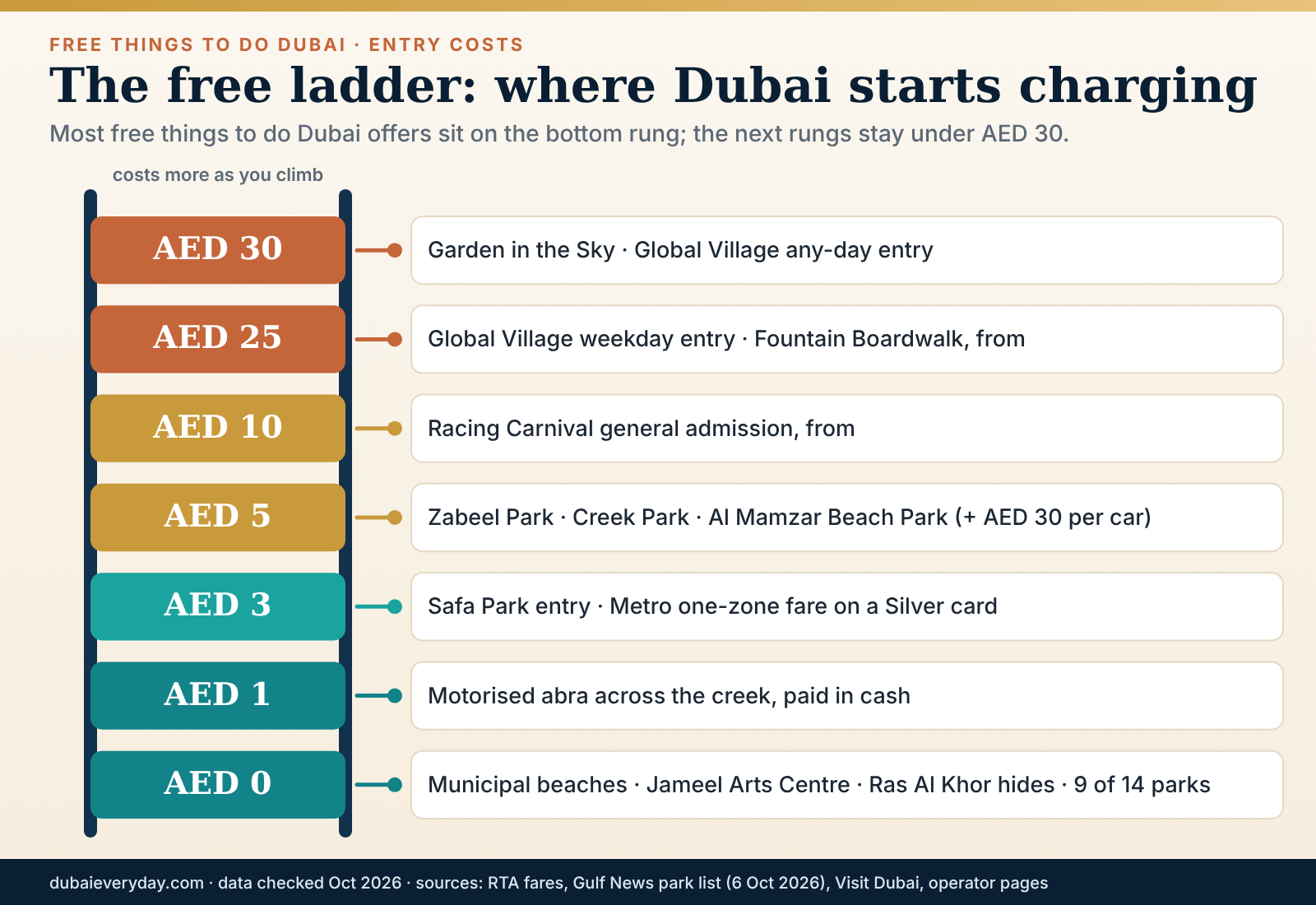
Three tiers cover almost all the free things to do Dubai offers in this guide. The first is plainly free: beaches, public squares, waterfront promenades, the Jameel Arts Centre, the Ras Al Khor hides and nine of the fourteen parks in the Gulf News list. The second is free with a catch: the place costs nothing to enter, but reaching it or staying costs something. Parking, Metro fares and a required registration all land here. The third, the “nearly free” rung, charges AED 1 to 30 and is worth knowing about because it buys a lot.
Free with a catch: the four hidden costs
For free things to do Dubai offers, the catch is nearly always one of four things. Getting there is the first, covered in detail in the transport section. Parking is the second: on-street bays are metered on most days, and mall parking is free only for a limited number of hours. Time is the third, because evening shows and sunset spots cluster in the same hour and the queues for Metro and taxis do too. Registration is the fourth, which applies to mass-participation events such as Dubai Ride.
There is also a fifth catch that travellers feel most: heat. The free things to do Dubai offers outdoors in July have a cost in discomfort that no ticket price captures. The season section later turns that into a month-by-month view.
What we left out on purpose
Three kinds of listing appear on many lists of free things to do Dubai publishes and are excluded here. The first is anything that needs a ticket, such as the Dubai Frame (about AED 52.50 on marketplace listings) or a Burj Khalifa deck (from around AED 161 on a marketplace; the operator page was not readable).
The second is free-to-enter places that only make sense with a paid add-on, such as a mall where the interest is a paid attraction. The third is anything whose current access we could not confirm, which is why the Hatta area gets only a short note instead of a ranked entry: the official Visit Hatta page lists transport and seasonal activities but gives no entry details for free sights.
If you want the paid side, our Dubai travel guide sets out what each attraction type costs, and the first time in Dubai plan shows where free items fit around bookings.
Free things to do Dubai has on the coast: public beaches
If you ask which of the free things to do Dubai can do for a whole day, the answer is the municipal beach. Dubai Municipality’s own beach page states that its public beaches do not charge an entrance fee, apart from fees for services you choose to request, and gives a line for enquiries on 800900. That sentence carries a lot of weight: it means a sea swim, a walk on sand and a sunset cost nothing in admission.
This section summarises the free things to do Dubai has on the sand. For facilities, showers, parking bays and lifeguard detail beach by beach, our guide to free public beaches in Dubai goes deeper, and the wider comparison with paid beach clubs and hotel sand sits in best beaches in Dubai. Families choosing between them should read the family beaches guide as well.
The coast in order, from Al Mamzar to the Marina
The geography is simple once you see it as one line. Heading south-west from the creek, the municipal beaches run in numbered sequence: Jumeirah 1, 2 and 3, then Umm Suqeim 1, 2 and 3, with the Burj Al Arab beyond. Past the Palm and the Marina sits the JBR waterfront, which has its own access rules. In the opposite direction, past the creek and towards the Sharjah border, lie Al Mamzar and the newer Khor Al Mamzar.

Jumeirah and Umm Suqeim: the municipal strip
The five numbered beaches between Jumeirah 1 and Umm Suqeim 2 are the backbone of the free things to do Dubai offers on the coast. Municipal pages for these beaches describe lifeguard towers, public facilities and accessibility corridors, with daytime hours generally given as sunrise to sunset. Jumeirah 1 was rebuilt and reopened in 2026 according to press coverage, with lockers and a larger footprint, though the details come from the press, not a municipal page.
Umm Suqeim 1 is the beach many visitors know as Kite Beach. That mapping is our reading, not an official statement, so confirm before you navigate by it. If your priority is the view of the Burj Al Arab from the sand, the Umm Suqeim end of the strip is where that view is framed best, and the evening light on it is why the beaches fill up at sunset. A paid tour of the hotel’s interior starts at AED 249 (Visit Dubai Experiences); standing on the beach costs nothing.
What you will not find on most of these stretches is a long list of free amenities. Municipal pages mention public facilities, though we have not confirmed what each beach offers. Food and kit hire are commercial and priced accordingly. Bring water, a towel and shade, and treat any kiosk price as a convenience premium.
Night swimming: three municipal beaches and one new one
Dubai Municipality announced night swimming at Jumeirah 2, Jumeirah 3 and Umm Suqeim 1 as part of its beach tourism expansion, with the floodlit sections marked off from the rest of the sand. Khor Al Mamzar then added a 300 metre night section that its opening release describes as operating 24/7. Reports disagree on the closing time at Umm Suqeim 1: one says the night zone runs to midnight, while the lifeguard pages say sunrise to sunset.
That conflict matters because the rule outside the night zones is simple: swimming after sunset is not allowed. In winter, sunset falls around 17:30 on our calculation, so a swim after work is a night-zone swim or no swim at all. Check the posted signs and flags on arrival; they overrule any web page, including this one.
Sunset times, our calculation. For Dubai (25.2 N, 55.3 E), sunset is about 17:32 on 15 November, 17:31 on 15 December, 17:49 on 15 January and 19:10 on 15 June. Those figures come from a standard solar-position calculation, not an official timetable. They tell you roughly how long the legal swimming day is at each end of the year.
Al Mamzar and Khor Al Mamzar are not the same thing
Two names that look alike are worth separating. Al Mamzar Beach Park is a ticketed park with beaches, lawns, swimming pools and chalets: the Gulf News park price list shows AED 5 per person and AED 30 per car, with pools at AED 10 for adults and AED 5 for children and daily hours from 08:00. It is cheap, but it is not free.
Khor Al Mamzar is the municipal beach opened in May 2026. The Dubai Media Office release lists 20 public facilities, 19 food and beverage outlets, a floating walkway, beach volleyball, padel courts, an outdoor gym and more than 5.5 km of running, walking and cycling tracks. It states no fee and no day-time hours. Our reading is that it follows the municipal free-beach model, but until a gate sign says so, this guide keeps a “confirm at the gate” label on it.
For a family with small children, the 12 lifeguard towers and 12 emergency call points reported at Khor Al Mamzar are the detail that stands out. For a runner, the 5.5 km of tracks are the draw. We could not confirm a direct Metro link, so plan on a taxi or a drive and check parking on arrival.
JBR: free sand, paid parking
The JBR beachfront is one of the free things to do Dubai offers without a gate, and the Marina and JBR area is easy to reach without a car. The Beach’s own FAQ gives the parking rate as AED 20 per hour, with the first three hours free when you present a validated bill of AED 100. That is the classic “free with a catch” structure: you can walk on to the sand and promenade at no cost, but arrive by car and the arithmetic changes.
The better answer is the tram. The Dubai Tram links to the Metro at the Sobha Realty (R36) and DMCC (R37) stations, runs Monday to Saturday 06:00 to 01:00 and Sunday 09:00 to 01:00, and reaches the JBR area without parking. Our Dubai Marina guide covers the district itself, and the Palm Jumeirah guide explains why the Palm’s beaches belong in a different, mostly resort-controlled, category.
Flags, lifeguards and rules in a paragraph
The municipal flag system, which applies across the free things to do Dubai has on the sand, is straightforward: red means unsafe, yellow means caution, and purple warns of harmful marine life, as reported from Dubai Municipality’s own posts. The rules published on the municipal content portal prohibit pets, barbecues and fires, shisha, overnight stays and swimwear in passageways, and restrict photography of other people. Lifeguards are normally on duty from sunrise to sunset only. A swim outside those hours is a swim without cover.
The UK government’s current travel advice for the UAE adds an important legal point: photographing people without permission, including on beaches, has led to arrests, and swimwear belongs on the beach or by the pool, not in the street. We cover the dress question in more detail in the rules section and in the Dubai dress code guide.
Our reading of the data. Of the free things to do Dubai has on the coast, the lowest-friction choice for one beach day is a municipal Jumeirah beach reached by taxi in the morning, with a return by taxi or ride-hailing in the afternoon. Taxi fares were not readable on the RTA page, so we give no price; use the meter or the app estimate. If you are staying near the Marina, the tram route to JBR is cheaper than parking. For most visitors, the beach is the cheapest full day among all the free things to do Dubai offers.
Free heritage in Old Dubai: Al Fahidi, Al Seef and the creek
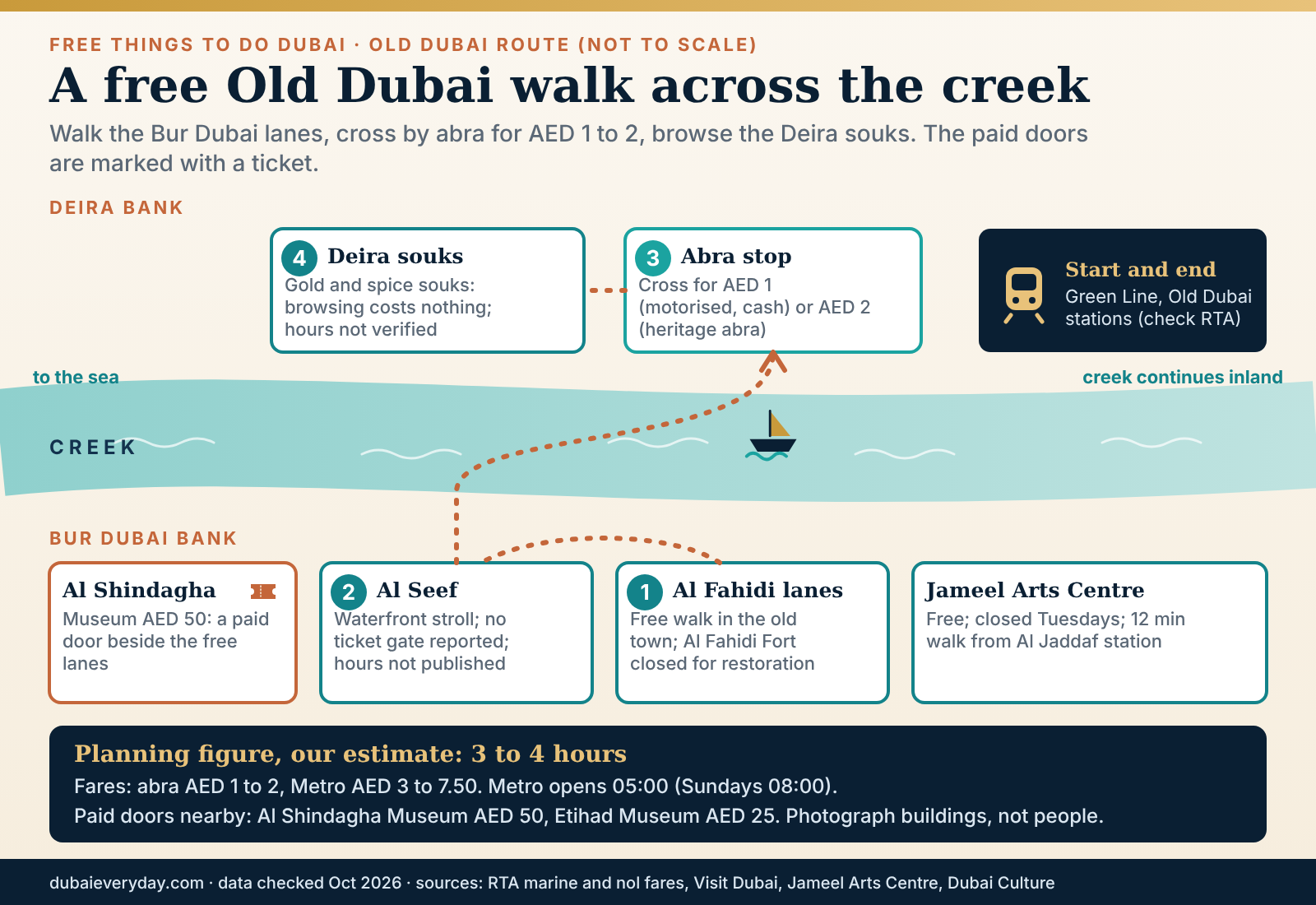
Among the free things to do Dubai visitors skip in favour of towers, the Old Dubai circuit offers the best return per dirham. The creek splits the old city into Bur Dubai on one bank and Deira on the other. Walking the lanes, crossing by abra and browsing the souks costs nothing in admission, and the only unavoidable spend is a one-dirham boat ride.
The Visit Dubai page for the Al Fahidi Historical Neighbourhood describes a restored old town in Bur Dubai with wind-tower buildings, galleries and museums, listed under history and heritage. It does not publish opening hours or fees for individual venues, which tells you something useful: the lanes themselves are a public walk, and the paid and ticketed parts are separate doors inside it.
The Al Fahidi lanes
Plan this neighbourhood, like most free things to do Dubai offers in the old town, as a walk rather than a list of stops. The built form is low, the lanes are narrow and shaded in places by the buildings, and the wind towers that give the district its look are best appreciated from street level. The interest is architectural and atmospheric, not a set of must-see exhibits, which is why our recommendation is early morning or late afternoon rather than midday.
Galleries and cafes inside the district set their own hours and prices, so the sensible plan is to treat anything you step into as an optional purchase. Walking past costs nothing, which is the point of the free things to do Dubai has in this district. The neighbourhood’s best-known fort is a closed item for now: Al Fahidi Fort is under restoration, with a reopening reported by Euronews in September 2026 but no date.
If you want a paid museum in the same part of town after the free walk, the Al Shindagha Museum charges AED 50 for an individual adult ticket, and the Etihad Museum in Jumeirah charges AED 25, according to Dubai’s 2024 administrative resolution on fees. We could not confirm the Etihad Museum’s current opening hours, so check before you plan around it.
Al Seef and the waterfront
Visit Dubai describes Al Seef as a place that mixes souk-style shopping with cafes on the creek, with heritage-inspired streets, boutique shops, waterfront restaurants and creek views. Nothing we read mentions a ticket gate for the streets or the waterfront, though the restaurants and shops clearly charge. The page gives no opening hours and does not say the walk is free, so treat it as an open-air stroll to confirm on arrival, and go when the light is good.
The useful fact is the transport link. The RTA’s marine page lists a heritage abra service between Al Seef and Baniyas at AED 2, with the standard motorised abra at AED 1 cash. That makes Al Seef the natural turning point: walk the Bur Dubai side, cross the creek, and come back by Metro from the Deira side.
Crossing the creek by abra
The abra is the cheapest boat ride in the city and one of the few that is part of ordinary public transport. The RTA’s marine fare list shows AED 1 for the motorised abra paid in cash, AED 2 for the heritage abra on the Al Seef to Baniyas run, and AED 2 for the air-conditioned abra between Al Jaddaf and Festival City. Water taxis start at AED 7 for a single segment.
Practical points: carry coins, expect to queue at busy evening hours, and note that the RTA’s marine page also mentions life jackets for children under 12 on its services. The abra is also the one place on this route where you will notice the heat, because the crossing is open to the sun.
The Deira souks
Across the water, the Deira side is the traditional trading quarter. Wikipedia’s entry for the Dubai Gold Souk, which is a secondary source, cites more than 380 retailers and notes renovation plans dating from 2024. We could not find an official timetable or a current renovation status, so do not plan a visit around a specific opening hour without checking on the day.
Browsing counts among the free things to do Dubai offers, and nobody is obliged to buy. Bargaining is widely described as customary in the souks, though prices in fixed-price shops will not move. Photograph shop goods rather than people unless you ask. The legal point from the UK government’s travel advice is that photographing people without permission can lead to arrest, which is a good reason to keep the camera pointed at gold, spice sacks and lanterns.
Our planning figure. Allow three to four hours for the Al Fahidi lanes, Al Seef, the abra crossing and a souk loop at a walking pace with stops. This is our estimate for planning, not a measured route time. Start early and finish by early afternoon in any month from April to October.
Getting there by Metro
The Green Line serves the Old Dubai side of the city. The interchange at BurJuman connects with the Red Line, the Union station is the other interchange, and Al Ghubaiba sits at the Bur Dubai end of the creek corridor. Fares are AED 3 for one zone, AED 5 for two adjacent zones and AED 7.50 for more, on a Silver nol card, and the Metro runs 05:00 to midnight on most days (Friday to 01:00, Sunday from 08:00). See our Green Line guide for the Old Dubai stops and the Dubai Metro guide for fares and cards.
For the paid layer of Old Dubai, including museums, read the mix of paid and free stops in our things to do in Dubai guide.
Free art, libraries and indoor spaces
Most lists of free things to do Dubai offers stop at beaches and fountains. The indoor end is smaller but real, and it matters in summer, when the free outdoor list shrinks to a few early-morning and after-dark hours. Three venues stand out in our sources, and each has a different catch.
Jameel Arts Centre: free, with a Tuesday gap
Of the free things to do Dubai offers under a roof, the Jameel Arts Centre is the clearest case. Its visit page describes the centre as open-access and free for all, with visitors asked to check in at the Welcome Desk. Hours are 10:00 to 20:00 daily except Tuesday, when it is closed, and Fridays run 12:00 to 20:00. It sits at Jaddaf Waterfront on the Bur Dubai bank of the creek, between the Business Bay Bridge and Garhoud Bridge.
Getting there is straightforward on paper: the centre’s page puts it about a 12-minute walk from Al Jaddaf station on the Green Line, and says parking is available outside, next to its shop. In summer, that 12-minute walk is the hard part; a taxi for the last stretch is a sensible spend. The programme changes, so check what is on before going. Among free things to do Dubai offers indoors, the permanent free entry is the useful fact for a visitor who wants air conditioning and substance rather than another mall.
Alserkal Avenue: a district, not a gallery
Alserkal Avenue is a warehouse district of galleries, studios and cafes, and a candidate for free things to do Dubai offers indoors, with caveats. Its own site lists opening hours of 10:00 to 19:00 daily and publishes no district entry fee. That is a weaker claim than “free”, because individual venues inside can run ticketed events or workshops. Our reading: you can walk the district and look at most gallery spaces without paying, but check each venue’s door sign, and expect café prices to be those of a design district.
Alserkal’s own visit page gives the nearest Metro station as Onpassive (formerly Al Safa), about a five-minute taxi ride away, and says parking inside the Avenue is restricted, with more than 500 RTA spaces nearby. Station names change, so check the RTA planner. Pair it with the Jameel Arts Centre for a full art day if you do not mind a taxi between them. The combination covers a contemporary art museum and a commercial gallery district, which is a rarer pairing in free listings than another beach.
Mohammed Bin Rashid Library: hours confirmed, fee not
The Mohammed Bin Rashid Library’s visitor page gives hours of 9:00 to 21:00 Monday to Saturday, with Friday opening at 14:00, and says it is closed on Sundays. It says visits do not require a reservation and that children aged five and over may enter. The page does not say whether entry is free, so we cannot call it a free option. If the visit matters to you, confirm admission with the library before you travel.
Malls as free shade, with the parking catch
Malls are the pragmatic summer answer among free things to do Dubai offers. Walking in costs nothing, and the Dubai Mall’s own page lists retail hours of 10:00 to 23:00 Monday to Thursday and 10:00 to midnight Friday to Sunday, with the supermarket from 07:00. Its parking is free for the first four hours on weekdays and the first six at weekends, then steps up from AED 20 for the fifth weekday hour.
That structure makes a mall a perfectly good free afternoon if you stay inside the free-parking window, and an expensive one if you drift past it. For more depth on the largest of them, see the Dubai Mall guide, and for the wider cost picture of a shopping day the Dubai shopping guide. The indoor things to do guide covers the paid indoor attractions that this page deliberately leaves out.
A summer-proof list of free things to do Dubai offers indoors
- Jameel Arts Centre, 10:00 to 20:00 except Tuesday, a short taxi from Al Jaddaf station in heat.
- Alserkal Avenue galleries, 10:00 to 19:00, with air-conditioned gallery interiors and shaded courtyards.
- Malls inside the free-parking window or reached by Metro, where the walkway to the Dubai Mall from the Burj Khalifa/Dubai Mall station is air-conditioned (820 m, per 2012 reports).
- Early-morning or after-dark outdoor walks, using the sunrise and sunset table in the season section.
Free views: skyline, fountain and sunset spots
The skyline is the city’s most photographed asset, and the best viewing positions are often public ground. The price gap is stark. A Burj Khalifa deck ticket is listed from AED 161 on a marketplace, and republished operator rates in a May 2026 report show AED 173 off-peak and AED 250 in prime late-afternoon slots for levels 124 and 125, rising to AED 400 and AED 554 for level 148.
Those are secondary figures and the operator’s own page was not readable, so confirm before you book anything. The free alternative is to look at the tower from outside.
The free things to do Dubai offers with a skyline view come down to three zones: Downtown around the Dubai Fountain, the sunset coast near the Burj Al Arab, and the water edge at Dubai Creek Harbour. Our Downtown Dubai guide covers the district in detail; here we stay with the free parts.
The Dubai Fountain from the promenade
Emaar’s reopening guide gives the show schedule: afternoon performances at 13:00 and 13:30 from Saturday to Thursday, 14:00 and 14:30 on Friday, and evening shows every 30 minutes from 18:00 to 23:00 every day. It names the Waterfront Promenade at Dubai Mall as the classic spot, the Souk Al Bahar terraces as the dining option, Burj Park as the calmer one with the tower as backdrop, and the Dubai Fountain Boardwalk as a separate floating walkway.
The Visit Dubai page lists the boardwalk from AED 25 and lake rides from AED 73. Neither page states in so many words that watching from the public promenade is free, but the paid options are sold as separate products, which suggests the public promenade itself is not ticketed. Our reading: stand on the public side and you pay nothing; step on to the boardwalk and you pay.
Gulf News reported a new look for the fountain on 26 October 2026 after works, and the Emaar guide referred to a second renovation phase scheduled for the second quarter of 2026. Allow for programme changes; of all the free things to do Dubai offers in the evening, this is the one with the most moving parts.
Timing logic, our calculation. In mid-November sunset is about 17:32, so the first evening show at 18:00 falls roughly half an hour after sunset, when the sky is in blue hour. In mid-June, with sunset at about 19:10, shows from 18:00 to 19:00 happen in full daylight and the water-and-light effect is weaker. If the show is your reason to visit, winter is the better season.

Burj Park
Burj Park is the green space beside the tower and the one place in Downtown where you can sit down without ordering anything, which makes it one of the free things to do Dubai Downtown offers without a ticket. A Property Finder guide from January 2026 reported free entry from 08:00 to 23:00 daily. That is a secondary source, so a confirmation on the day is sensible, particularly around major events when the park can be fenced for ticketed viewing.
New Year’s Eve is the clear example. For 2025 into 2026, The National reported road closures from 16:00, Metro station entry closed from 17:00 at Downtown stations, free viewing zones opening from 17:00, and a ticketed Burj Park zone at AED 997.50. The 2026 to 2027 arrangements had not been published at 29 October 2026, so treat last year’s pattern as a warning rather than a plan.
The sunset coast
The Umm Suqeim end of the municipal beach strip faces the Burj Al Arab, and the sunset there is among the free things to do Dubai offers as an alternative to a paid sunset experience. As the section on beaches noted, the night sections at Jumeirah 2, Jumeirah 3 and Umm Suqeim 1 extend the evening after the legal swimming day ends. For a view without getting wet, the beach itself is enough.
The hotel’s own tour starts at AED 249 for 90 minutes, according to Visit Dubai Experiences. That buys the interior; the exterior photograph is free. Arrive at least 30 to 45 minutes before the sunset time in the season section, because parking, not the sand, is what fills first. The best time to visit Dubai guide has the wider weather picture.
Creek Harbour and the Marina
The Emaar flamingo guide names the Harbour Promenade and The Viewing Point as places to walk and look at Dubai Creek Harbour, but does not say whether any are free, so we leave them as “check”. The Marina is easier: it is a waterfront district with public walkways, tram access, and open views of the towers. Nothing in our sources suggests a gate or admission charge for walking there, though the restaurants and boat trips clearly cost money.
Two cautions apply to views generally. Drone flying is regulated by the General Civil Aviation Authority and the rules were tightened in January 2025, with recreational use under review, so do not fly one without checking. And some government buildings and military sites cannot be photographed, according to the UK government’s travel advice, so keep a long lens off anything with a guard post.
Free walks, cycling tracks and parks
Walking is the most undersold of the free things to do Dubai residents actually do. The city is hostile to walking from 11:00 to 16:00 for much of the year, but the cooler months and the early and late hours reward it. The options fall into waterfront promenades, parks and dedicated tracks.
Waterfront promenades
The Dubai Water Canal is described by Wikipedia as 3.2 km long and cuts through the Downtown and Business Bay side of the city. The Marina Walk runs round the Marina basin. Khor Al Mamzar’s opening release mentions more than 5.5 km of running, walking and cycling tracks. None of these free things to do Dubai offers on the water has a published ticket gate in our sources. All are worth treating as open-air routes with intermittent shade, and the commercial frontage along the Marina and the Canal means coffee is never far away, at a price.
Our Marina guide and Downtown guide cover the surrounding districts, while Palm Jumeirah is mostly a drive-and-resort district rather than a free-walking one.
The park list, priced
Gulf News published a park price list on 6 October 2026. Its general notes say most parks open at 08:00 and close at 22:00, staying open later at weekends, and that children aged two and under and People of Determination usually enter public parks free. The detail by park is more useful to a visitor.
Free entry
Al Nahda Pond Park, Al Qusais Pond Park, Quranic Park (small separate fees for the Cave of Miracles and Glass House), Al Sufouh Park, Al Barsha Pond Park, Al Ittihad Park (open 24 hours, free parking), JLT Park, Dubai Hills Park (day pass for rides and attractions from AED 55 to 85) and Town Square Park (separate fees for rides).
Small entry fee
Safa Park at AED 3, Mushrif National Park at AED 3 plus AED 10 per car, Zabeel Park at AED 5, Creek Park at AED 5, and Al Mamzar Beach Park at AED 5 plus AED 30 per car.
What the numbers say
Nine of the fourteen parks listed are free to enter. The five that charge cost AED 3 to 5 for a person on foot. A car adds AED 10 at Mushrif and AED 30 at Al Mamzar, so how you arrive matters more than the ticket.
Of the free group, and of all the free things to do Dubai has for walkers, Al Ittihad Park is the standout for walkers: the Gulf News entry lists a 3.2 km jogging track, labelled native plants, nearby cafes, free parking, and 24-hour opening. Al Barsha Pond Park offers three shaded playground zones, a large pond and cycling paths. Both are residential parks, not tourist destinations, which is exactly why they feel like the city rather than a postcard.
Families should note that Dubai Hills Park and Town Square Park charge for specific rides and splash areas even though entry is free, so the “free park” can still lead to a paid afternoon, a common way free things to do Dubai offers families end up costing money. Our Dubai with kids guide covers the logistics of children, strollers and heat.
Cycling tracks and mass rides
RTA’s cycling page describes a network of about 560 km with a target of 1,000 km by 2030. It lists Al Qudra, Seih Al Salam, Meydan, the Dubai Canal, the Marina and Jumeira Street among the tracks, and park loops such as Mushrif at 4,000 m and Quranic Park at 3,200 m. Speed limits are 20 km/h on urban tracks and 30 km/h on amateur tracks. Helmets and reflective jackets are advised, bicycles are banned on roads above 60 km/h, and folding bikes are allowed on the Metro.
Using the track is among the free things to do Dubai offers cyclists. Hiring a bike is not, and we have no verified rental prices, so we give none. If you want a free group ride instead, Dubai Ride on 1 November 2026 is free with registration: rides start at 06:15, the gates close at 07:30, and Sheikh Zayed Road reopens at 08:15, according to The National. Helmets are required and scooters are not allowed.
Running and sport
The same logic applies to running among free things to do Dubai offers: tracks cost nothing, events need registration. The Dubai Run on Sunday 22 November uses Sheikh Zayed Road for 5 km and 10 km routes starting at 06:30, with the road reopening at 09:00. The Dubai Sports Council’s 2026 to 2027 calendar lists more than 500 events and is free in the DubaiNow app. For the wider sports scene, see our Dubai sports guide.
Free wildlife: Ras Al Khor and the flamingo season
One of the more surprising free things to do Dubai has is bird-watching, a few kilometres from the tallest buildings in the world. The Ras Al Khor Wildlife Sanctuary, a protected wetland on the creek, runs public observation hides. Emaar’s flamingo guide, published on 23 October 2026, states that access to the public hides is free. Dubai Municipality’s own visitor page does not state a fee either way, so the Emaar statement is the only explicit one we found.
Hours, seasons and which hides are open
Dubai Municipality gives two seasonal schedules: 07:30 to 17:30 in winter (October to March) and 06:00 to 18:00 in summer (April to September). The winter season is when migratory birds, including greater flamingos, arrive in numbers, which is why Emaar published its guide in late October.
Emaar names the Flamingo Hide, overlooking the wetlands where the birds feed, and the Lagoon Hide, with open-water views over wading birds and birds of prey. The Mangrove Hide is described as temporarily closed by the municipality. Do not plan around it.
Light and gate times, our calculation. Mid-November sunrise in Dubai is about 06:36, but the winter gate opens at 07:30. The soft first hour of light the guides recommend for photography is over before you can get in. Aim to be at the gate when it opens rather than expecting a pre-dawn session.
Hide etiquette and rules
Like most free things to do Dubai offers in protected areas, the hides come with specific rules. The hides are a quiet zone where phones, pets, food, drinks and smoking are not allowed. Only 15 people may be inside a hide at a time. Visitors should not sit on the window plank, rush or push, and should give priority to People of Determination. Stay behind “No Entry” signs and fences, park only in designated areas, and do not approach, feed or harm wildlife; heavy fines and legal action are possible.
Practical kit follows from that: binoculars or a telephoto lens, because the birds may be far from the glass, plus patience. The municipality page does not give directions. It points to the Makani addressing app and a location map on its protected-areas pages, so use those for navigation. We did not find a Metro route to the sanctuary in our sources, so plan on a taxi or a drive and confirm the parking before you set off.
Nearby, and what is not covered
The Emaar guide also names the Harbour Promenade and The Viewing Point at Dubai Creek Harbour for walking and city views, and does not say whether they are free. We list them as unconfirmed. We did not read official pages for the Al Marmoom reserve or the Al Qudra lakes, so we do not describe access, fees or rules there. RTA does list Al Qudra among the cycling tracks, which tells you the track exists, nothing more.
For readers who want a wildlife day with paid add-ons nearby, the things to do in Dubai guide covers the Dubai Safari Park and other ticketed options. The free flamingo trip is, by contrast, a short, cheap morning, and few free things to do Dubai has are as seasonal, so check the dates.
Free events: a dated calendar for November 2026 to March 2027
The free things to do Dubai offers multiply from late October because the city’s public-event season starts. This section lists the free or nearly free events with dates we could find, and is explicit about which dates are firm. For the full event picture, including ticketed festivals, sports and concerts, use our Dubai events calendar guide, with the month detail in Dubai events in January and Dubai events in February.

The dated dataset
| Event | Date | Free part | Catch | Basis |
|---|---|---|---|---|
| Dubai Fitness Challenge, 10th edition | 31 Oct to 29 Nov 2026 | Free classes; free registration; three free Fitness Villages reported | Account sign-up; some events outside Dubai (Hatta) | Official site; Dubai Media Office |
| Dubai Ride | Sun 1 Nov 2026 | Free ride on Sheikh Zayed Road | Register; helmet; gates close 07:30 | The National |
| Dubai Design Week | 3 to 8 Nov 2026 | Festival entry reported free by one travel blog; the official page does not state it | Downtown Design (4 to 8 Nov) is ticketed, AED 80 a day per the blog | Official dates; blog for prices |
| Dubai Racing Carnival | From 6 Nov 2026 to 12 Mar 2027 | Not free: general admission from AED 10 | Nearly-free rung | TicketNews |
| Dubai Run | Sun 22 Nov 2026 | Free 5 km and 10 km on Sheikh Zayed Road | Register; 06:30 start | The National (Aug 2026) |
| National Day holiday | Expected 2 to 3 Dec 2026 | Programme not published | Holiday dates not confirmed | Gulf News |
| Dubai Shopping Festival, 32nd edition | 4 Dec 2026 to 17 Jan 2027 | Programme not yet published | Confirm which elements are free | Visit Dubai; TradeArabia |
| New Year’s Eve | 31 Dec 2026 | Free viewing zones were used in 2025/26 | 2026/27 plan unpublished; ticketed zones exist | The National (last year) |
| Ramadan 2027 | Expected from about 8 Feb 2027 | Evening atmosphere, not an event | Opening hours change; conduct rules | The National; Khaleej Times |
Three reading notes on this dataset of free things to do Dubai events. First, the dates for the Dubai Fitness Challenge come straight from the official site and the Dubai Media Office, while Dubai Ride and Dubai Run dates come from press.
Second, the Dubai Design Week dates are on the official site, but the “free festival entry” and ticket prices are from a travel blog updated on 29 October 2026, because the official page we read does not state them, so confirm. Third, “expected” means projected by an astronomy centre or a press explainer and not yet confirmed by a formal announcement.
Dubai Fitness Challenge: the engine of the autumn calendar
The challenge is a 30-day, 30-minutes-a-day programme running 31 October to 29 November. The official site lists Dubai Ride, Dubai Stand Up Paddle in Hatta, Dubai Run and Dubai Yoga among its flagship events and labels free classes. Gulf News reported three free Fitness Villages and more than 23 community hubs, and the site says registration goes through an account login. It does not say whether individual events need a separate sign-up, so register early and read each event page.
A visitor does not have to be a runner to use these free things to do Dubai events. The classes and villages are among the few structured free things to do Dubai offers to people who are not residents. The catch is that the stand-up paddle event is in Hatta, a long trip from the city. Our Dubai sports guide covers the permanent options for people who want more than a month.
How to find free events yourself
Visit Dubai’s calendar page groups events as family-friendly, live entertainment and sports, and includes a “Free” filter. The list view carries no dates or prices, so you have to open each event page. We also found the Dubai Sports Council’s 2026 to 2027 season calendar, launched on 20 October 2026 with more than 500 events, offered free in the DubaiNow app.
A practical routine for finding free things to do Dubai events list: filter the Visit Dubai calendar by “Free” and your dates, open any hit, and look for a registration or ticket step. If the event page shows ticket tiers with a zero tier, you have a free option. If it only says “free entry” in a press story, find the organiser’s own page.
The catches that cost people their morning
Mass events close roads, which is the main hidden cost of free things to do Dubai offers in November. Dubai Ride closes Sheikh Zayed Road to traffic until 08:15, and Dubai Run reopens it at 09:00. Metro hours, taxi availability and parking all change on those mornings. The 2025 New Year’s Eve plan closed roads from 16:00 and closed station entry at Downtown from 17:00. Build in extra time, and read the Metro and road advisories issued the day before.
Weather and dates also move. The Arabian Travel Market 2026 was shifted to September, Art Dubai was postponed and held in May, and various events shifted in spring. The lesson from the 2026 calendar is that an event date more than a few weeks out is a plan, not a promise.
Dubai Run registration details were “to follow” in the August report we read, and the Dubai Shopping Festival programme was still to be announced as of mid-October. Treat both as dates to watch, not as bookings, and treat any “free things to do Dubai” claim on a press page the same way. Global Village, which is in season and often appears on “free” lists, is not free: the official site shows AED 25 on weekdays and AED 30 any day, with children under three, people aged 65 and over and People of Determination free.
Getting around without spending the saving
The honest arithmetic of free things to do Dubai is that entry is the smallest line in the bill. Getting to a beach or a promenade is what costs. The numbers below are the ones that set that cost, with the source for each. Our guide to the Dubai Metro has the full fare and card story; this section is the version for a free-itinerary traveller.
Metro, tram and abra: the fare facts
The RTA fare page lists three Silver-card tiers: AED 3 for one zone, AED 5 for two adjacent zones and AED 7.50 for more. A card needs a balance of at least AED 7.50 to check in. Children aged five and under travel free, and the journey rules allow up to 180 minutes and three transfers, with a Metro-to-bus transfer inside 30 minutes. A single-use Red Ticket costs a dirham or so more per journey (AED 4, 6 and 8.50).
The Silver card itself is reported at AED 25 with AED 19 of credit, so the card nets out at AED 6. That figure comes from secondary sources, because the RTA pages we read do not print the card price. On a stay of five or more journeys the Silver card beats the Red Ticket on our arithmetic, since you save about AED 1 a journey against a AED 6 net cost.
Metro hours on the RTA timetable page are 05:00 to midnight on Monday to Thursday and Saturday, 05:00 to 01:00 on Friday, and 08:00 to midnight on Sunday. The tram runs 06:00 to 01:00 Monday to Saturday and 09:00 to 01:00 on Sunday. The abra is AED 1 in cash on the standard motorised service and AED 2 on the heritage Al Seef to Baniyas run.
Parking: where free becomes metered
If you drive, parking is the largest hidden line in the budget for free things to do Dubai offers. Gulf News reported the paid-parking window as 08:00 to 22:00 with peak tariffs of AED 4 in standard zones and AED 6 in premium zones (March 2025 report), and parking free on Sundays and public holidays.
The JBR waterfront charges AED 20 per hour, with three hours free against a validated AED 100 bill. Dubai Mall gives four free hours on weekdays and six at weekends. Al Ittihad Park offers free parking, while Al Mamzar Beach Park charges AED 30 per car.
Two readings follow. A free beach day by car in a metered zone can easily cost AED 20 to 40 in parking before you buy water. And Sundays flip the economics: parking is free, but the Metro does not open until 08:00, so the cheapest day for drivers is the most limited for rail users. If you are renting, our car rental guide covers deposits and Salik.
Our calculation: three free days, costed
We built a three-day plan of free things to do Dubai offers by Metro and priced it from the fares above. Plan A is Old Dubai: two Metro journeys plus two abra crossings. Plan B is a Downtown evening: two Metro journeys. Plan C is a JBR beach day: two Metro journeys plus two tram rides at the AED 3 fare reported in 2023, assuming separate fares.
- Plan A, Old Dubai on foot: AED 8 to 19 (Metro AED 6 to 15, abra AED 2 to 4).
- Plan B, Downtown fountain evening: AED 6 to 15.
- Plan C, JBR beach by Metro and tram: AED 12 to 21.
- Card, net of credit: AED 6, once.
- Total: about AED 32 to 61 for three days, before water, food and any optional extras.
For scale, a paid basket of the Burj Khalifa deck (from AED 161), the Dubai Aquarium (from AED 209) and the Dubai Frame (about AED 52.50), at the marketplace “from” prices we found, comes to about AED 422.50. The free plan costs between roughly 8% and 14% of that. These are our calculations on secondary price data, so use them for scale, not for budgeting to the dirham.
What we could not price. Taxi fares: the RTA taxi page was not readable, so we give no tariff beyond the AED 25 start fare quoted for airport taxi ranks. Bike hire, bus routes to the beaches and parking at Kite Beach or the Palm were also not verifiable. Use live app estimates for those.
The best months for free things to do Dubai has outdoors
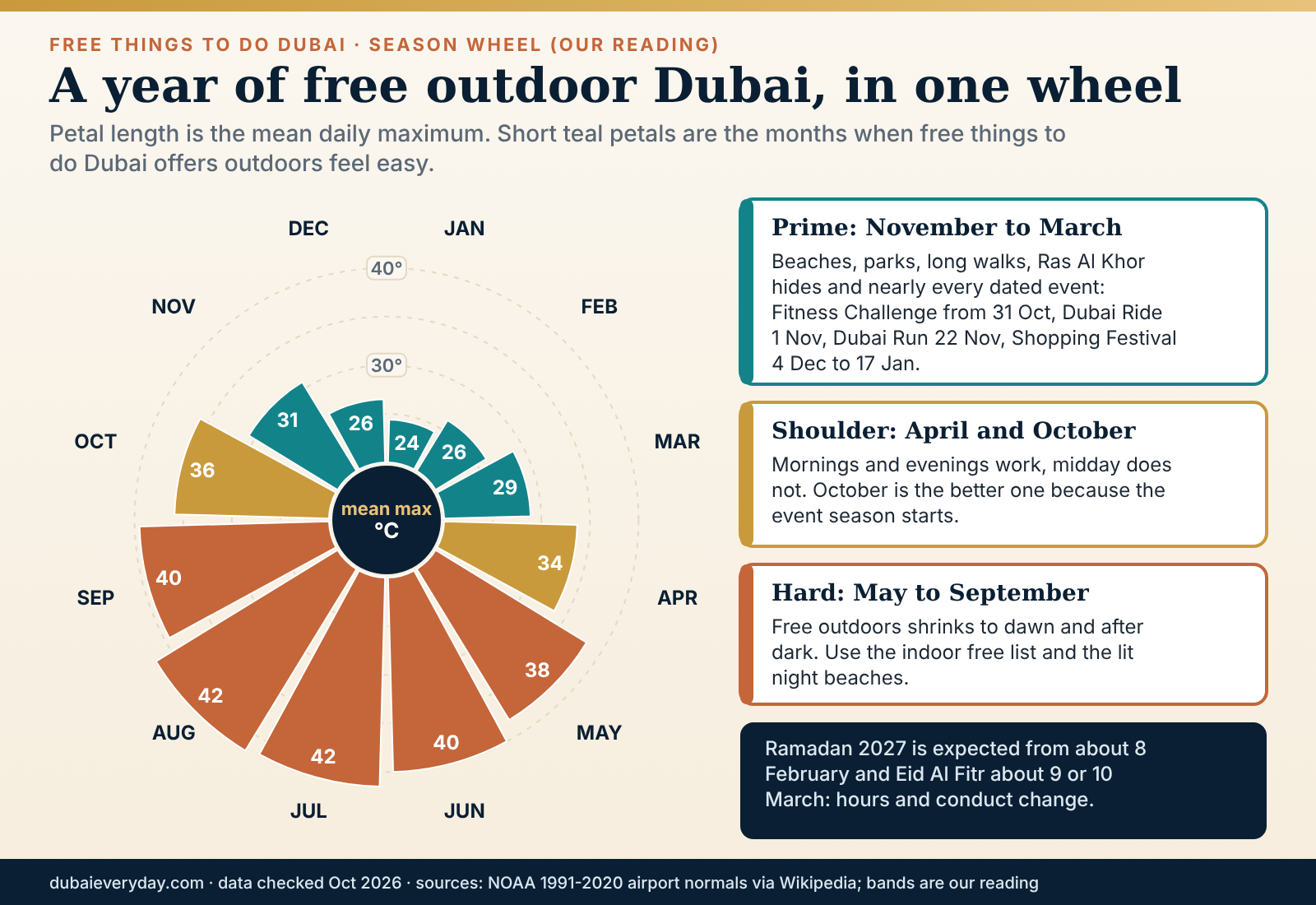
Most free things to do Dubai offers are outdoors, which makes the calendar the biggest variable. Wikipedia’s climate entry, which reproduces the NOAA 1991 to 2020 normals for Dubai International Airport, gives a mean daily maximum of 24.4 C in January and 41.9 C in August, and mean minimums of 15.3 C and 31.5 C. The difference between those two months is the whole story. In January a long walk is a pleasure. In August it is a risk-management exercise.
Sunrise and sunset: the free window in each month
The useful number is not the temperature but the length of the cool window. These are our calculations for Dubai on the 15th of each month, from a standard solar-position formula, and they may differ from an almanac by a minute or two.
Prime: November to March
Sunrise runs from 06:29 in March to 07:06 in January, and sunset from 17:31 in December to 18:28 in March. Sea temperature is about 28 C in November and 22 to 23 C in January and February, on rounded weather-site figures. This is the season for free things to do Dubai wide: beaches, long walks, parks and almost every event in the dated list.
Shoulder: April and October
Sunrise is 05:57 on 15 April and 06:16 on 15 October, sunset 18:41 and 17:53. Mornings and evenings work; midday does not. October is the better shoulder month because the events calendar is starting up.
Hard: May to September
Sunrise runs from 05:28 in June to 06:04 in mid-September, sunset up to 19:12 in July. The free outdoor window shrinks to the first hour after dawn and the hours after dark, so favour the indoor free things to do Dubai offers and the lit night beaches.
The wider question of when to book a trip, including hotel prices and crowds, is in our best time to visit Dubai guide. For a free-things trip specifically, the answer is simple: pick a week between mid-November and mid-March, and avoid the Eid and New Year peaks if you hate queues.
Ramadan, Eid and school holidays
Ramadan 2027 is expected to start around 8 February, and Eid Al Fitr around 9 or 10 March, with the dates confirmed by moon sighting. Press reports of the 2027 public-holiday pattern are projections, not Cabinet decisions. During Ramadan, opening hours change and public eating and drinking in daylight is discouraged, which affects café stops on a free walking day. See the Dubai etiquette guide for what to expect.
Holiday weeks affect free things to do Dubai offers differently from paid ones. Beaches and parks fill, the Metro runs more crowded, and the free fountain viewing spots tighten. If you can travel outside the Eid and year-end peaks, the free things to do Dubai offers get markedly easier to enjoy.
Rules, etiquette and heat safety on free outdoor days
Free things to do Dubai offers in public places are governed by public-place rules, and most visitor trouble in Dubai comes from conduct rather than from anything dramatic. The UK government’s travel advice for the UAE, updated on 27 October 2026, is a plain-spoken official summary, and we lean on it for the points below. It is not UAE law and it is not individual legal advice.
Dress and behaviour
The advice says women should cover their shoulders and knees in public areas such as malls, avoid see-through clothing and offensive slogans, and keep swimwear for beaches and pools. Some venues set their own dress codes. Swearing and rude gestures, including online, can be treated as obscene acts. Public displays of affection are frowned upon, and kissing in public has led to arrests. See the Dubai dress code guide for a venue-by-venue view.
Jaywalking is illegal. That matters on a free walking day because Dubai’s wide roads and long blocks tempt people to cross where there is no crossing. Use the pedestrian bridges and signalised crossings.
Photography and drones
Do not photograph people without permission. The UK advice records arrests of men for photographing women on beaches, and Federal Decree-Law 34 of 2021 includes privacy offences with prison and fines for photos taken without consent, as we read it in our etiquette research; this is not legal advice. Some government buildings and military sites cannot be photographed. Powerful cameras, binoculars and recording devices may need a licence under UAE rules. Check before flying a drone: the rules were tightened in January 2025.
Alcohol, drugs and Ramadan
The drinking age in Dubai is 21. Drinking in public is illegal, as is being under the influence in public, so a beach picnic is not the place for a drink. Possession of any drugs, including drug traces in the bloodstream, is treated seriously. In Ramadan, avoid eating, drinking, smoking and chewing gum in public in daylight, avoid loud music and dancing, and expect changed hours. More in the Dubai etiquette guide.
Beach and park rules in short
Municipal beach rules prohibit pets, barbecues and fires, shisha, overnight stays and swimwear in passageways. Swimming after sunset is allowed only in designated night zones. At Ras Al Khor, phones, food, drinks and pets are barred from the hides. Parks have their own rules and hours, usually 08:00 to 22:00 for the paid parks. On the Metro, reported fines include about AED 100 for eating or drinking and up to AED 300 for sleeping; those amounts are from secondary sources, so confirm with the RTA.
Heat safety
Heat is the risk you can plan for. The World Health Organization’s UV index describes a reading of 8 or more as very high, and weather sites place Dubai’s UV at 11 or more from April to September. Use shade, water, a hat and sunscreen, and keep outdoor walks to the first and last hours of the day in summer.
If someone shows signs of heat illness, such as confusion, a very high temperature or collapse, treat it as an emergency. The emergency numbers commonly published for the UAE are 999 for police and 998 for ambulance; confirm on the u.ae portal.
Heat rule of thumb, our reading. From May to September, plan outdoor free things to do Dubai offers for the first two hours after sunrise or after sunset, and use the indoor list at midday. In December and January you can reverse the logic and walk at noon. This is a planning heuristic, not medical advice.
Free things to do Dubai itineraries: one day, three days, summer and stopover
Lists help you choose; itineraries help you do. The plans below are built from the opening hours, fares and sun times in this guide. They are desk-built, not field-tested, and the walking times are our planning estimates. Costs are Metro and abra only, from the fare ranges above, and exclude food and water.
One day of free things to do Dubai offers in November: Old Dubai, art and the fountain
- 07:30 Metro to the Old Dubai sideTake the Green Line towards the BurJuman and Al Ghubaiba end. Metro runs from 05:00 on most days but from 08:00 on Sundays, so on a Sunday start later or take a taxi.
- 08:00 Al Fahidi lanesWalk the wind-tower lanes while the light is low. Treat any gallery or café as an optional purchase and keep the museum tickets for another day.
- 10:00 Al Seef and the abraWalk the waterfront, cross the creek for AED 1 to 2 and start the souk loop on the Deira side.
- 12:30 Metro to Al JaddafGreen Line to Al Jaddaf, then the 12-minute walk the Jameel Arts Centre describes. Skip this on a Tuesday, when it is closed.
- 15:30 Metro to DowntownChange at an interchange to the Red Line and get off at Burj Khalifa/Dubai Mall. In mid-November sunset is about 17:32.
- 17:15 Burj Park, then the fountainSettle in before sunset. Evening shows run every 30 minutes from 18:00, which in mid-November is the blue hour just after sunset.
Our cost estimate for this day is four Metro journeys at AED 3 to 7.50 and one or two abra crossings: about AED 13 to 32, plus the one-time card cost. If you only do half of it, do the Old Dubai half in the morning and the fountain in the evening, and drop the art centre.
Three days of free things to do Dubai offers, as costed
Day one is Old Dubai on foot, day two is a Downtown evening with an indoor art stop earlier, and day three is a coast day. The transport section prices them at about AED 32 to 61 in total for fares and card. If you want to swap in a second beach day for the art centre, the cost does not change much, but you gain a lot on a hot day by keeping the art stop.
Where to stay for this style of trip matters more than the plan. A base near a Metro station on the Red or Green Line saves taxi costs on every one of the days above. Our best budget hotels in Dubai guide covers well-located options near Metro and major districts, and the broader best hotels in Dubai guide sets out the area trade-offs.
A free summer day, June to August
The summer problem for free things to do Dubai offers outdoors is simple: sunrise is about 05:28 to 05:52 and sunset about 19:10 on 15 June and 15 July, but the usable outdoor hours are the first two after dawn and the hours after dark. Build the day around that gap.
- Early morning walk or beachLifeguards operate sunrise to sunset on the municipal beaches, so a swim in the first hours is both cooler and covered. Leave by mid-morning.
- 10:00 Jameel Arts Centre or Alserkal AvenueBoth open at 10:00 and offer air-conditioned galleries. Taxi the last stretch rather than walking.
- Afternoon in a mallStay within the Dubai Mall free-parking window, or arrive by Metro and use the air-conditioned walkway to the mall.
- After dark: night beach or fountainThe fountain’s 18:00 shows are in daylight in June, so pick the later ones. The night-swimming sections at Jumeirah 2, Jumeirah 3 and Umm Suqeim 1 extend the evening.
The summer plan is the weakest of the free things to do Dubai offers, and we would rather say so. If your dates are flexible, move them. If they are not, read the indoor things to do in Dubai guide for what is worth paying for.
A free stopover of six to ten hours
If you are passing through DXB with a long layover, the free things to do Dubai offers near the Red Line are limited but real, because the line runs from the airport terminals to Burj Khalifa/Dubai Mall, and a single trip costs at most AED 7.50 on a Silver card. A free stopover is Burj Park, the afternoon fountain show at 13:00 or 13:30 (Friday 14:00 and 14:30) or an evening show, and the walkway through the mall. Our rule of thumb, not an official figure: under about six hours between flights, stay airside.
Check visa and entry rules for your passport first, and re-read the connection advice in our Dubai airport guide, which explains terminals, Metro access and buffers. Two points matter: DXB handled fewer foreign airlines in autumn 2026 than in 2025, and separate-ticket connections need far longer buffers than same-ticket ones.
Families with young children
Among free things to do Dubai offers for families, pick parks with free entry and shade. Al Ittihad Park offers several play areas, a 3.2 km jogging track and free parking; Al Barsha Pond Park lists three shaded playground zones; Town Square Park and Dubai Hills Park are free to enter but charge for rides and attractions. Municipal beaches have lifeguards in daylight, and Khor Al Mamzar has 12 lifeguard towers. Under-fives travel free on the Metro. See Dubai with kids and Dubai with a baby for strollers, feeding and heat management.
Which of the free things to do Dubai offers fits you: a decision table
The table below matches common situations to a first choice among the free things to do Dubai offers, with the reason and the catch. It is our reading of the evidence on this page, not a ranking of quality, and no entry was paid for.
| Your situation | First free choice | Why | Catch |
|---|---|---|---|
| One day, first visit, November to March | Old Dubai walk plus the fountain | Two contrasting sides of the city for about AED 13 to 32 in transport | Fort closed; Sunday Metro starts at 08:00 |
| Hot month (June to September) | Jameel Arts Centre and Alserkal Avenue | Free, air-conditioned, open from 10:00 | Jameel closed Tuesdays; a taxi may be needed |
| Travelling with under-fives | Municipal beach or Al Ittihad Park | Lifeguards in daylight; free entry; free park parking | Beach shade and facilities vary |
| Photographer or sunset chaser | Umm Suqeim and the Burj Al Arab view | The hotel’s skyline for no ticket | Parking fills; no photos of people |
| Runner or cyclist | Khor Al Mamzar tracks, Al Ittihad Park, Dubai Ride | 5.5 km and 3.2 km tracks; a free road ride on 1 November | Registration; no bike hire prices verified |
| Wildlife and birds | Ras Al Khor hides, October to March | Free hides and flamingo season | Gate opens 07:30 in winter; Mangrove Hide closed |
| Long layover (six to ten hours) | Burj Park and fountain by Metro | One line from the airport; AED 7.50 maximum one way | Entry rules; buffer for return |
| Strict budget, any season | Parks, beaches, abra, Metro | Costs mostly transport at AED 1 to 7.50 a hop | Heat limits hours; parking can undo the saving |
Mistakes and risks with free things to do Dubai offers: where free turns expensive
Lists of free things to do Dubai publishes rarely say how people lose money on them. These are the mistakes that follow from the evidence on this page, in rough order of cost.
Driving into paid parking
A free beach with a metered road in front of it is a paid beach. JBR’s own FAQ states AED 20 per hour, and mall parking steps up quickly past the free hours: from AED 20 for the fifth weekday hour at the Dubai Mall, with higher steps beyond eight hours. For a car-based day, check the zone and the clock, or use the tram or Metro instead.
Believing every “free” label
A press story or a blog saying “free entry” is not the organiser. The Dubai Design Week claim on this page is from a travel blog, and the Visit Dubai calendar showed “Free” only as a filter, not as a label on any individual event. Go to the organiser’s page. If the page asks for a ticket, even a zero-price one, the free status is real. If it gives no information, assume you need to ask.
Planning around closed or changed places
Al Fahidi Fort, the Museum of the Future and the Mangrove Hide at Ras Al Khor are all currently off the table. The Dubai Fountain has a new look after works. Al Mamzar’s Corniche was not open as of a September report. Any plan that quietly assumes one of these is open will fail in the middle of the day.
Swimming after sunset or without lifeguards
Lifeguards on the municipal beaches work sunrise to sunset, and swimming after dark is allowed only in designated night zones. The risk is physical, not just legal. Rip currents occur on open coasts, and the National Weather Service guidance on them is as relevant in Dubai as anywhere: swim parallel to the shore to escape one. Swim where the flags are green or yellow and the tower is staffed.
Skipping registration
Free events are not walk-in events. Dubai Ride requires registration at dubairide.com and bib collection at Zabeel Park on 28 to 31 October, and the Dubai Fitness Challenge uses account login. Turning up on the day is the surest way to find the gate closed.
Midday walks from May to September
The cost of free things to do Dubai offers outdoors in the heat is not money. A mean daily maximum of 41.9 C in August, with a mean minimum of 31.5 C, means the evening offers little relief. Plan the first and last two hours, drink water before you feel thirsty, and treat any dizziness as a reason to stop and go inside.
Photographing people
The best free photographs in Dubai are of buildings, water and light. The cheapest way to end a free day is to point a camera at a stranger. The UK advice notes arrests for this, and Dubai law includes privacy offences. Ask first, or do not.
If you can spend AED 100: the best near-free upgrades
Several of the best-value alternatives to free things to do Dubai offers sit just above zero. The prices below are those we found on the dates given, and several are marketplace or press figures, so confirm before you go. For a fuller view of the paid end, our things to do in Dubai guide ranks the attractions.
- Abra crossing: AED 1 in cash on the standard motorised service (RTA).
- Safa Park AED 3; Zabeel Park and Creek Park AED 5 (Gulf News, 6 October 2026).
- Dubai Racing Carnival general admission from AED 10 (TicketNews, 20 October 2026).
- Global Village: AED 25 on weekdays, AED 30 any day, in season from 14 October 2026 (official site).
- Dubai Fountain Boardwalk from AED 25; lake ride from AED 73 (Visit Dubai).
- Etihad Museum AED 25 and Al Shindagha Museum AED 50 (Dubai’s 2024 fee resolution and Dubai Culture).
- Expo City Dubai’s Garden in the Sky AED 30 (operator page).
- Dubai Safari Park AED 50, open since 12 October 2026 (press).
Our calculation of three AED 100 days: an Old Dubai culture day with Al Shindagha Museum, the Etihad Museum and two abra crossings comes to about AED 77; a Global Village weekday, the Racing Carnival and the Fountain Boardwalk to about AED 60; and a nature day of the Safari Park and the Garden in the Sky to about AED 80. Each excludes transport and food.
At the other end of the scale, a shared morning desert safari was listed at about AED 500 on Dubai Pass, which is five times this budget. Our desert safari guide and the morning desert safari page cover that comparison; this page deliberately stops short of it.
Free things to do Dubai FAQ
What are the best free things to do Dubai visitors can fit into one day?
On our reading of the evidence, the best one-day combination of free things to do Dubai offers from November to March is an Old Dubai walk in the morning, with the Al Fahidi lanes, Al Seef and a AED 1 abra crossing, followed by Burj Park and the Dubai Fountain at sunset. Transport for that day is roughly AED 13 to 32 by Metro. In summer, swap the walk for the free Jameel Arts Centre or Alserkal Avenue and keep outdoor time to early morning and after dark.
Are Dubai’s public beaches really free?
Among the free things to do Dubai offers, beaches are the easiest to confirm: Dubai Municipality’s beach page states that its public beaches do not charge an entrance fee, apart from fees for services you request, such as sunbed hire where offered. The municipal strip from Jumeirah 1 to Umm Suqeim 2 and the new Khor Al Mamzar beach follow that model, although the Khor Al Mamzar release does not state a fee. Al Mamzar Beach Park is different: it charges AED 5 per person and AED 30 per car. Parking near some beaches is metered.
Is the Dubai Fountain show free to watch?
Our sources do not state it outright, but they sell the Dubai Fountain Boardwalk (from AED 25) and lake rides (from AED 73) as separate products, which suggests the public promenade is not ticketed. Shows run every 30 minutes from 18:00 to 23:00 daily, with afternoon shows at 13:00 and 13:30 from Saturday to Thursday and 14:00 and 14:30 on Friday. On New Year’s Eve, viewing arrangements change, so check the year’s plan. Confirm any ticket question with the operator before you queue.
Can I see the Burj Khalifa for free?
You can see it from outside at no cost, from Burj Park, the Waterfront Promenade at Dubai Mall and many other points in Downtown. Going up is ticketed: a marketplace listing shows decks from AED 161, and a May 2026 report of operator rates shows AED 173 off-peak and AED 250 in prime slots for levels 124 and 125. The operator’s own page could not be read, so confirm prices there. Many visitors find the free ground-level view enough for photographs.
What free things to do Dubai offers are best in summer?
Indoors, the Jameel Arts Centre (10:00 to 20:00, closed Tuesday, Friday from 12:00), the Alserkal Avenue galleries (10:00 to 19:00) and malls reached by Metro. Outdoors, plan the first two hours after sunrise and the evening after dark: the municipal night-swimming sections at Jumeirah 2, Jumeirah 3 and Umm Suqeim 1 extend the evening. Midday outdoor walks from May to September are a health risk, and the mean August maximum is 41.9 C.
Is the Dubai Mall free to enter?
Walking in costs nothing, and the mall lists retail hours of 10:00 to 23:00 Monday to Thursday and 10:00 to midnight Friday to Sunday. Attractions inside, such as the aquarium and observation decks, are ticketed. Parking is free for the first four hours on weekdays and the first six at weekends, then rises from AED 20 for the fifth weekday hour. Arriving by Metro avoids the parking question; an air-conditioned walkway links the station to the mall.
Are there free museums in Dubai?
Among the free things to do Dubai offers indoors, we found one free art venue, the Jameel Arts Centre, which describes itself as open-access and free for all. The heritage museums charge: the Al Shindagha Museum is AED 50 and the Etihad Museum AED 25 under Dubai’s 2024 fee resolution. Al Fahidi Fort is closed for restoration, and the Museum of the Future is closed from 1 September 2026 with a 2027 reopening and no date. The Mohammed Bin Rashid Library publishes hours but not a fee.
Is public transport free anywhere in Dubai?
Not as a general rule. RTA fares for the Metro are AED 3, 5 or 7.50 on a Silver card, the abra is AED 1 in cash, and a card needs at least AED 7.50 of balance to check in. Children aged five and under travel free, and people of determination can travel free on the relevant card. Some events lay on special arrangements, and Metro hours change for big days, so check the day before. Budget on the assumption that every ride costs money.
Can I see flamingos for free in Dubai?
Yes, in season, and it is one of the free things to do Dubai offers between October and March. Emaar’s October 2026 guide states that access to the public observation hides at Ras Al Khor Wildlife Sanctuary is free. Winter hours (October to March) are 07:30 to 17:30. The Flamingo Hide and Lagoon Hide are the named options; the Mangrove Hide is listed as temporarily closed. Phones, food, drinks, pets and smoking are not allowed in the hides, and only 15 people may be inside at once. Bring binoculars or a telephoto lens.
What free events are on in Dubai in November and December 2026?
The firm items are the Dubai Fitness Challenge (31 October to 29 November, free registration and free classes), Dubai Ride on 1 November and Dubai Run on 22 November (both free with registration). Dubai Design Week (3 to 8 November) was reported to have free festival entry. The Dubai Shopping Festival runs from 4 December to 17 January, but its programme was not published at our check date. Use the Visit Dubai calendar’s Free filter and confirm each organiser.
Can I swim at night at Dubai beaches?
Only in designated night-swimming sections. Dubai Municipality announced night swimming at Jumeirah 2, Jumeirah 3 and Umm Suqeim 1, and the new Khor Al Mamzar beach has a 300 metre night section described as operating 24/7. Swimming after sunset elsewhere is not allowed under the municipal rules. Reports differ on closing time at Umm Suqeim 1, so follow the signs and flags on arrival, and remember that daytime lifeguard cover does not extend into the night.
Is Dubai safe for free walking and exploring on your own?
Visit Dubai publishes a dedicated safety page for visitors, and the practical risks we found are conduct rules, heat and traffic, not crime. Jaywalking is illegal, photographing people without consent can lead to arrest, and public displays of affection and public drinking are against the rules. Check the current UK government travel advice, which was updated on 27 October 2026, for the security picture before you go. This is general information, not personal safety advice.
Which free things to do Dubai offers suit young children?
Municipal beaches with daytime lifeguards and the free parks. Al Ittihad Park has several play areas, a 3.2 km jogging track and free parking; Al Barsha Pond Park lists three shaded playground zones. Dubai Hills Park and Town Square Park are free to enter but charge for rides and splash areas. Children aged two and under usually enter public parks free, and under-fives travel free on the Metro. Shade and heat matter more than the activity list.
Do the free things to do Dubai offers change during Ramadan?
Yes, mainly in hours and conduct. Beaches, parks and promenades stay open, but opening times for venues and malls change, and the UK government’s advice says to avoid eating, drinking, smoking and chewing gum in public in daylight and to avoid loud music. Ramadan 2027 is expected to start around 8 February, with the date confirmed by moon sighting. Plan outdoor walks for the evening and check each venue before you go.
How much does a free day in Dubai really cost?
Entry is zero but travel is not. Our calculation for three days of free things to do Dubai offers, using Metro, abra and tram fares, comes to about AED 32 to 61 including the one-off card cost. That excludes food, water and any parking, and the tram figure rests on a 2023 fare report. Driving can cost more: JBR parking is AED 20 an hour, and paid roadside bays were reported at AED 4 to 6 an hour at peak times.
Related reading
Sources and further reading (50 links)
- Dubai Municipality: Discover Dubai beaches — public beach listing, no-entrance-fee statement, 800900 line
- Dubai Media Office: Khor Al Mamzar Beach opens — shoreline, lifeguard towers, night beach, tracks
- Dubai Municipality: three beaches for night swimming — Jumeirah 2, Jumeirah 3, Umm Suqeim 1
- Dubai Municipality: Ras Al Khor Wildlife Sanctuary, plan your visit — seasonal hours, hide rules
- Emaar: flamingo season at Ras Al Khor — free hides, hide status, season
- Jameel Arts Centre: visit — free admission, hours, address, transport
- Alserkal Avenue: plan your visit — opening hours, no district entry fee published
- Mohammed Bin Rashid Library — visitor hours and rules
- RTA: nol fares — Metro fare tiers, concessions, transfer rules
- RTA: public transport timetables — Metro and tram hours
- RTA: marine transport — abra and water taxi fares
- RTA: cycling tracks — network length, rules, speed limits
- Visit Dubai: Dubai events calendar — Free filter, listed events
- Visit Dubai: The Dubai Fountain — boardwalk and lake ride prices
- Visit Dubai: Al Seef — description of the district
- Dubai Design Week — 2026 dates
- Visit Dubai: Al Fahidi Historical Neighbourhood — description
- Visit Dubai: Dubai Shopping Festival — 32nd edition dates
- Emaar: Dubai Fountain show timings — schedule and viewing areas
- Dubai Fitness Challenge — dates, free classes, flagship events
- Dubai Media Office: Dubai Fitness Challenge returns — tenth edition
- The National: Dubai Ride 2026 guide — date, timings, registration (press)
- The National: Dubai Run 2026 — date and route (press)
- Gulf News: Dubai’s outdoor parks with entry prices — park fees and features (press)
- Gulf News: Dubai parking zones and tariffs — Parkin hours and rates (press)
- The Beach JBR: FAQ — parking and public access
- The Dubai Mall: paid parking — free hours and tiers
- Global Village — Season 31 prices and concessions
- UK Foreign, Commonwealth & Development Office: UAE safety and security — conduct, photography, alcohol
- Wikipedia: Climate of Dubai — monthly mean maxima, minima and sunshine from NOAA 1991 to 2020 normals for Dubai International Airport (secondary)
- World Health Organization: The ultraviolet (UV) index — UV categories
- Khaleej Times: Dubai public parks and the Al Mamzar Corniche — Corniche not open at 14 Sep 2026 (press)
- Euronews: Al Fahidi Fort set to reopen — closure status (press)
- The National: Dubai New Year’s Eve closures and timings — 2025/26 pattern (press)
- TradeArabia: Dubai sports calendar 2026-2027 — free DubaiNow calendar (press)
- Dubai Legislation Portal: Administrative Resolution No. 256 of 2024 on museum fees — Etihad Museum and Al Shindagha Museum fees
- Dubai Culture: Al Shindagha Museum, plan your visit — visit information
- Visit Dubai Experiences: Burj Al Arab tour — tour price comparison
- Platinumlist: At the Top, Burj Khalifa — marketplace “from” price, not operator pricing
- Dubai Pass: morning desert safari listing — price comparison only
- Expo City Dubai: Garden in the Sky — ticket price
- Gulf News: Dubai Safari Park eighth season — opening and pass price (press)
- TicketNews: Dubai Racing Club 2026-27 ticketing — Carnival dates and general admission (press)
- Wego blog: Dubai Design Week — free-entry and Downtown Design price claims (travel blog; secondary)
- Gulf News: UAE National Day holidays 2026 — expected dates (press)
- The National: Ramadan 2027 dates — projected Ramadan and Eid dates (press)
- Khaleej Times: Museum of the Future to close temporarily — closure from 1 Sep 2026 (press)
- Wikipedia: Dubai Gold Souk — retailer count and renovation note (secondary; Sept 2024 information)
- US National Weather Service: rip current safety — general guidance
- weather2travel: Dubai climate — rounded UV and sea-temperature context (secondary)
Update log: 29 October 2026 — first publication; facts re-checked against the sources above. Next review due: 31 January 2027 (events, fees and seasonal status), and sooner if a venue, fee or access rule changes. Corrections welcome.
This page is general travel information, not legal, medical or individual safety advice. Prices, hours and event dates change; confirm with the operator before you go. Inclusion was not paid for.
About DubaiEveryday and this guide
DubaiEveryday.com is an independent editorial project that publishes practical, research-based guides to everyday life in Dubai: where to live, what things cost, how the rules work and how to get around. This page was written and edited by the DubaiEveryday editorial team. It is not signed by a named expert, doctor, lawyer or adviser, and we do not claim first-hand testing of a venue, clinic or service unless the page says so.
Each guide is built from official sources such as government and regulator pages, operator websites and established news outlets, cross-checked where we can. When we could not confirm something, we say so in the text, and examples that use made-up numbers are labelled as illustrations. Mentions are editorial choices, not paid placements, and a link is not an endorsement.
Dubai changes quickly. If you spot something that is out of date or wrong, please tell us through the contact options on DubaiEveryday.com and we will check it and correct the page.