

Moving to a new country fails less often on the big decisions than on the order of the small ones. This Dubai relocation checklist puts documents, visa, housing, utilities, banking and transport into the sequence the paperwork actually allows, with a countdown from six months out to ninety days after landing.
Most moves to a new country do not fall apart on the big choices. They stall on a small one done too early. Try opening a full bank account, registering a tenancy or setting up a SIM before your Emirates ID exists, and you meet a locked door. So much of the paperwork waits for something else.
That is why a plain to-do list tends to struggle here. A Dubai relocation checklist that works is a chain, where each step opens the next. This guide lays that chain out from six months before you fly to ninety days after you land, with what to bring, what each stage costs and how you know it is done. Follow the order and the waiting becomes far more predictable.
A Dubai relocation checklist is a dependency chain, not a to-do list. Your passport and attested documents unlock an entry permit, the entry permit unlocks the medical test and the residence visa, the visa unlocks the Emirates ID, and the Emirates ID unlocks almost everything else: a registered SIM, a full bank account, a tenancy registration, utilities and a driving licence exchange.
So the practical order is: choose your visa route and start attestations six to three months out; line up housing, shipping and health cover in the three months before departure; fly with an original-document pack and a temporary base; then spend the first week on the identity steps and only after that on the rest. Most delays in any Dubai relocation checklist come from doing step six before step three. The official clock is short too: an entry permit stays valid for two months, and residency formalities are expected within one month of arrival.
Below, this Dubai relocation checklist gives every stage with its trigger, owner, cost and “done when” test, a worked calendar for a landing on 3 May 2027, and the mistakes that break the sequence. Fees and rules were checked on 29 October 2026 and need re-checking before you act.
This Dubai relocation checklist is desk research. DubaiEveryday.com has not moved house with these forms, queued at these counters or paid these fees, and nothing below describes a personal move. Inclusion of any company or app is not paid for, and none is ranked or recommended.
Rules, fees and timings come from government and regulator pages read on 29 October 2026: u.ae on preparing to work, the Dubai government residence-visa page, the Federal Authority for Identity, Citizenship, Customs and Port Security (ICP), Dubai Land Department, the Roads and Transport Authority (RTA) and the Ministry of Foreign Affairs.
Where an official page could not be read, the figure is marked “reported” and attributed to press or industry sources. The utility provider DEWA’s own service pages returned errors, so its deposits and fees are secondary figures. Everything here is general information, not individual immigration, legal, tax or financial advice. Confirm each fee on the authority’s own page before you pay.
Dubai relocation checklist: what is different in late 2026
A Dubai relocation checklist written two years ago would be mostly right on paperwork and noticeably wrong on context. Three things have moved, and they change how you should plan, even though they do not change the order of the steps.
Flights and the regional picture
The UK government’s travel advice for the UAE, updated on 27 October 2026 and shown as current on 29 October, describes the wider Middle East situation as deeply unpredictable. It warns of possible flight cancellations and airspace closures at short notice, and it tells travellers to hold appropriate travel insurance covering their itinerary. Other governments publish their own advice, and yours may differ, so read it directly at GOV.UK or your own foreign ministry before you commit money.
For a relocation this matters in a boring, practical way. Fixed-date tickets are riskier than they were. Our Dubai airport guide tracks which airlines are flying to DXB this winter and which are still returning, so check it close to booking. The sensible adjustment to a Dubai relocation checklist is a flexible or changeable ticket, a longer buffer between your last day at home and the day your employer needs you, and shipping that does not depend on you being present on a particular date.
Rents have eased, which helps newcomers
Press coverage of Savills’ third-quarter 2026 data, published by Khaleej Times on 13 October 2026, reported year-on-year falls in apartment rents of roughly 10 to 13 percent in Dubai Marina, Business Bay and Jumeirah Village Circle. Property Finder data reported on 18 October showed asking rents for a basket of communities dropping sharply from December 2025 to June 2026 and then edging up slightly by September. Both are secondary sources, and they measure different things, so treat the direction as useful and the percentages as indicative.
The checklist consequence: more choice and more room to negotiate on cheque count or maintenance terms, but also more reason to read the contract carefully instead of grabbing the first flat. Our renting in Dubai guide covers the lease and renewal rules in full.
Digital identity is the real gatekeeper
Most federal and Dubai services now sit behind UAE PASS, the national digital identity. ICP’s Emirates ID application, the Ministry of Foreign Affairs attestation service, the RTA licence services and the Dubai Municipality pet registration all use it for sign-in. That is why the Emirates ID is the hinge of the whole checklist: UAE PASS registration works by scanning one, and without it you are usually stuck at a basic, unverified account that unlocks fewer services.
What this Dubai relocation checklist covers and what it leaves to others
This page has one job: the dated, ordered checklist. For the broad question of whether and where to move, how visas compare in depth, how much a life in Dubai costs and how neighbourhoods differ, use the moving to Dubai guide. For the residence-visa process in detail, go to the Dubai residence visa guide, and for the employer-sponsored version, the Dubai work visa guide. In this Dubai relocation checklist you get the sequence, the dependencies, the costs and the done-when tests, with links out at each step.
How a Dubai relocation checklist fits together: gates, clocks and dependencies
Every item on a good Dubai relocation checklist belongs to one of five tracks: identity and visa, home, money, mobility, and family. The tracks run in parallel, but they cross at a handful of gates. A gate is a document or status that, once you hold it, lets several other tasks start. The map below shows the five tracks as Metro-style lines and marks the interchanges where a single document feeds more than one line.
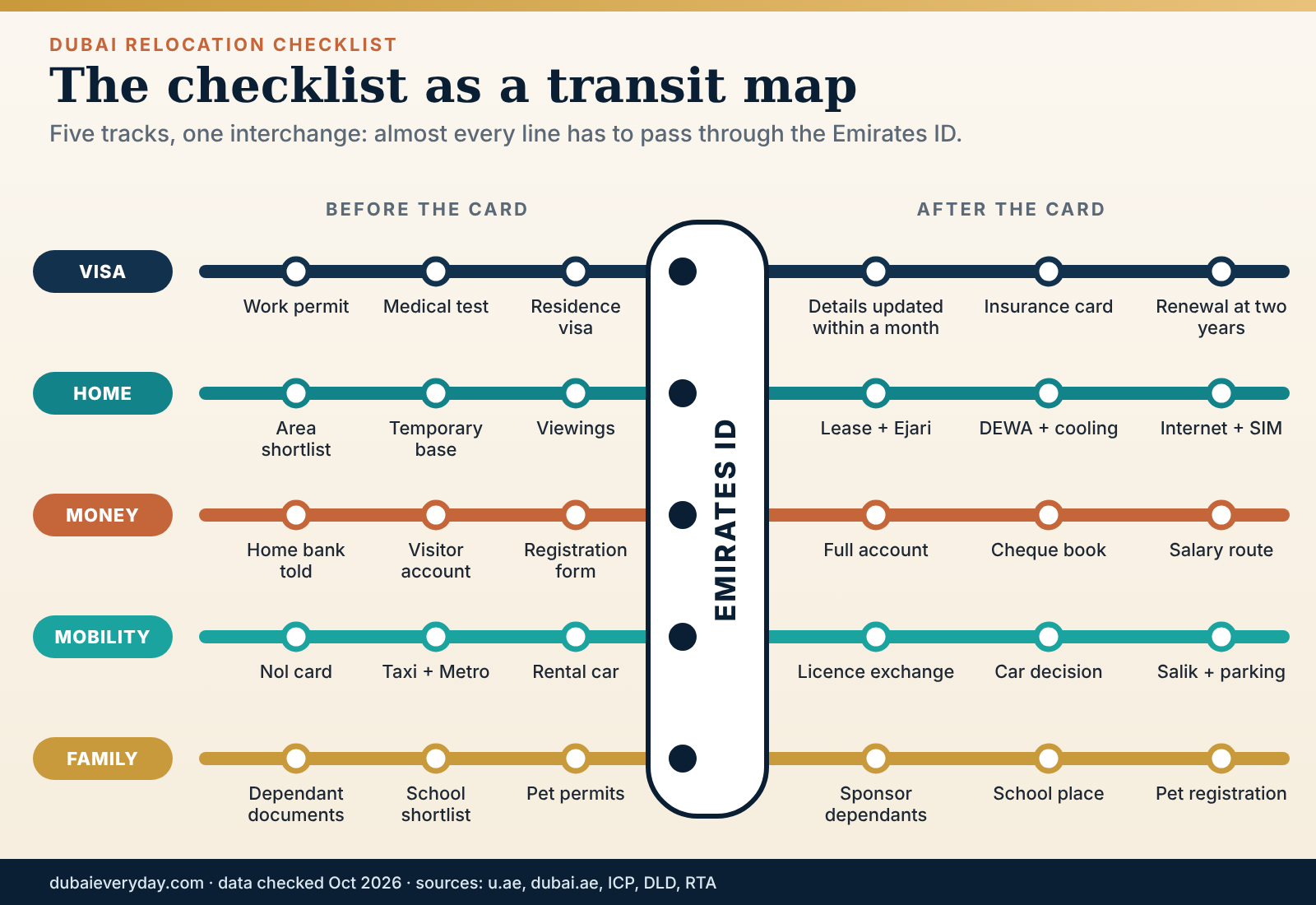
The five gates of a Dubai relocation checklist, in order
Gate one is a passport valid for at least six months on the day you arrive, according to u.ae guidance for people preparing to work in the private sector. Gate two is a sponsor-issued permit: for an employee that is the employer’s work permit from the Ministry of Human Resources and Emiratisation, followed by an entry permit. Gate three is the medical fitness test, and gate four is the residence visa itself. Gate five is the Emirates ID, which ICP issues after biometrics and which most services then ask for by number.
Between those gates sit things that do not need residency at all. A hotel or serviced flat can be booked on a visit visa. A prepaid visitor SIM works on a passport. Some banks open limited accounts for people on visit visas. These “pre-gate” tools matter because they let you function during the days when your paperwork is still moving, and a good Dubai relocation checklist uses them deliberately instead of by accident.
Three clocks run at once
The first clock is immigration. The Dubai government’s residence-visa page says that once the work permit is approved you receive an entry permit and must enter within 60 days, and u.ae adds that residency procedures should be completed within one month of entering. Treat 60 days as a hard ceiling for scheduling flights in any Dubai relocation checklist, and one month as the target for medical, visa stamping and Emirates ID.
The second clock is money. Rent is typically paid by post-dated cheques agreed with the landlord, and u.ae lists post-dated cheques among the documents a tenant brings, so the first large outflow arrives the day you sign. The third clock is the school year, which does not wait for your paperwork. A family arriving in July faces different constraints from one arriving in January, and the Dubai schools guide explains why.
Immigration clock
Entry permit valid two months from issue. Residency steps expected within one month of arrival. Emirates ID completion time is stated as five days. Source: u.ae, Dubai government, ICP.
Money clock
Deposit, commission, first cheque and utility deposits fall due before you get the keys. Refundable items come back months later, if at all. Source: u.ae, DLD, reported DEWA figures.
Family clock
School terms, sponsor salary thresholds and dependants’ medical tests set their own deadlines, often tighter than the adult’s. Source: u.ae, school calendars.
Rule of thumb. Never put an irreversible expense on your Dubai relocation checklist, such as a lease signature, shipping contract or non-refundable school deposit, before the gate that makes it usable. A flat you cannot connect to DEWA, because the Ejari is unregistered, is rent paid for nothing.
Six to three months out: the planning stage of the Dubai relocation checklist
This stage of the Dubai relocation checklist feels like it can wait, and it is the one that most reliably saves money. Nothing here is expensive. All of it has lead times that you cannot compress later, mostly because other organisations, your employer, a ministry, a school or a vet, control the pace.
Task 1: Fix your visa route and name your sponsor
Everything downstream depends on who sponsors you. Most people moving for a job are sponsored by the employer; spouses and children are sponsored by the resident family member; remote workers, investors, freelancers and some job seekers use routes that do not depend on one employer. The moving to Dubai guide compares the routes side by side. Here, the Dubai relocation checklist test is simple: can you name the person or entity that will submit your permit application, and do you know their expected submission date?
If the answer is “my employer, probably after I resign”, pause. Get the date in writing. The work-permit step has no published processing time on the Dubai government page, so the employer’s own estimate is the best data you have.
Task 2: Read the offer as a checklist item, not a celebration
Before you resign or give notice on a lease at home, confirm in writing the items that change your move. The labour-law pages on u.ae describe fixed-term contracts, probation of up to six months and the rules on wages paid through the Wages Protection System, so a compliant offer will already look familiar. Ask your future employer about these points:
- Start date, and the earliest date they will file the work permit.
- Who pays the visa, medical and Emirates ID fees, and whether you are reimbursed or they pay directly.
- Health insurance for you and for any dependants, and the policy start date.
- Housing or relocation allowance, and whether it is paid on arrival or after probation.
- Flight tickets, shipping allowance and temporary accommodation, if offered.
- Probation length and the notice period during and after it.
- Whether the company enrols staff in the job-loss insurance scheme (ILOE) and who pays the premium.
That last item is easy to miss. The scheme’s own site shows monthly premiums of a few dirhams and a benefit of up to 60 percent of basic salary for up to three months, subject to contribution history, so ask HR how enrolment is handled instead of finding out at the first payslip.
Task 3: Audit every passport
The six-month rule applies to the passport you will arrive on, and the Emirates ID application wants at least three months’ validity left (ICP). In practice, a passport with under a year left will tempt you to renew it after you land, which means an embassy appointment in the middle of your busiest weeks.
Check children’s passports too, since many countries issue them for shorter periods. Dual nationals should decide which passport the residence visa will be stamped on, because RTA’s Singapore exchange page warns that dual passport holders whose residency is stamped on a non-exception-country passport cannot exchange, and the same logic is worth checking for your own country.
Task 4: Start attestations if your job or visa needs them
Degree attestation is required for some jobs, and the sponsor or professional body will say if yours is one. u.ae describes the chain for documents issued abroad as authentication by your home country’s foreign ministry and then by a UAE embassy or consulate. The Ministry of Foreign Affairs adds that documents issued outside the UAE are attested through selected UAE missions, many of which publish their own online-or-in-person rules. Timings vary by country and are not published centrally, so start early and ask the mission. The documents section below covers the full pack.
Task 5: Notify the people who will notice you left
Your home bank, tax office, pension provider, health insurer, landlord and employer all need to hear about an overseas move, each on its own timetable. This page cannot tell you how your home country treats departures, since tax residence and social-security rules differ widely. A qualified adviser in your current country should answer the exit question, in parallel with this checklist.
Task 6: Pick a landing window on purpose
Climate normals attributed to the Dubai Meteorological Office put the mean daily maximum near 42 degrees Celsius in August and near 24 degrees in January, according to the Wikipedia summary of those figures. Landing in summer does not stop anything on a Dubai relocation checklist, because offices run indoors, but it does shape what you can do on foot with a suitcase and a pile of documents. Our best time to visit Dubai guide and the Dubai events calendar explain how crowds, hotel prices and school holidays shift across the year.
Task 7: Decide what ships, what is sold and what is bought new
Do this before you book a mover, because quotes depend on volume. Homes are let both furnished and unfurnished, and reported move-in deposits differ between the two, so settle that question first. Whatever you choose, clothes, bedding, kitchenware and sentimental items are the usual candidates for the shipment, with large furniture the usual candidate for a local purchase. The decision aid in the shipping section below puts numbers on that. Medicines, pets and electronics each have their own permit questions covered in the customs paragraph.
Task 8: Start the slow-lead-time items
Three things have lead times set by others. Pet travel needs a microchip, vaccination timing and an import permit that depends on your origin country. School applications depend on each school’s own calendar. Medical records and prescriptions need your doctor’s time. If any of those apply, start them now and read the family section of this page for specifics.
Documents checklist: the pack to build before you fly
The documents stage of a Dubai relocation checklist is where most avoidable delays start, because a missing original cannot be fixed from a hotel room. The idea is to build a pack in three layers: originals you carry yourself, scans stored somewhere you can reach from any country, and a trusted person at home who can fetch or courier the things you forgot.
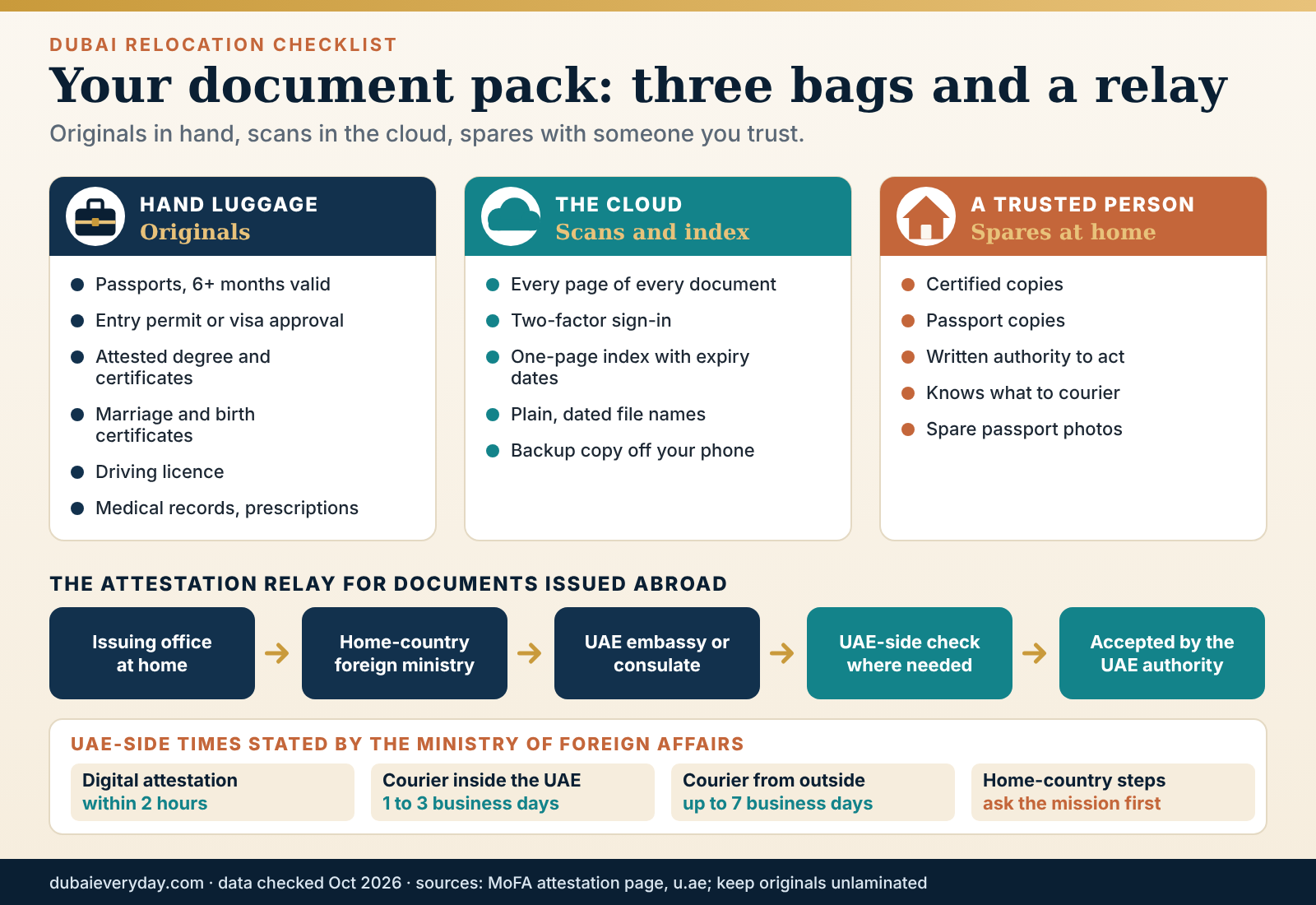
Layer one: originals in your hand luggage
Do not check these bags in; nothing else on a Dubai relocation checklist is as hard to replace. Airline baggage delays are rare, but a delayed bag holding your degree certificate and marriage certificate on the same morning as your medical appointment would be a rough start. Pack the originals in a flat folder, in hand luggage, in the order you will need them.
- Passports for everyone, valid at least six months from arrival, with spare ICAO-standard photographs; ICP requires a photo that meets the ICAO standard for the Emirates ID.
- The entry permit or visa approval your sponsor sends, printed and on your phone.
- Offer letter and signed contract, if your employer issued one before arrival.
- Attested degree and professional certificates, if your job or visa category requires them.
- Marriage certificate and children’s birth certificates, attested if you will sponsor family.
- Your current driving licence, plus any translation your country’s entry on the RTA list may need.
- Vaccination and medical records, including prescriptions for anything you take regularly.
- A little local cash and a card that works abroad, so that the first taxi and the first SIM are not a problem.
Layer two: scans you can reach from any country
Scan every page of every passport, every certificate and every contract at readable resolution, and store them where you can open them without your phone: an encrypted drive, a password manager or a cloud folder with two-factor sign-in. Some services accept digital copies for application steps, for example Dubai Land Department’s Ejari app asks for a copy of the unified tenancy contract rather than the original, so a clean PDF saves a trip.
Name the files plainly. “Passport-Maria-2031.pdf” beats “IMG_4471”. Make that index the first page of your Dubai relocation checklist. It should be a single page listing each document, its issue date, its expiry date and where the original is. When someone at home must send something, the index lets them find it in a minute.
Layer three: spares with someone you trust
Leave certified copies of the key documents, a copy of each passport and a short written authority with a relative or friend who can post things. A courier takes days, but a document that nobody can find takes weeks. The person holding spares should also know how to reach your bank and your landlord at home.
Attestation in the Dubai relocation checklist: the relay for documents issued abroad
Attestation is a chain of confirmations, and each link only accepts the previous link’s stamp. Per u.ae guidance, an original degree is authenticated first by the foreign ministry in the country that issued it, then by a UAE embassy or consulate there; some professions need a further Ministry of Education step after arrival. If your country has no UAE mission, the Ministry of Foreign Affairs (MoFA) in the UAE is the contact.
The Ministry’s attestation page adds the UAE-side detail, which is useful for planning. Documents issued outside the UAE are attested through selected UAE missions abroad, and each mission decides whether to run online or in person. For UAE-issued documents, digital originals that carry a QR code, barcode or reference number can go through Digital Attestation, which the page says completes within two hours in working hours. Paper documents go through an approved courier provider: one to three business days inside the UAE and up to seven business days when sent from outside.
MoFA says UAE-issued paper documents must be in Arabic or English, or accompanied by a legally certified translation, and must not be laminated. The destination country you pick in the online service cannot be changed afterwards. Scans and photos of documents do not qualify for the digital route, since only original digital PDFs with a verification feature do. Read the page before you send anything.
Translations
Arabic is the language of official records, and many authorities accept English documents. The exceptions tend to show up at the worst moment, such as a foreign driving licence whose language triggers the RTA’s translation requirement, which then needs a legal translation.
Translating at home before you fly may be cheaper or quicker than doing it after arrival, but only certified translators in the right jurisdiction are recognised for some uses, so ask the receiving authority which kind it accepts. We could not verify a current price list for legal translation, so no figure is given here.
Family documents on the Dubai relocation checklist
Sponsoring a spouse or children typically depends on proof of relationship. u.ae lists the sponsor’s salary thresholds, AED 4,000 a month, or AED 3,000 plus accommodation, and the eligible relatives: a spouse, unmarried daughters, sons under 25 and children with special needs, with parents possible on a yearly visa. The relationship documents and their attestation rules vary by nationality and by the sponsor’s visa channel, so confirm the exact list at the start of your planning. The residence visa guide goes through sponsorship in detail.
Health records and medicines
Bring vaccination records, recent test results for any chronic condition and a doctor’s letter that names your regular medicines by their generic names. The Dubai Customs passenger guide lists medicines and medical equipment among the goods that need a permit, and the guide dates from 2021, so check the current rules with Dubai Customs (800 1886) or the Ministry of Health and Prevention before packing anything strong, controlled or in large quantity. Our healthcare in Dubai guide covers the system you will be joining.
The digital layer
Add the UAE PASS app to your Dubai relocation checklist and install it before you fly if your phone supports it, and set up the national apps that your sector uses. Registration works by scanning the Emirates ID, so full verification waits until the card arrives, but having the app, a working number and an email address ready removes friction. Keep your home phone number reachable for the first months, since home-country banks often send security codes to it; check each bank’s policy before you cancel anything.
Done when. The documents stage of your Dubai relocation checklist is done when all passports have at least six months’ validity at your landing date. Every original is in one folder in your hand luggage. Every document has a scan and an index entry. A trusted person at home holds copies and knows what to send.
Visa and residency checklist: entry permit to Emirates ID
This is the spine of the Dubai relocation checklist, and for an employee it is mostly out of your hands. Your employer, acting as sponsor, files and pays for most of it. Your job is to be present at the right moment with the right documents and to know what “done” looks like at each stage, so that a silent delay is noticed within days instead of weeks.
The employer-sponsored sequence in a Dubai relocation checklist, step by step
The sequence in this Dubai relocation checklist follows the Dubai government’s residence-visa page, last modified 14 April 2026, with timing details added from the u.ae guidance for people preparing to work. Where either page gives no timeline, we say so instead of estimating one.
- Offer and contractA Dubai employer who will sponsor you issues an offer. Done when: you hold a written offer and have checked the points listed in the planning section.
- Work permitThe employer applies through the Ministry of Human Resources and Emiratisation. The Dubai government page gives no processing time. Done when: the employer confirms approval in writing.
- Entry permitAfter approval you receive an entry permit and must enter within 60 days; u.ae describes it as valid for two months from issue. If you are already in Dubai, a change-of-status permit replaces it. Done when: you hold the permit and your flight is booked inside its validity.
- Medical fitness testTaken at an authorised Dubai centre; the Dubai government says it typically includes a blood test and a chest X-ray. Done when: the result is released to your sponsor.
- Residence visaAfter the medical result the employer applies online, and the page says the visa is issued within 48 hours. Done when: the visa status shows as issued.
- Emirates ID biometricsFingerprints and photo are submitted at an authorised typing centre or ICP service centre. Done when: the application shows as paid and biometrics are captured.
- Health insuranceDubai law makes cover mandatory, and employers must insure their staff. Done when: you hold a policy certificate or card number.
The visa is valid for two years and renewable on similar terms, and u.ae expects the residency procedures to be completed within one month of entering the country.
What the medical test screens for
According to u.ae, the screening covers HIV, hepatitis B, syphilis, tuberculosis and leprosy, with a pregnancy test applying only to domestic workers. The same page states that a positive HIV or leprosy result leads to residency being denied or not renewed. That is a serious outcome, and nobody can advise on it from a checklist. Anyone with a health condition that could be affected should take advice from a qualified doctor or the relevant health authority before applying, not after.
Put the appointment on your Dubai relocation checklist for the first days after arrival. Centres quote their own result times, generally hours rather than days, but we could not verify a current official figure. Ask your sponsor’s PRO, the employer’s government-relations officer, which centre they use and how fast it reports.
The Emirates ID: fee, timing and the one-month rule
ICP lists residents’ fees as AED 100 per year of residence plus a AED 100 smart-service fee, with an urgent option of AED 150 at service centres only. The page’s wording for the cards is ambiguous across categories, so check the amount on the payment screen before you pay. Our calculation for a standard two-year residence visa, reading the fee as AED 100 for each year plus the AED 100 service fee, is AED 300. Many employers cover this, so ask.
ICP states a completion time of five days. Applicants aged 15 and over complete fingerprint and signature steps at a service centre, the passport must have at least three months’ validity, and standard cards are delivered by courier. u.ae adds two obligations that are easy to forget: report a change of personal details within one month, and report a lost card within seven days. Late renewal more than one month after expiry costs AED 20 a day, capped at AED 1,000.
ICP announced that the Emirates ID renewal window was extended from six months to one year before expiry, effective 14 July 2026. The announcement’s wording refers to citizens, and u.ae still says six months, so confirm which applies to your category on ICP’s renewal page.
Already in Dubai on a visit visa?
If you are in Dubai when the job is confirmed, the Dubai relocation checklist shifts to a change of status instead of a fresh entry permit. The practical rule from u.ae is blunt: do not work on a visit or tourist visa. Both employee and employer face fines and legal accountability. Wait for the work permit, even if the employer asks you to “start informally”. Our jobs in Dubai guide covers how to search, including scam checks that apply when an offer arrives before the paperwork does.
Joining a resident family member
For dependants, u.ae gives the sponsor’s minimum salary as AED 4,000 a month, or AED 3,000 plus accommodation, and lists the sponsorable relatives. Dependants aged 18 and above take the medical, and u.ae notes a 60-day window to complete formalities after the entry permit. Dependants have a six-month grace period if the sponsor’s visa is cancelled or expires. Sequence matters in a family’s Dubai relocation checklist: it is usually the sponsor who lands first and arranges a home, as covered in the variants section below.
Routes that do not rely on one employer
The remote-working route is the clearest example of why you must read the official page on the day you apply. The General Directorate of Residency and Foreigners Affairs service page we read lists a monthly income requirement of USD 3,500, while the u.ae summary of the Dubai virtual working programme lists USD 5,000. Those are different numbers on different official pages, and we could not reconcile them. Check with GDRFA or ICP before you build a plan around either figure.
A job exploration visa lets some skilled professionals and recent graduates enter without a sponsor for a limited period, according to Gulf News reporting updated in September 2026 (we found no current official fee, so none is given). Green and Golden residence routes, covered on u.ae and the ICP site, are sponsor-free and longer, with their own criteria; the Golden visa page notes holders may stay abroad beyond six months. These routes are summarised in the moving to Dubai guide and detailed in the residence visa guide.
Done when. This stage of the Dubai relocation checklist is done when you hold a valid residence visa, your Emirates ID application is paid with biometrics captured, you have a health insurance reference, and you have written down the date of your first Emirates ID follow-up call.
Three to one months out: housing, shipping and cover
The middle stage of the Dubai relocation checklist turns decisions into bookings. Three items dominate: where you will sleep on night one, how you will search for a home from abroad without paying anyone you have not verified, and what you will ship or leave behind. None of them requires a residence visa, which is exactly why they belong here and not later.
Book a temporary base, not a home
Book two to four weeks of short-term accommodation with free cancellation, in an area with Metro or easy taxi access. That is your landing pad while the identity steps run. It also gives you a postal address for the first week and a place to be when the Emirates ID courier calls. Our best hotels in Dubai guide and the budget hotels near the Metro page explain how to compare options by area and cost, and the Downtown Dubai guide shows what a central base looks like for daily life.
Why not sign a lease from abroad? u.ae lists a valid residence visa and an Emirates ID among the documents a tenant brings, alongside a passport copy and post-dated cheques. Most newcomers therefore shortlist from overseas and sign after the card arrives, which is why a Dubai relocation checklist treats shortlisting and signing as separate steps. Some landlords may accept other arrangements, and we found no official rule either way, so ask the agent what they need and in what order.
Shortlist from overseas without getting burned
Use the weeks before departure to narrow the map, not to commit. Three filters do most of the work: commute to your workplace, the school catchment if you have children, and whether you want a Metro station or a car. The Dubai Marina guide and the apartment rental guide show how those trade-offs play out in two very different districts; the villa rental guide does the same for community living.
Dubai Land Department introduced a QR requirement for property adverts in April 2023, and the department advises dealing only with listings that carry a valid QR code. Scanning it shows the authorised details, whether the property is already sold or let, and who the advertiser is. If a listing has no code, treat that as a reason to stop and ask.
Money before keys. Never transfer a deposit, “holding fee” or first rent to someone you have not met, for a flat you have not seen, under a contract you have not read. The DLD Ejari rules require the landlord to be the owner or a power-of-attorney holder, so ask for proof of ownership or authority, and check it against the listing. Legitimate agents will not mind.
Read the contract as a Dubai relocation checklist item
The unified tenancy contract is a standard Dubai Land Department form with blocks for owner, tenant, property and contract terms, and the property block asks for details such as the Makani number and the DEWA premises number. Additional terms are added as a signed addendum. Look for these items before you sign:
- Total annual rent, the number of cheques, their dates and the payee on each.
- Security deposit amount and the written conditions for its return.
- Who pays for district cooling, and whether it is in the rent; the term “chiller-free” is used both ways, so ask in writing.
- Maintenance split, parking allocation and any building move-in permit or access-card charge.
- Notice terms for early termination; we found no official standard penalty, so it is whatever you agree in writing.
- Furnished or unfurnished, with an inventory attached if furnished.
On rent increases, u.ae notes that Dubai assesses them against the area average using the RERA increase calculator under Law No. 43 of 2013. DLD launched the Smart Rental Index in January 2025, and press coverage reports that landlords must give 90 days’ written notice before renewal changes. Our tenant rights in Dubai guide goes through renewal and dispute options in depth.
Shipping in the Dubai relocation checklist: ship, sell or buy again
International moves are priced by volume and distance, so your quote depends on a list you have not made yet. Add the inventory to your Dubai relocation checklist before you call any mover. Sort items into three piles: ship, store or sell at home, and replace in Dubai. The arithmetic that decides the piles is simple, and the illustrative example below shows it.
Illustrative example (not a quote or market fact). Suppose a sofa and dining set would cost AED 9,000 to buy new in Dubai, a mover quotes AED 6,000 to ship them, and you could sell them at home for AED 2,000. Option A, ship: you pay AED 6,000 and keep the furniture.
Option B, sell and replace: you pay AED 9,000 and receive AED 2,000, a net AED 7,000. Shipping saves AED 1,000, which damage risk and transit insurance could erase. Change any number and the answer flips, so get a real quote before deciding.
For customs, the Dubai Customs passenger guide, dated 2021, is the most explicit official document we could read. It sets duty-free allowances for personal use, for example gifts up to AED 3,000, and says passengers aged 18 or over must declare cash, cheques and precious metals or stones above AED 60,000 or the foreign-currency equivalent. It lists domestic animals, medicines, drones and certain electronic and wireless devices among goods that need permits. It does not cover household-goods shipments. Ask your mover which documents they need, and check with Dubai Customs (800 1886).
Health cover from the first day
Health insurance in Dubai is mandatory under the Dubai Health Law, according to the Dubai government’s page, last modified 14 April 2026. Employers insure employees, including in free zones, and sponsors insure dependants, which the page lists as spouses, children and domestic workers. That does not tell you how good the cover is.
Ask HR for the policy’s network, co-pay structure and start date in writing, then read the Dubai health insurance guide for the terms to look for. For the cover that bridges the gap before your policy starts, our insurance in Dubai page lists the product types.
Flights, schools and pets
Book a changeable ticket for the landing date, and keep a buffer between your final day at work at home and the day your employer needs you in Dubai. Shortlist schools now if you have children, since each school sets its own admission steps. Start the pet-import paperwork if you are bringing an animal. Both topics have their own section in this Dubai relocation checklist.
Done when. This stage of the Dubai relocation checklist is done when you have a refundable temporary base booked, a shortlist of areas and listings (not a signed lease), a ship-or-replace decision with real quotes, written health-insurance terms, and a flight you can change.
The last 14 days before you fly
The final fortnight of a Dubai relocation checklist is about removing surprises. Nothing here is new work; it is confirmation that the earlier stages produced what they were supposed to. Run through it at 14, 7 and 3 days before departure, and again the night before.
Fourteen days out: confirm what your Dubai relocation checklist has produced
- Entry permit or visa approval is in hand, the name and passport number match your passport exactly, and the permit’s validity covers your landing date with room to spare.
- Flight and temporary accommodation are confirmed, with cancellation terms noted.
- Your employer or sponsor has named a contact for the medical appointment and the Emirates ID biometrics step.
- Health insurance start date is confirmed in writing, and travel insurance covers the journey and the first weeks.
- Mover, if any, has a collection date and the documents they need.
- Pet paperwork, if relevant, has been checked by the vet against the import permit.
Seven days out: money, phone and packing
Tell your home bank and card issuers where you are going, set up app access for transfers and check that your cards work abroad. Carry enough local currency for the first taxi, a SIM and a meal, but not more than you need, bearing in mind the AED 60,000 declaration threshold for cash and equivalents on entry.
Sort out phone access: the e& prepaid page lists a SIM at AED 40 with the same amount of credit preloaded, and the operator’s visitor line is another route. The Dubai internet and mobile guide compares the options in more detail.
For packing, work from the three-layer document pack on your Dubai relocation checklist and put medicines, chargers and one change of clothes in hand luggage. Do not guess at airline limits; check your own ticket’s baggage terms, particularly if you are bringing sports kit or musical instruments.
Three days out: the last paperwork check
Check in online, if your airline allows. Print the entry permit, the temporary accommodation confirmation and the first-day addresses. Save the sponsor’s contact numbers offline. Write down the national emergency numbers: according to u.ae, 998 is the ambulance, 999 the police and 997 the fire service. If you have a connection through another country, check that country’s transit rules for your passport.
The night before
Run the Dubai relocation checklist top to bottom one last time, tick what is done and write down what is not. Photograph the contents of the document folder once more, and email the pack to yourself and your spares contact. Charge power banks. Set two alarms. Confirm how you will leave the airport: our Dubai airport guide covers the Metro, taxi and ride-hailing choices from each terminal, and first time in Dubai covers the first day on the ground.
Arrival week: a day-by-day Dubai relocation checklist
The first seven days decide whether the rest of the Dubai relocation checklist runs smoothly. The sequence below is a planning pattern, not a promise: the exact order depends on your sponsor’s appointments and on the queue at each centre. What does not change is the dependency logic, identity first, everything else after.
Heat and errands. Climate normals attributed to the Dubai Meteorological Office put the mean daily maximum near 37.5 degrees in May and near 42 in August. Cluster errands by building, use air-conditioned transport and carry water. An appointment queue outdoors in July is a different task from the same queue in January.
- Day 0: land and settleClear passport control, collect bags, get a working SIM and reach your temporary base. Send a message to your sponsor confirming arrival. Done when: you have data, a bed and the sponsor’s next appointment time.
- Day 1: medical fitness testAttend the authorised centre your sponsor named, with passport, entry permit and photographs if requested. Done when: the test is complete and you know when the result is due.
- Day 2: biometrics and nol cardIf your sponsor’s process allows it, give fingerprints and a photo at the typing or ICP centre. Buy a nol card to move around cheaply. Done when: your Emirates ID application is submitted and paid.
- Day 3: visa issuance and insurance proofAfter the medical result, the Dubai government says the employer applies online and the visa is issued within 48 hours. Ask for the visa copy and your insurance card number. Done when: you hold both.
- Days 4 to 5: bank registrationWith visa copy and passport, start a bank account application; registration forms are often accepted while the Emirates ID is in process. Done when: the application is lodged and you know what final documents the bank still needs.
- Days 5 to 7: viewingsVisit three to five shortlisted homes in one or two areas, from a single base, with a running list of questions. Done when: you have a preferred home and a written offer, not a signature.
- Day 7: weekly reviewCheck each open item against the dependency map: Emirates ID delivery, bank application, lease paperwork. Done when: every open item has an owner and a date.
What usually does not fit in week one
On any Dubai relocation checklist, the Emirates ID itself, the signed tenancy, DEWA activation and the driving licence exchange rarely all complete in seven days, since each requires the card or the contract to exist first. ICP’s stated completion time is five days for the card, then courier delivery, so a week-two arrival is a realistic planning assumption. Do not let anyone pressure you into signing a lease on day two to “beat the rush”.
Questions to ask your sponsor on day one
Ask who is handling each step, what the expected date is and how you will be told when it completes. In many companies a government-relations officer, often called the PRO, runs the process. A short written list helps: medical appointment time and location, biometrics location, visa issuance date, Emirates ID courier address, insurance start date and the person to call if any step stalls for more than two working days.
If your paperwork stalls
A stalled line on a Dubai relocation checklist is almost always waiting for a person, not a system. Ask the sponsor which document or approval is outstanding and who holds it.
If the answer is vague after a few days, ask in writing and escalate to HR. As sponsor, the employer files the applications, and the u.ae guidance on preparing to work warns against working on a visit visa while you wait, so do not start work informally to move things along. The Dubai legal basics for residents page explains where to verify your rights.
Utilities and home setup checklist: Ejari, DEWA, cooling, internet and mobile
The utilities part of a Dubai relocation checklist looks like five separate errands, and it is really one chain. A signed tenancy produces an Ejari registration, and the Ejari is what the rest of the chain is built on: u.ae says registration is compulsory to connect water, electricity, gas and telecoms. Starting with the wrong errand costs days.

Step one: register the lease with Ejari
u.ae states that lease registration is compulsory in order to connect water, electricity, gas and telecommunications. In Dubai that means Ejari, run by Dubai Land Department. DLD’s service page lists a total of AED 177.75 through the Dubai REST app or website, made up of AED 100 registration, AED 10 knowledge and AED 10 innovation fees, and a AED 55 service-partner fee plus AED 2.75 VAT. At a Real Estate Trustee Centre the total is AED 220.
The app route needs a copy of the unified tenancy contract, and it applies when both tenant and landlord are individuals and the owner’s details are current. A trustee centre needs the original contract, the applicant’s Emirates ID and, if someone represents the tenant, a power of attorney.
DLD quotes about 25 minutes at a centre, excluding waiting time. Who pays is a matter of the contract and custom; the tenant usually does, according to press explainers, though those same explainers say Dubai’s tenancy law places the registration duty on the landlord, so raise it before you sign.
Step two: activate DEWA
The Dubai Electricity and Water Authority supplies electricity and water. Its own service pages returned errors on the day of checking, so everything about DEWA in this section is reported by Bayut, Engel & Völkers, Gulf News and similar sources that quote DEWA, and should be confirmed on DEWA’s site.
The reported refundable deposit is AED 2,000 for an apartment and AED 4,000 for a villa. The reported connection or activation fee is around AED 130, with sources giving figures from AED 100 to AED 155 depending on whether small registration fees are counted. Reported activation time is within about 15 working hours of payment, or 24 hours, depending on the source.
Several explainers say that, for non-free-zone tenants, Ejari registration can start the DEWA move-in automatically, with the account number sent by email or SMS. Keep the Ejari certificate and the premises number from the tenancy contract to hand. DEWA’s customer care line, per a Dubai Media Office notice, is 04 601 9999. Our DEWA move-in guide goes through the process, and the home setup guide adds the rest of the first-week list.
The 5 percent housing fee
u.ae confirms that Dubai tenants pay a housing fee to Dubai Municipality equal to 5 percent of yearly rent, added to the monthly electricity and water bills. For a flat let at AED 70,000 a year, our calculation gives AED 3,500 a year, or about AED 292 a month, added to the DEWA bill in twelve instalments according to press explainers. It is not a DEWA charge, and it surprises people whose Dubai relocation checklist budget covers only consumption.
District cooling: the bill you may not expect
Many Dubai buildings are cooled by a district cooling provider, not by units you own. The operators Empower and Emicool are examples. If your building uses one, you register separately, and the contract terms matter.
Emicool’s own FAQ says registration is handled within two business days, lists Ejari, passport, Emirates ID, mobile number, email and IBAN as documents, and says a deposit equal to eight months of capacity charge applies, with owners needing a no-objection certificate from the master developer. Reported Empower deposits are around AED 2,000 for a flat, from press sources of varying age.
The term “chiller-free” is used inconsistently in listings, with some sources meaning that the building’s management pays and others that the tenant pays the provider directly. Ask in writing: who is the cooling provider, is cooling included in the rent, what is the capacity charge, and what was last summer’s typical bill for this unit? A reported figure of about AED 900 a month average and AED 1,000 to AED 1,500 at peak, from a broker explainer, shows why the answer matters.
Gas, internet and mobile on the Dubai relocation checklist
Central gas, where the building has it, is reported at AED 600 to AED 800 for a connection or transfer, with a possible deposit; sources conflict and none is official, so ask the building manager. Internet is a building-by-building question. A broker explainer reports that in most buildings only one of the two licensed operators has fibre installed, so check which before choosing a plan, and expect installation to be booked in working days once the lease details are in. The home internet guide compares the options.
For mobile, the telecoms regulator (TDRA) states that residents register a SIM with an original Emirates ID, visitors with a passport, and that residents can hold up to five SIMs per provider. Number porting between du and e& is free and usually takes under one working day. Convert your visitor SIM to a resident line once the card arrives.
Move-in condition and cleaning
The last line of the utilities stage in a Dubai relocation checklist is evidence. Photograph and date everything on handover: walls, floors, appliances, windows, the balcony and every existing mark. Send the photos to the landlord or agent by email the same day and attach them to the move-in record. Deposit disputes at the end of a tenancy turn on the difference between normal wear and damage, and a dated record is your best evidence. If the flat needs a clean, the deep cleaning guide covers what is included and what is not.
Done when. This part of the Dubai relocation checklist is done when the lease is registered with Ejari, DEWA is active in your name with the housing fee understood, cooling responsibility is settled in writing, internet is booked, mobile numbers are registered to your Emirates ID, and handover photos are saved.
Banking checklist for newcomers
Banking is the stage of the Dubai relocation checklist where the order is most flexible and the consequences of getting it wrong are most annoying. Your employer needs account details for salary. Your landlord wants cheques. Your DEWA deposit needs a card. Yet a full resident account needs the Emirates ID that you do not yet have.
What banks ask for
Abu Dhabi Commercial Bank’s expat guide lists the usual set: passport, Emirates ID, proof of residence and salary proof, and notes that some banks set a minimum salary, often around AED 3,000. Citibank UAE’s guide says a registration form is accepted at most banks while the documents are still being processed, and that minimum balances up to AED 3,000 are often waived with a salary transfer. Policies differ by bank and by product, so ask for the key facts statement and fee schedule before signing.
Accounts for people who have not arrived yet
A few digital accounts are designed for visitors. As an example only, not an endorsement, Mashreq’s key facts document for its NEO On Arrival account says it is for adults on a visit visa with at least seven days of validity, has no minimum balance, closes when the visa expires or after 180 days, and does not allow international transfers. Such accounts bridge the gap, not replace a resident account.
How to choose a bank for your Dubai relocation checklist, in four questions
- What will salary require?Ask HR whether the employer needs a specific bank or accepts any, and whether pay is credited through the Wages Protection System that u.ae describes.
- What are the real fees?Read the fee schedule for monthly service charges, minimum balances and the cost of falling below them.
- How soon does a cheque book arrive?Rent is often paid by post-dated cheques, so ask when you can have one. Issue times vary by bank and we found no published figure.
- How will you send money home?Check transfer fees, exchange-rate margins and any limits. Compare the cost on your own typical amount.
Money habits that protect you
Banks do not ask for your PIN or one-time code by phone or message; anyone who does is a fraud risk.
Complaints about regulated financial firms can go to the Central Bank’s consumer channels, including the ombudsman unit Sanadak, whose scope you should confirm on its own site. Keep a separate savings buffer in your home currency until you understand your Dubai running costs; the cost of living in Dubai and single-person budget pages provide a starting point.
The dirham is pegged to the US dollar at a widely published 3.6725 per dollar, which makes converting your budget stable arithmetic. We could not open the Central Bank’s rate page on the day of checking, so confirm the peg there before a large transfer.
Done when. This stage of the Dubai relocation checklist is done when you have a registered or open account, a debit card, a salary route confirmed with HR, a cheque book request lodged, and a written plan for sending money home.
Transport checklist: Nol, taxis, Salik and your driving licence
Transport in a Dubai relocation checklist splits into two time frames. For the first weeks you need ways to move without a local licence or a car. For the longer run you need to decide whether you will drive at all, and if so how your foreign licence becomes a Dubai one. The second question has a clean decision tree, shown below.
The first weeks: Nol card, taxis and the Metro
The RTA’s Nol card works on the Dubai Metro, buses, the tram, marine transport (ferry, water taxi and abra), taxis, RTA paid parking and the Nakheel Monorail, according to the RTA’s card page. It also works for small retail payments, capped at AED 200 a transaction at participating outlets. Silver and Gold cards can be registered online with RTA so that a lost card does not mean a lost balance, and the minimum balance to check in is AED 7.50.
RTA’s fare page lists Silver card single-trip fares of AED 3 for one zone, AED 5 for two adjacent zones and AED 7.50 for more. Card purchase prices are not on the RTA page we read; a dubizzle explainer last modified on 25 September 2026 gives AED 25 for a Silver or Gold card including about AED 19 of credit, which is secondary and worth confirming at the machine. The Dubai Metro guide has the full fare, zone and timing detail.
For taxis, Dubai Taxi’s own page lists a minimum fare of AED 12 for a street hail and AED 13 for an app booking, plus AED 2.45 a kilometre, and Dubai Airports lists an airport start fare of AED 25. Salik tolls are added to taxi fares. Our calculation: the AED 12 street-hail minimum is four times the AED 3 Silver fare for one zone, before tolls, so use taxis for luggage days and late nights, and the Metro or bus for routine commuting where a station is near.
If you want a car quickly
Rental is the usual bridge. The best car rental in Dubai guide explains deposits, insurance and total cost, and the cheap car rental page explains why the daily rate is rarely the final price. Salik toll gates charge AED 6.30 at peak and AED 4.20 off-peak including VAT since 1 June 2026, according to Gulf News, Khaleej Times and The National coverage of the announcement; confirm current rates with Salik. Rental firms typically add their own administration charge per crossing.
Licence status changes when you become resident. Federal Decree-Law No. 14 of 2024 on traffic, in the English text as summarised in our research, exempts foreign and international licence holders who are staying for non-residence purposes. Once your residence visa is issued you are no longer a visitor. We found no official grace period for new residents, and rental companies’ own terms generally follow the same line. Plan to exchange your licence as soon as the Emirates ID exists.
Exchanging a foreign licence in the Dubai relocation checklist: the decision tree
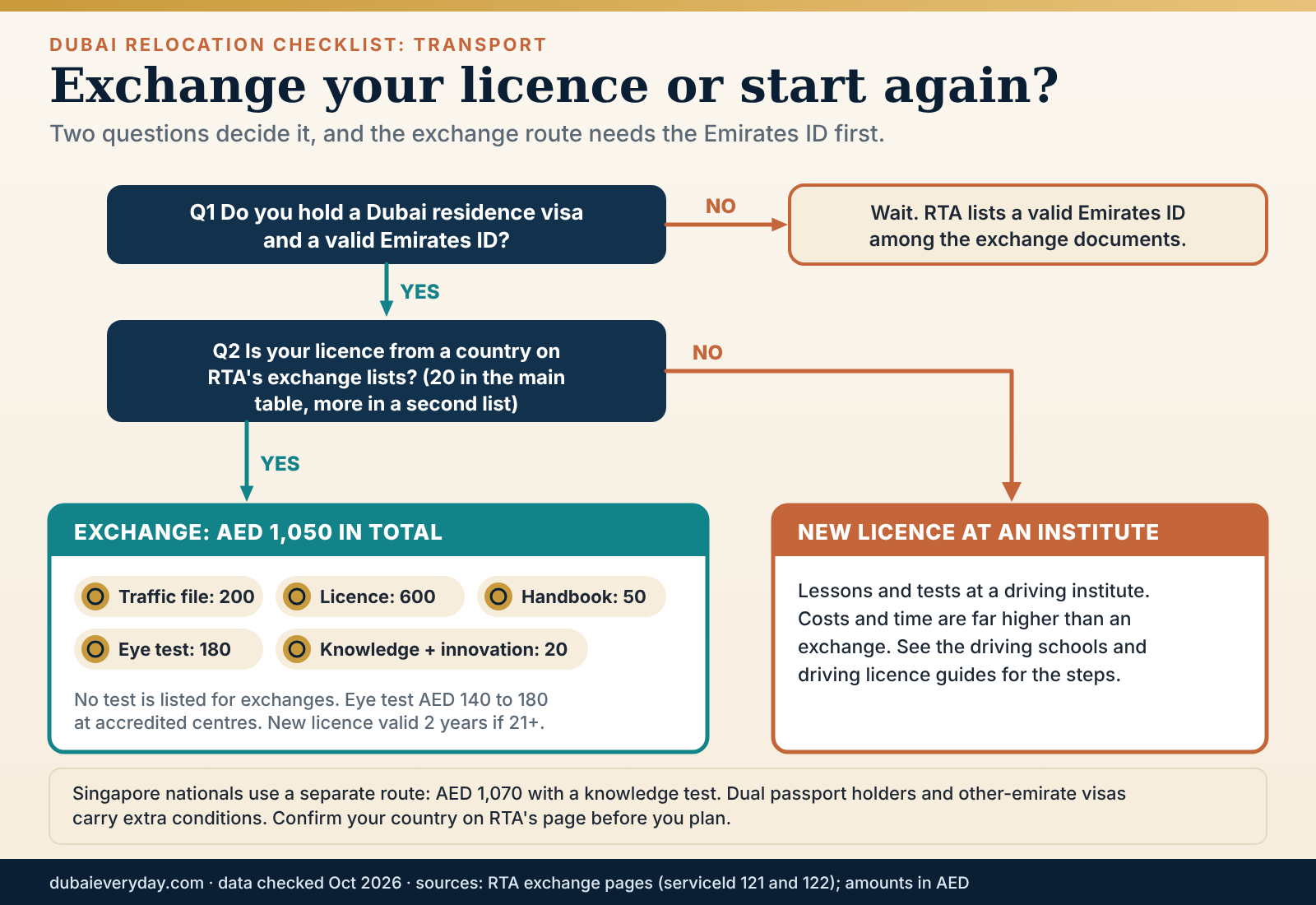
The RTA’s exchange page for other countries lists 20 countries in its main table: Austria, Belgium, Britain, Denmark, Finland, France, Germany, Hong Kong, Italy, Japan, the Netherlands, Norway, Poland, Romania, South Africa, Spain, Sweden, Switzerland, Turkey and the United States.
A second “check if your country is on the list” section names many more, including Australia, Canada, Ireland, New Zealand, South Korea and several Gulf neighbours. The page does not explain how the two lists differ, so confirm your country with RTA, and note that licences from a handful of territories, such as Jersey and Puerto Rico, cannot be replaced.
If you qualify, the page lists total exchange fees of AED 1,050: AED 200 for the traffic file, AED 600 for the licence, AED 50 for the handbook, AED 180 for the electronic eye test and AED 20 knowledge and innovation. Eye test fees at accredited centres range from AED 140 to AED 180.
No knowledge or road test is listed for exchanges. You need a valid Emirates ID, your original licence, a valid electronic eye test, a legal translation if the licence’s language requires one and, if the licence lacks security features, a certificate from your embassy.
The new licence is valid for two years if you are 21 or older, and for one year if under 21. Delivery is optional at AED 20 to AED 50. Singapore nationals use a separate route with a knowledge test and a total of AED 1,070. If your country is not eligible, you will take lessons and tests at a driving institute, which costs far more; the driving licence exchange guide, the driving licence guide and the driving schools comparison cover the options in order.
Dual nationals and other-emirate visas. RTA’s Singapore exchange page warns that dual passport holders whose residency is stamped on a non-exception-country passport cannot exchange. The other-countries page lists extra proof for visas issued by another emirate, such as a trade licence copy and an employment verification letter. Check which applies at the start of your visa stage, not at the licence counter.
Owning a car: where this Dubai relocation checklist stops
Registration, insurance and Salik tag paperwork for a purchased car follow the licence in the sequence, since each typically asks for your Emirates ID and a UAE licence. We did not verify the steps against RTA pages, so they are outside this Dubai relocation checklist. A sensible rule while you settle: do not buy a car until you have a lease, a licence and an idea of your commute.
Done when. This stage of the Dubai relocation checklist is done when you have a registered nol card, a documented plan for the first month of travel, a clear answer on licence eligibility from RTA, and a date in your calendar for the exchange or the first lesson.
Health cover, schools and pets: the family checklist
Families add three tracks to the Dubai relocation checklist, and each has its own lead time. Health cover is mandatory and fast. School places are limited and slow. Pet import is tightly regulated and the slowest of all.
Health cover and finding care
On a Dubai relocation checklist, health cover is arranged before you need it: the employer insures the employee, the sponsor insures dependants, and the Dubai government says the Dubai Health Law makes this mandatory. After that, the task is finding a GP and a pharmacy near your home.
The healthcare in Dubai page covers how the system is organised and what to do in an emergency, and the health insurance for Dubai residents page covers employer cover, dependants and claims in detail. Register with a clinic in the network named on your card before you are ill, not after.
Schools
Dubai’s private schools are regulated by KHDA, which publishes inspection ratings. Start by reading the Dubai schools guide and the KHDA ratings guide, which explains what a rating does and does not tell you. Khaleej Times reported on 9 October 2026 that enrolment exceeded 406,000 and that new schools were adding about 17,000 places, secondary figures that suggest supply is growing but not that your preferred school has room.
For planning, the 2026 to 2027 school calendar reported by Gulf News runs from 31 August 2026 to 2 July 2027, with a winter break from 14 December to 3 January and a spring break from 5 to 11 April. Confirm against KHDA or your school. Each school sets its own application steps and documents, so the Dubai relocation checklist step is to contact your shortlist, ask for the document list, and apply to more than one school. A transfer from a different curriculum is a topic to raise with each school directly.
Pets
Import rules depend on where the animal comes from, and the Ministry of Climate Change and Environment issues import permits; its permit page blocked our tools, so no fee is stated. Dubai Customs lists domestic animals among goods that need a permit.
Airlines have their own rules, and an airline FAQ we read said pets on itineraries ending in Dubai must travel as cargo. Federal Law No. 22 of 2016 bans a list of dog breeds, including Pit Bull types, American Staffordshire Terriers, Rottweilers and Dobermans, so check your dog against the annex before any other step.
Once the animal is in Dubai, registration with Dubai Municipality is done online with UAE PASS, using the home’s Makani number and the microchip and rabies records, per a Gulf News explainer updated in September 2024 that reports a fee of AED 30 plus VAT; confirm the current amount. The pets in Dubai and pet registration guides give the full process, and check whether your landlord’s rules allow your pet before you sign.
Done when. The family part of the Dubai relocation checklist is done when every family member has a confirmed insurance policy, you hold written admission steps for at least two schools, and any pet has a permit, a date and a vet who has signed off the paperwork.
Cash checklist: what the first weeks cost
A Dubai relocation checklist that ignores cash will fail at the first lease signature. The shock is not the size of any one fee; it is that a cluster of them lands in the same week, before your first salary arrives, and that some are refundable while others are gone for good. The graphic below separates the two.

The worked example: first-week cash on a Dubai relocation checklist
Illustrative example (not a market fact): a one-bedroom flat let at AED 70,000 a year, paid in four cheques of AED 17,500, unfurnished. We chose the rent because it is a round number, so every line can be checked by hand. Here is what leaves your account in the first week.
- First rent cheque: AED 17,500, with three more of the same amount on dates agreed in the contract.
- Security deposit at the reported custom of 5 percent for an unfurnished let: AED 3,500, refundable subject to condition.
- Agent commission, at the u.ae ceiling of up to 5 percent of total rent: up to AED 3,500, not refundable. Some agencies set a minimum, so ask for the figure in writing.
- Ejari: AED 177.75 through the app, or AED 220 at a trustee centre.
- DEWA deposit for an apartment, as reported: AED 2,000, refundable.
- DEWA activation, as reported: around AED 130.
Our calculation of that subtotal is AED 26,807.75: 17,500 plus 3,500 plus 3,500 plus 177.75 plus 2,000 plus 130. Of that, AED 5,500 is refundable, which is about 21 percent. The other three cheques, AED 52,500 in total, follow on their dates. If you pay the rent in one cheque instead, the first week’s outflow is AED 79,307.75.
Setup items on top
Then come the smaller lines, in ranges because the sources are secondary and the prices vary. Central gas is reported at AED 600 to AED 800. A local mover for a one-bedroom flat is reported at AED 1,000 to AED 1,500, and a deep clean at AED 200 to AED 600.
An e& prepaid SIM is AED 40, and a nol card is reported at about AED 25. Together those add AED 1,865 to AED 2,965 in our calculation, which takes the first-week total to between AED 28,672.75 and AED 29,772.75 for the four-cheque example.
Two recurring items start soon afterwards. The Dubai Municipality housing fee, at 5 percent of AED 70,000, is AED 3,500 a year, about AED 292 a month, on the DEWA bill. District cooling, if your building uses it, is billed separately, and the amount depends on the building. Our cost of living in Dubai guide shows how running costs build up after the first month.
The buffer rule
Our planning rule for a Dubai relocation checklist, not an official figure: before you leave, hold the first-week cash above, plus the cost of your temporary base, plus two months of living costs, in an account you can reach from Dubai. The two-month cushion exists because salary timing, bank account opening and card activation do not always line up on day one. If your employer pays a relocation allowance or reimburses fees, treat the reimbursement as arriving after the outflow, not before.
Fees move. Every figure in this section is dated October 2026. DLD fees, DEWA deposits and agent commissions are set by different bodies and change on different schedules, so confirm each on the authority’s page before you transfer money. The illustrative rent is not an indication of what a one-bedroom flat costs in any district.
A dated example: one Dubai relocation checklist, landing on 3 May 2027
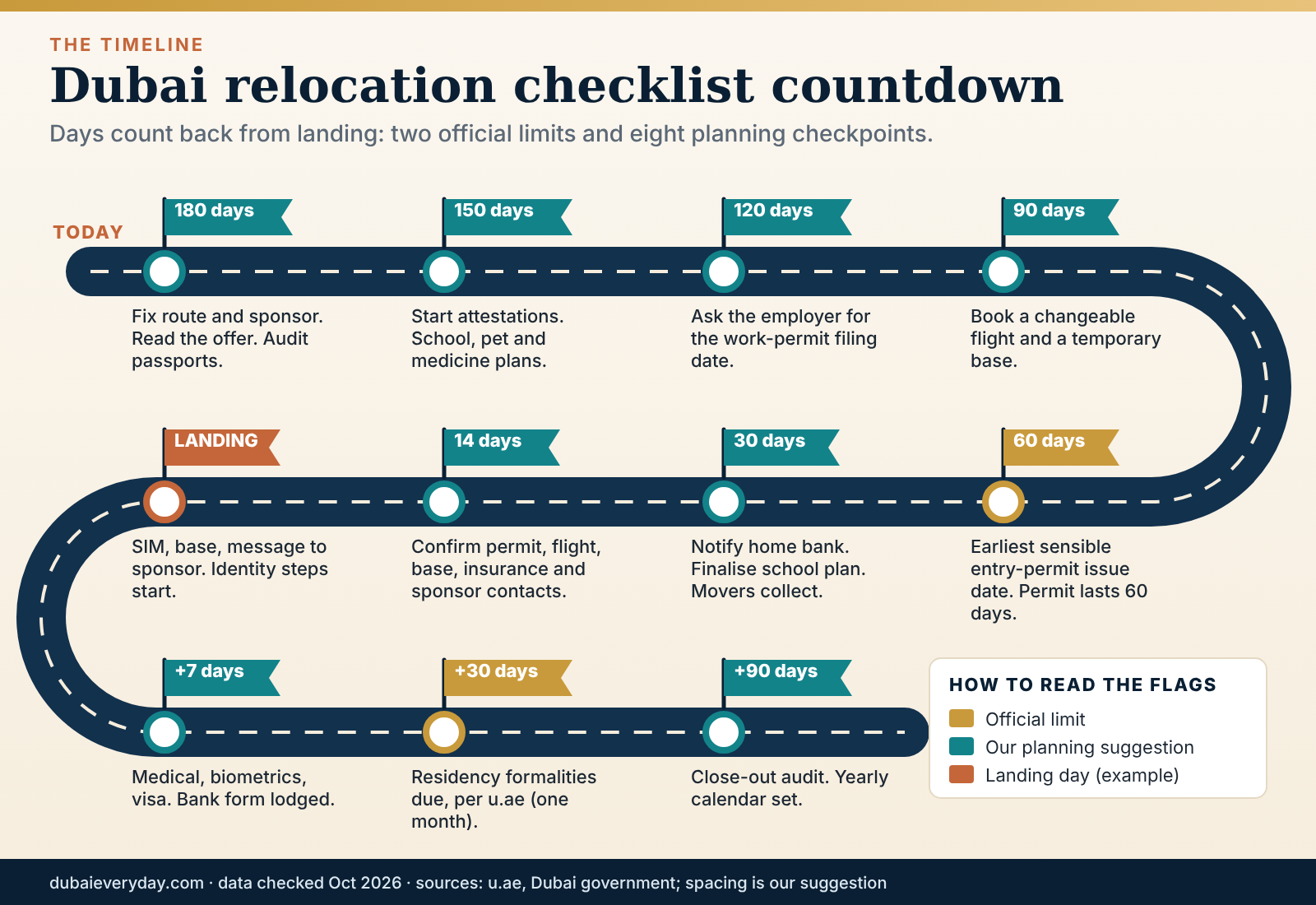
A Dubai relocation checklist becomes useful when it has dates. The table below applies the sequence to an illustrative landing on Monday 3 May 2027, an employee with a job offer and a spouse joining later. Replace the date with your own landing date and recompute each row by counting back or forward. The only official limits in the table are the 60-day entry-permit window and the one-month residency target; everything else is our planning suggestion.
| When | Date | Milestone | Owner |
|---|---|---|---|
| 180 days before | Wed 4 Nov 2026 | Confirm route and sponsor; written offer checks; passport audit | You |
| 150 days before | Fri 4 Dec 2026 | Start attestations if required; school shortlist; pet and medicine plan | You |
| 120 days before | Sun 3 Jan 2027 | Ask employer for the planned work-permit filing date | You and employer |
| 90 days before | Tue 2 Feb 2027 | Book changeable flight and temporary base; confirm insurance terms | You |
| 60 days before | Thu 4 Mar 2027 | Earliest sensible entry-permit issue date, since it lasts 60 days | Employer |
| 45 days before | Fri 19 Mar 2027 | Mover collection window; confirm transit time | You and mover |
| 30 days before | Sat 3 Apr 2027 | Finalise school plan; notify home bank and tax adviser | You |
| 14 days before | Mon 19 Apr 2027 | Confirm permit, flight, base and sponsor contacts | You |
| 7 days before | Mon 26 Apr 2027 | Money, phone and packing | You |
| 3 days before | Fri 30 Apr 2027 | Final paperwork check and check-in | You |
| Landing | Mon 3 May 2027 | SIM, base, message to sponsor | You |
| +1 to +2 days | Tue 4 to Wed 5 May | Medical test and biometrics | You and sponsor |
| +7 days | Mon 10 May 2027 | Visa issued; bank application lodged; viewings done | Employer and you |
| +14 days | Mon 17 May 2027 | Emirates ID expected (five-day completion plus courier); sign lease | ICP and you |
| +21 days | Mon 24 May 2027 | Ejari, DEWA, internet; licence exchange; move in | You |
| +30 days | Wed 2 Jun 2027 | Residency formalities should be complete | Employer and you |
| +90 days | Sun 1 Aug 2027 | Close-out audit: every task done, every receipt filed | You |
Two quirks of this example are worth copying into your own Dubai relocation checklist. First, ask the employer to avoid issuing the entry permit too early: a permit issued in January for a May landing would lapse before you flew.
Second, check public holidays and Ramadan hours against your dates; Ramadan 2027 is projected to begin around 8 February according to press coverage of a UAE Astronomy Centre projection, which would overlap the 90-day and 60-day rows. Government and company hours change during Ramadan, so give attestation and permit steps extra margin if they overlap.
Checklist variants by situation
The sequence of a Dubai relocation checklist changes in predictable ways depending on who sponsors you, and the trap changes with it. The table lists six common situations and the first gate in each.
| Situation | Who files the visa | First gate | Typical trap |
|---|---|---|---|
| Employee with a Dubai offer | Employer | Work permit approval | Entry permit expires before you fly |
| Spouse or child joining a resident | The resident sponsor | Sponsor salary threshold met | Missing attested family documents |
| Whole family landing together | Employer plus sponsor | Family permits issued at once | School term and lease dates collide |
| Remote worker | You, via GDRFA or ICP | Income proof and insurance | Conflicting income thresholds across official pages |
| Job seeker | You, no sponsor | Eligibility for the exploration visa | Visit-visa days run out before an offer lands |
| Business owner or investor | Company or ICP route | Licence or investment approval | Bank account delays while the licence is processed |
Family sequence: who goes first in a Dubai relocation checklist
The common pattern is that the sponsor lands, completes residency, signs a lease and then the family arrives on dependants’ visas. u.ae sets the sponsor’s salary at AED 4,000 a month, or AED 3,000 plus accommodation, and dependants aged 18 and over need a medical. Moving everyone together is possible but ties every task to the slowest document. Our Dubai with kids guide covers the family logistics once you are there.
Job seekers
If you are searching from inside Dubai, the order inverts: the clock starts at arrival, not at an offer. Keep housing short-term and flexible, avoid long leases until you hold a residence visa, and use the jobs in Dubai guide for search strategy and scam checks. Once an offer arrives, the work visa guide picks up the visa steps.
Business owners and investors
Setting up a company changes the Dubai relocation checklist because the licence comes first and the visa second. The business setup in Dubai guide explains the choices. Company bank accounts may take longer than personal ones, so ask the bank for its current timeline and keep a personal account route open in parallel.
Mistakes, scams and risks that break the sequence
Most failures on a Dubai relocation checklist are order errors, not knowledge gaps. Each mistake below reverses a dependency, and each has a cheap fix if you catch it early.
Order mistakes on a Dubai relocation checklist
Signing a lease before the residence visa and Emirates ID exist is the commonest. u.ae lists both among the documents a tenant brings, and lease registration is what unlocks DEWA, so an early signature can leave you paying rent on a flat you cannot connect.
The second is letting the entry permit lapse. It lasts two months, so an employer who files in January for a May landing has created a problem. The third is starting work on a visit visa because the employer is in a hurry, which u.ae says exposes both parties to fines.
Others are quieter. Laminating a certificate you plan to attest can make the Ministry of Foreign Affairs reject it. Assuming your foreign licence will keep working after residency is issued risks a traffic offence, and Federal Decree-Law 14 of 2024, as summarised in our research, sets fines for driving without a recognised licence. Forgetting the 5 percent housing fee turns a comfortable budget into a tight one by month two.
Money mistakes
Paying a deposit to a person you have not met, for a flat you have not seen, tops the list. So does treating the advertised rent as the cost of moving in: the example in the cash section shows that the first-week outflow is about 38 percent of the annual rent for a four-cheque lease, once deposits, commission and fees are added. Skipping the written question on district cooling can add hundreds of dirhams a month. And leaving receipts unfiled makes any end-of-tenancy or reimbursement discussion harder than it needs to be.
Scams to recognise
u.ae publishes tips on avoiding labour and visa fraud, and the pattern is stable: offers that ask you to pay a fee for a visa you have not been sponsored for, jobs that ask you to work before a permit is approved, and agents who promise results regardless of eligibility. Ask your real sponsor who pays which fee, in writing. Any request for money from a third party should prompt you to check the company’s licence and the exact government service involved before you pay.
In housing, the warning signs are listings without a verifiable QR code, landlords who cannot show ownership or authority, pressure to transfer money before a viewing, and requests to pay outside the contract. In banking, never share a PIN or one-time code. Our legal basics for residents page explains where to verify rules, and the Dubai etiquette guide covers the norms that make offices and landlords easier to deal with.
Risk register. Highest impact, hardest to reverse: working without a permit, paying unverified parties, signing a lease you cannot register, and letting a permit or passport lapse. Lowest impact, easiest to reverse: choosing the wrong SIM plan or the wrong gym. Spend your attention accordingly.
Days 30 to 90 and the yearly admin calendar
The last stage of a Dubai relocation checklist is an audit, not another task list. At day 30, check each gate against the map: residency complete, Emirates ID received, bank account open, lease registered, utilities active, licence exchange started. u.ae expects residency formalities within one month of entry, so anything outstanding at day 30 deserves a direct call to the sponsor.
Day 60 and day 90
By day 60, update every account with your Emirates ID number and your new address: employer, bank, insurer, schools and your home-country institutions. u.ae requires a change of personal details to be reported to ICP within one month. Review your actual spending against the buffer rule. Note your probation end date, since u.ae describes a probation period of up to six months under the labour law, and diarise the dates that follow.
By day 90, confirm that the second and third rent cheques are funded, that you understand your first full DEWA bill, and that nothing in your document folder has expired or is about to. Close the loop with anyone at home who held your spares.
The yearly calendar after your Dubai relocation checklist
Every year
Rent renewal discussions begin at least 90 days before expiry, since press coverage of the DLD rent index reports a 90-day notice requirement for changes. Pet registration tags renew with the annual rabies vaccination, per Dubai Municipality guidance reported by Gulf News.
Every two years
The employment residence visa is valid for two years. A newly issued Dubai licence for someone aged 21 or over is valid for two years, per the RTA exchange page.
Before expiry
Emirates ID renewal opens six months to a year before expiry depending on which ICP notice applies to you; late renewal costs AED 20 a day from one month after expiry, capped at AED 1,000. Passports need at least six months of validity for most onward steps.
If you ever leave, the sequence runs in reverse, and the same dependency logic applies: cancel utilities with a final bill, recover deposits, close the lease through the proper channel and cancel the visa. The DEWA move-out guide covers the utility side. Keep the calendar in the same place as your document index so that annual admin becomes a ten-minute routine rather than a scramble.
Dubai relocation checklist FAQ
How long does a Dubai relocation checklist take from start to finish?
There is no official end-to-end timeline. The official limits are narrow: an entry permit valid for two months and residency formalities expected within one month of entry. Around those, plan six months for planning, attestations and school or pet paperwork, then roughly three to four weeks after landing for visa, Emirates ID, bank and lease. Our planning estimate is six to eight months from decision to settled, with the weeks after landing the busiest.
What documents do I need to move to Dubai?
At minimum: passports valid at least six months, passport-size photographs meeting the ICAO standard, your entry permit or visa approval and your offer letter. Add attested degree certificates if your job requires them, marriage and birth certificates if you sponsor family, your driving licence, medical and vaccination records and a few spare copies. Keep originals in hand luggage and scans in secure storage. Your sponsor or the receiving authority can confirm anything specific to your case.
Can I rent a flat before I have a residence visa?
You can search and shortlist, but u.ae lists a valid residence visa and an Emirates ID among the tenant’s documents, and lease registration is compulsory to connect utilities. Most newcomers therefore sign after the card arrives. We found no official rule on whether visitors can sign, and a landlord may have its own approach. A Dubai relocation checklist therefore uses temporary accommodation first, and never pays a deposit before you have seen the flat and the contract.
How long is the entry permit valid?
u.ae says the entry permit stays valid for two months from the date of issue, and the Dubai government says you must enter within 60 days. Ask your employer to time the issue date to your flight. An entry permit that lapses means a fresh application and a new delay. If you are already in Dubai, a change-of-status permit replaces the entry permit, and the medical and residence steps follow.
When will I get my Emirates ID?
ICP states a completion time of five days for a new card, after fingerprints and signature are captured at a service centre for applicants aged 15 and over. Standard cards are delivered by courier, so allow a little more than five days in total. Urgent processing is AED 150 at service centres only, according to ICP, which also notes the passport needs at least three months’ validity. Confirm the live status through the ICP app.
Do I need to attest my degree certificate?
Only if your job or visa category requires it. u.ae says that where required, the original is authenticated by your home country’s foreign ministry and then by a UAE embassy or consulate, and some professions need a Ministry of Education step after arrival. The Ministry of Foreign Affairs adds that documents must not be laminated. Ask your employer early whether they need it, since the home-country steps are the slowest part.
How much cash do I need for the first weeks?
It depends on the rent and your choices. In our illustrative example, a flat let at AED 70,000 a year with four cheques needs about AED 28,700 to AED 29,800 in the first week, of which AED 5,500 is refundable, plus your temporary accommodation and living costs. Use the cash section of this page to rerun the calculation with your own rent, and keep a two-month buffer before the first salary. Fees change, so verify them.
Can I open a bank account before I arrive?
Some digital accounts accept people on a visit visa, and many banks accept a registration form while residency documents are in process. A full resident account usually needs a residence visa and an Emirates ID. As one example only, Mashreq’s NEO On Arrival account has no minimum balance but closes when the visa expires or after 180 days and does not allow international transfers. Ask each bank for its key facts statement and fee schedule.
Can I keep driving on my foreign licence once I live in Dubai?
We found no official grace period for new residents, and the federal traffic law summarised in our research exempts visitors staying for non-residence purposes. Plan to exchange or replace your licence once the Emirates ID exists. RTA lists 20 countries in its main exchange table and more in a second list; check yours. For the main list the total is AED 1,050, with no test listed. Otherwise you will take lessons and tests.
What is Ejari and why does it matter?
Ejari is Dubai’s tenancy registration system run by Dubai Land Department. u.ae says lease registration is compulsory to connect water, electricity, gas and telecoms, and Ejari certificates are usually needed to activate DEWA. The fee is AED 177.75 through the app or AED 220 at a trustee centre. The landlord must be the owner or hold a power of attorney. Keep the certificate with your lease and renew it when you renew the contract.
Can my family come with me?
Residents can sponsor a spouse, unmarried daughters, sons under 25 and children with special needs, subject to salary rules: u.ae gives AED 4,000 a month, or AED 3,000 plus accommodation. Parents may be possible on a yearly visa. Dependants aged 18 and over take the medical, and health insurance for dependants is the sponsor’s responsibility. Many people arrive first and bring family once a lease is signed; the order is a choice, not a rule.
Is health insurance mandatory in Dubai?
Yes. The Dubai government says health insurance is mandatory under the Dubai Health Law, that employers must insure employees including in free zones, and that sponsors must cover dependants such as spouses, children and domestic workers. The page does not give cover levels or penalties, so ask your employer for the policy terms in writing and read the Dubai health insurance guide for what to look for.
What should I do first when I land in Dubai?
Get a working phone, reach your temporary base and message your sponsor. Then follow the identity sequence: medical test, biometrics, visa, Emirates ID application. Every Dubai relocation checklist puts identity first. Everything else, including the lease, Ejari, DEWA and licence exchange, comes after that. Our first time in Dubai page covers getting around on day one.
What is the right order for a Dubai relocation checklist?
Identity first, money second, comfort last. A Dubai relocation checklist should start with passports, attested documents and the sponsor’s permit, move to the medical test, residence visa and Emirates ID, and only then to the lease, Ejari, DEWA, the bank account and the driving licence. The reason is dependency: the later items ask for documents the earlier items produce. Planning tasks with long lead times, such as attestations, school places and pet permits, start months earlier and run in parallel.
Does a Dubai relocation checklist change for remote workers?
Yes, mainly at the front. A remote worker has no employer to file the permit, so the Dubai relocation checklist begins with the visa route and its income and insurance proof. Official pages differ on the income threshold: the GDRFA service page we read gave USD 3,500 a month while the u.ae summary gave USD 5,000, so confirm with GDRFA or ICP. After the visa, the housing, Emirates ID, bank and transport steps match the employee sequence.
Related reading
Sources and further reading (24 links)
- UAE Government (u.ae): Preparing to work in the private sector — passport validity, entry permit validity, medical tests, attestation, one-month residency target
- Dubai government: Dubai standard residence visa for work — employer-sponsored sequence, 60-day entry, 48-hour issuance, two-year validity
- ICP: New Emirates ID issuance — fees, five-day completion time, photo and passport requirements, channels
- UAE Government (u.ae): Emirates ID — late-renewal fee, change-of-details and lost-card deadlines
- UAE Ministry of Foreign Affairs: Documents attestation — digital and courier attestation times, document rules
- UAE Government (u.ae): Leasing a property in the UAE — tenant documents, commission ceiling, compulsory registration, 5% Dubai housing fee
- Dubai Land Department: Register or renew an Ejari contract — Ejari fees, documents, channels and time
- Roads and Transport Authority: Exchange a foreign driving licence (other countries) — country lists, documents, AED 1,050 total, steps and validity
- Roads and Transport Authority: Licence exchange for Singapore holders — separate route and AED 1,070 fee
- Roads and Transport Authority: About the nol card — card types, where accepted, minimum balance
- Dubai Customs: Passenger customs guide (2021 edition) — duty-free allowances, AED 60,000 declaration threshold, permit list
- Dubai government: Health insurance in Dubai — mandatory cover, employer and sponsor duties
- GOV.UK (FCDO): Travel advice for the UAE — regional tensions, flight disruption, insurance advice
- TDRA: Porting numbers — free mobile number portability between operators
- e&: Prepaid plans — prepaid SIM price, as a neutral example
- ADCB: Current account opening tips for expatriates — usual bank document list and minimum salary note
- Citibank UAE: Documents needed to open an account — registration while residency is processed, balance waivers
- Mashreq: NEO On Arrival key facts statement — example visa-holder account terms, not an endorsement
- Bayut: DEWA account guide (secondary) — reported DEWA deposits and fees, because DEWA pages could not be read
- Emicool: FAQ — district cooling registration, documents and deposit rule (operator source)
- Gulf News: Renting in Dubai, extra costs when moving in — custom costs for deposits, movers, gas (secondary)
- Khaleej Times: Rents in Dubai fall over 12% (Savills Q3 2026) — rent trend context (secondary)
- Gulf News: UAE job-seeker visa, who can apply — job exploration visa outline (secondary)
- Wikipedia: Climate of Dubai — monthly temperature normals citing the Dubai Meteorological Office (secondary)
Update log: 29 October 2026 — first publication; all facts re-checked against the sources above. Next review due: 30 November 2026 for fees, flight disruption and rent trends, then at least annually, and sooner if visa, Emirates ID, tenancy, licence or utility rules change. Corrections welcome. This page is general information, not individual immigration, legal, tax, medical or financial advice.
About DubaiEveryday and this guide
DubaiEveryday.com is an independent editorial project that publishes practical, research-based guides to everyday life in Dubai: where to live, what things cost, how the rules work and how to get around. This page was written and edited by the DubaiEveryday editorial team. It is not signed by a named expert, doctor, lawyer or adviser, and we do not claim first-hand testing of a venue, clinic or service unless the page says so.
Each guide is built from official sources such as government and regulator pages, operator websites and established news outlets, cross-checked where we can. When we could not confirm something, we say so in the text, and examples that use made-up numbers are labelled as illustrations. Mentions are editorial choices, not paid placements, and a link is not an endorsement.
Dubai changes quickly. If you spot something that is out of date or wrong, please tell us through the contact options on DubaiEveryday.com and we will check it and correct the page.