

Moving to Dubai is a chain of linked paperwork jobs, and the order matters more than the speed. This guide gives you the sequence, the official rules behind it, the real cash needed on day one and what has changed in late 2026.
Most people start by hunting for apartments. It feels like progress. Then they find out the lease needs an Emirates ID, the bank account needs the lease, and the ID needs the visa.
The order matters more than the speed, and getting it backwards costs weeks. If you are moving to Dubai with a job offer, a fixed sequence will save you from those loops. This guide lays out that sequence, the real cash needed on day one, and how to cover your first weeks while the paperwork catches up, so nothing stalls halfway and you are not paying for a hotel while you wait.
Moving to Dubai comes down to five linked jobs: a residence visa, a home, a bank account, health insurance and, if you have children, a school place. Most people with a job offer get them done in a fixed order. The employer secures a work permit, you enter on an entry permit, take the medical test, get the visa and Emirates ID, and only then can you sign a normal lease and open a salary account.
The Emirates ID is the bottleneck, so plan your first two to three weeks around it: short-term accommodation, a SIM and a transport card first, the lease and bank account second. On our calculation, a one-bedroom at the AED 57,000 citywide median needs roughly AED 23,800 in cash on move-in day if you pay the rent in four cheques, and about AED 66,550 if the landlord wants one.
Two things are different this year for anyone moving to Dubai. Rents fell in most areas over the 12 months to Q3 2026, which gives tenants more room to negotiate. And government advice on the region remains cautious, so read your own country’s guidance before you commit. Below you get the sequence for moving to Dubai, visa routes, costs, a worked budget and three sample moves.
This is a desk-research guide to moving to Dubai. DubaiEveryday.com has not made the move, queued at a typing centre, signed a lease or opened an account described below, and nothing here is a personal account. Every rule, fee and figure was read on 29 October 2026 from official or near-official pages: the Dubai government’s residence-visa page, the UAE government portal, the Federal Authority for Identity and Citizenship (ICP), the Dubai Land Department (DLD), GDRFA Dubai, the ILOE scheme and the Dubai Health Authority’s regulatory index.
Where an official page would not load (the DHA and KHDA sites returned errors), we used Gulf News, Khaleej Times or a law-firm summary and say so in the text. Rent and cost figures are medians, press reports or crowd-sourced averages, labelled as such. Calculations are ours and labelled “our calculation”.
Banks and platforms are named only as neutral examples, inclusion was not paid for, and there are no referral links. This is general information, not immigration, legal, tax, medical or financial advice. Rules change, so confirm with the authority named before you act.
Moving to Dubai in late 2026: what is different this year
Most guides to moving to Dubai were written in calmer years. Three things in 2026 change the advice on moving to Dubai, and you should settle them before you spend money on a visa or a flight.
Regional security and your own government’s advice
Since the regional conflict began in early 2026, official travel advice for the UAE has stayed cautious. The UK Foreign Office updated its UAE page on 27 October 2026 and still describes the situation as highly unpredictable, with a high risk of sudden escalation, possible flight cancellations and short-notice airspace closures. It tells readers to follow local authorities, keep documents current and have suitable insurance.
Other governments word their advice differently and change it at different times. We are an editorial site, not a security assessor, so we do not tell you whether to go ahead with moving to Dubai. What we can say is that this is a decision to make with your own government’s current page open, your family’s circumstances in mind and, ideally, a conversation with your employer about their duty of care and contingency plans.
Read the current advice from your own government, ask your employer what support exists if flights are disrupted, and ask any insurer you plan to use what conflict or war exclusions apply. Keep a copy of your passport, visa and Emirates ID outside the UAE.
Flights are patchy even though Dubai airport is busy
The airport itself is operating, and Emirates and flydubai run wide schedules. But a long list of foreign airlines has paused or postponed Dubai service. Time Out Dubai’s 27 October summary lists Air Canada out until the end of March 2027, Cathay Pacific until 31 January, KLM through 27 March, Finnair for the whole winter season, British Airways paused to 3 November and Lufthansa’s return pushed past 25 November.
For people moving to Dubai, that has a practical meaning. Your usual home airline may not fly to Dubai, so price your one-way ticket and your future visits home on the carriers that do. Book flexible fares for the first trip of moving to Dubai, and do not commit to a lease start date that a cancelled flight could make you miss. For arrival logistics, our Dubai airport guide covers terminals and transfers.
Rents have fallen, and that helps new tenants
The biggest practical change for anyone moving to Dubai is the rental market. Savills’ Q3 2026 report, as reported by Khaleej Times on 13 October, put apartment rents in Dubai Marina down 12.8% year on year, Business Bay down 12.2% and Jumeirah Village Circle down 10.4%. Property Finder data reported on 18 October showed median asking rents in Downtown Dubai down 21.7% and in Marina down 16.1%.
The same Property Finder series puts the median apartment asking rent at about AED 135,000 at the December 2025 peak, AED 100,000 by June 2026 and AED 105,000 in September. Savills describes “early signs of stabilisation” and reads the shift as a rebalancing, not a reversal. Our reading: the bottom may be near, but a tenant who arrives now still has more bargaining power than in 2024 and 2025, and should use it on price, cheque count and included parking.
What this guide covers, and what it leaves to siblings
This page is the map for moving to Dubai: sequence, choices, costs and trade-offs. For a tick-list you can print, use our Dubai relocation checklist. For the detail of each residency category, renewals and cancellations, go to the Dubai residence visa guide. For job search and offers, see finding a job in Dubai.
We cover the contract, the money, the home, the insurance and the school only to the depth you need to decide and act on moving to Dubai. Where a topic has its own guide, we link it at the point where you would need it.
The order that works when you are moving to Dubai
Almost every early mistake in moving to Dubai comes from doing a later step before an earlier one. People pay a deposit on a flat they cannot yet lease, or turn up on a visit visa expecting to start work. The official rules explain why the order is fixed, and three of them do most of the work.
First, when moving to Dubai you cannot get a residence visa from abroad. The UAE government’s fraud-prevention guidance says a residency visa cannot be processed from outside the country, so you must first enter on a valid entry permit. Second, it states that a visit or tourist visa does not give you the right to work. Third, a normal lease needs a valid residence visa and an Emirates ID, according to the official leasing page.

What the order means for moving to Dubai in week one
Because the lease comes late in the chain for anyone moving to Dubai, you need somewhere to stay while the visa and Emirates ID are processed. When moving to Dubai, plan a short-term base for two to four weeks: a serviced apartment, a hotel on a monthly rate or a friend’s spare room. Our guides to budget hotels near the Metro and hotels by area help you compare locations for that first stretch, and the Dubai travel guide covers the arrival basics.
Two other consequences follow. Do not pay a holding deposit on a long lease until you know your visa is approved and when you land. And do not count on a salary account on day one, because most banks ask for residency documents. Some do open accounts for people in the process or on a visit visa, which we cover in the banking section.
Three versions of the sequence for moving to Dubai
The chain in the figure is the employer route, the most common one. Two other starting points change the early steps but not the logic.
- Employer route. Offer, work permit, entry permit, arrival, medical test, visa, Emirates ID. Your employer or its PRO (the person who handles government paperwork) drives most of it.
- Remote-work route. You apply yourself to GDRFA Dubai. The service page says the initial stay is 60 days from entry while residence formalities are completed, and that processing is expected to take about 48 hours.
- Family route. A resident sponsors you. The sponsor has 60 days after you enter on the entry permit to apply for your residence visa, according to the UAE sponsorship page.
How long does moving to Dubai take?
The official figures for moving to Dubai are short. The Dubai government says the residence visa is issued within 48 hours after your medical fitness result is released and your employer applies online. The ICP lists a completion time of five days for a new Emirates ID. The entry permit is valid for two months from issue, and the UAE portal says residency procedures should be completed within one month of entering.
Real calendars run longer because of queues, courier time and employer paperwork. Our planning assumption, and it is only that, is two to four weeks from landing to Emirates ID in hand. If your employer promises faster, good. If a quick fix costs extra, ask for the official fee list first.
Ask this in the offer stage. Before moving to Dubai, ask your employer or PRO four things in writing: who pays for the medical test and Emirates ID, when the work permit is expected, how long they allow for the visa after you land, and what accommodation they provide during that window. Many disputes later come from assumptions made at this point.
Choosing a visa route for moving to Dubai
Most people moving to Dubai arrive on an employer-sponsored residence visa, but it is no longer the only door. The UAE now has routes for remote workers, job hunters, long-stay investors and self-employed professionals. Pick by your situation today, not by what sounds most impressive, because the thresholds for moving to Dubai are real and the paperwork is different for each.

Employer-sponsored residence
This is the default for people moving to Dubai. A Dubai employer offers you a job, applies for a work permit through the Ministry of Human Resources and Emiratisation (MOHRE) and sponsors your residence. The Dubai government page gives the initial validity as two years, renewable. We walk through every step in the next section, and the Dubai work visa guide goes deeper on entry, medical and contract details.
Remote working visa
If you are moving to Dubai while employed by, or owning a company based, outside the UAE, you can apply for the remote (virtual) working residence. The issuing authority’s GDRFA Dubai service page asks for a recent photo, a passport valid for six months, evidence that you work remotely for a foreign entity, proof of monthly income of at least USD 3,500 and valid health insurance.
The visa fee is AED 200 plus 5% VAT. If you are already inside the UAE, add AED 500 in-country fee plus two AED 10 charges. The residence lasts one year and is extendable, and you can sponsor family for the same period. One wrinkle: the UAE portal’s own summary page still shows a USD 5,000 threshold and a USD 287 programme fee. We treat the GDRFA service page as the better guide for Dubai applicants, but confirm both numbers before you pay anyone.
This visa is designed for people paid from outside the UAE. If you plan to take Dubai clients or a local job later, you will need the correct permit for that work. Several commercial sites also report a longer bank-statement history from early 2026. The GDRFA page does not state a month count, so ask the authority, not a visa agent, what proof it wants today.
Job exploration visa
For skilled professionals moving to Dubai to look for work in person, the job exploration visa needs no local employer or sponsor. Gulf News, updated on 11 September 2026, describes it as a single-entry visa for 60, 90 or 120 days, possibly extendable to roughly 180 days in total. Applicants generally need a bachelor’s degree or equivalent and a target role at MOHRE skill levels 1 to 3, and recent graduates of top-500 universities within two years can also qualify.
The article does not list current fees and we could not find an official fee table, so check the amount at application. It is also worth reading our guide to finding a job in Dubai first: the visa buys you time, not interviews, and a job search without a defined target sector burns that time quickly.
Green and Golden residence
Both are sponsor-free, longer-term routes for moving to Dubai. The ICP’s Green Residence page lists five-year residence for skilled workers (a valid contract, MOHRE skill level 1 to 3, at least a bachelor’s degree and a salary of AED 15,000 a month or more), for freelancers (a MOHRE freelance permit and AED 360,000 in income in each of the previous two years) and for investors and partners.
The Golden visa runs five or ten years depending on category. Real-estate investors need AED 2 million of property for the five-year version, and other categories cover entrepreneurs, exceptional talent, outstanding students and humanitarian pioneers. Holders need no sponsor, can bring family and can stay abroad longer than the usual six-month limit. If property is your route, read buying Dubai property as a foreigner first: buying a flat only for a visa is an investment decision with its own risks, and nothing here is financial advice.
Side-by-side summary
| Route | Suits | Sponsor | Validity | Headline requirement |
|---|---|---|---|---|
| Employer-sponsored | Anyone with a Dubai job offer | Employer | 2 years initially | Work permit, medical test, insurance |
| Remote working | Employed or owning a business abroad | None | 1 year, extendable | USD 3,500 monthly income, insurance (GDRFA) |
| Job exploration | Skilled jobseekers | None | 60, 90 or 120 days | Degree, MOHRE level 1 to 3 |
| Green residence | Skilled, freelancers, investors | None | 5 years | AED 15,000 a month (skilled) |
| Golden visa | Investors, talent, founders | None | 5 or 10 years | AED 2 million property (investors) |
| Family sponsorship | Spouse, children, parents | Resident relative | Tied to sponsor | Sponsor earns AED 4,000 (or 3,000 plus housing) |
Business owners moving to Dubai have another path, which is to set up a company and sponsor yourself through it. That is a project in its own right, covered in our Dubai business setup guide. The same applies to student and retirement routes, which we did not verify for this page and leave to the residence visa guide.
Employer-sponsored residence, step by step
If you are moving to Dubai with a job offer, your employer does most of the filing, but you control the parts that stall: documents, the medical test and the Emirates ID appointment. The steps below combine the Dubai government’s residence-visa page (last modified 14 April 2026), the UAE portal’s job-offer process and the ICP’s Emirates ID service page.
- Offer letter and work permitThe employer signs the offer electronically and sends it to you. You sign it (by signature for skill levels 1 to 3, by fingerprint for levels 4 and 5). The signed offer goes into the initial work-permit application that MOHRE reviews. Approval is what allows you to enter.
- Entry permit, or change of statusIf you are abroad, you receive an entry permit and have about two months to use it. If you are already in Dubai on a visit visa, the employer applies for a change-of-status permit instead, which replaces this step.
- Medical fitness testYou take it at an authorised centre in Dubai. The government describes it as typically a blood test and a chest X-ray.
- Residence visaOnce your medical result is released, the employer applies online and the visa is issued within 48 hours. Initial validity is two years.
- Emirates ID biometricsYou give fingerprints and a photo at an authorised typing centre. The ICP lists the fee for residents as AED 100 per year of residence plus AED 100 for the smart service, a five-day completion time, and a AED 150 urgent option available only at service centres.
- Health insuranceCover must be active for visa processing. In Dubai the employer provides it for you. We cover the rules in the health insurance section.
- Contract registrationAfter arrival, you and the employer sign the offer, and MOHRE registers it as your binding employment contract. It must be filed within 14 days of your arrival or status change.
What the medical test screens for
The UAE portal lists the screening under Cabinet Resolution No. 5 of 2016: HIV, hepatitis B, syphilis, tuberculosis and leprosy, plus pregnancy for domestic workers only. It states that positive HIV or leprosy results lead to denial or non-renewal of residency. The family-visa page adds that residents with dormant or inactive pulmonary TB can receive a one-year health fitness certificate, subject to treatment and follow-up.
This is the part of moving to Dubai where a private conversation with your own doctor, before you resign from a job at home, is cheap insurance. We cannot advise on individual medical eligibility, and the authority, not an agent, decides it.
Attestations and passports: do these before moving to Dubai
For some jobs you need attested academic certificates. The UAE portal describes a chain: certificates issued abroad are attested by the foreign ministry of the issuing country and then by a UAE embassy or consulate, and certificates issued in the UAE are attested through the Ministry of Foreign Affairs’ digital channels. Doctors, lab technicians and other regulated professions also need to pass licensing exams before they can practise.
We could not verify typical attestation timelines, so treat anything quoted online as a guess and ask your employer which documents they need and by when. Check your passport too. It should be valid for at least six months before you travel, and the portal notes that you are entitled to keep possession of your own passport.
Who pays what. The UAE portal’s fraud advice says the employer is expected to pay recruitment expenses under UAE labour law, and it tells candidates to check official fees to avoid overpaying. If an agent asks you for a “visa fee” or “job fee” before you have a verified offer, treat that as a red flag and read the scam checks below.
Already in Dubai on a visit visa?
Changing status from inside the country is a legitimate route, but the visit visa itself does not allow you to work. Do not start work before your permit is in place, even if an employer asks you to “help out” during the process. Whether you also need to leave and re-enter depends on the permit type, so ask your employer’s PRO rather than a forum.
Your contract, pay and protections in month one
Moving to Dubai with a job offer also means moving into a different employment law. The private-sector rules sit in Federal Decree-Law No. 33 of 2021, which the UAE portal summarises page by page. These are the points that matter most in your first month and first year.
Contract basics and probation
Contracts for people moving to Dubai on a job offer must be fixed-term, for no more than three years, and can be renewed for a similar or shorter term. The UAE portal’s contract page lists the models in use: full-time, part-time, flexible, temporary, remote and job-sharing. After registration, the employer cannot change the offer’s terms without your consent.
Probation cannot exceed six months and cannot be extended. During probation an employer ending the contract must give 14 days’ written notice, and so must you if you are leaving the job and the country. If you move to another UAE employer during probation, the notice is at least one month and the new employer may have to compensate the old one for recruitment costs. That last rule is the one that surprises people, so read it before you accept a second offer in your first six months.
Hours, overtime and Ramadan
The working-hours page sets the standard at 8 hours a day or 48 hours a week, reduced by 2 hours a day in Ramadan. After five consecutive hours you are entitled to breaks totalling at least an hour. Overtime is capped at two extra hours a day and is paid at your basic hourly rate plus 25%, rising to 50% between 10 pm and 4 am. Work on an agreed off day earns either a substitute rest day or pay plus 50%.
There is also a heat rule for outdoor work. Under Ministerial Resolution No. 44 of 2022, outdoor work in direct sun is prohibited from 12:30 pm to 3 pm between 15 June and 15 September. It is aimed at site and delivery workers, but it tells you what the authorities consider the dangerous window, which matters when you plan your own summer days.
Wages and the Wages Protection System
Private-sector wages are paid through the Wages Protection System (WPS) via banks, exchange houses or other institutions authorised by the Central Bank, in dirhams unless you agree another currency in writing. The UAE portal says salary for the previous month is due on the first day of each month, and employers must transfer at least 85% of the wages due on time.
Late payment triggers an escalation ladder, which starts with electronic monitoring and alerts, suspends new work permits at day five, adds fines at day 11 and registers labour disputes automatically from day 16. If you are paid late, you can file a salary complaint with MOHRE. In practice this system is why you need a working bank channel by your first pay day, even if your Emirates ID card is still in the post.
End-of-service gratuity
Expatriates with at least one year of continuous service receive an end-of-service gratuity, calculated on basic salary only. The portal gives 21 days’ salary for each of the first five years and 30 days for each year after that, capped at two years’ wages, payable within 14 days of termination. Allowances for housing, transport and similar items are excluded.
Our calculation: a gratuity example. Take a basic salary of AED 12,000 and treat a day’s pay as one thirtieth of the month, which is AED 400. Each of the first five years earns 21 days, or AED 8,400. A seven-year stay would earn 5 x 8,400 = AED 42,000 plus 2 x 12,000 = AED 24,000 for the last two years, which comes to AED 66,000. The cap of two years’ wages (AED 288,000) does not bite. Confirm the day-rate convention with MOHRE’s calculator or your HR team.
MOHRE also runs a voluntary savings scheme as an alternative to the traditional gratuity. The portal describes employer contributions of 5.83% of basic monthly salary for the first five years and 8.33% after that, with optional employee top-ups. If your employer enrols you, the traditional gratuity stops accruing, so ask which system applies and what happens to years already served.
Job-loss insurance (ILOE)
Most private-sector and federal-government employees must subscribe to the Involuntary Loss of Employment scheme set up under Federal Decree-Law No. 13 of 2022. The ILOE site lists premiums of AED 5 a month (plus VAT) for basic salaries up to AED 16,000 and AED 10 a month above that. Benefits are up to 60% of average basic pay over the previous six months, capped at AED 10,000 or AED 20,000 a month by category, for up to three months per claim.
The limits matter. Benefits are only paid to people who have paid premiums for at least 12 consecutive months, and there is a lifetime cap of 12 monthly benefits. It is a bridge, not a safety net, so keep a cash cushion of your own. The site is silent on penalties for not subscribing, so ask HR how it is being handled for you.
Tax: what changes and what does not when moving to Dubai
The UAE portal states that the UAE does not levy income tax on individuals, and that value-added tax is 5% on goods and services. That is the headline most people cite, but it is not the whole picture. Your home country may still tax you, depending on its residency and citizenship rules, and moving can trigger exit and reporting obligations. Check with a tax adviser in both countries before you give up your home tax residence.
Offer scams: three checks before moving to Dubai
The government’s labour and visa fraud guidance is concrete. A genuine job offer comes with an offer letter issued through MOHRE and signed by an authorised manager. You can check its reference number on MOHRE’s enquiry service, confirm the company in the National Economic Register by its English and Arabic names, and verify a Dubai entry permit on the GDRFA website.
Be wary if anyone says a tourist visa lets you work, asks you to pay recruitment costs, or wants you to start a residency application from outside the UAE. Our job-search guide has a longer list of scam patterns, and the Dubai legal basics guide points to where each rule can be checked.
Moving to Dubai with a partner, children or parents
Moving to Dubai as a family adds a second layer to the chain: you become a sponsor, and your dependants’ residence is tied to yours. The rules below come from the UAE portal’s family-visa page and its sponsorship-requirements subpage. The portal warns that conditions may change, so confirm with GDRFA or ICP before you act.
Sponsor income
At least AED 4,000 a month, or AED 3,000 plus accommodation provided. The page lists no other housing test, so expect questions about where your family will live.
Who can be sponsored
A spouse, unmarried daughters, sons under 25 and children with special needs. Parents can be sponsored on a visa issued yearly, whatever the length of the sponsor’s own visa.
Medical test
Dependants aged 18 and over must pass the medical fitness test at an approved health centre in the UAE.
Timing
After a dependant enters on an entry permit, the sponsor has 60 days to apply for the residence visa.
Who goes first when moving to Dubai as a family?
The cleanest plan for moving to Dubai as a family is usually sequential. The sponsor arrives, completes the medical test, visa and Emirates ID, signs a lease and then sponsors the family, who land into a home with a working address. It costs a few weeks of separation, but it avoids paying for a hotel suite for four while the paperwork runs.
The alternative, bringing everyone on entry permits together, makes sense when a school start date is close or one parent will not manage alone. Budget for the extra short-term accommodation, and keep to the 60-day window. The official page does not say whether GDRFA asks for a tenancy contract at the family-visa stage, so ask your PRO for the exact document list before the family flies.
Attestations, insurance and the sponsor’s duties
For families moving to Dubai, the family-visa page lists only the medical test as a document requirement. In practice you should expect to be asked for proof of relationship, so find out early whether your marriage and birth certificates need attestation and in what chain. We could not verify the current document list on an official page, so this is a question for the authority, not a guess to carry in your luggage.
In Dubai, the sponsor is responsible for arranging health insurance for dependants who are not covered by the employer’s plan. Gulf News, in a piece updated on 14 July 2026, makes the same point. Ask HR at the offer stage whether the employer extends cover to family, subsidises it or leaves it entirely to you, because the difference can be thousands of dirhams a year.
Your dependants’ visas follow yours. If your own visa is cancelled, theirs must be cancelled too, although dependants get a six-month grace period from expiry or cancellation to secure a new residence permit. A sponsor who fails to renew or cancel dependants’ visas may be fined, so put both dates in your calendar. If you plan to bring a pet, start with our Dubai pet ownership guide and pet registration guide, because paperwork lead times differ from people’s.
Finally, a partner who wants to work will need their own work permit through an employer or another route, since a dependant visa is not a work permit. Ask MOHRE or the PRO what applies to the specific visa type. For the family side of daily life, our Dubai with kids guide covers logistics and heat management.
Where to live: rents, areas and trade-offs
Rent is the largest line in any budget for moving to Dubai, and it varies more by area than by anything else. The best public dataset is the registered tenancy contracts (Ejari) held by the Dubai Land Department. Two independent services publish medians from that open data, which reflect what tenants actually signed, not what landlords asked.
According to houserent.ae (June 2026 data, reviewed 14 September), the citywide median annual rent is about AED 41,000 for a studio, AED 57,000 for a one-bedroom, AED 80,000 for a two-bedroom and AED 110,000 for a three-bedroom. Community medians for studios run from about AED 24,000 to about AED 95,000, and for one-bedrooms from about AED 35,000 to about AED 150,000, with Palm Jumeirah at the top of both. Both services are independent aggregators, not government pages, so treat the numbers as indicative.
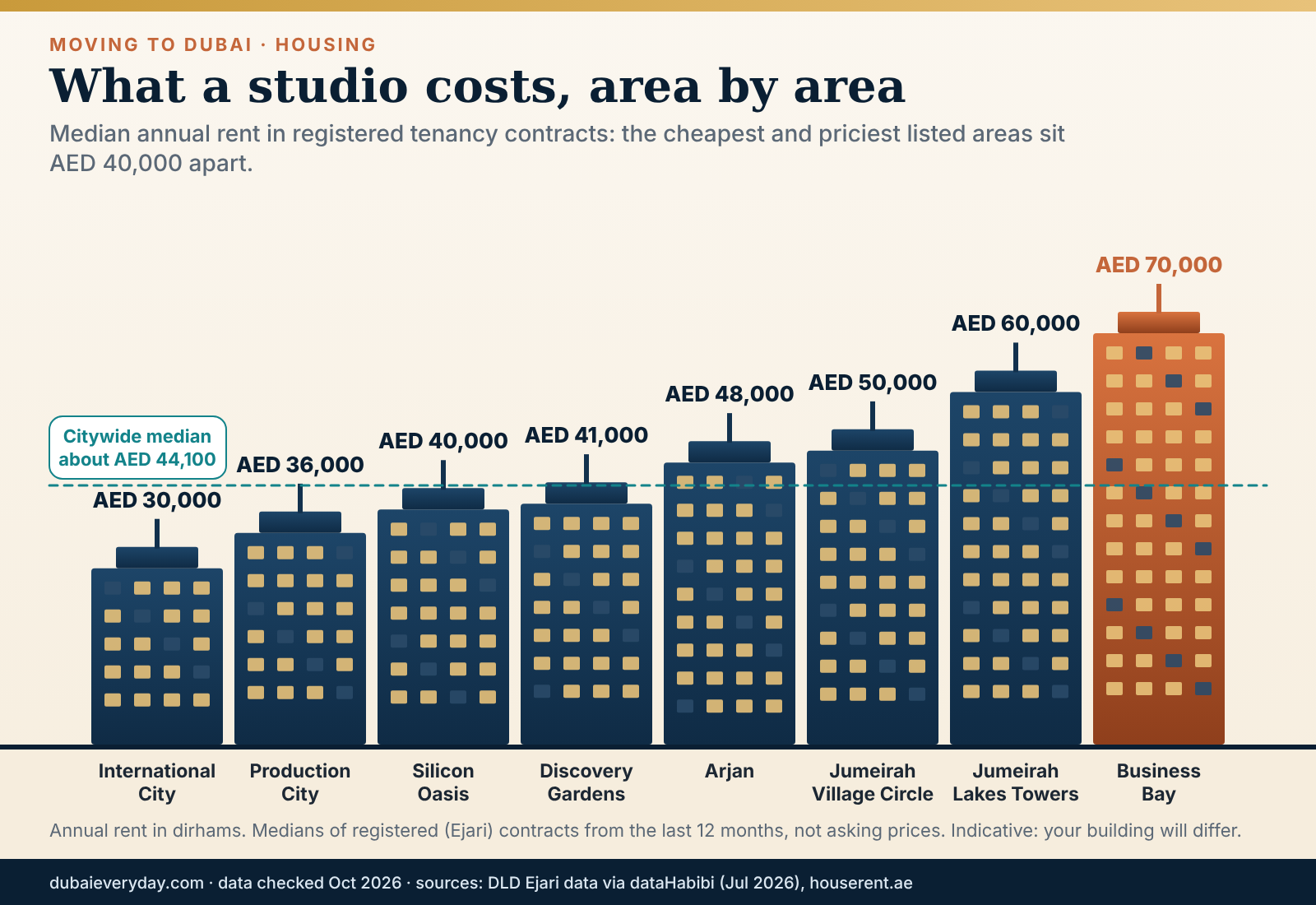
What the skyline tells you about moving to Dubai on a budget
The same studio costs AED 30,000 a year in International City and AED 70,000 in Business Bay, according to dataHabibi’s July 2026 analysis. Dubai Silicon Oasis (AED 40,000), Discovery Gardens (AED 41,000), Arjan (AED 48,000) and Jumeirah Village Circle (AED 50,000) sit around or just above the citywide median of about AED 44,100, while Jumeirah Lakes Towers (AED 60,000) and Business Bay carry a premium for Metro access and central location.
That premium is not an arbitrary label. For anyone moving to Dubai, rent buys proximity: to the Metro, to the coast, to the central business districts and to the school you want. Cheaper areas generally trade travel time or car dependence for rent, and the figure is the quickest way to see how much.
Metro corridor or car suburb when moving to Dubai?
Before you look at a single listing, decide whether you can live without a car. The Red Line runs through Business Bay, Burj Khalifa/Dubai Mall, the Financial Centre, Mall of the Emirates, Dubai Internet City and the stations serving Jumeirah Lakes Towers and Dubai Marina. The extension adds Discovery Gardens, Al Furjan and Jumeirah Golf Estates, according to Wikipedia’s station list, which is a secondary source and should be checked against the RTA map.
None of the station names on that list correspond to Jumeirah Village Circle, Arjan, Dubai Silicon Oasis or International City, so assume you will rely on buses, taxis or a car there. For the full map and fares, use our Metro guide and Red Line guide, and for district profiles see Dubai Marina, Downtown Dubai and Palm Jumeirah.
A four-question filter for choosing an area when moving to Dubai
- Where do you spend five days a week?Put a pin on the office and the school, then rule out areas where the daily commute is not realistic for you.
- Metro or car?If you want the Metro, shortlist stations first and walk or tram outward from there. If you drive, include the cost of parking and tolls.
- What rent fits your pay?A common budgeting rule of thumb, which is not an official rule, keeps rent at or below a third of gross monthly pay. A median one-bedroom at AED 57,000 is AED 4,750 a month, which implies about AED 14,250 of monthly pay.
- Apartment or villa?Villas bring space, gardens and community fees. Apartments bring amenities and, in many towers, district cooling. See our apartment rental guide and villa rental guide for the checks each needs.
Use the soft market, but read the contract
With asking rents lower than a year ago, a tenant moving to Dubai now can ask for things that were hard to get in 2025: a longer cheque schedule, a modest discount, a parking space included, or a repainted unit. Do it in writing, and compare any bargain against nearby listings of the same size and building age.
Be sceptical of a price far below the median for the building. The Dubai Land Department runs a Rental Dispute Centre for tenant and landlord disputes, but prevention is cheaper than a dispute. View in person, ask for the title deed, match the landlord’s name to the person you are paying, and register the contract before you hand over a deposit. Our renting in Dubai guide and tenant rights guide cover viewings and disputes in detail.
Leases, Ejari, deposits and the move-in cash
The official leasing page lists what a tenant needs when moving to Dubai: a passport copy, a valid residence visa, an Emirates ID and post-dated cheques covering the agreed lease period. Rent can be paid in one payment or several, as agreed with the broker or landlord. The same page says registering the lease is compulsory because it is required to connect utility services.
That registration is called Ejari. The Dubai Land Department’s Ejari page lists a total fee of AED 177.75 through the Dubai REST app or website and AED 220 at a Real Estate Trustee Centre, where you bring the original tenancy contract and your Emirates ID. Done properly, it is the cheapest step in the whole process. It is also the one that unlocks your electricity and water account.

The line items, one by one
- Agent commission. The UAE portal says brokers charge up to 5% of the total rent. On AED 57,000 that is AED 2,850. Gulf News reports some agents quoting a minimum, so ask for the figure in writing before you view.
- Security deposit. Gulf News gives 5% of annual rent for an unfurnished home and 10% for a furnished one, refundable. On AED 57,000 unfurnished that is AED 2,850.
- Ejari. AED 177.75 to AED 220 as above. We use AED 220, the higher figure.
- DEWA deposit and activation. Gulf News gives AED 2,000 for an apartment and AED 4,000 for a villa, refundable on closing the account and settling bills, plus about AED 130 for activation of a smaller connection. We use AED 2,130.
- Removal company. Gulf News gives AED 1,000 to 1,500 for a one-bedroom and AED 2,000 to 3,000 or more for a two-bedroom or villa. We use AED 1,500.
- Municipality housing fee. 5% of annual rent, added to your electricity and water bills over the year. On AED 57,000 that is AED 2,850 a year, or about AED 238 a month. It is a running cost, so it is not in the day-one total.
The arithmetic: AED 23,800 or AED 66,550
Add the fixed items for our example: 2,850 + 2,850 + 220 + 2,130 + 1,500 = AED 9,550. Now add the first rent cheque. If the landlord accepts four cheques, the first is AED 14,250 and the total is AED 23,800. If the landlord wants the whole year up front, it is AED 57,000 and the total is AED 66,550. The fixed part does not change. That gap is the biggest swing factor in the cash you need when moving to Dubai.
Not included are furniture, internet set-up, a car, the Emirates ID fee if your employer does not cover it, and the temporary accommodation you will have used before moving in. Gulf News, in its 22 October 2026 breakdown of extra costs, makes the same point: rent is just the beginning.
The cheque count is a negotiating chip. In a softer market, landlords want occupied units. A tenant who can offer a clean reference and a prompt start may be able to trade the number of cheques against price. Decide before you view whether you would rather have a lower rent with one or two cheques, or a slightly higher rent paid in four. The right answer depends on your cash, not the listing.
Renewal and rent increases
Your first lease after moving to Dubai is not your last. Dubai’s Smart Rental Index, launched by the DLD in January 2025, uses building, area and market data to guide permitted rent increases. In a clarification reported by Cushman & Wakefield, the DLD confirmed that landlords must still give 90 days’ notice before a tenancy contract expires if they want to change the rent. Diary the date, then read our tenant rights guide for renewal and dispute options.
For the first-week jobs after you collect the keys, use our home setup guide, the DEWA move-in guide and the home internet guide.
Banking and money in the first weeks
Banking when you are moving to Dubai has an awkward loop at the start. Rent is paid by post-dated cheques, which need an account. Your salary has to land in an account through the Wages Protection System, which needs an account. And most banks want residency documents, which arrive after the visa. Breaking the loop is mostly about knowing what each bank will accept while your paperwork is in process.
What banks ask for
ADCB’s guide for expatriates lists the usual documents: your passport, Emirates ID, proof of residence such as a tenancy contract or utility bill, and salary proof such as a transfer letter or payslips. It adds that some banks require a minimum salary of AED 3,000 and tells you to check the terms and schedule of fees first.
Citi’s UAE page says residents need their residency visa and Emirates ID, but that most banks accept a registration form while your documents are in process. It also says some banks require a minimum balance of up to AED 3,000, often waived if you transfer your salary, and that many let you open an account through a mobile app. Treat those as examples and ask each bank what it accepts today.
Accounts for people who have not arrived yet
Some banks offer accounts for visitors, which can help in the weeks before your paperwork for moving to Dubai is complete. Mashreq’s NEO On Arrival account, described in its key facts statement, is for people aged 18 or over on a visit visa with at least seven days of validity left. It has no minimum balance and a digital debit card, but it allows no international transfers, and it closes about seven days after the earlier of 180 days or your visa expiry.
We mention it as an example of the category, not a recommendation. It is not a substitute for a salary account once you are a resident, so treat it as a bridge while you work through the rest of moving to Dubai.
How to choose a bank when moving to Dubai: four questions
- Which bank pays your employer’s payroll?Salary transfer can waive minimum balances. Ask HR whether a particular bank or exchange house is used, and whether you can choose.
- What are the real fees?Ask for the key facts statement and schedule of fees. Check monthly charges, minimum-balance penalties, ATM limits and cheque-book charges.
- Can you send money home?ADCB’s guide tells you to check whether foreign remittance is allowed. Compare the exchange rate margin as well as the transfer fee.
- Who do you complain to?Sanadak, the UAE’s independent complaint-resolution unit for the financial and insurance sector, covers 178 licensed financial institutions and 58 insurers according to its own site.
Money facts worth knowing on day one
One thing that simplifies moving to Dubai is that the dirham has been pegged at AED 3.6725 to the US dollar for many years, which makes conversions simple. The airport authority’s FAQ says cash above AED 60,000 must be declared on entry. And, to repeat the tax point, the UAE portal says there is no income tax on individuals and a 5% VAT on goods and services.
We did not verify credit-card or loan eligibility thresholds, which vary by bank and change. Credit history from another country does not always carry over, so ask any lender what it will recognise before you apply. For a cost snapshot by lifestyle, see our cost of living guide and the single-person budget guide.
Health insurance and healthcare for new residents
Health insurance is not optional when you are moving to Dubai. It is built into the visa process. The Dubai Health Authority’s regulatory portal lists the legal basis: Law No. 11 of 2013 on health insurance in Dubai, its implementing bylaw (Administrative Resolution No. 78 of 2022), the Essential Benefits Plan (EBP) documents, including an updated table of benefits issued in 2024, and a circular on enforcement through visa applications. That last item is the practical point: no valid cover, no visa processing.
The DHA’s own pages would not load for us, so the figures below come from secondary summaries, named each time. Treat them as a starting point and ask your insurer for the current table of benefits before you rely on any number.
Who pays for health insurance when moving to Dubai
Employers in Dubai must provide health insurance for employees. Gulf News, in a July 2026 explainer, says employers, including free-zone companies, cannot deduct the cost from salary, and that dependants such as a spouse or children must be insured by the sponsor if the employer’s plan does not cover them. The law firm Kayrouz & Associates, in an article dated 23 March 2026, adds that coverage must be continuous through any notice period until the visa is cancelled.
The minimum plan is the EBP. Both sources describe it as having an annual benefit limit of AED 150,000, and they put the annual premium at roughly AED 500 to 700 (Gulf News says AED 550 to 650 typically). The EBP is the legal floor, not a recommendation. Many employers offer more generous plans, and the older Gulf News summary notes that higher earners are expected to get better cover than the minimum.
Emirate of your visa matters. Rules differ across the UAE. The Kayrouz article says Abu Dhabi requires employers to cover the employee, one spouse and up to three children under 18, while in Dubai dependants are the sponsor’s job. A 2024 Cabinet decision extended mandatory private-sector cover to the northern emirates from 1 January 2025. If your job is in one emirate and your home in another, ask HR which regime applies to your visa.
What to ask about any policy
- What is the annual limit per person, and does it apply across the UAE or only inside Dubai?
- Which hospitals and clinics are in the network, and is there direct billing or reimbursement after you pay?
- What co-payment applies to consultations, medicines and tests?
- Are there waiting periods for pre-existing conditions or maternity? Older summaries of the basic plan mention six months for both, so confirm today’s rule.
- Is dental, optical or mental health cover included, and at what limit?
- How are premiums reviewed at renewal, especially for dependants and for older members?
When you price cover for family members, ask for at least three quotes for the same specification, so the comparison is fair. Our health insurance guide covers policy types and comparison, and the guide for residents goes deeper on dependants, networks and claims. If a claim is refused and the insurer will not budge, Sanadak accepts complaints about insurance companies.
Finding care once you are covered
After moving to Dubai, your insurer’s network decides where cover works smoothly, so choose a family doctor and a pharmacy inside it before you need them. Our healthcare guide explains how clinics, hospitals, emergency care and pharmacies fit together, and the hospital comparison guide shows how to compare emergency services and specialists. For routine dental work, start with the Dubai dentist guide.
Medication needs planning. The airport authority’s FAQ says certain medications are not allowed into the UAE without prior approval from the airline and the Ministry of Health and Prevention, and recommends carrying others in original packaging with a prescription. If you take a regular prescription, check the rules for your specific medicine before you fly, and bring a doctor’s letter. We cannot advise on individual treatment.
Schools when moving to Dubai with children
If you are moving to Dubai with children, the school search usually drives the timeline, the budget and the choice of area. The Dubai government explains that the Knowledge and Human Development Authority (KHDA) regulates private education and rates schools from Outstanding to Weak based on inspections. Enrolment requires a mandatory Parent-School Contract covering fees, curriculum, attendance and behaviour, according to the Dubai education page.
The scale of the system
For families moving to Dubai, the scale of the system matters: private-school enrolment has passed 406,000 pupils, according to a Khaleej Times report of 9 October 2026. For 2026-27, seven new private schools with about 17,000 places and 17 early-childhood centres opened, and about 18,000 affordable seats are planned over the next two academic years. The curricula on offer include British, American, International Baccalaureate and Indian, among others.
The unified academic calendar for 2026-27 starts on 31 August 2026 and ends on 2 July 2027, with a winter break from 14 December to 3 January and a spring break from 5 to 11 April, per a Gulf News summary updated 7 September. Some schools, such as Indian-curriculum schools, follow different dates, so check each school’s own calendar.
The admission steps
- Choose by curriculum, location and rating.The Dubai government’s order is curriculum, location, school rating and quality. If your child may return to a home-country system, curriculum continuity matters more than a brand name.
- Apply, online or in person.Apply to more than one school at the same time. Ask each about places in your child’s year group, waiting lists and assessment dates.
- Submit documents.The government’s page gives ID and medical certificates as examples, and says other documents may apply. Ask the school what it needs for a child who is not yet resident.
- Attend any interview or placement test.Schools set their own entry assessments.
- Sign the Parent-School Contract.Read the refund and withdrawal terms before you pay a deposit.
What schools cost
There is no single fee range for families moving to Dubai, because fees vary by school and by year group, and the KHDA site that holds the official fee data returned an error when we attempted to read it. The government’s page points to the fee fact sheet in the KHDA school directory, which lists possible charges beyond tuition. As examples of mid-to-upper British-curriculum fees, Khaleej Times’s report mentions Dubai British School Jumeira from AED 43,500 and DBS Mira from AED 51,477.
For a rough crowd-sourced benchmark, Numbeo’s October 2024 average for an international primary school was about AED 47,491 a year per child. That is indicative only, based on user submissions. Use the KHDA directory for the school you are actually considering, and budget extra for uniforms, transport, activities and deposits.
What we cannot tell you
We could not verify central admissions dates, entry-age cut-offs or how many places remain at any named school, because the official sources did not load and schools set these themselves. Our advice, labelled as ours, is to begin the school search before you commit to a lease for moving to Dubai, and to treat ratings as one input. Our Dubai schools guide covers curricula and admissions, and the KHDA ratings guide explains what the grades do and do not tell you.
Your first 30 days, in parallel
The first month of moving to Dubai looks like one long queue, but it is five separate tracks that run side by side: paperwork, housing, money, getting around and, for families, school. The figure below is our planning sequence, built from the official steps. The one dependency that bites is the Emirates ID, because the lease, the utilities and most bank accounts lean on it.
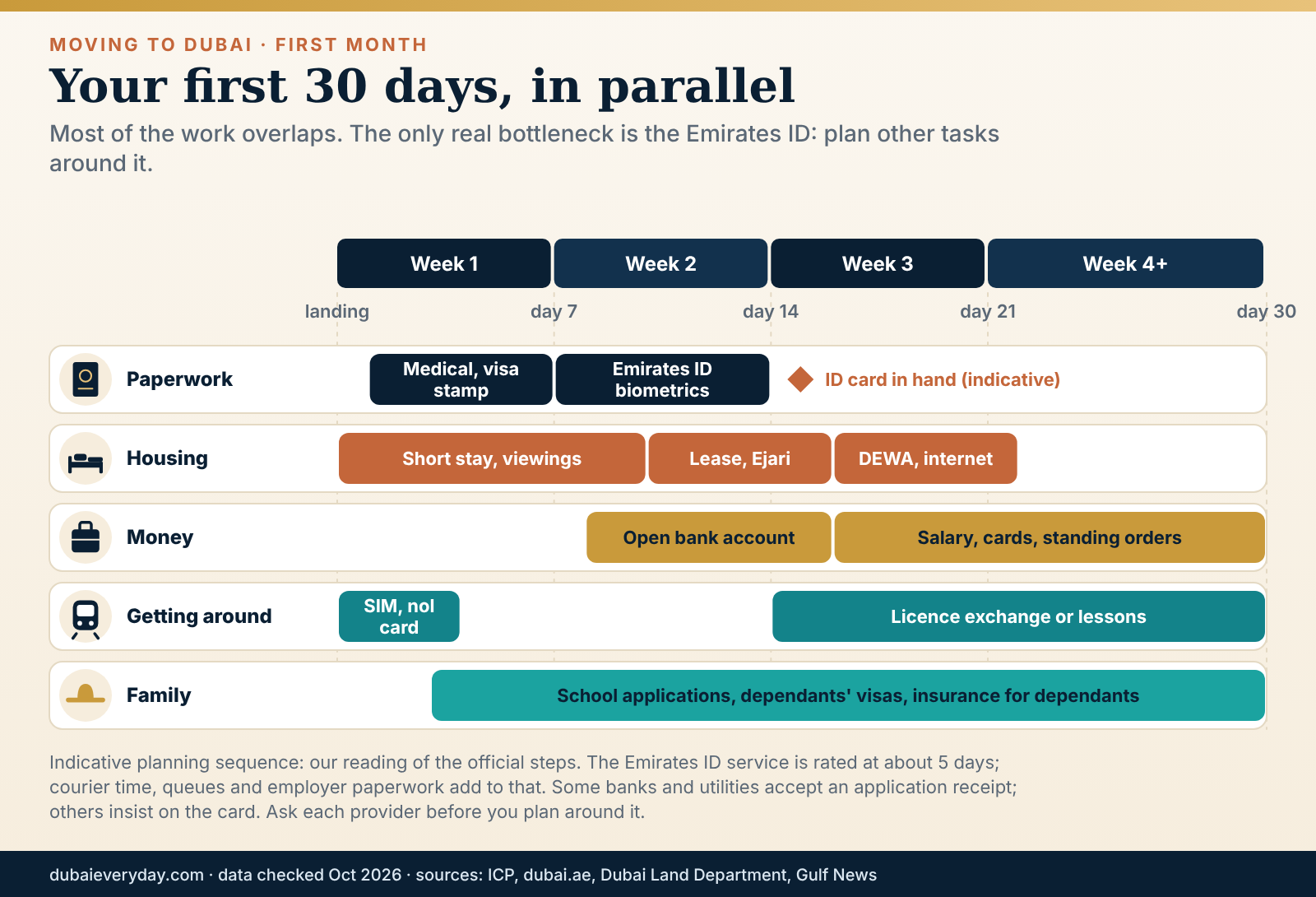
Days 0 to 3: base, phone and transport
Settle into your short-term base, get a working phone line and a transport card. Our internet and mobile guide covers SIM and eSIM options, apps and payments. For transport, the RTA’s Nol page lists Silver-card fares of AED 3 within one zone, AED 5 across two adjacent zones and AED 7.50 across more than two, with children aged five and under travelling free. Transfers between Metro, tram and bus within 30 minutes of checking out are charged as one journey, with a 180-minute maximum.
Registered cards can buy 7, 30, 90 and 365-day passes, while anonymous cards can only buy the 7-day pass, so register your card once you have an ID. Our Dubai Metro guide has fares, hours and station detail.
Days 1 to 14: paperwork and the Emirates ID
Your employer’s PRO should book the medical test and the visa stamp. Your job is to turn up with your passport and photos, and to chase the Emirates ID appointment. Once you have given your biometrics, the ICP’s own process is a five-day service. Install the ICP Smart App, which logs in through UAE PASS, so you can track the application yourself.
While you wait, make digital and paper copies of your passport, visa, entry permit, medical result, offer letter and contract. You will use them for the bank, the lease, school forms and insurance. Store one set outside the UAE.
Days 7 to 21: bank, viewings and lease
Open the bank account as soon as a bank will accept you, using the ID application receipt if your bank allows it. Start viewings in week two, and use the Metro or a taxi to test your commute at the hours you will actually travel. A flat that looks close on a map may sit behind a long traffic jam on the way to work.
Before you sign, run through the checklist in our apartment rental guide, then register Ejari and connect DEWA. The DEWA move-in guide covers deposits and activation. A deep clean before you unpack is worth a look, and our deep cleaning guide explains what is included.
Days 14 to 30: licence, school and routines
If you plan to drive, find out whether your home licence can be exchanged before you book lessons. Our driving licence exchange guide lists eligible countries and steps, and the driving licence guide covers the first-time process if you must start from scratch. For groceries and household basics, our supermarket guide compares the main chains.
Moving to Dubai is more than paperwork, so leave some space for the city itself. After three weeks of paperwork, one afternoon at the beach or an evening at the Old Dubai waterfront does more for morale than another form. Our guides to things to do in Dubai and beaches in Dubai help you pick, and the etiquette guide covers dress and public behaviour.
Your 30-day document pack.
- Passport and visa pages, plus photos in the format the authority requires
- Entry permit, medical result and Emirates ID application receipt
- Signed offer letter and registered employment contract
- Insurance card or policy certificate for you and each dependant
- Tenancy contract, Ejari certificate and DEWA account number
- Bank account details, including IBAN
When to land: heat, school year and Ramadan
The calendar matters more than people expect when moving to Dubai. Mean daily highs climb from about 24°C in January to about 42°C in July and August, according to NOAA’s 1991 to 2020 normals as compiled on Wikipedia’s climate page, a secondary source. They stay above 38°C from May to September. October and April sit in the middle at about 36°C and 34°C, and the comfortable stretch is November to March.

Our reading: the best months for moving to Dubai are October to April
For a single person or couple moving to Dubai, the first month is walk-heavy: viewings, the typing centre, the bank. Doing that in 38°C to 42°C afternoons is miserable and sometimes unwise. A landing between October and April lets you walk to viewings, find your area on foot and take your time. Between May and September, plan indoor appointments, morning errands and Metro-adjacent housing.
Moving day in summer. The UAE portal says outdoor work in direct sun is prohibited from 12:30 pm to 3 pm between 15 June and 15 September. Movers know it, so book morning slots and ask how they handle loading in heat. Keep water, medicines and electronics in your own car or hand luggage, not on the truck.
Families: work backwards from the school start
The 2026-27 school year began on 31 August 2026 and runs to 2 July 2027, with a winter break from 14 December to 3 January and a spring break from 5 to 11 April. The 2027-28 start date has not been published in the sources we read. For a family moving to Dubai with school-age children, the practical rule, which is our reading and not a regulation, is to be in Dubai early enough to see schools, secure places and sign a lease before term starts.
Landing in early June means doing viewings in 38°C to 40°C heat, but it leaves July and August for settling in before term. Landing in October means a mid-year school entry, which depends on a place being free in your child’s year group. Both paths work. Which suits you depends on your child’s age and how flexible your employer is.
Ramadan and the winter peak
If you are moving to Dubai in early 2027, Ramadan is projected to begin around 8 February and end around 8 or 9 March, with Eid al-Fitr about 9 or 10 March, according to The National’s October 2026 projection. Private-sector working hours are reduced by two hours a day, per the UAE portal, and daytime eating and drinking in public is generally avoided out of respect, as our etiquette guide explains. Allow extra time for appointments, because daily rhythms shift.
The Dubai Shopping Festival is announced for 4 December to 17 January, which makes the winter holidays a busy period for hotels and roads. If your short-term base is a hotel, book it early. Our events calendar and best time to visit guide show how demand moves through the year.
A worked monthly budget for moving to Dubai
Budgets for moving to Dubai usually fail because they mix a verified rent number with guessed everything else. We separate the two. Rent, the municipality fee and the transport fare come from the sources above. Utilities, internet, mobile, gym and school fees use Numbeo’s crowd-sourced averages from October 2024, which are old and indicative. Food, car and personal spending are our allowances and are shown as such.
Each total below is our calculation for a household with one salary, no income tax and employer-paid health insurance for the employee. Dependants’ insurance is excluded because we have no verified premium, so get quotes.
Single professional: about AED 10,800 a month
Rent AED 4,750 (one-bedroom at the AED 57,000 median), housing fee AED 238, utilities AED 740, internet AED 372, mobile AED 200, Metro and taxis AED 520, gym AED 298, job-loss insurance about AED 5.
Our allowances: food AED 2,900 (20 lunches at AED 40, AED 1,200 of groceries, three mid-range dinners for two) and AED 800 for everything else.
Couple: about AED 16,500 a month
Rent AED 6,667 (two-bedroom at the AED 80,000 median), housing fee AED 333, utilities AED 1,000 (our scaling), internet AED 372, two mobiles AED 400, transport AED 840, two gyms AED 596, job-loss insurance about AED 10.
Our allowances: food AED 4,800 and AED 1,500 for everything else. One partner on a dependant visa adds an insurance premium we could not verify.
Family of four: about AED 28,600 a month
Rent AED 9,167 (three-bedroom at the AED 110,000 median), housing fee AED 458, school fees AED 7,915 (two children at AED 47,491 a year each), utilities AED 1,300 (our scaling), internet AED 372, two mobiles AED 400.
Our allowances: car AED 1,800, food AED 5,200 and AED 2,000 for everything else. Dependants’ insurance is excluded.
What the totals tell you about moving to Dubai
Rent plus housing fee is 46% of the single budget (AED 4,988 of AED 10,823), 42% of the couple’s budget and 34% of the family’s, because school fees take over. The one-third rule of thumb from the housing section would put the single professional at about AED 14,250 of monthly pay and the family at about AED 27,500. If your offer is well below those levels, either choose a cheaper area, share, or negotiate the package.
Because the UAE does not tax personal income, gross and net are the same on the payslip, but check what your employer deducts for other items.
Remember that the budgets above exclude the one-off costs of moving to Dubai: the move-in cash (AED 23,800 or AED 66,550 in our example), flights, shipping, furniture and a buffer. A sensible buffer, which is our advice and not a rule, is three months of living costs on top of those one-off items, because ILOE cover starts paying only after 12 months of premiums.
Where these numbers can be wrong. Numbeo averages come from user submissions and are 12 months old. Summer cooling bills can sit well above a yearly average. School fees vary by school and year group. Use the budgets to size the decision, then rebuild them with real quotes. Our cost of living guide and single-person budget guide go further on lifestyle tiers.
Three realistic moves, worked through
These three examples of moving to Dubai are hypothetical, built from the figures and rules above. They are not case studies of real people, and we did not interview anyone for them.
The employee moving to Dubai with an offer, landing in November
An engineer signs an offer on 1 October. The employer’s PRO files the work permit, and the entry permit arrives in time for a flight in early November. The engineer books a serviced apartment for three weeks. Within the first week, the medical test is done and the visa stamped, and in the second week biometrics are given for the Emirates ID. A bank that accepts the application receipt opens a salary account in week two.
Viewings run in weeks two and three, and the engineer takes a one-bedroom at the median, paid in four cheques. Move-in cash is about AED 23,800 plus the short stay. Monthly spending is around AED 10,800, so the engineer needs about AED 14,000 in pay to save a little. Everything that could go wrong is paperwork timing, which is why the chain matters.
The remote-working couple
Two freelancers employed by overseas companies each earn above USD 3,500 a month, which is the GDRFA’s stated threshold, and hold valid health insurance. Each applies for the remote-working residence at AED 200 plus VAT, plus in-country charges if they apply from inside the UAE. They rent a two-bedroom, with no employer to bank their pay through WPS, so they open an account with documents showing foreign employment.
Their risks are different from an employee’s. The visa lasts one year and must be extended, there is no employer to chase the Emirates ID and insurance is theirs to buy. They cannot assume the visa permits local freelance work. They should keep records of foreign income and ask GDRFA before taking any Dubai client. Monthly spending is around AED 16,500 plus two insurance premiums.
The family landing in June
A project manager with a spouse and two children, aged six and ten, receives an offer in March. The family wants the children in school by 31 August 2027, assuming the next unified calendar follows the pattern. The manager lands in early May, completes the visa and Emirates ID in about three weeks, signs a three-bedroom lease in late May and sponsors the family, who arrive in mid-June.
School applications go in before the family lands, because places in some year groups can be limited. Fees run near AED 95,000 a year for two children. Monthly spending is around AED 28,600 before dependants’ insurance. The family should check whether the employer subsidises family cover and apply for school places at several schools. This is the scenario where our guides to Dubai schools and Dubai with kids earn their keep.
Mistakes, scams and the exit rules
Most costly errors in moving to Dubai are avoidable with a short list. The first set is about order and verification, the second about money, and the third about leaving, which you should read before you arrive.
Mistakes that cost time or money
- Signing a long lease before your visa and Emirates ID are in hand, then discovering you cannot register it or connect utilities.
- Working on a visit visa, which the UAE portal says gives no right to work.
- Paying an agent for a “visa fee” or “job fee” without checking the official fee list and the offer on MOHRE’s enquiry service.
- Accepting an offer without a MOHRE-issued offer letter, or without checking the company in the National Economic Register.
- Assuming the employer insures your family, when in Dubai the sponsor must arrange dependants’ cover unless the plan includes it.
- Letting dependants’ visas lapse after your own is cancelled. They have six months’ grace, but the sponsor can be fined.
- Opening a bank account without reading the key facts statement and fee schedule.
- Paying a deposit for a flat you have not viewed, from a landlord you have not verified.
- Filming or sharing footage during an emergency alert. The National reports that this is a punishable offence, and tells people to follow official sources instead.
Emergency alerts: the one habit to learn early
UAE emergency alerts use cell broadcast and arrive on your phone without any app. The National’s August 2026 explainer says to move into the nearest building, stay away from external walls and glass, avoid lifts unless told to use them, and stay sheltered until an official follow-up message arrives. Do not drive to look, and do not go outside to see what is happening. Read it once while you are calm.
Leaving, or pausing, properly
Your exit is a chain too. The employer cancels your residence visa, which cancels your dependants’ visas, although they have six months’ grace to secure another route. The UAE portal says outstanding wages and any end-of-service gratuity must be paid within 14 days of termination. You close your DEWA account, settle the final bill and recover your deposit, as our DEWA move-out guide explains, and cancel the Ejari tenancy and your bank commitments.
If you plan to spend long periods away, check your visa conditions first. The UAE portal’s Golden visa page notes that holders may stay outside the UAE for longer than the usual six-month limit, which implies the limit applies to others, so ask GDRFA or your PRO how absence affects your residence. For renewals and cancellations, see the residence visa guide.
Frequently asked questions about moving to Dubai
How much money do I need before moving to Dubai?
For a one-bedroom at the AED 57,000 citywide median, our calculation puts move-in cash for moving to Dubai at about AED 23,800 if the rent is paid in four cheques and about AED 66,550 if the landlord wants one. Add the short-term accommodation you use while the visa and Emirates ID are processed, flights, shipping and furniture. A cautious buffer is three months of living costs, roughly AED 32,000 for the single-person budget above. Employers often cover visa costs, so ask who pays what in writing.
Can I move to Dubai without a job?
Yes, moving to Dubai without a job is possible on certain routes. The remote working visa suits people employed or running a business abroad, with the GDRFA stating a minimum monthly income of USD 3,500. The job exploration visa lets skilled professionals search for 60, 90 or 120 days without a sponsor. Investors, entrepreneurs and some professionals can use Golden or Green residence, and relatives of residents can be sponsored. Each route has its own thresholds, so confirm them with the issuing authority before you quit anything at home.
Can I work in Dubai on a tourist visa?
No. The UAE government’s fraud-prevention guidance says a visit or tourist visa does not give you the right to work, and that a residence visa cannot be processed from outside the country. An employer who asks you to start work on a visit visa is putting you at risk. The legitimate path is a work permit and entry permit, or a change of status arranged by the employer, followed by the medical test, residence visa and Emirates ID.
How long does a Dubai residence visa take?
The Dubai government says the employer-sponsored visa is issued within 48 hours after your medical fitness result is released and the employer applies online. The ICP lists five days for a new Emirates ID. In practice the whole chain from landing to ID in hand takes longer because of queues, courier time and employer paperwork. Our planning assumption, not an official figure, is two to four weeks, so avoid fixed commitments in the first fortnight.
How much does an Emirates ID cost?
The ICP lists AED 100 per year of residence plus an AED 100 smart-service fee for residents, with an urgent option at AED 150 that is available only at service centres. On a two-year residence that works out at AED 300 by our calculation. Employers often pay it, but not always, so ask. Applicants aged 15 and over give fingerprints and a signature at a service centre, and the passport should be valid for at least three months.
Is Dubai really tax-free for residents?
The UAE portal says it does not levy income tax on individuals, and that VAT is 5% on goods and services. Companies face corporate tax, covered on separate government pages. Your home country may still tax you, depending on its residency or citizenship rules, and leaving may trigger exit or reporting steps. Get advice from a tax professional in both countries before you cut your home ties. This is general information, not tax advice.
Do I need health insurance when moving to Dubai?
Yes. Under Dubai’s health insurance law, cover is tied to visa processing, and employers must provide it for employees and cannot deduct the cost from salary, according to Gulf News and a law-firm summary. Dependants are the sponsor’s responsibility unless the employer’s plan includes them. The Essential Benefits Plan is the minimum, with an annual limit reported at AED 150,000. Ask for the table of benefits, network list and co-payments before you accept a plan.
Can I rent a home before I have an Emirates ID?
For a standard lease, generally not. The UAE portal lists a valid residence visa, an Emirates ID and post-dated cheques as tenant requirements, and the DLD’s Trustee Centre route for Ejari asks for your Emirates ID. The practical answer is to use short-term accommodation first and sign the lease once your documents arrive. Some landlords may agree a lease start date after your card is issued, so ask the agent about timing.
What salary do I need to sponsor my family in Dubai?
The UAE portal gives AED 4,000 a month, or AED 3,000 plus accommodation provided by the sponsor. You can sponsor a spouse, unmarried daughters, sons under 25 and children with special needs, and parents on a yearly visa. That is the visa threshold, not the cost of moving to Dubai with a family. On our figures a family of four needs far more than that to cover rent and schooling, so budget separately from the legal minimum.
When is the best time of year for moving to Dubai?
Our reading is that October to April is the best window for moving to Dubai, because mean daily highs stay below about 36°C and move-in errands are manageable on foot. May to September is hot, with highs of 38°C to 42°C. Families should work backwards from the school start, since the 2026-27 year began on 31 August. Ramadan 2027 is projected to begin around 8 February, which changes working hours and daily rhythms for a few weeks.
Is moving to Dubai safe right now?
We cannot assess safety. The UK Foreign Office’s advice, updated on 27 October 2026, describes a highly unpredictable regional situation with a high risk of sudden escalation, flight cancellations and airspace closures. Other governments differ, so read your own. Ask your employer about contingency plans, learn the emergency-alert guidance, keep documents backed up and consider flexible travel arrangements. If the answer is uncertain, a short exploratory trip or a delayed start are legitimate choices.
Do I need a car in Dubai?
Not necessarily. The Red Line serves Business Bay, Downtown, Mall of the Emirates, Dubai Internet City, the Marina and Jumeirah Lakes Towers areas, and the extension reaches Discovery Gardens and Al Furjan. If your home and work are on the line, you can manage with the Metro, tram, taxis and walking in the cooler months. Areas such as Jumeirah Village Circle and Dubai Silicon Oasis are more car-dependent. Check licence exchange rules early if you plan to drive.
What happens to my visa if I leave Dubai for a long time?
The UAE portal’s Golden visa page says holders may stay outside the UAE for longer than the usual six-month limit, which implies the limit applies to other residence categories. Long absences can put a residence at risk, so check your category with GDRFA or your PRO before you plan a sabbatical or long stay abroad. If you are leaving permanently, your employer cancels your visa, and your dependants get six months’ grace to secure a new residence.
Related reading
Sources and further reading (44 links)
- Dubai government: Residence visa for work — employer route steps, 48-hour visa, two-year validity
- UAE government portal: Preparing to work — entry permit, medical screening, attestations
- UAE government portal: Job offers and the employment process — offer, permit and contract registration
- UAE government portal: Employment contracts — duration, probation and notice
- UAE government portal: Working hours and overtime — hours, Ramadan reduction, summer outdoor rule
- UAE government portal: Payment of wages — Wages Protection System and late-payment steps
- UAE government portal: End of service benefits — gratuity formula and savings scheme
- UAE government portal: Tips to avoid labour and visa fraud — offer checks and red flags
- ICP: New identity card issuance — Emirates ID fees, five-day service, requirements
- ICP: UAE Green Residency — categories and thresholds
- UAE government portal: Golden visa — categories, validity, benefits
- UAE government portal: Residence visa for family members — sponsor salary, dependants, grace period
- GDRFA Dubai: Visa issuance (virtual work) — remote working requirements and fees
- UAE government portal: Dubai virtual working programme — differing summary figures noted in text
- Gulf News: UAE jobseeker visa, who can apply and how it works — secondary; job exploration terms
- UAE government portal: Leasing a property in the UAE — tenant documents, commission, housing fee
- Dubai Land Department: Register and renew Ejari — fees and documents
- Gulf News: 11 extra costs when moving into a new home — secondary; deposits, DEWA, movers
- Khaleej Times: Rents in Dubai fall over 12% (Savills Q3 2026) — secondary; rent trend
- Khaleej Times: Dubai rents fall in most areas (Property Finder) — secondary; asking rents
- houserent.ae: Average rent in Dubai 2026 — secondary; medians from DLD Ejari open data
- dataHabibi: Studio apartments in Dubai — secondary; studio medians by area
- Cushman & Wakefield: DLD clarifies 90-day notice — secondary; Smart Rental Index
- ADCB: Money guide for expatriates — bank documents and tips
- Citi UAE: Documents to open a UAE bank account — resident documents and minimum balances
- Mashreq: NEO On Arrival key facts statement — example of a visit-visa account
- Sanadak: Financial and insurance complaint resolution — scope of the ombudsman unit
- DHA ISAHD: Law and regulations — Law No. 11 of 2013, bylaw and EBP circulars index
- Gulf News: Does your employer have to pay for your health insurance? — secondary
- Kayrouz & Associates: UAE health insurance employer obligations — law-firm summary
- ILOE: Involuntary Loss of Employment scheme — premiums, benefits and caps
- UAE government portal: Taxation — no personal income tax, 5% VAT
- Dubai government: Education — KHDA role, ratings, Parent-School Contract
- Khaleej Times: Dubai private-school enrolment crosses 406,000 — secondary
- Gulf News: UAE school holidays 2026-27 — secondary; unified calendar
- RTA: Nol fares — Silver and Gold fares, journey rules, pass types
- Wikipedia: Red Line (Dubai Metro) — secondary; station list to be checked against the RTA map
- Wikipedia: Climate of Dubai — secondary; NOAA 1991 to 2020 airport normals
- The National: Ramadan 2027 dates — secondary; projection from the UAE Astronomy Centre
- UK FCDO: UAE travel advice — conditions and advice
- Time Out Dubai: Airlines suspended — secondary; airline status
- The National: UAE emergency alerts explained — secondary
- Dubai Airports: FAQs — cash declaration and medication notes
- Numbeo: Cost of living in Dubai — crowd-sourced; used only for indicative budget lines
Update log: 29 October 2026 — first publication; all facts re-checked against the sources above. Next review due: April 2027, or sooner if visa rules, fees, rent data, school calendars or regional advice change. Corrections welcome. This page is general information, not immigration, legal, tax, medical or financial advice; confirm with the relevant authority or a licensed professional before you act.
About DubaiEveryday and this guide
DubaiEveryday.com is an independent editorial project that publishes practical, research-based guides to everyday life in Dubai: where to live, what things cost, how the rules work and how to get around. This page was written and edited by the DubaiEveryday editorial team. It is not signed by a named expert, doctor, lawyer or adviser, and we do not claim first-hand testing of a venue, clinic or service unless the page says so.
Each guide is built from official sources such as government and regulator pages, operator websites and established news outlets, cross-checked where we can. When we could not confirm something, we say so in the text, and examples that use made-up numbers are labelled as illustrations. Mentions are editorial choices, not paid placements, and a link is not an endorsement.
Dubai changes quickly. If you spot something that is out of date or wrong, please tell us through the contact options on DubaiEveryday.com and we will check it and correct the page.