

Keeping dogs and cats is routine for pets Dubai residents, but the rules sit in three layers: federal law, Dubai Municipality and your own building. This guide walks through registration, housing, vets, heat, parks, travel and what pets cost, using official sources read on 29 October 2026.
Imagine you have already fallen for a rescue puppy, and then your building manager mentions a rule you have never heard of. Pets are routine in Dubai, but the rules arrive in layers, and the layer people forget is often the one that causes trouble. Your building can be stricter than the law itself.
This guide to pets dubai residents can keep walks you through federal rules, municipal registration, housing, vets and the summer heat, which reshapes every walk. It also separates the costs that are government fees from those that are simply market prices. Read it before you sign a lease or book a flight, and you can sort the paperwork in the right order instead of discovering it one surprise at a time.
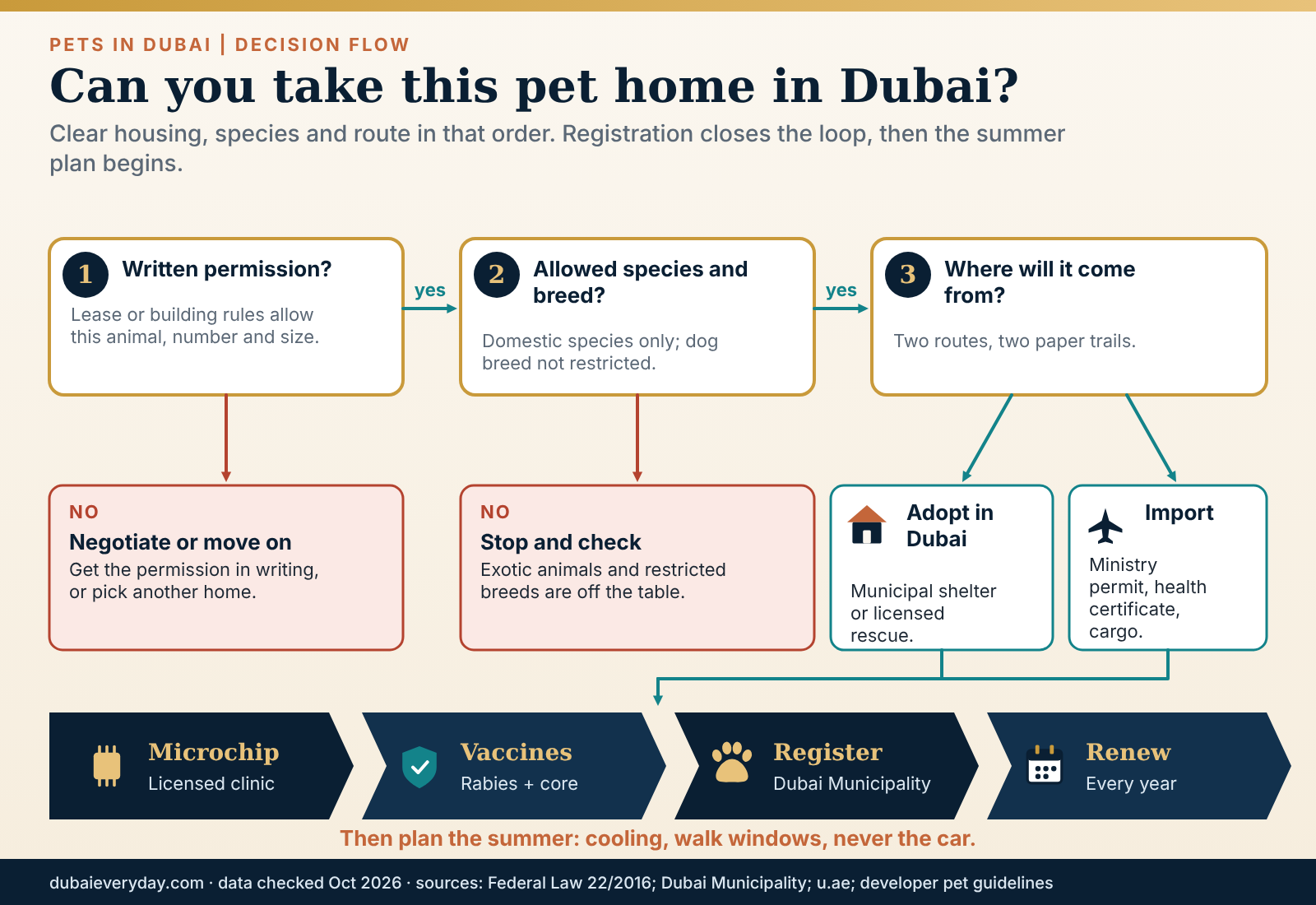
The rules for pets Dubai residents keep come in three layers, and you clear them in order. Federal law comes first: only domestic companion animals may live at home, restricted dog breeds need to be checked before you commit, and a dog in public must be on a leash with a collar.
Dubai Municipality comes second: dogs and cats are microchipped, vaccinated (rabies plus a core combination vaccine) and registered in the municipal system. Your building or master community comes last, and it can be stricter than either. One large developer’s published guidelines, for example, keep pets out of pools and children’s play areas and fine AED 500 per violation.
After the paperwork, heat runs your routine. Mean afternoon highs sit between 39.5°C and 42.1°C from June to September, so walks move to the hour after sunrise and the hour after sunset, and the car is never a waiting room. Costs of pets Dubai households carry are mostly market prices (food, vets, boarding, flights), not government fees. Moving a pet out of Dubai by air as checked baggage is priced in the hundreds of dollars on one major local carrier, and bringing one in is a cargo job.
This page covers the whole picture for pets Dubai owners. The step-by-step registration process, document list and renewals sit in our pet registration guide, and this page only summarises them.
This is a desk-research guide to the pets Dubai residents keep. DubaiEveryday.com has not adopted, boarded, flown, treated or walked any animal for this page, and nothing here describes a personal experience.
The facts come from official or operator pages read on 29 October 2026: Dubai Municipality’s July 2026 veterinary statistics release, its Veterinary Services Section page, the UAE government portal page on dangerous animals, a community pet policy published by a major developer, an airline’s animal-carriage rules and a government import form. The full list is in the sources box at the end.
Where an official page could not be read (the federal ministry’s import-permit page rejected automated access), we say so and send you to the source rather than guess. Prices are labelled with the date and the type of source, and market prices that we could not verify are left out or shown as clearly marked illustrative examples.
Inclusion was not paid for and nothing here is a recommendation of a named clinic, boarder or shop. This is general information, not individual veterinary or legal advice; for an animal that is unwell, call a licensed vet.
Pets Dubai rules in one page: three layers and one calendar
Most arrival-week mistakes with pets Dubai newcomers make come from treating Dubai as a single rulebook. It is not. The pets Dubai residents keep are governed by a federal layer that sets what you may own, an emirate layer that registers and inspects, and a private layer that decides whether the animal is welcome in your particular lift. A missed step in any one of them can end an otherwise lawful arrangement.
Layer 1: federal law
Federal Law No. 22 of 2016 regulates possession of dangerous animals, and Federal Law No. 16 of 2007 covers animal protection, both named on the UAE government portal. Private ownership of wild, dangerous and exotic animals is banned, and dogs in public must be leashed and collared.
Layer 2: Dubai Municipality
The municipality registers dogs and cats, microchips them, vaccinates them at its clinics, licenses private vets (176 establishments by its July 2026 count), runs the new Warsan shelter and issues veterinary health certificates for travel.
Layer 3: building and community
Leases, owners’ association rules and developer guidelines add limits on number, size, lifts, pools and noise. These are contractual, so they differ per building and are the layer people most often skip.
The calendar matters as much as the rulebook. Dubai is a place where a lawful, well-registered dog can still be in danger at 14:00 on a July afternoon, and where a flight option that exists in January may be closed in August. The sections below follow the order in which decisions usually come up: whether you can keep the animal, where you will live, how it gets onto the municipal record, who treats it, and how you both survive the summer.
What this page covers, and what it hands to other guides
One search job belongs to this page: running a household with pets Dubai authorities regulate, from the decision to get one through the first year of costs. The mechanics of microchip numbers, municipal records, renewals and the document list are the job of the pet registration guide, so the registration section here stays short and focuses on how registration connects to housing, vets and flights.
Pets Dubai tenancy questions are the same: tenancy law and deposits live in our tenant rights guide, and general vet-adjacent insurance questions belong to the Dubai insurance guide.
Those figures come from the municipality’s own release of 19 July 2026 and describe only the first half of the year and only the municipal channel. Private clinics also vaccinate and microchip, so the true number of pets Dubai households keep is larger than the registration count suggests. Treat the numbers as a sense of scale, not a census.
The sequence we recommend, in plain terms
If you are deciding whether to get a pet at all, check things in this order: your lease or building rules first (cheapest to check, hardest to change), the species and breed second, the heat and your working hours third, the registration and vet route fourth, and the budget last because it will make sense only once the first four are settled. The decision flow in the figure below puts that order into one picture.
Which pets Dubai law lets you keep
Start with the species, because it is the one decision that no landlord, vet or airline can reverse for you. Dubai Municipality’s public FAQ is blunt on the point: keeping animals at home is allowed for domestic companion animals only, with the exceptions and prohibitions set by Federal Law No. 22 of 2016 on dangerous animals. In practice the pets Dubai households typically keep are dogs, cats, small caged birds and aquarium fish, and anything wild, venomous or exotic is outside what a private household may hold.
The UAE government portal states the principle more sharply: private individuals may not own, possess, breed or trade in dangerous animals, and the licensed exceptions are institutions such as zoos, animal parks, circuses, breeding centres and research bodies. If a seller offers you a cheetah cub, a monkey or a large reptile, the lawful answer is no, and the buyer, not only the seller, carries the risk.
Dogs: the licence, the breed annex and the leash
Dogs are the pets Dubai federal law regulates most specifically. The English text of Federal Law No. 22 of 2016 on the UAE government’s asset server says in Article 12 that no one may possess a dog without a licence from the competent authority, and Article 13 has that authority keep a register that includes the dog’s chip number and vaccination record. Article 15 requires dogs to be leashed when taken outside the boundaries of their shelters, using appropriate collars. The text does not mention muzzles.
The penalties are not small. Under Article 22, breaching the licence or leash articles carries a fine of AED 10,000 to 100,000. Possessing, trading in or breeding a listed dangerous breed carries imprisonment of one to six months, a fine of AED 10,000 to 500,000, or both (Article 20). Those are the statutory ranges in the 2016 text; what an individual owner is actually charged depends on the case, and Article 31 allows conciliation on fine-only offences. Treat the leash as a legal duty, not a courtesy.
The restricted breed list: read it twice and check the current version
Annex 2 of that law lists the dangerous breeds. In the 2016 text it names Staffordshire Bull Terriers, Pit Bulls, American Pit Bull Terriers, American Staffordshire Terriers, American Bullies, Brazilian and Argentinian Mastiffs, other mastiffs, Tosas, Rottweilers, Doberman Pinschers, Presa Canarios and Boxers, together with mixes and hybrids of them.
The import form that Canada’s food inspection agency publishes for the UAE (dated June 2026) lists a similar but not identical set of barred breeds, including Fila Brasileiro, Dogo Argentino, Tibetan Mastiff, Neapolitan Mastiff, Dogue de Bordeaux, Boerboel, Bullmastiff, Cane Corso, Bully Kutta and Japanese Tosa.
Two lists that disagree are the warning. The ministry has issued later resolutions on the subject (its resolution listing includes numbers 109 of 2021, 190 of 2021, 379 of 2022 and 21 of 2025), and we could not read them. So we cannot say which breeds are restricted today, and you should not rely on this page, a breeder or a blog for that. The ministry’s current breed resolution is the document that counts.
Use both lists as warning lights, not legal references. Crossbreeds, “types” and puppies whose adult look is uncertain are the grey zone, and an adoption listing that says “mixed” settles nothing, because the 2016 annex expressly covers mixes and hybrids. Before you commit to a rescue dog of uncertain parentage, ask the federal ministry or the municipality how a mixed-breed dog is assessed.
The practical consequence is not abstract. An owner of a restricted breed who lands in Dubai has no appeal to the airline, and an owner who adopts a look-alike locally may face questions at registration. Neither is a place you want to learn the rule for the first time. If you are unsure of a dog’s ancestry, a licensed vet’s written assessment is a sensible first document, though it is an opinion, not an exemption.
Cats, birds, fish and the smaller pets Dubai residents keep
Among pets Dubai cat owners keep, cats face no breed list of the same kind, but the import form above flags one case: Bengal and serval cats must come with a pedigree certificate showing at least a fifth-generation cross. That is a reminder that hybrid wild-domestic cats sit near the line the law draws around exotic animals. A plain domestic shorthair, a Persian or a Maine Coon raises no such question.
Birds, small mammals and aquarium fish are the least documented of the pets Dubai sources cover. The same airline rules that carry dogs and cats also name pet birds, and the airline we checked bars birds (apart from some falcons) from transit through Dubai between 1 May and 30 September.
Exotic reptiles, large parrots listed under international wildlife trade rules and anything described as “rare” deserve a call to the federal ministry before purchase. CITES-listed animals travel as cargo on that airline, which hints at how much extra paperwork follows them.
One animal, one household: how many is too many?
We did not find a municipal cap on the number of pets Dubai households may keep, and the developer guidelines we read do not state one either. Your lease, building rules and common sense set the practical ceiling. A one-bedroom with two large dogs may be lawful on paper and unworkable in a lift at 06:30. For import, the limit is explicit: the Canadian form lists a maximum of two cats, two dogs, or one of each per personal importer.
Housing for pets Dubai buildings will accept
Housing is where the pets Dubai households plan for most often collide with reality. Neither the municipal nor the federal sources we read turn a pet into a tenant right or ban it from rented homes, which leaves the decision to the landlord, the building and the community. The only dependable rule is the written one. If a leasing agent says “pets are fine”, ask for that sentence in the contract or in an email you can print.
Apartment, townhouse or villa
Villas and townhouses with a garden or walled yard are the easy answer for a dog, and the community rule sets for pets Dubai villa residents keep are written with them in mind: leashes in common areas, no dogs in pools or play areas, waste bins at intervals. They also tend to cost more to rent and to cool.
Apartments work for cats and for small or calm dogs, provided the lift, corridor and balcony arrangements are acceptable. High floors suit cats poorly if the balcony is open, because falls from balconies are a recognised household risk for cats, and netting or a closed balcony is a basic precaution.
For the mechanics of renting each type, see our guides to renting an apartment in Dubai and renting a villa in Dubai, which cover viewings, maintenance and community fees. The pet-specific questions below sit on top of those checklists.
The pet-specific questions to put to a landlord or agent
- Is the pet allowed in writing, and does the permission name the species, the number and any size limit?
- Is there a pet deposit or a pet clause in the contract, and how is damage assessed against ordinary wear?
- What do the building or community rules say about lifts, corridors, balconies, pools and play areas? Ask for the document, not a summary.
- Is there a nearby outdoor area where a dog can be walked without crossing a main road?
- What are the floors? Polished marble in summer is cool underfoot, but it is slippery for dogs, while carpet holds hair and odour.
- Who handles pest control, and which products are used? Some treatments matter if you have cats, fish or birds.
If the building is in a freehold community run by a master developer, there is usually a published rule set. The Emaar guidelines we read are specific: dogs leashed in common areas at all times, cats kept within the property, pets barred from community pools and children’s play areas, no feeding of stray cats in common areas, and a AED 500 fine per violation after a notice.
Other developers publish their own versions. They are all, in effect, a second layer of regulation that you accept when you sign.
Cooling, bills and the hours you are away
Pets Dubai owners leave at home during a working day turn the cooling bill into a welfare question. Switching the air conditioning off when you leave is common advice for saving money and a bad idea when an animal is inside at 41°C.
Budget for the unit running at a sensible setpoint, especially from May to October, and look at the cooling arrangements before you sign: some towers charge district cooling by usage while others bundle it into rent, which changes the arithmetic. Our home setup guide explains cooling, utilities and the first-week checklist, and the DEWA move-in guide covers deposits and activation, both of which matter more when the air conditioning is not optional.
Heat rule for the lease. If your plan relies on turning the cooling off, or on a balcony or garage as the pet’s daytime spot, the plan is wrong for June to September. Budget the electricity before you adopt, not after the first bill.
Fur, smell, scratches and the move-out inspection
Pets Dubai tenants keep change cleaning needs, and an end-of-lease inspection is when the difference is priced. Fur in upholstery, scratches on doors and urine marks on grout are the usual deposit disputes. Regular cleaning and a professional deep clean before handover are cheaper than an argument. Our guides to cleaning services in Dubai, deep cleaning and sofa cleaning explain what each service includes, and the tenant rights guide covers how deposit disputes are handled.
Before you leave a home, photograph the condition room by room, repair what you caused, and keep receipts. That advice is true for any tenant, and it counts double when a landlord can plausibly blame a pet for every mark.
Pets Dubai Municipality registration at a glance
Registration is the step that puts pets Dubai families keep onto Dubai Municipality’s record. It matters for more than compliance. The community rules we read require it, the municipality’s own guidance on travel assumes it, and the new Warsan shelter says it reunites lost pets with owners only after verifying identification and ownership. A registered, microchipped animal is simply easier to prove is yours. The detailed walkthrough is in the pet registration guide; the outline below is what you need to plan the first fortnight.
- Get the animal microchipped by a licensed clinic.The Emaar guidelines state that dogs must be chipped by an approved, licensed vet clinic. Bring your Emirates ID and, if the animal is already vaccinated, the rabies certificate.
- Vaccinate against rabies and the core combination.The municipality names rabies plus DHPPi for dogs, and rabies plus FVRCP for cats, in its own service statistics.
- Apply online and attend the appointment.A 2024 Gulf News explainer describes an application on the Dubai Municipality website using UAE Pass, a Makani number for the animal’s address, the microchip number and uploads of a photo and the vaccination record, followed by a clinic visit within a day or two.
- Collect the tag and diarise the renewal.The same explainer says tags are renewed every year, at the annual rabies vaccination.
What the fee looks like, and what it leaves out
The same secondary source gives a registration fee of AED 10 plus VAT and a “knowledge and innovation” fee of AED 20 plus VAT, a total of AED 30 plus VAT. At the UAE’s 5% VAT that is AED 31.50 (our calculation) for a first registration.
Treat that as a recent secondary figure, not a quote: an earlier community summary cited a different line-item structure (AED 10 registration plus AED 50 numbering), and the municipality’s own fee table was not readable when we checked. Confirm the figure on the municipal service page or at the clinic.
For pets Dubai owners register, the fee is also the cheapest part of the process. It excludes the microchip, the vaccinations and the vet’s consultation, all of which are priced by the clinic.
A municipal clinic is one route (Al Khawaneej, with Al Lisaili and Hatta also listed on the Veterinary Services Section page), and an accredited private clinic is the other. Check which route offers the appointment time you need, because the municipal pet clinic’s published hours are Sunday to Thursday 07:30 to 14:30 and Friday 08:00 to 11:30.
Tip. Register the day the animal arrives in your home, not the week the lease is checked. If you adopt through the municipality, the adopter’s vaccination and registration fees are part of the process, so the registration is effectively done at collection.
What registration unlocks
Four things depend on an up-to-date record. Moving between homes is easier because developers ask for proof of registration. A lost animal can be matched to you faster. Veterinary health certificates for export are issued only for animals that are microchipped and registered in the approved system, as the municipality’s own travel guidance states. And a vet or boarder who asks for current vaccination proof is following the same logic. Letting the tag lapse is a small administrative failure that surfaces at the least convenient moment.
Registration is not an alternative to insurance. Pet insurance is a separate commercial product, so compare exclusions and waiting periods in the same way you would for any policy; our Dubai insurance guide sets out how to read a policy schedule.
Bringing a pet to Dubai: permit, flight and arrival
Importing is the part of keeping pets Dubai-side where timing and paperwork cost the most, and where the official page that matters most could not be read by our tools. The federal Ministry of Climate Change and Environment runs the import permit for cats and dogs; its page returned an access-rejected error on 29 October 2026, so fees, permit validity and processing time are not stated here. Check them on the ministry’s service page before you book anything.
What we could read is a government import form. Canada’s food inspection agency publishes the UAE health certificate it uses for dogs and cats (the file is dated June 2026). It is one country’s version, and requirements can differ by the country you export from, so treat it as a worked example of how strict the sequence is.
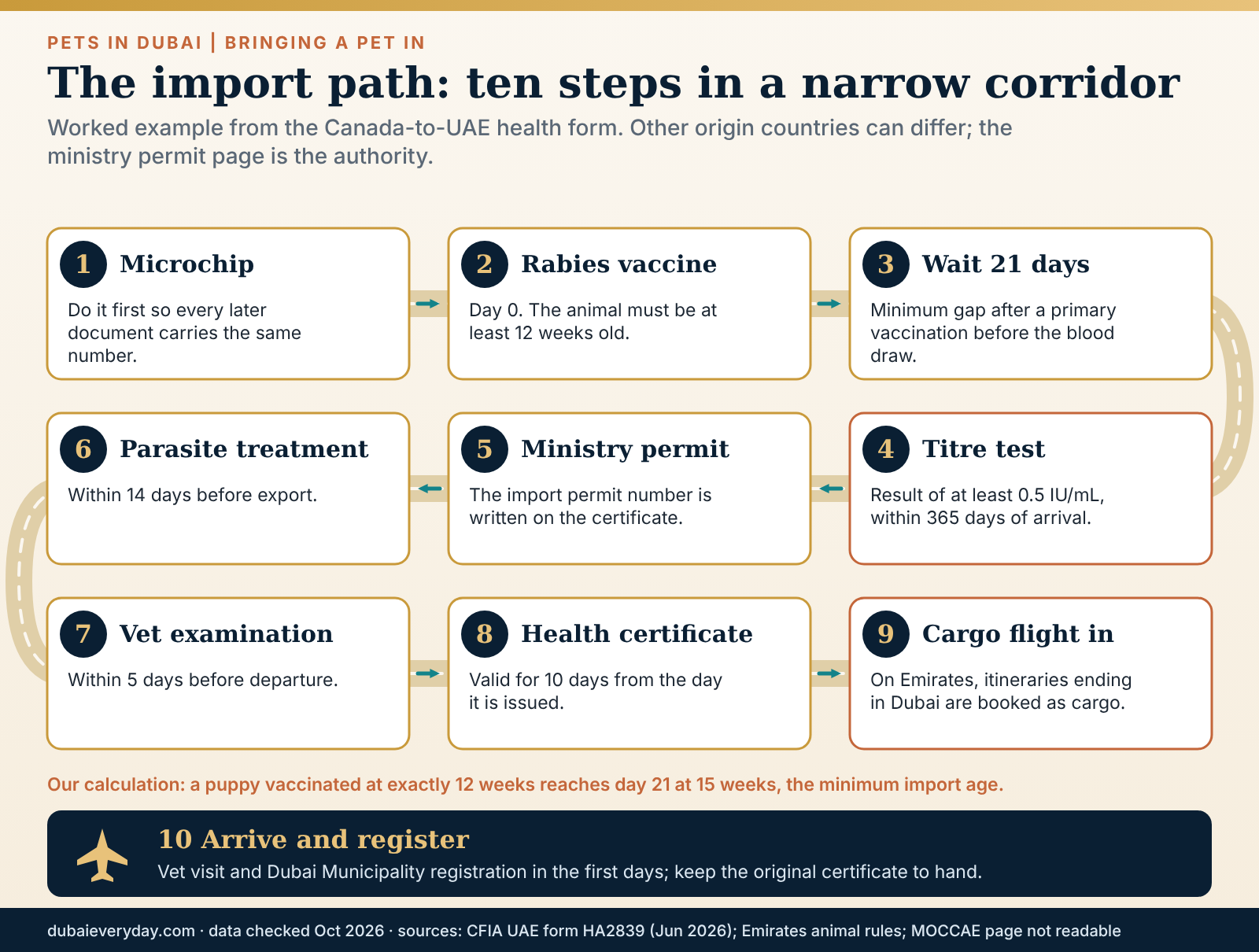
The example sequence, and the numbers that drive it
- Microchip first, so every later document carries the same number.
- Rabies vaccination at least 21 days before departure, and the animal must be at least 12 weeks old when it is vaccinated.
- A rabies neutralising antibody titre of at least 0.5 IU/mL from an approved laboratory, drawn at least 21 days after a primary vaccination, and completed within 365 days of arrival in the UAE.
- A veterinary import permit number on the certificate, which is the ministry permit.
- A clinical examination within 5 days before departure and parasite treatment within 14 days.
- A health certificate that is valid for 10 days from issue.
- A minimum age of 15 weeks at import (the cargo operator says 27 weeks for pets from countries classed as high risk) and a personal limit of two cats, two dogs, or one of each.
Read together, the dates form a narrow corridor. Our calculation: a puppy vaccinated for the first time at exactly 12 weeks reaches the 21-day mark at 15 weeks, which is also the minimum import age, so the earliest travel date is set by the vaccine and the lab turnaround, not by the airline. Anything that delays the permit or the lab pushes the health certificate out of its 10-day window, and the certificate then has to be reissued.
The flight: why pets Dubai-bound travel as cargo
The airline rules we read are explicit on the direction of travel. On Emirates, an itinerary that ends in Dubai must be booked as cargo, and the same applies to journeys longer than 17 hours, a Dubai connection longer than six hours, and cages with combined dimensions above 300 cm.
Checked-baggage carriage is for itineraries that start in Dubai. Animals are generally not allowed in the cabin, with exceptions for falcons on some routes and guide dogs. So the common request, “can my dog sit under the seat on the way in?”, has the answer no on the largest local carrier.
Other airlines carry pets Dubai-bound under their own rules, and we have not verified them, so do not assume. Ask each carrier: whether animals are accepted at all on your route, whether a heat-related restriction applies in your travel month, which kennel specification they require, and who handles the animal at Dubai. If a connection is involved on another airline, responsibility can split between carriers, and the Emirates rules say the airline is not responsible for pets on itineraries that include other airlines.
Relocation agents are legitimate and can save weeks, but the legal duty to comply sits with you. Ask them to cite the ministry permit and the airline rule for each step, and check that the permit is in your name. Do not pay for a “guaranteed” route; a guarantee cannot override a lab result or an embargo.
What the cargo operator adds: breeds, heat and age
Emirates SkyCargo’s pet leaflet adds rules that matter more than the fee. Pets travel in a temperature-controlled hold, are loaded last and unloaded first, and move between the aircraft and SkyCargo’s temperature-controlled facilities in Dubai in a dedicated vehicle, under IATA live-animal rules plus UAE rules. Transit pets need a minimum connection of six hours. The documents it lists include pet and cage details with photographs, veterinary reports, vaccination certificates, health certificates, a fit-to-fly statement, the microchip and a signed acknowledgement form.
Two restrictions deserve a pause. Snub-nosed dog and cat breeds, and their crosses, are not permitted except under specific conditions in the winter season of November to April. And dogs and cats must be at least 15 weeks old, rising to 27 weeks for pets coming from countries classed as high risk.
If your pet is flat-faced or comes from a high-risk country, the calendar and the age rule, not your preferred moving date, set the plan. The leaflet gives no fees and no booking lead time, so ask SkyCargo directly.
Arrival, and what we could not confirm
The form we read does not mention quarantine, and we found no official statement of a quarantine period on arrival, but we also could not read the ministry page that would settle it. We did not verify cargo-terminal fees, collection hours or what happens when paperwork is incomplete on landing.
Plan to be reachable at the airport, to keep the original certificate to hand, and to schedule a vet visit and municipal registration within the first days. Our Dubai airport guide covers terminals and transport for people, and our relocation checklist shows where a pet fits in the wider move.
The sensible season for flying pets Dubai-bound is the cool one. The same airline bars birds in transit from 1 May to 30 September, which tells you the carrier regards summer as a risk period, and the climate data in the heat section below shows why. Even for dogs and cats, avoid the hottest weeks if you have a choice, ask about temperature restrictions in writing, and expect the operator’s own breed and season limits to apply, as described above.
Adopting or buying a pet in Dubai
Where your pet comes from decides its health record, its paperwork and a fair share of your first-year bills, and pets Dubai households take in come from several routes. Dubai now has an official adoption route with a purpose-built shelter, alongside a long-established private market of shops, breeders and rescue groups. Each has a different risk profile, and none of the numbers in this section are prices, because the sources we could read do not publish any.
The municipal route: Al Khawaneej and the Warsan shelter
Dubai Municipality’s own statistics say it adopted out 298 animals in the first half of 2026 and treated and rehabilitated 2,274 strays.
On 26 July 2026 it opened an integrated pet shelter at the Birds and Pets Market in Warsan, with a pre-adoption viewing area, interactive adoption rooms, a clinic with an operating theatre, a grooming unit and a centre that reunites lost pets with owners after verifying identification and ownership. A digital adoption platform launched alongside it, letting you browse animals and read their health and behavioural profiles.
The municipal release sets out who can adopt. You must be 21 or older, have no recorded violations for animal abuse or mistreatment, attend the Al Khawaneej Veterinary Clinic in person for the examination and collection, and pay the vaccination and registration fees. Once requirements are met you are contacted, and the animal and its vaccination record are collected within two working days. That is a short, controlled process, and the animal comes vaccinated and registered, which removes the two steps most new owners underestimate.
What the municipal sources do not say. The pages we read give no adoption fee, no capacity figure, no opening hours for the Warsan shelter and no eligibility rule for renters. Ask about all four before you travel across the emirate. The adopter requirements above are for the Al Khawaneej route described in the July 2026 statistics release; the shelter’s own rules may add to them.
The shelter also runs trap-neuter-return for stray cats and, where appropriate, trap-neuter-vaccinate-return. If you feed cats around your building, that policy is the lawful alternative to carrying them home. The municipality also reports 12 AI-powered “Ihsan” smart feeding units across several locations, which points to a feeding policy that is organised, not improvised.
Rescues and private shelters
Volunteer-run rescues are a separate layer of the pets Dubai adoption scene. The municipality has signed memoranda of understanding with two private veterinary clinics in connection with the shelter, which suggests the system is built to work with the private sector, but we have no list of rescue groups that we could verify, so we name none.
A practical checklist applies to any rescue: ask who holds the licence, whether the animal is microchipped and vaccinated, whether its history is documented in writing, and what happens if the adoption does not work out. A group that refuses to answer those four questions has answered them.
- The animal has a microchip number you can see on a vaccination card, not just a promise to get one.
- Rabies vaccination is recorded with a date and a clinic stamp.
- The breed description is honest about uncertainty, given the dangerous-breed rules covered above.
- There is a returns or rehoming clause so that a mistake does not become an abandoned animal.
Shops, breeders and the Birds and Pets Market
Dubai Municipality publishes approved health requirement documents for several categories of business, including pet shelters and ornamental fish and live-animal trading establishments (the page says they are available only in Arabic). That tells you a licensing framework exists, and it gives you a fair question for any seller: which licence do you hold, and can I see it? A seller who is evasive about the licence is more likely to be evasive about where the animal came from.
Be especially careful with the online listings pets Dubai buyers come across. Photos and a “ready to go” message are easy to fake, and a deposit paid before you see the animal is the classic loss. Meet the seller, see the animal with its mother where that applies, and ask for the vaccination card and the microchip number before any money moves.
Breeding for commercial purposes is also prohibited in some developer communities, as the guidelines we read state, so a breeder who lives in a villa community may be breaking a community rule as well as running a business.
Finally, think hard about age and travel. Puppies and kittens imported from abroad face the 15-week import minimum and the vaccination timing described earlier, and a seller who offers to “ship a puppy next week” without mentioning a permit is selling something that cannot lawfully arrive.
Vets for pets Dubai licenses: categories and how to choose
Dubai has a large veterinary sector for pets Dubai owners to choose from, and a licensing system with more structure than most owners realise. In its July 2026 statistics release, Dubai Municipality reported 176 licences issued in total: 103 comprehensive veterinary clinics, 67 primary veterinary clinics, 2 specialist veterinary clinics, 3 comprehensive veterinary hospitals and 1 specialist veterinary hospital.
It also says it sets and periodically updates technical and health requirements, issues no-objection certificates to clinics and hospitals, and runs scheduled inspections through a Smart Inspection System, investigating complaints and issuing circulars.

Decoding the five categories
The category names suggest a ladder of scope: a primary clinic handles routine care, a comprehensive clinic covers more services, a specialist clinic focuses on a field, and hospitals are the larger facilities.
We could not read the municipality’s Arabic-language requirement documents that define the categories, so treat that as our reading of the names, not an official scope list. The practical way to use the information is to ask the clinic which category it is licensed in and what that licence lets it do, particularly for surgery, anaesthesia, overnight care and imaging.
Our reading of the counts is that 103 of 176 establishments, about 59%, are comprehensive clinics, 67 (about 38%) are primary clinics, and only four of the 176 are hospitals. That is a notable gap for emergencies. Four licensed hospitals across the emirate means that an out-of-hours emergency may involve a longer drive than a family doctor visit would. Find the nearest option that offers overnight or out-of-hours care now, call to confirm what it handles, and put the number in your phone before you need it.
How to choose a vet without a review-site war
Public reviews are noisy and we cannot verify them, so we do not rank clinics. A better approach is to compare on facts you can ask for on the phone:
- The licence category and licence display. A clinic should be able to tell you which category it holds.
- The named vets and their qualifications and registration, and whether the vet you see is the vet who operates.
- Itemised quotes for vaccination, microchipping, neutering and dental work, so you can compare like with like.
- Out-of-hours policy: who answers at 02:00, and where emergencies are referred.
- Records: whether you receive digital copies of vaccination cards, lab results and discharge notes.
- Willingness to explain options, including what can wait.
For pets Dubai summers make distance matter more than most owners expect. In a Dubai summer a 25-minute drive with a heat-stressed dog is a risk of its own, so a good clinic you can reach in ten minutes is often the better clinic. The area guides for Dubai Marina, Palm Jumeirah and Downtown Dubai show how traffic patterns shape the real time to anywhere.
The municipal clinics as a baseline
Dubai Municipality runs veterinary clinics at Al Khawaneej, Al Lisaili and Hatta, with the pet animal clinic open Sunday to Thursday 07:30 to 14:30 and Friday 08:00 to 11:30, and appointments requested through the municipality’s website, with confirmation by SMS and email. The contact number on the page is 800900.
The hours are weekday mornings and early afternoons, which suits routine vaccination and registration and does not suit an emergency. Those clinics are a useful baseline for vaccination and registration needs, not a substitute for a private practice that covers evenings and weekends.
Vaccination, parasite prevention and neutering: what to ask
Nothing on this page replaces a veterinary examination, and we give no dosing or treatment advice. The municipality’s published statistics name the vaccines it delivers: rabies and DHPPi for dogs, and rabies and FVRCP for cats. Your vet will advise on what else suits your animal, including tick, flea and worm prevention and whether to neuter.
In a place where stray cats are managed by a trap-neuter-return programme, neutering is a mainstream conversation to have with your vet early, not an afterthought, and it is worth asking what ages and risks apply to your animal.
If your animal has a long-term condition, ask for a written summary you can hand to any other clinic. Treatment of a chronic illness rarely stays with one practice for years in a city with this much turnover, and a one-page history saves repeated tests. Our healthcare guide covers the human side of the system, and it is a useful comparison for how licensing and referral work for people versus animals, which are separate regulators.
Heat: keeping pets safe through a Dubai summer
Every list of risks for pets Dubai owners face ends up at the same one. Rules can be fixed by paperwork, but a summer afternoon cannot.
Dubai’s heat is not an inconvenience that a good owner copes with by being tougher; it is a hazard that changes what a day with pets Dubai-side looks like for six or seven months of the year, and nothing else on the checklist for pets Dubai residents moves as much from month to month. It decides which breeds suit the city, when you walk, how you travel and what you spend on cooling.
Scope of this section. This is general information on heat and pets, built from climate data and standard welfare principles. We could not retrieve a veterinary body’s heat guidance page today, so there are no clinical thresholds here and no first-aid instructions beyond “get cool and call a vet”. Your own vet can tell you how your animal’s age, coat, weight and breed change the picture.
What the climate data says about pets Dubai summers
The Dubai climate table that cites the Dubai Meteorological Office gives mean daily maxima of 24.0°C in January and 25.0°C in February, rising to 30.0°C in March, 34.0°C in April and 37.5°C in May. June is 39.9°C, July 41.7°C, August 42.1°C and September 39.5°C. October is 36.5°C, November 31.0°C and December 26.0°C.
Records are higher: 47.9°C in June, 49.0°C in July and 48.8°C in August, recorded at Jebel Ali and the airport. These are secondary figures, repeated from the meteorological office’s table, and they describe averages at official stations, not the surface in front of your building.
The overnight minimum is the number owners tend to overlook. A mean low of 30.0°C in July and 30.4°C in August means that “wait until it cools down” does not work in the way it does in a temperate city. Humidity in the same table sits between roughly 50% and 65% across the year.
An animal cools by panting and, for dogs, through the pads, and wet heat makes panting less effective, which is one reason humid evenings can still be hard on a dog. That is a general physiological point, not a Dubai-specific measurement.
The walking calendar: our calculation
Using the mean highs above and sunrise and sunset times calculated for Dubai (25.2°N, 55.3°E, UTC+4), we built the planning windows in the figure below. Mid-month sunrise and sunset are 07:06 and 17:49 in January, 05:57 and 18:41 in April, 05:38 and 19:12 in July and 06:16 and 17:53 in October (our calculation, rounded to the minute). The windows are our planning judgement, not veterinary thresholds, and they assume a healthy adult dog of average build. For a short-nosed breed, an elderly animal or a puppy, shorten them.
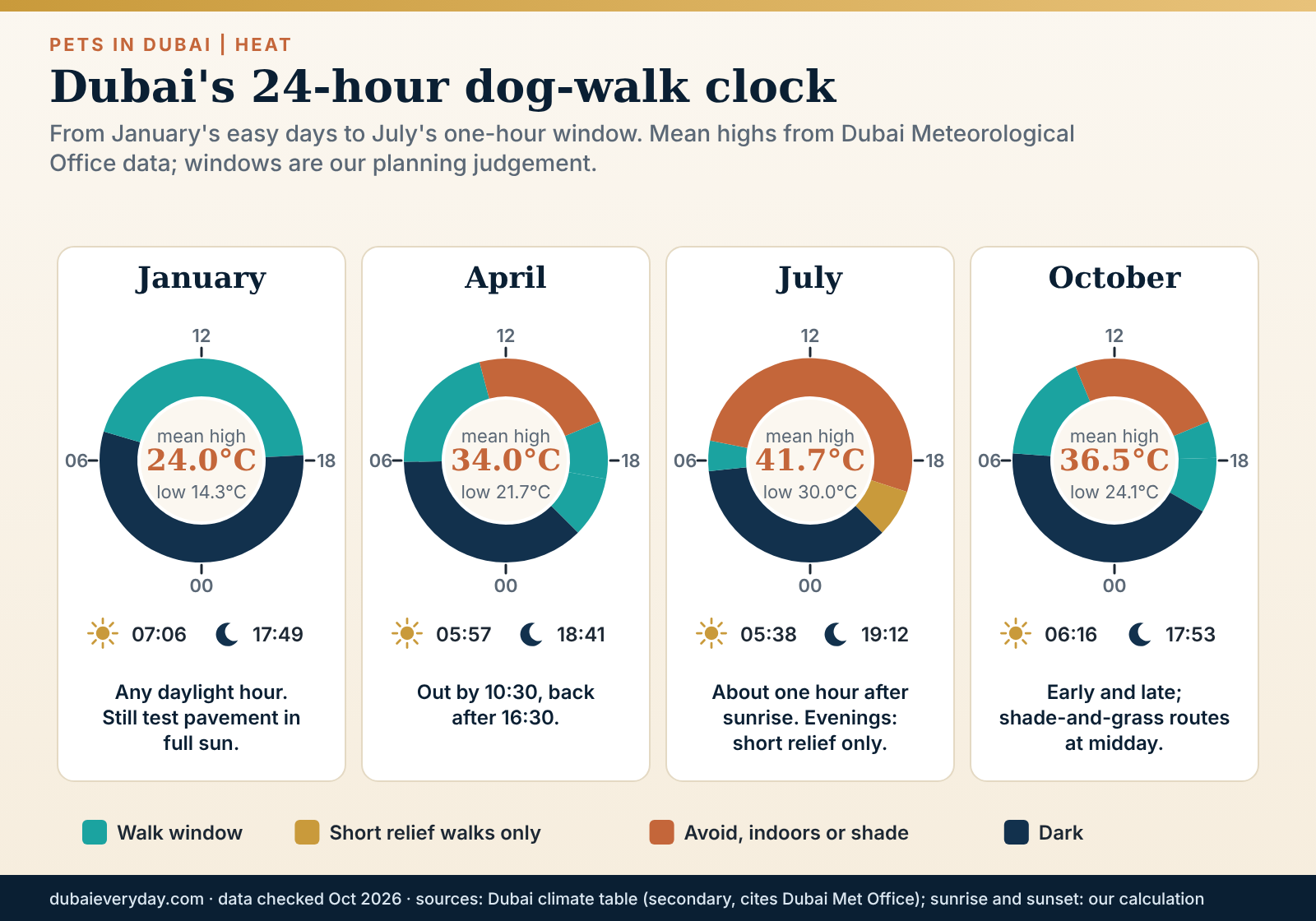
Read the figure as a season guide. From November to March the day is largely yours, though pavement in full sun can still be hot. April and October are shoulder months where the middle of the day is out.
May to September is the hard stretch, where the usable window collapses to the first hour after sunrise and a short, cautious evening outing, and where much of a dog’s exercise has to move indoors. Cats that live indoors have an easier time, with the proviso that a cat on a sun-struck balcony is as exposed as a dog on a pavement.
Heatstroke: what to watch for and what to do
Heatstroke is a medical emergency in animals as in people. General welfare guidance lists heavy or noisy panting that does not settle, drooling, a bright red or pale tongue, vomiting, weakness, wobbling and collapse as warning signs. Flat-faced breeds, overweight animals, very young and elderly animals, thick-coated breeds and dogs with heart or breathing problems are at higher risk.
If you suspect it, move the animal to a cool, shaded or air-conditioned place, offer water, and call a vet immediately rather than waiting to see how it goes. Do not start improvised treatments that a vet has not recommended.
The first call is a reason to have a clinic saved in your phone before summer. It is also a reason to know what the nearest out-of-hours option is, which is why the earlier section on the licence categories matters in practice: with four licensed veterinary hospitals in the emirate, the distance to emergency care can be the difference between a minor scare and a bad outcome.
The car is not a waiting room. Never leave an animal in a parked car, with the engine running or not, for “two minutes”. The inside of a parked car in Dubai in summer heats far faster than people expect, and a few minutes is enough to create an emergency. If your errand cannot include the animal, leave the animal at home in the cool.
Pavement, sand and surfaces
Air temperature understates what a dog’s paws meet. Asphalt, dark paving and metal can be much hotter than the air above them in direct sun. The commonly repeated hand test applies here: if you cannot comfortably hold the back of your hand on the surface for several seconds, it is too hot for paws.
That is general advice we could not source to a single authority today, so treat it as a rule of thumb and not a measurement. Grass and shaded routes help, as do routes with a walk-through in a cool building. Booties exist, and some dogs tolerate them, though they are no licence to walk at noon.
Beach sand needs a note of its own. Municipal public beaches do not allow pets under the rules published on the municipality’s beach pages, so the question of hot sand is moot at those locations. Where dogs are permitted on a beach, the same logic applies: test the surface and plan the hour.
Cooling the home without wrecking the bill
Keeping the air conditioning on at a sensible setpoint while an animal is indoors is the baseline in summer, and we give no target temperature because that is a question for your vet. The cost is real: a pet that needs the unit running all day will raise your summer electricity bill. Our DEWA move-in guide explains deposits and billing at activation, and the cost of living guide shows how utilities sit in a household budget.
- Fresh water in several places, in bowls that cannot be knocked over, and changed often because water in a warm room goes stale quickly.
- No access to balconies or terraces in the middle of the day, even “with shade”.
- Keep curtains or blinds closed on sun-facing windows; cats will still find the one patch of sun.
- Cooling mats and frozen toys are optional extras, not a substitute for air conditioning.
- For birds and fish, move cages and tanks away from windows and check water temperature, since glass and sun heat an aquarium quickly.
Which breeds and pets Dubai’s climate suits
This is an editorial view, not a veterinary one. Short-nosed dogs and cats, giant breeds with thick double coats and very elderly animals are the groups most likely to struggle. They live in Dubai, and plenty of owners manage well with air conditioning and discipline, but the margin for error is thinner.
If you are choosing a dog for a one-bedroom apartment and your working day is 09:00 to 18:00, an adult medium-sized, short-coated, low-energy dog or a cat is an easier first animal than a husky. The animal you love and the animal the climate allows are not always the same.
Planning a holiday? Summer is also when many owners leave the country, and it is the hardest season to fly an animal in or out. The airline we checked bars birds in transit through Dubai from 1 May to 30 September, and its cargo arm does not accept snub-nosed dog and cat breeds or their crosses except under specific conditions in the winter season of November to April.
Other restrictions may apply on specific routes, so ask for the rules in writing for your date. The boarding and travel sections below return to this.
Parks, beaches, cafes and transport: where pets can go
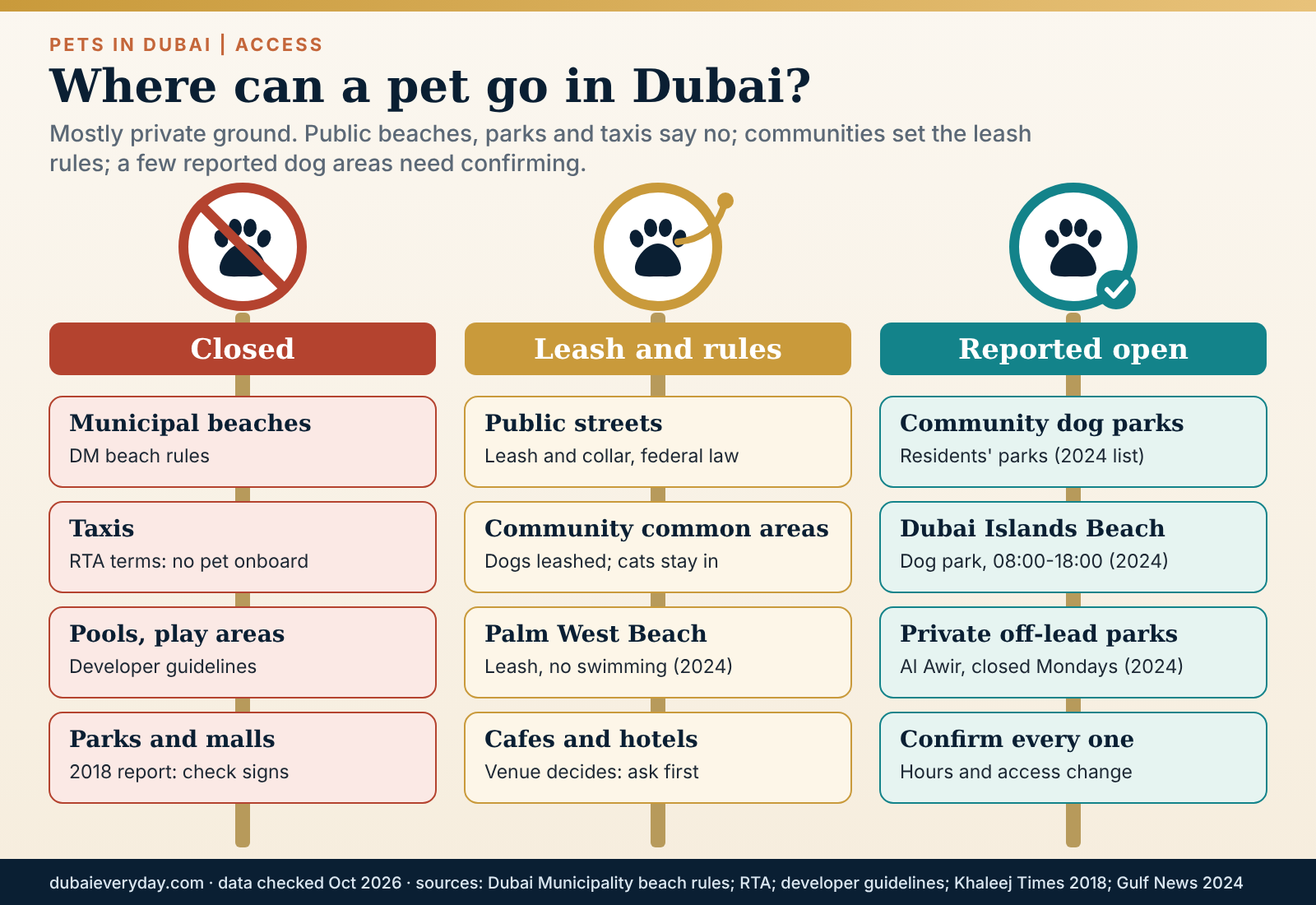
The honest picture is that Dubai’s public realm is built for people, and most of the places where pets Dubai residents are welcome are private: community parks, enclosed dog runs, a handful of beach areas and venues that choose to allow animals. Public-sector spaces are mostly closed to them. The sources for this section vary in age and quality, so each claim below is tagged with how old it is, and everything outside the official rules should be treated as “confirm before you go”.
Public parks, malls and municipal beaches
Dubai Municipality’s beach rules, as published on its beach pages, do not allow pets on its public beaches, and our best beaches guide and free public beaches guide carry the same warning among the usual beach rules. A 2018 Khaleej Times report quoted an official saying dogs are not allowed in public parks, beaches or shopping malls, citing Local Order No. 11 of 2003, and named Al Mamzar, Za’abeel, Mushrif and Creek parks as strict no-pet parks.
That article is old, and Dubai has opened and reopened many outdoor spaces since, so check signs at the gate. As a default for planning, assume a municipal park or a mall is closed to your dog until a sign or an operator says otherwise. Our Dubai Mall guide covers what visitors can expect there; its practical advice on timing does not extend to dogs.
Beaches and parks reported as dog-friendly
A Gulf News explainer, last updated 1 August 2024, listed a few exceptions. It described Dubai Islands Beach, reached by the Dubai Islands bridge, as pet-friendly, with a 460 square metre leash-free dog park, a drinking fountain, a pet shower, waste bins and agility equipment, open 08:00 to 18:00.
It described Palm West Beach on Palm Jumeirah as open from 08:00 to midnight, with dogs required to stay on a leash and not allowed to swim, and a 1.6 km promenade with some pet-welcoming cafes nearby. It also listed BarkPark, a privately run, fully enclosed, off-leash facility in Al Awir that closes on Mondays and shifts its hours with the weather.
Treat all of that as reported, not confirmed. Opening hours, fees and access rules for new waterfront areas change often, and we could not verify any of them against a municipal or operator page today. The summer heat changes the arithmetic further: a beach dog park with limited shade at 14:00 in July is not a good plan whatever the sign says, and a licensed facility’s own hours (the Al Awir park’s reported evening-only opening is an example) are more useful than the calendar.
Community dog parks
The same 2024 explainer named dog parks in or near The Springs, Al Ittihad Park on Palm Jumeirah, The Greens, JLT, JBR, Dubai Hills Estate, DAMAC Hills, Motor City and Mudon. It described them as mainly serving nearby communities, being smaller, and having playgrounds, water fountains and litter bins.
Master developers also publish their own listings; Emaar’s community site, for instance, carries a dog parks page for its Emirates Living area. Access is often limited to residents, so the question to ask when you view a home is whether the nearest dog park is open to you and where the shade is.
We have not been to these parks, and the list is a snapshot from a secondary source. Use it as a starting point for your own check, not as a guarantee that a park is open, fenced, shaded or free.
Cafes, restaurants and hotels
For pets Dubai cafes and hotels, “pet-friendly” is a venue decision, not a municipal licence category that we could find, so it deserves a call before you travel. Outdoor terraces are the usual exception, and the same shade and heat logic applies to them in summer.
Ask four things: whether dogs are allowed inside or outdoors only, whether a leash and a water bowl are provided, whether there is a size or breed limit, and whether there is a fee. Our cafes guide and restaurants guide do not assume pet access, and our hotel guide is for people-only stays unless a hotel states otherwise.
If you are travelling with an animal, check the hotel before you book and ask for the rule in writing. The cost of getting it wrong is a refused check-in with a tired animal in a car in July.
Taxis, the Metro and your own car
The Roads and Transport Authority’s taxi service page carries a plain rule in its terms and conditions: you cannot bring a pet onboard. That applies to taxis. The page says nothing about the Metro, buses, trams or abras, and we found no official rule for them, so we cannot tell you that the Metro is open or closed to animals; check the RTA’s current regulations before you try. Our Metro guide covers fares, cards and timings for people.
The practical result is that most pet owners need a car, a friend with one or a private pet-transport service for trips to the vet. We could not verify any licensed pet taxi operator, so we name none.
If you are a visitor, a rental car is the workable option; read the deposit and cleaning terms with animal hair in mind, using our car rental guide as a checklist, and restrain the animal in a carrier or harness. If you are new to the roads, our driving licence guide explains the licence steps that make a car possible.
Choosing an area that works for pets Dubai residents
Areas matter more for dogs than for cats, and the best evidence on pets Dubai neighbourhoods is not a ranking. We do not rank neighbourhoods for pets, because the sources we could verify are dated and partial. What we can offer is a way of reading a neighbourhood so that you can test any listing in a day.
Six tests for a pet-friendly street
- Is there a legal place to walk within five minutes?A path with shade, a community loop or a permitted dog park, not a verge beside a six-lane road.
- Is the building’s rule set generous?Ask for the document. Some towers restrict lifts or common corridors, and some limit numbers or sizes.
- How long is the walk to a vet and an out-of-hours option?Time it at rush hour. A distance on a map is not the distance in a heat emergency.
- Is the shade real?Covered walkways, trees and building shadows matter more in July than distance to a park.
- How noisy and how dense is the block?Barking complaints are the commonest dispute in towers, and developer guidelines treat noise as a violation.
- Where do you go when it is 42°C?An indoor option that accepts animals is rare, so a cool home and a flexible schedule are the substitute.
Villa communities versus towers versus waterfront
Reports we read, including the 2018 Khaleej Times piece and a 2024 Gulf News list, tend to associate villa communities such as The Springs, Arabian Ranches and The Greens with dog ownership, and to note that some neighbourhood parks within them are still off limits to pets while open paths are not. Those are secondary and dated, and conditions change with each community’s rules. Our villa renting guide covers what to check about gardens, cooling and community fees.
Towers suit cats and the smaller pets Dubai apartments hold, though the practical tests are lifts, corridors and the walk to the nearest green space. Waterfront areas are a mixed picture: the beach itself is usually closed to dogs, while the promenade can be a pleasant, shaded evening walk if the building’s own rules allow the animal. If you are weighing the best-known waterfront and city-centre areas, our guides to Dubai Marina, Palm Jumeirah and Downtown Dubai describe daily life and transport without assuming a pet.
A one-day test before you sign. Visit the building at 07:00 and again at 18:00 on a weekday. Watch who is walking dogs, where they go, how the lift handles the traffic and how the building sounds at those times. That single comparison tells you more than a brochure about whether a lease will suit your animal.
Everyday costs of pets Dubai owners pay
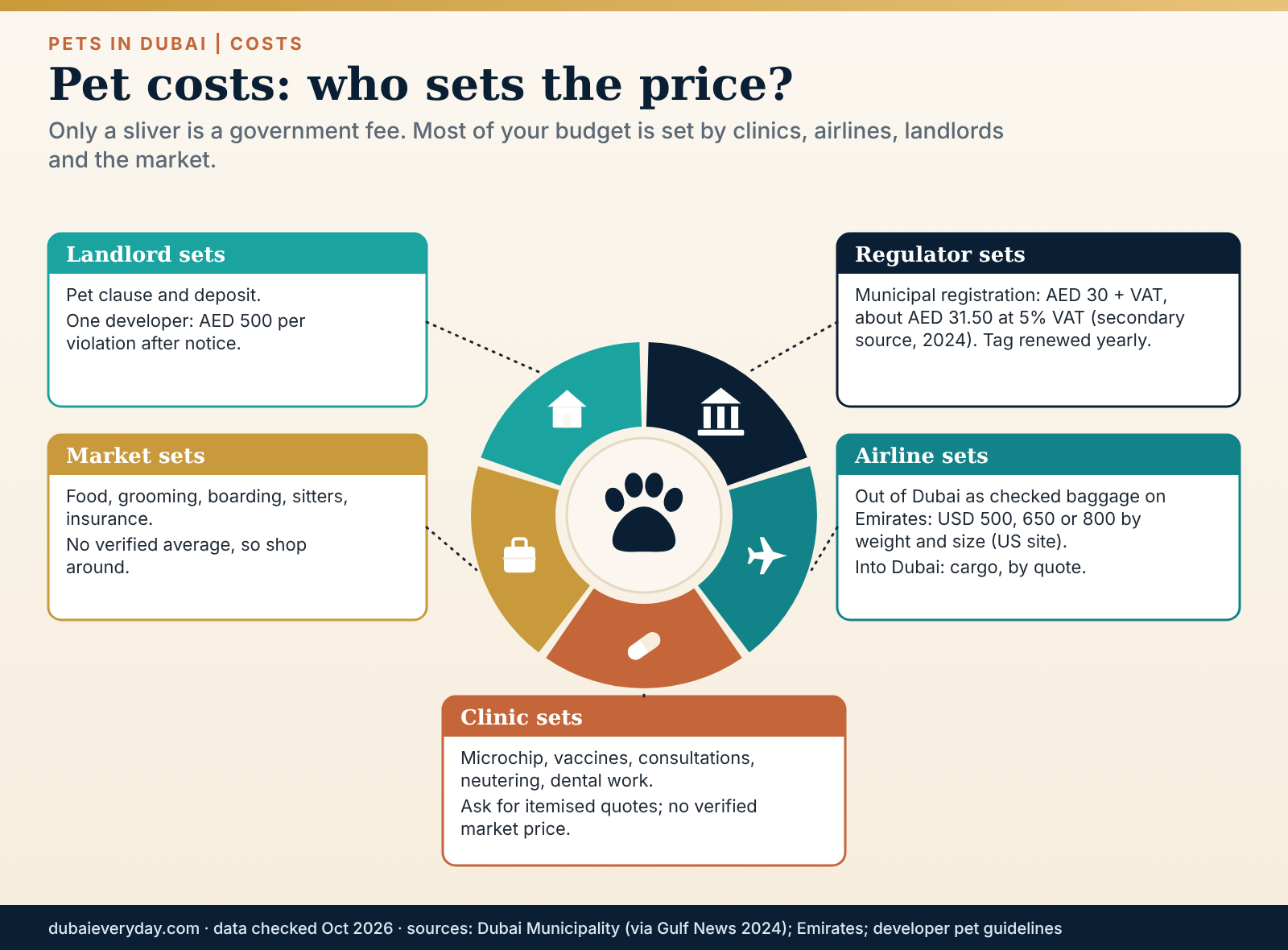
A fair warning first: we could not verify a single market price that pets Dubai owners pay for food, vet consultations, boarding or grooming from a source we are willing to quote, and an invented “average cost of a dog in Dubai” would be exactly the kind of number this site refuses to publish. What we can do is show which costs are fixed by someone with authority, which are set by the market, and how to build a budget that survives the first quote you actually receive.
The hard numbers we do have
| Item | Figure | Source type and date |
|---|---|---|
| Municipal pet registration (first registration) | AED 10 + AED 20 knowledge and innovation fee, plus VAT = AED 30 + VAT (about AED 31.50 at 5% VAT, our calculation) | Gulf News explainer, updated September 2024; confirm with Dubai Municipality |
| Community fine for a pet-rule violation | AED 500 per violation after a notice | Developer pet guidelines, 2022; other developers differ |
| Federal fine, dog without licence or off leash | AED 10,000 to 100,000 (statutory range) | Federal Law No. 22 of 2016, Article 22, English text on u.ae |
| Flying a pet out of Dubai as checked baggage (Emirates) | USD 500 up to 23 kg and 150 cm; USD 650 for 24 to 32 kg; USD 800 above 32 kg (about AED 1,836, 2,387 and 2,938, our calculation at 3.6725) | Emirates US-site FAQ, 29 October 2026; fees may differ by sales region |
| Flying a pet into Dubai | Cargo, priced by quote | Emirates rule that itineraries ending in Dubai travel as cargo; no price published |
The pattern in that table is the useful part. The one fee set by Dubai Municipality is small. The expensive official numbers are penalties, which you control by following the rules, and the biggest verified item is an airfare for the animal. Everything else sits with private providers.
The cost anatomy of a first year
A first year has four layers. One-off set-up (the animal, microchip, first vaccinations, registration, bed, crate, lead, bowls and a carrier) falls mostly in the first month. Recurring costs (food, litter, preventive medicine, grooming and routine checks) run monthly.
Annual costs (booster vaccination, registration renewal, dental or health checks, insurance premium) fall once a year. Irregular costs (emergency treatment, boarding when you travel, replacing what a puppy destroys) arrive unannounced. A budget that omits the last two is a budget for a pet that never gets ill and never meets a holiday.
Cooling belongs in the budget too, and it is the cost owners most often forget. If your home needs the air conditioning running longer because an animal is inside, the extra goes straight to the utility bill. Our cost of living guide and single-person budget guide show how rent, utilities and food sit in a monthly budget, which is the frame to add pet costs to.
A worksheet instead of an average
Use this formula and fill it with quotes from two or three providers. It only works with your numbers.
- First-year total = one-off set-up + registration (about AED 31.50 for the municipal fee alone, if the secondary figure holds) + 12 times monthly recurring + annual items + a contingency you choose.
- Choose a contingency that matches how much risk you can carry. Some owners hold a separate emergency fund, and others buy insurance and accept the premium.
- Re-run the sum for summer, when cooling and boarding costs rise, and again for the year you plan to travel.
Illustrative example (not a quote or market fact). To show the arithmetic only: suppose a household’s quotes came to AED 1,200 of one-off set-up, AED 500 a month in recurring costs, AED 900 a year in annual items and AED 2,000 held as contingency. The first-year total would be 1,200 + 31.50 + (12 x 500 = 6,000) + 900 + 2,000 = AED 10,131.50. Every figure except the AED 31.50 is a placeholder for the sum, not a statement about what Dubai pets cost, and your own quotes will differ.
Insurance and savings
Pet insurance exists as a commercial product in various markets, but we have not verified which Dubai insurers sell it or what any policy covers, so we cannot compare. When you ask for a quote, look at four things: exclusions for pre-existing conditions, waiting periods before cover starts, annual and per-condition limits, and whether the insurer reimburses you or pays the clinic directly. Our insurance guide explains how to read a policy schedule, which applies here as it does to any cover.
Ways to lower the bill without lowering the care are mostly boring. Keep vaccinations and parasite prevention current so that preventable illness does not become a large invoice. Get itemised quotes before elective procedures. Keep a record of treatment so that you do not repeat tests when you change vets. Buy a decent carrier and harness once, since a failed one is a safety problem.
And treat the municipal clinics as a low-cost baseline for registration and vaccination, with the caveat that their published pet clinic hours are weekday mornings and early afternoons. For food, our supermarket guide and Carrefour guide explain how delivery and price levels work for everyday shopping; check each retailer’s pet range yourself.
Boarding, sitters, grooming and daycare
For pets Dubai summer travel turns boarding from a luxury into a recurring need, and it is a part of the pet economy where the provider’s licence, the heat plan and the vet link matter more than the website.
Dubai Municipality publishes approved requirement documents for pet shelters and for ornamental fish and live-animal trading establishments, so a regulatory framework exists for some categories of premises. We could not confirm which licence applies to which service (boarding, grooming, daycare), so the safest course is to ask each provider to name its licences and to show them.
Choosing a boarder or daycare
- Ask for the trade licence and any municipal approval for the premises, and note the name on it.
- Ask which vaccinations they require, and expect them to ask for yours. A place that accepts any animal with no proof is a risk to yours.
- Ask how the facility handles heat: indoor air-conditioned space, outdoor time windows, shade and water, and what happens in a power or cooling failure.
- Ask which clinic they use in an emergency, how far it is, and who decides to take your animal there.
- Ask about staffing: how many animals per handler, and whether anyone is on site overnight.
- Ask for a visit in advance, and judge the smell, the noise and whether dogs are separated by size and temperament.
- Read the cancellation, deposit and liability terms. Some facilities limit liability to a stated amount.
A trial day before a long booking is cheap insurance against an animal that hates the place. If you travel in the heat, book early. We have no demand data, but boarding is likely to be tightest around school holidays and the summer break, so waiting until the week before can leave you with few options.
Home sitters and friends
A sitter who visits or stays can be gentler on an anxious animal than a kennel, but the checks are different. Meet the person first, confirm that they know where your vet is, give written instructions on feeding, medication and heat, and leave a signed authority for the vet to treat in an emergency, with a spending limit you are comfortable with.
Keep your home’s cooling arrangements simple enough that someone else can follow them. If your building has access rules, tell the management who has permission to enter and when.
If you employ domestic staff, remember that the developer guidelines we read ask residents to educate household staff and family members on waste disposal and leashing, which means a fine can follow someone else’s mistake with your animal. Write the rules down and walk through them once.
Grooming
Grooming needs vary by coat, and in this climate the practical goal is comfort, not a showpiece. Ask whether the groomer is comfortable with your breed’s coat, how they handle heat and drying, and whether they require vaccination proof. Be wary of aggressive shaving of double-coated dogs without advice from a vet or experienced groomer, because the coat can matter for protection from heat and sun, and the question deserves a professional opinion. If your animal has skin or ear problems, see the vet before the groomer.
Training and behaviour
Training in a city where the dog is walked in elevators, corridors and shared paths is largely about calm behaviour in confined spaces. Lead manners, quiet in the building and tolerance of other animals are the skills that protect you from complaints and fines. Choose trainers on method and transparency: reward-based approaches, a written plan, and willingness to tell you what a dog can and cannot learn. Be sceptical of promises of fast fixes, and of any trainer who recommends equipment that causes pain.
Travelling out of Dubai with a pet, or without one
Summer breaks, family visits and relocations are routine for many Dubai households, so the exit side of pets Dubai life needs its own plan. There are two decisions: whether the animal travels with you, and if it does, how to meet the destination’s rules rather than only Dubai’s. For pets Dubai residents take abroad, the destination’s requirements usually decide the timetable.
What Dubai requires on the way out
The municipality’s travel guidance says the animal must be microchipped and registered in the approved system, hold all mandatory vaccinations and carry an approved veterinary health certificate. Dubai Municipality issues veterinary health certificates for owned animals once it confirms freedom from infectious disease and compliance with approved health requirements.
The municipality’s service directory also lists a health certificate service for animals and veterinary products for export or re-export, but we could not open its fee and requirements page. The guidance tells owners to check export requirements with the federal ministry, to verify the destination’s rules, including any tests or quarantine, and to confirm transport requirements and book with the airline in advance.
That last point is the real work. Some destinations ask for blood tests followed by a waiting period of weeks to months, others require an import permit of their own, and a few impose quarantine. Because those rules come from the destination, not from Dubai, we do not summarise them here. Ask the destination authority and your airline in writing, and start early enough that a failed test does not force you to cancel the trip.
The airline side, using Emirates as the example
On Emirates, carriage as checked baggage is available only for itineraries that start in Dubai and go to countries that accept animals as excess baggage, with a total journey time, including transit, of under 17 hours. Beyond that, or for a Dubai connection longer than six hours, the animal must travel as cargo.
The airline asks for at least one week’s notice, accepts animals older than four months, requires a valid import permit and health certificate, does not accept pregnant animals beyond one-third of gestation, and allows up to two adult animals of similar size, each up to 14 kg, to share a container if they live together. Animals over 14 kg need separate containers.
The fees we read are US-site figures: USD 500 for an animal and cage up to 23 kg and 150 cm, USD 650 for 24 to 32 kg and 150 to 300 cm, and USD 800 above 32 kg.
At the fixed peg of 3.6725 dirhams to the dollar, those are about AED 1,836, 2,387 and 2,938 (our calculation). The airline states that charges apply even when no other baggage is carried, and that its rules do not cover itineraries involving other airlines. Check the version for your sales region, as fees can differ.
Two common traps. First, assuming a good rule on the outbound leg applies to the return. An itinerary that ends in Dubai is a cargo booking on that airline, so a round trip with your dog is two different products. Second, assuming the destination’s rules are the same as Dubai’s. They are not, and they are the ones that stop animals at the gate.
If the animal stays behind
For most trips, the animal stays in Dubai with a sitter or a boarder. Summarise your home’s cooling, feeding, medication and emergency steps in one page, and make sure the sitter has your vet’s number and a written authority for emergency treatment.
If you are away during the hottest months, ask the sitter to message you a photo and a short note each day; it takes a minute, and it creates a trail if something goes wrong. Our travel guide and best time to visit guide are written for visitors, though the seasonal logic in them explains why summer departures are busy.
Moving away for good
Plan an exit as carefully as an arrival. Update your pet’s record (municipal registration includes record updates), collect the full vaccination history and a copy of every lab result, check the destination’s import rules before you commit to a moving date, and book the animal’s travel before your own. For the home side, our DEWA move-out guide covers final bills and timing, and the renting guide covers handover and deposits, both of which affect a landlord’s view of a pet’s damage.
Neighbours, strays, fines and what the law expects for pets Dubai residents
Most disputes over pets Dubai neighbours raise are not dramatic. They are noise, waste, leashes, a cat in a corridor and a neighbour who is afraid of dogs. The rules sit in a handful of documents, and most can be satisfied with habit rather than money.
The legal duties, in plain terms
Federal law licenses dogs, requires leashing with a collar outside the dog’s shelter, bans listed breeds and exotic animals, and attaches fines in the tens of thousands of dirhams to breaches of the licence and leash rules.
A separate federal law protects animals from mistreatment; the UAE government portal names it as Federal Law No. 16 of 2007, but we did not read its text and give no penalty figures for it. The municipality’s adoption rules ask applicants to have no recorded violations for animal abuse or mistreatment, which shows how seriously the record is treated.
For day-to-day etiquette, the community rules that we read set a good baseline whether or not you live in that community: leash dogs in common areas, keep cats on your property, never take animals into pools or play areas, clean up after them with bags, do not let them bark excessively and do not feed strays in common areas.
A violation after a notice is AED 500 in that developer’s guidelines. Report incidents to the municipality’s contact centre on 800 900, as the guidelines direct. This is general information, not legal advice. For a disagreement with a landlord or neighbour, our legal basics guide explains where to verify rules.
Strays and feeding
Many residents want to help the cats they see. The community guideline we read says not to feed strays in common areas because it draws more cats and rodents. Dubai Municipality’s approach is trap-neuter-return, with trap-neuter-vaccinate-return where appropriate, operated from the Warsan shelter, and it has set up 12 AI-powered “Ihsan” smart feeding units in several locations.
If you want to help, the supported routes are adoption, reporting a sick or injured animal to the municipality, and using the official programmes rather than putting out food in your lobby.
Barking, smells and shared walls
Most complaints in towers come from the same few causes: an animal left alone for long hours, an animal that is not exercised, or an animal frightened by a particular sound. The remedy is the same in each case. Exercise before you leave, leave stimulating food toys, keep a routine, and ask a neighbour to tell you directly if there is a problem so it does not become a formal notice. A modest note to the neighbours when a new animal arrives often avoids the first complaint.
If a dog bites or is bitten
The federal law sets severe penalties when a dangerous animal attacks a person, ranging up to life imprisonment where a death results. Penalties for unintended attacks fall under the Penal Code, as the law’s text says. For a minor injury, the practical sequence is to separate the animals, give first aid, seek medical care for any person bitten, exchange contact details and then contact your vet.
For anything serious, call the police emergency number, 999, and the municipality’s line. We have not verified the municipal reporting procedure for bites, so ask the authority, and keep your animal’s vaccination record to hand because any bite will lead to questions about rabies status.
Lost pets, emergencies, rehoming and end of life
No one plans for the worst day, which is exactly why it helps to read this section once in advance.
If your pet goes missing
- Search the building and surroundings immediately.Cats hide, so check stairwells, parking levels, balconies and neighbours’ units, and ask security for camera access.
- Call your vet and the clinic that implanted the chip.Make sure the owner details on the chip record are current, which is the main reason to keep your registration updated.
- Contact Dubai Municipality.The new Warsan shelter has a centre for reuniting lost pets with owners after verifying identification and ownership; the contact centre number is 800 900.
- Post locally.Share a clear photo, the chip number and a contact number in your building and community groups.
- Verify before you pay anyone.Ask a finder to describe a feature that is not in your photo, and meet in a public place.
Emergencies
An emergency is anything where you would call a doctor for a person without hesitation: collapse, breathing difficulty, heavy bleeding, suspected poisoning, a road accident or heatstroke. Call the clinic first so that it can prepare, and transport the animal in a carrier or on a towel with a second person if possible.
Keep a card by the door with the clinic’s name, location, number, your animal’s weight and vaccination date, and a note of any medication or allergy. If you have no car, plan the lift in advance, because licensed taxis do not take pets onboard under the RTA’s terms.
Rehoming pets Dubai households can no longer keep
If your circumstances change, rehome the animal; do not release it. The municipality’s adoption service, rescue groups and the new shelter exist for this, and a documented handover with a vaccination record protects the animal and you. Abandonment is both a welfare problem and a legal one, given the country’s animal-protection law. Start looking for a new home weeks, not days, before a move, and be honest about the animal’s temperament and health so that the match works.
End of life
Veterinary clinics can discuss euthanasia and what happens afterwards. We could not verify the municipal rules on disposal or any cremation or burial provider, so we name none and recommend that you ask your vet and the municipality’s contact centre what is permitted. Do not bury an animal on public land, a beach or a desert site without confirming it is allowed. The guidance on the day is simple: you do not have to decide everything alone, and your vet will usually help with the practical arrangements.
Ten mistakes new pets Dubai owners make
These mistakes of new pets Dubai owners come from the rules and numbers above, not from anecdotes. They are listed roughly in the order a new owner meets them.
- Choosing the animal before checking the lease. A pet without written permission is a dispute waiting for the first complaint.
- Assuming a breed or a “mix” is fine. The federal annex covers mixes and hybrids, and the list is the ministry’s to update, so check the current one.
- Treating registration as optional. Community rules, vets, flights and lost-pet reunification all assume a microchipped, registered animal.
- Letting the annual renewal slide. The tag is renewed with the yearly rabies vaccination, so one missed appointment means two problems.
- Walking at midday outside the cool months. Between May and September the usable window is the first hour after sunrise and a short evening outing.
- Leaving the animal in a parked car, even briefly, or on a balcony in the afternoon.
- Switching the cooling off to save money. The saving is small compared with a vet emergency.
- Buying from an online listing that wants a deposit before you have seen the animal, its microchip and its vaccination card.
- Planning an import without reading the permit, age, season and breed rules, or booking the flight before the paperwork is certain.
- Having no plan for the emergency, with no saved number, no known out-of-hours clinic and no way to get there without a taxi that cannot take the animal.
A 30-day plan for pets Dubai newcomers
This sequence for pets Dubai newcomers assumes you already have written permission and have cleared the breed question. It fits an animal adopted locally. If you are importing, add the permit, test and flight steps from the earlier section and move everything after arrival into the days that follow it.
- Before the animal comes homeConfirm the lease and building rules in writing, buy a carrier, harness or collar and lead, set up water in two places and decide the cooling setpoint and the room the animal will sleep in. Save the clinic, the out-of-hours option and the municipal line (800 900) in your phone.
- Days 1 to 3: health and identityBook a vet visit, check the microchip with a scanner, confirm vaccinations and ask for the next dates in writing. Take photos from several angles for any future lost-pet notice.
- Days 3 to 7: registrationApply for municipal registration online or at a municipal or accredited clinic, with your Emirates ID, the vaccination record and the microchip number, and collect the tag. Ask the clinic when the renewal falls due and put it in your calendar.
- Week 2: routineFix the walking windows for the month using the heat clock, introduce the animal to the lift and corridors at quiet times, and begin simple training for calm behaviour in shared spaces.
- Week 3: neighbours and buildingIntroduce yourself to neighbours who share a wall or a lift, learn where the nearest waste bin and green space are and read the community rules again with the animal in mind.
- Week 4: the budget and the backupCompare what you actually spent with your worksheet, identify a boarder or sitter before you need one and arrange insurance if you want it. Take a first-month look at whether the home’s cooling bill has changed.
Repeat the cycle each year: the renewal date, the vaccination dates, the summer plan and the budget check are what keep pets Dubai-wide healthy and legal.
If children are involved, supervise the first weeks closely and teach them how to approach and handle the animal. Our Dubai with kids guide and Dubai with a baby guide cover the heat and logistics from the family side, and the same planning applies to the animal that lives with them. If you plan to use a home camera or a smart feeder while you are out, check the building’s connection with our home internet guide first.
FAQ: pets Dubai owners ask about
Do I have to register my pet in Dubai?
Dubai Municipality registers the pets Dubai households keep, meaning dogs and cats, and its own statistics list registration, microchipping and record updates among its pet services. The community rules we read require registration and dog microchipping, and the municipality’s travel guidance assumes it. Federal law separately requires a licence for any dog. The practical process (microchip, rabies vaccination, online application, tag renewed yearly) is in our pet registration guide.
Which dog breeds are banned or restricted in Dubai?
The 2016 federal law’s annex lists Staffordshire Bull Terriers, Pit Bulls, American Pit Bull Terriers, American Staffordshire Terriers, American Bullies, Brazilian and Argentinian Mastiffs, other mastiffs, Tosas, Rottweilers, Doberman Pinschers, Presa Canarios and Boxers, with mixes and hybrids. A June 2026 import form from Canada lists a similar but different set. Later ministerial resolutions exist and we could not read them, so confirm the current list with the federal ministry before you adopt or import.
Can I keep a pet in a rented apartment in Dubai?
For pets Dubai tenants keep, it depends on your landlord and building. The official sources we read do not turn a pet into a tenant right or ban it, so the contract and building rules decide. Get permission in writing, naming the species and number, and read the community rules for lifts, corridors and pools. Our apartment renting guide has a viewing checklist that you can add the pet questions to.
Are dogs allowed on Dubai beaches and in parks?
Dubai Municipality’s beach rules do not allow pets on its public beaches, and a 2018 report quoted an official saying dogs are not allowed in public parks, beaches or malls. A 2024 explainer reported a dog park at Dubai Islands Beach and leashed dogs on Palm West Beach. Treat those as reported, confirm hours and rules before you go, and avoid the middle of the day from May to September. See our beaches guide for the human rules.
Can I take my dog in a taxi or on the Metro?
The RTA’s taxi terms say you cannot bring a pet onboard. Its taxi page says nothing about the Metro, buses, trams or abras, and we found no official statement, so check the RTA’s current regulations. Most owners rely on a car, a friend’s car or a private pet-transport service, which we have not verified. See our Metro guide for how the system works for people.
How do I bring a dog or cat to Dubai?
For pets Dubai-bound you need a federal ministry import permit, a microchip, a valid rabies vaccination, a health certificate in the exporting country’s form, and a flight booked with the airline as cargo if the itinerary ends in Dubai. One government form we read also requires a rabies titre test of at least 0.5 IU/mL, a minimum age of 15 weeks and a limit of two cats, two dogs or one of each per person. Requirements vary by country of origin.
Can my pet fly in the cabin to Dubai on Emirates?
Not according to the rules we read. Emirates says animals are generally not allowed in the cabin, with exceptions for falcons on some routes and guide dogs, and that any itinerary ending in Dubai must travel as cargo. Outbound from Dubai, animals can go as checked baggage in a special area of the hold for eligible journeys. Other airlines have their own rules, so ask them directly.
How much does pet registration cost in Dubai?
A Gulf News explainer, updated in September 2024, gave AED 10 for registration plus AED 20 for a knowledge and innovation fee, plus VAT, so AED 30 plus VAT (about AED 31.50 at 5%, our calculation). We could not read the municipality’s own fee table, so confirm on the service page or at the clinic. The microchip, vaccinations and vet consultation are charged separately by the clinic.
How hot is too hot to walk a dog in Dubai?
There is no single number, and we publish no clinical threshold. Our planning view for pets Dubai summers, built on mean highs between 39.5°C and 42.1°C from June to September and a July mean low of 30.0°C, is that summer walks should be limited to roughly the first hour after sunrise and a short evening outing, with pavement tested by hand first. Dogs that are flat-faced, elderly, overweight or thickly coated need shorter outings. Ask your vet for advice on your animal.
Can anyone adopt an animal from Dubai Municipality?
The municipality’s July 2026 release says adopters must be 21 or older, have no recorded violations for animal abuse or mistreatment, attend the Al Khawaneej Veterinary Clinic in person for examination and collection, and pay the vaccination and registration fees. Collection follows within two working days once requirements are met. A digital adoption platform and a new Warsan shelter launched in July 2026, and their own rules may add to these.
What happens if my dog is off the leash?
Federal Law No. 22 of 2016 requires dogs to be leashed outside their shelters, with an appropriate collar, and Article 22 sets a fine of AED 10,000 to 100,000 for breaching the licence or leash articles. Those are the statutory ranges in the English text, not a quote for any particular case. Community rules add their own penalties; one developer fines AED 500 per violation after a notice.
How many licensed vets are there in Dubai, and how do I choose?
Dubai Municipality reported 176 licensed veterinary establishments for pets Dubai-wide in July 2026: 103 comprehensive clinics, 67 primary clinics, 2 specialist clinics, 3 comprehensive hospitals and 1 specialist hospital. Ask a clinic which licence it holds, who the vets are, whether it gives itemised quotes and who answers out of hours. Measure distance in rush-hour minutes, since a short drive matters in a heat emergency.
Can I feed stray cats in my building?
One large developer’s guidelines say not to feed strays in common areas because it draws more cats and rodents. Dubai Municipality runs trap-neuter-return and trap-neuter-vaccinate-return programmes from its Warsan shelter and has installed 12 AI-powered feeding units. If you want to help, use adoption, report sick or injured animals to the municipality on 800 900, or support the official programmes, rather than feeding in shared spaces.
What should I do with my pet when I travel in summer?
Most pets Dubai households leave behind stay with a boarder or a sitter. Ask for licences, vaccination requirements, a heat plan, a named emergency vet and the cancellation terms, and book early. If your pet travels with you, start with the destination’s rules and the airline’s breed and season limits. Emirates, for example, bars birds in transit through Dubai from 1 May to 30 September, and its cargo arm limits snub-nosed breeds outside November to April.
Related reading
Sources and further reading (18 links)
- Dubai Municipality: Nearly 183,700 veterinary services delivered in H1 2026 — registration, vaccination, adoption, licence counts and travel guidance
- Dubai Municipality: Veterinary Services Section — clinics, hours, contact number
- Dubai Municipality: Services directory — adoption and animal health certificate services listed
- Dubai Municipality: Frequently Asked Questions — domestic animals only at home
- Dubai Media Office: Dubai Municipality opens integrated pet shelter and launches digital adoption platform — Warsan shelter facilities and programmes
- UAE Government Portal: Banning private ownership of dangerous animals — federal law names, leash and collar rule
- UAE Government Portal: Federal Law No. 22 of 2016, English text — dog licence, annex of dangerous breeds, penalties
- Canadian Food Inspection Agency: UAE health certificate for dogs and cats — worked example of import requirements
- Ministry of Climate Change and Environment: Import of pets (cats / dogs) — the authority for permits; page rejected automated access, so not used for facts
- Emirates: Rules and charges for travelling with animals — cabin, hold and cargo rules, fees
- Emirates: Pets travel — notice period and minimum age
- Emirates SkyCargo: Emirates Pets leaflet — cargo handling, snub-nosed breed and age rules
- Emaar Community Management: Community Pet Guidelines — leash, pools, waste, feeding, AED 500 fine
- Roads and Transport Authority: Taxi service terms — no pets onboard
- Gulf News: How to microchip and register your pet in Dubai — secondary source for steps and fees
- Gulf News: Pet-friendly UAE, top dog parks and beaches — secondary source, treated as reported only
- Khaleej Times: Dubai says pets allowed, but how welcome are they? — secondary source
- Climate of Dubai (citing the Dubai Meteorological Office) — monthly temperatures; secondary
Update log: 29 October 2026 — first publication of this pets Dubai guide; all facts re-checked against the sources above. Next review due: April 2027, or sooner if Dubai Municipality, the federal ministry or an airline changes a rule, fee or breed list. Corrections welcome. This page gives general information, not individual veterinary, legal or financial advice.
About DubaiEveryday and this guide
DubaiEveryday.com is an independent editorial project that publishes practical, research-based guides to everyday life in Dubai: where to live, what things cost, how the rules work and how to get around. This page was written and edited by the DubaiEveryday editorial team. It is not signed by a named expert, doctor, lawyer or adviser, and we do not claim first-hand testing of a venue, clinic or service unless the page says so.
Each guide is built from official sources such as government and regulator pages, operator websites and established news outlets, cross-checked where we can. When we could not confirm something, we say so in the text, and examples that use made-up numbers are labelled as illustrations. Mentions are editorial choices, not paid placements, and a link is not an endorsement.
Dubai changes quickly. If you spot something that is out of date or wrong, please tell us through the contact options on DubaiEveryday.com and we will check it and correct the page.