

A first time in Dubai goes smoothly when you do things in the right order: conditions and cover, papers, bookings, money, the first 24 hours, transport, dress and rules. This guide sets out that order, with the official numbers behind each step, checked on 29 October 2026.
Everyone tells you Dubai is easy, and then you are standing in a queue with the wrong terminal in your head, no idea what a taxi should cost and a sudden worry about what to wear. Easy is true. It is just easy in a certain order. Do the steps backwards and small things get expensive or awkward.
If it is your first time in Dubai, you do not need a hundred tips. You need to know which few decisions come first: protecting the trip, checking your entry papers, booking the things that sell out and sorting your money. This plan walks through eleven steps in that order, including an hour-by-hour first day, so everything else can wait until you land.
For a first time in Dubai, work through eleven steps in a fixed order: check current conditions and buy insurance, confirm your entry papers, book the hotel and the few tickets that sell out, pick an area, sort out cards and cash, plan the first 24 hours, learn the Metro and taxi basics, pack for venues as well as weather, learn the handful of rules with real penalties, shortlist the sights, then pace the days around the heat. Everything else can be decided after you land.
Some numbers to anchor the plan. UK passport holders get a free visa on arrival of up to 90 days in any 180; other nationalities differ, so confirm with your airline first. A Metro journey on a Silver nol card costs AED 3, 5 or 7.50 by zones, and a taxi from Dubai International starts at AED 25.
A hotel room advertised at AED 1,000 can cost AED 1,155 to AED 1,248.50 once fees and tax are added (our calculation). And the UK and Australian governments both currently advise caution, so read Step 1 before you pay for anything non-refundable.
This is a research-based guide. Nobody on the site has done the trips described here, so you will find no personal stories, only sourced facts, arithmetic and judgement. On 29 October 2026 we read the UK Foreign, Commonwealth and Development Office (FCDO) and Australian Smartraveller advice, the Roads and Transport Authority (RTA) fares page, Dubai Airports pages, the Federal Tax Authority tourist refund rules and several operator pages. We also reused verified figures from the other guides on this site, which were checked the same day.
Where a rule or price sits on a page we could not open (Visit Dubai, several operator sites and some government portals blocked automated reading), we say so and label the figure as reported or approximate. Calculations are marked “our calculation”. Nothing here is paid placement. This is general information, not legal, medical, insurance or immigration advice, and rules change: confirm anything that decides a booking.
First time in Dubai: the whole plan in one view
Most first-timer guides are lists of places. This one is a sequence, because the costly mistakes on a first time in Dubai are almost all about order: paying for a non-refundable tour before checking conditions, arriving without a way to pay for the ride, wearing the wrong thing to a place that enforces its own dress rule, or scheduling the sights in the hottest hours.
The eleven steps for a first time in Dubai run roughly in the order you will meet them. Steps 1 to 5 happen before you fly. Step 6 covers the first 24 hours on the ground. Steps 7 to 9 are the everyday skills (getting around, what to wear, what the rules are). Steps 10 and 11 are the part most people read first: what to see and how to pace it.
Before you fly (Steps 1 to 5)
Conditions and cover, papers, bookings, area, money. About two weeks of light admin, mostly done in an evening or two.
Landing and moving (Steps 6 to 7)
The first 24 hours and the transport basics. This is where tiredness, heat and a new city combine, so the plan stays simple.
Living by local rules (Steps 8 to 9)
Dress and law. Few rules matter, but the ones that do carry fines, arrests or deportation, not just frowns.
Seeing it (Steps 10 to 11)
A ranked shortlist with honest status notes, then a four-day skeleton you can stretch or shrink.
What this first time in Dubai plan covers, and what it leaves to other guides
This page has one job: taking a first time in Dubai from decision to a working first week, in order. The wider planning questions have their own pages. For month-by-month weather, a full daily budget and long itineraries, use our Dubai travel guide. For seasons and crowds in detail, see the best time to visit Dubai. For the airport itself, terminal by terminal, see the Dubai airport guide.
Where those pages go deep, this one stays practical and links out. If you read only one thing before a first time in Dubai, read the short answer above and the checklist near the end, then come back to individual steps as you reach them.
Step 1: Check conditions and protect the trip
Normally this step of a first time in Dubai would be a footnote. In October 2026 it is not. Both the UK and Australian governments describe the wider region as unpredictable, and anyone planning a first time in Dubai should read their current advice before booking anything that cannot be refunded. This section sets out what the official sources say, what it does and does not mean for a visitor, and how to build a trip that survives a change of plan.
What the official sources say about a first time in Dubai right now
The FCDO page for the UAE was last updated on 27 October 2026. It describes the Middle East context as “deeply unpredictable” with a high risk of sudden escalation, and tells British travellers to expect possible flight cancellations and airspace closures. It says to monitor local and international media, keep departure plans under review and make sure documents are in order. Smartraveller, the Australian equivalent, currently tells Australians to reconsider their need to travel to the UAE, including for transit.
Neither page is a ban, and neither says Dubai itself is closed. The wording reflects regional risk and the possibility of disruption at short notice. The United States has also had a travel advisory in place since early March 2026 (read by our team for the Dubai travel guide, version dated 3 March 2026), so check your own government’s current page, not a copy of someone else’s.
Advice levels differ by country and change without warning. Open your foreign ministry’s UAE page on the day you pay for flights, and again a week before you fly. Do not rely on a screenshot, a forum post or this page for the level that applies to you.
What has changed for a first time in Dubai in 2026
Dubai International (DXB) is operating, but with fewer airlines than in 2025. Dubai Airports reported 31.5 million guests in the first half of 2026, down 31.3% on the first half of 2025, with roughly 50 international airlines flying against 108 the year before. Several foreign carriers have suspended or limited services into 2027, and the dates keep moving. The practical rule: the flight you book is a booking until the airline confirms it, so check it the week of departure and again the day before.
Some attractions are also closed. Gulf News reports that the Museum of the Future closed on 1 September 2026 for a transformation and is due to reopen in the first quarter of 2027. The Burj Al Arab is closed for an 18-month restoration, with a reopening expected in October 2027.
The Armani Hotel inside the Burj Khalifa is closed until around March 2027, and Barasti Beach Club at Le Méridien Mina Seyahi closed on 21 June 2026 for redevelopment. Al Fahidi Fort is closed for restoration with no firm reopening date. If a guide older than this page still lists any of these as open, treat the guide as stale.
A decision rule for a first time in Dubai
You do not need to decide whether Dubai is “safe” in the abstract. You need to decide whether you can absorb a delay or a cancellation. That depends on three things you control.
- Can you change or cancel the flight and hotel without losing most of the money?
- Does your travel insurance cover the situation you worry about, or does it exclude regions your government advises against?
- Could you spare two extra days if a flight is cancelled, in work, school or money terms?
If the answer to all three is yes, a first time in Dubai in the coming winter season is a reasonable plan. If the answer to any is no, either buy flexibility (refundable fares and hotels cost more, and that is the price of the insurance) or move the trip. Policies differ, and several governments advise reading the small print on exclusions, so check the wording rather than the marketing line. A first time in Dubai is not the moment to find out your policy excludes the region.
Insurance for a first time in Dubai: what to look for
The FCDO advises insurance that covers your itinerary, planned activities and emergency expenses. Smartraveller adds that medical care is not free for tourists and that cover for medical treatment and evacuation is essential.
In practice, check four things: whether your policy excludes travel to places your government advises against, whether cancellation cover applies if an airline cancels, what it pays for medical care, and whether activities such as dune bashing, quad biking or skydiving are covered or excluded. Our Dubai insurance guide explains how residents compare policies; the travel-specific points above are the ones that matter to you.
If a phone alert sounds while you are there
The FCDO advice is plain. If told to shelter, go indoors or to the nearest safe building or designated shelter; an interior stairwell or a room with few external walls or windows offers more protection. Do not approach or touch drone or missile fragments or unusual objects, and stay away from security or military facilities. Add one habit of your own: know the nearest interior stairwell wherever you are sitting, the same way you note fire exits. It costs nothing and removes hesitation.
Do this before you leave home. Before a first time in Dubai, save your embassy or consulate number in your phone and write it on paper. Dubai-based consulates and the UAE-wide emergency number (999 for police, fire and ambulance, per Smartraveller) belong in your notes. Register for your government’s travel alerts if it offers them, and give a relative your hotel name and flight numbers.
Step 2: Papers, visa and customs for a first time in Dubai
Entry rules are the one place where “probably fine” is not good enough for a first time in Dubai, because the airline checks your papers before it lets you board. Rules depend on your passport, so this section gives the structure and the official places to check, then the UK and Australian specifics because those governments publish them clearly.
The passport checks that stop people at the gate
Your passport should be valid for at least six months from the day you arrive; the FCDO and Smartraveller both say so. Smartraveller adds that emergency passports are not accepted, and that passports with “XX” in the date of birth, only one name or an “X” gender marker will not be accepted for entry or transit. If your passport has a single name or an unusual marker, ask your airline in writing before you book, because the check happens at the departure airport, not in Dubai.
The FCDO also warns that entry can be refused if you have an outstanding visa issue, unpaid debts or unresolved legal matters. Smartraveller says unresolved criminal charges or unpaid debts can lead to detention on arrival, even in transit. If you have an open dispute with a bank or a previous UAE employer, sort it out before you fly, not at passport control.
Which visa route applies to your first time in Dubai
The UAE government portal groups visitors into three routes. Citizens of GCC states enter without a visa. Citizens of a long list of countries receive a visa on arrival, in 30-day or 90-day categories depending on nationality. Everyone else needs a visa arranged before travel, usually through an airline, hotel or licensed agent. Dubai Airports lists 47 countries on its visa-on-arrival page but warns the list is not guaranteed to be current, so treat it as a pointer, not a decision.
- UK citizens (full British passport): a free visa on arrival, stamped at immigration, valid up to 90 days in any 180-day period (FCDO entry requirements).
- Australian citizens: eligible for a tourist visa on arrival, with the passport conditions above; confirm the current terms before travel (Smartraveller).
- Other nationalities: check the UAE government entry-permit page, then confirm with your airline, which has the final word at check-in.
If you need a pre-arranged tourist visa, one published figure is a single-entry visa at AED 200 for 30 days or AED 300 for 60 days, plus 5% VAT, with about 48 hours’ processing through accredited offices (a General Directorate of Residency and Foreigners Affairs, GDRFA, page read for our travel guide).
Agents add their own fees. Treat those numbers as a floor, not a quote. Overstaying carries a daily fine, reported at AED 50 a day counted from ten days after expiry; the FCDO says to contact GDRFA Dubai if you need to extend.
The FCDO is explicit that working on a visit visa is not permitted, and that illegal work can lead to fines, imprisonment or deportation. A remote-working laptop session in a hotel lobby for your home employer is a grey area people ask about often. If work is part of the trip, ask the relevant authority or an immigration lawyer, not a forum.
Stopovers and transit
If you are only changing planes and never pass through immigration, passport validity rules are lighter (the FCDO says three months for transit without clearing immigration) and the medicine approval rule below does not apply.
If you are staying a day or two on a long layover, you are a visitor like any other, and the transit-versus-visit distinction is worth settling with your airline first. The Federal Authority for Identity and Citizenship (ICP) publishes a 96-hour transit visa in its FAQ; whether it suits your itinerary depends on the airline. Our Dubai airport guide covers layover logic in detail.
Medicines, customs and what not to pack
This is where good people get caught on a first time in Dubai. The FCDO says medicines classed as narcotic, psychotropic, controlled or semi-controlled need prior approval from the Ministry of Health, applied for online, usually within up to five working days. Without proof of approval, medication can be confiscated and you can be prosecuted.
Visitors may bring up to three months’ supply, or one month for medicines on the approval list. Smartraveller advises carrying a copy of the prescription and a doctor’s letter. Many common drugs for anxiety, sleep, ADHD and strong pain relief fall into the controlled classes, so check yours by name, not by category.
The wider customs picture, from the FCDO and Smartraveller: pork products and pornography are illegal to import, weapons and related equipment (including ammunition and body armour) need permission, and cash of AED 60,000 or more (or equivalent) must be declared on entry. The FCDO also warns that some herbal and CBD products are illegal, and that airport screening can detect residual traces of drugs, including in transit baggage. Leave the vape liquids, CBD gummies and anything you are unsure about at home.
The first time in Dubai paper trail
Keep these in one folder, on paper and on your phone.
- Passport with at least six months’ validity and two blank pages (a sensible habit, not a stated rule)
- Printed or saved flight and hotel confirmations with the hotel’s address in English
- Return or onward ticket details
- Insurance policy number and the emergency assistance phone number
- Prescriptions, doctor’s letters and any ministry approval for medicines
- One payment card that works abroad plus a backup on a different network, and a small amount of dirhams
For a first time in Dubai, remember that hotels photocopy passports routinely at check-in, which the FCDO describes as normal. Under-18s cannot check into a hotel without an adult. Neither fact is a reason to worry, but both are worth knowing before the desk asks.
Step 3: Book in this order
The most useful planning idea for a first time in Dubai is a simple one: book early only the things that are scarce or that punish you for being wrong, and leave the rest open. Dubai rewards flexibility. Most of what you will do (the beach, the souks, the Metro, a mall, the evening Dubai Fountain show) needs no booking at all. The ladder below ranks the rest by how soon to commit.

Rung 1: lock these first, but keep them flexible
Flights, hotel and insurance sit on the first rung because everything else hangs from them. Book the flight on a fare you can change if conditions turn, and book the hotel on a free-cancellation rate if the saving for non-refundable is small. Many travel policies require you to buy cover soon after the first payment for the cancellation benefit to apply, so buy it when you book, not the night before flying. This is general guidance; the policy wording decides.
Choose the hotel by area first and star rating second (Step 4 explains why). When you compare prices, compare the total including fees, because the advertised rate in Dubai often excludes service charge, a municipality fee, VAT and the Tourism Dirham. Step 5 works through the arithmetic. Our guide to the best hotels in Dubai compares areas and budgets in more depth.
Rung 2: book two to four weeks ahead if the dates are fixed
For a first time in Dubai, these are the items where a sold-out slot costs you the thing you came for, and where winter peaks bite. Our judgement, not an operator rule: if your dates fall between early December and mid-January, move everything on this rung a week or two earlier. The Dubai Shopping Festival runs 4 December 2026 to 17 January 2027, school winter holidays run from 14 December to 3 January, and hotels and attractions fill around both.
- A timed visit to the Burj Khalifa observation decks, especially for sunset. Published rates in 2026 are higher for prime hours (about 16:00 to 19:00) than off-peak, so the slot you choose changes the price.
- A desert safari, for which Step 10 explains the licensing checks.
- Restaurants with a view, a famous brunch or a set-menu night, if you care about a particular one.
- Event tickets: the Emirates Dubai 7s, the DP World Tour Championship, concerts and the like sell out on their own schedule. Our Dubai events calendar guide explains how to track them.
Rung 3: book in the last week
Attractions with large capacity rarely sell out on ordinary days. Book them once you know the weather and your energy: the Dubai Aquarium, the Dubai Frame, a Palm Jumeirah viewing deck, Dubai Miracle Garden (its Season 15 runs from 8 October 2026 to 31 May 2027), Global Village (Season 31 opened 14 October), a guided heritage walk or a Jumeirah Mosque visit. For several of these, booking online a day or two ahead is mostly about avoiding a queue at the ticket desk, not about securing a place.
Rung 4: do not book at all
Free and walk-up items belong on the bottom rung: public beaches, the Dubai Fountain shows, abra crossings on the Creek, the souks and heritage streets, and parks. Our list of free things to do in Dubai covers the cost-nothing options in detail. If a website asks for money for something on that list, check whether you are buying a guided extra rather than entry.
Tours, safaris and the licensing check
Tours are where a first time in Dubai can burn a lot of money on the strength of a thumbnail photo. Dubai regulates tourist camps and tour operators, so you can ask a better question than “is it good?”: is it licensed?
Under Dubai’s 2023 administrative resolution on tourist camps (read by our team for the desert safari guide), a camp holds a permit valid for one year and is classed as Economy, Premium or Luxe. Camps must carry insurance, publish a price list, give 24-hour contact numbers and answer complaints within seven days.
That gives you three practical checks before you pay anyone. Ask for the operator’s Department of Economy and Tourism (DET) licence number and confirm it with DET if you can. Ask which camp class you are booking. And ask what is extra, because quad bikes, sandboarding, alcohol upgrades and photos are routinely sold on top of a headline price. Our desert safari comparison sets out the formats, and the separate pages on morning and evening safaris go further.
For orientation only, October 2026 marketplace listings put a basic shared evening safari at roughly AED 110 to 150, a premium red-dune camp at about AED 393, and a shared morning nature-reserve trip at about USD 136.95 (roughly AED 503). Those are listing prices on third-party sellers, not operator quotes, and the cheapest listings often exclude the extras above. Confirm every price on the day you book.
Do multi-attraction passes pay off?
Visit Dubai sells the Dubai Pass in several package types, and several third-party sellers bundle tickets too. The test is arithmetic, not marketing. From the October 2026 listings used for our things-to-do guide, three modest attractions (a Burj Khalifa deck at about AED 161, The Green Planet at about AED 175 and the Dubai Frame at about AED 52.50) total roughly AED 389 bought one by one, against a Select-type pass quoted at about AED 545. A pass like that loses.
The same logic reverses if your list is expensive. Swapping in a top-tier water-park ticket (about AED 285), a desert safari (about AED 503) and Sky Views (about AED 88) puts the individual total near AED 876 and the pass saves about AED 331 (our calculation). The rule: write your list first, price it ticket by ticket, and only then look at a pass. Never buy a pass to decide what to do. Our things to do in Dubai guide has the longer shortlist.
What to check before you press pay
- The total in dirhams, with every fee shown, and the currency your card will actually be charged in (decline conversion to your home currency if offered, as it usually costs more)
- The cancellation window, to the hour; one operator’s published terms refund only up to 18 hours before pickup, and cut-offs like that are common
- The pickup point and window; one shared-safari listing warns pickups can run up to 40 minutes late and asks you to be in the lobby 15 minutes early
- Age, height and health restrictions, including for balloon flights and quad bikes
- The name on the booking, which should match your passport
- Whether the ticket is for a date and time or open, and whether it needs printing
If a seller asks for a bank transfer, a payment link by messaging app or cash in advance with no receipt, walk away. If something goes wrong with a Dubai business, DET runs a consumer-rights complaints service (phone 600 545 555 according to a Gulf News explainer updated 3 October 2026), and its online form asks whether you are a resident or a tourist, so tourists can use it. Keep the invoice, because DET generally asks for one.
Step 4: Where to stay on a first trip
For a first time in Dubai, the area you sleep in decides how much of the trip you spend in transit. The city is long and thin along the coast, the heat punishes walking, and distances that look small on a map mean 40 minutes in a taxi at the wrong hour. Our rule for a stay of three to five nights: choose the area by what you want to do daily, and walk-to-Metro or walk-to-tram distance matters more than the pool.
Downtown and Burj Khalifa
Best for first-timers who want the headline sights without logistics. The Burj Khalifa/Dubai Mall Metro station connects to the mall by a walkway reported at about 820 metres. Costs more, and the area is polished rather than characterful. See the Downtown Dubai guide.
Marina and JBR
Best for a beach-plus-restaurants stay with a tram and Metro nearby. The cost is distance: Old Dubai and Downtown are a real journey away. See the Dubai Marina guide.
Palm Jumeirah
Resort holiday territory, and the right answer if the hotel is the destination. It is a poor base for sightseeing without a car or taxi budget. See the Palm Jumeirah guide.
Deira and Bur Dubai
Old Dubai: the Creek, the souks, abras and lower prices, with Red and Green Line access at Union and BurJuman. Older buildings and busier streets, and a walk to the beach is not possible.
Choosing an area for a first time in Dubai in five minutes
For a first time in Dubai, start with your daily shape. If your plan is “sights in the morning, hotel pool in the afternoon, dinner somewhere good”, you want a hotel with a pool and a Metro station within a short walk, which points to Downtown, Business Bay or Marina.
If your plan is “beach every day”, pick a beachfront or near-beach area. If your plan is “see as much as possible on a tight budget”, pick a Metro-linked mid-range area such as Deira, Bur Dubai or Al Barsha, near Mall of the Emirates, and accept the less polished surroundings.
Business Bay sits one Metro station past Burj Khalifa/Dubai Mall on the Red Line and is often cheaper than Downtown. The Al Garhoud and City Centre Deira stations are close to the airport, which suits an early flight out. These are geographic facts from the Red Line station order, not hotel recommendations: we have not stayed anywhere, and room quality varies by building.
Check walking distance, not “Metro nearby”
“Near the Metro” is a marketing phrase. Put the hotel address into a map app, switch to walking, and read the minutes. Our rule of thumb: in the cooler months, up to 10 minutes on foot is fine; in summer, it should be a covered or air-conditioned route or a very short walk. Ask whether the hotel runs a shuttle and whether it is free, because beach shuttles are common at resort hotels but the terms differ.
For the money side of a first time in Dubai, our budget hotels guide focuses on well-located options near the Metro, and the luxury hotels guide explains what the premium buys. Both are research-based, like this page, and neither rates a hotel from a stay, which is the honest basis for any first time in Dubai hotel advice.
One decision that saves a day. For a stay under four nights, do not change hotels in the middle. Packing, check-out times and a second transfer eat half a day each time. If you want both a city stay and a beach stay, split the trip only once you reach seven nights or more, and book the second hotel for the end, when you want to lie down.
Step 5: Money for a first time in Dubai
Money on a first time in Dubai is easy in the ways that matter (cards work almost everywhere) and slippery in the ways that do not show on a menu or a booking page. This step covers how to pay, what the extras are, and the one refund scheme tourists can actually use.
How to pay on a first time in Dubai, and what to carry
Smartraveller describes credit cards as widely accepted in the UAE and currency exchange outlets and ATMs as widely available. That matches what most people expect on a first time in Dubai: hotels, malls, restaurants, attractions and taxis take cards, and phone wallets are common. Because the dirham is pegged to the US dollar at 3.6725, a US-dollar price divides by about 3.67 in your head, and a dirham price converts to dollars by dividing by 3.67. For pounds or euros, check the day’s rate.
Carry some cash anyway. Small amounts help for abra crossings (AED 1 to 2), a kiosk, a tip, a taxi driver whose card machine is “not working”, and a bakery. For the first day of a first time in Dubai, AED 200 to 400 in small notes is a sensible float (our judgement, not a rule). Take the rest from an ATM or pay by card.
- Tell your bank you are travelling, and check the foreign transaction fee on your card before you leave.
- When a terminal or ATM offers to charge you in your home currency, choose dirhams. The conversion offered at the till or machine usually carries a worse rate.
- Carry two cards on different networks, stored separately.
- Do not exchange large sums at the airport by default. Terminal exchange counters exist at all three DXB terminals, but compare their rate with the day’s mid-market rate before you accept it.
Tipping: no fixed rule
We found no official tipping rule for visitors. Practice varies by venue. Many restaurants and hotels add a service charge, so read the bill before you add anything. If a charge is already included, an extra tip is optional. For taxis, rounding up to the next note is the usual habit. Treat this as general practice, not a regulation, and tip for service you actually got.
What the advertised hotel price leaves out
Hotel pricing is the first place where a first time in Dubai surprises visitors, and the first place to check. The UAE government portal lists a 10% service charge, a Tourism Dirham fee of AED 7 to 20 per room per night (set by hotel grade, charged for up to 30 nights), and 5% VAT on hotel bills. Dubai also has a 7% municipality fee on room revenue, reported by The National in May 2026.
On 21 May 2026 the Dubai Media Office announced a relief package that exempted establishments registered with DET from collecting the Tourism Dirham and the sales fees on hotel rooms and restaurants. We found no end date for that exemption, which means your booking may or may not carry those fees on your travel dates. Ask the hotel in writing. The graphic below works through a worked example for a five-star room.
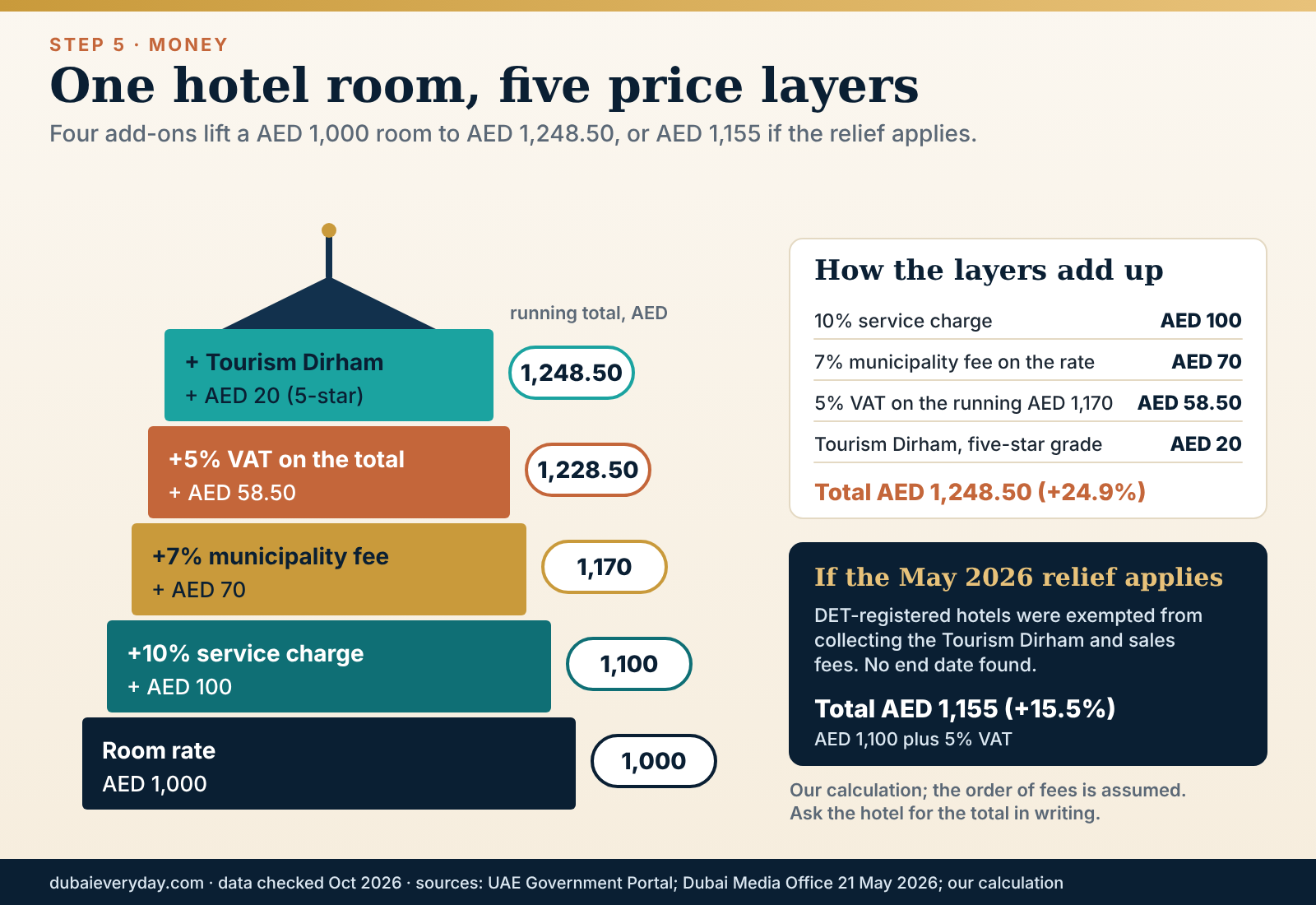
The sums, so you can repeat them. Start with the room at AED 1,000. Add the 10% service charge (AED 100) to reach AED 1,100. Add the 7% municipality fee on the room rate (AED 70) to reach AED 1,170. Add 5% VAT on that (AED 58.50) to reach AED 1,228.50.
Add the AED 20 Tourism Dirham for a five-star grade, and the total is AED 1,248.50. If the relief applies, the Tourism Dirham and municipality fee drop away and the total is AED 1,155 (AED 1,100 plus 5% VAT). The order of fees is our assumption; hotels may calculate them differently.
The takeaway is simple: compare totals, not headline rates. A AED 800 room with all fees and a AED 900 room with none are not the same price. Also expect a card hold or deposit at check-in; hotels commonly request one, and the amount varies by property.
Restaurants and cafés
Restaurant bills on a first time in Dubai commonly carry a service charge and 5% VAT on top of the menu price, and the same relief package covered the municipality sales fee on restaurants for DET-registered venues. Because rules differ by venue and may have changed after our research, assume the bill will be 10% to 25% above the menu total until you see the first one. Our guide to the best restaurants in Dubai explains how to choose across price levels.
Tourist VAT refund: worth it only above a threshold
Dubai’s tourist VAT refund scheme, run under the Federal Tax Authority, lets non-resident visitors aged 18 and over reclaim most of the VAT on goods they take out of the country. The rules read by our shopping guide research: the invoice must be at least AED 250 before VAT per transaction (AED 262.50 with VAT), you must validate the purchase within 90 days of the invoice date, and the goods must leave the UAE with you, usually shown unused at the validation point before you check in.
Deductions are 13% of the VAT plus AED 3.60 per transaction. A fee cut was reported to take effect from 12 July 2026 (secondary source, hedged), so the real deduction may be lower.
That matters because the fixed AED 3.60 swallows small refunds. Our calculation: an AED 262.50 invoice contains AED 12.50 of VAT, 87% of that is AED 10.88, and after AED 3.60 you receive about AED 7. An AED 3,000 purchase yields about AED 120.69. A AED 10,000 purchase yields about AED 410.69. Services (hotel, restaurants, tours), perishables eaten in the UAE and anything you do not carry out do not qualify. Cash payouts are capped at AED 35,000, and card refunds are expected within about nine calendar days.
The practical rule for a first time in Dubai: ask for a tax-free tag only at shops that offer one, keep the receipts and passport in your hand luggage, and budget 20 minutes at the airport. If you buy mostly small items, skip the scheme entirely. Our Dubai shopping guide and the Dubai Mall guide go deeper on malls, sales and refund counters.
Price traps to recognise
- “Free” airport meetings that become paid services at the end of the trip.
- Unlicensed taxis or offers from people in the arrivals hall. The FCDO advises using licensed taxis or recognised apps and not accepting lifts from strangers.
- Tour prices that exclude the headline activity, so you pay twice on site.
- Online “ticket” sellers with a service fee larger than the ticket’s difference to the official price. Compare with the attraction’s own site where it loads, which is a habit worth keeping for every first time in Dubai purchase.
- Currency conversion at the till, as noted above.
Step 6: Your first 24 hours in Dubai, hour by hour
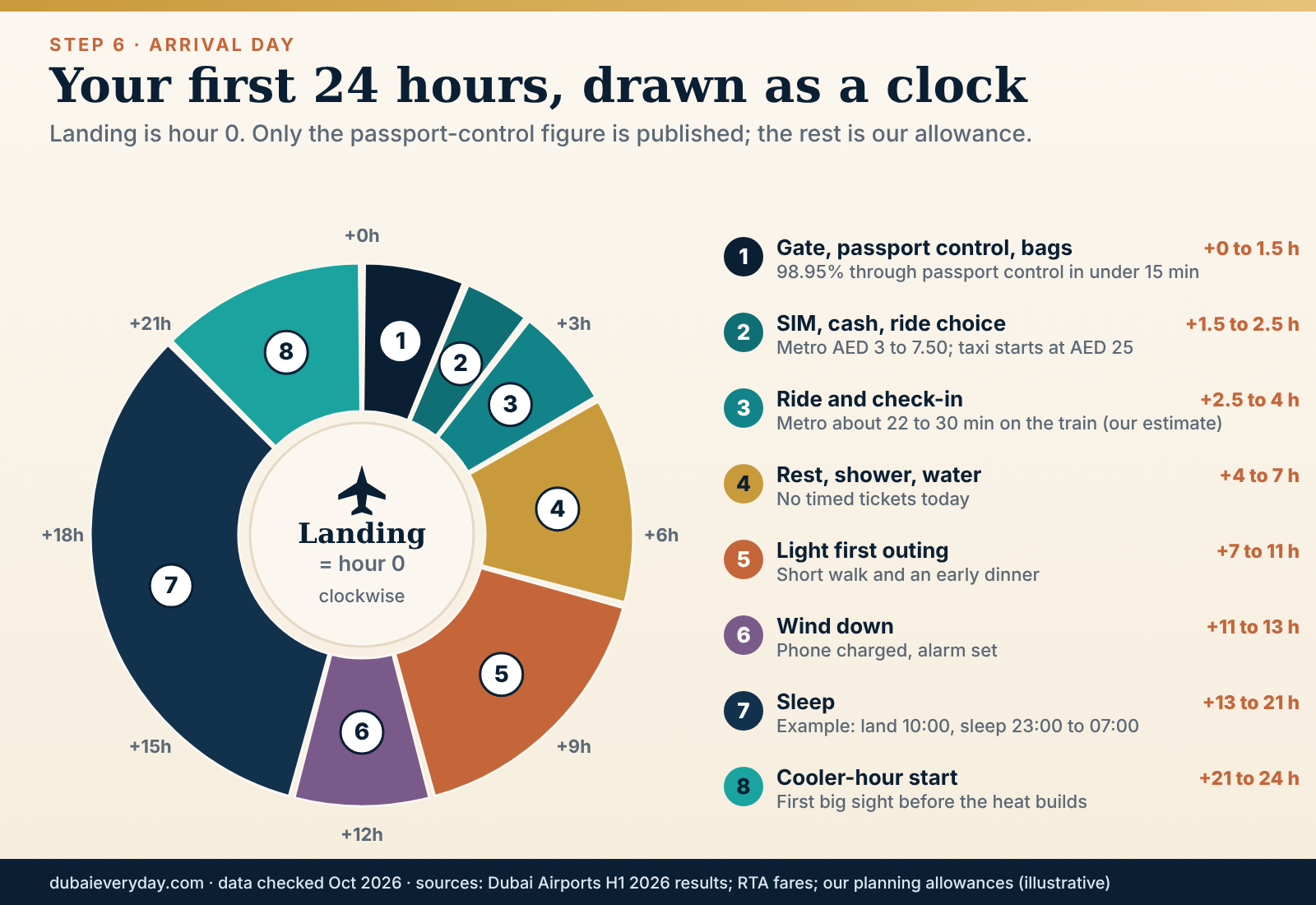
The first day of a first time in Dubai is where fatigue, heat and unfamiliar systems meet, so the aim is a clean landing, not an ambitious itinerary. This step walks through the hours in order and shows the choices that matter at each. The clock graphic summarises it; the sections below give the numbers.
Hour 0 to 1: gate, passport control, bags
Dubai Airports publishes service levels, which is rare and useful. In the first half of 2026, 98.95% of passengers cleared arrival passport control in under 15 minutes, and in 2025 about 89% of arriving bags reached the belt within 45 minutes.
These are measured at the airport’s counters, not guaranteed for your flight, and the baggage hall is the part with the most variation. Our planning allowance is 45 to 90 minutes from the aircraft door to the kerb on an ordinary day, and longer if several wide-bodies land together.
Eligible adults can use Smart Gates instead of the counter, and Dubai Airports lists groups who cannot, including people of determination, large strollers, families with children and anyone under 1.2 metres. Follow the signs for your passport type, have the passport open at the photo page and keep your hotel name and address to hand in case you are asked.
Know your terminal before you land. DXB is three airports under one name. Terminal 3 is mainly Emirates, plus some other airlines; Terminal 1 takes many foreign airlines; Terminal 2 serves flydubai and regional carriers, with no Metro. Your booking shows the terminal. Read our Terminal 1 guide or Terminal 2 guide if your airline uses either, because the exit routes differ.
Hour 1 to 2: phone, cash and the ride
On a first time in Dubai, do three things before you leave the arrivals hall: get connected, get a little cash, and decide how you are leaving the airport. A visitor SIM from e& (the main operator formerly known as Etisalat) requires your passport and visa, and each passport is limited to two Visitor Line SIMs.
The e& page lists a “from AED 49” headline for visitor lines and a connection fee that is waived when you buy online; other fees apply to out-of-bundle use, so read the plan before you sign. du also sells tourist plans and eSIMs, but its pages were not readable for our research, so we cannot quote its prices.
If your phone supports eSIM, buying one before you fly saves time at the airport. One caution from the Telecommunications and Digital Government Regulatory Authority (TDRA): VoIP services that are not licensed are generally not permitted, and operators block them. In practice, many visitors find that messaging apps work while voice or video calls over apps may not connect. For a first time in Dubai, plan to use ordinary calls, a licensed app or hotel Wi-Fi, and see our internet and mobile guide for the technical details.
Hour 2 to 3.5: reaching your hotel
You have four realistic options. The cards below use published fares and our own estimates of time.
Metro
Red Line stations at Terminals 1 and 3, tickets sold in both. Single journeys cost AED 3, 5 or 7.50 on a Silver nol card, AED 4, 6 or 8.50 on a paper Red Ticket. Luggage is limited to two pieces. Trains run 05:00 to midnight (Friday to 01:00), but only from 08:00 on Sundays.
Taxi
Dubai Taxi ranks at every terminal run 24 hours, with a start fare of AED 25 at the airport plus distance. To Downtown, roughly 13 to 16 km, we estimate AED 55 to 70 before Salik road tolls and extras.
Ride-hailing
Uber, Careem and Bolt use marked pickup points at the terminals. Prices vary by demand, so confirm the quote in the app before you confirm the ride.
Hotel or pre-booked transfer
The most expensive option, but sometimes the simplest with children, a late arrival or a lot of luggage. Ask what is included and whether it is fixed in dirhams.
How long does the Metro take? RTA publishes no airport-to-station time, so here is our estimate. From Terminal 1 to Burj Khalifa/Dubai Mall is eleven station gaps on the Red Line, and a rule of thumb of two to two and a half minutes per gap gives 22 to 28 minutes on the train; from Terminal 3, one more gap.
Add the walkway from the station to the mall (about 820 metres, roughly 10 to 12 minutes on foot) and waiting time. The official fares come from the RTA fares page and the airport rules from Dubai Airports.
The decision for a first time in Dubai is simple. With one or two bags and a daytime arrival, the Metro is cheap and predictable. With children, heavy bags, a Sunday morning, a night arrival or a hotel more than 10 minutes’ walk from a station, take a taxi. Our Dubai Metro guide covers the network, and if you rent a car, the Dubai airport car rental guide explains the desks, deposits and return timing.
Hour 3.5 to 6: check-in and the first rest
On a first time in Dubai, standard check-in is commonly mid-afternoon, though policies vary and we cannot quote a single time. If you land in the morning, message the hotel in advance and ask for early check-in or bag storage; most hotels hold luggage. If you arrive at 02:00, confirm the hotel expects a late arrival, because a night receptionist may release the room otherwise. Under-18s cannot check in without an adult, and expect the hotel to copy your passport and ask for a card for incidentals.
Hour 6 to 10: the light first evening
The best outing on a first time in Dubai evening is one you can abandon. Walk near the hotel, eat something local, buy water and a SIM top-up, then go to bed at a sensible hour. If you are staying in Downtown, the Dubai Fountain performs every 30 minutes from 18:00 to 23:00 and at 13:00 and 13:30 (14:00 and 14:30 on Fridays), according to the operator’s published schedule. Works and a new look were reported in October 2026, so check on the day.
Sunset matters for planning, not just for photographs. By our calculation, sunset in Dubai falls around 17:34 in late December and around 19:12 in mid-July, and in winter the pleasant window runs roughly from mid-morning to dusk. Do not schedule a long outdoor walk for the first afternoon, even in winter, and keep fluids with you.
Skip these on day one. Skip a desert safari, a long beach day, a long drive or a big-ticket reservation for the evening of arrival. Tiredness makes everything harder, and heat compounds it. A delayed flight can wipe out the slot anyway, which is why the booking ladder keeps timed tickets for day two onward.
Hour 10 to 24: sleep, then the first full day
On a first time in Dubai, set the alarm for the cooler part of the morning, because the first full day is the best day for a major outdoor sight. Between November and March you can go out from about 09:00; in summer, go before 10:00 or after 17:00. The sections on pacing and heat come later. For now, the aim of the first 24 hours is a working phone, a working card, a known route to the Metro and a hotel room you have slept in.
Step 7: Getting around Dubai for the first time
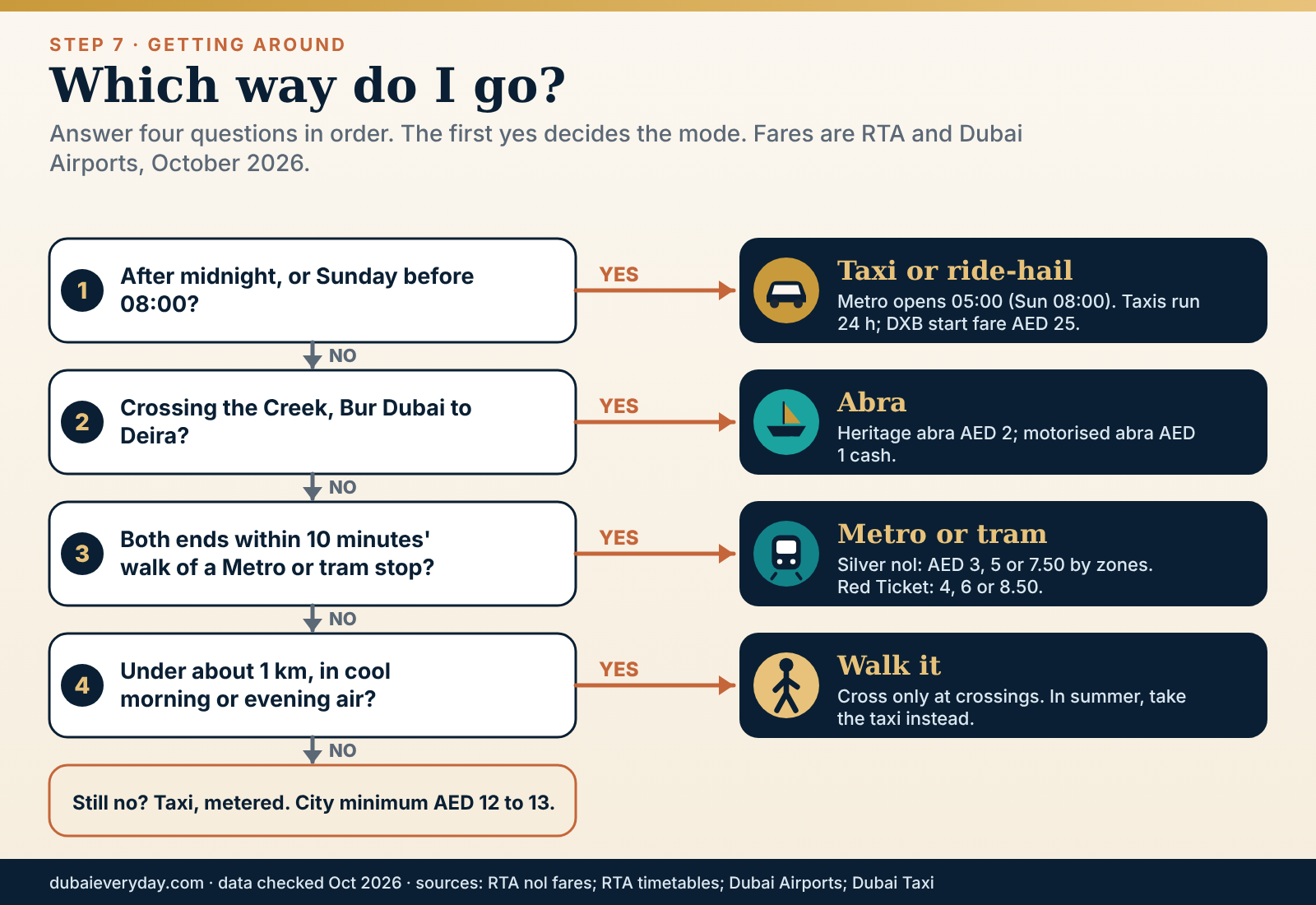
Dubai has more public transport than its car-heavy reputation suggests: two Metro lines, a tram, buses, water taxis, abras and plentiful taxis. The RTA reported 802.1 million journeys across all its modes in 2025 (taxis and shared mobility included), of which 294.7 million were on the Metro. The real question on a first time in Dubai is not whether transport exists but which mode fits each trip, and the flow chart below gives a quick rule.
The nol card: the key you need
Nol is the RTA’s fare card for the Metro, tram, buses and marine transport. A Silver nol card is the usual visitor choice. The fares on the RTA fares page are AED 3 for a journey within one zone, AED 5 across two adjacent zones and AED 7.50 across more than two. Gold cards pay double, and the paper Red Ticket costs AED 4, 6 or 8.50 for the same zones. Children aged five and under travel free on all cards.
The card itself is reported at AED 25 for Silver, of which AED 19 is usable credit (two secondary sources; RTA’s pages we could read do not print the price). The Red Ticket is a cheaper, non-reloadable paper card reported at AED 2. Our break-even: a Silver card nets about AED 6 of card cost after credit and saves AED 1 per journey on the lowest fare band, so it wins from about the fifth journey. A Metro-heavy first time in Dubai should use Silver.
- You need at least AED 7.50 of credit to tap in on the Metro, even if your fare will be lower, per the RTA’s nol page.
- The maximum journey time is 180 minutes with up to three transfers on one fare; a switch between Metro and bus must happen within 30 minutes.
- Top up at station machines, at ticket offices or by app. Keep a small cash reserve for machines that do not take your card.
- Anonymous cards can load the 7-day pass only (AED 50, 80 or 110 for one zone, two or all zones). At AED 7.50 per ride, the all-zones pass wins from 15 rides.
Metro and tram: the spine of a first time in Dubai
Dubai has two Metro lines. The Red Line runs from the airport terminals through BurJuman, Union, Emirates Towers, Burj Khalifa/Dubai Mall and on towards the Marina and Expo City. The Green Line serves Old Dubai and the Creek. The two meet at Union and BurJuman. Detail is in our guides to the Red Line and the Green Line.
Metro hours, per the RTA timetable page, are 05:00 to midnight Monday to Thursday and Saturday, 05:00 to 01:00 on Friday and 08:00 to midnight on Sunday. The tram, which serves the Marina, JBR and Al Sufouh, runs 06:00 to 01:00 Monday to Saturday and 09:00 to 01:00 on Sunday. The tram links with the Metro at the SOBHA Realty and DMCC stations. A first-timer’s mistake is planning a Sunday-morning airport run on the Metro: nothing runs before 08:00.
Behaviour on the Metro is enforced. Reports (secondary, so confirm) put the fine for eating or drinking at about AED 100, for using someone else’s card at about AED 200, and for sleeping up to AED 300. Each train has a cabin reserved for women and children; we could not confirm the exact position or the fine from a primary source, so follow the signs on the platform and in the carriage.
Taxis and ride-hailing
Taxis in Dubai are cream with coloured roofs, and the FCDO notes that pink roofs indicate female drivers. They are metered. Dubai Taxi’s own page lists a per-kilometre rate of AED 2.45, a minimum street-hail fare of AED 12 and an e-hail minimum of AED 13, waiting time at AED 0.50 a minute, and Salik toll fees added on top.
The airport start fare is AED 25. Press reports of changes in late 2025 quote slightly different per-kilometre figures, which is why we say “the meter decides”. Cash, card and nol are accepted.
Ride-hailing apps work alongside taxis. Their advantage is a quoted price and a record of the route. The disadvantage is surge pricing at peaks. During big events, the RTA has set higher start fares for taxis leaving event venues (press reports mention AED 20), so assume a premium when you leave a stadium, Global Village or Expo City at the end of a night. Ask the driver to use the meter and decline unlicensed rides, as the FCDO advises.
Abras, water taxis and buses
On a first time in Dubai, crossing the Creek by traditional abra is both the cheapest transport in Dubai and a useful shortcut between Bur Dubai and Deira. The RTA lists the heritage abra at AED 2 and a motorised abra at AED 1 in cash, and the air-conditioned Al Jaddaf to Festival City abra at AED 2.
The Water Taxi costs AED 7 for a single segment up to AED 21 for the longest route. Children under 12 must wear life jackets. Buses cover most of the city, but for a first visit the Metro and tram plus the occasional taxi are simpler to read.
Walking: the underrated mode, with conditions
Dubai is walkable in pockets and pointless in others. Downtown around the Dubai Mall, the Creek side in Deira and Bur Dubai, the Marina promenade and the beach walks are fine in cooler months. Between stations in a neighbourhood with no shade, distances of 800 metres feel long in July. Cross roads only at designated crossings; the FCDO warns that jaywalking can bring fines or even jail.
Do you need a car for a first time in Dubai?
For most people on a first time in Dubai who stay in Downtown, Marina, Business Bay or Deira, no. A car makes sense if you plan several day trips, stay on the Palm or far from a station, or travel with several children. The costs sit below the headline daily rate: deposits, insurance, Salik tolls and parking.
Salik rates are reported at AED 6 at peak weekday hours and AED 4 off-peak, from secondary sources that may be out of date. Our car rental guide explains how to compare licensed companies, and the FCDO states that driving after any amount of alcohol is illegal.
What a Metro-based visit costs, worked through
An illustrative example (not a quote): a four-day visit with three journeys a day on the Metro and tram, plus two abra crossings. That is twelve journeys at AED 3 to 7.50, so AED 36 to 90, plus roughly AED 6 of net card cost and AED 4 for the abra: about AED 46 to 100 in total.
The same twelve trips by taxi, at an assumed AED 20 to 40 per trip, would run AED 240 to 480. The gap is why many visitors mix modes: Metro for the long runs, taxi for the last stretch, in heat or at night.
A rule that works. On a first time in Dubai, take the Metro or tram when your start and end points are each within a 10-minute walk of a station. Take a taxi when either end is not, when you are with luggage or small children, after midnight, or on a Sunday morning. Everything else is a judgement call, and you will make it faster once you have taken your first fare.
Step 8: What to wear on a first time in Dubai
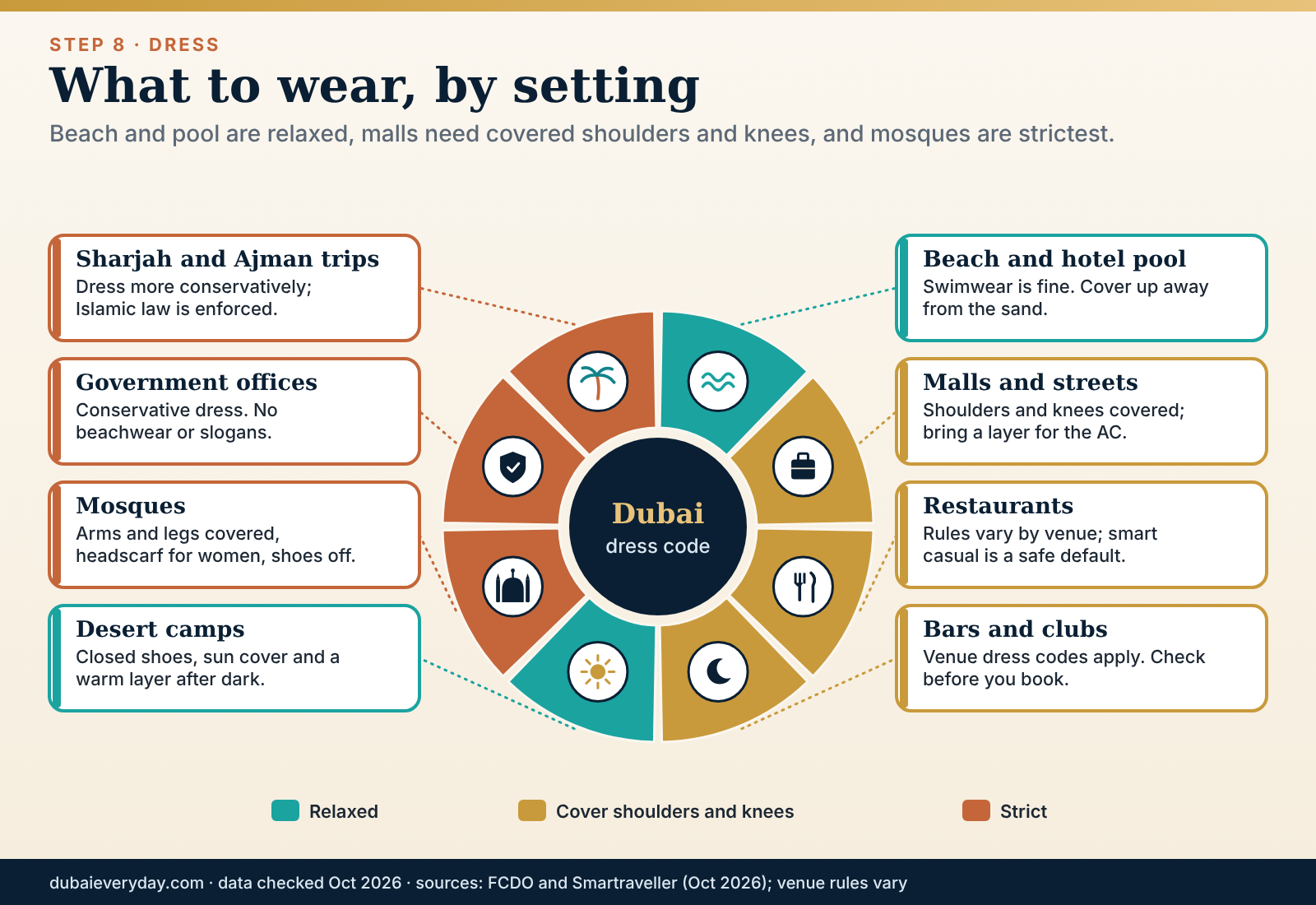
The dress question on a first time in Dubai is usually asked as “what is allowed?” The better question is “what works where?”, because dress in Dubai is governed by three different things at once: national law, the rule of a particular venue, and plain courtesy. The graphic below maps the common settings by how strict they are.
What the official advice says
The FCDO tells visitors to dress modestly in public areas such as malls. For women, it spells out covering shoulders and knees and not letting underwear show.
It adds that see-through clothing and clothing with images or wording that could offend should be avoided, that swimwear belongs at beaches and pools, and that some venues and buildings have their own dress codes. Smartraveller says to dress conservatively and to check dress codes for malls, beaches and attractions, especially in Sharjah and Ajman, where Islamic law is enforced more strictly.
For men, the equivalent is a sensible reading of the same principle (our reading, not an official list): a shirt, not a bare torso, away from the beach and pool, and shorts to the knee as the safer length in malls and offices.
Dubai is a cosmopolitan city, and visitors in shorts and T-shirts are common. The point is that enforcement tends to bite where behaviour is conspicuous or where a complaint is made, so aim for unremarkable. For a wider treatment of dress across settings, see our Dubai dress code guide and our Dubai etiquette guide.
Setting by setting
Malls and public streets
Covered shoulders and knees is the safe default. Air conditioning is strong, so carry a light layer. Swimwear and bare torsos do not belong here.
Beaches and hotel pools
Swimwear is expected at the beach and pool. Municipal beach rules, read by our beaches research, prohibit swimwear in passageways and restrict photography, so cover up when you leave the water.
Mosques
Arms and legs covered, and a headscarf for women, is the usual expectation, with shoes off. Not all mosques admit non-Muslims. The Jumeirah Mosque has offered guided visits through a cultural centre (reported AED 25, mornings Saturday to Thursday; confirm before you go).
Restaurants, bars and clubs
Venue rules vary: some insist on smart casual and refuse flip-flops or sportswear. Check the venue’s own page or ask when you book. See the Dubai nightlife guide.
Desert camps
Closed shoes, sun protection and a warm layer. At least one camp operator says no sandals. Winter evenings are cool after dark.
Government buildings and day trips
Dress conservatively, with covered knees and shoulders, and more so in Sharjah and Ajman, where Smartraveller says Islamic law is enforced.
Fabrics, layers and shoes for a first time in Dubai
The weather decides the fabric. Between November and March, the mean daily high runs from about 31 degrees Celsius in November down to 24 in January, and nights can be noticeably cooler, so light layers beat heavy ones.
From May to September, highs run from the high 30s to nearly 42 degrees, and a long-sleeved linen or lightweight cotton shirt is often more comfortable than a bare arm, because it blocks the sun. The monthly figures come from NOAA climate normals compiled on Wikipedia, and our travel guide has the full table.
Shoes matter more than visitors expect. Pavements get hot, queues are long, and mall corridors measure in kilometres. Take comfortable closed shoes for walking, sandals for the beach, and a pair you do not mind removing for mosques, homes and some attractions. A wide-brim hat, sunglasses and a small bottle of sunscreen belong in a day bag from March onward.
Heat and modesty are not opposites. Loose, light, long-sleeved layers cover shoulders and knees and also cut sun exposure. Dark synthetic fabrics hold heat; pale cotton and linen do not. If you pack one clothing category for the trip, make it this one.
Ramadan changes the rulebook
Ramadan 2027 is expected to begin around 8 February, subject to moon sighting. During the day, the FCDO advises visitors to avoid eating, drinking, smoking or chewing gum in public, including in your car, and to avoid loud music, dancing and swearing. Dress conservatively, and expect shops and restaurants to change their hours. We cover this period in our Dubai events in February guide because it falls partly in that month.
Step 9: Rules that catch first-timers
Most people on a first time in Dubai never meet a Dubai law. A few do, usually because of a phone, a drink, a prescription or a photograph. The graphic groups the rules by weight so you can tell what is an offence from what is merely poor form.
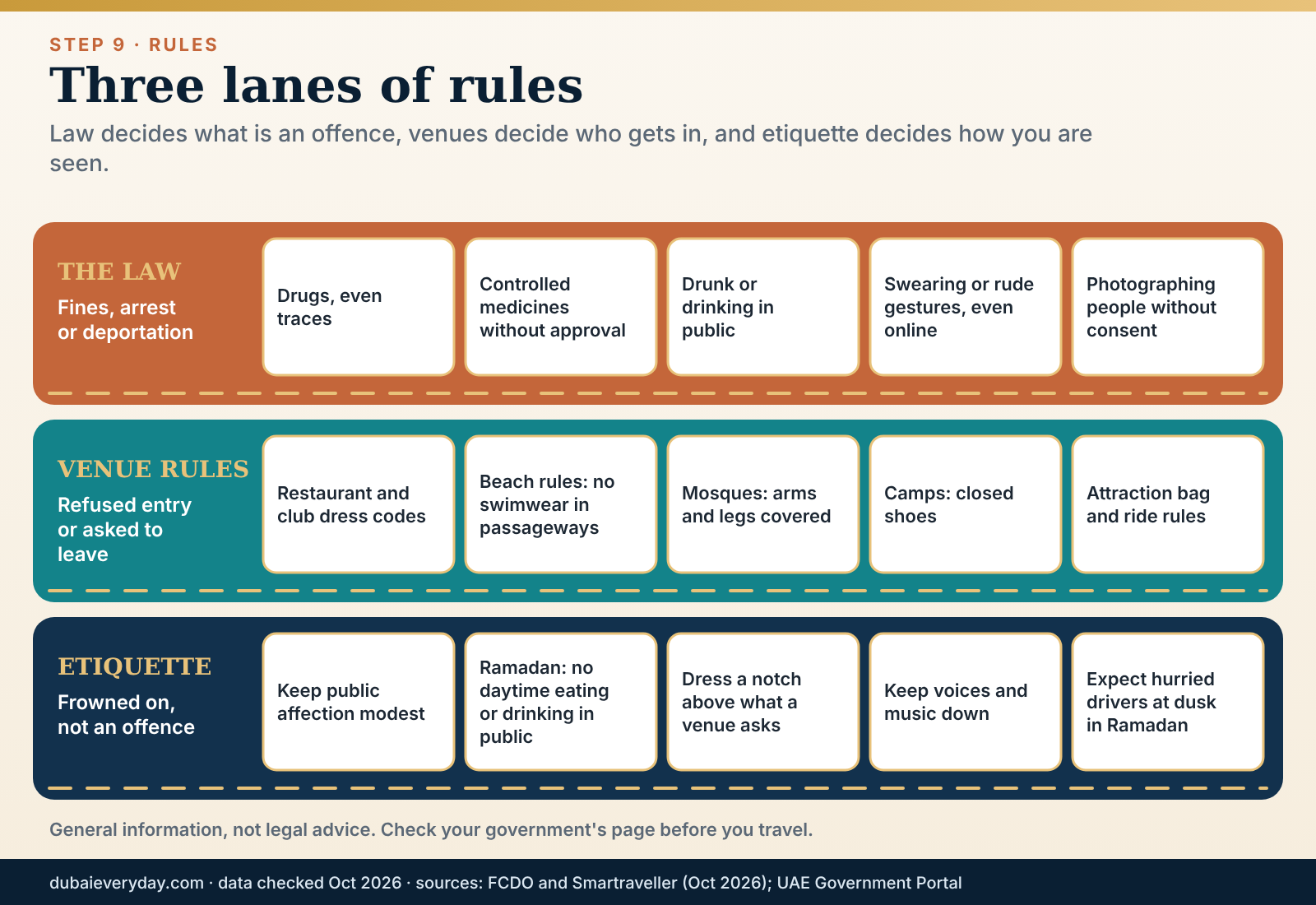
Alcohol
Alcohol is legal in licensed venues in Dubai, such as hotels, bars and restaurants, and the legal age is 21. Drinking in public is illegal everywhere in the UAE, including being intoxicated in public.
The FCDO says residents need a liquor licence to drink at home and that tourists can obtain a one-month temporary licence from two authorised distributors, valid only in Dubai. Driving after any amount of alcohol is illegal, and insurance may be void after a crash. If you cross into Sharjah on a day trip, alcohol is banned there.
Drugs and medicines
Zero tolerance is the right way to read it on a first time in Dubai. The FCDO says even tiny amounts of any illegal drug, including cannabis, can bring a minimum three-month prison term or a large fine, that drugs detected in your bloodstream count as possession, and that airport screening can detect residual traces, including in transit baggage. Smartraveller adds that this applies in transit and that some foods and branded products resemble drugs. The medicine rules in Step 2 are part of the same system.
Photography, privacy and online behaviour
On a first time in Dubai, do not photograph people without permission, especially women, children and anyone in a swimsuit. The FCDO notes that men have been arrested for photographing women on beaches, and photographing some government buildings and military sites is illegal.
The cybercrime decree-law (Federal Decree-Law 34 of 2021) is heavy: our reading of its privacy article is that photographing or publishing images of other people without authority can carry at least six months in prison and/or a fine of AED 150,000 to 500,000. Enforcement is complaint-driven, but that is exactly the point: a stranger’s complaint is all it takes.
The same logic applies online. The FCDO says swearing and rude gestures are illegal, including online, and can lead to jail or deportation. Smartraveller says posting identifiable people or their belongings without consent can lead to arrest or fines, as can defamatory or false posts. Public venting about a hotel or a taxi driver, naming a person, is the most common way tourists stray into this. Review the business, not the individual. The cyber-law summary is on the UAE government portal.
Public behaviour and relationships
The FCDO says affection in public is frowned upon and that kissing in public can lead to arrest. Where the line sits for something like hand-holding is not written down, so keep it modest. The FCDO also notes that consensual relationships between unmarried adults are generally legal, but that a spouse or parent can file a complaint that may lead to jail time of six months or more.
Same-sex sexual activity is illegal and same-sex marriages are not recognised; people have been punished, especially where conduct is public or causes offence. LGBT+ travellers should read the FCDO’s dedicated guidance before a first time in Dubai.
Money, debts and hotel bills
On a first time in Dubai, the FCDO warns that unpaid bills, including hotel bills, can lead to prosecution, frozen assets and denial of bail for non-residents. Do not walk out on a disputed bill. Pay under protest, keep the invoice and complain afterwards through DET. The same advice covers taxis and tour operators.
Roads, beaches and small fines
Pedestrians should cross at designated crossings. Rip currents can affect any beach, so the FCDO says to swim only at lifeguarded beaches with flags showing safe conditions. Public beaches run by Dubai Municipality have lifeguards from sunrise to sunset, and only a few beaches have night-swimming zones. If you plan a beach day, read our public beaches guide before you go.
A calm default. When you are unsure whether something is allowed, ask a hotel concierge, not a stranger or a forum. Concierges answer this question daily, and the answer is usually specific to the venue. For legal matters beyond that, our Dubai legal basics guide explains where to verify rules, though it is written for residents.
Step 10: Essential bookings and sights, ranked for a first visit
A shortlist for a first time in Dubai needs a method, so here it is. We ranked by five criteria: whether the place is open now according to a source we read, how easy it is to reach without a car, how well it works in the heat, whether it gives a first-timer something they cannot get elsewhere, and how much booking pressure it carries.
This is research-based, not field-tested. Prices are listing prices checked on 29 October 2026, many from marketplace sellers rather than the attraction itself, so treat them as ranges. Inclusion was not paid for.
Tier A: the sights for a first time in Dubai
Downtown evening: the Burj Khalifa, Dubai Mall and Dubai Fountain
Book ahead for the deckFountain free
The Burj Khalifa deck is the booking that matters. Operator-republished rates in 2026 put the Level 124/125 deck at AED 173 off-peak and AED 250 in prime hours (about 16:00 to 19:00), and a marketplace listing shows “from AED 161”. Mall retail hours are 10:00 to 23:00 Monday to Thursday and 10:00 to midnight Friday to Sunday. See our Downtown Dubai guide.
Old Dubai: Creek, abra, souks and heritage
Mostly walk-up
Take an abra across the Creek (AED 1 to 2), walk the textile and spice souks, and visit the Al Shindagha Museum (AED 50 for an individual ticket). Al Fahidi Fort is closed for restoration. Green Line stations make this a one-line morning. The Dubai Frame is a short taxi hop away, from AED 52.50 on listings that disagree about its hours.
A public beach
Free, no booking
Dubai Municipality’s public beaches charge no entry fee and have lifeguards, but municipal rules ban swimwear in passageways and restrict photography. Jumeirah 1 reopened in 2026 and Khor Al Mamzar beach opened in May 2026. Our best beaches guide compares public and hotel beaches.
One desert experience
Book 2 to 4 weeks ahead
Choose morning if you hate crowds and heat, evening if you want the dune drive, sunset and camp show. Listings in October 2026 range from about AED 110 to 150 for a basic evening trip to about AED 500 for a morning reserve trip. Use a licensed operator (Step 3).
Tier B: worth it if you have time or the right interest
A view of the Palm Jumeirah from The View at The Palm (from about AED 115 on a listing; hours vary between sellers) rewards a clear day. Dubai Miracle Garden’s Season 15 runs from 8 October 2026 to 31 May 2027, with adult tickets from about AED 105, and suits a cooler-weather morning.
Global Village’s Season 31 opened on 14 October 2026; official entry is AED 25 on weekdays and AED 30 any day, with hours of 16:00 to midnight Sunday to Wednesday and to 01:00 Thursday to Saturday, and Tuesdays reserved for ladies and families.
For indoor options, the Dubai Aquarium starts around AED 209 on a listing, with a combined Sky Views ticket at AED 252, saving about AED 45 against buying separately (our calculation). Alserkal Avenue, the arts district, is open 10:00 to 19:00 daily and publishes no district entry fee. Our indoor things to do guide collects summer-proof choices.
Closed or unclear: do not plan around these
Status as of 29 October 2026. Museum of the Future: closed since 1 September 2026, reopening expected in the first quarter of 2027. Burj Al Arab: closed for an 18-month restoration, reopening expected in October 2027, so a tour listing for it should be treated with suspicion. Armani Hotel (Burj Khalifa): closed, full reopening expected in March 2027. Barasti Beach Club: closed, redevelopment, 2027. Al Fahidi Fort: closed with no confirmed reopening date. Dubai Frame hours: sources disagree, so confirm. Fountain: works were reported in October 2026, so check the show on the day.
Two ways to use the ranking
If your first time in Dubai lasts three days, take all four of Tier A and one B. If you have five, add a second beach day, a market evening at Global Village and one thing from the indoor list for the hottest afternoon. If you have a week, you have room for a day trip.
Abu Dhabi is now reachable by the new Etihad Rail passenger service, which began on 30 September 2026 from Al Yalayis near Jumeirah Golf Estates with fares reported from AED 39, and the travel guide compares day trips in detail. Our broader things to do guide and the free things to do guide cover the rest.
Step 11: Pace your first four days
Pacing is the quiet difference between a good first time in Dubai and a tiring one. Three rules do most of the work. Put outdoor sights in the cooler hours. Put indoor sights in the middle of the day. And keep each day inside one area where possible: our estimate is about 35 minutes lost for every cross-zone hop between sightseeing zones, which is a planning assumption, not a measurement.
A four-day skeleton for a first time in Dubai, not a script
- Day 1: land and settleArrive, get connected, check in, walk near the hotel, early dinner. Nothing is booked.
- Day 2: Old Dubai by morning, Downtown by eveningTake the Green Line to the Creek side, ride an abra, walk the souks and the museum before the heat builds. Rest. Take the Red Line to Burj Khalifa/Dubai Mall late afternoon, use your timed deck slot, then the Fountain.
- Day 3: beach in the morning, a desert eveningBeach early or late, with the afternoon off. If the desert safari is booked for this evening, make the beach a short session and rest well before pickup.
- Day 4: choose a theme and leave a bufferOne of Miracle Garden, a Palm view, a mall afternoon or Global Village in the evening. Keep three hours spare before an evening departure for check-out, bags and the airport.
In summer (June to September), the same first time in Dubai skeleton survives with swaps. Replace the Old Dubai walk with an early start and a long indoor break, swap the beach for a hotel pool or an evening shoreline walk, and use the indoor list for the middle of the day. Our Dubai travel guide carries longer plans for three, five and seven days with seasonal swaps.
If you travel with children
Shorten each block, add an air-conditioned stop every two hours and move the big sight to the morning. The Dubai with kids guide and the Dubai with a baby guide cover strollers, feeding spaces and heat. Beach choices differ too: see the guide to family beaches in Dubai.
What to do when your plan does not survive contact with reality
Every first time in Dubai plan fails somewhere: a late flight, a closed attraction, a headache from the sun. Keep one indoor option within a ten-minute taxi ride of wherever you are and accept a lost half-day without panic. The skeleton above holds two slack blocks (Day 1 and the end of Day 4) precisely so a mishap can be absorbed.
Heat, health and safety: the short list
Health advice on a travel page has limits, so this section gives only what the official sources say and leaves treatment to doctors. Anyone with a medical condition should ask their own clinician before a first time in Dubai, and carry the paperwork described in Step 2.
Heat is the most likely problem
Smartraveller warns that extreme heat, dust and sandstorms can cause dehydration and worsen breathing problems, and it describes temperatures often above 50 degrees Celsius from June to September. The long-term monthly averages are lower (a mean daily high of about 41.9 degrees in August, from NOAA normals), so the difference is partly the gap between an average and a hot afternoon in the sun. Either way, the practical effect is the same: plan outdoor time around the heat.
- Carry water every time you leave an air-conditioned space, even for short walks.
- Put outdoor sights before 10:00 and after 17:00 from May to September.
- Wear sunscreen, a hat and sunglasses, and reapply after swimming.
- Rest in shade at the first sign of headache, dizziness or nausea, and seek medical help if it does not pass.
- Children, older travellers and anyone on medication that affects fluid balance need extra care.
Other health points from the official sources
For a first time in Dubai, Smartraveller notes that dengue cases have been reported, that the mosquitoes that carry it are active during the day, and that repellent and protective clothing help.
It advises avoiding contact with camels, raw camel milk and undercooked camel meat because of the risk of MERS-CoV, and avoiding shellfish and seafood during red tide alerts. The FCDO says a yellow fever certificate is required only if you arrive from a risk country. If you are unwell with fever, cough, breathing difficulty or diarrhoea, seek medical advice.
Medical care is not free for visitors. Smartraveller says public hospitals in major cities are adequate and several private facilities meet international standards, and that the Australian government will not pay your costs. Our Dubai healthcare guide explains how the system works, and the hospitals guide compares emergency services by location. For minor needs, pharmacies sit inside most malls, and The Dubai Mall lists a pharmacy open from 08:00 and a clinic open until 20:00 Monday to Saturday.
Personal safety
On a first time in Dubai, the FCDO says to be cautious walking alone at night, especially as a woman, to use licensed taxis or recognised apps, never to leave drinks unattended or accept drinks from strangers, and never to accept lifts from strangers. It rates the terrorism threat as high, with possible targets including hotels, restaurants, malls, beaches, transport and places of worship, and asks visitors to stay alert in public places. The emergency number is 999, according to Smartraveller. Save your embassy number as well.
At sea and on the road
Swim only at lifeguarded beaches when the flags show safe conditions, as the FCDO advises, because rip currents affect any beach. On the road, the FCDO notes that speeding and collisions are common, that flashing headlights usually mean a driver is going to proceed, not yield, and that after a crash you should call the police and not leave the scene. Pedestrians and cyclists should assume cars will not always stop.
Mistakes people make the first time in Dubai
These are the errors on a first time in Dubai that the rest of the guide is built to prevent. None is dramatic. Most cost an hour, a taxi fare or a deposit, and a few cost a trip. They come from the official advice and the numbers above, not from anecdotes.
- Paying for non-refundable flights, hotels and tours before reading your own government’s current UAE advice.
- Assuming a visa on arrival applies to your passport without checking with the airline, and assuming a passport with a single name or unusual marker will be accepted.
- Carrying a prescription medicine that needs ministry approval, with no approval and no doctor’s letter.
- Comparing hotels on the headline rate when fees can add roughly 15% to 25% to the bill.
- Choosing a hotel by star rating and pool, then discovering “near the Metro” means a 20-minute walk in the sun.
- Planning an early Sunday Metro ride to the airport, when trains do not start until 08:00.
- Landing without any way to pay for a ride beyond a single card, then finding the card machine in the taxi is “not working”.
- Accepting the till’s offer to charge you in your home currency.
- Wearing beachwear to the mall or a short skirt to a mosque, and then being surprised at the reaction.
- Photographing strangers, or posting a rant that names a person, on social media.
- Scheduling a long outdoor activity for 13:00 between May and September.
- Buying a multi-attraction pass before pricing the actual list of things you want to do.
- Trusting a listing for an attraction that is closed, such as the Museum of the Future or the Burj Al Arab, without checking the operator’s own status.
- Trying to do too much on arrival day and on the day before a flight home.
The cheapest fix on this list. Mistake 14 is the cheapest one to fix. Leave the first afternoon empty and the last evening buffered. A delay at any point is then an annoyance, not a collapse.
Five first-timer scenarios, worked through
These first time in Dubai scenarios are illustrative examples, not quotes or real itineraries. They use the verified figures above to show how the steps combine. Prices are listing-based ranges from October 2026; confirm every figure at booking.
1. A couple, four nights in early December, mid-range
The Dubai Shopping Festival opens on 4 December 2026, so the booking ladder moves a week earlier: hotel and insurance now, Burj Khalifa deck and desert safari three to four weeks ahead. In Downtown, with a Metro station close, the couple can do the Tier A list.
Illustrative activity costs: two Level 124/125 tickets off-peak at AED 173 each (AED 346), two Al Shindagha Museum tickets at AED 50 each (AED 100), a shared evening desert safari at about AED 130 each (AED 260) and roughly AED 100 for transport. That is about AED 806 for activities and transport, before hotel and food. Choosing prime-hour Burj tickets instead adds AED 154 (2 x 77).
2. A solo woman, three nights, a first time in Dubai alone
The advice is the FCDO’s, applied. Book a hotel within a short walk of a Metro station so evenings do not depend on a long walk. Use licensed taxis or recognised apps, share the ride details with someone, and keep the drink in your hand. Dress for the venue.
Choose daytime activities for the quieter sights and an organised evening activity from a licensed operator for the desert. The Metro has a cabin reserved for women and children. Keep the embassy number and 999 in your phone. None of this is a warning against going, it is a set of habits that cost nothing.
3. A family of four, five nights in January, children aged seven and ten
January is the coolest month, with a mean daily high of about 24 degrees, which makes outdoor time easy and makes peak-season prices likely. Our Dubai events in January guide covers the festival crowds. A family suite or connecting rooms often prices better than two rooms and avoids paying the Tourism Dirham twice, as noted in our hotels research.
Keep each block to two hours, add an indoor stop and plan the big outing in the morning. Dubai Airports lists families with children among the groups who cannot use Smart Gates, so expect to use the counters.
4. An 18-hour stopover instead of a full first time in Dubai
With eighteen hours between flights, the plan is a loop: Metro from the airport to Burj Khalifa/Dubai Mall, the mall and an evening Fountain show, then back. Left-luggage counters at the terminals cost about AED 35 to 50 for up to 12 hours (Dubai Airports, October 2026).
Check your passport’s visa-on-arrival status before you leave the airport, and confirm whether your airline offers a transit or stopover programme (Emirates lists a Dubai Connect programme for eligible long connections; its page contradicts itself on the booking deadline, so confirm with the airline). Return at least three hours before departure. The airport guide gives the terminal detail.
5. A business traveller with two free evenings
The paperwork question comes first: if the trip involves meetings, ask your host which visa category applies, because the FCDO states that working on a visit visa is not permitted. Book a hotel near the Metro in Business Bay, DIFC or Downtown to cut taxi time at peak hours.
Pack one set of venue-appropriate smart clothes. Keep alcohol to licensed venues and never drive after drinking. For the free evenings, a Downtown dinner and the Fountain, or an Old Dubai abra ride at dusk, cost little and need no booking. Our restaurants guide helps choose a dinner.
The last-week checklist for a first time in Dubai
Print this first time in Dubai checklist, or screenshot it. It repeats the steps above in the order you will need them in the final seven days.
- Open your government’s UAE travel advice and read the date it was last updated.
- Confirm your flight with the airline and note the terminal.
- Check passport validity (six months from arrival), name format and visa route with the airline.
- Pack medicines in original packaging with prescriptions, and check each by name against the ministry’s approval requirement.
- Save hotel confirmation, address in English and a phone number.
- Check the hotel’s total price, fees and deposit policy in writing.
- Confirm timed tickets (Burj Khalifa deck, desert safari, events) and their cancellation terms.
- Arrange a way to be online on landing: eSIM, roaming plan or airport SIM with passport ready.
- Tell your bank, carry two cards and plan AED 200 to 400 in small notes.
- Pack light layers, a hat, sunscreen, closed shoes, sandals and a cover-up for shoulders and knees.
- Note Metro hours, especially Sunday, and decide how you will leave the airport.
- Save your embassy number and the emergency number 999 in your phone and on paper.
- Leave one empty block on the arrival day and a three-hour buffer before the flight home.
First time in Dubai: questions answered
Is Dubai a good choice for a first-time visitor in 2026?
Dubai remains a straightforward city for a first trip, with strong infrastructure and clear rules, but 2026 is not a normal year. The UK FCDO (updated 27 October 2026) calls the regional context deeply unpredictable and warns of possible flight cancellations and airspace closures.
Smartraveller advises Australians to reconsider the need to travel. Read your own government’s advice, buy insurance that covers your situation and choose flexible bookings. If you can absorb a delay or a cancellation, a first time in Dubai in the cooler months is a reasonable plan.
Do I need a visa for my first time in Dubai?
It depends on your passport. GCC citizens enter without a visa. Many nationalities receive a visa on arrival, and UK citizens get a free one valid up to 90 days in any 180. Others need a visa arranged in advance through an airline, hotel or licensed agent. Your passport should be valid for at least six months from entry. The UAE government’s entry-permit page is the place to check, and your airline has the final say at check-in because it can refuse boarding without the right papers.
How many days do you need for a first time in Dubai?
Four nights is a good minimum for a first visit, in our judgement. It gives you an arrival day, an Old Dubai and Downtown day, a beach or desert day and a flexible fourth day with a buffer before leaving. Three nights works if you cut the desert and beach to one. A week gives room for a day trip, such as Abu Dhabi by the new Etihad Rail service, and a slow pace in summer. Longer stays are better in cooler months than in July or August.
What is the best way to get from the airport to the city?
For a daytime arrival with light luggage, the Metro is cheapest: Red Line stations serve Terminals 1 and 3, and the fare is AED 3 to 7.50 on a Silver nol card. For a night arrival, a Sunday morning before 08:00, children, heavy bags or a hotel far from a station, take a taxi, which starts at AED 25 at the airport. We estimate AED 55 to 70 to Downtown before tolls. Ride-hailing apps use marked pickup points. Terminal 2 has no Metro.
Is Dubai expensive for a first-time visitor?
It can be, mainly because of accommodation and paid attractions. Public transport is cheap (AED 3 to 7.50 a Metro journey) and public beaches are free, but a hotel advertised at AED 1,000 can reach AED 1,248.50 with fees. A Burj Khalifa deck ticket is roughly AED 160 to 250 depending on slot and seller. Compare totals, not headline prices, and price your list before buying a pass. Our Dubai travel guide has full daily budgets by tier.
Can I use WhatsApp and FaceTime calls in Dubai?
Messaging apps generally work, but voice and video calls on unlicensed VoIP services are often blocked, because the TDRA says VoIP not provided by a licensee or approved by it is generally not permitted.
Vendor sites also claim that calls over several popular apps fail on consumer plans, and that is one place where a hotel Wi-Fi or a licensed app helps. Do not use a VPN to get around the block; the TDRA lists bypassing blocked content among prohibited categories. Plan to use standard calls for anything urgent.
What should I wear on my first time in Dubai?
Cover shoulders and knees in malls and public places, per the FCDO, and keep swimwear for beaches and pools. Bring a light layer for strong air conditioning, closed shoes for walking and the desert, and a cover-up for mosques and government buildings. Some restaurants and clubs enforce their own dress codes, so check before booking. In the cooler months, light layers work; in summer, loose long sleeves in pale cotton or linen are cooler than bare skin. See our Dubai dress code guide for more.
Can tourists drink alcohol in Dubai?
Yes, in licensed venues such as hotels, bars and restaurants, if you are 21 or over. Drinking in public is illegal, as is being drunk in public. The FCDO says tourists can obtain a one-month temporary licence from authorised distributors, valid only in Dubai, to buy alcohol for private use. Driving after any amount of alcohol is illegal, and insurance may be void after a crash. If you visit Sharjah on a day trip, alcohol is banned there.
Is Dubai safe for solo women?
Many solo women travel to Dubai, but safe is not the same as risk-free. The FCDO advises caution walking alone at night, using licensed taxis or recognised apps, not accepting lifts from strangers and never leaving drinks unattended. Dress modestly in public, stay in a hotel close to the Metro and share your plans with someone. Read the legal notes on relationships and assault in the FCDO guidance, because the burden of proof falls heavily on victims.
What can I not bring into Dubai?
Controlled and psychotropic medicines without ministry approval, illegal drugs (including cannabis and some CBD or herbal products), pork products, pornography, and weapons and related equipment without permission. Undeclared cash of AED 60,000 or more (or equivalent) is also an offence. Visitors can bring up to three months’ supply of ordinary medicine, one month for approval-list items, in original packaging with a prescription. When in doubt, ask Dubai Customs or the Ministry of Health before you pack.
Do I need to tip in Dubai?
There is no official tipping rule that we found. Many restaurants and hotels add a service charge, so read the bill first. If service is included, an extra tip is optional. Rounding up a taxi fare is the usual habit. Tip for service you received, in small notes, and do not feel pressured by a card terminal that suggests a percentage. Tipping practice differs by venue, so treat any figure you read online, including ours, as general practice rather than a rule.
When is the best time for a first time in Dubai?
November to March is the comfortable window, with mean daily highs from about 31 degrees in November down to 24 in January. It is also the most expensive and crowded part of the year, particularly from early December to mid-January. Shoulder months (April, May and October) are hotter but cheaper, and June to September is an indoor season. Our best time to visit Dubai guide compares weather, prices and events.
Sources and further reading (24 links)
- UK FCDO: UAE travel advice — current warnings, shelter and insurance advice
- UK FCDO: UAE entry requirements — passport validity, UK visa on arrival, medicines, customs, working on a visit visa
- UK FCDO: UAE safety and security — dress, alcohol, drugs, photography, public behaviour, taxis, beaches
- Australian Government Smartraveller: United Arab Emirates — advice level, laws, passport conditions, health, emergency number
- RTA: nol fares — zone fares, passes, transfer and journey-time rules
- RTA: Metro and tram timetables — operating hours (via sibling research log)
- Dubai Airports: Metro — Terminal 1 and 3 stations, tickets, luggage limits (via sibling research log)
- Dubai Airports: taxis — airport start fare and ranks (via sibling research log)
- Dubai Airports: immigration and visas — visa-on-arrival list, Smart Gates eligibility (via sibling research log)
- Dubai Airports: first-half 2026 results — passenger numbers, airlines, passport-control service levels (via sibling research log)
- UAE Government Portal: entry permit or visa — visa routes by nationality group (via sibling research log)
- Federal Tax Authority: tourist VAT refunds — thresholds, validity and deductions (via sibling research log)
- UAE Government Portal: taxes in tourist facilities — service charge, Tourism Dirham, VAT (via sibling research log)
- TDRA: frequently asked questions — VoIP rules and visitor SIM registration (via sibling research log)
- e&: Visitor Line — visitor SIM rules and charges (via sibling research log)
- Dubai Taxi: taxi services — per-kilometre rate, minimum fares, waiting charge (via sibling research log)
- Gulf News: Dubai landmarks reopening 2027 — Museum of the Future, Burj Al Arab, Armani Hotel and Barasti closures (secondary)
- Global Village — Season 31 hours and entry prices (via sibling research log)
- The Dubai Mall: opening hours — retail, pharmacy and clinic hours (via sibling research log)
- Dubai Municipality: Dubai beaches — public beach facilities and rules (via sibling research log)
- Visit Dubai: Dubai Pass — pass packages for the break-even example (via sibling research log)
- Dubai Media Office: RTA 2025 ridership — public transport journeys in 2025 (via sibling research log)
- UAE Government Portal: cyber laws — cybercrime law summary (via sibling research log)
- Gulf News: how to file a consumer complaint in Dubai — DET complaint route and phone number (secondary; via sibling research log)
Update log: 29 October 2026 — first publication; all facts re-checked against the sources above, with limits noted in the text. Next review due: January 2027, or sooner if government advice, visa rules, fares, fees or the status of a named attraction changes. Corrections welcome.
This guide is general information based on public sources and our own calculations. It is not legal, immigration, medical, insurance or financial advice, and it does not rely on first-hand visits. Rules and prices change; confirm anything that decides a booking with the official body or the operator.
About DubaiEveryday and this guide
DubaiEveryday.com is an independent editorial project that publishes practical, research-based guides to everyday life in Dubai: where to live, what things cost, how the rules work and how to get around. This page was written and edited by the DubaiEveryday editorial team. It is not signed by a named expert, doctor, lawyer or adviser, and we do not claim first-hand testing of a venue, clinic or service unless the page says so.
Each guide is built from official sources such as government and regulator pages, operator websites and established news outlets, cross-checked where we can. When we could not confirm something, we say so in the text, and examples that use made-up numbers are labelled as illustrations. Mentions are editorial choices, not paid placements, and a link is not an endorsement.
Dubai changes quickly. If you spot something that is out of date or wrong, please tell us through the contact options on DubaiEveryday.com and we will check it and correct the page.