
Dubai has no personal income tax, but the bills arrive anyway. This page prices the cost of living Dubai residents actually pay, from rent and utilities to food, transport, insurance, schooling and lifestyle, using dated inputs, then turns it into four monthly budgets you can adapt.
No personal income tax sounds like a magic trick, right up until the first month’s bills land. Rent, cooling, fuel, school fees and all the small stuff arrive regardless. Plenty of people budget from a salary figure and a feeling, then wonder where the money went. Rent alone settles most of the answer.
A more useful way to think about the cost of living Dubai households face is to start from the biggest line and work outward. This guide builds four monthly budgets, from one person in a studio to a family of four with children in school. It also shows where tenants have room to negotiate, so you can see which numbers are fixed and which ones you can still move.
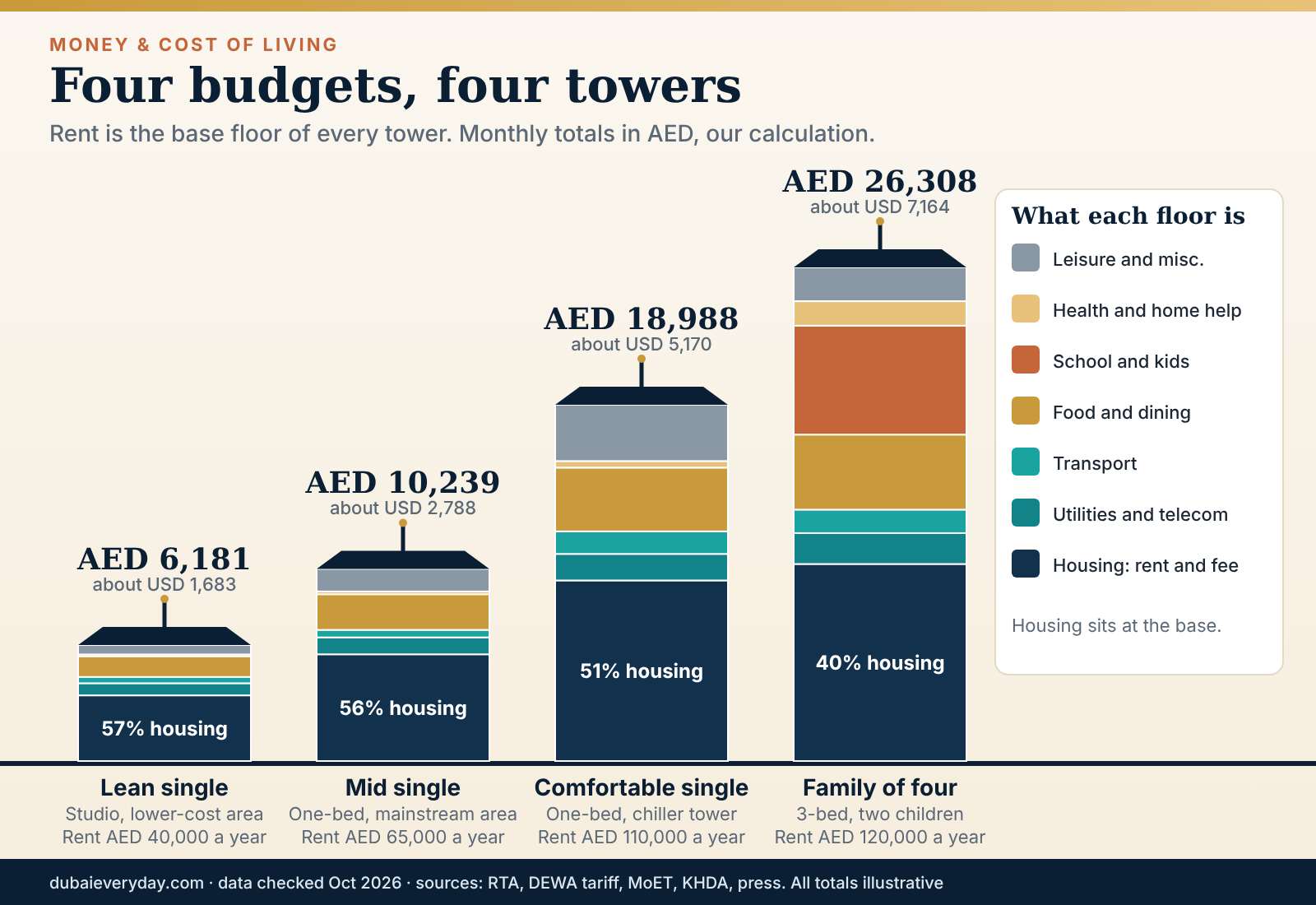
The cost of living Dubai residents face today runs from about AED 6,200 a month (roughly USD 1,700) for one person in a studio in a lower-cost area, to about AED 26,300 a month (roughly USD 7,200) for a family of four renting a three-bedroom home with two children in mid-priced private schools. In between, our model puts a mainstream one-bedroom life at about AED 10,200 a month and a comfortable, car-owning life near Dubai Marina at about AED 19,000.
Rent decides almost everything in any cost of living Dubai budget. It takes 50 to 57 per cent of the single-person budgets and 40 per cent of the family budget. School fees are the second lever for families, and they did not rise for 2026-27 because KHDA froze them.
Three things moved this autumn. Petrol rose about 16 per cent between September and October. Dubai’s headline inflation was 5.5 per cent in August. Yet apartment rents in the big towers are falling, so the useful move for most tenants is a renewal negotiation, not a panic. Everything below is research-based, dated and labelled: official figures where we could reach them, press or broker data where we could not.
This is a desk-research guide to the cost of living Dubai residents pay. DubaiEveryday.com has not rented the flats, paid the bills, queued at the school gate or bought the groceries described here, and nothing below is a personal anecdote.
Every number was read from a named source on 29 October 2026, or comes from arithmetic we show. Official sources first: the Dubai rent-increase decree, the Dubai Land Department Ejari page, the RTA Nol fares page, the Ministry of Economy and Tourism price platform and the UAE government taxation page.
Where an official page would not load for us (DEWA’s tariff page, the Dubai Taxi tariff, the school directory), we used press or broker figures and say so. Those items are flagged “secondary” and carry a confirm-before-you-commit note. Budget lines marked “allowance” are our assumptions, not market data. Nobody paid to be mentioned, and nothing here ranks providers. This is general information, not individual financial, legal or tax advice.
One boundary before the numbers. This page prices Dubai across household types. If you only need a line-by-line monthly plan and savings target for a single adult, the companion guide Monthly Budget for One Person in Dubai goes deeper on that one case. For the legal mechanics of leases, see Tenant Rights in Dubai. Here the job is simpler: what does the cost of living Dubai residents face look like in dirhams, where does each figure come from, and what moves it.
What changed in 2026: the cost of living Dubai residents are really facing
Any cost of living Dubai guide written in the spring is already out of date, because four inputs moved between May and October. We list them first so you can see which parts of the budget are drifting and which are fixed.
Fuel: a 16 per cent monthly jump
The UAE Fuel Price Committee set October 2026 prices at AED 4.40 per litre for Super 98, AED 4.28 for Special 95, AED 4.21 for E-Plus 91 and AED 4.80 for diesel. September’s were 3.80, 3.69, 3.61 and 4.30. Khaleej Times and Emirates 24|7 report the same figures. By our arithmetic that is +16.0 per cent for Special 95 in one month and +11.6 per cent for diesel.
For a driver burning 96 litres a month (1,200 km at 8 litres per 100 km, our assumption), the step costs about AED 57 more (AED 354 to AED 411). That is not ruinous. It matters because petrol is repriced monthly, and November’s prices are normally announced at the very end of October, so the number you budget today is a snapshot, not a promise.
Inflation: the cost of living Dubai index says 5.5 per cent
Dubai’s consumer price index rose 5.54 per cent year on year in August 2026, according to EnterpriseAM’s report on official data, after a peak of 5.7 per cent in June. The same report shows transport up 12.7 per cent (fuel and lubricants +31.3 per cent, passenger airfares +23.2 per cent), housing and utilities up 6.7 per cent, and food and beverages up 7.4 per cent. The National traced the transport surge to oil prices, which had risen sharply earlier in the year.
Emirates NBD Research lifted its year-end 2026 forecast to 5.6 per cent, from 2.9 per cent, and expects easing in 2027. That is a forecast, so treat it as one view. The practical reading: food and fuel costs are not flat this year, so a budget built on 2024 prices will be short.
Rents: the cost of living Dubai index says up, the market says down
This is the oddity in the data. The inflation index shows housing costs still rising, while Savills’ Q3 2026 data, reported by Khaleej Times, shows apartment rents down year on year in Dubai Marina (-12.8 per cent), Business Bay (-12.2), Jumeirah Village Circle (-10.4), Al Furjan (-7.5) and DIFC (-7.3), with International City almost flat (-0.4).
Our reading of the data: the index follows rents on every lease in force, including renewals that were set a year or two ago, while market reports follow what newly signed leases and listings are doing. The two should converge. Until they do, a tenant renewing a lease signed in the last boom has leverage, and a newcomer signing today has more choice than a year ago. The rent section below turns that into tactics.
Schools and tolls
Dubai’s Knowledge and Human Development Authority confirmed no increase in private school fees for 2026-27, announced through the Dubai Media Office on 22 May 2026. Schools may still charge for things outside tuition, which we cover later.
On the road, the Salik toll became AED 6.30 at peak and AED 4.20 off-peak from 1 June 2026 once 5 per cent VAT was added, per Gulf News and Khaleej Times reporting. If you want the wider picture of how Dubai’s seasons and prices interact, the Dubai Travel Guide covers the visitor side of the same city.
One crowd-sourced cost database we opened today still showed petrol at AED 3.04 a litre and a “last update” of October 2024. The real October 2026 price of Special 95 is AED 4.28. A stale cost of living Dubai average looks authoritative and quietly understates your costs by double digits. Every figure on this page carries a date; when a source gave none, we said so.
Four monthly budgets at a glance
A single “average cost of living Dubai” number is nearly useless, because the spread between households is the story. A lean tenant and a comfortable one live in the same city and differ by a factor of three. So the cost of living Dubai model below prices four households with explicit assumptions, and every line can be swapped for your own quote.
The four households
Lean single
Studio at AED 40,000 a year in a lower-cost community, public transport, cooking at home, no car. Rent sits just under the citywide studio median.
Mid single
One-bedroom at AED 65,000 a year in a mainstream area, metro plus occasional taxi, a mix of cooking and eating out. Close to the citywide one-bedroom median.
Comfortable single
One-bedroom at AED 110,000 a year in a Marina or Downtown-type tower with district cooling, one car, regular dining out and a premium gym.
Family of four
Three-bedroom townhouse or apartment at AED 120,000 a year, two children in mid-priced private schools at AED 30,000 each, one car, health cover for dependants.
These are not “typical” households. They are anchors for reasoning about the cost of living Dubai residents face. The rents come from Dubai Land Department contract data as summarised by two independent aggregators, plus broker price ranges, and the rent section explains where they disagree. The other lines mix official tariffs (DEWA slabs, Nol fares, Salik, fuel), official price monitoring (Ministry of Economy and Tourism staples), and clearly marked allowances.
The table
| Monthly line (AED) | Lean single | Mid single | Comfortable single | Family of four |
|---|---|---|---|---|
| Rent (annual rent / 12) | 3,333 | 5,417 | 9,167 | 10,000 |
| Municipality housing fee (5% of rent) | 167 | 271 | 458 | 500 |
| DEWA electricity and water | 260 | 385 | 185 | 870 |
| District cooling (chiller) | 0 | 0 | 500 | 0 |
| Home internet | 286 | 366 | 478 | 478 |
| Mobile | 100 | 150 | 250 | 300 |
| Transport | 335 | 400 | 1,200 | 1,250 |
| Groceries | 700 | 1,000 | 1,400 | 2,800 |
| Eating out and coffee | 400 | 900 | 2,000 | 1,200 |
| School fees (annual / 12) | 0 | 0 | 0 | 5,000 |
| Health: co-pays, top-ups, dependants | 100 | 150 | 350 | 1,000 |
| Fitness and leisure | 250 | 600 | 1,500 | 1,000 |
| Help at home | 0 | 0 | 0 | 310 |
| Children’s activities and childcare | 0 | 0 | 0 | 800 |
| Shopping and miscellaneous | 250 | 600 | 1,500 | 800 |
| Monthly total | 6,181 | 10,239 | 18,988 | 26,308 |
| Approx. USD at 3.6725 | 1,683 | 2,788 | 5,170 | 7,164 |
| Annual total | 74,172 | 122,868 | 227,856 | 315,696 |
| Rent plus housing fee as share of total | 57% | 56% | 51% | 40% |
All four totals are our calculation, summed from the rounded lines above. The AED/USD peg of 3.6725 is the long-standing official rate; we could not open the Central Bank’s own page today, so treat the USD column as a convenience conversion.
What the model includes, and what it leaves out
Included in this cost of living Dubai model: everything a resident pays most months. Excluded on purpose: savings, debt repayments, remittances to family, car purchase or finance, furniture, annual flights home, visa and Emirates ID renewals, tuition outside school fees, and any one-off such as moving house. Those are real costs, and several get their own treatment later, but folding them into a monthly average hides the moment they hit. The first-month cash needed to start a tenancy gets its own worked example in the scenarios section.
Two adjustments to make before you use any cost of living Dubai number. First, if your employer provides housing, a transport allowance or health cover, delete those lines. Second, if you are already in a lease, replace our rent with your actual rent, because rent is the line our model is most sensitive to. A AED 10,000 difference in annual rent moves the monthly total by about AED 875 once the 5 per cent housing fee is added.
Reading the cost of living Dubai table honestly
In this cost of living Dubai model, the housing share is the headline. For the two lower single-person budgets, rent plus the municipality fee takes more than half of monthly spend. That ratio falls as lifestyle spending grows, which is why the comfortable budget is three times the lean one while its rent is only 2.75 times higher. The family budget has the lowest rent share because school fees and a second layer of groceries and insurance sit on top.
Notice what is missing from the biggest swings: groceries, DEWA and mobile together never exceed about AED 4,000 even in the family case. The dominant levers are where you live, whether you own a car, and whether children are in fee-paying schools. Trimming streaming subscriptions while ignoring those three is a common framing error in budgeting advice, and it makes any cost of living Dubai plan look more flexible than it is.
If you are still deciding whether to relocate at all, pair this cost of living Dubai guide with the moving-to-Dubai guide, which covers visas, banking and school admission, and the relocation checklist for the order of tasks. For a view of how Downtown’s prices behave compared with cheaper districts, see the Downtown Dubai area guide and the Dubai Marina guide.
Rent: the biggest line in any cost of living Dubai budget
Rent is where a cost of living Dubai budget is won or lost, and it is also the line with the messiest data. Three different kinds of number circulate, and they answer different questions. Asking rents are what landlords hope for in listings. New-lease rents are what tenants just agreed. Contract medians from registered tenancies blend both with renewals. Before you quote any figure to a landlord, know which of the three it is.
What Dubai contracts actually say
The most useful public anchor is the median rent on registered Ejari contracts, which reflects what people pay rather than what they are asked.
One aggregator working from Dubai Land Department records, reviewed in September 2026, puts the citywide apartment medians at AED 41,000 a year for a studio, AED 57,000 for a one-bedroom, AED 80,000 for a two-bedroom and AED 110,000 for a three-bedroom (houserent.ae, June 2026 data). It also shows the range of community medians: studios from about AED 24,000 to AED 95,000, one-bedrooms from AED 35,000 to AED 150,000.
A second aggregator, DataHabibi, using the trailing twelve months of contracts to July 2026, gives a citywide studio median of AED 44,100 and a one-bedroom median of AED 68,000. The one-bedroom figures differ by about 19 per cent.
The likely causes are different windows and different ways of taking a median (a median of community medians versus a median of all contracts), but neither page explains the gap, so we use both as a range: roughly AED 57,000 to 68,000 for a citywide one-bedroom. Our cost of living Dubai model uses those medians as anchors, not as quotes.
DataHabibi’s studio medians by community show how much the neighbourhood matters. International City AED 30,000. Dubai Production City AED 36,000. Dubai Silicon Oasis AED 40,000. Discovery Gardens AED 41,000. Jumeirah Village Circle AED 50,000. Jumeirah Lakes Towers AED 60,000. Business Bay AED 70,000. Same unit type, a spread of more than 2.3 times.
Method note: why we do not print an area league table. The Dubai Land Department publishes rental data, but we could not reach a complete official area-by-bedroom table today. Rather than build a ranking from a patchwork of broker pages, we show the two contract-based medians above and a dated set of price bands below. Use them to bracket a search, then check live listings and ask for the Ejari history of comparable units.
Price bands by area, with an expiry date
For one-bedroom apartments, Real Estate Club Dubai’s rent map, published on 1 April 2026 and blending Ejari registrations, REIDIN data and Bayut asking prices, gave these annual ranges: Downtown Dubai AED 110,000 to 160,000, Palm Jumeirah AED 100,000 to 150,000, Dubai Marina AED 100,000 to 130,000, Business Bay AED 70,000 to 100,000, JLT AED 65,000 to 85,000, JVC and Al Furjan AED 50,000 to 65,000, Mirdif AED 42,000 to 55,000, and Silicon Oasis AED 40,000 to 50,000 (source).
That page carries an expiry date, because it predates the third-quarter falls. Our reading: treat the Marina, Business Bay, JVC and Downtown ranges as ceilings, not midpoints. The same source gave villa and townhouse ranges for three-bedroom homes, for example Mirdif AED 100,000 to 130,000, Al Furjan AED 120,000 to 150,000, DAMAC Hills AED 130,000 to 170,000, Arabian Ranches AED 180,000 to 230,000 and Dubai Hills Estate AED 200,000 to 260,000. Our family budget uses AED 120,000, which sits in the lower half of that spread.
If you are choosing between building types, Renting an Apartment in Dubai covers amenities, parking and chiller questions, while Renting a Villa in Dubai covers maintenance and community fees that sit outside the rent. For the island premium, the Palm Jumeirah area guide explains what the extra money buys.
Which way are rents moving?
Sources agree on direction and disagree on size. Savills’ Q3 2026 apartment figures (Khaleej Times) show year-on-year falls of 12.8 per cent in Dubai Marina, 12.2 per cent in Business Bay and 10.4 per cent in JVC, and villa falls of 15 per cent in Arabian Ranches 3 and 13.4 per cent in Damac Lagoons. The same report counted 181,900 rental transactions in the quarter, with 44 per cent of them new leases, and described the market as rebalancing rather than reversing.
Other trackers cut the same market differently. betterhomes reported median apartment rents down 3.8 per cent and villas down 2.3 per cent between June and September, while one villa community, Jumeirah Islands, was up 29.1 per cent year on year. Property Finder’s basket of ten communities, reported by Khaleej Times, showed median asking rent falling from about AED 135,000 in December 2025 to AED 100,000 in June 2026, then edging back to AED 105,000 in September.
Put together, the direction is clear and the floor is not. Apartments in towers built in volume are softening. Scarce villa communities can still rise. If you are planning a cost of living Dubai budget for twelve months ahead, assume flat-to-slightly-lower apartment rents, and do not extrapolate a double-digit fall.
The renewal rules that cap your increase
The most valuable fact in the cost of living Dubai tenants face is not a price; it is a rule. Under Decree No. 43 of 2013, a landlord’s rent increase at renewal depends on how far the current rent sits below the average rent for similar units, as determined by the Real Estate Regulatory Agency’s rent index. The bands, from the decree text, are simple.
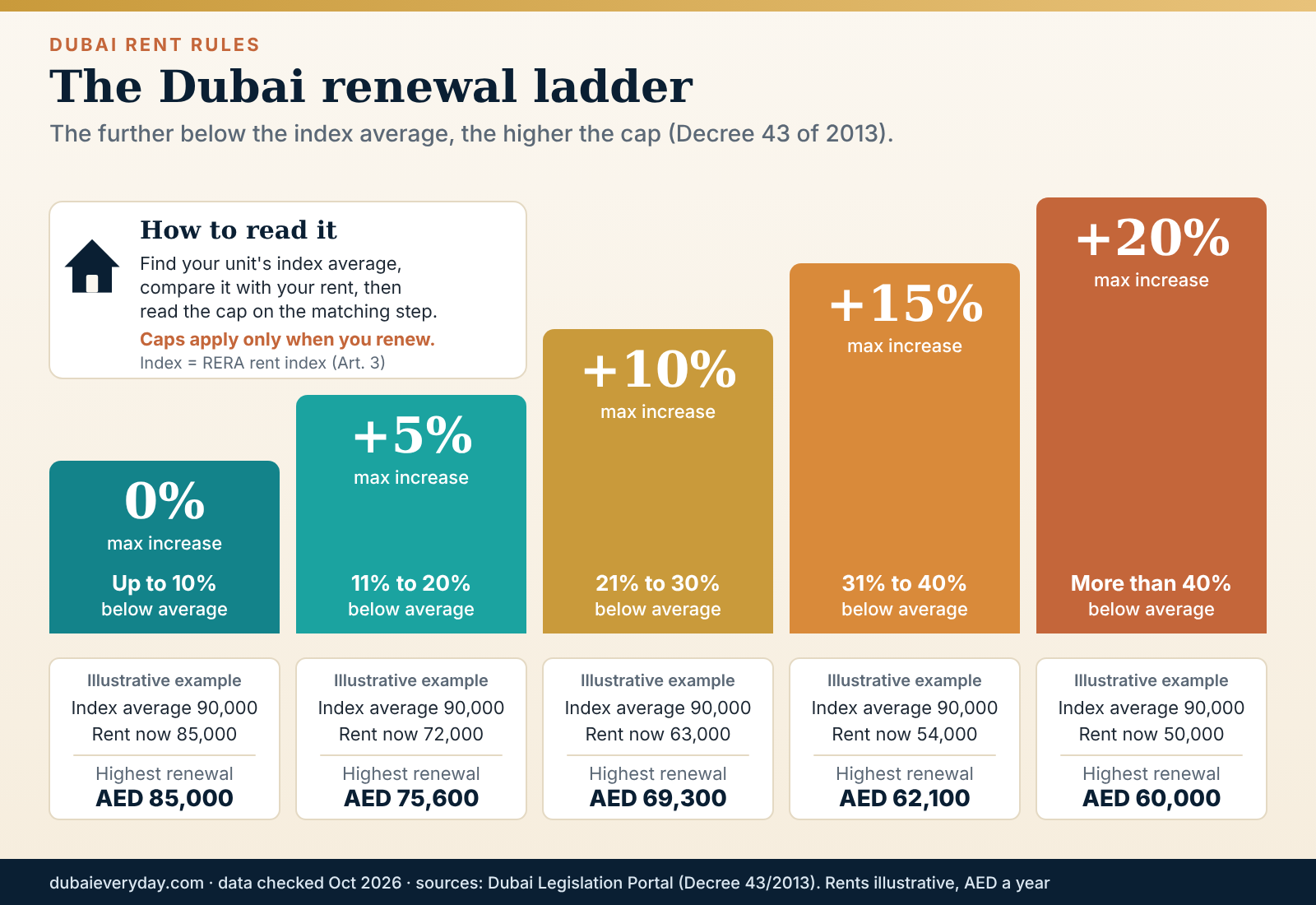
Rent up to 10 per cent below the index average: no increase. 11 to 20 per cent below: up to 5 per cent. 21 to 30 per cent below: up to 10 per cent. 31 to 40 per cent below: up to 15 per cent. More than 40 per cent below: up to 20 per cent.
Illustrative example, not a quote: if the index average for your unit is AED 90,000, a tenant paying AED 72,000 (20 per cent below) can face at most AED 75,600; one paying AED 63,000 (30 per cent below) at most AED 69,300; one paying AED 54,000 (40 per cent below) at most AED 62,100; one paying AED 50,000 (about 44 per cent below) at most AED 60,000; and one paying AED 85,000 can face no increase.
Two procedural points from sources read for this guide.
Landlords are expected to give at least 90 days’ written notice of changed terms before the lease ends, and a Gulf News report on the Smart Rental Index quotes that requirement; the full legal route is in the tenant-rights guide. And since January 2025 the Dubai Land Department’s Smart Rental Index rates buildings on technical and location criteria; its announcement does not say where tenants can look up a building’s rating, so ask the landlord to show the calculation and verify with the Dubai Land Department on 800 4488 if the numbers look off.
When moving beats staying
Moving has a price that most cost of living Dubai calculators leave out, and it is larger than renters expect.
Our calculation for a AED 65,000 flat: agency commission of AED 5,000 (the customary 5 per cent with a AED 5,000 floor, which is market custom rather than a legal rate), movers of AED 1,000 to 1,500 for a one-bedroom, Ejari at AED 177.75, DEWA activation of about AED 130 and a deep clean of AED 200 to 600. Total: AED 6,508 to 7,408, or 10 to 11 per cent of the annual rent. The refundable deposits are extra.
So a rent cut only pays if it exceeds about AED 6,500 to 7,400 in year one, before counting your time. If a comparable flat is AED 10,000 cheaper, move. If it is AED 4,000 cheaper, negotiate harder where you are.
The practical sequence for most tenants: check the index-based cap, gather three comparable listings or recent contracts, then ask for a flat renewal citing the market. In a falling-rent year that is a normal request, not a cheeky one. Investors reading the other side of the same data will find it in Rental Yield in Dubai.
Put plainly, the rent line in a cost of living Dubai plan should be a range with a date on it. Bracket your area with the contract medians, discount the early-2026 bands for the third-quarter falls, treat the renewal cap as your protection, and re-run the number at every renewal notice.
Shared housing and the lean end of the market
The cheapest rents in any city are rooms and partitioned units, and Dubai changed the rules this year. Law No. 4 of 2026 on shared housing, announced by the Dubai Media Office on 11 March 2026 and reported by Gulf News as taking effect on 26 August 2026, restricts who may let shared accommodation and bars tenants from subletting. Fines run from AED 500 up to AED 500,000, doubling for repeat breaches.
The cost of living Dubai implication is practical. A lean budget built on a sublet room or a partitioned flat carries legal risk that a studio lease does not, and the supply of such rooms may shrink or reprice. Our lean scenario therefore prices a registered studio at AED 40,000, not a bed-space. If you are weighing shared living, ask for the permit before paying anything, and read the resident legal basics for where to verify rules.
The costs that sit around the rent
The advertised rent is the smallest honest number in the cost of living Dubai tenants face. Around it sit a municipality fee, a deposit, an agent’s commission, registration charges and utility deposits. Some are one-off, some recurring, some refundable. The mistake is to treat all of them as “rent” or none of them as “cost”. This section separates them, because the difference between a refundable deposit and a sunk fee is the difference between a cash-flow problem and a real expense.
The municipality housing fee
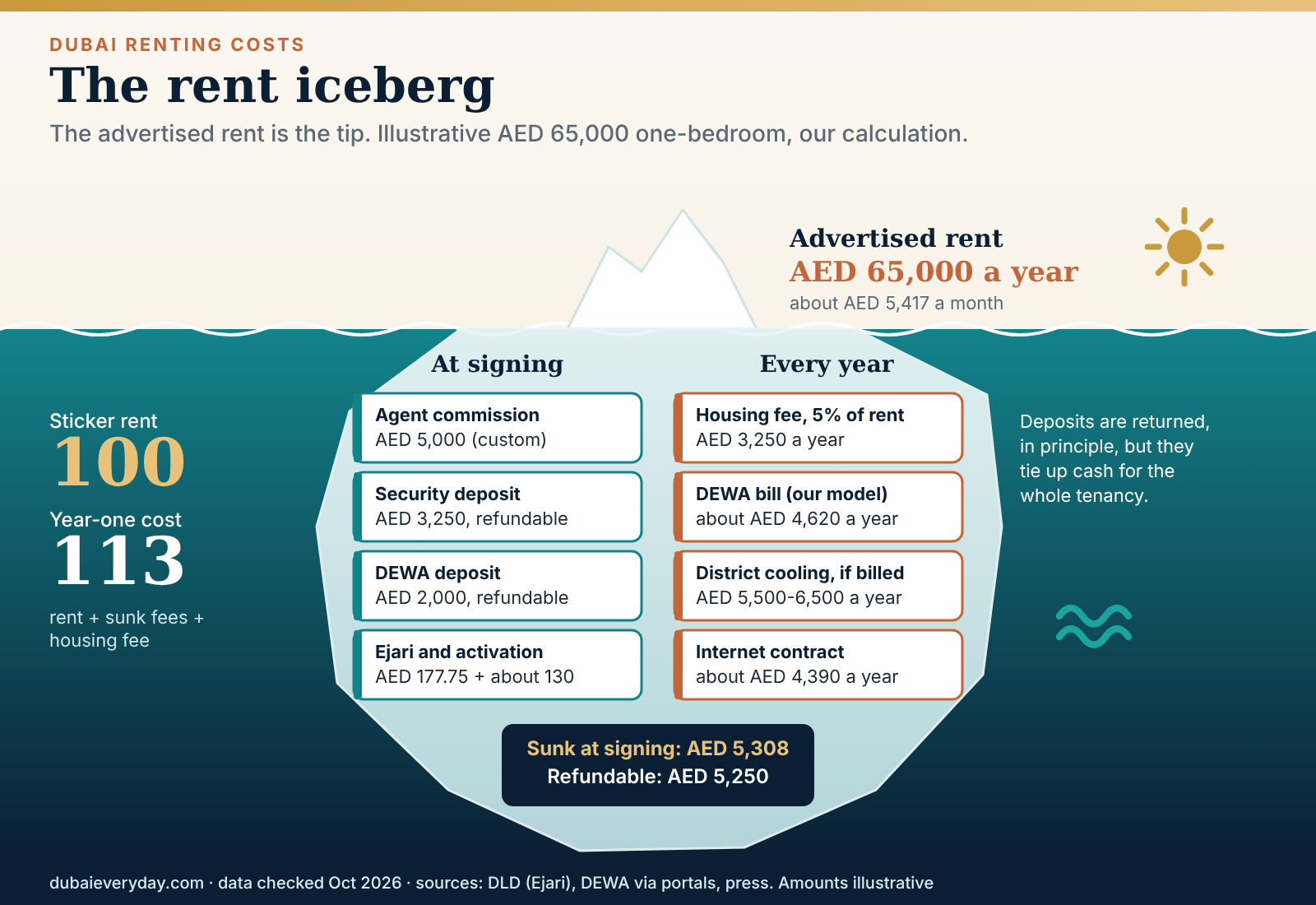
Expatriate tenants in Dubai are charged a municipality housing fee of 5 per cent of annual rent. It is collected through the DEWA bill in twelve monthly instalments, according to Bayut’s explainer (updated September 2026) and Property Finder’s DEWA guide. On a AED 65,000 lease that is AED 3,250 a year, or AED 271 a month, and it appears on the utility bill rather than in the lease. Sources differ on edge cases, such as who pays when an owner occupies the unit, so check your first bill.
Why this matters for comparison shopping: two flats at the same advertised rent have the same fee, but a flat advertised at AED 70,000 carries AED 250 a year more in fees than one at AED 65,000. It is small, and it scales with rent. Every rent negotiation is worth 5 per cent more than it looks in any cost of living Dubai comparison.
Commission, deposit and registration
Four items are charged at or before signing. The security deposit is customarily 5 per cent of annual rent for unfurnished homes and 10 per cent for furnished ones. The agent’s commission is customarily 5 per cent with a minimum of about AED 5,000, per Gulf News’ list of extra costs (updated 22 October 2026). Both are market practice that can be negotiated, not statutory rates. Ejari registration of the tenancy costs AED 177.75 online and AED 220 at a trustee centre, per the Dubai Land Department.
The fourth is the DEWA connection. A deposit of AED 2,000 for an apartment or AED 4,000 for a villa, plus activation fees of about AED 130, is reported by Gulf News and Bayut citing DEWA, though we could not open DEWA’s own pages. The deposit comes back when you close the account. The full sequence of what to ask for and when sits in Renting in Dubai and, for the utility side, the DEWA move-in guide.
A AED 3,250 deposit and a AED 2,000 DEWA deposit on a AED 65,000 flat tie up AED 5,250. They are returned, in principle, at the end of the tenancy. A deposit dispute can take months and the money earns nothing meanwhile. Budget it as a loan to your landlord and utility, not as spending, but do not budget it as available cash either.
Other recurring housing costs people forget
Beyond the fee and the bills, several recurring items depend on the property. A second car may need an extra paid parking space in some buildings.
Villas and townhouses often bring garden watering, pool upkeep and community charges, which differ by community and are set out in the villa-renting guide. Piped gas in some buildings is billed separately from DEWA, and Gulf News lists a connection cost of roughly AED 600 to 800 where it applies. We have not priced these in the model because no official table exists; we flag them because they are where a “cheap” listing turns expensive.
Cooling is the biggest of the hidden items in a Dubai summer, and it gets its own treatment next. Pets also change a budget, from deposits to registration to vet bills; the pet-ownership guide lists the categories. If you are comparing a few buildings, ask each agent four questions: Is cooling included? Is parking included? What is the cheque schedule? Who pays commission? The answers can swing the true annual cost by AED 6,000 or more on a one-bedroom.
Add the items up and the cost of living Dubai tenants carry in year one is the annual rent plus about 13 per cent of it in sunk costs. On the AED 65,000 flat that is AED 5,308 at signing plus AED 3,250 of housing fee across the year, with a further AED 5,250 (8 per cent of rent) tied up in refundable deposits. Our calculation, before movers, cleaning or furniture.
Utilities, cooling, internet and mobile
Utilities are a smaller part of the cost of living Dubai residents face than rent, but they swing with the seasons. They are inexpensive per unit and punishing in summer. Air conditioning drives almost everything, which is why a studio’s modelled bill runs from about AED 140 in a mild month to about AED 310 in a hot one. The numbers below are our modelled bills from published tariffs, with usage assumptions that are ours, not meter data.
DEWA: the tariff and four worked bills
Residential electricity is billed in slabs: 23 fils per kWh for the first 2,000 kWh a month, 28 fils for 2,001 to 4,000, 32 fils for 4,001 to 6,000 and 38 fils above that. A fuel surcharge of 6 fils per kWh is added. Water for residents is AED 7.70 per cubic metre up to 27 m³, AED 8.80 up to 54 m³ and AED 10.12 above.
Those water figures are the same as the older 3.5, 4.0 and 4.6 fils per imperial gallon, and DEWA moved billing to cubic metres in March 2025. VAT of 5 per cent is added, along with meter charges of about AED 5 to 35 and a sewerage element.
Sourcing: DEWA’s own tariff pages did not load for us today. The slab figures come from two property portals that agree to the fil (Property Finder, February 2026 and Dubizzle, modified September 2026). Confirm in DEWA’s calculator before treating them as final.
Studio, 500 kWh and 10 m³
Electricity AED 115.00, fuel surcharge 30.00, water 77.00. Subtotal 222.00, VAT 11.10, bill about AED 233. With AED 30 allowed for meter and other charges: about AED 260 a month.
One-bedroom, 850 kWh and 12 m³
Electricity AED 195.50, fuel 51.00, water 92.40. Subtotal 338.90, VAT 16.95, bill about AED 356. With the allowance: about AED 385 a month.
Chiller-paid tower, 300 kWh and 8 m³
Electricity AED 69.00, fuel 18.00, water 61.60. Subtotal 148.60, VAT 7.43, bill about AED 156. With the allowance: about AED 185, plus district cooling below.
Townhouse, 1,800 kWh and 35 m³
Electricity AED 414.00, fuel 108.00, water 278.30. Subtotal 800.30, VAT 40.02, bill about AED 840. With the allowance: about AED 870 a month.
We checked our slab arithmetic against Property Finder’s worked case of 3,000 kWh, where the electricity charge is AED 740 (2,000 kWh at 23 fils plus 1,000 kWh at 28 fils); our method reproduces it. The takeaway is structural.
Because the first 2,000 kWh is the cheapest band, a flat rarely leaves it, so bills scale almost linearly with usage. The slab penalty is mainly a villa problem. Turning the thermostat up two degrees matters more in a villa than in a studio, and a leaky unit costs money in every band.
District cooling: the bill that is not on DEWA
Many towers in Marina, JBR, JLT, Business Bay, DIFC and Discovery Gardens use district cooling, billed by a provider such as Empower, not by DEWA. A June 2026 broker explainer on chiller costs gives Empower’s tariff as AED 0.568 per refrigeration-ton hour plus a capacity charge of AED 750 per ton per year, billed monthly, with a refundable deposit of AED 2,000 for an apartment and AED 3,000 for a villa.
It models a one-bedroom at roughly AED 5,500 to 6,500 a year and a two-bedroom at AED 8,000 to 10,500 (source).
That is secondary data, built from published rates and stated usage assumptions, so treat it as a planning range and ask the building or provider for the real tariff. The decision rule is easy though. A one-bedroom in a district-cooled tower with a rent AED 6,000 below a chiller-free alternative may be a wash. Our comfortable budget uses AED 500 a month. For the sign-up sequence for cooling, internet and gas, see the home setup guide.
Home internet and mobile
Prices here are from a broker’s compilation of operator tariffs, last updated 21 September 2026 (Bayut); both operators’ own pages were closed to automated reading. On du, home plans at 1 Gbps ran AED 272 (Starter), AED 349 (Basic), AED 455 (Advanced) and AED 905 (Ultimate) a month. On e&, a 250 Mbps Unlimited Starter was AED 389 and a 500 Mbps Ultra Starter AED 299. All required 24-month contracts, with prices excluding 5 per cent VAT.
Add VAT and the three plans in our model come to AED 286, AED 366 and AED 478. The trap is the contract term. A 24-month plan on a 12-month lease creates a tail you must either move or pay out; the broker notes that early cancellation fees may apply and that moving a connection costs AED 100 (du) or AED 150 (e&). Compare in the home internet guide.
Mobile plans are cheaper and more negotiable. A July 2026 broker guide puts entry postpaid plans at AED 100 to 150 a month and mid-tier at AED 200 to 350, with prepaid data bundles from about AED 50 and resident SIM packs around AED 50 to 60. Those are ranges from one non-official source. Our four budgets use AED 100, 150, 250 and 300 (for two phones). See the internet and mobile guide for eSIM and digital-ID questions.
For a cost of living Dubai plan, model this layer as three numbers: the DEWA bill, any cooling charge, and the telecom contracts. Across our four budgets they come to AED 646 (lean), AED 901 (mid), AED 1,413 (comfortable) and AED 1,648 (family) a month, a far narrower spread than rent.
Food: groceries, eating out and the price spread
Food is the part of the cost of living Dubai residents can measure with official data, and almost nobody uses it. The UAE Ministry of Economy and Tourism runs an Essential Goods Prices Platform that compares shelf prices of basic staples across thirteen retail outlets, including Carrefour, LuLu, Spinneys, Union Coop, Choithrams, Nesto and several cooperatives. It is the nearest thing to a neutral price list that exists for a Dubai kitchen, and it is the base for our grocery lines.
What staples actually cost
The ministry’s August 2026 monitoring table, published on its site, gives average prices in AED: basmati rice 16.62 per kilo, flour 7.76 per kilo, fresh full-fat milk 9.46 per litre, yogurt 1.97 for 170 grams, canola oil 15.86 per litre, a tray of 30 brown eggs 23.05, a fresh whole chicken 22.97 per kilo and white sugar 8.75 per kilo.
Our calculation turns that into a one-adult monthly staples basket: 2 kilos of rice (33.24), a 2-kilo bag of flour (12.26), 8 litres of milk (75.68), one tray of eggs (23.05), 4 kilos of chicken (91.88), a 1.5-litre bottle of canola oil (23.97), a kilo of sugar (8.75) and 20 yogurts (39.40). Total: AED 308.23. That is the floor, not the budget. It excludes vegetables, fruit, fish, red meat, snacks, cleaning products, coffee and everything branded or imported.
Why show a floor in a cost of living Dubai guide? Because it tells you where the money actually goes. Staples are a small slice of a grocery bill. Our allowances of AED 700 (lean), 1,000 (mid), 1,400 (comfortable) and 2,800 (family of four) assume the other two-thirds is fresh produce, protein, household items and convenience. Those allowances are our assumptions. The ministry does not publish a full-basket price.
The spread between stores is the hidden saving
The platform’s page, updated on 28 October 2026, lists the cheapest and most expensive listed price per unit in each category. Cooking oil ranged from AED 5.10 to 18.67. Rice from AED 4.20 to 16.00. Chicken from AED 11.31 to 21.33 per kilo. Sugar AED 2.35 to 5.25. Bread AED 4.98 to 9.17. Dairy AED 3.48 to 5.99. Wheat flour AED 6.00 to 7.62. Eggs AED 0.23 to 0.75 each.
Read those with care. The platform does not normalise for brand, pack size or product form, and the page itself shows some empty fields, so a 4x gap on rice compares a bulk store brand with a premium specialty rice, not like with like.
Our reading of the data: even after discounting that, the gap between outlets for identical staples is wide enough that where you shop matters more than which week you shop. The platform lets you build a “My List” and compare totals, which is the right way to use it. That spread is the cheapest lever in the cost of living Dubai grocery line, though it is far smaller than rent.
A caution on the lowest prices quoted in the press: Gulf News’ 23 October report of the cheapest listings names cooperative outlets in Sharjah and Umm Al Quwain among the winners. Those bargains are not necessarily available to a Dubai resident without a drive. Check which outlets deliver to your community.
In short, the cost of living Dubai households pay at the till is set less by staple prices than by store choice, brand habits and how often a week is delivered rather than cooked. For store-by-store positioning, see the Dubai supermarket guide and the Carrefour guide.
Eating out: an allowance, not a measurement
There is no official restaurant price index we could find, so the eating-out lines are allowances. The only way to anchor them honestly is arithmetic. If an inexpensive restaurant meal is around AED 40 (a figure from a crowd-sourced database whose last update was October 2024, so treat it as an order of magnitude), then AED 400 a month is ten meals, AED 900 is about 22, one for every working day, and AED 2,000 is about 50 or a mix of cheap lunches and AED 150-plus dinners.
The honest message: dining out is the most elastic line in a cost of living Dubai budget. A household can spend AED 400 or AED 4,000 and live the same life with a different calendar. Delivery apps add fees and prices that vary by platform; we did not verify them. The restaurant and cafe guides, Best Restaurants in Dubai and Best Cafes in Dubai, cover value positioning; the specialty-coffee guide covers the cup-a-day habit that adds up faster than most people estimate.
One cheap discipline. Write down what you spend on food delivery for one month before setting your eating-out line. People who track it often find the figure is two or three times what they assumed, and it is the easiest category to reduce without changing where you live or work.
Transport: metro, taxi, car and the commute decision
In the cost of living Dubai residents face, transport is where the city splits people into two economies. One runs on a AED 3 metro tap. The other runs on fuel, tolls, parking and insurance. The monthly gap can be AED 1,000 or more, and the right choice depends on one question: how much of your life sits within walking distance of a station?
Metro, bus and tram: the fare maths
RTA’s Nol fare table, read on 29 October 2026 from the RTA site, gives Silver-card single trips at AED 3 within one zone, AED 5 across two adjacent zones and AED 7.50 across more than two. Gold-card fares are double on metro and tram. A transfer allowance of up to three transfers and 180 minutes applies, and children aged five and under travel free. The page mentions no daily cap.
Passes for registered Silver cards: 7 days AED 50 / 80 / 110 (one / two / all zones), 30 days AED 140 / 230 / 350, 90 days AED 330 / 550 / 830, and 365 days AED 1,060 / 1,770 / 2,670. Anonymous cards can only buy the 7-day pass.
Our calculation for a standard commute of 22 working days, 44 trips. At AED 5 per two-zone trip you spend AED 220; the 30-day two-zone pass costs AED 230, so it is slightly dearer unless you take more than 46 trips. All-zone: 44 trips at AED 7.50 is AED 330 against a AED 350 pass, with a break-even near 47 trips. The 30-day pass only wins if you ride a lot beyond work.
The annual pass is the real prize. A 365-day two-zone pass at AED 1,770 averages AED 147.50 a month; twelve 30-day passes would cost AED 2,760, so the saving is AED 990 a year, or 36 per cent. For all zones, AED 2,670 against AED 4,200 saves AED 1,530. The catch: you need a registered card, a stable zone pattern for a year and enough confidence in your job and address. For route details, start with the Dubai Metro guide.
Taxi: sources disagree, so plan with a range
Taxi tariffs are the least reliable numbers in this guide. Dubai Taxi’s FAQ lists a daytime base fare of AED 11 and says trip prices can be estimated in its app. Other pages of the operator quote AED 2.45 per kilometre with minimum fares of AED 12 for street hail and AED 13 for app bookings.
Press reports of the November 2025 tariff changes cite a street-hail flag-fall of about AED 5 by day and AED 5.50 by night, a per-kilometre rate between roughly AED 2.14 and 2.33, and an app booking fee of AED 4 to 7.50. The airport start fare at Dubai International is AED 25, per Dubai Airports.
For planning only, our calculation for a 12 km city ride is AED 34 to 42 depending on which tariff and booking route applies, before Salik tolls. We use AED 35 as the working figure. A daily taxi commute of 44 rides at AED 35 is AED 1,540 a month, nearly seven times the AED 230 pass. Taxis are a tool for the awkward trip, not a commuting plan.
Car: what a month of driving costs
For a driver covering 1,200 km a month at 8 litres per 100 km, our running-cost model has five parts. Fuel: 96 litres at the October Special 95 price of AED 4.28 is AED 411. Tolls: Salik at AED 6.30 peak and AED 4.20 off-peak, so 20 peak and 20 off-peak crossings cost AED 210.
Parking: an allowance of AED 150, which assumes free parking at work. Insurance: AED 230 a month. Maintenance: an allowance of AED 100. Total: AED 1,101, rounded to AED 1,200 in the budgets to cover occasional taxis.
Check the weak points. Parkin’s public tariff is AED 4 per hour in standard zones and AED 6 in premium zones during peak periods, Monday to Saturday from 8am to 10pm, with free parking on Sundays and public holidays, per Emirates 24|7 (18 October 2026).
If you park on-street for eight hours on 22 workdays at AED 4, that is AED 704 a month, which is nearly five times our allowance. Insurance rests on a February 2026 broker guide: third-party AED 1,200 to 2,000 a year, comprehensive AED 2,000 to 3,500, roughly 1.5 to 3 per cent of the car’s value. The premium depends heavily on driver age and claims history.
What is excluded from cost of living Dubai car figures matters more. The model has no car purchase, finance or depreciation. A monthly car payment of AED 1,500 wipes out the apparent saving over taxis (AED 1,540 against AED 1,101 plus the payment) and makes the metro pass look like a rounding error. Registration and renewal fees are also excluded because we did not verify them.
If you do not yet hold a UAE licence, the RTA’s fixed fees for an adult licence add up to about AED 670 (traffic file 200, learning permit 100, handbook 50, knowledge and innovation fees 20, issuance 300, per RTA’s new-licence service page), with institute packages running from roughly AED 3,200 to 4,600 for ten to twenty hours of normal-tier training, one institute’s published figures. The driving licence guide and the licence-exchange guide hold the detail.
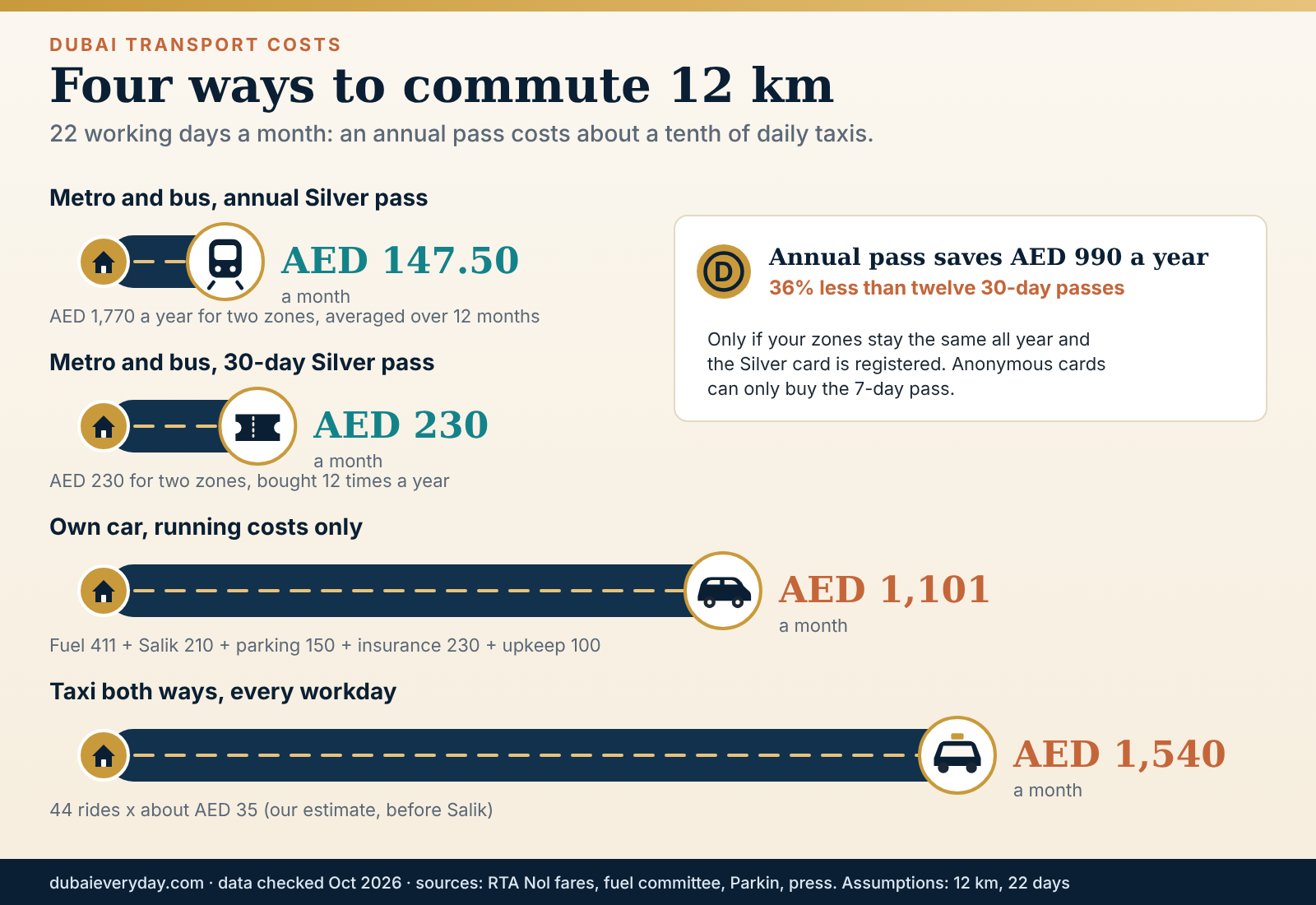
A decision rule for the cost of living Dubai commute
Our decision rule, not an official guideline: if both your home and your workplace are within 10 to 15 minutes’ walk of a station, skip the car and buy the annual pass. If one end is not, price a rental car or ride-hailing for a month before buying a vehicle; the cheap car rental guide shows how deposits and extras change the headline daily rate.
If you will drive daily, the monthly running cost is real but the purchase decision is a separate calculation. The point of the commute lanes is that this one choice moves the cost of living Dubai commuters bear by AED 900 to 1,400 a month, much more than any grocery trick.
Insurance and healthcare costs
Insurance is the part of the cost of living Dubai residents face that is partly compulsory and partly a choice, and the line between the two decides who pays. This is a YMYL topic, so a scope note first: what follows is general information drawn from press and broker sources, because several regulator pages (including the Dubai Health Authority’s) would not load for us today. It is not individual insurance or medical advice, and a licensed adviser should check any policy before you buy.
Health cover: who pays, and for whom
Under Dubai’s health insurance law, employers must provide and pay for at least a basic Essential Benefits Plan for employees, including those in free zones, and may not deduct the premium from salary. Gulf News, updated on 14 July 2026, gives the premium for that basic plan as typically AED 550 to 650 a year (source). The same article says sponsors must insure dependants such as a spouse or children if they are not covered by the employer’s plan.
That is the critical rule for any cost of living Dubai budget that includes a family. The employee is usually covered; the family usually is not. For a single person on an employer contract, health insurance is close to zero in the monthly budget, apart from co-pays and any top-up you choose.
For a family, it is a real line. A broker comparison updated on 9 October 2026 (PolicyBazaar) shows Dubai premiums per year of AED 725 to 5,945 for basic plans, AED 1,300 to 6,600 for semi-comprehensive, AED 3,000 to 12,000 for comprehensive, and AED 6,200 to 28,000 for a family of four.
Treat those as the shape of the market, not a quote. The page mixes emirates in places and contains an internal inconsistency in its comprehensive range, which we noted when reading it. It also says renewals typically rise 5 to 10 per cent a year and that moving into a higher age band can add 20 to 25 per cent.
Our family line uses AED 800 a month for dependants (AED 9,600 a year, inside the broker range) plus AED 200 for co-pays. A family with older children, pre-existing conditions or a preference for a wider hospital network will land higher.
The founder and freelancer gap. The employer-pays assumption disappears if you run your own company or work freelance. Business owners pay their own premium and, if they hire staff, take on the employer’s obligation. If that is your situation, price a plan before you finalise any budget, and read the business setup guide for ongoing costs that sit beside living costs.
What the premium does not cover
Premium is not total health cost. Basic plans commonly carry co-payments, annual caps, restricted networks and exclusions such as dental and optical care; we could not verify the current co-pay schedule from a regulator page, so ask for the schedule of benefits before signing.
Our single-person lines of AED 100 to 350 are allowances for co-pays and top-ups, not clinic prices. For the structure of cover, networks and exclusions, the health insurance guide and the resident cover guide go further; the wider insurance overview covers car, home, life and travel.
Dental work is the cost people most often learn about too late, because it is rarely covered at basic level. See the dentist guide for how clinics price treatment and what to verify. For hospital choice and emergency access, see the Dubai healthcare guide and the hospital comparison guide. None of those pages gives clinical advice, and neither does this one.
For budgeting, split health into three lines: the employer-paid premium (zero for you), dependants’ premiums, and out-of-pocket costs. That structure keeps the health line of a cost of living Dubai budget honest, and it shows quickly whether a job offer’s package covers the people who depend on it.
Car, home and the rest
Car insurance is covered in the transport section: third-party cover is mandatory and ranges roughly AED 1,200 to 2,000 a year, comprehensive AED 2,000 to 3,500, per a February 2026 broker guide. Home contents or renters’ cover is optional for most tenants; we found no verified price, so the model leaves it out.
Landlords insure the building, not your belongings. If your inventory includes a laptop, a bike and a wardrobe of work clothes, the premium relative to replacement cost is a reasonable question to put to a licensed insurer.
Schooling and childcare
School fees are the line that turns a comfortable cost of living Dubai budget into a tight one, and the one with the clearest official news this year.
On 22 May 2026, KHDA confirmed that Dubai’s private schools will not increase fees for the 2026-27 academic year, announced under the directives of Sheikh Hamdan bin Mohammed bin Rashid Al Maktoum through the Dubai Media Office. It followed a second economic incentives package of AED 1.5 billion that includes licence-fee relief for schools and early childhood centres. For context, Gulf News reported an Education Cost Index of 2.35 per cent for the prior year, 2025-26.
Fee levels by tier
The freeze is at the tuition level. It does not tell you the level. Khaleej Times, reporting on KHDA’s Outstanding-rated schools for 2026-27, put annual fees across 23 schools at AED 29,488 (a preschool place at the lowest-priced school) up to AED 111,799 (Year 13 at the highest).
By curriculum, the 15 British schools ran AED 43,084 to 111,799, five IB schools AED 44,616 to 89,889, one American school AED 66,185 to 93,300, one Indian school AED 38,246 to 73,876 and one French school AED 29,488 to 62,363 (source). Those are the newspaper’s figures, not a KHDA table, and fees vary by grade.
Lower tiers are far cheaper. Gulf News’ August 2026 list of eleven schools rated Very Good shows annual fees from AED 7,389 for a first-year place at the cheapest Indian-curriculum school on the list to AED 41,513 for the top grade at the dearest, with British-curriculum entries between AED 14,950 and AED 37,124 (source).
Those are examples of the range, not recommendations. The two lists make the point that a rating tier does not fix a price: a Very Good school can cost a quarter of an Outstanding one.
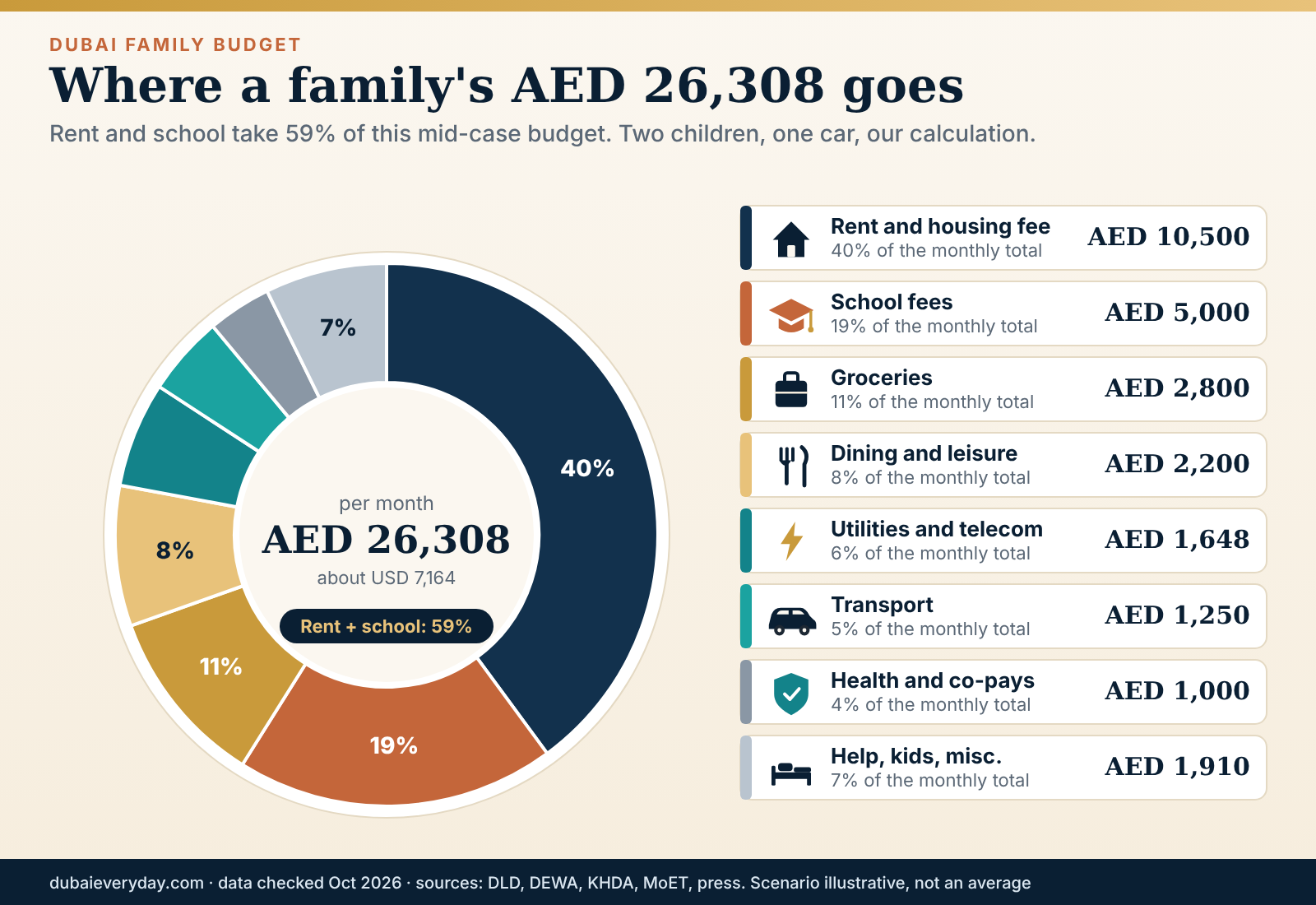
The family math, and a worse case
Our family model puts two children at AED 30,000 each, which is AED 60,000 a year or AED 5,000 a month. That is 19 per cent of the AED 26,308 monthly total. Move the same family to two Outstanding-rated British schools at AED 70,000 each and school fees become AED 11,667 a month; the total climbs to AED 32,975 (USD 8,979), and school fees alone are bigger than the rent.
These swings explain why the cost of living Dubai families carry varies so widely between households. Move them to two Indian-curriculum Very Good schools at AED 15,000 each and the monthly total drops by AED 2,500 to AED 23,808.
One caution on rating data: Khaleej Times noted that KHDA kept existing ratings for 2025-26 while pausing most standard inspections, so a rating you see may be older than it looks. The KHDA ratings guide explains what the labels do and do not tell you; the Dubai schools guide covers curricula, admissions and location trade-offs.
What sits on top of tuition
Tuition is not the full bill in the cost of living Dubai parents face. School buses, uniforms, books, trips, exam fees, registration charges and re-enrolment deposits are all typical extras, and we have no verified Dubai-wide price for them, which is why the family model carries an AED 800 allowance for children’s activities and childcare. Ask any school for its itemised fee schedule and its bus pricing, and check whether the freeze covers each item or only tuition. The announcement we read specifically says tuition.
Under-fours are a different budget. Nursery fees are set by each centre, and we found no verified citywide figure, so treat any nursery price you hear as a quote to confirm. Part-time help is a cheaper alternative for some families; cleaners and housekeeping cost roughly AED 34 to 58 an hour on provider pages (see the lifestyle section). If a spouse’s job depends on childcare, price it before deciding whether to move.
Bringing a family: the eligibility floor
Sponsoring family is an eligibility test, not a budget guide. The UAE government’s sponsorship requirements call for a sponsor salary of at least AED 4,000 a month, or AED 3,000 plus accommodation, to sponsor a spouse and children.
A family of four on that income would run a deficit against any budget above. Meeting the floor lets you apply; it does not make the arithmetic work. For visas and the sequence of steps, see the residence visa guide and the moving guide. Families planning leisure can look at Dubai With Kids.
Lifestyle, help at home and the discretionary layer
The discretionary layer is where two people on identical salaries end up with different bank balances. It is also where the cost of living Dubai residents experience differs most between households, and the layer with the least official data, so this section is honest about what is measured and what is allowance.
Our lifestyle lines (fitness and leisure, shopping and miscellaneous, eating out, help at home) total AED 900 in the leanest budget and AED 5,000 in the comfortable one, a more than fivefold range inside the same city.
Fitness, leisure and the seasonal effect
We did not verify any gym price from a primary source today, and the one crowd-sourced database we opened was dated October 2024, so we give no gym price here. Our allowances are AED 250 (lean: a basic membership or free outdoor routines in the cool months), AED 600 (mid), AED 1,500 (comfortable: a premium gym, classes or padel) and AED 1,000 for the family.
The gym guides, Best Gyms in Dubai and Best Cheap Gyms in Dubai, explain how joining charges and contract terms change the real monthly price. The reformer Pilates guide does the same for studio packages.
Dubai’s heat shifts leisure spending, so the seasonal cost of living Dubai residents bear is never flat. In the cool months, free options such as public beaches, walks and parks carry a household’s weekends; in summer, the same weekends move indoors and cost money.
Our reading: leisure is the one budget line with a built-in seasonal swing that no monthly average captures. A household that spends AED 600 a month on average may spend AED 300 in January and AED 900 in July. Free Things to Do in Dubai, the public beaches guide and the indoor options guide help you plan both halves of the year.
For high-ticket days, budget events, not months. A desert safari, a theme-park day or a brunch is a cost that arrives a few times a year. Things to Do in Dubai prices the main attractions; the desert safari guide compares formats, and the nightlife guide covers evening spending, where bills depend heavily on venue and drinks. Beach clubs often set minimum spends, and the beaches cornerstone separates free public beaches from paid ones.
Help at home
Hourly cleaning is the most widely used help, and provider pages are reasonably transparent. On provider pages read on 29 October 2026, entry rates for hourly cleaners ran from about AED 34 to 58 an hour before materials and VAT, with materials adding about AED 10 an hour at some providers.
Our calculation: a four-hour clean every fortnight at AED 34 an hour with 5 per cent VAT is about AED 3,713 a year, or AED 309 a month, which is the figure in the family budget. Weekly three-hour visits with materials and VAT come to about AED 7,535 a year, roughly AED 628 a month.
Live-in domestic workers are a different category: a visa, insurance, salary, food and accommodation, plus legal duties as an employer. The Ministry of Human Resources and Emiratisation has warned employers to use only licensed recruitment offices, as covered by Gulf News in August 2026. We did not price that route and do not recommend a figure. For quality, licensing and insurance questions on hourly services, see the cleaning services guide, the deep cleaning guide and the sofa cleaning guide.
The annual costs that hide outside the monthly view
Several costs arrive once a year or once every two years, so they never appear in a monthly cost of living Dubai average but still belong in a household plan.
An Emirates ID costs AED 100 per year of residence plus a AED 100 service fee on new issuance, according to the Federal Authority for Identity, Citizenship, Customs and Port Security, which means a two-year residence visa is AED 300 for the card. Insurance renewals, school re-enrolment deposits, vehicle registration, annual passes and flights home all follow the same pattern.
Airfares are the biggest. The August CPI report showed passenger airfares up 23.2 per cent year on year, so a flight budget set last year is short. Our suggestion, not an official rule: build a sinking fund by dividing your expected annual one-off costs by twelve and moving that sum into a separate account each month.
A household expecting AED 6,000 in annual one-offs (insurance renewal, ID, one trip) sets aside AED 500 a month and never feels the invoice. That is how a monthly cost of living Dubai budget stays honest about annual costs. Pets add their own recurring and one-off items, which the pet guide and the registration guide list.
Money, tax, banking and remittances
This is a YMYL section, so we stay with regulators and flag the limits. General information only: tax residency, banking terms and investment choices depend on your circumstances, and a licensed adviser should confirm anything that affects your obligations.
No income tax, but not no tax
The UAE government’s taxation page, read on 29 October 2026, states that the UAE does not levy income tax on individuals and that value-added tax is charged at a standard rate of 5 per cent on purchases of goods and services (u.ae).
Corporate tax applies to business profits, which matters if you are a founder or freelancer and is covered in the accounting services guide. For salaried residents, it means the headline salary in your offer letter is largely what reaches your account, but your contract decides how that figure splits between basic pay and allowances.
Two things this does not mean. It does not mean the cost of living Dubai residents pay is low: VAT sits on groceries, utilities, internet and restaurants, and many advertised prices exclude it. And it does not remove obligations in your country of citizenship or previous residence, which may still tax your worldwide income. We checked Dubai rules only. Where a home-country obligation exists, a tax adviser should address it.
Banking: ask for the fee schedule first
Opening a resident account usually needs a passport, Emirates ID, proof of address and proof of salary. One bank’s customer guide says some banks set a minimum salary of AED 3,000 for account eligibility, and another lender notes that minimum balances are often waived with a salary transfer. Visitors can open limited digital accounts on a visit visa in some cases. We read those as examples, not endorsements, and we name no bank as best.
What to check is the same everywhere: monthly fees, the minimum balance and the charge for falling below it, international transfer charges, and the Key Facts Statement (KFS) that you can ask any bank for on a product. A AED 25 monthly fee for falling under a minimum is AED 300 a year, which is a real cost for a lean budget. Start with the moving guide for the account-opening sequence.
Sending money home without losing a slice
The true cost of a transfer is the visible fee plus the gap between the rate you get and the mid-market rate on the same day. Many people compare fees and ignore the margin. Illustrative example, not a quote: send AED 5,000.
Provider A charges AED 15 and gives a rate 0.5 per cent below mid-market, so the total cost is AED 15 plus AED 25, or AED 40 (0.8 per cent). Provider B charges nothing but gives a rate 1.5 per cent below, so the cost is AED 75 (1.5 per cent). The “free” transfer is nearly twice as expensive. Over twelve monthly remittances, that is AED 420 of difference.
Check the licence before the rate. The Central Bank of the UAE licenses and supervises financial institutions, and its licensing page offers a searchable register of institutions that can be filtered by name, licence type or head office. A search returning “No Record” means the exact name or licence type needs rechecking, not necessarily that the firm is unlicensed. An in-principle approval is not a final licence. Use a licensed provider, compare the total received amount on the same day, and keep receipts.
What salary each cost of living Dubai budget implies
Our cost of living Dubai model gives costs, not income, so here is the conversion. Taking each monthly total from the table and asking what take-home pay leaves a 20 per cent savings rate gives AED 7,726 for the lean budget, AED 12,799 for the mid budget, AED 23,735 for the comfortable budget and AED 32,885 for the family. That is our arithmetic: monthly cost divided by 0.8. It is not an eligibility threshold, a landlord’s requirement or a recommendation, and it ignores debt, remittances and employer-provided benefits.
The lean case shows a structural truth. A tenant at AED 7,726 take-home paying AED 3,500 for rent and the housing fee (45 per cent of income) has little slack if rent rises. The family case shows another: a household earning AED 25,000 take-home in this model runs a deficit. Both are why the renewal rules matter more than any grocery hack.
Renting versus buying: where this model stops
All four cost of living Dubai budgets assume you rent. Buying changes the shape of the budget entirely, with a deposit, transfer and registration costs, mortgage payments, service charges and maintenance replacing rent. The Central Bank sets lending rules that affect how much deposit a buyer needs, and a licensed lender must give you its own terms in writing.
We did not model mortgage costs because they depend on loan size, rate and your residency status. Those are covered in Buying Property in Dubai, the foreign buyer guide and the ROI calculation guide; investors comparing yield with living costs can use the investment overview. For ownership structures, the freehold guide applies.
Worked budgets, day-one cash and a price sheet
A cost of living Dubai budget is only useful if you can see what breaks it. Each scenario below states what it assumes, where it is fragile, and the one swap that changes it most. Every figure is a monthly dirham amount from the table earlier, and every swap is our arithmetic. Illustrative example, not a quote: none of these households exists, and none is a prediction of what you will pay.
Scenario 1: lean single, AED 6,181 a month
A registered studio at AED 40,000 a year, a municipality fee of AED 167 a month, DEWA at AED 260, a basic home internet plan and a cheap mobile plan, a metro and bus pass plus a few taxis, and groceries that start from the AED 308 staples basket and grow to AED 700. Eating out is AED 400, fitness and shopping AED 250 each. Rent plus fee is 57 per cent of the total.
Where it breaks: rent and a car. A 10 per cent renewal increase (AED 4,000 a year) adds AED 350 a month with the fee, a 5.7 per cent rise in the whole budget. Buying even a modest car adds about AED 750 a month in running costs before any payment.
What helps most is the annual transport pass, which saves AED 990 a year over twelve 30-day passes, and cooking from the cheapest checked outlets. What does not help much: trimming small subscriptions, which saves tens of dirhams against hundreds on rent and transport.
Scenario 2: mid single, AED 10,239 a month
A one-bedroom at AED 65,000 a year in a mainstream community, a fibre plan, a mix of metro and rides, groceries of AED 1,000, dining of AED 900 and leisure of AED 600. This is the budget that most closely matches the citywide one-bedroom median, and rent plus fee is 56 per cent of it.
The swap that matters is location. Moving from a AED 65,000 flat to a AED 110,000 flat adds AED 45,000 a year, which with the housing fee is AED 3,938 a month, a 38 per cent increase in the total.
Adding a car in place of metro and taxis adds about AED 800, or 7.8 per cent. In other words, the neighbourhood decision is five times larger than the car decision. If you are choosing between districts, the Downtown guide and the Marina guide describe what the premium buys in daily convenience.
Scenario 3: comfortable single, AED 18,988 a month
A one-bedroom at AED 110,000 in a district-cooled tower, with AED 500 a month for cooling and AED 185 for DEWA. One car with running costs of AED 1,200 including occasional taxis. Groceries of AED 1,400, dining of AED 2,000, leisure of AED 1,500 and AED 1,500 for shopping and miscellaneous. Rent plus fee is 51 per cent, but lifestyle lines make up 26 per cent.
Where it flexes: a Business Bay-type flat at AED 85,000 saves AED 25,000 a year, or AED 2,188 a month with the fee, an 11.5 per cent cut. Replacing the car with an annual pass and six taxi rides a month (AED 148 plus AED 210) saves about AED 840.
Cutting dining from AED 2,000 to AED 1,000 saves AED 1,000. This budget has the most discretionary room of the four; any of those swaps leaves the life largely intact, which is why it is the one that survives a bad year.
Scenario 4: family of four, AED 26,308 a month
A three-bedroom at AED 120,000, DEWA at AED 870 for a 1,800 kWh month, a premium internet plan and two phones, one car at AED 1,250, groceries of AED 2,800, dining of AED 1,200, school fees of AED 5,000, dependants’ health cover and co-pays of AED 1,000, children’s activities of AED 800, help at home of AED 310, and AED 1,000 of leisure with AED 800 of miscellaneous costs.
The swaps are large. Two Very Good Indian-curriculum schools at AED 15,000 each cut AED 2,500 a month; two Outstanding British schools at AED 70,000 each add AED 6,667. Moving to a AED 200,000 villa adds AED 7,000 a month with the fee.
Because school and rent together are 59 per cent of the total, a family has fewer degrees of freedom than a single person with a higher salary. That is the finding to carry into any cost of living Dubai relocation decision. The family-focused sections of the moving guide and the schools guide should be read before you accept an offer.
Read together, the four scenarios say the cost of living Dubai residents face comes down to three decisions: where you live, which school tier you choose and whether you drive. Each can be priced before you commit. Everything else moves the total by single-digit percentages.
Day-one cash: the number most budgets forget
Monthly cost of living Dubai figures do not tell you how much cash you need on the day you collect keys. For a AED 65,000 flat, our calculation adds a 5 per cent deposit of AED 3,250, commission of AED 5,000 (the customary minimum), Ejari at AED 177.75, a DEWA deposit of AED 2,000 and DEWA activation of about AED 130.
Together that is AED 10,557.75 before the first rent cheque. The refundable part is AED 5,250; the sunk part is AED 5,307.75, or 8.2 per cent of annual rent.
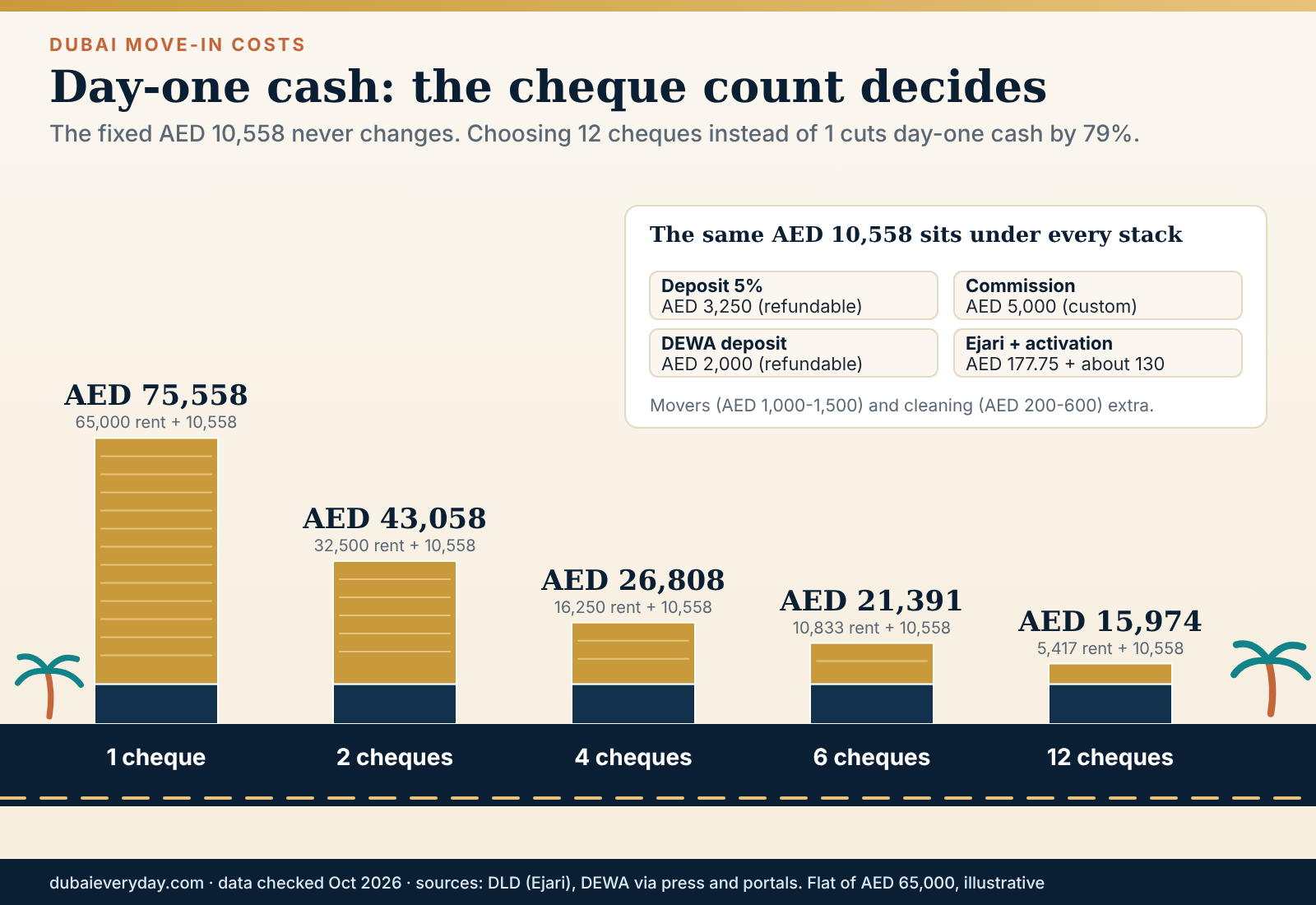
The number of rent cheques decides the rest. One cheque: AED 75,557.75 on day one. Two cheques: AED 43,057.75. Four: AED 26,807.75. Six: AED 21,391.08. Twelve: AED 15,974.42. Add movers (AED 1,000 to 1,500 for a one-bedroom, per Gulf News) and a deep clean (AED 200 to 600) and a four-cheque start is AED 28,008 to 28,908. Many landlords price the convenience of fewer cheques into the rent, though we found no published surcharge; ask for the price at each cheque count and compare.
Compare the cheque price, not the sticker rent. Illustrative example, not a quote: a landlord offers AED 63,000 for one cheque or AED 65,000 for four evenly spaced cheques (now, then at three, six and nine months). Choosing four frees AED 46,750 on day one at a cost of AED 2,000, which is an implied financing cost of roughly 9 per cent a year by our calculation. Compare that with what the cash earns elsewhere. If paying once empties your emergency savings, the dearer option is the safer one.
A calculator-ready price sheet
For readers who want to build their own cost of living Dubai spreadsheet, here are the inputs used in this guide, with where each came from and how much weight to give it. “Official” means a government or regulator page we read; “press” means a news report of an official announcement; “broker” means a commercial source. Everything was checked on 29 October 2026 unless a date is shown.
| Input | Value used | Source type |
|---|---|---|
| Special 95 petrol, October 2026 | AED 4.28 per litre (September 3.69) | Press (Fuel Price Committee) |
| Salik toll from 1 June 2026 | AED 6.30 peak, AED 4.20 off-peak, VAT included | Press |
| Nol Silver single trip | AED 3 / 5 / 7.50 (1 / 2 / more than 2 zones) | Official (RTA) |
| Nol Silver passes, two zones | 30 days AED 230; 365 days AED 1,770 | Official (RTA) |
| Ejari registration | AED 177.75 online; AED 220 at a trustee centre | Official (DLD) |
| Rent-increase cap at renewal | 0 / 5 / 10 / 15 / 20 per cent by distance below index | Official (Decree 43 of 2013) |
| DEWA electricity | 23 / 28 / 32 / 38 fils per kWh; fuel surcharge 6 fils | Broker/portal (DEWA page unreadable) |
| DEWA water | AED 7.70 / 8.80 / 10.12 per m³ | Broker/portal |
| Municipality housing fee | 5 per cent of annual rent, in 12 instalments | Broker/portal |
| Staples, August 2026 average | Eggs, tray of 30: AED 23.05; chicken: AED 22.97 per kg | Official (MoET) |
| Parkin public parking | AED 4 standard, AED 6 premium per hour; Mon-Sat 8am-10pm | Press |
| Basic health plan premium | AED 550 to 650 a year (employee) | Press |
| Private school fees 2026-27 | No increase confirmed; tuition AED 7,389 to 111,799 across the ranges quoted | Official announcement; press ranges |
| Emirates ID, new issue | AED 100 per year plus AED 100 service fee | Official (ICP) |
| VAT | 5 per cent | Official (u.ae) |
| AED per USD | 3.6725 (fixed peg) | Widely published; not re-read from the Central Bank |
One more use of the sheet. If a number on a listing, quote or bill differs sharply from the sheet, you have found either a different product or an error worth querying. Dubai’s prices are fairly standardised in tariffs and wildly variable in rents, services and schooling, and that contrast is the best diagnostic you have.
How to lower the cost of living Dubai households carry
Cost of living Dubai advice usually starts with coffee. That is backwards. The useful way to cut a Dubai budget is to rank the levers by size and start at the top, because the first three decisions are worth more than the next thirty put together. The ranking below uses our model’s numbers, so the monthly effects are our calculations from a given starting point, not promises.
- Rent: ten per cent off a AED 65,000 lease saves about AED 570 a month.That is AED 6,500 a year plus 5 per cent less municipality fee (AED 6,825 in total, AED 569 a month). Use the renewal ladder, three comparable listings and the fact that listings are plentiful. Property Finder data reported by Khaleej Times showed daily listings up 55.1 per cent year on year in September while enquiries per listing fell 23 per cent.
- School tier: AED 2,500 to 6,700 a month either way.The Very Good versus Outstanding choice moves a two-child family budget more than any other single decision after rent. Use fee schedules, not rating labels, to compare.
- Car versus annual pass: about AED 840 to 950 a month.Running a car costs about AED 1,100 a month before any payment. A two-zone annual pass averages AED 147.50. If both ends of your journey are near stations, this is the biggest everyday lever.
- Cooling model: about AED 500 a month.A district-cooled tower can add AED 5,500 to 6,500 a year on a one-bedroom. Compare total cost, not rent.
- Eating out: halving a mid-case AED 900 saves AED 450.Track delivery spend for one month before deciding.
- Internet tier: about AED 190 a month.Stepping from a 1 Gbps Advanced plan to a Starter plan on the same operator saves AED 192 a month after VAT (AED 478 down to AED 286), if you do not need the speed or bundle.
- Annual transport pass over monthly passes: AED 990 a year.Only if your zone pattern is stable and you register your card.
- Store choice for staples: AED 30 to 60 a month on a AED 308 basket.An illustrative range assuming a quarter of the basket moves to the cheaper outlets. The effect is small in dirhams and large in habit.
Notice what the ranking does to common advice. Switching grocery stores, the item people most often cite, sits at the bottom. Reducing the cost of living Dubai residents actually feel happens through rent, school tier and transport mode, and those decisions are made once, not weekly. The corollary is uncomfortable: if you are already in a flat at fair rent with a sensible commute, there is not much left to cut, and the right response to a tight budget may be income, not thrift.
When to act: a short calendar
A short calendar keeps your cost of living Dubai numbers current. Four dates recur. Ninety days before a lease expires is the notice window for changed renewal terms, so that is when to start gathering comparables. The end of each month is when petrol prices for the next month are announced; if you drive, that is the date to update the fuel line.
The 2026-27 KHDA fee decision came on 22 May 2026; watch for the 2027-28 decision around the same time, though no date is guaranteed. And when DEWA, RTA or the Dubai Land Department publishes a tariff or rule change, update the sheet before you update the plan.
We will revisit this cost of living Dubai page every three to six months, or immediately after a regulatory or market change. Next review: by end of January 2027. If your own bill or quote disagrees with ours, tell the editors. A correct number from a reader beats our best estimate.
Ten mistakes that wreck a cost of living Dubai budget
- Budgeting the advertised rent and forgetting the 5 per cent housing fee, commission, Ejari and DEWA deposit.
- Treating refundable deposits as spent money or, worse, as available savings.
- Comparing flats by rent alone without asking whether district cooling is billed separately.
- Signing a 24-month internet contract on a 12-month lease.
- Choosing a car because transport “feels expensive”, without pricing parking, tolls, insurance and finance.
- Using a 2024 cost of living Dubai calculator or crowd-sourced average for a 2026 decision.
- Assuming a school rating fixes the fee, or that a fee freeze covers buses, uniforms and activities.
- Ignoring dependants’ health insurance because the employer covers the employee.
- Choosing a money-transfer provider on the visible fee and ignoring the exchange-rate margin and licence.
- Paying a deposit or rent to someone who cannot show an Ejari-linked contract or the owner’s authority; verify before you transfer anything.
The last item is a safety point, not a budget one. Housing scams cost real money, and the cost of living Dubai tenants fear most is the deposit that never comes back. Read the tenant rights guide for deposit refunds and disputes, and the resident legal guide for where to verify rules. If you are still looking for work in Dubai, the jobs guide and the work visa guide explain which package components, such as housing allowances, change this budget before you sign a contract.
Who this page is not for
If you are planning a short visit, rather than residence, the arithmetic does not apply: hotel rates and attraction tickets drive a trip, and the hotel guide and the travel guide are the right starting points.
If your decision is whether to invest in property for rental income, the budget here is the wrong frame, and the investment guide is the right one. If you are a founder weighing running costs, start with the mainland company guide and the bookkeeping guide for ongoing obligations. Personal and business budgets overlap, but they do not share a calculator.
Cost of living Dubai: frequently asked questions
These are the questions people ask most when they price the cost of living Dubai raises, answered with the numbers used above.
How much money do you need to live in Dubai per month?
The cost of living Dubai residents face depends on household type more than on the city. Our dated model gives about AED 6,181 a month for a lean single person in a registered studio, AED 10,239 for a mainstream one-bedroom, AED 18,988 for a comfortable car-owning life near Dubai Marina, and AED 26,308 for a family of four with two children in mid-priced private schools.
Rent and the municipality fee are 40 to 57 per cent of each. Replace our rent with your own and delete anything your employer provides.
Is the cost of living in Dubai going up in 2026?
On average, yes, but unevenly. Dubai’s consumer price index rose 5.54 per cent year on year in August 2026, with food up 7.4 per cent, transport up 12.7 per cent and housing and utilities up 6.7 per cent, per EnterpriseAM citing official data. Special 95 petrol rose from AED 3.69 to AED 4.28 between September and October.
Against that, school fees are frozen for 2026-27 and Savills reports apartment rents falling in several large communities. Our reading: the cost of living Dubai residents see is being pushed up by fuel, food and older leases, and held down by softer new-lease rents.
How much is rent in Dubai in 2026?
For the cost of living Dubai rent line, registered-contract medians put a citywide studio at roughly AED 41,000 to 44,100 a year and a one-bedroom at AED 57,000 to 68,000, depending on the aggregator and window. Two-bedrooms sit near AED 80,000 and three-bedrooms near AED 110,000. Community medians vary by more than two times for the same unit type. Savills reports year-on-year apartment rent falls of 10 to 13 per cent in Marina, Business Bay and JVC, so recent asking prices may be lower than older ranges.
What salary do you need to live comfortably in Dubai?
There is no official salary threshold, so use arithmetic on the cost of living Dubai households face. Dividing our monthly totals by 0.8 gives the take-home pay that leaves a 20 per cent savings rate: about AED 7,726 for the lean budget, AED 12,799 for the mid budget, AED 23,735 for the comfortable budget and AED 32,885 for the family. Because Dubai levies no personal income tax, take-home is close to gross for most salaried residents, but check how your contract splits basic pay and allowances.
How much does a family of four need in Dubai?
In our cost of living Dubai model, the mid-case family budget is about AED 26,300 a month (roughly USD 7,200), with a three-bedroom at AED 120,000 a year, two children at AED 30,000 tuition each, one car and dependants’ health cover.
School choice moves it sharply: two Outstanding-rated British schools at AED 70,000 each raise it to about AED 32,975, while two lower-fee Very Good schools at AED 15,000 each lower it to about AED 23,800. Sponsoring family also needs a minimum salary of AED 4,000, or AED 3,000 plus housing, which is an eligibility floor, not a budget.
How much is the DEWA bill for an apartment?
Our modelled bills, from published slabs and our own usage assumptions, are about AED 233 for a studio using 500 kWh and 10 m³ (before a AED 30 allowance for meter and other charges), about AED 356 for a one-bedroom using 850 kWh and 12 m³, and about AED 840 for a townhouse using 1,800 kWh and 35 m³. Electricity runs 23 to 38 fils per kWh plus a 6 fils surcharge, and VAT of 5 per cent applies.
District cooling in many towers is billed separately and can add roughly AED 5,500 to 6,500 a year for a one-bedroom.
How much do groceries cost in Dubai?
For the cost of living Dubai grocery line, the Ministry of Economy and Tourism’s August 2026 averages include a tray of 30 eggs at AED 23.05, a kilo of whole chicken at AED 22.97, a litre of fresh milk at AED 9.46 and a kilo of basmati rice at AED 16.62.
Our one-adult staples basket of those items comes to AED 308 a month; a full grocery bill is higher. We use AED 700, 1,000, 1,400 and 2,800 as allowances for the four households. Shelf prices for identical staples vary widely between outlets, so compare totals on the ministry’s platform.
Are rents in Dubai going up or down?
Mostly down for apartments, up in a few scarce villa communities. Savills’ Q3 2026 data shows year-on-year apartment falls in Marina (-12.8 per cent), Business Bay (-12.2) and JVC (-10.4), and betterhomes reports median apartment rents down 3.8 per cent from June to September. The inflation index still shows housing costs up 6.7 per cent in August, because it follows rents on every lease in force, including older renewals. Our reading: new leases are softer than renewals, which makes renewal negotiation worthwhile.
How much are school fees in Dubai?
KHDA confirmed no private school fee increase for 2026-27, which keeps the cost of living Dubai school line flat. Levels differ enormously: Khaleej Times reports Outstanding-rated schools ranging from AED 29,488 to AED 111,799 a year across curricula, while Gulf News’ August 2026 list of Very Good schools shows fees from AED 7,389 to AED 41,513. A rating does not fix a price. Ask each school for its itemised schedule, including buses, uniforms, registration and activities, because the freeze announcement refers to tuition.
Is health insurance mandatory in Dubai, and who pays?
Under Dubai’s health insurance law, employers must provide and pay for at least a basic Essential Benefits Plan for employees and cannot deduct it from pay; sponsors must insure dependants. Gulf News (14 July 2026) puts the basic premium at typically AED 550 to 650 a year. Family cover is separate, and a broker range for a family of four is AED 6,200 to 28,000 a year. This is general information; confirm the rules with the regulator or a licensed adviser. See the health insurance guide.
Does Dubai have income tax?
The UAE government states that the UAE does not levy income tax on individuals. It does charge VAT at 5 per cent on goods and services, and corporate tax applies to business profits. Your home country may still tax you, depending on your residency and citizenship, so check there. Dubai’s lack of income tax is why salaries convert closely to take-home pay, but it does not lower the cost of living Dubai residents pay: rent, school fees and imports carry high costs, and VAT sits on many bills.
How much cash do I need to move into a rented flat in Dubai?
For an illustrative AED 65,000 flat, the day-one cost of living Dubai tenants meet outside rent is about AED 10,558 (deposit AED 3,250, commission AED 5,000, Ejari AED 177.75, DEWA deposit AED 2,000, activation about AED 130). Add the first rent cheque: AED 26,808 with four cheques, AED 43,058 with two, AED 75,558 with one. Movers and cleaning add roughly AED 1,200 to 2,100. Deposits and commission are market custom, not fixed rates, and landlords may price cheque counts differently.
Can you live in Dubai without a car?
Yes, if both your home and workplace are close to metro, tram or bus links, and it is the biggest cost of living Dubai saving available to most commuters. A registered Nol Silver card with a two-zone annual pass averages AED 147.50 a month, against about AED 1,100 a month in running costs for a car, before any payment. Taxis cost about AED 35 for a 12 km ride by our estimate, so they suit occasional trips rather than commuting. In summer heat, last-mile walking is the weak point. See the metro guide for lines and stations.
Related reading
If you are pricing a move, these guides carry the cost of living Dubai detail one step further.
Sources and further reading (35 links)
- Khaleej Times: UAE petrol and diesel prices for October 2026 — fuel prices and the September comparison for the cost of living Dubai transport line
- Emirates 24|7: UAE fuel prices for October 2026 — second confirmation of fuel prices
- EnterpriseAM: Dubai inflation rises to 5.5% — August 2026 CPI by category and forecast, the cost of living Dubai inflation read
- The National: Dubai inflation softens in July — July CPI, drivers and basket weight
- Khaleej Times: Rents in Dubai fall over 12% (Savills Q3 2026) — rent changes by community and transaction counts
- betterhomes: Dubai Property Market Report Q3 2026 — median rent changes June to September
- houserent.ae: Average rent in Dubai 2026 — Ejari-based citywide medians (secondary)
- DataHabibi: Studio apartments in Dubai — studio medians by community (secondary)
- Real Estate Club Dubai: Dubai Rent Map 2026 — Q1 2026 rent ranges (secondary)
- Dubai Legislation Portal: Decree No. 43 of 2013 — renewal rent-increase bands for the cost of living Dubai rent line
- Dubai Land Department: Register or renew an Ejari contract — Ejari fees and documents
- Dubai Media Office: Law regulating shared housing — Law No. 4 of 2026 announcement (read in DubaiEveryday research)
- Property Finder: DEWA calculator — DEWA slab figures, housing fee (secondary)
- Dubizzle: DEWA bill explained — second confirmation of slab and water figures (secondary)
- Bayut: Dubai Municipality housing fee — 5 per cent fee in 12 instalments (secondary; read in DubaiEveryday research)
- Gulf News: Renting in Dubai, 11 extra costs — deposit, commission, movers and utility deposit custom (secondary; read in DubaiEveryday research)
- Real Estate Club Dubai: Chiller-free vs chiller-paid buildings — district cooling tariffs and modelled costs (secondary)
- Bayut: Dubai internet packages — du and e& home plan prices (secondary)
- JobXDubai: SIM card and home internet guide — mobile plan ranges (secondary)
- Ministry of Economy and Tourism: August 2026 price monitoring table — average staples prices behind the cost of living Dubai grocery lines
- Ministry of Economy and Tourism: Essential Goods Prices Platform — best and highest listed prices by category
- Gulf News: UAE grocery prices this October — lowest listed prices and outlets (secondary)
- Roads and Transport Authority: Nol fares — single fares, passes and concessions behind the cost of living Dubai commute figures
- Dubai Taxi: FAQs — base fare and payment methods
- Emirates 24|7: Parkin tariffs — public parking rates and hours (secondary)
- ArabWheels: Car insurance cost in the UAE 2026 — premium ranges (broker)
- Gulf News: Does your employer have to pay for health insurance? — employer duty and basic premium (secondary)
- PolicyBazaar.ae: Cost of health insurance in the UAE — premium ranges (broker)
- Dubai Media Office: KHDA confirms no fee increase — 2026-27 school fee freeze behind the cost of living Dubai school line
- Khaleej Times: Dubai school fees 2026-27 at Outstanding schools — fee ranges by curriculum (secondary)
- Gulf News: Dubai schools under Dh45,000 — Very Good school fee ranges (secondary)
- UAE Government Portal: Taxation — no individual income tax, VAT 5 per cent
- Central Bank of the UAE: Licensing — financial institution register and licence warnings
- Federal Authority for Identity and Citizenship: Emirates ID issuance — fees (read in DubaiEveryday research)
- UAE Government Portal: Family sponsorship requirements — sponsor salary floor (read in DubaiEveryday research)
Update log: 29 October 2026 — first publication; all facts re-checked against the sources above. Next review due: by end of January 2027, or sooner after a DEWA, RTA, KHDA, Dubai Land Department or fuel-price change. Corrections welcome. This page is general information, not individual financial, legal, tax or insurance advice; confirm any decision with the relevant authority or a licensed professional.
About DubaiEveryday and this guide
DubaiEveryday.com is an independent editorial project that publishes practical, research-based guides to everyday life in Dubai: where to live, what things cost, how the rules work and how to get around. This page was written and edited by the DubaiEveryday editorial team. It is not signed by a named expert, doctor, lawyer or adviser, and we do not claim first-hand testing of a venue, clinic or service unless the page says so.
Each guide is built from official sources such as government and regulator pages, operator websites and established news outlets, cross-checked where we can. When we could not confirm something, we say so in the text, and examples that use made-up numbers are labelled as illustrations. Mentions are editorial choices, not paid placements, and a link is not an endorsement.
Dubai changes quickly. If you spot something that is out of date or wrong, please tell us through the contact options on DubaiEveryday.com and we will check it and correct the page.