

The Marina is a canal city of glass towers with a beach strip, a tram and a long list of trade-offs that glossy renders leave out. This Dubai Marina guide covers apartments, beach access, the tram, dining, traffic and daily lifestyle, checked against official and published sources on 29 October 2026.
The Marina looks sensational in a render: glass towers, a canal, boats, a beach a short stroll away. Then picture it at 6 pm on a weekday, with everyone heading home along the same few roads. Both pictures are true. The skill is knowing which one matches how you will actually live or stay.
This dubai marina guide sets the two side by side. It covers apartments, rents, JBR beach access, the tram link to the Metro, parking, tolls and dining, with the 2026 figures dated and sourced. By the end you will have nine checks to run before you sign a lease or book a stay.
This Dubai Marina guide starts with the verdict: the Marina suits people who want a walkable waterfront, a beach within reach and a tower apartment, and who accept that it is a dense district with a car problem at rush hour. It is not on the Metro itself. You reach it by changing to the Dubai Tram at Sobha Realty (R36) or DMCC (R37), and the tram runs 06:00 to 01:00 Monday to Saturday, 09:00 to 01:00 on Sunday.
On money, the numbers published in 2026 point one way. Property Monitor data cited by Engel & Völkers put the average Marina one-bedroom at AED 97,434 a year in May 2026, and Savills reported Marina apartment rents down 12.8% year on year in the third quarter. Tenants have more bargaining room than they had a year earlier, but advertised rents and signed rents are different things.
The beach side is simple: JBR’s beachfront is public with no stated entry charge, while parking at The Beach complex is AED 20 an hour unless you validate. Salik tolls are AED 6.30 at peak and AED 4.20 off-peak. Read the nine checks near the end of this Dubai Marina guide before you sign anything, and read the status board first.
This is a desk-research guide. Nobody on the editorial team has lived in a Marina tower, queued for the tram or eaten on Marina Walk for this page, and nothing here claims otherwise. Facts come from operator and government pages read on 29 October 2026 (RTA fares, timetables and marine pages, The Beach’s own FAQ, Dubai Municipality’s beach listing, Dubai Media Office), from market reports published in 2026 and, for background such as tower heights, from Wikipedia, which we label as secondary.
Where a number could not be verified today we say so, give a range or leave it out. Distances, travel times and monthly budgets marked “our calculation” are arithmetic on stated assumptions, not measurements. No restaurant, building, agent or brand paid to appear, and none is ranked. This page is general information, not legal, financial or property advice.
Dubai Marina guide: the October 2026 status board
Before the long version, here is what is current for anyone using this Dubai Marina guide. A Dubai Marina guide written in a calm year would start with the skyline. In 2026 it has to start with what moved, because several of the facts people repeat about the area are out of date or unverified.
Rents are softer
Savills reported Marina apartment rents 12.8% lower year on year in Q3 2026. Property Finder’s median asking rent for Marina fell about 16% over the same twelve months. Both are secondary reports of market data, covered in the rents section.
Palm Monorail: check first
Reports differ on the Palm Jumeirah Monorail. Wikipedia mentions a suspension from 5 December 2025, while Khaleej Times (9 July 2026, as carried in our hotel research) reported services resuming after about six months. We read no operator page, so confirm before you plan the Palm link.
Ain Dubai: unverified
The giant wheel on Bluewaters reopened on 26 December 2024 according to Wikipedia. We found no 2026 operator confirmation, so do not build a day around it without checking the official booking page.
Tram and Metro hours
RTA lists the tram at 06:00 to 01:00 Monday to Saturday and 09:00 to 01:00 on Sunday. The Metro closes at midnight on most days, 01:00 on Friday, and starts at 08:00 on Sunday.
Two more points belong on the status board of this Dubai Marina guide. The Marina Pinnacle tower had a major fire in June 2025; secondary sources describe an evacuation of roughly 3,800 to 4,000 residents with no injuries reported, and a fire brought under control within about six hours. We use it later for one purpose only, to turn “is this building safe?” into questions you can actually ask a building manager.
The other point is supply. Savills expects 75,000 to 85,000 new homes to be delivered across Dubai in 2026, and more than 525,000 scheduled for 2027 to 2030. That is a citywide figure, not a Marina one, and scheduled units are not always delivered on time. It does explain why tenants in older towers have more choices than they did in 2024.
What this Dubai Marina guide covers, and what it leaves to others
The search job here is “should I live, stay or spend time in the Marina, and how does it work day to day?” Other jobs have their own pages. For a visitor-led look at the other big district of towers and malls, read our Downtown Dubai area guide. For villas, resorts and the island next door, the Palm Jumeirah area guide is the better page. For the full process of leasing a flat, we point to the renting in Dubai guide rather than repeating it.
Beach choice across the whole city, including municipal beaches and clubs, sits in the best beaches in Dubai guide. Here we cover only the sand you can reach from the Marina and JBR, and what that access really involves.
What the Dubai Marina is, and where it ends
For the purposes of this Dubai Marina guide, the Marina is a planned district built around an artificial canal on the Gulf coast, roughly 3 kilometres of shoreline according to Wikipedia, with a waterfront walkway system that the same source puts at almost 8 kilometres. Emaar developed it, and the first residential phase was six freehold apartment buildings named after gemstones and scents. Later phases went much taller. Wikipedia counts about 70,550 residents in 2024 and says the district can accommodate over 120,000, which is the first number worth sitting with: a canal city that dense behaves like a small town with a very large lift lobby.
Residents and agents use “Dubai Marina” loosely, so this Dubai Marina guide defines its terms. In a strict sense it is the canal and the towers around it. In a loose sense it includes Jumeirah Beach Residence (JBR), the beachfront row of towers with its own promenade and retail, and sometimes neighbours such as Jumeirah Lakes Towers (JLT) on the inland side. The difference matters for your search, because listing portals split Marina and JBR into separate areas with separate rent figures, and a viewing “in the Marina” can be a 15-minute walk from the water.
The Dubai Marina guide boundary, in four edges
Think of the Dubai Marina as a block with four edges. On the Gulf side, the beach strip and JBR. On the inland side, Sheikh Zayed Road and JLT. To the north-east, Al Sufouh, Media City, Internet City and then Palm Jumeirah. To the south-west, newer developments along the coast towards Jebel Ali. Almost every choice in this Dubai Marina guide, from commute to noise, comes down to which edge your building sits near.
Two reference points help. The tram stops named Dubai Marina Mall and Dubai Marina serve the canal core; JBR1 and JBR2 serve the beachfront. A flat described as “Marina view” may look at the canal, the Gulf, or neither, and agents use the phrase generously. We return to this in the apartments section.
Dubai Marina guide boundary rule. Ask for the nearest tram stop by name and the walking time to the water, then check both on a map. If an agent cannot name the stop, the listing is probably describing the district, not the building.
Layout: canal, Walk, beach strip and towers
A Dubai Marina guide is easier to follow with the geography fixed in your head, so here is the simplified version. The Gulf is to the north-west. Moving inland you cross the beach strip, JBR’s tower row and The Walk, then the canal with its own promenades and towers, then the main road corridor, then JLT and the Metro line. Bluewaters, the artificial island with the observation wheel, sits just offshore from JBR and connects by a pedestrian bridge according to Wikipedia’s JBR page.
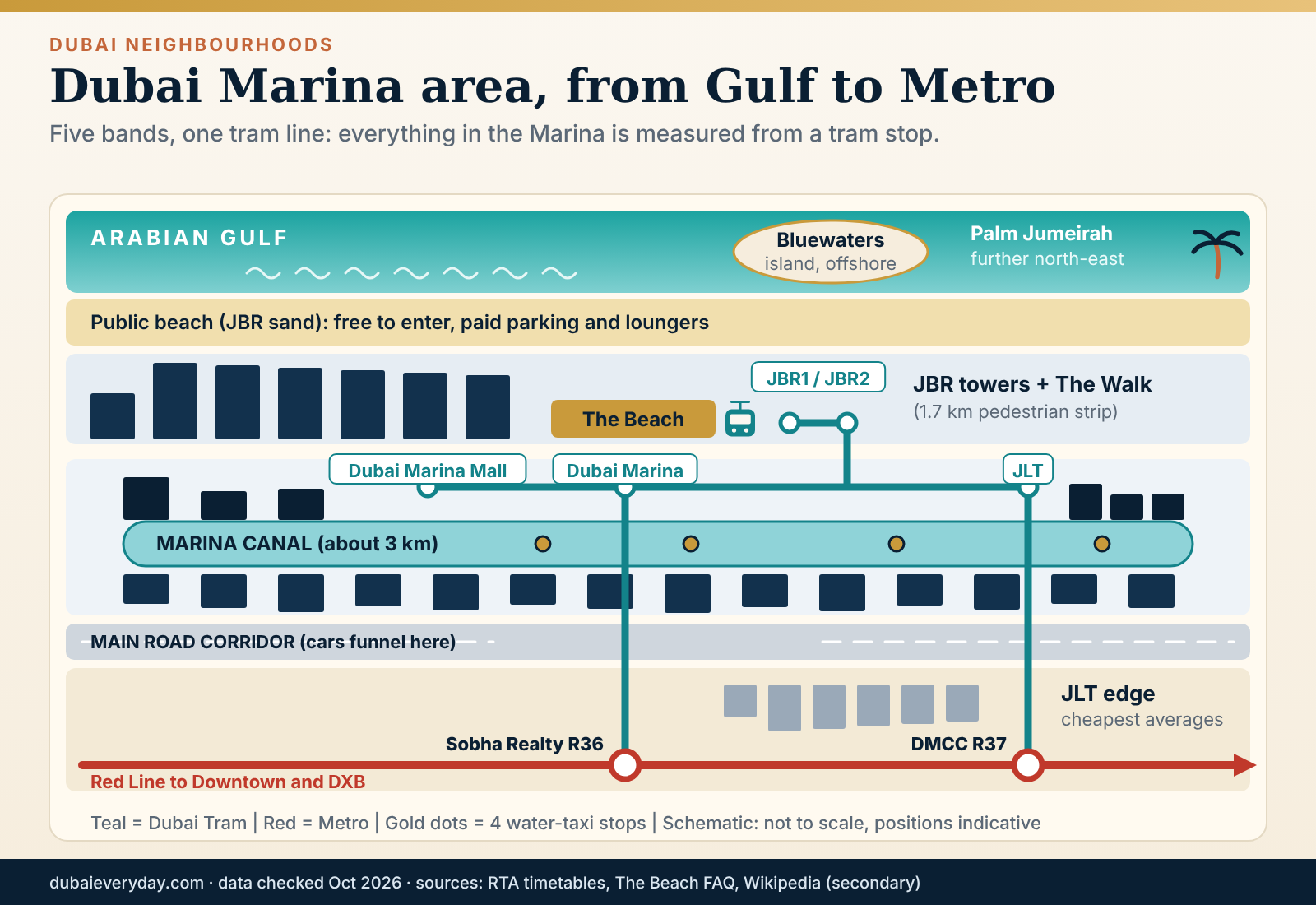
The map in this Dubai Marina guide makes one thing visible that listings hide: the tram is the spine. It threads JBR, the canal and the JLT edge, and it meets the Metro at two places, Sobha Realty (R36) and DMCC (R37). Everything on foot is measured from a tram stop. Everything by car is measured from the road corridor, and the two are not the same distance apart as they look.
Three waterfronts the Dubai Marina guide keeps apart
The Marina has three different kinds of waterfront, and they behave differently. The canal promenades, known as Marina Walk and Marina Promenade, are lined with restaurants and cafes and overlook yachts. They are calm water, no swimming, and the water taxi stops there. The JBR Walk, a 1.7 kilometre strip according to Wikipedia, is a pedestrian street of shops and restaurants one block back from the sand. The beach itself is the third waterfront, and it is the only one where you can swim.
The Beach is the retail and dining complex on the sand, between the Hilton and Sheraton hotels per Wikipedia. Its own FAQ describes six licensed restaurants in the Pavilion, a 600 metre running track and sun loungers operated by a beach club on site. We come back to what is free and what is paid in the beach section.
Dubai Marina guide: what is on the water
RTA’s marine page says the Dubai Water Taxi serves the Marina with four stops: Marina Terrace, Marina Walk, Dubai Marina Mall and Marina Promenade. The vessels are air-conditioned, seat 20, and fares are AED 7 per segment, or AED 7 to 21 for the full route. RTA’s timetable page adds two ferry routes from Dubai Marina Mall: FR2 to Bluewaters and FR4 to Palm Jumeirah and Atlantis. Departure times are in PDF timetables that we did not parse, so check them before you plan around a boat.
Apartments in the Dubai Marina: towers, views and trade-offs
Most people looking at the Dubai Marina are looking at a high-rise apartment, so this part of the Dubai Marina guide is about how to tell towers apart. They are not interchangeable. Wikipedia describes the first phase as six freehold apartment buildings, then a second phase of mostly 250 to 300 metre towers, then a run of supertalls. The skyline below uses heights from a public tall-building list; lists differ by a few metres and one source gives Ciel at 366 metres while another gives 377, so we show rounded values.
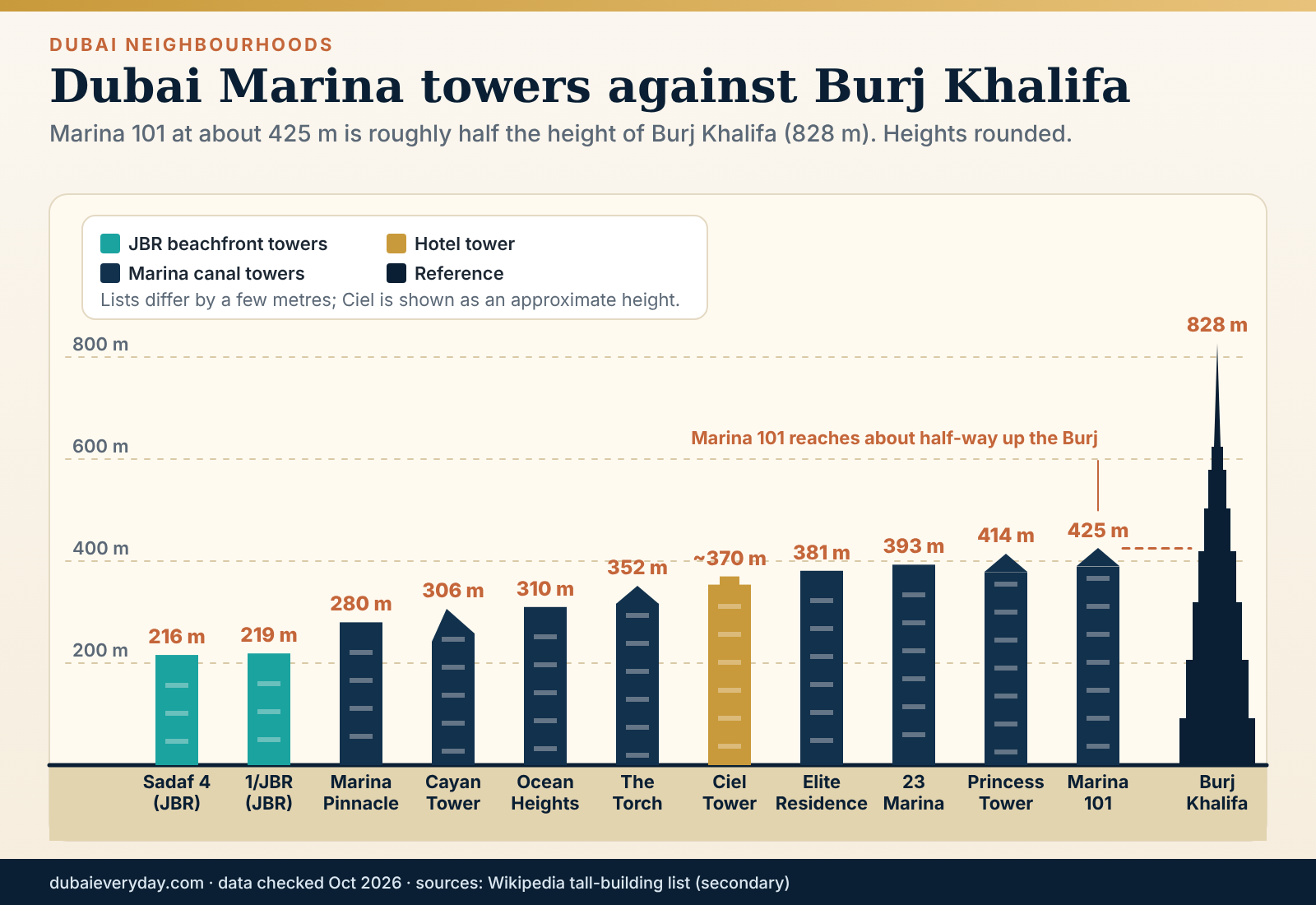
Dubai Marina guide to older and newer towers
A pattern holds across most Dubai districts and applies here: towers from the first wave tend to have larger floor plans and a pool-and-gym podium, while the newest ones lean on hotel-style amenities, sky lobbies and smaller units. Treat this as a prompt for questions, not a rule, because both ages contain very good and very tired buildings. What differs in practice is the age of the lifts, the chiller and plumbing systems, and how much the owners’ association has spent on maintenance. Ask to see the last service-charge statement if you are buying, and ask the building manager about lift outage frequency if you are renting.
Marina Walk side
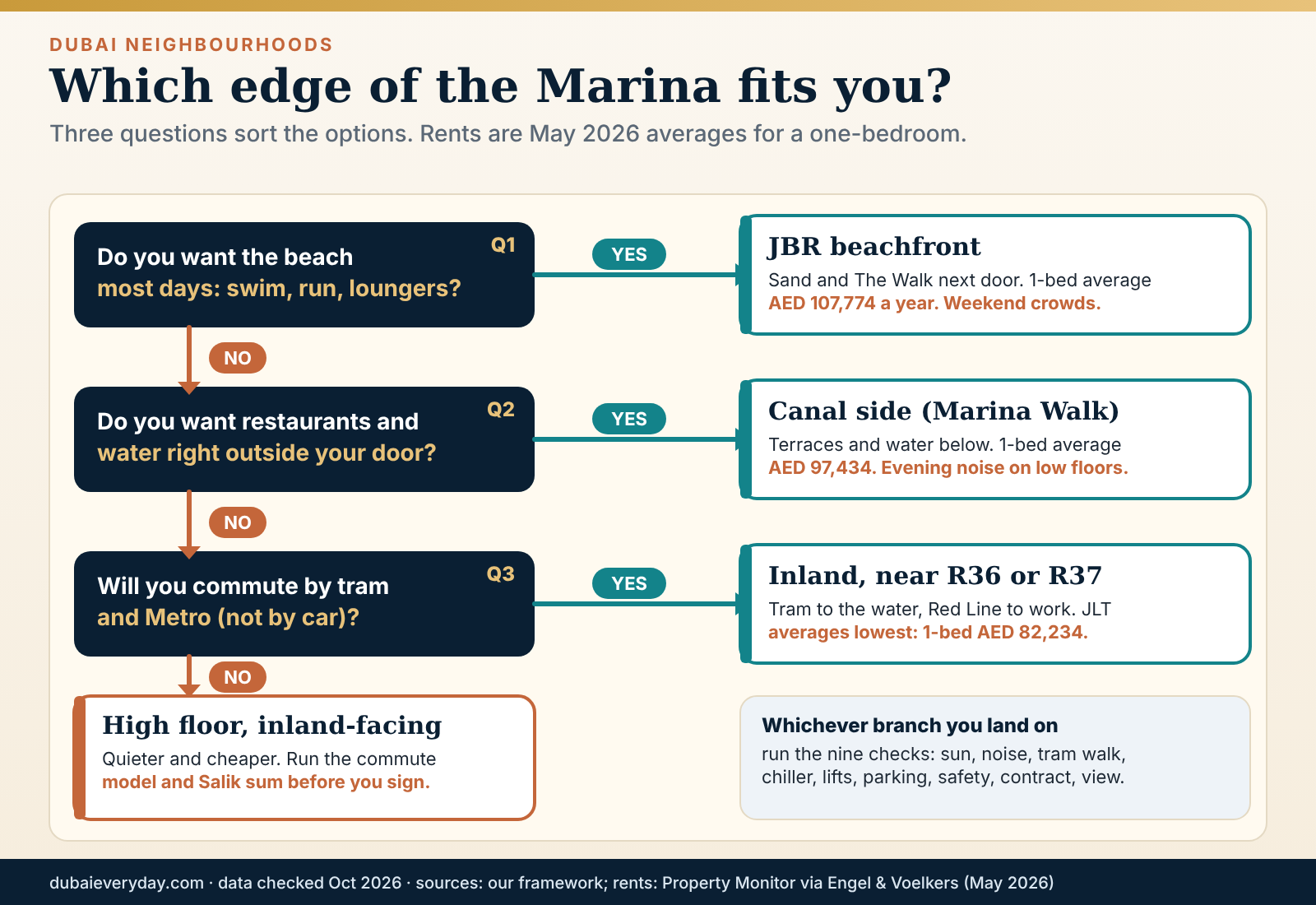
Canal views, restaurants at the base, evening noise on lower floors. Best for people who want to step out of the lift into the action and sleep with the door closed.
JBR beachfront
Closest to the sand and The Walk. Sea-facing flats catch the setting sun in summer. Beach-day crowds and weekend traffic are the cost.
Inland and JLT edge
Quieter after dark, closer to the Metro interchanges at DMCC and Sobha Realty, and usually cheaper per square foot. Walks to the water are longer.
Which way should the balcony face?
This is the part agents rarely explain. The Marina coast runs south-west to north-east, so the sea sits to the north-west. In summer the sun sets in the west-north-west, which means a sea-facing balcony takes direct afternoon sun from mid-afternoon until sunset, in the hottest months. In winter the sun sets further south and the same balcony gets far less. An inland-facing flat sees the reverse: morning sun, and a calmer late afternoon. This is our reading of the geometry, not a measurement of any building, so check the orientation on a map and visit at the hour that matters to you.
The trade is real either way. Sea view buys the sunset and the glare. Canal view buys boats and restaurant light. A road-facing flat buys the cheapest rent and the most traffic hum. If cooling cost matters, the chiller-and-DEWA explanation in our home setup guide is worth reading before you choose a floor.
Studios, one-beds and family units
JBR’s towers hold 6,917 apartments, from around 900 square feet to 5,500 square foot penthouses, per Wikipedia. Across the Marina the common offer is studios, one-beds and two-beds, with three-beds more common in the larger JBR and beachfront buildings. A studio is a decent fit for one person on a commute. A two-bed works for a couple who want a home office. A family with school-age children has a harder time, and the daily life section explains why.
“Full Marina view” and “partial sea view” are marketing terms with no legal definition. Ask which floors have the view, what is in front of it today, and whether any nearby plot is vacant. Check the plot on a map. A construction hoarding next door can erase a view within a year.
Dubai Marina guide to listing language
Marina listings share a vocabulary, and the words carry less information than they appear to. “High floor” has no threshold; in a 70-storey tower it can mean anything above the podium. “Vacant on transfer” or “vacant” says the flat is empty, which matters if you want to move in on a date. “Furnished” is a bargaining chip, because furniture is priced into the rent and you rarely get a refund when you stop using it. “Chiller free” is the vaguest of all, since sources disagree about who pays, as the daily life section explains.
The fix is dull and effective. Ask for the floor number, the unit number, the size in square feet, the cheque schedule, the chiller arrangement and the earliest move-in date, in writing, before you travel to a viewing. A good agent answers in one message. If you also want to understand the general viewing process, our apartment rental checklist goes through the same ground for the whole city, and this Dubai Marina guide adds only the local twists.
Dubai Marina guide: tower safety as questions
The June 2025 fire at Marina Pinnacle put building safety on every resident’s mind. Secondary sources describe thousands of residents evacuated, no injuries reported and the fire controlled in about six hours. We found no official statement we could read today, so we make no claim about cause or cladding. What we can do is list reasonable questions, and these are general, not an engineering or legal opinion.
- When was the last fire-alarm and evacuation drill, and is there a written fire safety plan the manager can show you?
- Are stairwells clear and are fire doors closed, not wedged open?
- Does the building have a clear policy on balcony storage, grills and charcoal?
- Who do you call at night for a lift fault, a leak or an alarm, and does that number work?
- What does the building insurance cover, and what does your contents policy need to cover?
Our Dubai insurance guide explains the difference between building cover and your own contents cover, which matters after any incident.
Rents, prices and running costs
This section of the Dubai Marina guide is the one most likely to date, so every figure carries its source and month. The Dubai Marina guide sticks to published, attributable numbers and then builds clearly labelled arithmetic on top.
What the published data says about Dubai Marina rents
Property Monitor data, as published by Engel & Völkers in an article updated on 17 May 2026, gives the following average yearly apartment rents. They are averages of signed or listed contracts, not offers, and they move monthly.
| Apartment size | Dubai Marina (AED/yr) | JBR (AED/yr) | Downtown (AED/yr) | JLT (AED/yr) |
|---|---|---|---|---|
| Studio | 68,152 | 84,471 | 81,067 | 60,781 |
| 1-bedroom | 97,434 | 107,774 | 120,285 | 82,234 |
| 2-bedroom | 153,953 | 146,101 | 188,791 | 124,545 |
| 3-bedroom | 241,190 | not listed | 284,674 | 152,048 |
Source: Property Monitor via Engel & Völkers, data to 17 May 2026 (secondary). Reading it: JBR studios and one-beds cost more than the Marina proper, while JBR two-beds were cheaper in this data set, which hints at a different building mix rather than a bargain. JLT is the cheapest of the four at every size shown.
The trend: softer, but sources disagree on how much
Savills, as reported by Khaleej Times on 13 October 2026, measured Marina apartment rents down 12.8% year on year in Q3 2026. Property Finder’s median asking rent for Marina went from AED 155,000 to AED 130,000 over the same Q3-to-Q3 window, a fall of about 16%, as reported by Arabian Business and Gulf News. A betterhomes report, also from Q3, claims Marina rents rose 3.7% quarter on quarter, which can be true alongside a year-on-year fall if prices bottomed earlier in the year.
The fair reading in this Dubai Marina guide is that Marina rents are lower than a year ago, with early signs of stabilisation that Savills itself describes as “rebalancing rather than a reversal”. Do not assume a further fall. Do assume your landlord has seen the same headlines, and that a vacant flat on a tower with several others vacant will negotiate.
Sale prices and service charges
The same Engel & Völkers family of articles, citing Property Monitor and Dubai Land Department data, put the Marina average at AED 2,058 per square foot for 1 January to 6 June 2026 (secondary). A February 2026 review put the average Marina service charge at about AED 22 per square foot a year (secondary). The official place to check a building’s charge is the Dubai Land Department’s service charge index.
Illustrative example (not a quote or market fact). Take an assumed 800 sq ft one-bedroom. At AED 2,058 a square foot, the purchase price would be AED 1,646,400. At AED 22 a square foot, the annual service charge would be AED 17,600, or about AED 1,467 a month. Neither figure is for a real unit. The point is the shape: service charges are a running cost of owning that rent never shows. See our rental yield guide for how that changes a net return.
A Dubai Marina guide budget: one renter’s month
Here is a worked monthly budget for a one-bedroom renter who commutes to Downtown on weekdays. The rent is the May 2026 average above, divided by twelve. The commute choice is where the Marina forces a decision, so we price both.
- Rent: AED 97,434 divided by 12 is AED 8,120 a month. If you pay in four cheques the total is the same but the cash timing is not, and some landlords price the cheque count.
- Metro and tram route: a Silver nol card pays AED 3, 5 or 7.50 per journey depending on zones crossed (RTA). We could not verify the zone count for this exact pair, so budget the AED 7.50 top tier. Forty-four journeys in a month is AED 330 at the top tier, against AED 350 for a 30-day all-zones pass, so a pay-as-you-go card wins at that volume.
- Driving route: assume four Salik crossings a working day if your route uses two gates each way. At the peak price of AED 6.30 that is AED 25.20 a day, or about AED 554 over 22 working days, before fuel, parking or insurance.
Our calculation shows that Salik alone on a daily car commute can cost more than a full month of Metro and tram, before a single litre of petrol. The caveat is that the number of gates depends on your route and your hours, and the price is lower off-peak. Check the Salik map, then re-run the sum. The broader cost picture is in our cost of living in Dubai guide, and the single-person version is in the monthly budget for one person.
Three renter budgets, built from verified inputs
The table below is the same arithmetic applied to three common set-ups. It uses only inputs we could source: Property Monitor average rents, RTA’s top Silver fare of AED 7.50, Salik at AED 6.30, and a broker’s reported chiller range of AED 900 to 1,500 a month where chiller is billed separately. It leaves out electricity, water, food, internet, insurance, fuel and parking, which vary too much to guess.
- Studio, car-free: rent AED 5,679 plus 44 journeys at the top tier AED 330 is AED 6,009 a month. If chiller is billed separately, add AED 900 to 1,500 for AED 6,909 to 7,509.
- One-bedroom, driving to Downtown: rent AED 8,120 plus about AED 554 Salik is AED 8,674 before fuel and parking. With a separate chiller bill, AED 9,574 to 10,174.
- Two-bedroom couple, one person on the tram: rent AED 12,829 plus AED 330 is AED 13,159. With a separate chiller bill, AED 14,059 to 14,659.
These are our calculations from May 2026 averages, which a particular flat may beat or miss by tens of thousands of dirhams. The use is comparison: the car adds more to the one-bedroom budget than the Metro adds to the studio, and the chiller line can move a budget by more than the commute does. Our cost of living guide models a fuller lifestyle budget for a comfortable, car-owning life near the Marina.
Renting versus buying in the Dubai Marina guide area
The Marina is freehold, which means foreign buyers can own apartments outright. The process, fees and checks live in the buying property in Dubai guide and the guide to buying as a foreigner. Two Marina-specific cautions. First, rents have just fallen, and a buyer who underwrites on last year’s rent is using the wrong baseline. Second, a Marina apartment competes with a large stock of nearly identical ones; resale liquidity depends on the specific tower, floor and view, not the district.
Nothing in this Dubai Marina guide is investment advice. Property returns are not guaranteed, and the Dubai property investment guide sets out the risks and the questions to ask a licensed broker.
Beach access in the Dubai Marina area
The honest summary of beach access in this Dubai Marina guide is that the sand is free to enter and the convenience around it is not. The canal does not have a swimming beach. The beach is the JBR strip, and The Beach’s own FAQ confirms public access and mentions no entry charge. The charges arrive at the edges: parking, loungers, towels and food.
Free sand, paid comfort: the beach in this Dubai Marina guide
According to The Beach’s FAQ, parking is AED 20 an hour. Spending AED 100 or more in one bill at a participating outlet validates the first three hours free, and a few outlets (Roxy Cinemas, Pavilion, Sea Breeze and Bla Bla) offer up to four. Validation works once per car plate, receipts from carts, vans or kiosks do not count, and after validation you have a 15-minute grace period to leave. There is no paper ticket: your plate is the ticket, and you pay at stations near the lift lobbies or escalators.
Run the numbers for a typical morning. A four-hour visit with no validation is 4 × AED 20 = AED 80. With a validated AED 100 breakfast, three hours are free and the fourth costs AED 20, so the all-in parking cost is AED 20 while you spent AED 100 on food you may have wanted anyway. That is our calculation from the posted rates; confirm both on the day.
Cheaper way in. The Beach’s FAQ itself suggests Metro to DMCC, then the tram to JBR1 or JBR2 and a walk across. For a morning swim that avoids the parking maths entirely, and it fits the tram hours: first tram 06:00 Monday to Saturday, 09:00 on Sunday.
What the municipality lists, and what it does not
Dubai Municipality’s public beach page lists Jumeira Beach and Al Mamzar Beach and says its centres do not charge entry fees except for requested services. JBR is not named on the page we read, so we treat JBR’s sand as a separately managed public beach and do not assume the municipal rulebook, lifeguard hours or night-swimming zones apply here. Municipal beaches have posted rules on pets, barbecues, shisha, overnight stays and swimwear in walkways, per Dubai Municipality content summarised in our best beaches guide. The sensible approach at JBR is to follow the signs and the same common-sense rules.
Two items this Dubai Marina guide could not verify for JBR: lifeguard coverage hours, and the dog and drone policy. The Beach’s FAQ does not address either. Treat any beach with no visible lifeguard tower as unguarded, keep children within arm’s reach and check the flag colours. If you need a municipal-run alternative with lifeguards and published hours, the free public beaches guide and the family beaches guide compare the options.
Dubai Marina guide to the beach season
The Gulf is warm for most of the year, and the problem is the air. The chart below uses monthly averages published by weather2travel (secondary, rounded): daily maximum air temperature, sea temperature and UV index. The seasonal wheel colours each month by how usable a midday beach session is, which is our reading of those numbers, not an official comfort index.
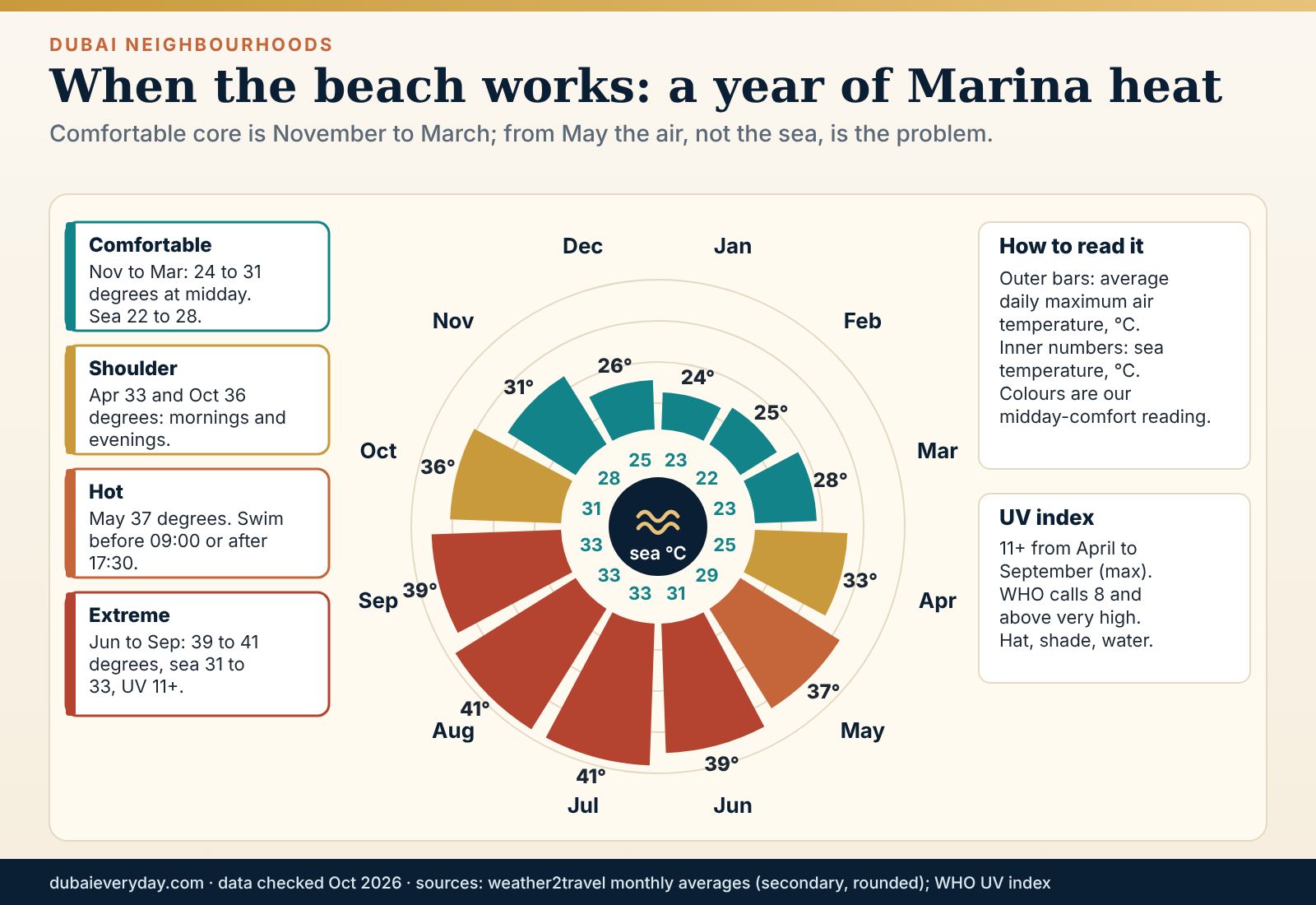
The pattern in this data is clear. November, December through February and March are the comfortable core, although January and February sea water at about 22 to 23 degrees feels cold to many swimmers. April sits at an average maximum of 33 degrees with UV 11 or more. From May the sea is warm but the air is 37 degrees and rising, and June to September is 39 to 41 degrees with the highest UV rating. The WHO treats a UV index of 8 or above as very high. In July and August the practical beach hours are before about 09:00 and after about 17:30.
Heat is a safety topic in any Dubai Marina guide, not just a comfort one. Dubai’s heat and humidity can bring on heat illness faster than visitors expect, and the sensible rules are to drink water before you are thirsty, take shade breaks and avoid long midday sessions. The best time to visit Dubai guide turns the same logic into a whole-city calendar.
Beach clubs, hotel day passes and what to expect
The Beach lists Sea Breeze as its on-site provider of sun loungers, cabanas, day beds, umbrellas and towels. We did not find a price on the page, so none is quoted. Hotels on the strip also sell day access in various forms; prices, age limits and availability change quickly and several Dubai beach clubs have closed or reopened this year, per the reporting summarised in the beaches guide. Ask the club for the full inclusive price, including minimum spend, before you travel.
Dress is simple on the sand and stricter off it. Swimwear belongs on the beach, not in the mall or on The Walk. Our Dubai dress code guide covers where cover-ups are expected, which in practice is anywhere you leave the beach.
Getting around: tram, Metro, ferry and on foot
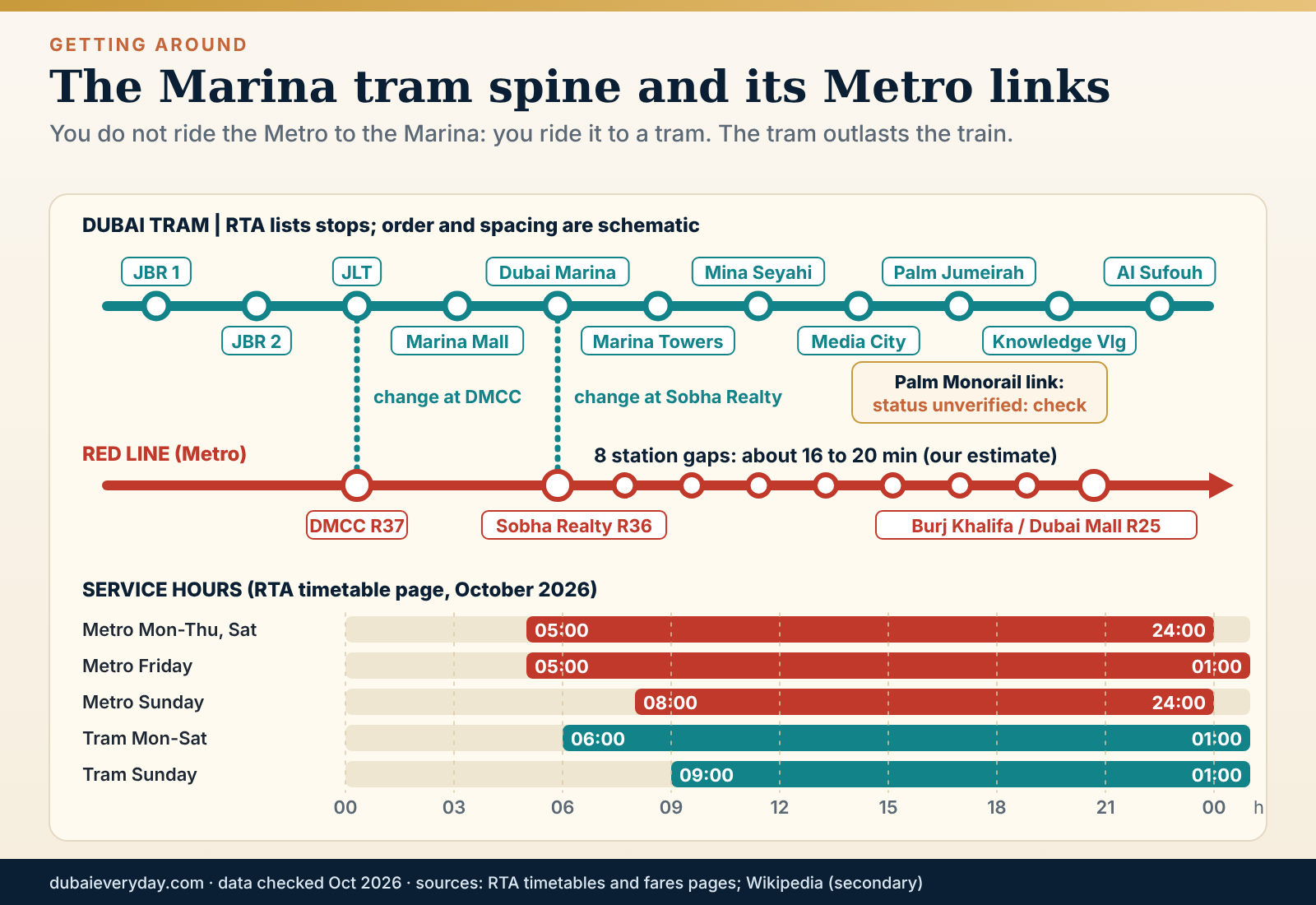
The transport story in this Dubai Marina guide has one headline: you do not take the Metro to the Marina, you take the Metro to a tram. That extra step is cheap in money and slightly costly in time, and it shapes who enjoys living here.
Dubai Marina guide to the tram in practice
RTA’s timetable page lists tram hours as 06:00 to 01:00 Monday to Saturday and 09:00 to 01:00 on Sunday. Wikipedia lists the Phase 1 stations as Jumeirah Beach Residence 1 and 2, Jumeirah Lakes Towers, Dubai Marina Mall, Dubai Marina, Marina Towers, Mina Seyahi, Media City, Palm Jumeirah, Knowledge Village and Al Sufouh, a route of about 10.6 kilometres that opened to the public on 12 November 2014. RTA’s timings PDF, read for our Metro guide, names the same stops. The tram connects to the Metro at DMCC (R37) and Sobha Realty (R36), and to the Palm Monorail through Palm Gateway.
RTA’s Dubai Media Office release for 2025 counts 9.9 million tram journeys and 294.7 million Metro journeys. Divide the tram figure by 365 and you get roughly 27,000 journeys a day, which is our calculation. That is a modest load for a district of tens of thousands of residents, and it hints that many people still choose to drive, walk or take a taxi for short trips. It also means the tram is rarely the constraint; frequency and wait times are something we could not verify, so use the RTA app for live information.
Fares and the Metro leg
RTA’s nol fares page applies the same zone fares to Metro and tram: on a Silver card AED 3 for one zone, AED 5 for two adjacent zones and AED 7.50 for more than two. A Gold card pays double and RTA notes a surcharge on tram and Metro. The page caps a single journey at 180 minutes with up to three transfers, which comfortably covers tram plus Metro. Older articles quote a flat AED 3 tram fare; RTA’s current fares page lists the zone fares above, so use those.
The Red Line run from Sobha Realty (R36) to Burj Khalifa/Dubai Mall (R25) is eight station gaps, which at the rule of thumb of 2 to 2.5 minutes per gap gives 16 to 20 minutes, per the estimate in our Dubai Metro guide. Add a tram ride to the interchange, a wait and the walk at each end and a realistic door-to-door budget for Marina to Downtown is 40 to 60 minutes. That is our estimate, not an RTA figure.
The tram outlasts the train: it runs to 01:00 while the Metro closes at midnight on most days, so the constraint is the last Red Line departure, not the tram. Friday Metro service runs to 01:00 and Sunday opens at 08:00. If your evening finishes after about 23:30 in Downtown or DIFC, budget a taxi home. The Red Line guide lists the stations.
Ferry, water taxi and walking
The water options are real but not commuter tools. The Dubai Water Taxi works within the canal, and the ferries to Bluewaters and the Palm are an experience that also happens to move you somewhere. Children under 12 cannot travel unaccompanied on RTA marine transport, and children under 12 with an adult must wear a life jacket, with valid ID for the child, per RTA.
Walking is the Marina’s real transport mode in the cool months, and this Dubai Marina guide treats it as one. Wikipedia puts the district’s walkways at almost eight kilometres, and a route along the canal is flat and mostly shaded in the evening. From May to September the maths flips: the 11:00 to 16:30 window is a no-walk zone for anything over five minutes. RTA also lists Marina among its cycling tracks; urban tracks carry a 20 km/h limit and cyclists are asked to walk their bikes on pedestrian bridges and in Metro stations, per RTA’s cycling pages as summarised in our Dubai sports guide.
Taxis and ride-hailing
Dubai Taxi publishes a metered rate of AED 2.45 per kilometre, a minimum of AED 12 for street-hail and AED 13 for e-hail, and a waiting charge of AED 0.50 a minute, with Salik fees added. Dubai Airports lists a start fare of AED 25 for airport pickups. From the Marina to DXB, our straight-line estimate is about 30 kilometres, which becomes roughly 39 kilometres by road with a 1.3 detour factor. At AED 2.45 per kilometre the distance component alone is about AED 95, so budget AED 100 to 130 all in. That is our calculation. Ride-hailing apps price dynamically, so treat them as a different market.
For airport transfers in general, including Metro routes from DXB to the tram, see the Dubai airport guide.
Traffic, Salik and parking
The traffic problem in any Dubai Marina guide is structural. It is a dense district with a small number of exits onto the main corridors, so everyone leaving at 07:30 and everyone returning at 18:00 is competing for the same lanes. We could not find an official congestion measure for the area, so this section uses RTA’s toll peaks as a proxy and then models the commute.
Salik and Parkin in the Dubai Marina guide: the cost of driving
Salik, Dubai’s toll system, charges AED 6.30 per crossing at peak (06:00 to 10:00 and 16:00 to 20:00, Monday to Saturday) and AED 4.20 off-peak (10:00 to 16:00 and 20:00 to 01:00), including 5% VAT from 1 June 2026. It is free from 01:00 to 06:00. Sundays are reported as a flat AED 4.20, though the sources differ on whether the old AED 4 figure still applies, so confirm in the Salik app. These figures come from Gulf News, Khaleej Times and The National reports of the official announcement; we could not load Salik’s own page.
Public street parking under Parkin runs AED 4.20 an hour in standard zones and AED 6.30 in premium zones, Monday to Saturday 08:00 to 22:00 per press reports; Sunday and public-holiday treatment is ambiguous in the sources we read, so check the bay sign. Inside towers, visitor parking rules vary building by building. Ask before you invite guests.
The commute, modelled
To compare destinations on equal terms, we measured straight-line distance from the Marina to eight reference points using approximate coordinates, multiplied by 1.3 for an assumed road detour, and divided by two assumed average speeds: 55 km/h in light traffic and 30 km/h in heavy traffic. This is a model for planning, not a measurement, and your own route and hour will differ.
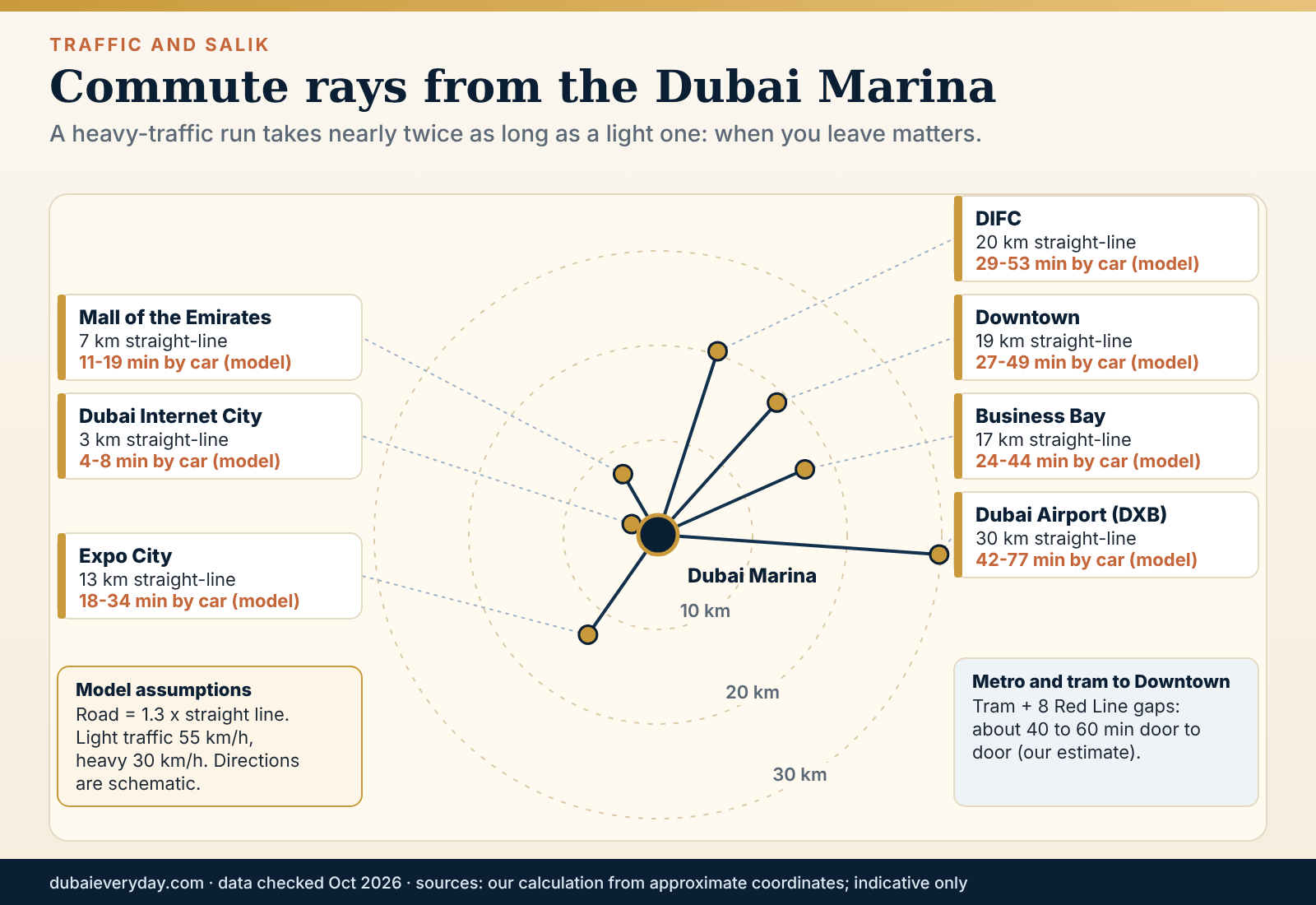
Under those assumptions, Downtown is about 19 km straight-line and 24 km by road, or roughly 27 to 49 minutes. DIFC, at 20 km, comes out at 29 to 53 minutes. Business Bay is 24 to 44 minutes. DXB is the long one: 30 km straight-line, 39 km by road, 42 to 77 minutes. Mall of the Emirates is under 20 minutes even in heavy traffic, Dubai Internet City under ten, and Al Maktoum Airport (DWC) lands at 29 to 53 minutes.
The useful insight in this Dubai Marina guide model is the spread. A heavy-traffic Downtown run costs nearly twice the light-traffic run, so the real decision is when you travel. A person whose job lets them start at 10:00 and finish at 16:00 gets the light-traffic version and the off-peak Salik price. Someone locked into 08:30 to 17:30 gets the heavy version twice a day.
Who should own a car, in this Dubai Marina guide
Our reading in this Dubai Marina guide is that the Marina is one of the few Dubai districts where a car-free life is workable for a specific profile: single or couple, a job near a Red Line station, errands within walking distance, and the habit of taking a taxi for the occasional late night or airport run. It becomes harder with children, a workplace outside the Metro corridor, or a need for regular trips to the desert, Hatta or Abu Dhabi.
If you do not own a car but want one for a weekend, short-term rental is a sensible compromise; see the car rental guide for deposits and insurance, and the driving licence guide if you are new to Dubai’s rules.
Dubai Marina guide timing rule. Plan non-urgent drives between 10:00 and 15:30 or after 20:00. That is the off-peak Salik band and, in our model, the light-traffic band. It is also when most Marina car parks have the least friction.
Dubai Marina guide for visitors: one day, done sensibly
If you are visiting rather than moving, the Dubai Marina guide advice is that the Marina is a district to use for a day or an evening, not to treat as a sightseeing list. It works best as a half-day beach and waterfront plan with a long dinner. Here is a plan built only from hours and fares we could verify, in the cooler months first and then for summer.
A cool-season day (November to April)
- Early walk, 07:00 to 08:30Take the first tram if you are coming from a Metro interchange (06:00 Monday to Saturday, 09:00 on Sunday). Walk the canal promenade before the cafes fill up and before the sun is high.
- Beach morning, 09:00 to 12:00Go to the JBR sand. If you drive, an AED 20 per hour car park becomes expensive by lunchtime; if you come by tram and walk from JBR1 or JBR2, the cost is a nol fare.
- Lunch on The Walk or at The Beach, 12:30 to 14:00The Beach’s retail opens at 10:00 and its food and beverage outlets run later than its shops. A validated AED 100 bill lowers parking, but only if you were going to eat there anyway.
- Indoor break, 14:00 to 16:00Marina Mall’s own site lists Reel Cinemas and a Jump N Fun play area. Use this window for the hottest part of the day in the shoulder months.
- Water in the late afternoon, 16:30 to 18:00A water taxi segment costs AED 7 on RTA’s page, and the ferry from Marina Mall to Bluewaters is route FR2. Fares for the ferry were not listed on the page we read.
- Dinner on the canal, from 19:30Book if it is a Friday or Saturday. Last tram is 01:00; last Metro is midnight (01:00 on Fridays).
A summer day (June to September)
Flip the order. Swim before 09:00, stay indoors from about 11:00 to 17:00, and come out for dinner when the sun is low. In July and August the weather2travel monthly maximum is 41 degrees and the sea is 33, so water is not a relief. Marina Mall is the obvious indoor stop; our indoor things to do guide lists other heat-proof options if you want a full day of them.
Heat rule for visitors. From June to September, treat any walk longer than ten minutes between 11:00 and 16:30 as a risk to be planned, not a minor discomfort. Carry water, wear a hat and use shade and air-conditioned links. Heat illness is a medical issue and general information here is not medical advice.
Dubai Marina guide to staying as a visitor
A short stay here means choosing between three things: beach convenience, canal atmosphere or transport. JBR hotels put you on the sand. Canal-side hotels put you near restaurants and the water taxi. Inland hotels near the DMCC and Sobha Realty interchanges save money and make Metro days easy, at the cost of a longer walk or short tram hop to the water. We do not rank hotels here. For a city-wide comparison by area and budget, use the best hotels in Dubai guide, and for the whole-trip view, the Dubai travel guide and things to do in Dubai.
A single honest caution from this Dubai Marina guide on short stays: do not choose the Marina for a trip where most of your time will be at Downtown, the desert or the old districts. The tram-plus-Metro hop works, but you will repeat it daily, and a Downtown base costs less time even if it costs more per night. If you are new to the city, start with first time in Dubai.
Dining in the Dubai Marina: how to choose
This Dubai Marina guide is a research guide, not a restaurant tour, and we did not eat our way through the Marina. We have not ranked a single restaurant and no restaurant paid to be here. What we can offer is a way of choosing, built on how the district is laid out and what the verifiable sources say. For city-wide picks, the best restaurants in Dubai guide and the Michelin restaurants guide use stated methodologies.
The three dining zones in this Dubai Marina guide
Canal frontage
Marina Walk and Marina Promenade: terraces over the water, long evenings, the highest ground-floor rents and so, usually, the highest prices for the view. Good for occasions; check what you are paying for.
The Walk and The Beach
JBR’s pedestrian street and the beachfront complex. Pavilion at The Beach lists six licensed restaurants, per its operator. Casual, busy and beach-adjacent.
Hotels and inland
Hotel restaurants and the streets behind the towers. Hotels hold many of the licences for alcohol. Inland options skew toward everyday food and delivery.
A five-question filter
When you open a menu or booking page, five questions do most of the work.
- What is the view or terrace worth to you tonight? Water-facing tables cost more, and it is fair to ask for an inside table if you only want the food.
- Is the venue licensed, and does that matter? Alcohol is served in licensed venues, many of them in hotels. See the nightlife guide for the rules and age limits.
- When will you eat? A weeknight table is a different experience from a Friday dinner, and brunch demand is a separate peak covered in the cafes guide.
- How will you get home? Tram to 01:00, Metro to midnight, taxi after that.
- Does it take a reservation, and does it require a deposit or a minimum spend? Ask before you arrive.
Cafes, coffee and the daytime economy
The Marina is full of cafes because it is full of people who work from home or walk past one on the way to the gym. Our specialty coffee guide covers roasters; for a laptop-friendly spot with Wi-Fi and power, ask rather than assume. The biggest practical tip is timing: weekday mornings are calm and weekend lunches are not.
Cost and the waterfront premium
We could not verify a Marina price level against the rest of Dubai, and we will not invent one. The sensible method is to compare two menus for the same type of dish, one on the canal frontage and one a street back, and see the gap yourself. Where service charge and VAT appear on the bill, add them to the menu price before you compare. The money and budgeting tips in the etiquette guide cover tipping norms, which differ from venue to venue.
Daily life: groceries, gyms, schools, clinics and pets
This section of the Dubai Marina guide is about the unglamorous infrastructure of living here. It is where the district wins or loses for long-term residents.
Dubai Marina guide to groceries and errands
The Marina is well covered for everyday shopping, which is a quiet strength in any Dubai Marina guide. A third-party branch list updated in February 2025 shows a Carrefour hypermarket at Dubai Marina Mall and a Carrefour supermarket at Bunyan Tower in the Marina, and a secondary list shows a Waitrose branch at Marina Mall.
Carrefour announced a 24-hour express delivery service in December 2024 with a hub in Dubai Marina, per Gulf News. Branches change, so confirm on the retailer’s store locator before you rely on one.
Our supermarkets guide and Carrefour guide explain price positioning and delivery. Marina Mall’s own site lists Reel Cinemas, Jump N Fun and an Emaar loyalty scheme; for bigger shopping trips see the Dubai shopping guide.
Gyms, studios and outdoor exercise
Most towers include a gym and pool, and that fact alone changes the maths for residents. Fitness First lists a Marina Gate club on its page, with tier labelled Titanium, four studios, weekday hours of 06:00 to 23:00 and weekend hours of 07:00 to 21:00, per our best gyms guide. The reformer pilates research found seven of its 22 verified Dubai studios in the Marina, JBR and JLT stretch, which is the densest cluster in the city; see the reformer pilates guide. Outdoors, The Beach’s 600 metre running track and the canal walkways handle the rest.
Schools in the Dubai Marina guide: be realistic
The Marina is a district of apartment towers, and a family should confirm school logistics before signing a lease. We could not verify a list of schools located inside the Marina boundary today. Some families choose a Marina flat and school elsewhere in the city, accepting a daily run. The Knowledge and Human Development Authority (KHDA) publishes school ratings and fees; our schools guide and KHDA ratings guide show how to read them. Use the KHDA directory to filter by area and measure the actual school-run time at your hour, using the commute logic above.
Clinics, hospitals and insurance
The Dubai Health Authority licenses health facilities. We did not verify a specific list of clinics in the Marina, so we give the method. Confirm any clinic on the DHA register before an appointment, check that your insurer’s network includes it, and identify an emergency department before you need one. The widely published emergency numbers are 999 for police, 998 for ambulance and 997 for fire; confirm them on official channels. Our healthcare in Dubai guide covers clinics and pharmacies, the hospitals guide compares emergency services, and health insurance in Dubai explains networks and co-pays. This is general information, not medical advice.
Pets
Pet ownership in a high-rise needs a lease clause, not a hope. A Gulf News list from August 2024 names a residential dog park at JBR among others, but dog access to beaches is restricted, and we could not verify JBR’s current rule. Check the building’s pet policy in writing before you rent, and read our pet ownership guide for registration and vet basics.
Home setup
Setting up the flat is the same process as elsewhere in Dubai: tenancy contract and Ejari, DEWA connection, internet, then cooling. The Marina twist is the chiller. One broker reported average chiller costs of about AED 900 a month in the Marina and Downtown, up to AED 1,000 to 1,500 at peak, and sources disagree on who pays in a “chiller-free” unit (March 2026, secondary). Ask your landlord for a written statement. Then follow the DEWA move-in guide and the home internet guide.
Lifestyle: noise, seasons and the rhythm of the week
Lifestyle is the word agents use when they cannot give a number, so this Dubai Marina guide gives some. The Marina’s rhythm is set by three clocks: the heat, the beach and the weekend.
The weekly pulse
The UAE working week for most employers is Monday to Friday with a Saturday and Sunday weekend, and Friday is a half day for government staff; confirm with your employer. The Beach’s own hours show where the pulse is: retail runs to 23:00 Sunday to Thursday and midnight Friday and Saturday, and food and beverage outlets close an hour later. Weekends bring beach-goers and day visitors, so the pavements and the road network feel busier from Friday afternoon.
A Dubai Marina guide calendar, month by month
Using weather2travel’s monthly averages, the year in the Marina splits into four moods. From November to March the average maximum runs from 31 degrees in November down to 24 in January and back up to 28 in March, with sea temperatures of 22 to 28 degrees. This is the outdoor season: terraces full, the canal walk at its best, and the beach busiest at weekends. April and October are shoulder months at 33 and 36 degrees, usable in the morning and evening.
From May to September the daily maximum sits between 37 and 41 degrees. Life moves indoors and onto a schedule: gym before work, errands in air conditioning, and a walk after sunset. That is not a reason to avoid the Marina in summer, it is a reason to check that your building has a decent pool, a gym and a covered walk to transport. Ramadan moves earlier each year; by the usual calendar arithmetic it falls in February to March 2027, with exact dates set by moon sighting, and opening hours shift for the month.
Noise and sleep in the Dubai Marina guide
Noise comes from four sources: restaurant terraces at the base of towers, traffic on the main corridors, construction and events. Lower floors facing the canal or The Walk get the most evening noise. High floors facing inland get the least. The only reliable test is to stand in the flat at 22:00 on a Friday and again at 07:00 on a Monday. Our nine checks list this explicitly.
Etiquette and public behaviour
The Marina is a mixed, international district, and public spaces follow the same rules as the rest of Dubai: modest dress away from the beach, respect during Ramadan daylight hours and caution with photography of people. The Dubai etiquette guide sets these out, and the dress code guide maps them by venue.
Events and the calendar
The Beach listed a fitness programme running until 29 November 2026 and a fragrance event, Scentscape, until 31 January 2027. Beyond those, the Marina and JBR host seasonal events that change each year, including large New Year’s Eve crowds in the wider Dubai area. We did not verify a 2026-27 programme for the Marina itself, so track major dates through the Dubai events calendar guide. On busy event nights, expect road closures and a heavy tram load.
Not for you if. You need silence at 23:00, a garden, a school next door or a short, cheap commute to Downtown by car. Each of these is solvable elsewhere in Dubai at lower friction, and our neighbour comparison below shows where.
Who the Dubai Marina suits: six scenarios
A Dubai Marina guide is only useful if it ends in a decision, so here are six profiles. Below are six profiles with the arithmetic that applies to each. Rents are the May 2026 averages from Property Monitor via Engel & Völkers, divided by twelve; they are examples of scale, not offers, and every scenario is an illustration rather than a case study of a real person.
1. Dubai Marina guide scenario: the single professional near a Red Line station
An average Marina studio at AED 68,152 a year is about AED 5,680 a month; a one-bedroom at AED 97,434 is about AED 8,120. Commute by tram and Metro costs up to AED 7.50 a journey on a Silver card. The fit is good if the office sits within a short walk of a Red Line station and you are happy to take a taxi home after a late night. It is poor if your office is in a business park without a station, because then you have bought the Marina’s tram link without using it.
2. The couple, one working from home, one commuting to Media City or Internet City
Internet City is about 3 km straight-line from the Marina in our model, and the tram stops at Media City on the same line. This is the scenario where the Marina is at its best: a short, car-free commute, an apartment sized for two and a walkable evening. A two-bedroom averages AED 153,953 a year, about AED 12,830 a month. The working-from-home partner should do the 22:00 and 07:00 noise test and ask about internet, using our internet and mobile guide.
3. The family with two school-age children
An average three-bedroom is AED 241,190 a year, about AED 20,100 a month. Add a school run that, unless the school is within the immediate area, becomes two journeys a day in traffic. Run the commute model for your actual school and hours. Compare the total with a villa or townhouse community inland before deciding; the Dubai with kids guide describes what family logistics look like. Our reading is that the Marina is workable for families with younger children and a school close by, and harder for those facing two long school runs.
4. The short-stay visitor
Covered in the visitor section: use the Marina as a beach-and-evening base only if the rest of your trip fits the tram corridor.
5. The remote worker on a 12-month lease
Remote workers value quiet, internet and a place to walk at lunch. The Marina has the last of those in abundance and varies on the first two. A one-bedroom at AED 8,120 a month is above JLT’s AED 82,234 average (AED 6,850 a month) by roughly AED 1,270 a month, which is the price of being closer to the water. Whether that is worth it depends on how much of your life happens outdoors. In July it matters less.
6. Dubai Marina guide scenario: the buy-to-let investor
This is an illustration, not a forecast. Assume a 750 sq ft one-bedroom bought at the AED 2,058 per square foot average: AED 1,543,500. The average one-bedroom rent of AED 97,434 gives a gross yield of about 6.3%. Subtract an assumed service charge of AED 22 per sq ft (AED 16,500) and the figure falls to about 5.2% before vacancy, maintenance, agent fees, financing and purchase costs. Those omitted items are why net returns are lower than headline ones, as the property ROI guide shows step by step.
Investment caution. Rents here fell about 13% year on year in Savills’ Q3 2026 data, and supply across Dubai is rising. Past rents do not guarantee future rents. This page is general information, not investment advice; speak to a licensed broker and verify the property on the Dubai Land Department’s systems before paying anything.
Dubai Marina vs JBR, JLT, Bluewaters, Palm and Downtown
Almost every decision in this Dubai Marina guide is really a comparison with a neighbour. The Property Monitor numbers give a first-order picture for a one-bedroom: JLT AED 82,234, Business Bay AED 94,206, Marina AED 97,434, JBR AED 107,774, Downtown AED 120,285 and Palm Jumeirah AED 146,315 a year, as of 17 May 2026 (secondary). These are averages of different building mixes, so use them to rank, not to price.
JBR
Sand and The Walk on your doorstep, a higher rent for studios and one-beds, more weekend footfall. Choose it if the beach is part of the daily routine.
JLT
The lowest averages in our four-area table, an interchange at DMCC and quieter streets. Choose it if budget and Metro access beat a walk to the water.
Bluewaters
An island with a pedestrian bridge to JBR and ferries to Marina Mall. A small, self-contained setting. We did not verify rents or the wheel’s current status.
Palm Jumeirah
Higher averages and a different lifestyle of villas, resorts and beach clubs. See the Palm Jumeirah guide, and note that the monorail status needs checking, as the status board explains.
Downtown
On the Metro itself, with the mall and the tower on the doorstep and a higher rent. Compare it in the Downtown Dubai guide.
Dubai Marina guide comparison with Downtown, in one paragraph
Downtown costs about AED 22,900 a year more than the Marina for a one-bedroom on these averages.
In return it sits on the Red Line, has the Dubai Mall within reach and puts the airport on a straight Metro ride. The Marina gives you a beach, a larger choice of apartments and water in view, at the price of a tram transfer and a heavier car commute. If you work in Downtown or DIFC, the Marina saves rent and costs time; if you work in Media City or Internet City, it saves both. For a first-time resident comparing the whole city, start with moving to Dubai and the relocation checklist.
Nine essential checks before you commit
These nine checks are the practical core of this Dubai Marina guide. They apply to a lease, a purchase or a long stay. Do them in person, at the hours that matter, and write down what you find.
- Orientation and sunWork out which way the main windows and balcony face, then visit at 16:00 in a hot month if you can. Sea-facing units take the setting sun in summer; inland units take the morning sun.
- The two noise testsStand in the flat at about 22:00 on a Friday and 07:00 on a Monday. Listen for terraces, traffic, building works and the lift motor.
- The real walk to the tramTime the walk from the door to the nearest tram stop, in the heat if possible. A map minute and a July minute are different units.
- Chiller, cooling and DEWA in writingAsk who pays the chiller, how it is metered and what the last twelve months cost. The home setup guide explains the terms.
- Lifts, management and maintenanceCount the lifts, ask about outages and see how fast the manager answers. A building with slow repairs is a monthly tax on your patience.
- Parking and visitorsAsk how many bays come with the unit, what a second car costs and how guests park. Add Salik and public Parkin to your commute sum.
- Fire safety and insuranceUse the questions in the apartments section. Confirm what the building insures and what your policy must cover.
- Contract and priceRead the tenancy terms, check Ejari registration and compare the rent to current averages. The tenant rights guide and the apartment viewing checklist cover this, and the legal basics page tells you where to verify.
- What is next doorLook at plots around the building for construction, check the pipeline of towers and decide whether your view is secure. Visit the street at lunch, evening and weekend.
Mistakes people make in the Dubai Marina
The nine checks exist because the same errors recur. The most common are choosing on a render and a view claim; ignoring the afternoon sun; assuming the Metro reaches the door; underestimating Salik and parking; signing without a chiller statement; and treating last year’s rent as this year’s. A seventh sits with buyers: underwriting a purchase on a rent that has since fallen.
There is also an emotional mistake worth naming. The Marina photographs beautifully at dusk, and every Dubai Marina guide you read will show it. Daily life happens at 07:45 on a Tuesday, in a lift lobby with forty other people. Test the Tuesday.
Dubai Marina guide one-hour viewing plan. Arrive 15 minutes early and walk to the tram. Look at the lift and lobby. Do the flat last. Ask the three money questions: chiller, service charge if buying, and who pays for repairs. Leave the building and walk the block again before you decide.
The Dubai Marina guide in six decision rules
If you only keep one page of notes from this Dubai Marina guide, keep these rules. They compress the analysis above into choices you can apply on a viewing day.
- Work near Media City, Internet City or a Red Line station you can reach by tram: the Dubai Marina guide verdict is yes, choose a tower within a short walk of the tram.
- Work in Downtown or DIFC and drive: expect 27 to 53 minutes in our model and about AED 550 a month of Salik at peak; consider the Metro instead, or a base closer to the Red Line.
- Beach every week: pick JBR or a tram stop within a few minutes of it, and budget for parking or use the tram.
- Quiet matters most: choose a high floor facing inland, away from restaurant terraces, and do the 22:00 noise test.
- Rent is the constraint: compare JLT and the inland edge first, where the May 2026 averages were lowest.
- Buying: treat the 2026 rent decline as the baseline, ask for service-charge statements and check everything with a licensed professional.
Dubai Marina guide FAQ
Is the Dubai Marina a good place to live?
On the evidence in this Dubai Marina guide, it is good for people who want a walkable waterfront, a beach within reach and an apartment lifestyle, and who either work near the tram corridor or accept a long drive. It is weaker for families who need nearby schools, people who need quiet at night and anyone commuting by car at peak hours. The honest test is the nine checks above, done at the hours you would actually live there.
Is the Dubai Marina on the Metro?
Not directly, and this Dubai Marina guide flags it early. The Red Line stations at Sobha Realty (R36) and DMCC (R37) connect to the Dubai Tram, and the tram serves JBR, the canal and the Marina Mall. You tap in with a nol card, and the zone fares apply: AED 3, 5 or 7.50 on a Silver card. Trams run 06:00 to 01:00 Monday to Saturday and 09:00 to 01:00 on Sunday, per RTA’s timetable page.
Is JBR beach free?
The Beach’s FAQ confirms public access and mentions no entry charge, which is the starting point for beach access in this Dubai Marina guide. What costs money is parking at AED 20 an hour, with free validation of three hours when you spend AED 100 or more at a participating outlet, plus loungers, cabanas and food. Dubai Municipality’s own beach list does not name JBR, so we would follow the posted signs rather than assume municipal rules or lifeguard hours.
Is there a beach in the Dubai Marina itself?
The canal has no swimming beach. The beach people mean is the sand along the JBR strip on the Gulf side. From the canal core it is a walk, a tram hop or a short drive depending on your tower. The two are often described together because the districts run into one another, but the water you swim in is at JBR.
How much is rent in the Dubai Marina?
The rent table in this Dubai Marina guide uses Property Monitor data cited by Engel & Völkers, which gave average yearly rents on 17 May 2026 of AED 68,152 for a studio, AED 97,434 for a one-bedroom, AED 153,953 for a two-bedroom and AED 241,190 for a three-bedroom. Savills measured Marina apartment rents down 12.8% year on year in Q3 2026. Individual flats vary widely with the tower, floor and view, so use these as a range, not a quote.
Do you need a car in the Dubai Marina?
As this Dubai Marina guide shows, you can live car-free if your work, errands and exercise sit along the tram corridor and you take a taxi for late nights and airport runs. You will want a car, or a rental now and then, if your job is outside the Metro corridor, you have children in school elsewhere or you travel often outside the city. Our model puts a Downtown run at 27 to 49 minutes depending on traffic.
How far is the Dubai Marina from the airport?
DXB is about 30 km in a straight line and, with an assumed detour factor, roughly 39 km by road, or about 42 to 77 minutes in our traffic model. By Metro you can ride the Red Line to Sobha Realty and change to the tram; the Metro guide estimates 38 to 48 minutes of train from Terminal 1 plus the tram leg. A taxi budget of AED 100 to 130 is our calculation, not a quote.
What is the best time to visit the Dubai Marina?
For beach and outdoor walking in this Dubai Marina guide, November to March is the comfortable core, with April workable in mornings and evenings. From June to September, daily highs average 39 to 41 degrees and the UV index sits at 11 or more, so plan beach time before 09:00 or after 17:30 and use air-conditioned space midday. The best time to visit Dubai guide covers events and prices.
Is the Dubai Marina safe?
This Dubai Marina guide did not verify crime statistics, so it makes no ranking claim. What we can say is practical: follow beach flags, know the emergency numbers, and use the building safety questions in this guide, prompted by the June 2025 Marina Pinnacle fire. Official safety information comes from Dubai Police and Dubai Civil Defence. For visitors, the UK government’s travel advice for the UAE is a useful independent reference.
What is the difference between the Marina and JBR?
The Marina is the canal district with its towers, promenades and Marina Mall. JBR is the beachfront row of towers with The Walk and direct access to the sand. Listing portals separate them, and Property Monitor’s May 2026 averages show JBR studios and one-beds costing more than the Marina, with two-beds cheaper. The tram connects them in a few stops.
Is it worth buying an apartment in the Dubai Marina?
That depends on your horizon and risk tolerance, and nothing in this Dubai Marina guide is investment advice. The Marina is a freehold area with a large stock of similar flats, so resale depends on the tower and view. Rents have fallen over the past year, and service charges and purchase costs reduce net returns. Read the buying, ROI and investment guides, and consult a licensed professional.
How much does Salik cost for Marina drivers?
Press reports of RTA’s announcement put Salik at AED 6.30 per crossing at peak (06:00 to 10:00 and 16:00 to 20:00, Monday to Saturday) and AED 4.20 off-peak, including VAT from 1 June 2026, free between 01:00 and 06:00. How many gates you cross depends on your route; Sheikh Zayed Road routes to Downtown typically cross two each way, which you should confirm on the Salik map.
Where to go next
The best next page depends on your question. If it is where to live in Dubai more broadly, start with renting in Dubai. If it is the beach, the beaches guide. If it is a short stay, the hotels and things-to-do guides. These are the pages that pick up where this Dubai Marina guide stops.
Sources and further reading (27 links)
- Roads and Transport Authority: nol fares — zone fares for Metro and tram, Gold surcharge, journey limits
- Roads and Transport Authority: Metro, tram and marine timetables — tram and Metro hours, water taxi and ferry routes
- Roads and Transport Authority: marine transport — Dubai Water Taxi stops, fares and child rules
- The Beach JBR: FAQ — public access, parking rates and validation, hours, facilities
- Dubai Municipality: public beaches — municipal beach list and fee statement
- Dubai Marina Mall: official site — cinema, play area and loyalty scheme
- Dubai Media Office: RTA 2025 ridership — tram and Metro journey counts, carried from our Dubai Metro guide research
- Engel & Völkers (Property Monitor data): average apartment rents — Marina, JBR, JLT, Downtown, Business Bay and Palm averages to 17 May 2026
- Khaleej Times: Savills Q3 2026 rent report — Marina year-on-year rent change and supply outlook
- weather2travel: Dubai climate — monthly air temperature, sea temperature and UV index (secondary)
- Wikipedia: Dubai Marina — background facts and population (secondary)
- Wikipedia: Jumeirah Beach Residence — towers, apartments, The Walk and Bluewaters (secondary)
- Wikipedia: Dubai Tram — station list, opening date and interchanges (secondary)
- Wikipedia: tallest buildings in Dubai — tower heights for the skyline graphic (secondary)
- Wikipedia: Marina Pinnacle — June 2025 fire summary (secondary)
- Wikipedia: Palm Jumeirah Monorail — suspension reports (secondary); resumption reported by Khaleej Times on 9 July 2026, carried from sibling research
- Wikipedia: Ain Dubai — closure and reopening history (secondary)
- Dubai Land Department: service charge index — official lookup for building service charges (named; not opened)
- World Health Organization: the UV index — meaning of UV index 8 and above (carried from our beaches research)
- UK Foreign, Commonwealth & Development Office: UAE safety and security — independent traveller advice (carried from our beaches research)
- Gulf News: Salik and Parkin prices from 1 June 2026 — peak and off-peak toll and parking rates (press report of the RTA announcement; carried from sibling research)
- Dubai Taxi: taxi service and fares — per-kilometre rate and minimum fares (carried from our Dubai airport research)
- Dubai Airports: taxi — airport start fare (carried from our Dubai airport research)
- Arabian Business: Dubai rents Q3 2026 — Property Finder asking-rent medians (secondary; carried from sibling research)
- Fitness First UAE: Dubai Marina Gate club — tier, hours and studios (carried from our gyms research)
- Gulf News: Carrefour express delivery — Marina hub for 24-hour delivery (secondary)
- betterhomes: chiller-free vs chiller-inclusive — broker chiller cost range (secondary)
Update log: 29 October 2026 — first publication; facts re-checked against the sources above where they could be opened, and flagged where they could not. Next review due: October 2027, or sooner if tram, Metro, Salik, beach or rent data change. Corrections welcome. This page is general information, not legal, financial, medical or property advice.
About DubaiEveryday and this guide
DubaiEveryday.com is an independent editorial project that publishes practical, research-based guides to everyday life in Dubai: where to live, what things cost, how the rules work and how to get around. This page was written and edited by the DubaiEveryday editorial team. It is not signed by a named expert, doctor, lawyer or adviser, and we do not claim first-hand testing of a venue, clinic or service unless the page says so.
Each guide is built from official sources such as government and regulator pages, operator websites and established news outlets, cross-checked where we can. When we could not confirm something, we say so in the text, and examples that use made-up numbers are labelled as illustrations. Mentions are editorial choices, not paid placements, and a link is not an endorsement.
Dubai changes quickly. If you spot something that is out of date or wrong, please tell us through the contact options on DubaiEveryday.com and we will check it and correct the page.